绝密★考试结束前
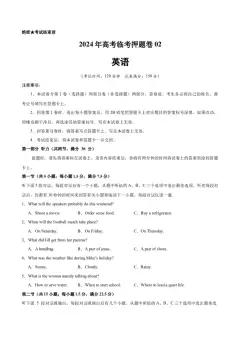
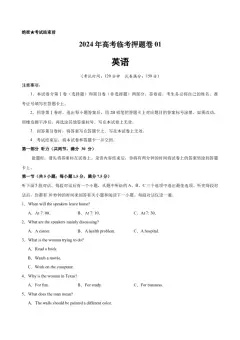
2025 年高考临考押题卷
英语
(考试时间:120分钟 试卷满分:150分)
注意事项:
1.本试卷分第Ⅰ卷(选择题)和第Ⅱ卷(非选择题)两部分。答卷前,考生务必将自己的姓名、准
考证号填写在答题卡上。
2.回答第Ⅰ卷时,选出每小题答案后,用2B铅笔把答题卡上对应题目的答案标号涂黑。如需改动,
用橡皮擦干净后,再选涂其他答案标号。写在本试卷上无效。
3.回答第Ⅱ卷时,将答案写在答题卡上。写在本试卷上无效。
4.考试结束后,将本试卷和答题卡一并交回。
第一部分 听力(共两节,满分 30 分)
做题时,请先将答案标在试卷上。录音内容结束后,你将有两分钟的时间将试卷上的答案转涂到答
题卡上。
第一节(共5小题;每小题1.5分,满分7.5分)
听下面5段对话。每段对话后有一个小题,从题中所给的A、B、C三个选项中选出最佳选项。听完每段
对话后,你都有10秒钟的时间来回答有关小题和阅读下一小题。每段对话仅读一遍。
1.When will the woman probably get the phone?
A.On Thursday. B.On Friday. C.On Saturday.
2.What may the weather be like now?
A.Sunny. B.Snowy. C.Windy.
3.What is Susan busy doing now?
A.Reading a novel. B.Writing an essay. C.Preparing for a test.
4.Where does the conversation take place?
A.On the phone. B.In a restaurant. C.At home.
5.How much change does the man get?
A.4 dollars. B.6 dollars. C.10 dollars.
第二节(共15小题;每小题1.5分,满分22.5分)
听下面 5 段对话或独白。每段对话或独白后有几个小题,从题中所给的A、B、C三个选项中选出最佳
选项,并标在试卷的相应位置。听每段对话或独白前,你将有时间阅读各个小题,每小题 5 秒钟;听完
后,各小题将给出 5 秒钟的作答时间。每段对话或独白读两遍。听下面一段较长对话,回答以下小题。
6.How does the woman sound at first?
A.Amused. B.Relieved. C.Surprised.
7.What is Emily like according to the woman?
A.She is reliable.
B.She is playful.
C.She is troublesome.
听下面一段较长对话,回答以下小题。
8.What does the sports center fail to do?
A.Plan water games for children.
B.Ensure essential security.
C.Match their advertisements.
9.How would the lifeguard come to rescue?
A.By taking a boat.
B.By swimming.
C.By throwing a life jacket.
听下面一段较长对话,回答以下小题。
10.What is the man probably doing?
A.Teaching class.
B.Telling stories.
C.Correcting mistakes.
11.Why does Mr. Green consider the Fibonacci series important?
A.Because it is a very difficult concept to understand.
B.Because it can be commonly found in our daily life.
C.Because it is composed of a series of lucky numbers.
12.What is man going to do next Wednesday?
A.Give further explanation.
B.Lecture students’ behavior.
C.Conduct a survey.
听下面一段较长对话,回答以下小题。
13.Why does Donald start working at early age?
A.To acquire various skills.
B.To help support his family.C.To be financially independent.
14.Who is Robert?
A.Donald’s father.
B.Donald’s brother.
C.Donald’s son.
15.What does Donald think about children doing housework?
A.He believes it’s beneficial for their well-being.
B.He thinks it’s just a waste of time for children.
C.He feels that children should focus on their studies instead.
16.How does Donald view his father?
A.As a strict disciplinarian.
B.As someone unimportant.
C.As a role model and hero.
听下面一段独白,回答以下小题。
17.Why did the speaker’s mother stop the truck?
A.It ran out of gas.
B.It got to the destination.
C.There was something wrong with the wheel.
18.Which car is there one person in it?
A.The red one.
B.The blue one.
C.The yellow one.
19.How many people came to help push the truck?
A.4. B.5. C.7.
20.Who helped the speaker and her mother solve the problem?
A.The speaker’s friends.
B.Car repairmen.
C.The strangers.
第二部分 阅读(共两节,满分50分)
第一节(共15小题;每小题2.5分,满分37.5分)
阅读下列短文,从每题所给的A、B、C、D四个选项中选出最佳选项。
A
Best Books for College AdmissionsCollege admissions are usually a complex process, with weighted GPAs, AP scores, volunteer requirements,
and extracurricular activities. These 4 books are the best guides we can offer to help you think through this
complex and expensive process with your teens.
Who Gets In and Why by Jeff Selingo
Bestselling author and education journalist, Jeff Selingo, spent months in the college admissions
departments of three different universities. He gained a true insider’s view of what really goes on when decisions
are made about which students to admit, and which ones to deny. This insightful book offers families guidance on
helping their teens discover the fit college on every level, including financial must-reads!
College Essay Essentials by Ethan Sawyer
The college application essay is the most difficult part of the application process for many students. Ethan
Sawyer is here to help with his comprehensive guide to writing the college essay. Filled with tips, exercises and
essays from students who gained admission to their top choice schools, this book will take the sting out of the
essay-writing process for your teen and you!
The Truth about College Admission by Rick Clark and Brennan Barnard
Rick Clark has written this excellent guide, offering families a chance to learn how admissions officers
think about the college application process. Written with co-author Brennan Barnard, Director of College
Counseling at The Derryfield School, this is the admissions guidebook for families that will take them through the
entire college admissions process.
The College Conversation by Eric J. Furda and Jacques Steinberg
Eric J. Furda, Dean of Admissions at the University of Pennsylvania, and bestselling author Jacques
Steinberg, provide guidance for parents about the crucial conversations they need to have with their college-bound
teens.
21.Which book might you turn to when you have difficulty with the application letter?
A.Who Gets In and Why.
B.College Essay Essentials.
C.The Truth about College Admission.
D.The College Conversation.
22.What do Who Gets In and Why and The Truth about College Admission have in common?
A.They are both best sellers of the year.
B.They are both the result of two authors.
C.They focus on the admissions matter.
D.They share admissions officers’ opinions.23.Who is the text mostly intended for?
A.High school students.
B.Educational experts.
C.College admissions officers.
D.Parents of pre-college students.
B
When I was a girl of eight, living in a town, I used to work for Mrs. White, an elderly lady. She paid me
very little for my work, because she didn’t have much money. She did, however, promise to give me a Christmas
present. The girls I played with had baseball gloves, bicycles and ice skates, and I was so eager to acquire any one
of these. On Christmas morning, Mrs. White gave me a little package which could hardly hold anything. I was
painfully disappointed but she told me it was a kind of magic. My disappointment turned into curiosity.
With great excitement I opened the package, only to find a pile of ten sheets of black paper inside, each
labeled in colorful letters, Carbon Paper Regal Premium. I didn’t know what it was. “Is it magic?” I asked. My
Aunt Karen, who was a school teacher, answered, “It really is!” She took two pieces of white paper and placed
between them one of the black sheets from the box. Then, with a hard pencil, she wrote my name on the upper
sheet. Removing it and the Carbon Paper Regal Premium, she handed me the second sheet, which her pencil had
in no way touched. There was my name!
I was enthralled. I wrote and wrote, using up whole tablets until the last piece of black paper was used up. It
was a game I didn’t want to end. I was very happy with my special gift. I can honestly say that, in that one
moment, I understood as much about printing, copying words and the mystery of spreading ideas as I have learned
in the remaining half-century of my life.
I hope that this year some boys and girls will receive, from thoughtful adults who really love them, gifts
that will shock them. It is such gifts and such experiences — usually costing little or nothing — that transform a
life and lend it a motivation that may continue for decades.
24.Why did Mrs. White promise to give the girl a Christmas present?
A.She wanted to meet the child’s wish. B.She rewarded the girl for her good work.
C.She gave gifts to every child in the town.D.She wanted to make up for the low salary.
25.What do we know about Carbon Paper Regal Premium?
A.It is used in school teaching. B.It is made by special magicians.
C.It usually consists of colorful paper. D.It can copy something written on paper.
26.What does the underlined sentence “I was enthralled.” in Paragraph 3 mean?
A.I was addicted to Carbon Paper Regal Premium.B.I was curious about Carbon Paper Regal Premium.
C.I was confused about Carbon Paper Regal Premium.
D.I was shocked there was a name on the second sheet.
27.What message does the author seem to convey in the text?
A.Children should work for others to get a gift. B.A gift with long-term effects is a better choice.
C.Children need to receive a gift that they want.D.Carbon Paper Regal Premium is a perfect gift.
C
Your phone has a screen that displays images and videos. The screen uses tiny dots known as pixels (像素)
that consist of three primary colors: red, green and blue. By mixing these colors in different ways, your phone can
show you everything from beautiful beach scenes to cute puppies.
Now imagine something similar for smells. Scientists are developing digital scent technology that uses a
small number of different cartridges (暗盒), each containing a specific scent. Just like how pixels mix the three
basic colors to create images, these scent cartridges could mix to create different smells. Just as images on your
phone are made of digital codes that represent combinations of pixels, smells produced by a future phone could be
created through digital codes. Each smell could have a specific recipe made up of different amounts of the
ingredients in the cartridges.
When you receive a digital scent code, your phone could mix tiny amounts of the different scents from the
cartridges to create the desired smell. This mix would then be released through a small vent on the phone,
allowing you to smell it. With just a few cartridges, your phone could potentially create a huge variety of smells,
much like how red, green and blue pixels can create countless colors.
Creating a phone that can produce smells involves several challenges. One is designing a system that can
produce thousands of different smells using only a few cartridges. Another is how to control how strong a scent
should be and how long a phone should send it out. And phones will also need to sense odors near them and
convert those to digital codes so your friends’ phones can send smells to you. The cartridges should also be easy to
refill, and the chemicals in them should be safe to breathe. These hurdles make it a tricky but exciting area of
research.
28.What enables a phone screen to present diverse visual contents from paragraph 1?
A.Special sensors detecting colors. B.A unique way for color reflection.
C.Advanced software for image generation. D.Pixels of three primary colors in combination.
29.What can we learn about digital scent from paragraph 2?
A.It is created by using cartridges. B.It’s a fully-developed technology.
C.It comes from the same cartridges. D.It is related to images on mobile phones.30.What is one of the troubles scientists face when developing digital scent technology?
A.Creating new scents that don’t exist in nature.
B.Regulating the intensity and duration of scents.
C.Combining all primary colors to produce one smell.
D.Finding a way to emit scents that last for a long time.
31.What is a suitable title for the text?
A.Technology that can combine colors to create images.
B.Challenges faced by digital scent technology.
C.The development and potential of digital scent technology.
D.The history and future of complex phone technology.
D
Many years ago, I got drunk. The next morning, I told my dad what happened. “We had some wine at the
restaurant”, I said, “and then some beer. It doesn’t seem enough for me to feel this bad.” My dad said something I
carry with me to this day, “Beer before wine and you’ll feel fine; wine before beer and you’ll feel queer (奇怪
的).”
Out of all the many pieces of advice my father handed down over the years, only a few stick in my memory.
And those are the ones that rhyme. This is known as the “rhyme-as-reason effect”, a cognitive (认知的)
phenomenon with lots of real-life, practical application. There’s a strange fact: You might be able to remember all
the lines of the song from your childhood, yet you can’t remember something that happened last week. When we
use rhymes, we break down details into something that can more easily be stored and recovered.
We often judge rhymes more favorably. Friedrich Nietzsche was a big fan of aphorisms (格言). He wrote a
series of books entirely in aphorisms because he knew that a well-organized turn of phrase cut into your
understanding far quicker than essays. He expressed in one of his books, “We sometimes consider an idea truer
simply because it rhymes and presents itself with a brilliant skip and jump.”
Two psychologists, Matthew McGlone and Jessica Tofighbakhsh, investigated this phenomenon. They
presented their participants with a series of aphorisms — some are rhymed; others not. They discovered that not
only did participants aesthetically (审美上) prefer the rhymed sentences, but they more often considered them
more accurate. Despite participants agreeing that aesthetic qualities don’t represent truth, they couldn’t avoid their
own prejudice. This led the team to remember the poet John Keats’ line: “Beauty is truth; truth beauty.”
There are two important lessons to learn from this. The first is that rhyming makes for long-term memory.
If you want to remember it, rhyme it. The second is that rhyming doesn’t equal accuracy. My dad’s wisdom might
sound neat but it is based on insufficient evidence. Keep in mind that a nice turn of phrase isn’t necessarily betterthan an awkward one.
32.What can we know about the “rhyme-as-reason effect”?
A.It conveys a deeper meaning. B.It is less frequently used nowadays.
C.It makes information more memorable. D.It is inconsistent with childhood memories.
33.Why does the author mention Friedrich Nietzsche in paragraph 3?
A.To prove the influence of his writings.
B.To illustrate people’s preference for rhymes.
C.To show the complexity of his writing style.
D.To encourage the wide use of rhymes and aphorisms.
34.What can be concluded from Matthew and Jessica’s findings?
A.Aesthetic qualities help clarify the fact.
B.People tend to ignore precision in rhymes.
C.Rhymed sentences are usually less trustworthy.
D.Aesthetic qualities likely conflict with people’s judgments.
35.What message does the author want to convey at the end of the text?
A.Treat rhymes with a wise mind.
B.Make good use of factual information.
C.Respect the wisdom of our old generations.
D.Focus on the improvement of long-term memory.
第二节(共5小题;每小题2.5分,满分12.5分)
阅读下面短文,从短文后的选项中选出可以填入空白处的最佳选项。选项中有两项为多余选项。
Lighthouse parenting, is a parenting style that is about many important aspects of parenting. 36 .
Parents provide their children with guidance, love, nurturing and protection, while allowing children to make their
own mistakes and learn things on their own.
37 . However, lighthouse parenting, as the name suggests, believes in being there for your children
like a lighthouse is there at night. This parenting is available and present when needed, not making the decisions
and providing solutions all the time, therefore allowing the children to grow, learn to be independent and develop
their resilience (适应力). 38 . It also includes setting the right boundaries, providing support and guidance,
and encouraging an open dialogue. With this kind of environment, a child can feel confident, supported, loved and
empowered to be himself or herself.
According to the social media, this parenting style is becoming popular as parents are looking for a middle
ground in parenting, something that resonates with them, does not put too much pressure on them and is healthyfor their children. There is too much information out there for parents nowadays, they explain, and it can get
overwhelming. 39 .
Children that are raised in this style can become healthy, functional adults, as they were given the tools to
be independent, to understand the world, and to be well-adjusted. 40 . Their parents are also less burnt out,
as they are able to take a step back and be there for their child more in the background.
A.It is also mainly about maintaining the balance
B.Therefore, lighthouse parenting can become an ideal choice
C.It is an environment where children and parents can disagree
D.The key point to this parenting style is loving unconditionally
E.Parents must have an endless sea of choices, styles and ideas first
F.They aren’t scared of making mistakes and taking responsibility for themselves
G.Some parenting, like control parenting, gives children less freedom to experience alone
第三部分 语言运用(共两节,满分30分)
第一节 (共15小题;每小题1分,满分15分)
阅读下面短文,从每题所给的A、B、C、D四个选项中选出可以填入空白处的最佳选项。
My classmate Pratik was always painting on paper in his spare time. I really wanted to know what he was
painting, but he 41 kept it secret.
One day, during a 42 , only Pratik and I were in the classroom. One of our classmates came to tell
him that our teacher wanted to see him. He 43 the classroom and forgot to put his paper away. 44
, I quickly came to his place and had a look. What I saw had 45 me. On the paper was painted a waterfall
which looked so real that I thought it was going to make me 46 . As I was about to take another look at the
paper, the bell rang. Pratik returned and I put it back quickly and went back to my 47 .
After school, I tried bravely to 48 to Pratik. I praised his painting and he was 49 . He said
he wanted to become a famous painter and I shared my dream of becoming a(n) 50 . He wanted to paint
the cover for my 51 and I agreed. I always shared with him my 52 and he always showed me
his ideas.
Many 53 passed and Pratik has really become a 54 artist but I’m still an unknown
writer.
I 55 him all the time and I hope our friendship will last forever.
41.A.only B.hardly C.still D.always
42.A.break B.game C.class D.play
43.A.passed B.entered C.checked D.left44.A.Out of curiosity B.Out of question C.Out of breath D.Out of sight
45.A.calmed B.shocked C.encouraged D.relaxed
46.A.happy B.relaxed C.wet D.cool
47.A.office B.room C.seat D.home
48.A.agree B.speak C.shout D.wave
49.A.pleased B.moved C.nervous D.worried
50.A.artist B.lawyer C.teacher D.writer
51.A.magazines B.notes C.books D.papers
52.A.schedules B.secrets C.necessities D.expectations
53.A.days B.weeks C.months D.years
54.A.common B.strange C.famous D.special
55.A.keep a balance with B.keep in touch with C.keep up with D.keep away from
第二节(共10小题;每小题1. 5分, 满分15分)
阅读下面材料,在空白处填入适当的内容(1个单词)或所给单词的正确形式。
About 2,000 participants from more than 160 countries and regions are set to participate in the World
Chinese Language Conference to be held in Beijing. Scholars and experts say they have high expectations for the
event as they look forward 56 sharing experiences and the best practices 57 (gain) at various
Confucius Institutes and acquiring more resources in Chinese teaching.
With the theme of “Interconnection, Integration, Inheritance, Innovation”, the conference aims 58
(promote) the development of international Chinese language education and support relevant countries and
regions in carrying out Chinese language teaching. The event 59 (expect) to deepen exchange and
learning among civilizations.
In the 60 (come) conference, a seminar(研讨会) on the 20th anniversary of the establishment of
Confucius Institutes and other featured events will be hosted. Breakout sessions will focus on the future
development of Confucius Institutes, the application of standards in international Chinese language education and
61 (approach) in the training of local teachers.
These sessions are arranged in 62 effort to bring together wisdom and strength from both
domestic and foreign countries to 63 (joint) promote the innovative development of careers in
international Chinese language education.
“ 64 this conference provides is a unique platform for global scholars and professionals to
exchange knowledge and promote 65 (meaning) cooperation,” Tioe Se Tin, vice rector of
Maranatha Christian University, says.第四部分 写作(共两节, 满分40分)
第一节(满分15分)
66.假定你是李华,你所在的校社会实践小组制作了一批中国结,计划利用周末出售,现招募销售人员,
请你给你的交换生好友David写一封信,邀请他积极参与,内容包括:
(1)写信目的;(2)招募信息介绍:(3)你的期待。
注意:(1)写作词数应为80个左右;
(2)可适当增加细节,以使行文连贯;
(3)称呼和落款已给出,不计入总词数。
参考词汇:中国结 Chinese knot
Dear David,
___________________________________________________________________________________________
___________________________________________________________________________________________
___________________________________________________________________________________________
___________________________________________________________________________________________
________________________________________________________________________________________
Yours,
Li Hua
第二节(满分25分)
67.阅读下面材料,根据其内容和所给段落开头语续写两段,使之构成一篇完整的短文。
Kwan’s Secret Talent
“Kwan, isn’t that your art teacher?” his grandmother said, pointing at a woman walking out of the grocery
store.
Kwan waved, and Mrs. Gibbs walked over to him and his grandmother. “It’s very nice to see you,” Mrs.
Gibbs said. Then she saw the cloths wrapped around the groceries Kwan and his grandmother were loading into
their car. “Oh, how beautiful!” she exclaimed.
“Thank you. These are our hometown wrapping cloths,” grandmother explained. “Kwan and I embroidered
(刺绣) them together.”
Kwan looked away. Although he enjoyed helping grandmother make the cloths, he didn’t want anyone at
school to know about it.
“Kwan, you should bring your cloths to school tomorrow. Your classmates would enjoy seeing them. You
have a unique skill,” Mrs. Gibbs said.Kwan appreciated his teacher’s comments, but he was hesitant. The kids might laugh at the idea of a boy
who liked to stitch (缝) patterns with a needle and thread. He thought about his grandmother’s wide smile that
showed how proud of him she would be for sharing this custom.
“O.K. I’ll bring some to class tomorrow,” Kwan replied quietly.
Grandma sensed that something was wrong. “Kwan, are you worried about tomorrow?” she asked.
Kwan stared at the floor. “What are the other kids going to think?” he said. “This isn’t the kind of thing
they do for fun. Creating embroidered patterns isn’t like playing an instrument or a sport.”
“You’re right,” Grandma said. “It is different. But that is why it is so special.” Then she brought out a fine
cloth with different designs. “When your grandfather and I were married, we received a gift from his mother
wrapped in this cloth she made. In our culture, gifts given in wrapping cloths are extra special because they are a
symbol of love and good luck.” she explained.
注意:
1. 续写词数应为 150 左右;
2. 请按如下格式在答题卡的相应位置作答。
The next morning Kwan took several wrapping cloths to school.
___________________________________________________________________________________________
___________________________________________________________________________________________
___________________________________________________________________________________________
___________________________________________________________________________________________
___________________________________________________________________________________________
____________________
As Kwan listened to his classmates, he noticed that his forehead no longer felt hot.
___________________________________________________________________________________________
___________________________________________________________________________________________
___________________________________________________________________________________________
___________________________________________________________________________________________
___________________________________________________________________________________________
___________________