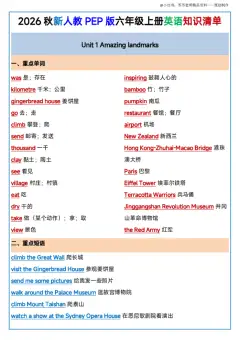
圆圆的知识画报屋Ruby 老师原创整理
2026 秋新版|人教PEP 六年级上册
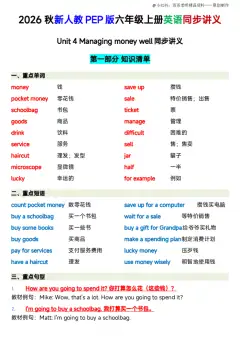
暑假预习课堂笔记
Unit 1 - Unit 6
原文English + 中文释义+ 逐行学习提示
资料说明
每个单元按教材Part A / Part B / Part C / Reading time 顺序整理。
理解课文的核心词汇以红色加粗标注。
Read and write 配有写作总结、仿写支架和完整范文;Part C 配有完成思路。
第1页
圆圆的知识画报屋Ruby 老师原创整理
单元导入|Why do we travel to different places
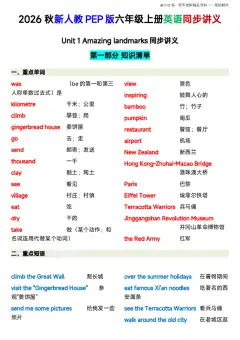
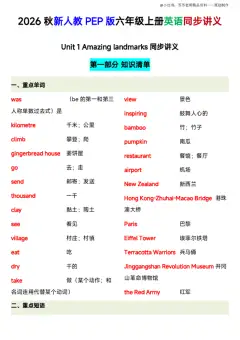
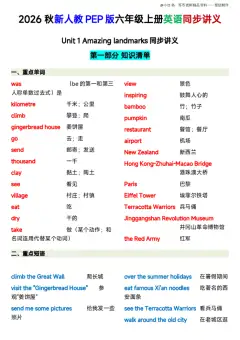
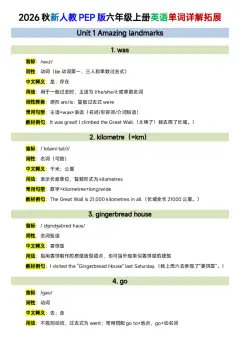
Unit 1 Amazing landmarks
?
原文English
中文释义
学习提示
Unit 1 Amazing landmarks
第一单元神奇的地标
landmark = 地标;amazing 表示“令
人惊叹的”。
Why do we travel to different
places?
我们为什么去不同的地方旅
行?
本单元核心问题,引导学生从“看风
景”走向“理解地方特色与旅行意
义”。
In this unit, you will share travel
experiences.
在本单元,你将分享旅行经
历。
share travel experiences = 分享旅行
经历;为Part A 的一般过去时表达做
铺垫。
describe travel activities.
描述旅行活动。
describe = 描述;重点关注visited,
climbed, watched 等过去式动词。
read and analyse reviews and
identify their structure.
阅读并分析评论,识别其结
构。
analyse / identify / structure 是高年
级阅读策略词,教师可引导学生找标
题、开头、经历和评价。
write a short travel review.
写一篇简短的旅行评论。
本单元写作目标,不只是写“去了哪
里”,还要写活动与感受。
Share and explain.
分享并说明。
单元导入任务,训练“说出地点+ 说
明特别之处”的表达链。
Name a famous place.
说出一个著名的地方。
name 在这里作动词,意为“说出名
称”。
Explain what is special about it.
说明它有什么特别之处。
what is special about it 可作为学生介
绍地标的核心句型。
Look and think
看一看,想一想
导入观察任务,先激活学生已有的地标
经验。
What are some landmarks in your
hometown?
你家乡有哪些地标?
hometown = 家乡;可引导学生从本
地地标过渡到世界地标。
Why are they special?
它们为什么特别?
回答时可用They are
famous/old/beautiful/special
because ...。
Listen and sing: Travelling around
听一听,唱一唱:《到处旅
行》
主题歌曲,用来激活travel /
landmark 话题氛围。
Part A Let's talk|What famous landmarks do you know?
原文English
中文释义
学习提示
Zhang Peng is talking with John.
Listen and choose.
张鹏正在和约翰交谈。听录
音并选择。
听前任务:先看问题,再听关键信息。
1. What day is it?
A. Saturday. B. Sunday. C. Friday.
1. 今天星期几?
A. 星期六。B. 星期日。
C. 星期五。
听日期、星期等时间信息。
第2页
圆圆的知识画报屋Ruby 老师原创整理
原文English
中文释义
学习提示
2. What will Zhang Peng do now?
A. He'll meet a friend.
B. He'll answer a call.
C. He'll have a class.
2. 张鹏现在要做什么?
A. 他要见朋友。
B. 他要接电话。
C. 他要上课。
will + 动词原形:表示将要做的事。
Zhang Peng: Hi, Peter! How was
your weekend?
张鹏:嗨,彼得!你周末过
得怎么样?
How was ...? 询问过去经历整体感受。
Peter: Not too bad, thanks. And you?
彼得:还不错,谢谢。你
呢?
Not too bad = 还不错。
Zhang Peng: It was great! I
climbed the Great Wall.
张鹏:太棒了!我爬了长
城。
climbed 为过去式;climb the Great
Wall = 爬长城。
Peter: Wow! The Great Wall is
amazing.
彼得:哇!长城太壮观了。
amazing = 令人惊叹的;地标评价词。
Zhang Peng: Yes, it is! It's 21,000
kilometres in all. What did you do?
张鹏:是啊!它全长21000
千米。你做了什么?
What did you do? 询问过去做了什么;
did 后用动词原形do。
Peter: I visited the "Gingerbread
House" last Saturday.
彼得:我上周六参观了“姜
饼屋”。
visited 为过去式;last Saturday 表示过
去时间。
Zhang Peng: What did you do there?
Eat gingerbread?
张鹏:你在那里做了什么?
吃姜饼吗?
there = 在那里;What did you do
there? 可追问旅行活动。
Peter: Ha! Ha! No! It's a beautiful
train station in New Zealand.
彼得:哈哈!不是!那是新
西兰一座美丽的火车站。
New Zealand = 新西兰;注意不是食
物,而是地标。
Zhang Peng: That sounds
interesting. Please send me some
pictures.
张鹏:听起来很有趣。请发
些照片给我。
That sounds ... 表达听后的感受;send
me some pictures = 发些照片给我。
What did the boys do last weekend?
两个男孩上周末做了什么?
课本问题:概括两人的周末活动。
What facts do you learn from their
conversation?
你从他们的谈话中了解到哪
些事实?
fact = 事实;可回答长城长度、“姜饼
屋”是火车站等。
Part A Let’s talk 小结
• 核心表达链:How was your weekend? →What did you do? →What did you do there?
• 本段重点是用一般过去时谈论周末旅行经历。
• 可让孩子预习时圈出过去式:was, climbed, visited。
Part A Let's learn|Photo show 照片秀
原文English
中文释义
学习提示
Amy walked around the Palace
Museum for hours.
埃米在故宫逛了好几个小
时。
walked 为过去式;walk around = 四处
走走/ 参观游览。
Mike visited the Hong Kong-
Zhuhai-Macao Bridge.
迈克参观了港珠澳大桥。
visited 为过去式;长地名可分段读。
Zhang Peng climbed Mount
Taishan.
张鹏登上了泰山。
climbed 为过去式;Mount Taishan =
泰山。
Liu Jia's family travelled to Paris
and visited the Eiffel Tower.
刘佳一家人去了巴黎旅行,
并参观了埃菲尔铁塔。
travelled / visited 为过去式;and 连接
两个过去活动。
Oliver and his cousin watched a
show at the Sydney Opera House.
奥利弗和他的堂兄在悉尼歌
剧院观看了一场演出。
watched 为过去式;watch a show =
看演出。
Wu Binbin: What did they do last
summer holidays?
吴彬彬:他们去年暑假做了
什么?
did 后用动词原形do;last summer
holidays 表示过去时间。
第3页
圆圆的知识画报屋Ruby 老师原创整理
原文English
中文释义
学习提示
I visited a great place last
Saturday.
我上周六参观了一个很棒的
地方。
visited 为过去式;可用于Choose and
talk。
Really? Tell me about it.
真的吗?跟我说说吧。
Tell me about it. 鼓励对方继续分享。
I climbed Mount Huangshan. I
watched the sunrise.
我爬了黄山。我看了日出。
连续表达旅行活动:climbed +
watched。
Part A 写作积累
• 动词+ 地标:climb the Great Wall / visit the Eiffel Tower / watch a show。
• 描述旅行经历时,不只说地点,还要补充活动:I visited ... / I climbed ... / I watched ...。
Part A 小结
重点词汇:Great Wall, Gingerbread House, Palace Museum, Mount Taishan;
重点短语:climb the Great Wall, walk around, visit;
重点句型:What did you do last weekend? I climbed/visited ...;
语法重点:一般过去时,规则动词过去式-ed。
Part B Let's talk|What makes a trip special?
原文English
中文释义
学习提示
Binbin and Sarah meet Amy at
school. Listen and write T (True) or F
(False).
彬彬和萨拉在学校遇见埃
米。听录音并判断正误。
听力前先关注人物和旅行地点。
1. Amy went to Hainan.
1. 埃米去了海南。
判断地点信息。
2. The weather was good in
Guiyang.
2. 贵阳的天气很好。
判断天气信息。
Amy: Where did you go over the
summer holidays, Binbin?
埃米:彬彬,暑假你去了哪
里?
Where did you go ...? 询问过去去了哪里;
did 后用go。
Binbin: I went to Xi'an with my
family.
彬彬:我和家人去了西安。
went 为go 的过去式;with my family = 和
家人一起。
Sarah: I like Xi'an very much. What
did you do there?
萨拉:我非常喜欢西安。你
在那里做了什么?
What did you do there? 追问旅行活动。
Binbin: We ate some famous Xi'an
noodles. Then we went to see the
Terracotta Warriors.
彬彬:我们吃了一些著名的
西安面条。然后我们去看了
兵马俑。
ate / went 为不规则过去式;Then 表示顺
序。
Sarah: Wow! I really want to go
there! How was it?
萨拉:哇!我真想去那里!
怎么样?
How was it? 询问体验感受。
Binbin: Amazing! There are over
seven thousand clay warriors and
one hundred horses.
彬彬:太惊人了!那里有七
千多个陶俑和一百匹马。
There are ... 描述事实;over = 超过。
Amy: I saw pictures on the
Internet. What else did you do?
埃米:我在网上看过照片。
你还做了什么?
What else did you do? 追问“还做了什
么”。
Binbin: Well, we walked around
the old city and rode bikes on the
old city wall.
彬彬:嗯,我们逛了古城,
还在古城墙上骑了自行车。
walked 为规则过去式;rode 为ride 的过去
式。
Amy: That sounds great fun!
埃米:听起来很有趣!
That sounds ... 表达听后的评价。
Where did Binbin go?
彬彬去了哪里?
课本问题:回答地点Xi’an。
What made his trip special?
是什么让他的旅行很特别?
回答时可从美食、兵马俑、古城墙活动等方面
概括。
Part B Let’s talk 小结
第4页
圆圆的知识画报屋Ruby 老师原创整理
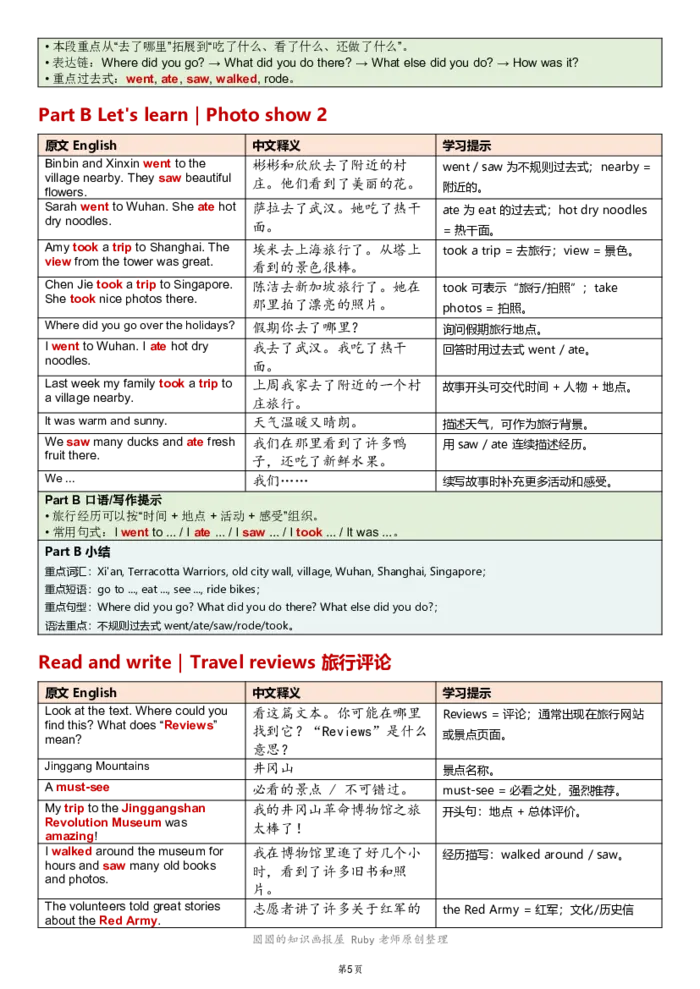
• 本段重点从“去了哪里”拓展到“吃了什么、看了什么、还做了什么”。
• 表达链:Where did you go? →What did you do there? →What else did you do? →How was it?
• 重点过去式:went, ate, saw, walked, rode。
Part B Let's learn|Photo show 2
原文English
中文释义
学习提示
Binbin and Xinxin went to the
village nearby. They saw beautiful
flowers.
彬彬和欣欣去了附近的村
庄。他们看到了美丽的花。
went / saw 为不规则过去式;nearby =
附近的。
Sarah went to Wuhan. She ate hot
dry noodles.
萨拉去了武汉。她吃了热干
面。
ate 为eat 的过去式;hot dry noodles
= 热干面。
Amy took a trip to Shanghai. The
view from the tower was great.
埃米去上海旅行了。从塔上
看到的景色很棒。
took a trip = 去旅行;view = 景色。
Chen Jie took a trip to Singapore.
She took nice photos there.
陈洁去新加坡旅行了。她在
那里拍了漂亮的照片。
took 可表示“旅行/拍照”;take
photos = 拍照。
Where did you go over the holidays?
假期你去了哪里?
询问假期旅行地点。
I went to Wuhan. I ate hot dry
noodles.
我去了武汉。我吃了热干
面。
回答时用过去式went / ate。
Last week my family took a trip to
a village nearby.
上周我家去了附近的一个村
庄旅行。
故事开头可交代时间+ 人物+ 地点。
It was warm and sunny.
天气温暖又晴朗。
描述天气,可作为旅行背景。
We saw many ducks and ate fresh
fruit there.
我们在那里看到了许多鸭
子,还吃了新鲜水果。
用saw / ate 连续描述经历。
We ...
我们……
续写故事时补充更多活动和感受。
Part B 口语/写作提示
• 旅行经历可以按“时间+ 地点+ 活动+ 感受”组织。
• 常用句式:I went to ... / I ate ... / I saw ... / I took ... / It was ...。
Part B 小结
重点词汇:Xi'an, Terracotta Warriors, old city wall, village, Wuhan, Shanghai, Singapore;
重点短语:go to ..., eat ..., see ..., ride bikes;
重点句型:Where did you go? What did you do there? What else did you do?;
语法重点:不规则过去式went/ate/saw/rode/took。
Read and write|Travel reviews 旅行评论
原文English
中文释义
学习提示
Look at the text. Where could you
find this? What does “Reviews”
mean?
看这篇文本。你可能在哪里
找到它?“Reviews”是什么
意思?
Reviews = 评论;通常出现在旅行网站
或景点页面。
Jinggang Mountains
井冈山
景点名称。
A must-see
必看的景点/ 不可错过。
must-see = 必看之处,强烈推荐。
My trip to the Jinggangshan
Revolution Museum was
amazing!
我的井冈山革命博物馆之旅
太棒了!
开头句:地点+ 总体评价。
I walked around the museum for
hours and saw many old books
and photos.
我在博物馆里逛了好几个小
时,看到了许多旧书和照
片。
经历描写:walked around / saw。
The volunteers told great stories
about the Red Army.
志愿者讲了许多关于红军的
the Red Army = 红军;文化/历史信
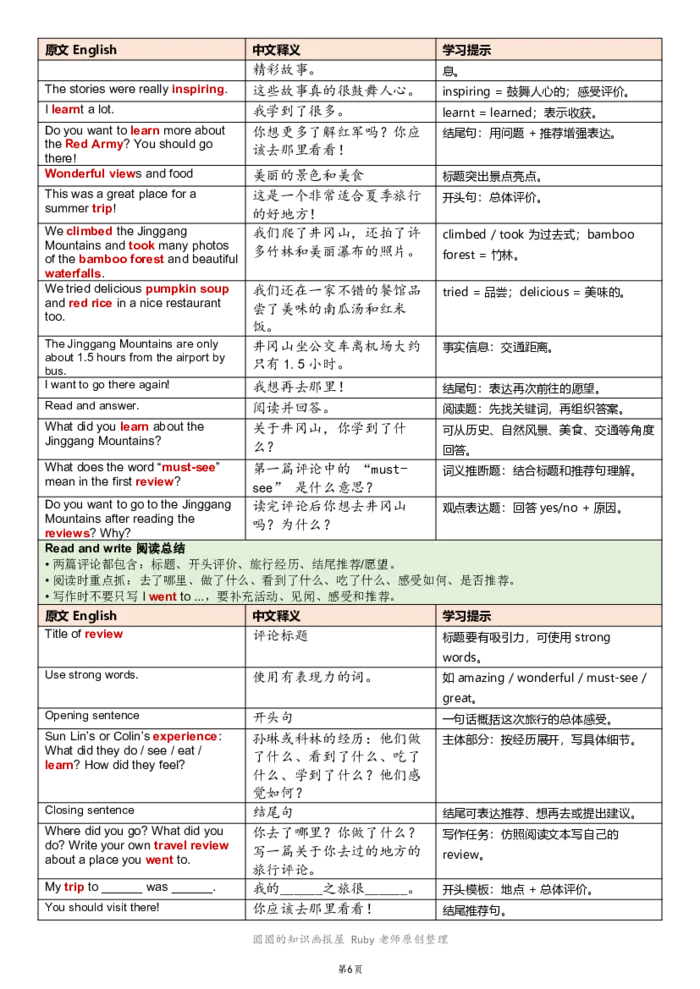
第5页
圆圆的知识画报屋Ruby 老师原创整理
原文English
中文释义
学习提示
精彩故事。
息。
The stories were really inspiring.
这些故事真的很鼓舞人心。
inspiring = 鼓舞人心的;感受评价。
I learnt a lot.
我学到了很多。
learnt = learned;表示收获。
Do you want to learn more about
the Red Army? You should go
there!
你想更多了解红军吗?你应
该去那里看看!
结尾句:用问题+ 推荐增强表达。
Wonderful views and food
美丽的景色和美食
标题突出景点亮点。
This was a great place for a
summer trip!
这是一个非常适合夏季旅行
的好地方!
开头句:总体评价。
We climbed the Jinggang
Mountains and took many photos
of the bamboo forest and beautiful
waterfalls.
我们爬了井冈山,还拍了许
多竹林和美丽瀑布的照片。
climbed / took 为过去式;bamboo
forest = 竹林。
We tried delicious pumpkin soup
and red rice in a nice restaurant
too.
我们还在一家不错的餐馆品
尝了美味的南瓜汤和红米
饭。
tried = 品尝;delicious = 美味的。
The Jinggang Mountains are only
about 1.5 hours from the airport by
bus.
井冈山坐公交车离机场大约
只有1.5 小时。
事实信息:交通距离。
I want to go there again!
我想再去那里!
结尾句:表达再次前往的愿望。
Read and answer.
阅读并回答。
阅读题:先找关键词,再组织答案。
What did you learn about the
Jinggang Mountains?
关于井冈山,你学到了什
么?
可从历史、自然风景、美食、交通等角度
回答。
What does the word “must-see”
mean in the first review?
第一篇评论中的“must-
see” 是什么意思?
词义推断题:结合标题和推荐句理解。
Do you want to go to the Jinggang
Mountains after reading the
reviews? Why?
读完评论后你想去井冈山
吗?为什么?
观点表达题:回答yes/no + 原因。
Read and write 阅读总结
• 两篇评论都包含:标题、开头评价、旅行经历、结尾推荐/愿望。
• 阅读时重点抓:去了哪里、做了什么、看到了什么、吃了什么、感受如何、是否推荐。
• 写作时不要只写I went to ...,要补充活动、见闻、感受和推荐。
原文English
中文释义
学习提示
Title of review
评论标题
标题要有吸引力,可使用strong
words。
Use strong words.
使用有表现力的词。
如amazing / wonderful / must-see /
great。
Opening sentence
开头句
一句话概括这次旅行的总体感受。
Sun Lin’s or Colin’s experience:
What did they do / see / eat /
learn? How did they feel?
孙琳或科林的经历:他们做
了什么、看到了什么、吃了
什么、学到了什么?他们感
觉如何?
主体部分:按经历展开,写具体细节。
Closing sentence
结尾句
结尾可表达推荐、想再去或提出建议。
Where did you go? What did you
do? Write your own travel review
about a place you went to.
你去了哪里?你做了什么?
写一篇关于你去过的地方的
旅行评论。
写作任务:仿照阅读文本写自己的
review。
My trip to ______ was ______.
我的______之旅很______。
开头模板:地点+ 总体评价。
You should visit there!
你应该去那里看看!
结尾推荐句。
第6页
圆圆的知识画报屋Ruby 老师原创整理
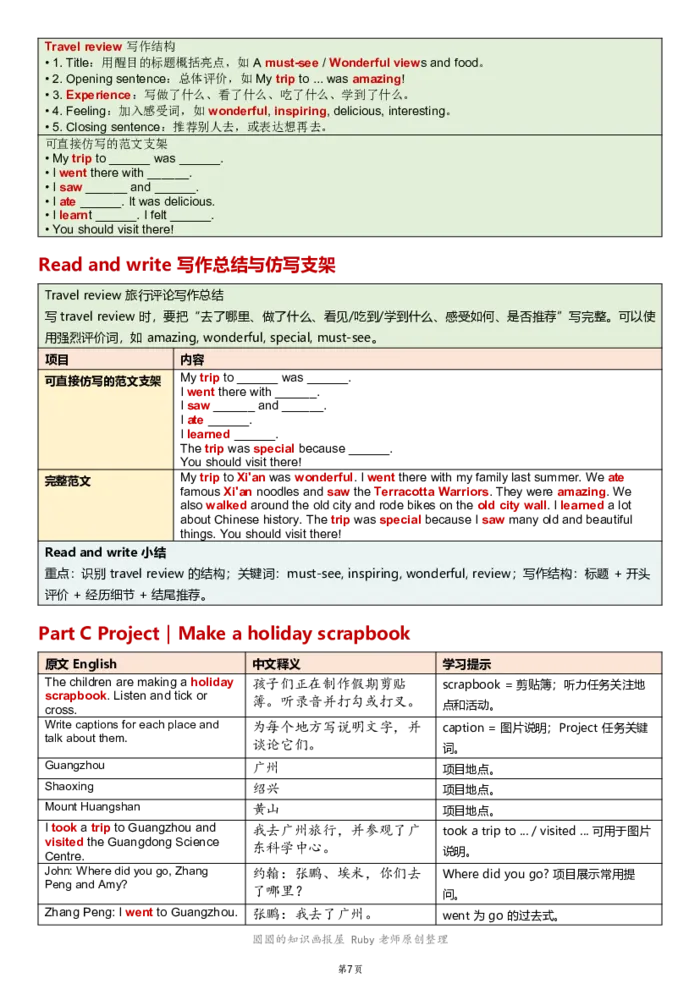
Travel review 写作结构
• 1. Title:用醒目的标题概括亮点,如A must-see / Wonderful views and food。
• 2. Opening sentence:总体评价,如My trip to ... was amazing!
• 3. Experience:写做了什么、看了什么、吃了什么、学到了什么。
• 4. Feeling:加入感受词,如wonderful, inspiring, delicious, interesting。
• 5. Closing sentence:推荐别人去,或表达想再去。
可直接仿写的范文支架
• My trip to ______ was ______.
• I went there with ______.
• I saw ______ and ______.
• I ate ______. It was delicious.
• I learnt ______. I felt ______.
• You should visit there!
Read and write 写作总结与仿写支架
Travel review 旅行评论写作总结
写travel review 时,要把“去了哪里、做了什么、看见/吃到/学到什么、感受如何、是否推荐”写完整。可以使
用强烈评价词,如amazing, wonderful, special, must-see。
项目
内容
可直接仿写的范文支架
My trip to ______ was ______.
I went there with ______.
I saw ______ and ______.
I ate ______.
I learned ______.
The trip was special because ______.
You should visit there!
完整范文
My trip to Xi'an was wonderful. I went there with my family last summer. We ate
famous Xi'an noodles and saw the Terracotta Warriors. They were amazing. We
also walked around the old city and rode bikes on the old city wall. I learned a lot
about Chinese history. The trip was special because I saw many old and beautiful
things. You should visit there!
Read and write 小结
重点:识别travel review 的结构;关键词:must-see, inspiring, wonderful, review;写作结构:标题+ 开头
评价+ 经历细节+ 结尾推荐。
Part C Project|Make a holiday scrapbook
原文English
中文释义
学习提示
The children are making a holiday
scrapbook. Listen and tick or
cross.
孩子们正在制作假期剪贴
簿。听录音并打勾或打叉。
scrapbook = 剪贴簿;听力任务关注地
点和活动。
Write captions for each place and
talk about them.
为每个地方写说明文字,并
谈论它们。
caption = 图片说明;Project 任务关键
词。
Guangzhou
广州
项目地点。
Shaoxing
绍兴
项目地点。
Mount Huangshan
黄山
项目地点。
I took a trip to Guangzhou and
visited the Guangdong Science
Centre.
我去广州旅行,并参观了广
东科学中心。
took a trip to ... / visited ... 可用于图片
说明。
John: Where did you go, Zhang
Peng and Amy?
约翰:张鹏、埃米,你们去
了哪里?
Where did you go? 项目展示常用提
问。
Zhang Peng: I went to Guangzhou.
张鹏:我去了广州。
went 为go 的过去式。
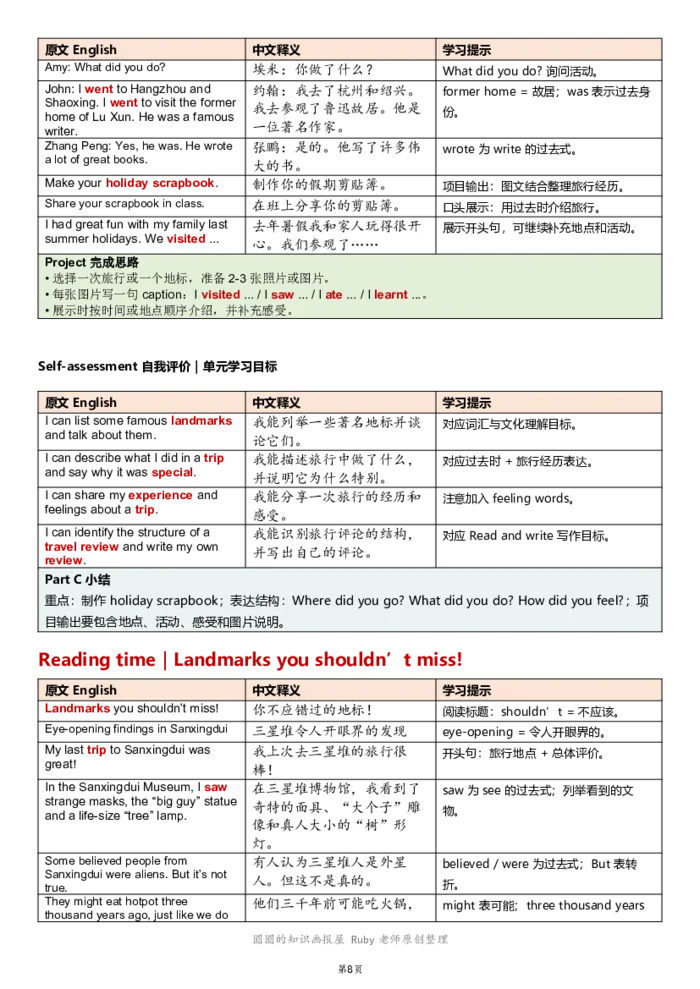
第7页
圆圆的知识画报屋Ruby 老师原创整理
原文English
中文释义
学习提示
Amy: What did you do?
埃米:你做了什么?
What did you do? 询问活动。
John: I went to Hangzhou and
Shaoxing. I went to visit the former
home of Lu Xun. He was a famous
writer.
约翰:我去了杭州和绍兴。
我去参观了鲁迅故居。他是
一位著名作家。
former home = 故居;was 表示过去身
份。
Zhang Peng: Yes, he was. He wrote
a lot of great books.
张鹏:是的。他写了许多伟
大的书。
wrote 为write 的过去式。
Make your holiday scrapbook.
制作你的假期剪贴簿。
项目输出:图文结合整理旅行经历。
Share your scrapbook in class.
在班上分享你的剪贴簿。
口头展示:用过去时介绍旅行。
I had great fun with my family last
summer holidays. We visited ...
去年暑假我和家人玩得很开
心。我们参观了……
展示开头句,可继续补充地点和活动。
Project 完成思路
• 选择一次旅行或一个地标,准备2-3 张照片或图片。
• 每张图片写一句caption:I visited ... / I saw ... / I ate ... / I learnt ...。
• 展示时按时间或地点顺序介绍,并补充感受。
Self-assessment 自我评价|单元学习目标
原文English
中文释义
学习提示
I can list some famous landmarks
and talk about them.
我能列举一些著名地标并谈
论它们。
对应词汇与文化理解目标。
I can describe what I did in a trip
and say why it was special.
我能描述旅行中做了什么,
并说明它为什么特别。
对应过去时+ 旅行经历表达。
I can share my experience and
feelings about a trip.
我能分享一次旅行的经历和
感受。
注意加入feeling words。
I can identify the structure of a
travel review and write my own
review.
我能识别旅行评论的结构,
并写出自己的评论。
对应Read and write 写作目标。
Part C 小结
重点:制作holiday scrapbook;表达结构:Where did you go? What did you do? How did you feel?;项
目输出要包含地点、活动、感受和图片说明。
Reading time|Landmarks you shouldn’t miss!
原文English
中文释义
学习提示
Landmarks you shouldn’t miss!
你不应错过的地标!
阅读标题:shouldn’t = 不应该。
Eye-opening findings in Sanxingdui
三星堆令人开眼界的发现
eye-opening = 令人开眼界的。
My last trip to Sanxingdui was
great!
我上次去三星堆的旅行很
棒!
开头句:旅行地点+ 总体评价。
In the Sanxingdui Museum, I saw
strange masks, the “big guy” statue
and a life-size “tree” lamp.
在三星堆博物馆,我看到了
奇特的面具、“大个子”雕
像和真人大小的“树”形
灯。
saw 为see 的过去式;列举看到的文
物。
Some believed people from
Sanxingdui were aliens. But it’s not
true.
有人认为三星堆人是外星
人。但这不是真的。
believed / were 为过去式;But 表转
折。
They might eat hotpot three
thousand years ago, just like we do
他们三千年前可能吃火锅,
might 表可能;three thousand years
第8页
圆圆的知识画报屋Ruby 老师原创整理
原文English
中文释义
学习提示
today.
就像我们今天一样。
ago 表过去时间。
The pearl of Hangzhou
杭州明珠
pearl 可比喻“珍宝”。
I visited the West Lake last
autumn.
去年秋天我游览了西湖。
visited 为过去式;last autumn 表过去
时间。
On the first night, my friends and I
watched the moon rising from a
boat on the Lake.
第一天晚上,我和朋友们在
湖上的船里看月亮升起。
watched ... rising 描写看到的景象。
We ate mooncakes and drank
Longjing tea.
我们吃了月饼,喝了龙井
茶。
ate / drank 为不规则过去式。
The next day we walked along the
lake. It was such a nice trip.
第二天我们沿着湖边散步。
那真是一次美好的旅行。
The next day 表时间顺序;such a nice
trip 强调感受。
A magical island
一座神奇的岛
magical = 神奇的。
On Easter Island, I saw huge
statues called Moai.
在复活节岛,我看到了叫作
摩艾的巨大雕像。
called Moai 作后置说明。
The Rapa Nui people made them
thousands of years ago.
拉帕努伊人在几千年前制造
了它们。
made 为make 的过去式;thousands
of years ago = 几千年前。
I loved the food on the island.
我喜欢岛上的食物。
loved 表示过去的喜爱。
The locals cooked fresh food on
rocks!
当地人在石头上烹饪新鲜食
物!
locals = 当地人;cooked 为过去式。
We had fish. It was so delicious!
我们吃了鱼。太美味了!
had 为have 的过去式;delicious = 美
味的。
An unusual “table”
一张不同寻常的“桌子”
unusual = 不寻常的;标题制造悬念。
I climbed many mountains on my
trips, but Table Mountain in South
Africa was a special one.
我在旅行中爬过许多山,但
南非的桌山是一座特别的
山。
but 表转折;special = 特别的。
Its name comes from its top. It is flat
like a table!
它的名字来自它的山顶。它
像桌子一样平!
flat = 平的;like 表“像”。
But I found it only looks flat from one
side.
但我发现它只从一侧看起来
是平的。
found 为find 的过去式。
I went to the top by cable car.
我乘缆车到了山顶。
by cable car = 乘缆车。
The first cable car opened in 1929.
第一辆缆车于1929 年开放。
opened 为过去式;in 1929 表年份。
The view was so amazing!
景色太令人惊叹了!
view = 景色;amazing = 令人惊叹的。
Reading time 阅读总结
• 四篇短文都用“地点+ 见闻+ 感受”的方式介绍地标。
• 阅读重点:找出地标名称、位置、看到的事物、吃到的食物、特别之处。
• 可积累评价词:great, eye-opening, magical, unusual, special, amazing, delicious。
Reading time 小结
重点:阅读不同地标介绍;积累描述景点的形容词和事实信息;学习从地点、特色、活动、感受四方面理解文
本。
第9页
圆圆的知识画报屋Ruby 老师原创整理
Unit 1 预习重点汇总
项目
内容
核心目标
能谈论旅行经历,读懂travel review,并写一段简单旅行评论。
重点句型
What did you do last weekend?
Where did you go over the summer holidays?
What did you do there?
What else did you do?
You should visit there!
重点语法
一般过去时:
• be 动词过去式:am/is →was;are →were。
• 规则过去式:visited, climbed, walked, watched, travelled。
• 不规则过去式:go →went, eat →ate, see →saw, take →took, ride →rode, write
→wrote, make →made。
Did + 主语+ 动词原形?
Did 提问时,后面动词用原形:What did you do? / Where did you go?
易错提醒
Did you went? →Did you go?
I goed there. →I went there.
What did you did? →What did you do?
Travel review 写作检
查清单
• 是否有标题?标题是否能突出景点亮点?
• 开头是否写清楚地点和总体感受?
• 主体是否写了具体经历:see / do / eat / learn?
• 是否使用了过去式动词?
• 结尾是否有推荐、感受或想再去的表达?
预习建议
• 第一遍:读英文,看中文,理解意思。
• 第二遍:遮住中文,尝试自己翻译。
• 第三遍:圈出过去式动词和地标名称。
• 最后:用写作支架仿写一段5-6 句话的travel review。
第10页
圆圆的知识画报屋Ruby 老师原创整理
单元导入|Why do we get together?
原文English
中文释义
学习提示
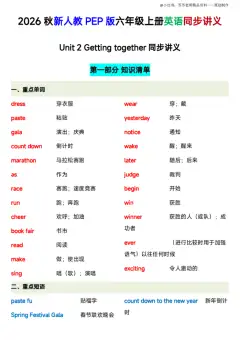
Unit 2 Getting together
第二单元相聚在一起
单元主题:节日、活动与相聚的意义。
Why do we get together?
我们为什么相聚在一起?
主题问题,引导学生思考“相聚”的原因
和价值。
In this unit, you will share opinions
about festivals and big events.
在本单元,你将分享关于节
日和大型活动的看法。
share opinions = 分享观点。
describe activities in festivals and
big events.
描述节日和大型活动中的活
动。
describe activities = 描述活动。
read and separate fact from
opinion and identify key events in
a text.
阅读并区分事实和观点,识
别文本中的关键事件。
本单元阅读重点:Fact / Opinion。
write about your experience of a
festival or a big event.
写一写你参加节日或大型活
动的经历。
写作目标:活动经历+ 感受。
List any festivals or big events
you know.
列出你知道的节日或大型活
动。
预习时可先激活已有经验。
Choose one festival or event and
make a mind map.
选择一个节日或活动,制作
一张思维导图。
思维导图四问:where/when, see/hear,
do, feel。
Where and when?
在哪里?什么时候?
活动信息维度。
What do people see and hear?
人们看见和听见什么?
感官描写,可用于写作拓展。
What do people do?
人们做什么?
核心活动信息。
How do people feel?
人们感觉怎么样?
引导表达观点和感受。
What festival or event does the
picture show?
图片展示的是什么节日或活
动?
Look and think 观察问题。
What's your favourite festival or
event? Why?
你最喜欢的节日或活动是什
么?为什么?
Why 引导学生说明理由。
Listen and sing: Getting together
听一听并唱一唱:《相聚在一
起》
本页预习重点|帮助孩子提前抓住课堂重点
本单元预习重点
节日与活动经历;一般过去时;fact / opinion;写活动
经历。
主题表达链
Festival/Event →Activities →Feelings →Meaning
Part A Let's talk|How can festivals bring us together?
原文English
中文释义
学习提示
Mike and Matt are having breakfast.
Listen and write T (True) or F
(False).
迈克和马特正在吃早饭。听
录音,写T(正确)或F
(错误)。
听前先看题,抓人物和物品
mooncakes。
1. Matt knows about mooncakes.
1. 马特知道月饼。
听力判断题。
Unit 2 Getting together
第11页
圆圆的知识画报屋Ruby 老师原创整理
原文English
中文释义
学习提示
2. Mike's father bought the
mooncakes.
2. 迈克的爸爸买了月饼。
bought 是buy 的过去式。
Mike: How was your Mid-Autumn
Festival holiday, Binbin?
迈克:彬彬,你的中秋节假
期过得怎么样?
How was ...? 询问过去经历。
Binbin: It was great! My family and I
had a really nice day.
彬彬:非常棒!我和家人度
过了非常愉快的一天。
had 是have 的过去式。
Mike: What did you do? Did you take
a trip?
迈克:你们做了什么?你们
去旅行了吗?
did 后用动词原形do / take。
Binbin: No, we didn't. My aunt's
family visited us.
彬彬:没有。我的姑姑一家
来看望了我们。
didn't = did not;visited 为过去式。
Mike: Did you eat mooncakes?
迈克:你们吃月饼了吗?
Did + 主语+ 动词原形?
Binbin: Yes, we did. We enjoyed
some mooncakes and fruit.
彬彬:是的,我们吃了。我
们享用了一些月饼和水果。
enjoyed 为过去式;some 用于肯定句。
Grandpa told us some stories
about the festival.
爷爷给我们讲了一些关于这
个节日的故事。
told 是tell 的过去式。
Mike: Wow! Can I join you next year?
迈克:哇!明年我能加入你
们吗?
join sb. = 加入某人一起活动。
Binbin: Sure. You can also join us
for the Spring Festival.
彬彬:当然。你也可以和我
们一起过春节。
also = 也;Spring Festival = 春节。
We can paste fu and eat jiaozi
together.
我们可以一起贴福字、吃饺
子。
paste fu = 贴福字;together 呼应单元
主题。
Mike: Great! I can't wait!
迈克:太好了!我等不及
了!
I can't wait! 表示非常期待。
What did Binbin do in the Mid-
Autumn Festival?
彬彬在中秋节做了什么?
课本问题:用过去式回答。
What did you do in the last Mid-
Autumn Festival?
你在上一个中秋节做了什
么?
联系自身经历,练习一般过去时。
本页预习重点|帮助孩子提前抓住课堂重点
重点句型
How was your ...? / What did you do? / Did you ...?
语法重点
一般过去时;did 提问后动词用原形;had / visited /
enjoyed / told。
Part A Ask and answer|Teachers' Day
原文English
中文释义
学习提示
Think of what you did last
Teachers' Day. Then talk with your
partner.
想一想你去年教师节做了什
么,然后和同伴交流。
last Teachers' Day 表示过去时间。
Did you draw pictures for our
teachers?
你为我们的老师画画了吗?
Did + you + 动词原形?
No, I didn't. I took some photos.
不,我没有。我拍了一些照
片。
took 是take 的过去式。
Did you make cards for our
teachers?
你为我们的老师制作卡片了
吗?
make cards = 制作卡片。
Yes, I did.
是的,我做了。
Did 问句的肯定回答。
第12页
圆圆的知识画报屋Ruby 老师原创整理
Part A Let's learn|Spring Festival activities
原文English
中文释义
学习提示
My dad and I cleaned the house.
我和爸爸打扫了房子。
cleaned 为规则过去式。
My sister and I pasted fu on the
door.
我和姐姐/妹妹把福字贴在门
上。
pasted 为过去式;paste fu = 贴福。
We dressed in red.
我们穿着红色衣服。
dressed 为过去式;dress in red = 穿红
衣。
We waited for the Spring Festival
Gala.
我们等待春节联欢晚会。
waited 为过去式;Spring Festival Gala
= 春晚。
We counted down to the new year.
我们倒计时迎接新年。
counted down = 倒计时。
Mike: What did you do for the
Spring Festival?
迈克:你们春节做了什么?
What did you do for ...? 询问节日活
动。
Binbin: Xinxin and I pasted fu on
the door.
彬彬:欣欣和我在门上贴了
福字。
pasted 是paste 的过去式。
本页预习重点|帮助孩子提前抓住课堂重点
文化重点
春节活动:cleaned the house, pasted fu, dressed in
red, waited for the Spring Festival Gala, counted
down。
语法重点
规则过去式常见结尾-ed:cleaned / pasted / dressed /
waited / counted。
Part A Play a guessing game|Festivals
原文English
中文释义
学习提示
Did you eat mooncakes?
你们吃月饼了吗?
mooncakes 对应Mid-Autumn
Festival。
No, we didn't.
不,我们没有。
Did 问句的否定回答。
Did you count down to 12 o'clock?
你们倒计时到12 点了吗?
count down to = 倒计时到。
Yes, we did.
是的,我们倒计时了。
Did 问句的肯定回答。
Oh, it's the Spring Festival.
哦,是春节。
通过活动猜节日。
Children's Day
儿童节
Dragon Boat Festival
端午节
dragon boat = 龙舟。
Lantern Festival
元宵节
lantern = 灯笼。
Mid-Autumn Festival
中秋节
National Day
国庆节
Teachers' Day
教师节
Part A 小结
重点词汇:Mid-Autumn Festival, mooncakes, moon, Spring Festival;重点短语:eat mooncakes, watch
the moon, paste Fu, count down;重点句型:How was your festival? We ate/watched ...;语法重点:一
般过去时描述节日活动。
第13页
圆圆的知识画报屋Ruby 老师原创整理
Part B Let's talk|How can big events bring us together?
原文English
中文释义
学习提示
Binbin, Chen Jie and Amy are talking
about last weekend. Listen and
answer.
彬彬、陈洁和艾米正在谈论
上周末。听录音并回答问
题。
听力抓两个人的活动和感受。
1. What did Binbin do last weekend?
1. 彬彬上周末做了什么?
What did ... do? 询问过去活动。
2. Did Robin go with Binbin?
2. 罗宾和彬彬一起去了吗?
Did + 主语+ 动词原形?
Chen Jie: How was your weekend,
Amy?
陈洁:艾米,你周末过得怎
么样?
How was your weekend? 复现Unit
1/2 句型。
Amy: It was great. My mother and I
went to a marathon on Sunday.
艾米:很棒。我和妈妈星期
天去看/参加了一场马拉松。
went 是go 的过去式;marathon = 马
拉松。
She worked as a volunteer. I
watched the race.
她做志愿者。我观看了比
赛。
worked / watched 为过去式;
volunteer = 志愿者。
Chen Jie: What did you like about it?
陈洁:你喜欢它的什么?
What did you like about it? 询问喜欢
的方面。
Amy: I liked watching the runners.
They ran very fast.
艾米:我喜欢看跑步者。他
们跑得很快。
liked 为过去式;ran 是run 的过去式。
I cheered for them.
我为他们加油。
cheer for = 为……加油。
Binbin: Nice! And you, Chen Jie?
What did you do last weekend?
彬彬:真不错!你呢,陈
洁?你上周末做了什么?
继续用What did you do? 交流经历。
Chen Jie: I joined an online book fair.
I liked it very much.
陈洁:我参加了一个线上书
展。我非常喜欢它。
joined / liked 为过去式;online book
fair = 线上书展。
Binbin: What did you like about it?
彬彬:你喜欢它的什么?
复现询问喜好理由的句型。
Chen Jie: We shared ideas and
talked about different books online.
陈洁:我们在线分享想法,
并谈论不同的书。
shared / talked 为过去式。
Binbin: That sounds fun!
彬彬:听起来很有趣!
That sounds ... 表达评价。
Did Amy and Chen Jie like the
events?
艾米和陈洁喜欢这些活动
吗?
课本问题:回答Yes, they did.。
What did they like about them?
她们喜欢这些活动的什么?
回答要说明具体喜欢的方面。
本页预习重点|帮助孩子提前抓住课堂重点
重点句型
How was your weekend? / What did you like about
it? / I liked ...
动词过去式
went, worked, watched, liked, ran, cheered, joined,
shared, talked。
Part B Choose and discuss|Events
原文English
中文释义
学习提示
birthday
生日
活动话题词。
sports meet
运动会
school event 常见表达。
school trip
学校旅行
How was your ...?
你的……怎么样?
可替换活动名称进行问答。
It was ...
它很……
表达总体感受。
What did you like about it?
你喜欢它的什么?
询问喜欢的方面。
第14页
圆圆的知识画报屋Ruby 老师原创整理
原文English
中文释义
学习提示
I ...
我……
用过去式补全活动。
cheered for the players
为运动员加油
cheered 为过去式;cheer for = 加
油。
enjoyed delicious food
享用了美味的食物
enjoyed 为过去式。
hiked in the mountains
在山里徒步
hiked 为过去式。
played games
玩游戏
played 为过去式。
sang and danced
唱歌跳舞
sang 是sing 的过去式;danced 规则
过去式。
watched the race
观看比赛
watched 为过去式。
Part B Let's learn|Big events
原文English
中文释义
学习提示
The writer read his book to the
children.
这位作家给孩子们读了他的
书。
read 过去式拼写不变,读音变化。
People from different places ran a
marathon.
来自不同地方的人们跑了一
场马拉松。
ran 是run 的过去式。
Students made different robots.
学生们制作了不同的机器
人。
made 是make 的过去式。
Children sang and danced in an
art festival.
孩子们在艺术节上唱歌跳
舞。
sang 是sing 的过去式;danced 为过去
式。
Children wore beautiful clothes on
National Day.
孩子们在国庆节穿着漂亮的
衣服。
wore 是wear 的过去式。
Zhang Peng: Did you go to the book
fair yesterday?
张鹏:你昨天去书展了吗?
Did + you + go,go 用原形。
Sarah: Yes, I did.
萨拉:是的,我去了。
Did 问句的肯定回答。
Zhang Peng: What did you like about
it?
张鹏:你喜欢它的什么?
复现重点句型。
Sarah: The writer read his book to
us.
萨拉:那位作家给我们读了
他的书。
read his book to us = 给我们读他的
书。
本页预习重点|帮助孩子提前抓住课堂重点
不规则过去式
read, ran, made, sang, wore, went。
活动表达
Big events 可以从people / actions / feelings 三方面描
述。
Part B Look and say|Earth Day activities
原文English
中文释义
学习提示
Students in Class One did fun
activities on Earth Day. They ...
一班的学生在地球日做了有
趣的活动。他们……
did 是do 的过去式;Earth Day = 地球
日。
They went camping together.
他们一起去露营。
went camping = 去露营。
Some students put up a camp and ...
一些学生搭起了帐篷并……
put up = 搭起;布置。
Some students ...
一些学生……
用动词过去式补充活动。
They ...
他们……
可用danced / helped / made / ran /
第15页
圆圆的知识画报屋Ruby 老师原创整理
原文English
中文释义
学习提示
read / sang / wore。
danced
跳舞了
dance 的过去式。
helped
帮助了
help 的过去式。
made
制作了
make 的过去式。
ran
跑了
run 的过去式。
read
读了
read 过去式拼写不变。
sang
唱了
sing 的过去式。
wore
穿了
wear 的过去式。
Part B 小结
重点词汇:marathon, runners, event, exciting;重点短语:look for teachers, cheer for the runners;重点
句型:What did they do there? They ...;语法重点:规则与不规则过去式。
Read and write|Dragon Boat Festival
原文English
中文释义
学习提示
Listen and number the pictures.
Say more about these festivals.
听录音并给图片编号。说一
说更多关于这些节日的信
息。
节日背景导入。
Sunday, 22 June
6 月22 日,星期日
日记/记录类文本常见日期格式。
The notice about the dragon boat
race finally came out last Friday.
关于龙舟比赛的通知终于在
上周五出来了。
finally 表示“终于”,暗示等待了一段时
间。
I was excited because my father was
on a race team!
我很兴奋,因为我的爸爸在
一支比赛队伍里!
because 引导原因;was 是be 过去式。
In the morning, my dad woke up
early.
早上,我爸爸很早醒来。
woke 是wake 的过去式。
We went to the river later and waited
for the race.
后来我们去了河边,等待比
赛。
went / waited 为过去式。
Then the judge counted down and
the race began!
然后裁判倒计时,比赛开始
了!
counted down = 倒计时;began 是
begin 的过去式。
I ran and cheered for my dad.
我跑着为爸爸加油。
ran 是run 的过去式;cheer for =
为……加油。
His boat was very fast.
他的船非常快。
was 表示过去状态。
Finally, his team won the race!
最后,他的队赢得了比赛!
won 是win 的过去式。
They all sang their team song
together.
他们一起唱了他们的队歌。
sang 是sing 的过去式;together 呼应
单元主题。
They were so happy!
他们非常开心!
were 是are 的过去式。
In the evening, our family made
zongzi and had a big dinner for the
festival, and for the winner, my
dad!
晚上,我们全家包了粽子,
并为这个节日,也为获胜
者——我的爸爸,吃了一顿
丰盛的晚餐!
made 是make 的过去式;had 是have
的过去式。
It was the best Dragon Boat
Festival ever!
这是有史以来最棒的端午
节!
Opinion 观点句,表达个人感受。
本页预习重点|帮助孩子提前抓住课堂重点
第16页
圆圆的知识画报屋Ruby 老师原创整理
阅读结构
Before the race →During the race →In the
evening。
阅读思维
区分Fact(事实)和Opinion(观点)。
Read and write|Notice & Tasks
原文English
中文释义
学习提示
NOTICE
通知
Notice = 通知,注意时间和地点。
Love boats? Like exciting races?
喜欢船吗?喜欢激动人心的
比赛吗?
宣传语,吸引读者。
The Dragon Boat Festival is
coming. Come and join us!
端午节就要到了。快来加入
我们吧!
Come and join us! 发出邀请。
Time: 8:30 a.m. Sunday
时间:星期日上午8:30
Notice 关键信息:Time。
Place: Xingfu River
地点:幸福河
Notice 关键信息:Place。
Xingfu Community
幸福社区
组织者/地点信息。
Write F (Fact) or O (Opinion).
写F(事实)或O(观
点)。
本页核心阅读技能:fact / opinion。
1. My father was on a race team.
1. 我的爸爸在一支比赛队伍
里。
Fact:可以验证的事实。
2. The judge counted down and the
race began!
2. 裁判倒计时,比赛开始
了!
Fact:事件发生顺序。
3. Finally, his team won the race!
3. 最后,他的队赢得了比
赛!
Fact:比赛结果。
4. It was the best Dragon Boat
Festival ever!
4. 这是有史以来最棒的端午
节!
Opinion:个人感受和评价。
What activities did the people in the
text do in the Dragon Boat
Festival?
文中人们在端午节做了哪些
活动?
答案需从文本中提取活动。
What can you infer from "finally" in
the first sentence?
你能从第一句中的
“finally”推断出什么?
infer = 推断;说明之前等待过。
Before the race: The boy ______ the
notice. He was excited.
赛前:男孩______通知。他
很兴奋。
根据文本填read。
During the race: The family went to
the river early and ______ for the
race.
比赛期间:一家人早早来到
河边,并______比赛。
根据文本填waited。
Then the judge ______. The boy
______ and cheered for his father.
然后裁判______。男孩
______并为爸爸加油。
根据文本填counted down / ran。
Finally, his father's team won. They
______ their team song.
最后,他爸爸的队赢了。他
们______队歌。
根据文本填sang。
In the evening, they ______ zongzi
and had a big dinner.
晚上,他们______粽子,并
吃了一顿丰盛的晚餐。
根据文本填made。
What are some fun things you did
in a festival or a big event? Write
them down.
你在某个节日或大型活动中
做过哪些有趣的事?写下
来。
写作准备:用过去式写经历。
______ was great fun! First, we
______.
______非常有趣!首先,我
们______。
写作句型支架。
第17页
圆圆的知识画报屋Ruby 老师原创整理
Read and write 写作总结与仿写支架
Festival / Event writing 节日活动写作总结
写节日或活动经历时,要写清楚时间、人物、活动和感受。注意区分fact(事实)和opinion(观点)。
项目
内容
可直接仿写的范文支架
Last ______, I joined / celebrated ______.
I went there with ______.
We ______ and ______.
Many people ______.
It was ______.
I think ______ because ______.
完整范文
Last Mid-Autumn Festival, my family and I had a really nice day. We ate mooncakes
and watched the moon together. My grandparents told us stories about the festival.
We also took some photos. It was warm and meaningful. I think festivals are
important because people can get together and share happy memories.
Read and write 小结
重点:区分fact 和opinion;写作时既要写活动事实,也要写个人感受。
Part C Project|Present snapshots from school events
原文English
中文释义
学习提示
Project: Present snapshots from
school events
项目:展示学校活动快照
Project 是单元综合输出任务。
Mr Jones and Binbin are talking
about school events. Listen and
fill in the table.
琼斯老师和彬彬正在谈论学
校活动。听录音并填写表
格。
听力信息:last year / this year 对比。
Last year's activity
去年的活动
last year 表示过去时间。
went to an old people's home
去了养老院
went 是go 的过去式。
______ the rooms
______房间
可填cleaned。
______ the paper cuttings on
windows
把剪纸______在窗户上
可填pasted。
______ dumplings
______饺子
可填made。
______ newspapers out loud
大声______报纸
可填read。
This year's plan
今年的计划
plan 表示计划。
invite our grandparents to school
邀请我们的祖父母来学校
invite sb. to ... = 邀请某人到……
______ and ______ for them
为他们______和______
根据听力填写活动。
see old photos
看老照片
Project 活动内容。
Here are photos from the school
events. Look and role-play.
这里有一些学校活动的照
片。看一看并角色扮演。
role-play = 角色扮演。
Miss White: Are these photos from
the Double Ninth Festival this
year?
怀特老师:这些是今年重阳
节的照片吗?
Double Ninth Festival = 重阳节。
Binbin: Yes, they are.
彬彬:是的,它们是。
Are these...? 的肯定回答。
Miss White: Did the old people have
a good time?
怀特老师:老人们玩得开心
吗?
Did + 主语+ 动词原形。
Binbin: Yes, they did.
彬彬:是的,他们很开心。
Did 问句肯定回答。
Miss White: What did they like about
it?
怀特老师:他们喜欢这次活
动的什么?
本单元核心问句复现。
Binbin: ...
彬彬:……
学生根据图片补充。
Miss White: Did you ...?
怀特老师:你们……了吗?
用Did you ...? 继续追问活动。
第18页
圆圆的知识画报屋Ruby 老师原创整理
原文English
中文释义
学习提示
Binbin: ...
彬彬:……
学生用过去式回答。
本页预习重点|帮助孩子提前抓住课堂重点
Project 重点
用照片介绍学校活动:where/when, people, actions,
feelings。
过去式复盘
was/were, cleaned, pasted, played, visited, watched,
did, went, made, read, saw。
Part C Project|Prepare and present snapshots
原文English
中文释义
学习提示
Prepare your snapshots.
准备你的活动快照。
准备图片+ 句子说明。
Chen Jie and Liu Xin played the pipa
to greet the old people.
陈洁和刘欣弹琵琶迎接老
人。
played 为过去式;greet = 迎接。
Mike and John did wonderful kung
fu.
迈克和约翰表演了精彩的功
夫。
did 是do 的过去式。
What a great show!
多么精彩的表演啊!
感叹句:What a/an + adj. + n.!
Present your snapshots in class.
在班里展示你的活动快照。
present = 展示,做汇报。
These are snapshots from ...
这些是来自……的快照。
展示开头句型。
Self-assessment
自我评价
检查本单元学习目标。
1. I can say what people do in
festivals or big events.
1. 我能说出人们在节日或大
型活动中做什么。
能力目标1。
2. I can describe family activities
during traditional Chinese
festivals.
2. 我能描述中国传统节日期
间的家庭活动。
能力目标2。
3. I can share ideas about what
brings people together.
3. 我能分享关于什么让人们
相聚的想法。
单元主题核心。
4. I can order and write about
things I did in a festival or a big
event.
4. 我能按顺序写出我在节日
或大型活动中做过的事情。
写作目标:按时间顺序。
Part C 小结
重点:school event snapshots;项目输出要说明活动名称、参加人物、做了什么、感受如何。
Reading time|The story of Nian - Scene 1
原文English
中文释义
学习提示
Reading time: The story of Nian
阅读时间:年的故事
春节文化拓展阅读。
Scene 1
场景一
剧本结构:Scene 场景。
Narrator: One night, an old man
came to a village.
旁白:一天晚上,一位老人
来到了一个村庄。
came 是come 的过去式。
He saw the local people running
away.
他看见当地的人们正在逃
跑。
saw 是see 的过去式;running away
= 逃跑。
Old man: Excuse me, why are you
running? What happened?
老人:打扰一下,你们为什
么在跑?发生了什么?
What happened? 询问发生了什么。
Villager: The monster Nian will come!
村民:怪兽“年”要来了!
will 表示将要发生。
Last year, it ate many animals.
去年,它吃了许多动物。
ate 是eat 的过去式。
We are all afraid of it.
我们都害怕它。
be afraid of = 害怕……。
第19页
圆圆的知识画报屋Ruby 老师原创整理
原文English
中文释义
学习提示
Old man: Wait! I have a good idea. I
can help you.
老人:等等!我有一个好主
意。我能帮助你们。
can + 动词原形。
Villager: The monster is very strong.
村民:这个怪兽非常强壮。
You should run away to the
mountains with us!
你应该和我们一起逃到山里
去!
should + 动词原形,表示建议。
Old man: No. I will stay alone in the
village and face Nian.
老人:不。我会独自留在村
子里面对年。
will + 动词原形;face = 面对。
Reading time|The story of Nian - Scene 2
原文English
中文释义
逐行学习提示
Scene 2
场景二
Narrator: The old man stayed in the
village.
旁白:老人留在了村子里。
stayed 为过去式。
Then, at midnight, the monster
came.
然后,在午夜,怪兽来了。
came 是come 的过去式。
Nian: What is that red paper on the
doors and windows?
年:门窗上的红纸是什么?
red paper 与春节习俗相关。
I hate the colour red!
我讨厌红色!
hate = 讨厌。
Why are the windows so bright?
窗户为什么这么亮?
bright = 明亮的。
I hate bright lights!
我讨厌明亮的灯光!
Old man: Aha! He looks worried.
老人:啊哈!它看起来很担
心。
looks worried = 看起来担心。
Narrator: Then the old man set off
fireworks.
旁白:然后老人放起了烟
花。
set off fireworks = 放烟花。
Bang! Bang! Bang!
砰!砰!砰!
拟声词,表现声音。
Nian: Oh no! I hate loud noises! No,
no!
年:哦不!我讨厌巨大的声
音!不,不!
loud noises = 巨大的声音。
Reading time|The story of Nian - Scene 3
原文English
中文释义
逐行学习提示
Scene 3
场景三
Narrator: Nian was very afraid and
ran back to the sea.
旁白:年非常害怕,跑回了
海里。
was / ran 为过去式。
The next day, the villagers came
back to the village.
第二天,村民们回到了村
子。
came back = 回来。
Villager 1: I can't believe it! All our
animals are safe!
村民1:我简直不敢相信!
我们的动物都安全了!
can't believe it = 不敢相信。
Villager 2: How did you do it?
村民2:你是怎么做到的?
How did you do it? 询问方法。
Old man: Last night, I pasted red
paper on the doors and windows,
老人:昨晚,我在门窗上贴
了红纸,
pasted 为过去式。
and I also lit many candles.
并且我还点了许多蜡烛。
lit 是light 的过去式。
Finally, I set off fireworks. He ran
away!
最后,我放了烟花。它跑走
了!
set off fireworks = 放烟花;ran away = 跑
走。
Villagers: Hooray! We are safe!
村民们:好哇!我们安全
了!
第20页
圆圆的知识画报屋Ruby 老师原创整理
原文English
中文释义
逐行学习提示
Narrator: From then on, on New
Year's Eve, people get together to
celebrate the coming new year.
旁白:从那以后,在除夕
夜,人们聚在一起庆祝即将
到来的新年。
get together 呼应单元主题。
They paste fu and Spring Festival
couplets on their doors and set off
fireworks.
他们在门上贴福字和春联,
并放烟花。
Spring Festival couplets = 春联。
This is why the Spring Festival is
also called guonian.
这就是为什么春节也被称为
“过年”。
文化解释:guonian = 过年。
本页预习重点|帮助孩子提前抓住课堂重点
文化重点
春节习俗来源:贴红纸/春联、点灯、放烟花。
语言复盘
过去式:came, saw, ate, stayed, ran, pasted, lit。
Reading time 小结
重点:拓展阅读节日/活动相聚主题,理解people get together 的意义。
剧本阅读策略:引导学生抓Scene / Narrator / characters / problem / solution / tradition,把故事课处理成有
结构的阅读课。
Unit 2 预习重点汇总
项目
内容
核心目标
能描述节日和活动经历,区分fact 和opinion,并介绍一次school event。
重点句型
How was your festival?
What did you do?
We ate mooncakes.
They cheered for the runners.
I think it was wonderful.
重点语法
一般过去时描述活动
规则过去式:looked, cheered, watched
不规则过去式:ate, had, went, ran, made, sang, wore
易错提醒
What did they did? →What did they do?
We eat mooncakes yesterday. →We ate mooncakes yesterday.
单元总结
本单元核心是getting together。节日和活动不只是热闹,更能让人们相聚、分享和支持彼
此。
第21页
圆圆的知识画报屋Ruby 老师原创整理
单元导入|What is a healthy lifestyle?
原文English
中文释义
学习提示
What is a healthy lifestyle?
什么是健康的生活方式?
【主题】healthy lifestyle = 健康生活
方式
In this unit, you will talk about
illnesses and ways to stay
healthy.
在本单元,你将谈论疾病以
及保持健康的方法。
【单元目标】illnesses 疾病;stay
healthy 保持健康
You will describe healthy and
unhealthy lifestyle.
你将描述健康和不健康的生
活方式。
【词汇】healthy / unhealthy 一组反
义词
You will read and identify a
student's problem and its solution
in a story.
你将阅读并识别故事中一名
学生的问题及解决办法。
【阅读策略】problem →solution 问
题→解决办法
You will write suggestions to help
friends with their problems.
你将写建议,帮助朋友解决
他们的问题。
【写作任务】suggestions = 建议
Healthy lifestyle: Do exercise.
健康生活方式:锻炼。
【词组】do exercise = 做运动
Unhealthy lifestyle: Eat too much
cake.
不健康生活方式:吃太多蛋
糕。
【易错】too much + 不可数名词;
cake 在这里泛指蛋糕
Discuss what makes us healthy.
讨论是什么让我们保持健
康。
【核心问题】what makes us healthy
= 什么让我们健康
How can we stay healthy?
我们怎样才能保持健康?
【句型】How can we ...? 询问方法
Part A Let's talk|How do we know if we are ill?
原文English
中文释义
学习提示
Mike and Chen Jie are in the
playground. Listen and write T (True)
or F (False).
迈克和陈洁在操场上。听录
音,判断正误。
【任务】T=True 正确;F=False 错误
Mike has a runny nose.
迈克流鼻涕。
【词组】have a runny nose = 流鼻涕
Mike should go back home.
迈克应该回家。
【语法】should + 动词原形
Mike: Hello?
迈克:喂?
Binbin: Hi, Mike. It's Binbin. I'm going
to the science museum tomorrow.
Are you coming?
彬彬:嗨,迈克。我是彬
彬。我明天要去科学博物
馆。你来吗?
【句型】be going to 表示计划;Are
you coming? 口语中询问是否会来
Mike: I'm afraid not, Binbin. I have
a bad cold.
迈克:恐怕不行,彬彬。我
得了重感冒。
【表达】I'm afraid not. = 恐怕不行;
have a bad cold = 得了重感冒
Binbin: Oh dear! How do you feel?
彬彬:哎呀!你感觉怎么
样?
【关心用语】How do you feel? 询问
身体或情绪状态
Mike: I feel ill. My head hurts and I
have a runny nose.
迈克:我觉得不舒服。我头
疼,还流鼻涕。
【重点】ill 不舒服;My head hurts.
= 我头疼
Binbin: I'm sorry to hear that.
Maybe you should see a doctor.
彬彬:听到这个我很难过。
也许你应该去看医生。
【关怀表达】I'm sorry to hear
that.;【语法】should see a doctor
Mike: I know. My mum is going to
take me to hospital this afternoon.
迈克:我知道。我妈妈今天
下午要带我去医院。
【词组】take sb. to hospital = 带某
人去医院
Unit 3 Healthy life
第22页
圆圆的知识画报屋Ruby 老师原创整理
原文English
中文释义
学习提示
Binbin: That's good. Take care and
get well soon!
彬彬:那就好。保重,早日
康复!
【固定表达】Take care. / get well
soon = 早日康复
Mike: Thanks.
迈克:谢谢。
How does Mike feel?
迈克感觉怎么样?
【课本问题】用He feels ... 回答
What should Mike do?
迈克应该做什么?
【课本问题】用He should ... 回答
Part A Add more words and make up a conversation
原文English
中文释义
学习提示
happy
开心的
【情绪词】可用于How do you feel?
的回答
sad
难过的
【情绪词】sad = 伤心的
ill
生病的;不舒服的
【核心词】feel ill = 感到不舒服
cold
感冒;冷的
【多义词】have a cold 感冒;feel
cold 感到冷
hungry
饥饿的
【状态词】I feel hungry. 我饿了。
How do you feel now?
你现在感觉怎么样?
【句型】询问现在的身体或情绪状态
I'm not feeling well. I feel cold and I
have a runny nose.
我感觉不太舒服。我觉得
冷,还流鼻涕。
【表达】not feeling well = 感觉不舒
服
You should drink some water and
have a rest.
你应该喝些水并休息一下。
【建议】should + 动词原形;have a
rest = 休息一下
Part A Let's learn|Illnesses 病症表达
原文English
中文释义
学习提示
What's the matter?
怎么了?
【核心句型】询问问题或身体状况
I have a bad cold. My head hurts
and I have a runny nose.
我得了重感冒。我头疼,还
流鼻涕。
【病症表达】have a bad cold / head
hurts / runny nose
Mike has a bad cold. His head
hurts and he has a runny nose.
迈克得了重感冒。他头疼,
还流鼻涕。
【语法】第三人称单数用has;his head
hurts
He has a fever.
他发烧了。
【病症】have a fever = 发烧
She has a cough.
她咳嗽。
【病症】have a cough = 咳嗽
Look and role-play.
看一看并进行角色扮演。
【活动】role-play = 角色扮演
at home
在家
【场景】at + 小地点
at school
在学校
【场景】at school = 在学校
in hospital
在医院
【场景】in hospital = 住院/在医院
teacher
老师
【角色】可用于问诊角色扮演
parents
父母
【角色】parents 是复数
doctor
医生
【角色】see a doctor = 看医生
You should ...
你应该……
【句型】should 后接动词原形,给出建
议
Part A 小结
重点词汇:cold, fever, cough, runny nose, head hurts;重点句型:What's the matter? I have ... You
第23页
圆圆的知识画报屋Ruby 老师原创整理
原文English
中文释义
学习提示
should ...;语法重点:have/has + illness, should + 动词原形。
Part B Let's talk|How can we stay healthy?
原文English
中文释义
学习提示
Binbin and Sarah meet in front of the
library. Listen and choose.
彬彬和萨拉在图书馆前见
面。听录音并选择。
【场景】in front of = 在……前面
What are Binbin and Sarah preparing
for?
彬彬和萨拉正在为什么做准
备?
【句型】prepare for = 为……做准备
What does Binbin think of the
website?
彬彬认为这个网站怎么样?
【句型】What do/does ... think
of ...? 询问看法
Miss White: Class, now we're going
to discuss health. First, what is
health?
怀特老师:同学们,现在我
们要讨论健康。首先,什么
是健康?
【主题词】health = 健康;discuss =
讨论
Chen Jie: Health is having a good
body and feeling happy.
陈洁:健康就是拥有健康的
身体并感到快乐。
【主题理解】body + feeling,身体和
心理都重要
Miss White: Good, Chen Jie. So,
how can we live a healthy life?
怀特老师:很好,陈洁。那
么,我们怎样才能过健康的
生活呢?
【核心问题】How can we live a
healthy life?
Sarah: We need to eat healthy
food. We should exercise too.
萨拉:我们需要吃健康的食
物。我们也应该锻炼。
【语法】need to + 动词原形;should
+ 动词原形
Miss White: What about you, Binbin?
怀特老师:你呢,彬彬?
【交际】What about you? = 你呢?
Binbin: I think our family and
friends are also important for a
healthy life.
彬彬:我认为我们的家人和
朋友对健康生活也很重要。
【观点表达】I think ...;【主题】
social life 社交健康
Chen Jie: Yes, it's always good to
talk to our family and friends.
陈洁:是的,和家人朋友交
谈总是有好处的。
【句型】It's good to ... = 做……是好
的
Miss White: Good job, everyone!
怀特老师:大家做得好!
【课堂用语】Good job! = 做得好
What are the students' answers to
Miss White's second question?
学生们对怀特老师第二个问
题的回答是什么?
【问题定位】second question 指
“How can we live a healthy life?”
Do you agree with them?
你同意他们吗?
【表达观点】Yes, I do. / No, I don't.
Because ...
Part B Discuss and make a mind map
原文English
中文释义
学习提示
Sleep well.
睡好。
【健康习惯】sleep well = 睡眠充足
Take care of your eyes and teeth.
保护好你的眼睛和牙齿。
【词组】take care of = 照顾;保护
Eat healthy food.
吃健康的食物。
【词组】healthy food = 健康食物
Drink enough water.
喝足够的水。
【词汇】enough = 足够的
How can we live a healthy life?
我们怎样才能过健康的生
活?
【核心句型】询问生活方式建议
We need to eat healthy food.
我们需要吃健康的食物。
【语法】need to + 动词原形
We should sleep well. And we
can ...
我们应该睡好。而且我们可
以……
【建议表达】should / can 都可用于提
建议
第24页
圆圆的知识画报屋Ruby 老师原创整理
Part B Let's learn|Healthy life 健康生活
原文English
中文释义
学习提示
Healthy life
健康生活
【主题】本单元核心概念
Have a healthy diet.
保持健康饮食。
【词组】healthy diet = 健康饮食
Don't stay up late.
不要熬夜。
【祈使句】Don't + 动词原形;stay up late
= 熬夜
Exercise often.
经常锻炼。
【祈使句】动词原形开头提建议
Think about happy things.
想一想开心的事情。
【心理健康】think about = 思考;想
Join clubs and teams.
参加社团和团队。
【社交健康】join = 参加
Have fun with your friends and
family.
和朋友、家人一起玩得开
心。
【社交健康】have fun with ... = 和……开心
相处
How can we live a healthy life?
我们怎样才能过健康的生
活?
【复现句型】用于引出建议
Discuss and make a plan.
讨论并制定计划。
【任务】make a plan = 制定计划
How can you live a healthy life?
What is your plan?
你怎样才能过健康的生活?
你的计划是什么?
【输出任务】计划表达可用I can ... / I
should ...
I can exercise often. Jump rope or
play ball games every day. And I
should ...
我可以经常锻炼。每天跳绳
或玩球类游戏。而且我应
该……
【表达】jump rope = 跳绳;play ball
games = 玩球类游戏
Jump rope or play ball games every
day.
每天跳绳或玩球类游戏。
【建议】具体、可执行的健康计划
Part B 小结
重点词汇:healthy diet, physical, mental, social;重点短语:exercise often, think about happy things,
join clubs and teams;重点句型:What makes a healthy life? We need to ...;语法重点:need to / should
表建议。
Read and write|情绪支持与解决办法
原文English
中文释义
学习提示
Look at the pictures. How do they
feel? Did you feel this way before?
Why?
看图片。他们感觉怎么样?
你以前有过这种感觉吗?为
什么?
【阅读导入】关注feelings 感受
Liu Jia was crying. So Miss White
asked her, "What's the matter, Liu
Jia? You look sad."
刘佳在哭。所以怀特老师问
她:“怎么了,刘佳?你看
起来很难过。”
【结构】Problem 问题;You look sad. 看
起来……
Liu Jia answered, "I'm feeling down.
My good friend Lucy moved to
another city."
刘佳回答:“我感到低落。
我的好朋友露西搬到另一个
城市去了。”
【情绪】feel down = 情绪低落;moved
为过去式
Miss White listened carefully and
told Liu Jia, "Think about happy
things. Call your friend or send her
some emails."
怀特老师认真地听,并告诉
刘佳:“想一想开心的事
情。给你的朋友打电话,或
者给她发一些电子邮件。”
【建议】Think / Call / send 都是动词原形
开头的建议
第25页
圆圆的知识画报屋Ruby 老师原创整理
原文English
中文释义
学习提示
"I tried that, but I still feel
unhappy," said Liu Jia.
“我试过了,但是我仍然觉
得不开心。”刘佳说。
【词汇】still = 仍然;unhappy = 不开心
的
Miss White gave her a glass of
water. "Maybe you can do some
exercise. Exercise may cheer you
up!"
怀特老师给了她一杯水。
“也许你可以做些运动。运
动可能会让你振作起来!”
【词组】cheer you up = 让你振作起来
"Join some after-school clubs and
make new friends! You can talk
and have fun with them," added
Miss White.
“参加一些课后社团,结交
新朋友!你可以和他们聊天
并玩得开心。”怀特老师补
充道。
【社交健康】after-school clubs;make
new friends
"I will try. Thank you, Miss White,"
said Liu Jia.
“我会试试的。谢谢您,怀
特老师。”刘佳说。
【表达】I will try. = 我会试一试
Dear Miss White,
亲爱的怀特老师:
【书信格式】开头称呼
I often make video calls with my
friend now.
我现在经常和我的朋友视频
通话。
【词组】make video calls = 视频通话
I also joined a ping-pong club and
made some new friends.
我还参加了一个乒乓球俱乐
部,并交了一些新朋友。
【过去式】joined / made
I feel much better. Thank you so
much!
我感觉好多了。非常感谢
您!
【结果】Result 结果:feel much better
Liu Jia
刘佳
【书信格式】署名
Read and write|课后任务与写作支架
原文English
中文释义
学习提示
Read and write T (True) or F (False).
读一读并写T(正确)或F
(错误)。
【任务】判断文本信息是否正确
Liu Jia had a runny nose and felt
unhappy.
刘佳流鼻涕,并且感到不开
心。
【辨析】文本中unhappy 是情绪,runny
nose 不符合原文
Liu Jia shared her feelings with Miss
White.
刘佳和怀特老师分享了她的
感受。
【阅读信息】shared her feelings = 分享
感受
Liu Jia often makes video calls
with her friend now.
刘佳现在经常和她的朋友视
频通话。
【细节】now 表示现在的变化
Liu Jia called Miss White and
thanked her.
刘佳给怀特老师打电话并感
谢她。
【细节辨析】原文是写信感谢
Read the text again and fill in the
blanks.
再读课文并填空。
【阅读策略】抓problem 和solutions
Problem: Liu Jia's good friend
______ to another city.
问题:刘佳的好朋友______
到另一个城市去了。
【答案线索】moved
Solutions: Think about ______.
解决办法:想一想______。
【答案线索】happy things
______ her friend or ______ her
emails.
______她的朋友,或者给她
______电子邮件。
【答案线索】Call / send
Do ______.
做______。
【答案线索】exercise
Join after-school ______ and make
______.
参加课后______,结交
______。
【答案线索】clubs / new friends
Write suggestions to the children
below.
给下面的孩子写建议。
【写作任务】suggestions = 建议
第26页
圆圆的知识画报屋Ruby 老师原创整理
原文English
中文释义
学习提示
You should / need to / can
______.
你应该/ 需要/ 可以
______。
【句型支架】should / need to / can + 动
词原形
Then ______.
然后______。
【拓展句】补充第二条建议或结果
Read and write 写作总结与仿写支架
Health advice 健康建议写作总结
写健康建议时,可以先写问题和感受,再给出具体建议,最后表达祝愿。建议要覆盖body, mind, social life。
项目
内容
可直接仿写的范文支架
My friend feels ______.
He / She has ______.
I think he / she should ______.
Maybe he / she can ______.
Why not ______?
I hope he / she will feel better.
完整范文
My friend feels unhappy because his good friend moved to another city. I think he
should talk to his family and tell them his feelings. Maybe he can make video calls
with his friend. He can also join an after-school club and make new friends. Why not
do some exercise too? I hope he will feel better soon.
Read and write 小结
重点:problem →feeling →suggestions →result;学习如何安慰朋友并给出建议。
安慰表达补充:It's OK to feel bad. / Why not ...? / Exercise may cheer you up. 课堂上要引导学生先安慰,再
给建议,避免只机械套用You should ...。
Part C Project|Make a healthy lifestyle pamphlet
制作健康生活小册子
原文English
中文释义
学习提示
Why aren't these people feeling well?
Listen and complete the sentences.
这些人为什么感觉不舒服?
听录音并完成句子。
【项目任务】先识别problem,再给
suggestion
John has a ______, a ______ and
a ______. He should see a
doctor.
约翰有______、______和
______。他应该去看医生。
【建议】see a doctor = 看医生
Binbin ate too much cake. He
should ______.
彬彬吃了太多蛋糕。他应该
______。
【原因→建议】too much cake 导致不适
Sarah's mum is tired. She
shouldn't ______.
萨拉的妈妈很累。她不应该
______。
【语法】shouldn't + 动词原形
Amy feels sad. She should
______ and join some clubs.
艾米感到难过。她应该
______并参加一些社团。
【社交健康】join clubs 可帮助改善情绪
How can we live a healthy life?
Make a list and discuss in groups.
我们怎样才能过健康的生
活?列清单并小组讨论。
【项目步骤】make a list = 列清单
Healthy Life: physical, mental,
social
健康生活:身体的、心理
的、社交的
【核心框架】body / mind / social life
Eat healthy food.
吃健康的食物。
【physical】身体健康建议
Don't stay up late.
不要熬夜。
【physical】睡眠习惯
第27页
圆圆的知识画报屋Ruby 老师原创整理
原文English
中文释义
学习提示
Exercise often.
经常锻炼。
【physical】运动习惯
It's OK to feel bad.
感觉不好也是可以的。
【mental】接纳情绪
Take a deep breath.
深呼吸。
【mental】调节情绪的方法
Have fun with your family.
和家人一起开心相处。
【social】家庭社交支持
Be a volunteer.
做一名志愿者。
【social】参与社会活动
We need to eat healthy food and
drink enough water.
我们需要吃健康的食物并喝
足够的水。
【表达】need to + 动词原形;enough
water
It's OK to feel sad. We can talk to
our friends.
感到难过是可以的。我们可
以和朋友谈谈。
【心理健康】talk to friends = 与朋友交谈
It's always good to talk to our family.
和家人交谈总是有好处的。
【句型】It's good to ...
Part C Project|Make and share your pamphlet
原文English
中文释义
学习提示
Make your healthy lifestyle
pamphlet.
制作你的健康生活方式小册
子。
【项目输出】pamphlet = 小册子
Take care of your body.
照顾好你的身体。
【physical health】身体健康
Don't stay up late.
不要熬夜。
【建议】Don't + 动词原形
Make yourself feel good.
让自己感觉好起来。
【mental health】心理健康
Think about happy things.
想一想开心的事情。
【情绪调节】think about happy things
Be friendly with people around you.
友善对待你身边的人。
【social health】社交健康
Join clubs and teams.
参加社团和团队。
【社交】扩大交往圈
Share your pamphlet in class.
在课堂上分享你的小册子。
【展示任务】share in class = 在课堂上分享
How can we live a healthy life?
First, we should take care of our
body. Then ...
我们怎样才能过健康的生
活?首先,我们应该照顾好
身体。然后……
【展示支架】First / Then 用于组织表达
I can describe illnesses and show
care for others.
我能描述疾病,并表达对他
人的关心。
【自评】describe illnesses;show care
I can suggest ways to live a
healthy life.
我能建议过健康生活的方
法。
【自评】suggest ways = 提出方法
I can give suggestions to friends
who feel bad.
我能给感觉不好的朋友提出
建议。
【自评】情绪支持
I can identify friends' problems and
write solutions.
我能识别朋友的问题并写出
解决办法。
【自评】problem →solution
Part C 小结
重点:healthy lifestyle pamphlet;项目输出要从physical, mental, social 三方面给建议。
第28页
圆圆的知识画报屋Ruby 老师原创整理
Reading time|Helping hands
原文English
中文释义
学习提示
My name is Right Hand. This is my
twin brother, Left Hand.
我的名字是右手。这是我的
双胞胎兄弟,左手。
【拟人写法】Right Hand / Left Hand 被当
作人物介绍
One day, our master didn't wash us
and ate his food.
一天,我们的主人没有洗我
们,就吃了食物。
【健康习惯】wash hands before eating
He felt ill the next day.
第二天他感到不舒服。
【结果】didn't wash hands →felt ill
Now he washes us before every
meal.
现在他每顿饭前都会洗我
们。
【一般现在时】washes 表示习惯动作
On another day, our master had a
bad cold.
另一天,我们的主人得了重
感冒。
【病症】had a bad cold,had 为过去式
He had a runny nose and a
cough.
他流鼻涕,还咳嗽。
【病症】runny nose / cough
We wiped his nose and covered his
mouth with a tissue.
我们擦了他的鼻子,并用纸
巾捂住他的嘴。
【健康习惯】cover mouth with a tissue
We're important for his physical
health.
我们对他的身体健康很重
要。
【主题】physical health = 身体健康
We're also important for his mental
and social health.
我们对他的心理健康和社交
健康也很重要。
【核心】mental health / social health
One day, our master felt unhappy.
一天,我们的主人感到不开
心。
【情绪】felt unhappy,felt 为过去式
But we helped him make handicrafts
(手工艺品).
但是我们帮助他制作手工艺
品。
【词汇】handicrafts = 手工艺品
He felt happy again.
他又感到开心了。
【结果】活动帮助改善情绪
Our master also cooked food for his
parents and sister.
我们的主人还为他的父母和
妹妹做饭。
【社交功能】help family = 帮助家人
They thanked him and said, "You
have really great hands!"
他们感谢他并说:“你有一
双非常棒的手!”
【表达】really great = 非常棒
We're important for our master and
his friends.
我们对主人和他的朋友们很
重要。
【主题】手帮助人与他人互动
He uses us to give them a high five.
他用我们和他们击掌。
【词组】give a high five = 击掌
We really are helping hands!
我们真的是帮助之手!
【主题句】helping hands 呼应全文
Reading time 小结
重点:理解hands 对身体、心理和社交健康的帮助,拓展healthy life 的内涵。
第29页
圆圆的知识画报屋Ruby 老师原创整理
Unit 3 预习重点汇总
Unit 预习重点汇总
项目
内容
核心目标
能描述身体不适,关心别人并给出健康建议,理解body/mind/social life。
重点句型
What's the matter?
I have a fever.
My head hurts.
You should drink more water.
Why not join an after-school club?
重点语法
have/has + illness
should / shouldn't + 动词原形
need to + 动词原形
Why not + 动词原形?
易错提醒
You should drinks water. →You should drink water.
He have a fever. →He has a fever.
Why not to join? →Why not join?
单元总结
本单元帮助学生理解健康不只是身体不生病,还包括心理健康和良好社交。
第30页
圆圆的知识画报屋Ruby 老师原创整理
单元导入|How can we make money work for us?
原文English
中文释义
学习提示
Unit 4 Managing money well
第四单元管理好金钱
manage money well = 合理管理金
钱;本单元不是普通购物课,而是理财
启蒙。
How can we make money work for
us?
我们怎样让金钱为我们服
务?
核心问题强调“计划、判断、节省”,
引导学生形成正确消费观。
In this unit, you will talk about
managing money.
在本单元,你将谈论如何管
理金钱。
talk about managing money = 谈论
理财方式。
describe ways to use and manage
money.
描述使用和管理金钱的方
法。
way to do sth. = 做某事的方法;可连
接spend, save, buy, pay for。
read and analyse ways of
managing money in a newspaper
article.
阅读并分析报纸文章中管理
金钱的方法。
newspaper article = 报纸文章;为后
续说明文阅读做准备。
write about how you are going to
manage your money well.
写一写你打算怎样管理好自
己的钱。
写作重点是be going to 表计划,内容
应体现理性消费。
Think and discuss
想一想,讨论一下
导入讨论任务,先从学生真实消费经验
进入主题。
Make a list of things you often buy.
列出你经常买的东西。
make a list = 列清单;可自然引出
need 和want 的区分。
Discuss how people can save
money.
讨论人们怎样省钱。
save money = 省钱/存钱;鼓励学生
说出可执行的方法。
Look and think
看一看,想一想
观察图片时关注人物行为:buy, save,
count, plan。
What are the people in the picture
doing?
图片里的人们正在做什么?
现在进行时are doing,用来描述正在
发生的画面。
Do you do the same? Why or why
not?
你也会这样做吗?为什么或
为什么不?
引导学生表达个人选择和理由,避免只
做机械翻译。
Listen and sing: Did they use money
well?
听一听,唱一唱:《他们把
钱用好了吗?》
主题歌曲,帮助学生理解use money
well 的价值判断。
Part A Why do we use money?|Let's talk
原文English
中文释义
学习提示
Mike: Are you counting your
pocket money, Matt?
迈克:马特,你在数你的零
花钱吗?
pocket money = 零花钱;counting
为现在进行时。
Matt: Yes. I have three hundred
and fifty-seven yuan.
马特:是的。我有三百五十
七元。
金额表达:three hundred and fifty-
seven yuan = 357 元。
Mike: Wow, that's a lot. How are
you going to spend it?
迈克:哇,那可不少。你打
算怎么花它?
How are you going to ...? 询问计划;
spend = 花费。
Matt: I'm going to buy a
schoolbag.
马特:我打算买一个书包。
be going to + 动词原形,表示计划。
Unit 4 Managing money well
第31页
圆圆的知识画报屋Ruby 老师原创整理
原文English
中文释义
学习提示
Mike: Yes, you need a new one.
迈克:是的,你需要一个新
的。
need 表示“需要”,这里属于
Need。
Matt: I also want to buy some
books.
马特:我还想买一些书。
want to + 动词原形,表示“想要做某
事”。
Mike: Nice. Maybe you can buy
some animal books. They're
interesting.
迈克:不错。也许你可以买
一些动物书。它们很有趣。
Maybe you can ... = 也许你可
以……;给出建议。
Matt: Great idea! I like animals.
Should I also buy some ice
cream?
马特:好主意!我喜欢动
物。我也应该买些冰淇淋
吗?
Should I ...? 用来征求建议;ice
cream 多属于Want。
Mike: Sure, but don't eat too much.
迈克:当然可以,但是别吃
太多。
don't + 动词原形,表示提醒或建议。
Matt: You're right. I won't.
马特:你说得对。我不会
的。
won't = will not,表示将不会。
How much pocket money does
Matt have?
马特有多少零花钱?
How much ...? 询问金额;money 不
可数,用much。
How is he going to spend his
pocket money?
他打算怎样花他的零花钱?
核心问题:抓住金额和消费计划。
Part A Think, list and say|Need / Want
原文English
中文释义
学习提示
How are you going to spend your
pocket money?
你打算怎样花你的零花钱?
用于询问个人花钱计划。
I'm going to buy ... And I also want
to buy ...
我打算买……而且我还想
买……
be going to 表计划;want to 表想
要。
Need
需要
真正需要的东西,如学习用品、必要服
务。
Want
想要
想买但不一定必须买的东西,如零食、
玩具。
Part A Let's learn|People use money to do different things
原文English
中文释义
学习提示
People use money to do different
things.
人们用钱做不同的事情。
use ... to ... = 用……来……。
We use money to buy goods.
我们用钱购买商品。
goods = 商品,看得见、能拥有的物
品。
We buy food and drink.
我们购买食物和饮料。
food and drink 属于goods。
We buy clothes and school things.
我们购买衣服和学习用品。
clothes / school things 都是商品类词
汇。
We use money to pay for
services.
我们用钱支付服务。
pay for = 为……付款;services = 服
务。
We need different services:
haircuts, home deliveries, ...
我们需要不同的服务:理
发、送货上门……
haircuts / home deliveries 属于
services。
Chen Jie: How are you going to
spend your pocket money?
陈洁:你打算怎样花你的零
花钱?
复现核心句型:How are you going
to ...?
第32页
圆圆的知识画报屋Ruby 老师原创整理
原文English
中文释义
学习提示
Amy: I'm going to have a
haircut, ...
埃米:我打算去理发……
have a haircut = 理发,属于服务。
Part A 小结|money 的用途
1. money 可以用来buy goods,也可以用来pay for services。
2. goods 是可以买到并拥有的商品;services 是别人提供的服务。
3. 预习时重点圈出use money to ... / buy goods / pay for services。
Part A Write and discuss|Where does our money go?
原文English
中文释义
学习提示
Where does our money go?
我们的钱花到哪里去了?
引导学生思考money 的用途。
go swimming
去游泳
属于service / activity。
go to a dance class
去上舞蹈课
属于服务类消费。
go to the cinema
去电影院
属于服务类消费。
see a doctor
看医生
属于必要服务,通常是Need。
We use money to buy goods. We
buy ...
我们用钱购买商品。我们
买……
goods 举例表达。
We use money to pay for
services. We see a doctor, ...
我们用钱支付服务。我们看
医生……
services 举例表达。
Part A 小结
重点词汇:money, pocket money, goods, services;重点短语:count pocket money, buy goods, pay for
services;重点句型:How are you going to spend it? I'm going to ...;语法重点:be going to 表计划。
Part B How can we use money wisely?|Let's talk
原文English
中文释义
学习提示
Mum: How much pocket money
do you have?
妈妈:你有多少零花钱?
How much + 不可数名词/ 金额。
Sarah: I have one hundred and
forty-six yuan.
萨拉:我有一百四十六元。
金额表达:one hundred and forty-six
yuan = 146 元。
Mum: What else are you going to
buy?
妈妈:你还打算买什么?
What else ...? = 还……什么?
Sarah: A lot. But first I'm going to
buy a pair of sunglasses for
Grandpa.
萨拉:很多。不过首先我打
算给爷爷买一副太阳镜。
a pair of sunglasses = 一副太阳镜;
buy sth for sb = 给某人买某物。
Mum: Why?
妈妈:为什么?
追问原因,帮助判断消费是否合理。
Sarah: Because he lost his old pair
last weekend.
萨拉:因为他上周末弄丢了
旧的那副。
Because 引导原因;lost 为lose 的过去
式。
Mum: That's so nice of you!
妈妈:你真贴心!
That's so nice of you! 表扬对方体贴。
Sarah: I also want to buy a
microscope.
萨拉:我还想买一台显微
镜。
want to buy = 想买;microscope 属于
Want 或学习需求。
Mum: Good idea! But
microscopes are expensive.
妈妈:好主意!但是显微镜
很贵。
expensive = 昂贵的。
Sarah: I also have some lucky
money from the Spring Festival,
but I still need to save more.
萨拉:我还有一些春节的压
岁钱,但我仍然需要多攒一
些。
lucky money = 压岁钱;need to save
more = 需要多攒钱。
Mum: Maybe we can wait for a
sale!
妈妈:也许我们可以等打
折!
wait for a sale = 等打折,体现理性消
第33页
圆圆的知识画报屋Ruby 老师原创整理
原文English
中文释义
学习提示
费。
What is Sarah's spending plan?
萨拉的花钱计划是什么?
spending plan = 花钱计划。
What do you think of it?
你觉得这个计划怎么样?
开放性评价:可回答It is a good plan. /
It is wise.
Part B 小结|合理用钱的思考
1. Sarah 的计划体现了“先买需要的,再考虑想要的”。
2. buy now / buy later / save more / wait for a sale 是本页重点逻辑。
3. 学生可用I think it is a good plan. She uses money wisely. 评价计划。
Part B Discuss and make a spending plan
原文English
中文释义
学习提示
Goods & services
商品与服务
消费前先判断类型。
I need (to) ...
我需要……
need 表必要需求。
I want (to) ...
我想要……
want 表愿望,不一定必须。
Things to think about
需要思考的事情
花钱前的判断清单。
Do I need it now?
我现在需要它吗?
判断Need / Want 的关键问题。
Do I already have one?
我已经有一个了吗?
避免重复购买。
What is it for?
它是用来做什么的?
for 表用途。
Is it expensive?
它贵吗?
判断价格是否合适。
Do I have enough money?
我有足够的钱吗?
enough = 足够的。
Buy now.
现在买。
计划中的即时消费。
Wait for a sale.
等打折。
理性消费策略。
What are you going to buy with
your lucky money?
你打算用压岁钱买什么?
with 表“用”。
I'm going to buy ...
我打算买……
be going to 表计划。
Part B Let's learn|Money Management
原文English
中文释义
学习提示
Mike is going to save up for a
computer.
迈克打算攒钱买一台电脑。
save up for ... = 为……攒钱。
He wants to be careful with
money, so he will write a
spending plan.
他想谨慎用钱,所以他会写
一份花钱计划。
be careful with money = 谨慎用钱;so
表结果。
Liu Jia wants to buy a new
schoolbag.
刘佳想买一个新书包。
want to buy = 想买。
But she is going to wait for a sale.
但是她打算等打折。
wait for a sale = 等打折。
Binbin is going to buy a nice gift
for Grandpa.
彬彬打算给爷爷买一份漂亮
的礼物。
buy sth for sb = 给某人买某物。
He also wants to buy a robot
show ticket.
他还想买一张机器人表演
票。
ticket = 票;also 表“也”。
How are our friends going to use
their money?
我们的朋友们打算怎样使用
他们的钱?
use money = 使用钱;关注具体计划。
Mike is going to save up for a
computer.
迈克打算攒钱买电脑。
本句可作为spending plan 示例。
How can we use our money
wisely?
我们怎样才能明智地使用
钱?
wisely = 明智地;本单元核心问题。
第34页
圆圆的知识画报屋Ruby 老师原创整理
原文English
中文释义
学习提示
We can write a spending plan.
我们可以写一份花钱计划。
write a spending plan = 写花钱计划。
We can wait for a sale.
我们可以等打折。
节约和等待的意识。
Part B 小结
重点词汇:spending plan, lucky money, save more, sale;重点句型:I also want to buy ... I still need to
save more.;语法重点:want to / need to / be going to 区分。
Part C Project|Make a spending plan for the next month
原文English
中文释义
学习提示
Oliver and Binbin are making a
spending plan.
奥利弗和彬彬正在制定一份
花钱计划。
make a spending plan = 制定花钱计
划。
Listen and fill in the table.
听录音并填写表格。
注意Item / Price / Need / Want /
Note 五栏。
Total: ¥200
总计:200 元
total = 总计。
Save: ¥50
储蓄:50 元
save = 储蓄。
Spend: ¥150
花费:150 元
spend = 花费。
dictionary
词典
学习用品,多属于Need。
basketball
篮球
可能属于Want,也可说明理由。
haircut
理发
服务类消费,多属于Need。
Do you have a spending plan?
Complete the chart and compare.
你有花钱计划吗?完成图表
并进行比较。
用I need / I want 分类。
I have 152 yuan. I put 52 yuan into
my piggy bank. Now I still have
100 yuan.
我有152 元。我把52 元放进
储蓄罐。现在我还剩100
元。
put ... into ... = 把……放进……;piggy
bank = 储蓄罐。
How are you going to spend it in
the next month?
你下个月打算怎样花它?
in the next month = 在下个月。
I'm going to buy ... I also need
some ...
我打算买……我还需要一
些……
用于展示自己的计划。
Write your spending plan.
写出你的花钱计划。
可按Item / Price / Need / Want /
Note 完成。
This is my spending plan for the
next month. I'm going to ...
这是我下个月的花钱计划。
我打算……
项目展示开头句。
I like your plan.
我喜欢你的计划。
课堂评价表达。
Your plan is nice. But maybe you
can ...
你的计划很好。但是也许你
可以……
同伴建议表达。
Project 小结|spending plan 应包含什么
Item:买什么;Price:多少钱;Need / Want:需要还是想要;Note:理由或备注。
一份完整计划应说明:我有多少钱、要存多少、打算花多少、为什么这样安排。
Part C 小结
重点:make a spending plan for the next month;项目输出要写金额、物品、价格、need/want 和note。
Reading time|The history and future of money
原文English
中文释义
学习提示
A long time ago, people
exchanged goods or services.
很久以前,人们交换商品或
exchange = 交换;goods / services 复
第35页
圆圆的知识画报屋Ruby 老师原创整理
原文English
中文释义
学习提示
服务。
现。
Sometimes it was difficult to get the
things they wanted.
有时很难得到他们想要的东
西。
It was difficult to ... = 做……很困难。
Later, people used different forms
of money.
后来,人们使用不同形式的
钱。
forms of money = 钱的形式。
But what did the money look like?
但是那些钱是什么样子的
呢?
What did ... look like? 询问外观。
Look! There is shell money, knife
money, copper coins, ...
看!有贝币、刀币、铜
钱……
There is ... 表存在;money history 关
键词。
But metal coins were heavy to carry.
但是金属硬币携带起来很
重。
heavy to carry = 携带起来重。
So people used paper money.
所以人们使用纸币。
so 表结果。
We still use paper money today.
今天我们仍然使用纸币。
still = 仍然。
We also have bankbooks and
cards.
我们还有存折和银行卡。
bankbooks and cards = 存折和银行
卡。
How are you going to pay for your
haircuts?
你打算怎样支付理发费用?
pay for services = 支付服务费用。
I'm going to pay in cash.
我打算用现金支付。
in cash = 用现金。
I'm going to use my mobile phone.
我打算使用手机支付。
mobile phone payment = 手机支付。
Now we can use our mobile
phones to pay. It is so quick and
easy!
现在我们可以用手机支付。
它又快捷又方便!
use ... to ... 复现;quick and easy = 快
捷方便。
How will we buy things in future?
What are your ideas?
未来我们将如何买东西?你
有什么想法?
will 表将来;引导开放思考。
You can write them down or draw
them here.
你可以把它们写下来,或者
在这里画出来。
write down = 写下。
Reading time 小结|money changes over time
阅读线索:exchange goods/services →shell money / knife money / copper coins →paper money →
bankbooks/cards →mobile phone payment。
本部分帮助学生理解money 的形式一直在变化,但核心功能仍然是帮助人们交换和支付。
本单元核心学习目标
• 能谈论pocket money,并说明自己打算怎样使用钱。
• 能区分goods 和services,理解money 的主要用途。
• 能区分need 和want,学会在消费前思考是否真的需要。
• 能使用be going to / want to / need to 表达计划、愿望和需求。
• 能制定并介绍一份spending plan。
• 能了解money 从交换物、金属币、纸币到手机支付的发展变化。
重点句型总结
• How much pocket money do you have? 你有多少零花钱?
• How are you going to spend it? 你打算怎么花它?
• I'm going to buy ... 我打算买……
• I also want to buy ... 我还想买……
• I need to save more. 我需要多攒一些钱。
• Maybe we can wait for a sale. 也许我们可以等打折。
• Do I need it now? 我现在需要它吗?
• Do I have enough money? 我有足够的钱吗?
重点语法总结
• be going to + 动词原形:表示计划或打算,如I'm going to buy a schoolbag.
• want to + 动词原形:表示想做某事,如I want to buy a microscope.
• need to + 动词原形:表示需要做某事,如I need to save more.
第36页
圆圆的知识画报屋Ruby 老师原创整理
• use ... to ...:表示用……来……,如We use money to buy goods.
• How much ...? 用于询问金额或不可数名词数量,money 是不可数名词。
易错点提醒
• 不要写I going to buy ...,应写I'm going to buy ...。
• 不要写I want buy ...,应写I want to buy ...。
• 不要写I need save more,应写I need to save more。
• money 不可数,不能说many money,应说much money / some money。
• spending plan 不是简单购物清单,要包含money、need、want、save 和note。
写作/ 项目表达支架
• This is my spending plan for the next month.
• I have ______ yuan.
• I'm going to save ______ yuan.
• I'm going to buy ______ because I need it.
• I also want to buy ______, but I can wait for a sale.
• I think I should use my money wisely.
Unit 4 学习小结
• Unit 4 的核心不是普通购物,而是帮助学生从“我想买”走向“我会计划、会判断、会等待”。
• 预习时可以先读懂每一句原文,再对照学习提示圈出be going to、want to、need to、goods、services、
need、want 等关键词。
• 学完后,孩子应能用英语介绍自己的零花钱计划,并说明哪些是需要,哪些是想要。
Reading time 小结
重点:money changes over time;理解从以物易物到手机支付的变化。
Project 写作总结与仿写支架
Spending plan 花钱计划写作总结
写spending plan 时,要写清楚自己有多少钱、准备花多少、存多少、买什么,以及哪些是need,哪些是
want。
项目
内容
可直接仿写的范文支架
This is my spending plan for next month.
I have ______ yuan.
I will save ______ yuan.
I need to buy ______ because ______.
I want to buy ______, but ______.
Maybe I can wait for a sale.
I think I should use money wisely.
完整范文
This is my spending plan for next month. I have 150 yuan. I will put 50 yuan into my
piggy bank. I need to buy a dictionary because it can help me learn English. It costs
50 yuan. I also want to buy a basketball, but it is not very important now. Maybe I
can wait for a sale. I think I should use money wisely.
第37页
圆圆的知识画报屋Ruby 老师原创整理
Unit 4 预习重点汇总
项目
内容
核心目标
能谈论零花钱,区分goods/services 和need/want,制定spending plan。
重点句型
How much pocket money do you have?
How are you going to spend it?
I'm going to buy ...
I need to save more.
Maybe we can wait for a sale.
重点语法
be going to + 动词原形
want to + 动词原形
need to + 动词原形
use ... to ...
How much money ...?
易错提醒
I going to buy. →I'm going to buy.
I want buy. →I want to buy.
many money →much money / some money
单元总结
本单元不是普通购物课,而是理性消费启蒙。重点是学会计划、判断、节省和等待。
第38页
圆圆的知识画报屋Ruby 老师原创整理
单元导入|Where are we in the universe?
原文English
中文释义
学习提示
Unit 5 Exploring space
第五单元探索太空
单元主题:Earth / space / universe。
Where are we in the universe?
我们在宇宙中的什么位置?
核心问题,引出地球、太阳、月球和外
太空。
In this unit, you will talk about
Earth and outer space.
在本单元,你将谈论地球和
外太空。
talk about = 谈论。
name things in space and describe
ways to explore space.
说出太空中的事物,并描述
探索太空的方式。
name 在这里作动词,表示“说出名
称”。
read and identify key events about
life in space.
阅读并识别关于太空生活的
关键事件。
identify key events = 识别关键事
件。
write about a day in space.
写一写太空中的一天。
本单元写作任务。
Write, compare and share.
写一写、比一比、分享一
下。
单元导入任务。
Write three facts you know about
space.
写出三个你知道的关于太空
的事实。
fact = 事实,可验证的信息。
Compare these facts with a partner.
和同伴比较这些事实。
compare ... with ... = 将……与……比
较。
Choose the two most interesting
facts.
选择两个最有趣的事实。
most interesting = 最有趣的,最高
级。
Share them with the class.
把它们分享给全班。
share ... with ... = 和……分享……。
Look and think
看一看,想一想
导入观察任务。
What are the children doing?
孩子们正在做什么?
现在进行时:are doing。
What interests you about life in
space?
太空生活的哪些方面让你感
兴趣?
interest 作动词:使……感兴趣。
Listen and sing: In space
听一听,唱一唱:《在太
空》
主题歌曲,激活太空话题。
Part A|What can we see in the sky?|Let's talk
原文English
中文释义
学习提示
Miss White is talking to Mr Liu before
class. Listen and choose.
怀特老师课前正在和刘老师
交谈。听录音并选择。
before class = 课前。
What class will Mr Liu have this
afternoon?
刘老师今天下午会上什么
课?
will + 动词原形,表示将要。
Where was Mr Liu before?
刘老师以前在哪里?
was 是is/am 的过去式。
Mr Liu: Hi, children. Let's talk about
our planet Earth today.
刘老师:嗨,孩子们。今天
我们来谈谈我们的地球。
planet Earth = 地球;talk about =
谈论。
Mr Liu: What can you see in the sky?
刘老师:你们在天空中能看
到什么?
What can you see ...? 询问能看到什
么。
Mike: The sky is often blue in the
daytime.
迈克:白天天空通常是蓝色
的。
in the daytime = 在白天;often = 通
Unit 5 Exploring space
第39页
圆圆的知识画报屋Ruby 老师原创整理
原文English
中文释义
学习提示
常。
Mike: We can see the Sun and the
clouds.
迈克:我们能看到太阳和
云。
can + 动词原形see。
Mike: We can also see birds and
planes.
迈克:我们也能看到鸟和飞
机。
also = 也,常放在实义动词前。
Amy: At night, we can see the
Moon and the stars.
埃米:晚上,我们能看到月
亮和星星。
at night = 在晚上;Moon / Sun 专有
名词常大写。
Mr Liu: Very good. But what can
we see from outer space?
刘老师:很好。但是从外太
空我们能看到什么?
outer space = 外太空;from =
从……。
Mr Liu: Let's look at some photos
from a space station.
刘老师:我们来看一些来自
空间站的照片。
space station = 空间站。
Binbin: Wow! We can see
mountains, oceans and clouds.
彬彬:哇!我们能看到山
脉、海洋和云。
mountains / oceans / clouds 均为复
数。
Binbin: How wonderful!
彬彬:多么精彩啊!
感叹句:How + 形容词!
Chen Jie: There are large oceans
on Earth.
陈洁:地球上有大片海洋。
There are + 复数名词。
Chen Jie: It looks like a big blue
marble.
陈洁:它看起来像一颗蓝色
的大弹珠。
look like = 看起来像。
Mr Liu: Right. Earth also has some
beautiful names.
刘老师:对。地球还有一些
美丽的名字。
has 是have 的第三人称单数。
Mr Liu: For example, the Blue
Planet and Mother Earth.
刘老师:例如,蓝色星球和
地球母亲。
For example = 例如;Blue Planet =
蓝色星球。
Mike: I like those names.
迈克:我喜欢那些名字。
those = 那些。
Mike: I want to know more about
our Mother Earth!
迈克:我想更多地了解我们
的地球母亲!
want to + 动词原形;know more
about = 更多了解。
What can Mike and Amy see in the
sky?
迈克和埃米在天空中能看到
什么?
课本问题:提取天空中可见事物。
What can you see in the sky?
你在天空中能看到什么?
可用I can see ... 回答。
What can you see from a hill / from
a plane / from the Moon?
你从山上/ 飞机上/ 月球
上能看到什么?
from 表示观察位置。
I can see buildings, a river, ...
我能看到建筑物、一条
河……
I can see ... 描述可见事物。
Part A|Let's learn|Earth and the Moon
原文English
中文释义
学习提示
Hi, I'm Earth. I'm a planet.
嗨,我是地球。我是一颗行
星。
planet = 行星。
I travel around the Sun.
我围绕太阳运行。
travel around = 围绕……运行。
Satellites travel around me.
卫星围绕我运行。
satellite = 卫星;复数satellites。
The Moon is my neighbour.
月球是我的邻居。
neighbour = 邻居。
It travels around me.
它围绕我运行。
it 指代The Moon。
People often see the Moon and the
stars at night.
人们经常在晚上看到月亮和
星星。
一般现在时描述自然事实。
Earth is a planet.
地球是一颗行星。
事实句:主语+ be + 名词。
第40页
圆圆的知识画报屋Ruby 老师原创整理
原文English
中文释义
学习提示
It travels around the Sun.
它围绕太阳运行。
第三人称单数travels。
The Moon travels around Earth.
月球围绕地球运行。
补全课本句意,可用于总结。
At night, we can see the Moon and
the stars from Earth.
晚上,我们从地球上能看到
月亮和星星。
from Earth = 从地球上。
We can see some planets too.
我们也能看到一些行星。
too 通常放句末,表示“也”。
In the daytime, we can see ...
白天,我们能看到……
学生可补充Sun / clouds / birds /
planes。
Part A 小结
重点词汇:Earth, Sun, Moon, planet, satellites;重点句型:What can you see in the sky? I can see ...;语
法重点:can + 动词原形,描述事实。
Part B|What do we know about Earth and its neighbours?|Let's talk
原文English
中文释义
学习提示
Chen Jie is showing Miss White a
magazine. Listen and choose.
陈洁正在给怀特老师看一本
杂志。听录音并选择。
show sb. sth. = 给某人看某物。
What is the magazine about?
这本杂志是关于什么的?
be about = 关于。
Why can't we live there?
为什么我们不能住在那里?
why 提问原因;can't = cannot。
Matt: Hey, Chen Jie. What are you
reading about?
马特:嘿,陈洁。你正在读
什么内容?
现在进行时:are reading。
Chen Jie: Mars!
陈洁:火星!
Mars = 火星。
Matt: Mars? What does it say?
马特:火星?上面说了什
么?
What does it say? 询问文本内容。
Chen Jie: It talks about things on
Mars.
陈洁:它讲的是火星上的事
物。
talks about = 谈论;on Mars = 在火
星上。
Matt: Wow! Is there any water on
Mars?
马特:哇!火星上有水吗?
Is there any ...? 询问是否存在。
Chen Jie: Yes, there is. There is soil,
too.
陈洁:是的,有。也有土
壤。
There is + 不可数名词/单数名词。
Matt: Oh! Are there any aliens?
马特:哦!有外星人吗?
Are there any + 复数名词?
Chen Jie: I don't think so.
陈洁:我不这么认为。
表达观点:I don't think so.。
Chen Jie: They say there aren't any
living things.
陈洁:他们说那里没有任何
生物。
living things = 生物;there aren't
any ... = 没有任何……。
Matt: I see.
马特:我明白了。
I see = 我明白了。
Chen Jie: Look! This is the sunrise
on Mars.
陈洁:看!这是火星上的日
出。
sunrise = 日出。
Matt: How beautiful! I really want to
travel to Mars.
马特:多么美啊!我真的想
去火星旅行。
How + 形容词!;want to + 动词原
形。
Chen Jie: Maybe you can go one
day.
陈洁:也许有一天你能去。
one day = 有一天。
Chen Jie: China already put a
rover on Mars.
陈洁:中国已经把一辆探测
车送上了火星。
rover = 探测车;put 为过去式/原形同
形。
Chen Jie: We learn more about the
'red planet' every year.
陈洁:我们每年都对这颗
“红色星球”了解更多。
the red planet 指Mars。
What is on Mars?
火星上有什么?
课本问题:抓取水、土壤等信息。
第41页
圆圆的知识画报屋Ruby 老师原创整理
原文English
中文释义
学习提示
What else do you know about
Mars?
关于火星你还知道什么?
What else ...? = 还……什么?
What can you see in the sky?
你在天空中能看到什么?
角色扮演句型。
I can see Earth and the Sun.
我能看到地球和太阳。
can + 动词原形。
Is there any water on Mars?
火星上有水吗?
There be 一般疑问句。
Yes, there is.
是的,有。
肯定回答:Yes, there is.。
Part B|Let's learn|Ways to explore space
原文English
中文释义
学习提示
We explore space in different
ways.
我们用不同的方式探索太
空。
explore space = 探索太空;in
different ways = 用不同方式。
We can look into space with
telescopes.
我们可以用望远镜观察太
空。
with = 用;telescopes = 望远镜。
Astronauts go into space.
宇航员进入太空。
astronaut = 宇航员。
They use a spaceship to fly there.
他们使用宇宙飞船飞到那
里。
use ... to ... = 用……来……。
Some astronauts live for months
on a space station.
一些宇航员在空间站生活数
月。
for months = 数月;space station =
空间站。
How can we explore space?
我们怎样探索太空?
How can we ...? 询问方式。
There are many ways. We can ...
有许多方式。我们可以……
There are + 复数名词。
What do people use to explore
space?
人们用什么来探索太空?
What do people use to ...?
We use telescopes, ...
我们使用望远镜……
可补充spaceships / space stations /
rovers。
What is man-made in the picture?
图中哪些是人造的?
man-made = 人造的。
The space station, ...
空间站……
space station 是人造设施。
Part B 小结
重点词汇:Mars, rover, aliens, living things, telescope, spaceship, space station;重点句型:Is there any
water on Mars? There is/are ...;语法重点:There be 句型。
Read and write|What do astronauts do?
原文English
中文释义
学习提示
Do you know any Chinese
astronauts? List their names.
你知道中国宇航员吗?列出
他们的名字。
astronaut = 宇航员;Chinese
astronauts 可称taikonauts。
What do you know about an
astronaut's life in space?
关于宇航员在太空中的生
活,你知道什么?
life in space = 太空生活。
What do astronauts do?
宇航员做什么?
文章标题,抓住主旨。
Chinese astronauts are called
taikonauts.
中国宇航员被称为
taikonauts。
be called = 被称为。
Their life in space is special.
他们在太空中的生活很特
别。
special = 特别的。
The taikonauts get up early in the
morning.
中国宇航员早上很早起床。
get up early = 早起。
But getting ready is different.
但是做准备的方式不同。
getting ready = 做准备。
第42页
圆圆的知识画报屋Ruby 老师原创整理
原文English
中文释义
学习提示
They can't use water to wash their
faces.
他们不能用水洗脸。
use ... to ... = 用……来……。
So taikonauts have to use a wet
cloth.
所以中国宇航员必须使用湿
布。
have to = 不得不;wet cloth = 湿
布。
They brush their teeth with a special
toothpaste and have to 'eat' it!
他们用一种特殊牙膏刷牙,
并且不得不把它“吃掉”!
with = 用;special toothpaste = 特
殊牙膏。
Each day the taikonauts are very
busy.
每天中国宇航员都很忙。
each day = 每天。
They do a lot of work.
他们做许多工作。
a lot of = 许多。
For example, they grow
vegetables and rice.
例如,他们种植蔬菜和水
稻。
For example = 例如;grow = 种植。
Sometimes, they also give classes
to children and answer questions
about space.
有时候,他们还给孩子们上
课并回答关于太空的问题。
give classes = 上课;answer
questions = 回答问题。
It is hard work.
这是一项艰苦的工作。
hard work = 艰苦的工作。
The taikonauts must stay healthy.
中国宇航员必须保持健康。
must + 动词原形;stay healthy = 保
持健康。
Every afternoon they do exercise
to keep healthy and strong.
每天下午他们锻炼,以保持
健康强壮。
to 表目的;keep healthy and
strong。
But their job is also very interesting.
但是他们的工作也很有趣。
also = 也。
They can see the sunrise and
sunset 16 times a day.
他们一天能看到16 次日出和
日落。
sunrise / sunset;times = 次数。
The view is amazing!
景色令人惊叹!
amazing = 令人惊叹的。
There is no other job like this one.
没有其他工作像这份工作一
样。
no other ... like ... = 没有其他……
像……。
What do taikonauts grow?
中国宇航员种植什么?
课本问题:定位grow vegetables
and rice。
What do taikonauts do for
children?
中国宇航员为孩子们做什
么?
定位give classes / answer
questions。
Why do taikonauts exercise?
为什么中国宇航员锻炼?
用because 回答原因。
Read and write|Tasks|Life in space is special
原文English
中文释义
学习提示
Find information in the text to fill in
the chart below.
在文中查找信息,填写下面
的图表。
阅读技能:提取信息。
Life in space is special.
太空生活很特别。
概括句,可作为中心句。
Getting ready
做准备
文章第一部分:洗脸、刷牙等准备方
式。
Everyday tasks
日常任务
文章第二部分:种植、上课、回答问
题。
Interesting parts
有趣的部分
文章第三部分:日出日落、景色等。
Use information in the text to
complete the class wall newspaper.
使用文中信息完成班级墙
报。
写作迁移任务。
A day in space
太空中的一天
墙报标题。
第43页
圆圆的知识画报屋Ruby 老师原创整理
原文English
中文释义
学习提示
It is special to be an astronaut.
当一名宇航员很特别。
It is + 形容词+ to do。
Early in the morning, ______.
一大早,______。
可填get up / getting ready 信息。
Every day is busy.
每天都很忙。
概括日常任务。
They grow ______ and ______.
他们种植______和______。
答案:vegetables and rice。
Sometimes ______.
有时候______。
可填give classes / answer
questions。
But their job is interesting.
但是他们的工作很有趣。
转折句:but。
And the view is amazing!
而且景色令人惊叹!
评价句,适合写作结尾。
Read and write 写作总结与仿写支架
A day in space 太空生活写作总结
写太空生活时,可以按一天的顺序写:getting ready, work, exercise, interesting things。注意使用事实性语
言。
项目
内容
可直接仿写的范文支架
A day in space is ______.
Early in the morning, astronauts ______.
Every day, they ______.
Sometimes, they ______.
They must ______ to keep healthy.
The most interesting part is ______.
完整范文
A day in space is special. Early in the morning, astronauts get up and get ready for
work. Every day, they do many tasks. They study space, grow vegetables and
answer questions from children. Sometimes, they exercise to keep healthy. The most
interesting part is looking at Earth from space. The view is amazing!
Read and write 小结
重点:astronauts/taikonauts 的太空生活;阅读结构:getting ready, everyday tasks, interesting parts;写
作可围绕a day in space。
Part C Project|Share the facts of Earth, the Sun and the Moon
原文English
中文释义
学习提示
Project: Share the facts of Earth,
the Sun and the Moon
项目:分享关于地球、太阳
和月球的事实。
Project 是单元综合输出任务。
What questions can we ask about
the Sun?
关于太阳,我们可以问哪些
问题?
ask questions about = 询问关于……的
问题。
Is the Sun a ______?
太阳是一个______吗?
可填star。
Can a ______ fly to the Sun?
一艘______能飞到太阳上
吗?
can + 动词原形fly。
Can ______ feel the warmth of the
Sun in the ______?
______能在______感受到太
阳的温暖吗?
warmth = 温暖;feel = 感受。
Are there any ______ around the
Sun?
太阳周围有______吗?
Are there any + 复数名词?
Work in groups to make fact cards
about space.
小组合作制作关于太空的事
实卡。
work in groups = 小组合作;fact cards
= 事实卡。
Facts about the Sun
关于太阳的事实
小标题。
It is a star.
它是一颗恒星。
star = 恒星/星星。
第44页
圆圆的知识画报屋Ruby 老师原创整理
原文English
中文释义
学习提示
There isn't any life on it.
上面没有任何生命。
There isn't any + 不可数名词。
It gives us light and keeps us warm.
它给我们光,并使我们保持
温暖。
give sb. sth.;keep sb. + 形容词。
Facts about Earth
关于地球的事实
小标题。
It is a planet.
它是一颗行星。
planet = 行星。
There are oceans, mountains and
______.
有海洋、山脉和______。
There are + 复数名词。
There are ______ around Earth.
地球周围有______。
可填satellites / the Moon 等。
Facts about astronauts
关于宇航员的事实
小标题。
An astronaut studies space, stars
and planets.
宇航员研究太空、星星和行
星。
第三人称单数studies。
They work in a ______.
他们在______工作。
可填space station。
They go there by ______.
他们乘坐______去那里。
by + 交通工具。
What facts do you know about the
Sun?
关于太阳,你知道哪些事
实?
分享事实。
The Sun gives us light and keeps
us warm.
太阳给我们光,并使我们保
持温暖。
核心事实句。
Is there any life on the Sun?
太阳上有生命吗?
There be 一般疑问句。
No, there isn't. It ...
不,没有。它……
否定回答:No, there isn't.。
Make models of Earth, the Sun
and the Moon.
制作地球、太阳和月球的模
型。
make models = 制作模型。
Share the facts in class.
在课堂上分享这些事实。
share ... in class = 在课堂分享。
The Sun is very big and hot.
太阳非常大且很热。
big and hot 并列形容词。
There isn't any life on it.
上面没有任何生命。
There isn't any ...。
But it gives us light and keeps us
warm.
但它给我们光,并使我们保
持温暖。
but 表转折。
Earth goes around the Sun.
地球围绕太阳运行。
goes 第三人称单数。
So we have four seasons.
所以我们有四季。
so 表结果。
Earth spins, so we have day and
night.
地球自转,所以我们有白天
和黑夜。
spin = 旋转;day and night = 昼夜。
In the daytime, we can see planes,
birds, ...
白天,我们能看到飞机、
鸟……
in the daytime = 在白天。
An astronaut studies space, stars
and planets.
宇航员研究太空、星星和行
星。
studies 为study 的第三人称单数。
They work in ...
他们在……工作。
可补充space station。
Part C 小结
重点:share the facts of Earth, the Sun and the Moon;项目输出要能介绍天体事实。
Reading time|Some fun facts about our solar system
原文English
中文释义
学习提示
Reading time
阅读时间
拓展阅读模块。
Some fun facts about our solar
system
关于我们太阳系的一些有趣
事实
solar system = 太阳系。
The closest planet to the Sun is
离太阳最近的行星并不是最
closest / hottest 是最高级。
第45页
圆圆的知识画报屋Ruby 老师原创整理
原文English
中文释义
学习提示
not the hottest.
热的。
The hottest planet is Venus.
最热的行星是金星。
Venus = 金星。
It has a temperature of about 467°C.
它的温度约为467 摄氏度。
temperature = 温度;about = 大
约。
Jupiter's storm may be more than
300 years old.
木星上的风暴可能有300 多
年历史。
may be = 可能是。
The name of the big storm on
Jupiter is the Great Red Spot.
木星上这个大风暴的名字是
大红斑。
the name of ... = ……的名字。
It is wider than Earth.
它比地球还宽。
比较级:wider than。
Neptune has the fastest wind in
the solar system.
海王星拥有太阳系中最快的
风。
fastest 是最高级。
Neptune's winds can reach over
2,000 kilometres per hour.
海王星上的风速可超过每小
时2000 千米。
over = 超过;per hour = 每小时。
Is there any water on these
planets?
这些行星上有水吗?
There be 一般疑问句。
Very little.
很少。
little 修饰不可数名词。
So there are no fish out there.
所以那里没有鱼。
there are no ... = 没有……。
Saturn has over ten moons.
土星有十多颗卫星。
over = 超过。
It may have more!
它可能有更多!
may + 动词原形。
Scientists are still looking for them.
科学家们仍在寻找它们。
look for = 寻找。
Are there any footprints on the
Moon?
月球上有脚印吗?
footprints = 脚印。
How old are they?
它们有多久了?
How old ...? 询问年龄/存在时间。
Footprints on the Moon could stay
there for a very long time.
月球上的脚印可能会在那里
保留很长时间。
could = 可能;stay = 保留/停留。
They could be there for thousands of
years!
它们可能在那里存在数千
年!
thousands of = 数千。
There are thousands of pieces of
space junk floating around Earth.
有数千块太空垃圾漂浮在地
球周围。
There are + 复数;floating around
= 漂浮在周围。
Space junk is man-made objects
left in space.
太空垃圾是留在太空中的人
造物体。
man-made objects = 人造物体;left
in space = 留在太空中。
And the number is growing!
而且数量正在增长!
is growing = 正在增长。
What other facts do you know?
你还知道哪些其他事实?
other facts = 其他事实。
本单元预习重点|帮助孩子提前抓住课堂重点
重点句型
What can you see in the sky?
We can see the Sun and the clouds.
There are large oceans on Earth.
Is there any water on Mars? Yes, there is.
How can we explore space?
We use telescopes / spaceships / space stations to explore space.
It gives us light and keeps us warm.
第46页
圆圆的知识画报屋Ruby 老师原创整理
重点语法与阅读技能
1. can + 动词原形:We can see ... / We can look into space ...
2. There be 句型:There is ... / There are ... / Is there any ...?
3. 一般现在时描述科学事实:Earth travels around the Sun.
4. use ... to ... 表示用途:use a spaceship to fly there。
5. 阅读说明文时抓事实信息:对象、特点、作用、数据、原因。
Reading time 小结
重点:solar system facts;学习用事实性语言介绍行星和太空现象。
事实卡复盘:Venus—hottest planet;Jupiter—Great Red Spot;Neptune—fastest wind;Saturn—over
ten moons;Moon—footprints stay for a long time;Earth—space junk is growing。
Unit 5 预习重点汇总
最后一页|Unit 预习重点汇总
项目
内容
核心目标
能谈论天空、地球、月球、火星和太空探索方式,读懂宇航员太空生活。
重点句型
What can you see in the sky?
Earth is a planet.
The Moon travels around Earth.
Is there any water on Mars?
We use telescopes to explore space.
重点语法
can + 动词原形
There is / There are
use ... to ...
一般现在时描述科学事实
易错提醒
There have water. →There is water.
Moon travel. →The Moon travels.
We use telescope to. →We use telescopes to.
单元总结
本单元通过space 主题训练事实表达。预习时要注意天体关系和科学事实句。
第47页
圆圆的知识画报屋Ruby 老师原创整理
单元导入|Why is saving energy important?
原文English
中文释义
学习提示
Unit 6 Energy, nature and us
第六单元能源、自然与我们
energy = 能源/能量;nature = 自
然;主题指向人与自然的关系。
Why is saving energy important?
为什么节约能源很重要?
核心问题引导学生从“能源从哪里来”
思考到“我们应该怎样做”。
In this unit, you will talk about
energy resources and ways to save
energy.
在本单元,你将谈论能源资
源和节约能源的方法。
energy resources = 能源资源;ways
to save energy = 节能方法。
describe different types of green
energy and the "3R" rules.
描述不同类型的绿色能源和
“3R”规则。
green energy = 绿色能源;3R 通常指
reduce, reuse, recycle。
read and discover ideas for saving
energy.
阅读并发现节约能源的想
法。
discover ideas = 发现/获得想法;为
阅读中的建议归纳做准备。
write a letter to an editor about
energy saving.
给编辑写一封关于节能的
信。
letter to an editor = 给编辑的信;写
作要有问题、建议和理由。
Think and discuss: Where does our
energy come from?
想一想,讨论一下:我们的
能源从哪里来?
导入问题聚焦能源来源,可连接sun,
water, wind 等自然资源。
List three things that use energy
from the sun.
列出三样使用太阳能的事
物。
use energy from the sun = 使用来自
太阳的能量。
Discuss what other natural resources
we can use.
讨论我们还可以使用哪些其
他自然资源。
natural resources = 自然资源;可引
导说出water, wind, sunlight。
Look and think
看一看,想一想
观察任务,关注机器与能源/自然资源
之间的关系。
What natural resources do these
machines need?
这些机器需要哪些自然资
源?
machine = 机器;need 在这里表示
“需要”。
What things in your daily life use
energy?
你日常生活中哪些东西会使
用能源?
daily life = 日常生活;鼓励学生联系
真实生活举例。
Listen and sing: Helping our planet
听一听,唱一唱:《帮助我
们的星球》
主题歌曲,连接saving energy 与
protecting the planet。
Part A Let's talk|Where do we get energy?
原文English
中文释义
学习提示
Binbin: Hi, Mike. Any ideas about our
project?
彬彬:嗨,迈克。关于我们
的项目,你有什么想法吗?
Any ideas about ...? 用来征求想法。
project = 项目。
Mike: Maybe we can talk about
water power.
迈克:也许我们可以谈谈水
能。
Maybe we can ... 表示提出建议。water
power = 水能。
Binbin: OK. We use water every
day. Let's find out more about
water power.
彬彬:好的。我们每天都用
水。让我们更多地了解水能
吧。
find out = 查明,弄清楚;more about
= 更多关于……
Mike: What do you know about it?
迈克:关于它你知道什么?
What do you know about ...? 询问已有
Unit 6 Energy, nature and us
第48页
圆圆的知识画报屋Ruby 老师原创整理
原文English
中文释义
学习提示
知识。
Binbin: Running water can make
electricity. We can get power
from the sea too.
彬彬:流动的水可以发电。
我们也可以从海洋获得能
量。
can + 动词原形;make electricity = 发
电;get power from ... = 从……获得能
量。
Mike: What else do you want to
know about water?
迈克:关于水,你还想知道
什么?
What else ...? = 还有什么……;want to
know = 想知道。
Binbin: Well, where does water
come from? How do we make
power from water?
彬彬:嗯,水来自哪里?我
们怎样用水发电呢?
come from = 来自;How do we ...? 询
问方式。
Mike: Good questions. Let's go to the
library. We can work on it together.
迈克:好问题。我们去图书
馆吧。我们可以一起研究
它。
Let's + 动词原形表示建议;work on =
研究,处理。
Binbin: Good idea!
彬彬:好主意!
Good idea! 表示赞同建议。
Question: What did they choose for
their project?
问题:他们为项目选择了什
么?
课本问题答案:They chose water
power. 注意choose →chose。
Question: What does Binbin want to
know about it?
问题:彬彬想了解关于它的
什么?
答案要抓住两个问题:make power
from water;whether water has a
smell。
Discuss and complete: Water
comes from rivers, lakes and seas.
讨论并完成:水来自河流、
湖泊和海洋。
comes from 用于描述来源;rivers /
lakes / seas 是自然水源。
How much fresh water does Earth
have? Does water have a smell?
地球有多少淡水?水有气味
吗?
fresh water = 淡水;smell = 气味。
本页预习重点|帮助孩子提前抓住课堂重点
重点句型
Maybe we can talk about water power.
Running water can make electricity.
Where does water come from?
How do we make power from water?
重点知识
water power = 水能
make electricity = 发电
can + 动词原形
come from = 来自
work on = 研究,处理
Part A Let's learn|Green energy
原文English
中文释义
学习提示
Wind power, solar power and
water power are types of green
energy.
风能、太阳能和水能都是绿
色能源的类型。
A, B and C are types of ... 用于分类说
明;green energy = 绿色能源。
They are clean and good for
Mother Earth.
它们清洁,并且对地球母亲
有益。
be good for = 对……有益;Mother
Earth = 地球母亲。
We use green energy to light,
heat and cool our homes and
schools.
我们用绿色能源来照亮、取
暖和给我们的家和学校降
温。
use ... to ... 表示“用……来……”;light
/ heat / cool 都是动词。
We also use it to run cars, buses
and trains.
我们也用它来驱动汽车、公
共汽车和火车。
run 此处表示“驱动、运行”,不是“跑
步”。
Our project is about green energy.
我们的项目是关于绿色能源
be about = 关于……
第49页
圆圆的知识画报屋Ruby 老师原创整理
原文English
中文释义
学习提示
的。
We use them to ...
我们用它们来……
them 指wind power, solar power and
water power。
Electricity is useful. We use
electricity to cool a room and
heat a house.
电很有用。我们用电给房间
降温和给房子取暖。
electricity = 电;use electricity to ... 描
述用途。
We use electricity to light a bulb
and run a car.
我们用电点亮灯泡并驱动汽
车。
light a bulb = 点亮灯泡;run a car =
驱动汽车。
Question: What can make
electricity?
问题:什么可以发电?
可回答:Wind power, solar power and
water power can make electricity.
本页预习重点|帮助孩子提前抓住课堂重点
重点词汇
wind power 风能
solar power 太阳能
water power 水能
green energy 绿色能源
electricity 电
重点语法
use ... to ... 表示“用……来……”
light / heat / cool / run 在本课都可作动词
can make electricity = 可以发电
Part A 小结
重点词汇:water power, green energy, electricity;重点句型:Running water can make electricity.;语法
重点:can + 动词原形,use ... to ... 表用途。
Part B Let's talk|How do we save energy?
原文English
中文释义
学习提示
Mrs Green: We use energy every
day. But many resources are
running out. What should we do?
格林老师:我们每天都使用
能源。但是许多资源正在耗
尽。我们应该怎么做?
resources = 资源;run out = 用完,耗
尽;should + 动词原形。
Mike: We should save energy.
Then we will use fewer resources.
迈克:我们应该节约能源。
这样我们将使用更少的资
源。
save energy = 节约能源;fewer + 可数
名词复数。
Mrs Green: How can we save
energy?
格林老师:我们怎样节约能
源?
How can we ...? 询问方法。
Binbin: We should change our
energy use.
彬彬:我们应该改变我们的
能源使用方式。
change = 改变;energy use = 能源使
用。
Mrs Green: Can you give us an
example, Binbin?
格林老师:彬彬,你能给我
们举个例子吗?
give us an example = 给我们举个例
子。
Binbin: Sure. We can take quick
showers. That will save energy
and water.
彬彬:当然。我们可以快速
淋浴。那样会节约能源和
水。
take quick showers = 快速淋浴;will
表示将会产生的结果。
Mike: I agree. We can also use
LED lighting.
迈克:我同意。我们也可以
使用LED 照明。
I agree. = 我同意;also = 也。
Mike: And we should always
unplug our computers and TVs.
迈克:而且我们应该总是拔
掉电脑和电视的插头。
unplug = 拔掉插头;always 表示频
率。
Mrs Green: Great! Small changes
can make a big difference.
格林老师:很好!小改变可
以产生大影响。
make a big difference = 产生大影响。
第50页
圆圆的知识画报屋Ruby 老师原创整理
原文English
中文释义
学习提示
Question: Why do we have to save
energy?
问题:我们为什么必须节约
能源?
答案:Because many energy
resources are running out.
Question: What did Binbin and Mike
suggest?
问题:彬彬和迈克提出了什
么建议?
答案要点:quick showers, LED
lighting, unplug computers and TVs。
We can use LED lighting. We can
also ...
我们可以使用LED 照明。我
们还可以……
用于拓展节能建议。
School is over. We should turn off
the lights.
放学了。我们应该关灯。
turn off = 关闭;lights = 灯。
We can go by bus or walk to ...
我们可以乘公共汽车或步行
去……
go by bus = 乘公共汽车;walk to = 步
行去。
本页预习重点|帮助孩子提前抓住课堂重点
重点句型
We should save energy.
We can take quick showers.
We should always unplug our computers and TVs.
Small changes can make a big difference.
重点语法
should + 动词原形
can + 动词原形
will 表示结果
run out = 耗尽
fewer resources = 更少资源
Part B Let's learn|3R rules
原文English
中文释义
学习提示
Follow the “3R” rules to save
energy and resources—every
little thing helps!
遵循“3R”原则来节约能源
和资源——每一件小事都有
帮助!
3R = Reduce, Reuse, Recycle;helps
此处表示“有帮助”。
Reduce: Use air conditioners
less.
减少:少用空调。
reduce = 减少;less = 更少地。
Reduce: Walk more and drive less.
减少:多步行,少开车。
more / less 对比表达。
Reduce: Take quick showers.
减少:快速淋浴。
quick shower = 快速淋浴,可节约水和
能源。
Reuse: Bring our own bags to
shops and markets.
再使用:去商店和市场时带
上我们自己的袋子。
bring ... to ... = 把……带到……;own =
自己的。
Recycle: Recycle bottles and
boxes.
回收利用:回收瓶子和盒
子。
recycle = 回收利用。
Recycle: Recycle old clothes, toys
and books.
回收利用:回收旧衣服、玩
具和书。
并列名词clothes, toys and books。
Let’s follow the “3R” rules. We
should use air conditioners less.
We should ...
让我们遵循“3R”原则。我
们应该少用空调。我们应
该……
Let’s + 动词原形;should + 动词原
形。
Reduce + Reuse + Recycle = For
a happy Earth
减少+ 再使用+ 回收利用
= 为了快乐的地球
图表结论:3R 能帮助保护地球。
To follow the “3R” rules, we should
reduce, reuse and recycle.
为了遵循“3R”原则,我们
应该减少使用、再使用和回
收利用。
To follow ... 作目的状语。
This will save more energy and
resources.
这将节约更多能源和资源。
will + 动词原形表示结果。
第51页
圆圆的知识画报屋Ruby 老师原创整理
原文English
中文释义
学习提示
本页预习重点|帮助孩子提前抓住课堂重点
重点词汇
Reduce 减少
Reuse 再使用
Recycle 回收利用
resources 资源
air conditioners 空调
学习重点
3R 是本单元核心环保原则。
句型:We should ...
用具体行动说明如何save energy and resources。
Part B 小结
重点词汇:save energy, fewer resources, LED lighting, 3R rules;重点句型:We should ... We can ...;语法
重点:should/can 表建议。
Read and write|Save energy, save our Earth!
原文English
中文释义
学习提示
Read and write: What energy do
you often use every day? Do
people waste energy? How?
读写:你每天经常使用什么
能源?人们会浪费能源吗?
怎样浪费?
读前思考:联系生活中的用电、用水、交
通。
Save energy, save our Earth!
节约能源,拯救我们的地
球!
标题使用祈使句,突出行动号召。
Mother Earth is running out of
resources! What should we do?
地球母亲的资源正在耗尽!
我们应该怎么做?
run out of resources = 资源耗尽;
should 引出建议。
Here are our top three ideas. We
should all try to save energy and
save our Earth!
以下是我们的三个最佳想
法。我们都应该努力节约能
源、拯救地球!
Here are ... 用于列举;try to = 努力
做。
Idea 1: Useful tips to save water.
想法1:节约用水的有用建
议。
tip = 建议;save water = 节约用水。
Take a quick shower.
快速淋浴。
祈使句,直接给建议。
Wash all your dirty clothes together,
not one at a time.
把所有脏衣服一起洗,不要
一次只洗一件。
not one at a time = 不要一次一件。
Wash fruit and vegetables, then
use the water again.
清洗水果和蔬菜,然后再次
利用这些水。
use ... again = 再次使用。
Think: How does a quick shower
save energy?
思考:快速淋浴怎样节约能
源?
引导学生理解水与能源消耗的关系。
Idea 2: Useful tips to use less
electricity.
想法2:少用电的有用建
议。
electricity = 电;use less electricity =
少用电。
Use LED lighting.
使用LED 照明。
LED lighting = LED 照明。
Turn off your TV or computer and
unplug it.
关掉你的电视或电脑,并拔
掉插头。
turn off = 关闭;unplug = 拔掉插头。
Set your air conditioner to 26℃or
more in summer.
夏天把空调设定在26℃或更
高。
set ... to ... = 把……设置到……。
Think: How can you use air
conditioners less?
思考:你怎样能少用空调?
use ... less = 少用……。
Idea 3: Great tips to save and
recycle resources.
想法3:节约和回收资源的
好建议。
resources = 资源;save and recycle 并
列动词。
Use both sides of paper.
使用纸的两面。
both sides = 两面。
第52页
圆圆的知识画报屋Ruby 老师原创整理
原文English
中文释义
学习提示
Use old bottles again. You can put
noodles or pencils in them.
再次使用旧瓶子。你可以把
面条或铅笔放在里面。
reuse 的具体做法。
Think: What are your ideas for
following the “3R” rules?
思考:你对遵循“3R”原则
有什么想法?
your ideas for ... = 关于……的想法。
Choose the best title for each idea.
为每个想法选择最佳标题。
阅读策略:抓每段关键词判断标题。
Idea 1 →Do small things to save
water.
想法1 →做小事来节约用
水。
标题对应water。
Idea 2 →Save electricity.
想法2 →节约用电。
标题对应electricity。
Idea 3 →Reduce, reuse and
recycle.
想法3 →减少、再使用和
回收利用。
标题对应3R。
Dear readers, How can we all help
Mother Earth?
亲爱的读者们,我们大家怎
样帮助地球母亲呢?
书信开头;readers = 读者。
We are running a competition to
find some helpful ideas from our
readers.
我们正在举办一场比赛,寻
找读者们有帮助的想法。
run a competition = 举办比赛;
helpful ideas = 有帮助的想法。
Please write to us and let us know
your ideas and tips. Thank you.
请写信给我们,让我们知道
你的想法和建议。谢谢。
write to us = 写信给我们;tips = 建
议。
Sincerely, Editor
此致,编辑
正式书信结尾。
Dear Editor, We are running out of
resources. But it is not too late.
亲爱的编辑:我们的资源正
在耗尽。但是现在还不晚。
not too late = 还不晚。
We can do things to change this.
Here are my ideas.
我们可以做些事情来改变这
种情况。以下是我的想法。
change this 指改变资源浪费的情况。
Tips to save energy and
resources: 1. ____ 2. ____ 3.
____
节约能源和资源的小建议:
1.____ 2.____ 3.____
写作任务:用should / can / 祈使句写
建议。
Sincerely, ____
此致,____
书信署名。
本页预习重点|帮助孩子提前抓住课堂重点
阅读结构
Problem: resources are running out
Idea 1: save water
Idea 2: save electricity
Idea 3: reduce, reuse and recycle
写作重点
给编辑写信:Dear Editor / Sincerely
用should / can / 祈使句写节能建议
注意tips = 建议
Read and write 写作总结与仿写支架
Energy-saving letter 节能建议信写作总结
写给editor 的节能建议时,可以先说明问题,再列出三条建议。每条建议要具体、可操作。
项目
内容
可直接仿写的范文支架
Dear Editor,
We are running out of resources.
But it is not too late.
Here are my ideas.
First, we should ______.
Second, we can ______.
Third, we should ______.
Sincerely, ______
完整范文
Dear Editor, We are running out of resources, but it is not too late. Here are my
ideas. First, we should take quick showers and wash all clothes together to save
water. Second, we can use LED lighting and turn off the TV or computer when we do
第53页
圆圆的知识画报屋Ruby 老师原创整理
not use it. Third, we should reuse bags and recycle old bottles and boxes. Every little
thing helps. Sincerely, Ruby
Read and write 小结
重点:save energy, save our Earth;阅读结构:idea + tips + think question;写作可写给editor 的节能建
议。
Part C Project|Give a presentation about green energy
原文English
中文释义
学习提示
Project: Give a presentation about
green energy.
项目:做一个关于绿色能源
的展示。
presentation = 展示,演讲;green
energy = 绿色能源。
What does green energy mean to
you? Listen and circle what you
hear.
绿色能源对你意味着什么?
听录音并圈出你听到的内
容。
mean to you = 对你意味着……。
Search for information about green
energy and complete the outline.
搜索关于绿色能源的信息并
完成提纲。
search for information = 搜索信息;
outline = 提纲。
Green Energy: What green
energy do you know?
绿色能源:你知道哪些绿色
能源?
可回答wind power / solar power /
water power。
How do we use it? We use green
energy to ____.
我们怎样使用它?我们用绿
色能源来____。
use ... to ... 表示用途。
We also use it to ____.
我们也用它来____。
also 表示补充信息。
Saving energy: Many resources
will run out. How can we save
energy?
节约能源:许多资源将会耗
尽。我们怎样节约能源?
will run out = 将会耗尽。
We follow the “3R” rules. We
should ____.
我们遵循“3R”原则。我们
应该____。
should + 动词原形写节能建议。
Make your slides.
制作你的幻灯片。
slides = 幻灯片。
Write an interesting opening.
Pictures or questions can help.
写一个有趣的开头。图片或
问题会有帮助。
opening = 开头;可用问题吸引听众。
At home, what things use energy?
Where does their energy come
from?
在家里,哪些东西使用能
源?它们的能源来自哪里?
presentation 开头问题。
Write your main body. Pictures and
graphs give good supporting details.
写你的主体部分。图片和图
表能提供好的支撑细节。
main body = 主体;supporting details
= 支撑细节。
Write a good ending. For example, a
famous saying or call to action.
写一个好的结尾。例如,一
句名言或行动号召。
call to action = 行动号召。
Give a presentation. What things
use energy at home? We can ...
做展示。家里哪些东西使用
能源?我们可以……
口头展示时可用We can ... 提建议。
Self-assessment: I can tell others
about power from water.
自我评价:我能告诉别人关
于水能的知识。
power from water = 水能。
I can describe types of green
energy and its uses.
我能描述绿色能源的类型和
用途。
describe = 描述;uses = 用途。
I can follow the “3R” rules and give
examples of energy saving.
我能遵循“3R”原则并举出
节能的例子。
give examples of ... = 举出……的例子。
I can write a letter to share ideas
about saving energy.
我能写一封信分享关于节能
的想法。
write a letter to ... = 写信去……。
本页预习重点|帮助孩子提前抓住课堂重点
第54页
圆圆的知识画报屋Ruby 老师原创整理
项目任务
搜索green energy 信息
完成展示提纲
制作slides
课堂presentation
表达支架
We use green energy to ...
We also use it to ...
We follow the 3R rules.
We should ...
Part C 小结
重点:green energy presentation;项目输出要有opening, main body, ending。
Reading time|A solar oven
原文English
中文释义
学习提示
Reading time
阅读时间
拓展阅读:太阳能烤箱的故事。
It was a sunny day. Grandpa, Binbin
and Robin played outside.
那是一个晴朗的日子。爷
爷、彬彬和罗宾在外面玩。
It was ... 一般过去时;sunny = 晴朗
的。
They didn’t want to go back to the
kitchen to cook lunch. So, what could
they do?
他们不想回厨房做午餐。那
么,他们能做什么呢?
didn't want to = 不想;could 表示“能
够,可以”。
Grandpa had an idea.
爷爷有了一个主意。
have →had,过去式。
“The Sun is very hot. We can use
solar power to cook our lunch
here,” he said.
“太阳很热。我们可以用太
阳能在这里做午餐,”他
说。
use solar power to ... = 用太阳能
来……。
“Let’s make a solar oven!” So,
they did.
“我们来做一个太阳能烤箱
吧!”于是,他们做了。
Let's + 动词原形;solar oven = 太阳能
烤箱。
“Wow! How does the box keep the
heat? Why do we use black
paper?” Binbin wanted to know.
“哇!这个盒子怎样保持热
量?为什么我们使用黑
纸?”彬彬想知道。
keep the heat = 保持热量;black
paper = 黑纸。
Soon their meal was ready.
很快,他们的饭做好了。
meal = 一餐;ready = 准备好的。
“The food is delicious! And we
cooked with no gas or electricity!
That’s super cool!” said Binbin.
“食物真美味!而且我们没
有用燃气或电就做好了饭!
太酷了!”彬彬说。
with no gas or electricity = 不用燃气或
电。
“Sunlight is a great source of
energy. It can help light our
house.”
“阳光是一种很棒的能源来
源。它可以帮助照亮我们的
房子。”
source of energy = 能源来源;light 此
处为动词。
“It can run cars. And we can use it
to cook too!” said Robin.
“它可以驱动汽车。而且我
们也可以用它做饭!”罗宾
说。
run cars = 驱动汽车;use it to cook =
用它做饭。
“Yes, we should use energy in
smart ways,” said Grandpa with a
smile.
“是的,我们应该明智地使
用能源,”爷爷微笑着说。
in smart ways = 以明智的方式;本故事
主题句。
本页预习重点|帮助孩子提前抓住课堂重点
故事主线
Sunny day →use solar power →make a solar oven
→cook with no gas or electricity →use energy in
smart ways
重点词句
solar power 太阳能
solar oven 太阳能烤箱
source of energy 能源来源
use energy in smart ways 明智使用能源
第55页
圆圆的知识画报屋Ruby 老师原创整理
Unit 6 预习重点汇总
项目
内容
核心目标
能谈论能源来源、绿色能源和节能方法,理解3R rules 并写节能建议。
重点句型
Where do we get energy?
Running water can make electricity.
We should save energy.
Follow the 3R rules.
Every little thing helps.
重点语法
can + 动词原形
use ... to ...
should + 动词原形
祈使句:Reduce, Reuse, Recycle
易错提醒
can makes →can make
should saves →should save
use energy do →use energy to do
单元总结
本单元核心是能源与责任。预习时要把energy sources、energy use 和saving actions
连起来。
第56页