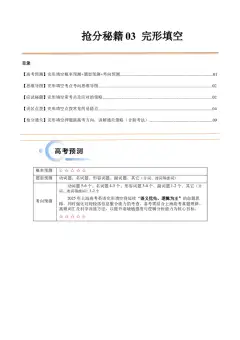
抢分秘籍 03 完形填空
目录
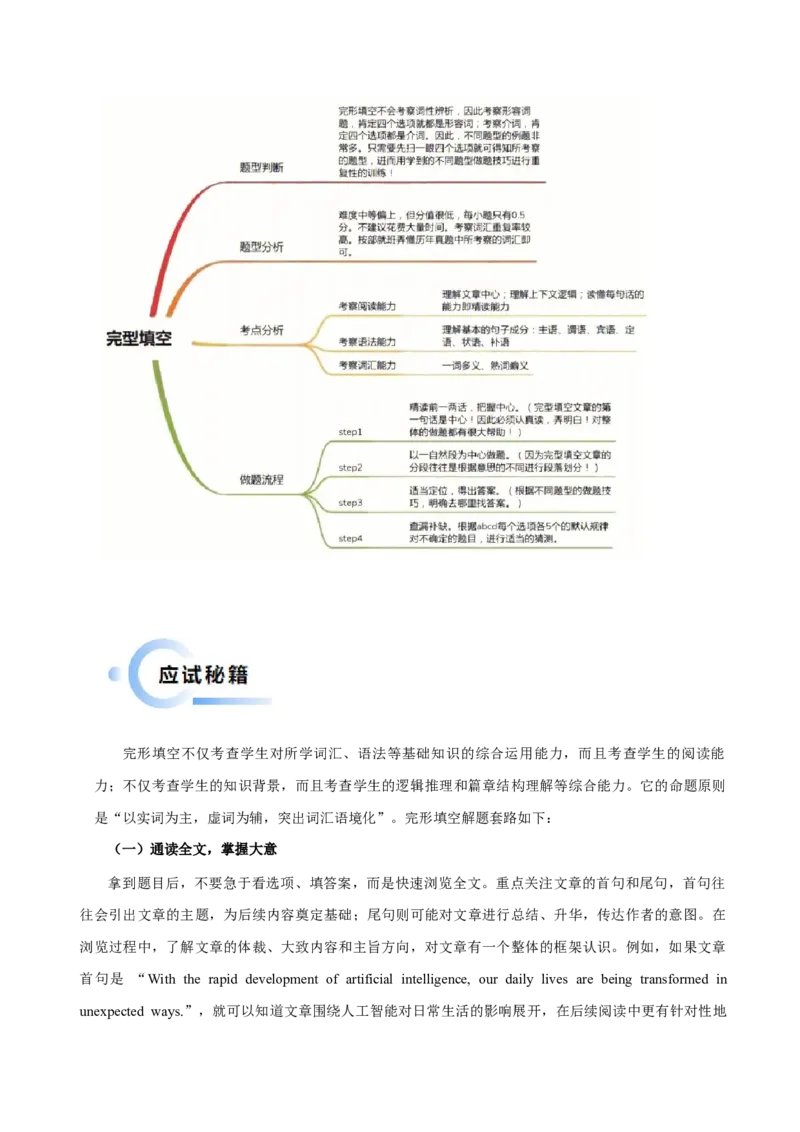
【高考预测】完形填空概率预测+题型预测+考向预测........................................................................................01
【思维导图】完形填空考点考向思维导图............................................................................................................02
【应试秘籍】完形填空常考点及应对的策略........................................................................................................02
【误区点拨】完形填空点拨常见的易错点............................................................................................................04
【抢分通关】完形填空押题新高考方向,讲解通关策略(含新考法)............................................................09
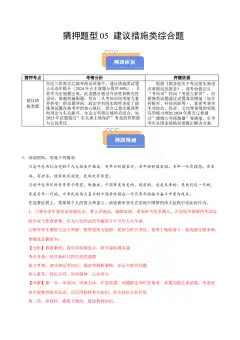
概率预测 ☆ ☆ ☆ ☆ ☆
题型预测 动词题、名词题、形容词题、副词题、其它(介词、连词等虚词)
动词题5-6个、名词题4-5个、形容词题3-4个、副词题1-2个、其它(介词、连
词等虚词)1-2个
2025年上海高考英语完形填空将延续“语义优先、逻辑为王”的命题思路,同
考向预测
时强化对跨段落信息整合能力的考查。备考需结合上海高考真题规律、高频词
汇及科学训练方法,以提升语境敏感度与逻辑分析能力为核心目标。
☆ ☆ ☆ ☆ ☆完形填空不仅考查学生对所学词汇、语法等基础知识的综合运用能力,而且考查学生的阅读能
力;不仅考查学生的知识背景,而且考查学生的逻辑推理和篇章结构理解等综合能力。它的命题原则
是“以实词为主,虚词为辅,突出词汇语境化”。完形填空解题套路如下:
(一)通读全文,掌握大意
拿到题目后,不要急于看选项、填答案,而是快速浏览全文。重点关注文章的首句和尾句,首句往
往会引出文章的主题,为后续内容奠定基础;尾句则可能对文章进行总结、升华,传达作者的意图。在
浏览过程中,了解文章的体裁、大致内容和主旨方向,对文章有一个整体的框架认识。例如,如果文章
首句是 “With the rapid development of artificial intelligence, our daily lives are being transformed in
unexpected ways.”,就可以知道文章围绕人工智能对日常生活的影响展开,在后续阅读中更有针对性地关注相关信息。
(二)逐空分析,先易后难
判断词性与语法要求:阅读到每个空格时,首先根据句子结构判断该空所需词汇的词性。如果句子
缺少谓语动词,就从选项中的动词形式中筛选;若该空在名词前,可能需要一个形容词来修饰。同时,
考虑句子的语法规则,如时态、语态、主谓一致等。例如,“The project ______ (complete) next
month will bring great benefits to the community.”,根据时间状语 “next month” 可知应用一般将来
时,且 “project” 与 “complete” 是被动关系,所以应填 “will be completed”。
结合上下文逻辑:从上下文寻找线索,判断该空与前后文的逻辑关系。如果前文描述了一个问题,
后文提到了解决办法,那么中间的空可能需要一个表示因果关系的词。例如,“He missed the bus this
morning. ______, he was late for school.”,这里应填 “Therefore”。对于一些较难判断的空,可以先
暂时搁置,继续往下读,随着对文章理解的深入,可能会从后文找到提示。
进行词义辨析:当通过词性和逻辑筛选出几个可能的选项后,仔细辨析它们的词义。注意近义词、
同根词的细微差别,结合语境选择最恰当的词汇。比如,“The ______ of the new policy has caused a
lot of discussion.”,选项中有 “effect”(影响)和 “affect”(影响,动词),这里需要一个名词,所
以应选 “effect”;若选项中有 “influence”,则要进一步分析 “effect” 和 “influence” 在语境中
的细微差别,“effect” 更强调直接产生的结果,“influence” 侧重于潜移默化的影响,根据文章具体
语境选择。
(三)复读全文,检查验证
完成所有填空后,再次通读全文。从语法、词汇、逻辑和语篇等多个角度进行检查。检查语法是否
正确,句子结构是否完整,词汇搭配是否合理,文章逻辑是否连贯,整体意思是否通顺。如果发现有不
顺畅或不合理的地方,仔细分析并进行修改。例如,检查到某句话 “Although he worked hard, but he
still failed the exam.” 存在语法错误,“although” 和 “but” 不能同时使用,应删去 “but”。通过
认真检查,确保答案的准确性和完整性,提高得分率。
坚持两大原则:
1.语义优先于语法原则
文章的开头部分尤其是第一句话不设空格,它起到的作用是对所选短文的题材和可能涉及的内容
作简单的介绍或提示,并且不同于全国卷和其他各种考试类型(如考研等)中的完形填空,单纯的语法题
已从该题型中彻底消失。如果一味按照语法规则来选择答案,就必定陷入了答题误区,无任何选项得以被排除。
每一题脱离语境上下文后四个选项都必定符合语法规则。所以理解文章的主旨大意,快速识别语
篇类型(是议论文还是说明文,并进一步识别是其中具体某一类),进而预判篇章结构以及作者的行文步
骤和风格,心中有了大致的蓝图之后,即可结合以下各种解题技巧和对文章意思的理解对每个空格作
出正确的判断。
2.词内选项句内找原则
从近几年的高考原题来看,近义词或词组的辨析正成为考试的热点。四个选择项要么都是词义相
近的名词单数或复数,要么都是近义动词的同一时态等,只能根据上下文的语境作出正确的选择。如
果提供的四个选择项词义相差悬殊,则上文或下文肯定有答题提示,有时第一个空格要读完全文才能
回答。
易错点一:利用习惯搭配及固定结构解题
秘籍:完形填空题型常常会测试一些固定结构和句式,因此,掌握习惯搭配和固定结构对于解题至关重要。
这一技巧主要涉及惯用搭配,注重词汇间的搭配关系,包括连词、动词、副词、形容词、名词以及短语等。
其中,动词短语、介词搭配、固定句型等高频考点需熟练掌握。
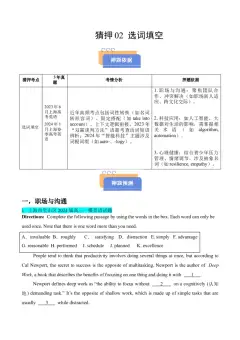
2023年6月上海高考真题第47题
原文段落:
"When Upshur teaches medical students how to diagnose an ailment, he tells them to ______ their inquiry
—come up with a list of possibilities, rather than quickly home in on a single solution."
选项: A. cover B. train C. clarify D. broaden
变式1:2022年7月上海高考真题第46题
原文段落:
"You know that y'know is among the most common of these ______ forms."选项: A. perseverance B. complexity C. hesitation D. obligation
变式2:2022年1月上海高考真题第45题
原文段落:
"In many cases, researchers had failed to disclose ______ of interest relating to links with the food
industry."
选项: A. threats B. matters C. conflicts D. appeals
固定短语 conflict of interest(利益冲突),学术研究中常见搭配。答案:C
易错点二:利用生活常识和文化背景解题
秘籍:结合科学常识、社会现象或文化背景知识辅助解题。完形填空的语篇通常融入了文化科学、历史地
理、风俗民情等多方面的知识。在解答题目时,如果能够主动调动个人的文化背景知识和生活经验,并巧
妙地应用这些知识,尤其是留意中西文化的差异,将能显著简化复杂的分析和判断过程,节省宝贵的时间,
并顺畅地跟随作者的思路继续阅读。
2023年6月上海高考真题第42题
原文段落:
"Experts are asking whether doctors' apparent ______ when communicating with patients does more harm
than good."
选项: A. victim B. instance C. transparency D. certainty
变式1:2022年7月上海高考真题第43题
原文段落: "Be sensitive to the fact that other people are not comfortable talking about emotional
______."
选项: A. appliances B. substances C. disturbances D. finances
变式2:2022年1月上海高考真题第41题
原文段落:
"Artificially sweetened diet drinks make no difference to weight gain and should not be seen as healthier
than their sugar-laden counterparts, according to a team of experts."选项: A. relieve B. oppose C. prevent D. bother
常识中“无糖饮料无法预防肥胖”与研究结论一致,排除其他干扰项。答案:C
易错点三:利用上下文逻辑关系
秘籍:在处理句组层次题目时,运用逻辑关系来解答同样至关重要。完形填空的每个空格都不是孤立的,
命题者必须通过上下文提供线索,以确保填入的答案具有唯一性。这些线索正是贯穿全文的逻辑关系。如
果在解题过程中忽略了这一点,就相当于只关注了细节而忽略了整体。文章的逻辑关系主要包括列举、因
果、让步、对照、递进、目的和条件等。命题者通常会利用连词或介词短语来构建选项。因此,在日常学
习中,我们应当学会辨识并牢记这些连词和介词短语所代表的逻辑关系。
2023年6月上海高考真题第41题
原文段落:
"Yet they've long been taught that... ______ clear diagnosis and a straightforward course of treatment."
选项:
A. On the hand B. Afterwords C. As a result D. Above all
:C
变式1:2022年7月上海高考真题第48题
原文段落:
"If the purpose is to tee up a point, we should accept y'know and its friends as a mildly ______ spoken
punctuation..."
选项: A. annoying B. striking C. entertaining D. embarrassing
变式2:2022年1月上海高考真题第53题
原文段落:
"Leading British nutritionist Professor Susan Jebb said despite the mixed evidence, there was no reason to
believe that replacing sugary drinks with artificially sweetened ______ did any harm."选项: A. initiatives B. alternatives C. objectives D. representatives
易错点四:语义复现
秘籍:即通过原词、同/近义词、上下义词等复现现象锁定答案。
完形填空的文章构成了一个意义紧密相连的语篇,通常围绕一个中心话题展开论述。因此,在行文中,
词语的重复、替代或同现现象是不可避免的。也就是说,某个词汇往往会以原形、同义词、近义词或其他
形式在语篇中反复出现。词汇复现的语用功能确保了语篇中句子的衔接与连贯性,进而形成一个完整且有
机的意义整体。基于这一原则,空格处的答案很可能就是上下文中复现的相关词汇。考生可以利用这些词
汇之间的内在联系来确定答案。
2023年6月上海高考真题第45题
原文段落:
"If you think about knowledge and what it does, it’s about ______ uncertainty, not about creating
certainty."
选项: A. limiting B. hitting C. threatening D. assembling
后文“not creating certainty”提示前文应为“限制不确定性”,limiting 与 uncertainty 复现。答案:
A
变式1:上海高考真题示例2:2022年7月上海高考真题第44题
原文段落: "You know that y'know is among the most common of these ______ forms."
选项: A. perseverance B. complexity C. hesitation D. obligation
变式2:2022年1月上海高考真题第49题
原文段落:
"Artificially sweetened drinks are a step in the ______ direction to cut calories."
选项: A. wrong B. right C. proper D. opposite易错点五:作者态度与情感色彩
秘籍:通过褒贬词、评价性语言判断作者立场,排除态度相反选项。
在完形填空的文章中,我们必须在迅速浏览全文的同时,细心辨识出能够体现作者立场和情感倾向的
关键词汇。这些词汇通常是名词、形容词、副词或动词。它们往往成为我们解题时的关键线索,有助于我
们迅速锁定某些题目的正确选项,或根据作者对人物或事件的正面或负面评价,排除干扰项,作出正确的
判断。
2023年6月上海高考真题第48题
原文段落:
"Even when you make a diagnosis that you think is firm, you usually don’t have certainty about what
would be the best ______ and what the outcomes will be in the long run."
选项: A. identify B. cure C. defend D. cause
变式1:2022年7月上海高考真题第55题
原文段落:
"He ______ ‘The conclusion that reduced sugar or sugar-free drinks should not be promoted or seen as
part of a healthy diet seems unwarranted and likely to add to public ______.’"
选项:
54. A. transferred B. ranged C. accessed D. added
55. A. fascination B. ambition C.confusion D.isolation
变式2:2022年1月上海高考真题第52题
原文段落:
"Artificially sweetened drinks are a step in the ______ direction to cut calories."
选项: A. wrong B. right C. proper D. opposite1.(2025届·上海杨浦区·统考)
Don’t Kick the Robot
Over the next decade, our relationships to our devices will become a lot more interesting. Advanced robot
companions are extremely well-suited to tap into our social 1 and make us behave as though we’re
interacting with something alive. What does it mean to be 2 or physically violent toward an
artificial agent?
People have already started to 3 . For example, during the mass 4 of virtual voice
assistants, parents expressed concern that the little speakers in their living rooms were teaching their kids to be
rude. Major companies responded by releasing special features that encouraged the use of languages like ‘ 5
’ to prevent children from barking commands at the devices.
One 2015 research showed that there’s a link between people’s tendencies for sympathy and how they
feel toward a robot. But that doesn’t answer the question of whether beating up robots makes people more
6 . Society has asked similar questions about video games, with some 7 results. Just because I
play Grand Theft Auto Game doesn’t mean I try to run people over in the car park.
Studies show that we behave differently toward embodied robots than characters on a screen, in part
because we’re biologically hardwired to 8 physical motion. People will 9 treat any agent
that moves like it’s alive. As robot design gets better, the line between alive and lifelike may continue to 10
in our subconscious minds.
If so, maybe it would be great for people to take out their aggression and frustration on human-and
animal-like robots that mimic pain. 11 , they aren’t harming a living being. On the other hand, it
could be bad if it makes people insensitive to violence in other contexts. Would a child who grows up kicking
a robot dog find it 12 to kick a real dog? Unfortunately, desensitization (脱敏) remains a difficult
thing to study.
For now, it seems pretty reasonable to keep robot 13 away from little children. But even for the
rest of us, maybe it’s just not cool to treat an artificial agent poorly. Yes, it’s much better than 14 a
living, breathing being, but why do it at all? As philosopher Vallor argues, it might be worth 15kindness, instead.
1.A.media B.nature C.attitude D.change
2.A.orally B.mentally C.emotionally D.physiologically
3.A.suffer B.assume C.wonder D.inspect
4.A.adjustment B.absence C.awareness D.adoption
5.A.please B.sorry C.nasty D.perfect
6.A.tolerantB.violent C.mature D.inconsistent
7.A.definiteB.positive C.inconclusive D.inaccurate
8.A.take in B.originate from C.react to D.associate with
9.A.readily B.coldly C.eventually D.obviously
10.A.emerge B.fade C.cross D.move
11.A.In addition B.After all C.In a way D.On the contrary
12.A.harder B.funnier C.easier D.worse
13.A.exposure B.company C.fancy D.abuse
14.A.mistreating B.mismanaging C.misleadingD.misunderstanding
15.A.suspecting B.replacing C.spreading D.practising
2.(2025届·上海延安中学·校考)
Better diagnoses. Personalized support for patients. Faster drug discovery. Greater efficiency. Artificial
intelligence (AD) is generating excitement and hyperbole (夸张) everywhere, but in the field of health care it
has the potential to be 1 . In Europe analysts predict that deploying AI could save hundreds of
thousands of lives each year; in America, they say, it could also save money, shaving $200 to $360 billion
from overall annual medical spending, now $4.5 trillion a year (or 17% of GDP). From smart stethoscopes (听
诊器) and robot surgeons to the analysis of large data sets or the ability to chat to a medical AI with a human
face, opportunities 2 .
There is already evidence that AI systems can enhance 3 accuracy and disease tracking,
improve the prediction of patients’ outcomes and suggest better treatments. It can also boost efficiency in
hospitals and surgeries by 4 tasks such as medical transcription and monitoring patients, and by
streamlining administration. It may already be 5 the time it takes for new drugs to reach clinical
trials. New tools, including generative AI, could supercharge these abilities. Yet as our Technology Quarterlythis week shows, 6 AI has been used in health care for many years, integration has been slow and
the results have often been of average standard.
There are good and bad reasons for this. The good reasons are that health care demands high evidentiary
7 when introducing new tools, to protect patients’ safety. The bad reasons involve data, regulation and
incentives. Overcoming them could hold lessons for AI in other fields.
AI systems learn by processing huge volumes of data, something health-care providers have in
abundance. But health data is highly fragmented; strict rules control its use. Governments recognize that
patients want their medical 8 protected. But patients also want better and more personalized care.
Each year roughly 800,000 Americans suffer from poor medical decision- making.
Improving accuracy and reducing 9 in AI tools requires them to be trained on large data sets
that reflect patients’ full diversity. Finding secure ways to allow health data to move more freely would help.
But it could benefit patients, too: they should be given the right to 10 their own records in a digital
format. Consumer-health firms are already making use of data from wearables, with varying success. 11
patients’ records would let people make fuller use of their data and take more responsibility for their health.
Another problem is managing and 12 these innovations. In many countries the governance of
AI in health, as in other areas, is struggling to keep up with the rapid pace of innovation. Regulatory
authorities may be slow to approve new AI tools or may lack capacity and expertise. Governments need to
13 regulators assessing new AI tools. They also need to fill regulatory gaps in the surveillance of adverse
events, and in the continuous monitoring of algorithms to ensure they remain accurate, safe, effective and
transparent.
That will be hard. One solution would be for countries to work together, to learn from each other and
create minimum global standards. A less 14 international regulatory system would also help create a
market in which small companies can innovate. Poorer countries, with less developed health infrastructure,
have much to gain from introducing new tools, such as an AI-powered portable ultrasound device for
obstetrics. Because the 15 to an AI tool is often no treatment at all, they may even be able to
leapfrog the entrenched health systems of rich countries — though a lack of data, connectivity and computing
power will get in the way.
1.A.transformational B.exaggerated C.informative D.capitalized
2.A.popularize B.dominate C.outstand D.flourish
3.A.technological B.administrative C.diagnostic D.theoretical4.A.getting into B.taking on C.breaking through D.hanging
out
5.A.speeding B.devoting C.budgeting D.killing
6.A.whenever B.since C.unlessD.although
7.A.certificates B.barriers C.interventions D.qualifications
8.A.interestB.insurance C.symptom D.privacy
9.A.rumors B.misfortunes C.bias D.defeats
10.A.access B.clarify C.investigate D.preserve
11.A.Chronological B.Authentic C.Portable D.Documentary
12.A.advancing B.exploiting C.resisting D.regulating
13.A.dismiss B.anticipate C.facilitate D.stimulate
14.A.exclusive B.problematic C.complex D.indulgent
15.A.counterpart B.alternative C.rival D.contrary
3.(2024·上海嘉定·一模)
Carlo Rovelli’s book, There Are Places in the World Where Rules Are Less Important Than Kindness,
offers a refreshing perspective on learning, urging readers to pursue curiosity and exploration without
worrying about practical outcomes. For Rovelli, 1 isn’t just a means to an end — it’s a way of
experiencing the world, asking meaningful questions, and connecting with others.
The book celebrates the joy of learning for its own sake, reminding readers that knowledge doesn’t need
to be tied to a specific 2 to be valuable. In today’s fast-paced world, people often view education as
a tool for 3 — getting good grades, securing a job, or achieving material goals. Rovelli 4
this mindset, showing that true learning is about much more than these practical objectives. It’s about
broadening your mind, exploring new ideas, and finding 5 in the process.
Rovelli draws on fascinating stories from science, history, and everyday life to make his point. 6
, he reflects on the revolutionary thinkers of the Renaissance (文艺复兴时期) who dared to question the belief
that Earth was the center of the universe. These individuals weren’t 7 by profit or fame; they were
motivated by pure curiosity and a desire to understand the world. Their discoveries didn’t just change science
— they 8 how people viewed their place in the universe. Rovelli uses these examples to show that
the act of learning itself can be 9 , inspiring new ways of thinking and seeing the world.Another key theme in the book is the connection between learning and wonder. Rovelli believes that
curiosity is one of humanity’s greatest 10 , and he invites readers to cultivate it by exploring topics
that arouse their interest. Whether it’s physics, art, philosophy, or even everyday experiences, the process of
discovering something 11 can be deeply rewarding. He argues that this sense of wonder is what
makes learning worthwhile — not the 12 it might bring.
Rovelli also emphasizes that learning should never be limited by rules or expectations. Instead, it should
be a creative, 13 journey. He encourages readers to ask big questions, follow their interests, and
take time to reflect on what they learn. By doing so, he believes we can 14 a deeper understanding
of ourselves and the world around us.
In There Are Places in the World Where Rules Are Less Important Than Kindness, Rovelli offers a
heartfelt reminder that learning isn’t just about facts or 15 — it’s about curiosity, wonder, and the
joy of discovering new possibilities.
1.A.kindness B.thinking C.learning D.practice
2.A.preference B.purpose C.problem D.condition
3.A.communication B.success C.cooperation D.survival
4.A.challenges B.maintain C.presents D.extends
5.A.meaning B.solution C.conflict D.distinction
6.A.What’s more B.For example C.As a result D.On the contrary
7.A.rejectedB.pursued C.observed D.driven
8.A.shifted B.revealed C.understood D.noticed
9.A.moderate B.appropriate C.expensive D.transformative
10.A.connections B.traditions C.strengths D.innovations
11.A.similar B.funny C.new D.dark
12.A.growth B.grades C.uncertaintyD.wisdom
13.A.shortB.affordable C.safe D.personal
14.A.unlock B.complicate C.complement D.expose
15.A.motivations B.interests C.resultsD.questions
4.(2024·上海宝山·一模)
At times we all wish that we knew what other people were thinking. 1 , people’s facial expressions,movements and posture (姿势) can communicate a lot about what is going on in their minds. Understanding
these messages hidden in people’s language can require a lot of skill, but Joe Navarro’s book What EVERY
BODY is Saying can help 2 that ability.
Small changes in body language can help you recognize if someone is . Even when people don’t lie
directly, they sometimes try to hide their feelings. Whether you are 4 with people in business or in your
personal life, recognizing these feelings can help you look out for their interests and your own.
According to Navarro, establishing a baseline for how a person behaves is important to avoid 5
their body language. Most facial expressions and gestures can mean several different things, so 6 when
people use certain expressions. Recognizing this baseline can help you understand whether expressions and
gestures indicate a(n) 7 to something you said or not. For example, rubbing one’s eyes may be a sign of
8 with a topic. But if the person has been rubbing their eyes 9 , they might just be tired.
When people think of body language, facial expressions tend to come to mind, and these can tell you a
lot. For example, if someone keeps looking away from you, they might be distracted or uncomfortable, and
pressing one’s lips together often indicates 1 0 . And if someone keeps looking away or covering their
mouth, it might mean they are 1 1 something.
Some people have become good at controlling their facial expressions to conceal their 1 2 . When
dealing with someone like that, look at the rest of their body, especially their feet and legs. Many people
bounce their feet when they are happy or excited. 1 3 , if someone feels uncomfortable, they may point
their feet away from the person they are speaking to.
Proximity (接近,亲近) to other people is also part of body language. People stand closer to people they
like or feel comfortable with than to strangers or people they don’t like. And posture also 1 4 . Sitting or
standing up straight can show that someone feels confident, while sitting with crossed arms indicates that they
feel 1 5 or uncomfortable.
Body language can communicate a lot about people's thoughts and feelings, and thus, help you relate to
them.
1.A.Frequently B.Generally C.FortunatelyD.Frankly
2.A.provideB.develop C.discover D.arouse
3.A.lying B.thinking C.changing D.wishing
4.A.cooperating B.negotiating C.investigating D.interacting
5.A.misguiding B.misinterpreting C.mistrustingD.mismanaging6.A.look out B.give out C.figure out D.put out
7.A.reaction B.result C.instinct D.insight
8.A.satisfaction B.anxiety C.appreciation D.discomfort
9.A.occasionally B.constantly C.suddenly D.gradually
10.A.agreement B.excitement C.depression D.displeasure
11.A.hiding B.criticizing C.transferring D.explaining
12.A.habits B.expressions C.emotions D.advantages
13.A.In principle B.In contrast C.In all D.In reality
14.A.adjusts B.follows C.movesD.matters
15.A.defensive B.ambitious C.dependent D.Aggressive
5.(2025·上海闵行·一模)
Effective monitoring of endangered species is key to their survival. Studying the 1 , range, and
habits of wild animals is essential to ensure their habitat remains free from development and illegal hunters.
Traditional methods of monitoring wild animals, especially large ones, include radio-tagging (无线电标记). To
do this, individual animals must at first be captured so that collars can be 2 .
One organization that 3 this technique was WildTrack. In the late 1990s, the team was using
radio-collars to monitor black rhinos (犀牛) in Namibia. However, the team soon realized that the chemicals
used to immobilize the rhino to fit the collars 4 female fertility. Not only that but also a large
proportion of the radio-collars 5 within the first 6 months and had to be replaced. 6 , as
animals grew, the collars would tighten, annoying or even hurting them. The method was costly and had the
unintended 7 of altering the rhinos’ behavior, making the collected data unreliable. At the same time,
the team was working alongside local 8 . Animal tracking is one of the oldest human skills, and these
experts have years of experience in identifying individual animals by their footprints. They could effectively
create a true picture of individual rhinos’ activities without the use of any invasive (侵入的) techniques.
Consequently, the team were interested to know whether the trackers’ knowledge could be effectively 9
a computerized technique for monitoring animal movement.
Within each species, each individual has its own unique foot 10 . If an animal is sighted and
identified just once, and the characteristics of its footprints are properly photographed and measured, itsfootprint can be 11 whenever it is sighted again. If that is done repeatedly, conservationists can draw
up a 12 of all, or at least a significant proportion of the individuals within the population. After that,
conservationists can use it to identify an animal and its movements by its print. The data gathered can be used
for a range of 13 , for example, to monitor biodiversity. WildTrack is currently using footprint
identification technology in Greece to study the potential effect of a large highway construction through brown
bear habitat.
Identifying an animal from its footprint is not without its 14 , however, as each time the
individual places its foot on the ground, it leaves a slightly different track, according to the ground type,
moisture (湿度), and movement. To account for these 15 , it is necessary to collect multiple tracks
from each animal on a range of surfaces.
1.A.flexibility B.diet C.movement D.behavior
2.A.fixed B.updated C.removed D.examined
3.A.opposed B.developed C.promoted D.adopted
4.A.enhanced B.harmed C.tested D.ensured
5.A.lasted B.matched C.failed D.bent
6.A.Therefore B.However C.Likewise D.Moreover
7.A.consequence B.mistake C.cause D.target
8.A.programmers B.photographers C.trackers D.officials
9.A.compared to B.translated into C.integrated into D.classified into
10.A.features B.sizes C.colorsD.shapes
11.A.copied B.recognized C.erasedD.marked
12.A.budget B.schedule C.blueprint D.database
13.A.purposes B.experiments C.solutions D.services
14.A.limitations B.losses C.challenges D.concerns
15.A.variations B.signs C.factors D.standards
6.(2025届·上海金山区·统考)
July 19th was a day for IT heroes. A routine software update caused computer outages in offices,
hospitals and airports worldwide. Most white-collar workers looked sadly at their screens and realized justhow useless they are if they cannot 1 . People in IT came to the rescue of helpless colleagues and
2 passengers. Their work that day was full of stress— but also full of meaning.
If machines can add purpose to some jobs when they fail, what about when they work 3 ? This
is not an idle question, but a serious one. Discussions about A in particular easily get lost in aypotherical (假设
的) debates about wholesale job losses or, worse, the nature of consciousness. But technologies tend to spread
in less 4 ways, task by task rather than role by role. Before machines replace individuals, they
change the nature of the work they do.
That transformation is likely to affect job satisfaction. Many employees give 5 to non-
monetary rewards, such as job interest and engagement. A recent discussion paper surveyed American workers
who had 6 jobs to find out whether and why they thought their new positions were better; they
found that interest in the work mattered more to people than pay and benefits.
However, a study revealed a concerning 7 : Robots in industrial settings reduced the perceived
meaningfulness of jobs across the board, 8 age, gender, skills and the type of work. While machines
can theoretically free up time for more interesting tasks, 9 , they seem to have had the opposite
effect. Why might this be? They find that industrial robots make jobs less physically demanding. But the
number of tasks that remain open to humans 10 , hurting both the variety of work and people’s
understanding of the production process. Work becomes more routine, not less.
However, machines don’t always have a (n) 11 impact. For example, in service industries like
health care, less time spent on boring work might indeed mean more time with patients.
Consumer reactions to automation can also 12 . In an experiment to test how customers reacted
to different descriptions of a cooking set, people who 13 being skilled chefs really didn’t like
products that promised to do everything at the touch of a button. A technology that cuts down on boring tasks
is fine; one that 14 your sense of identity is not.
While it is stil too early to know how AI will affect the quality of work, one thing is clear: machines can
make employees feel 15 about their work. Introducing new technologies in cooperation with
employees, rather than imposing (勉强) them, and enhancing their sense of competence are crucial. Bosses
who ignore these issues are missing something meaningful.
1.A.log in B.opt out C.show off D.hurry up
2.A.stranded B.responsible C.hesitant D.embarrassed
3.A.properly B.purposelessly C.continuously D.unwillingly4.A.accessible B.casual C.dramatic D.dynamic
5.A.rise B.way C.priority D.insight
6.A.created B.switched C.completed D.evaluated
7.A.cause B.concept C.secret D.trend
8.A.rather than B.in case of C.according to D.regardless of
9.A.in practice B.as a result C.in short D.in addition
10.A.exists B.continues C.decreases D.emerges
11.A.negative B.powerful C.immediate D.significant
12.A.ceaseB.occur C.impress D.vary
13.A.occupied themselves with B.prided themselves on
C.concentrated themselves on D.freed themselves of
14.A.lacksB.heightens C.threatens D.maintains
15.A.anxiously B.differently C.strongly D.oddly
7.(2025届·上海宝山区·月考)
I was thrilled to cover a new expedition to Qomolangma as a journalist. However, as I got off the vehicle
at the base camp, I was immediately 1 by dizziness and shortness of breath — 2 of
mountain sickness. Even the act of taking a few steps demanded an extraordinary amount of 3 .
At that moment, a question 4 within me: Why do people keep climbing Mount Qomolangma?
When asked this question, British mountaineer George Mallory gave his famous 5 : “Because it’s
there.”
Mallory reminded me of countless climbers who have put their lives at risk to 6 the mountain’s
towering height with their own footsteps. They encounter an almost vertical (垂直的) wall close to the top. It
is so difficult to find 7 points for climbing that the earliest climbers thought no one could 8
the wall.
In 1960, Liu Lianman, a Chinese climber, let his teammates 9 on his shoulders to cross the
wall. Already 10 , he gathered all his strength to uplift his teammates. Though his 11 did
not appear on the list of those who reached the top, Liu is undoubtedly a true 12 .
I recalled the interview with Dong Hongjuan, the first woman to conquer (征服) 14 mountains above
8,000 meters, who 13 understands how small humans are compared to 14 . She told me:“I never felt I conquered those mountains; it’s just that the mountains 15 me.”
1.A.struck B.taught C.found D.drawn
2.A.causes B.types C.risks D.signs
3.A.patience B.money C.energy D.practice
4.A.ended B.arose C.remained D.lay
5.A.suggestion B.response C.conclusion D.guidance
6.A.adjust B.cover C.measure D.confirm
7.A.check B.view C.rest D.support
8.A.get pastB.come across C.go through D.take back
9.A.work B.fight C.cry D.step
10.A.exhausted B.terrified C.annoyed D.disappointed
11.A.storyB.name C.act D.failure
12.A.champion B.talent C.hero D.friend
13.A.hardly B.slightly C.firstlyD.truly
14.A.time B.life C.nature D.success
15.A.protected B.accepted C.admired D.discovered