2026 年全国硕士研究生招生考试试题(模拟)
(英语一)
Section I
Use of English
Directions: Read the following text. Choose the best word(s) for each numbered blank and
mark A, B, C, or D on the ANSWER SHEET. (10 points)
Scientists around the world are racing to learn how to rapidly diagnose, treat and stop the
spread of a new, deadly disease. SARS --- Severe Acute Respiratory Syndrome --- was (1) ____
for the first time in February 2003 in Hanoi, (2) _____ since then has infected more than 1,600
people in 15 countries, killing 63. At this (3) _____, there are more questions than answers
surrounding the disease.
Symptoms start (4) _____ a fever over 100.4 degrees F, chills, headache or body (5)____.
Within a week, the patient has a dry cough, which might (6) _____ to shortness of breath. In 10%
to 20% of cases, patients require (7)_____ ventilation to breathe. About 3.5% die from the disease.
Symptoms (8)____ begin in two to seven days, but some reports suggest it (9) ____ take as long
as 10 days. Scientists are close to (10) ____ a lab test to diagnose SARS.
In the meantime, it is diagnosed by its symptoms. There is no evidence (11)____ antibiotics
or anti-viral medicines help, (12) _____ doctors can offer only supportive care. Patients with
SARS are kept in isolation to reduce the risk of (13) ____. Scientists aren’t sure yet, but some
researchers think it’s a (14) ____ discovered coronavirus, the family of viruses that cause some
common colds.
Most cases appear to have been passed (15) ____ droplets expelled when infected patients
cough or sneeze. Family members of infected people and medical workers who care (16) ____
them have been most likely to (17) ____ the illness. But recent developments in Hong Kong
suggest that the (18) ____ might spread through air, or that the virus might (19) ____ for two to
three hours on doorknobs or other (20)____. Health experts say it is unlikely, though, that sharing
an elevator briefly with an infected person would be enough to pass the virus.
1.
A. detected
B. caught
C. disclosed
D. revealed
2.
A. but
B. and
C. or
D. yet
3.
A. time
B. point
C. aspect
D. instance
4.
A. from
B. over
C. upon
D. with
5.
A. hurt
B. sore
C. aches
D. feelings
6.
A. process
B. advance
C. progress
D. convert
7.
A. automatic
B. artificial
C. mechanical
D. controlled
8.
A. regularly
B. ordinarily
C. traditionally
D. generally
9.
A. will
B. might
C. should
D. must
10. A. cultivating
B. fostering
C. developing
D. designing
11. A. which
B. that
C. whether
D. what
12. A. so
B. but
C. still
D. yet
13. A. communication
B. transportation
C. transformation
D. transmission
14.
A. lately
B. newborn
C. newly
D. renewed
15. A. under
B. through
C. beneath
D. from
一笑而过
一笑而过
一笑而过
过
一笑而过
一笑而过
一
一笑而过
一笑而过
16. A. for
B. over
C. after
D. about
17. A. acquire
B. receive
C. obtain
D. contract
18. A. ailment
B. ill-health
C. disease
D. infection
19. A. continue
B. linger
C. delay
D. persist
20.
A. exteriors
B. outside
C. surfaces
D. coverings
Section II
Reading Comprehension
Part A
Directions: Read the following four texts. Answer the questions below each text by choosing A,
B, C or D. Mark your answers on the ANSWER SHEET. (40 points)
Text 1
If you intend using humor in your talk to make people smile, you must know how to identify
shared experiences and problems. Your humor must be relevant to the audience and should help to
show them that you are one of them or that you understand their situation and are in sympathy
with their point of view.
Depending on whom you are addressing, the problems will be different.
If you are talking to a group of managers, you may refer to the disorganized methods of their
secretaries; alternatively if you are addressing secretaries, you may want to comment on their
disorganized bosses.
Here is an example, which I heard at a nurses’ convention, of a story which works well
because the audience all shared the same view of doctors. A man arrives in heaven and is being
shown around by St. Peter. He sees wonderful accommodations, beautiful gardens, sunny weather,
and so on. Everyone is very peaceful, polite and friendly until, waiting in a line for lunch, the new
arrival is suddenly pushed aside by a man in a white coat, who rushes to the head of the line, grabs
his food and stomps over to a table by himself. “Who is that?” the new arrival asked St. Peter.
“Oh, that’s God,” came the reply, “but sometimes he thinks he’s a doctor.”
If you are part of the group which you are addressing, you will be in a position to know the
experiences and problems which are common to all of you and it’ll be appropriate for you to make
a passing remark about the inedible canteen food or the chairman’s notorious bad taste in ties.
With other audiences you mustn’t attempt to cut in with humor as they will resent an outsider
making disparaging remarks about their canteen or their chairman.
You will be on safer ground
if you stick to scapegoats like the Post Office or the telephone system.
If you feel awkward being humorous, you must practice so that it becomes more natural.
Include a few casual and apparently off-the-cuff remarks which you can deliver in a relaxed and
unforced manner. Often it’s the delivery which causes the audience to smile, so speak slowly and
remember that a raised eyebrow or an unbelieving look may help to show that you are making a
light-hearted remark.
Look for the humor. It often comes from the unexpected. A twist on a familiar quote “If at
first you don’t succeed, give up” or a play on words or on a situation. Search for exaggeration and
understatement. Look at your talk and pick out a few words or sentences which you can turn about
and inject with humor.
21. To make your humor work, you should
.
[A] take advantage of different kinds of audience [B] make fun of the disorganized people
[C] address different problems to different people [D] show sympathy for your listeners
一笑而过
一笑而过
一笑而过
过
一笑而过
一笑而过
一
一笑而过
一笑而过
22. The joke about doctors implies that, in the eyes of nurses, they are
.
[A] impolite to new arrivals
[B] very conscious of their godlike role
[C] entitled to some privileges
[D] very busy even during lunch hours
23. It can be inferred from the text that public services
.
[A] have benefited many people
[B] are the focus of public attention
[C] are an inappropriate subject for humor
[D] have often been the laughing stock
24. To achieve the desired result, humorous stories should be delivered
.
[A] in well-worded language
[B] as awkwardly as possible
[C] in exaggerated statements
[D] as casually as possible
25. The best title for the text may be
.
[A] Use Humor Effectively
[B] Various Kinds of Humor
[C] Add Humor to Speech
[D] Different Humor Strategies
Text 2
Since the dawn of human ingenuity, people have devised ever more cunning tools to cope
with work that is dangerous, boring, burdensome, or just plain nasty. That compulsion has resulted
in robotics—the science of conferring various human capabilities on machines. And if scientists
have yet to create the mechanical version of science fiction, they have begun to come close.
As a result, the modern world is increasingly populated by intelligent gizmos whose presence
we barely notice but whose universal existence has removed much human labor. Our factories
hum to the rhythm of robot assembly arms. Our banking is done at automated teller terminals that
thank us with mechanical politeness for the transaction. Our subway trains are controlled by
tireless
robot-drivers.
And
thanks
to
the
continual
miniaturization
of
electronics
and
micro-mechanics, there are already robot systems that can perform some kinds of brain and bone
surgery with submillimeter accuracy—far greater precision than highly skilled physicians can
achieve with their hands alone.
But if robots are to reach the next stage of laborsaving utility, they will have to operate with
less human supervision and be able to make at least a few decisions for themselves—goals that
pose a real challenge. “While we know how to tell a robot to handle a specific error," says Dave
Lavery, manager of a robotics program at NASA, “we can't yet give a robot enough ‘common
sense’ to reliably interact with a dynamic world.”
Indeed the quest for true artificial intelligence has produced very mixed results. Despite a
spell of initial optimism in the 1960s and 1970s when it appeared that transistor circuits and
microprocessors might be able to copy the action of the human brain by the year 2010, researchers
lately have begun to extend that forecast by decades if not centuries.
What they found, in attempting to model thought, is that the human brain's roughly one
hundred billion nerve cells are much more talented—and human perception far more
complicated—than previously imagined. They have built robots that can recognize the error of a
machine panel by a fraction of a millimeter in a controlled factory environment. But the human
mind can glimpse a rapidly changing scene and immediately disregard the 98 percent that is
irrelevant, instantaneously focusing on the monkey at the side of a winding forest road or the
single suspicious face in a big crowd. The most advanced computer systems on Earth can't
approach that kind of ability, and neuroscientists still don’t know quite how we do it.
一笑而过
一笑而过
一笑而过
过
一笑而过
一笑而过
一
一笑而过
一笑而过
26. Human ingenuity was initially demonstrated in
.
[A] the use of machines to produce science fiction.
[B] the wide use of machines in manufacturing industry.
[C] the invention of tools for difficult and dangerous work.
[D] the elite’s cunning tackling of dangerous and boring work.
27. The word “gizmos” (line 1, paragraph 2) most probably means
.
[A] programs [B]experts
[C]devices
[D]creatures
28. According to the text, what is beyond man's ability now is to design a robot that can
.
[A] fulfill delicate tasks like performing brain surgery.
[B] interact with human beings verbally.
[C] have a little common sense.
[D] respond independently to a changing world.
29. Besides reducing human labor, robots can also
.
[A] make a few decisions for themselves.
[B] deal with some errors with human intervention.
[C] improve factory environments.
[D] cultivate human creativity.
30. The author uses the example of a monkey to argue that robots are
.
[A] expected to copy human brain in internal structure.
[B] able to perceive abnormalities immediately.
[C] far less able than human brain in focusing on relevant information.
[D] best used in a controlled environment.
Text 3
Could the bad old days of economic decline be about to return? Since OPEC agreed to
supply-cuts in March, the price of crude oil has jumped to almost $26 a barrel, up from less than
$10 last December. This near-tripling of oil prices calls up scary memories of the 1973 oil shock,
when prices quadrupled, and 1979-1980, when they also almost tripled. Both previous shocks
resulted in double-digit inflation and global economic decline. So where are the headlines warning
of gloom and doom this time?
The oil price was given another push up this week when Iraq suspended oil exports.
Strengthening economic growth, at the same time as winter grips the northern hemisphere, could
push the price higher still in the short term.
Yet there are good reasons to expect the economic consequences now to be less severe than
in the 1970s. In most countries the cost of crude oil now accounts for a smaller share of the price
of petrol than it did in the 1970s. In Europe, taxes account for up to four-fifths of the retail price,
so even quite big changes in the price of crude have a more muted effect on pump prices than in
the past.
Rich economies are also less dependent on oil than they were, and so less sensitive to swings
in the oil price. Energy conservation, a shift to other fuels and a decline in the importance of heavy,
energy-intensive industries have reduced oil consumption. Software, consultancy and mobile
telephones use far less oil than steel or car production. For each dollar of GDP (in constant prices)
rich economies now use nearly 50% less oil than in 1973. The OECD estimates in its latest
Economic Outlook that, if oil prices averaged $22 a barrel for a full year, compared with $13 in
一笑而过
一笑而过
一笑而过
过
一笑而过
一笑而过
一
一笑而过
一笑而过
1998, this would increase the oil import bill in rich economies by only 0.25-0.5% of GDP. That is
less than one-quarter of the income loss in 1974 or 1980. On the other hand, oil-importing
emerging economies—to which heavy industry has shifted—have become more energy-intensive,
and so could be more seriously squeezed.
One more reason not to lose sleep over the rise in oil prices is that, unlike the rises in the
1970s, it has not occurred against the background of general commodity-price inflation and global
excess demand. A sizable portion of the world is only just emerging from economic decline. The
Economist’s commodity price index is broadly unchanging from a year ago. In 1973 commodity
prices jumped by 70%, and in 1979 by almost 30%.
31. The main reason for the latest rise of oil price is_______
[A] global inflation.
[B] reduction in supply.
[C]fast growth in economy.
[D] Iraq’s suspension of exports.
32. It can be inferred from the text that the retail price of petrol will go up dramatically if______.
[A] price of crude rises.
[B] commodity prices rise.
[C] consumption rises.
[D] oil taxes rise.
33. The estimates in Economic Outlook show that in rich countries_______.
[A]heavy industry becomes more energy-intensive.
[B]income loss mainly results from fluctuating crude oil prices.
[C]manufacturing industry has been seriously squeezed.
[D]oil price changes have no significant impact on GDP.
34. We can draw a conclusion from the text that_______.
[A]oil-price shocks are less shocking now.
[B]inflation seems irrelevant to oil-price shocks.
[C]energy conservation can keep down the oil prices.
[D]the price rise of crude leads to the shrinking of heavy industry.
35. From the text we can see that the writer seems__________.
[A]optimistic.
[B]sensitive.
[C]gloomy.
[D]scared.
Text 4
The Supreme Court’s decisions on physician-assisted suicide carry important implications for
how medicine seeks to relieve dying patients of pain and suffering.
Although it ruled that there is no constitutional right to physician-assisted suicide, the Court
in effect supported the medical principle of “double effect”, a centuries-old moral principle
holding that an action having two effects—a good one that is intended and a harmful one that is
foreseen—is permissible if the actor intends only the good effect.
Doctors have used that principle in recent years to justify using high doses of morphine to
control terminally ill patients’ pain, even though increasing dosages will eventually kill the
patient.
Nancy Dubler, director of Montefiore Medical Center, contends that the principle will shield
doctors who “until now have very, very strongly insisted that they could not give patients
sufficient medication to control their pain if that might hasten death”.
George Annas, chair of the health law department at Boston University, maintains that, as
long as a doctor prescribes a drug for a legitimate medical purpose, the doctor has done nothing
一笑而过
一笑而过
一笑而过
过
一笑而过
一笑而过
一
一笑而过
一笑而过
illegal even if the patient uses the drug to hasten death. “It’s like surgery,” he says. “We don’t call
those deaths homicides because the doctors didn’t intend to kill their patients, although they risked
their death. If you’re a physician, you can risk your patient’s suicide as long as you don’t intend
their suicide.”
On another level, many in the medical community acknowledge that the assisted-suicide
debate has been fueled in part by the despair of patients for whom modern medicine has prolonged
the physical agony of dying.
Just three weeks before the Court’s ruling on physician-assisted suicide, the National
Academy of Science (NAS) released a two-volume report, Approaching Death: Improving Care at
the End of Life. It identifies the undertreatment of pain and the aggressive use of “ineffectual and
forced medical procedures that may prolong and even dishonor the period of dying” as the twin
problems of end-of-life care.
The profession is taking steps to require young doctors to train in hospices, to test knowledge
of aggressive pain management therapies, to develop a Medicare billing code for hospital-based
care, and to develop new standards for assessing and treating pain at the end of life.
Annas says lawyers can play a key role in insisting that these well-meaning medical
initiatives translate into better care. “Large numbers of physicians seem unconcerned with the pain
their patients are needlessly and predictably suffering”, to the extent that it constitutes “systematic
patient abuse”. He says medical licensing boards “must make it clear...that painful deaths are
presumptively ones that are incompetently managed and should result in license suspension”.
36. From the first three paragraphs, we learn that
.
[A] doctors used to increase drug dosages to control their patients’ pain
[B] it is still illegal for doctors to help the dying end their lives
[C] the Supreme Court strongly opposes physician-assisted suicide
[D] patients have no constitutional right to commit suicide
37. Which of the following statements its true according to the text?
[A] Doctors will be held guilty if they risk their patients’ death.
[B] Modern medicine has assisted terminally ill patients in painless recovery.
[C] The Court ruled that high-dosage pain-relieving medication can be prescribed.
[D] A doctor’s medication is no longer justified by his intentions.
38. According to the NAS’s report, one of the problems in end-of-life care is
.
[A] prolonged medical procedures
[B] inadequate treatment of pain
[C] systematic drug abuse
[D] insufficient hospital care
39. Which of the following best defines the word “aggressive” (line 4, paragraph 7)?
[A] Bold.
[B] Harmful.
[C] Careless.
[D] Desperate
40. George Annas would probably agree that doctors should be punished if they
.
[A] manage their patients incompetently
[B] give patients more medicine than needed
[C] reduce drug dosages for their patients
[D] prolong the needless suffering of the patients
Part B
Directions:
一笑而过
一笑而过
一笑而过
过
一笑而过
一笑而过
一
一笑而过
一笑而过
Part B
Directions: You are going to read a list of headings and a text about plagiarism in the
academic community. Choose the most suitable heading from the list A-F for each numbered
paragraph (41-45). The first and last paragraphs of the text are not numbered. There are two
extra heading which you do not need to use. Mark your answers on ANSWER SHEET l. (10
points)
[A] What to do as a student?
[B] Various definitions of plagiarism
[C] Ideas should always be sourced
[D] Ignorance can be forgiven
[E] Plagiarism is equivalent to theft
[F] The consequences of plagiarism
[G] The acknowledgement of plagiarism
Scholars, writers and teachers in the modern academic community have strong feelings
about acknowledging the use of another person’s ideas. In the English-speaking world, the term
plagiarism is used to label the practice of not giving credit for the source of one’s ideas. Simply
stated, plagiarism is “the wrongful appropriation or purloining, and publication as one’s own of
the ideas, or the expression of ideas of another.”
41.______________________________.
The penalties for plagiarism vary from situation to situation. In many universities, the
punishment may range from failure in a particular course to expulsion from the university. In the
literary world, where writers are protected from plagiarism by international copyright laws, the
penalty may range from a small fine to imprisonment and a ruined career. Protection of scholars
and writers, through the copyright laws and through the social pressures of the academic and
literary communities, is a relatively recent concept. Such social pressures and copyright laws
require writers to give scrupulous attention to documentation of their sources.
42.______________________________.
Students, as inexperienced scholars themselves, must avoid various types of plagiarism by
being self-critical in their use of other scholars' ideas and by giving appropriate credit for the
source of borrowed ideas and words, otherwise dire consequences may occur. There are at least
three classifications of plagiarism as it is revealed in students' inexactness in identifying sources
properly.
They are plagiarism by accident, by ignorance, and by intention.
43.______________________________.
Plagiarism by accident, or oversight, sometimes is the result of the writer’s inability to
decide or remember where the idea came from. He may have read it long ago, heard it in a lecture
since forgotten, or acquired it second-hand or third-hand from discussions with colleagues. He
may also have difficulty in deciding whether the idea is such common knowledge that no
reference to the original source is needed. Although this type of plagiarism must be guarded
against, it is the least serious and, if lessons learned, can be exempt from being severely
punished.
44.______________________________.
一笑而过
一笑而过
一笑而过
过
一笑而过
一笑而过
一
一笑而过
一笑而过
Plagiarism through ignorance is simply a way of saying that inexperienced writers often do
not
know
how
or
when
to
acknowledge
their
sources.
The
techniques
for
documentation-note-taking, quoting, footnoting, listing bibliography — are easily learned and
can prevent the writer from making unknowing mistakes or omissions in his references. Although
'there is no copyright in news, or in ideas, only in the expression of them," the writer cannot
plead ignorance when his sources for ideas are challenged.
45.______________________________.
The most serious kind of academic thievery is plagiarism by intention. The writer, limited
by his laziness and dullness, copies the thoughts and language of others and claims them for his
own. He not only steals, he tries to deceive the reader into believing the ideas are original. Such
words as immoral, dishonest, offensive, and despicable are used to describe the practice of
plagiarism by intention.
The opposite of plagiarism is acknowledgement. All mature and trustworthy writers make
use of the ideas of others but they are careful to acknowledge their indebtedness to their sources.
Students, as developing scholars, writers, teachers, and professional leaders, should recognize
and assume their responsibility to document all sources from which language and thoughts are
borrowed. Other members of the profession will not only respect the scholarship, they will
admire the humility and honesty.
Part C
Read the following text and then translate the underlined segments into Chinese. Write your
answers on the ANSWER SHEET. (10 points)
46. The amazing success of humans as a species is the result of the evolutionary development of
our brains which has led, among other things, to tool-using, tool-making, the ability to solve
problems by logical reasoning, thoughtful cooperation, and language. One of the most striking
ways in which chimpanzees biologically resemble humans lies in the structure of their brains. The
chimpanzee, with the capacity for primitive reasoning, exhibits a type of intelligence more like
that of humans than does any other mammal living today. 47. The brain of the modern chimpanzee
is probably not too dissimilar to the brain that so many millions of years ago directed the behavior
of the first ape man.
For a long time, the fact that prehistoric people made tools was considered to be one of the major
criteria distinguishing them from other creatures. As I pointed out earlier, I have watched
chimpanzees modify grass stems in order to use them to probe for termites. 48. It is true that the
chimpanzee does not fashion tools to "a regular and set pattern"—but then, prehistoric people,
before their development of stone tools, undoubtedly poke around with sticks and straws, at which
stage it seems unlikely that they made tools to a set pattern either.
49. It is because of the close association in most people's minds of tools with humans that special
attention has always been focused upon any animal able to use an object as a tool; but it is
important to realize that this ability, on its own, does not necessarily indicate any special
intelligence in the creature concerned. The fact that the Galapagos woodpecker finch uses a cactus
spine or twig to probe insects from crevices in the bark is indeed a fascinating phenomenon, but it
does not make the bird more intelligent than a genuine woodpecker that uses its long beak and
tongue for the same purpose.
50. The point at which tool-using and tool-making, as such, acquire evolutionary significance is
一笑而过
一笑而过
一笑而过
过
一笑而过
一笑而过
一
一笑而过
一笑而过
surely when an animal can adapt its ability to manipulate objects to a wide variety of purposes,
and when it can use an object spontaneously to solve a brand-new problem that without the use of
a tool would prove insoluble.
Section III
Writing
Part A
Directions:
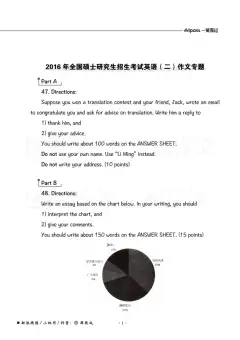
Your classmate, Jimmy, has invited you to join the swimming club. Write him an e-mail,
declining his invitation and explaining why. You should write about 100 words neatly on the
ANSWER SHEET. Do not use your own name at the end of the email. Use “Li Ming” instead
(10 points)
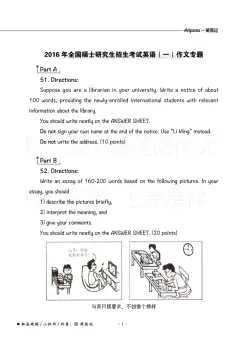
Part B
Directions: Write an essay of 160-200 words based on the chart below. In your essay, you
should
1) describe the chart briefly
2) interpret the meaning, and
3) give your comments.
Write your answer neatly
on the ANSWER SHEET. (20 points)
一笑而过
一笑而过
一笑而过
过
一笑而过
一笑而过
一
一笑而过
一笑而过
参考答案
1-5 ABBDC
6-10 ACDBC
11-15 BADCB
16-20 ADCBC
21-25 CBDDA
26-30 CCDBC
31-35 BDDAA
36-40 BCBAD
41-45 FADCE
46. 人类作为一个物种所取得的惊人成功在于其大脑的进化。这带来了诸多影响,包括工具
的使用和制造,即:通过逻辑推理、细心协作,以及语言来解决问题的能力。
47. 现代黑猩猩的大脑大概同数百万年前指挥最早猿人行为的大脑没有多大的区别。
48. 确实,黑猩猩不能把它的工具做成“常规或固定的样式”,但是史前人类在石器发展以前
毫无疑问也是用树枝和草秆四处翻找。在那个阶段,人类似乎也不可能将工具制成固定
的样式。
49. 正是由于大多数人都认为工具与人类关系密切,所以人类才特别关注可以使用外界物体
作为工具的动物。
50. 严格来说,工具的使用和制造达到进化意义的标志无疑就是动物能够将自己使用外界物
体的能力运用于更广泛的范围,并且能够自发地使用物品来解决只有通过工具才能解决
的崭新问题。
写作Part A
December 26th, 2020
Dear Jimmy,
You can’t imagine how delighted I was when I received your e-mail in which you invite me to
join the university’s swimming club.
Much as I’d like to, it’s my great pity to inform you that I have to decline your kind invitation as
I’ve already agreed to join the basketball club. If you don’t mind, I would like to recommend
Zhang Wei, who enjoys a high reputation for his outstanding physical condition, to replace me. I
am confident that he will make an excellent swimmer.
Look forward to your favourable reply. Thank you for your invitation all the same. Wish your club
a complete success.
Best Regards
Li Ming
写作Part B
Reflected in the table above is the situation of work satisfaction of the employees in a certain
company. Among all the three age groups included in the survey, the over 50 group outruns the
others, with the highest 40.0% job satisfaction. The workers under 40 come as the runner-up,
which occupies 16.7%, while those between 41 and 50 rank the last, making up only 0.0%.
Even though quite complex factors contributed to this phenomenon, by no means can we deny that
the major reasons can be identified as follows. For one thing, more stable working conditions and
less desire rendered it possible for the older employees to feel less burden, as a result of which
their job satisfaction was naturally found on top of the list. On the other hand, owing to the great
pressure and burden from all aspects of life, the group between 41 and 50 attached more
importance to their career development in the highly competitive working world, which could be
easily turned into dissatisfaction and complaint.
As for me, it is advisable that the company should work out more policies to inspire the employees,
like creating more promotion opportunities and providing better welfare packages so that the staff
一笑而过
一笑而过
一笑而过
过
一笑而过
一笑而过
一
一笑而过
一笑而过
can truly enjoy work. (207 words)
一笑而过
一笑而过
一笑而过
过
一笑而过
一笑而过
一
一笑而过
一笑而过