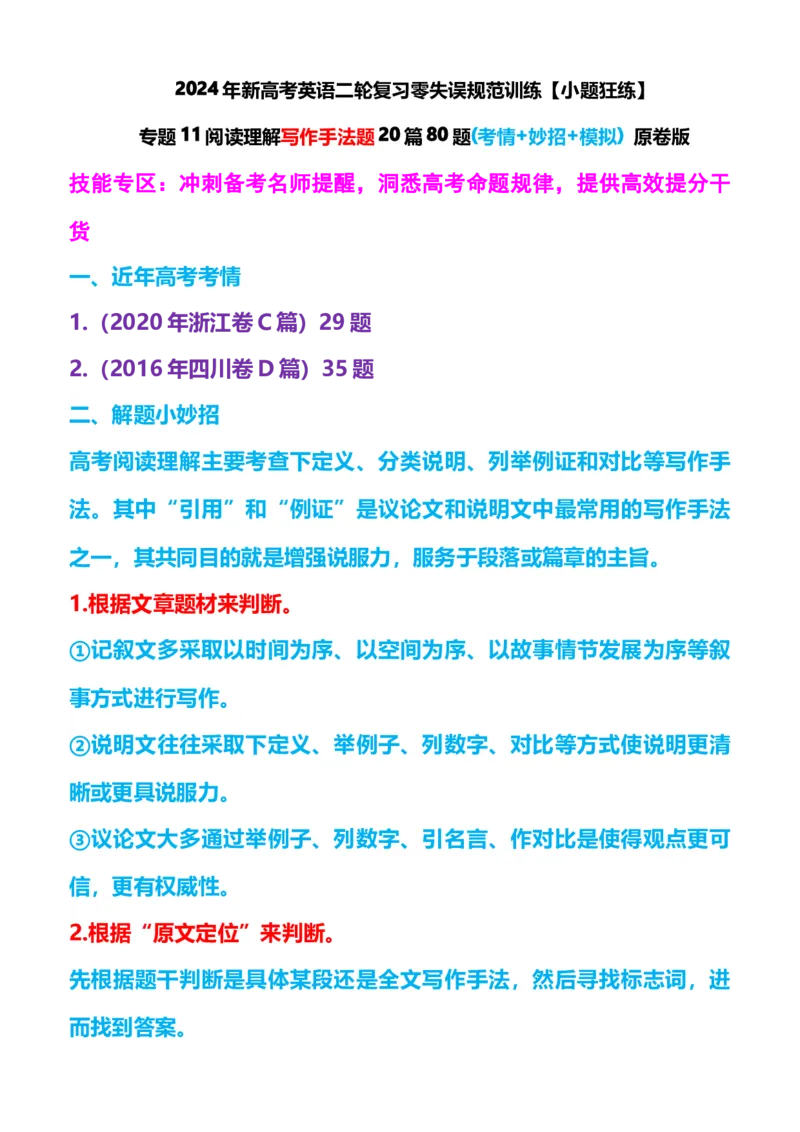
2024年新高考英语二轮复习零失误规范训练【小题狂练】
专题11阅读理解写作手法题20篇80题(考情+妙招+模拟) 原卷版
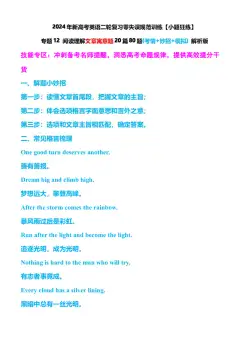
技能专区:冲刺备考名师提醒,洞悉高考命题规律,提供高效提分干
货
一、近年高考考情
1.(2020 年浙江卷 C 篇)29 题
2.(2016 年四川卷 D 篇)35 题
二、解题小妙招
高考阅读理解主要考查下定义、分类说明、列举例证和对比等写作手
法。其中“引用”和“例证”是议论文和说明文中最常用的写作手法
之一,其共同目的就是增强说服力,服务于段落或篇章的主旨。
1.根据文章题材来判断。
①记叙文多采取以时间为序、以空间为序、以故事情节发展为序等叙
事方式进行写作。
②说明文往往采取下定义、举例子、列数字、对比等方式使说明更清
晰或更具说服力。
③议论文大多通过举例子、列数字、引名言、作对比是使得观点更可
信,更有权威性。
2.根据“原文定位”来判断。
先根据题干判断是具体某段还是全文写作手法,然后寻找标志词,进
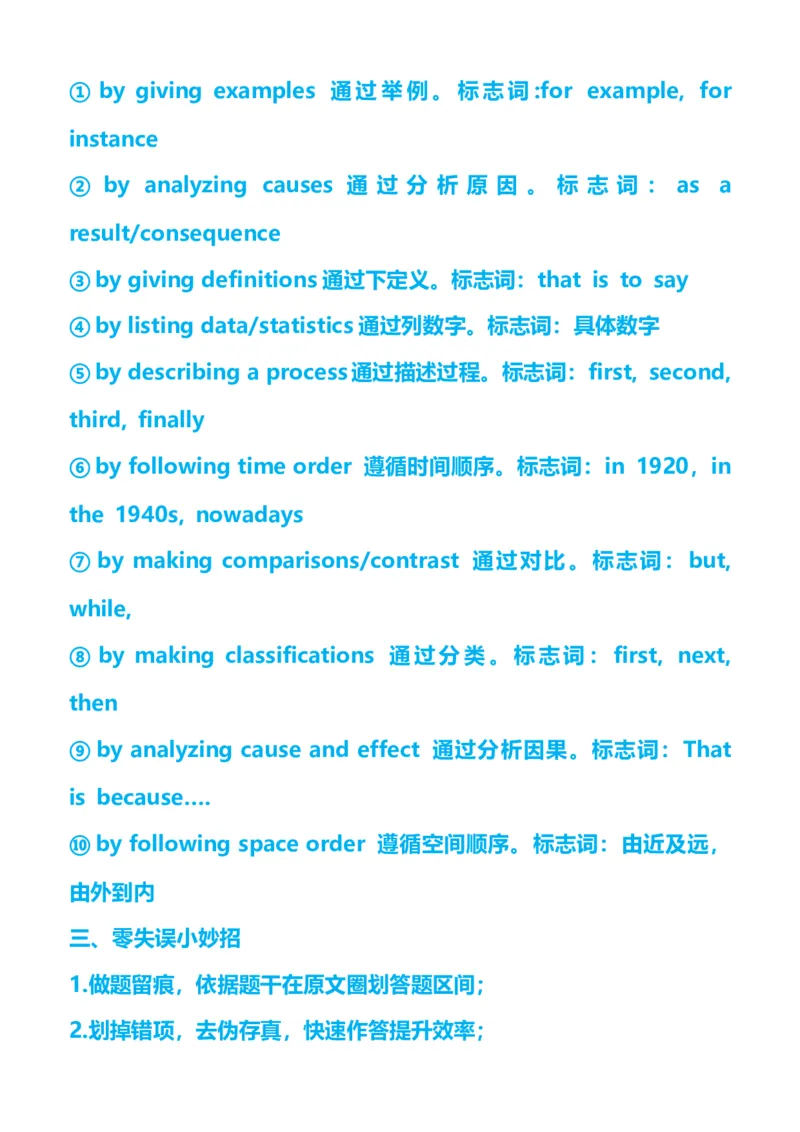
而找到答案。① by giving examples 通过举例。标志词 :for example, for
instance
② by analyzing causes 通 过 分 析 原 因 。 标 志 词 : as a
result/consequence
③ by giving definitions 通过下定义。标志词:that is to say
④ by listing data/statistics 通过列数字。标志词:具体数字
⑤ by describing a process通过描述过程。标志词:first, second,
third, finally
⑥ by following time order 遵循时间顺序。标志词:in 1920,in
the 1940s, nowadays
⑦ by making comparisons/contrast 通过对比。标志词:but,
while,
⑧ by making classifications 通过分类。标志词:first, next,
then
⑨ by analyzing cause and effect 通过分析因果。标志词:That
is because….
⑩ by following space order 遵循空间顺序。标志词:由近及远,
由外到内
三、零失误小妙招
1.做题留痕,依据题干在原文圈划答题区间;
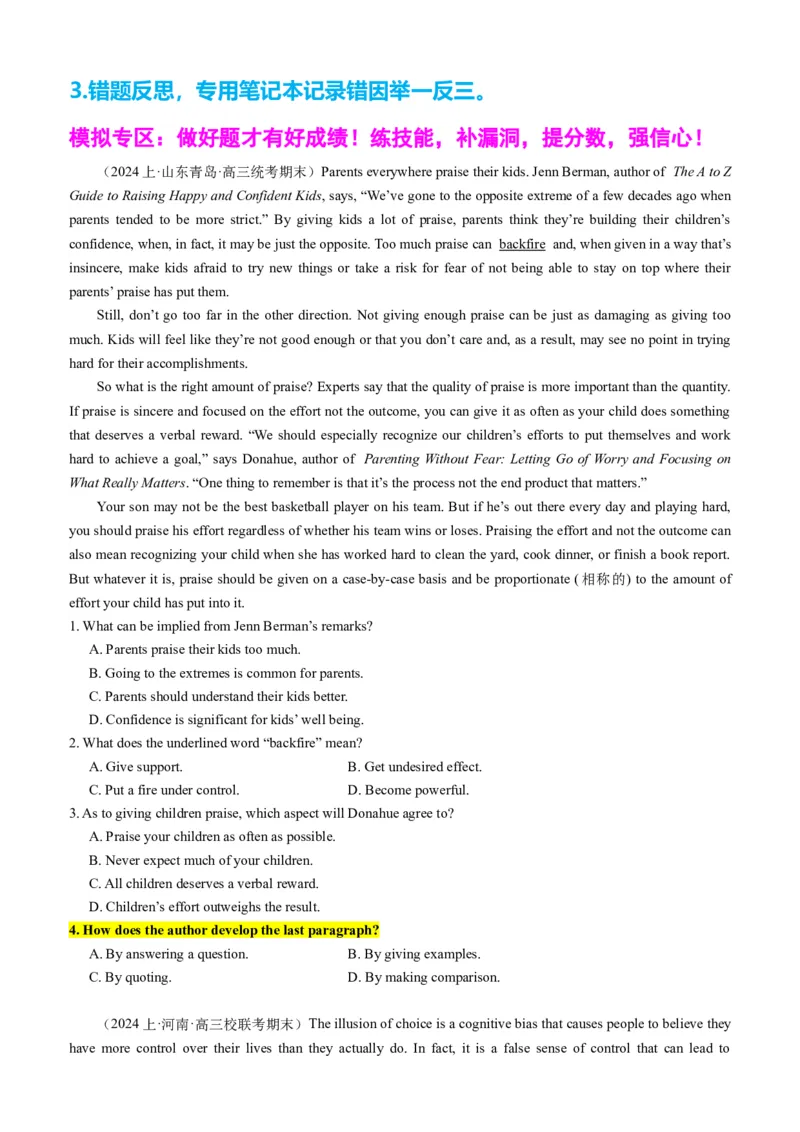
2.划掉错项,去伪存真,快速作答提升效率;3.错题反思,专用笔记本记录错因举一反三。
模拟专区:做好题才有好成绩!练技能,补漏洞,提分数,强信心!
(2024上·山东青岛·高三统考期末)Parents everywhere praise their kids. Jenn Berman, author of The A to Z
Guide to Raising Happy and Confident Kids, says, “We’ve gone to the opposite extreme of a few decades ago when
parents tended to be more strict.” By giving kids a lot of praise, parents think they’re building their children’s
confidence, when, in fact, it may be just the opposite. Too much praise can backfire and, when given in a way that’s
insincere, make kids afraid to try new things or take a risk for fear of not being able to stay on top where their
parents’ praise has put them.
Still, don’t go too far in the other direction. Not giving enough praise can be just as damaging as giving too
much. Kids will feel like they’re not good enough or that you don’t care and, as a result, may see no point in trying
hard for their accomplishments.
So what is the right amount of praise? Experts say that the quality of praise is more important than the quantity.
If praise is sincere and focused on the effort not the outcome, you can give it as often as your child does something
that deserves a verbal reward. “We should especially recognize our children’s efforts to put themselves and work
hard to achieve a goal,” says Donahue, author of Parenting Without Fear: Letting Go of Worry and Focusing on
What Really Matters. “One thing to remember is that it’s the process not the end product that matters.”
Your son may not be the best basketball player on his team. But if he’s out there every day and playing hard,
you should praise his effort regardless of whether his team wins or loses. Praising the effort and not the outcome can
also mean recognizing your child when she has worked hard to clean the yard, cook dinner, or finish a book report.
But whatever it is, praise should be given on a case-by-case basis and be proportionate (相称的) to the amount of
effort your child has put into it.
1. What can be implied from Jenn Berman’s remarks?
A. Parents praise their kids too much.
B. Going to the extremes is common for parents.
C. Parents should understand their kids better.
D. Confidence is significant for kids’ well being.
2. What does the underlined word “backfire” mean?
A. Give support. B. Get undesired effect.
C. Put a fire under control. D. Become powerful.
3. As to giving children praise, which aspect will Donahue agree to?
A. Praise your children as often as possible.
B. Never expect much of your children.
C. All children deserves a verbal reward.
D. Children’s effort outweighs the result.
4. How does the author develop the last paragraph?
A. By answering a question. B. By giving examples.
C. By quoting. D. By making comparison.
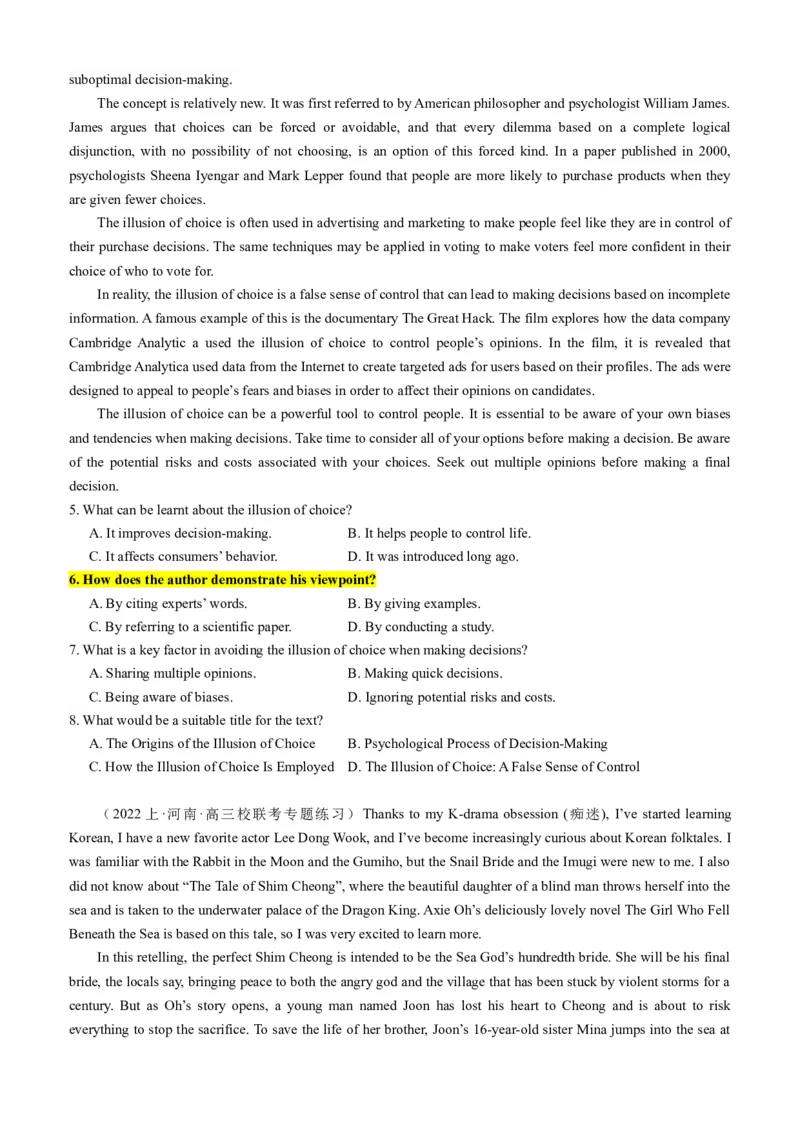
(2024上·河南·高三校联考期末)The illusion of choice is a cognitive bias that causes people to believe they
have more control over their lives than they actually do. In fact, it is a false sense of control that can lead tosuboptimal decision-making.
The concept is relatively new. It was first referred to by American philosopher and psychologist William James.
James argues that choices can be forced or avoidable, and that every dilemma based on a complete logical
disjunction, with no possibility of not choosing, is an option of this forced kind. In a paper published in 2000,
psychologists Sheena Iyengar and Mark Lepper found that people are more likely to purchase products when they
are given fewer choices.
The illusion of choice is often used in advertising and marketing to make people feel like they are in control of
their purchase decisions. The same techniques may be applied in voting to make voters feel more confident in their
choice of who to vote for.
In reality, the illusion of choice is a false sense of control that can lead to making decisions based on incomplete
information. A famous example of this is the documentary The Great Hack. The film explores how the data company
Cambridge Analytic a used the illusion of choice to control people’s opinions. In the film, it is revealed that
Cambridge Analytica used data from the Internet to create targeted ads for users based on their profiles. The ads were
designed to appeal to people’s fears and biases in order to affect their opinions on candidates.
The illusion of choice can be a powerful tool to control people. It is essential to be aware of your own biases
and tendencies when making decisions. Take time to consider all of your options before making a decision. Be aware
of the potential risks and costs associated with your choices. Seek out multiple opinions before making a final
decision.
5. What can be learnt about the illusion of choice?
A. It improves decision-making. B. It helps people to control life.
C. It affects consumers’ behavior. D. It was introduced long ago.
6. How does the author demonstrate his viewpoint?
A. By citing experts’ words. B. By giving examples.
C. By referring to a scientific paper. D. By conducting a study.
7. What is a key factor in avoiding the illusion of choice when making decisions?
A. Sharing multiple opinions. B. Making quick decisions.
C. Being aware of biases. D. Ignoring potential risks and costs.
8. What would be a suitable title for the text?
A. The Origins of the Illusion of Choice B. Psychological Process of Decision-Making
C. How the Illusion of Choice Is Employed D. The Illusion of Choice: A False Sense of Control
(2022 上·河南·高三校联考专题练习)Thanks to my K-drama obsession (痴迷), I’ve started learning
Korean, I have a new favorite actor Lee Dong Wook, and I’ve become increasingly curious about Korean folktales. I
was familiar with the Rabbit in the Moon and the Gumiho, but the Snail Bride and the Imugi were new to me. I also
did not know about “The Tale of Shim Cheong”, where the beautiful daughter of a blind man throws herself into the
sea and is taken to the underwater palace of the Dragon King. Axie Oh’s deliciously lovely novel The Girl Who Fell
Beneath the Sea is based on this tale, so I was very excited to learn more.
In this retelling, the perfect Shim Cheong is intended to be the Sea God’s hundredth bride. She will be his final
bride, the locals say, bringing peace to both the angry god and the village that has been stuck by violent storms for a
century. But as Oh’s story opens, a young man named Joon has lost his heart to Cheong and is about to risk
everything to stop the sacrifice. To save the life of her brother, Joon’s 16-year-old sister Mina jumps into the sea atthe last minute and gives herself to the Sea God instead.
Throughout the story are woven the timeless topics of faith, hope, responsibility, and loyalty to one’s family.
And of course one of my favorite themes in all of literature: fate (命运) versus free will. What is it that determines
our fate? If our path is truly one of our own makings, do we trust ourselves enough to make the “right” choices?
What if we find our goals changing as we go along?
And if you, like me, have fallen hard in love with the legends woven into fantastic dramas like Hotel Del Luna
and Tale of the Nine-Tailed, you’ll want to get your hands on The Girl Who Fell Beneath the Sea immediately and
keep it in a special place on your bookshelf, for the express purpose of enjoying Axie Oh’s magical tale again and
again!
9. What can we learn about Axie Oh from the text?
A. She’s an actress. B. She’s a good diver.
C. She’s a great novelist. D. She’s a language expert.
10. Why did Mina throw herself into the sea?
A. To search for more sea animals.
B. To bring peace to her village.
C. To accompany her friends Cheong.
D. To rescue her beloved brother Joon.
11. How does the author mainly develop paragraph 3?
A. By giving examples. B. By asking questions.
C. By making comparisons. D. By listing figures.
12. What does the author suggest readers do in the last paragraph?
A. Write more fantastic dramas.
B. Learn more traditional dramas.
C. Watch The Girl Who Fell Beneath the Sea on TV.
D. Read the book The Girl Who Fell Beneath the Sea.
(2021·湖南长沙·宁乡一中校考一模)It is no secret that play-based learning improves the cognitive,
physical, social, and emotional well-being of children. Researchers now believe that certain board games, like
Chutes and Ladders and Monopoly, can also help enhance their math skills.
The team at Pontificia Universidad Católica de Chile in Santiago, Chile, came to this conclusion after analyzing
the results of 19 studies. They were conducted between 2000 and2023. All but one of the studies focused on the
relationship between math skills and board games.
In these studies, kids aged 3-9 played board games under the supervision (监督) of teachers or trained adults.
The 20-minute sessions were held twice a week for about six weeks. In some cases, one set of kids (the intervention
group) played number-centric board games, while the other (the control group) played board games that did not
require math skills. in other studies. both the intervention and control groups played number-based games. They
were, however, given different games, like Monopoly and Dominoes.
The participants’ math skills were assessed before and after each study. The researchers looked for improvement
in four key categories. They included the ability to name numbers and demonstrate simple number knowledge-such
as “nine is greater than three.” Changes in the kids’ abilities to add and subtract and their interest in math were also
noted.
The results of the study were published in the journal Early Years on July 6, 2023. It revealed that playing boardgames helps improve the children’s math skills in over half of the four areas. Additionally, nearly a third of the
children in the intervention groups scored higher on math tests than those in the control groups.
The researchers hope their findings will inspire the creation of new board games specially designed for
classroom learning. Meanwhile, boost your math skills by organizing a game a night or two with family and friends
this summer—it all adds up!
13. What’s the researchers’ attitude towards the relationship between play-based learning and children’s well-being?
A. Negative. B. Indifferent C. Doubtful. D. Positive.
14. How were the participants’ math skills assessed?
A. By giving examples. B. By asking questions.
C. By making comparisons. D. By providing definitions.
15. What do the researchers hope their findings will inspire?
A. The improvement of social and emotional well-being in children.
B. The creation of new board games for classroom learning
C. The introduction of play-based learning in schools.
D. The use of board games for physical development
16. What is the main focus of the text?
A. The benefits of play-based leaning to children.
B. The solution to improving children’s math skills.
C. The results of a study on board games and math skills
D. The need for new board games for classroom learning.
(2024 上·山西·高三统考期末)Greta Thunberg may be the voice of a generation alarmed about climate
change but she is also the voice of a generation failing to do much about it. A new study shows that young people,
are taking less action to lower their carbon footprint than older Britons and are much worse at taking simple steps to
help the environment, such as recycling.
The YouGov survey of 1,008 Britons found that more than 80 per cent of 18-to 24-year-old say they are worried
about global warming compared with nearly 70 per cent of the over -65s. A higher proportion (比例) of young
people also believe that urgent action is required to deal, with climate change. However, nearly 90 per cent of the
over-65s say they recycle as much as possible compared with only half of young people. The over-65s are also more
likely to have reduced the number of flights they take, to take steps to save water and to repair items. They are also
more likely to turn the heating down and switch off lights in rooms they are not using.
Overall, the study found that 74 per cent of Britons are concerned about climate change and 70 per cent believe
urgent action is required. However, the data suggests that the economic climate is affecting people’s willingness to
act. Over half of the people questioned said that dealing with, the cost of living is a greater priority than making
changes to lower their environmental impact.
Claudine Blamey, group sustainability director at Aviva, said, “The majority of UK residents believe urgent
action is required to tackle environmental change. It’s heartening to see that older generations are leading the way
through their climate-conscious behaviors and younger people are committing to doing more.” “It is vital that people
realize making a difference is within their gift, helping their families, communities and country to get ready,” he
added.
17. How did researchers of the YouGov survey support their findings?
A. By giving examples. B. By stating arguments.C. By quoting statistical data. D. By presenting theoretical basis.
18. What can be known from paragraph 3?
A. Measures have been taken to get around climate change.
B. Many people in Britain are struggling with their living cost.
C. Most people are unwilling to act to protect the environment.
D. Changes made to lower environmental impact are most effective.
19. Which of the following can best replace the underlined word “heartening” in the last paragraph?
A. Amusing. B. Confusing. C. Disturbing D. Inspiring
20. What is the best title for the text?
A. Britons Lead the Way in Protecting the Environment
B. Action Speaks Louder Regarding Climate Change
C. It Is an Urgent Need to Reduce Carbon Footprint
D. Young People Fail to Act on Carbon Concerns
(2024 上·辽宁·高三朝阳市第一高级中学校联考期末)A new international organization, ReShark,
including partners from 15 countries and 44 aquariums, is challenging the shark statistics. According to National
Geographic, ReShark’s goal is to release 500 endangered zebra sharks in Indonesian waters to increase a wild
population that is on the edge of extinction. This is the first-ever attempt to reintroduce captive sharks into the wild.
Marine reintroductions present significant challenges due to the complexity and shortage of ocean life, as well
as the difficulty in managing threats, according to National Geographic. Team ReShark understands that the
reintroduction may go up in smoke. Unlike land animals that have been successfully reintroduced in the past, such
as giant pandas in China, young sharks are more likely to suffer from diseases and be killed by other animals, and
they struggle to find food on their own.
Sharks have a remarkable history as one of the oldest vertebrate species, surviving five mass extinctions over a
period of 420 million years. They play an important role in marine ecosystems by influencing the ocean’s food
chains. However, they are now facing the second-highest rate of disappearance. Research shows that more than 37
percent of the shark species are at risk of extinction due to overfishing, both legal and illegal. Sharks are hunted for
their meat. Nearly 100 million sharks are killed by human hands each year, according to the organization Sentient
Media.
Despite the alarming decline in shark populations globally, top shark scientists are hopeful that ReShark’s
efforts will succeed. Given these challenges, Simon Fraser University ecologist Dulvy initially had some doubts
about ReShark’s plans. However, after asking some questions, he was surprised by what the initiative could produce.
“This initiative is different,” Dulvy explained. Similarly, Rima Jabado, Dulvy’s successor, recognized ReShark as a
unique project that could provide a lifeline for endangered shark species. “It may provide an opportunity for species
not to go extinct,” she said.
21. What’s the ReShark’s intention of releasing sharks?
A. To conduct shark data collection.
B. To study the living habits of sharks.
C. To save the endangered shark species.
D. To test new ways of keeping sharks.
22. What does the underlined part “go up in smoke” in Paragraph 2 probably mean?
A. Disappear. B. Fail. C. Work. D. Influence.23. How does the Paragraph 3 develop?
A. By giving examples. B. By giving descriptions.
C. By making comparison. D. By making classifications.
24. What does Rima Jabado think of ReShark’s project?
A. Special and promising. B. Hopeful and effortless.
C. Risky and costly. D. Doubtful and immature.
(2023 上·重庆·高三重庆市第十一中学校校考阶段练习)Professionals use the word “amateur” as a
disapproving term for those who lack formal training and qualifications. I think such prejudice is a mistake. One day
that amateur might just create a new industry.
Typical amateurs are free to invent as they please, try new ideas, fail, and get up and do it all again—but better.
As Marshall McLuhan, the media theorist, said: “Amateurs can afford to lose.” They are self-improvers, chasing a
dream rather than a laborious, life-long career within a group. Amateurs can do it part-time, for charity or for fun.
Thanks to the Internet, we can all be competent amateurs at almost everything. Now everyone can DIY and
experiment—from blogging to film-making to online advice shops. The mysteries, terms and exclusiveness of the
self-satisfied old crafts are revealed online for all to see. Besides, the world is vastly more complex now, but that
means even the most respected professional needs expert help. The end of the age of authority means we no longer
hold elites (精英) such as judges and bankers in such awe. For centuries the club-like professional bodies have taken
society in their control, a form of freemasonry (互助协会) for the well-educated and connected.
Charles Leadbeater has written persuasively about the importance of serious amateurs, or “professional
amateurs”, who have helped introduce innovations to the mainstream. These passionate amateurs cooperate to give
disruptive ideas (颠覆性的观点) possibility. Their constructive ideas contribute to the improvement of mountain
bikes. Social enterprises are dominated by enthusiastic amateurs whose priority is to improve the world rather than
bill clients. Among the greatest cooperative achievements of the Internet Age have been Wikipedia and Linux. It is
surprising there haven’t been more crowded-sourced successes. Perhaps business projects have been too chaotic and
lacked the leadership necessary for any complicated project to come to fruition.
Nevertheless, I show my admirations for the armies of gifted amateurs. I don’t deny the importance of
education, but I place greater emphasis on results and originality, which are the highlights of amateurism.
25. The advantages of amateurs are listed below except ______.
A. they enjoy more freedom in creation. B. they can afford the cost of failure.
C. they are the fruit of the Internet Age. D. they have a wide range of choices.
26. What can be seen in Paragraph 3?
A. The influence of professionals are being challenged.
B. Public opinion is influenced by the small group of elites.
C. Only the competent amateurs can make crafts revealed.
D. Human society has been governed by well-educated groups.
27. How does the author present his point in Paragraph 4?
A. By listing figures. B. By making comparisons.
C. By explaining causes. D. By giving examples.
28. What’s the best title for the text?
A. The Evolution of Amateurism B. A New Industrial Revolution
C. A Salute to the Amateur D. The End of Authority Age(2023上·重庆·高三重庆市第十一中学校校考期中)We often share images or thoughts on social networks.
Now, researchers at the Universitat Oberta de Catalunya (UOC) have developed an algorithm (算法) that can analyse
the content people post online.
According to William Glasser’s Choice Theory, there are five basic needs: Survival, Power, Freedom,
Belonging and Fun. “These needs even have an influence on the images we choose to upload to our Instagram page,”
explained Mohammad Mahdi Dehshibi, a researcher at the UOC.
The research team has spent two years working on a deep-learning model that identifies the five needs
described by Glasser. For the study, which has been published in the journal IEEE Transactions on Affective
Computing, the researchers analyzed 86 Instagram profiles, in both Spanish and Persian (波斯语), and developed an
algorithm to identify the content of the images and categorize textual content by assigning different labels.
Glasser’s theory argues that each choice users make on social media does not respond to just one basic need —
the multi-label approach of this study helps to clear it up. Dehshibi uses an example to explain this: “Imagine that a
cyclist is riding up a mountain, and at the top, he can choose between sharing a selfie (自拍照) and a group photo. If
he chooses the selfie, we perceive a need for Power, but if he chooses the other option, we can conclude that the
person is not only looking for Fun but also a way to satisfy his need for Belonging.”
“Studying data from social networks that belong to non-English-speaking users could help build inclusive and
diverse tools and models for addressing mental health problems in people with diverse cultural backgrounds,”
Dehshibi adds.
The research team believe that their study can help improve preventive measures, ranging from identification to
improved treatment when a person has been diagnosed (诊断) with a mental health disorder.
Back in 2019, University of Vermont researchers developed an artificial-intelligence-based system that can
detect signs of anxiety in the speech patterns of young children. Meanwhile, computer scientists from the University
of Alberta, Canada, have developed algorithms that can detect and identify depression through people’s voices.
29. What can the algorithm be used to do?
A. Introducing William Glasser’s Choice Theory.
B. Creating different databases for the research team.
C. Identifying users’ basic needs from the content they share online.
D. Giving people a tool to post images or thoughts on social networks.
30. How does Dehshibi present his idea in Paragraph 4?
A. By providing data. B. By making comparisons.
C. By quoting sayings. D. By giving examples.
31. What does the research team think of their study?
A. It can suggest ways to improve social networks.
B. It is useful in handling mental health problems.
C. It is helpful in changing online users’ bad habits.
D. It can link people with diverse cultural backgrounds together.
32. What does the author intend to do in the last paragraph?
A. Summarize the previous paragraphs. B. Provide some advice for the readers.
C. Add some background information. D. Introduce a new topic for discussion.
(2024·广东·华南师大附中校考模拟预测)Two and a half millennia ago, Socrates complained that writingwould harm students. With a way to store ideas permanently and externally, they would no longer need to memorize.
However, studies today have found that writing on paper can improve everything from recalling a random series of
words to better understanding complex concepts.
For learning material by repetition, the benefits of using a pen or pencil lie in how the motor and sensory
memory of putting words on paper reinforces that material. The scribbling (涂鸦) on a page feeds into visual
memory: people might remember a word they wrote down in French class as being at the bottom-left on a page.
One of the best-demonstrated advantages of writing by hand seems to be in note-taking. Students typing on
computers wrote down almost twice as many words directly from lectures, suggesting they were not understanding
so much as rapidly copying the material. However, handwriting forces note-takers to process and organize ideas into
their own words. This aids conceptual understanding at the moment of writing, resulting in better performance on
tests.
Many studies have confirmed handwriting’s benefits, and policymakers have taken note. Though America’s
curriculum from 2010 does not require handwriting instruction past first grade (roughly age six), about half the states
since then have required more teaching of it. In Sweden there is a push for more handwriting and printed books and
fewer devices. England’s national curriculum already includes the teaching of basic cursive writing (连写体) skills
by age seven.
However, several school systems in America have gone so far as to ban most laptops. This is too extreme. Some
students have disabilities that make handwriting especially hard. Nearly all will eventually need typing skills.
Virginia Berninger, professor of psychology at the University of Washington, is a longtime advocate of handwriting.
But she is not a purist; she says there are research tested benefits for “manuscript” print-style writing but also for
typing.
Socrates may or may not have had a point about the downsides of writing. But no one would remember, much
less care, if his student Plato had not noted it down for the benefit of future generations.
33. According to the text, why does writing on paper have benefits for learning?
A. It provides visual enjoyment in class.
B. It improves the effect of memorization.
C. It promotes the motor and sensory ability.
D. It helps to remember the information forever.
34. How does the author show the emphasis on handwriting instruction at school?
A. By giving examples. B. By providing statistics.
C. By making comparisons. D. By making classification.
35. What is paragraph 5 mainly about?
A. Difficulties faced by the disabled.
B. Unreasonableness of forbidding typing.
C. The research-tested benefits of typing.
D. The longtime advocacy for handwriting.
36. Why does the writer mention Socrates and Plato in the last paragraph?
A. To thank Plato for his efforts.
B. To defend Socrates’ point of view.
C. To show people’s indifference to typing.
D. To confirm the importance of handwriting.(2021·河南·模拟预测)Think of the last time you disagreed with another person. Maybe you argued with a
sibling (兄弟,姊妹) over what to watch on TV. Or perhaps you tried to convince grown-ups that ice cream makes a
better dinner than vegetables. How did your disagreement end? Were you able to see the issue from the other
person’s viewpoint?
In many situations, disagreements are unavoidable. They’re part of life. After all, everyone has different
opinions. We all have past experiences that shape how we see the world. Still, not all disagreements are bad. In fact,
many people look at them as opportunities to learn. They do so by trying to understand where both sides are coming
from.
How can you understand both sides of an issue? Often, it’s best to start by asking questions. Questions help us
learn about the world around us. The right questions can also help us learn about other people. In a disagreement,
asking for more information can help you learn about a person’s viewpoint. It can also lead you to gather more facts.
This can paint a better picture of the entire issue.
When seeking to understand both sides of an issue, it’s important to know the difference between facts and
opinions. Remember, facts are based on true information. Opinions can change from person to person. Paying
attention to facts can stop biases (偏见) from taking over in a disagreement. This can help everyone involved see
both sides of the issue.
Maybe you’re wondering why it’s important to understand both sides of an issue, anyway. After all, don’t most
people just want to prove that their side is right? Often, that’s true. However, understanding the whole issue can lead
to both sides working together.
Disagreements may be uncomfortable at first. However, when both sides truly try to understand each other, they
often find they have more in common than they thought. The next time you disagree with other people, try asking
them questions about their viewpoints. You never know what you might learn.
37. What does the underlined word “so” refer to in Paragraph 2?
A. Ignoring chances to learn.
B. Knowing more about themselves.
C. Shaping a right way to see the world.
D. Making the disagreements a chance to learn.
38. According to the passage, how can we solve a disagreement?
A. By changing the other’s opinion.
B. By making both sides comfortable.
C. By trying to stand in the other’s shoes.
D. By telling facts and opinions apart.
39. How does the author support his view?
A. By reasoning. B. By making comparison.
C. By debating. D. By giving examples.
40. What’s the author’s attitude to people’s arguments?
A. Indifferent. B. Pessimistic. C. Positive. D. Skeptical.
(2023上·湖北·高三华中师大一附中校考期中)In 2022, campaign group Fashion Revolution Chelsea dye a
garden for its Chelsea Flower Show presentation. An ancient craft, natural dyeing is a practice whose time has come
again, with hand tie-dyed fashion also making a comeback in recent years.
The revival has been encouraged by Covid lockdowns, “which allowed people to explore the craft at home, saysnatural-dyeing enthusiast and teacher Susan Dye. It’s unlikely, though, that the practice would have caught on in
quite the same way if not for a continually growing discomfort about fashion’s heavy footprint. From carbon
emissions to animal cruelty, fashion is under considerable inspection. “Put it this way, 97% of dyes used in the
industry are petrochemically (石油化学产品) based,” says sustainable fashion consultant Jackie Andrews, who
helped advise the UN Ethical Fashion Initiative. We’ve got net zero targets which mean we’re going to have to
remove all those petrochemicals from the manufacturing cycle.
Fashion is a huge polluter. According to the UN Environment Program, the industry is responsible for up to
one-fifth of all industrial water pollution—due to the fact that most clothes today are produced in poorer countries
where regulation is weak and enforcement weaker. Waste water is dumped directly into rivers and streams, poisoning
the land as well as the water sources of people and animals who rely on them.
It’s easy to see why someone who cares about people, planet and animals, as well as clothes, might turn to
natural plant dyeing. From the beauty of the raw materials—often wild plants-to the property of only bonding with
natural fiber like cotton and linen (亚麻布) from the minor footprint of recycling old clothing that has grayed or
faded over time to the vibrant and long-lasting dyeing results, plant dyeing feels like a quiet act of rebellion. This is
why, while beginners start with simply changing their clothes’ color, new worlds open. Many of today’s natural dyers
grow their own dye plants, run local community workshops, and advocate for change in industrialized fashion
systems and beyond.
41. What is the main reason for the growing discomfort mentioned in paragraph 2?
A. The adoption of petrochemical-based dyes
B. The disturbing consequences of the fashion industry.
C. The fashion industry’s focus on luxurious designs.
D. The challenging net zero targets to be achieved.
42. How does the author illustrate Fashion is a huge polluter?
A. By making a comparison. B. By listing numbers
C. By giving examples. D. By introducing a new topic
43. What does the underlined phrase a quiet act of rebellion in paragraph 4 refer to?
A. A protest against turning to natural fiber.
B. An objection to recycling old clothing
C. A resistance to vibrant colors in natural dyeing
D. A struggle for a sustainable fashion industry
44. What would be the most suitable title for the passage?
A. The Environmental Impact of Natural Dyeing
B. The Return of Natural Dyeing with Ethical Appeal
C. Fashion Revolution’s Dye Garden Presentation
D. The Petrochemical Dye Industry and Its Challenges
(2023上·重庆梁平·高三统考阶段练习)After a particularly strong storm named Klaus hit southwestern
France in 2009, researchers made a curious observation about the damage: nearly all the trees beaten up by winds
blowing at speeds of 94 miles per hour, regardless of their species, height or diameter, however, most trees hit by
strong winds below that were in good condition. Was this wind-speed threshold(分界线) really the arbiter(仲裁者)
of destruction?
Physicist Christophe Clanet and his colleagues at France’s École Polytechnique and ESPCI Paris Tech set tofind out by breaking beechwood rods(格木棒) of different lengths and diameters under controlled conditions. To do
so, they inserted one end of a given rod into a hole of the same diameter in a block of steel and slowly added force to
the other end, causing the rod to bend. Then they measured the critical figures to determine a corresponding wind
speed. What they found matched the real-world situation of 2009: the calculated wind speed to break the rods—no
matter the size was about 94 mph.
However, several outside experts have concerns about this. For example, Lee Frelich, director of the University
of Minnesota Center for Forest Ecology, says that modeling trees as branchless cylinders(无分支气缸) ignores the
streamlining (直线型化) of branches in the wind, which in turn changes the relation between force on the trunk and
wind speed. In other words, the method did not reflect the complex interactions of real-life biology, weather and
physics. Regardless, Clanet and his colleagues do think the results have utility and plan to study whether strong
winds can change the breaking point.
45. How did Clanet conduct the study?
A. By setting plans and giving examples.
B. By collecting figures and using information.
C. By doing experiment and measuring figures
D. By analyzing data and drawing a conclusion.
46. What’s the attitude of Lee Frelich towards the study?
A. Optimistic. B. Indifferent C. Objective. D. Worried.
47. What does the underlined word “utility” in Paragraph 3 mean?
A. Effect. B. Usefulness. C. Future. D. Significance.
48. Which of the following is the best title for the passage?
A. How the wind cuts wood
B. Why the wind destroys wood
C. Wind speed: the changer of winds
D. Whether strong winds can change the breaking point
(2022上·河南·高三校联考期末)Nature can be unforgiving, especially when it comes to the animal world.
As such, squirrels need every advantage they can get in order to protect themselves from a variety of predators that
may want to make them their next meal. Squirrels pay incredibly close attention to their surroundings, and they pick
up alarm calls from other nearby animals in reference to nearby predators. Now, a new study reveals that squirrels
also listen to nearby birds’ conversations to make sure there is no threat close by.
Researchers from Oberlin University say that if the talk from birds is relaxing and normal, the squirrel knows it
is not in immediate danger. The authors said that squirrels were listening to bird conversations and sounds to assess
their safety, so in order to test their theory they observed the behavior of 54 wild Eastern gray squirrels scattered
across various parks and areas in Ohio.
First, a threat was shown by playing a record of a red-tailed hawk(鹰), an animal known to hunt and eat both
squirrels and other smaller birds. Then, researchers played one of two different recordings; one recording was of
many songbirds chattering among one another happily, and the other was with no bird noises. After playing these
recordings, each squirrel’s behavior was monitored for three minutes.
As expected, after hearing the initial record, all the squirrels displayed defensive attitudes, such as running
away, looking around, or freezing their movements. Interestingly, the squirrels that heard the happy sounds of
songbirds returned back to a normal, relaxed state much faster than the other group that heard the quiet sounds.The study’s authors say that this indicates squirrels use the sounds of nearby animals to ensure their own safety.
This allows the squirrel to either get back to what they were doing in a faster manner, or prepare for potential threats
more efficiently.
“Perhaps in some circumstances, cues of safety could be as important as cues of danger,” the study reads. The
study is published in the scientific journal PLOS ONE.
49. What does the underlined word “predators” mean in the first paragraph?
A. Animals that hunt squirrels as food.
B. Animals that make friends with squirrels.
C. Animals that hunt squirrels and birds at night.
D. Animals that steal the food from the squirrels’ nests.
50. What will the squirrels do after hearing the sound of a red-tailed hawk?
A. They will stay and freeze.
B. They will behave normally.
C. They will keep on their guard.
D. They will look around and run away.
51. How did the researchers get the result?
A. By studying the different data.
B. By listing the different figures.
C. By comparing the different responses.
D. By playing different games with the squirrels.
52. What is the best title for the passage?
A. Three interesting experiments.
B. Squirrels listen to birds to stay safe.
C. Judging danger from nearby sounds.
D. Squirrels can record the dangerous sound.
(2023上·全国·高三校联考阶段练习)Zheng Xiaoying was born in Shanghai in September 1929. Her youth
and passion for music helped her become a conductor in an art troupe (巡回演出团). In the early 1960s, Zheng was
sent to the Moscow State Tchaikovsky Conservatory to study opera and symphony conducting, becoming the first
professionally trained female conductor in China at that time.
As a student, she conducted the Italian opera “Tosca” in public at a large opera house in the Soviet Union and
won great applause not only for the wonderful performance, but also for the Chinese woman on the stage. Recalling
this experience, Zheng said it was of great importance for her to become an opera symphony conductor and served as
one of the turning points in her life.
After return to China, she did her best to combine Western and Oriental music. In addition to lectures and
performances, in 1998, she founded the Xiamen Philharmonic Orchestra. With the concept of “attracting more
audiences to the concert hall to enjoy the beauty of music,” the musical orchestra has now gained worldwide
recognition. It has also become a popular travel destination in the city of Xiamen.
Besides being a conductor, Zheng is also a teacher. As one of the most famous Chinese conducting professors,
she has taught many famed musicians. Many of them are still active on stage, both in China and abroad. Still, as a
daughter of the Hakka people, she follows the tradition of valuing education. The Hakka culture enabled her to create
a Chinese symphony called “The Echoes of Hakka Earth Building” which promotes China’s cultural achievements inmusic. So far, the symphony has been performed 80 times in over 12 countries and regions.
Zheng not only promotes the Chinese symphony to the world, she also presents traditional Chinese music. She
said the thought of spending her last few seconds on the conductor’s podium (乐队指挥台) would be what she calls
“the most romantic” of a desirable career. Now in her 90s, Zheng Xiaoying is still active on the stage, sharing China
with the world through her music.
53. What’s a turning point in Zheng’s life?
A. Joining in an art troupe.
B. Studying conducting in Moscow.
C. A job at a large opera house in Italy.
D. A public performance in the Soviet Union.
54. What can we know about the Xiamen Philharmonic Orchestra?
A. It is a characteristic of Xiamen.
B. Its concept is to draw people’s attention.
C. It combines Western and Oriental music.
D. Its aim is to inspire people’s music talent.
55. How is the fourth paragraph mainly developed?
A. By asking questions. B. By listing examples.
C. By analyzing reasons. D. By making comparisons.
56. What do Zheng’s words imply?
A. Her desire for romanticism. B. Her ideal of spreading musical ideas.
C. Her enthusiasm for music career. D. Her achievement in music field.
(2024 上·湖北·高三校联考阶段练习)Soda bottles and sour cream containers—these plastics typically
arrive at recycling plants mixed together in the same bin. But because they are made of different monomers (单体),
they must be sorted into different streams before they can be melted to make new products.
“Until about a year ago, everybody thought the only thing you could do is take a plastic, break it back down to a
monomer and then re-form it,” says Sanat Kumar, a chemical engineer at Columbia University. To seek new
solutions to old recycling problems, his team had to solve a fundamental chemical difficulty: when different plastics
are melted together, their various monomers tend to separate from one another. They have developed a process that
allows different kinds of plastic to be recycled together. Their findings, reported recently in Nature, could give new
life to many items that end up in landfills.
The new process solves this problem by adding chemicals called universal dynamic cross-linkers (交联剂) to
the mix. Just as soap brings together oil and water, which creates a bridge, allowing the oil and water to mix together
and form a stable liquid, these cross-linkers(when applied under heat)form covalent molecular bonds (共价键) that
attach the diverse monomers together. These materials can then be melted and remade again and again because the
cross-linkers can break and re-form their bonds.
The researchers hope the technique could eventually help handle more plastic waste—but it’s not yet cheap
enough to be widely used at existing recycling facilities. Still, Kumar wishes it would be one way to help recyclers
address the plastic waste crisis. “The plastics problem is huge,” he says, “and you’re going to have to look for
multiple solutions.”
57. The difficulty of recycling different plastics together lies in how to ________.
A. re-form them more quicklyB. prevent various monomers being apart
C. break them down thoroughly
D. separate various monomers successfully
58. How does the author explain the new process?
A. By listing facts.
B. By quoting a report.
C. By providing examples.
D. By making a comparison.
59. What can be inferred about the new technique from the last paragraph?
A. It still needs some improvement.
B. It will solve the plastics problem.
C. It has already gained great popularity.
D. It has been affordable for most plants.
60. What can be a suitable title for the test?
A. Monomers Are Still Important for Plastics Recycling
B. The Use of Cross-linkers Outperformed Other Chemicals.
C. Multiple Solutions Are Needed for Mixed-Plastics Recycling
D. New Chemical Process Offers Hope for Mixed-Plastics Recycling
(2024·陕西·校联考三模)A physical checkup often begins with a series of questions: What foods do you
eat? Do you smoke? Getting any exercise? New research suggests another telling indicator could be added to that
list: What was your college major? The study finds one’s chosen field of college study is a statistically significant
predictor of health in midlife.
The researchers find the four majors associated with the best midlife health are architecture/engineering,
biology/life sciences, business, and—here’s a surprise—communications/journalism. Perhaps chasing after big
stories keeps us journalists in shape.
It has long been established that people with more education tend to be healthier. But does one’s major matter?
To find out, the researchers analyzed data from the nationally representative American Community Survey.
Their sample consisted of 3.7 million United States-born adults between the ages of 45 and 64—the time of life
when physical functioning problems start to appear. Participants noted whether they had difficulty walking or
climbing stairs, dressing or bathing. A “yes” answer in any of those categories resulted in a grade of relatively poor
health.
The researchers focused on the 667,362 participants who earned a bachelor’s degree, but went no further in
their education. They noted each person’s college major, which they placed into one of 15 categories. They found
substantial differences in health across majors. Two majors are particularly disadvantaged in midlife. The chances of
poor health are 1.9 times greater among psychology /social work and law/public policy majors compared to business
majors. The researchers argue this is likely due to several factors. Psychology majors tend to suffer from high
unemployment and low earnings. Law/public policy majors often enter the field of law enforcement(执行).
The researchers say that they have discovered associations, not proof of causality(因果关系). But they make a
convincing case that some majors lead people to live healthier lifestyles than others.
Their findings might even inspire a warning country song: Mammas, don’t let your babies grow up to be
psychology majors.
61. What can be learned from the first two paragraphs?A. Smoking can lead to poor health. B. Diet is more important than exercise.
C. Physical checkups keep you healthy. D. College major chould be added to a checkup.
62. How do researchers draw their conclusions?
A. By doing face-to-face interviews. B. By following participants’ daily routines.
C. By doing medical examinations. D. By analyzing the representative data.
63. Which of the following is against midlife health according to the researchers?
A. Engineering. B. Business. C. Psychology. D. Agriculture.
64. What is the best title of the passage?
A. College majors can predict midlife health.
B. More majors in college can improve health.
C. The annual physical exam is necessary to life.
D. People with more education tend to be healthier.
(2024上·陕西西安·高三西安中学校考期末)In recent days, the small “potatoes” from southern China have
occupied Harbin, the capital city of Northeast China’s Heilongjiang province. The streets and alleys are full of
groups of little people sitting on suitcases, feet up in the air, wearing cute hairy hats, light-colored and thick down
jackets.
Upon their arrival, in addition to the must do playing in the ice and snow world, they would not let go of the
food in the Northeast, but they didn’t expect that Harbin also sells tofu curd.
A little “potato” came to a food stall and asked the boss for a tofu curd, and the boss asked her what to add. The
answer — sugar — made the boss widened her eyes and looked at the little “potato” unbelievably. She has never
heard of anyone who eats tofu curd with sugar.
Frozen pears sellers knew that southerners have lived a delicate lifestyle back home, so they cut the frozen pears
into pieces for them, while the locals usually bite them directly.
The Harbiners are sincerely hospitable. They really spoil the small “potatoes”, which makes the locals who have
lived there for decades envious.
In order to welcome the distinguished guests, a transparent glass cover was specially installed in the Harbin
Sophia Square by the municipal government to allow them to watch the snow cozily.
Also, an artificial moon shone brightly in the sky to satisfy their fantasy to admire a white moon on a cold
winter night. Besides, the Oroqen people were called out from the mountains and forests to pull reindeer in the
Central Street of Harbin, just to pet the southern tourists.
According to official data, Harbin received a total of 3.0479 million tourists during this year’s New Year’s Day
holiday, with a total tourism income of 5,914 billion. The number of tourists and the total tourism income reached a
record high. Iron pot stew is the most popular food, and 100,000 pieces of popsicles (棒冰) are sold in 3 days.
65. What is the boss’s reaction when a small “potato” asks for sugar in her tofu curd?
A. Pleased and hesitant. B. Happy and welcoming.
C. Surprised and incredible. D. Excited and enthusiastic.
66. What does the underlined word “installed” in Paragraph 6 probably mean?
A. Held. B. Built. C. Operated. D. Protected.
67. What’s the main idea of the last but one paragraph?
A. The change of the lifestyle of the northeast people.
B. More measures taken to welcome the southern tourists.C. The new attractions added to attract tourists in Harbin.
D. The comparison between the small “potatoes” and the local people.
68. How does the author mainly develop the last paragraph?
A. By listing numbers. B. By giving explanations.
C. By making comparisons. D. By following the order of time.
(2024·四川攀枝花·统考二模)Recently I’ve been drawn to books which motivate me to look at myself, and
hopefully make me a better “me”. The Courage to Be Disliked, by Ichiro Kishimi and Fumitake Koya, has a title I
just can’t go past.
The book has taken Japan by storm, using the theories of philosopher Alfred Adler to create conversations
between a fictional philosopher and a young man. The conversations cover many broad, interesting and sensitive
topics. The philosopher character sticks by the theories of Adler, and explains how we are competent to determine
our own lives, and be free of the influence of past experiences and others’ expectations. It’s a way of thinking that
allows us to develop the courage to change and to ignore the limitations placed on us.
These often complex topics are played out in a conversational style between the two men. While it’s easy to
follow the conversations, the topics will knock around in your own head as you work out whether you sit on the side
of the philosopher, the young man, or somewhere in between. The book is well-received by readers primarily owing
to the fact that it presents two well-balanced viewpoints in the arguments. You’ll find yourself doing household
chores, or at your keyboard, unpacking all the information in your mind and coming to your own conclusions.
You will wholeheartedly agree on some points and want to throw the book at the wall at others. Its content is
polarizing (两极分化) and I certainly don’t agree with everything the philosopher or the young man says, but I think
that’s the point. The Courage to Be Disliked is there to start a conversation with yourself and do some slightly
uncomfortable soul-searching.
69. Which category does the book belong to?
A. Self-improvement. B. Philosophy theory.
C. Collection of experiences. D. Biography of Alfred Adler.
70. Which statement might the fictional philosopher agree with?
A. People are free of their past influence. B. People can take charge of their life course.
C. People should live up to others’ expectations. D. People ought to take their limitations seriously.
71. How does the book develop?
A. By listing sufficient data. B. By making comparisons.
C. By following the time line. D. By presenting dialogues.
72. Why is the book popular with readers?
A. It shows ideas in plain language. B. It displays the scientific statistics.
C. It offers balanced sides to the topics. D. It avoids the use of philosophic terms.
(2024·黑龙江·高三专题练习)I was never very neat, while my roommate Kate was extremely organized.
Each of her objects had its place, but mine always hid somewhere. She even labelled (贴标签) everything. I always
looked for everything. Over time, Kate got neater and I got messier. She would push my dirty clothing over, and I
would lay my books on her tidy desk. We both got tired of each other.
The war broke out one evening. Kate came into the room. Soon, I heard her screaming, “Take your shoes away!
Why under my bed!” Deafened, I saw my shoes flying at me. I jumped to my feet and started yelling. She yelledback louder.
The room was filled with anger. We could not have stayed together for a single minute but for a phone call. Kate
answered it.
From her end of the conversation, I could tell right away her grandma was seriously ill. When she hung up, she
quickly crawled (爬) under her covers, sobbing.
Obviously, that was something she should not go through alone. All of a sudden, a warm feeling of sympathy
rose up in my heart.
Slowly, I collected the pencils, took back the books, made my bed, cleaned the socks and swept the floor, even
on her side. I was so buried in my work that I even didn’t noticed Kate had sat up.
She was watching, her tears dried and her expression showed her disbelief. Then, she reached out her hands to
grasp mine. I looked up into her eyes. She smiled at me, “Thanks.”
Kate and I stayed roommates for the rest of the year. We didn’t always agree, but we learned the key to living
together, giving in, cleaning up and holding on.
73. How is paragraph 1 mainly developed?
A. By analyzing causes. B. By showing differences.
C. By describing a process. D. By following time order.
74. Why did I got tired of my roommate Kate?
A. Kate always hid my belongings.
B. Kate often wore my clothes.
C. Kate wouldn’t share her books with me.
D. Kate didn’t agree with my way of doing things.
75. What made Kate so angry one evening?
A. The author’s shoes were dirty.
B. She heard the author shouting loud.
C. The author’s shoes were in Kate’s place.
D. She got the bad news from her grandma.
76. The author tidied up the room most probably because .
A. she wanted to show her care
B. she was asked by Kate to do so
C. she was scared by Kate’s anger
D. she had planned to do so
(2023·全国·模拟预测)As children, we used to listen to a song called “Sharing is Fun”, which was all about
how we can enjoy things better when we share them. I was not always sure I agreed, particularly when it came to
sharing my snacks with my two brothers.
But later, I come to be aware that the old German children’s song seems to be true — at least for humans. We
altruistically (利他地,无私地) share food: in both hunter-gatherer and industrialized societies; there are customs
and institutions to provide needy people with food, even when it is scarce and the donator needs the food themselves.
In a study in Leipzig, three-year-old children were presented with a task in which they had to pull a board with
an unequal amount of sweets on either end. If there were five jellybeans on one side of the board and only one on the
other side, the children would divide the treats so that everyone got the same amount.
In a very recent study, the 19-month-old infants tested witnessed an experimenter pick up a desirable fruit,“accidentally” dropping it out of reach. When the experimenter tried to reach for the dropped fruit with his
outstretched arm, these little kids handed over the fruit, surprisingly even if they were hungry themselves.
It is well known that wolves provide their children with food, but this is probably an inborn action that can be
explained by kin selection. Chimpanzees do share food with each other. But there is a difference in terms of with
whom, why, and how chimpanzees share. Chimpanzees share independently of the effort each individual invested in
the cooperative hunt — in contrast to the above-mentioned children who worked together to pull a board.
Evolutionary scientists have explained human food sharing like this: by giving away food to strangers,
individuals may promote partnership and group cohesion (凝聚力), thereby helping the species succeed within the
dynamic environment of evolutionary adaptation.
77. Why does the author mention the song “Sharing is Fun”?
A. To express his opinion on sharing. B. To explain the pleasure of sharing.
C. To share his memory of childhood. D. To introduce an old children’s song.
78. What do the studies focus on?
A. The stages of sharing. B. The benefits of sharing.
C. The purposes of sharing. D. The behaviors of sharing.
79. What does the underlined word “kin” in the fifth paragraph mean?
A. Children and zookeepers. B. Hunters and gatherers.
C. Families and relatives. D. Searchers and participants.
80. How does the text develop?
A. By analyzing causes. B. By making comparisons.
C. By following time order. D. By making classifications.