2024年新高考英语二轮复习零失误规范训练【小题狂练】
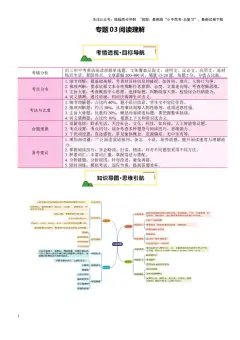
专题12 阅读理解文章寓意题20篇80题(考情+妙招+模拟) 原卷版
技能专区:冲刺备考名师提醒,洞悉高考命题规律,提供高效提分干
货
一、解题小妙招
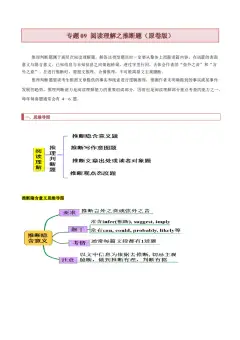
第一步:读懂文章首尾段,把握文章的主旨;
第二步:体会选项格言字面意思和言外之意;
第三步:选项和文章主旨相匹配,确定答案。
二、常见格言梳理
One good turn deserves another.
善有善报。
Dream big and climb high.
梦想远大,攀登高峰。
After the storm comes the rainbow.
暴风雨过后是彩虹。
Run after the light and become the light.
追逐光明,成为光明。
Nothing is hard to the man who will try.
有志者事竟成。
Every cloud has a silver lining.
黑暗中总有一丝光明。God helps those who help themselves.
自助者天助。
Action speaks louder than words.
行动胜于雄辩。
Many hands make light work.
众人拾柴火焰高。
Storms make trees take deeper roots.
暴风雨使树木生根更深。
The darkest hour has only sixty minutes.
困境总会过去。
Failure is the mother of success.
失败是成功之母。
All things come to those who wait.
苍天不负有心人。
The grass is always greener on the other side of the hill.
这山望着那山高
One is never too old to learn.
活到老学到老。
Necessity is the mother of invention.
需要乃发明之母。
Genius is 1% inspiration and 99% perspiration.天才是 1%的灵感和 99%的汗水。
Every dog has its day.
人人都有得意之时
Sharp tools make good work.
工欲善其事
Go into battle with a light pack.
轻装上阵。
Every cloud has a silver lining.
黑暗中总有一丝光明。
Well begun is half done.
良好的开端是成功的一半。
Nothing is impossible to a willing heart.
世上无难事,只怕有心人
All things are difficult before they are easy.
凡事总是由难而易。
The longest journey begins with the first step.
千里之行,始于足下。
Rome wasn’t built in a day.
冰冻三尺非一日之寒。
Easier said than done.
说起来容易做起来难。Two heads are better than one.
三个臭皮匠胜过一个诸葛亮。
Don't judge a book by its cover.
不要以貌取人。
三、零失误小妙招
1.做题留痕,依据题干在原文圈划答题区间;
2.划掉错项,去伪存真,快速作答提升效率;
3.错题反思,专用笔记本记录错因举一反三。
模拟专区:做好题才有好成绩!练技能,补漏洞,提分数,强信心!
(2024·新疆·统考一模)An Indiana man ordered a Sausage McMuffin at his local McDonald’s and got much
more than he expected.
On January 6, TikTok user Josiah Vargas, aka @ dookiedoeboy, shared a video detailing his trip to a
McDonald’s drive-through in Elkhart, Indiana that resulted in him receiving much more than he ordered. In the
video, which has attracted over 2.3 million views, Vargas is shocked by what he finds in his to-go bag instead of
breakfast: thousands of dollars.
“Why? There’s a couple thousand dollars here,” Vargas says, holding up a baggie full of $20bills. “Like, why
would they do this? Why would they give this to me?”
Vargas took to TikTok to share his shocking discovery, knowing that he could easily take the money and leave
the McDonald’s workers in quite a bind. But, ultimately, he says he knows what he needs to do.
“Now I have to return it because I’m a good person, I guess,” Vargas says, putting the money back in the bag.
“How interesting!”
After he walks into the store, he gives the bag to a worker at the register. The worker realizes he’s returning the
cash they had been looking for. Amid all the relieved reactions from staff that can be heard from McDonald’s staff,
one employee asks if they could give him a hug — which he accepts.
Back in the car, Vargas reflects on his good deed. “They were just all hugging me and thanking me,” he says.
“When I was driving away, they called me back in. They gave me $200as well as free McDonald’s for a month.”
The TikTok ends with Vargas sharing what he believes to be the moral of the story. “Do good, people. Returned
$5,000, got $200 and free McDonald’s for a month,” he says. “Good trade value and maybe a viral TikTok.”
1. Why was January 6 a special day for Josiah Vargas?
A. His video views ranked top in TikTok. B. His bag was taken by others by mistake.
C. He was given a lot of money unexpectedly.D. He was awarded a big prize by McDonald’s.
2. What does the underlined phrase “in quite a bind” in paragraph 4 mean?
A. In serious trouble. B. At great ease.C. With extreme caution. D. Under strict control.
3. What words can be used to describe Josiah Vargas?
A. Responsible and generous. B. Considerate and honest.
C. Confident and humorous. D. Curious and lucky.
4. What message does the text try to convey?
A. Every man has his price. B. Money is not everything.
C. Details determine success. D. One good turn deserves another.
(2024·山东潍坊·统考一模)On a bright September day in the French Alps in 2022, John McAvoy was 38
kilometres into a very exhausting ultramarathon through rough mountain paths. Battling tiredness, he pushed his
body and mind through the final leg of the race. With the finish arch in the famous town of Chamonix just four
kilometres away and the cloud-topped peak of Mont Blanc high over him, McAvoy welled up with emotion.
In that moment, he felt so free and alive. It was quite the opposite from where his life had been a decade before.
He had just been released from prison after serving a 10-year sentence.
Now 40 years old, McAvoy has spent the last 10 years rebuilding his life from one of crime to one with
purpose. It was on this day, while running the ultramarathon, that he realized how impactful conquering (征服) this
mountain run could be for inner-city kids like him. After all, sport had helped him live a normal life again and open
up his world. It could do the same for others.
With the help of Youth Beyond Borders, McAvoy started the Alpine Run Project, which recently led 12
disadvantaged British young people through their own Mont Blanc races. The participants, from refugees (难民) to
young reformed criminals and those who grew up in Children’s home, were matched with coaches, consultants and
physiotherapists. After a six-month training program, the youth travelled to the Alps to meet up with McAvoy for
their race.
McAvoy says the highlight of this project for him was watching Yasmin Mahamud, a 20-year-old refugee from
Syria, run through the finish arch and into the arms of her new friends. It was a life-changing high for Mahamud,
too-inspiring her to keep running, take up martial arts and go to university to study physiotherapy.
“It changed my point of view on life, says Mahamud. Pushing herself to complete the race gave her a brief
experience of her own potential through hard work and devotion.” I will always be thankful to John for giving me
this opportunity and guidance.
5. How did McAvoy feel before the finish arch?
A. He felt totally collapsed. B. He was peaceful and hopeful.
C. He was satisfied with his pace. D. He felt as if completely reborn.
6. What can we learn about McAvoy from paragraph 3?
A. He was a builder 10 years ago. B. He realized the importance of sport.
C. He ran to make up for his past wrongs. D. He had sympathy for the inner-city children.
7. Who most probably took part in the Mont Blanc races?
A. A running coach. B. A travel lover. C. A homeless teenager. D. A skilled athlete.
8. What message does McAvoy’s story convey?
A. Live for the moment. B. Dream big and climb high.
C. After the storm comes the rainbow. D. Run after the light and become the light.
(2024·安徽蚌埠·统考三模)In June 1985, two British mountaineers Joe Simpson and Simon Yates made thefirst-ever climb of the West Face of the 21,000 foot snow-covered Siula Grande mountain in Peru. It was
exceptionally tough — but nothing compared to what was to come. Early in the descent (斜坡), Simpson fell and
broke his right knee. Yates could have abandoned him but managed to find a way of lowering him down the
mountain in a series of difficult drops blinded by snow and cold. Then Simpson fell into a crevasse (冰隙) and Yates
eventually had no choice but to cut the rope, utterly convinced that his friend was now dead.
In his subsequent book on the climb entitled “Touching The Void”, Joe Simpson wrote: “As I gazed at the
distant moraines (冰碛石), I knew that I must at least try. I would probably die out there amid those rocks. The
thought didn’t alarm me. It seemed reasonable, matter-of-fact. That was how it was. I could aim for something. If I
died, well, that wasn’t so surprising, but I wouldn’t have just waited for it to happen. The horror of dying no longer
affected me as it had in the crevasse. I now had the chance to confront it and struggle against it. My leg would hurt
when I fell and when I couldn’t get up I would die.”
The survival of Simpson himself was extraordinary. That somehow found a way of climbing out of the crevasse
after 12 hours and then dragged himself six miles back to camp, going three days and nights without food or drink,
would be the stuff of heroic fiction if it was not so true. Indeed, six operations and two years later, he was even back
climbing. All because, against all the odds, he tried.
9. What happened to Simpson?
A. He went blind in the accident. B. He was hurt for lack of the rope.
C. He had his knee injured in the descent. D. He was deserted into a crevasse on purpose.
10. What did Simpson do in the crevasse?
A. He tried to remove the rocks. B. He struggled for food and drink.
C. He thought about his dead friend. D. He stayed calm to rescue himself.
11. What does the underlined word “confront” in paragraph 2 probably mean?
A. Face up to. B. Give way to. C. Get away with. D. Come up with.
12. What message does the text mainly convey?
A. No way is impossible to wisdom.
B. Nothing is hard to the man who will try.
C. The good seaman is known in bad weather.
D. Good company on the road is the shortest cut.
(2024下·广东东莞·高三校联考阶段练习)Tonight, our family was going out to play under the full moon.
My husband Todd and I first started going on full moon walks for ourselves, as we needed these little doses of
moonlight to stay happy, though sometimes we had to hike through the forest to find a perfect spot. But after we
became parents, we did this for our children. We wanted to show Sierra and Bryce that it was not necessary to travel
far from home to have an adventure and learn something new, and that there was much magic in the natural world,
available to all.
Once we arrived at our location, Sierra and I stood holding hands, waiting to cheer the full moon in its rising—a
thin sliver of the appealing moon emerged above the ridge of the mountain afar. Soon, more of the moon came out
until it turned into a brilliant orange sphere. Todd explained to Sierra and Bryce that the moon generates no light, but
simply acts like a mirror, reflecting the sunlight back to us. “Does the moon’s face change?” Bryce asked. I told him
that the moon rotates (旋转) around the earth, but does not spin by itself, so the same side of the moon is always
facing the earth. Sierra remarked that the moon looked larger and closer when it was rising. I explained that it is avisual illusion (错觉) because it is so close to the horizon that the moon magically tricks our eyes into comparing it
with nearby objects, thus creating the impression of the increased size.
Much of the knowledge that I shared with the kids was learned from my parents. During my childhood, they
would take me on educational adventures out in the woods, and as I later found, so did their parents. So every time I
go for a full moon walk with my beloved family, I thank those wise educators who came before me.
To educate, sometimes all it takes is going outdoors and gazing up at the heavens.
13. What does the underlined word “this” in paragraph 2 refer to?
A. Going on a hike through the forest.
B. Taking a walk under the full moon.
C. Watching magic shows every month.
D. Traveling far from home for adventure.
14. What can we learn from their family outing?
A. The kids were reluctant to participate.
B. Todd mentioned the mirror to explain sunlight.
C. The kids exhibited a spirit of exploration about the moon.
D. The author used a magic trick to explain the larger moon.
15. Which of the following best describes the parents?
A. Creative and faithful. B. Selfless and brave.
C. Inspiring and generous. D. Insightful and patient.
16. What does the story convey to the readers?
A. Life is what you make it.
B. Every cloud has a silver lining.
C. Nature is the best teacher.
D. God helps those who help themselves.
(2024·四川巴中·统考一模)When Darrell Langworthy was growing up, Thanksgiving meant 30 neighbors
sharing a potluck meal in the family driveway.
“My parents worked at a golf course. They’d invite all the workers to Thanksgiving dinner. They would never
turn anybody away,” he says. “If there was a kid in the neighborhood who needed dinner, he got it.” It has become an
essential part of their family life. Today, Langworthy carries on the tradition at his restaurant in Colchester, Vermont,
where a combination of barbecue and community service has made Mark BBQ a hot spot.
Colchester is a small town on the shores of Lake Champlain, just north of Burlington. Locals know Mark BBQ
for its brisket burgers, pulled-pork sandwiches and Tex-Mex meatloaf.
For many, Mark BBQ is also a stop on the road to recovery. Enter: Recovery Kitchen, a programme that brings
former addicts into the kitchen to build service industry skills. The effort was inspired by manager Casey DeGuise,
who arrived with a troubled history and even more determination.
“He had been turned down for 35 jobs,” Langworthy says. “We said ‘Let’s take a chance,’ and he’s never let me
down.”
Langworthy knows that a little help can go a long way. “I had a time when I was definitely drinking too much,”
he recalls. Now, he offers to others the support he once needed. He keeps a cooler by Mark BBQ’s front door with
free food for anyone who wants it. But his favorite pastime is still watching full plates turn to dirty dishes.
“If we can pay the bills and staff, we’re happy,” says Langworthy. “If we can help the community, we’rehappier.” So far, Darrell Langworthy has handed out more than 170,000 free meals.
17. What’s the tradition of the Langworthy family?
A. To invite people in his community to Thanksgiving dinner.
B. To work at a golf course like his parents.
C. To start a programme called Enter: Recovery Kitchen.
D. To have a family reunion on Thanksgiving Day.
18. What is special about Darrell Langworthy’s restaurant?
A. It serves tasty and countless food. B. It offers job chances for people.
C. It combines BBQ and community service.D. It lies on the shores of Lake Champlain.
19. Which of the following words can best describe Darrell Langworthy?
A. Adventurous and responsible B. Generous and empathetic
C. Cooperative and productive D. Ambitious and demanding
20. What message is conveyed in the text?
A. Action speaks louder than words. B. Many hands make light work.
C. Loving is a thing that grows. D. Devotion makes the world a better place.
(2023 上·河北沧州·高三泊头市第一中学校联考阶段练习)Time is running short to address climate
change, but there are possible and effective solutions on the table, according to a new UN climate report released in
March.
Only swift, dramatic, and sustained emission (排放) cuts will be enough to meet the world’s climate goals,
according to the new report from the Intergovernmental Panel on Climate Change (IPCC), a body of climate experts
that regularly summarize the state of this issue.
“We are walking when we should be running fast,” said Hoesung Lee, IPCC chair, in a press conference
announcing the report in March. To limit warming to 1.5℃ above preindustrial levels, the target set by international
climate agreements, annual greenhouse-gas emission will need to be cut by nearly half between now and 2030,
according to the report. It calculates that the results from actions taken now will be clear in global temperature trends
within two decades.
“We already have the technology and the know-how to get the job done,” said Inger Andersen, executive
director of UN Environment Programme, during the press conference. “Stopping climate change will still be
complicated, and long-term emission cuts may largely rely on technologies, like carbon dioxide removal, that are
still unproven at scale. In addition to technological advances, cutting emission in industries that are difficult to
transform will involve many factors.”
But in the near term, there’s a clear path forward for the emission cuts needed to put the planet on the right
track. There are some of the tasks with the lowest cost and highest potential to address climate change during this
decade, such as developing wind and solar power, cutting methane (甲烷) emission from fossil-fuel production and
waste, protecting natural ecosystems that trap carbon, and using energy efficiently in vehicles, homes, and industries.
21. What is the author’s attitude towards tackling climate change?
A. Positive. B. Worried. C. Skeptical. D. Uncertain.
22. What does Hoesung Lee mean?
A. It’s impossible to achieve the climate goal.
B. He knows how to cut emission efficiently.
C. The pace of global warming is speeding up.D. He is dissatisfied with current emission cuts.
23. What is the guarantee of long-term emission reduction according to Inger Andersen?
A. Policy. B. Market. C. Funding. D. Technology.
24. What message does this text mainly convey?
A. Emission cutting is urgent.
B. Climate change is unstoppable.
C. Global warming is becoming complicated.
D. Meeting climate goals needs cooperation.
(2024 下·重庆·高三重庆巴蜀中学校考阶段练习)We find the owl at the very edge of our woods the
morning after the storm. Wings flight-frozen and round eyes glassy. I touch its feathers lightly with my fingertip and
I’m surprised because they still feel real even though the owl has slipped away somewhere else and Dad is already
digging a hole for it in the rain-soaked earth.
I lift its body and it’s huge in my hands but the hollow bones do most of the work for me and I almost think the
owl might shake the stiffness from its feathers and fly away. I really don’t think this one should go into a hole in the
ground. I say that to Dad and he says that it’s the circle of life and that now the owl will become part of nature again.
Feeding the soil with its flesh and growing the roots of plants from its feathers.
Dad shifts the last of the dirt with his spade and sits down at the base of a tree with a huff of air that smokes
around him. I put the bird in the hole and mark it with a smooth pebble so I’ll always know.
After we’ve buried the owl, we walk all around the woods and clear the worst of the damage from the winds
and the rain. The damage isn’t as bad as it’s been before and it feels like the storm has cleaned everything back to
being new and fresh. I use my hawk eyes and search the ground in flicks and sweeps and I find treasures in the rain-
raked earth just like always. Pieces of pottery and something that could be a Roman coin. I slip them into my pocket
and they bump against each other to tell their stories to me, but I’ll listen later.
I help Dad load the best of the fallen branches on to the trailer so we can cut them for fire wood or maybe a
bonfire, and then we drive over the muddy paths and back to our house.
25. What do we know about the owl when the author finds it?
A. It is already dead. B. It is hidden in a hole.
C. It is too stiff to fly away. D. It is trying to flee the woods.
26. Why does the author mark the hole with a pebble?
A. To facilitate future visits. B. To show sympathy for the owl.
C. To keep the site clear of plants. D. To draw the attention of passers-by.
27. What message does the author want to convey by mentioning the owl?
A. Storms make trees take deeper roots. B. In nature’s embrace, time stands still.
C. The darkest hour has only sixty minutes. D. With every leaf’s fall, a new life emerges.
28. What does “I’ll listen later” in paragraph 4 reveal about the author?
A. Money-driven. B. Wonder-seeking. C. Artistically talented. D. Emotionally mature.
(2023下·全国·高三校联考阶段练习)An icon (偶像) from my childhood, Linda Ronstadt announced this
week that she has Parkinson’s disease and has lost her ability to sing. One of her songs that I was singing for a long
time without realizing it was, “Poor, poor, poor, me, poor, poor, pitiful me.” However, she is doing anything but
saying, poor me. She is embracing (欣然接受) her accomplishments and bringing enlightenment (启迪) to the worldby sharing her journey. It is wonderful that they are recording her voice via interviews for the generations to come,
as she will more than likely lose her ability to speak clearly. I have enjoyed listening to these interviews.
As a young girl, I had dreams about being a journalist one day. I put those dreams away with reality, along with
my writing. I was singing poor, poor, poor me for a long, long time. Once I changed my song, opened myself up to
the world and allowed things to flow my way... I continue to be constantly amazed.
People actually notice what I have to say. Yes, I have found my voice...and I like it! I am overjoyed each week
when over 700 followers of The Year of the Cicadas blog read what I have floating around in my head. If you are
reading this blog, thank you. It really does matter to me.
Last week I was asked to submit a blog for consideration to the Huffington Post. Do you know they have over
43,240,000 readers every month?! I have no idea if it will be accepted or not, that is not the point. The point is that I
was asked and they wrote me back and said,“Perfect. Thank you so much for doing the work. It was worth it.”Wow,
this is a big moment for me, and for that young girl who one day long ago dreamed about writing an article that
would be published.
29. How does the author begin the text?
A. By providing an example. B. By conveying an opinion.
C. By introducing a conclusion. D. By describing a saying.
30. What can be inferred about the author from the second paragraph?
A. Her dream changed. B. She had many readers.
C. Her mental state changed. D. She began to learn singing.
31. Why did the Huffington Post send the request to the author?
A. Her article got recognized. B. Her blog was extremely popular.
C. Her opinion received support. D. Her work was published.
32. What message does the passage mainly convey?
A. It is the first step that costs.
B. Failure is the mother of success.
C. Things come true to those who dream.
D. The grass is always greener on the other side of the hill.
(2024上·河南·高三校联考期末)“Will you go on this ride with me? ”my friend’s eleven-year-old daughter
Jenny asked. I could have made up an excuse for not wanting to have a go. But earlier that morning, I was ready to
push myself out of my comfort zone. Jenny stared at the ride, eager to experience the same excitement as the brave
group of riders in front of us. I couldn’t say no.
After climbing into our seats, an attendant reached up, pulled down the bar, and locked it in place. The ride
lifted us slowly, then turned us over like the blueberry pancakes I had eaten three hours earlier, and hoped to keep in
their proper place. As I stared at the concrete directly below us, I had a sudden feeling of great fear. I wondered if I
had replacement coverage for the phone that I was sure would slip out of my pocket and break into a million tiny
pieces. I wondered when my new health insurance would kick in.
The ride touched down after twisting and turning our bodies. My friend was waiting for us at the exit. “How
was it?” she asked. “Fine. No big deal,” I said, even though my head was spinning(旋转)like one of the other
annoying machines dotting the midway.
Jenny walked ahead of us and convinced me to keep taking chances and sample more rides.
“Oh, look at the pirate ship(海盗船)!” she said. “That looks like a calm ride.”“Let’s go, Auntie!” she said as she rushed to join others in line.
I followed her, confident the ride would be uneventful. When I reached the bottom, I tapped out like a WWF
wrestler admitting defeat. Although my body was shaking and my head was still spinning, I felt exhilarated just like
I was on cloud nine. That morning, I had set a goal, taken my first step to reach it, and felt the joy of achievement.
Each time you try something for the first time, you will grow—a little piece of the fear of the unknown is
removed and replaced with a sense of satisfaction.
33. What made the author decide to try riding with Jenny?
A. The desired look in Jenny’s eyes. B. The curiosity about the unknown.
C. The encouragement from other riders. D. The eagerness to experience something exciting.
34. What happened to the author when she was in the high sky?
A. She lost her phone. B. She got into a panic.
C. She was served pancakes. D. She almost fell off the seat.
35. What does the underlined word “exhilarated” in paragraph 7 mean?
A. Occupied. B. Excited. C. Confused. D. Disappointed.
36. What message does the story convey?
A. He who hesitates is lost. B. It’s never too late to learn.
C. One’s potential can’t always be underrated. D. It’s worthwhile to get out of your comfort zone.
(2024上·山西阳泉·高三统考期末)After 18 years of devotion to rhythmic gymnastics, Fanni Pigniczki
claimed the gold medal on the international stage. The 23-year-old Hungarian topped the podium (领奖台) not just
once but twice!
In a remarkable display of skill and determination, she secured victories in both the individual all-around and
Ball at Chengdu Sport University Gymnasium. “It was an amazing feeling to see the Hungarian flag rising up,”
Pigniczki said after the medal ceremony. At the Chengdu games, Hungary has secured three gold medals, with
Pigniczki, the country’s only rhythmic gymnast then, responsible for two of those. But it was not without a sense of
regret — her errors in the concluding pose denied her a medal in another round. Pigniczki vowed to learn from that
setback. “I need to improve my stability in the coming training.” she said.
Actually, this positive attitude should be credited to her psychology background at Karoli Gaspar University in
Budapest. This major benefits her athletic pursuits, helping her to better manage her emotions. “I have learned to
stay calmer and think less during competition. I have also learned that I need to relax and concentrate on the ‘now’ of
competition,” added Pigniczki.
“When I was a kid, I tried all kinds of activities like swimming, basketball, and ballet. Seeing the sparking
outfit, I fell in love with rhythmic gymnastics instantly. But what truly attracts me is the feeling of readiness in the
sport, as I could always improve more.” she said. It is this feeling that has motivated her to set numerous records for
Hungarian rhythmic gymnastics. Her outstanding performances at the 2021 European championships earned her a
spot at the delayed Tokyo Olympics. Pigniczki became the first Hungarian rhythmic gymnast to grace the Olympic
stage since Viktoria Frater at the Sydney 2000 Games. At the Olympics, she finished 20th in the qualification round
for the individual all-around. Last year, she continued to make history by becoming the first Hungarian to claim a
World Cup medal in rhythmic gymnastics.
Her role in inspiring the next generation of gymnasts was recognized in May when she was honored with the
Smart Scoring Shooting Star award.
37. What was Pigniczki’s notation towards her errors in competition?A. She looked down upon them directly.
B. She had strong sense of regret for them.
C. She promised never to make them again.
D. She analyzed them with stable emotion.
38. What attracts Pigniczki most in rhythmic gymnastics according to paragraph 4?
A. The gold medals she won for her country.
B. The opportunities to perform at Olympics.
C. The feeling of making improvement constantly.
D. The attractive outfit she saw for the first time.
39. Which word best describes this Hungarian rhythmic gymnast?
A. Motivated.
B. Responsible.
C. Dominated.
D. Predictable
40. What message does the author seem to convey in the text?
A. Pride goes before a fall.
B. Care and diligence bring luck.
C. The power of example is endless.
D. All the roads lead to Rome.
(2024上·福建·高三统考期末)My plan to learn to play the cello (大提琴) was a health y choice. So I took
the next innocent step of going to a shop that sells and rents string instruments, especially violins, violas, and cellos.
The place was a hole-in-the-wall, up a steep flight of stairs. Instruments left a narrow path to the counter where a
woman with grey hair and warm eyes greeted me. Since I couldn’t form a question about what I wanted, I just stood
there exploring the scene, which felt immensely pleasurable.
I rented a cello, a bow, and a case to hold them. What attracted me to the cello was its enormous size and its
soft, smooth, and memorable sounds. It’s an instrument made of beautifully polished wood that I could wrap my
arms around and feel its powerful vibrations when the strings were played. That was a good starting point for me.
The only problem was that I didn’t know how to play it.
There’s a popular belief that the cello is a particularly difficult instrument to learn. Another is the admonition,
“Don’t bother if you are a beginner over age 10!” Well, I was 70, and what others thought no longer influenced me.
And besides, I thought of the words of Dr. Cohen, who suggested that learning causes physical changes in the brain.
So I found a teacher who had respect for older adult beginners and I practiced diligently, daily for years, and
sometimes disheartened, but I kept up. I’m happy to report that now, more than a decade later, I can hold my own in
a string trio and two quartets (two violins, a viola, and me, the female cello)and even a senior community band.
Of course, I’ll never sound like Yo-Yo Ma but you could recognize a Mozart piece if you heard me play it. And,
more importantly, I don’t need to please anyone but myself.
Whether it’s a pleasurable pastime or a new career, the starting point is the same: wonder, curiosity,
determination, and the desire to keep your brain sharp.
41. How did the writer feel in the shop?
A. Amused by the shop assistant.
B. Anxious for a live performance.C. Pleased at the nice music atmosphere.
D. Curious about where to find a teacher.
42. What does the underlined word “admonition” in paragraph 3 mean?
A. Approval. B. Criticism.
C. Puzzlement. D. Warning.
43. Why does the writer mention Dr. Cohen in paragraph 3?
A. To recommend a reliable doctor.
B. To provide proof for common belief.
C. To add another reason for her decision.
D. To stress the crucial function of the brain.
44. Which of the following can best convey the writer’s idea?
A. Art is man’s second nature.
B. One is never too old to learn.
C. Education is the key to success.
D. Happiness is the best form of health.
(2024·山东潍坊·昌乐二中校考模拟预测)Michael and his wife, new residents in a San Francisco
apartment, learned about their neighbor Jeff Dunan’s volunteer work for Bangladesh Relief, an organization that
provides food, clothing and essential supplies for disadvantaged people in northern Bangladesh. Inspired, Michael
donated $150 to Dunan’s GoFundMe campaign. However, a credit card notification alerted him to an unintended
$15,041 charge.
When he saw the five-figure number, he was confused. Soon, it all made sense. Michael’s credit card number
started with four and one. Clearly, he accidentally began typing his credit card information while his cursor (光标)
was still in the donation box.
Michael planned to call Dunan to explain, but before he had the chance to do that, he started receiving
Facebook messages from Shohag Chandra, the charity’s Bangladesh-based program manager, thanking him for his
generous donation. After he looked through the photos of people holding thank-you signs that read his name,
Michael’s heart sank. He felt terrible that he had to withdraw his handsome donation. Once his original contribution
was refunded, he decided to donate $1,500.
Although Michael had told his family and friends about the tale, he decided to share it publicly on social media,
after Dunan told him the organization was desperately in need of funds. “The least I could do was take the time to
post this story online and see if I could inspire other people to donate to the cause,” Michael said.
Little did he know, though, that the story would be seen far and wide, ending up raising more than $120,000 for
Bangladesh Relief in the span of only a few weeks—about eight times Michael’s mistaken donation. According to
Dunan, more than 3,700 people have contributed because of Michael’s post. Michael has been stunned (震惊) by the
ongoing outpouring of support. “Never in my wildest dreams did I imagine this reaction,” he said. “People can be
amazing when they come together for something like this.”
45. How did Michael make the large donation?
A. He input an incorrect amount. B. He encountered a system error.
C. He was greatly inspired by Dunan. D. He entered wrong credit card details.
46. Why did Michael’s heart sink according to Paragraph 3?
A. He saw people in despair. B. He failed to offer enough money.C. He didn’t receive the full refund. D. He realized the scale of his mistake.
47. What motivated Michael to share the story on social media?
A. Dunan’s request for publicity. B. A desire for personal recognition.
C. The organization’s urgent need for funds. D. Pressure from his family and friends.
48. What message does the story convey?
A. Actions speak louder than words. B. Many hands make light work.
C. Always prepare for a rainy day. D. A good beginning is half of victory.
(2023·浙江金华·浙江省义乌中学校考模拟预测)Like many other five-year-olds, Jeanie Low of Houston,
Texas, would use a stool (凳子) to help her reach the bathroom sink. However, the plastic step-stool she had at home
was unstable and messed up the small bathroom shared by her whole family. After learning of an invention contest
held by her school that year, Jeanie resolved to enter the contest by creating a stool that would be a permanent fixture
in the bathroom, and yet could be kept out of the way when not in use.
Jeanie decided to make a stool attached to the bathroom cabinet door under the sink. She cut a board of wood
into two pieces, each about two feet wide and one foot long. Using metal hinges (铰链), Jeanie attached one piece of
the wood to the front of the cabinet door, and the second piece to the first. The first piece was set just high enough so
that when it swung out horizontally from the cabinet door, the second piece would swing down from the first, just
touching the ground, and so serving as a support for the first piece of the wood. This created a convenient, strong
platform for any person too short to reach the sink. When not in use, the hinges allowed the two pieces of wood to
fold back up tightly against the cabinet, where they were held in place by magnets (磁铁). Jeanie called her invention
“the Kiddie Stool”.
Jeanie’s Kiddie Stool won first place in her school’s contest. Two years later, it was awarded first prize again at
Houston’s first annual Invention Fair. As a result, Jeanie was invited to make a number of public appearances with
her Kiddie Stool, and was featured on local TV as well as in newspapers. Many people found the story of the Kiddie
Stool inspiring because it showed that with a pair of observant eyes, anyone can be an inventor.
49. According to the passage, why did Jeanie Low invent the Kiddie Stool?
A. Many other five-year-olds had problems reaching the bathroom sink.
B. She did not think that plastic stools were tall enough for her.
C. The stool in her bathroom was not firm and often got in the way.
D. She was invited to enter an invention contest held by her school.
50. Which of the following statements is true about how the Kiddie Stool works?
A. The platform is supported by two metal hinges.
B. It swings from left to right to be attached to the cabinet door.
C. It uses hinges and magnets to keep the wooden pieces in place.
D. The Kiddie Stool will swing out only when the cabinet door opens.
51. What are the characteristics of Jeanie’s Kiddie Stool?
A. Permanent and foldable. B. Fragile and disposable.
C. Conventional and portable. D. Convenient and recyclable.
52. What message does the passage convey?
A. Failure is the mother of success.
B. Necessity is the mother of invention.
C. Genius is 1% inspiration and 99% perspiration.D. Invention requires both disciplines and wild imagination.
(2023上·山东·高三校联考期中)Zach Conti has been taking up various jobs for four years so he could go to
school. To get by and pay the bills, he had to sell his plasma, something he wouldn’t have to do if he had a
scholarship.
Unfortunately, Eastern Michigan University could not give any more scholarships, according to the coach of the
university’s football team, Chris Creighton. He shared that they’re at 85 scholarships and no matter how many times
he went to the National Collegiate Athletic Association (NCAA) to apply for another one, the answer was no.
Luckily, a teammate Dooley, who regards Conti as a family member, was willing to give up his scholarship and give
it to Conti.
When asked why he made such a decision, Dooley mentioned he did it because he had seen Conti grow over the
years. Seeing him walk away from something that he loves did not sit well with him. In his eyes, giving up his
scholarship so Conti can stay and play means everything. For Conti, football was something he really loved, so ever
since he got to school, he did whatever it took to stay here and stay in a good position with academics and football
and everything.
When the scholarship was presented to him, Conti said he was so thankful for Dooley for his kindness and
generosity though he did not expect such a big sacrifice (牺牲) from him. Creighton said he had never seen anything
like that before and he was comforted by Dooley’s good deed. Dooley repeated he would do it again in a heartbeat
and he hoped to help Conti some more along the way. “I’m proud of what he has become and cannot wait to see
what he does on the field,” added Dooley.
53. Why did Zach Conti do many jobs?
A. To raise family. B. To gain life skills.
C. To earn a scholarship. D. To afford the school fees.
54. What drove Dooley to give up his scholarship?
A. Sense of responsibility. B. Willingness to help others.
C. Eagerness of being praised. D. Recognition of sportsmanship.
55. What can be learned about Conti?
A. He sacrificed his learning time to play football.
B. He was worried about his college admission.
C. He showed great sympathy for Dooley.
D. He spared no effort to achieve his goal.
56. What does the story convey?
A. Reach out when it is needed.
B. Hard work will finally pay off.
C. Opportunities lie in preparation.
D. One can’t succeed without a team.
(2023上·河南南阳·高三南阳中学校考阶段练习)A few years ago, I stood underneath a red overhanging
cliff near my hometown. The weather was amazing. Deer chewed on the brown grasses by the river below. An eagle
rode the wind. Townsfolk and visitors wandered in a nearby hot spring.
I was tied in, ready to climb. I was attempting to do a route first try, “onsight,” as we call it, which means I
didn’t know what I was climbing into. It would have been a hard on sight for me to onsight hard climbs. You needclarity. No interference.
Just as I was about to climb, nerves in my body, which I hadn’t felt yet, said hello. That’s not good for any
athlete. Desperate, I painted a coat of confidence on my inner walls of doubt. I visualized myself at the top,
celebrating. “You can do this,” I firmly told myself. “If you believe, success is certain.”
It didn’t work. I fell near the top. Defeated, I lowered to the ground and realized powerfully that the desire to
climb the route had kept me from doing it. My self-worth was bound together by my success or failure at that
moment, and that set off a chain reaction: unnatural desire, pressure, performance anxiety, anticipation, a mind
fascinated with the top but a body struggling below, bad decision-making, irregular movement, distraction,
frustration. All in that order, too.
In a flash, I told myself that on my next attempt, success or failure was irrelevant. “Make one move at a time.
That’s all.” I gave myself a pass from whatever would happen. It worked. I floated to the top with self-control and
clarity.
That moment got me thinking. At some point, I framed this experience for myself in terms of simple
mathematics. When I added determination, courage, self-confidence and desire, I failed. When I took away the desire
for success, I improved. I enjoyed it more as well, which, as an athlete of 30 years, I didn’t think was possible.
Eventually, I discovered the power of subtraction.
57. What can we infer from the author’s first attempt?
A. He managed to reach the top of the cliff.
B. He fully knew what he was climbing into.
C. He was confident in his own ability to get over obstacles.
D. He employed mental practice in order to overcome his nervousness.
58. What is the author’s purpose in writing Paragraph 4?
A. To list his shortcomings. B. To give background information.
C. To describe a social phenomenon. D. To explain the reason for his failure.
59. Which of the following can best describe the author?
A. Determined and sensible. B. Optimistic and humorous.
C. Modest and conservative. D. Aggressive and stubborn.
60. What is conveyed in the text?
A. Every dog has its day. B. Sharp tools make good work.
C. Go into battle with a light pack. D. Every cloud has a silver lining.
(2024·四川内江·统考一模)In elementary school, Glenn Cameron was very aware of the challenges faced
by his friend, Roger, who was missing a hand. Now he has built an artificial helper for him.
The robotic hand is called “Dexi”. Its each finger can move independently. The strength and speed of the hand’s
“muscles” can be controlled. The fingers stop closing when they come across something, allowing the hand to shake
hands, for example. He’s also created a digital version of this hand, which responds on a computer screen. The
system considered unusual by experts is that it takes electrical signals from a human brain and sends them to a
computer. Cameron managed to apply the brain interface (接口) after hundreds of experiments. Wearing a special
headset, he can open and close the robotic hand just by thinking. To make the hand close, he “sees” a fist in his head.
To open the hand, he thinks about the beep (嘟嘟声).
In fact, Cameron’s first robotic hand was 3D printed from an online robot kit. Realizing the hand was too
limited, he decided to build his own. It was quite a challenge, but his new version was better. It’s also cheap,compared to many other robotic hand projects. Mr. Cameron says designing and building the hand is hard and finds
programming computers easier. Then came the one Roger is using.
Cameron is working on a hand that can actually be used by a person who’s lost a hand at present. He says the
new hand will be simpler, because there won’t be as much space. To make up for this, he’s adding a mini camera and
trying to make the hand smarter. He wants to let users think of a task and have the hand do it automatically.
Cameron encourages young people who think they might want to do something demanding and similar: “You
just begin working towards it, taking one little step at a time, purposeful and determined, sooner or later you’re going
to get to where you long for.”
61. What’s the most special about the robotic hand Roger uses?
A. The mini camera. B. Controllable muscles.
C. 3D printing. D. The brain interface.
62. Which version of the artificial hand does Dexi belong to?
A. The first. B. The second. C. The third. D. The fourth.
63. Which saying do Cameron’s words convey?
A. Well begun is half done.
B. Nothing is impossible to a willing heart.
C. All things are difficult before they are easy.
D. The longest journey begins with the first step.
64. What is the text mainly about?
A. Cameron’s road to success.
B. A robotic helper for the disabled.
C. Cameron’s latest artificial hand design.
D. The evolution of Cameron’s robotic hands.
(2023·全国·模拟预测)When I moved to northern New Jersey in 2012 and took a software test engineering
job in midtown Manhattan, I suddenly found myself with an hour-long bus journey to work. I’d solved newspaper
crossword puzzles (纵横字谜) for many years, but I had little patience and wasn’t very good. So when I started my
crossword again during those long trips, I was determined to become a better solver. However, after noticing all of
The New York Times puzzles had bylines (署名行), I thought, “Why couldn’t one of them be mine?”
I bought crossword construction software and a dictionary of crossword puzzle entries. I started with a blank 15
× 15 grid (方格). After reading, rereading, and more rereading of my puzzle, I decided it was as good as it was ever
going to be. So I sent it off to The New York Times and anxiously waited for their response. Several weeks later, I
received an email saying “Thanks, but no thanks.” What’s worse, I received nearly the same rejection from editor
Shortz and his co-workers of the next several puzzles I submitted.
I was definitely down at this point — clearly, I needed help and guidance. So I found my way to the Crossword
Puzzle Collaboration Directory. In the group I connected with Mark, an experienced constructor. After making some
edits for my 21 × 21 grid at Mark’s suggestion, I sent the puzzle off to The New York Times again. A few months
later, I got something new in my inbox: an actual acceptance message! They changed some of the clues to be more
straightforward. Anyway, my hard work finally paid off and the puzzle got published.
Now I’ve made a lot in my spare time. And the lesson I learned from the several weeks is that even if it feels
like an impossible task, it’s probably not. Very few things in life are truly impossible.
65. What did the bylines inspire the author to do?A. Contact The New York Times. B. Take advantage of his long trips.
C. Create a crossword of his own. D. Become expert at solving puzzles.
66. Why did the author feel sad at one point?
A. He failed to do the 15 × 15 grid. B. His submissions were turned down.
C. He got no response from Shortz. D. His knowledge of puzzles was poor.
67. How did The New York Times find the author’s 21 × 21 grid?
A. Printable but tricky. B. Outstanding and clear.
C. Creative but imperfect. D. Acceptable and fun.
68. What message does the author’s experience convey?
A. Rome wasn’t built in a day. B. Easier said than done.
C. Where there is a will, there is a way. D. Many hands make light work.
(2023·四川成都·校联考三模)I was traveling with my husband and three teenage sons in the United States.
We ordered our food at a fast-food place, and with my meal I also wanted a blueberry pie. My husband is the chatty
one in the family and likes to socialize, so he started a conversation about the place where blueberries grow with the
waitress. She answered, with some anxiety, “They grow on trees.”
The whole family’s jaws dropped! How could this girl not know where blueberries grow? We tried not to
embarrass her, and just took the opportunity to teach her a little about how blueberries grow, on small shrubs (灌木)
on the ground. She seemed to appreciate learning something new. We can’t know all the same things, as you'll see
from the next thing I'm going to tell you.
In 2002 our family made a short trip to a coffee plantation. The road to the plantation was narrow, filled with
sharp bends. I worried about hitting another car. We didn’t, lucky us! When we finally got to our destination, we
learned a lot about the plantation and coffee production, but we didn’t see any coffee plants. Where were they? We
decided to ask one of the people working there. “So where are the coffee plants? We can’t see them anywhere.”
She reached out her arm and caught a twig (细枝) right next to us and explained, “This is the coffee plant and
these little things will be coffee beans.” I looked around in embarrassment, as we were surrounded by coffee plants!
She explained that coffee plants aren’t big and that they have to grow in the shade of other bigger plants. I
appreciated her lesson.
We love our coffee, but I’m sure most of my countrymen would not be able to recognize a coffee plant among
other tropical plants if asked. Our jaws can drop at different things, depending on geographical locations, at what we
know and don’t know. Never take anything for granted!
69. By saying “The whole family’s jaws dropped!”, the author means that ________.
A. the waitress was extremely ignorant B. the waitress gave the strangest answer
C. the whole family was greatly surprised D. the whole family had problems with their mouths70. Which of the following best describes the waitress?
A. Curious. B. Chatty. C. Self-centered. D. Stubborn.
71. What can we learn about the blueberry plant and the coffee plant?
A. They produce the same beans.
B. They grow in the tropical areas.
C. They look very similar to each other.
D. They are shrubs growing on the ground.
72. What message does the author want to convey in the passage?
A. The pot calls the kettle black. B. Two heads are better than one.
C. Don't judge a book by its cover. D. There are spots even on the sun.
(2023·湖北襄阳·襄阳四中校考模拟预测)For years, I rejected this part of myself, until I realized what I
was missing.
I used to be proud of my southern origin. My own voice reflected my family’s past and present, all southern.
While growing up, I began to realize outside of our region, southerners were often dismissed as uncultured and
uneducated, ignorant and narrow-minded. In that awkward stage between teenager and adult, my accent was a
symbol of everything I hated about my life in the rural South.
The process of getting rid of my accent began in high school with Gilmore Girls. After each episode, I’d stand
before a mirror, practicing the characters’ lines in an effort to speak like a “normal” white upper-middle-class girl.
Eventually, I was successful at breaking down my tongue and rebuilding it. Every time I was asked where I was
from, I would say “near Memphis” or make an ambiguous statement about my country background.
Now I’m living in a big city with a respectable job downtown. Every step I walk from the train station to the
office seems victorious. However, I’ve been pretending and I’m fed up with it. Occasionally my old self escapes
from my lips when encouraged by an extra glass of whiskey, but I unconsciously go back to the safety of the
unaccented minutes later, making me feel as if I’m a fraud — a girl who forgets where she comes from. Then
gradually I’ve become kind of homesick that leads me to put on the old Highwomen record and dance around,
singing with all the accent s I’ve got left.
My grandmother used to tell me, “Girl, don’t you forget where you come from?” Memories are fading by time
but this one has remained impressed on my mind. So, I decide to move back. I’m still searching for what it means to
be southern, but now I’m doing it with all the “y’alls”, and “ain’ts” I’ve kept back for so long.
73. Why did the author decide to get rid of her southern accent?
A. Because she hated the southern rural life. B. Because it reflected her shameful past.
C. Because it made her laughed at by others.D. Because she was misled by prejudice.
74. What’s the main idea of Paragraph 3?
A. The author learnt the language well. B. The author managed to rebuild her accent.
C. The author made a white upper class girl. D. The author finally succeeded in big cities.
75. What contributed most to the author’s return to her southern accent?
A. Her grandmother’s words. B. Her homesickness.
C. Her boredom of pretending. D. Her over-drinking.
76. What message does the passage want to convey?
A. Everyone has his dark secret.
B. God helps those who help themselves.C. There’s always a silver lining in the cloud.
D. You should never compromise who you are.
(2024·四川绵阳·统考一模)My wife, Hannah, and I didn’t usually keep houseplants. Anything in pots got
either over-watered or under-watered and was finally thrown away. But after my diagnosis (诊断) with glioblastoma,
a terminal brain cancer, I loved the idea of having something new and green around.
My friend Mitch gave me a lucky bamboo plant in a deep-green pottery bowl. We placed the plant beside the
living room window.
I told Hannah I wanted to care for the plant myself. When it didn’t turn yellow or brown or lose all its leaves a
fortnight later, I was kind of pleased. Tending to the plant gave me a sense of accomplishment.
Glioblastoma limited my ability to walk, making it hard for me to accomplish everyday tasks. As a family
physician, I was used to being the one who provided care instead of the one who received it. My diagnosis made me
rely on help from other people. The great change left me unsettled. Watering the plant, small act though it was,
taught me I could still be a caregiver.
Later, after I recovered from surgery and completed chemotherapy (化疗), I continued to care for the plant.
Soon, it even doubled in height and its leaves were shiny. Both the tree and I were thriving (生机勃勃).
Whenever I look at the bamboo, I make a point to think of those who have cared for and supported me. Even if
my cancer returns and the plant outlives me, I hope it will comfort Hannah and remind her that our large community
will continue to care for her after I am gone.
77. What usually happened to the couple’s houseplants?
A. They were given away. B. They hardly survived.
C. They grew quite well. D. They were properly cared for.
78. How did the author react when the plant remained healthy after two weeks?
A. He had a sense of achievement. B. He suffered a sense of loss.
C. He felt completely useless. D. He got encouraged.
79. Why did the author want to care for the bamboo himself?
A. His wife was too busy. B. He had much time to kill.
C. He hated to lose his old identity. D. He had gained better gardening skills.
80. What message does the author seem to convey in the last paragraph?
A. Pride comes before a fall.
B. It’s family that matters most.
C. Kindness is the key to a happy life.
D. The world never lacks care and support.