文档文本内容
高 中
时 事
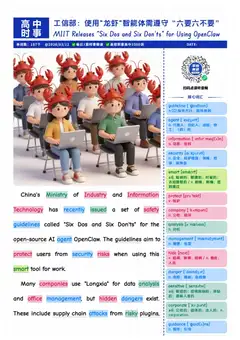
教育部鼓励中小学每周设置"无作业日"
Encourage "No-Homework Day" Weekly for Primary
and Secondary Students
measure [ˈmeʒər]
n. 衡量;量度;措施;方法 / v.
测量;衡量;度量
mental [ˈment(ə)l]
adj. 精神的;心理的
include [ɪnˈkluːd]
v. 包括;包含
encourage [ɪnˈkɜːrɪdʒ]
v. 鼓励;鼓舞;促进;鼓动
weekly [ˈwiːkli]
adj. 每周的 / adv. 每周 / n. 周
刊;周报
academic [ˌækəˈdemɪk]
adj. 学院的;学术的 / n. 大学教
师;学者
anxiety [æŋˈzaɪəti]
n. 忧虑;焦虑;渴望
regulate [ˈreɡjuleɪt]
v. 管制;调整
reasonable [ˈriːznəb(ə)l]
adj. 合理的
difficulty [ˈdɪfɪkəlti]
n. 困难;艰难
rank [ræŋk]
n. 列;排;行列;阶层;等级;
军衔 / v. 排列;分类;分等级 /
adj. 繁茂的;恶臭的;讨厌的;
极端的
control [kənˈtroʊl]
v. 控制;操纵 / n. 控制;管制
pressure [ˈpreʃər]
单词数:132个
@2025/10/25  ✅每日1篇时事阅读  ✅高效积累高中3500词
DATE:
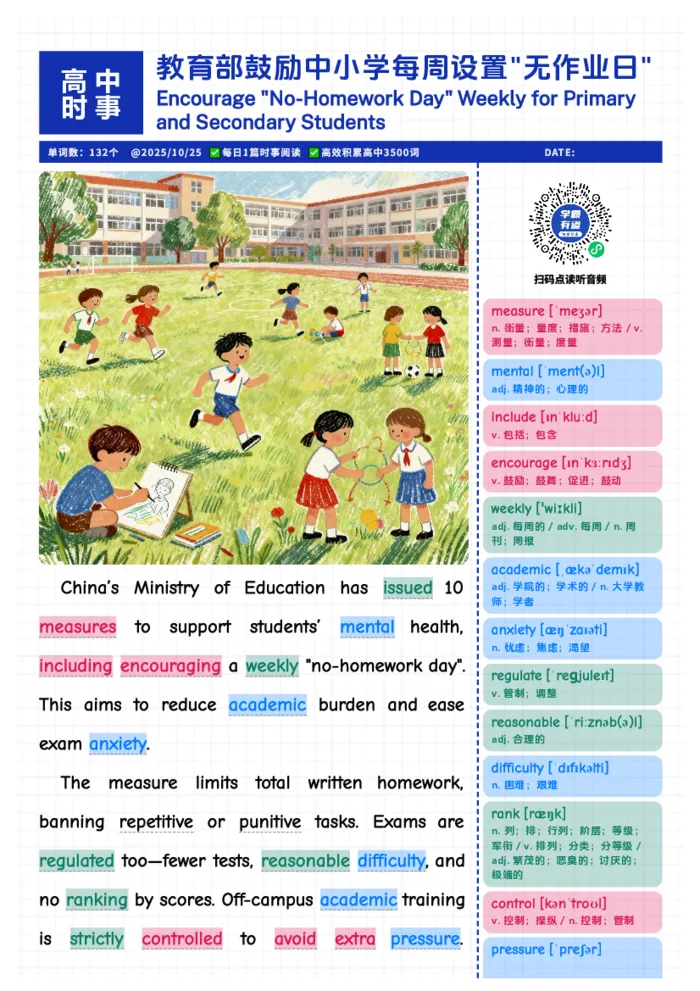
China’s   Ministry   of   Education   has   issued   10
measures   to   support   students’   mental   health,
including encouraging a weekly "no-homework day".
This   aims   to   reduce   academic   burden   and ease
exam anxiety.
The   measure   limits   total   written   homework,
banning   repetitive   or   punitive   tasks. Exams   are
regulated too—fewer tests, reasonable difficulty, and
no ranking by scores. Off-campus academic training
is   strictly   controlled   to   avoid   extra   pressure.
扫码点读听音频
n. 压力;压强;压迫 / v. 对…施
加压力
partner [ˈpɑːrtnər]
n. 合伙人;搭档
community [kəˈmjuːnəti]
n. 社区;团体;群落
protect [prəˈtekt]
v. 保护
monitor [ˈmɑːnɪtər]
n. 监视器;班长;显示器 / v. 监
控;监视
promote [prəˈmoʊt]
v. 促进;推动;提拔;宣传;推
销
relate [rɪˈleɪt]
v. 讲;叙述;有关;把…联系起
来;认同;理解
environment
n. 环境
Other   rules   include   2   hours   of   daily   PE, with
schools partnering with communities to open sports
venues. Students’   sleep   is   protected   by stopping
overtime study, and their sleep status is monitored.
Phones   and   other   electronics   are   banned   in
classrooms   to   promote   healthy   internet   use.
These policies help students balance study and
rest. They   also   boost   mental   resilience   through
related   education,   creating   a   healthier   learning
environment   for   primary   and   secondary students.