1
九年级上学期·期末复习宝典
2
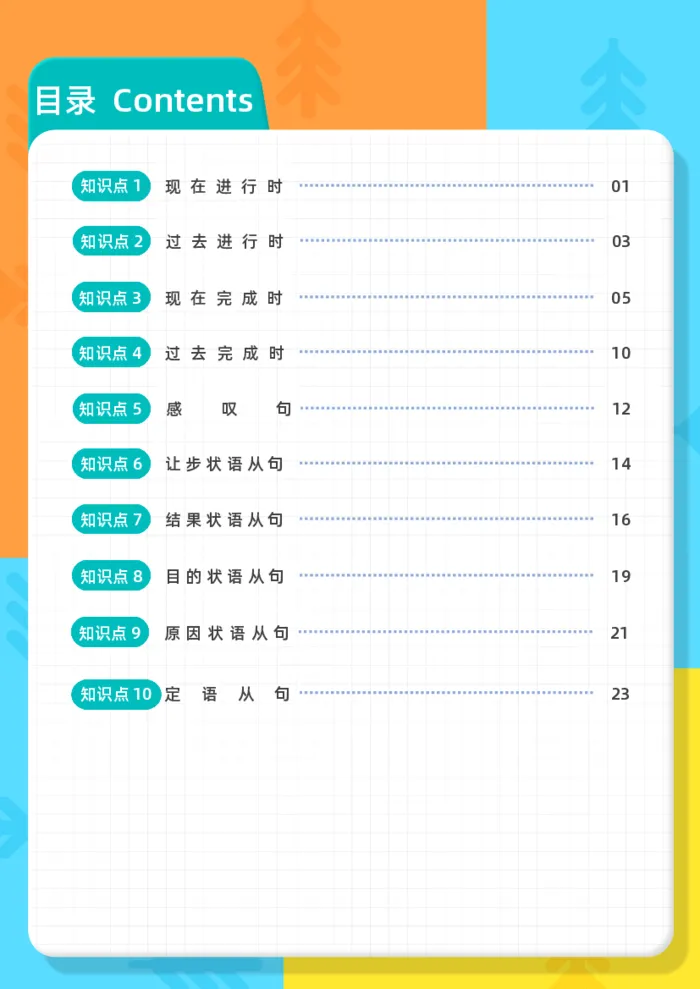
目录 Contents
现在进行时
01
知识点1
过去进行时
03
知识点2
现在完成时
05
知识点3
过去完成时
10
知识点4
感
叹
句
12
知识点5
让步状语从句
14
知识点6
结果状语从句
16
知识点7
目的状语从句
19
知识点8
原因状语从句
21
知识点9
定
语
从
句
23
知识点10
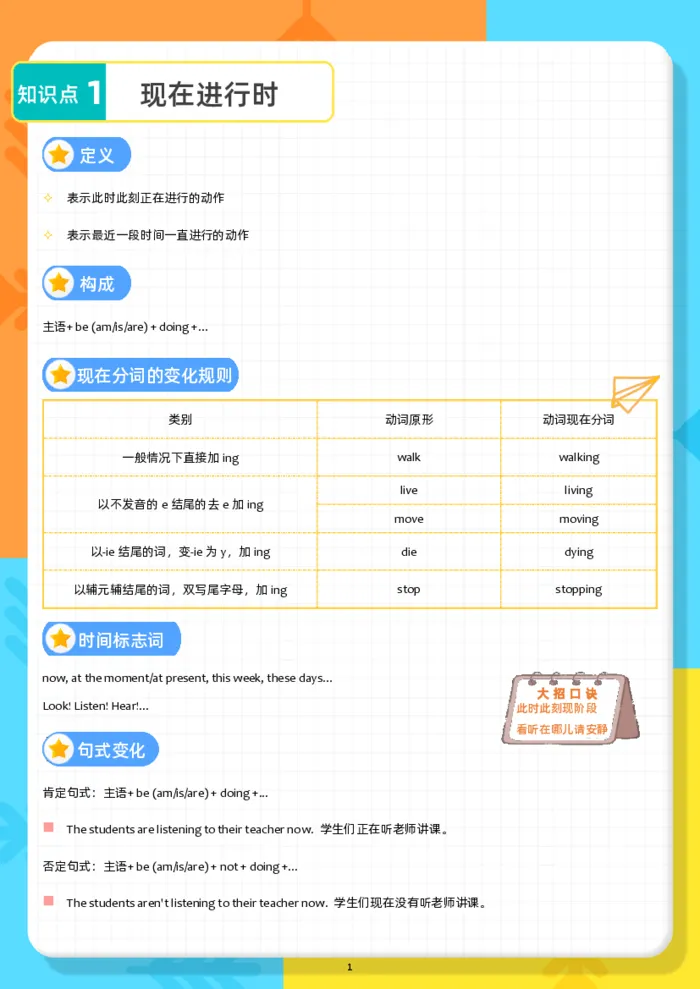
1
表示此时此刻正在进行的动作
表示最近一段时间一直进行的动作
主语+ be (am/is/are) + doing +…
类别
动词原形
动词现在分词
一般情况下直接加ing
walk
walking
以不发音的e 结尾的去e 加ing
live
living
move
moving
以-ie 结尾的词,变-ie 为y,加ing
die
dying
以辅元辅结尾的词,双写尾字母,加ing
stop
stopping
now, at the moment/at present, this week, these days…
Look! Listen! Hear!...
肯定句式:主语+ be (am/is/are) + doing +...
◼ The students are listening to their teacher now. 学生们正在听老师讲课。
否定句式:主语+ be (am/is/are) + not + doing +...
◼ The students aren't listening to their teacher now. 学生们现在没有听老师讲课。
定义
构成
现在分词的变化规则
时间标志词
句式变化
知识点
现在进行时
1
大招口诀
此时此刻现阶段
看听在哪儿请安静
2
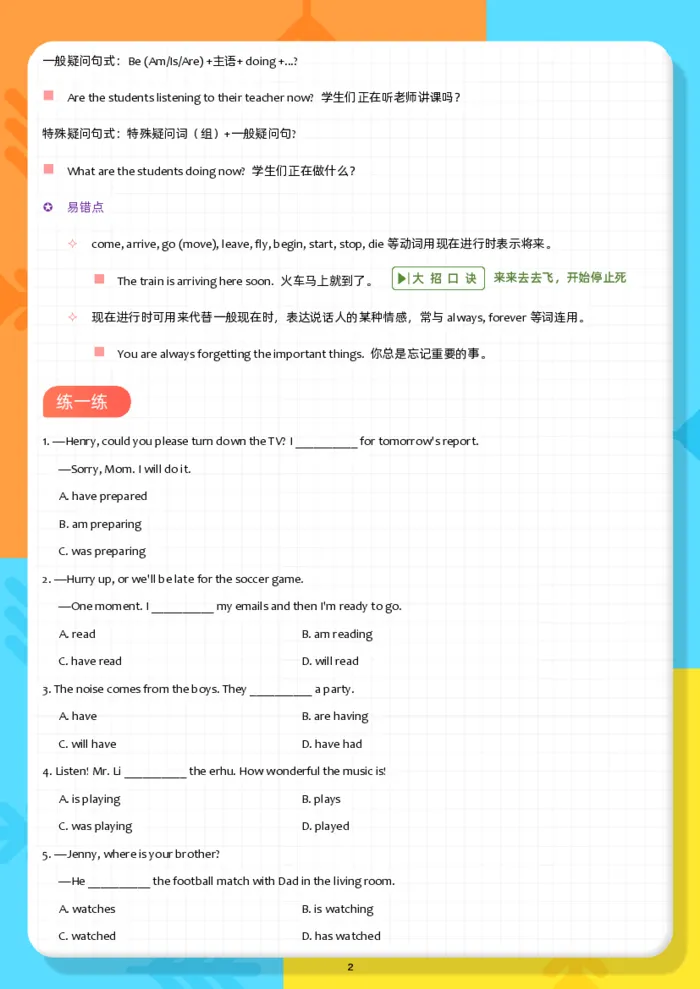
一般疑问句式:Be (Am/Is/Are) +主语+ doing +...?
◼ Are the students listening to their teacher now? 学生们正在听老师讲课吗?
特殊疑问句式:特殊疑问词(组)+一般疑问句?
◼ What are the students doing now? 学生们正在做什么?
易错点
come, arrive, go (move), leave, fly, begin, start, stop, die 等动词用现在进行时表示将来。
◼ The train is arriving here soon. 火车马上就到了。
现在进行时可用来代替一般现在时,表达说话人的某种情感,常与always, forever 等词连用。
◼ You are always forgetting the important things. 你总是忘记重要的事。
1. —Henry, could you please turn down the TV? I __________ for tomorrow's report.
—Sorry, Mom. I will do it.
A. have prepared
B. am preparing
C. was preparing
2. —Hurry up, or we'll be late for the soccer game.
—One moment. I __________ my emails and then I'm ready to go.
A. read
B. am reading
C. have read
D. will read
3. The noise comes from the boys. They __________ a party.
A. have
B. are having
C. will have
D. have had
4. Listen! Mr. Li __________ the erhu. How wonderful the music is!
A. is playing
B. plays
C. was playing
D. played
5. —Jenny, where is your brother?
—He __________ the football match with Dad in the living room.
A. watches
B. is watching
C. watched
D. has watched
练一练
大招口诀
来来去去飞,开始停止死
3
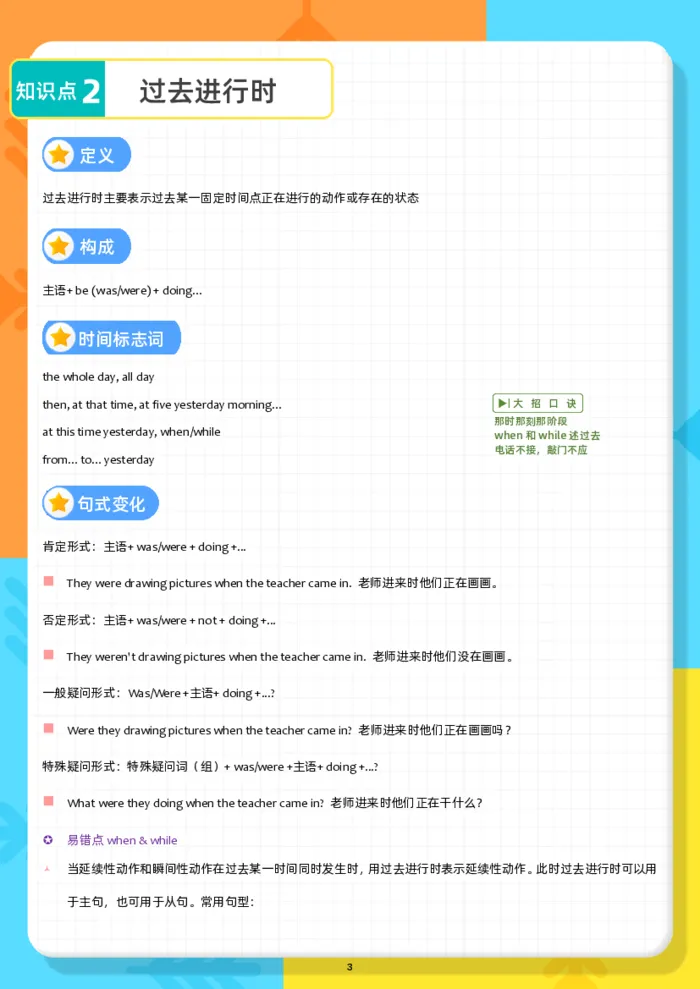
过去进行时主要表示过去某一固定时间点正在进行的动作或存在的状态
主语+ be (was/were) + doing…
the whole day, all day
then, at that time, at five yesterday morning…
at this time yesterday, when/while
from…to…yesterday
肯定形式:主语+ was/were + doing +...
◼ They were drawing pictures when the teacher came in. 老师进来时他们正在画画。
否定形式:主语+ was/were + not + doing +...
◼ They weren't drawing pictures when the teacher came in. 老师进来时他们没在画画。
一般疑问形式:Was/Were +主语+ doing +...?
◼ Were they drawing pictures when the teacher came in? 老师进来时他们正在画画吗?
特殊疑问形式:特殊疑问词(组)+ was/were +主语+ doing +...?
◼ What were they doing when the teacher came in? 老师进来时他们正在干什么?
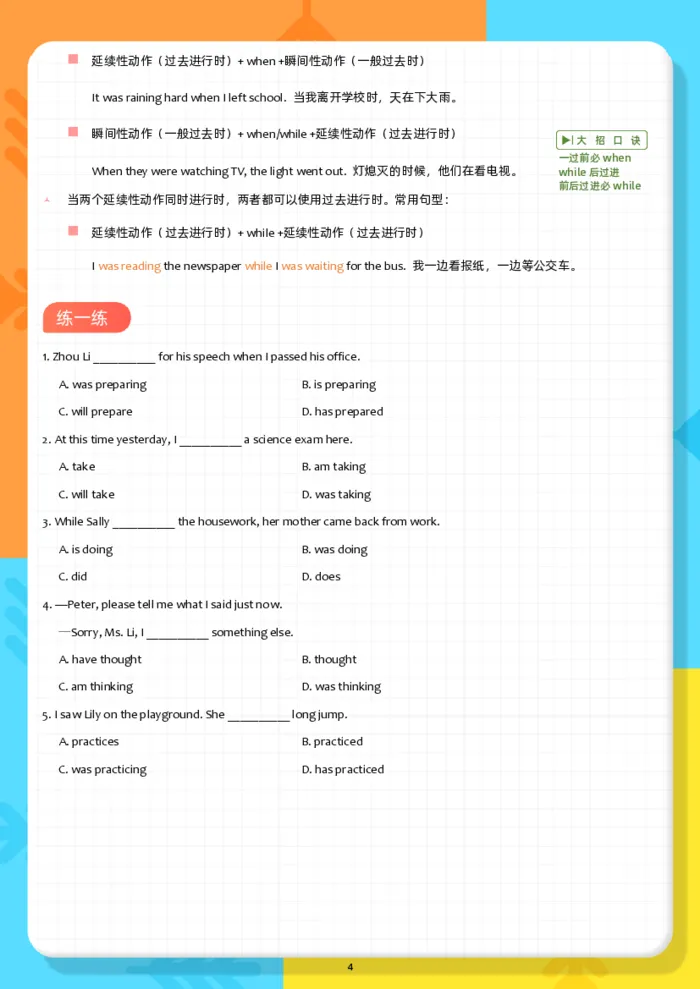
易错点when & while
当延续性动作和瞬间性动作在过去某一时间同时发生时,用过去进行时表示延续性动作。此时过去进行时可以用
于主句,也可用于从句。常用句型:
定义
构成
时间标志词
句式变化
知识点
过去进行时
2
大招口诀
那时那刻那阶段
when 和while 述过去
电话不接,敲门不应
4
◼ 延续性动作(过去进行时)+ when +瞬间性动作(一般过去时)
It was raining hard when I left school. 当我离开学校时,天在下大雨。
◼ 瞬间性动作(一般过去时)+ when/while +延续性动作(过去进行时)
When they were watching TV, the light went out. 灯熄灭的时候,他们在看电视。
当两个延续性动作同时进行时,两者都可以使用过去进行时。常用句型:
◼ 延续性动作(过去进行时)+ while +延续性动作(过去进行时)
I was reading the newspaper while I was waiting for the bus. 我一边看报纸,一边等公交车。
1. Zhou Li __________ for his speech when I passed his office.
A. was preparing
B. is preparing
C. will prepare
D. has prepared
2. At this time yesterday, I __________ a science exam here.
A. take
B. am taking
C. will take
D. was taking
3. While Sally __________ the housework, her mother came back from work.
A. is doing
B. was doing
C. did
D. does
4. —Peter, please tell me what I said just now.
—Sorry, Ms. Li, I __________ something else.
A. have thought
B. thought
C. am thinking
D. was thinking
5. I saw Lily on the playground. She __________ long jump.
A. practices
B. practiced
C. was practicing
D. has practiced
练一练
大招口诀
一过前必when
while 后过进
前后过进必while
5
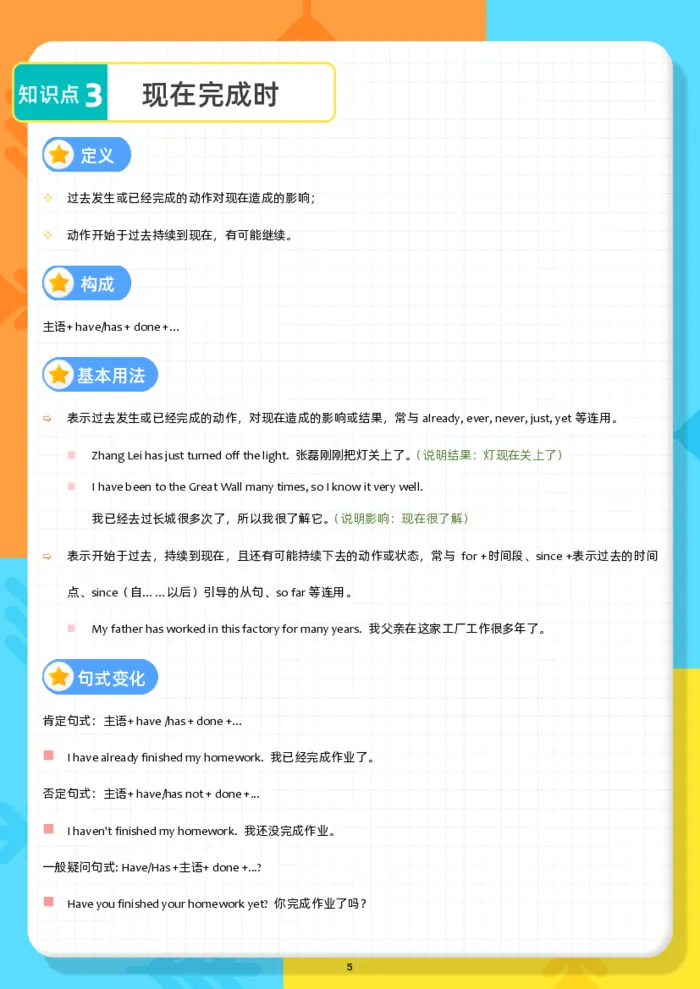
过去发生或已经完成的动作对现在造成的影响;
动作开始于过去持续到现在,有可能继续。
主语+ have/has + done +…
表示过去发生或已经完成的动作,对现在造成的影响或结果,常与already, ever, never, just, yet 等连用。
◼
Zhang Lei has just turned off the light. 张磊刚刚把灯关上了。(说明结果:灯现在关上了)
◼
I have been to the Great Wall many times, so I know it very well.
我已经去过长城很多次了,所以我很了解它。(说明影响:现在很了解)
表示开始于过去,持续到现在,且还有可能持续下去的动作或状态,常与for +时间段、since +表示过去的时间
点、since(自……以后)引导的从句、so far 等连用。
◼
My father has worked in this factory for many years. 我父亲在这家工厂工作很多年了。
肯定句式:主语+ have /has + done +...
◼ I have already finished my homework. 我已经完成作业了。
否定句式:主语+ have/has not + done +...
◼ I haven't finished my homework. 我还没完成作业。
一般疑问句式: Have/Has +主语+ done +...?
◼ Have you finished your homework yet? 你完成作业了吗?
定义
构成
基本用法
句式变化
知识点
现在完成时
3
6
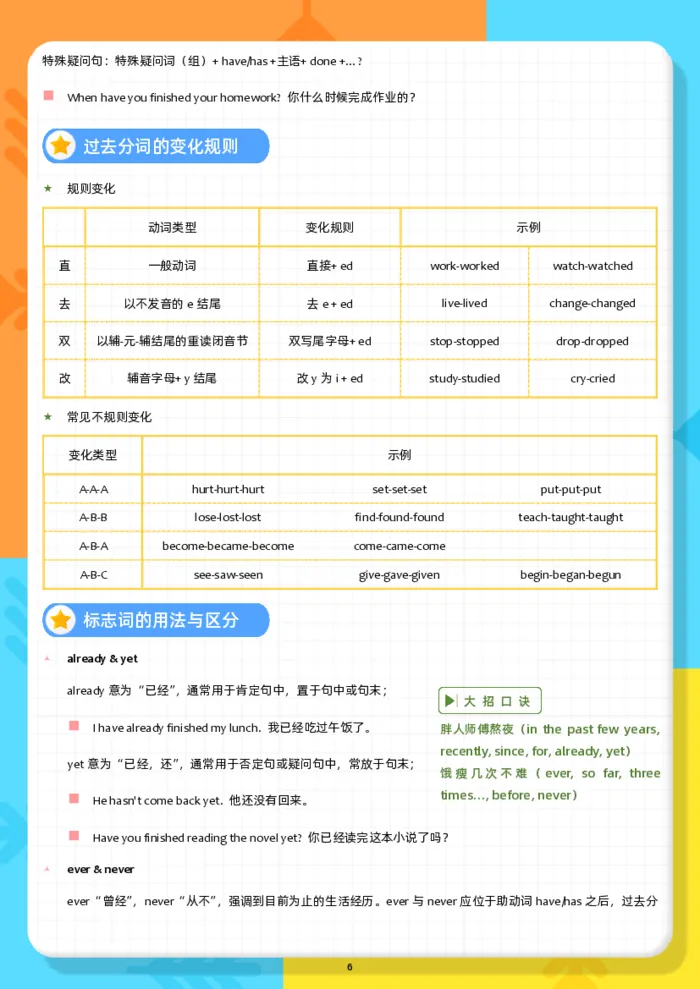
特殊疑问句:特殊疑问词(组)+ have/has +主语+ done +…?
◼ When have you finished your homework? 你什么时候完成作业的?
规则变化
动词类型
变化规则
示例
直
一般动词
直接+ ed
work-worked
watch-watched
去
以不发音的e 结尾
去e + ed
live-lived
change-changed
双
以辅-元-辅结尾的重读闭音节
双写尾字母+ ed
stop-stopped
drop-dropped
改
辅音字母+ y 结尾
改y 为i + ed
study-studied
cry-cried
常见不规则变化
变化类型
示例
A-A-A
hurt-hurt-hurt
set-set-set
put-put-put
A-B-B
lose-lost-lost
find-found-found
teach-taught-taught
A-B-A
become-became-become
come-came-come
A-B-C
see-saw-seen
give-gave-given
begin-began-begun
already & yet
already 意为“已经”,通常用于肯定句中,置于句中或句末;
◼ I have already finished my lunch. 我已经吃过午饭了。
yet 意为“已经,还”,通常用于否定句或疑问句中,常放于句末;
◼ He hasn't come back yet. 他还没有回来。
◼ Have you finished reading the novel yet? 你已经读完这本小说了吗?
ever & never
ever“曾经”,never“从不”,强调到目前为止的生活经历。ever 与never 应位于助动词have/has 之后,过去分
过去分词的变化规则
标志词的用法与区分
大招口诀
胖人师傅熬夜(in the past few years,
recently, since, for, already, yet)
饿瘦几次不难(ever, so far, three
times…, before, never)
7
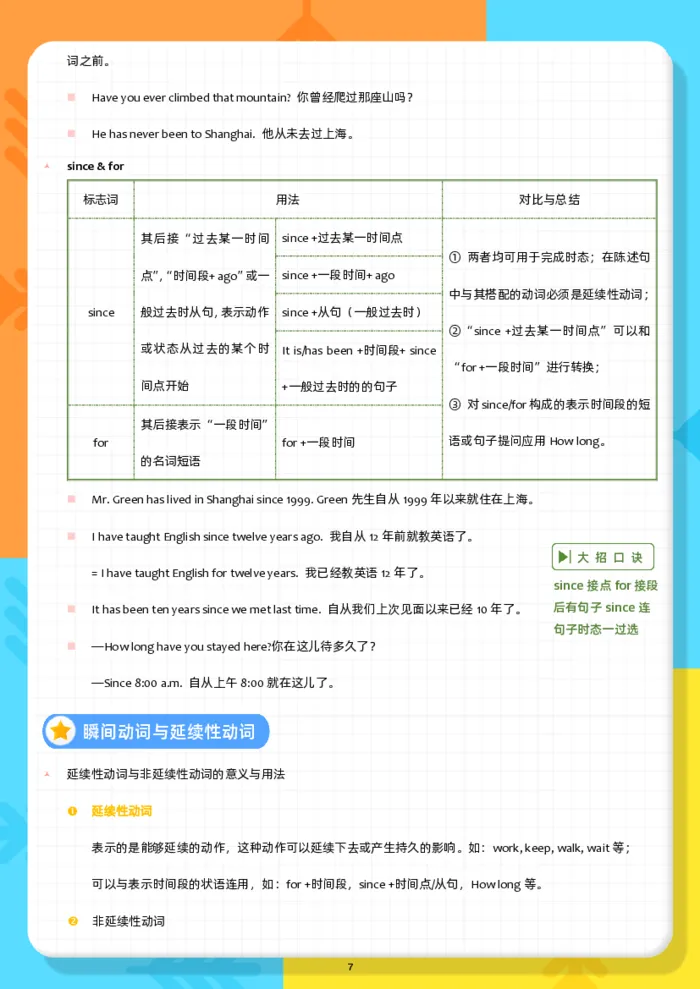
词之前。
◼
Have you ever climbed that mountain? 你曾经爬过那座山吗?
◼
He has never been to Shanghai. 他从未去过上海。
since & for
标志词
用法
对比与总结
since
其后接“过去某一时间
点”,
“时间段+ ago”或一
般过去时从句,表示动作
或状态从过去的某个时
间点开始
since +过去某一时间点
① 两者均可用于完成时态;在陈述句
中与其搭配的动词必须是延续性动词;
②“since +过去某一时间点”可以和
“for +一段时间”进行转换;
③ 对since/for 构成的表示时间段的短
语或句子提问应用How long。
since +一段时间+ ago
since +从句(一般过去时)
It is/has been +时间段+ since
+一般过去时的的句子
for
其后接表示“一段时间”
的名词短语
for +一段时间
◼
Mr. Green has lived in Shanghai since 1999. Green 先生自从1999 年以来就住在上海。
◼
I have taught English since twelve years ago. 我自从12 年前就教英语了。
= I have taught English for twelve years. 我已经教英语12 年了。
◼
It has been ten years since we met last time. 自从我们上次见面以来已经10 年了。
◼
—How long have you stayed here?你在这儿待多久了?
—Since 8:00 a.m. 自从上午8:00 就在这儿了。
延续性动词与非延续性动词的意义与用法
延续性动词
表示的是能够延续的动作,这种动作可以延续下去或产生持久的影响。如:work, keep, walk, wait 等;
可以与表示时间段的状语连用,如:for +时间段,since +时间点/从句,How long 等。
非延续性动词
瞬间动词与延续性动词
大招口诀
since 接点for 接段
后有句子since 连
句子时态一过选
8
表示的是不能延续的动作,即动作发生后立即结束或产生某种结果。如:open, borrow, come, go, buy 等;
非延续性动词可直接用来表示某一动作的完成,且不与表示时间段的状语连用。
常见的瞬间动词要接时间段时,需做如下转换:
瞬间动词
延续性动词
瞬间动词
延续性动词
borrow
keep
buy
have
leave
be away
begin/start
be on
die
be dead
join
be a member of
come/go
be in/at
marry
be married
get to/ arrive in/reach
be in
finish
be over
open
be open
close
be closed
◼ 这本书我已经买了两个星期了。
I have bought this book for two weeks.
I have had this book for two weeks.
易错点:结构区分
含义
用法
have/has gone to
去了某地
表示不在说话者所在的地方,强调没有回来,常在“找人人不
在”的场景使用。
have/has been to
(曾经)去过某地
表示曾经去过,即说话人已回到说话处,常与ever、never 或
次数连用。
have/has been in
在某地待着
表示在某地(一段时间),通常与表示一段时间的状语连用。
大招口诀
海(how long)飞(for)丝(since)
不(been)好(had)看(kept)
大招口诀
找人人不在,gone to 没回来
never/ever 和次数,去过已回用been to
海飞丝若在,been in 某地待
后有副词现,in 就要拜拜
9
1. So far the number of cars on our road __________ greatly.
A. have increased
B. has increased
C. were increasing
D. was increasing
2. —How is everything going?
—Not bad. At least, the relationship between the police and the community __________.
A. has improved
B. improved
C. has controlled
D. controlled
3. —Where is your uncle?
—He __________ to London. He __________ for over three months.
A. has been, has been away
B. has gone, has gone
C. has gone, has been away
D. has been, has left
4. The film Changjinhu __________ a lot of praise since its first show months ago.
A. wins
B. won
C. was winning
D. has won
5. Shenyang __________ an important industrial city in China since the PRC was founded.
A. is
B. was
C. will be
D. has been
6. —Is this your new dictionary?
—Yes, I __________ it for one week.
A. bought
B. have bought
C. have had
7. The Whites __________ China for 2 years since they __________ here.
A. have been in; arrived
B. have come to; arrived
C. has came to; arrived
D. has been to; arrived
8. —Have you ever been to Sam's Club in Nantong?
—No. Although it __________ for several years, I'm far too busy to go there.
A. has started
B. has opened
C. has been opened
D. has been open
练一练
10
表示过去某一时间或动作以前已经发生或完成了的动作,即“过去的过去”。
主语+ had + done (动词过去分词)
by / by the end of +过去的时间点
when / before / by the time +一般过去时的句子
肯定句:主语+ had +动词过去分词+其他.
◼ When I got there, he had left. 当我到那儿时,他已经走了。
否定句:主语+ had + not +动词过去分词+其他.
◼ She told me she hadn't had supper. 她告诉我她还没吃晚饭呢。
一般疑问句:Had +主语+动词过去分词+其他?
* 肯定回答:Yes, 主语+ had.
* 否定回答:No, 主语+ hadn't.
◼ —Had you known anything about our school before you came here? ——你来这之前就了解我们学校吗?
—Yes, I had. ——是的,我了解。
—No, I hadn't. ——不,我不了解。
特殊疑问句:特殊疑问词(组)+一般疑问句?
◼ What had you completed before I called you? 我给你打电话之前,你都完成了什么?
定义
构成
时间标志词
句式变化
知识点
过去完成时
4
大招口诀
过去的过去用过完,had 加done 也不难
by 或before 加过去,过去完成是答案
11
1. By the time I got to school, Mr. Wang __________ teaching.
A. started
B. has started
C. was starting
D. had started
2. The Greens __________ the welcome party already before Henry came to talk about it.
A. has arranged
B. would arrange
C. were arranging
D. had arranged
3. He told me that he __________ writing that composition.
A. finish
B. have finished
C. will finish
D. had finished
4. When I got to the station, I realized I __________ my schoolbag at home.
A. has left
B. had forgotten
C. had left
5. —Have you received the mail?
—No. By the time I got out of the house, the postman __________.
A. disappears
B. disappeared
C. has disappeared
D. had disappeared
练一练
12
知识点
感叹句
概念
感叹句是表示喜、怒、哀、乐等感情色彩的句子。一般以how 或what 开头。how 修饰形容词或副词;what
修饰名词(名词前可有形容词或冠词)。
What 引导的感叹句
What + a(n) +形容词+可数名词单数+主语+谓语!
What a clever kid he is! 多聪明的孩子啊!
What +形容词+可数名词复数+主语+谓语!
What funny boys they are! 多么有趣的男孩子们啊!
What +形容词+不可数名词+主语+谓语!
What nice weather it is! 多好的天气啊!
How 引导的感叹句
How +形容词/副词+主语+谓语!
How fast he is running! 他跑得真快!
How +形容词+ a(n) +可数名词单数+主语+谓语!
How clever a kid he is! 他是个多聪明的孩子啊!
How +主语+谓语!
How time flies! 时光飞逝啊!
5
大招口诀
形名what,其他how;
名词可数单,what a 或 an
13
1. __________ important information it is! Thank you for telling me.
A. What
B. What an
C. How
D. How an
2. —__________ great progress you've made! Congratulations!
—Thank you!
A. What
B. What a
C. How
D. How a
3. __________ clean the classroom is! Who cleaned it?
A. How
B. What
C. What a
D. How a
4. __________ important work the teachers are doing! Let's show our respect for them.
A. How
B. What a
C. What an
D. What
5. __________ food it is! Would you like to taste it?
A. What delicious
B. How delicious
C. What a delicious
D. How a delicious
练一练
14
表示某种与主句相反条件或情况下,主句的情况依然存在的状语从句。
though 和although 意义一样,意为“尽管,虽然”,都表示让步,一般情况下互换使用,只是although 语气较重,
大多用于句首。两个词可以与yet 连用,但不与but 连用。
◼ Although he was Japanese, he spent most of his life in China. 尽管他是日本人,但他大多数时间是在中国度过的。
表示语气更强的让步,意为“虽然,尽管,即使”,不与but 连用。
◼ Even though he's 24 now, he's still like a baby. 尽管他现在24 岁了,但他仍然像个孩子。
引导让步状语从句时,-ever 词常可换成“no matter +相应的疑问词”。
◼ I'll wait for you however late it is. = I'll wait for you no matter how late it is. 不管有多晚我都会等着你。
1. __________ he doesn't have much money, he is still happy.
A. Until
B. Unless
C. Though
D. Because
2. —How do you like the English article?
—I still can't understand it __________ I've read it three times.
A. so that
B. if
定义
though 和although
even if 和even though
-ever 类引导词的用法
练一练
知识点
让步状语从句
6
15
C. even if
3. You should help your parents with the housework __________ you may not like to do it.
A. although
B. until
C. because
D. if
4. —Sally is my best friend. She is always there __________ I'm in trouble.
—Yeah, a friend in need is a friend indeed.
A. whatever
B. whenever
C. whoever
5. You will soon forget it unless you use it as often as possible, __________ you learn something well.
A. even if
B. because
C. if
D. but
6. My father doesn't like to throw away old things __________ they are useless.
A. but
B. because
C. even though
D. so that
7. __________ Jack was a bit nervous on the stage, he still looked calm and confident.
A. Although
B. Because
C. Unless
D. Since
16
结果状语从句就是用来补充说明谓语动词发生的结果的状语从句,一般放在主句之后。
so...that...表示“如此......以至于......”,常考结构如下:
◼ so +形容词/副词+ that 从句
◼ The story is so interesting that I want to read it again. 这个故事如此有趣,以至于我想再读一遍。
◼ so +形容词+ a/an +可数名词单数+ that 从句
◼ He was so hard-working a boy that he passed the exam. 他是如此努力的一个男孩,以至于通过了考试。
在so…that…结构中,that 从句如果是否定句,可与too…to…进行转换。
◼ They were so tired that they couldn't go any farther. = They were too tired to go any farther.
他们太累了不能再走了。
such...that...表示“如此......以至于......”,常考结构如下:
◼ such + a/an +形容词+可数名词单数+ that 从句
◼ Kathy is such a lovely girl that we all like to play with her. 凯西是个很可爱的女孩,我们都愿意和她玩。
◼ such +形容词+可数名词复数+ that 从句
◼ These were such difficult questions that none of us could answer them.
这些问题如此难,以至于我们之中没有一个人能回答上来。
◼ such +形容词+不可数名词+ that 从句
◼ It was such fine weather yesterday that we went swimming. 昨天天气很好,我们去游泳了。
当名词前有many, few, much, little 等表示数量修饰时,用so。(注意★)
定义
so…that…
such…that…
知识点
结果状语从句
7
大招口诀
名词such 形副so
17
so + many/few +可数名词复数+ that 从句
◼ She said it so many times that she came to believe it. 这件事她说了太多遍,以至自己都开始相信了。
so + much/little +不可数名词+ that 从句
◼ Mrs. Lindon has so little education that she is unable to get a job.
林顿夫人受教育如此之少,以至连工作都找不到。
little 表示“少”用so;表示“小”用such。(注意★)
◼ They are such little pandas that I love them so much. 他们是如此小的熊猫,以至我非常喜欢他们。
1. Panda Yaya was __________ hungry __________ he ate up all the bamboos in front of him.
A. so; that
B. such; that
C. too; to
2. It's __________ a fine day __________ we should go out for a picnic.
A. such; to
B. such; that
C. so; that
D. so; to
3. I'm __________ scared __________ I can't move.
A. so; to
B. too; to
C. so; that
D. too; of
4. The jacarandas (蓝花楹) in Kunming are __________ beautiful __________ many people come and enjoy them.
A. too; to
B. so; that
C. very; that
D. such; that
5. The launch (发射) of the Shenzhou 16 is __________ news that everyone is __________ about it.
A. such exciting; excited
B. such an exciting; excited
练一练
18
C. so excited; exciting
D. such an exciting; exciting
19
用来说明主句发生目的的状语从句。引导目的状语从句的词组有so that (以便), in order that (为了)等,从句的谓语
动词常含有may, might, can, could, will, would 等情态动词。
◼ He must get up early so that he can go to work on time. 他必须早点起床,以便能按时上班。
◼ They go by plane in order that they may get there in time. 他们坐飞机走,为了可以及时赶到那里。
当从句主语和主句主语一致时,可用so as to, in order to 对从句进行省略。
◼ He worked day and night in order that he could succeed. 他夜以继日地工作,为的是取得成功。
= He worked day and night in order to succeed.
1. Jack learned some Chinese in the USA __________ he could talk to people in Chinese during his stay in Beijing.
A. such that
B. so that
C. in order to
D. because
2. More and more people in Western countries begin to learn Chinese __________ they can better understand Chinese
culture.
A. because of
B. as a result
C. so that
D. in order to
3. —He dressed up __________ everyone might notice him.
—He looked so handsome.
A. in order to
B. such that
定义
注意
练一练
知识点
目的状语从句
8
大招口诀
to 接动原,that 接句
20
C. in order that
4. My father exercises every day __________ keep fit.
A. in order that
B. so that
C. in order to
D. thanks to
5. My sister runs every morning __________ get fat.
A. in order not to
B. in order to
C. doesn't in order to
D. not in order to
21
在句中用来说明主句发生原因的句子叫原因状语从句。常用because (因为)、as (由于)、since (既然)等来引导。
(重点★)
表因果关系最强,用来回答why 的问句,所引出的原因往往是听话人所不知道或最感兴趣的,because 引导的原因状
语从句往往比主句显得更重要。引导的从句可放句首或句尾。
◼ I'm leaving because I am fed up with the boss. 我离开是因为我受够老板了。
易错点
because 不和so 连用
◼ 我们听不懂他们在说些什么,因为他们说的是汉语。
Because they were talking in Chinese, so we couldn't understand them.
Because they were talking in Chinese, we couldn't understand them.
because 后接句子;because of 后接词汇或短语
◼ The game was called off because of bad weather. 比赛因天气恶劣被取消。
表示人们已知的事实,不需要强调的原因,故常意为“既然”,通常放在句首。since 引导的从句是次要的,重点强调
主句的内容,语气比because 弱。
◼ Since everyone is here, let's get started. 既然大家都来了,咱们开始吧。
as 和since 用法差不多,所引出的理由在说话人看来已经很明显,或已为说话人所熟悉而不需用because 加以强调。
语气比since 弱。
◼ She didn't hear us come in as she was asleep. 她睡着了没听见我们进来。
定义
because
since
as
知识点
原因状语从句
大招口诀
必(because)胜(since)啊(as)有原因
因为所以二选一
9
22
for 和上述三个从属连词不同,它是一个并列连词,用来连接并列句。它有时可用来作附加说明,为前面的事实提供
一种推断的理由。
◼ We should be more careful, for it is already dark. 天已经黑了,我们应该更小心点。
1. __________ we are good friends, let me share your trouble and worries.
A. Since
B. Though
C. If
D. Unless
2. At first, many people in Europe refused to eat tomatoes __________ they thought the fruit was dangerous.
A. when
B. unless
C. because
D. though
A. Though; /
B. Though; but
C. Because;
3.
/
D. Because; so
4. Little John didn't accept his mother's help __________ he wanted to try it himself.
A. though
B. until
C. as soon as
D. because
5. —It's said that Dongtai fish soup noodles taste delicious.
—Well. __________ we are here, why not go to the restaurant and order some?
A. Though
B. Unless
C. Since
D. Whenever
for
练一练
23
在复合句中,修饰某一名词或代词的从句叫定语从句。定语从句在句子中的作用相当于形容词。
先行词+关系词+从句
◼ 先行词 被定语从句修饰的名词、代词称为先行词。先行词一般出现在定语从句之前。
◼ Do you know the girl who is singing on the stage? 你认识在舞台上唱歌的那个姑娘吗?
◼ 关系词 引导定语从句的词被称为关系词。关系词可分为关系代词和关系副词。关系代词在从句中作主语、宾语、
定语等;关系副词在从句中作状语。
◼ I'll cherish the moment when I met Lisa. 我将怀念我和Lisa 见面的那一时刻。(作状语)
关系代词在句子中作宾语时,通常可以省略。
◼ 关系代词who
◼ His wife who is now in Paris is one of my old classmates. 他妻子现在在巴黎,是我的老同学之一。
◼ 关系代词whom
◼ I don't like the boy whom Linda likes. 我不喜欢Linda 喜欢的那个男孩。
定义
结构构成
关系代词的用法
知识点
定语从句
10
24
◼ 关系代词which
◼ —Mom, did you see my T-shirt which I put here just now? ——妈妈,你看到我刚刚放在这里的T 恤了吗?
—Oh, I've taken it to your bedroom. ——我拿到你卧室了。
◼ 关系代词that
◼ In America, Thanksgiving is a holiday that celebrates the love of family.
在美国,感恩节是庆祝家庭的爱意的。
◼ The woman that is watering flowers is my wife. 那个正在浇花的女人是我妻子。
◼ 关系代词whose
◼ He is the man whose car was stolen last night. 他就是昨晚车被偷的那个人。
◼ The book whose cover has a beautiful picture is Lily's. 那个封皮上有漂亮图片的书是Lily 的。
关系代词中,只能用that 的情况
25
当先行词既包含人又包含物
▪
Jack took photos of the things and people that he was interested in.
Jack 给他感兴趣的事物和人照了照片。
当先行词是all, little, much, none, everything, anything, nothing 等不定代词
▪
Have you taken down everything that Mr. Liu said? 你记下刘先生说的全部内容了吗?
当序数词修饰先行词
▪
The first place that we visited was the Great Wall. 我们参观的第一个地方是长城。
当先行词前面有the only, the very, the last 等修饰
▪
Basketball is the only thing that interests him. 篮球是他唯一感兴趣的事情。
当形容词最高级修饰先行词
▪
I have found the best way that could finish the test. 我已经找到了完成测试的最好方法。
◼ 关系副词when
关系代词在从句中充当宾语
◼ April Fool's Day is the day that/which I like best. 愚人节是我最喜欢的一天。
关系副词在从句中充当时间状语,可以用“时间介词+which”替换
◼ April Fool's Day is the day when/on which people make fun of others.
愚人节是人们愚弄他人的日子。
关系副词的用法
大招口诀
数风流人物唯一that 最高兴。
数:前有序数词;人物:先行既指人也指物
唯一:the only、the very;最:前有最高级
兴(thing):先行词是指物的不定代词(something、anything、nothing 等)
26
◼ 关系副词where
关系代词在从句中充当宾语
◼ The factory that/which we'll visit next week is not far from here.
我们下周要参观的工厂离这里不远。
关系副词在从句中充当地点状语,可以用“地点介词+which”替换
◼ The factory where/in which I have worked for 2 years is near a school.
我工作了两年的工厂挨着一所学校。
◼ 关系副词why
关系代词在从句中充当宾语
◼ I don't want to listen to any reason that/which you give. 我不想听你给的任何理由。
关系副词在从句中充当原因状语,可以用“for which”替换
◼ I don't want to listen to any reason why/for which you were absent. 我不想听你缺席的任何理由。
1. The students in the speech are talking about the inventors __________ have made a big difference to our daily life.
A. which
B. whom
C. who
D. whose
2. —Do you like the song Yesterday Once More?
—Yes, I like the songs __________ I can dance to.
A. who
B. that
C. this
D. what
3. It's said the news about the famous speaker __________ you are searching for is deleted on the Internet.
A. which
B. who
C. whose
D. what
练一练
大招口诀
名代之后跟定从,先定所属用whose
不是whose 用that,没有that 定人物
物用which 人用who,从句完整用关副
27
4. Simon works hard on study. He always does everything __________ can improve himself.
A. what
B. whose
C. who
D. that
5. Give me the book __________ you read just now.
A. which
B. what
C. whom
D. who
6. I was talking to the girl __________ father was my history teacher when you called me yesterday.
A. who
B. whose
C. whom
7. —Tom, you look worried, is there anything __________ I can do for you?
—Oh, thank you. Can you tell me something about the writer __________ wrote this passage?
A. that; whose
B. which; whom
C. that; who
8. Children __________ don't like exercising will put on weight easily.
A. who
B. which
C. what
D. how
9. —Could you tell me what kind of movies you like best?
—I like the movies __________ make me laugh.
A. which
B. what
C. where