文档文本内容
主题语境:人与自然
主题群:环保
语篇类型:说明文
来源:reader’s digest
Word count:367
Flesch-Kincaid Grade Level:9.2


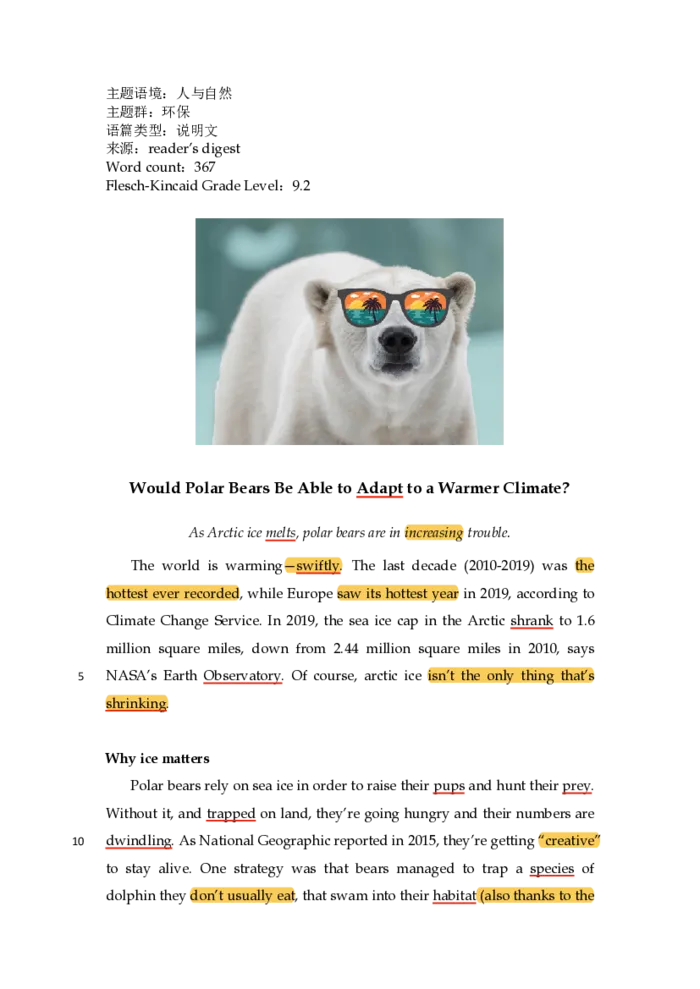
Would Polar Bears Be Able to Adapt to a Warmer Climate?
As Arctic ice melts, polar bears are in increasing trouble.
The world is warming—swiftly. The last decade (2010-2019) was the
hottest ever recorded, while Europe saw its hottest year in 2019, according to
Climate Change Service. In 2019, the sea ice cap in the Arctic shrank to 1.6
million square miles, down from 2.44 million square miles in 2010, says
NASA’s Earth Observatory. Of course, arctic ice isn’t the only thing that’s
5
shrinking.

Why ice matters
Polar bears rely on sea ice in order to raise their pups and hunt their prey.
Without it, and trapped on land, they’re going hungry and their numbers are
dwindling. As National Geographic reported in 2015, they’re getting “creative”
10
to stay alive. One strategy was that bears managed to trap a species of
dolphin they don’t usually eat, that swam into their habitat (also thanks to the
lack of ice), ate some of it, then buried the rest in snow to eat later—a behavior
these animals don’t normally exhibit.

Alternate food sources
15
Polar bears in the western Hudson Bay have been eating another alternate
and highly unusual food source, snow geese eggs; according to researchers 88
of which equal the calories that come from devouring a single seal. While this
may be a most welcome snack alternative, it cannot sustain the bears in the
long run; additionally, bears eating eggs will have the secondary effect of
20
decreasing snow geese populations. Warming weather is also driving polar
bears south, to forage in human garbage. Another problem is that polar bears
are waking up from winter slumbers earlier and earlier, which means they
need more (unavailable) food than ever. And these smaller bits of food
require more energy to pursue and collect—energy a hungry bear has little of
25
to spare.

More scientists weigh in
Without sea ice, there is no sea ice ecosystem and losing that ecosystem
includes losing polar bears. There’s only so much a polar bear can adapt to an
ice-free life. They go without food for about 220 days, but more than that
30
decreases their chances of survival. And while they can swim, they can’t go
far, for long, and cubs have even less ability to swim distances.