文档文本内容
主题语境:人与社会
主题群:科学技术
语篇类型:说明文
来源:Time for Kids, May 1, 2020
Word count:492
Flesch-Kincaid Grade Level:7.5
Lexile Range:1010L - 1200L

Speak, FIDO!
Imagine you’re out for a walk with your family when a strange dog
approaches. The dog isn’t aggressive, but it seems to want something because
it nudges you with its snout, and barks.
What you don’t know is that this dog is trained to help a person with a
medical condition. Around the corner, the dog’s owner has collapsed, and the
5
dog has run off to find help. That’s you! But how can the dog make you
understand what’s wrong? It’s not like dogs can talk.
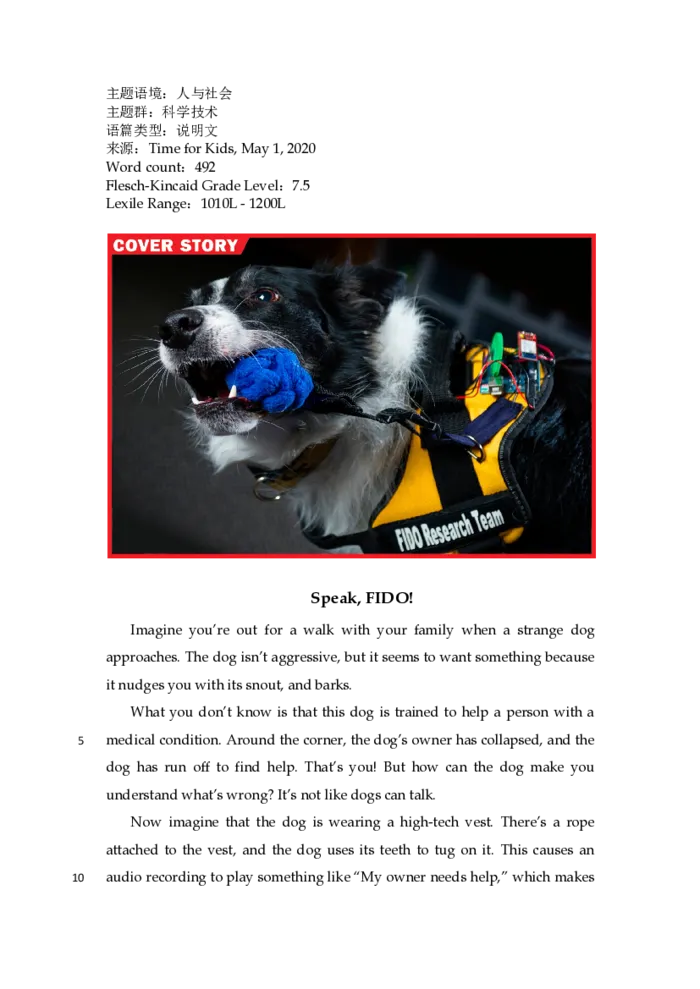
Now imagine that the dog is wearing a high-tech vest. There’s a rope
attached to the vest, and the dog uses its teeth to tug on it. This causes an
audio recording to play something like “My owner needs help,” which makes
10
you understand that you should follow the dog to its owner.
It might sound like science fiction, but this is the goal of the FIDO project,
an ongoing study at the Georgia Institute of Technology.
New Tricks
Dogs can be trained to do many tasks. For example, some dogs are trained
to fetch help for people with epilepsy, a condition that can cause a person to
15
lose consciousness and twitch uncontrollably. Allergy dogs can smell a
life-threatening allergen nearby, and diabetes dogs know when their owner’s
blood sugar is dangerously low.
FIDO stands for Facilitating Interactions for Dogs with Occupations. The
team’s goal is to make it easier for working dogs to do their job, and
20
researchers believe wearable technology will help. “Technology can give dogs
so much more power as they help their humans,” FIDO director Melody
Jackson told TIME for Kids.
FIDO researchers designed a vest with a tiny computer built in. It can call
911, send a text to a family member, or play an audio recording, among other
25
things. The next step was to figure out how a dog would activate the
computer.
The team made several sensors and put them on a prototype. There was a
touch sensor (it’s similar to the touch screen on a smartphone) that a dog taps
with its nose. Another had a rope for the dog to tug with its mouth. There was
30
also a proximity sensor (think of a touchless faucet in a restroom) that a dog
activates with a movement of its snout, and a sensor that activates when a dog
bites on it.
“Then we tested them all with all types of dogs—everything from a
border collie to a basset hound to a poodle,” Jackson says. In the end, the dogs
35
were able to activate the vest using every sensor the team had designed. Plus,
Jackson notes, “We were able to train all the dogs to use all the sensors in 27
minutes or less.”
In the real world, vests could be customized for a dog’s job. For example,
police dogs on search-and-rescue missions near water could use a tug sensor
40
instead of a touch sensor, which fails when wet.