Tiger Times 01
你以为大象是笨拙的呆萌动物吗?你大错特错
讲师丨但汉松 来源丨Scientific American 日期丨2021.06.21 Mon.
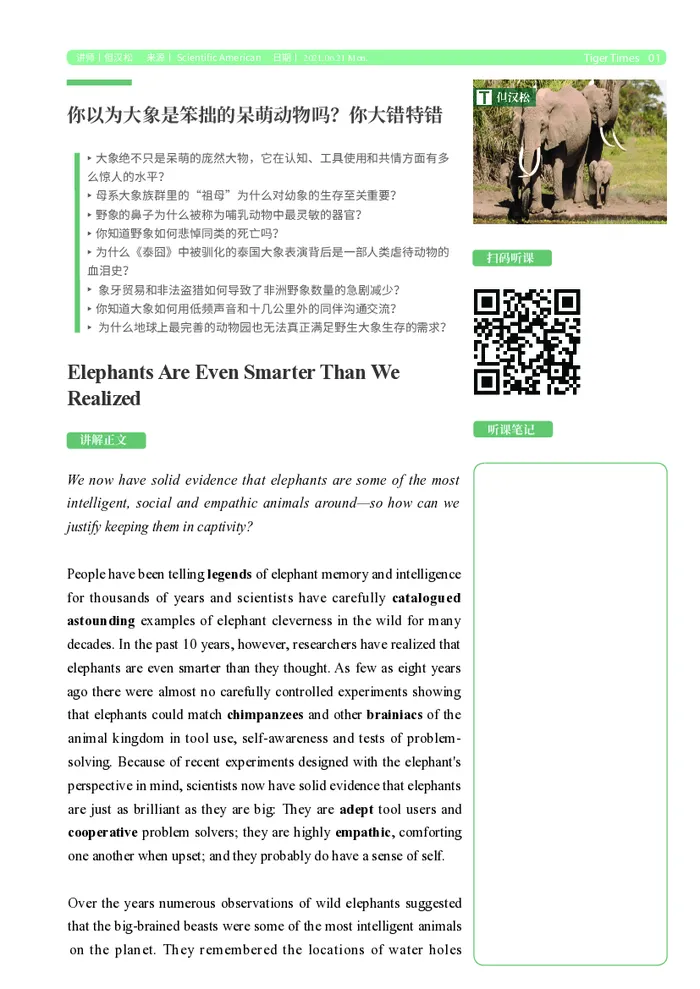
▶ 大象绝不只是呆萌的庞然大物,它在认知、工具使用和共情方面有多
么惊人的水平?
▶ 母系大象族群里的“祖母”为什么对幼象的生存至关重要?
▶ 野象的鼻子为什么被称为哺乳动物中最灵敏的器官?
▶ 你知道野象如何悲悼同类的死亡吗?
▶ 为什么《泰囧》中被驯化的泰国大象表演背后是一部人类虐待动物的
血泪史?
▶ 象牙贸易和非法盗猎如何导致了非洲野象数量的急剧减少?
▶ 你知道大象如何用低频声音和十几公里外的同伴沟通交流?
▶ 为什么地球上最完善的动物园也无法真正满足野生大象生存的需求?
扫码听课
听课笔记
Elephants Are Even Smarter Than We
Realized
讲解正文
We now have solid evidence that elephants are some of the most
intelligent, social and empathic animals around—so how can we
justify keeping them in captivity?
People have been telling legends of elephant memory and intelligence
for thousands of years and scientists have carefully catalogued
astounding examples of elephant cleverness in the wild for many
decades. In the past 10 years, however, researchers have realized that
elephants are even smarter than they thought. As few as eight years
ago there were almost no carefully controlled experiments showing
that elephants could match chimpanzees and other brainiacs of the
animal kingdom in tool use, self-awareness and tests of problem-
solving. Because of recent experiments designed with the elephant's
perspective in mind, scientists now have solid evidence that elephants
are just as brilliant as they are big: They are adept tool users and
cooperative problem solvers; they are highly empathic, comforting
one another when upset; and they probably do have a sense of self.
Over the years numerous observations of wild elephants suggested
that the big-brained beasts were some of the most intelligent animals
on the planet. They remembered the locations of water holes
hundreds of kilometers apart, returning to them year after year. They
fashioned twigs into switches to shoo flies and plugged drinking
holes with chewed up balls of bark. They clearly formed strong
social bonds and even seemed to mourn their dead. Yet scientists
rarely investigated this ostensibly immense intellect in carefully
managed experiments. Instead, researchers looking for evidence
of exceptional mental aptitude in nonhuman animals first turned
to chimpanzees and, later, to brainy birds like ravens, crows and
some parrots. Only in the past 10 years have scientists rigorously
tested elephant cognition. Again and again these new studies have
corroborated what zoologists inferred from behavior in the wild.
Scientists living among herds of wild elephants have long observed
awe-inspiring cooperation between family members. Related
elephant mothers and their children stay together throughout
life in tight-knit clans, caring for one another's children and
forming protective circles around calves when threatened by lions
or poachers. Elephant clan members talk to one another with a
combination of gentle chirps, thunderous trumpets and low-
frequency rumbles undetectable to humans, as well as nudges,
kicks and visual signals such as a tilt of the head or flap of the ear.
They deliberate among themselves, make group decisions and
applaud their achievements. Being part of an elephant family is all
about unity and working together for the greater good. When they are
getting ready to do a group charge, for example, they all look to one
another: "Are we all together? Are we ready to do this?" When they
succeed, they have an enormous celebration, trumpeting, rumbling,
lifting their heads high, clanking tusks together, intertwining their
trunks.
Some scientists studying wild elephants have argued that, in addition
to cooperating for survival's sake, the creatures are capable of
genuine empathy. Elephants often refuse to leave their sick and
injured behind, even if the ailing animal is not a direct relative.
Scientists once observed three young male elephants struggle to
revive a dying matriarch, lifting her body with their tusks to get her
back on her feet. Another time, scientists saw a female elephant give
Tiger Times
02
birth to a stillborn baby. The mother guarded her dead calf for two
days, trying over and over to revive its limp body.
When elephants encounter an elephant skeleton, they slow down,
approach it cautiously, and caress the bones with their trunk and
the bottoms of their sensitive padded feet. Elephants do not show
the same interest in the remains of other species. In one experiment
elephants spent twice as much time investigating an elephant skull as
those of either a rhinoceros and buffalo and six times longer probing
ivory than a piece of wood. Moss has witnessed elephants kicking
dirt over skeletons and covering them with palm fronds.
Ed Stewart thinks that even his massive haven is not adequate to keep
the elephants as healthy as they would be in the wild. "Elephants
should not be in captivity— period," he says. "It doesn't matter if
it's a zoo, a circus or a sanctuary. The social structure isn't correct,
the space is not right, the climate is not right, the food is not right.
You can never do enough to match the wild. They are unbelievably
intelligent. With all of that brainpower—to be as limited as they are
in captivity—it's a wonder they cope at all. In 20 years I hope we will
look back and think, 'Can you believe we ever kept those animals in
cages?'"
Tiger Times
03
Tiger Times
04
legend /ˈledʒənd/ n. 传说,传奇(故事)
○ an old well-known story, often about brave people,
adventures, or magical events
○ e.g. e.g. a book of ancient Greek legends 一本讲述古希腊
传说的书
catalogue /ˈkætəlɒɡ/v. 列出,列举,历数
○ to list all the things that are connected with a particular
person, event, plan, etc.
○ e.g. The report catalogued numerous dangerous work
practices. 这份报告列出了许多危险的作业方法。
astounding /əˈstaʊndɪŋ/ adj. 令人震惊的,令人惊骇的
○ so surprising that it is almost impossible to believe
○ e.g. The concert was an astounding success. 音乐会出奇地
成功。
chimpanzee /ˌtʃɪmpænˈziː/ n.(非洲的)黑猩猩
○ an intelligent African animal that is like a large monkey
without a tail
brainiac /ˈbreɪniæk/ n. 聪明人,天才
○ (informal) someone who is very intelligent
adept /əˈdept/ adj. 内行的,熟练的
○ good at something that needs care and skill
○ e.g. Melissa quickly became adept at predicting his moods.
很快梅莉莎就学会了预测他的情绪。
cooperative /kəʊˈɒpərətɪv/ adj. 合作的,有协作精神的,同
心协力的
○ [usually before noun] involving doing sth. together or
working together with others towards a shared aim
○ e.g. Cooperative activity is essential to effective community
work. 要把社区工作做好,协作活动是必不可少的。
empathy /ˈempəθi/ n. 同情,同感,共鸣
○ the ability to understand other people's feelings and
problems
○ e.g. She had great empathy with people. 她对人充满同情
之心。
○ empathic /emˈpəθɪk/ adj. 有共情力的
○ e.g. We have to be empathic to be a hero. 我们得要有同理
心,才能当英雄。
fashion /ˈfæʃn/ v.(尤指用手工)制作,使成形,塑造
○ to make or shape sth., especially with your hands
○ e.g. She fashioned a pot from the clay. 她用黏土制成一个
罐。
twig /twɪɡ/ n.(树枝上的)细枝,嫩枝
○ a small very thin stem of wood that grows from a branch on
a tree
switch /swɪtʃ/ n.(细软)枝条,鞭子
○ a thin stick that bends easily
○ e.g. a riding switch 马鞭
shoo /ʃuː/ v.(尤指发出嘘声并挥手)赶走,轰走
词汇
○ to make sb./sth. go away or to another place, especially by
saying 'shoo' and waving your arms and hands
○ e.g. He shooed the dog out of the kitchen. 他嘘嘘地把狗赶
出了厨房。
plug /plʌɡ/ v. 堵塞,封堵,塞上
○ to fill a hole with a substance or piece of material that fits
tightly into it
○ e.g. He plugged the hole in the pipe with an old rag. 他用
一块旧破布把管子上的那个洞塞住了。
bark /bɑːk/ n. 树皮
○ the outer covering of a tree
mourn /mɔːn/ v.(因失去…而)哀悼,忧伤
○ to feel and show sadness because sb. has died; to feel sad
because sth. no longer exists or is no longer the same
○ e.g. He was still mourning his brother's death. 他仍然在为
哥哥的去世而悲伤。
ostensible /ɒˈstensəbl/ adj. 表面的,宣称的,假托的
○ [only before noun] (formal) seeming or stated to be real or
true, when this is perhaps not the case
○ e.g. The ostensible reason for his absence was illness. 他假
托生病缺勤。
○ ostensibly /ɒˈstensəbli/ adv. 表面地,明显地,假装地,
谎称地
○ If something is ostensibly true, people say that it is true but
it is not really true.
○ e.g. She stayed behind at the office, ostensibly to work. 她
留在办公室里不走,假装要工作。
aptitude /ˈæptɪtjuːd/ n. 天资,天生的才能,天赋
○ natural ability or skill at doing sth.
○ e.g. She showed a natural aptitude for the work. 她表现出
了做这工作的天赋。
brainy /ˈbreɪni/ adj. 聪明的,多智的,敏锐的
○ able to learn easily and think quickly
○ e.g. He always was the brainy one. 他一向是个聪明人。
raven /ˈreɪvn/ n. 渡鸦(羽毛亮黑色,鸣声刺耳)
○ a large bird of the crow family, with shiny black feathers
and a rough unpleasant cry
crow /krəʊ/ n. 乌鸦
○ a large bird, completely or mostly black, with a rough
unpleasant cry
rigorous /ˈrɪɡərəs/ adj. 严格的,缜密的,精确的
○ careful, thorough, and exact
○ e.g. a rigorous analysis of defence needs 对国防需求的缜
密分析
○ rigorously /ˈrɪɡərəsli/ adv. 严格地,缜密地
○ e.g. The country's press is rigorously controlled. 这个国家
的新闻出版事业受到严格控制。
域
cognition /kɒɡˈnɪʃən/ n. 认识,认知
○ (formal) the process of knowing, understanding, and
learning something
○ e.g. the regions of the brain that are responsible for mem
ory and cognition 大脑主管记忆与认知的区域
corroborate /kəˈrɒbəreɪt/ v. 证实,确证(陈述、理论等)
○ (formal) to provide evidence or information that supports
a statement, theory, etc.
○ e.g. The evidence was corroborated by two independent
witnesses. 此证据被两名独立证人证实。
zoologist /zuˈɒlədʒɪst/ n. 动物学家
○ a scientist who studies zoology
○ zoology /zuːˈɒlədʒi/ n. 动物学
○ the scientific study of animals and their behaviour
infer /ɪnˈfɜː/ v.(根据资料)推断,推定
○ to form an opinion that something is probably true because
of information that you have
○ e.g. A lot can be inferred from these statistics. 根据这些统
计资料可以推断出很多事情。
herd /hɜːd/ n.(同一种类并一同活动的)兽群,牧群
○ a group of animals of one kind that live and feed together
○ e.g. a herd of cattle 一群牛
awe-inspiring /ˈɔː ɪnspaɪərɪŋ/ adj. 令人惊叹的,使人敬佩
的,令人敬慕的
○ impressive; making you feel respect and admiration
○ e.g. The building was awe-inspiring in size and design. 这
座建筑的规模和设计气势宏伟。
tight-knit /ˌtaɪt ˈnɪt/ adj.(家族或社群)关系密切的,紧
密团结的
○ (of a family or community) with all the members having
strong friendly relationships with one another
○ e.g. a tight-knit mining community 紧密团结的矿工们
clan /klæn/ n. 家族,宗族,氏族
○ a large group of families who often share the same name
○ e.g. warring clans 交战的各氏族
calf /kɑːf/ n. 小牛,牛犊;(象等某些大型动物的)崽,
幼兽
○ the baby of a cow, or of some other large animals, such as
an elephant
poacher /ˈpəʊtʃə(r)/ n. 偷猎者,非法捕猎的人
○ a person who illegally hunts birds, animals or fish on sb.'s
else's property
chirp /tʃɜːp/ v.(鸟或昆虫)发啁啾声,吱喳叫,唧唧叫
○ If a bird or insect chirps, it makes short high sounds.
thunderous /ˈθʌndərəs/ adj. 响声极大的,雷鸣般的
○ (formal) extremely loud
○ e.g. His speech was greeted with thunderous applause. 他
的演讲赢得雷鸣般的掌声。
trumpet /ˈtrʌmpɪt/ v.(尤指大象)吼叫
○ (especially of an elephant ) to make a loud noise
rumble /ˈrʌmbl/ v. 发出持续而低沉的声音,发出隆隆声
○ to make a long deep sound or series of sounds
○ e.g. The machine rumbled as it started up. 机器轰鸣着发动
起来。
nudge /nʌdʒ/ v.(通常用肘)轻推(以引起某人的注意)
○ to push someone gently, usually with your elbow, in order to
get their attention
○ e.g. Jill nudged him in the ribs. 吉尔用胳膊肘轻轻碰了一
下他的肋部。
undetectable /ˌʌndɪˈtektəbl/ adj. 看不见的,察觉不出的,发
现不了的
○ impossible to see or find
○ e.g. The sound is virtually undetectable to the human ear. 这
声音实际上是人耳难以听得到的。
deliberate /dɪˈlɪbəreɪt/ v. 仔细考虑,反复思考
○ to think about something very carefully
○ e.g. The jury deliberated for four days before acquitting him.
陪审团斟酌了四天之后裁断他无罪。
clank /klæŋk/ v.(使)发出叮当声,发出当啷声
○ to make a loud sound like pieces of metal hitting each other;
to cause sth. to make this sound
○ e.g. clanking chains 叮当作响的镣铐
tusk /tʌsk/ n.(大象等动物的)长牙,獠牙
○ one of a pair of very long pointed teeth, that stick out of the
mouth of animals such as elephants
intertwine /ˌɪntəˈtwaɪn/ v.(使)缠结,缠绕在一起
○ If two or more things intertwine or are intertwined, they are
twisted together so that they are very difficult to separate.
○ e.g. intertwining branches 缠绕在一起的树枝
trunk /trʌŋk/ n. 象鼻
○ the very long nose of an elephant
ailing /ˈeɪlɪŋ/ adj. 有病的,体弱的
○ (formal) ill/sick and not improving
○ e.g. She looked after her ailing father. 她照顾她有病的父亲。
matriarch /ˈmeɪtriɑːk/ n. 女家长,女族长
○ a woman, especially an older woman, who controls a family
or a social group
stillborn /ˈstɪlbɔːn/ adj. 死产的;夭折的,开始就不成功的
○ born dead
○ e.g. a stillborn baby 死产儿
○ (written) completely unsuccessful from the beginning and
not developing at all
○ e.g. a stillborn romance 夭折的恋情
limp /lɪmp/ adj. 软弱的,无力的,无生气的,无精神的
○ lacking strength or energy
○ e.g. His hand went limp and the knife clattered to the ground.
他的手一软,刀子当啷一声掉到地上。
skeleton /ˈskelətən/ n.(人体或动物的)骨骼
○ the structure consisting of all the bones in a human or animal
Tiger Times
05
词汇
body
○ e.g. the human skeleton 人体骨骼
caress /kəˈres/ v. 抚摩,爱抚
○ gently, especially in a sexual way or in a way that shows
○ e.g. His fingers caressed the back of her neck. 他的手指抚摩
着她的后颈。
padded /ˈpædɪd/ adj. 装有衬垫的,有护垫的
○ filled or covered with a soft material to make it thicker or
more comfortable
○ e.g. The shoes are padded to protect the foot. 这双鞋有软垫,
可以保护脚。
rhinoceros /raɪˈnɒsərəs/ n. 犀,犀牛(栖于非洲和亚洲)
○ a large heavy animal with very thick skin and either one or
two horns on its nose, that lives in Africa and Asia
buffalo /ˈbʌfələʊ/ n. 水牛
○ an African animal similar to a large cow with long curved
horns
palm /pɑːm/ n. 棕榈树
○ a tropical tree which grows near beaches or in deserts, with a
long straight trunk and large pointed leaves at the top
○ e.g. coconut palms 椰子树
frond /frɒnd/ n.(尤指棕榈类或蕨类的)叶,蕨叶
○ a long leaf of some plants or trees, especially palms or ferns.
Fronds are often divided into parts along the edge.
captivity /kæpˈtɪvəti/ n. 监禁,关押,困住
○ the state of being kept as a prisoner or in a confined space
○ e.g. The bird had escaped from captivity. 那只鸟已经逃离樊
笼。
circus /ˈsɜːkəs/ n. 马戏团
○ a group of people and animals who travel to different places
performing skillful tricks as entertainment
sanctuary /ˈsæŋktʃuəri/ n. 鸟兽保护区,禁猎区; 避难所,
庇护所
○ an area where wild birds or animals are protected and en
couraged to breed
○ e.g. The park is the largest wildlife sanctuary in the US. 这座
公园是美国最大的野生生物保护区。
○ a safe place, especially one where people who are being
chased or attacked can stay and be protected
○ e.g. The church became a sanctuary for the refugees. 教堂成
为这些难民的庇护所。
cope /kəʊp/ v.(成功地)对付,处理
○ to deal successfully with sth. difficult
○ e.g. I got to the stage where I wasn't coping any more. 到了
这个阶段,我已经无法应付了。
Tiger Times
06
词汇
Tiger Times
07
今日习题
1. 根据英文释义写出文中出现的对应词
______: so surprising that it is almost impossible to believe
______: to think about something very carefully
______: the state of being kept as a prisoner or in a confined space
2. 一词多义
Which of the following underlined words is closest in meaning to the one in the sentence "They fashioned
twigs into switches to shoo flies and plugged drinking holes with chewed up balls of bark."? ____
A. We are all unique human beings, fashioned by life experiences.
B. Jamie could take a piece of wood and fashion it into a wonderful work of art.
C. Some styles never go out of fashion.
D. The fashion at the time was for teaching mainly the written language.
3. 翻译:根据给定中文回译英文
这些新的研究一次又一次地证实了动物学家从野外行为中推断出来的结论。
_____________________________________________________________________________________
_________________________________________________________________
习题答案
1. astounding; deliberate; captivity
2. B
3. Again and again these new studies have corroborated what zoologists inferred from behavior in
the wild.
编辑丨雨洁