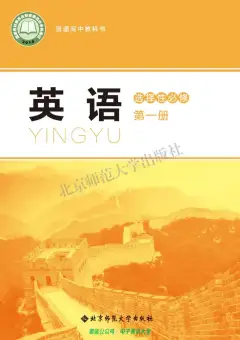
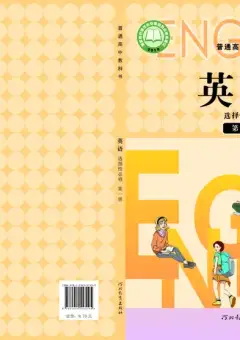
普通高中教科书
英 语
普

通

高

中

教

科

书
选择性必修
第一册
英

语

选
择
性
必
修

第
一
册
定价:9.70 元
普通高中教科书
英 语
选择性必修
第一册
主    编    田贵森
副 主 编    杨永军  付晓丽  Guo Yangsheng
编    者    田贵森  杨永军  付晓丽  胡春来  周  红  杨  琳
            Ingrid Johnston  Leonard Judge  Naama Bar-David  Anja Pujic
责任编辑    董  芳  杨慧敏
美术编辑    张尧杰
绘    画    李  奥
书    名    普通高中教科书 · 英语  选择性必修  第一册
出  版
http://www.hbep.com
        ( 石家庄市联盟路705 号,050061)
发  行    河北省新华书店
印  刷    河北省新华联合印刷有限公司
开  本    890×1240 1/16
印  张    8.25
字    数    210 千字
版  次    2020 年4 月第1 版
印  次    2020 年4 月第1 次印刷
印  数   1-3,000
书  号   ISBN 978-7-5545-5749-5
定  价   9.70 元
版权所有·请勿擅用本书制作各类出版物·违者必究
如有印刷质量问题,请与本社出版部联系调换,电话:18603114066
购书电话:0311-88643600
    图书在版编目(CIP)数据
    普通高中教科书. 英语 : 选择性必修. 第一册 / 田
贵森著. -- 石家庄 : 河北教育出版社, 2020.4
    ISBN 978-7-5545-5749-5
    Ⅰ. ①普… Ⅱ. ①田… Ⅲ. ①英语课-高中-教材
Ⅳ. ①G634
    中国版本图书馆CIP数据核字(2020)第054127号
出版者的话
亲爱的同学们:
欢迎使用冀教版高中英语教科书。这套教材由国内外富有英语教育经验的学者、科研人员
及一线教师根据2017 版《普通高中英语课程标准》编写。
本套教材必修阶段共3 册,满足高中毕业基本要求;选择性必修阶段有4 册,满足高考升
学要求;提高类阶段有3 册,满足有意继续提高英语能力的发展需求。
让我们了解一下教材的结构。每册教材有5 个单元,每个单元包括4 个板块。第1 板块
(Reading for Meaning)为同学们提供了地道、优美的语篇,文章体裁丰富多样、内容有趣且
富有时代特色;第2 板块(Learning through Practice)提供了有意义的语言探究和语言实践活动,
同学们通过完成任务可以体验语言并归纳知识,提高语言运用能力;第3 板块(Using English
in Context)设计有专题调查、访问纪实、讨论汇总、活动设计等多种形式的项目活动,帮助同
学们发展听、说、读、看、写等语言技能,为真实语言交际打下基础。第4 板块(Expanding
Our Horizons)为同学们提供了更多与单元主题相关的经典、有趣的文章。
另外,教材中的评价部分(Evaluate yourself)可以帮助同学们积极反思学习过程,及时调
整学习策略,提高学习效率;单元反思(Unit Reflection)帮助同学们对整个单元进行回顾;链
接部分(More Connections)便于同学们拓展相关主题知识。
本套教材内容涉及人文、社会、自然、科学等多个领域,注重中外文化的介绍与比较。通
过学习本套教材,同学们会在提高语言能力的同时,增强对中华优秀传统文化和社会主义先进
文化的认识,成长为新时代有文明素养和社会责任感的人。
同学们,中学时代是人生美好的一段时光,相信在使用这套教材的过程中,你们通过自
己不懈的努力和老师的正确引导,能够顺利完成教科书中的学习任务,为终身学习打下良好
基础。
愿同学们在英语学海中徜徉,感受英语学习带给你们的新奇、充实与快乐。
Contents
1
UNIT
2
UNIT
WHAT
KIND OF
LEARNER
AM I?
MOVIE,
MIRROR OF
LIFE
SECTION 1  READING FOR MEANING
Different Ways of Learning


2
SECTION 2  LEARNING THROUGH PRACTICE
Task One  Making a Poster about How to Study Smart	6
Task Two  Sharing How to Learn English Effectively	 8
      (Grammar: the present perfect continuous tense)
SECTION 3  USING ENGLISH IN CONTEXT
Project  Investigating Learning Styles and
      Preferences


10
SECTION 4  EXPANDING OUR HORIZONS
Know Your Learning Style


14
We Learn by Doing


16
The Confucian View of Learning


17
SECTION 1  READING FOR MEANING
Li Ming’s New Pen Pal Talking about
      Chinese Movies


20
SECTION 2  LEARNING THROUGH PRACTICE
Task One  Classifying Movies


24
Task Two  Writing a Movie Review


26
      (Grammar: predicative clauses)
SECTION 3  USING ENGLISH IN CONTEXT
Project  Making a Microfilm of Mrs. Thompson
28
SECTION 4  EXPANDING OUR HORIZONS
Hollywood


32
Chinese Culture in Movie Posters


33
Movie with a Message


35
3
UNIT
4
UNIT
MORE
THAN A
MEAL
LITERATURE
FOR SELF-
UNDERSTANDING
SECTION 1  READING FOR MEANING
Food Is Culture: A Lecture


38
SECTION 2  LEARNING THROUGH PRACTICE
Task One  Introducing Chinese Noodles

42
Task Two  Designing a Breakfast Menu

44
     (Grammar: the infinitive as subject)
SECTION 3  USING ENGLISH IN CONTEXT
Project  Exploring Your Family’s Eating Habits
46
SECTION 4  EXPANDING OUR HORIZONS
What Is Food Tourism?


50
Zongzi – the Traditional Chinese Food

51
Loving Food


53
SECTION 1  READING FOR MEANING
The Meaning of Literature


56
SECTION 2  LEARNING THROUGH PRACTICE
Task One  Retelling Morning Girl’s Story

60
Task Two  Exploring Key Theme of a Play

61
     (Grammar: subject clauses)
SECTION 3  USING ENGLISH IN CONTEXT
Project  Recommending Literature to
     a Reading Corner


64
SECTION 4  EXPANDING OUR HORIZONS
Understanding Yourself through Literature
68
The Old Man and the Sea


69
A Dream of
Red Mansions
A Dream of
Red Mansions
5
UNIT LEARNING
THROUGH
TRAVEL
SECTION 1  READING FOR MEANING
Travel Experiences


74
SECTION 2  LEARNING THROUGH PRACTICE
Task One  Describing Your Favourite Travel
      Destination


78
Task Two  Giving Tips about Travel Etiquette
      in China


80
     (Grammar: the v-ing form as subject)
SECTION 3  USING ENGLISH IN CONTEXT
Project  Writing a Travel Brochure


82
SECTION 4  EXPANDING OUR HORIZONS
Travel with Eric, Brian and Li Ming


86
Why Is Travelling Such a Valuable Learning
Experience?


89
APPENDICES
WRAP IT UP!


91
VOCABULARY (I)


106
VOCABULARY (II)


112
LIST OF PROPER NAMES


119
GRAMMAR


122
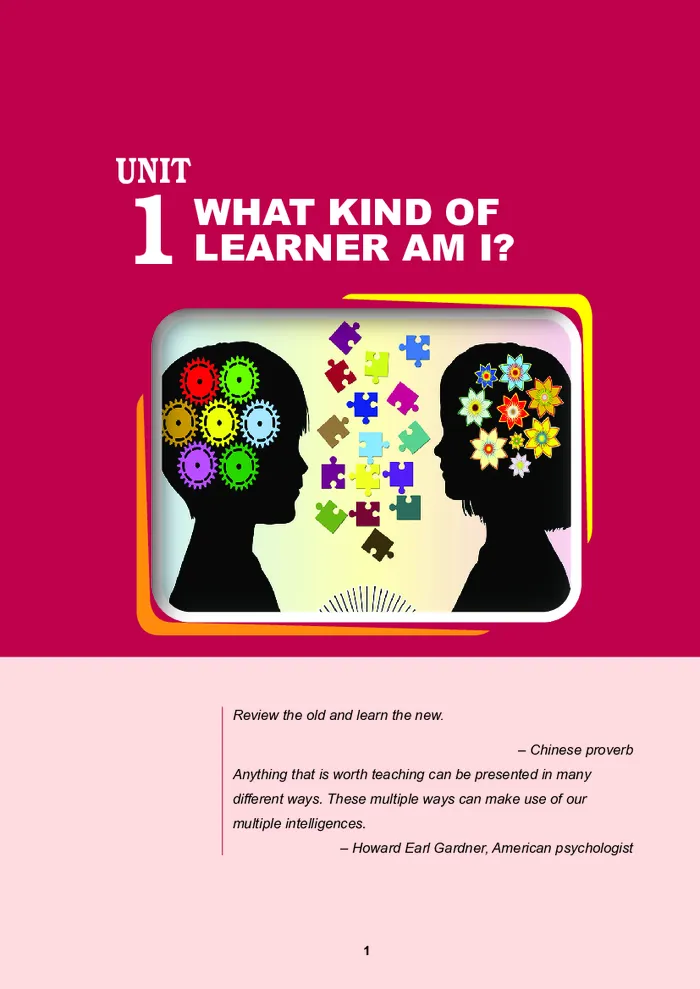
1
UNIT
WHAT KIND OF
LEARNER AM I?
Review the old and learn the new.
 – Chinese proverb
Anything that is worth teaching can be presented in many
different ways. These multiple ways can make use of our
multiple intelligences.
– Howard Earl Gardner, American psychologist
1
Different Ways of Learning
BEFORE YOU READ
1	 Do you know that there are different ways of learning? What are they?
2	 Have you heard about “Multiple Intelligences”? What does this term mean?
3	 Do you know why different students are good at different subjects?
READING FOR MEANING
1
A parcel arrived in the mail. Li Ming was excited because a parcel
from Canada was more than he had hoped for. He opened the parcel
and looked at the heavy square box. It was a board game from Jenny. Li
Ming liked board games, such as chess. However, he had never seen this
game before. He invited a few friends over to try out the new game that
weekend. Li Ming’s friends were curious about the game and Li Ming
had to explain the rules to them. Here is part of their conversation.
Howard Earl Gardner is
an American developmental
psychologist. He is best known
for his theory of multiple
intelligences, as outlined in his
1983 book Frames of Mind: The
Theory of Multiple Intelligences.
DO YOU KNOW?
Li Ming: Okay, guys, this is how we play the game. We divide
players into two teams. We take turns rolling the dice and
move to different coloured squares. The square we land on
determines which box we draw a card from. Then the players
on each team must try to complete the task on the card. The
interesting thing is that the tasks on the cards are based on a
theory called Multiple Intelligences.
Dong Hao: I’ve heard of that before. A teacher in the U.S. came
up with that theory. I think his name was Gardner. He says that
people can be intelligent in at least seven different areas. One
person, for example, might be good at problem solving and
mathematics – that’s called logical intelligence. Another person
might be good at sports – that’s called physical intelligence.
2
 UNIT 1 WHAT KIND OF LEARNER AM I?
Chen Hai: What other types are there?
Li Ming: Well, there’s verbal intelligence, meaning you are good at language.
Chen Hai: I don’t have verbal intelligence because I think English class is horribly boring. I
got a terrible mark on that last test we had.
Lan Yuan: It’s not just about a foreign language. Having verbal intelligence also means that
you like reading, writing poems, doing word puzzles and things like that.
Xiong Jian: And maybe it also refers to people who talk a lot – just like you!
Lan Yuan: Ha ha, Xiong Jian! Very funny! To tell you the truth, I am a person with musical
intelligence. Musical learners like the sounds of human voice, sounds from nature and
sounds made by instruments, like drums or guitars. They also like singing and music.
Chen Hai: What about artists? What kind of intelligence do they have?
Li Ming: They’re called visual learners. They are good at things like creating models or
drawings.
Xiong Jian: Hey, you guys, enough about theory. What about our game?
Li Ming: Yeah, let’s begin. But remember that the tasks we have to complete in this game require
us to use skills from all seven areas of intelligence. All the tasks in the red box use visual
or musical intelligence. The green box focuses on physical learners. The pink box contains
questions that test mathematical intelligence. The yellow box is full of cards with spelling
questions and word puzzles, so of course here we will be using our language skills.
Lan Yuan: Yes, our verbal intelligence and much more! This game is in English. That means
If you get bonus points, you get
extra points.
QUICK CHECK!
if we can complete a yellow card in a foreign language,
we probably should get bonus points for using all
the different forms of intelligence. I know when I use
English, I sometimes use logic to figure out the grammar.
Sometimes I just guess a dictation right because I copy
a phrase I heard in class. I usually don’t even remember
what it means. That’s using my musical ability because
it’s based on the sound patterns I hear.
Dong Hao: You have a good point. Maybe it is important
to improve our intelligence in all areas. Hey, Li Ming,
we’ve talked about logical, visual, musical, physical,
and verbal intelligence. I have enough mathematical
intelligence to know that this is five, not seven, different
3
 UNIT 1 WHAT KIND OF LEARNER AM I?
AFTER YOU READ

Reading Comprehension
1	 What is the “Theory of Multiple Intelligences”?
2	 What are the major learning techniques mentioned in the text? How are they matched with each
type of learner?
3	 Who is Einstein? Why does Xiong Jian call Li Ming by this name?
4	 In what way does the game use interpersonal or intrapersonal intelligence?
5	 Some people group interpersonal and intrapersonal skills together and call it emotional intelligence.
Do you agree? Compare and contrast interpersonal intelligence and intrapersonal intelligence.
6	 What kind of learner do you think you are? Why do you think so?

Post-reading Activities
1 The prefix inter- means “between”. It can be added to adjectives and nouns to form other adjectives
and nouns that refer to something existing or happening between similar things or groups of people.
Can you guess what the following words mean? Do you know other words that begin with inter-?
kinds of intelligence. What are the other two?
Li Ming: Those are called interpersonal intelligence and intrapersonal intelligence.
Interpersonal intelligence is when you are very good at building relationships with other
people. Intrapersonal intelligence is when you know yourself very well, understand and
accept your own personality, and often like to work independently.
Xiong Jian: Come on, Einstein, let’s play.
Dong Hao: Yeah, let’s go. I want to be on Li Ming’s team.
...
interchangeable
interactive
international
interrelated
interview
internet
inter
4
 UNIT 1 WHAT KIND OF LEARNER AM I?
             SONG
What Kind of Learner Am I?
Some of us learn quickly and some a little slow
Some of us use our hands to pick up what we know
Everyone is different in how they handle tests
Everyone is learning at the speed that suits them best.
Some of us like maths and do it all day long
Some of us like art and can sing any song
Some of us like structure in our play and school
Some of us like freedom and not so many rules.
Chorus
I’m learning the best that I can
I’m helping the teacher know me
I’m learning the best that I can
I’m helping the teacher show me.
So I won’t be discouraged if I’m not at the top
I’m just finding out the qualities I’ve got
There is something that I’ve realized:
The smartest may not get the prize.
Repeat Chorus
2	 According to the text, what are the seven ways of learning? What are some learning techniques
that might work best for each type of learner? In groups, discuss and share your answers with your
classmates.
3	 Work in groups of seven. Based on the information from the text and other sources, each group
member chooses and writes about one of the seven ways of learning. Share your descriptions in
your group.
4 When you look back on your life in school or your education in general, what difficulties have you
had to overcome in order to learn well? Is there one person, such as your teacher, relative or
friend who has helped you to learn something really well? Share your experiences in your group.
5
LEARNING THROUGH PRACTICE
2
Task One  Making a Poster about How to Study Smart
In this task, you will read a passage about study habits. Do a survey in your group to make a
poster about how to study smart with the help of good study habits.
Step 1  Pre-task Resources
Read the following passage about study habits and reflect on your own study habits.
Study Habits Really Matter
If you want better grades, you need more effective study habits. The key to effective
studying isn’t studying longer, but studying smarter. You can begin studying smarter with
these effective study habits.
Study in a quiet place.
A place with a lot of distractions makes for a poor study area. If you try and study in your
dorm room, for instance, you may find the computer, TV more interesting than the reading
material you’re trying to digest. The library is a good place to check out.
Bring everything you need, nothing you don’t.
Unfortunately, when you find an ideal place to study, sometimes you bring things you don’t
need. For instance, while it may seem ideal to type notes into your laptop to refer back to
later, computers are a powerful distraction for many people because of their convenience.
Keep your phone in your purse or bag to keep distraction at bay as much as possible. Your
phone is a potential time-sink and one of the worst enemies of concentration.
Don’t forget the things you need to study for the class, exam, or paper you’re focusing on for
the study session. Nothing is more time-consuming and wasteful than having to run back and
forth regularly because you forget an important book, paper, or some other resource you need.
Outline and write your notes.
It may be helpful to use as many senses as possible when studying. That’s why writing
notes works in the first place – it puts information into words and terms you understand.
Mouthing the words out loud while you copy the notes before an important exam can be
one method for involving another sense.
6
Practice with friends.
Some people enjoy reviewing their materials with a
group of classmates. Such groups work best when
they’re kept small. Some groups like to work through
chapters together, quizzing one another as they go
through it. Others like to compare class notes and
review materials that way, ensuring they haven’t
missed any critical points. Such study groups can be
helpful for many students, but not all.
Step 2  Task Cycle
1
In pairs, talk about the study habits mentioned in Step 1. Which do you think are good and
which are bad? Why?
2
In groups of four, do a survey about your study habits. Sort these habits out as good ones
and bad ones.
3
Discuss your study habits and choose top five good study habits and top five bad study habits
to make a poster as follows:
 UNIT 1 WHAT KIND OF LEARNER AM I?
Study Habits Matter
We need to employ good study habits and avoid bad ones. Let’s
take action!
Top Five Good Study Habits
Top Five Bad Study Habits
Step 3  Language Focus
An imperative sentence is used to give advice, instructions or invitations. It can also
express a request or command. An imperative sentence tells people what to do or what
not to do.
7
● Study in a quiet place.	 ● Bring everything you need, nothing you don’t.
An imperative sentence typically begins with the base form of a verb and ends with a period
or an exclamation point. However, it can also end with a question mark in some instances.
● Please be quiet.
● Go away!

● Please open the door, would you?
An imperative sentence may seem to be missing a subject. Sometimes, the subject is given
to make it much clearer who is spoken to, by adding a person’s name to the beginning or
ending of some imperative sentences.
● Sally, please don’t give the dog popcorn.
● Please sit down, Sam!
Imperative sentences can take several forms in everyday speech and writing. A few of the
most common uses include:
Task Two  Sharing How to Learn English Effectively
In this task, you will read a short passage about an English-language learning experience.
Then you will recall and reflect on your own experience. Tell your classmates how you study
English effectively.
Step 1  Pre-task Resources
Read the passage and pay attention to the function of the words in blue.
Keep a Diary in English
I have an English teacher from Canada. Her name is Laura and she has been teaching me
English for almost two years. From the very beginning, she has been asking us to keep a
diary in English. Laura tells us that we can write anything we like and that it doesn’t have
 UNIT 1 WHAT KIND OF LEARNER AM I?
A request or wish
Pack enough clothing for the cruise.
Have fun at the fair tonight!
An invitation
Come by at 8 a.m., please.
A command
Raise your hands and turn around.
An instruction
Turn left at the crossroads.
8
 UNIT 1 WHAT KIND OF LEARNER AM I?
to be personal. She says that we can write about
weather, what we have for dinner or what we plan
for the day. She insists that we write something in
English every day. I have been keeping an English
diary since then. Writing in English every day really
helps. It helps me to work on English word spelling, sentence structure and grammar. And
I’m very lucky that Laura has been reading my work, checking it over and correcting my
errors. This helps me to avoid making the same mistakes over and over again.
Step 2  Exploring the Language
Here are some sentences from the passage in Step 1. Examine the sentence structure. Do
you find anything in common?
● … she has been teaching me English for almost two years.
● From the very beginning, she has been asking us to keep a diary in English.
● I have been keeping an English diary since then.
● And I’m very lucky that Laura has been reading my work, checking it over and
correcting my errors.
The present perfect continuous is made up of two elements: the present perfect of the verb
“be” (have/has been), and the present participle of the main verb (v-ing).
The present perfect continuous is used to refer to an act that has started sometime recently,
is still going on and especially may go on in the future. The speaker is more interested in
the process than the result. However, some verbs, such as know, hate, hear, understand,
are seldom used in the present perfect continuous tense.
Step 3  Task Cycle
■
Discuss with your classmates your way of learning English. Share with them how you learn
vocabulary, grammar and pronunciation, or how you develop language skills like listening,
speaking, reading and writing.
■
Write briefly about your own best way of learning English. Practice using the present perfect
continuous in your writing.
■
Present your passage in your group and learn how your classmates effectively learn English.
9
3
USING ENGLISH IN CONTEXT
Project  Investigating Learning Styles and Preferences
In this project, you will read a passage, do a quiz and listen to the learning preferences of
several students. Then interview your classmates about their learning styles and report your
investigation afterwards.
Step 1  Read and Discuss
Read the following passage. Then with your classmates discuss what kind of learner you are.
Learning styles refer to an individual’s preferred or
most effective way of learning. Each student has his
or her own method. Some students are comfortable
with one particular learning style while others tend
to use multiple styles. But they all learn things more
easily and quickly with their preferred styles.
Teachers often use their own preferred learning style
as their main mode of teaching. If students do not
share those same preferred styles, learning can be very difficult. Sometimes, students
struggle with a concept or an idea not because they aren’t intelligent, but because the
information has not been presented to them in a learning style with which they are
comfortable.
Learning would be relatively easy and efficient for students if teachers could consider
multiple learning styles when designing their lessons. So knowing their students’ preferred
learning styles is perhaps one of the most important tasks for teachers. Identifying
learning preferences would surely improve both learning and teaching in schools.
Each of us learns differently. We all have our own study methods based on our
experience, practice and born preferences for what works. There are three methods
we can use to discover how we learn. We determine our learning styles by observing
our study habits, answering questions, or connecting them to our learning strategies.
10
 UNIT 1 WHAT KIND OF LEARNER AM I?
Step 2  Read and Measure
Complete the following Learning Style Quiz and identify your learning style.
Learning Style Quiz
Which Learning Style Do You Have?
Complete the following sentences with one answer that best describes you. Remember, there is no
right or wrong answer.
1	 When learning something new, I need to
a. read the information and see diagrams.
b. listen to a lecture or discuss the information.
c. try it out, build a model or touch the
materials.
2	 When giving or receiving directions to a
new address, I usually
a. draw a map and write out the directions.
b. have someone explain the directions to me.
c. just start walking and find my way.
3	 I prefer to
a. write things down and take notes to learn
well.
b. hear discussions or recordings of critical
information to learn well.
c. participate in an experiment or
demonstration to learn well.
4	 After meeting someone, I usually
remember
a. how he/she looked.
b. what he/she said.
c. what he/she did.
5	 When learning vocabulary, I prefer to
a. write out the words alone or in sentences.
b. repeat the words aloud or say them aloud in
sentences.
c. walk around, move around and do something
while learning the words.
6	 When spelling a word, I usually
a. write out the word.
b. spell the word out loud.
c. write the word in the air.
7	 I enjoy
a. reading and writing exercises.
b. listening exercises.
c. activities in which I take part (e.g. role-play).
8	 When I think of a movie I have seen, I
remember best
a. what the people and places in the movie
looked like.
b. what the characters said and how the music
sounded.
c. what the characters did and how they felt.
9	 When I am trying to memorize something,
I prefer to
a. write it down repeatedly.
b. say it aloud repeatedly.
c. use it repeatedly.
10  I prefer homework that requires me to
a. hand in an essay or written assignment.
b. give an oral presentation.
c. lead a demonstration or activity.
11  I really like
a. reading books and magazines.
b. listening to music.
c. going on field trips, etc.
12  In a class or seminar, I usually
a. take lots of notes about what the teacher is
saying.
b. listen carefully but don’t take many notes.
c. draw pictures while listening.
11
 UNIT 1  WHAT KIND OF LEARNER AM I?
Learning Style Quiz Results
After you have completed the Learning Style Quiz, add up the total number of each letter(a,
b or c) you have circled. It should be pretty clear which answers correspond to each learning
style – a corresponds to a visual learning style, b to auditory, and c to tactile-kinesthetic.
Based on this information, you will be able to fill in the following profile for yourself.
My main learning style is ___________.
My secondary learning style is ___________.
My tertiary learning style is ___________.
Step 3  Listen and Summarize
Listen to a list of students’ learning preferences and fill in the blanks. Then make your own
list of 6 – 8 learning preferences. You may choose from this list or add your own.
Step 4  Investigate and Collect
Investigate your classmates’ learning styles and learning preferences. Before you get started,
read and discuss the instructions below.
●	 Work in groups of four. Prepare 10 copies of the Learning Style Quiz and 10 sheets
of paper with learning preferences from Step 3.
●	 Invite 10 students to do the Learning Style Quiz and then ask them to write 6 – 8 learning
preferences. Tell them that they may choose from the given list, or write their own.
We will learn BEST when
our teachers...
assign us in groups.
let us do work hands-
on and with more
discussion.
allow us to ask questions
and to discuss details.
teach us language
skills ________
________.
show us something visually
________ ________ just
talking to us.
show us ________
________ ________ on
how to do things and
clarify misunderstanding.
take us on field trips to
________ real life
situations.
explain things first, then
show them to us, and
ask us to demonstrate.
12
 UNIT 1 WHAT KIND OF LEARNER AM I?
●	 Collect and mark the results of the Learning Style Quiz. Then, classify the learning
styles into four types: visual, auditory, kinesthetic, and mixed.
●	 Collect and rank the learning preferences. If many students list the same or similar
learning preferences, count how many and check what learning styles they are from.
Step 5  Analyze and Write
Now you may analyze your findings of investigation, and write your report. Your report
should include:
●	 a short introduction of three to five sentences, explaining the purpose and contents of
your investigation;
●	 your findings of students’ learning styles (how many of each type and scores);
●	 your findings of students’ learning preferences (list them based on rankings);
●	 your comments on the implications of your findings and your reflection upon the
investigation.
Evaluate yourself!
Can you improve your learning after you figure out what kind of learner you are?
Can you use verbal or non-verbal means to start or end a conversation?
How well have you done with the following? Tick the circles that best reflect your performance.
Using conversation fillers and other means to
communicate naturally in English
Adjusting my own learning strategies according
to different learning goals and contents
Analyzing reasons when meeting with learning
difficulties and overcoming them
Excellent    Very Good    Good    Needs Improvement
13
EXPANDING OUR HORIZONS
4
Know Your Learning Style
Knowing your learning style can help you find the best way to learn a new skill. The four
most common learning styles are: visual, auditory, kinesthetic and reading/writing. Your
learning style determines how you access information.
Read ahead to see which description sounds like you and learn how you can use your
strengths to apply to academic learning and your everyday life!
1. Visual Learners
Visual learners best understand information by using their eyes. They absorb and remember
information when it is presented in pictures, diagrams, maps, or charts. Watching videos,
and looking at illustrations are also great tools for a visual learner. They may speak quickly
and prefer to work alone rather than in groups.
You may be a visual learner if…
● your notes are covered with drawings.
● you are good at remembering faces but not names.
● you can spell well.
● you’d rather read a story than listen to it.
● you’re good with maps and directions.
2. Auditory Learners
People who belong to this category prefer to listen to information rather than read it or see it
visually displayed. They work well in a classroom setting and learn quickly through guidance and
stories. They also learn quickly by listening to lectures and participating in group discussions.
You may be an auditory learner if…
● you are easily distracted by noises.
● you have difficulty working quietly for long periods of time.
● you are a good listener.
● you easily remember what others say.
14
 UNIT 1 WHAT KIND OF LEARNER AM I?
POST-READING QUESTIONS
1	 What kind of learner are you? Are you a mixed type of learner or not?
2 How do you find the four types of learners? Are they making our understanding of learning clear, or
confused?
3	 Discuss with your classmates and see if they are the same or different in learning styles. Share your
opinions about learning styles.
3. Kinesthetic Learners
Kinesthetic learners are the most hands-on learning type. They use their senses to work on
new skills and rely heavily on muscle memory. Kinesthetic learners learn best by doing and
tend to have good coordination and best remember what they do.
You may be a kinesthetic learner if…
● you shine at sports, art or drama.
● you enjoy building, making or creating.
● you have trouble sitting still.
● you play with objects while thinking.
4. Reading/Writing Learners
Reading/Writing learners are extremely comfortable with the written word. They prefer to
consume information by reading texts. The traditional lecture and note-taking environment
works well for the reading/writing learning style.
Everyone learns best if they are able to experience a lesson in a way that makes sense to
them. Knowing which type of learner you are can help your teacher develop a lesson plan
that works best for you.
You may be a reading/writing learner if…
● you love making lists.
● you enjoy reading and writing.
● you prefer to have written directions.
15
 UNIT 1 WHAT KIND OF LEARNER AM I?
We Learn by Doing
Not many years ago, John Holt began to play the cello. He told us his story of learning by
Not many years ago, John Holt began to play the cello. He told us his story of learning by
doing. “Most people would say that what I am doing is learning to play the cello. But these
doing. “Most people would say that what I am doing is learning to play the cello. But these
words suggest that there are two very different processes: (1) learning to play the cello and (2)
words suggest that there are two very different processes: (1) learning to play the cello and (2)
playing the cello. They
playing the cello. They imply
imply that I will do the first until I have completed it, at which point
 that I will do the first until I have completed it, at which point
I will stop the first process and begin the second. In short, I will go on learning to play until
I will stop the first process and begin the second. In short, I will go on learning to play until
I have learned to play and then I will begin to play. Of course, this is nonsense. There aren’t
I have learned to play and then I will begin to play. Of course, this is nonsense. There aren’t
two processes, but one. We learn to do something by doing it. There is no other way.”
two processes, but one. We learn to do something by doing it. There is no other way.”
Learning anything new requires a lot of doing. It is also
Learning anything new requires a lot of doing. It is also essential
essential for students to practice
 for students to practice
frequently when learning English as a foreign language. Some students do not like to
frequently when learning English as a foreign language. Some students do not like to
practice things they have learned because they think they know it already. Yet, as an English
practice things they have learned because they think they know it already. Yet, as an English
saying
saying goes, “Knowing without doing is not knowing at all.” In language learning, a word
 goes, “Knowing without doing is not knowing at all.” In language learning, a word
repeatedly practiced is a word learned; a sentence repeatedly used is a sentence learned. We
repeatedly practiced is a word learned; a sentence repeatedly used is a sentence learned. We
should ensure that we will have lots of DOING after we know lots of English.
should ensure that we will have lots of DOING after we know lots of English.
Now in the following “The Cone of Learning”, Edgar Dale shows us how we can learn by doing.
Now in the following “The Cone of Learning”, Edgar Dale shows us how we can learn by doing.
The Cone of Learning
Doing a Dramatic Presentation
Simulating the Real Experience
Doing the Real Thing
Participating in a Discussion
Giving a Talk
Watching a Movie
Looking at an Exhibit
Watching a Demonstration
Seeing It Done on Location
Seeing
Hearing Words
Reading
P
a
s
s
i
v
e
A
c
t
i
v
e
10% of what we READ
After 2 weeks,
we tend to remember...
20% of what we HEAR
30% of what we SEE
70% of what we SAY
90% of what
we SAY & DO
50% of what we SEE & HEAR
Source: Edgar Dale (1969)
16
 UNIT 1 WHAT KIND OF LEARNER AM I?
The Confucian View of Learning
Born in 551 BCE, Confucius was one of the great teachers and thinkers of all time. He is
known to us as Kongzi. He believed in people’s ability to understand, learn and improve
themselves. His ideas about learning have been important for thousands of years and can still
be applied to our learning today, as well as to philosophies across the globe.
Here are some quotes from Confucius. Read and discuss what they mean and compare them
with Western ideas about learning.
Quote 1
Studying, and from time to time going over what you’ve learned – that’s enjoyable,
isn’t it?
This quote from Confucius stresses the importance of REVIEW in learning.
Quote 2
When I walk with two others, I’m bound to find my teacher there. I single out their good
points and pursue them, note their bad points and make my corrections.
This quote from Confucius expresses the Chinese view about relationships in learning. In
Chinese culture, individual students prefer not to be singled out from the rest of a group.
The value of education and learning is in cooperation and students are taught to learn from
each other.
We have two more quotes. Quote 3 expresses the Confucian view about the attitude towards
learning. Quote 4 expresses the Confucian view about methods of learning.
POST-READING QUESTIONS
1	 Do you agree that we learn things by doing them? What is the process of learning according to the writer?
2	 Did you learn anything from Edgar Dale? What is it? Which piece of advice mentioned in the text do you
find useful or helpful?
3	 What inspiration can you get from Edgar Dale’s “Cone of Learning”?
17
Unit Reflection
Review the whole unit and reflect on what you have learned.
1	 What are the seven types of intelligence? What kind of learner are you? Are you a mixed
type of learner or not? Do you agree with the results of the test in this unit?
2	 What have you discovered about learning from this unit? What are the major factors that
contribute to effective learning? Can a teacher open a door to your creativity “from the
outside” or do you have to open yourself from within – under your teacher’s guidance – in
order to really learn something?
3	 What is the present perfect continuous tense? What have you learned about the meaning
and use of the present perfect continuous tense?
 UNIT 1 WHAT KIND OF LEARNER AM I?
POST-READING QUESTIONS
1	 How do you like these four quotes from Confucius? What did you learn from them? Do you know other
quotes from Confucius in English?
2 What do you think about the Confucian idea of cooperation in learning? How can we benefit by learning
from each other?
3	 Is there a quote that helps shape your way of learning? What is it?
Quote 3
To know it is not as good as to approve it. To approve it is not as good as to find joy in it.
Quote 4
Learning without thought is pointless. Thought without learning is dangerous.
More Connections
●	 A popular book named How to Study written by Rob Fry gives information on how to
create an effective study environment. It also shows students the essential skills that can
be applied outside the classroom and later in life.
●	 Learn more about current information of learners, learning styles and multiple
intelligences. Here are some key words for your reference: study skills, learning styles,
learning strategies, and multiple intelligences.
18
2
UNIT
MOVIE, MIRROR OF
LIFE
Film is both a visual art such as sculpture and painting, and an auditory art like
music. It is an art that combines audio and visual.
– Zhang Lujun, Chinese playwright
Film is hard to explain, because it is so easy to understand.
                              – Christian Metz, French film theorist
Movies can and do have tremendous influence in shaping young lives in the
realm of entertainment towards the ideals and objectives of normal adulthood.
– Walt Disney, American entrepreneur
19
READING FOR MEANING
1
Li Ming’s New Pen Pal Talking about
Chinese Movies
BEFORE YOU READ
1	 What are your movie-watching experiences like today?
2	 What type of movie do you like best? List your reasons.
3	 Who is your favourite movie star? Why do you like his/her acting style?
Dear Li Ming,
I’m happy to be your pen pal, too! I like your ideas about
Hollywood movies. Guess what I did last weekend! I watched
a Chinese movie with Jenny! I saw a Jackie Chan movie and
I really enjoyed it. I was a little surprised, though, because
it was different from a typical Western movie. Jackie Chan’s
movie has a lot of action in it. I couldn’t believe how quickly
the action took place. It was full of kung fu! I actually got
dizzy watching the actors jump around so rapidly.
The reason I liked the movie was that it was so funny! I laughed
my head off the whole time. I think it is good to watch a movie
to relax and forget the real world for a while. Western movies
are often so serious and realistic. When you watch them, you
think a lot about the problems in the world and sometimes you
feel depressed. Sometimes the endings are very sad. I think
Jackie Chan’s movies always have happy endings. People who
like Jackie Chan don’t care if the ending is realistic. They just
care that everything turns out well.
20
 UNIT 2 MOVIE, MIRROR OF LIFE
The other thing I noticed about the movie was the fantastic
special effects; it was very high-tech. Maybe Chinese
moviemakers think that special effects and action are the
two most important aspects of a movie. Different things are
important to Western moviemakers. For example, Western
movies are filled with scenic shots and beautiful landscapes
like mountain ranges, natural bodies of water, or colourful
skies. In the Jackie Chan’s movie, the camera was moving
so fast that I had no time to notice the scenery!
When I discussed the Chinese movies with Jenny, she had
a different point of view. Later she surfed the Internet and
sent me some comments in English on Chinese movies.
I agree on the idea in the comments that movies have the
capacity to mirror and to influence society. However,
the society, its trends, and people’s reactions to those
trends influence the movies, too. Now I have become more
curious about Chinese movies.
Please find the comments in the attached files, and see how
you feel. Have you ever seen the movies mentioned in the
comments? I love romantic movies, simply because a loose
end is rare in the plot. Actually, they are my favourite
genre. Can you recommend one to me? What is your
favourite genre, Li Ming?
Well, it’s time for me to go now. I have an assignment to
finish for class tomorrow. I have to do a movie review.
Last week in class, we watched a movie called Pay It
Forward. It had such a touching plot! Now, I have to write
out my impressions of the movie. I don’t mind doing this
homework because I enjoyed the movie so much!
Yours,
Mary
A movie review is a report in
which someone gives their opinion
of a movie. A decent movie review
should entertain, persuade and
inform readers by creating an original
thesis based on reasonable analysis,
giving a brief summary of the plot,
discussing interesting elements of
the movie to support the thesis, and
ending with a conclusion.
DO YOU KNOW?
21
 UNIT 2 MOVIE, MIRROR OF LIFE
Some Chinese movies portray historical events. For
instance, My 1919 (wo de 1919) and The Founding of a
Republic (jian guo da ye) provide good opportunity for
the younger generation to learn about what their elder
generation did for the country. Among these historical
movies, Little Soldier Zhang Ga (xiao bing zhang ga)
is remarkable for it is based on the real life of a boy
and depicts actual events of the War of Resistance
against Japanese Invasion. The movie gives an accurate
description of young people’s participation during the war.
Apart from these historical movies, there are many
movies that mirror the everyday life of Chinese people.
For example, Not One Less (yi ge dou bu neng shao)
centres on a young girl teacher who spares no effort to
do her job well and never gives up. The movie has a
slow plot that leads to a small climax and a quick ending,
which is quite different from Western movies. Besides,
there are many Chinese movies telling romance stories.
The film Forever Young (wu wen xi dong) tells stories of
four generations of students from Tsinghua University –
about how they pursue their love, interests and dreams,
conveying how traditional virtues were passed down.
Through these movies, we can better understand the
society and the world. They tell stories about the past
and the present, which reflect the values of a society.
Comments on Chinese Movies
22
AFTER YOU READ

Reading Comprehension
1	 What impressed Mary most when she saw Jackie Chan’s movie?
2	 How does Mary judge a movie? Do you agree with her? What’s your opinion?
3	 How does Mary see the differences between Western movies and Chinese movies? What are your
thoughts about the differences between the two types of movies?
4	 How did Jenny help Mary know more of Chinese movies? What do you think of the comments?
5	 What type of movie do you like? Why?
6	 What is the relationship between movies and life?

Post-reading Activities
1	 Look at the category words and examples given, and then add as many words related to the
categories in the movies as you can in groups.
 UNIT 2 MOVIE, MIRROR OF LIFE
people
actor
2	 Do you think movies mirror real life? Do you have any experience with movies influencing or
shaping some of your behaviours? Share this experience with others in groups.
3	 Movies and music are a natural combination. Talk about your favourite songs written for movies and
discuss how they help the audience better understand the movie’s theme.
4	 Make a list of movies you and your classmates have seen. Share your views on these movies in
groups. Then, vote and rank top 5 movies in your group. Give a brief comment (2 – 3 sentences) on
each movie.
movie
camera
equipment
23
LEARNING THROUGH PRACTICE
2
Task One  Classifying Movies
In this task, you’ll learn a variety of words related to movie genres. With some knowledge of
movie genres, you will have a better appreciation of the theme and plot when you watch a movie.
Step 1  Pre-task Resources
Read the passage and guess the meanings of the words and phrases in blue.
Major Types of Movies
In movie-making, each genre has its own set of rules and characteristics. If you want
to make people laugh and feel good, obviously a comedy is the way to go. If you
just want to excite your audience, then produce an action picture that gives viewers
a roller coaster of emotions. Steven Spielberg scared people out of the water for
years with Jaws. Horror movies use the element of shock to surprise the audience.
Romance stories focus on love. Science fiction often tells the stories about science and
technology of the future and typically includes worlds with aliens, robots or monsters,
and plays on the idea that we may not be alone in the universe. The fantasy genre
combines fantasy worlds and magical elements that could never exist in today’s world
(This is what separates this genre from science fiction). War movies have always been
popular. It’s the good team versus the bad team with lots of gunfire. Suspense movies
keep you on the edge of your seat. They give you a feeling of excitement mixed with
fear, tension and anxiety. A musical is like a real stage show combined with the magic
of movie-making.
24
 UNIT 2 MOVIE, MIRROR OF LIFE
Step 2  Task Cycle
1
View the following movie posters and match them with the proper movie genres.
2
Pair work. Describe each movie above and explain why it belongs to such a movie genre.
Step 3  Language Focus
If you’ve just seen a great movie, you might want to tell your friends about it. Here are some
words and expressions for introducing its genre.
Musical
Romance
War
Action
Sci-Fi
Cartoon
Learning tips
Classifying information can help you remember things more effectively.
When encountering new words, you can remember them better if you
organize them in a logical way instead of just memorizing them.
cartoon
horror/thriller/
suspense/mystery
science fiction/
fantasy
romance
musical
action
movie genre
fighting, chases,
explosions,
fast scenes
computer-animated,
hand-drawn characters
dark, scary,
bloody scenes
story told with
music, singing
and dancing
a love
story
not a true story,
based on make-
believe situations,
usually set in some
future time
25
 UNIT 2 MOVIE, MIRROR OF LIFE
Task Two  Writing a Movie Review
Just like “there are a thousand Hamlets in a thousand people’s eyes”, the audience often has
different impressions of a movie. Movie reviews tend to summarize the plot of the movie as
well as the writer’s thoughts about it. In this task, you’ll first read a movie review, and then
reflect on your favourite movie and write your own review.
Step 1  Pre-task Resources
Read the following movie review about Zootopia and underline the subordinate clauses.
Zootopia is a computer-animated movie made in 2016 and
produced by an American company. It was directed by
Byron Howard and Rich Moore.
Animated movies have always been what interests me
most. This movie details the unlikely partnership between
a rabbit police officer and a red fox cheat when they
investigate a missing-person case. The moral of the
movie is that people should never give up on their dreams
despite the prejudice that holds them back.
In this movie, a rabbit named Judy Hopps becomes what she always wanted to be: the
first rabbit police officer. During Judy’s first day on the job, she meets Nick Wilde.
Nick laughs at her work and says she will never be successful. He suggests that Judy
should return to her hometown to plant carrots instead of working in Zootopia. Judy is
angry at his hurtful words. This is why she dislikes Nick at first. However, when Judy
follows up on a case about 14 missing animals, she finds that Nick is no longer what
she thought he was. What impresses Judy is that Nick’s wisdom always works best
when they are in trouble. It seems as if Nick could be a good partner. As the two work
together, Nick slowly becomes Judy’s friend and adviser.
The genius of Zootopia is that it works on two levels: it’s a timely and clever examination
of the prejudices common in society, and it is also an entertaining and funny adventure
about hairy creatures engaged in solving a mystery.
26
 UNIT 2 MOVIE, MIRROR OF LIFE
Step 2  Exploring the Language
1
Examine some subordinate clauses from Step 1 and pay attention to their structures.
●	Animated movies have always been what interests me most.
●	The moral of the movie is that people should never give up on their dreams…
●	This is why she dislikes Nick at first.
●	It seems as if Nick could be a good partner.
2
Whatever follows a linking verb, it is a predicative. If a subordinate clause acts as a
predicative, this clause is called a predicative clause. Here are the different types of
predicative clauses.
Step 3  Task Cycle
In general, a movie review consists of several elements: title, director, theme, opinions about
the main characters, music, conclusion, and recommendation. What do you think of the movie
review in Step 1? If you were the author, how would you make it better?
Choose a movie you like and write a review about it. Before you start to write, think about
the elements of a movie review, and ask yourself the following questions.
■
What is the message of this movie? Do you agree or disagree with it?
■
Did anything that happened in this movie remind you of something that has occurred in your
own life or in someone else’s?
■
What part of the story was the most powerful? Why?
■
What feelings did you share with any of the characters in the movie?
■
Analyze the use of music in the movie. Did it enhance the story that the moviemakers were
trying to tell?
■
Would you recommend this movie to a friend? Explain your reasons.
Try to use predicative clauses to express your ideas and suggestions when you write your review.
Linking verb +
that-clause
whether-clause
wh-clause
as if/though and because clauses
Besides “be”, there are some
other linking verbs that may be
followed by a predicative clause:
appear, feel, lie, look, remain,
seem, smell, sound, etc.
Learning tips
27
3
USING ENGLISH IN CONTEXT
Project  Making a Microfilm of Mrs. Thompson
Microfilms are short, low-budget films made by amateur filmmakers. The Chinese term for
microfilms – Weidianying – makes reference to Weibo where many of these films make their
debut. In this project, you will learn how to make a microfilm.
Step 1  View, Fill in Blanks and Discuss
View the report about the Fourth China International Microfilm Festival in Hangzhou,
complete the following table and discuss the recent development of microfilms.
Step 2  Read, Learn and Write
1
Read the story of Mrs. Thompson. Divide the story into four scenes: Knowing about Teddy,
Christmas Present, Self-reflecting and Wedding.
Mrs. Thompson
There was a story many years ago of a school teacher – Mrs. Thompson. She told the
students on the first day that she loved them equally. But that was a lie. There in the front
row was a little boy named Teddy Stoddard. He didn’t play well with the other children
and he always needed a bath. She did not like him as much.
Then Mrs. Thompson learned that Teddy used to be a very good boy before the death of
his mother. Mrs. Thompson was ashamed of herself.
One winter, Teddy brought Mrs. Thompson a Christmas present. It was his mother’s
Definition of microfilms
Length of microfilms
Charm of microfilms
Winner of the year
Future trends of microfilm production
Function of the blue book
28
 UNIT 2 MOVIE, MIRROR OF LIFE
a  Fade in  The very first item on the first page should be these words
b  Scene Heading  A one-line description of the location and time of day of a scene
c  Character’s First Appearance   A description of the character
d  Character   A character’s name always appears before his/her dialogues
e  Action  The narrative description of the events of a scene
f  Transition  Film editing instructions
g  Dialogue  Lines of speech for each character
perfume. Mrs. Thompson put some on her wrists. After school, Teddy said, “Mrs.
Thompson, today you smell just like my mom used to.” After the children left, she cried
for at least an hour. On that day, she stopped teaching reading, writing and geometry.
Instead, she began to actually teach children.
From then on, Mrs. Thompson paid particular attention to Teddy. The boy’s mind seemed
to come alive. The more she encouraged him, the faster he improved. By the end of the
sixth grade, Teddy had become one of the smartest children in the class.
Six years went by. Mrs. Thompson received a note
from Teddy. He wrote that he had finished high
school, third in his class, and she was still the
best teacher he ever had in his whole life. Over
the years, Mrs. Thompson got two more letters
from him with the last one signed, Theodore F.
Stoddard, M. D.
The story does not end there. On his wedding day, Teddy asked his former teacher to be
his partner for the mother-son dance. The bridegroom whispered to Mrs. Thompson,
“Thank you, Mrs. Thompson, for believing in me. You made me feel important and
showed me that I could make a difference.” Mrs. Thompson, with tears in her eyes,
whispered back, “Teddy, you have it all wrong. You were the one who taught me that I
could make a difference. I didn’t know how to teach until I met you.”
2
First, learn about the elements a screenplay features. Then look at the sample from the first
scene of Mrs. Thompson and see how you can write a screenplay.
29
 UNIT 2  MOVIE, MIRROR OF LIFE
FADE IN:
INT. THE DOOR OF THE CLASSROOM — DAY
Noise from the classroom. Some students chat and laugh in pairs. A Little
boy, in an untidy uniform, is seated in the corner.
In comes a young lady, Mrs. Thompson. She looks around the class and
stands herself on the platform.
MRS. THOMPSON, a new teacher in the school, 25 years old
MRS. THOMPSON: Good morning, boys and girls!
KIDS, some feel curious and some excited…
KIDS: Morning!
MRS. THOMPSON: I am your new teacher Whitney Thompson. You can just call
me Mrs. Thompson. This is my first day here. To me, all of you are my children and
my friends. Emm… Will you tell me something about yourself?
TOM, an energetic and active student stands up
TOM: My name is Tom. I like playing football. I want to be a player like Peyton
Manning!
MRS. THOMPSON: That’s great! Work hard and try your best! You can make it!
Other students introduce themselves one by one, and then it’s Teddy’s turn.
TEDDY, a short thin boy, timid
TEDDY: Emm… my name is Teddy emm… That’s all.
Mrs. Thompson looks at Teddy’s clothes and frowns and seats him.

DISSOLVE TO:
EXT. ON THE SPORTSGROUND. SEVERAL WEEKS LATER
Mrs. Thompson comes across the P.E. teacher, Ramond Radington.
RAMOND, a tall and strong football coach
RAMOND: Hi, Mrs. Thompson. How is everything getting along?
MRS. THOMPSON: Hi. Pretty good, except Teddy… He was always slow, always
in the same dirty uniform and always reticent…
RAMOND: He used to be very good before his mom died…
MRS. THOMPSON, shocked and ashamed.
MRS. THOMPSON: Emm…
3
Choose one of the other scenes of Mrs. Thompson and write your own screenplay.
a
b
c
d
f
e
g
30
Items
Actions
Find locations to match the script
We will ask permission from the headteacher to shoot the
film in our classroom after school.
Get actors/actresses for the film
Recruit a crew
Find filming equipment
Rehearse the scene
Dress the actors in their costumes
 UNIT 2 MOVIE, MIRROR OF LIFE
Step 3  Read, Plan and Shoot
1
Before you get started, complete the production plan.
2
Shoot the scenes one by one. After you’ve finished, upload the film to a film-editing software.
Do a rough cut of the scenes and put the shots in chronological order. Add the audio tracks of
the dialogue and match them up with the video. You can also take this time to add any music or
sound effects to the film. Review the film and create a final cut. Once all of the people producing
the film agree on the final product, you can start showing your short film to audiences.
Evaluate yourself!
Can you tell the major functions of movies in English? Education, entertainment, or something else?
Can you name and discuss your favourite film in English? Why do you like it?
How well have you done with the following? Tick the circles that best reflect your performance.
Understanding elements of a movie review and
its structure
Knowing how to write a screenplay and make a
microfilm with my teammates
Taking an active part in class by communicating
effectively with my classmates and seizing every
chance to practice English
Excellent    Very Good    Good    Needs Improvement
31
EXPANDING OUR HORIZONS
4
Hollywood
Hollywood suggests glamour – it’s a place where the young star-struck teenagers can, with
a bit of luck, fulfill their dreams. Hollywood implies luxurious houses with vast swimming
pools, cocktail bars, beautiful vases and statues, as well as top-end furniture fit for a
millionaire. Big movie stars are millionaires. Many spend their fortunes on Rolls Royces and
diamonds. But a few of them lose their glamour quite suddenly and are left with nothing but
emptiness. Some even owe extremely large debts.
Movies were first made in Hollywood before World War I. The constant sunshine and
mild climate of southern California made it an ideal site for shooting motion pictures.
Hollywood’s fame and fortune reached its peak in the 1930s and 1940s, which were the
golden days of black-and-white movies. In those days, Hollywood was like a magnet,
drawing ambitious young men and women from all over the world. Most of them had only
their good looks going for them – no acting experience or ability whatsoever. Occasionally
they got temporary jobs, if they were lucky enough to be noticed. Gary Cooper was one of
the few who were noticed. He rose to be one of the great stars of the early Westerns from an
initial stunt rider. Many girls got jobs in cafes or gas stations, hoping to attract the attention
of some important person connected with the movies. Most of their efforts were in vain.
As for the movie stars themselves, they were held on a tight leash by the studio chiefs who
could make or break anyone except the stars with really big appeal. The stars were “persuaded”
to sign seven-year contracts, during which time the studios built up their images. Under their
contracts, the stars did not have the right to choose their parts. Their studios decided everything.
32
 UNIT 2 MOVIE, MIRROR OF LIFE
Hollywood is no longer the heart of the world’s motion picture industry. Most movies today are
filmed on location. Hollywood studios are still standing, but most of them have been leased to
television networks. About 80% of all American TV entertainment comes from Hollywood.
Yet Hollywood has not lost all its glamour. Movie stars still live there, or in neighbouring
Beverley Hills, and so do many celebrities and wealthy people who have made southern
Symphonies under the Stars
is a Hollywood Bowl concert. It’s also
entitled “Under the Stars”.
POST-READING QUESTIONS
1	 What made Hollywood ideal for moviemaking?
2	 How do you understand “the movie stars were held on a tight leash by the studio chiefs”?
3	 What changes have occurred to Hollywood?
Chinese Culture in Movie Posters
An increasing number of Hollywood producers have, in recent years, released movie posters
for Chinese audiences. The movie posters are typically drawn in a traditional Chinese style
and highlight Chinese cultural features.
Classic Chinese Novels
Romance of the Three Kingdoms, Water Margin, Journey to the West, and A Dream of
Red Mansions are four novels that form the core of Chinese classical literature and still
influence modern culture. These books are never-ending resources for Chinese movie and TV
DO YOU KNOW?
California their homes. There is also the attractive
Hollywood Bowl, the huge outdoor theatre where, every
summer since 1922, “Symphonies under the Stars”
brings together America’s best orchestras to play various
symphonies in front of packed audiences.
Hollywood is a name that will always be associated with
moviemaking, and for many years to come, old Hollywood
movies will be shown again and again in theatres and on
television screens all over the world.
33
 UNIT 2 MOVIE, MIRROR OF LIFE
adaptations. Kung fu masters appear regularly in these novels,
which have inspired a number of western superhero movies and
their posters.
Chinese Paper Cutting
The poster for Kung Fu Panda gives us a great example of
Chinese paper cutting, right in time for the Spring Festival.
Chinese paper cutting, or jianzhi, is a kind of folk art that uses
scissors or knives to cut paper for decorations and other folk
activities. Paper-cutting artwork is always made with red paper,
as red means luck and happiness according to Chinese culture.
This colour is often featured at events like the Spring Festival,
weddings, and childbirth celebrations.
Chinese Landscape Painting
Landscape painting is considered the highest form of Chinese
art. Chinese landscape painting, or shanshui, literally refers to
a style of traditional Chinese painting that, using brushes and
ink, typically depicts natural scenery. Mountains, rivers, and
waterfalls feature regularly in this art style. Shanshui is the most
popular form used to expose the West to Chinese culture. Many
western moviemakers choose Chinese landscape paintings as
backgrounds for their movies’ posters.
Chinese Landmarks
Every country has its landmark tourist attractions, and China is
no exception. China’s historic scenic spots see more and more
visitors every year. These landmarks recall Chinese history and
culture while also making them accessible to Western audiences.
You can see fantastic photos of Chinese landmarks in the poster
for James Cameron’s Avatar, one of the best-selling movies.
Aside from these promotional posters, many of the world’s
biggest movies incorporate many Chinese elements including
symbols, languages, and clothing. Hollywood is looking East.
34
 UNIT 2 MOVIE, MIRROR OF LIFE
POST-READING QUESTIONS
1	 How many Chinese cultural features are mentioned in the text? What are they?
2	 Why do Hollywood producers use Chinese elements in their movie poster designs?
3	 How do you understand the sentence “Hollywood is looking East”?
Movie with a Message
An impressive action movie; a military adventure that advocates patriotism; an enormous
commercial success – all these labels can be attached to Wolf Warrior II, whose box office
was over 5 billion yuan (about $750 million) less than a month after its release, making it
the world’s second highest-grossing movie in a single market. But most importantly, it tells a
story, with which audiences can identify.
Wolf Warrior II is set in an African country. When a civil war plunges the country into
violence and chaos, Leng Feng, a former member of the Chinese special forces, finds himself
on a mission to rescue trapped Chinese citizens and locals. At first sight, Leng reminds
people of the Hollywood superhero who defeats bad guys and saves the world. Indeed, many
virtues that the main character represents, such as courage, sacrifice and commitment, are
highly prized worldwide.
QUICK CHECK!
Evacuate people from
somewhere means to move
people from a place of
danger to a safer place.
AUGUST 20, 2017
Nevertheless, Wolf Warrior II has proven to be a great hit in China.
One reason is that the movie, inspired by the evacuation of Chinese
nationals from the war zone in Libya in 2011, resonates with a larger
message. A total of 35,860 Chinese were evacuated from Libya in a
well-coordinated campaign. China also helped 2,100 foreign citizens
from 12 nations leave the war-torn country. Notably, it was the first
time China had sent military transport aircrafts overseas to take part in
such an operation. Against this background, Leng is both a champion
of heroism and the typical example of China’s enhanced capacity to
protect its citizens abroad and growing role in international affairs.
35
 UNIT 2 MOVIE, MIRROR OF LIFE
POST-READING QUESTIONS
1	 What message can you get by studying the case of Wolf Warrior II?
2	 What virtues does a superhero possess in a war movie? Can you list more?
3	 What is the author’s view about the further development of China’s movie industry?
Unit Reflection
Review the whole unit and reflect on what you have learned.
1	 What have you learned about reviewing a film? What have you learned about analyzing
the plot and theme of a film? What did you learn from Wolf Warrior II? What are the
character’s personal qualities that you have seen in your own experience?
2	 What’s the process of making a microfilm? Do you use music? How do filmmakers use
music in movies? How does the music enhance the story that filmmakers are trying to tell?
3	 How does a predicative clause function in a sentence? What have you learned about the
structure and use of predicative clauses in English?
China’s movie industry has developed rapidly in recent years. Encouragingly, cinemas appear
across the nation. Up to now, China has more movie screens than any other country – over
45,000 – a sign of the enthusiasm of the nation’s movie-goers.
The key lies in how moviemakers will cash in on this huge market. Although the success
of Wolf Warrior II may not be easily copied, it at least can be a case study for domestic
moviemakers. In the face of severe competition from Hollywood, they still stand a chance
given their unique advantage in understanding audiences in China.
More Connections
●	 Basically, filmmaking is the telling of a story with the use of motion pictures. How do you
interpret a film? You can refer to The Language of Film, a book written by Robert Edgar-
Hunt, John Marland and Steven Rawle. Each chapter contains exercises, tips, further
reading and case studies, which help you to branch into the specific areas of filmmaking.
●	 An effective filmmaker knows how the screen communicates with people, how meaning
is gradually built up of tiny elements, and how to control the audiences’ thoughts and
feelings. If you want to try a microfilm, it is important for you to learn how to write a
screenplay. Surf the Internet to get some tips.
36
3
UNIT
When eating bamboo sprouts, remember the man who planted them.
– Chinese proverb
It’s difficult to think anything but pleasant thoughts while eating a
homegrown tomato.
– Lewis Grizzard, American writer
One cannot think well, love well, sleep well, if one has not dined well.
– Virginia Woolf, English writer
MORE THAN A MEAL
37
READING FOR MEANING
1
Food Is Culture: A Lecture
BEFORE YOU READ
1	 What is your favourite food? Why?
2	 Describe a happy or sad time in your life that was related to food in some way.
3	 What do you think this text is about based on the title “Food Is Culture: A Lecture”?
Dr. Hanson, an expert in food and cooking habits across
cultures, was invited as a guest speaker to a class. This is
an excerpt from one of his lectures.
Dr. Hanson: Good afternoon, everyone. We’re here today to
talk about cooking and culture. In different cultures, food has
different meanings, uses, and rules. What we eat and how
we eat is influenced by many things, such as climate, social
and economic factors. To begin with, I’d like to hear about
your experiences. I see this is a multicultural school. Is there
anyone who would like to say something about his or her
experience with food in another culture?
This is an interactive lecture.
The goal of it is to engage students to
interact with the content, the instructor,
and their classmates. Accordingly,
interactive lectures include segments
of lecture combined with segments
where students interact.
DO YOU KNOW?
Student A: Last year my dad had a business trip to India, and my whole family went along. We ate
at McDonald’s every day because I was too scared to try Indian food. It looked so different and I
didn’t know what to order. I wished that I had taken a barbecue with me. That way, I could have
eaten steak with mushrooms every day! It would have been easier if I had had someone with
me who could explain the dishes to me.
Dr. Hanson: You’ve raised a good point. Large companies are changing the eating habits of
people all around the world. In many countries, you can find McDonald’s, Pizza Hut and Kentucky
Fried Chicken.
38
 UNIT 3 MORE THAN A MEAL
Student B: I went on a student exchange to France. I saw
all those familiar restaurants but I didn’t go. I tried many new
foods and I enjoyed them very much. The thing that surprised
me was that they ate dinner very late and they had wine with
every meal. Also, in my host family, we sat around the dinner
table for a long time talking and laughing.
Dr. Hanson: Yes, in many cultures people share food around the dinner table and mealtime is
a time for communicating, sharing the stories of the day, laughing and discussing. Eating is an
important social activity for people from all cultures. Think about a memory you have involving
food. What were the sights and smells? Who was there? Who would like to share your story?
Student C: We live in Canada now, but I come from Germany. I will never forget the smell of
gingerbread when we made gingerbread houses at Christmas time. All my relatives were around,
and it was a very happy memory for me.
Pilaf is rice boiled in a seasoned
liquid, usually with meat or fish.
QUICK CHECK!
Dr. Hanson: Some foods are found in almost every culture.
Take rice, for example. Rice can be found in the diet of almost
all cultures of the world, yet eating a bowl of steamed rice in
China is nothing like the taste sensation of a Spanish pilaf.

Food is an essential part of cultural celebrations. What we eat,
how it is prepared, how and when it is served – all these are an
important part of our cultures. What is a Chinese Mid-Autumn
39
 UNIT 3 MORE THAN A MEAL
Festival without mooncakes? What is a Canadian Thanksgiving
without turkey and dressing, a girl’s 15th birthday celebration
in Columbia without flat corn bread, or a Ukrainian Christmas
Eve without 13 meatless dishes? These foods help make strong
connections between people and their shared culture and history.
You can learn a lot about the values of a culture by sharing food.

One example of this is considering who eats first. In many African
cultures, the eldest person at the table would be served first and
people would generally follow according to age. In many Eastern
European cultures, the men are served first, and the children
and women follow in that order. In many modern North American
families, the children’s food is often prepared and served first.

There are also taboos that differ from culture to culture. Has anyone
in the class ever been confused by a different culture’s habits?
Student D: I’m originally from Poland. I was at my Canadian friend’s
house one day and he asked me if I wanted a Coke. I said yes
and he said, “Okay, there’s one in the fridge. Help yourself.” In my
culture, it is very rude to go into someone else’s fridge. I felt very
uncomfortable doing it, but I understood that my friend and I just had
different ways of doing things. When he comes to my house, he can
try my way.
Dr. Hanson: Yes, we can see that some cultures are more formal
around food and some are less formal. There are also some things
that are considered rude in one culture and quite polite in another.
In Japan, for example, eating your soup loudly is a sign that you are
enjoying your soup. In North America, on the other hand, one should
be as quiet as possible when eating. In many African and Indian
cultures, people believe that food tastes better when eaten with hands.

In a word, it is difficult to know what to do, in any culture, without
watching, listening, and asking a lot of questions.
Taboo is something forbidden
in a culture.
QUICK CHECK!
40
AFTER YOU READ

Reading Comprehension
1 What is the topic sentence of the first paragraph? What is the main idea of the lecture?
2	 What mood does Student A convey by saying “It would have been easier if I had had someone with
me who could explain the dishes to me”?
3	 Where did Student B go on a student exchange? Did he/she enjoy the trip?
4	 What memories does Student C have of gingerbread?
5	 How do you understand the rhetorical question “What is a Chinese Mid-Autumn Festival without
mooncakes?” in Paragraph 8?
6	 Why do you think food is such an important part of different cultures based on the lecture as well as
your own experiences?

Post-reading Activities
1	 What were the feelings and reactions of Student A and Student B towards the new foods? Do you
think they had a positive or negative attitude towards the differences in food and culture?
2 What are some food-related taboos in China? Do some research online and share your findings
with a partner.
3	 Different cultures have different table manners. Discuss some of the differences you know about
with a partner.
4	 Interview your group members to learn about how often they eat at a fast-food restaurant and what
they usually have. Junk foods usually contain high amounts of sugar and fat, which are harmful to
your health in the long run. Discuss in groups how you can keep a balanced diet in everyday life.
 UNIT 3 MORE THAN A MEAL
41
LEARNING THROUGH PRACTICE
2
Task One  Introducing Chinese Noodles
Preparing and eating noodles is a big part of Chinese culture. In this task, you’ll read a passage
about the significance of noodles in Chinese culture, and then introduce it to a foreign friend.
Step 1  Pre-task Resources
1
View the video about Chinese noodles. Note the concluding remark at the end of it.
2
Read the passage and pay attention to the types of Chinese noodles mentioned and the role
they play in Chinese culture and our daily life.
Noodles were first invented in China nearly
4,000 years ago. Noodles have been an
important part of Chinese cuisine and culture
ever since. All over China, you can find many
different ways of preparing, cooking and
eating noodles. Noodles can be made from
wheat flour, rice flour and many other types of
grains. Whether noodles are machine-made or hand-made, they are delicious. Noodles
are used in many different dishes and can be served in many different ways. They can be
served hot with soup or cold like a salad. They can be boiled, fried or braised. What’s
more, noodles come in all different shapes and sizes from long and thin to short and fat.
Noodles play an important role in traditional Chinese dishes. They are enjoyed for
breakfast, lunch and dinner and remain a standard in Chinese cuisine. They are also a
significant part of Chinese customs. Noodles are important for many celebrations from
birthdays and baby showers to weddings and other major occasions. For instance, when
celebrating an elderly person’s birthday, it is a custom to eat “longevity noodles”, which
are very long noodles typically made of wheat flour and represent a long life. This
tradition was first established during the Tang Dynasty. Another custom is to eat “festive
noodles” at a wedding. These noodles imply a long and happy marriage. Chinese cuisine
is rich with tradition and is essential to understanding in the culture.
42
 UNIT 3 MORE THAN A MEAL
Step 2  Exploring the Language
1
Complete the mind map about all the different noodle dishes. How are they prepared and
what are the shapes and sizes of different noodles?
2
Write a few sentences to explain the cultural significance of noodles for different occasions.

Step 3  Task Cycle
Your foreign friend Peter is preparing a school project on Chinese food. Write an email to
introduce him to Chinese noodles and their significance in Chinese culture.
On an elder’s
birthday
At a wedding
wheat flour
machine-made
boiled
wide
Chinese
noodles
way of
way of making
material
shape
and size
cooking
Dear Peter,
43
 UNIT 3 MORE THAN A MEAL
Task Two  Designing a Breakfast Menu
In this task, you’ll learn about the differences between a typical American breakfast and
Chinese breakfast. Then, you’ll design a breakfast menu for your family and present it to your
group, using the infinitive as the subject of your sentences.
Step 1 Pre-task Resources
Below is a typical breakfast menu from an American restaurant. Examine it and see how it
differs from a typical Chinese breakfast menu.
BREAKFAST AT JUNIOR’S
7:00 a.m. Until 11:45 a.m.
Eggs
Two Eggs (Any Style)
   With Bacon
   With Sausage
   With Corned Beef
Pancakes and French Toast
Pancakes
   With Bacon
   With Sausage
   With Virginia Ham
French Toast
   With Bacon
   With Sausage
   With Virginia Ham
Beverages
Coffee
Hot Tea
Hot Chocolate with Cream
Iced Coffee
Grade A Milk
Fresh Orange Juice
Soda
Step 2 Task Cycle
1
Discuss in pairs. What foods does an American breakfast consist of? What about a Chinese
breakfast? What’s the difference between them?
44
 UNIT 3 MORE THAN A MEAL
2
Design a breakfast menu, combining Western and Chinese foods. Make a poster and present
it in your group. When you’re introducing your menu, try to use the infinitive as the subject of
your sentences, for example, To eat healthy is to feel good.
Step 3 Language Focus
In English, the subject of a sentence is usually a noun or a pronoun. But sometimes, the
infinitive is used as the subject shown in the examples below.
 ● To travel is exciting for us.
● For me to speak five languages well would be ideal.
● For him to admit his mistakes is not easy.
● For Edward to commute to New York takes three hours.
However, it is more common in modern English to use the infinitive subject at the end of a
sentence. In these cases, the pronoun “it” is the placeholder for the displaced clause.
● It is exciting for us to travel.
● It would be ideal for me to speak five languages well.
● It’s not easy for him to admit his mistakes.
● It takes Edward three hours to commute to New York.
 Useful expressions
● huajuan: steamed twisted rolls
● roujiamo: Chinese hamburger
● niangao: rice cake
● doujiang: soybean milk
● youtiao: fried bread stick
● shaobing: clay oven rolls
● xifan: rice porridge
● baifan: plain white rice
45
3
USING ENGLISH IN CONTEXT
Project  Exploring Your Family’s Eating Habits
Your foreign friend Peter is quite curious about Chinese cuisine and Chinese eating habits.
In this project, you will write an email to tell him about Chinese food and your family’s eating
tradition. You can describe these things on the basis of observation, interviews and reflection.
Step 1  Read, Compare and Discuss
Here is a passage about Chinese eating habits from a foreign perspective. Read it carefully
and compare what the author says about general Chinese food culture with your own family’s
eating tradition. Discuss the questions with your partners:
■
Is food a central theme in your family?
■
Do you eat noodles when celebrating your birthday?
■
Does your family regularly eat meals together?
■
What foods or dishes does your family often prepare?
The Role of Food in China
The West is just catching on to the role that
food plays in our well-being, something that
has been well known to the Chinese for
thousands of years. Food in China is a central
theme. When someone wants to politely
greet you, they say, “Have you eaten?”
When someone is feeling unwell, they are
instructed to balance their body by eating
“hot” or “cold” foods. All festivals, family
gatherings, business deals, celebrations and
significant events are marked by eating.
46
46
 UNIT 3 MORE THAN A MEAL
There is even a variety of specific foods that are enjoyed on certain special occasions. For
example, mooncakes are given as gifts during the Mid-Autumn Festival, while noodles are
often eaten at birthdays.
The Chinese are typically punctual with meal times. At noon, restaurants are crowded
and noisy. Tea is a constant throughout the day. You can find a steaming cup of tea on
most office desks, or just about anywhere else at almost any time of day. The afternoon is
for snacks or sweets depending upon the person. At 6:00 p.m. sharp, a going-out begins
towards home or a restaurant in pursuit of dinner.
Step 2  Listen, Fill in Blanks and Judge
Going out to eat at a restaurant can be a fun experience. Listen to an introduction to eating
at a fancy restaurant and complete the tasks required. While listening, pay close attention to
the use of “It is... to...” structure.
1
Fill in the blanks according to what you hear.
Eating at a Fancy Restaurant
A Chinese meal typically starts with small
(1)______________________. A glass disk
(or a Lazy Susan) is often placed
(2)______________________ of the table if there is a
large group. It is turned constantly so that all the dishes are easily accessible to people
(3)______________________ the table.
A good Chinese meal is usually a marathon of food. In the West, there may be
(4)_____________________ different courses, while in China, dishes can keep coming
one by one, for hours. A signal that you may be near the end of a meal is if soup is being
served, but the meal isn’t typically over until
(5)______________________.
2
Tell the following statements True or False.
(          ) You can find a Lazy Susan on every table in a Chinese restaurant.
(          ) When putting a dish on the table, it is common for the waiters to turn the glass disk.
(          ) Sometimes the dish is divided into individual servings.
(          ) When eating Chinese food, it is a custom to take one or two bites of food at a time.
(          ) When the soup is served on the table, it means the meal is over.
47
 UNIT 3 MORE THAN A MEAL
Step 3  View and Analyze
If your family is made up of multiple generations, you might have noticed some of the
differences between the eating habits and diets of the elder people in your family versus the
younger people. The circle graphs below show the changes in diet structures over fifty years.
Analyze the data in the graphs. What similarities/differences do you notice?
Step 4  Read and Interview
You may have noticed that your own eating habits are different from your parents’ or
grandparents’ eating habits. Interview your parents or grandparents about the foods they eat
and their eating habits. Here are some questions to help you get started:
■
What does your family typically eat for breakfast? For lunch? For dinner?
■
How often does your family go out to eat at a restaurant or fast-food chain?
■
What was your favourite food when you were a child?
China – 1961
China – 2011
Produce
26%
Produce
15%
Dairy
& Eggs
1%
Dairy
& Eggs
6%
Meat
2%
Meat
17%
Other
8%
Other
4%
Sugar &
Fat
11%
Sugar &
Fat
6%
Grain
57%
Grain
47%
48
 UNIT 3 MORE THAN A MEAL
Step 5  Summarize and Write
Learning tips
In an interview, the interviewer might offer the following verbal responses:
Summarizing. This is a way of noting that you have been hearing what the
participant has been saying, and the summary will invite either acknowledgment,
correction or further detail.
Mirroring. This involves reflection of feeling. This response expressively focuses on the
feelings communicated in the account and invites elaboration on the emotional level.
It has the form of “So you were feeling ________ when that happened.”
Write Peter an email to share your findings. In this email, you will summarize
what you find about Chinese food and your family’s eating habits and
traditions. Be sure to include some of the similarities and differences between
the generations in your family when it comes to diet and eating habits.
Evaluate yourself!
Can you explain the meaning of the saying “You are what you eat” in English?
Can you comment on the idiom “One man’s meat is another man’s poison”?
How well have you done with the following? Tick the circles that best reflect your performance.
Understanding how the discourse varies in style
and structure, and how authors choose genres
according to their purpose
Explaining the link between a certain Chinese
dish and Chinese tradition and culture
Analyzing the data in graphs and getting the
information organized in forms in a presentation
Excellent    Very Good    Good    Needs Improvement
49
EXPANDING OUR HORIZONS
4
What Is Food Tourism?
It used to be that people travelled to distant lands in order
to see historic memorials or to have an adventure. Now,
however, some people are heading to distant lands in order
to eat historic food or have an adventure related to cooking.
Food tourism is sweeping the world and is becoming
something that people should know and understand. But
what, exactly, is food tourism?
Food Tourism
We’ve all seen the little tourist centres at the popular vacation
destinations. They are a great help to someone who is
unfamiliar with the area and just wants to enjoy the sights.
But what about people who travelled to the area specifically
to try its cuisine?
Cooking shows have become all the rage in most parts of
the world. Shows like Ramsay’s Kitchen Nightmares and
Top Chef are helping ordinary people to understand the ins
and outs of all types of cuisines. Cookbook sales have gone
through the roof, all because people want to attempt to
recreate the dishes that they see on these television shows.
Ramsay’s Kitchen Nightmares is
a  television program  featuring
British  celebrity chef  Gordon
Ramsay, first broadcast in 2004.
DO YOU KNOW?
Reason to Visit
Some people believe that instead of trying to recreate a dish, they should go to the
country that is famous for it. Take, for instance, John. John enjoyed eating Chinese
takeout from the local fast-food Chinese restaurant. One day, John decided that he
wanted to see what traditional Chinese food was like, so he hopped on a flight to China
and spent a week travelling the country, trying different foods. It might sound a bit
incredible, but this type of situation is occurring more and more regularly.
50
 UNIT 3 MORE THAN A MEAL
POST-READING QUESTIONS
1	 What is “an adventure related to cooking”?
2	 The author asked the question, “But what, exactly, is food tourism?” Why do you think the author used
the word “exactly”? Would it make a difference if the author didn’t use any commas in that sentence
and wrote, “But what exactly is food tourism?”
3	 What did John do to satisfy his curiosity about Chinese food?
Zongzi – the Traditional Chinese Food
Many traditional Chinese foods are intended to honour
either the gods or godlike figures in history. Zongzi – a
sticky rice dumpling wrapped in bamboo or reed leaves –
is no exception. It is meant to honour Qu Yuan (340 BCE –
278 BCE), the pioneer poet of ancient China.
Qu Yuan was a famous poet who was also concerned about
the fate of his government. Unfortunately, he aroused the
jealousy of the king, who banished him to a remote area.
The poet lost heart in the government and its policies.
He committed suicide by drowning himself in the Miluo
River (on May 5 according to the Chinese lunar calendar).
The Chinese people felt this loss deeply, as he was a much
beloved poet. Local folk searched for him in the river,
meanwhile dropping zongzi into the river in order to keep
Planning a Trip
Food tourism is something that is becoming more commonly understood. But how would
someone decide where to go, and what to see? It’s fairly simple, actually. Tourists should
first decide which type of cuisine they would like to try. Then, after arriving in the city, they
should seek the advice of others. Ask the local cab driver or the hotel clerk where the best
places are to eat.
51
 UNIT 3 MORE THAN A MEAL
POST-READING QUESTIONS
1	 What makes zongzi special for the Chinese people?
2	 Why did the local folk drop zongzi into the Miluo River when they searched for Qu Yuan?
3 What does the filling of zongzi usually contain? What kind of filling do you like most?
the fishes from attacking Qu Yuan’s body. Since that time, it has been conventional on this
day to enjoy zongzi as a memorial to the patriotic poet.
I still remember making and enjoying zongzi as a child. Along with my brothers and sisters, I
was unable to wait until they were cooked. We were very eager since the food was made only
once a year on May 5. But now it is quite different. The Chinese zongzi is not only made for
the Duan Wu Festival. It is available at any time of the year. And local areas have developed
their own styles and varieties of dumplings.
The main material of zongzi is the sticky rice. The next most important is the bamboo or
reed leaves which form the wrapping and make zongzi distinct from other types of Chinese
dumplings. The filling often contains either dates or red bean paste. These are the ones I once
had in my family. I like them much more than the ones with meat but my brother doesn’t. He
says the meat ones are wonderful.
If the materials are available to you, it is quite possible for you to make Chinese zongzi at
home, just for pleasure or maybe even to honour the great poet, Qu Yuan.
52
 UNIT 3 MORE THAN A MEAL
Loving Food
This text is an excerpt from the book In a French Kitchen:
Tales and Traditions of Everyday Home Cooking in France,
by Susan Herrmann Loomis, published in 2015.
The French love food. Their love for food is universal –
it spreads throughout the air, the life, the lifestyle, and the
habits of all in this country.
This love of food started from the day I set foot in France
and smelled butter in the air. It was a cold day in March,
and I had just arrived on an early flight. Nothing was open
in Paris that morning. When one finally opened its doors,
I stepped inside and bought my first French croissant. It
shattered all over me when I bit into it, and I’ve never been the same since. The croissant
was like a perfect first kiss at the start of a lifelong romance.
Since then, I’ve discovered just how much the French love food. Take Edith, my friend, for
example. She has been a stay-at-home mom for nearly thirty years. Her four kids, they were
born, they were fed, they were schooled, and now they’re out of the house.
What does Edith do with her time? She has many other passions, and one of her most notable
passions is her love of eating. I’ve never encountered anyone who approaches meals with so
much enjoyment. When she sits down in front of something she loves, you’d better be sure
to serve yourself quickly because otherwise she is likely to eat it all, with big, appreciative
mouthfuls, down to the last small piece.
What I find amazing about Edith, aside from her colourful nature, is the time she spends
cooking. Edith loves good bread and while she might not take time to go to the market for
vegetables, she’ll drive miles for a great loaf. She loves dessert and whips up honey cake in
five minutes, or a thick chocolate sauce, which she’ll pour over homemade ice cream.
53
 UNIT 3 MORE THAN A MEAL
Unit Reflection
Review the whole unit and reflect on what you have learned.
1	 Imagine a friend presents you with a new food to try, something that you’ve never thought
you’d eat. What would you do? How would you approach the situation?
2	 Do you have a special dish or food that is part of your family’s own culture? If yes, what
is its significance? With a good knowledge of your family’s eating habits, what changes
would you make to your family members’ diets to improve their health?
3	 Do you use the infinitive as subject in a sentence? What have you learned about the
meaning and use of the infinitive from this unit?
POST-READING QUESTIONS
1 In what month and what time of day did the author first arrive in Paris? What first struck her about the city?
2	 How does the author describe Edith? Find one sentence in the text that vividly describes Edith’s love of eating.
3	 What does the author mean when she says “food became the vehicle for emotion” for Edith? Provide an
example from the text to support your answer.
Most of Edith’s dishes are based on memories from her grandmother’s farm, where she
spent many a summer and school holiday. When she bites into a butter cookie, it reminds
her of those the housekeeper made with fresh top cream when she was a girl. Edith wasn’t
surrounded by a lot of warmth and affection when she was growing up, so food became the
vehicle for emotion. Food, for her, is memory and warmth all wrapped up together.
More Connections
●	 Ever wonder how the ancient Romans fed their armies? Who invented the potato chip...
and why? Most foods are not invented; they evolve. If you want to know more about food
history, you can surf the Internet and find more resources online. You may even compare
British food history and the history of American food. Here are some key words for your
reference: food timeline; American food timeline; history of British food.
●	 Have you ever heard about the term “food travel”? If you are interested in it, you can surf the
Internet and find more relevant resources. You may find an e-magazine titled Food and Travel
Magazine. You may find a leading organization named World Food Travel Association and
explore it. Enjoy reading the texts and share the funny articles with your partner!
54
4
UNIT
A Dream of
Red Mansions
A Dream of
Red Mansions
No tears in the writer, no tears in the reader.
                            – Robert Lee Frost, American poet
Great literature is simply language charged with meaning to the
utmost possible degree.
– Ezra Pound, American poet and critic
Those who know others are wise, and those who know themselves
are enlightened.
– Laozi, Chinese philosopher
LITERATURE FOR
SELF-UNDERSTANDING
55
READING FOR MEANING
1
The Meaning of Literature
BEFORE YOU READ
1	 What is literature? What do you like to read? Stories, novels, or poems?
2	 Who is your favourite writer? What do you like about his or her work?
3	 What do you think this text is about based on the title “The Meaning of Literature”?
Allan, a writer in Edmonton, Canada, stopped at a library on
his way home to pick up a book he wanted to reread. He was 55
years old, an age when people like to go back to the books that
shaped them when they were young.
It was dinnertime, so the library was not crowded. A librarian
looked up from her computer and nodded hello. Another librarian
was carefully folding newspapers and putting them back on the
shelves. In the corner, a man in worn clothes dozed in a comfortable
chair. “For some people, a library is a refuge,” Allan thought.
Allan intended to find a novel called Crime and Punishment,
written in the 19th century by Fyodor Dostoevsky, a Russian
writer. Its story of a student called Raskolnikov has affected
thousands of readers, including Allan.
“It’s time to read the book again,” he thought. “Will it impress me
as it did decades ago?”
He walked along the fiction aisles and looked for the
“Dostoevsky” collection, running his fingers over the books.
He must have passed by the book, for he was in the “Doyle”
section now, looking at a row of books called The Collected
Adventures of Sherlock Holmes by Arthur Conan Doyle.
Fyodor Dostoevsky (1821 –
1881), was a Russian novelist,
short story writer, essayist,
journalist, and philosopher.
DO YOU KNOW?
56
 UNIT 4 LITERATURE FOR SELF-UNDERSTANDING
Allan’s heart trembled as a memory came back to him! He
had seen Conan Doyle’s books many times. But these old
copies with worn edges reminded him of the first time he
discovered The Adventures of Sherlock Holmes.
All of a sudden, he was flooded with memories of an
afternoon when he was 12 years old in a quiet library in his
home village. It was a brilliant autumn day, with the yellow
light coming to the Canadian grassland in September. The
green of summer was fading to a gentle brown. Leaves
were turning yellow. The wind blew gently with the smell
of drying wheat in the fields surrounding the village. Low in the sky, birds were gathering as
they prepared for the long migration south, with their cries filling the air.
That was a Friday afternoon. Allan did his work quickly and finished it ahead of time. He was
listening to a baseball game with a tiny radio at a very low volume.
“Allan,” said the teacher, “what’s the score?” Allan clicked off the radio, rather embarrassed.
“Two to one for New York,” he answered in a low voice.
Smiling, the teacher turned to the class. “Get ready, everyone,” he said. “We’re going to the
library.”
The library! Was he kidding? Allan’s village was so small that it didn’t even have a library!
Children hardly read any books except for the few handed out at school. Nobody else in the
village seemed to need books.
stretch: to spread over an area of
land
QUICK CHECK!
The teacher led the students down the street to an old
village office. When they stepped inside, the children were
shocked.
There were at least eight rows of books stretching to the
ceiling! The village secretary stood proudly in the doorway.
“Come in,” she said. “Two books for one week each. When
you return them, you can take another two.”
The children pushed their way forward. Young Allan soon
found himself staring at more books than he had ever seen
57
 UNIT 4 LITERATURE FOR SELF-UNDERSTANDING
in his life. He reached up and took two books from the shelf,
The Adventures of Sherlock Holmes, Volumes One and Two.
“That was 44 years ago!” Allan thought. He suddenly
realized that he was not in a library in his little village in
northern Saskatchewan, but in Edmonton!
He looked around. The young librarian was wheeling a
cart of books to the next aisle. A mother was helping her
little son read at a table. The little boy’s eyes were carefully
following his mother’s moving finger. Allan was overcome
with a feeling of wonder.
“Where would I be without the village library of my
childhood?” he asked himself. He did not get an answer.
Instead, a flood of images of books came up to him. They
were the books he had read all through those years when
he was growing up, falling in love, finding work, and
raising a family. At every stage of his life, he was always
accompanied by books!
“They aren’t simply books,” Allan said to himself, “but the
story of my life.”
He went back to the Dostoevsky section and found Crime
and Punishment. The man who had been sleeping in the
comfortable chair was gone.
“Libraries have been a refuge for me too,” Allan thought,
“and also a passport.”
58
58
AFTER YOU READ

Reading Comprehension
1	 In your own words, what does “literature” mean?
2	 What book was Allan looking for at the beginning of the story and why?
3	 What made Allan think back to the time when he was 12 years old?
4	 Why were the children surprised when they entered the library?
5	 What does Allan think of libraries? What do the words “refuge” and “passport” actually mean in the
text? How do you know that?

Post-reading Activities
1	 Have you ever had a strong connection to a book like Allan? Which book?
2 Do you have a favourite literary work? How has this work influenced you? Share in groups.
3	 Some people prefer reading physical printed books and others prefer reading online. What’s your
preference and why? Discuss in groups.
4 Many people think highly of literature and the benefits they can gain from reading great books. What
role do you think literature plays in our lives? Share and discuss in groups.
 UNIT 4 LITERATURE FOR SELF-UNDERSTANDING
             SONG
A Song for the Poet
What’s in a poem? Does anybody care?
Poems and poets are everywhere.
Rhyming lines and words with flair
Inner thoughts and hearts laid bare.
I met a poet some time ago,
We talked for hours till she had to go.
We played with words, making them grow
Into a poem with lines that flow.
It’s not that hard, let your mind run free.
Think of a topic, tell what you see.
Write from your heart, describe that tree.
There’s a poem in you, and also in me.
59
LEARNING THROUGH PRACTICE
2
Task One  Retelling Morning Girl’s Story
In this task, you will learn the meaning and use of narrating techniques: the first person
narration, second person and third person narration. You will retell the Morning Girl’s story
using the third person narration.
Step 1  Pre-task Resources
Here is an excerpt from Morning Girl, a novel published in 1992, written by Michael  Dorris. Read
it carefully, pay attention to the use of “I”, “my”, and “you” as well as the expressions in blue.
The name my family calls me is Morning Girl because I wake up early, always with
something on my mind. In my dreams I’m always doing things: swimming or searching
on the beach for unbroken shells or figuring out a good place to fish. I open my eyes as
soon as the light calls through the smoke hole in the roof; sort the ideas that have come to
me in the night and decide which one to follow first.
I don’t tell this to anyone because they might misunderstand, but I like the aloneness of
the early morning. I try to step gently on the path. Father taught me how to swim on land,
careful as a turtle. “You’ll see more if you’re quiet,” he told me. “Things don’t hide or
wait for you to pass. And, it’s more polite.”
Another thing: if the day starts before you do, you never catch up. You spend all your
time running after what you should have already done, and no matter how much you
hurry, you never finish the race in a tie. The day wins.
Step 2  Exploring the Language
Point of view is an important technique in narrative writings. Writing in the first person (I)
focuses attention on the author; writing in the second person (you) draws attention of the
audience. By using the third person narration, the author directs the reader’s attention to
what he/she has to say.
A first-person narrative is a mode of storytelling in which a narrator relays events
from their own point of view using the first person “I” or “we”.
Read the passage in Step 1 again. Find the first person uses in the first paragraph.
60
 UNIT 4 LITERATURE FOR SELF-UNDERSTANDING
Step 3  Task Cycle
In addition to “I” use, “you” use is worthy of our attention. In most cases, “you” refers
to the person or people you are talking to.
● “You’ll see more if you’re quiet,” he told me.
“You” here refers to the Morning Girl herself.
“You” is sometimes used to make statements about people in general, or about a
person in a situation that you are imagining.
● Things don’t hide or wait for you to pass.
“You” is used by the Morning Girl to refer to people in general. Here “you” means
“anyone”.
Can you tell to whom “you” refers in the third paragraph?
Task Two  Exploring Key Theme of a Play
Themes are expressed through a play’s plot and characters. In this task, you will explore one
of the key themes of Death of a Salesman.
Step 1  Pre-task Resources
1
Here is the opening scene of Death of a Salesman. Willy Loman, an old salesman, returns
early from a business trip and his wife Linda talks to him. Read it carefully and underline the
words and expressions that convey negative sense.
1
Read the passage in Step 1 again and discuss the importance of the words and
phrases in blue. Why are they important here?
2
Retell the passage in your group by speaking in third-person. Here are two examples:
●	 The name my family calls me is Morning Girl.
 The name her family calls her is
Morning Girl.
●	 “You’ll see more if you’re quiet,” he told me.
 She will see more if she is quiet, he
told her.
61
 UNIT 4 LITERATURE FOR SELF-UNDERSTANDING
LINDA (hearing Willy outside the bedroom, calls): Willy!
WILLY: It’s all right. I came back.
LINDA: Why? What happened? Did something happen, Willy?
WILLY: No, nothing happened.
LINDA: You didn’t smash the car, did you?
WILLY (a bit irritated ): I said nothing happened. Didn’t you hear me?
Death of a Salesman presents an ordinary American family – the
Lomans. It’s apparent that this play is a social commentary, for it
touches on all the problems brought on by wealth and success in
American culture. It’s obvious that the hero Willy Loman’s desire
for money consumes him. Additionally, that Death of a Salesman
is performed all over the world proves its popularity: the play’s
themes appear not to be uniquely American.
Expressing frustration
●This is driving me crazy/up
the wall/around the bend.
●I don’t have a clue what to do.
●I just can’t get a handle on this.
●I’m fed up/sick and tired.
LINDA: Don’t you feel well?
WILLY: I’m tired to death. I couldn’t make it. I just
couldn’t make it, Linda.
LINDA : Where were you all day? You look terrible.
WILLY: I got as far as a little above Yonkers. I stopped
for a cup of coffee. Maybe it was the coffee.
LINDA: What?
WILLY: I suddenly couldn’t drive anymore.
LINDA: Maybe it’s your glasses. You never went for your new glasses.
WILLY: No, I see everything. I came back ten miles an hour. It took me nearly four
hours from Yonkers.
LINDA: Well, you’ll just have to take a rest, Willy. You can’t continue this way.
WILLY: I just got back from Florida.
LINDA: But you didn’t rest your mind. Your mind is overactive, and the mind is what
counts, dear.
WILLY: I’ll start out in the morning. Maybe I’ll feel better in the morning.
2
Here is a short commentary of Death of a Salesman. Read it carefully and pay attention to the
expressions in blue.
62
 UNIT 4 LITERATURE FOR SELF-UNDERSTANDING
Step 2  Task Cycle
■
Read the dialogue in Step 1 again. Try to understand how Willy and Linda feel.
■
Identify the key theme of the dialogue. Circle the letter before the word which you think is correct.

■
Role-play the opening scene with your partner in class. Use proper intonation and stress to
fully reveal the key theme.
Step 3  Language Focus
When a clause functions as the subject of a sentence, it is called a subject clause.
Subject clauses are often introduced by conjunctions such as that, whether, what, who,
when, where, why, etc.
● ... that Death of a Salesman is performed all over the world proves its popularity...
● What we do know is that he was born in Stratford-upon-Avon, England, in 1564.
● Why Shakespeare’s plays remain popular is that he was able to capture the
reality and truth of human emotion in his characters.
“It” is usually used as a formal subject at the beginning of the sentence to replace the subject
clause (the real subject) while the subject clause is located at the end of the sentence. Here
are two examples from Step 1:
● It’s apparent that this play is a social commentary, ...
● It’s obvious that the hero Willy Loman’s desire for money consumes him.
A  War      B  Frustration      C  Friendship      D  Justice
Sentence stress is one golden key for speaking and understanding English. With
sentence stress, some words in a sentence are STRESSED (loud) and other words
are weak (quiet). Speakers can use stress and intonation to show their attitude
to what they are saying. Here is a mini-talk:
– Michael bought a bicycle for his daughter.
– No, Peter bought a bicycle for his daughter.
Learning tips
63
3
USING ENGLISH IN CONTEXT
Project  Recommending Literature to a Reading Corner
You’ll be setting up a literature reading corner in your classroom. Every student is to
recommend at least one book. Discuss in groups and make a list of books.
Step 1  Listen and Fill in Blanks
Listen to an interview about “What Makes a Book Worth Reading”. Complete the sentences
and take notes while you listen.
What Makes a Book Worth Reading
For me, if it grabs my interest,
makes me
(1)__________ or helps me
(2)__________ something, then it is a
good book.
A good book is one that makes the
reader
(5)__________… It takes the
reader on an exciting journey. A great
story with many struggles and final
success can be good even when the
writing is average. If a book is written
well and tells a great story, it has more
of a chance of making a
(6)__________
in people’s lives.
The author needs to be able to write
the story in a way that
(7)__________ a
reader and keeps the reader’s
attention. That doesn’t necessarily
mean that he or she is a great
(8)__________ by literary standards,
but rather that he or she can tell a
good story.
A good book is a treasure of humanity
so that no matter how often you open
a page and start
(3)__________, there
is still something new
(4)__________.
A good book is great literature.
Carrie
Amy
Katie
Darian
64
 UNIT 4 LITERATURE FOR SELF-UNDERSTANDING
Step 2  Read, Examine and Learn
Read the passage below to get a general idea of what a recommended reading list could
look like. Notice that the recommendation for each book is accompanied by a short
description of the book.
Learning tips
Taking notes is an effective way to keep a record of what you hear and prevent the
important information from slipping. But what should you take down? Here are some
tips for you:
● You needn’t write down every word you hear.
● Pay special attention to the main facts and opinions.
● Take down the basic facts about who, what, when, where, how, etc.
● Take down verbs, nouns, adjectives and adverbs.
● You needn’t write the whole sentence.
● Take down the subject, the verb and the object of a sentence.
Hamlet by William Shakespeare is considered one of Shakespeare’s
four “core tragedies”. Probably the most famous play ever written,
Hamlet tells the story of a Danish prince, attempting to kill his uncle,
who murdered his father in a cruel manner, married his mother and
took power in the kingdom. Hamlet cannot tolerate it and he reflects
deeply on the problems of existence. Unfortunately, his reflections
delay his action and cause the loss of innocent lives. When he
finally acts with firmness, Hamlet takes with him every remaining
major character with increasing violence.
Great Expectations by Charles Dickens takes a turn to an ancient
storyline – a child of royal birth raised in humble surroundings.
Looking back on his life, Pip, describes his poor youth in rural
England – his chance encounters with a cruel criminal, his
experiences with the strange Miss Havisham, who always wears a
Classic Works by Famous Authors (selected)
65
 UNIT 4 LITERATURE FOR SELF-UNDERSTANDING
wedding dress, and his love for her beautiful, adopted
daughter, Estella. As he approaches adulthood, Pip
learns that he has a secret supporter who has been
arranging opportunities for him in London, wherein
lies the tale, and the turn.
A Dream of Red Mansions by Cao Xueqin, written in
the mid-18th century during the Qing Dynasty is the
great novel of manners. It is a semi-autobiographical
work which focuses on the financial and moral decline of
author Cao Xueqin’s family as well as the Qing Dynasty.
The novel provides a detailed record of life in the two
branches of the wealthy, noble Jia clan – the Rongguo
House and the Ningguo House. The novel describes not
only the Jias’ wealth and influence but also the Jias’ fall,
following some thirty main characters and over four
hundred minor ones.
Don Quixote by Miguel de Cervantes, perhaps the most
influential work of Spanish literature, tells the story of
an innocent man who takes the name “Don Quixote de la
Mancha” and sets off over romantic novels about chivalry
to bring back the custom and become a hero himself. The
character of Don Quixote has become an idol influencing
many major works of art, music, and literature since the
novel’s publication. The text has been so significant that
a word, quixotic, based on the Don Quixote character,
was created to describe someone who is, “foolishly
impractical especially in the pursuit of ideals”.
A Dream of
Red Mansions
Don Quixote
66
 UNIT 4 LITERATURE FOR SELF-UNDERSTANDING
Step 3  Reflect and Write
Think about what a recommended reading list consists of. Write your own list of
recommended reading for literature. Make sure that your list includes the following:


Step 4  Work Together and Make the List
Complete the following tasks in groups.
■
Share and discuss your recommended reading list.
■
Select the top 10 books recommended by most students.
■
Write a new recommended reading list using the top 10 books you selected as a group.
●  A picture of the book
●  The author profile
●  The story in brief
●  Comments or opinions
Evaluate yourself!
Can you explain in English why some believe that reading changes a person for the better?
Can you identify the speaker’s intention of satire or humour by his tone, intonation or pause in a conversation?
How well have you done with the following? Tick the circles that best reflect your performance.
Sharing my favourite literary work and its
influence on me with my classmates
Making a recommended reading list for
classmates
Predicting the content of the discourse based on
the contextual clues or information from charts
Excellent    Very Good    Good    Needs Improvement
67
EXPANDING OUR HORIZONS
4
Understanding Yourself through Literature
What Is Literature?
Literature, as a form of art, can be grouped into various
types: short story, novel, poetry, drama, essay, and so
on. Each has sub-categories of its own: science fiction,
detective, romance, fantasy, etc. Although drama is a mixed
media form, it uses the common medium of language in
unique ways.
Literature, as was claimed by Horace, the Roman poet,
more than two thousand years ago, is “sweet” and “useful”.
It has been traditionally understood as having the purposes
of both entertaining and educating its audience.
medium: something that is used for
a particular purpose
QUICK CHECK!
Literary texts are constructed as objects of beauty, sources of pleasure, and conveyors of
messages and information. Understanding the ideas or values which a text advances is not
always a simple task. Part of the problem is the fact that the ideas of a literary text are almost
always presented in an indirect or “symbolic” form.
Literature does more than tell a story. It also teaches. Lessons are often taught behind and
beyond the words and stories. Therefore, the stories are not only to be taken literally, but also
as symbols that build up human character. An important guide in literary study is the idea
that one must always try to go beyond the words and think more deeply while enjoying the
story itself.
68
 UNIT 4 LITERATURE FOR SELF-UNDERSTANDING
Approaching Literature Step by Step
Since a work of literature is a human expression of some aspect of life, literature qualifies as
an art form that may be approached on at least three levels.
Level A – basic facts
This is the most obvious level of what we can all agree to (characters, events, physical
setting, style, elements, etc.). All understanding at this level arises from the grasping of
the specific information actually contained in the work.
Level B – motivation or psychology
This is a less obvious level that involves perceiving why elements occur as they do
(why characters act in certain ways, why the author made certain choices). At this level,
motives may be stated either directly or indirectly in the work, and the reader often need
interpret from the context as a whole.
Level C – meaning or philosophy
It is this level that gets at the artistic vision first, then the significance of it all to the
reader. This is the level that addresses the question of so what.
POST-READING QUESTIONS
1	 What are the types of literature?
2	 What is literature aside from telling a story?
3	 In literary study, it is important to “go beyond the words” of the story. What do you think that means?
The Old Man and the Sea
The Old Man and the Sea is a short novel written by the American author Ernest Hemingway
in 1951 and published in 1952. It was his last major work of fiction published during his
lifetime.
In 1953, The Old Man and the Sea was awarded the Pulitzer Prize for Fiction and the Nobel
Prize in Literature in 1954.
69
 UNIT 4 LITERATURE FOR SELF-UNDERSTANDING
Santiago, an aging, experienced fisherman, has gone 84
days without catching a fish. He is so unlucky that his young
apprentice, Manolin, has been forbidden by his parents to
sail with him and has been told to fish with other successful
fishermen instead. The boy visits Santiago each night, hauling
his fishing gear, preparing food, and talking about American
baseball and his favourite player, Joe DiMaggio. Santiago tells
Manolin that on the next day, he will head far out into the Gulf
Stream, north of Cuba in the Straits of Florida to fish, confident
that this adventure will bring his bad luck to its end.
On the eighty-fifth day of his bad luck, Santiago takes his
boat into the Gulf Stream, sets his lines and, by noon, has his
bait taken by a big fish that he is sure is a marlin. Unable to
haul in the great marlin, Santiago is pulled by the marlin, and
two days and nights pass with Santiago holding onto the line.
Though wounded by the struggle and in pain, Santiago expresses
appreciation for his adversary, often referring to him as a brother.
On the third day, the fish begins to circle the boat. Santiago,
worn out, uses all his remaining strength to pull the fish onto its
side and stab the marlin with a harpoon. Santiago ties the marlin
to the side of his boat and heads home, thinking about the high
price the fish will bring him at the market and how many people
he will feed.
On his way to shore, sharks are attracted
to the marlin’s blood. Santiago kills a
great shark with his harpoon, but he loses
the weapon. He makes a new harpoon
by tying his knife to the end of an oar
to help ward off the next line of sharks;
five sharks are killed and many others are
driven away. But the sharks keep coming,
QUICK CHECK!
strait: a narrow passage of
water that connects two seas or
large areas of water
70
 UNIT 4 LITERATURE FOR SELF-UNDERSTANDING
and by nightfall the sharks have almost eaten up the
whole marlin, leaving a skeleton consisting mostly of
its backbone, its tail, and its head. Santiago knows that
he is defeated and tells the sharks how they have killed
his dreams.
Upon reaching the shore before dawn on the next day,
Santiago carries the heavy mast on his shoulder, leaving
the fish head and the bones on the shore. Once home, he
drops onto his bed and falls into a deep sleep.
The next day, a group of fishermen gather around the
boat where the fish’s skeleton is still attached. One of the
fishermen measures it to be 18 feet (5.5 m) from nose to
tail. Pedrico is given the head of the fish, and the other
fishermen tell Manolin to tell the old man how sorry they
are for doubting him. Tourists at the nearby café mistakenly
take it for a shark. Manolin, worried about the old man,
cries upon finding him safely asleep. He cries at his injured
hands and brings Santiago newspapers and coffee. When
the old man wakes up, they promise to fish together once
again. Upon his return to sleep, Santiago dreams of his
youth, and of lions on an African beach.
71
 UNIT 4 LITERATURE FOR SELF-UNDERSTANDING
Unit Reflection
Review the whole unit and reflect on what you have learned.
1	 How can people understand themselves by reading literature? Do you agree with the idea
that literature is based on the authors’ knowledge of the world and self?
2	 What have you learned about the function and significance of classic literary works in this
unit? What classic Chinese literary works do you choose to read after class? What literary
works in English have you read after class?
3	 Can subject clauses be used often in people’s daily oral communication? What have you
learned about the function and use of subject clauses from this unit?
POST-READING QUESTIONS
1 Why is Santiago, the old fisherman, considered to be unlucky?
2 What does the struggle between the old fisherman and a giant marlin represent?
3	 What can you learn from the story of Santiago and his struggle?
More Connections
●	 Do you want to know about the 100 best novels written in English? Surf the Internet for
more information about the following books: The Way of All Flesh, To the Lighthouse,
An American Tragedy, The Heart Is a Lonely Hunter, Henderson the Rain King,
Appointment in Samarra.
●	 William Shakespeare (1564 – 1616) is widely regarded as the greatest English writer
and playwright while Tang Xianzu (1550 – 1616) is considered to be the greatest ancient
Chinese playwright during the same historical period. To know more about the two great
playwrights, surf the Internet by using such key words as William Shakespeare, Tang
Xianzu, Chinese ancient playwright, etc.
72
5
UNIT
LEARNING THROUGH
TRAVEL
Travel, in the younger sort, is a part of education; in the elder, a part
of experience.
  – Francis Bacon, English philosopher
Read ten thousand books and travel ten thousand li.
– Dong Qichang, Chinese artist
The world is a book, and those who do not travel read only a page.
– Saint Augustine, Roman philosopher
73
READING FOR MEANING
1
Travel Experiences
BEFORE YOU READ
1	 What places have you travelled to? What have you learned from your trips?
2	 What impressed you most during your trips? Share it with your group members.
3	 Why do you think people enjoy travelling?
Li Ming and Jenny are chatting online. They are talking about different travel experiences
they have had.
Yesterday, I made a presentation in class about my student exchange experience
in Canada. It was so nice to think back and remember all the good times we had
together. I learned so much while I was out there. Do you remember when we went
ice-skating on the lake behind your house? It was bitter that day, but we were having so
much fun that we barely noticed the cold. Then, later that day we made a campfire. That
was so great. But then we ran out of wood, so we had to walk in the thick snow to get more.
Remember? My classmates thought that it was nice that your parents came and spent the
whole day with us. I think families in Canada have more free time than those in China.
Yes, I noticed that when I visited China. I really loved that visit, not just because
of the delicious food! I enjoyed learning about Chinese history. China has a much
longer history than Canada. I loved hearing all the stories about ancient buildings
and temples that really made all of those places come alive. When we visited a part
of the Great Wall that was surrounded by countryside, I not only felt a connection to
nature, but also a connection to the past. I could understand why Chinese culture values
its ancestors so greatly. We don’t have such a deep history like that in Canada.
An ancestor is a person in your family who lived a long time ago.
QUICK CHECK!
Li Ming
Jenny
74
 UNIT 5 LEARNING THROUGH TRAVEL
Yes, between your culture and my culture, many things are different, and yet in
some ways, people are still very similar all over the world. That’s why we can be
friends! Travelling around the world is a wonderful way to explore the differences
and similarities.
I agree! I think we can learn so much from each other. That’s one of the things
that make travelling so great. Travelling has really changed my view of the world.
Besides the difference in language, I also realized that people from different places
have different ways of understanding the world. When I went to Mexico, I noticed that
Mexican people have fewer “things” than we do in Canada, and they don’t seem to think
“things” are important in life. Mexican people tend to use things and share things, rather
than collect things. They seem to enjoy a simpler lifestyle.
Yeah, I know what you mean. When I came to Canada, I was surprised to see how much
stuff people had, how big the houses were, and how much space there was all around.
Do you realize what else you learned when you came here? You learned the word
stuff! You sound very Canadian now. Wow!
Thanks, Jenny. Spending time in Canada with an English-speaking family has
helped me improve my English speaking a lot. But I still want to learn more. I am
applying to attend a summer camp in Australia next year. We will do some touring
and some camping. There will be young people from all over the world going to this
camp. I’m really looking forward to it. Why don’t you come along with us?
That sounds great! I would love to come, but I already have a plan for next
summer. I’m going on a school trip to Brazil with a bunch of my classmates. We
As the largest country in both South America and Latin America, Brazil is the world’s fifth largest country by area and
the sixth most populous. Portuguese is its official language. The capital is Brasília, and the most populated city is São
Paulo. Its Amazon River basin includes a vast tropical forest, home to diverse wildlife.
DO YOU KNOW?
Li Ming
Li Ming
Li Ming
Jenny
Jenny
Jenny
75
 UNIT 5 LEARNING THROUGH TRAVEL
AFTER YOU READ

Reading Comprehension
1	 Have you ever done a student exchange to another country? If so, what did you like most about it?
If not, where would you like to go on a student exchange?
2	 Li Ming thinks that families in Canada have more free time than those in China. Do you agree? Why
or why not?
3	 What was Jenny’s impression of China after her visit?
4	 What does Jenny think she can learn from travelling? What else do you think you could add?
5	 What do you think Jenny means when she says, “Mexican people have fewer ‘things’ than we do in
Canada... They seem to enjoy a simpler lifestyle”?
6	 What are Li Ming’s and Jenny’s plans for next year? What are their goals? Do you have travel plans
for next holiday? If so, what are they?

Post-reading Activities
1 What can you learn from travelling? Brainstorm and fill in the table with some key words.
Categories
Things I can learn
Geography weather
History
 events
Culture
 festivals
Customs
 lifestyles
will be there for three weeks to help people in a community. We plan to help the local
people build a small medical centre, and some of us will be teaching English to the local
children. I am happy that I can help. I am very excited, but a little nervous too. I don’t
speak Portuguese very well, but this will be a good opportunity to improve. Travel is the
best way to learn about different cultures. And I think more understanding among people
can help us live in a more peaceful world.
That sounds like a wonderful plan, Jenny. Good luck! I think both of us will have
many valuable experiences next summer.
Li Ming
76
 UNIT 5 LEARNING THROUGH TRAVEL
             SONG
They used to think the world was flat.
They used to say that it was so.
They thought that if you went too far
Off the edge you would go.
But once their ship went past
The point they thought was too far.
They realized the world had changed
And we circle round a star.
Chorus
Oh to see a brand new place
When you travel and see a smiling face,
Once you’ve done it
You’ll never be the same.
Part of you comes home,
But part of you remains.
I never thought the world was flat.
I knew it wasn’t so.
But I didn’t realize till I travelled
How much I didn’t know.
Just like Marco Polo
Trying to find the east,
I travelled all around this world
For my heart it was a feast.
Repeat Chorus
Travelling
2	 It is a common saying that travel broadens the mind. However, it is also true that not everyone who
travels becomes wiser and more open-minded. In groups, discuss what you think are some of the
benefits and some of the costs of travel.
3	 Travel etiquette counts when you’re away from home. When you travel, you are an ambassador
for your country or hometown, and it’s important to convey a good impression of the place that you
come from. Using your best travel etiquette is the best way to do it. Work in pairs and develop a list
of 5 do’s and 5 don’ts of travelling.
4	 Tourists can make a valuable contribution to a country’s economy. This includes the money that
tourists spend and the jobs that tourism creates. Many countries, therefore, do their best to attract
as many tourists as possible. In groups, discuss what steps can be taken to attract tourists.
77
LEARNING THROUGH PRACTICE
2
Task One  Describing Your Favourite Travel Destination
We all have our favourite travel destinations. Perhaps you have more than one. In this task,
you’ll read a passage about a travel destination. You’ll then write about your favourite travel
destination and prepare a presentation for the class.
Step 1  Pre-task Resources
1
View the video that introduces Hawaii. Try to write down its top 5 spots and describe
the scenery that impresses you most.
2
Read the passage and take a note of how the writer describes her feelings and memories
about her favourite travel destination.
Hawaii: My Favourite Vacation Destination
If you ask me, my best vacation destination is Hawaii. I visited there last year with my family,
and we had a wonderful time. There was so much to see and do on the island. One day, we
went diving and saw a ton of ocean life, like sea turtles, fish in all sorts of sizes and colours,
and even a huge sea lion and a shark! The island was truly beautiful with a very diverse
landscape, from large valleys and waterfalls to thick rainforests and beautiful beaches. I also
probably saw close to 100 rainbows during my stay there, which was awesome.
The weather in Hawaii was always warm and sunny. All of the restaurants we went to
were out in the open, which meant we could enjoy the beautiful weather day and night.
And everywhere we went we could enjoy amazing views of the Pacific Ocean.
The water there was just perfect. It was warm and so clear that we could see right down
to the bottom. Looking down into the ocean we could see colourful fish and huge rocks. I
got to swim and even surf all day long.
My family and I had such a great time in Hawaii! It’s surely at the top of my list for
vacation destinations.
78
78
 UNIT 5 LEARNING THROUGH TRAVEL
Step 2  Task Cycle
1
Discuss how the writer shares her impressions and memories of her travel destination.
●	What details does she describe about her travel destination?
●	What do you think makes her experience unique?
●	What did you notice about the language she was using? Is it factual, descriptive, and
creative? Why?
●	What does the writer want the reader to know and feel about the destination?
2
Describe your favourite travel destination. Use the passage above as a model to help you
write, and consider the following questions:
●	When and where did you go?
●	What did you enjoy about it?
●	What did you see and do there?
●	What makes it an interesting place to visit?
3
Present your work to the class.
Step 3  Language Focus
Travel writing is a form of descriptive writing. Descriptive writing uses words to paint a picture
so that the reader can “see” exactly what is described. If we examine the passage from Step 1,
we will see that it has the following characteristics:
1
Using sensory details
When describing a particular place, we can make our travel experience vivid by paying
attention to details that appeal to the five senses – sight, sound, smell, taste, and touch.
(saw a ton of ocean life)
2
Focusing on specific aspects
In your descriptions, it’s always best to focus on one to three specific aspects in a
paragraph. This makes it easier for the reader to follow along and helps create a clearer
image of what you’re describing. For instance, in Step 1, the writer focused on her diving
experience and the landscape in the first paragraph.
3
Sharing feelings and emotions
Using emotive language to express how you felt throughout your travel experience will help to
add a personal touch to your writing and make it more interesting for the reader.
(enjoy the beautiful weather, enjoy amazing views)
79
79
 UNIT 5 LEARNING THROUGH TRAVEL
Task Two  Giving Tips about Travel Etiquette in China
Travel etiquette means showing good manners and an appreciation for how things work
when you are abroad. In this task, you will read about some travel etiquette tips for places
around the world, and then you will write your own travel etiquette tips about China to send
to your pen pal George.
Step 1  Pre-task Resources
Let’s get started with some common differences that you’ll likely come upon while travelling.
Read the passage below and highlight the verbs with -ing forms.
Japan
No tipping. Tipping your servers in Japan will confuse them. Escalators
have one side for standing and one side for passing. In some cities,
you’ll notice that people stand on the left, and in other cities people
stand on the right. Make sure you’re on the correct side. Don’t walk
around while eating.
Russia
If you’re invited to a friend’s house for dinner, you’ll want to keep
these tips in mind. Shaking hands across the doorstep is considered
unlucky. Wait until you’re fully inside. Remove your shoes and coat
upon entering a house. Always bring a gift. If you bring flowers, make
sure there’s an odd number. Don’t be afraid to ask if you don’t know
something. If a situation arises and you’re not sure what is going on, ask
someone.
France
The French have a strong dislike for discussing financial matters
openly. You’ll make people uncomfortable if you talk about how much
they make or spend on something. Don’t rush while you eat. The French
take great pride in their cuisine, and they like to take the time to enjoy
their food.
80
 UNIT 5 LEARNING THROUGH TRAVEL
Step 2  Exploring the Language
Observe the v-ing forms from the passage in Step 1.
● Tipping your servers in Japan will confuse them.
● In India, using your left hand during a meal is a giant no-no.
Verbs ending with -ing can function as nouns. V-ing accompanied by an object, a
complement, and/or a modifier is called a v-ing phrase or simply a noun phrase. Like nouns,
v-ing and v-ing phrases can function as the subject in a sentence. Unlike nouns, however,
verbs ending with -ing don’t have distinct plural forms.
● Swimming is very good for her health.
● Learning is the eye of the mind.
Find more v-ing forms serving as subjects in Section 1 and Section 2.
●	v-ing forms in Section 1 _________________________________________________
	 ____________________________________________________________________
●	v-ing forms in Section 2 _________________________________________________
	 ____________________________________________________________________
Step 3  Task Cycle
1
Suppose George, your pen pal, will travel to China. Write
him an email to give him some travel etiquette tips in China,
such as proper visiting time, gifts, and table manners.
2
Try to use at least three v-ing forms as subjects to convey
your ideas.
3
Share your work in your group and collect v-ing forms in your
presentation.
India
In India, using your left hand during a meal is a giant no-no. Your right
hand is reserved for eating, while the left hand is for other daily tasks.
Many Indians do not wear shoes inside a home. Follow what your host
is doing. Make sure your socks are clean and do not have holes.
81
3
USING ENGLISH IN CONTEXT
Project  Writing a Travel Brochure
Travelling is not only about getting to enjoy the unique scenery and food, but also a great
opportunity to learn more about different cultures and history. A travel brochure can be a very
useful tool in helping you plan your travels and can act as a guide during your travels. In this
project, you will first look at what a travel brochure is and then make one of your own.
Step 1  Read, View and Learn
Read an introduction to a travel brochure and view a sample for Stratford-upon-Avon,
Shakespeare’s hometown in the U.K. Pay attention to its content, language and structure.
What Is a Travel Brochure?
A travel brochure is a document that contains information about a country, city, or
place of interest. It is usually made in the form of a booklet or a single sheet of paper
commonly folded into two (bi-fold) or three (tri-fold) parts. The major purpose of
a travel brochure is to inform readers about a particular venue or a subject, and
sometimes it also has the aim of influencing readers’ actions or choices.
A well-written travel brochure always gives the reader accurate, relevant, and up-
to-date information. It is written in clear language. Headings and sub-headings are
used to organize the information into sections so that it can be easily understood.
Photographs and pictures are used to help readers’ understanding and will leave a
deeper impression on them.
82
 UNIT 5 LEARNING THROUGH TRAVEL
Take a journey into the life, work and times of the greatest writer the world has ever
known and discover something magical.
     Shakespeare’s Houses & Gardens
     Shakespeare’s Houses & Gardens
Visit Shakespeare’s houses and gardens in Stratford-upon-Avon and enjoy unique,
entertaining, and dramatic days out. These fascinating houses have been attracting visitors
from around the world for centuries. Now, with a visit to Shakespeare’s grave at Holy
Trinity Church, you can discover the complete Shakespeare story from birth to death.
Shakespeare’s Birthplace
This is where it all began. William Shakespeare was born and grew up in this house.
●	 Explore the Shakespeare family home and glove-making business
●	 Stand where the genius was born
●	 Enjoy live theatre every day with costumed actors performing Shakespeare’s plays
Nash’s House & New Place
Visit Nash’s House and the site of Shakespeare’s last home at New Place
where he died in 1616.
●	 See a well-preserved Tudor house and traditional garden
●	 Get involved in hands-on activities and Tudor games in the gardens
Hall’s Croft
Join us at Hall’s Croft as we celebrate the 400th anniversary of Shakespeare’s
daughter’s home.
●	 Explore the elegant home of Shakespeare’s daughter Susanna and her
husband Dr. John Hall
●	 Discover stories of the famous people who lived there
●	 Join us this summer for a festival of outdoor music
Anne Hathaway’s Cottage
Discover the family home of Shakespeare’s wife with its beautiful
cottage gardens.
●	 Fall in love with this charming Tudor cottage
●	 Explore nine acres of gardens, grounds, and woodland walks
●	 See where young William courted his future wife
83
 UNIT 5  LEARNING THROUGH TRAVEL
Step 2  Listen and Discuss
Listen to the instructions, fill in the blanks and discuss in groups how to design a travel
brochure.
Step 3  Design and Write
Work in groups to design and create your travel brochure. Follow these steps:
1
Share your travel stories and include details like places of interest, weather, history, culture,
and cuisine.
2   Decide on a place for your travel brochure. You may choose a place you have been to or a
place you would like to visit.
1  Choose one destination
●	 pick out an exotic and
________ location
●	 ________ the location
you choose
5  Choose eye-catching photos
and designs
●	 add some designs such as
stars, __________, etc.
3  Write an attractive title
●	 use __________ adjectives
●	 put the location right
__________ the adjective
2  Create an outline
●	 ________ writing exactly
what you want to say
●	 check spelling, ________
and punctuation
6  Organize the brochure
●	 __________ a final copy
proof
4  Write each of your sections
●	 use a few __________
to explain each distinct
aspect of the travel
84
 UNIT 5 LEARNING THROUGH TRAVEL
3
Do your research before you start creating your brochure. You may look for information
about the place at the library or online. You may also want to collect travel brochures from
travel agents. Be sure to collect photos that you might like to use in your brochure. You can
find photos online or in magazines.
4
Start designing the layout of your brochure. Decide on the size of the brochure, number of
folds and number of panels.
5
Write an outline for your brochure. Decide on what sections you’d like to cover in your
brochure. Then, assign a section to each member of your group and write the first draft.
Step 4  Revise and Present
Look over all of the sections of your brochure
as a group and make any necessary changes
or revisions to your first draft. Once you and
your group are happy with the revisions you
have made, you can start to create the final
copy of your brochure. Make sure to add
images to your brochure and make it nice,
colourful, and attractive to tourists. Share the
final product with the class.
Evaluate yourself!
Can you explain in English why you would choose “leisure travel” or “adventurous travel”?
Can you comment in English on the view, “Travel does not help if you do not learn to change your perspective”?
How well have you done with the following? Tick the circles that best reflect your performance.
Comparing advantages and disadvantages of tourism
Designing and creating a travel brochure with my
teammates
Monitoring the process of my learning according to the
goal and result, and making adjustment when necessary
Excellent    Very Good    Good    Needs Improvement
● We’d love to introduce… because…
● Here are some attractions…
● You must want to know what
activities…
● Are you eager to…?
● Which part do you like best…?
Presenting your brochure
85
EXPANDING OUR HORIZONS
4
Travel with Eric, Brian and Li Ming
During the holidays, Li Ming and his pen pals, Eric and Brian, travelled to experience
different cultures. They wrote emails to each other to share their experiences.
Eric: London, the U.K.
Dear Li Ming and Brian,
Wow! I was so lucky to take this trip to Britain! I just
arrived in London a few days ago, and I’m having a great
time. The city is huge and the most crowded in England.
I have already seen lots of the major sights – the Houses of Parliament, Big Ben,
Westminster Abbey and, of course, Buckingham Palace. Buckingham Palace is the
home of the royal family. I also went to the Piccadilly Circus and took a walk around
Trafalgar Square.
Being a tourist here can be a big expense, but my friends and I have found a few ways
to save money. Most restaurants, for example, are expensive, but the East Indian curry
houses are quite reasonable. Not only that, but the food is delicious! Then, of course,
there’s the traditional English favourite: fish and chips. My friends and I have been
eating lots of this as well.
For accommodation, I’m staying at a nice B&B on the west side of London. Travellers
on a really tight budget stay in hostels, since they are the cheapest places to stay.
Hostels usually have larger rooms with many beds inside, and travellers simply rent
a bed for the night. There are hostels all over the world, including China, Li Ming! I
B&B means “Bed and Breakfast”. It is used in British English, especially in newspaper ads and on signs outside houses. As
the name suggests, it provides you with a bed and offers you free breakfast. B&Bs are usually cheaper than hotels.
DO YOU KNOW?
86
 UNIT 5 LEARNING THROUGH TRAVEL
met a girl here. She stayed at a youth hostel while she was visiting Xi’an, and she had a
wonderful time there!
Well, Brian and Li Ming, that’s about it for now! Tomorrow I’m going to see
St. Paul’s Cathedral, which is supposed to be just splendid. I’ll be in London for
another week! Wish me luck!
Your friend,
Eric
Brian: Cape Town, South Africa
Hi Li Ming and Eric,
Well, I’ve made it safely to my destination: Cape Town, South
Africa. It’s so different than London! First of all, it is so hot here!
We’re in the southern hemisphere, so while it’s winter in China
right now, it’s summer here in South Africa.
The coolest thing about Cape Town is that there’s a mountain
right in the middle of it! It’s called Table Mountain because it looks just like a table. You
may have seen pictures of it before. A few days ago, I hiked to the very top of Table
Mountain. The view from there was amazing! You could look way out over the city to
the Atlantic Ocean. It was just beautiful!
Yesterday, I went on a tour to see great oceanic white sharks in the ocean. It was so
exciting! A group of six of us met the tour guide at a harbour in the morning, and he took
us out on the boat. When we got far enough from the shore, the guide stopped the boat
and put some meat in the ocean to attract the sharks. After a few minutes, one came close
to our boat. One by one, we got in the small cage at the end of the boat, which the guide
lowered under the water so that we could see the shark. It was so big! I can’t believe I was
brave enough to get into that cage.
I can’t wait to tell you more stories when I get back home.
Cheers,
Brian
87
 UNIT 5 LEARNING THROUGH TRAVEL
POST-READING QUESTIONS
1	 What are some of the major sights to see in London?
2	 What did Brian experience during his tour in Cape Town?
3	 How is Li Ming broadening his understanding of Chinese tea culture? Find evidence from the text.
Li Ming: Fujian Province, China
Hi Eric and Brian,
Have you heard about Fujian, a province in southeastern China? During the holidays, I went
there with my friends and enjoyed the great views as well as its fascinating tea culture.
First, we went to Wuyi Mountains, where Dahongpao, a type of oolong tea, grows
everywhere. Oolong tea is known for its sweet smell of the flowers and dark fruit
flavours. We went to a tea tasting and got to try some. The tea had a nice mellow and
sweet flavour. After the tasting, we walked along some paths in the mountains and
crossed a few creeks before we arrived at the spot where the original Dahongpao plant
grows. The Wuyi Mountain range is incredible. It’s said that the 36 peaks and 99 famous
rocks all produce good oolong.
Then, we travelled to Anxi, the home of Tieguanyin, another famous oolong tea in
southern Fujian. Tieguanyin has a pure, refreshing smell and a dark green colour like
iron. Anxi’s tea-farming history dates back to the Tang Dynasty. It produces 15,000 tons
of oolong across 16,700 acres of tea gardens. Most of the population is involved in tea
cultivation. It’s an amazing place! We spent time at various tea farms, getting to know
how tea was picked and made through a complicated process of shaping, roasting, and
drying. I bought 500 grammes of oolong tea for my parents.
Good mountains and good waters produce good teas. Touring these beautiful places in
China and learning about the tea culture has really broadened my understanding of the
local people’s life and culture.
Looking forward to reading more of your travel stories!
Talk to you soon,
Li Ming
88
 UNIT 5 LEARNING THROUGH TRAVEL
Why Is Travelling Such a Valuable
Learning Experience?
School is probably the best place to expand your academic knowledge, but when it comes to
learning about life, there is nothing more enriching than travelling. Whether it’s the people
you meet or the things you see, travelling provides more valuable life lessons than school,
mainly because instead of being told something, you experience it. Here are four reasons
why travelling is such a valuable learning experience:
1  Travelling forces you out of your comfort zone.
School is a place where you usually feel safe. You feel comfortable with all the people in the
school: friends, classmates, teachers, and other staff members. They all usually live in the
same city, speak the same language and eat the same kind of food as you. Hence, you share
a very similar culture. Meanwhile, travelling means new foods, cultures, languages, people,
and places to explore. It pushes you out of your comfort zone. And it is a good thing, because
it will help you grow as a person.
2  Travelling allows you to see and experience new ways of life.
Nothing is more eye-opening than surrounding yourself with another culture that chooses to
live a life in a completely different way. Travelling gives you a new view on how you live.
You might be able to read about different ways of life in a textbook, but experiencing it for
yourself offers a whole dimension of learning and understanding that can only really be
achieved through travelling.
3  Travelling helps you build confidence.
You’ve moved to a new place far away from home. After some time, you learn the language
or the dialect, and you learn the geography of your new home along with the customs and
cultures of the people. You have learned how to become independent and how to fit into this
new life. You’ve really surprised yourself and accomplished things you never thought you
could do. With travel come challenges, and the more challenges you take on and overcome,
the greater your confidence will grow.
89
Unit Reflection
Review the whole unit and reflect on what you have learned.
1	 What have you learned about the meanings and benefits of travel? What did you learn
about London, Cape Town, and Fujian Province? Have you travelled much? Does this unit
broaden your view of travel? How? Did you see any drawbacks of travel?
2	 What did you learn about making a travel brochure? What is the purpose of a travel
brochure? What are some of the major components? What did you learn about travelling
from creating your own travel brochure?
3	 Do you use the v-ing form as subject in writing or speech in English? What have you
learned about the structure and use of the v-ing form as subject from this unit?
 UNIT 5 LEARNING THROUGH TRAVEL
 4  You will learn how to be comfortable with uncertainty and the unexpected.
If there’s only one thing you can be sure of while travelling, it’s that trips don’t always go
according to plans. There are plenty of things that can go wrong and that can force you to
change your plans. Travel teaches you that the unexpected is rarely as bad as you think.
Learning to go with the flow and be flexible in life is probably one of the best lessons you
can learn because life doesn’t go as planned. Eventually, you become used to the uncertainty
and the unexpected challenges that come your way. In fact, you might find that you’ll start
welcoming the challenges because they help you grow and expand.
POST-READING QUESTIONS
1	 Why do people travel?
2	 What’s the difference between learning in school and learning while travelling?
3	 What do you think is one of the most important things you can learn from travelling?
More Connections
●	 Do you like to explore various places of interest and discover new cultures? If so, search
the key words, such as travel blogs, to learn more about what’s out there.
●	 Gulliver’s Travels is Jonathan Swift’s best known full-length work, and a classic of
English literature, in which Gulliver encounters strange groups, like the Lilliputians and
Brobdingnagians. Upon his return to England, he no longer wishes to associate with
people, whom he links with the repulsive Yahoos. Find this book and follow Gulliver’s
fabulous journeys.
90
WRAP IT UP!
UNIT 1  WHAT KIND OF LEARNER AM I?
 Build Your Vocabulary
A 	Look at the pictures and then complete the words according to the given letters.
B Fill in the blanks with the words you’ve learned in this unit. The first letter is given.
1
It’s important to put the t_ _ _ _ _ _s you learned from books into practice.
2
In addition to his salary, he has a b_ _ _ _ of 500 yuan per month.
3
Each of us needs to c_ _ _ _ _ _ at least 5 liters of water per day.
4
The advertisement of your product should be aimed at p_ _ _ _ _ _ _ _ users of it.
5
In the newspaper I read about some c_ _ _ _ _ _ _ comments on the heavy burden of pupils.
6
Many people now r_ _ _ on the Internet for news.
7
London was used by Dickens as the s_ _ _ _ _ _ for Oliver Twist.
8
The weather and soil conditions in this area are i_ _ _ _ for growing rice.
9
The teacher’s smile i_ _ _ _ed that she had forgiven me.
10	 Hardening the ground reduces its ability to a_ _ _ _ _ rain water.
1
p_ _ _ _l
2
_ _ _k
3
c_ _ _t
4
g_ _b_
5
m_ _ _l_
APPENDICES
91
WRAP IT UP!
C 	Complete the following passage with the correct forms of the words in the box.
During the summer holiday, many of my friends
(1)____________ in summer camps
in England, where they had easy
(2)____________ to native speakers. They believe it
is an
(3)____________ way to improve their oral English. But I chose to work in an
old men’s home as a volunteer. I enjoyed being with the elderly. Talking with them
was like reading
(4)____________ books, through which I learned a lot about their
wisdom of life. However, from time to time, I would imagine how much progress
my friends were making in their oral English. So I wrote an
(5)____________ to my
English teacher. She recommended some English learning websites on which there are
abundant audio and
(6)____________ materials. I learned very
(7)____________. When
I talked about this with my senior friends and they got interested and
(8)____________
on learning with me. Each time I brought my
(9)____________ there, they would gather
around it and have their English
(10)____________ with my
(11)____________. You
know what? At the end of the summer, they were able to speak some English to me and
to each other!
Grammar Grammar Makes Sense
A 	Make sentences using the present perfect continuous tense and put them in the
boxes on the right to describe the situation stated in the boxes on the left.
Li Hong started preparing the dishes at 9:00
a.m. Now she is still working on them.
4
You started watching TV two hours ago.
Now you are still watching it.
2
It is still raining now. The city is flooded.
3
The young man stopped running just now.
He is trying to catch his breath.
1
email   visual   laptop   session   insist   efficient   guidance   essential
philosophy   participate   access
The young man has been trying
to catch his breath since he
stopped running.
92
WRAP IT UP!
B 	Describe the following pictures using the given information.


C 	Complete the following passage with the correct forms of the words or phrases in
brackets.
A group of high school students from Xinghua School
(1)____________ (start) a
project last year on protecting water resources of the local area. They
(2)____________
(spend) a whole year testing the water quality of each river in the area and identifying
causes of pollution.
Early this year, they
(3)____________ (enter) the second stage of the project. Since then
they
(4)____________ (work) separately. Zhang Zixuan
(5)____________ (interview)
people about their attitudes towards water pollution as well as how their lives are
affected. Lin Chaoran
(6)____________ (visit) government departments asking them
about the measures they are taking, the effects and what they
(7)____________
(plan) to do. Hao Zhigang and Xu Xiaoxuan
(8)____________ (work) with research
institutes studying their discoveries in the field of water protection. Gao Zhihua
(9)____________ (do) research in libraries and on the Internet reading related
papers and documents. Their goal is to get their report published in the local paper.
Hopefully, the work
(10)____________ (contribute) to raising people’s awareness of
water protection.
Jack;
lately
Michael;
for two hours
the boys;
since 4:00 p.m.
the family;
the whole morning
1
Jack has been learning driving lately.
2
_______________________________________________________________________
3
_______________________________________________________________________
4
_______________________________________________________________________
93
UNIT 2  MOVIE, MIRROR OF LIFE
 Build Your Vocabulary
A 	Replace the blue part in each sentence with a proper word.
1
The state police are trying to find out the truth about the incident. (        )
2
The new equipment will improve energy saving and promote comfort in offices. (        )
3
The band’s latest album will be made available for people in July. (        )
4
She felt very sorry and embarrassed to admit that she had never seen any of his movies.


(        )
5
The film partially reflects the present situation of health care in the country. (        )
6
He bent down and addressed her in a low voice. (        )
B 	Complete the passage with the correct forms of the words in the box.
The Shanghai International Film Festival (SIFF) is
one of the biggest film festivals in Asia and one of
the fastest growing international film festivals in the
world. The first SIFF took place in 1993, and since
then, it has
(1)__________ been held 21 times. It works
to break prejudice and
(2)__________ communication
in the world. The films from more than 100 countries
(3)__________ a rich culture and life wisdom, which have
achieved outstanding
(4)__________ and critical success
both at home and abroad. In the meantime SIFF invites a group of distinguished
filmmakers to discuss the specific strategies of promoting
(5)__________ films at an
international level and is on a
(6)__________ to expand diversity – Chinese Opera
will communicate from stage to screen to the world.
 advocate    continuous    mission    commercial    combine    domestic
WRAP IT UP!
94
WRAP IT UP!
C Complete the passage with the proper words. The first letter is given.
Jurassic Park is a series of science fiction
films, which has a_ _ _ _ _ed to millions of
people around the world. Jurassic World:
“Fallen Kingdom” is set three years after
the chaos of Jurassic Park. The film follows
Owen and Claire as they r_ _ _ _ _ the
dinosaurs t_ _ _ped on the island before a
volcanic s_ _ _ _ _s. At last, the authority is
p_ _ _ _ _ _ _d that a new Jurassic park is built. There humans and dinosaurs learn to coexist.
The dinosaurs in this film look more r_ _ _ _ _ _ _ _ than any other prehistoric film. To make
the film scientifically accurate, the filmmakers spent more than eight months at studios
e_ _ _ _ _d in the creatures before filming. The box office has peaked across the $1
billion mark worldwide.
Grammar Grammar Makes Sense
A Analyze the function of each clause in blue and tick (√) the sentence with
predicative clause.
	After helping the clownfish Marlin finds his son Nemo, the forgetful Dory remembers
that he has a family of his own.
	In the animated film Zootopia, animals that act like humans live in a giant animal city.
	However, the film’s great trick is that it slowly tightens the noose around these two
characters.
	The strange beauty of the original six Star Trek movies is that the characters’ aging is a
key part of the narrative.
	Secret Superstar, an Indian movie which was released in China during January 2018,
grossed $29.2 million in its opening weekend there.
B 	Choose the suitable clauses to complete the following passage.
Coco is a 2017 American 3D computer-animated fantasy film produced by Pixar
Animation Studios and released by Walt Disney Pictures. In the movie, family and
legacy are expressed through storytelling and song. And this is
(1)____________. One of
95
WRAP IT UP!
the most fascinating things about the movie is
(2)____________. The film’s hero, twelve-
year-old Miguel Riviera, lives in the small town of Santa Cecilia. He’s a goodhearted
child who loves to play guitar and idolizes the greatest popular singer-songwriter of the
1920s and 30s. However, it seems
(3)____________. The story is
(4)____________. This
movie has a lot of heart. For that alone it’s Oscar-worthy.
(5)____________ is its animation,
voice acting, music, emotional story, and respect for Mexican culture.
a. What made the film popular
b. why I like the movie Coco
c. that it builds its plot around members of Miguel’s family, living and dead
d. how Miguel seeks the help of his descent family and returns to his family among the living
e. that his family has banned its members from performing music since Miguel’s great-great-
grandfather left
C 	After enjoying the movie “clip”, finish the sentences according to the pictures and
the introduction. Try using the predicative clause. The key words are given.
Wonder is a great film for all ages, especially for kids, as it teaches them important
lessons on life and about people who look “different”. Auggie is a 10-year-old boy
with a rare medical facial deformity. He wears a special mask on his face when he
goes to school. At first, Auggie is ostracized by nearly the entire student body, but
with the help of his family and friends as well as his own bravery, kindness and
smartness, he is accepted by others and gains friendship, respect and love in the end.
1
Family love and friendship is ____________________________ (what, impress) about
the movie Wonder.
2
The private school is ____________________________ (where, ostracize).
3
It seems ____________________________ (that, Auggie, accept) by the end of the year.
1
2
3
96
WRAP IT UP!
UNIT 3  MORE THAN A MEAL
1
2
3
4
 Build Your Vocabulary
A Look at the pictures and then write the words (ways of cooking).

B 	Match the words with their explanations.
1
cuisine

a
able to be used
2
emotion

b
not polite
3
available

c
far from towns or other places where people live
4
dessert


d
a particular style of cooking
5
encounter

e
a professional cook
6
remote

f
a strong human feeling
7
chef


g
sweet food eaten at the end of a meal
8
rude


h
to experience something
97
WRAP IT UP!
C 	Fill in the blanks with the correct forms of the words in the box.
China’s Dragon Boat Festival, which falls on the fifth day of the fifth
(1)____________
month, is in memory of famous Chinese scholar and
(2)____________ Qu Yuan, who
was a loyal minister of the King of Chu in the third century BCE. He had a strong
(3)____________ for his homeland.
In 278 BCE at the age of 61, following the capture of the Chu capital by Qin, Qu Yuan
drowned himself in the Miluo River. The people of Chu
(4)____________ in from
all over the country. They searched desperately in their boats for Qu Yuan but were
unable to save him. The Chu people threw zongzi –
sticky rice dumplings
(5)____________ in bamboo
leaves, into the river to feed fish, to ensure that the
fish wouldn’t instead eat Qu Yuan’s body.
Zongzi is a popular food nationwide all over China,
but the
(6)____________, shapes, fillings and
cooking methods
(7)____________ widely among
different regions.
Grammar Grammar Makes Sense
A 	Write the sentences in another way, beginning with “It”.
1
To respect the elderly at the table is really an admirable custom.

It is ___________________________________________________________________
2
To use chopsticks as tableware is a tradition in China.

_______________________________________________________________________
3
The questions in the exam are quite difficult to answer.

_______________________________________________________________________
4
Some words in the book are impossible to translate.

_______________________________________________________________________
5
To have a balanced diet in our daily life pays.

_______________________________________________________________________
passion    lunar    flavour    poet    pour    differ    wrap
98
dangerous
unhealthy
rewarding
illegal
necessary
take an umbrella
do a lot of reading
swim in the river
eat too much fried food
drive without a license
B Choose proper parts to make sentences using the infinitive.


1
When a policeman stops a driver without a license, he will say:

_______________________________________________________________________
2
When you find your friend eating a lot of fried meat, you will tell him:

_______________________________________________________________________
3
When you meet your friend who is to travel to Britain, you will advise him:

_______________________________________________________________________
4
When you see a boy in a swimming suit by the river bank, you will warn him:

_______________________________________________________________________
5
When you are asked to give some advice on learning English, you will suggest:

_______________________________________________________________________
C 	Here is a passage about Chinese table manners. Use your own ideas to complete
the passage. Use the “to do” phrase.
Some etiquette considerations
occur when dining in China.
To begin with, as a guest,
never begin to eat or drink
before your host does. It’s
good manners to help yourself
after the host. If there are
elderly people at the table, it’s
polite ___________________.
However, it’s maybe impolite ________________________. While dining, it’s
advisable ________________________. As for the use of chopsticks, it’s improper
________________________.
WRAP IT UP!
99
UNIT 4  LITERATURE FOR SELF-UNDERSTANDING
 Build Your Vocabulary
A 	Circle the proper word for each blank and complete the sentences.
Across
1
Wherever her husband went, she would _ _ _ _ _ _ _ _ _ him.
2
The beef is tender and full of _ _ _ _ _ _ _. No wonder the kids like it so much!
3
New homes need fitting out from floor to _ _ _ _ _ _ _, a job that only professionals can do.
4
He has the ability to get straight to the _ _ _ _ of a problem.
5
She usually turns down the _ _ _ _ _ _ of the radio when she listens to music at night to
avoid disturbing others.
6
They spoke good Spanish and promised to _ _ _ _ _ _ _ _ _  for me when I was in Spain.
Down
7
Experts believe that the trade war between the two countries is sure to _ _ _ _ _ _ the
economy and life all over the world.
8
You can _ _ _ _ _ your lost property at the Lost & Found Office between 10 a.m. and 4
p.m.
9
They always try their best to _ _ _ _ _ _ _ _ all kinds of difficulties and never give it up.
10	 After such a heavy flood, such problems as the lack of food, fresh water and shelter often
_ _ _ _ _.
a
c
c
o
m
p
a
n
y
f
l
a
v
o
u
r
j
v
f
a
c
e
i
l
i
n
g
e
i
o
r
c
u
s
o
r
c
m
i
c
o
r
e
v
a
t
a
v
o
l
u
m
e
b
b
t
q
m
p
i
h
l
k
i
n
t
e
r
p
r
e
t
WRAP IT UP!
100
decade    impress    shelf    surrounding    stare    murder    beauty
essay    detective    noble
WRAP IT UP!
11	 Her newly-published _ _ _ _ _ soon became a best seller.
12	 The man tried to _ _ _ _ my bag and run away, but in vain.
B 	Fill in the blanks with the correct forms of the words in the box.
I like reading literary works, whether they are
masterpieces,
(1)__________ or novels, just to appreciate
the
(2)__________ of the language or the plot and
characters, who are either humble or
(3)__________.
Some stories may not be literally of great value but
they are very attractive and
(4)__________.
It was Sunday and my reading time. I took a book
from the
(5)__________ in my study and began to read
it. It tells about a
(6)__________ who feels embarrassed
whenever he fails to find the murderer. A salesman is
(7)__________ cruelly in
an old house built
(8)__________ ago in the rural area. Having observed all the
(9)__________, the detective begins to
(10)__________ at a unique symbol on the wall.
It seems that he has grasped the core of the problem eventually.
So absorbed was I in the story that I didn’t even realize it was time for dinner.
Grammar Grammar Makes Sense
A 	Complete the sentences using that, what, why, where, whether or who.
1
____________ is beautiful is not always good.
2
____________ she was behaving so strangely was not clear to us.
3
____________ he is interested in the offer is still unknown to us.
4
It is certain ____________ we will have to admit defeat.
5
It remains a question ____________ will deliver a speech at the conference.
6
____________ she lives is not clear to me. But she must live nearby, for she often walks
to work.
101
WRAP IT UP!
B 	Fill in the blanks with the proper words in the box. You may need only some of them.
Shakespeare is considered to be the greatest playwright in the English language in
the world. Not much is known about Shakespeare’s life.
(1)__________ we do know
is that he was born in Stratford-upon-Avon, England, in 1564, but
(2)__________
exactly he was born, his actual date of birth, remains unknown. In his late 20s,
Shakespeare went to London and began to write and act in plays.
Over the next 20 years, Shakespeare wrote 37 plays and many poems. It’s clear
(3)__________ he knew a lot about human feelings, as well as city and country life. His
characters and the way that he told their stories attracted crowds of people to the theatre.
(4)__________ Shakespeare’s plays remain popular is that his characters show
realistic human emotions. His plots always hold the attention of the audience. And
his language is powerful and poetic. It is said
(5)__________ his plays have been
translated into every major living language, and are performed more often than those
of any other playwright.
C 	Find and correct the mistake in each of the sentences below.
1
What he is not interested in the offer is known to us.
 (            )
2
What we were late to class really upset the teacher.
 (            )
3
Whoever broke the window is still unknown to us.
 (            )
4
Why the project will be finished is not clear.
 (            )
5
That we need is more time and money.
 (            )
6
Who breaks the law will be punished.
 (            )
7
It is clear what she hasn’t made up her mind yet.
 (            )
8
When it will rain or not doesn’t matter too much.
 (            )
9
It happened why the man was on the spot when the murder took place.
 (            )
10	 Where we do must agree with the laws and rules.
 (            )
11	 It is obvious to the students which they should get well prepared for the future.

 (            )
12	 It makes no difference what we’ll share the bedroom with.
 (            )
that    what    when    why    where    whether    who    how
102
WRAP IT UP!
complicated    relevant    awesome    pure
financial    elegant    incredible
UNIT 5  LEARNING THROUGH TRAVEL
 Build Your Vocabulary
A 	Look at the pictures and then complete the words according to the given letters.

B 	Fill in the blanks with the words in the box.
1
I got the ____________ support after I entered the university.
2
The novel is too ____________ for your age. It’s difficult to read.
3
Jenny was already showing her gifted and ____________ talent.
4
It seemed ____________ that people would still want to play football during the war.
5
I like my clothes to be simple but ____________.
6
The look in her eyes is still so ____________, like an unblemished crystal.
7
A paper ____________ to this research has been published by him.
1
r_ _ _b_ _
2
_ _t_ _ _ _
3
c_ _ _
4
the T_ _ _ _ _ of Heaven
5
a b_ _ _ _ of flowers
103
C Complete the passage with proper words. The first letter is given.
Travel is often considered a luxury, but it’s very possible to see the world without
breaking the bank.
(1)H _ _ _ _, planning your
(2)b _ _ _ _ _ is a must before you
travel. Assess how much money you have available for the vacation. Keep in
mind your ongoing expenses that you’ll need to take care of when you travel,
like
(3)a _ _ _ _ _ _ _ _ _ _ _ _ and food costs. You don’t want to stress yourself out
during your vacation by having no money to spend. If your money allows,
(4)r _ _ _ a
car, which enables you to enjoy more
(5)c _ _ _ _ _ _ while travelling. Meanwhile, a
car provides more flexibility, avoiding the crowds in public transportation. Looking
for some natural sceneries that require no admission fee can always
(6)l _ _ _ _
your cost. What’s more, remember, you can
(7)b _ _ _ _ _ survive your travel without
food. Get these ready and enjoy your travel.
Grammar Grammar Makes Sense
A Circle the correct answers.
1
In some parts of London, __________ a bus means waiting for another hour.

A missing

B to miss

C miss

D missed
2
__________ to sunlight for too much time will do harm to one’s skin.

A Exposed

B Having exposed
C Being exposed
D Exposing
3
He sent me an email, __________ to get further information.

A hoped

B hoping

C to hope

D hope
4
Mr. Smith made up his mind to devote all he had to __________ some schools for poor
children.

A set up

B setting up

C have set up
D having set up
5
__________ late in the morning, Bob turned off the alarm.

A To sleep

B Sleeping

C Sleep

D Having slept
6
__________ without an aim is like __________ without a compass.

A Living; sailing
B Live; sail

C To live; sailing
D Living; to sail
7
The park was full of people, __________ themselves in the sunshine.

A enjoyed

B enjoying

C to enjoy

D having enjoyed
WRAP IT UP!
104
WRAP IT UP!
8
__________ more about Chinese culture, Eric has decided to take Chinese folk music as
an elective course.

A Learn


B Learned

C To learn

D Learning
9
__________ in painting, John didn’t notice evening approaching.

A To absorb

B To be absorbed
C Absorbed

D Absorbing
10	 __________ a trip abroad is certainly good for the old couple, but it remains to be seen
whether they will enjoy it.

A Have

B Had

C Having

D Having had
B Complete the sentences referring to the example.
Example Driving a car during the rush hour is tiring.
1
_____________ is no use.

2     _____________ is necessary.
3
_____________ is a good habit.
4     _____________ will do you good.
5
_____________ is really interesting.
6     _____________ will make you exhausted.
C Fill in the blanks with the correct forms of the given verbs in brackets.
In today’s ever more interconnected and globalized world,
(1)____________ (be)
able to speak multiple languages is an extremely valuable skill. The best way to
learn a language is
(2)____________ (go) to the country where it’s spoken. What
might take you years of study
(3)____________ (learn) in your home country, you
can learn in one semester in the country where it’s the native tongue. Even more
importantly, while you can learn a lot from books, you can never really learn the
way people authentically speak until you
(4)____________ (immerse) in the language
environment. Finally, the key to
(5)____________ (learn) a language
is practice – speaking it all the
time, and in lots of different
contexts. This is impossible to do in
your home country, but it’s almost
impossible
(6)____________ (avoid)
when you’re abroad.
105
VOCABULARY
Unit 1
106
Unit 2
VOCABULARY
107
Unit 3
VOCABULARY
108
VOCABULARY
Unit 4
109
VOCABULARY
Unit 5
110
VOCABULARY
111
VOCABULARY
112
VOCABULARY
113
VOCABULARY
114
VOCABULARY
115
VOCABULARY
116
VOCABULARY
117
VOCABULARY
118
LIST OF PROPER NAMES
119
LIST OF PROPER NAMES
120
LIST OF PROPER NAMES
121
GRAMMAR
注意
现在完成进行时
the present perfect continuous tense
一、概念
现在完成进行时表示“从过去某个时间开始到现在一直在进行的动作,这一动作很可能
在这个时间段内未完成”。
二、构成


has been doing


have been doing
三、用法
1 表示从过去某个时间开始一直持续到现在而且尚未完成的动作。例如:
I have been working on this report since eight o’clock this morning. Hopefully, I will be
able to finish it by noon.
I’ve been waiting for an hour but he still hasn’t come.
2 表示动作的延续性。例如:
It has been snowing constantly for the last three hours. I hope it stops soon!
Laura has been teaching me English for almost two years.
3 表示最近一段时间反复发生的事情。例如:
I have been cycling to work for the last three weeks.
I have been talking to everyone about the problem, but I don’t have a solution. Do you have
any ideas?
非延续性动词和表示状态的动词不用于进行时,所以也不用于现在完成进行时。
例如:
I have wanted to visit China for years.(√)
I have been wanting to visit China for years.(×)
We have understood everything.(√)
We have been understanding everything.(×)
主语+
122
表语从句
predicative clauses
一、概念
位于系动词之后充当表语的句子叫作表语从句。表语从句用来说明主语的身份、特征、
属性或状态。从句用陈述语序,从句的时态要根据主句时态和句意确定。引导表语从句的有
从属连词that、whether、because等,连接代词what、which、who、whose等,以及连接副词
when、where、why、how等。
二、用法
1 从属连词that、whether、as if(as though)、because等引导的表语从句:
My suggestion is that we (should) start early tomorrow.
What I want to know is whether the enemy is marching towards us.
It sounds as if/though somebody is knocking at the door.
He did not see the film last night. That is because he had to help his little sister with her
homework.
2 连接代词what、which、who、whom、whose等引导的表语从句:
That is what I want to tell you.
The problem is who will take charge of the project.
3 连接副词when、where、why、how等引导的表语从句:
Next Monday is when we shall meet.
The book is where you left it.
That is why she failed to pass the exam.
The problem is how we can get the things we need.
注意
系动词与其后的表语一起才能表达一个完整的意义。表示状态的系动词有be、
seem、look、 appear、smell、sound、taste、feel、remain、keep、stay、prove、stand、
sit、lie等。例如:
It appears that there has been a mistake.
Her head felt as if it would burst.
表示变化的系动词有become、go、grow、get、run、fall、turn等。例如:
He has become what he wanted to be ten years ago.
The troops were ordered to remain where they were.
GRAMMAR
123
不定式作主语
the infinitive as subject
一、概念
不定式或不定式短语可以在句子中作主语,相当于一个名词,谓语动词用单数形式。
二、构成
动词不定式一般由“to + 动词原形”构成。
三、用法
1 不定式或不定式短语作主语时,表语如果是非谓语动词一般也采用不定式形式。例如:
To see is to believe.
To work is to struggle.
2 在很多情况下,为了保持句子平衡,避免头重脚轻,我们常常用代词it代替不定式作主
语,而把不定式移到句子的后面。例如:
It took me half an hour to walk there.
It’s expensive to maintain a car.
It’s difficult to open the window.
3 不定式可以用介词for引出其逻辑主语,常用的这类形容词有hard、easy、necessary、
difficult、safe、expensive、impossible、interesting、exciting等。但是如果形容词既表示
不定式的特征又表示人的特征时则一般用介词of引出。常用的这类形容词有kind、nice、
clever、silly、wise、rude、selfish等。例如:
It’s impossible for so few workers to do so much work in a single day.
It was nice of you to take me to the station.
It’s silly of Mary to give up the job when she needs the money.
主语从句
subject clauses
一、概念
在复合句中充当主语的句子被称为主语从句。引导主语从句的有从属连词that、whether
等,连接代词what、which、who、whom、whose、whatever、whichever、whoever等,以及连
接副词when、where、why、how等。
二、用法
1 that引导主语从句,说明一个基本事实,that没有具体含义。这类从句在大多数情况下
GRAMMAR
124
GRAMMAR
都放到句子的后面,而用代词it作形式上的主语。例如:
That she won the race did not surprise us.
 It did not surprise us that she won the race.
It was clear that all of them made a mistake.
2 whether引导主语从句,说明一个“不定”的事实,意为“是否”,从句的末尾可以和
or (not) 搭配。例如:
Whether we will go there tomorrow depends on the weather.
To this day, it’s still unclear whether he shot himself or was murdered.
3 连接代词和连接副词引导主语从句,表示一个以该词为核心的事实,连接词本身有意
义,在从句中充当句子成分。例如:
When he will come to visit China again will be discussed later.
Why the student was absent from class was the teacher’s first concern.
Whoever fails to see this will make a big mistake.
Where the bridge will be built is what they are talking about.
What they need most in the flooded area is the supply of food, fresh water and power.
动词的-ing形式作主语
the v-ing form as subject
一、概念
动词的-ing形式是动词的一种非限定形式,在句中可以起名词作用,可单独或以短语形式
作主语。
二、构成
动词的-ing形式由“动词原形+ing”构成,其被动形式为“being+过去分词”;完成形式
为“having+过去分词”;否定形式为“not +v-ing”。
三、用法
1 直接位于句首作主语。例如:
注意
1 主语从句一般按单数处理,因此,谓语动词常用单数。
2 that和whether引导主语从句,在从句中不作句子成分,一般不能省略。
3 为保持句子平衡,常用it作形式主语,代替真正的主语从句,而将真正的主语
从句置于主句之后。
125
Reading is an art.
Climbing mountains is really fun.
2 用it作形式主语,把动词的-ing形式(真实主语)置于句尾作后置主语。例如:
It is fun playing with children.
It is no use/no good crying over spilt milk.
3 用于“there be”结构中。例如:
There is no joking about such matters.
There is no saying when he’ll come.
4 用于布告形式的省略结构中。例如:
No smoking. = No smoking is allowed (here).
No parking.
5 可在动词的-ing形式前面加上一个名词或代词的所有格充当其逻辑主语,构成动词-ing
形式的复合结构。动词-ing形式的复合结构也可以在句中作主语。例如:
The sound of desks being opened and closed could be heard out in the street.
Their coming to help was a great encouragement to us.
注意
1 动词的-ing形式作主语时,通常被看作单数不可数名词,谓语动词要用第三人
称单数形式。
2 动词的-ing形式和不定式都可以作主语。一般来说,在表示比较抽象的一般
行为时多用动词的-ing形式;在表示具体某次动作,特别是将来的动作时,多用不定
式。例如:
Reading without thorough comprehension is no good.
It is quite necessary to read it many times.
GRAMMAR
126