1
山东名校考试联盟
2027 届高三开学全域学情综合诊断
英语参考答案
听力
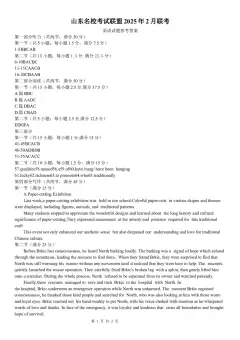
1-5 CBACB
6-10 AABCC
11-15 BBCBB
16-20 CCCAA
阅读理解
21-23 BAB
24-27 ABBC
28-31 CABC
32-35 DDCC
36-40 DGECB
完形填空
41-45 ABCDB
46-50 ACDDA
51-55 ABDCC
语法填空
56. placed
57. to ensure
58. which
59. chefs
60. increasingly
61. is pushing 62. requiring
63. how
64. to
65. The
应用文写作(满分 15 分)
Possible Version 1
Dear Chris,
I'm Li Hua from the school art club. I'm writing to suggest a theme for this year's art festival.
My idea is Art in Everyday Life. I think this theme is special because it encourages students
to find beauty in ordinary things. For example, in the photography exhibition, students can take
pictures of daily scenes like a cup of coffee or a rainy window. In the music performance, they
can create songs using everyday sounds, such as the sound of typing or rain. This makes art feel
closer and more fun for everyone.
I believe this theme will make our art festival fresh and meaningful. What do you think?
Yours,
Li Hua
Possible Version 2
Dear Chris,
Learning that you are seeking creative ideas for the theme of the art festival, I am writing to
share my thoughts.


2
I believe“Art Connects Us” would be a brilliant choice. Not only is this theme meaningful,
but it also highlights how art can bridge people from different backgrounds, emphasizing the bonds
and connections that lie at the heart of artistic expression. For example, in the drama
performance,students can act out stories about friendship and understanding. In the music section,
we can have a choir where students from different grades sing together, which is sure to help
everyone feel connected and valued.
This theme will make our art festival warm and inclusive. I hope my proposal is of some help
to you.
Yours
Li Hua
第二节(满分 25 分)
The Saturdays rolled by routinely, until one snowy morning in January. I set the board
up.It didn't take long before I realized that something seemed off. As the game
progressed,Grandpa seemed hesitant about the moves he made. His eyes were still concentrated
on the board, attempting to think through his next move. He put his hand on another piece,
shifting it. It was a trap! Did he let me win? Maybe. I kept setting up moves, all in hopes of
his clever mind,fogged with disease, acknowledging them. Desperate to see the signature smirk,
just one more time, I continued to try. He couldn't do it, but he smiled bitterly. I took his king.
I had won, but the victory tasted like ash.
“Another set,” I suggested, already resetting the pieces. This time, I played more
slowly,giving him space to think. The game stretched on, move by move, until neither of us
could find a way to break through. Ending in a draw, we both won that game. Grandpa smiled,
somehow sadly. I smiled back, pretending nothing had happened.“See how much I have
progressed,”Ijoked. Grandpa shook his head, holding my hand but saying nothing.“You are
grown up,”beamed Grandpa, his voice soft like worn velvet,“and the board no longer holds the
same weight.” That evening, snow fell silently outside the window as we packed away the
chess set.Although Alzheimer's stole my Grandpa's intellectual mind, it could not steal from us
the beautiful moments we had shared.
听力原文


3
Text 1
M: Has Jenny replied to your email, Mary?
W: Yes. She said her arm doesn't hurt as much as it did last week.
M: She'd better have it examined by a doctor anyway. I' ll give her a call about it this afternoon.
W: That would be for the best.
Text 2
M: Why are so many roads closed in the downtown district today? Is it due to construction work?
W: No. I thought it was due to a traffic accident at first, but it turned out there's a marathon taking
 place today.
M: When will it be finished?
W: Around 2 p. m.
Text 3
W: I'm going to go on a diet to lose weight.
M: Why not go to the fitness center? Combining exercise with a healthy diet is generally more
effective.
W: I hate working out though. I don't want to put on too much muscle.
M: Low- impact sports, like yoga, tai chi or swimming, won't build up muscle mass.
W: Well, I' ll think about it.
Text 4
M: Did you hear about the community garden project starting this month? They' ve already
prepared the plots and tools.
W: No, what's it about?
M: It's an area where residents can grow their own vegetables and flowers.
W: That sounds awesome! Do we need to sign up to participate?
M: Yes, there's a registration form online. It's free, but spots are limited.
W: We'd better hurry then. It' ll also be a nice way to meet our new neighbors.
Text 5
M: How was your time in the U. K.?
W: It was incredible. Talks with the locals got me a deeper understanding of their culture and way
 of life.
M: Wonderful. It sounds like your language skills enhanced your trip.
W: Absolutely. I visited several museums and could read all the information about the exhibits.
M: That's fantastic.
Text 6


4
W: I' ve been considering buying a new smart watch lately. Honestly, I'm still hesitating whether
it's really worthwhile to spend the money on it.
M: It's totally worth it, especially if you would like to track your daily fitness condition.
W: My purpose is to keep a close check on my heart rate on a regular basis.
M: Then you should get one. It can also record daily steps and analyze your sleeping quality thro
ughout the night.
W: That sounds perfect. Do you have any recommendation?
M: I'd recommend the FitTrack Pro—— it's FDA-cleared for medical-grade heart rate monitorin
g, and its battery lasts up to 14 days on a single charge.
Text 7
W: Hi, Jack! What a nice surprise to run into you here at the community book exchange event!
M: Nice to meet you, Mary. Actually I come here every year. It's such a great place for book lover
s to swap or buy books at affordable prices.
W: Tell me about it. I just wandered over to take a look, and I' ve spotted quite a few prize-winnin
g works and world classics.
M: Right. Check what I just bought. A hard-cover copy of Pride and Prejudice for my niece in sen
ior high, who needs it for literature class.
W: You are so considerate. I' ve always wanted to read To Kill a Mockingbird—— it's been on my
reading list for a while.
M: I know you love literary works. Me, too. My favorite is Wuthering Heights.
W: That's a marvelous read, but I am not a fan of the latest movie adapted from it. It felt more like
a reinterpretation than an adaptation.
M: Exactly.
Text 8
M: Hey, Linda. How was your summer?
W: It couldn't be better. I joined a volunteer program organized by seniors in our college to assist
 farmers in the mountainous regions.
M: What inspired you to do that?
W: One newspaper article said they' ve been facing challenges selling their produce. I just hit the
road.
M: How did you help them?


5
W: We discussed the matter with the staff of a company and decided to organize a live-streaming
event to sell their agricultural products. We had courses to train local farmers in basic e-commerce
skills and co-hosted the stream.
M: That's a great idea.
W: It was. We managed to sell over 500 kilograms of fruits and vegetables. It made us more aware
of the importance of finding innovative solutions to help them.
M: I'm sure your efforts will be recognized and rewarded by our school.
W: I didn't do it for that. I just wanted to help others.
Text 9
M: Welcome back to Brewed Words. I'm Ben. Today, I'm joined by Dr. Alice Watson, a linguist in
British social rituals. Alice, welcome to the show.
W: Thanks, Ben. Fancy a coffee?
M:(laughs) I do, actually. And that's the perfect place to start. I' ve noticed people say“fancy a
coffee?” all the time. Is that just a polite way to ask, or is there more to it?
W: It's the classic British invitation.“Fancy” implies a casual, friendly offer.
M: That makes sense. But I' ve also heard“builders’ tea” far more than coffee. Is coffee even that
big in Britain historically?
W: Absolutely. Builders’ tea is much stronger, brewed thicker, and usually has more milk and sugar
than regular tea. Tea dominates the popular imagination, but coffee has deep roots here. The first
coffeehouse in England opened in Oxford in 1650, then in London in 1652. So coffee is
veryBritish.
M:I' ve also heard“coffee and a catch-up”— is that a set phrase?
W: Yes, it means a long, friendly chat. It's a social ritual.
M:I see. What about“coffee morning”?
W: A coffee morning is a casual fundraising or social event, usually mid-morning, with
coffee,biscuits, and cake. It became popular in the 20th century, especially through church and
charity groups. Margaret Thatcher famously hosted coffee mornings at Chequers — though
she drank tea.
M:(laughs)I love that. I think I need a coffee after all that.
Text 10
W: Good afternoon, everyone.
I know you often think about health in terms of the body — exercise, diet, doctor visits. But health
is much broader than that. One key part is social health — your ability to connect with others and
build meaningful relationships.


Being socially healthy doesn't mean being surrounded by people all the time. It's about
balancing your social life with personal time, and being your true self when you interact with
others. When you understand what good social health looks like, you can start improving it.
So, how do you do that?
First, take care of your own needs. You can't pour from an empty cup. Make sure you' re
sleeping,eating well, and managing stress.
Second, use exercise to meet people. Join a sports club, a running group, or a yoga class. It's a
great way to boost your mood and make friends at the same time.
And finally, work on your communication skills. Listen more, ask questions, and be present in
conversations.
College is the perfect time to build these habits. Start small. Say hello to someone new. Join
one club.Your social health matters— and it's worth investing in.
Thank you.