2024 年秋新人教版七年级上册英语Unit 3 知识点总结
Unit 3 My School
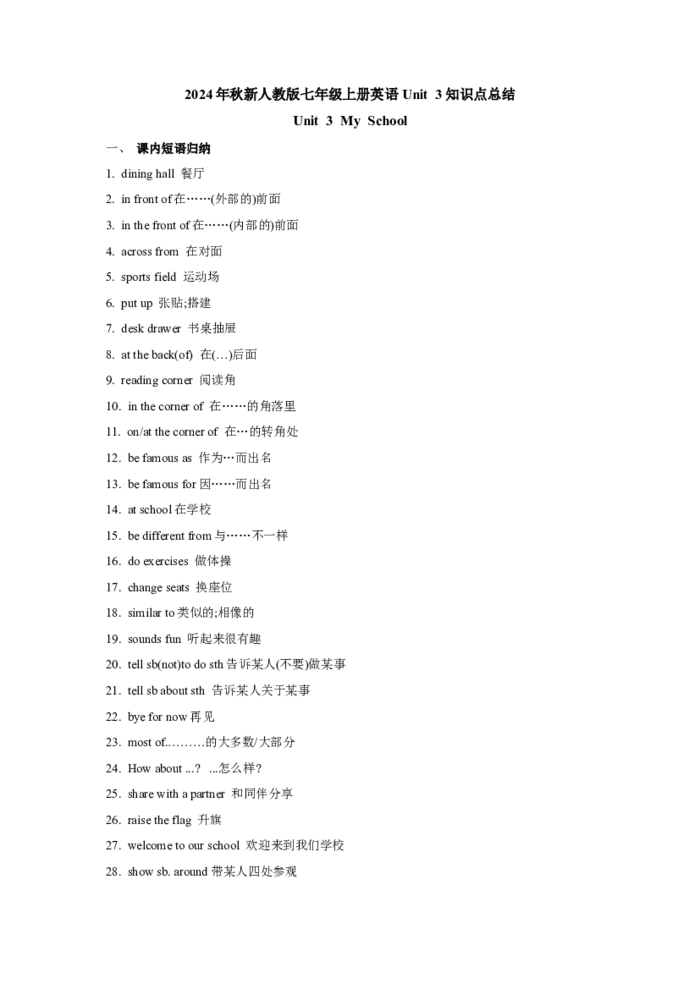
一、 课内短语归纳
1. dining hall 餐厅
2. in front of 在……(外部的)前面
3. in the front of 在……(内部的)前面
4. across from 在对面
5. sports field 运动场
6. put up 张贴;搭建
7. desk drawer 书桌抽屉
8. at the back(of) 在(…)后面
9. reading corner 阅读角
10. in the corner of 在……的角落里
11. on/at the corner of 在…的转角处
12. be famous as 作为…而出名
13. be famous for 因……而出名
14. at school 在学校
15. be different from 与……不一样
16. do exercises 做体操
17. change seats 换座位
18. similar to 类似的;相像的
19. sounds fun 听起来很有趣
20. tell sb(not)to do sth 告诉某人(不要)做某事
21. tell sb about sth 告诉某人关于某事
22. bye for now 再见
23. most of.………的大多数/大部分
24. How about ...?  ...怎么样?
25. share with a partner 和同伴分享
26. raise the flag 升旗
27. welcome to our school 欢迎来到我们学校
28. show sb. around 带某人四处参观
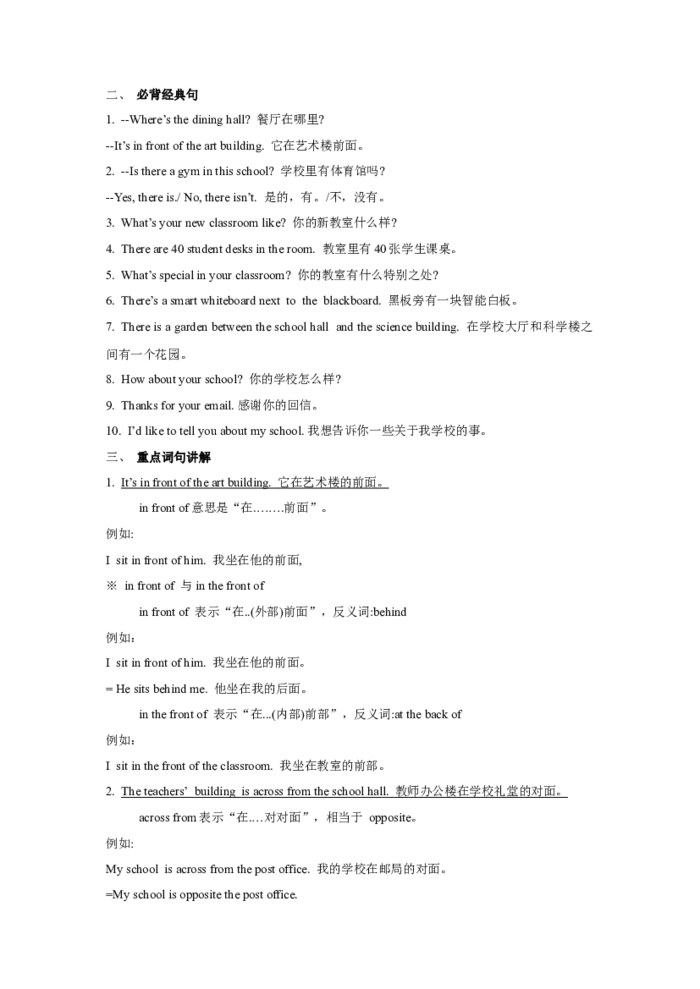
二、 必背经典句
1. --Where’s the dining hall? 餐厅在哪里?
--It’s in front of the art building. 它在艺术楼前面。
2. --Is there a gym in this school? 学校里有体育馆吗?
--Yes, there is./ No, there isn’t. 是的,有。/不,没有。
3. What’s your new classroom like? 你的新教室什么样?
4. There are 40 student desks in the room. 教室里有40 张学生课桌。
5. What’s special in your classroom? 你的教室有什么特别之处?
6. There’s a smart whiteboard next to the blackboard. 黑板旁有一块智能白板。
7. There is a garden between the school hall and the science building. 在学校大厅和科学楼之
间有一个花园。
8. How about your school? 你的学校怎么样?
9. Thanks for your email. 感谢你的回信。
10. I’d like to tell you about my school. 我想告诉你一些关于我学校的事。
三、 重点词句讲解
1. I t’s in front of the art building.

 它在艺术楼的前面

 。

in front of 意思是“在.…….前面”。
例如:
I sit in front of him. 我坐在他的前面,
※ in front of 与in the front of
in front of 表示“在..(外部)前面”,反义词:behind
例如:
I sit in front of him. 我坐在他的前面。
= He sits behind me. 他坐在我的后面。
in the front of 表示“在...(内部)前部”,反义词:at the back of
例如:
I sit in the front of the classroom. 我坐在教室的前部。
2. The teachers’

   building

   is across from the school hal

 l .   教师办公楼在学校礼堂的对面

 。

across from 表示“在.…对对面”,相当于 opposite。
例如:
My school is across from the post office. 我的学校在邮局的对面。
=My school is opposite the post office.
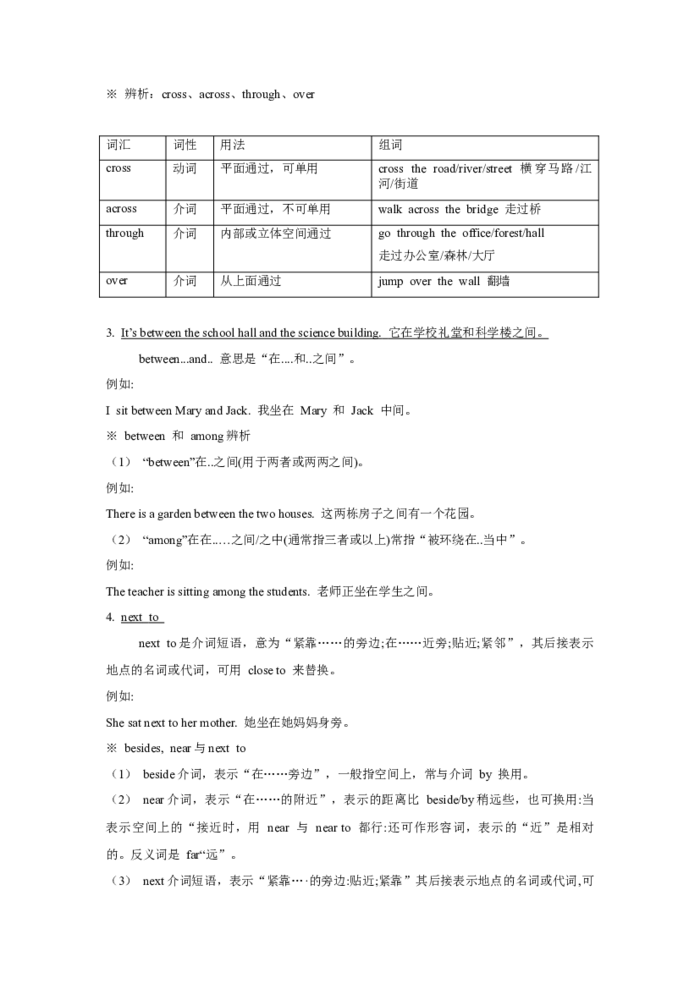
※ 辨析:cross、across、through、over
词汇
词性
用法
组词
cross
动词
平面通过,可单用
cross the road/river/street 横穿马路/江
河/街道
across
介词
平面通过,不可单用
walk across the bridge 走过桥
through
介词
内部或立体空间通过
go through the office/forest/hall
走过办公室/森林/大厅
over
介词
从上面通过
jump over the wall 翻墙
3. I t’s between the school hall and the science building.

   它在学校礼堂和科学楼之间。


between...and.. 意思是“在....和..之间”。
例如:
I sit between Mary and Jack. 我坐在 Mary 和 Jack 中间。
※ between 和 among 辨析
(1) “between”在..之间(用于两者或两两之间)。
例如:
There is a garden between the two houses. 这两栋房子之间有一个花园。
(2) “among”在在..…之间/之中(通常指三者或以上)常指“被环绕在..当中”。
例如:
The teacher is sitting among the students. 老师正坐在学生之间。
4. n  ext
    to

next to 是介词短语,意为“紧靠……的旁边;在……近旁;贴近;紧邻”,其后接表示
地点的名词或代词,可用 close to 来替换。
例如:
She sat next to her mother. 她坐在她妈妈身旁。
※ besides, near 与next to
(1) beside 介词,表示“在……旁边”,一般指空间上,常与介词 by 换用。
(2) near 介词,表示“在……的附近”,表示的距离比 beside/by 稍远些,也可换用:当
表示空间上的“接近时,用 near 与 near to 都行:还可作形容词,表示的“近”是相对
的。反义词是 far“远”。
(3) next 介词短语,表示“紧靠…·的旁边:贴近;紧靠”其后接表示地点的名词或代词,可
用 close to 来替换。
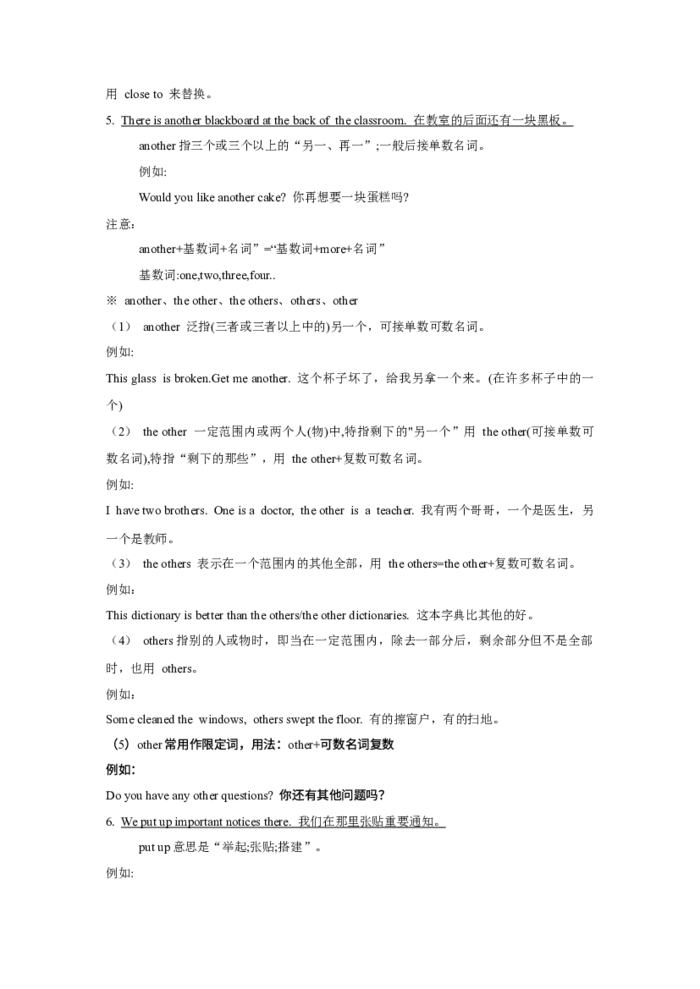
5. There is another blackboard at the back of

   the classroom.

   在教室的后面还有一块黑板。


another 指三个或三个以上的“另一、再一”;一般后接单数名词。
例如:
Would you like another cake? 你再想要一块蛋糕吗?
注意:
another+基数词+名词”=“基数词+more+名词”
基数词:one,two,three,four..
※ another、the other、the others、others、other
(1) another 泛指(三者或三者以上中的)另一个,可接单数可数名词。
例如:
This glass is broken.Get me another. 这个杯子坏了,给我另拿一个来。(在许多杯子中的一
个)
(2) the other 一定范围内或两个人(物)中,特指剩下的"另一个”用 the other(可接单数可
数名词),特指“剩下的那些”,用 the other+复数可数名词。
例如:
I have two brothers. One is a doctor, the other is a teacher. 我有两个哥哥,一个是医生,另
一个是教师。
(3) the others 表示在一个范围内的其他全部,用 the others=the other+复数可数名词。
例如:
This dictionary is better than the others/the other dictionaries. 这本字典比其他的好。
(4) others 指别的人或物时,即当在一定范围内,除去一部分后,剩余部分但不是全部
时,也用 others。
例如:
Some cleaned the windows, others swept the floor. 有的擦窗户,有的扫地。
(5)other 常用作限定词,用法:other+可数名词复数
例如:
Do you have any other questions? 你还有其他问题吗?
6. We put up important notices there.

   我们在那里张贴重要通知。


put up 意思是“举起;张贴;搭建”。
例如:
We put up a tent on the farm last night. 昨天晚上我们在农场搭建一个帐篷。
※ 与 put 有关的词组
Put on 穿上;上演
Put off 推迟
put away 放好;收拾
Put out 扑灭;伸出
Put back 放回
7. There are some pictures of

   famous people on the wal

 l .   墙上有一些名人的照片。

 ( 教材第

 39

页
  3b)

famous adj.著名的
[同义]well-known 出名的;众所周知的
[反义]:unknown 不为人所知的
[同根词]:infamous adj.臭名昭著的;声名狼藉的
与 famous 有关的词组:
 be famous for “
①
因……而出名”,后接闻名的原因,与 be known for 同义。
例如:Hangzhou is famous for its tea.杭州以茶叶而闻名。
 be famous as “
②
作为……而闻名”,后接表示职业、身份或地位等的词,与 be
known as 同义。
例如:爱因斯坦以一位伟大的科学家著称。Einstein was famous as a great scientist.
8. What’s

   your new school like?

   你的新学校是什么样的

 ?
“What’s..like?”是一个常用的询问事物特征、性质、状况的句型结构。这里 like 作介
词,意思是“像...样子”。be like 像什么 look like 看起来像,疑问词用 how。
※ What is sb.like?有两个用法:
(1) 用来询问某人的外貌特征,相当于What do/does+sb+look like? 例如:
--What is Tony like?  Tony 是个怎么样的人?
--Tony is fat. 他很胖。
(2)用来询问他人的性格特征,例如:
--What is Tony like?  Tony 是个怎么样的人?
--Tony is funny. 他很有趣。
9. How about

   your school?

 你的学校怎么样

 ?
“how about"和“what about”意思相近,用法也基本相同,其用法如下:
(1) How/What about+ 名词/代词表示询问情况、意见等
例如:“How about/What about the weather?”(天气怎么样?)
(2) How/What about+ doing sth.表示提出建议或征求意见
例如:“How about/What about going shopping?”(去购物怎么样)
※ 提建议的句型
(1) Let’s+ 动词原形 + 其他,意思是“咱们一起做某事”。
例如:
Let’s play football. 让我们去踢足球吧。
(2) Why don’t you/Why not+ 动词原形+ 其他? 意思是“为什么不不..”。
例如:
Why don’t you have a try ?=Why not have a try? 为什么不试一试?
(3) Shall we + 动词原形+其他?意思是“征求对方的意见”。
例如:
What a sunny day!Shall we go hiking?多好的天气啊! 我们去远足好吗?
(4) Could you please+ 动词原形 + 其他? 意思是“请你做某事好吗?"
例如:
Could you please go swimming with me? 请你和我一起去游泳好吗?
(5) Would you like + to do sth.? 表示“…好吗”。
例如:
Would you like to drink a cup of coffee? 喝杯咖啡怎么样?
10. How

   is Peter’s

   school similar to yours?

 彼得的学校和你的学校有多相似

 ?
与……相似,和……相似,to 后面可以接人,也可以接物。be similar to...从而构成
be similar to sb/ sth 结构,意思是:与某人/某物相似。
例如:
He is similar to his father. 他与他的父亲相似。
This book is similar to that one. 这本书和你那本相似。
四、 语法精讲
There

   be
  句型


1. 含义
There be 句型表示(某处)有(某物/人)。基本结构为“There be +某物/人+某地”。注
意区别:表达某人有某物,要用have/has
be 动词的单复数必须依主语的变化而变化。单数is,复数are
例如:
There is a table in the room. 房间里有一张桌子。
There are some birds in the tree. 树上有很多鸟。
2. There be 句型的结构
(1) There is+a/an  单数可数+地点状语
例如:
There is a ruler on the desk. 书桌上有一把尺。
(2) There are+复数可数+地点状语
例如:
There are four apples on the tree. 树上有四个苹果。
There are some flowers in the park. 公园里有许多花。
(3) There is + 不可数名词 +地点状语
例如:
There is some water in the bottle. 瓶子里有一些水。(水是不可数名词,即使有some ,be 动
词也是单数)
※ There be 选择就近原则:
重点考点:There be 句型中,几个名词并列时,be 的单复数形式由最近名词单复数决
定。如:There is a pen, two books and many pencils on the desk.本句中有钢笔、书和铅笔,
离be 最近的是单数a pen,因此,be 动词用单数is。
3. There be 句型的疑问句及回答
(1) 一般疑问句把be 动词调整到句首,再在句尾加上问号即可。当肯定句中有some
时,要改为any(否定变化也一样)。
例如:
There is some water on Mars. 火星上有一些水。
→Is there any water on  Mars? 火星上有水吗?
There are some fish in the water. 水里有一些鱼。
→Are there any fish in the water? 水里有鱼吗?
(2) There be 句型的回答
肯定回答:Yes, there is/are.
否定回答: No, there isn’t/aren’t.
(3) 特殊疑问句
提问There be 句型的特殊疑问句形式有以下三种变化:
① 对主语提问:当主语是人时,用“Who”提问;当主语是物时,用“What”。注
意:无论原句的主语是单数还是复数,提问时一般都用be 的单数形式,回答时根据实际情
况来决定。
例如:
There are many things over there. 那边有很多东西。
→What’s over there? 那边是什么?
There is a little girl in the room. 房间里有个小女孩。
→Who is in the room? 谁在房间里?
② 对地点提问:提问地点用“Where is/are+主语”。
例如:
There is a computer on the desk. 桌子上有一台电脑。
→Where is the computer? 电脑在哪里?
③ 对数量提问:How many+复数名词+are there+地点短语?How much+不可数名词
+is there+地点短语?
例如:
There are two chairs in the bedroom.卧室里有两把椅子。
How many chairs are there in the bedroom? 卧室里有多少把椅子?
4. There be 句型的否定:在be 后面加not 即可,is not =isn’t,are not= aren’t,句中如果出
现some 则改成any.
例如:
(1) There is a knife in the kitchen. 厨房里有一把刀。
否定: There is not a knife in the kitchen. 厨房里没有刀。
(2) There are five apples on the tree. 树上有五个苹果。
否定: There are not five apples on the tree. 树上没有五个苹果。
(3) There is some ink in the bottle. 瓶子里有墨水。
否定: There is not any ink in the bottle. 瓶子里没有墨水。ink 是墨水,不可数名词。
(4) There are some birds singing in the tree. 树上有几只鸟儿在歌唱。否定: There are not
any birds singing in the tree. 树上没有鸟儿在歌唱。
5. There be 句型的拓展
(1) 情态动词
表肯定推测:there may/must be:可能有/肯定有表否定推测:there can’t be:不可能
有
例如:
There can’t be forty books in the schoolbag. 书包里不可能有40 本书。
(2) 反义疑问句
陈述句部分+be(not) there?
例如:
There is a beautiful girl in the garden, isn’t there? 花园里有一个漂亮的女孩,是吗?
There are some books on the table, aren’t there? 桌子上有些书,是吗?
方位介词和短语
1. on 介词on 表示“在某物之上”的意思,它通常表示一个物体在另一个物体之表面上
面。两者之间有接触。
例如:
Your book is on the desk. 你的书在课桌上面。
There is a ball on the floor. 地板上有个球。
※ above 和 over 的区别on 指的有接触面的上面,但是over 和above 都是没有接触面的上
面。over“在……正上方”,与under 相对。
例如:
There is a bridge over the river. 河上有一座桥。
The picture is hanging over the blackboard. 那张图挂在黑板的正上方。
above 只表示“在……上方或位置高出……”,不一定是正上方,与below 相对。
例如:
A plane flew above our heads. 一架飞机从我们头上飞过。
The Turners live above us. 特纳一家人住在我们的上面。
2. in 介词in 表示“在某物的里面”,它通常表示一个物体在另外一个物体的内部、中间或
者在某个范围之内。
例如:
Your pen is in the pencil case. 你的钢笔在铅笔盒里面。
She is the tallest in her class. 她是她们班最高的。
3. under 介词under 表示“在某物的下面”,它通常表示一个物体在另外一个物体的垂直正
下面,两者之间没有接触。
例如:
My bike is under the tree. 我的自行车在树的下面。
The shoes are under the chair. 鞋在椅子的下面。
※ under 和below 的区别under 表示“在……之下”,通常表示位置处于正下方,与介词
over“在……上方”相对应。
例如:
There is a book under the table. 桌子下面有一本书。
A cat is sitting under the table. 一只猫在桌子下面。
below 表示“在……之下”,“在……的下游”,与介词above 相对应,常指在某物
体之下,但不一定在该物的正下方。
例如:
He is below the average at school. 他的学习成绩在水准以下。
He looked down at the hall below. 他瞧了瞧下面的大厅。
4. behind 介词behind 表示“在某物的后面”,它通常表示一个物体在另外一个物体的后
面。
例如:
Your brother is behind the tree.你的弟弟在树的后面。
She is standing behind her mother. 她站在她妈妈的后面。
5. next to
next to 是由形容词next 和介词to 构成的介词短语表示“紧挨着、在某物的旁边”的
意思。
例如:
The table is next to the wall.桌子紧挨着墙。
6. between 介词between 表示某个物体、某人位于两者之间,通常表示一个人、物处于另外
两个人、物之间。
例如:
Your desk is between the door and the window. 你的课桌位于门和窗户之间。
Lily sits between Mary and Ann. 丽丽坐在玛丽和安中间。
※ between 和among 的区别between 指两者之间, among 指三者或三者以上的人或物之间。
例如:
The teacher is among the students. 老师在学生们中间。
7. outside
outside 指“在……外面”
例如:
There are many people outside the room. 房间外有很多人。
What did you see outside the hall? 你在大厅外看见了什么?
8. near
near 在……附近,与far 相对。
例如:
A hospital was built near the railway station.在火车站附近建了一所医院。
My home is near the school. 我的家离学校很近。
9. in front of,  in the front of
in front of 在……前面 , in the front of 表示“在……前部”,指里面。例如:
A river flows in front of the house. 房子前有一条河。
There is a boy in the front of the car. 车的前座坐着一个小男孩。
10. around
around 在……周围,围绕。
例如:
There are many trees around the village. 村子周围有很多树围绕。
There are flowers around the stage. 舞台周围摆着鲜花。
11. at
“at”意为“在……”,可以用在地点前也可以用在时间前。
例如:
Let’s meet at the school gate. 我们在学校门口见面吧。
I get up at seven o’clock. 我七点起床。
五、 作文积累
本单元的写作话题是介绍学校,针对这一话题,我们可以围绕介绍某物在何处、某
地有某物以及物体的方位展开写作。此类作文通常会以邮件的方式进行考查,文体为应用
文。人称多用第一人称,时态为一般现在时,写作时应按照一定的空间顺序描述物体之间
的位置关系。
本单元相关话题写作素材有:
(1)..is in front of/behind/next to/across from.……在……的前面/后面/旁边/对面。
(2)...is between...and...……在…和……之间。
(3)There is/are...in...在…有…
(4)Thanks for...感谢…
(5)To answer your question,...回答你的问题…
(6)It’s a special way to ... 这是一种……的特殊方式。
(7)It’s my favourite...because... 这是我最喜欢的……,因为…
(8)I’d like to tell you about... 我想告诉你关于……
典型例题:
1. 假设你是李华,与学校合作的一所英国学校派团于下周到你的学校参观。请你根据有关
学校的提示,写信向英国朋友们介绍你的校园。
(1) 概况:干净漂亮,绿树环绕;操场在学校的中央,有教学楼,办公室,图书馆和餐厅等
有约60 位教师,900 名学生;
(2) 活动:放学后可以在图书馆读书、在操场运动等
(3) 谈谈你对学校的感受
范文:
Dear friends,
Welcome to our school! Let me introduce our school to you now. Our campus is clean and
beautiful. Green trees surround here. The playground is in the center of the school. There are
teaching buildings, offices, libraries, and restaurants. There are about 60 teachers and 900
students. After school, we can read books in the library, exercise on the playground, and so on. I
am very happy here every day. I like our school and enjoy the school life very much.
Yours,
Li Hua
2. 请以“My school”为题,写一篇短文,介绍一下你们学校的建筑物的布局,可适当发挥你的
想象力。
范文:
My school
This is a map of my school. When you enter the gate of our school, you will see a big
playground in front of you. On the left side of the playground, there is a restaurant, a science
building and a sports hall. On the right side of the playground, there is a library, a classroom
building and an office building. Our school is not big but it is very beautiful. We are very happy
here every day.