人教版(新标准)初中英语知识点精析
七年级下册 UNIT 3
How do you get to school? 你是怎样到学校的?
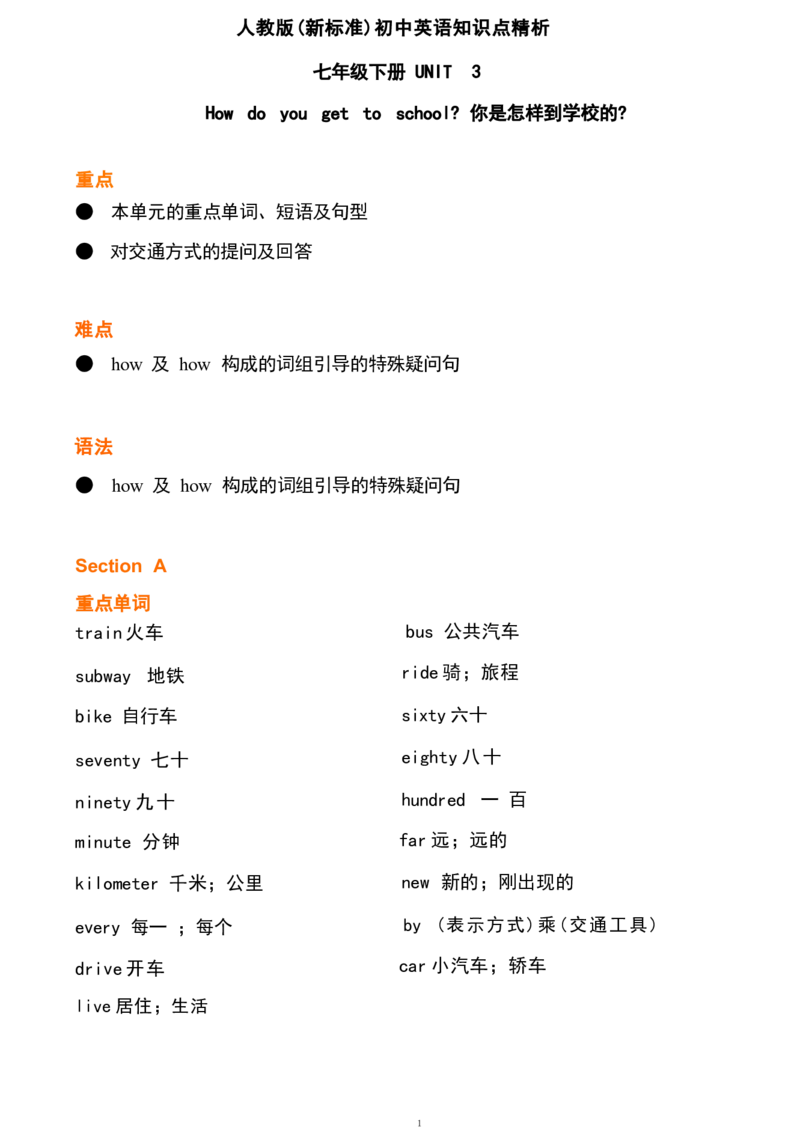
重点
● 本单元的重点单词、短语及句型
● 对交通方式的提问及回答
难点
● how 及 how 构成的词组引导的特殊疑问句
语法
● how 及 how 构成的词组引导的特殊疑问句
Section A
重点单词
train火车 bus 公共汽车
ride骑;旅程
subway 地铁
bike 自行车 sixty六十
seventy 七十 eighty八十
ninety九十 hundred 一 百
minute 分钟 far远;远的
kilometer 千米;公里 new 新的;刚出现的
every 每一 ;每个 by (表示方式)乘(交通工具)
drive开车 car小汽车;轿车
live居住;生活
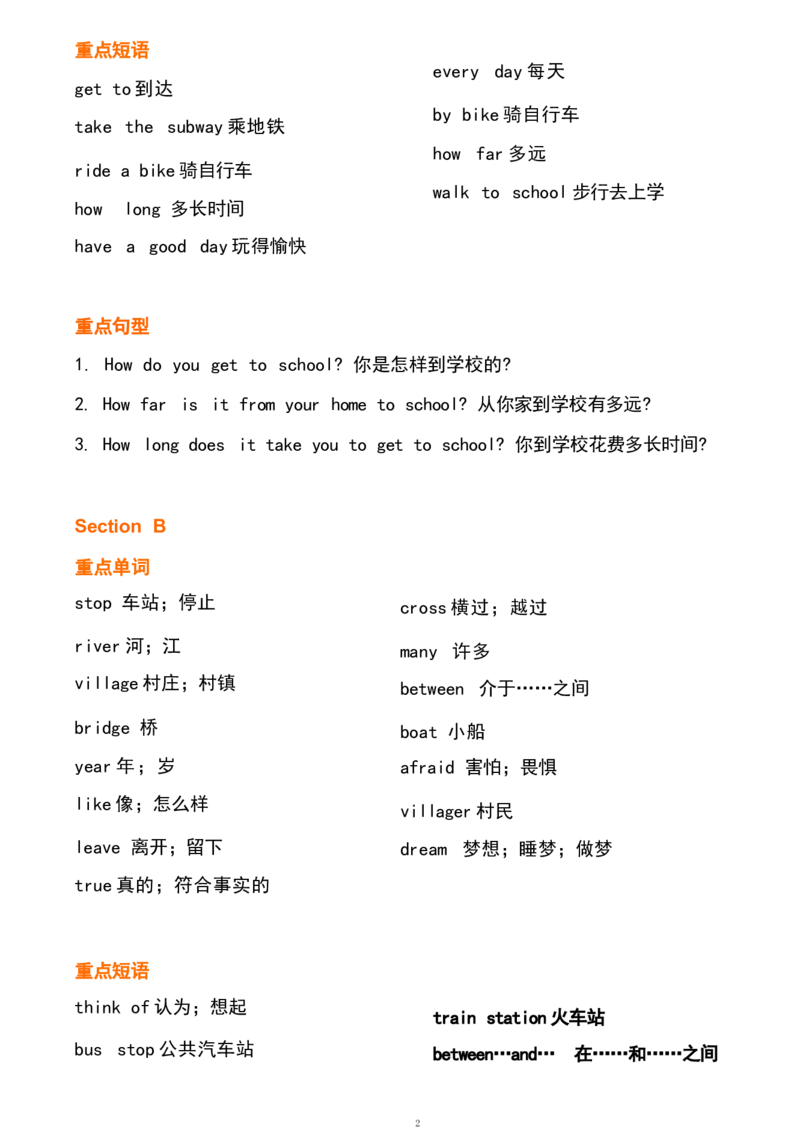
1重点短语
every day每天
get to到达
by bike骑自行车
take the subway乘地铁
how far多远
ride a bike 骑自行车
walk to school 步行去上学
how long 多长时间
have a good day玩得愉快
重点句型
1. How do you get to school? 你是怎样到学校的?
2. How far is it from your home to school? 从你家到学校有多远?
3. How long does it take you to get to school? 你到学校花费多长时间?
Section B
重点单词
stop 车站;停止
cross横过;越过
river 河;江
many 许多
village村庄;村镇
between 介于……之间
bridge 桥
boat 小船
year年;岁 afraid 害怕;畏惧
like像;怎么样
villager村民
leave 离开;留下 dream 梦想;睡梦;做梦
true真的;符合事实的
重点短语
think of 认为;想起
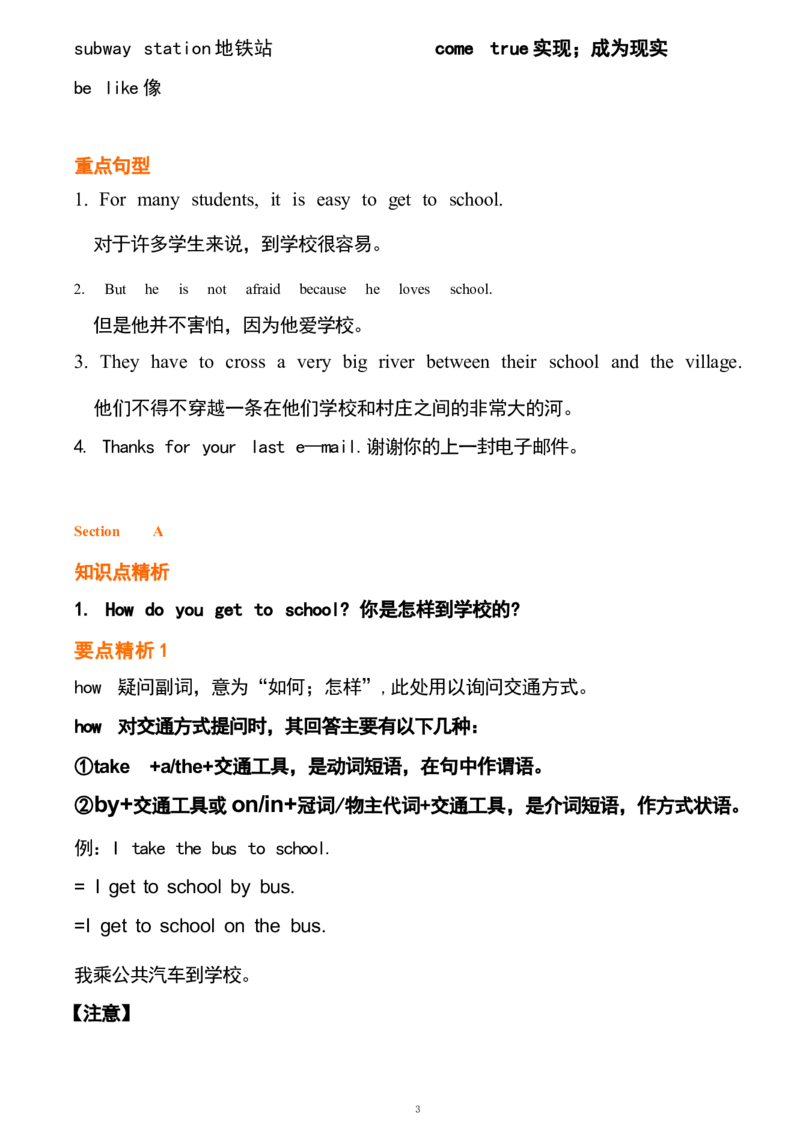
train station 火车站
bus stop公共汽车站
between…and… 在……和……之间
2subway station 地铁站 come true 实现;成为现实
be like 像
重点句型
1. For many students, it is easy to get to school.
对于许多学生来说,到学校很容易。
2. But he is not afraid because he loves school.
但是他并不害怕,因为他爱学校。
3. They have to cross a very big river between their school and the village.
他们不得不穿越一条在他们学校和村庄之间的非常大的河。
4. Thanks for your last e--mail.谢谢你的上一封电子邮件。
Section A
知识点精析
1. How do you get to school? 你是怎样到学校的?
要点精析 1
how 疑问副词,意为“如何;怎样”,此处用以询问交通方式。
how 对交通方式提问时,其回答主要有以下几种:
①take +a/the+交通工具,是动词短语,在句中作谓语。
②by+交通工具或 on/in+冠词/物主代词+交通工具,是介词短语,作方式状语。
例:I take the bus to school.
= I get to school by bus.
=I get to school on the bus.
我乘公共汽车到学校。
【注意】
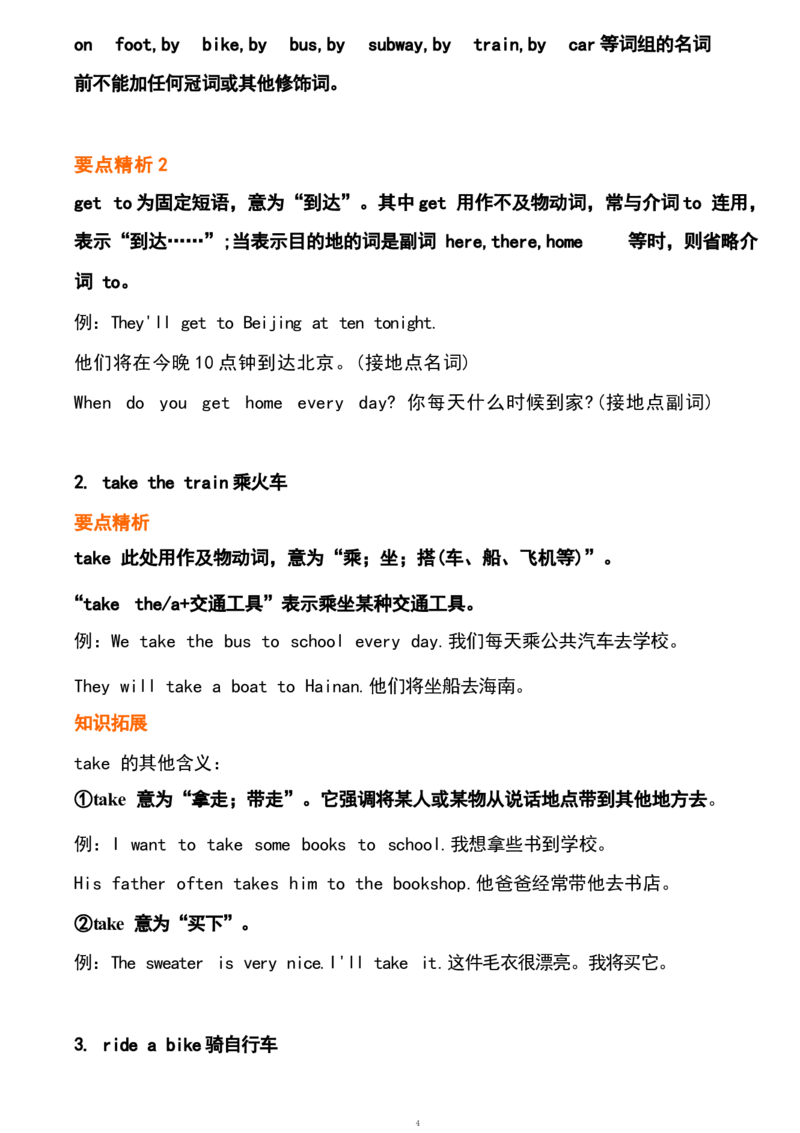
3on foot,by bike,by bus,by subway,by train,by car 等词组的名词
前不能加任何冠词或其他修饰词。
要点精析 2
get to 为固定短语,意为“到达”。其中 get 用作不及物动词,常与介词to 连用,
表示“到达……”;当表示目的地的词是副词 here,there,home 等时,则省略介
词 to。
例:They'll get to Beijing at ten tonight.
他们将在今晚 10 点钟到达北京。(接地点名词)
When do you get home every day? 你每天什么时候到家?(接地点副词)
2. take the train乘火车
要点精析
take 此处用作及物动词,意为“乘;坐;搭(车、船、飞机等)”。
“take the/a+交通工具”表示乘坐某种交通工具。
例:We take the bus to school every day.我们每天乘公共汽车去学校。
They will take a boat to Hainan.他们将坐船去海南。
知识拓展
take 的其他含义:
①take 意为“拿走;带走”。它强调将某人或某物从说话地点带到其他地方去。
例:I want to take some books to school.我想拿些书到学校。
His father often takes him to the bookshop.他爸爸经常带他去书店。
②take 意为“买下”。
例:The sweater is very nice.I'll take it.这件毛衣很漂亮。我将买它。
3. ride a bike骑自行车
4要点精析
ride 此处用作动词,意为“骑(自行车、马等)”; ride 还可作名词,意为“旅
程”。
例:Bob rides bike to school every day.鲍勃每天骑自行车去学校。
I want to go for a ride in your new car.我想乘你的新车去兜风。
【注意】
by bike也意为“骑自行车”,但它是介词短语,在句中作方式状语。
例:I usually go to work by bike.
=l usually ride bike to work.
我通常骑自行车去上班。
4. one hundred and five 一百零五
要点精析
hundred 数词,意为“一百”。
例:What will happen in a hundred years? 一百年后将发生什么?
知识拓展
s,
①当 hundred 前面有具体数字时,其后不加 也不和of 连用。
例:There are nine hundred students on the playground.操场上有九百名学生。
s,
②若表示一个不确定的数字,前面没有具体数字时,其后要加 且 与 of 连用。
hundreds of表示“数以百计的,成百上千的”。
例:There are hundreds of trees on the hill.小山上有成百上千棵树。
【助记】
hundred,thousand,million 与 billion的用法
模糊数字两有(有 s 有 of), 具体数字两无(无 s 无 of)。
5.I ride it to school every day.我每天骑着它去学校。
5要点精析
every 形容词,意为“每一;每个”,其后接单数可数名词。 every day 意为
“每天”,常用作一般现在时的时间状语。
例:Every student comes here.每一个学生都来这儿。
They are busy every day.他们每天都忙。
辨析: every day 与 everyday
every day 表示某事发生的频率,意为“每天,天天”,在句中作状语
everyday 形容词,意为“日常的,普通的“,在句中作定语
例:I study everyday English every day.我每天学习日常英语。
6.How far is it from your home to school? 从你家到学校有多远?
要点精析
how far意为“多远”,用来询问距离或路程。
例:-How far is it from the park to the school? 从公园到学校有多远?
-It's about3 miles.大约3英里。
知识拓展
在回答 how far 的提问时,通常有两种情形:
①有具体的数字时,应与 away from 连用,表示具体距离的计量,口语中 awa y
可省略。
②没有具体数字时,应用far 或 near 作答。
例:-How far is it from the library to the school? 从图书馆到学校有多远?
-It's twenty kilometers away from the library to the school./lt's very
far.
从图书馆到学校有 20 千米远。/很远。
链接中考
(广东中考)- is it from the village to your farm?
6-About 10 minutes' walk.
A. How often B. How soon C. How long D. How far
解析: how often “多久一次”,提问频率; how soon “多久以后",提问 “in+—
段时间"; how long “多长时间,多长”,提问 “for+一段时间”或物体长度; how
far “多远”,提问距离。句意:“从村庄到你的农场有多远?”“走路大约 10 分钟。”
结合句意可知选 D。
7.I'm not sure … about 10 kilometers. 不太确定 … … 大约10千米?
要点精析
I'm not sure.是一句表达自己对判断没有十足把握时的固定套语。其中的形容词
sure 意为“肯定的;确定的”,它的疑问形式和肯定形式在口语中也十分常用。
例:I'm not sure if he is Mr.Zhang.我不确定他是不是张先生。
-Are you sure? 你确定吗?
-Yes,I'm sure.是的,我确定。
知识拓展
sure 的用法:
①be sure to do sth. 意为“一定要做某事;务必要做某事 ”。
例: Be sure to finish your homework before supper.晚饭前一定要完成你的作业。
②be sure of 意为“有把握 … … ;确信 … … ”。
例:I'm sure of winning the game.我确信能赢得这场比赛。
③ “be sure +that 从句”意为“确信 ……”,当从句主语与主句主语一致时,可用
“be sure to do sth.”替换。
例:I'm sure that I'm right.=I'm sure to be right.我确信我是正确的。
8.How long does it take you to get to school? 你到学校花费多长时间?
要点精析 1
7how long 此处意为“多长时间”,用以询问某个动作所持续的时间,其谓语
动词为延续性动词,答语为表示一段时间的名词性短语。
例:-How long will we stay there? 我们要在那儿待多久?
-About week.大约一周。
知识拓展
how long 还可询问某物有多长。
例:-How long is the ruler? 这把尺子有多长?
-About one meter.大约一米。
要点精析 2
take 此处用作及物动词,意为“花费(时间)”。常用句型 It takes (sb.) some
time to do sth.意为“做某事花费(某人)多长时间”,其中 it 为形式主语,真
正的主
语是后面的动词不定式短语。
例:It took me half an hour to go to school by bike yesterday.
我昨天骑自行车去上学花了半个小时。
9. … lives about five kilometers from school.
……居住在距离学校大约 5 千米处。
要点精析
live此处用作不及物动词,意为“居住;生活”。其后若跟名词,则必须在名词前加
适当的介词;若跟副词,则省略介词。
例:l like to live in the country.我喜欢住在农村。
Where does he live? 他住在哪儿?
知识拓展
①live on sth. 意为“以某物为食”
例:Sheep live on grass.羊以草为食。
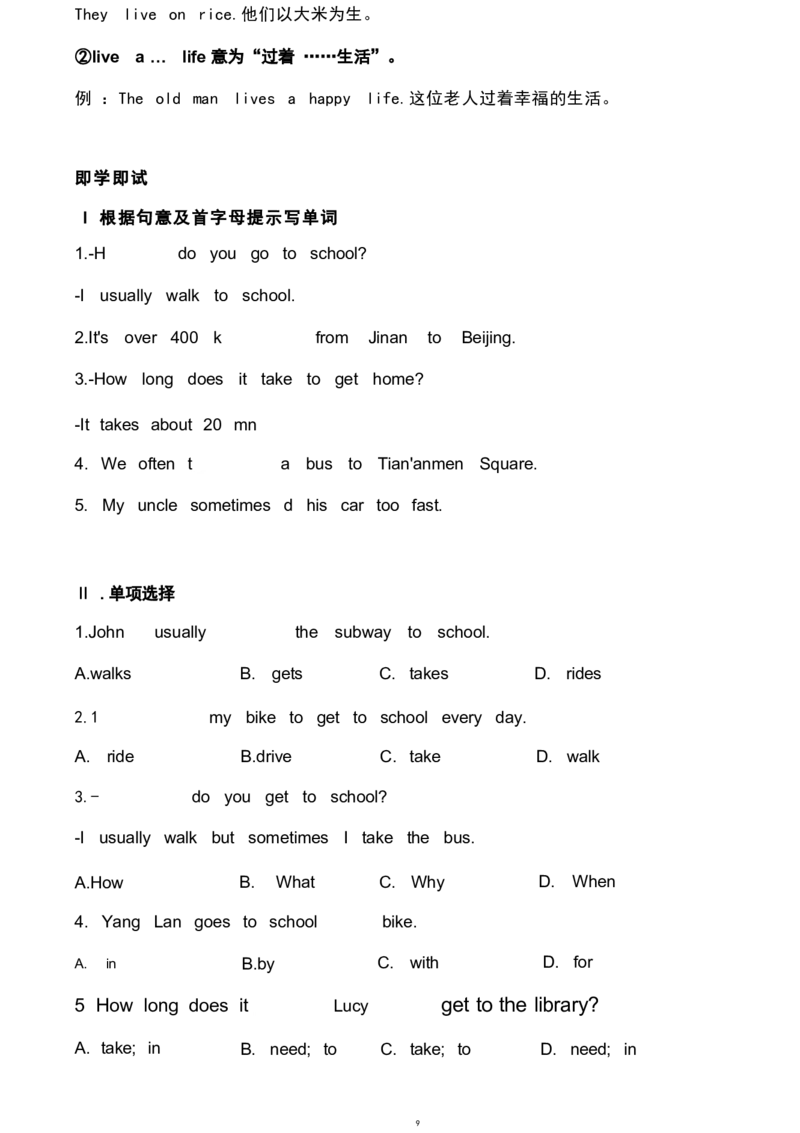
8They live on rice.他们以大米为生。
②live a … life 意为“过着 ……生活”。
例 :The old man lives a happy life.这位老人过着幸福的生活。
即学即试
I 根据句意及首字母提示写单词
1.-H do you go to school?
-I usually walk to school.
2.It's over 400 k from Jinan to Beijing.
3.-How long does it take to get home?
-It takes about 20 mn
4. We often t a bus to Tian'anmen Square.
5. My uncle sometimes d his car too fast.
Ⅱ .单项选择
1.John usually the subway to school.
A.walks B. gets C. takes D. rides
2.1 my bike to get to school every day.
A. ride B.drive C. take D. walk
3.- do you get to school?
-I usually walk but sometimes I take the bus.
A.How B. What C. Why D. When
4. Yang Lan goes to school bike.
A. in B.by C. with D. for
5 How long does it Lucy get to the library?
A. take; in B. need; to C. take; to D. need; in
9Section B
知识点精析
1.bus stop 公共汽车站
要点精析
stop 此处用作名词,意为“车站”。
例:There is a bus stop near here.这儿附近有个公共汽车站。
辨析: bus stop 与 bus station
bus stop 指城镇内外的停车点
指能停、转车辆的汽车站点
bus station
知识拓展
stop 还可作动词,意为“停止”。常见用法如下:
①stop doing sth. 停止做某事
例:Hearing the doorbell, she stopped washing the dishes.
听见门铃声,她停止了洗碗。
②stop to do sth. 停下来去做某事
例:Hearing the doorbell, she stopped to open the door.
听见门铃声,她停下(手中的活儿)去开门。
2. Crossing the River to School 过河上学
要点精析
cross 此处用作动词,意为“横过;越过”。
例:We must be careful when we cross the road.
当我们过马路时, 一定要小心。
They usually cross the river by boat.他们通常乘船渡河。
辨析: cross, across 与 crossing
10动词 横过;越过
Cross
介词,副词 在……对面;横过
across
crossing 名词 十字路口
例:Let's cross the road now.现在咱们过马路吧。
They live just across the road.他们就住在马路对面。
Turn left at the first crossing.在第一个十字路口向左转。
知识拓展
cross 还可用作名词,意为“十字形,叉形记号”。
例:The teacher marked the question with a cross.
老师在这个问题上打了一个叉。
3. For many students, it is easy to get to school.对于许多学生来说,到学校
很容易。
要点精析 1
many 限定词或代词,意为“许多”。
例:I have many friends.我有许多朋友。
Many of my classmates have mobile phones.我的许多同班同学都有手机。
辨析: many 与 much
都可意为“许多的,大量的”,均可用 lots of/ a lot of 替换
many 修饰可数名词复数
much 修饰不可数名词。同时,它还可放在比较级的前面,表示”….…得多“
例:There are many apples on the tree.树上有很多苹果。
There is much water in the bottle.瓶子里有很多水。
要点精析 2
11本句后半部分的结构为“it is+形容词(+for/of sb.)+ to do sth.”,意为
“(对 某人来说)做某事是 …… 的”,其中 it 是形式主语,真正的主语是
后面的动词
不定式短语。
例:It is easy(for me) to learn English well. (对我来说)学好英语是容易的。
知识拓展
①此句型中的形容词若为描述事物特征的词, 如 difficult,easy, hard,important
等,其后的介词用for, 构成 “It's +adj.+ for sb.+ to do sth. 句式,意为“做某
事对某人来说是……的”。
例:It is hard for me to speak in public.对我来说,在公共场合演讲很难。
②此句型中的形容词若为描述人物品质及性格特征的词,如
clever,kind,good,
nice 等 ,其后的介词用 of, 构成 “It's +adj.+of sb.+ to do sth.句式。
例:It's kind of you to help me.你帮我真是太好了。
4. There is a very big river between their school and the village.
在他们的学校和村庄之间有一条很大的河。
要点精析
between 介词,意为“在……之间”。between.and… 意为“在……和……之间”,
连接两个并列的成分。
例:There is a window between walls.墙之间有一扇窗户。
He sits between Tom and Jack.他坐在汤姆和杰克之间。
They will arrive here between 5 o'clock and 8 o'clock.
他们将在 5 点和 8 点之间到达这儿。
辨析:between 与 among
一般用于“两者之间”,其宾语往往是表示两者的名词或代词,
between
或者是由 and连接的两个人或事物。
12一 般用于三者或三者以上的人或物之间,其宾语可以是复数
among
名词或代词,也可以是集合名词
例: Remember this is a secret between you and me.记住,这是你和我之间的秘
密。
She is the tallest among her classmates.她在她的同班同学中是最高的。
【助记】
between 在两者之间
among 在三者或三者以上之中
链接中考
(湖北随州中考)-Do you know the student David and Jack?
-Yeah. It's Jim.
A. among B. in C. between D. around
解析:问句句意:你认识戴维和杰克之间的那个学生吗? between. and. 意 为
“在 ……和 ……之间”,结合句意和空后的 and 可知选 C。
5.One 11-year-old boy, Liangliang, crosses the river every school day.亮
亮是一个 11 岁的男孩儿,每个上学日他都要过河。
要点精析
11-year-old 是一个复合形容词,作定语,修饰名词 boy, 意为“11 岁的”。由
“基 数词+连字符+名词(+连字符+形容词)”构成的复合形容词,有两个特点: 一
是基
数词、名词和形容词之间要用连字符;二是基数词后的名词用单数形式。
例:Jane has three- year-old sister.简有个 3 岁的妹妹。
13【注意】
无连字符连接的“基数词+名词+形容词”结构一般用在be 动词后作表语,当
基数词大于 1 时,名词通常用复数。
例:Jane is eight years old.简8岁了。
链接中考
(江苏连云港中考)-Have you heard about Zhangjiajie Glass Footbridge?
-Of course, it's built over a canyon in the Zhangjiajie National Forest
Park.
A.300-meter-deep B.300-meters-deep
C.300 meter deep D.300-meters deep
解析:分析选项及答题空所在句可知,此处应用复合形容词作定语。复合形容词
具 备以下特点:①构成复合形容词的各词应用连字符连接;②其中的名词应用单
数形 式。故选 A。 句意:“你听说过张家界玻璃步行桥吗?”“当然,它是在张家
界国家
森林公园的 300 米深的峡谷上建造的。”选 A。
6. But he is not afraid because he loves school.
但是他并不害怕,因为他爱学校。
要点精析
afraid 形容词,意为“害怕;畏惧”。
be afraid of sth.意为“害怕某事/某物”;
be afraid to do sth.意为“害怕做某事”;
be afraid of doing sth.意为“害怕做某事”,指担心或担忧做某事会引起某种后
果。
例:Are you afraid of snakes? 你害怕蛇吗?
Mr. Black was afraid to climb the tree, because he was afraid of falling off it.
14布莱克先生害怕爬树,因为他怕从树上掉下来。
7.He's like father to me.他像父亲一样对待我。
要点精析
like 此处用作介词,意为“像”,其后可接名词或代词作宾语。
look like意为“看起来像”。
例:She sings like a bird.她唱起歌来像小鸟一样。
It looks like picture.它看上去像一幅画。
8.Many of the students and villagers never leave the village.
许多学生和村民从未离开过这个村庄。
要点精析
leave 此处用作及物动词,意为“离开“,
leave 后可以直接接地点名词作宾语。
例:It's time for us to leave.我们该走了。
Nancy wants to be doctor when she leaves school.南希毕业后想当一名医生。
知识拓展
① “leave for+地点”表示“动身去某地”。
例:Next week Alice is leaving for London.下周艾丽斯要去伦敦了。
② “leave+ 地点+for+ 地点”表示“离开某地去某地”。
例:Why are you leaving Beijing for Shanghai? 你为什么要离开北京去上海?
9. They have to cross a very big river between their school and the village.
他们不得不穿越一条在他们学校和村庄之间的非常大的河。
要点精析
have to意为“必须;不得不”,表示客观上的需要,有人称、数、时态的变化,其
15后接动词原形。
例:Because he had no money, he had to drop out of school.
因为没有钱,他不得不辍学了。
10. Thanks for your last e-mail. 谢谢你的上一封电子邮件。
要点精析
thanks for… (=thank you for…) 意为“为 ……而感谢”,其中 for 是介词,其后
常接名词、代词或动名词,表示感谢的内容或原因。
例:Thanks for your invitation.谢谢你的邀请。
Thanks for coming to see me.谢谢你来看我。
即学即试
I. 根据句意及首字母提示写单词
1. They usually c the river by boat.
2. There is no b over the river.
3. Mary is 13 y old.
4. Her d is to buy a big house for her
parents. 5.I'l call you b t hree o'clock and six
o'clock.
Ⅱ .根据汉语意思完成句子
1.在村庄和学校中间有一条河。
There is a river the village the school.
2.杰克的梦想能实现吗?
Can Jack's dream ?
3. 鲍勃是个 8 岁的男孩儿。
Bob is boy.
164.这个小女孩儿害怕狗。
The little girl dogs.
5.对许多学生来说,学好英语很容易。
For many students, it's English well.即学即试参考答案与解析
Section A
3.minutes 4.take 5.drives
I.1.How 2. kilometers
Ⅱ .1.C 2.A 3.A 4.B 5.C
Section B
I.1.cross 2.bridge 3.years 4.dream 5.between
Ⅱ.1. between, and 2.come true 3.an eight-year-old
5. easy to learn
4. is afraid of