 夜雨聆风
夜雨聆风


AI来了,劳动者权益怎么维护?
你是否听说过“AI替岗”?它对劳动者会带来什么影响?面对AI时代大潮,劳动者的权益又该如何保护?近日,央视新闻、新华社等聚焦杭州法院一起涉“AI替岗”案例。以下是报道详情:
央视报道

员工被AI替岗拒绝降薪遭解雇
法院:以AI替代为由裁员违法
35岁的周先生在一家金融科技企业担任AI大模型质检主管,负责对AI与用户交互所生成的答案进行把关。去年1月,公司提出要将他从主管调到普通运营岗位,原先2.5万元的月薪降为1.5万元。协商不成后,公司直接通知他解除劳动合同。直至周先生提起劳动仲裁,公司才告诉他具体原因,由于技术升级,他从事的质检工作AI就能完成,他被AI替岗了。
这起AI替岗案最终的结果是,从劳动仲裁到法院一审、二审,均支持周先生的诉求,认定公司构成违法解除劳动合同,并且需要向他支付26万余元的赔偿金。法院判定,公司以AI成本优势为由和劳动者解约,并不属于劳动合同无法履行的“客观情况发生重大变化”。
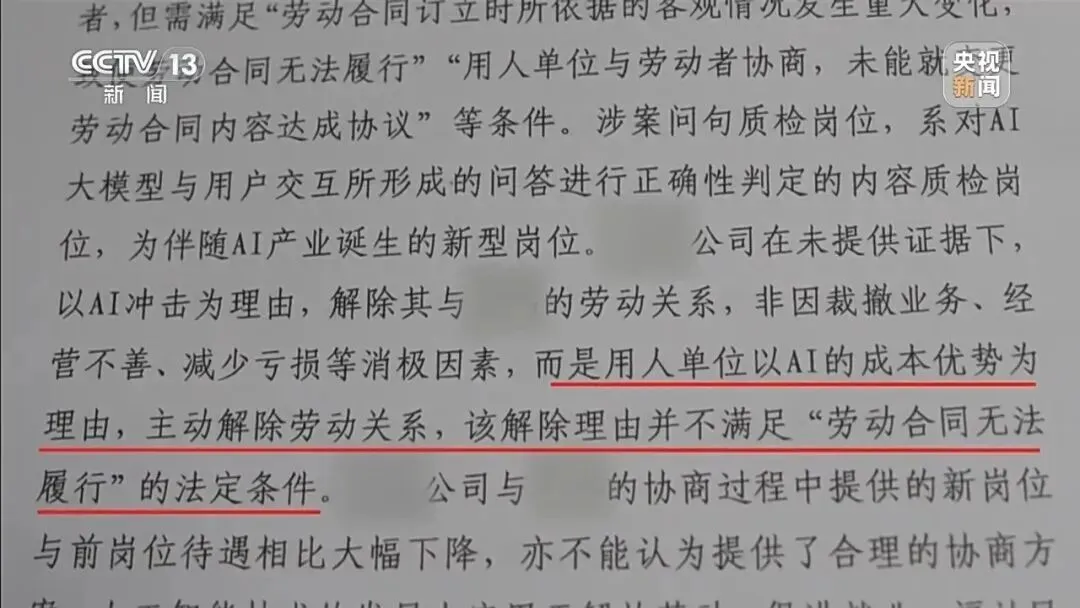
2024年,广东广州中院也审理过一起案件,一位平面设计师的岗位被AI取代,法院同样认定,使用AI是公司因市场变化在自主经营范围内作出的调整,不属于“客观情况”的范畴。
以上两起案件审理都明确,企业不能将正常的技术更新风险转嫁给劳动者。
杭州中院的法官指出,周先生这起案件的另一个关键点在于,解除合同前双方是否公平地进行了协商和沟通。公司向周先生提供的新岗位和原岗位相比待遇大幅下降了40%,显然不是合理的协商方案。
涉AI、大数据领域纠纷逐步增多
如何守住劳动者权益?
近日,杭州中院发布的白皮书显示,2025年,杭州全市新收劳动人事争议案件12359件,同比上升61.68%,涉人工智能、大数据等领域的争议逐步增多,这与杭州AI产业集聚壮大的现实密不可分。
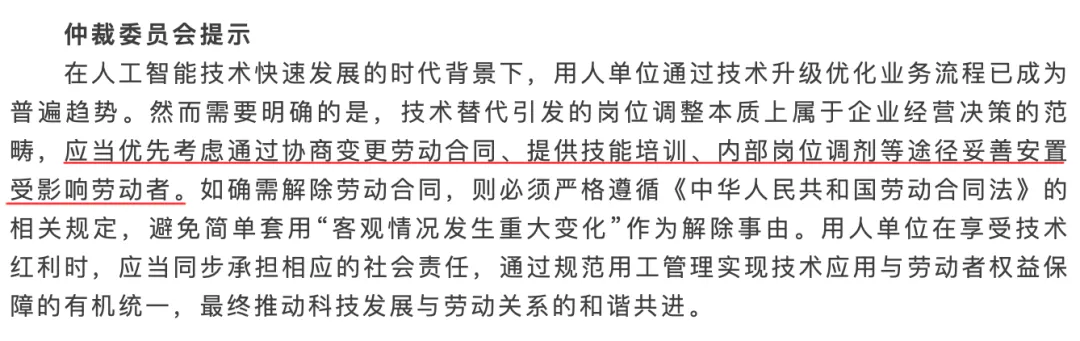
在这起案件中,杭州中院给出了一个正面指引:确实需要岗位调整时,应当优先考虑培训员工、提升技能、内部转岗,而不是大幅降薪的不合理调岗或直接让人离开。这也提醒我们,是否需要尽快调整相关制度,让企业不能在“AI来了,你该走了”之间直接画等号。
劳动合同法第四十八条规定,用人单位违法解除劳动合同,劳动者要求继续履行合同的,用人单位应当继续履行。
这意味着,法律原本赋予了劳动者在遭遇不公时“回归岗位”的选择权。但在现实中,劳动者却往往不会做出这样的选择。
在专家看来,事后赔偿只是劳动关系破裂后的一种被动补救,事前预防显然更重要。那么,在AI替代风险真正降临之前,有没有办法防止企业违法解除劳动关系?
此前,北京市人社局在公布典型案例时提示:用人单位应当优先考虑通过协商变更劳动合同、提供技能培训、内部岗位调剂等途径,妥善安置受影响劳动者。杭州中院则进一步提出:对因调岗增加的通勤、住宿等成本,应给予合理补偿。
今年1月,人社部明确表示,将出台应对人工智能影响就业的指导文件。而在专家看来,当前AI对就业还没有产生实质性、大规模冲击,这也意味着法律和政策仍处于可以主动调整的“窗口期”。
全球四分之一就业岗位或受AI影响
人社部:需加快建立相关监测预警体系
来自国际劳工组织2025年的研究,全球四分之一的就业岗位有可能受到生成式AI影响。应对AI对就业的影响不是个别企业的问题,而是全社会需要去面对的时代命题。
今年年初,人力资源社会保障部曾经表示,要加快建立人工智能就业影响监测预警应对体系。“十五五”规划纲要也提出,综合应对外部环境变化和人工智能等新技术发展对就业的影响,健全重大政策、重大项目、重大生产力布局就业影响评估机制。
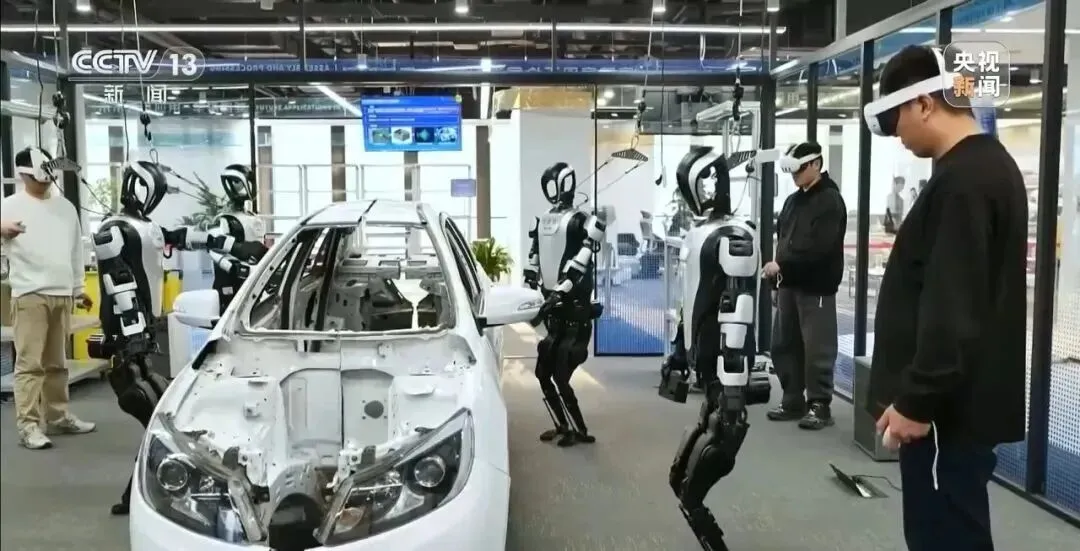
如何评估人工智能对就业的影响,今年两会,全国人大代表、中国科学院大学知识产权学院院长马一德曾建议,参照环境影响评价的制度逻辑,对企业大规模部署AI替代人工的行为实施前置评估和过程监测。对企业的要求是,在实施大规模AI替代计划前要向主管部门提交就业影响评估报告。
在专家看来,各地都在大力推动人工智能产业发展,但产业政策与就业政策如何有效衔接,就应该在制定产业政策时,同步评估就业的创造效应和替代效应,关键是要建立一套兼顾效率与公平的制度框架。
35岁的周先生需要收拾一下自己的心情,重新去寻找新的岗位,继续为生活打拼。而社会需要做的是抓紧行动,无论是在劳动保障,还是在预警监测方面,都需要尽快达成共识。我们应该确保,AI可以改变世界,但不能改变谁是主角,这个世界的主角永远是人,也只能是人。
更多中文报道
新华社海外版报道

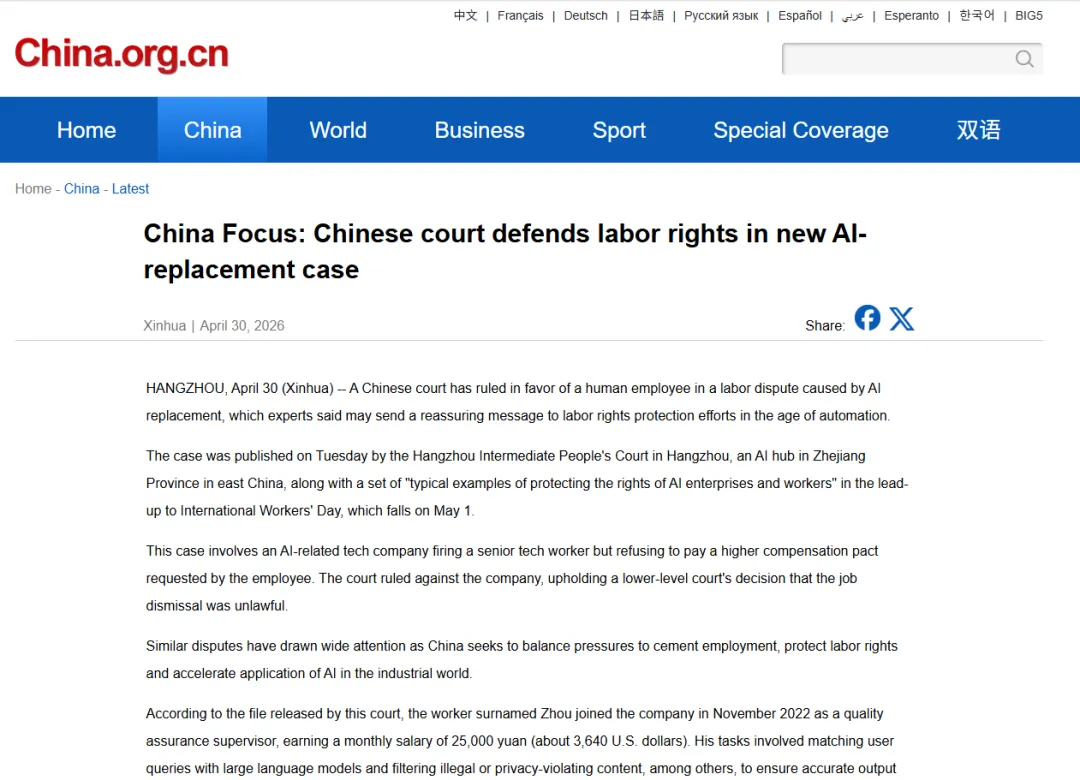
China Focus: Chinese court defends labor rights in new AI-replacement case
HANGZHOU, April 30 (Xinhua) — A Chinese court has ruled in favor of a human employee in a labor dispute caused by AI replacement, which experts said may send a reassuring message to labor rights protection efforts in the age of automation.
The case was published on Tuesday by the Hangzhou Intermediate People’s Court in Hangzhou, an AI hub in Zhejiang Province in east China, along with a set of “typical examples of protecting the rights of AI enterprises and workers” in the lead-up to International Workers’ Day, which falls on May 1.
This case involves an AI-related tech company firing a senior tech worker but refusing to pay a higher compensation pact requested by the employee. The court ruled against the company, upholding a lower-level court’s decision that the job dismissal was unlawful.
Similar disputes have drawn wide attention as China seeks to balance pressures to cement employment, protect labor rights and accelerate application of AI in the industrial world.
According to the file released by this court, the worker surnamed Zhou joined the company in November 2022 as a quality assurance supervisor, earning a monthly salary of 25,000 yuan (about 3,640 U.S. dollars). His tasks involved matching user queries with large language models and filtering illegal or privacy-violating content, among others, to ensure accurate output by AI models.
His job, however, was later taken over by AI large language models, and the company attempted to reassign Zhou to a lower-level position with a reduced salary of 15,000 yuan per month. After Zhou refused, the company terminated his contract with an offer of 311,695 yuan in compensation, citing organizational restructuring and reduced staffing needs.
Zhou contested the sum and sought higher compensation through arbitration. The arbitration panel ruled the dismissal unlawful and supported Zhou’s claim for additional compensation.
Unhappy with the arbitration outcome, the company filed a lawsuit with a district court in Hangzhou in August 2025, and later appealed to the Hangzhou Intermediate People’s Court.
At the heart of the case was whether AI-driven job replacement constitutes a “major change in the objective circumstances,” which can lead to termination of the contract under China’s Labor Contract Law.
The intermediate court found that the grounds the company cited for Zhou’s dismissal didn’t constitute such a “major change,” which typically refers to significant events like the company’s relocation or mergers. It also ruled that the company had failed to demonstrate that the contract had become impossible to perform.
Moreover, the alternative position offered to Zhou came with a substantial pay cut, which the court ruled was not a reasonable reassignment proposal. As a result, the company’s termination of the contract was deemed unlawful.
Wang Xuyang, a lawyer from Zhejiang Xingjing law firm, noted that the ruling clarified an important principle: while companies may benefit from AI-driven efficiency gains, they must also bear corresponding social responsibilities. AI replacement, notably, does not automatically justify terminating a labor contract.
A case prior to this one sent a similar message. On Dec. 26 last year, the Beijing Municipal Bureau of Human Resources and Social Security released a set of typical arbitration cases for 2025, including a dispute triggered by AI-driven job displacement that involved a map data collector. In that case, the arbitration panel made it clear that AI replacement does not validate a dismissal.
The panel found that the company’s adoption of AI technology was a voluntary move to stay competitive. By citing AI replacement as grounds for dismissal, the company had effectively shifted the risks of technological iteration onto its employees. The arbitration panel therefore ruled the dismissal unlawful.
BALANCING TECH ADOPTION, LABOR RIGHTS
Official data show that China’s core AI industry exceeded 1.2 trillion yuan in 2025, featuring more than 6,200 related enterprises. By 2030, the penetration rate of next-generation intelligent terminals and agents in China is expected to exceed 90 percent.
Such sweeping AI adoption has stirred worries about abusive AI replacement. Recent media reports of a company in east China’s Shandong Province using an AI digital replica of a former employee to continue performing his tasks have sparked widespread attention. In open-source communities, a trend has emerged to harvest human capabilities into reusable AI “skills.”
These experiments at the frontier of innovation are raising sharp questions regarding some fundamental issues in labor law, including who qualifies as a legal subject in an employment relationship and where the boundaries of personality rights lie, according to Wang Tianyu, a researcher with the Chinese Academy of Social Sciences.
“Technological progress may be irreversible, but it cannot exist outside a legal framework,” Wang commented, adding that safeguarding the dignity and rights of workers as human beings will require forward-looking institutional design.
Legal scholars have emphasized a key principle in tackling AI-related labor disputes: the costs of technological transformation should not be borne solely by workers.
Companies, they argue, should not use AI adoption as a pretext for layoffs or as a means to sidestep their obligations. At the same time, employees are encouraged to adapt by upgrading their skills.
Pan Helin, an economist and a member of an expert committee under China’s Ministry of Industry and Information Technology, argued that while AI-driven job displacement may be inevitable, companies must ensure fair treatment during transitions, including reasonable reassignment arrangements and adequate compensation for layoffs.
This year’s government work report called for improving measures to promote employment and entrepreneurship in response to the development of AI, marking the inclusion of AI’s impact on jobs within a national policy framework.
Goldman Sachs researchers cautioned in a 2025 report: “It’s early days for AI adoption, and the impact on jobs will largely depend on how employers ultimately put the technology to best use.”