ARTICLE · 1162419
卡帕西:AI 能力理解差距正变成尖锐漏斗
Dusting off this tweet from April because this gap in shared understanding of LLM capability is *widening*. It's now less "two groups of people speaking past each other" and more a sharp funnel.
重提四月那条推文,因为围绕 LLM 能力的共同理解差距正在*扩大*。它已经不像「两群人各说各话」,更像一个尖锐的漏斗。
一、四月原帖 · The April Post
Judging by my tl there is a growing gap in understanding of AI capability.
从我的时间线看,对 AI 能力的理解正在出现一个不断扩大的差距。
The first issue I think is around recency and tier of use. I think a lot of people tried the free tier of ChatGPT somewhere last year and allowed it to inform their views on AI a little too much.
第一个问题,我认为出在「时点」与「使用档位」。很多人是去年某个时候试了试 ChatGPT 的免费档,然后让那次体验过多地塑造了他们对 AI 的看法。
This is a group of reactions laughing at various quirks of the models, hallucinations, etc.
这个群体留下的反应,是嘲笑模型的各种怪癖、幻觉等等。
Yes I also saw the viral videos of OpenAI's Advanced Voice mode fumbling simple queries like "should I drive or walk to the carwash". The thing is that these free and old/deprecated models don't reflect the capability in the latest round of state of the art agentic models of this year, especially OpenAI Codex and Claude Code.
是的,我也看过那些疯传的视频:OpenAI 高级语音模式连「我该开车还是走路去洗车店」这种简单问题都答不利索。但问题是,这些免费的、老旧/已弃用的模型,并不能反映今年这一轮最先进智能体模型的能力——尤其是 OpenAI Codex 和 Claude Code。
But that brings me to the second issue. Even if people paid $200/month to use the state of the art models, a lot of the capabilities are relatively "peaky" in highly technical areas. Typical queries around search, writing, advice, etc. are *not* the domain that has made the most noticeable and dramatic strides in capability.
这就带到第二个问题。就算有人每月花两百美元用最先进的模型,很多能力也只在高度技术性的领域里相对「尖锐」。搜索、写作、建议等典型问答,并不是能力进步最明显、最惊人的领域。
Partly, this is due to the technical details of reinforcement learning and its use of verifiable rewards.
一部分原因是强化学习的技术细节,以及它对可验证奖励的依赖。
But partly, it's also because these use cases are not sufficiently prioritized by the companies in their hillclimbing because they don't lead to as much $$$ value. The goldmines are elsewhere, and the focus comes along.
另一部分原因是,这些用例在公司爬坡优化时没有被排在前面,因为它们带不来那么多钱(原文为 $$$ value)。金矿在别处,注意力也就跟着去了。
So that brings me to the second group of people, who *both* 1) pay for and use the state of the art frontier agentic models (OpenAI Codex / Claude Code) and 2) do so professionally in technical domains like programming, math and research.
于是就有了第二群人:他们既付费使用最先进的前沿智能体模型(OpenAI Codex / Claude Code),又在编程、数学、研究这类技术领域把它当作生产工具。
This group of people is subject to the highest amount of "AI Psychosis" because the recent improvements in these domains as of this year have been nothing short of staggering.
这一群体受到的「AI Psychosis」(AI 精神冲击)最重,因为这些领域今年的进步,只能用「目瞪口呆」来形容。
When you hand a computer terminal to one of these models, you can now watch them melt programming problems that you'd normally expect to take days/weeks of work.
当你把一个终端交给这类模型,你能亲眼看着它「熔化」掉那些你本来预计要花数天数周的编程难题。
It's this second group of people that assigns a much greater gravity to the capabilities, their slope, and various cyber-related repercussions.
正是这第二群人,给这些能力、能力的斜率、以及各种与网络空间相关的后果,赋予了重得多的分量。
TLDR the people in these two groups are speaking past each other.
一句话总结:这两群人说的完全不是同一件事。
It really is simultaneously the case that OpenAI's free and I think slightly orphaned (?) "Advanced Voice Mode" will fumble the dumbest questions in your Instagram's reels
现实确实同时成立:OpenAI 免费的、而且我觉得有点被冷落(?)的「高级语音模式」,会在你 Instagram 信息流的段子里搞砸最弱智的问题;
and *at the same time*, OpenAI's highest-tier and paid Codex model will go off for 1 hour to coherently restructure an entire code base, or find and exploit vulnerabilities in computer systems.
而与此同时,OpenAI 最高档的付费 Codex 模型可以独自跑上一个小时,有条有理地重构整个代码库,或者找到并利用计算机系统的漏洞。
This part really works and has made dramatic strides because 2 properties:
这一部分是真的能打,而且进步惊人,原因有两条:
1) these domains offer explicit reward functions that are verifiable meaning they are easily amenable to reinforcement learning training (e.g. unit tests passed yes or no, in contrast to writing, which is much harder to explicitly judge), but also 2) they are a lot more valuable in b2b settings, meaning that the biggest fraction of the team is focused on improving them.
一,这些领域有明确、可验证的奖励函数,天然适合强化学习训练(比如单元测试过没过——而写作就很难显式评判);二,它们在 to B(企业级)场景里值钱得多,所以团队里最大的一块力量都在改进它们。
So here we are.
于是就有了今天这个局面。
二、四级漏斗 · The Four-Tier Funnel
Napkin math somewhere around 6B people (~75% of the population) have barely come in contact with LLMs at all.
粗略估算(餐巾纸数学):大约六十亿人(约 75% 的人口)几乎完全没有接触过 LLM。
Around 1-2B (~20%) are casual and infrequent users of free-tier ChatGPT-like products. This group sees derpy chatbots and treats them a bit like a better Google search, a writing aid, or etc. Maybe an agent tries to book you a flight.
约十亿至二十亿人(约 20%)是免费档 ChatGPT 类产品的轻度、低频用户。这个群体看到的是憨憨的聊天机器人,把它们当作好一点的谷歌搜索、写作助手之类,也许有个智能体试着帮你订机票。
I have non-tech friends who (reasonably, imo) say they have not much use for it at all. Even many professionals outside of math&code are in this tier. For example, execs and many other functions spend a lot of their time talking to other people, so while they understand what is happening intellectually, it is still second-hand and a bit abstract.
我有非科技圈的朋友(在我看来很合理地)说,他们完全用不上这东西。甚至许多数学与编程之外的专业人士也在这一层。比如高管和许多其他职能的人,大量时间花在与人交谈上——所以他们虽然在理智上明白正在发生什么,但那仍是二手的、有点抽象的。
Now we get to professional use of frontier-grade LLMs in math&code. Somewhere around 20M people (0.2%) see first-hand that large, complex projects that used to take them weeks/months can now be completed by agents with a prompt.
再往上是数学与编程领域对前沿级 LLM 的专业使用。大约两千万人(0.2%)亲眼看到:过去要花数周数月的大型复杂项目,现在一条提示词就能交给智能体完成。
Building apps, copying apps, translating apps, decompiling apps from binaries... This has all happened very quickly and recently - less than 1 year ago, I was writing code manually by hand, typing memorized computer code commands into a code editor character by character, occasionally pressing Tab to autocomplete a little chunk of code.
构建应用、复制应用、翻译应用、从二进制反编译应用……这一切发生得非常快也非常近——不到一年前,我还在手写代码,把背下来的命令逐字符敲进代码编辑器,偶尔按一下 Tab 补全一小段代码。
And finally we get to the ~5,000 people (~0.00006%) with access to frontier-grade systems internally. The external world has seen the preview.
最后是约五千人(约 0.00006%)——他们能在内部用到前沿级系统。外部世界看到的只是预览。
It looks like swarms of thousands of agents collaborating over weeks on software mega projects: minting zero days, running cyber attacks and defenses at machine speeds, discovering new science, advancing the frontier of mathematics. Things that would have taken top professionals in the industry years of work.
那看起来像是:数千个智能体组成集群,用数周时间协作完成软件超级工程——铸造零日漏洞、以机器速度发起网络攻防、发现新科学、推进数学前沿。这些原本需要业界顶尖专业人士数年才能完成的工作。
Meanwhile, human review and comprehension are starting to fall behind. For example, people are still involved in the "archeology" of the OpenAI-HF incident from many months ago. Mathematicians may be poring over the 722 manuscripts on frontier mathematics for a while.
与此同时,人类的审查和理解开始跟不上。比如,几个月前 OpenAI-HF 事件的「考古」,人们至今仍在进行;数学家们可能要在七百二十二篇前沿数学手稿里埋头苦读一阵子。
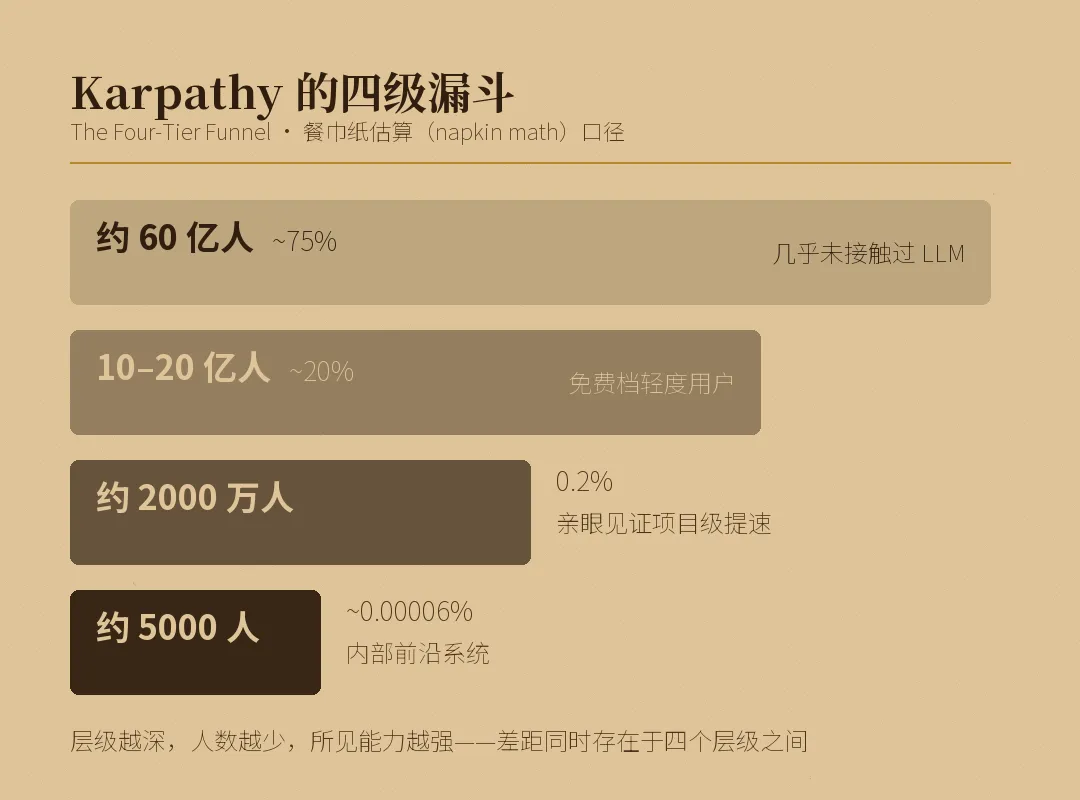
Karpathy 的四级漏斗(餐巾纸估算口径)
三、漏斗因何而成 · What Drives the Funnel
The funnel is driven by a combination of factors:
这个漏斗由几重因素共同驱动:
1. The impact scales with ambition, problem size, and horizon. A question with a paragraph answer barely stresses the system. You need a reservoir of big, difficult problems that you really care about. This aspect drives the consumer / professional dimension of the funnel.
一、影响随抱负、问题规模与时间尺度而放大。一段话就能回答的问题,几乎测不出系统的极限。你需要一个由你真正在乎的重大难题构成的水库。这个因素决定了漏斗的「消费者/专业」维度。
2. The jaggedness of the system (which I have written about a lot separately). Capability peaks in domains that are digital, verifiable and economically valuable. This is because LLM capability emerges from reinforcement learning on verifiable rewards on a curated environment mixture driven by revenue potential. This aspect primarily drives the area (e.g. math&code) dimension of the funnel.
二、系统的参差性(这一点我另写过很多)。能力在数字化、可验证、有经济价值的领域达到峰值。这是因为 LLM 的能力,来自强化学习对可验证奖励的学习,而训练环境的组合是按收入潜力筛选的。这个因素主要决定漏斗的「领域(如数学与编程)」维度。
3. Access. Free-tier, paid-tier, internal.
三、接入层级。免费档、付费档、内部。
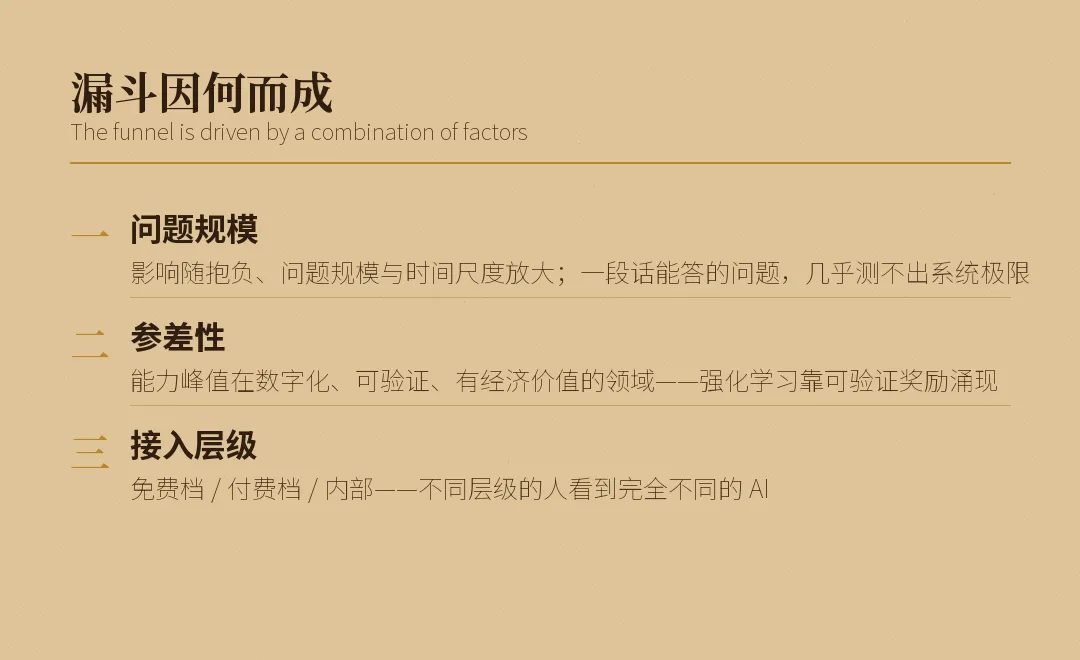
漏斗的三个驱动因素
So this is the weirdness of the moment. The general public has mostly not interacted with these systems. When they have, it looks like a derpy chatbot.
这就是此刻的怪异之处。大众大多还没接触过这些系统;接触过时,看到的是一只憨憨的聊天机器人。
The majority of professionals still see only a modest uplift. And a small sliver of professionals are experiencing the vertigo of the curve going vertical. And it is all happening at the same time.
多数专业人士仍只看到温和的提升。而一小撮专业者,正在经历曲线垂直上升的眩晕。而这一切,正在同时发生。
来源:X · Andrej Karpathy(2026-04-09 / 2026-10-11 原帖)|观澜 · 英文以原文为准