ARTICLE · 1389959
2026年下半年全国大学英语六级考试(CET6)笔试(第二套)全真模拟(含答案解析)·考前冲刺必刷题

2026年全国大学英语四、六级考试(CET)将于2026年12月12日举行,本文为星蓝海学习网依据历年真题命题规律编写的《六级》模拟试卷,覆盖写作题、长对话、听力篇章、讲座讲话、选词填空、长篇阅读等710分核心题型。建议考生收藏并限时自测,检验备考效果。试卷答案解析请添加星蓝海学习网刘老师VX:up0005,备注CET六级第二套试卷答案。点击阅读原文发现更多完整备考资料。
2026年下半年全国大学英语六级考试(CET6)
笔试模拟试卷(第二套)
卷面:写作15%+听力35%(长对话8×1+篇章7×1+讲座10×2)+阅读35%(选词10×0.5+匹配10×1+仔细10×2)+翻译15%,55客观+2主观 / 130分钟
满分 710分(报道分) | 合格标准 425分及以上为通行合格线(四级425分方可报考六级) | 130分钟
考试时间:2026年12月12日(四级上午 9:00—11:20 / 六级下午 15:00—17:25) | 命题依据:《全国大学英语四、六级考试大纲(2016年版)》· 教育部教育考试院(2026年下半年沿用,2026年12月12日笔试)
| 试卷说明 |
本试卷按教育部教育考试院《全国大学英语四、六级考试大纲(2016年版)》(2026年下半年沿用,2026年12月12日笔试)编制(考试日期:2026年12月12日 15:00—17:25)。
本卷为 2026 年下半年全国大学英语六级考试(CET6)笔试全真演练卷(第二套),按官方卷面结构编制:
写作 15%+听力理解 35%+阅读理解 35%+翻译(汉译英段落)15%,合计 55 道客观题+2 道主观题,
考试时间 130 分钟;总分按 710 分报道分制折算(本卷按 100 分标准化呈现),
听力较四级增加讲座/讲话题型、语速与词汇难度同步提升。本卷听力部分以文字材料呈现,供精听复盘使用。
| 一、写作题(共1题,共15分) |
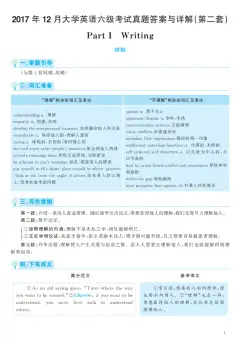
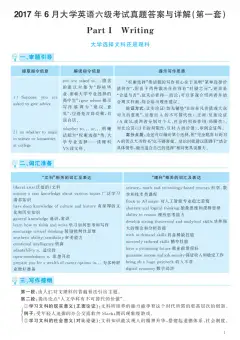
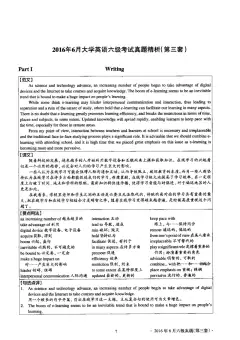
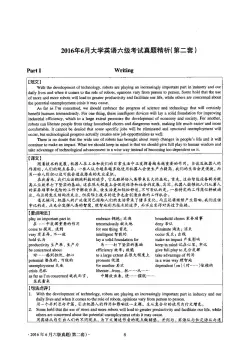
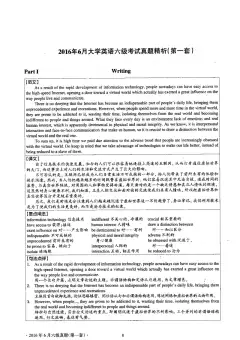
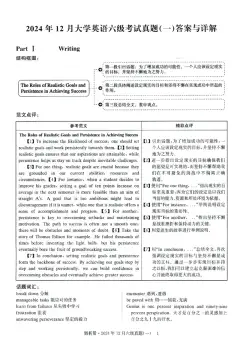
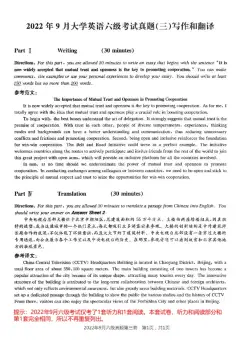
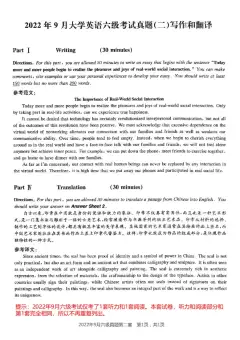
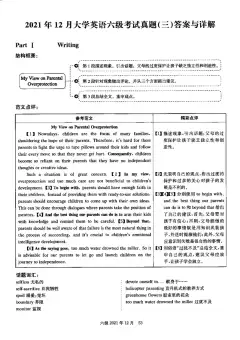
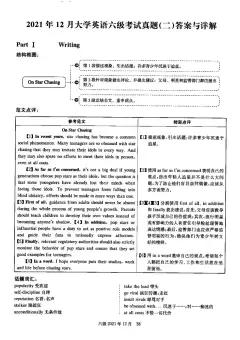
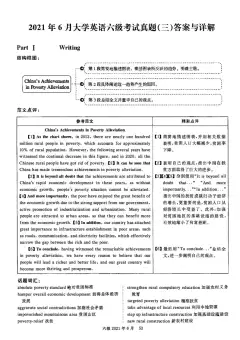
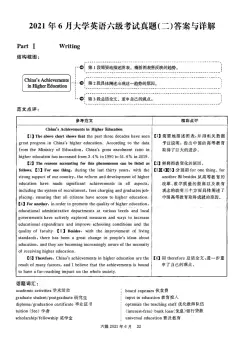
1.写作题(15分)
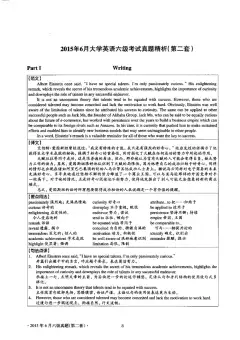
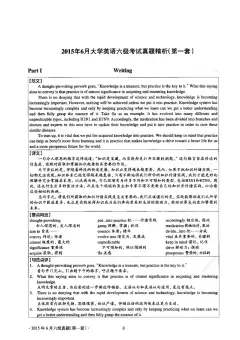
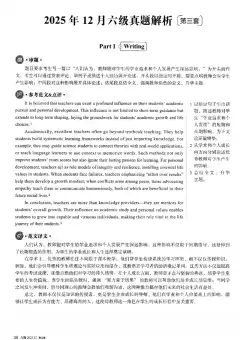
**Directions:** For this part, you are allowed 30 minutes to write an essay on the following topic. You should write at least 150 words but no more than 200 words.
Topic: Is a Cashless Society the Future of Everyday Life?
With mobile payment apps and digital currencies spreading rapidly, many people rarely carry cash these days. Write an essay to express your own view. You should:
① 简述无现金支付普及的现状与推动因素;
② 分析其便利与潜在风险(如隐私保护与老年人数字鸿沟);
③ 表明你的立场并提出合理化建议。
| 二、长对话(共8题,每题1分,共8分) |
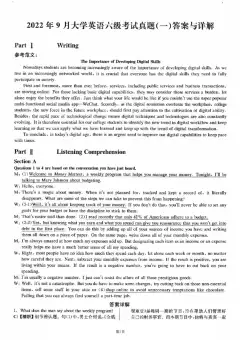
In this section, you will hear two long conversations. At the end of each conversation, some questions will be asked about what was said. Both the conversation and the questions will be spoken only once. After each question there will be a pause. During the pause, read the questions and the choices marked A, B, C and D, and decide which is the best answer.
Conversation One
W: Hi, Mark. Glad you could make it to the community garden meeting.
M: Thanks for inviting me. I moved into this neighbourhood only last month, and I've been looking for a way to get to know my neighbours.
W: Well, you've come to the right place. The garden is run entirely by volunteers, and every resident can apply for a small plot.
M: That sounds wonderful. What are people actually able to grow there?
W: Mostly vegetables and herbs — tomatoes, peppers, mint. Each plot comes with the use of a shared tool shed, and seeds are free in spring.
M: I'm afraid I don't have much experience. Do I need to know anything about gardening before I join?
W: Not really. There's a short training session for beginners, and experienced members are always around to help. Everyone also takes turns watering the common areas at weekends.
M: That's reassuring. One last thing — is there a fee for joining? I don't want to sign up for something I can't afford.
W: There's a small annual contribution of twenty dollars, which covers seeds and tools. But nobody is ever turned away because of money.
Questions 2 to 5 are based on the conversation you have just heard.
2.Why does the man want to join the community garden?
A.He hopes to earn money by selling vegetables.
B.He needs a safe place to store his gardening tools.
C.He wants to get to know people in his new neighbourhood.
D.He was asked by his landlord to attend the meeting.
3.What does the garden provide for each member?
A.A small plot and free seeds in spring.
B.A private greenhouse of their own.
C.A paid job in the tool shed.
D.A discount at local supermarkets.
4.What are members expected to do?
A.Attend a business meeting every month.
B.Buy all their own tools and seeds.
C.Grow only tomatoes and herbs.
D.Take turns watering the shared areas.
5.What does the man ask at the end of the conversation?
A.When the training session will be held.
B.Whether there is a fee to join.
C.How large the garden actually is.
D.Who looks after the tool shed.
Conversation Two
M: Good afternoon. How can I help you?
W: I'd like to ask about the career restart programme. I'm a graphic designer, but I want to move into data analysis.
M: Certainly. Many people make a similar switch. The first thing to know is that all our courses are part-time and held in the evenings, so you can keep your current job.
W: That's exactly what I was hoping for. How long does the whole programme take?
M: Most participants finish in about twelve weeks, attending twice a week. The classes run from seven to nine in the evening.
W: Twelve weeks sounds manageable. And will I get any help finding a new position afterwards?
M: Yes. We work with local employers and arrange interviews for graduates. Last year, over half of our participants found a new job within three months.
W: That's encouraging. What should I do next?
M: I'd suggest coming to the centre and talking to a course advisor in person. You can see the timetable and decide which track suits you best.
Questions 6 to 9 are based on the conversation you have just heard.
6.What is the woman's main concern about the programme?
A.Whether it is taught by experienced teachers.
B.The cost of the course materials.
C.Whether she can study while keeping her job.
D.The reputation of the training centre.
7.What do we learn about the classes?
A.They are held every weekend.
B.They last a full academic year.
C.They are taught entirely online.
D.They meet twice a week in the evening.
8.What help does the programme offer after graduation?
A.It arranges interviews with local employers.
B.It guarantees a well-paid job in data analysis.
C.It provides free textbooks for life.
D.It offers a cash reward to every graduate.
9.What does the man suggest the woman do?
A.Apply for the programme online immediately.
B.Visit the centre and speak to an advisor.
C.Ask her employer to pay for the course.
D.Wait until the next term begins.
| 三、听力篇章(共7题,每题1分,共7分) |
In this section, you will hear two passages. At the end of each passage, some questions will be asked about what was said. Both the passage and the questions will be spoken only once. After each question there will be a pause. During the pause, read the questions and the choices marked A, B, C and D, and decide which is the best answer.
Passage One
Every year, millions of tonnes of plastic waste enter the ocean, and the figure is still rising. A recent international study, however, offers a glimmer of hope by identifying where most of this waste comes from. Researchers tracked river systems across five continents and found that a surprisingly small number of rivers carry the bulk of the plastic into the sea. Just twenty rivers, many of them in Asia and Africa, account for more than half of the total. The finding suggests that targeting a limited number of waterways could make a real difference.
The damage is not only visible in floating rubbish. Tiny plastic particles, known as microplastics, have been detected in the stomachs of fish, in seabirds and even in the water we drink. Once inside the marine food chain, these particles are difficult to remove, and scientists are still studying their long-term effects on both wildlife and humans.
For years, the main response was to organise ocean clean-ups. But experts now argue that cleaning the sea after the event is inefficient and expensive. Their advice is straightforward: stop waste before it reaches the water. Better waste collection, stricter controls on plastic production and public education, they say, will do more than any ship at sea.
Questions 10 to 12 are based on the passage you have just heard.
10.What did the international study find?
A.Plastic waste in the ocean is decreasing year by year.
B.Most plastic comes from ships rather than from rivers.
C.Ocean clean-up projects have failed completely.
D.A small number of rivers carry most of the plastic.
11.What do we learn about microplastics?
A.They are too large to be eaten by fish.
B.They have entered the marine food chain.
C.They can be easily removed from the ocean.
D.They affect seabirds but not human beings.
12.What does the passage advise doing?
A.Organising more ocean clean-up voyages.
B.Banning plastic production immediately.
C.Preventing waste from reaching the water.
D.Doing more research on seafood safety.
Passage Two
Farmers around the world are facing a new reality. Heatwaves, droughts and unpredictable rainfall are arriving more often, and traditional planting calendars no longer produce reliable harvests. In response, many growers are changing the dates on which they sow and harvest, and turning to crop varieties that can survive long dry spells. In parts of Australia, farmers now plant wheat later in the season to avoid the worst of the summer heat.
Because the risks are becoming harder to insure privately, several governments have stepped in. A new scheme in India, for example, pays compensation to farmers when rainfall falls far below average or a flood destroys a crop. Participants receive payments within weeks, which helps them buy seed for the next season instead of falling into debt.
Yet experts caution that money alone is not enough. Better weather forecasting, they say, is just as important as new seed varieties. When farmers receive an accurate warning a fortnight in advance, they can adjust irrigation or protect sensitive crops. The ultimate aim, researchers conclude, is not simply to survive the next bad season but to build farming systems that can withstand a changing climate over decades.
Questions 13 to 16 are based on the passage you have just heard.
13.What are many farmers doing in response to extreme weather?
A.Changing planting dates and using hardier crop varieties.
B.Moving their farms to cooler northern regions.
C.Giving up farming altogether.
D.Relying only on traditional planting calendars.
14.What is said about the new scheme in India?
A.It was designed by private insurance companies.
B.It provides free seeds to every rural family.
C.It compensates farmers when harvests fail.
D.It was introduced after a severe drought in Australia.
15.What do experts say is as important as new technology?
A.Building more dams and reservoirs.
B.Training farmers in modern accounting.
C.Reducing the number of small farms.
D.Better weather forecasting.
16.What is the ultimate aim according to researchers?
A.Increasing short-term grain production.
B.Building farming systems resilient to climate change.
C.Making insurance available to all farmers.
D.Returning to traditional growing methods.
| 四、讲座讲话(共10题,每题2分,共20分) |
In this section, you will hear three lectures or talks. At the end of each lecture or talk, some questions will be asked about what was said. Both the material and the questions will be spoken only once. After each question there will be a pause. During the pause, read the questions and the choices marked A, B, C and D, and decide which is the best answer.
Lecture One
Good morning. Today I'd like to talk about the people who keep traditional crafts alive — the inheritors of intangible cultural heritage. Across the world, skills such as hand-weaving, paper-cutting and traditional pottery are passing into the hands of fewer and fewer practitioners. Their work matters not only because the objects are beautiful, but because each technique carries knowledge built up over generations.
Why, then, are young people reluctant to learn these trades? The reasons are practical. Apprenticeships are long, often taking five years or more, and the income during training is low. In a small town, a young craftsperson may earn far less than a colleague in a factory or an office. At the same time, mass-produced goods have made handmade items seem expensive and unfashionable to many buyers.
So what can be done? One answer is to connect heritage skills with modern markets. When a craft is linked to tourism, design or education, it can reach customers who would never visit a museum. Several workshops now sell contemporary objects made with ancient techniques, and some run short courses for visitors. Such projects do not turn a craft into a factory product; instead, they give artisans a reason to continue and a chance to pass their knowledge on.
Questions 17 to 19 are based on the lecture you have just heard.
17.What is the lecture mainly about?
A.The difficulties facing keepers of traditional crafts.
B.The history of museum collections.
C.The rise of mass-produced goods.
D.The training of museum curators.
18.Why are young people unwilling to learn traditional trades?
A.The skills are too difficult to master.
B.The work is physically dangerous.
C.Tools and materials are in short supply.
D.The pay is low and the training takes years.
19.What does the speaker suggest doing?
A.Raising the price of handmade objects.
B.Linking traditional skills with modern markets.
C.Forbidding the sale of factory-made goods.
D.Moving workshops into large cities.
Lecture Two
Museums today are no longer content to keep objects behind glass. Many are creating cultural products — items inspired by their collections and designed for everyday use. A museum shop may sell notebooks printed with ancient patterns, scarves based on a famous painting, or toys shaped like figures from history. This is more than a commercial decision; it is a way of making the collection part of people's daily lives.
The reasons are clear. First, younger visitors who may find a gallery intimidating are drawn in by a familiar object they can take home. Second, the extra income helps museums fund conservation work and educational programmes at a time when public budgets are tight. When a product is successful, it also raises the museum's profile and attracts new audiences.
One well-known museum, for instance, launched a series of products based on its collection of ancient paintings. Tote bags and mugs bearing the images became bestsellers, and the museum reported a sharp rise in visitor numbers among people under thirty. Yet not everyone is pleased. Some critics warn that turning artefacts into souvenirs risks cheapening their meaning, and that museums should be careful not to let sales drive the way history is presented.
Questions 20 to 22 are based on the lecture you have just heard.
20.Why do museums create cultural products?
A.To replace their traditional exhibitions.
B.To compete with private shops nearby.
C.To connect their collections with daily life.
D.To reduce the cost of conservation work.
21.What happened at the museum mentioned in the lecture?
A.It closed its shop after poor sales.
B.It stopped displaying ancient paintings.
C.It was criticized by the government.
D.Products inspired by ancient paintings sold very well.
22.What worry do some critics express?
A.Commercialization may weaken the meaning of artefacts.
B.Young visitors no longer go to museums.
C.Museum shops charge too much for entry.
D.Conservation work has become too expensive.
Lecture Three
In academic circles, the phrase "publish or perish" has long described a familiar pressure: to keep a job, researchers must publish frequently. Critics argue that this pressure distorts the very thing universities claim to value. When the number of papers matters more than their quality, scientists are tempted to split one study into several small articles, or to rush results before they are properly checked. The reward system, in short, encourages quantity at the expense of reliability.
Reforms are under way. A growing number of universities now judge research by its quality and its real-world impact rather than by a simple count of publications. Under such systems, a single thorough study that changes clinical practice could count for more than ten routine papers. Supporters believe this will restore both honesty and ambition to academic work.
Yet the new approach brings its own problems. Measuring "impact" is far harder than counting articles. A paper may be cited widely because it is controversial, not because it is correct, and the social benefits of basic research often appear only after many years. Evaluators may therefore disagree about what deserves credit, and decisions can seem subjective.
For these reasons, most experts recommend a balanced model. Numbers still tell us something, but they should sit alongside careful reading by peers and a broader judgment of contribution. Only by combining quantitative and qualitative measures, the speaker concludes, can universities reward the kind of research that truly advances knowledge.
Questions 23 to 26 are based on the lecture you have just heard.
23.What does the phrase "publish or perish" refer to?
A.The fear that university libraries will close.
B.The rapid decline of academic journals.
C.Pressure to publish frequently distorts research priorities.
D.The habit of reading only famous papers.
24.What do the reforms mentioned in the lecture emphasise?
A.The number of papers a researcher produces.
B.Judging research by quality and real-world impact.
C.Publishing only in international journals.
D.Reducing teaching hours for senior staff.
25.What problem does the new approach create?
A.It makes publishing much more expensive.
B.It reduces the number of research projects.
C.It forces researchers to work in large teams.
D.Assessing social impact can be subjective.
26.What conclusion does the speaker reach?
A.Counting publications should be abandoned completely.
B.Universities should judge research by citation numbers only.
C.Quantitative and qualitative measures should be combined.
D.Peer review is no longer necessary.
| 五、选词填空(共10题,每题0.5分,共5分) |
In this section, there is a passage with ten blanks. You are required to select one word for each blank from a list of choices given in a word bank. Each word in the word bank can be used only once.
备选项:A.booming B.justify C.deliberately D.investing E.commercial F.decline G.genuine H.interpret I.struggling J.embrace K.restrict L.routine M.substitute N.widespread O.symbolic
In many countries, sleep has become a (27)______ industry. Hotels now offer "sleep menus", and companies are (28)______ heavily in devices that promise deeper rest. The reason is simple: with millions of people (29)______ to fall asleep, it is hardly surprising that firms see an opportunity. Yet it can be hard to (30)______ the high prices charged for some of these products. A weighted blanket or a smart alarm may help, but consumers should not (31)______ every claim they read. Specialists remind us that a regular bedtime (32)______ matters more than any gadget, and that the (33)______ value of a good night's sleep cannot be measured in money. At the same time, some young people (34)______ stay up late, trading rest for screen time, while the (35)______ belief that "I'll sleep when I'm dead" persists among students. Doctors urge everyone not to (36)______ sleep time for the sake of work or entertainment; no product can replace the habit of going to bed at a reasonable hour.
答题栏:
27.Blank(27)
28.Blank(28)
29.Blank(29)
30.Blank(30)
31.Blank(31)
32.Blank(32)
33.Blank(33)
34.Blank(34)
35.Blank(35)
36.Blank(36)
| 六、长篇阅读(共10题,每题1分,共10分) |
In this section, you are going to read a passage with ten statements attached to it. Each statement contains information given in one of the paragraphs. Identify the paragraph from which the information is derived. Each paragraph is marked with a letter.
Reclaiming the City: The New Politics of Public Space
[A] In many cities, the most successful public-space projects begin with a simple act: taking land back from cars. A once traffic-choked square in the centre of a European city was closed to vehicles and repaved with stone. Within a year, café tables appeared, street performers drew crowds, and shopkeepers reported higher sales. The change was not expensive, yet it altered how people used the heart of the city.
[B] Not every project needs a large site. Planners have discovered that tiny vacant lots — sometimes no bigger than a parking space — can become pocket parks. With a few benches, a tree and some shrubs, a neglected corner turns into a place where neighbours sit and children play. Because the cost is low, such parks can be created quickly in neighbourhoods that lack green space.
[C] The economic argument for public space is increasingly hard to ignore. Streets that are pleasant to walk along attract more shoppers, and studies consistently show that well-designed squares raise the value of nearby shops and offices. Cities that invest in public realms often recover the cost through higher tax revenues, even though the spaces themselves are free to use.
[D] Experienced designers insist that residents must be involved from the beginning. Top-down plans frequently fail because officials misjudge how a place is actually used. When local people are invited to workshops and asked to map their daily routes, the resulting design tends to reflect real needs — safer crossings, more shade, or somewhere to sit — and wins broader support.
[E] A public space that cannot be entered is not truly public. Good design therefore pays close attention to accessibility: step-free paths, tactile paving, adequate seating and clear signage. These features benefit not only people with disabilities but also parents with pushchairs and the elderly, making the space usable by the whole community.
[F] Safety after dark depends less on fences than on good visibility. Planners have learned that well-lit paths, open sightlines and active street-level uses — such as a café or a small kiosk — encourage people to remain in a square in the evening. When a place feels watched by other users, antisocial behaviour tends to fall without heavy policing.
[G] Maintenance remains the least glamorous but most persistent problem. Parks and squares need regular cleaning, repair and planting, yet maintenance budgets are often the first thing cut. Several cities have experimented with community stewardship agreements, though volunteers rarely replace professional care for more than a few seasons.
[H] Before committing to permanent construction, many cities use temporary, movable furniture. Plastic chairs, planters on wheels and painted street markings allow planners to test an idea for a few weeks at little cost. If people respond well, the change can later be made permanent; if not, the furniture is simply moved elsewhere.
[I] A place designed for children turns out to work better for everyone. Wider pavements, slower traffic and interesting play elements give young people independence, but they also create a calmer, greener street for adults. Cities that adopt child-friendly principles often find that older residents use the space more, too.
[J] Traffic calming is a central tool of public-space renewal. Raised crossings, narrowed roads and planted roundabouts force drivers to slow down, which reduces noise and makes walking or cycling far more attractive. In several districts, streets once dominated by through-traffic have become social spaces where neighbours meet.
[K] The long-term payoff is measured in health as much as in appearance. People who live near attractive public spaces walk more, meet neighbours more often and report lower levels of stress. For older residents in particular, having a pleasant place to sit and talk can be the difference between isolation and active participation in community life.
37.Revitalized public spaces can raise the value of nearby businesses.
38.A traffic-choked square was closed to cars and became a popular gathering place.
39.Movable, low-cost furniture lets planners try out changes before building permanently.
40.Residents should take part in the design process from the very beginning.
41.Measures that slow vehicles make streets quieter and more pleasant for walking.
42.Very small empty lots can be turned into mini parks for local people.
43.Designing with children in mind also benefits older users of a space.
44.Good lighting and open sightlines help people feel safe after dark.
45.Attractive public places encourage walking, social contact and lower stress.
46.Step-free paths and clear signs make a space usable by the whole community.
| 七、仔细阅读(共10题,每题2分,共20分) |
In this section, there are two passages followed by some questions or unfinished statements. For each of them there are four choices marked A, B, C and D. You should decide on the best choice.
Passage One
Questions 47 to 51 are based on the following passage.
It is easy to dismiss daydreaming as a waste of time. Students who stare out of the window are assumed to be losing focus, and workers who let their minds wander are thought to be lazy. Psychological research, however, tells a more complicated story. When the brain is not absorbed in a demanding task, it does not switch off; instead, it enters a mode known as the default network, in which memories are combined and unexpected connections are formed.
In one experiment, participants were asked to complete a routine task while their minds were allowed to wander. Afterwards, they performed better on a test requiring creative ideas than a group that had been kept constantly busy. The researchers concluded that periods of unstructured thinking give the brain room to rearrange information. Importantly, the effect appeared only when the task was simple enough not to demand full attention; difficult work still requires concentration.
This distinction matters for education. Schools often fill every minute with instruction, fearing that silence invites misbehaviour. Yet encouraging short breaks, walks without phones, or even boring chores may be a better way to nurture imagination than another worksheet. The trick is to make room for wandering without letting it turn into a habit of avoiding hard work.
The practical message is modest but useful. Creativity is not a resource that is used up by rest; on the contrary, it often depends on it. For anyone stuck on a problem, a ten-minute walk with no destination may be more productive than another hour of forcing an answer.
47.Why does the author mention students staring out of the window?
A.To praise their remarkable ability to concentrate.
B.To show that modern classrooms are too strict.
C.To introduce a common but mistaken view of daydreaming.
D.To explain why windows should be removed from schools.
48.What did the experiment find?
A.People whose minds wandered performed better on a creativity test.
B.Busy participants remembered more details of the task.
C.The default network shuts down completely during rest.
D.Difficult tasks benefit most from frequent daydreaming.
49.What does the passage say about the default network?
A.It is active only while a person is asleep.
B.It prevents people from remembering everyday things.
C.It works best during the most demanding tasks.
D.It combines memories and forms unexpected connections.
50.What does the author suggest schools do?
A.Ban all forms of silence during class hours.
B.Allow short breaks and phone-free walks.
C.Replace worksheets with more teacher lectures.
D.Give students more difficult homework.
51.What is the concluding advice?
A.Avoid all rest until a problem has been solved.
B.Take a short, undirected walk when stuck.
C.Work in a completely silent room.
D.Depend on other people for creative ideas.
Passage Two
Questions 52 to 56 are based on the following passage.
Electric vehicles are often presented as the cleanest answer to transport emissions, and in use they certainly produce no exhaust fumes. Yet a full assessment must include the battery. Manufacturing a large battery is energy-intensive, and the minerals inside it — lithium, cobalt and nickel — are mined in a limited number of countries. Questions about the source of these materials have therefore become as important as questions about fuel economy.
What happens when a battery reaches the end of its life is equally important. A car battery is not simply thrown away; it still contains valuable metals that can be recovered. However, recycling is far from simple. Batteries differ widely in design, dismantling them is slow, and in many countries there are too few facilities to handle the growing numbers. As a result, a significant share of used batteries is exported or stored rather than recycled.
New rules are beginning to change this picture. Several governments now require manufacturers to take back used batteries and to meet minimum recycling targets. At the same time, engineers are developing batteries that use fewer scarce materials and are easier to take apart. A few companies have built plants that recover over ninety percent of the metals in a spent battery, making the process both cleaner and more profitable.
Even so, observers caution against treating batteries as a complete solution. Electricity must come from clean sources for the environmental benefit to be real, and the mining of minerals must be subject to safe labour and environmental standards. The transition to electric transport, they conclude, is a chain, and every link in that chain must be made responsible.
52.What does the passage say about electric vehicles?
A.Their batteries raise environmental and sourcing questions.
B.They produce no pollution at any stage of their life.
C.They are cheaper than petrol cars in every country.
D.Their batteries last longer than the cars themselves.
53.What is said about battery recycling?
A.It is illegal in most countries.
B.It is made easy by standard battery designs.
C.It is difficult because of varied designs and limited facilities.
D.It is mainly carried out by car owners themselves.
54.What change do new rules bring?
A.They ban the sale of new electric cars.
B.They make mining companies pay no tax at all.
C.They reduce the number of battery plants.
D.They require makers to take back used batteries.
55.What are engineers doing?
A.Designing batteries that use fewer scarce materials.
B.Making batteries heavier and more powerful.
C.Stopping the use of lithium completely.
D.Increasing the overall size of car batteries.
56.What conclusion do observers draw?
A.Batteries should be recycled only in their home country.
B.Electric vehicles will soon replace all other transport.
C.Mining standards have already been fully improved.
D.Every link in the transport chain must be made responsible.
| 八、翻译题(共1题,共15分) |
57.翻译题(15分)
**Directions:** For this part, you are allowed 30 minutes to translate a passage from Chinese into English.
请将下面这段话翻译成英文:
中国航天事业自20世纪50年代起步,经过几代人的不懈奋斗,已发展成为世界上最具活力的航天力量之一。从第一颗人造卫星成功发射,到载人飞船遨游太空,再到空间站长期有人驻留,中国航天人走出了一条自主创新之路。近年来,中国还实施了月球探测、火星探测等深空任务,取得一系列重要成果。这些成就不仅推动了科技进步,也增强了民族自信心,并为人类探索宇宙贡献了中国智慧。未来,中国将继续秉持和平利用太空的原则,与各国开展广泛合作。
📝 试卷答案获取方式
答案请添加星蓝海学习网刘老师VX:up0005,备注CET六级第二套试卷答案
如需更多2026年职业资格考试备考资料(英语四级、英语六级、CET4、CET6等),欢迎关注星蓝海学习网,获取全国大学英语四、六级考试(CET)最新动态与免费题库。 #大学英语四六级 #CET #六级 #第二套
星蓝海学习网 · 为考研考证学子提供12万+备考资料与真题题库
xlh.100xuexi.com