ARTICLE · 1431536
2026高考英语模拟试题六(含听力)
2026年高考英语模拟卷六
满分150分 考试时间120分钟
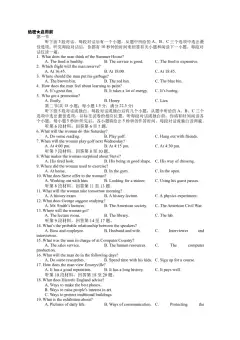
第一部分听力(共两节,满分30分)
第一节(共5小题;每小题1.5分,满分7.5分)
听下面5段对话。每段对话后有一个小题,从题中所给的A、B、C三个选项中选出最佳选项。听完每段对话后,你都有10秒钟的时间来回答有关小题和阅读下一小题。每段对话读两遍。
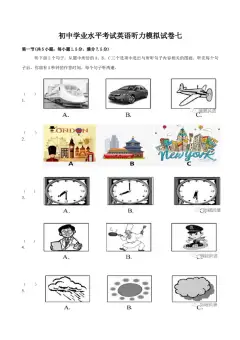
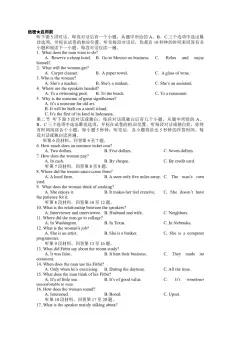
1.What will the woman do at once?
A. Go to fetch her notebookB. Hand in her report directlyC. Buy a new notebook
2.What does the man plan to do this summer?
A. Learn a traditional Chinese artB. Do a part-time jobC. Travel to another country
3.Where does the conversation most probably take place?
A. In a libraryB. In a classroomC. At a bookstore
4.What does the man think of the lecture?
A. It is extremely boringB. It is very inspiringC. It is a bit difficult
5.When will the meeting start?
A. 2:00 pmB. 2:15 pmC. 2:30 pm
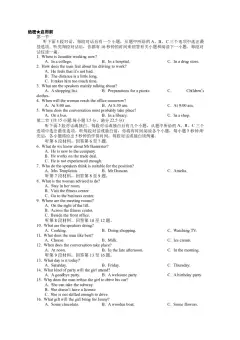
第二节
听下面 5 段对话或独白。每段对话或独白后有几个小题,从题中所给的 A、B、C 三个选项中选出最佳选项。听每段对话或独白前,你将有时间阅读各个小题,每小题 5 秒钟;听完后,各小题将给出 5 秒钟的作答时间。每段对话或独白播放两遍。
听第6段材料,回答第6至7题
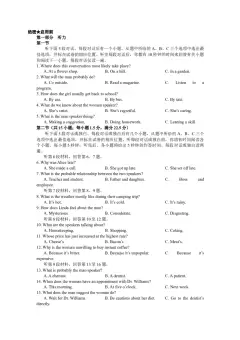
6.Why did the man fail the test?
A. He was not well-preparedB. He arrived lateC. He was probably nervous
7.What’s the woman’s advice to him?
A. Turn to others for helpB. Make more practice C. Give it up
听第 7 段材料,回答第 8 至 10 题
8.What is the relationship between the speakers?
A. Interviewer and intervieweeB. Teacher and studentC. Coach and player
9.What is the woman good at?
A. Public speakingB. Writing articlesC. Playing chess
10.When will they contact each other next?
A. Next week B. Wednesday C. Friday
听第 8 段材料,回答第 11 至 13 题
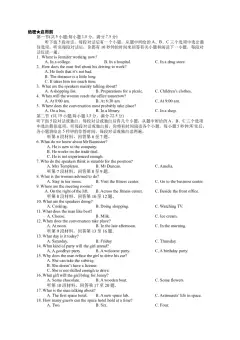
11.What are the speakers mainly discussing?
A. Online safety rulesB. Children’s screen timeC. Their weekend plans
12.What does the woman suggest kids do?
A. Learn digital skillsB. Reduce time on digital devicesC. Make more friends online
13.What’s the man’s attitude towards the woman’s idea?
A. SupportiveB. DoubtfulC. Uninterested
听第 9 段材料,回答第 14 至 17题
14.What’s the purpose of the program?
A. To receive young leadersB. Toimprove leadership C. To help the elderly
15.How long does the program last?
A. 42 weeksB. 2 weeks C. 4 days
16.What can participants do in the program?
A. Learn first aidB. Design speeches B. make public speeches
17.How can people join the program?
A. By emailB. By phoneC. Online
听第 10 段材料,回答第 18至 20 题
18.What is the speaker mainly introducing?
B. A city garden B. A community gardenC. A new community
19.What benefit of the garden is mentioned?
A. Reducing pollutionB. Improving healthC. Saving money
20.Who is the speech intended for?
A. GardenersB. CitizensC. Students
第二部分阅读理解(共两节,满分50分)
第一节(共15小题;每小题2.5分,满分37.5分)
阅读下列短文,从每题所给的A、B、C、D四个选项中选出最佳选项。
A
Mevagissey, a picturesque fishing village on Cornwall’s south coast, has been attracting visitors from home and abroad for over 200 years. Nestled between rolling green hills and a clear blue harbor, it carefully preserves the unique charm of traditional British coastal life.
The harbor, which was shaped in 1774, still operates as a busy working fishing port. Local fishermen set sail at dawn to catch seafood and sell their fresh catches at the quayside market every morning. Tourists can taste authentic Cornish pasties and tasty seafood pies at warm family-run cafes along the shore.
For history enthusiasts, the Mevagissey Museum shows ancient fishing tools, classic paintings and vivid tales of the village’s splendid maritime past. A short uphill walk leads to the towering cliffs, where visitors can enjoy breathtaking views of the English Channel. They can also take relaxing boat tours to observe seabirds and even catch sight of lovely seals in summer.
Different from crowded tourist spots, Mevagissey remains quiet and peaceful. Without large shopping malls or noisy clubs, its narrow streets are lined with brightly colored cottages and delicate handmade craft shops. It serves as a perfect destination for people to slow down, appreciate natural beauty and experience the simple joy of peaceful coastal living.
21What can tourists do in Mevagissey?
A. Shop in large modern malls.B. Watch seals at any time of the year.
C. Taste local food in family-run cafes.D. Learn about maritime future in the museum.
22.What can we learn about the harbor of Mevagissey?
A. It was built more than 300 years ago.
B. It still serves as an active fishing port.
C. Fishermen sell seafood at the market every evening.
D. It is surrounded by tall modern buildings.
23.What is the author's purpose in writing the text?
A. To compare different coastal villages in Britain.
B. To teach people how to make Cornish pasties.
C. To explain the history of British fishing industry.
D. To introduce a charming and peaceful fishing village.
B
When I entered high school, I was extremely shy and had a strong fearof public speaking. The mere prospect of standing before a crowd would make my palms perspire and my voice falter, so I remained reticent in class and shunned all activities that demanded public utterance. My English teacher, Ms. Li, a kind and perceptive woman, soon detected my anxiety and sense of isolation. One afternoon, she drew me aside gently and urged me to join the school speech club, stating that it would assist me in fostering self-assurance and conquering my fear.
Initially, I hesitated profoundly and even contemplated quitting after the first session. I could scarcely stand on the stage without trembling uncontrollably, and I frequently blanked on my lines while practicing with other members. Nevertheless, Ms. Li never abandoned me. She devoted extra time to helping me refine my speeches, listened to my rehearsals patiently, and offered pragmatic suggestions on body language and intonation. With her consistent support and my daily diligence, I gradually grew more at ease speaking in front of others.
A month later, I was unexpectedly selected to participate in a school-level speech contest. Resolute to live up to Ms. Li’s expectations, I practiced assiduously every day after school—recording my voice to scrutinize my pronunciation, rectifying my errors repeatedly, and even soliciting feedback from my classmates. On the crucial day, my heart thumped violently as I stepped onto the stage, but I recalled Ms. Li’s words and took a deep breath. Though still anxious, I delivered my speech fluently and articulately. To my immense astonishment, I secured the third prize.
That memorable experience imparted a precious lesson to me: courage is not the absence of fear, but forging ahead in spite of it. Nowadays, I am no longer the timid girl who dared not speak out. I have become more self-confident and am always prepared to embrace new challenges in both my studies and daily life.
24. What can we infer about the author when she entered high school?
A. She was enthusiastic about class activities.
B. Her shyness led to her fear of public speaking.
C. She had excellent speaking skills but lacked confidence.
D. She frequently consulted her teacher about public speaking.
25. Which of the following best explains Ms. Li’s reason for encouraging the author to join the speech club?
A. The author turned to her for help with public speaking.
B. She intended to help the author win the school-level contest.
C. She aimed to help the author develop self-confidence.
D. The speech club was in need of more members.
26. What did the author do to prepare for the school-level speech contest?
A. She asked Ms. Li to take her place in the contest.
B. She only practiced her speech once before the crucial day.
C. She gave up practicing when she felt anxious.
D. She recorded her voice to check and improve her pronunciation.
27.What can we conclude from the last paragraph?
A. The author has completely eliminated fear from her life.
B. The speech contest exerted a profound influence on the author.
C. Ms. Li’s words were the key factor in the author’s success.
D. The author will no longer participate in speech-related activities.
C
In the digital age, an increasing number of people harbor concerns that young people are gradually losing the competence to communicate face to face. They argue that the over-reliance on digital devices, such as smartphones and tablets, makes teens accustomed to typing messages rather than engaging in in-person conversations, thus weakening their ability to interpret facial expressions and body language. However, recent academic research conducted by educational experts suggests that digital tools can actually enhance real-life communication skills when used properly, rather than undermining them.
Social media platforms, for instance, serve as a valuable medium for adolescents to express their thoughts and perspectives freely. Unlike face-to-face interactions that may bring anxiety or embarrassment, online communication allows teens to organize their ideas deliberately and learn from diverse views posted by peers from different backgrounds. This process not only boosts their confidence in expressing themselves but also cultivates their ability to respect and respond to different opinions—an essential skill for real-world communication. Additionally, video calls, which have become increasingly prevalent, enable young people to maintain intimate connections with family members who live far away, bridging the geographical gap and preserving emotional bonds.
What matters most is not whether young people use technology, but how they utilize it rationally. Many teens fall into the trap of excessive screen time, which indeed affects their offline interactions. Therefore, schools and parents shoulder the responsibility to guide students to use digital tools wisely. They should help teens strike a balance between screen time and real-world activities, such as group discussions, community service and face-to-face gatherings. By doing so, young people can develop both online and offline communication skills, mastering the art of interacting effectively in various scenarios.
In conclusion, digital tools are not the enemy of face-to-face communication. When guided properly, they can act as a supplement to enhance young people’s communication competence, helping them adapt better to the increasingly interconnected world.
28. What is the common concern of many people in the digital age?
A. Young people are spending too much time on digital devices.
B. Digital tools are replacing face-to-face communication completely.
C. Young people’s face-to-face communication ability is declining.
D. Social media makes teens more anxious in real-life interactions.
29.. What does the underlined word “undermining” in Paragraph 1 probably mean?
A. ImprovingB. StrengtheningC. WeakeningD. Protecting
30. How can social media help young people improve communication skills?
A. By allowing them to avoid embarrassing face-to-face talks.
B. By providing them with various digital communication tools.
C. By enabling them to communicate with people from different regions.
D. By helping them build confidence and learn to respect diverse opinions.
31. What can we conclude from the text?
A. Digital tools are harmful to young people’s communication skills.
B. Schools and parents should ban young people from using digital tools.
C. Proper guidance on digital tool use can help teens develop communication skills.
D. Young people can only improve communication skills through offline activities.
D
The integration of artificial intelligence (AI) into modern education has sparked an intense and ongoing debate among educators, policymakers, and parents worldwide. While proponents hail AI as a revolutionary force that democratizes access to learning resources and drastically boosts teaching efficiency, critics warn that over-reliance on such technology erodes interpersonal connection and undermines students’ critical thinking abilities. A 2026 UNESCO report explicitly emphasizes that the true value of AI in education lies not in replacing human teachers, but in augmenting human instruction—provided that its application is guided by clear educational principles and ethical standards.
Advocates of AI in education argue that it effectively addresses long-standing flaws in traditional classroom teaching. Intelligent tutoring systems can tailor learning content to individual students’ paces and learning styles, accurately identifying knowledge gaps and providing instant, personalized feedback that a single teacher cannot possibly offer to dozens of students simultaneously. For students in remote or underfunded regions, AI serves as a bridge, delivering access to top-tier courses and academic resources that would otherwise be inaccessible, thus bridging deep-rooted educational inequalities. Moreover, AI automates tedious grading and administrative tasks, freeing teachers to focus on mentorship, emotional support, and fostering students’ creativity—qualities that no algorithm or machine can replicate.
Yet skeptics highlight significant and potential risks associated with excessive AI use in education. Over-reliance on AI may cultivate passive learning habits: students grow accustomed to obtaining instant answers, gradually losing the perseverance and ability to solve complex problems independently. Critical thinking and collaborative skills, which are essential for future career success and social adaptation, diminish when students replace face-to-face debates and group discussions with AI-assisted learning. Worse, over-reliance on AI weakens students’ foundational literacy and numeracy skills as they increasingly outsource basic mental tasks—such as calculation and text comprehension—to digital devices. Most importantly, the precious human bond between teacher and student, which is vital for students’ motivation, emotional growth, and moral development, risks being sacrificed for the sake of efficiency.
In essence, AI itself is neither inherently good nor inherently bad. It is a powerful tool whose impact on education depends entirely on intentional, balanced, and ethical use. Schools and educators must integrate AI to enhance—not replace—human instruction, while teaching students to use technology critically and responsibly. Only by preserving the heart of education—interpersonal connection, intellectual curiosity, and character building—can we ensure that AI serves as a catalyst for educational progress rather than a threat. The future of learning lies in the harmony between human wisdom and machine efficiency.
32. What is the author’s main purpose in writing the passage?
A. To prove that AI is superior to traditional teaching methods.
B. To warn people of the serious risks of AI in education.
C. To argue that AI should be completely banned in classrooms.
D. To analyze the pros and cons of AI in education and offer a rational view.
33.33. According to the passage, what does the 2026 UNESCO report stress about AI in education?
A. AI should take the place of human teachers to improve teaching efficiency.
B. AI’s real value lies in assisting human teaching under proper guidance.
C. AI can solve all the long-standing problems in traditional education.
D. AI’s application in education doesn’t need any ethical restrictions.
34.Which of the following statements would the author most likely agree with?
A. AI can perfectly replace teachers in delivering knowledge.
B. The use of AI in education should be guided by educational principles.
C. Students in remote regions benefit more from AI than those in cities.
D. AI has more negative effects than positive ones on students’ development.
35.What can we infer from the passage about the author’s attitude toward AI in education?
A. He is fully supportive of AI’s widespread use in classrooms.
B. He is deeply worried about AI’s negative impact on education.
C. He advocates a balanced and rational use of AI in education.
D. He believes AI will eventually replace human teachers in the future.
第二节:七选五(共5小题;每小题2.5分,满分12.5分)
Good study habits help you learn better and reduce stress, making your learning journey more efficient and enjoyable. They not only help you grasp knowledge quickly but also enable you to arrange your study time reasonably, avoiding the anxiety of last-minute cramming and improving your overall academic performance. 36 ______
First, create a comfortable study space. A quiet, clean area with enough light helps you focus and avoid unnecessary distractions. It’s better to choose a place away from noisy environments like the living room or kitchen, where family activities may interrupt your study. 37 ______ Put your books, notebooks, pens and other study tools in order so you can find them easily whenever you need them, which saves time and keeps your mind focused on studying instead of searching for items.
Second, make a plan. Write down your daily and weekly study tasks and set clear, achievable goals. 38 ______ Break down big tasks into small, manageable parts and finish them one by one. This stops you from putting things off and helps you make steady progress in your study without feeling overwhelmed.
Third, take breaks. Studying for hours without rest makes you tired and reduces your learning efficiency. 39 ______ It’s wise to take a 10-15 minute break every 45-60 minutes—you can stretch your body, drink some water or look at distant scenery. Short breaks can refresh your mind, relieve fatigue and help you concentrate better when you go back to studying.
Finally, review regularly. It helps you remember knowledge firmly and prepare for exams more effectively, as regular review can deepen your understanding of what you’ve learned. 40 ______ Good habits don’t come overnight; they take time and consistent effort to develop. With good study habits, you will enjoy learning and make steady progress day by day.
A. However, a study space that is too comfortable, like a bed or a sofa, may actually reduce your concentration.
B. In other words, good study habits are the foundation of academic success and personal growth.
C. Besides, reviewing the same material repeatedly without spacing it out is a common mistake among students.
D. This not only prevents procrastination but also gives you a sense of achievement after completing each small part.
E. In contrast, some students prefer studying in public places like libraries or cafes to feel more motivated.
F. Actually, taking no breaks at all is less effective than taking short, regular breaks.
G. But don’t just review passively—try to recall the information from memory, as this strengthens learning more effectively.
第三部分语言运用(共两节,满分30分)
第一节完型填空(共15小题;每小题1分,满分15分)
Growing Sunflowers
When I was little, my grandmother taught me to grow flowers. She told me that plants, like people, need love and care to grow vigorously. Every weekend, we worked together in our small garden, chatting and enjoying the warmth of the sun. It was in the garden that I learned the connection between living creatures and nature.
One spring, she handed me some plump sunflower seeds. I planted them at a suitable spot and 41 them carefully. Every day, I checked the moisture of the soil and watered them gently, refusing to disturb their growth. After weeks of waiting, green shoots 42 from the soil. I jumped with joy and shared my excitement with my grandmother at once.
As the sunflowers grew tall and sturdy, a sudden strong wind 43 some of them. Their soft stems bent and some even cracked. I felt frustrated and tears welled up in my eyes. Grandmother told me not to 44. She helped me fix the broken ones and put firm supports next to them to keep them standing straight. She reminded me that plants had to stand against wind to become stronger.
Under my patient care, the sunflowers recovered soon and kept growing. Finally, they bloomed in full glory. Big and bright, they turned toward the sun proudly. Looking at the golden flowers swaying in the wind, I 45 that life is just like growing sunflowers. 46 obstacles cannot stop our growth, and we should embrace every challenge bravely.
Grandmother's words always 47 in my mind. Every time I meet troubles in my study and life, I will think of those sunflowers. Difficulties are not 48 but chances for us to become tough. With persistent efforts, we can overcome all hardships.
I still keep the habit of planting sunflowers every year. The small garden 49 many beautiful memories. It teaches me that growth is a long process, 50 with ups and downs. Only with patience, courage and perseverance can we bloom like sunflowers.
What's more, this experience has 51 my view towards life. I no longer fear failures, 52 they are part of our growth. I learn to take care of not only plants but also my own heart.
When feeling depressed, I will walk to the garden and 53 the sunflowers. They silently tell me to look at the bright side. The warmth from the flowers can 54 my mood instantly.
From growing sunflowers, I have gained a precious life philosophy. It is the love and persistence that make life full of 55 and beauty.
41.A. ignored B. tended C. controlled D. decorated
42.A. faded B. collapsed C. sprouted D. faded
43.A. knocked down B. picked up C. gave away D. left out
44.A. hesitate B. panic C. pretend D. forgive
45.A. suspected B. recalled C. realized D. assumed
46.A. Temporary B. Permanent C. Imaginary D. Ridiculous
47.A. disappeared B. echoed C. faded D. changed
48.A. punishments B. rewards C. disasters D. wonders
49.A. resembles B. holds C. replaces D. accepts
50.A. filled B. equipped C. covered D. compared
51.A. shaped B. ruined C. limited D. reflected
52.A. unless B. though C. because D. until
53.A. observe B. harvest C. remove D. classify
54.A. ruin B. lift C. freeze D. disturb
55.A. anxiety B. sorrow C. wisdom D. routine
第二节(共10小题;每小题1.5分,满分15分)
Self-reflection, 56_________ meaningful practice rooted in self-awareness, 57_______ (regard) as a quiet force that drives personal growth. Many people rush through life 58 ________(focus) only on goals, yet few pause to think about their experiences deeply.
Last year, I struggled with my 59________(academy) progress and felt frustrated every day. It was not until I joined a reflection workshop 60_______ I realized that blind effort would lead to nowhere. The instructor told us that reflection helps us figure out 61_______ we can improve and celebrate our small wins.
Every evening, I spend 15 minutes 62_________ (write) down my thoughts and mistakes. The notes, 63 ________are recorded in a small notebook, remind me of the lessonslearned each day. I have found that this habit, which seems simple at first, has changed my attitude greatly over the past months.
What makes reflection so 64_______(power)? It allows us to step back and see things clearly. When we reflect, we accept failures as part of growth instead of fearing them. Research shows that people who keep reflecting regularly are more likely to achieve their goals.
Life is a journey full of 65________(challenge), and self-reflection is our compass. Only by reflecting constantly can we grow into better versions of ourselves.
第四部分写作(共两节,满分40分)
第一节应用文(满分15分)
假定你是李华,你校英文报将开设“Environmental Protection”专栏,请给编辑写一封邮件,内容包括:
1.表示支持;
2.提出建议(如环保知识、校园行动、生活小贴士);
3.表达期待。
注意:
词数80左右;
可适当增加细节,以使行文连贯。
Dear Editor,
Yours faithfully,
Li Hua
第二节读后续写(满分25分)
阅读下面材料,根据其内容和所给段落开头语续写两段,使之构成一篇完整的短文。
Last month, our class made a collective decision to collect rubbish in the city park, a small but meaningful step to protect our surrounding environment and awaken people’s environmental awareness. We gathered at the park gate early in the morning, divided ourselves into several small groups, and each group was assigned a different area. I was fortunate to work with my best friend Tom, who has always been enthusiastic about public welfare.
At first, excitement bubbled in my chest as we rolled up our sleeves and got to work. I bent down repeatedly to pick up crumpled plastic bags, empty beverage bottles, and scattered waste paper, my fingers brushing against the damp grass occasionally. Tom, beside me, worked tirelessly, his brows furrowed slightly as he picked up even the tiniest pieces of rubbish hidden in the bushes. Soon, our garbage bags bulged with the collected waste, and a sense of accomplishment welled up in me.
But suddenly, dark clouds gathered overhead, and it began to rain heavily, pouring down like a waterfall. Cold raindrops soaked through our clothes in an instant, making us shiver uncontrollably. My hands turned red from the cold, and fatigue crept into my limbs. Some students sighed and shook their heads, voices filled with disappointment as they suggested giving up and heading back to school.
Tom wiped the rain off his face with his sleeve, turned to me with a firm look in his eyes, and said earnestly, “We can’t stop now. The park will be cleaner if we keep working, and our efforts will not be in vain.” His words struck a chord in me. I nodded firmly, squeezing my cold hands into fists to gather strength, and continued bending down to pick up rubbish. Although the rain kept falling and we were cold and exhausted, neither of us stopped for a moment, determined to finish what we had started.
When we finally finished, the rain had stopped, and the park looked much tidier, with no more scattered rubbish marring its beauty. A cleaner passing by smiled warmly at us, his eyes full of appreciation, and said softly, “Thank you, kids. You’ve done a great job.” A surge of pride rushed through my body, wiping away all the tiredness and cold. I looked at Tom, and we both smiled, our faces still wet but glowing with satisfaction.注意:
续写词数应为150左右;
请按如下格式在答题卡的相应位置作答。
Para 1:On the way back to school, we talked happily.
Para 2:From this experience, I learned an important lesson.听力文本和答案解析见下一篇文章.