

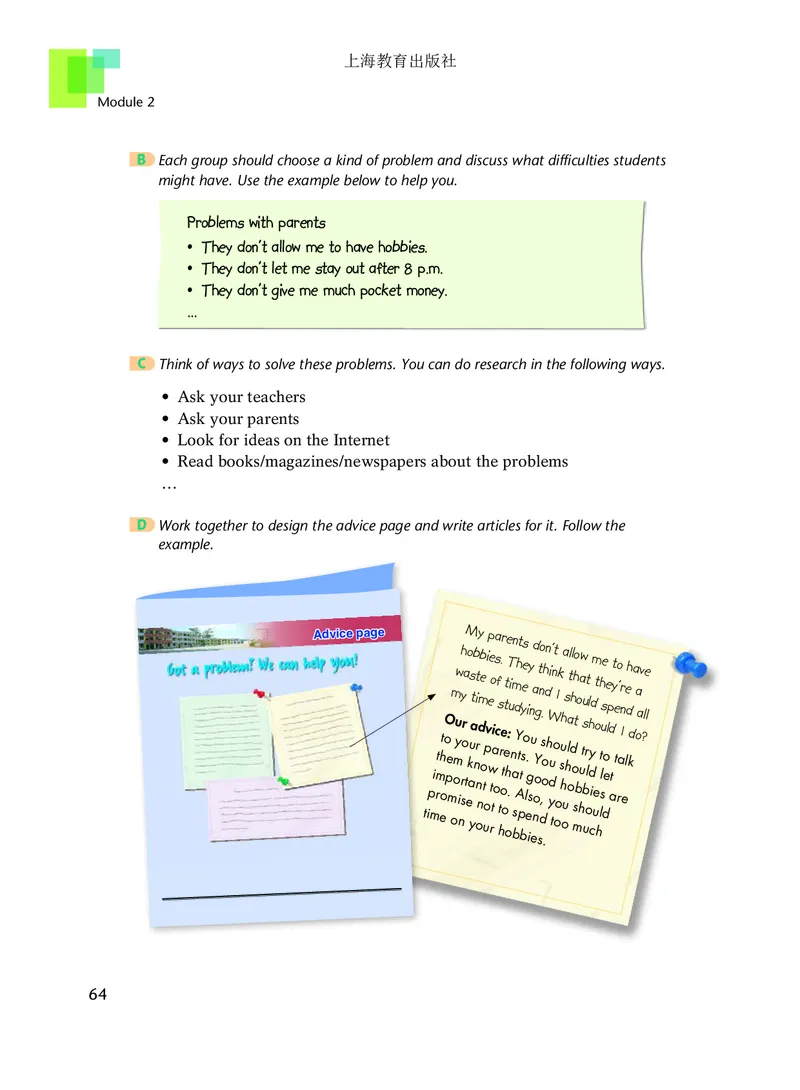
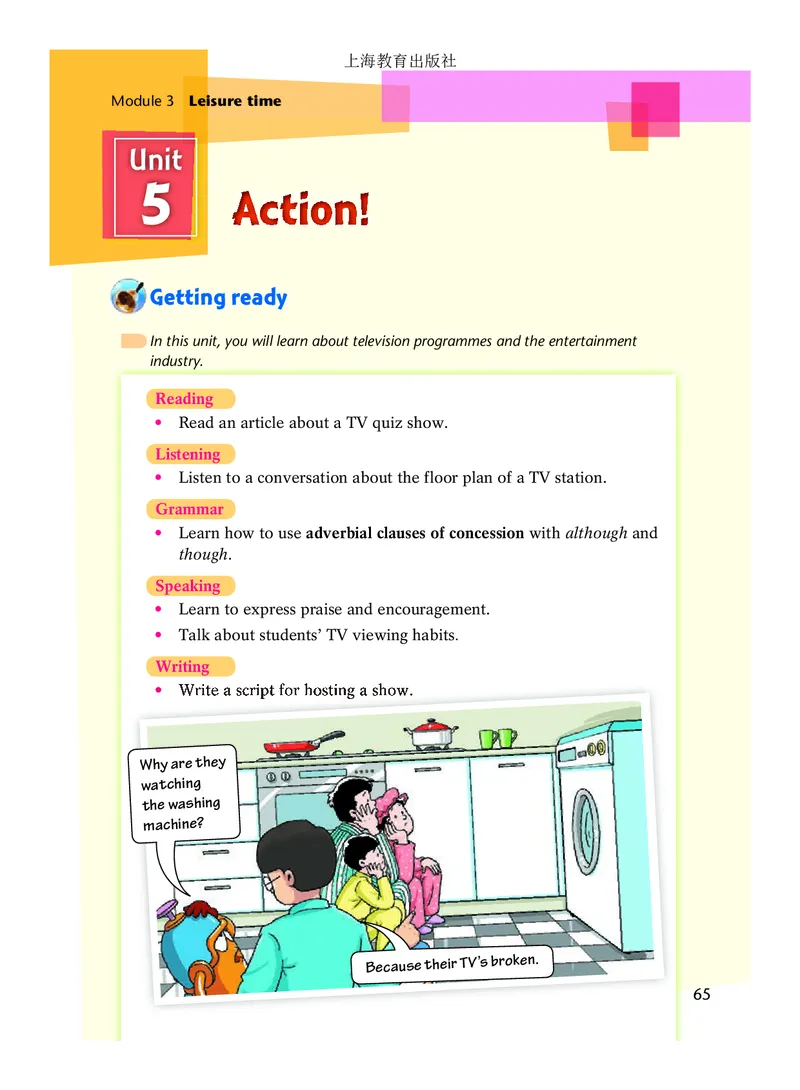
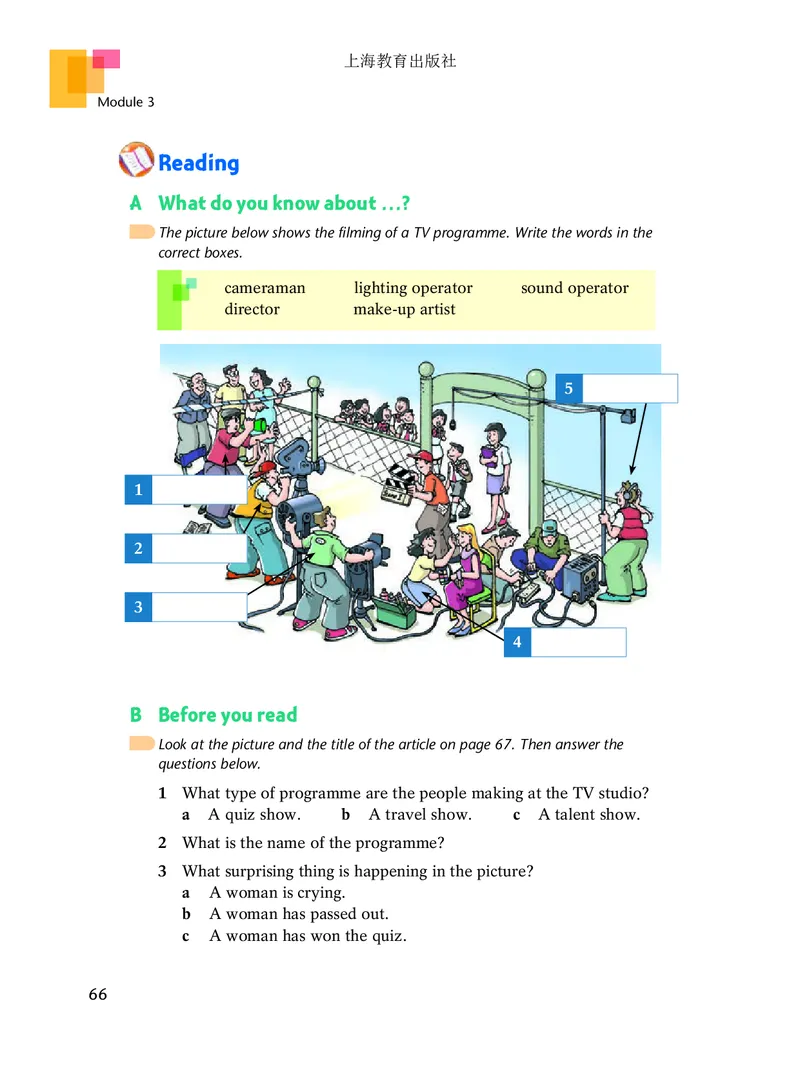
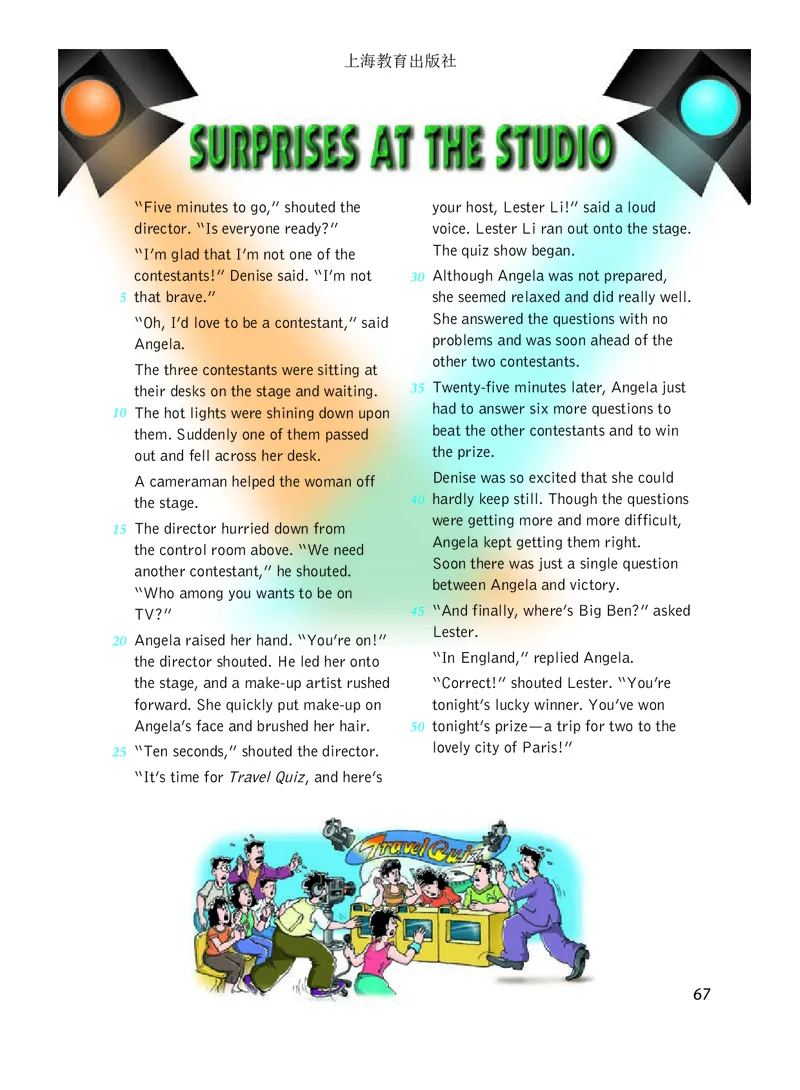
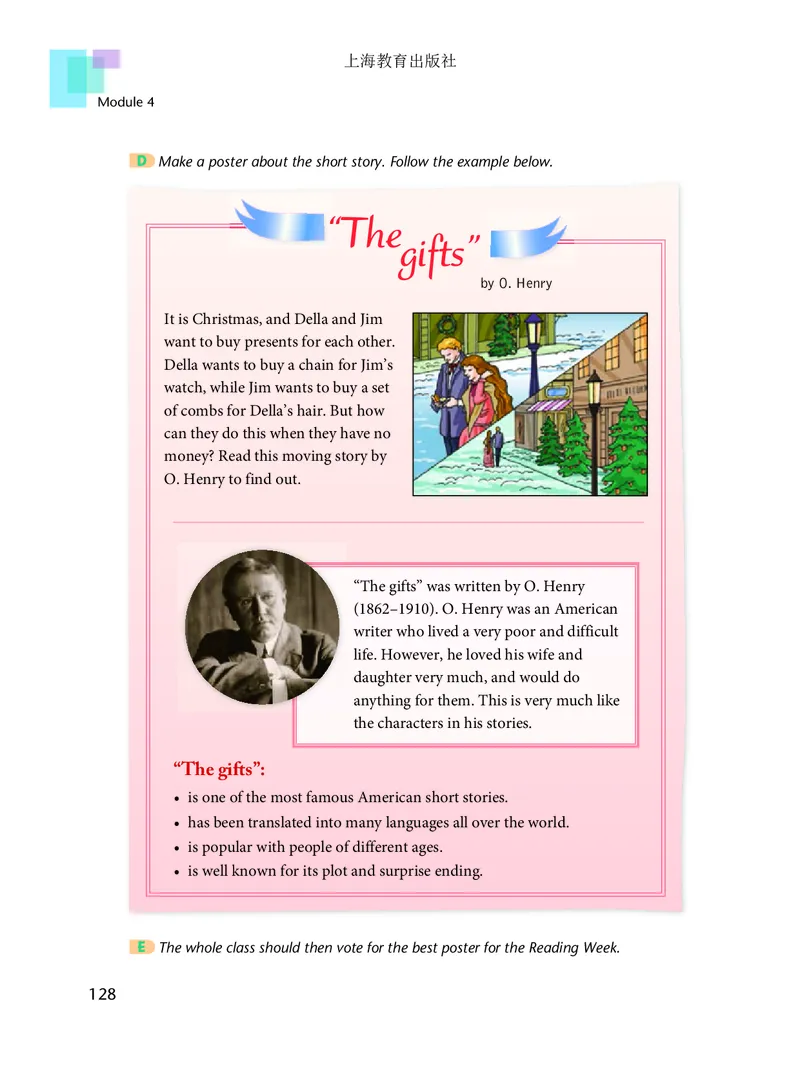

文档内容
上海教育出版社上海教育出版社
(cid:4461)(cid:4097)(cid:2462)(cid:4579)(cid:2462)(cid:2644)(cid:3713)
(cid:2549)(cid:3150)(cid:2346)(cid:33)(cid:33)(cid:3593)(cid:1449)
(cid:3593)(cid:2139)(cid:2462)(cid:4579)(cid:1564)(cid:1266)(cid:3617)上海教育出版社
(cid:4855)(cid:257)(cid:257)(cid:1354)(cid:470)(cid:33)(cid:4711)春(cid:1252)(cid:257)(cid:3710)(cid:4623)(cid:4183)
(cid:4593) (cid:4949) (cid:4737)(cid:470)(cid:33)(cid:78) (cid:69)(cid:102)(cid:98)(cid:111)(cid:257)(cid:81) (cid:70)(cid:117)(cid:105)(cid:102)(cid:115)(cid:117)(cid:112)(cid:111)(cid:257)(cid:72) (cid:78)(cid:100)(cid:66)(cid:115)(cid:117)(cid:105)(cid:118)(cid:115)
(cid:1354)(cid:33) (cid:33) (cid:4737)(cid:470)(cid:33)(cid:2900)(cid:257)(cid:6480)(cid:257)朱(cid:257)(cid:4767)(cid:257)王(cid:1619)(cid:1619)(cid:33) 朱(cid:257)(cid:3292)
(cid:4711)(cid:257)(cid:1651)(cid:257)(cid:4376)(cid:257)(cid:4377)(cid:257)(cid:4551)(cid:2212)珍
(cid:3173)(cid:2500)大学(cid:1564)(cid:1266)(cid:3617)(中国)(cid:4534)(cid:4172)(cid:2053)(cid:3764)英(cid:4565)教(cid:1420)(cid:1354)(cid:4224)(cid:4031)员(cid:2295)
(cid:3593)(cid:2139)(cid:3672)(cid:2369)(cid:1564)(cid:1266)(cid:2083)(cid:1915)(cid:4534)(cid:4172)(cid:2053)(cid:3764)(cid:3988)(cid:4565)教育图(cid:3713)(cid:1908)(cid:2053)(cid:3764)英(cid:4565)教(cid:1420)(cid:1354)(cid:4224)(cid:4031)员(cid:2295)
(cid:4660)(cid:3498)(cid:1354)(cid:2337)(cid:470)(cid:33)(cid:2268) (cid:4360)(cid:257)林 (cid:6269)(cid:257)
©(cid:3593)(cid:2139)(cid:3688)中小学((cid:4541)(cid:1849)(cid:4596))(cid:2652)(cid:1522)(cid:1984)(cid:2027)(cid:4031)员(cid:2295)和(cid:3173)(cid:2500)大学(cid:1564)(cid:1266)(cid:3617)(cid:51)(cid:49)(cid:50)(cid:53)
(cid:272)(cid:80)(cid:121)(cid:103)(cid:112)(cid:115)(cid:101)(cid:273)(cid:4026)(cid:3173)(cid:2500)大学(cid:1564)(cid:1266)(cid:3617)的(cid:4864)(cid:1449)(cid:3590)(cid:1364)(cid:259)
(cid:4036)(cid:2525)(cid:3593)(cid:2139)(cid:3688)中小学((cid:4541)(cid:1849)(cid:4596))(cid:2652)(cid:1522)(cid:1984)(cid:2027)(cid:4031)员(cid:2295)和(cid:3173)(cid:2500)大学(cid:1564)(cid:1266)(cid:3617)(中国)(cid:4534)(cid:4172)(cid:2053)(cid:3764)(cid:3713)(cid:3052)(cid:4281)(cid:2647),(cid:1411)得
(cid:4638)(cid:3498)(cid:2182)(cid:1722)(cid:3446)(cid:4444)(cid:3498)(cid:2182)(cid:4250)(cid:3669)、(cid:3498)(cid:2182)(cid:3011)(cid:2491)、(cid:3498)(cid:2182)(cid:4052)(cid:4916)(cid:1867)(cid:4487)、(cid:1888)(cid:4806)(cid:2312)(cid:4872)(cid:4636)本(cid:3713)的(cid:4052)(cid:4916)、图(cid:3276)(cid:2312)(cid:4476)(cid:1660)(cid:259)
(cid:2252)(cid:4499)(cid:2109)大师(cid:3636)(cid:2720)(cid:1737)(cid:2720)(cid:2151)(cid:4792)(cid:1564)教(cid:1420)的(cid:1462)(cid:1649)和(cid:1411)(cid:4929),(cid:3893)(cid:1564)(cid:1296)(cid:2125)(cid:4458)(cid:2415)(cid:259)(cid:1737)(cid:2246)(cid:470)(cid:49)(cid:51)(cid:50)(cid:46)(cid:55)(cid:53)(cid:52)(cid:50)(cid:58)(cid:51)(cid:53)(cid:50)(cid:259)(cid:1737)子(cid:4528)(cid:4178)(cid:470)
(cid:107)(cid:100)(cid:107)(cid:122)(cid:65)(cid:116)(cid:102)(cid:113)(cid:105)(cid:47)(cid:100)(cid:112)(cid:110)(cid:47)(cid:100)(cid:111)(cid:259)(cid:3930)(cid:4320)(cid:1722)(cid:4791)(cid:470)(cid:3593)(cid:2139)(cid:3688)(cid:4518)福(cid:2911)(cid:50)(cid:51)(cid:52)(cid:2173)(cid:259)(cid:4528)政(cid:1354)(cid:2963)(cid:470)(cid:51)(cid:49)(cid:49)(cid:49)(cid:52)(cid:50)(cid:259)
(cid:3635)(cid:3069)(cid:257)(cid:1216)(cid:4727)(cid:278)中(cid:2240)人(cid:3063)共和国(cid:4856)作(cid:3460)(cid:1862)(cid:279)(cid:1724)(cid:1854)(cid:3654)(cid:4085)(cid:3913)(cid:4534)(cid:2098)(cid:2112)(cid:1768),(cid:4066)(cid:3021)(cid:4441)(cid:2513)(cid:2825)(cid:4314)(cid:4724)(cid:4856)作(cid:3460)人(cid:4775)(cid:1970)(cid:1298)(cid:1552)(cid:259)
(cid:4856)作(cid:3460)人(cid:3523)(cid:4534)(cid:2098)(cid:4544)(cid:4775)(cid:1970)(cid:1298)(cid:1552)事(cid:4435)(cid:2647)(cid:2340)(cid:3657)(cid:4561)(cid:1564)(cid:1266)(cid:3617)(cid:2804)(cid:4131)(cid:259)
(cid:4461)(cid:4097)教育教科(cid:3713)
英 语
(cid:2549)(cid:3150)(cid:2346) (cid:3593)(cid:1449)
(cid:266)(cid:266)(cid:266)(cid:266)(cid:266)(cid:266)(cid:266)(cid:266)(cid:266)(cid:266)(cid:266)(cid:266)(cid:266)(cid:266)(cid:266)(cid:266)(cid:266)(cid:266)(cid:266)(cid:266)(cid:266)(cid:266)(cid:266)(cid:266)(cid:266)(cid:266)(cid:266)(cid:266)(cid:266)
(cid:3593)(cid:2139)(cid:3672)(cid:2369)(cid:1564)(cid:1266)(cid:2083)(cid:1915)(cid:4534)(cid:4172)(cid:2053)(cid:3764)
(cid:1564)(cid:1266)(cid:1856)(cid:4252)
(cid:3593) (cid:2139) 教 育 (cid:1564) (cid:1266) (cid:3617)
((cid:3593)(cid:2139)(cid:4518)福(cid:2911)(cid:50)(cid:51)(cid:52)(cid:2173) (cid:4528)政(cid:1354)(cid:2963)(cid:470)(cid:51)(cid:49)(cid:49)(cid:49)(cid:52)(cid:50))
(cid:2035)(cid:1722) (cid:2525)(cid:4200) (cid:3593)(cid:2139)(cid:2503)(cid:2373)(cid:4487)(cid:3736)(cid:4534)(cid:4172)(cid:2053)(cid:3764)(cid:4487)(cid:3736)
(cid:266)(cid:266)(cid:266)(cid:266)(cid:266)(cid:266)(cid:266)(cid:266)(cid:266)(cid:266)(cid:266)(cid:266)(cid:266)(cid:266)(cid:266)(cid:266)(cid:266)(cid:266)(cid:266)(cid:266)(cid:266)(cid:266)(cid:266)(cid:266)(cid:266)(cid:266)(cid:266)(cid:266)(cid:266)
(cid:2616)本 (cid:56)(cid:57)(cid:56)(cid:289)(cid:50)(cid:49)(cid:58)(cid:51) (cid:50)(cid:459)(cid:50)(cid:55) (cid:4487)(cid:4711) (cid:58)(cid:47)(cid:54)
(cid:51)(cid:49)(cid:50)(cid:53)(cid:3150)(cid:56)(cid:4614)(cid:1724)(cid:50)(cid:1266) (cid:51)(cid:49)(cid:51)(cid:50)(cid:3150)(cid:56)(cid:4614)(cid:1724)(cid:50)(cid:49)(cid:1618)(cid:4487)(cid:3736)
(cid:74)(cid:84)(cid:67)(cid:79) (cid:58)(cid:56)(cid:57)(cid:457)(cid:56)(cid:457)(cid:54)(cid:53)(cid:53)(cid:53)(cid:457)(cid:54)(cid:52)(cid:52)(cid:58)(cid:457)(cid:53)(cid:459)(cid:72)(cid:260)(cid:53)(cid:52)(cid:49)(cid:52)
(cid:266)(cid:266)(cid:266)(cid:266)(cid:266)(cid:266)(cid:266)(cid:266)(cid:266)(cid:266)(cid:266)(cid:266)(cid:266)(cid:266)(cid:266)(cid:266)(cid:266)(cid:266)(cid:266)(cid:266)(cid:266)(cid:266)(cid:266)(cid:266)(cid:266)(cid:266)(cid:266)(cid:266)(cid:266)
(cid:1768)(cid:2383)(cid:470)(cid:58)(cid:47)(cid:53)(cid:49) 元((cid:2871)(cid:3238)(cid:4476)(cid:1660)和(cid:2817)(cid:4126)(cid:1449))
辽宁省物价局价格审查批准文号:辽价发[2018]30号
全国物价举报电话:12315
此书如有印、装质量问题,请向出版社调换。联系电话:021-64377165上海教育出版社
(cid:4224)(cid:4224)(cid:4224)(cid:4638)(cid:4638)(cid:4638)(cid:3374)(cid:3374)(cid:3374)(cid:3052)(cid:3052)(cid:3052)
(cid:1563)中学(cid:4126)的(cid:4940)(cid:2219)一(cid:3150),(cid:3934)学(cid:3021)(cid:1626)(cid:2940)(cid:1722)(cid:2626)一(cid:4144)教(cid:1420)(cid:3107)(cid:2916)(cid:2295)(cid:1856)(cid:4164),(cid:4534)一(cid:4213)(cid:3772)(cid:4668)相(cid:3662)的(cid:3134)
(cid:3513)(cid:259)(cid:4026)(cid:3658)(cid:3002)(cid:475)因(cid:4026)(cid:4066)(cid:3021)(cid:2506)(cid:3527)(cid:2837)一(cid:2034)(cid:4026)(cid:272)(cid:4778)(cid:4238)(cid:273)(cid:1848)(cid:272)温(cid:2084)(cid:273)的(cid:3150)(cid:1806)(cid:470)一(cid:4213)(cid:4778)(cid:3662)的(cid:1968)(cid:4164),一
(cid:4213)(cid:1862)(cid:4662)的(cid:2115)(cid:3117),一(cid:4213)(cid:2246)(cid:3894)的(cid:4349)(cid:3622),一(cid:4213)(cid:272)说(cid:1862)(cid:273)的(cid:3913)理化,(cid:1288)(cid:2708)(cid:4638)教(cid:1420)(cid:3593)(cid:2878)(cid:1564)的(cid:2659)(cid:2392),
(cid:1788)(cid:3679)想(cid:3487)(cid:3934)学(cid:3021)(cid:2339)中(cid:2523)(cid:2800),(cid:1245)(cid:1824)(cid:3150)英(cid:4565)学(cid:4126)的(cid:1733)(cid:1733)(cid:1712)(cid:1712)(cid:3510)(cid:2297)(cid:4638)一(cid:3344),(cid:1511)(cid:1743)、(cid:3169)(cid:2817),(cid:4444)(cid:4250)
(cid:1519)(cid:2389)(cid:3661)的基(cid:1573)(cid:259)
(cid:4638)(cid:272)(cid:1793)(Reading)(cid:273)的(cid:1451)(cid:3052),(cid:3802)(cid:3479)(cid:3504)(cid:3679)(cid:1793),(cid:1677)(cid:4441)(cid:1411)(cid:4793)(cid:4544)(cid:2837)(cid:2484)(cid:3134)(cid:3513)的(cid:3374)因(cid:2219)(cid:2133),(cid:2040)(cid:4402)
理(cid:2484)(cid:1793)物的人(cid:4052)(cid:3134)(cid:2149)和(cid:3636)(cid:2308)(cid:3893)(cid:3670)(cid:259)本(cid:3150)(cid:1806)(cid:4066)(cid:3021)(cid:2295)(cid:4561)(cid:4281)(cid:1824)(cid:4032)大的人物和(cid:2525)(cid:1734)的(cid:4052)学作(cid:3287)相
(cid:4572)(cid:471)(cid:4410)(cid:2295)(cid:2469)(cid:1577)(cid:1683)(cid:4144)的(cid:3492)(cid:1733)(cid:2246)(cid:3894),(cid:3523)(cid:2419)(cid:2627)(cid:4483)(cid:3659)和(cid:2253)(cid:2531)(cid:1293)(cid:2234)(cid:259)对(cid:3115)(cid:4213)相(cid:2032)(cid:3657)(cid:2659)(cid:2312)(cid:2510)(cid:4638)(cid:6253)(cid:1541)的
(cid:4616)(cid:1793)(cid:3134)(cid:3513),(cid:4402)(cid:1623)(cid:272)(cid:2837)(cid:2484)(cid:273)(cid:3445)(cid:4544)(cid:272)理(cid:2484)(cid:273),(cid:1386)(cid:1480)(cid:3692)(cid:3287)(cid:4038)和(cid:2412)(cid:3591),(cid:4444)(cid:2311)得对(cid:4066)(cid:3021)(cid:4534)(cid:4462)的人(cid:3636)(cid:2525)(cid:4371)(cid:259)
(cid:4638)(cid:272)(cid:3921)(Listening)(cid:273)和(cid:272)说(Speaking)(cid:273)的(cid:1451)(cid:3052),本(cid:3150)(cid:1806)(cid:2040)(cid:4864)(cid:4824)(cid:4740)(cid:2823)(cid:4188)(cid:3136)(cid:2800)(cid:4638)(cid:3661)
(cid:2366)(cid:3636)(cid:2308)中的(cid:2445)(cid:2366)(cid:2048)(cid:3136)(cid:259)(cid:4565)(cid:4476)(cid:4565)(cid:1753)的(cid:2040)加老(cid:2817)和(cid:2295)(cid:2246)的(cid:2040)加(cid:4914)(cid:3523)(cid:3679)(cid:4319)(cid:2817)的(cid:3107)(cid:1364)(cid:471)(cid:2255)(cid:2429)(cid:2368)(cid:4292)
教(cid:3698)一(cid:4213)(cid:2048)(cid:3136)(cid:4458)(cid:3154)的(cid:1367)(cid:1651)(cid:1862),(cid:3523)(cid:2469)(cid:3700)(cid:2312)(cid:2572)(cid:2600)(cid:1275)(cid:4858),(cid:3359)(cid:1683)(cid:1722)(cid:1367)(cid:3670)喜(cid:2171)、(cid:4642)(cid:4377)和(cid:3934)(cid:3431)(cid:1706)(cid:259)(cid:4402)
(cid:1623)(cid:272)(cid:3921)(cid:1774)(cid:273)(cid:3445)(cid:4544)(cid:272)(cid:2837)(cid:3479)(cid:273)(cid:471)(cid:1623)(cid:272)(cid:3136)说(cid:273)(cid:3445)(cid:4544)(cid:272)说(cid:2171)(cid:273),(cid:2800)(cid:3441)(cid:4638)(cid:2295)(cid:2246)(cid:2392)(cid:3897)(cid:2295)(cid:1695)(cid:2312)(cid:1367)(cid:1651)(cid:1564)(cid:3431)(cid:4291)
和(cid:3431)(cid:1996)(cid:259)
(cid:4638)(cid:272)(cid:4224)(Writing)(cid:273)的(cid:1451)(cid:3052),(cid:1571)(cid:2368)(cid:4292)(cid:3327)、(cid:1239)(cid:3150)(cid:2346)(cid:4441)(cid:2469)(cid:1577)的(cid:2035)(cid:4822)(cid:3897)(cid:1419)和(cid:3894)(cid:1420)的(cid:4224)作(cid:4319)(cid:2817),
(cid:2549)(cid:3150)(cid:2346)的(cid:272)(cid:4224)(cid:273)(cid:2040)(cid:4402)(cid:4561)(cid:272)(cid:3921)(cid:273)(cid:272)说(cid:273)(cid:272)(cid:1793)(cid:273)(cid:3339)(cid:3945)(cid:1386)(cid:2506)(cid:259)(cid:4224)作(cid:3679)(cid:2871)一(cid:4822)(cid:1883)(cid:3669)的(cid:272)说(cid:273),(cid:3823)(cid:4045)(cid:1332)(cid:3726)(cid:259)
(cid:1683)(cid:4066)(cid:3021)(cid:2040)(cid:2171)(cid:1722)(cid:4712)(cid:4069)(cid:2837)(cid:4565)(cid:1862),(cid:4534)(cid:2837)(cid:2040)(cid:1824)的(cid:1614)(cid:2297)和(cid:2040)(cid:3066)(cid:3533)的(cid:4565)(cid:4350)(cid:1996)(cid:4098)(cid:3657),(cid:4066)(cid:3021)(cid:1683)(cid:3479)(cid:4402)(cid:4638)(cid:272)(cid:1332)
(cid:3726)(cid:273)中作一(cid:4213)比(cid:2465)、(cid:4299)(cid:4661)和(cid:1520)(cid:4164),(cid:4402)(cid:1623)(cid:272)(cid:2295)(cid:4224)(cid:273)(cid:3445)(cid:4544)(cid:272)(cid:2295)(cid:1984)(cid:273),(cid:3487)(cid:4668)(cid:2525)(cid:272)(cid:4541)(cid:4809)(cid:273)的(cid:2580)子、
(cid:1804)(cid:4052)(cid:4848)(cid:2423)(cid:1358)得(cid:1519)(cid:3716)、(cid:3636)(cid:1775)(cid:3344)(cid:2720)(cid:259)
(cid:4638)(cid:272)(cid:2652)(cid:3894)(Project)(cid:273)(cid:4806)作(cid:1451)(cid:3052),(cid:4402)(cid:3441)(cid:3934)学(cid:3021)(cid:4699)(cid:2616)的(cid:3134)(cid:3513)(cid:4561)(cid:3636)(cid:2308)(cid:3654)(cid:1908)(cid:3917)(cid:2510)(cid:259)(cid:4191)(cid:272)(cid:3618)
(cid:2362)一(cid:1915)图(cid:4052)(cid:1386)(cid:2997)的(cid:1427)(cid:3319)(cid:273)(cid:4740)(cid:4387)的(cid:3074)(cid:3894),(cid:1623)(cid:4299)(cid:4661)(cid:1427)(cid:3669),(cid:3897)(cid:4164)国别、人(cid:4052)(cid:1309)(cid:2528),(cid:3238)(cid:3686)图(cid:1220),
(cid:1695)(cid:1654)(cid:3801)(cid:1367)(cid:2910)(cid:3112)(cid:4213)(cid:4052)化(cid:4624)(cid:2148),(cid:1788)(cid:4402)(cid:3930)(cid:3214)(cid:2634)(cid:2927),(cid:2344)(cid:4458)(cid:4038)(cid:4899)(cid:3934)学(cid:3021)(cid:3996)(cid:1519)的(cid:272)(cid:4806)作(cid:273)(cid:4402)(cid:4848)(cid:2423)(cid:1623)
(cid:272)(cid:2406)(cid:273)(cid:272)(cid:3377)(cid:273)(cid:3445)(cid:4544)(cid:272)(cid:1824)元(cid:273)和(cid:272)(cid:2523)(cid:3624)(cid:273)(cid:259)
(cid:4638)(cid:272)学(cid:4126)(cid:2352)(cid:3136)(Study skills)(cid:273)(cid:4712)(cid:4069)(cid:1451)(cid:3052),(cid:4066)(cid:3021)(cid:4441)(cid:2525)(cid:4534)(cid:2837)一(cid:1768)(cid:2825)的(cid:2759)(cid:2323),(cid:2499)(cid:3150)(cid:2255)(cid:2429)
学(cid:4126)一(cid:4213)(cid:4052)(cid:1220)(cid:3661)(cid:4097),(cid:2793)(cid:3523)(cid:4806)(cid:1768)(cid:2112)(cid:2244)、(cid:3344)(cid:1445)(cid:3893)(cid:2005)(cid:471)(cid:1386)(cid:3930)(cid:2135)(cid:2363)(cid:3662)(cid:2035)(cid:4822)(cid:1364)(cid:3662)(cid:4444)(cid:2682)(cid:3791)(cid:2837)(cid:2484)、(cid:1908)(cid:4102)
(cid:3988)(cid:2489)的一(cid:3406)(cid:259)(cid:3679)(cid:3657)(cid:2218)(cid:1245)(cid:4066)(cid:3021)(cid:3823)学的英(cid:4565)(cid:2352)(cid:3136)(cid:7647)(cid:2183)(cid:4638)一(cid:3344),(cid:1623)(cid:272)(cid:1671)一(cid:273)(cid:3445)(cid:4544)(cid:272)(cid:4921)(cid:2183)(cid:273),(cid:3487)
(cid:4066)(cid:3021)(cid:3052)对(cid:3672)(cid:2489)的(cid:4357)(cid:2518)(cid:4534)(cid:2040)(cid:2683)(cid:2711)的(cid:3691)(cid:4408)(cid:259)
(cid:4940)(cid:2219)说一(cid:4144)教(cid:1420)中的(cid:2871)(cid:3988)(cid:272)(cid:3545)(cid:2034)(cid:1265)(cid:2679)(cid:273)(cid:470)(cid:272)(cid:4565)(cid:1862)(Grammar)(cid:273)的(cid:4238)(cid:3698)(cid:4188)(cid:3107)(cid:4855)(cid:4402)(cid:3679)(cid:2035)
(cid:2764)(cid:4882)(cid:4565)(cid:1623)(cid:2580)和(cid:1376)(cid:4565)(cid:1623)(cid:2580),(cid:4444)(cid:2340)(cid:4131)(cid:1775)(cid:1614)和(cid:2491)(cid:1614)的(cid:4521)(cid:1862),基本(cid:3724)(cid:4544)(cid:1563)中(cid:2473)(cid:1806)(cid:4565)(cid:1862)的(cid:3125)(cid:1733)(cid:259)(cid:1677)(cid:3679),
(cid:1683)(cid:4066)(cid:3021)(cid:2654)(cid:4144)(cid:4740)(cid:4213)(cid:272)(cid:2081)(cid:3945)(cid:273)(cid:4444)(cid:2219),(cid:4066)(cid:3021)(cid:4441)(cid:3479)(cid:3463)(cid:3052)(cid:4712)(cid:4069)(cid:2837)英(cid:4565)的(cid:1563)(cid:2346)(cid:4565)(cid:1862),(cid:4638)(cid:4616)(cid:1793)和(cid:4224)作
(cid:3593)(cid:2295)(cid:4534)一(cid:2034)(cid:2677)(cid:1413)(cid:259)本(cid:3150)(cid:1806)的(cid:272)(cid:1409)(cid:1546)(cid:4616)(cid:1793)(More practice)(cid:273)和(cid:272)(cid:4052)化(cid:2457)(Culture corner)(cid:273)
(cid:3654)(cid:1908)(cid:1919)(cid:1975)(cid:470)中国的老子,西(cid:1883)的(cid:3173)(cid:1817)(cid:471)(cid:4855)(cid:4402)英(cid:4565)国家(cid:2392)的英(cid:4565)(cid:4410)(cid:4534)(cid:1462)(cid:4468)(cid:475)(cid:1824)(cid:3002)(cid:4534)(cid:3456)的(cid:3134)
(cid:3513)(cid:445)一(cid:1768)(cid:2295)(cid:2036)大家(cid:4534)(cid:4462)的(cid:3348)迪(cid:259)
(cid:3934)学(cid:3021),(cid:3182)(cid:2800)(cid:1237),一(cid:1768)(cid:4402)(cid:3487)(cid:4914)(cid:2350)(cid:4018)(cid:4210)(cid:4899),(cid:4914)(cid:4241)(cid:1722)(cid:2445)(cid:1564)(cid:1563)中(cid:3150)(cid:1806)的(cid:4940)(cid:2219)一(cid:1915)(cid:1652)(cid:2589)(cid:445)
(cid:1563)中(cid:278)英(cid:4565)(cid:279)(cid:1354)(cid:4224)(cid:4935)
2012(cid:3150)12(cid:4614)上海教育出版社
鸣谢
(cid:4638)教(cid:1420)(cid:1354)(cid:4224)的(cid:2135)(cid:1522)中,(cid:1415)(cid:1908)教师对(cid:1615)(cid:2046)作(cid:4558)(cid:4444)(cid:2335)大的(cid:1275)(cid:4858),特(cid:1615)(cid:1996)(cid:4231)(cid:470)
安(cid:1933)(cid:5812)(cid:257)朱(cid:257)(cid:1519)(cid:257)(cid:2894)(cid:1384)(cid:2704)(cid:257)(cid:1444)国(cid:2859)
(cid:85)(cid:112)(cid:111)(cid:122) (cid:69)(cid:98)(cid:109)(cid:102)上海教育出版社
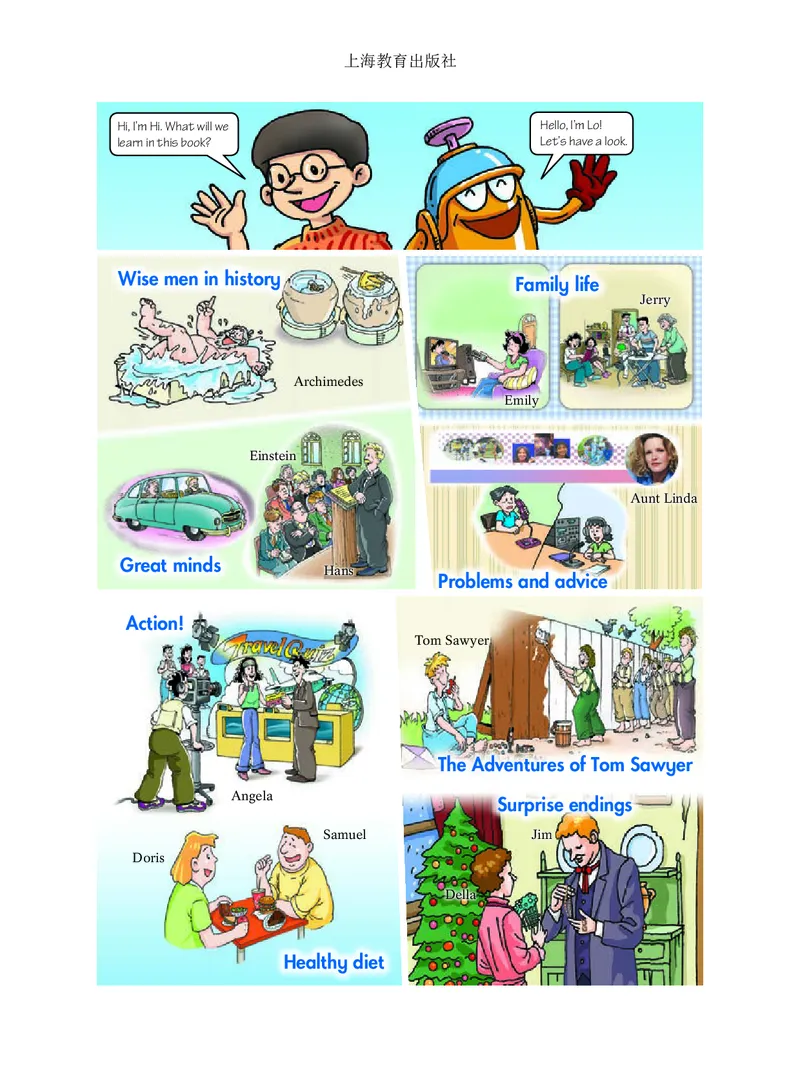
Hi, I’m Hi. What will we Hello, I’m Lo!
learn in this book? Let’s have a look.
Wise men in history
Family life
Jerry
Archimedes
Emily
Einstein
Aunt Linda
Great minds
Hans
Problems and advice
Action!
Tom Sawyer
The Adventures of Tom Sawyer
Angela
Surprise endings
Samuel Jim
Doris
Della
Healthy diet上海教育出版社
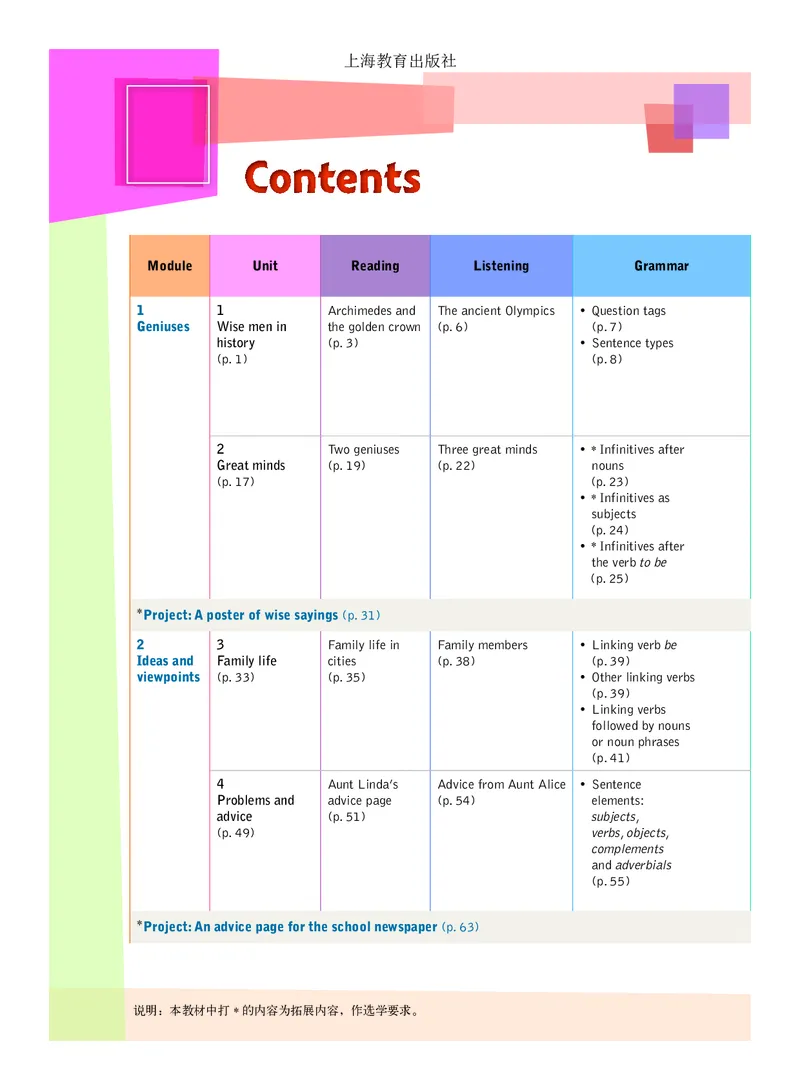
CCCooonnnttteeennntttsss
Speaking Culture corner
(cid:43)
Module Unit Reading Listening Grammar Writing More practice Study skills and
Talk time Speak up Self-assessment
1 1 Archimedes and The ancient Olympics • Question tags Asking for Helen at the Improving your Cao Chong Punctuation • Laozi
Geniuses Wise men in the golden crown (p. 6) (p. 7) agreement or Olympics work weighs an (p. 14) (p. 16)
history (p. 3) • Sentence types confi rmation (p. 11) (p. 12) elephant • Self-assessment
(p. 1) (p. 8) (p. 10) (p. 13) (p. 16)
2 Two geniuses Three great minds • (cid:43) Infinitives after Leaving and A famous Floating Einstein and — • Isaac Newton
Great minds (p. 19) (p. 22) nouns taking phone person listeners the little girl (p. 30)
(p. 17) (p. 23) messages (p. 26) (p. 27) (p. 29) • Self-assessment
• (cid:43) Infinitives as (p. 26) (p. 30)
subjects
(p. 24)
• (cid:43) Infinitives after
the verb to be
(p. 25)
(cid:43)
Project: A poster of wise sayings (p. 31)
2 3 Family life in Family members • Linking verb be Offering, How much My family life How to Practical • Family trees
Ideas and Family life cities (p. 38) (p. 39) accepting and housework do (p. 44) communicate writing (3): (p. 48)
viewpoints (p. 33) (p. 35) • Other linking verbs refusing help you do? with your Making rules • Self-assessment
(p. 39) (p. 42) (p. 43) parents and regulations (p. 48)
• Linking verbs (p. 45) (p. 46)
followed by nouns
or noun phrases
(p. 41)
4 Aunt Linda’s Advice from Aunt Alice • Sentence Asking for What advice An email to Replies from — • Agony aunts
Problems and advice page (p. 54) elements: and giving would you give Aunt Linda Aunt Linda (p. 62)
advice (p. 51) subjects, advice about students’ (p. 59) (p. 61) • Self-assessment
(p. 49) verbs, objects, (p. 58) problems? (p. 62)
complements (p. 58)
and adverbials
(p. 55)
(cid:43)
Project: An advice page for the school newspaper (p. 63)
说(cid:3069)(cid:470)本教(cid:1420)中(cid:1654)(cid:454)的(cid:3134)(cid:3513)(cid:4026)(cid:3978)(cid:4699)(cid:3134)(cid:3513),作(cid:4299)学(cid:4402)(cid:3441)(cid:259)上海教育出版社
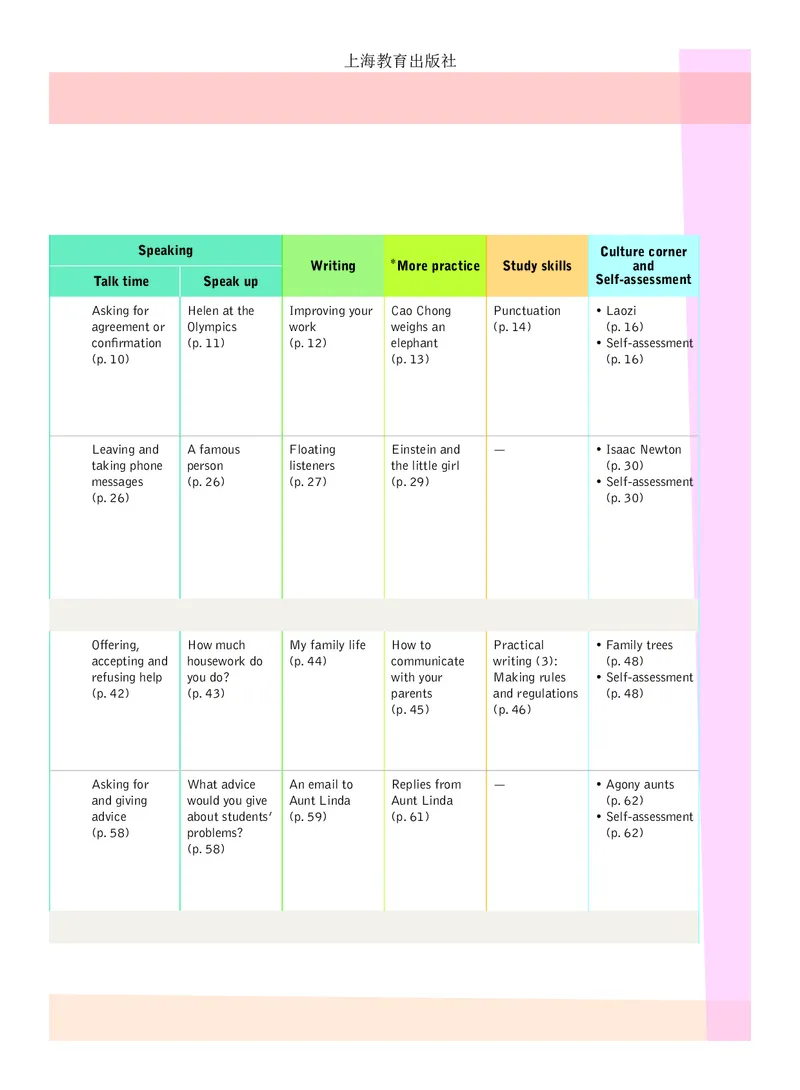
Speaking Culture corner
(cid:43)
Module Unit Reading Listening Grammar Writing More practice Study skills and
Talk time Speak up Self-assessment
1 1 Archimedes and The ancient Olympics • Question tags Asking for Helen at the Improving your Cao Chong Punctuation • Laozi
Geniuses Wise men in the golden crown (p. 6) (p. 7) agreement or Olympics work weighs an (p. 14) (p. 16)
history (p. 3) • Sentence types confi rmation (p. 11) (p. 12) elephant • Self-assessment
(p. 1) (p. 8) (p. 10) (p. 13) (p. 16)
2 Two geniuses Three great minds • Infinitives after Leaving and A famous Floating Einstein and — • Isaac Newton
Great minds (p. 19) (p. 22) nouns taking phone person listeners the little girl (p. 30)
(p. 17) (p. 23) messages (p. 26) (p. 27) (p. 29) • Self-assessment
• Infinitives as (p. 26) (p. 30)
subjects
(p. 24)
• Infinitives after
the verb to be
(p. 25)
(cid:43)
Project: A poster of wise sayings (p. 31)
2 3 Family life in Family members • Linking verb be Offering, How much My family life How to Practical • Family trees
Ideas and Family life cities (p. 38) (p. 39) accepting and housework do (p. 44) communicate writing (3): (p. 48)
viewpoints (p. 33) (p. 35) • Other linking verbs refusing help you do? with your Making rules • Self-assessment
(p. 39) (p. 42) (p. 43) parents and regulations (p. 48)
• Linking verbs (p. 45) (p. 46)
followed by nouns
or noun phrases
(p. 41)
4 Aunt Linda’s Advice from Aunt Alice • Sentence Asking for What advice An email to Replies from — • Agony aunts
Problems and advice page (p. 54) elements: and giving would you give Aunt Linda Aunt Linda (p. 62)
advice (p. 51) subjects, advice about students’ (p. 59) (p. 61) • Self-assessment
(p. 49) verbs, objects, (p. 58) problems? (p. 62)
complements (p. 58)
and adverbials
(p. 55)
(cid:43)
Project: An advice page for the school newspaper (p. 63)上海教育出版社
Speaking Culture corner
(cid:43)
Module Unit Reading Listening Grammar Writing More practice Study skills and
Talk time Speak up Self-assessment
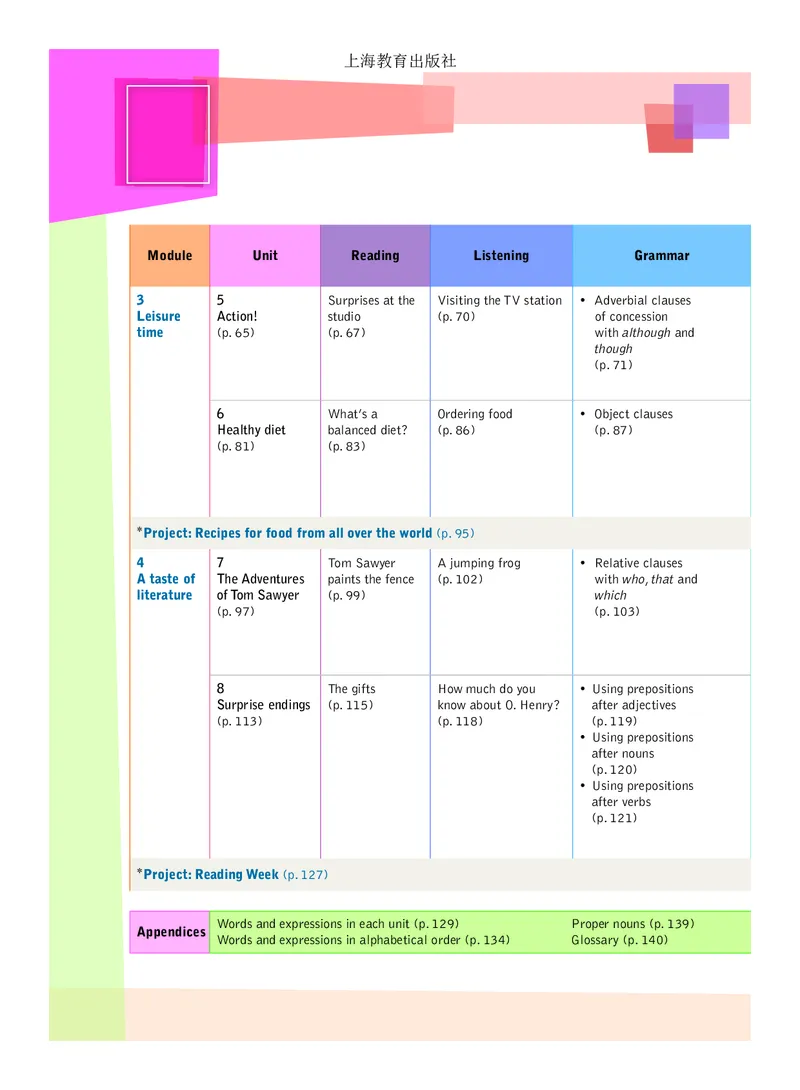
3 5 Surprises at the Visiting the TV station • Adverbial clauses Expressing Students’ TV A script for We love the Charts and • International
Leisure Action! studio (p. 70) of concession praise and viewing habits hosting a Film Park! graphs (4): fi lm festivals
time (p. 65) (p. 67) with although and encouragement (p. 75) show (p. 77) Using tables (p. 80)
though (p. 74) (p. 76) to give • Self-assessment
(p. 71) information (p. 80)
(p. 78)
6 What’s a Ordering food • Object clauses Expressing A weekly lunch A restaurant Two poems — • The tale of the
Healthy diet balanced diet? (p. 86) (p. 87) preferences menu review about farming tomato
(p. 81) (p. 83) (p. 90) (p. 91) (p. 92) (p. 93) (p. 94)
• Self-assessment
(p. 94)
(cid:43)
Project: Recipes for food from all over the world (p. 95)
4 7 Tom Sawyer A jumping frog • Relative clauses Expressing My favourite A report on a Tom and Becky Making • Adventures of
A taste of The Adventures paints the fence (p. 102) with who, that and congratulations story story in the cave outlines Huckleberry
literature of Tom Sawyer (p. 99) which and sympathy (p. 107) (p. 108) (p. 109) (p. 110) Finn
(p. 97) (p. 103) (p. 106) (p. 112)
• Self-assessment
(p. 112)
8 The gifts How much do you • Using prepositions Disagreeing in What kinds of The most The last leaf — • White elephants
Surprise endings (p. 115) know about O. Henry? after adjectives a polite way gifts do you valuable gift (p. 125) (p. 126)
(p. 113) (p. 118) (p. 119) (p. 122) usually give on (p. 124) • Self-assessment
• Using prepositions special days? (p. 126)
after nouns (p. 123)
(p. 120)
• Using prepositions
after verbs
(p. 121)
(cid:43)
Project: Reading Week (p. 127)
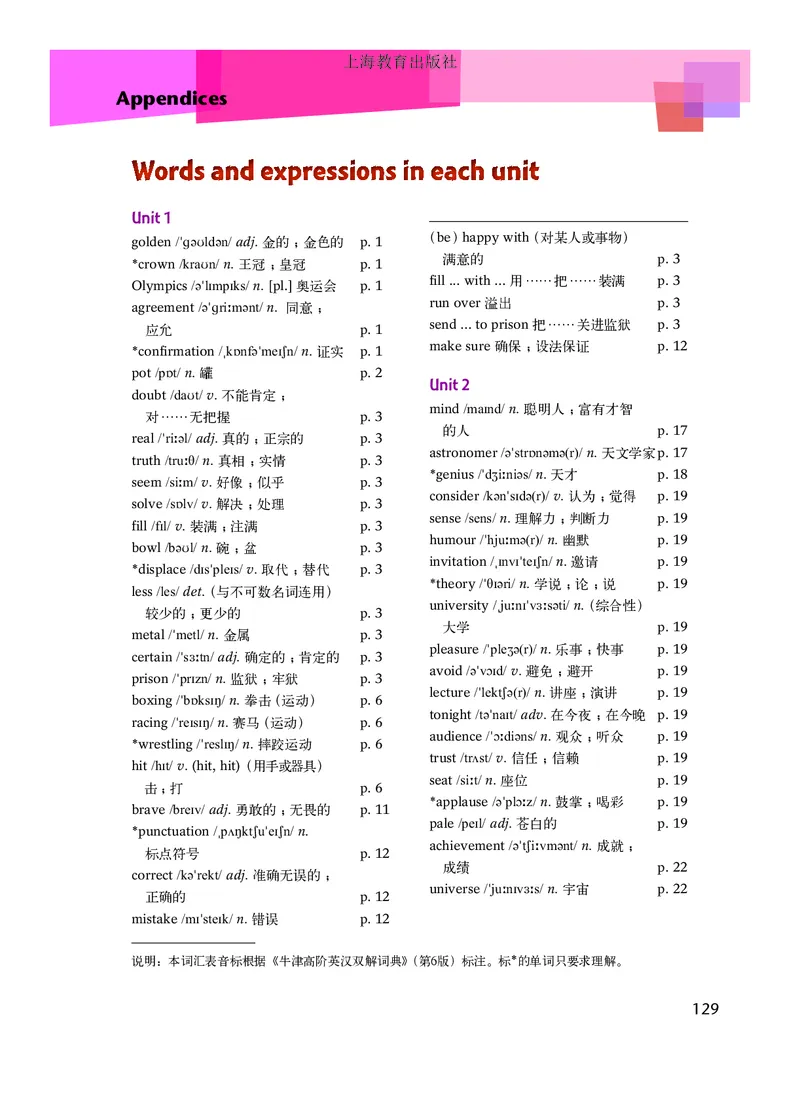
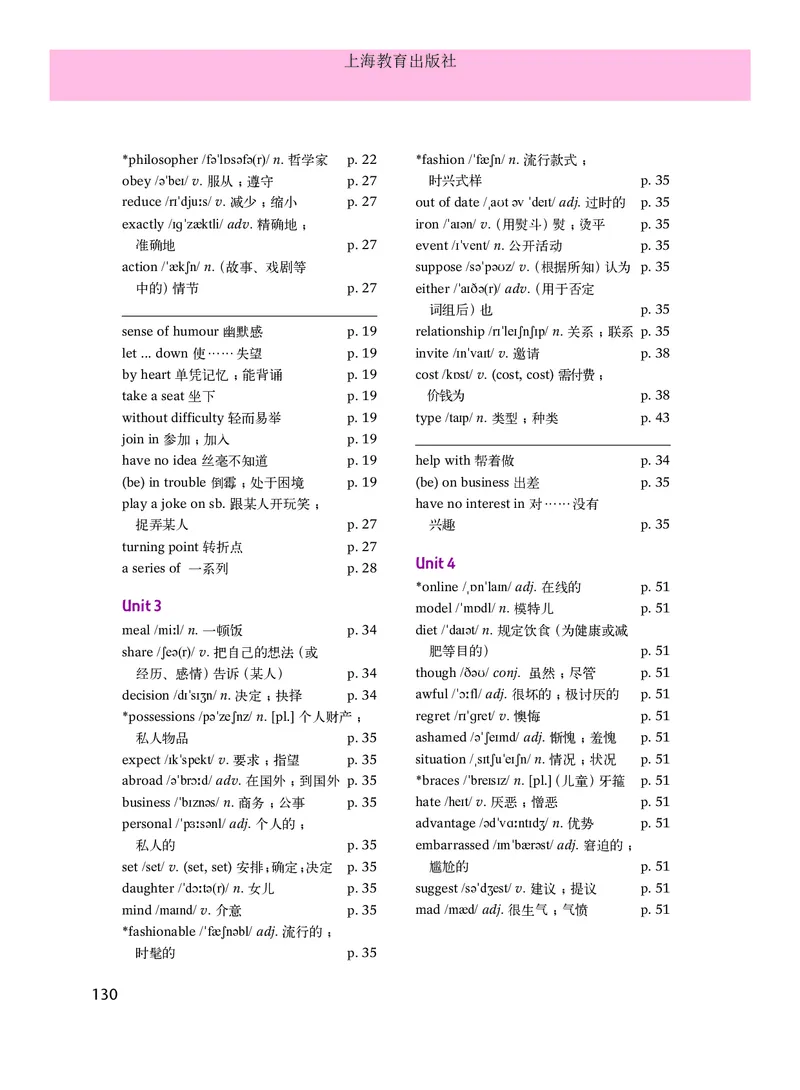
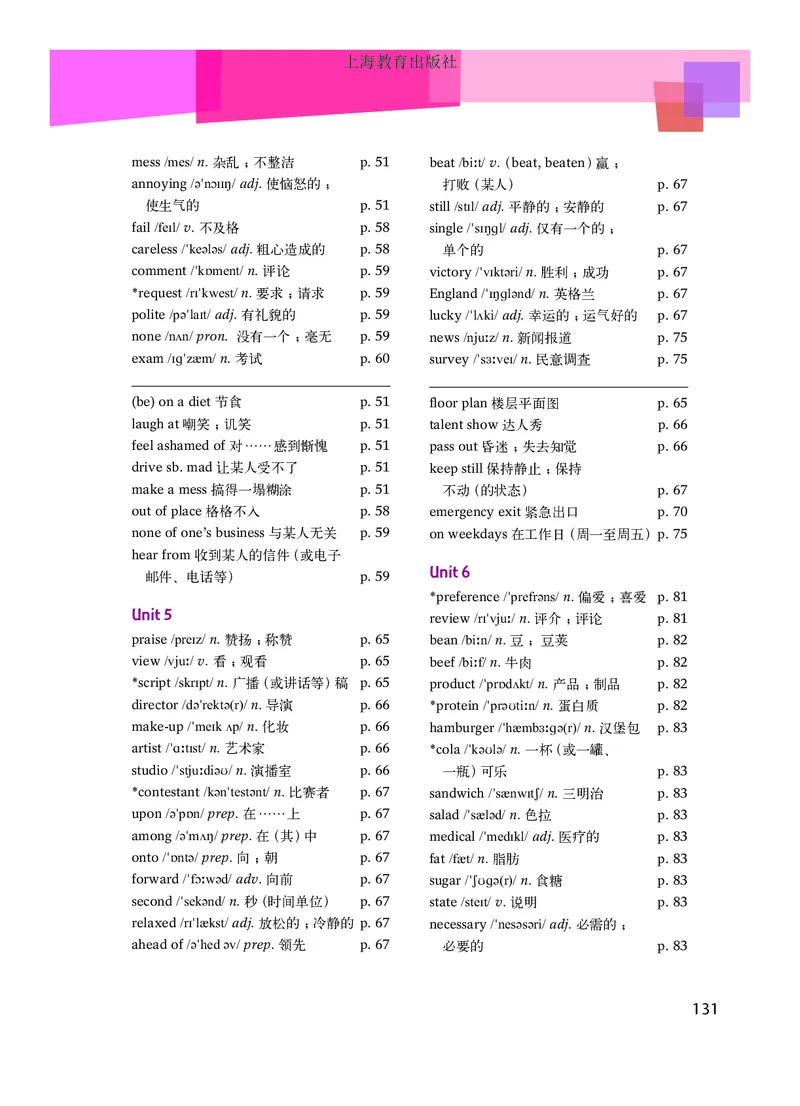
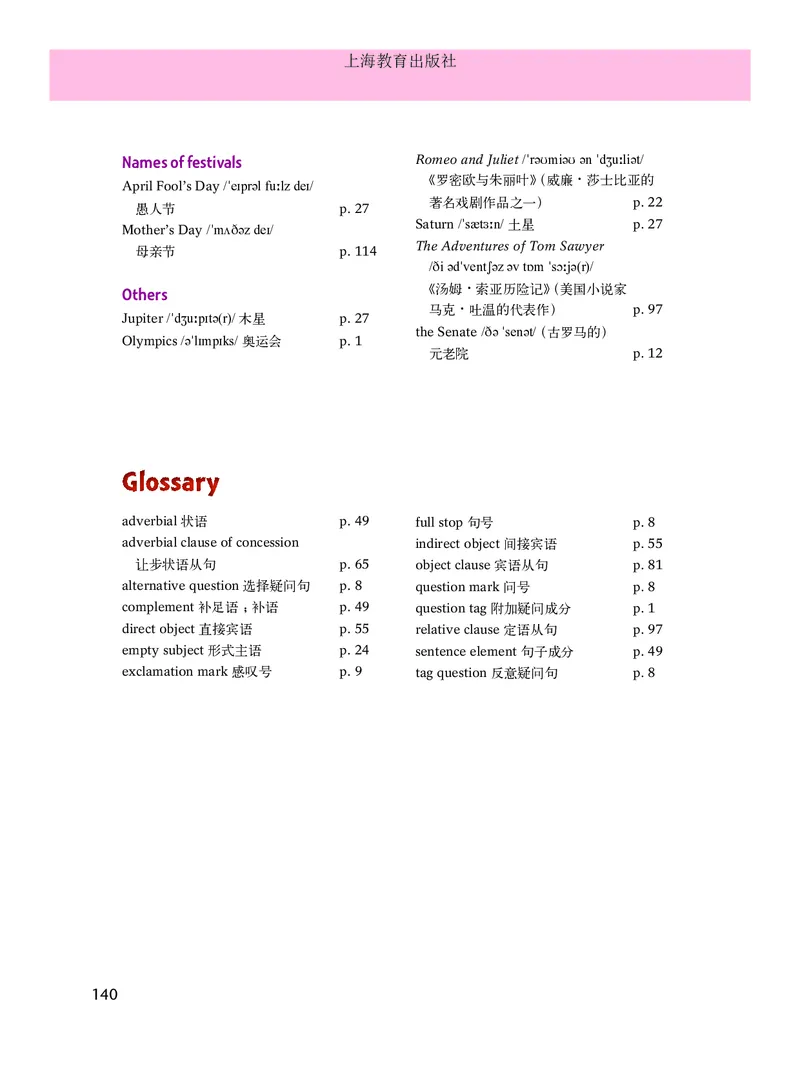
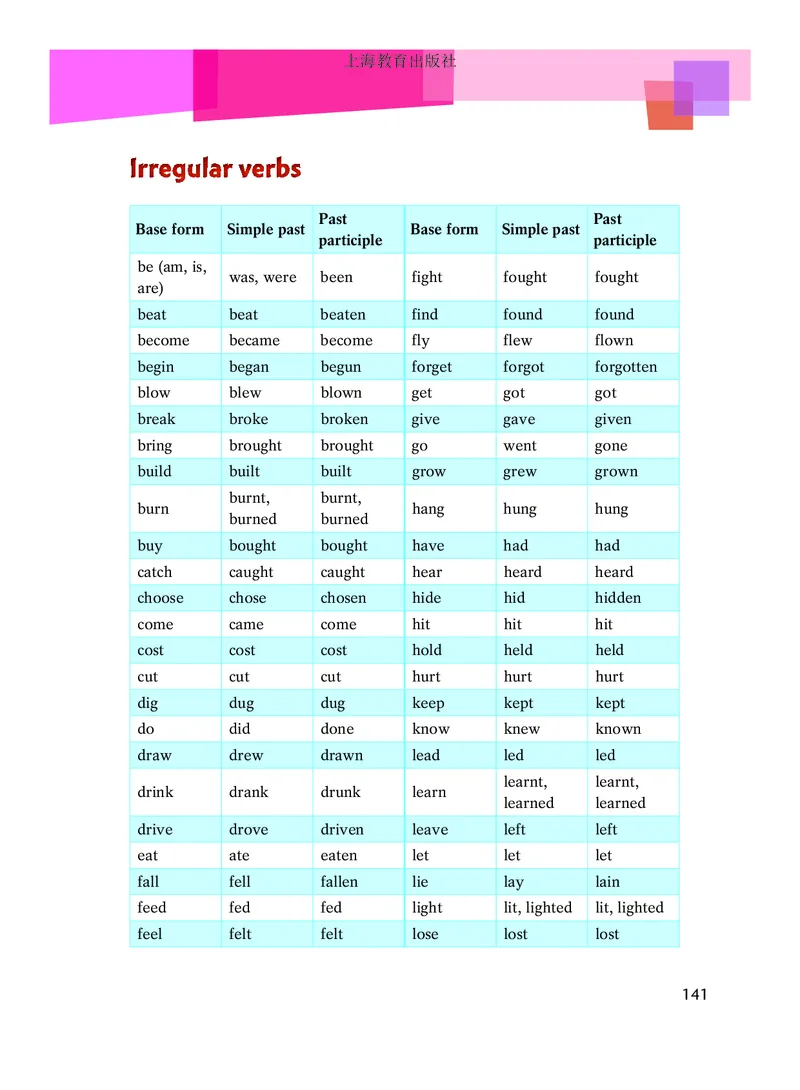
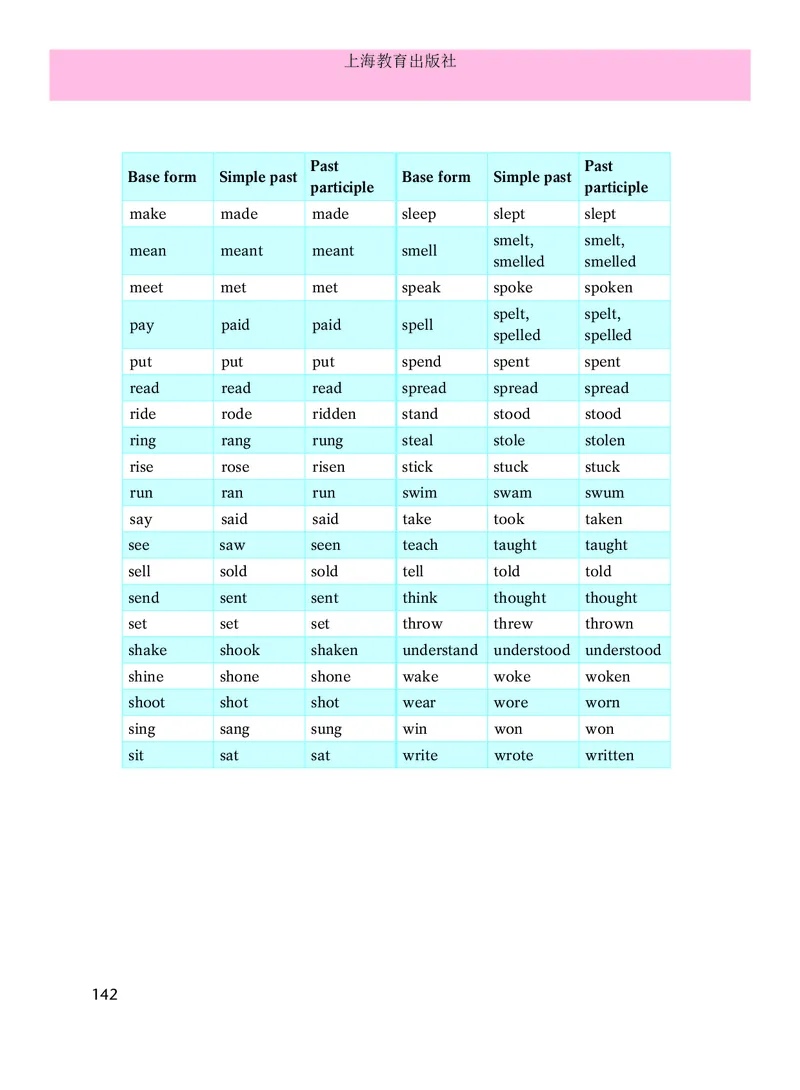
Words and expressions in each unit (p. 129) Proper nouns (p. 139) Irregular verbs (p. 141)
Appendices
Words and expressions in alphabetical order (p. 134) Glossary (p. 140)上海教育出版社
Speaking Culture corner
(cid:43)
Module Unit Reading Listening Grammar Writing More practice Study skills and
Talk time Speak up Self-assessment
3 5 Surprises at the Visiting the TV station • Adverbial clauses Expressing Students’ TV (cid:43)A script for We love the Charts and • International
Leisure Action! studio (p. 70) of concession praise and viewing habits hosting a Film Park! graphs (4): fi lm festivals
time (p. 65) (p. 67) with although and encouragement (p. 75) show (p. 77) Using tables (p. 80)
though (p. 74) (p. 76) to give • Self-assessment
(p. 71) information (p. 80)
(p. 78)
6 What’s a Ordering food • Object clauses Expressing A weekly lunch A restaurant Two poems — • The tale of the
Healthy diet balanced diet? (p. 86) (p. 87) preferences menu review about farming tomato
(p. 81) (p. 83) (p. 90) (p. 91) (p. 92) (p. 93) (p. 94)
• Self-assessment
(p. 94)
(cid:43)
Project: Recipes for food from all over the world (p. 95)
4 7 Tom Sawyer A jumping frog • Relative clauses Expressing My favourite A report on a Tom and Becky Making • Adventures of
A taste of The Adventures paints the fence (p. 102) with who, that and congratulations story story in the cave outlines Huckleberry
literature of Tom Sawyer (p. 99) which and sympathy (p. 107) (p. 108) (p. 109) (p. 110) Finn
(p. 97) (p. 103) (p. 106) (p. 112)
• Self-assessment
(p. 112)
8 The gifts How much do you • Using prepositions Disagreeing in What kinds of The most The last leaf — • White elephants
Surprise endings (p. 115) know about O. Henry? after adjectives a polite way gifts do you valuable gift (p. 125) (p. 126)
(p. 113) (p. 118) (p. 119) (p. 122) usually give on (p. 124) • Self-assessment
• Using prepositions special days? (p. 126)
after nouns (p. 123)
(p. 120)
• Using prepositions
after verbs
(p. 121)
(cid:43)
Project: Reading Week (p. 127)
Words and expressions in each unit (p. 129) Proper nouns (p. 139) Irregular verbs (p. 141)
Appendices
Words and expressions in alphabetical order (p. 134) Glossary (p. 140)上海教育出版社上海教育出版社
Module 1 Geniuses
Unit
1
WWWiiissseee mmmeeennn iiinnn hhhiiissstttooorrryyy
Getting ready
In this unit, you will learn about some wise men in history.
Reading
• Read the story “Archimedes and the golden crown”.
Listening
• Listen to a radio programme about the ancient Olympics.
Grammar
• Learn how to use question tags.
• Learn about different types of sentences.
Speaking
• Learn how to ask for agreement or confirmation.
• Learn to retell a story.
Writing
•• LLeeaarrnn hhooww ttoo iimmpprroovvee yyoouurr wwoorrkk..
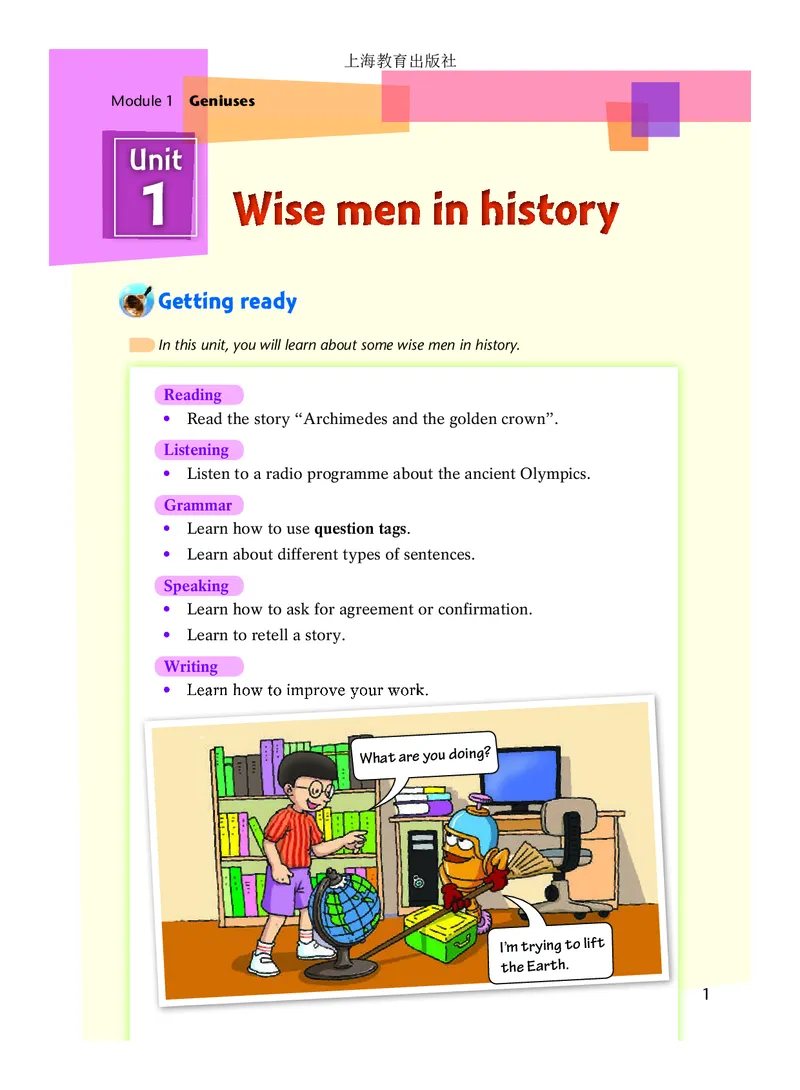
What are you doing?
I’m trying to lift
the Earth.
1上海教育出版社
Module 1
Reading
A What do you know about …?
A1 Try the short quiz below. Circle the correct answers.
1 Which of these ancient countries is in Europe?
a Greece. b Egypt.
2 Which of these people lived in ancient Greece?
a Archimedes. b Julius Caesar.
3 What was Archimedes?
a A scientist. b A painter.
4 Archimedes died in 212 BC. How long ago was that?
a About 1,800 years ago. b About 2,200 years ago.
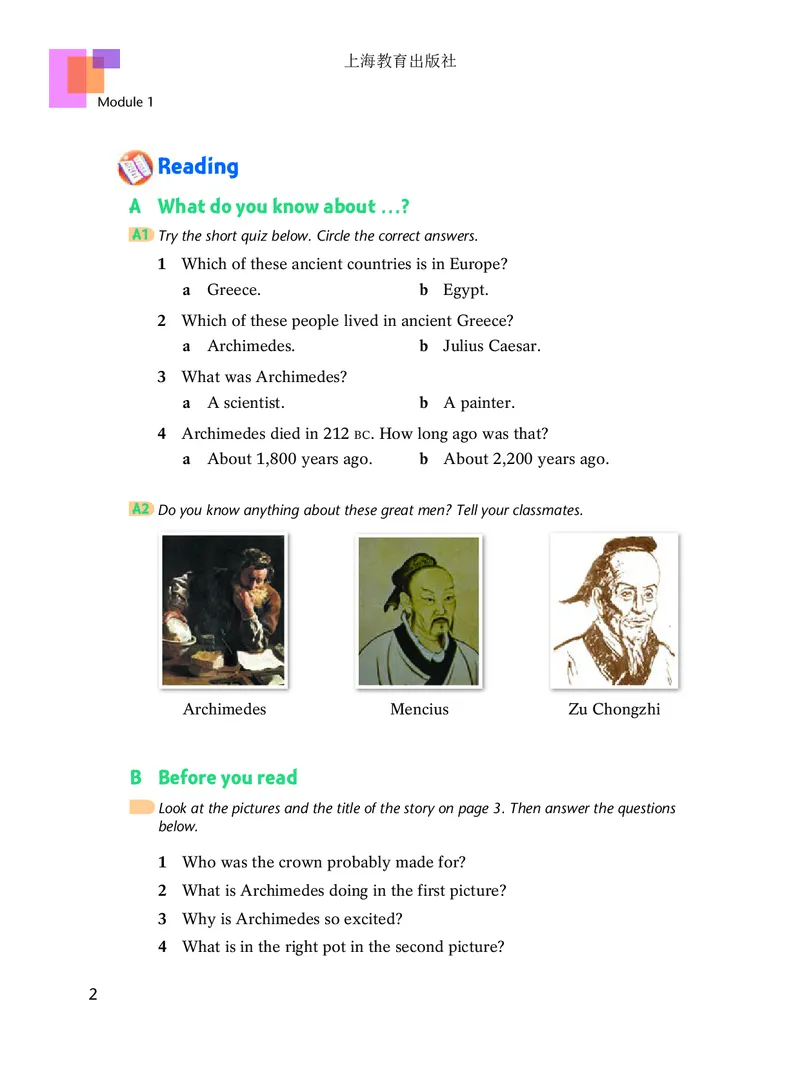
A2 Do you know anything about these great men? Tell your classmates.
Archimedes Mencius Zu Chongzhi
B Before you read
Look at the pictures and the title of the story on page 3. Then answer the questions
below.
1 Who was the crown probably made for?
2 What is Archimedes doing in the first picture?
3 Why is Archimedes so excited?
4 What is in the right pot in the second picture?
2上海教育出版社
Unit 1
Archimedes and the golden crown
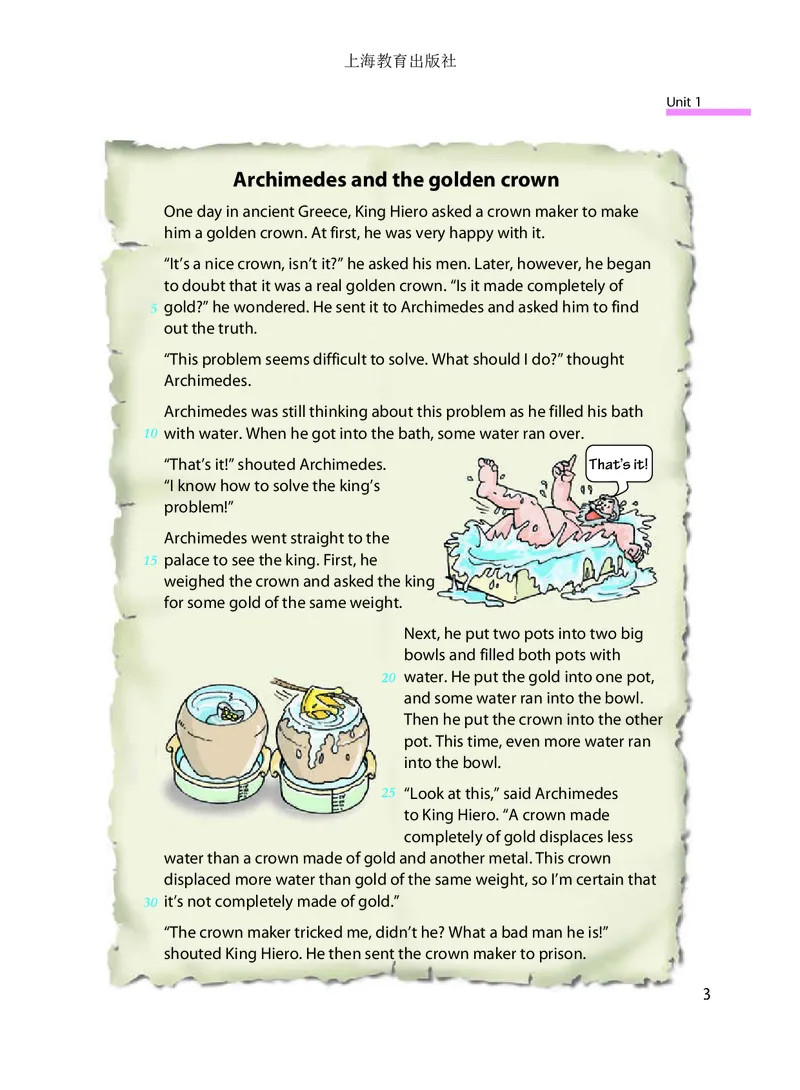
One day in ancient Greece, King Hiero asked a crown maker to make
him a golden crown. At first, he was very happy with it.
“It’s a nice crown, isn’t it?” he asked his men. Later, however, he began
to doubt that it was a real golden crown. “Is it made completely of
5 gold?” he wondered. He sent it to Archimedes and asked him to find
out the truth.
“This problem seems difficult to solve. What should I do?” thought
Archimedes.
Archimedes was still thinking about this problem as he filled his bath
10 with water. When he got into the bath, some water ran over.
“That’s it!” shouted Archimedes. That’s it!
“I know how to solve the king’s
problem!”
Archimedes went straight to the
15 palace to see the king. First, he
weighed the crown and asked the king
for some gold of the same weight.
Next, he put two pots into two big
bowls and filled both pots with
20 water. He put the gold into one pot,
and some water ran into the bowl.
Then he put the crown into the other
pot. This time, even more water ran
into the bowl.
25 “Look at this,” said Archimedes
to King Hiero. “A crown made
completely of gold displaces less
water than a crown made of gold and another metal. This crown
displaced more water than gold of the same weight, so I’m certain that
30 it’s not completely made of gold.”
“The crown maker tricked me, didn’t he? What a bad man he is!”
shouted King Hiero. He then sent the crown maker to prison.
333上海教育出版社
Module 1
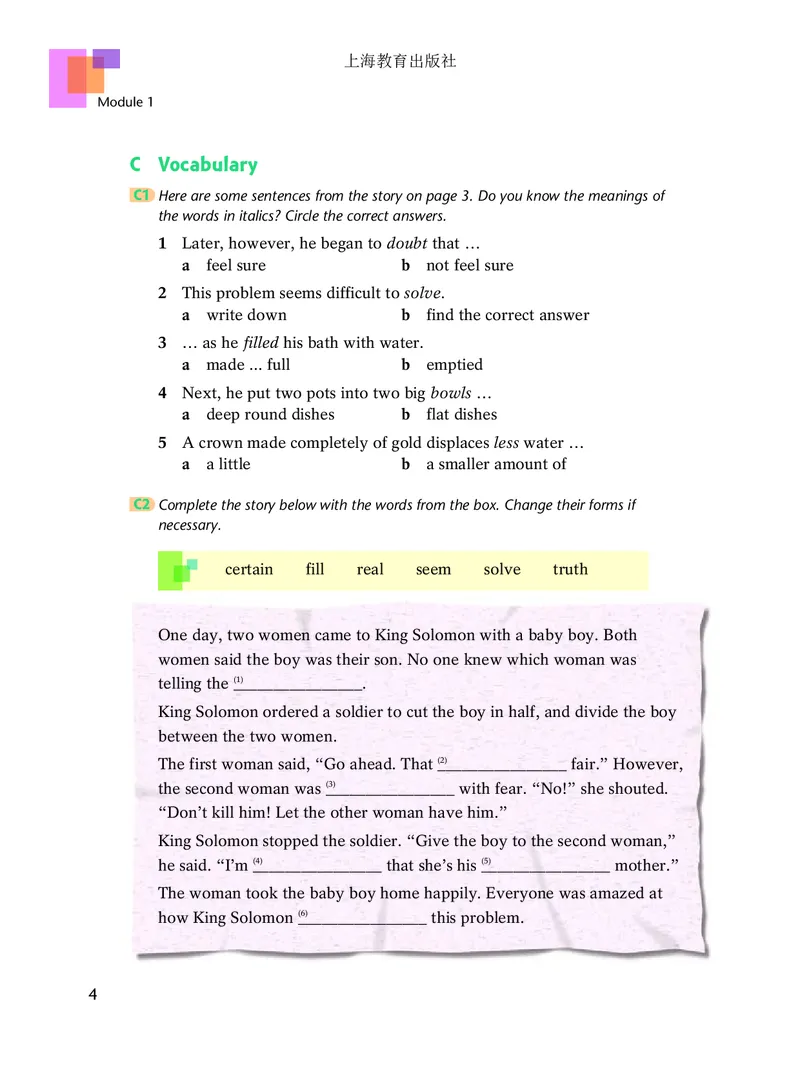
C Vocabulary
C1 Here are some sentences from the story on page 3. Do you know the meanings of
the words in italics? Circle the correct answers.
1 Later, however, he began to doubt that …
a feel sure b not feel sure
2 This problem seems difficult to solve.
a write down b find the correct answer
3 … as he filled his bath with water.
a made ... full b emptied
4 Next, he put two pots into two big bowls …
a deep round dishes b flat dishes
5 A crown made completely of gold displaces less water …
a a little b a smaller amount of
C2 Complete the story below with the words from the box. Change their forms if
necessary.
certain fill real seem solve truth
One day, two women came to King Solomon with a baby boy. Both
women said the boy was their son. No one knew which woman was
telling the (_1)_______________.
King Solomon ordered a soldier to cut the boy in half, and divide the boy
between the two women.
The first woman said, “Go ahead. That (_2)_______________ fair.” However,
the second woman was _(3)_______________ with fear. “No!” she shouted.
“Don’t kill him! Let the other woman have him.”
King Solomon stopped the soldier. “Give the boy to the second woman,”
he said. “I’m _(4)_______________ that she’s his (_5)_______________ mother.”
The woman took the baby boy home happily. Everyone was amazed at
how King Solomon _(6)_______________ this problem.
4上海教育出版社
Unit 1
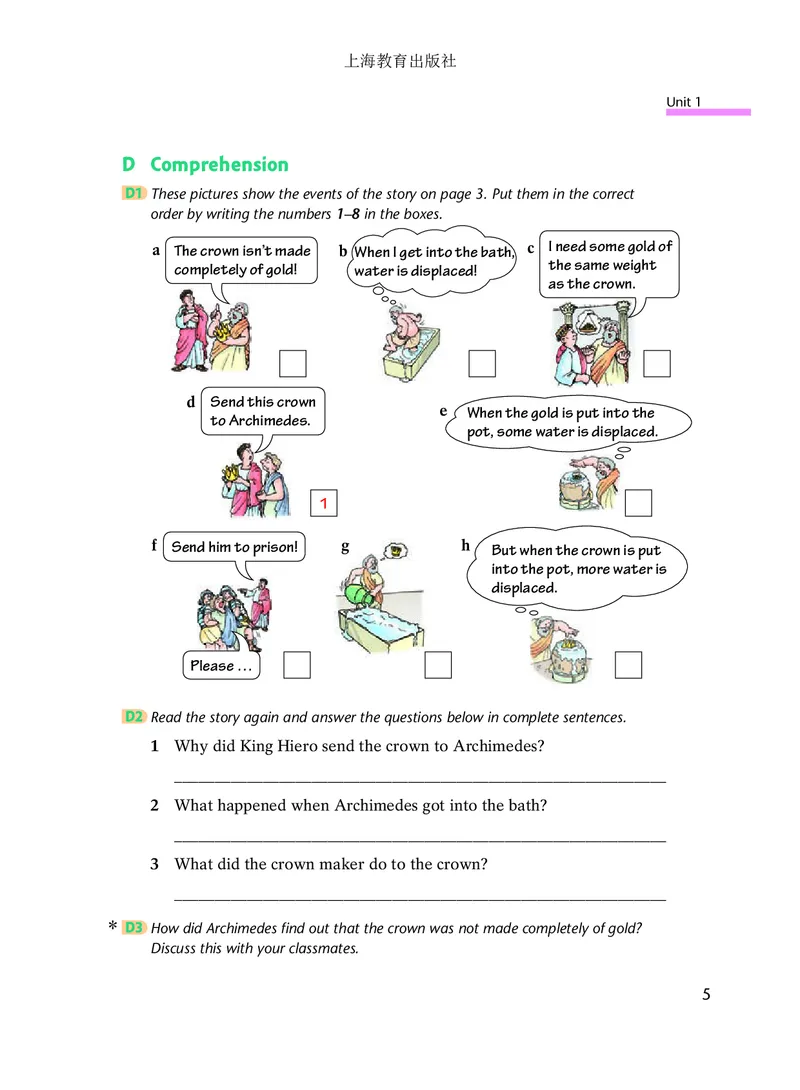
D Comprehension
D1 These pictures show the events of the story on page 3. Put them in the correct
order by writing the numbers 1–8 in the boxes.
a The crown isn’t made b When I get into the bath, c I need some gold of
the same weight
completely of gold! water is displaced!
as the crown.
d Send this crown
e When the gold is put into the
to Archimedes.
pot, some water is displaced.
1
f Send him to prison! g h But when the crown is put
certain fill real seem solve truth into the pot, more water is
displaced.
Please …
D2 Read the story again and answer the questions below in complete sentences.
1 Why did King Hiero send the crown to Archimedes?
_____________________________________________________________
2 What happened when Archimedes got into the bath?
_____________________________________________________________
3 What did the crown maker do to the crown?
_____________________________________________________________
(cid:43)
D3 How did Archimedes find out that the crown was not made completely of gold?
Discuss this with your classmates.
5上海教育出版社
Module 1
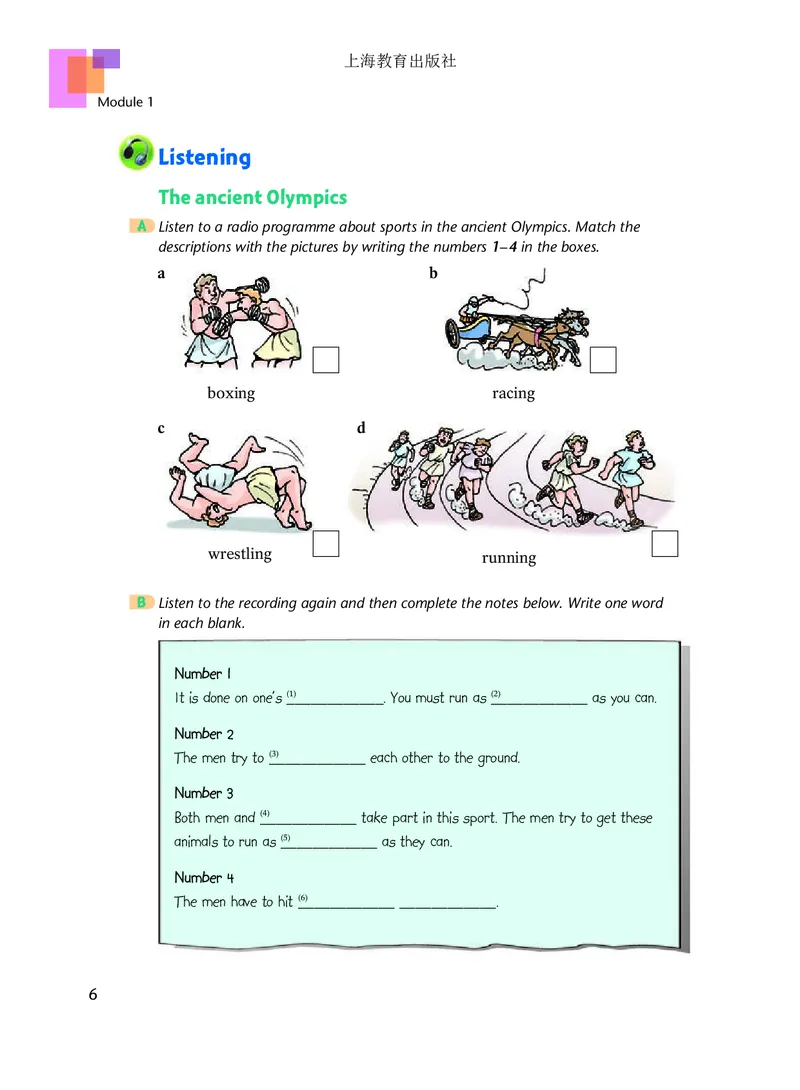
Listening
The ancient Olympics
A Listen to a radio programme about sports in the ancient Olympics. Match the
descriptions with the pictures by writing the numbers 1–4 in the boxes.
a b
boxing racing
c d
wrestling running
B Listen to the recording again and then complete the notes below. Write one word
in each blank.
(cid:69)(cid:108)(cid:100)(cid:89)(cid:92)(cid:105)(cid:23)1
It is done on one’s _(1)___________. (cid:80)ou must run as _(2)___________ as you can.
(cid:69)(cid:108)(cid:100)(cid:89)(cid:92)(cid:105)(cid:23)2
The men try to _(3)___________ each other to the ground.
(cid:69)(cid:108)(cid:100)(cid:89)(cid:92)(cid:105)(cid:23)(cid:42)
(cid:57)oth men and _(4)___________ take part in this sport. The men try to get these
animals to run as _(5)___________ as they can.
(cid:69)(cid:108)(cid:100)(cid:89)(cid:92)(cid:105)(cid:23)(cid:43)
The men have to hit _(6)___________ ____________.
6上海教育出版社
Unit 1
Grammar
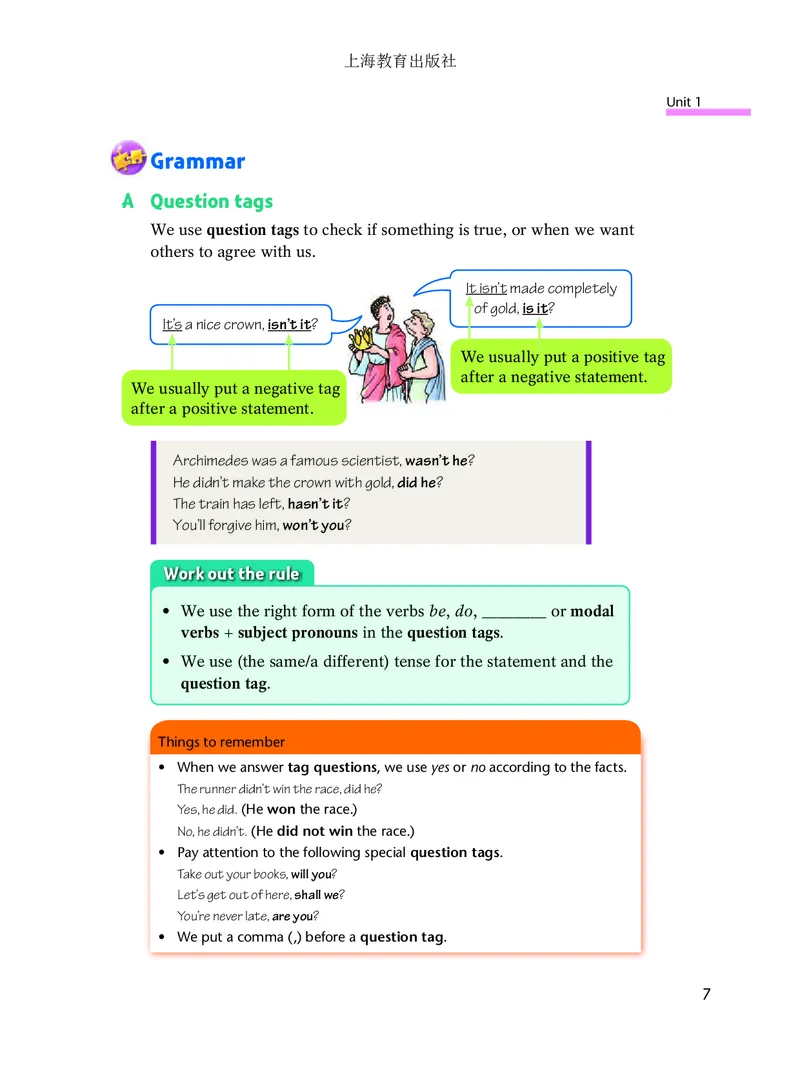
A Question tags
We use question tags to check if something is true, or when we want
others to agree with us.
It isn’t made completely
of gold, is it?
It’s a nice crown, isn’t it?
We usually put a positive tag
after a negative statement.
We usually put a negative tag
after a positive statement.
Archimedes was a famous scientist, wasn’t he?
He didn’t make the crown with gold, did he?
The train has left, hasn’t it?
You’ll forgive him, won’t you?
Work out the rule
• (cid:56)e use the ri(cid:72)ht form of the (cid:87)erbs be, do, ________ or modal
verbs + subject pronouns in the question tags.
• (cid:56)e use (cid:9)the same/a different(cid:10) tense for the statement and the
question tag.
Things to remember
• W(cid:73)en (cid:88)e ans(cid:88)e(cid:83) tag questions(cid:13) (cid:88)e use yes or no acco(cid:83)(cid:69)(cid:74)n(cid:72) to t(cid:73)e (cid:71)acts(cid:15)
The runner didn’t win the race, did he?
Yes, he did. (He won t(cid:73)e (cid:83)ace(cid:15)(cid:10)
No, he didn’t. (He did not win t(cid:73)e (cid:83)ace(cid:15)(cid:10)
• (cid:49)a(cid:90) attent(cid:74)on to t(cid:73)e (cid:71)ollo(cid:88)(cid:74)n(cid:72) s(cid:81)ec(cid:74)al question tags(cid:15)
Take out your books, will you?
Let’s get out of here, shall we?
You’re never late, are you?
• We (cid:81)ut a co(cid:78)(cid:78)a (cid:9)(cid:13)(cid:10) (cid:67)e(cid:71)o(cid:83)e a question tag(cid:15)
7上海教育出版社
Module 1
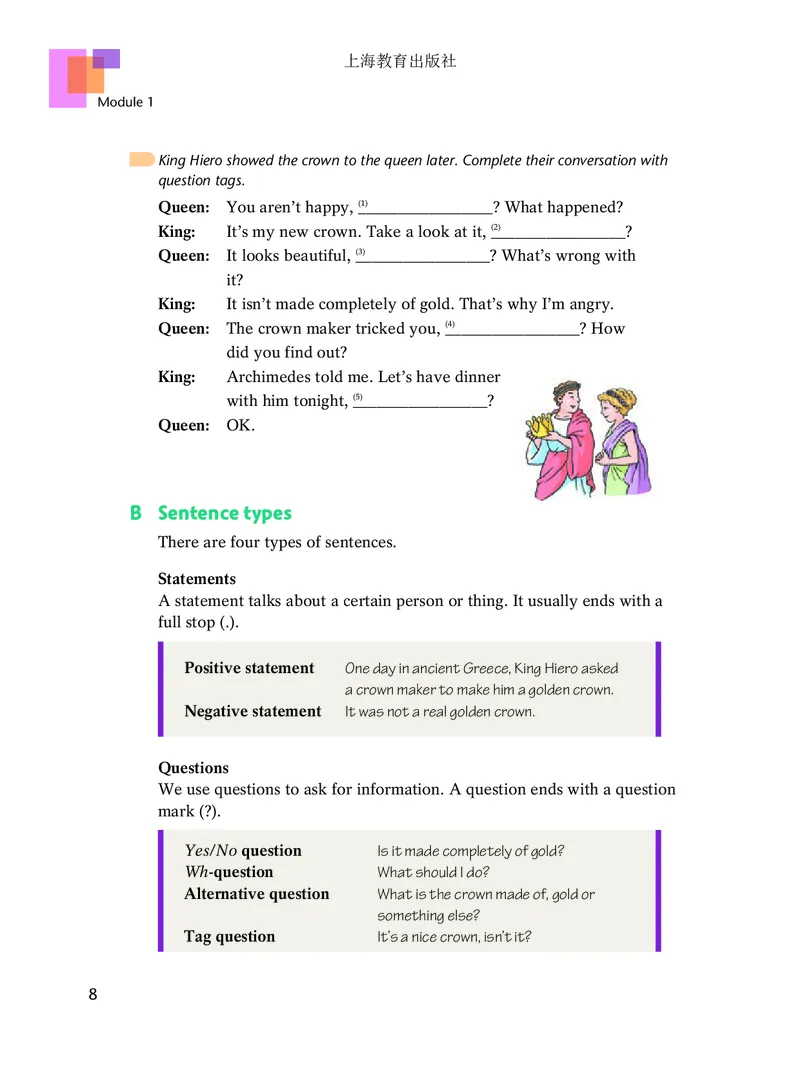
King Hiero showed the crown to the queen later. Complete their conversation with
question tags.
Queen: You aren’t happy, (_1)________________? What happened?
King: It’s my new crown. Take a look at it, (_2)________________?
Queen: It looks beautiful, _(3)________________? What’s wrong with
it?
King: It isn’t made completely of gold. That’s why I’m angry.
Queen: The crown maker tricked you, (_4)________________? How
did you find out?
King: Archimedes told me. Let’s have dinner
with him tonight, _(5)________________?
Queen: OK.
B Sentence types
There are four types of sentences.
Statements
A statement talks about a certain person or thing. It usually ends with a
full stop (.).
Positive statement One day in ancient Greece, King Hiero asked
a crown maker to make him a golden crown.
Negative statement It was not a real golden crown.
Questions
We use questions to ask for information. A question ends with a question
mark (?).
Yes/No question Is it made completely of gold?
Wh-question What should I do?
Alternative question What is the crown made of, gold or
something else?
Tag question It’s a nice crown, isn’t it?
8上海教育出版社
Unit 1
Imperatives
When we want to give commands or make requests or suggestions, we
use the imperative. An imperative sentence ends with a full stop (.) or an
exclamation mark (!).
Look at this. Keep quiet!
Please give me some gold of the same weight. Watch out!
Exclamations
When we want to express strong feelings, we use exclamations. An
exclamation usually ends with an exclamation mark (!).
How excited Archimedes was!
What a bad man the crown maker is!
B1 Add a full stop (.), a question mark (?) or an exclamation mark (!) to the end of the
following sentences.
1 How can I find out___ 5 Please close the window___
2 The crown is nice___ 6 What a nice crown___
3 How wonderful___ 7 This is difficult, isn’t it___
4 The king was not happy___ 8 Leave me alone___
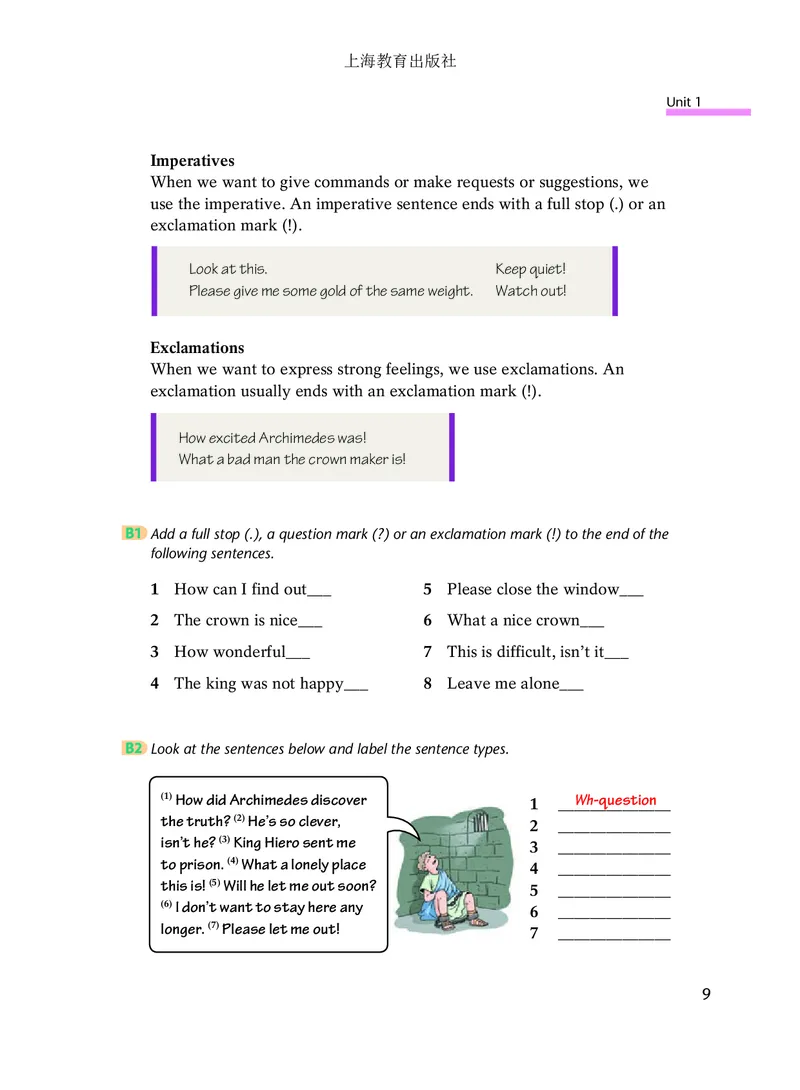
B2 Look at the sentences below and label the sentence types.
(1) How did Archimedes discover 1 __W__h_-_q_u_es_t_i_o_n__
the truth? (2) He’s so clever, 2 ______________
isn’t he? (3) King Hiero sent me 3 ______________
to prison. (4) What a lonely place 4 ______________
this is! (5) Will he let me out soon? 5 ______________
(6) I don’t want to stay here any 6 ______________
longer. (7) Please let me out! 7 ______________
9上海教育出版社
Module 1
Speaking
A Talk time
Asking for agreement or confirmation
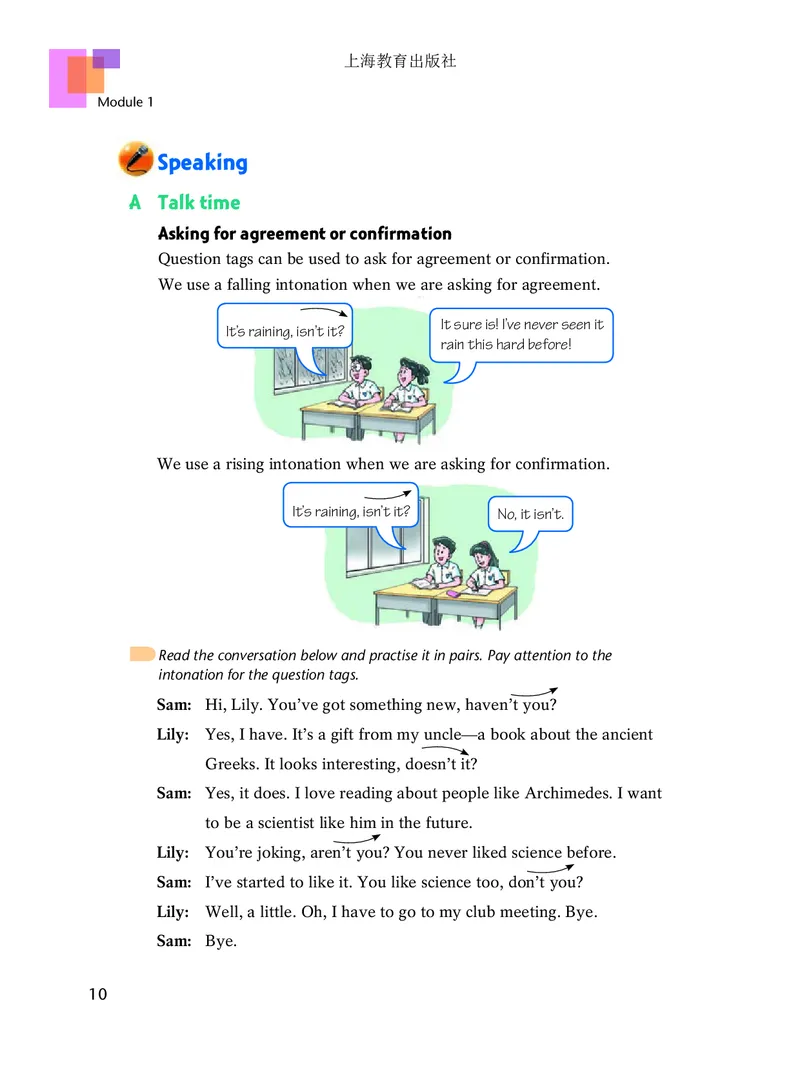
Question tags can be used to ask for agreement or confirmation.
We use a falling intonation when we are asking for agreement.
It sure is! I’ve never seen it
It’s raining, isn’t it?
rain this hard before!
We use a rising intonation when we are asking for confirmation.
It’s raining, isn’t it? No, it isn’t.
Read the conversation below and practise it in pairs. Pay attention to the
intonation for the question tags.
Sam: Hi, Lily. You’ve got something new, haven’t you?
Lily: Yes, I have. It’s a gift from my uncle—a book about the ancient
Greeks. It looks interesting, doesn’t it?
Sam: Yes, it does. I love reading about people like Archimedes. I want
to be a scientist like him in the future.
Lily: You’re joking, aren’t you? You never liked science before.
Sam: I’ve started to like it. You like science too, don’t you?
Lily: Well, a little. Oh, I have to go to my club meeting. Bye.
Sam: Bye.
10上海教育出版社
Unit 1
B Speak up
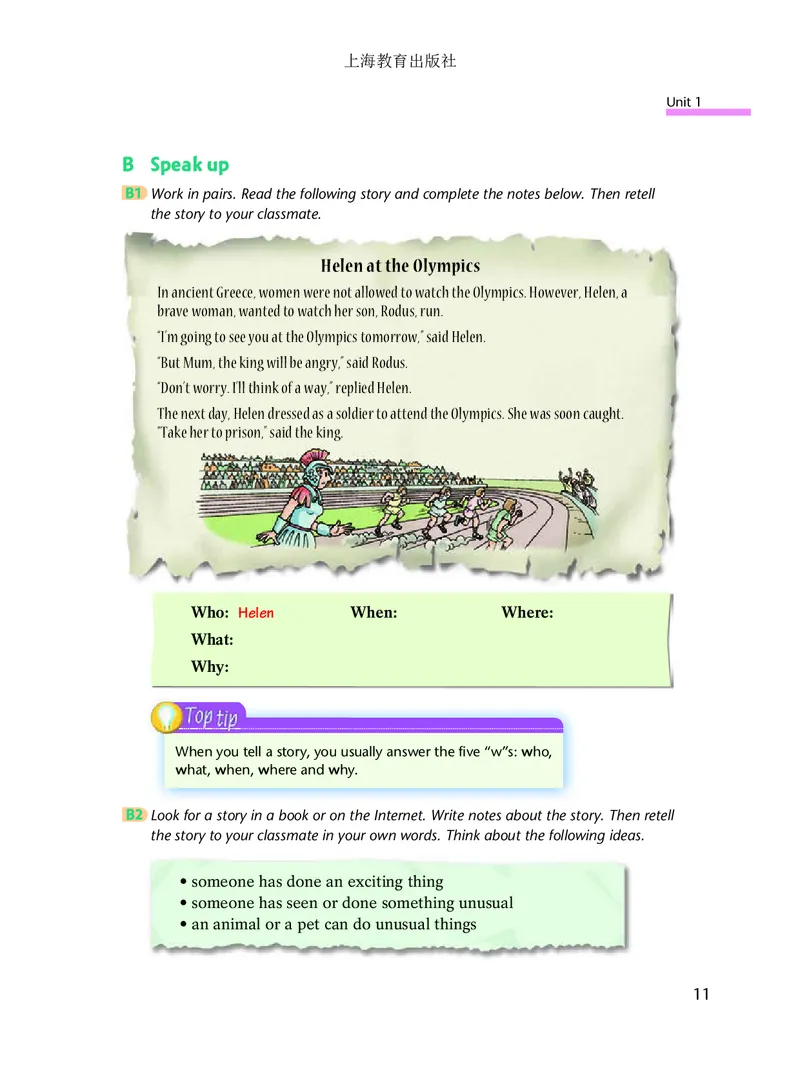
B1 Work in pairs. Read the following story and complete the notes below. Then retell
the story to your classmate.
Helen at the Olympics
In ancient Greece, women were not allowed to watch the Olympics. However, Helen, a
brave woman, wanted to watch her son, Rodus, run.
“I’m going to see you at the Olympics tomorrow,” said Helen.
“But Mum, the king will be angry,” said Rodus.
“Don’t worry. I’ll think of a way,” replied Helen.
The next day, Helen dressed as a soldier to attend the Olympics. She was soon caught.
“Take her to prison,” said the king.
Who: Helen When: Where:
What:
Why:
W(cid:73)en (cid:90)ou tell a sto(cid:83)(cid:90)(cid:13) (cid:90)ou usuall(cid:90) ans(cid:88)e(cid:83) t(cid:73)e (cid:71)(cid:74)ve (cid:105)(cid:88)(cid:119)s(cid:27) who,
w(cid:73)at(cid:13) when, w(cid:73)e(cid:83)e an(cid:69) w(cid:73)(cid:90)(cid:15)
B2 Look for a story in a book or on the Internet. Write notes about the story. Then retell
the story to your classmate in your own words. Think about the following ideas.
• someone has done an e(cid:89)citin(cid:72) thin(cid:72)
• someone has seen or done somethin(cid:72) unusual
• an animal or a pet can do unusual thin(cid:72)s
11上海教育出版社
Module 1
Writing
Improving your work
When you have written something, you should check your work to make
sure the spelling, grammar and punctuation are all correct.
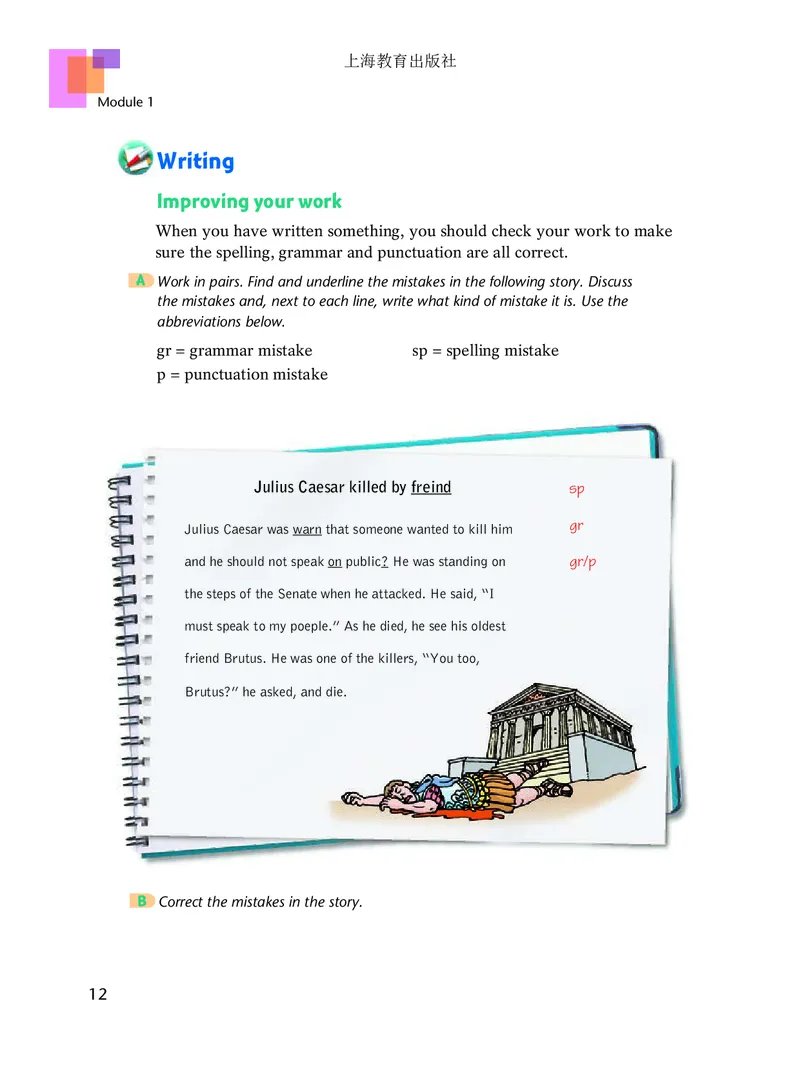
A Work in pairs. Find and underline the mistakes in the following story. Discuss
the mistakes and, next to each line, write what kind of mistake it is. Use the
abbreviations below.
gr = grammar mistake sp = spelling mistake
p = punctuation mistake
Julius Caesar killed by freind sp
gr
Julius Caesar was warn that someone wanted to kill him
and he should not speak on public? He was standing on gr/p
the steps of the Senate when he attacked. He said, “I
must speak to my poeple.” As he died, he see his oldest
friend Brutus. He was one of the killers, “You too,
Brutus?” he asked, and die.
B Correct the mistakes in the story.
12上海教育出版社
Unit 1
(cid:43)
More practice
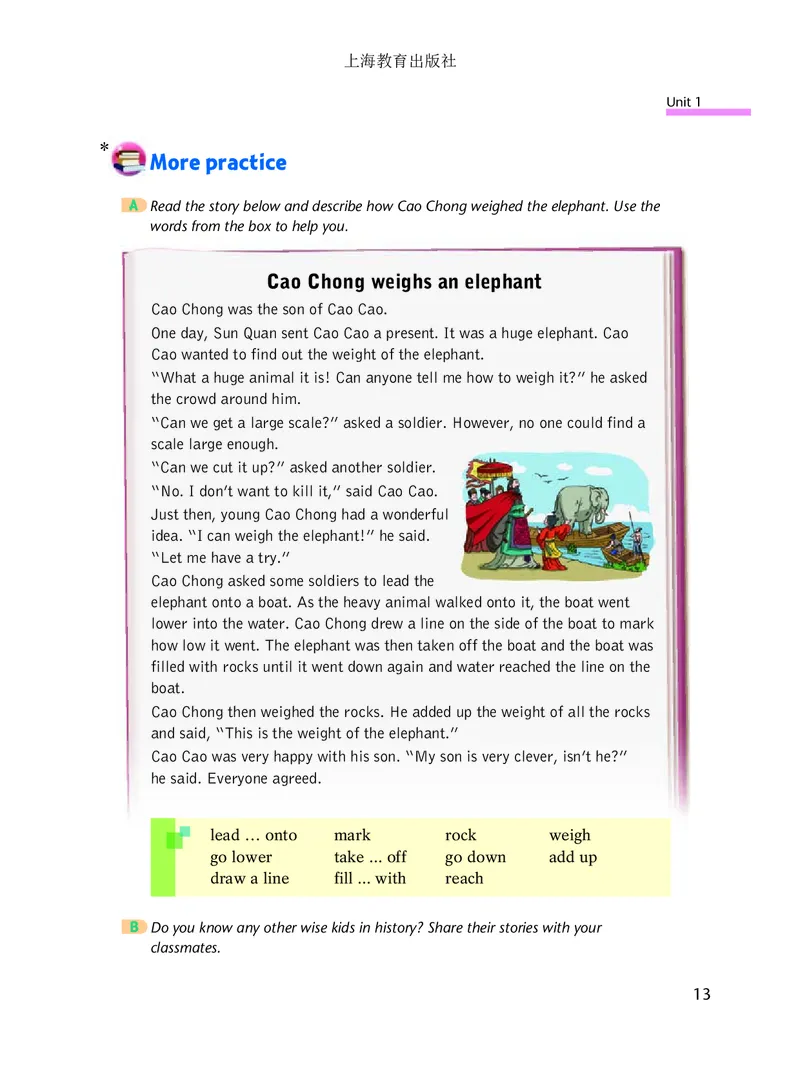
A Read the story below and describe how Cao Chong weighed the elephant. Use the
words from the box to help you.
Cao Chong weighs an elephant
Cao Chong was the son of Cao Cao.
One day, Sun Quan sent Cao Cao a present. It was a huge elephant. Cao
Cao wanted to find out the weight of the elephant.
“What a huge animal it is! Can anyone tell me how to weigh it?” he asked
the crowd around him.
“Can we get a large scale?” asked a soldier. However, no one could find a
scale large enough.
“Can we cut it up?” asked another soldier.
“No. I don’t want to kill it,” said Cao Cao.
Just then, young Cao Chong had a wonderful
idea. “I can weigh the elephant!” he said.
“Let me have a try.”
Cao Chong asked some soldiers to lead the
elephant onto a boat. As the heavy animal walked onto it, the boat went
lower into the water. Cao Chong drew a line on the side of the boat to mark
how low it went. The elephant was then taken off the boat and the boat was
filled with rocks until it went down again and water reached the line on the
boat.
Cao Chong then weighed the rocks. He added up the weight of all the rocks
and said, “This is the weight of the elephant.”
Cao Cao was very happy with his son. “My son is very clever, isn’t he?”
he said. Everyone agreed.
lead … onto mark rock weigh
go lower take ... off go down add up
draw a line fill ... with reach
B Do you know any other wise kids in history? Share their stories with your
classmates.
13上海教育出版社
Module 1
Study skills
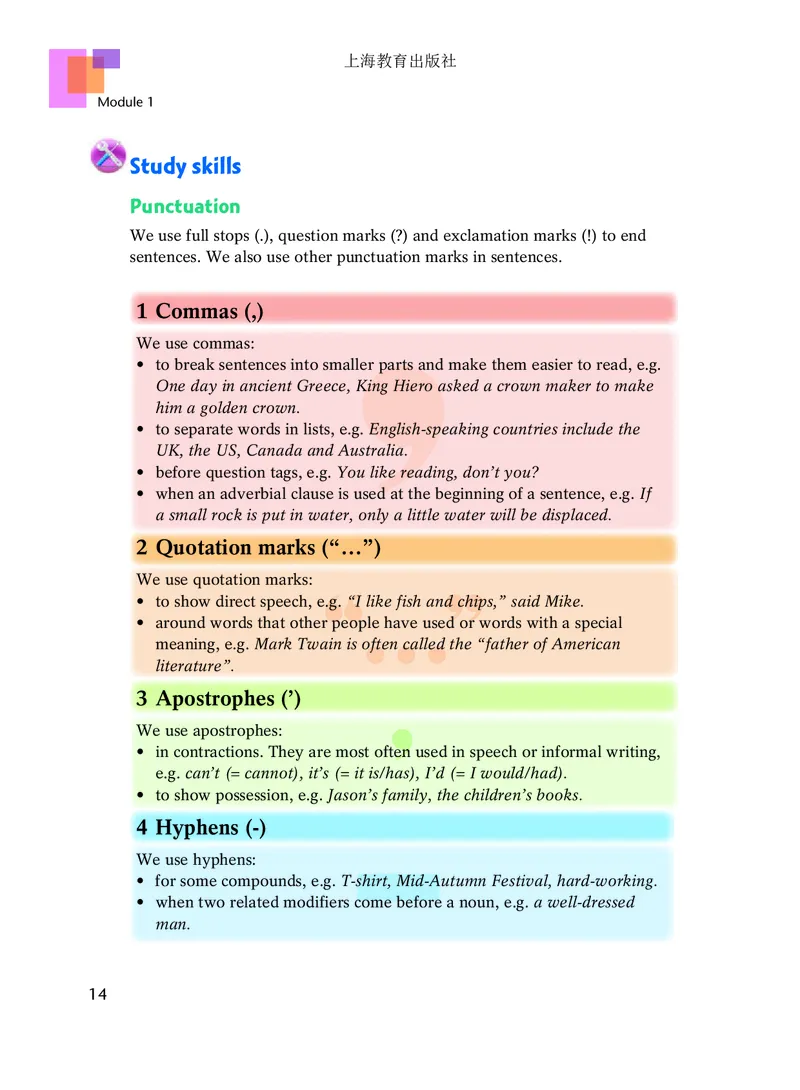
Punctuation
We use full stops (.), question marks (?) and exclamation marks (!) to end
sentences. We also use other punctuation marks in sentences.
1 Commas (,)
We use commas:
• to brea(cid:76) sentences into smaller parts and ma(cid:76)e them easier to read(cid:13) e.(cid:72).
One day in ancient Greece, King Hiero asked a crown maker to make
him a golden crown.
• to separate words in lists(cid:13) e.(cid:72). English-speaking countries include the
UK, the US, Canada and Australia.
• before (cid:82)uestion ta(cid:72)s(cid:13) e.(cid:72). You like reading, don’t you?
• when an ad(cid:87)erbial clause is used at the be(cid:72)innin(cid:72) of a sentence(cid:13) e.(cid:72). If
a small rock is put in water, only a little water will be displaced.
2 Quotation marks (“…”)
We use quotation marks:
• to show direct speech(cid:13) e.(cid:72). “I like fish and chips,” said Mike.
• around words that other people ha(cid:87)e used or words with a special
meaning, e.g. Mark Twain is often called the “father of American
literature”.
3 Apostrophes (’)
We use apostrophes:
•• iinn ccoonnttrraaccttiioonnss.. TThheeyy aarree mmoosstt oofftteenn uusseedd iinn ssppeeeecchh oorr iinnffoorrmmaall wwrriittiinn(cid:72)(cid:72)(cid:13)(cid:13)
e.g. can’t (= cannot), it’s (= it is/has), I’d (= I would/had).
• to show possession(cid:13) e.(cid:72). Jason’s family, the children’s books.
4 Hyphens (-)
We use hyphens:
• for some compounds(cid:13) e.(cid:72). T-shirt, Mid-Autumn Festival, hard-working.
• when two related modifiers come before a noun(cid:13) e.(cid:72). a well-dressed
man.
14上海教育出版社
Unit 1
5 Colons (:)
We use a colon to introduce a list, e.g. We need seven people: three
students, three engineers and one expert.
A Add punctuation marks to the following sentences.
1 You like Chinese food don t you asked Mary
2 Since she s your little sister please take care of her
3 I ve passed these subjects Chinese Maths English History and Music
4 This is a well run hotel
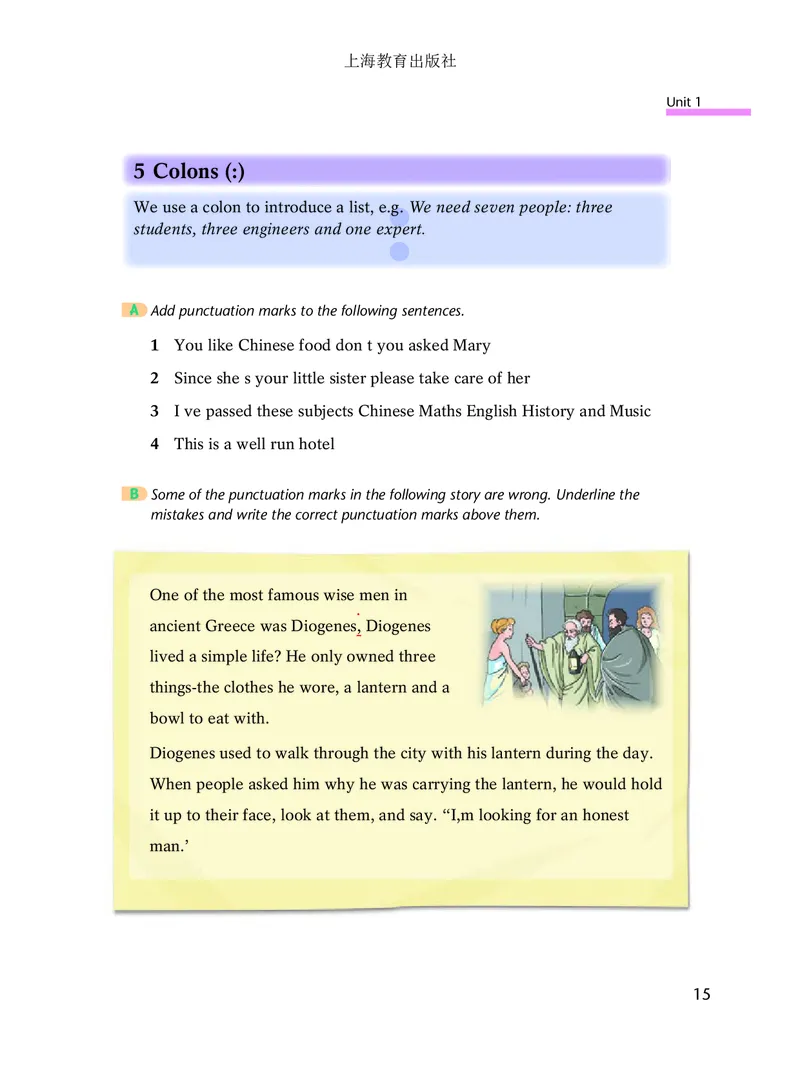
B Some of the punctuation marks in the following story are wrong. Underline the
mistakes and write the correct punctuation marks above them.
One of the most famous wise men in
.
ancient Greece was Diogenes, Diogenes
lived a simple life? He only owned three
things-the clothes he wore, a lantern and a
bowl to eat with.
Diogenes used to walk through the city with his lantern during the day.
When people asked him why he was carrying the lantern, he would hold
it up to their face, look at them, and say. “I,m looking for an honest
man.’
15上海教育出版社
Module 1
Culture corner
Laozi
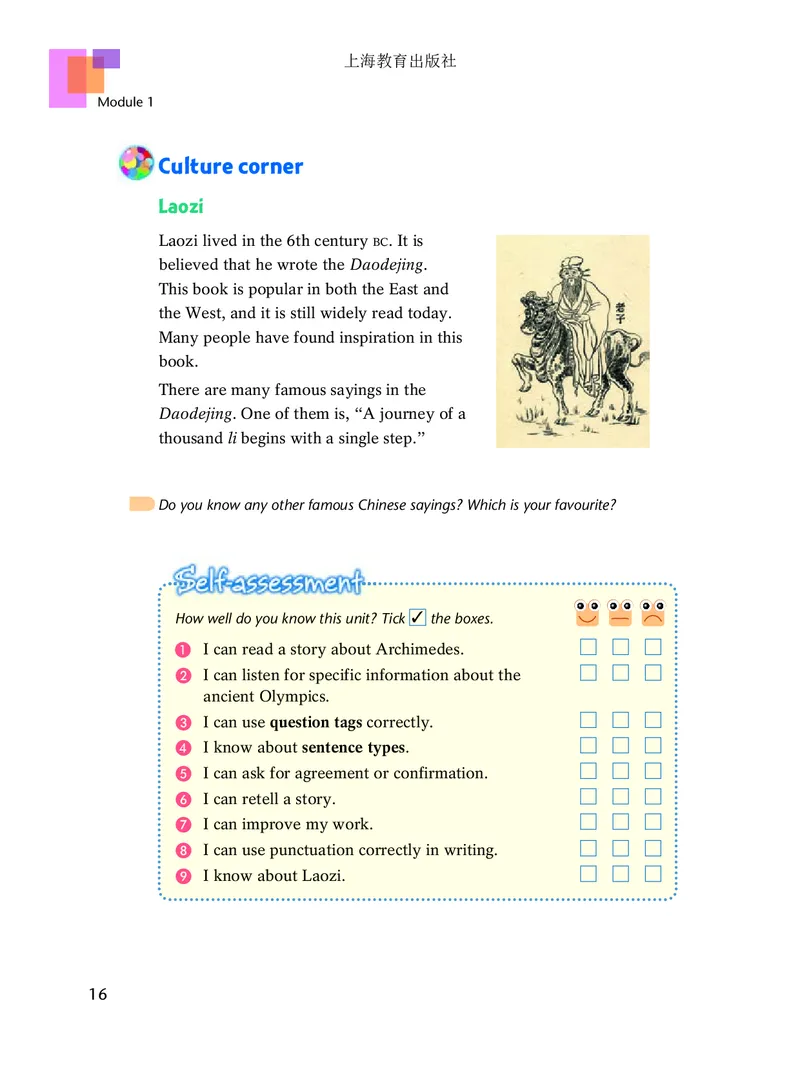
Laozi lived in the 6th century BC. It is
believed that he wrote the Daodejing.
This book is popular in both the East and
the West, and it is still widely read today.
Many people have found inspiration in this
book.
There are many famous sayings in the
Daodejing. One of them is, “A journey of a
thousand li begins with a single step.”
Do you know any other famous Chinese sayings? Which is your favourite?
How well do you know this unit? Tick ✓ the boxes.
❶ I can read a story about Archimedes.
❷ I can listen for specific information about the
ancient Olympics.
❸ I can use question tags correctly.
❹ I know about sentence types.
❺ I can ask for agreement or confirmation.
❻ I can retell a story.
❼ I can improve my work.
❽ I can use punctuation correctly in writing.
I know about Laozi.
16上海教育出版社
Module 1 Geniuses
Unit
2
GGGrrreeeaaattt mmmiiinnndddsss
Getting ready
In this unit, you will learn about great minds such as Albert Einstein.
Reading
• Read a short story about Einstein and his driver.
Listening
• Listen to a radio programme about some great minds.
Grammar
• Learn how to use infinitives after nouns, as subjects and after
the verb to be.
Speaking
• Learn to leave and take phone messages.
• Tell a story about a famous person.
Writing
• WWrriittee aa sshhoorrtt ssttoorryy aabboouutt aa ffaammoouuss aassttrroonnoommeerr..
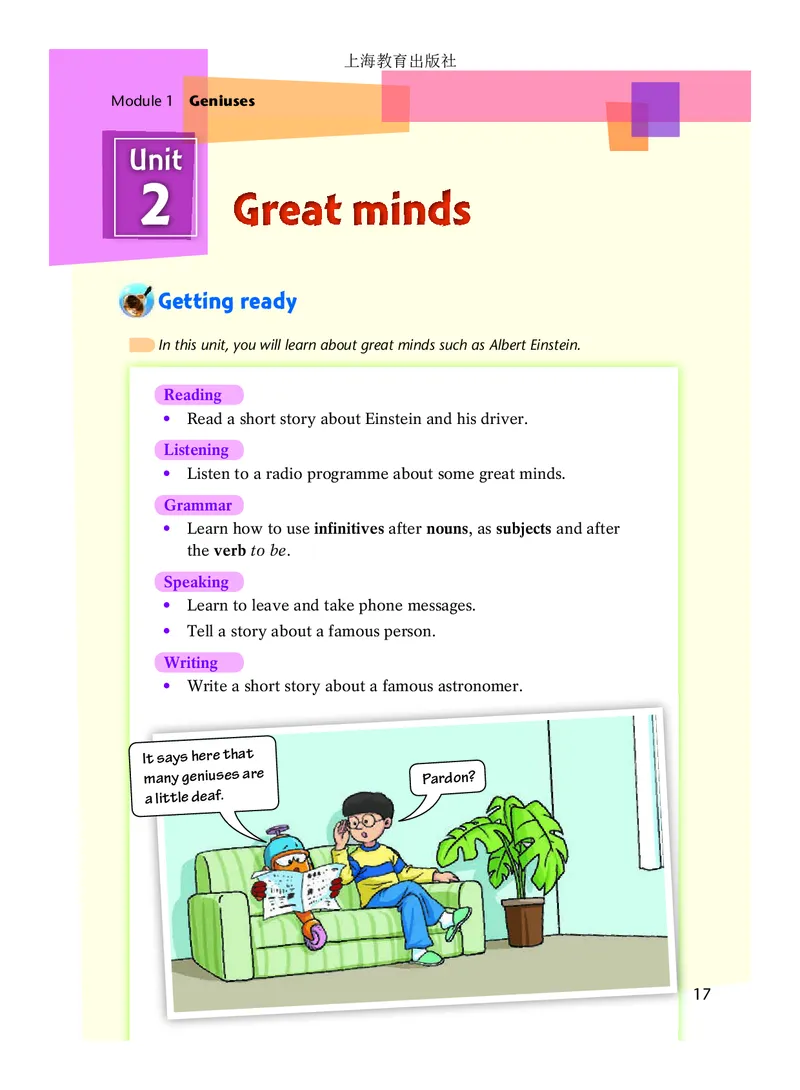
It says here that
many geniuses are Pardon?
a little deaf.
17上海教育出版社
Module 1
Reading
A What do you know about …?
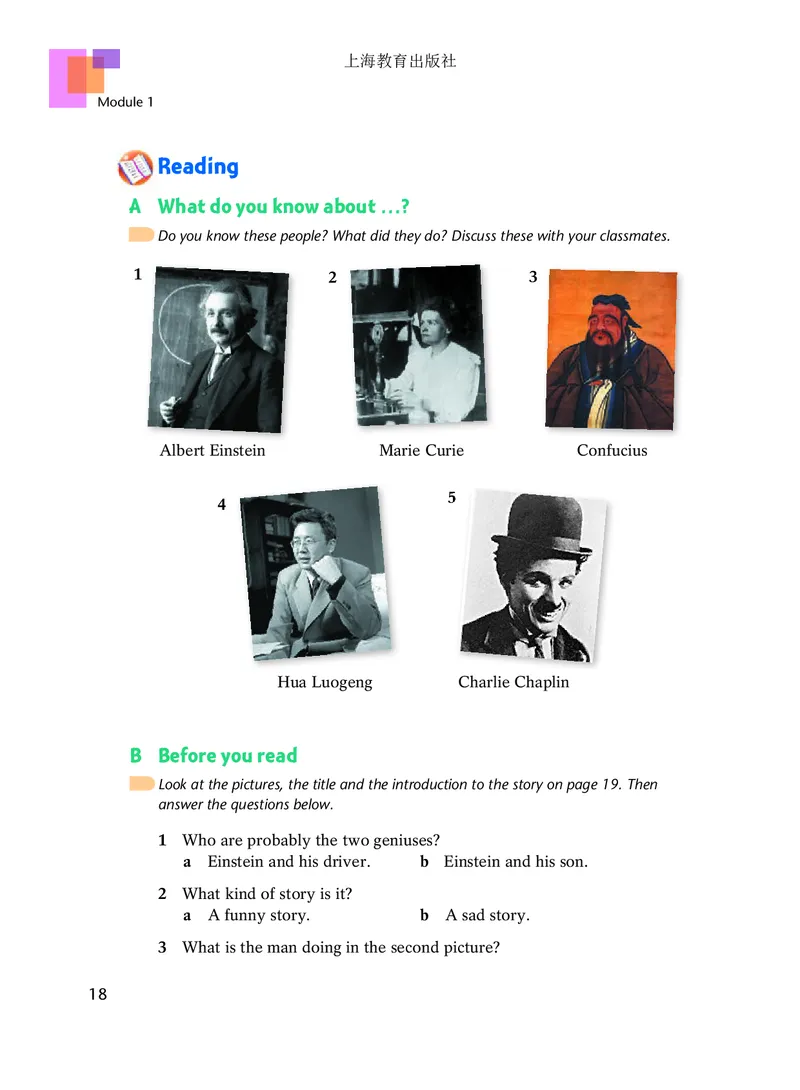
Do you know these people? What did they do? Discuss these with your classmates.
1 2 3
Albert Einstein Marie Curie Confucius
55
4
Hua Luogeng Charlie Chaplin
B Before you read
Look at the pictures, the title and the introduction to the story on page 19. Then
answer the questions below.
1 Who are probably the two geniuses?
a Einstein and his driver. b Einstein and his son.
2 What kind of story is it?
a A funny story. b A sad story.
3 What is the man doing in the second picture?
18上海教育出版社
Unit 2
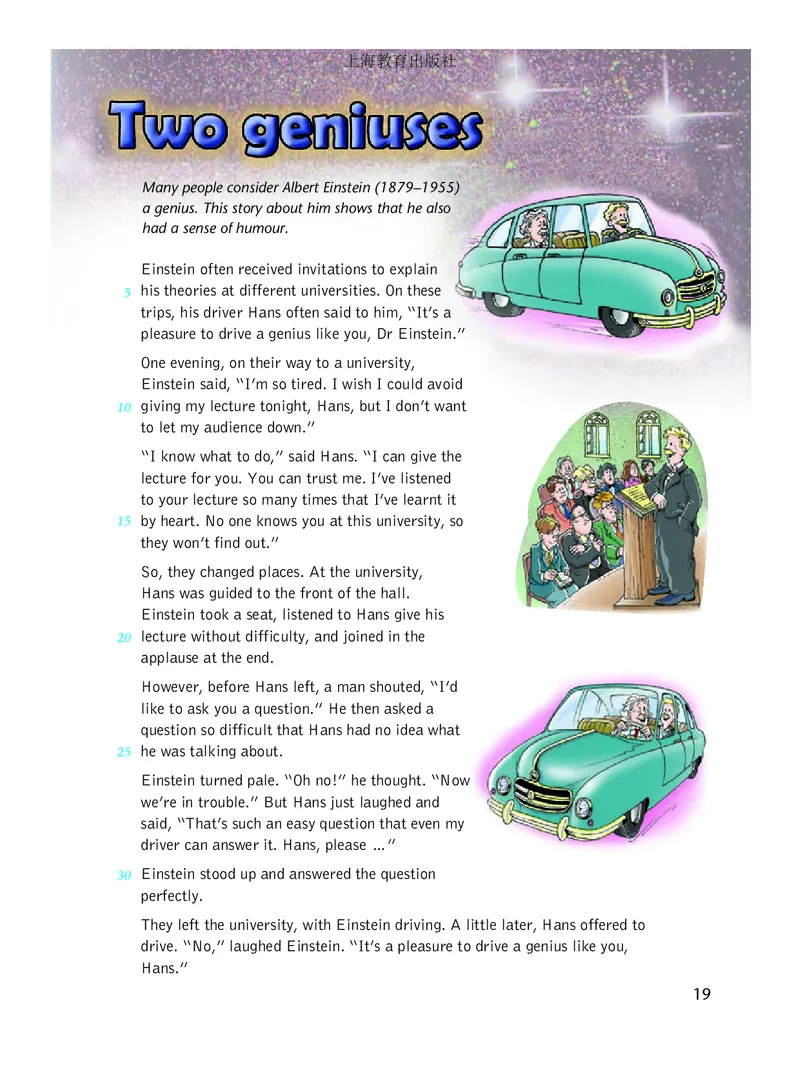
Many people consider Albert Einstein (1879–1955)
a genius. This story about him shows that he also
had a sense of humour.
Einstein often received invitations to explain
5 his theories at different universities. On these
trips, his driver Hans often said to him, “It’s a
pleasure to drive a genius like you, Dr Einstein.”
One evening, on their way to a university,
Einstein said, “I’m so tired. I wish I could avoid
10 giving my lecture tonight, Hans, but I don’t want
to let my audience down.”
“I know what to do,” said Hans. “I can give the
lecture for you. You can trust me. I’ve listened
to your lecture so many times that I’ve learnt it
15 by heart. No one knows you at this university, so
they won’t find out.”
So, they changed places. At the university,
Hans was guided to the front of the hall.
Einstein took a seat, listened to Hans give his
20 lecture without difficulty, and joined in the
applause at the end.
However, before Hans left, a man shouted, “I’d
like to ask you a question.” He then asked a
question so difficult that Hans had no idea what
25 he was talking about.
Einstein turned pale. “Oh no!” he thought. “Now
we’re in trouble.” But Hans just laughed and
said, “That’s such an easy question that even my
driver can answer it. Hans, please …”
30 Einstein stood up and answered the question
perfectly.
They left the university, with Einstein driving. A little later, Hans offered to
drive. “No,” laughed Einstein. “It’s a pleasure to drive a genius like you,
Hans.”
19上海教育出版社
Module 1
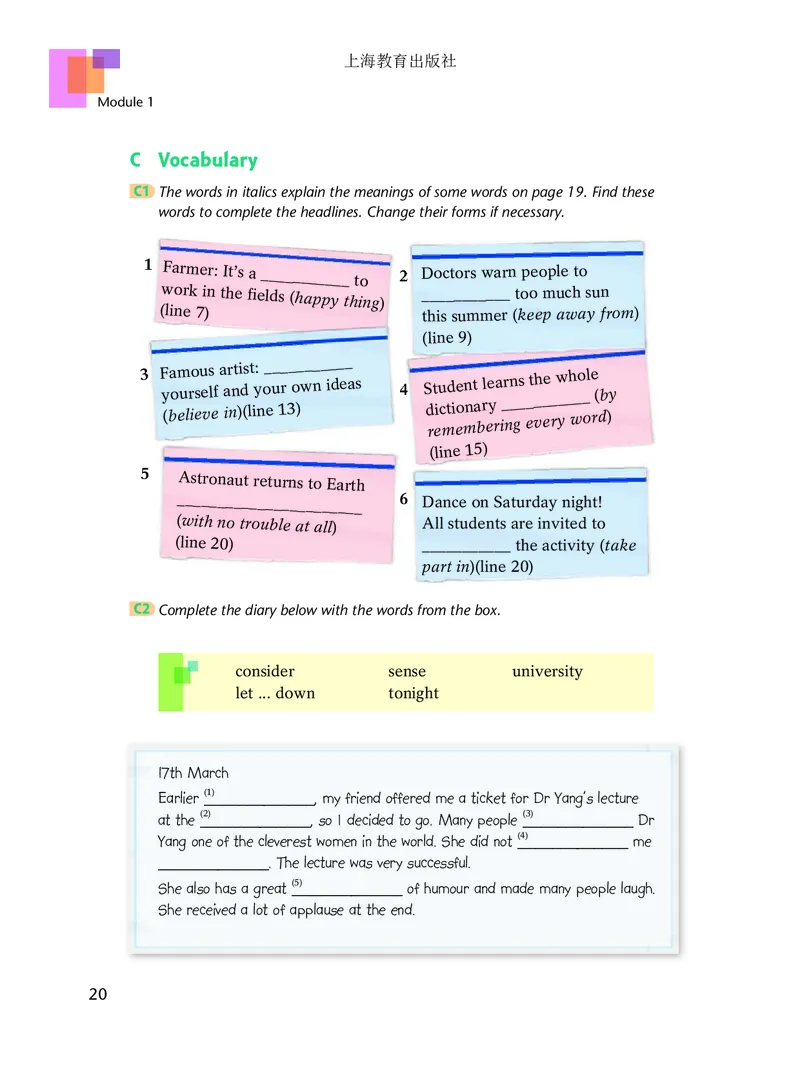
C Vocabulary
C1 The words in italics explain the meanings of some words on page 19. Find these
words to complete the headlines. Change their forms if necessary.
1 Farmer: It’s a ___________ to 22 Doctors warn people to
work in the fields (happy thing) ___________ too much sun
(line 7) this summer (keep away from)
(line 9)
33 F y (b a o e m u l r i o e s u e v s l e f a a i r n n t ) i d ( s l t i y : n o _ e u _ 1 _ r 3 _ o ) _ w __ n _ i _ d _ e _ a s 444 S d r t e i u c m t d i e e o m n n t a b r l e e y r a i _ r n n _ g _ s _ e t _ v h _ e e _ r w y __ h w _ o _ o l e r ( d b ) y
(line 15)
5 Astronaut returns to Earth
_______________________ 6 Dance on Saturday night!
(with no trouble at all) All students are invited to
(line 20) ___________ the activity (take
part in)(line 20)
C2 Complete the diary below with the words from the box.
consider sense university
let ... down tonight
(cid:40)(cid:46)th March
(cid:60)arlier (_1)____________(cid:35) my frien(cid:91) offere(cid:91) me a ticket for (cid:59)r (cid:80)an(cid:94)(cid:203)s lecture
at the _(2)____________(cid:35) so I (cid:91)eci(cid:91)e(cid:91) to (cid:94)o(cid:37) Many (cid:103)eo(cid:103)le (_3)____________ (cid:59)r
(cid:80)an(cid:94) one of the cleverest women in the worl(cid:91)(cid:37) She (cid:91)i(cid:91) not (_4)____________ me
_____________(cid:37) The lecture was very successful(cid:37)
She also has a (cid:94)reat _(5)____________ of humour an(cid:91) ma(cid:91)e many (cid:103)eo(cid:103)le lau(cid:94)h(cid:37)
She receive(cid:91) a lot of a(cid:103)(cid:103)lause at the en(cid:91)(cid:37)
20上海教育出版社
Unit 2
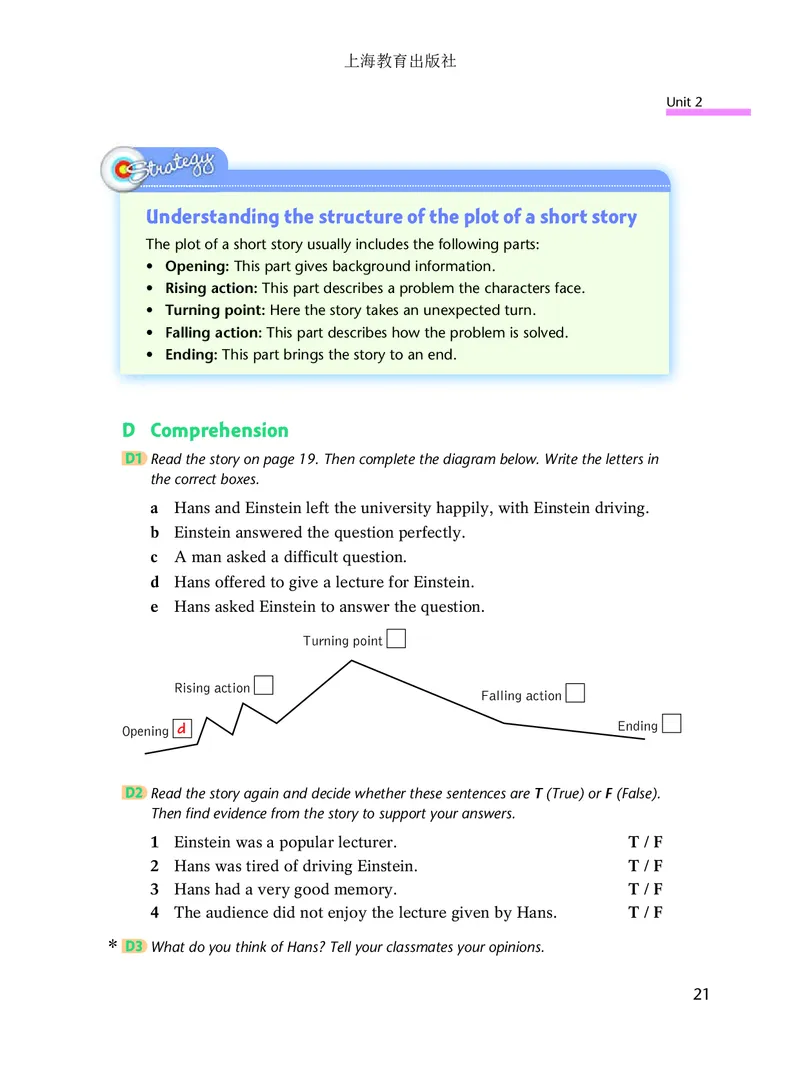
Understanding the structure of the plot of a short story
The plot of a short story usually includes the following parts:
• Opening: This part gives background information.
• Rising action: This part describes a problem the characters face.
• Turning point: Here the story takes an unexpected turn.
• Falling action: This part describes how the problem is solved.
• Ending: This part brings the story to an end.
D Comprehension
D1 Read the story on page 19. Then complete the diagram below. Write the letters in
the correct boxes.
a Hans and Einstein left the university happily, with Einstein driving.
b Einstein answered the question perfectly.
c A man asked a difficult question.
d Hans offered to give a lecture for Einstein.
e Hans asked Einstein to answer the question.
Turning point
Rising action
Falling action
Opening d Ending
D2 Read the story again and decide whether these sentences are T (True) or F (False).
Then find evidence from the story to support your answers.
1 Einstein was a popular lecturer. T / F
2 Hans was tired of driving Einstein. T / F
3 Hans had a very good memory. T / F
4 The audience did not enjoy the lecture given by Hans. T / F
(cid:43)
D3 What do you think of Hans? Tell your classmates your opinions.
21上海教育出版社
Module 1
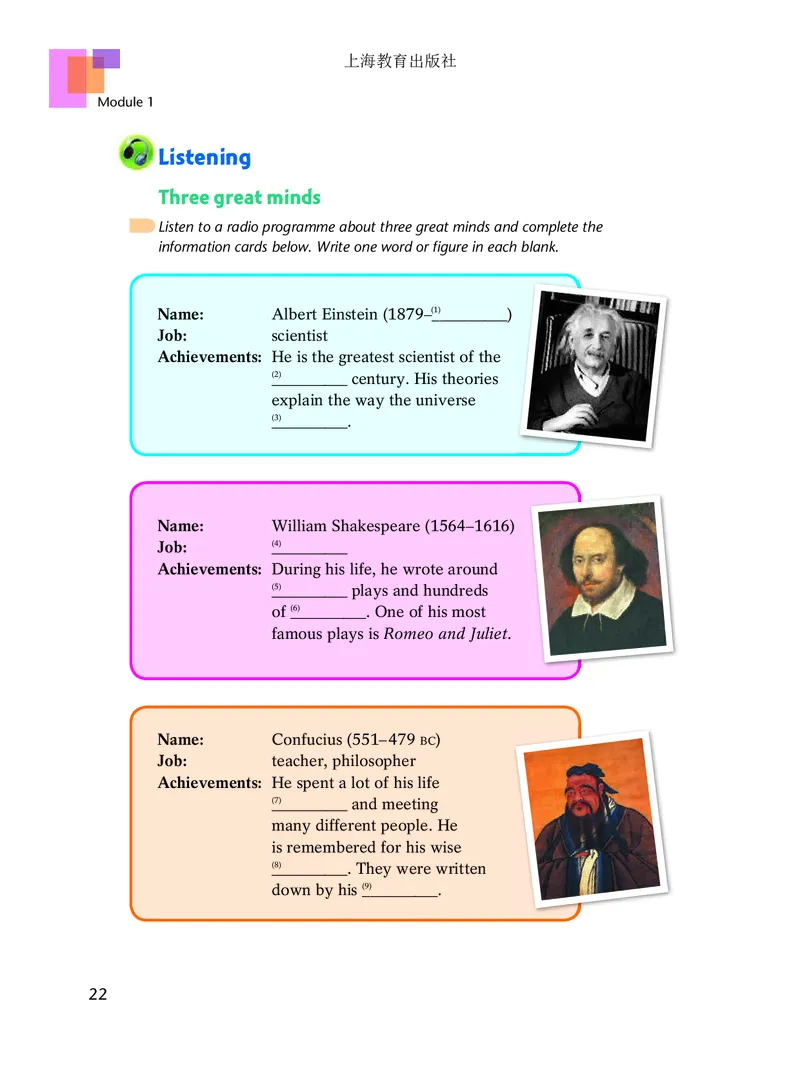
Listening
Three great minds
Listen to a radio programme about three great minds and complete the
information cards below. Write one word or figure in each blank.
Name: Albert Einstein (1879–(_1)_________)
Job: scientist
Achievements: He is the greatest scientist of the
_(2)_________ century. His theories
explain the way the universe
_(3)_________.
Name: William Shakespeare (1564–1616)
Job: _(4)_________
Achievements: During his life, he wrote around
_(5)_________ plays and hundreds
of (_6)_________. One of his most
famous plays is Romeo and Juliet.
Name: Confucius (551–479 BC)
Job: teacher, philosopher
Achievements: He spent a lot of his life
_(7)_________ and meeting
many different people. He
is remembered for his wise
_(8)_________. They were written
down by his (_9)_________.
22上海教育出版社
Unit 2
(cid:43)
Grammar
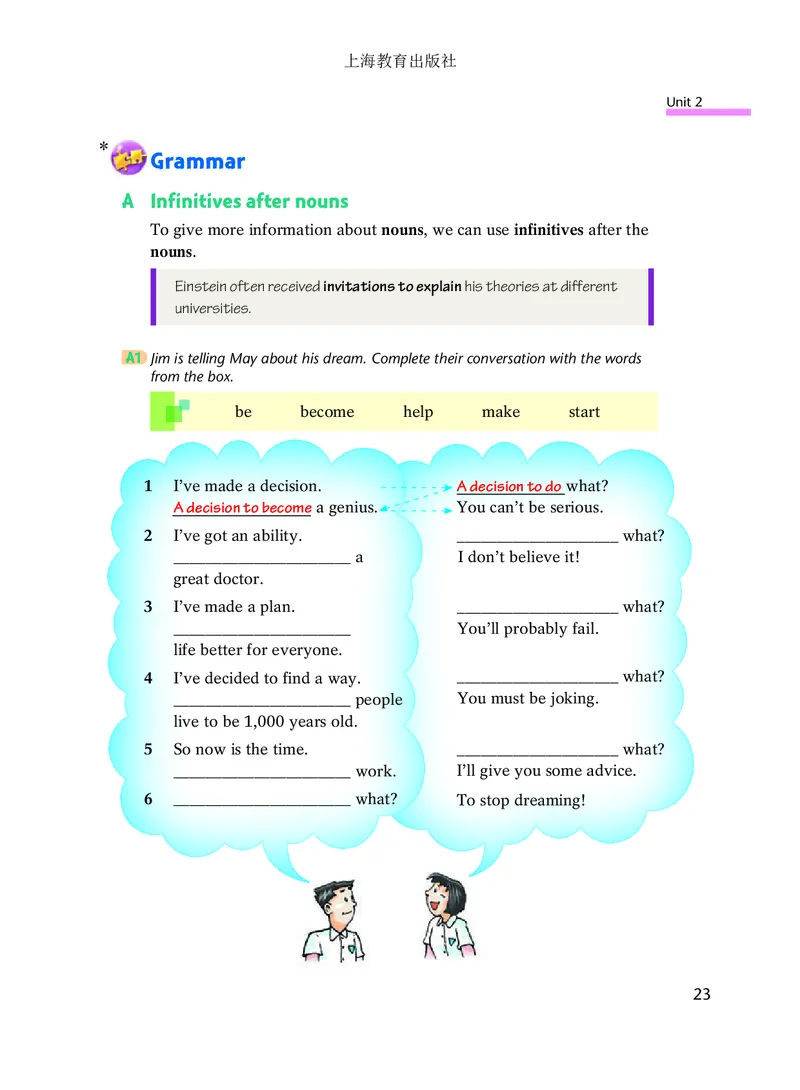
A Infinitives after nouns
To give more information about nouns, we can use infinitives after the
nouns.
Einstein often received invitations to explain his theories at different
universities.
A1 Jim is telling May about his dream. Complete their conversation with the words
from the box.
be become help make start
1 I’ve made a decision. A decision to do what?
A decision to become a genius. You can’t be serious.
2 I’ve got an ability. ____________________ what?
______________________ a I don’t believe it!
great doctor.
3 I’ve made a plan. ____________________ what?
______________________ You’ll probably fail.
life better for everyone.
4 I’ve decided to find a way. ____________________ what?
______________________ people You must be joking.
live to be 1,000 years old.
5 So now is the time. ____________________ what?
______________________ work. I’ll give you some advice.
6 ______________________ what? To stop dreaming!
23上海教育出版社
Module 1
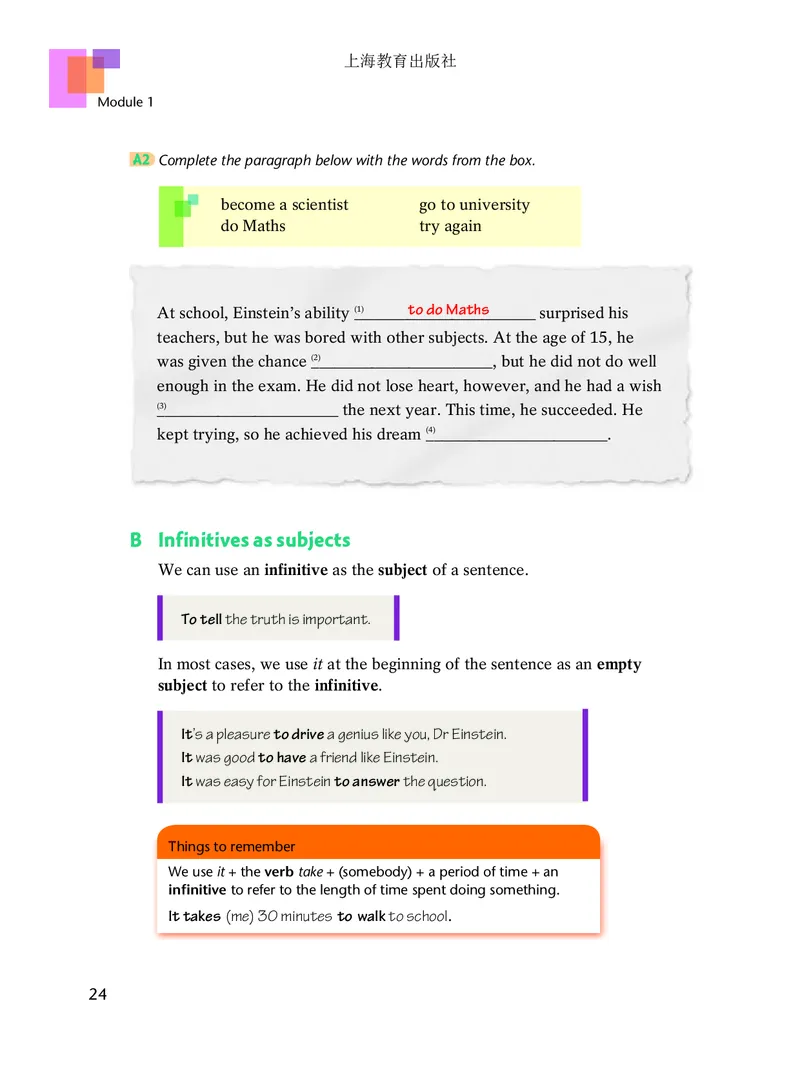
A2 Complete the paragraph below with the words from the box.
become a scientist go to university
do Maths try again
At school, Einstein’s ability (_1)_______t_o_ d_o_ _M_a__th_s_______ surprised his
teachers, but he was bored with other subjects. At the age of 15, he
was given the chance _(2)_______________________, but he did not do well
enough in the exam. He did not lose heart, however, and he had a wish
_(3)_______________________ the next year. This time, he succeeded. He
kept trying, so he achieved his dream (_4)_______________________.
B Infinitives as subjects
We can use an infinitive as the subject of a sentence.
To tell the truth is important.
In most cases, we use it at the beginning of the sentence as an empty
subject to refer to the infinitive.
It’s a pleasure to drive a genius like you, Dr Einstein.
It was good to have a friend like Einstein.
It was easy for Einstein to answer the question.
Things to remember
We use it + the verb take + (somebody) + a period of time + an
infinitive to refer to the length of time spent doing something.
It takes (me) 30 minutes to walk to school.
24上海教育出版社
Unit 2
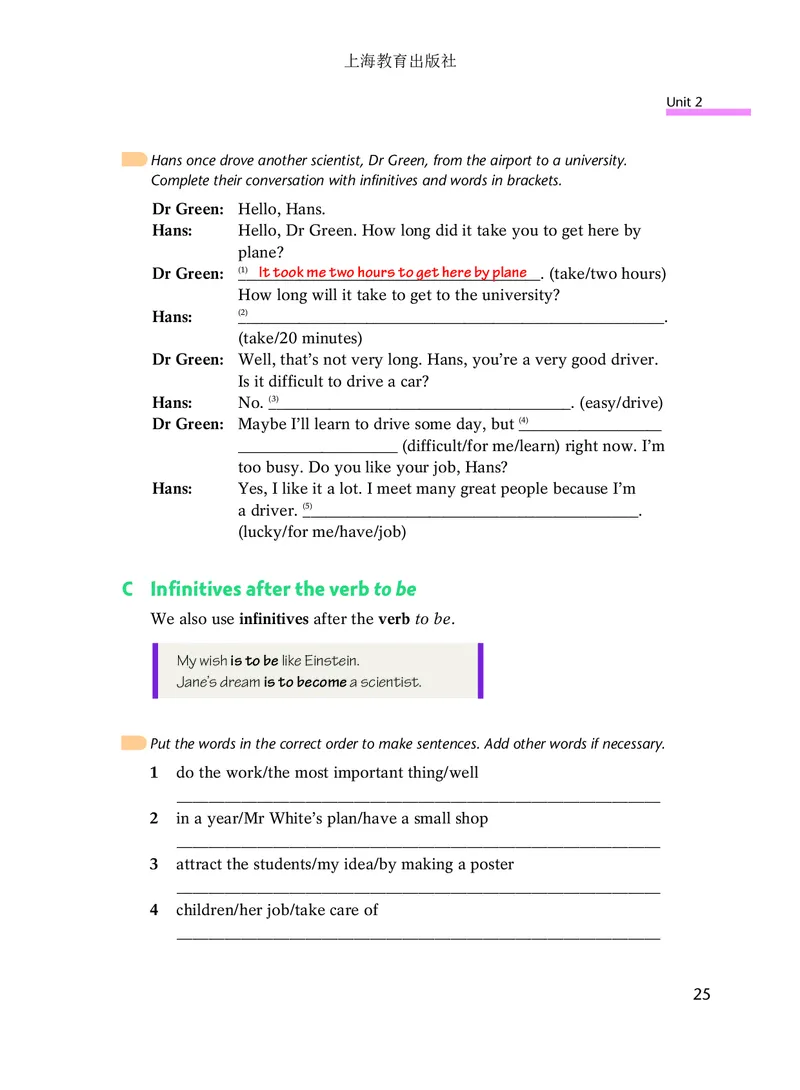
Hans once drove another scientist, Dr Green, from the airport to a university.
Complete their conversation with infinitives and words in brackets.
Dr Green: Hello, Hans.
Hans: Hello, Dr Green. How long did it take you to get here by
plane?
Dr Green: _(1)__I_t_ t_o_o_k_ _m_e_ _t_w_o_ h_o_u_r_s_ _t_o_ g_e_t_ _h_er__e _b_y_ p_l_a_n_e__. (take/two hours)
How long will it take to get to the university?
Hans: _(2)________________________________________________________.
(take/20 minutes)
Dr Green: Well, that’s not very long. Hans, you’re a very good driver.
Is it difficult to drive a car?
Hans: No. _(3)_______________________________________. (easy/drive)
Dr Green: Maybe I’ll learn to drive some day, but (_4)__________________
_____________________ (difficult/for me/learn) right now. I’m
too busy. Do you like your job, Hans?
Hans: Yes, I like it a lot. I meet many great people because I’m
a driver. _(5)____________________________________________.
(lucky/for me/have/job)
C Infinitives after the verb to be
We also use infinitives after the verb to be.
My wish is to be like Einstein.
Jane’s dream is to become a scientist.
Put the words in the correct order to make sentences. Add other words if necessary.
1 do the work/the most important thing/well
____________________________________________________________
2 in a year/Mr White’s plan/have a small shop
____________________________________________________________
3 attract the students/my idea/by making a poster
____________________________________________________________
4 children/her job/take care of
____________________________________________________________
25上海教育出版社
Module 1
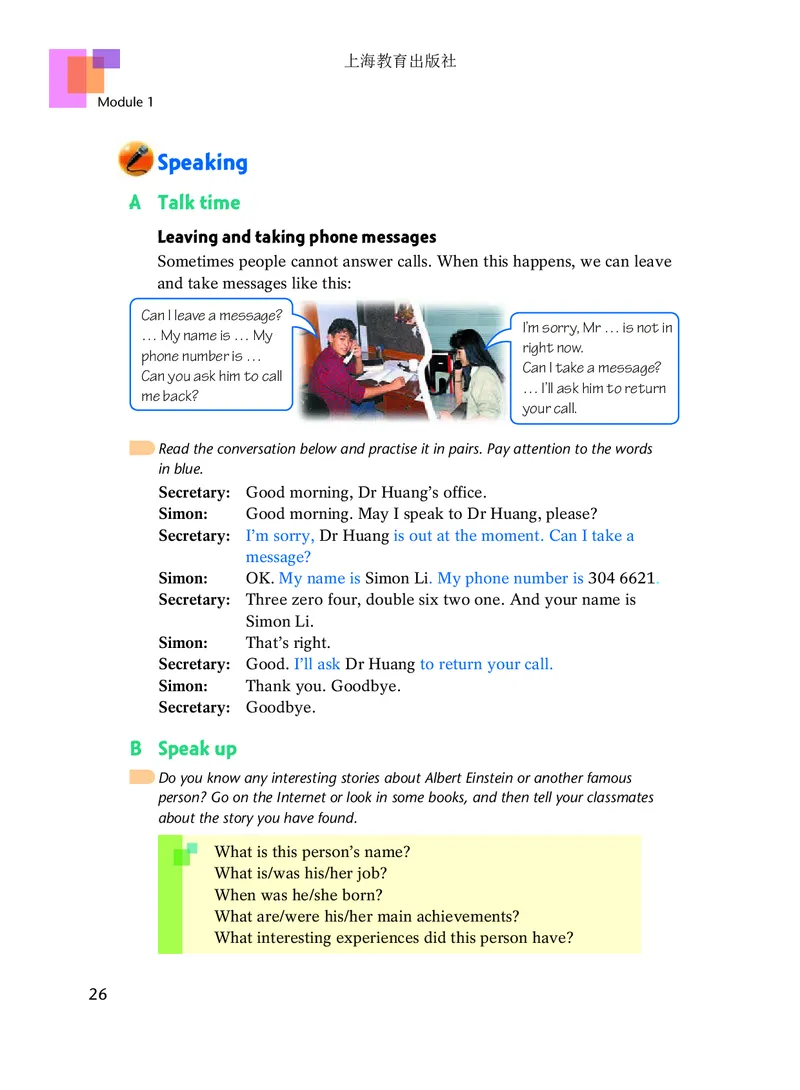
Speaking
A Talk time
Leaving and taking phone messages
Sometimes people cannot answer calls. When this happens, we can leave
and take messages like this:
Can I leave a message?
I’m sorry, Mr … is not in
… My name is … My
right now.
phone number is …
Can I take a message?
Can you ask him to call
… I’ll ask him to return
me back?
your call.
Read the conversation below and practise it in pairs. Pay attention to the words
in blue.
Secretary: Good morning, Dr Huang’s office.
Simon: Good morning. May I speak to Dr Huang, please?
Secretary: I ’m sorry, Dr Huang is out at the moment. Can I take a
message?
Simon: OK. My name is Simon Li. My phone number is 304 6621.
Secretary: T hree zero four, double six two one. And your name is
Simon Li.
Simon: That’s right.
Secretary: Good. I’ll ask Dr Huang to return your call.
Simon: Thank you. Goodbye.
Secretary: Goodbye.
B Speak up
Do you know any interesting stories about Albert Einstein or another famous
person? Go on the Internet or look in some books, and then tell your classmates
about the story you have found.
What is this person’s name?
What is/was his/her job?
When was he/she born?
What are/were his/her main achievements?
What interesting experiences did this person have?
26上海教育出版社
Unit 2
Writing
Floating listeners
You are going to write a short story about Patrick Moore, another
famous person with a good sense of humour.
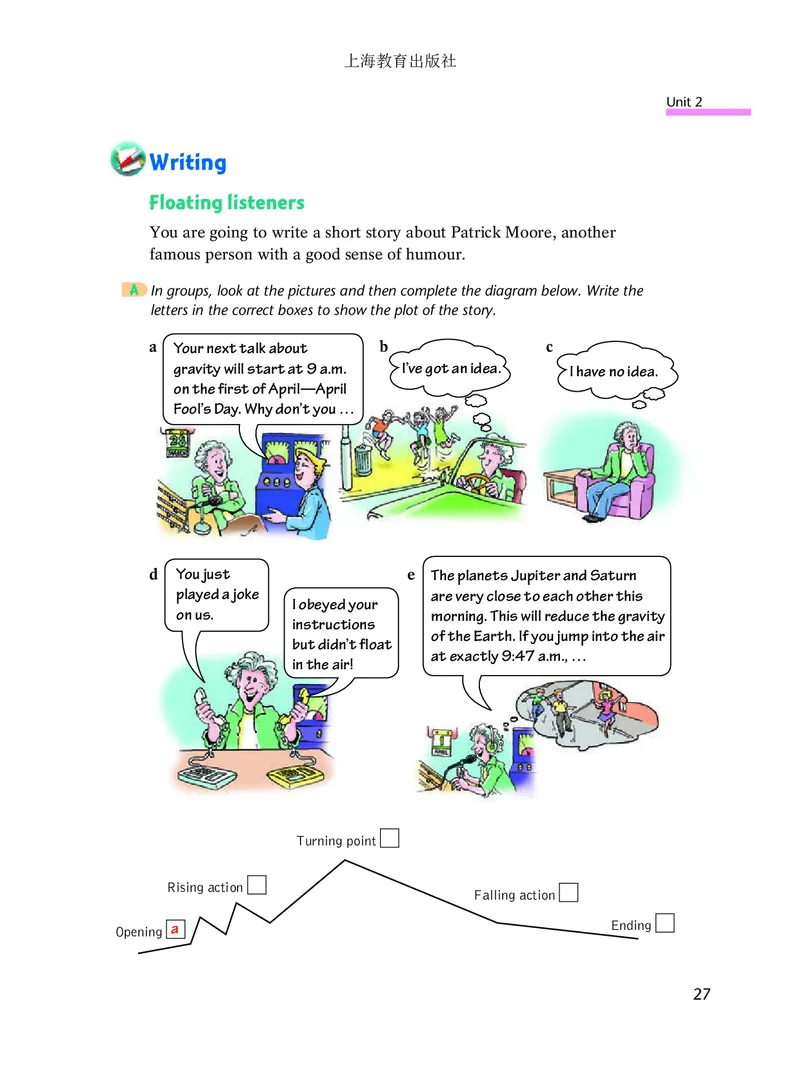
A In groups, look at the pictures and then complete the diagram below. Write the
letters in the correct boxes to show the plot of the story.
a Your next talk about b c
gravity will start at 9 a.m. I’ve got an idea. I have no idea.
on the first of April —April
Fool’s Day. Why don’t you …
d You just e The planets Jupiter and Saturn
played a joke are very close to each other this
I obeyed your
on us. morning. This will reduce the gravity
instructions
of the Earth. If you jump into the air
but didn’t float
at exactly 9:47 a.m., …
in the air!
Turning point
Rising action
Falling action
Opening a Ending
27上海教育出版社
Module 1
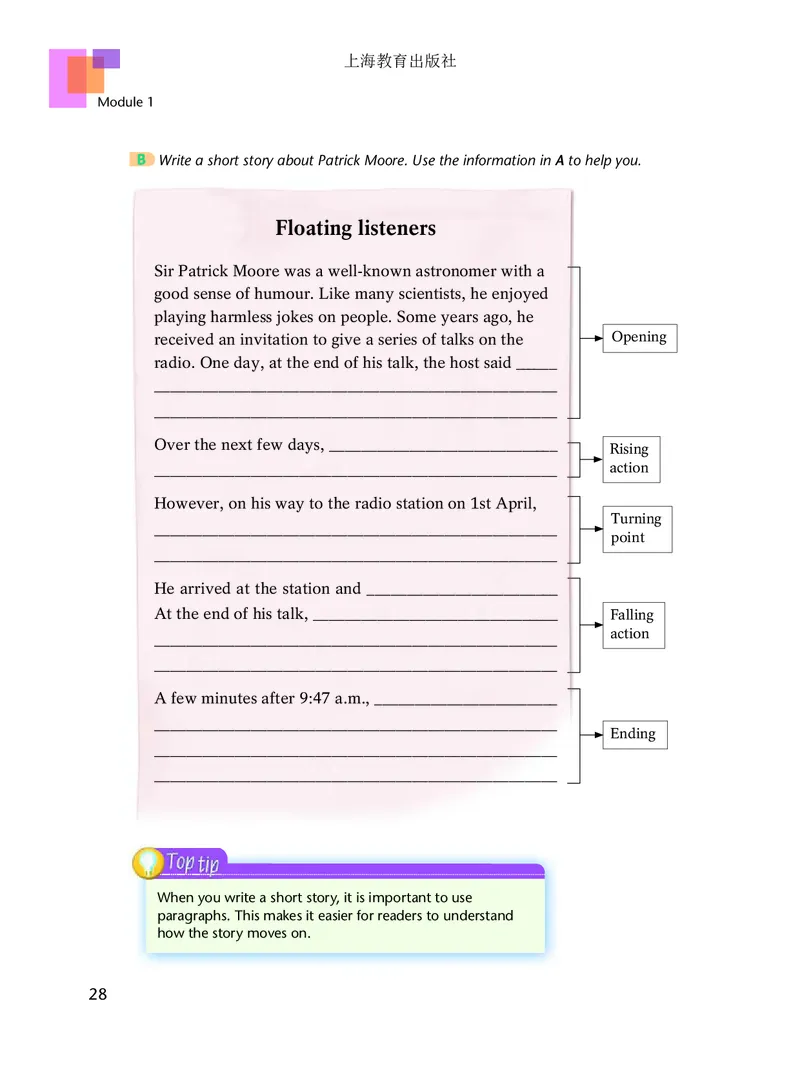
B Write a short story about Patrick Moore. Use the information in A to help you.
Floating listeners
Sir Patrick Moore was a well-known astronomer with a
good sense of humour. Like many scientists, he enjoyed
playing harmless jokes on people. Some years ago, he
received an invitation to give a series of talks on the Opening
radio. One day, at the end of his talk, the host said ______
__________________________________________________
__________________________________________________
Over the next few days, _____________________________
Rising
__________________________________________________ action
However, on his way to the radio station on 1st April,
Turning
__________________________________________________
point
__________________________________________________
He arrived at the station and ________________________
At the end of his talk, _______________________________ Falling
action
__________________________________________________
__________________________________________________
A few minutes after 9:47 a.m., _______________________
__________________________________________________
Ending
__________________________________________________
__________________________________________________
When you write a short story, it is important to use
paragraphs. This makes it easier for readers to understand
how the story moves on.
28上海教育出版社
Unit 2
(cid:43)
More practice
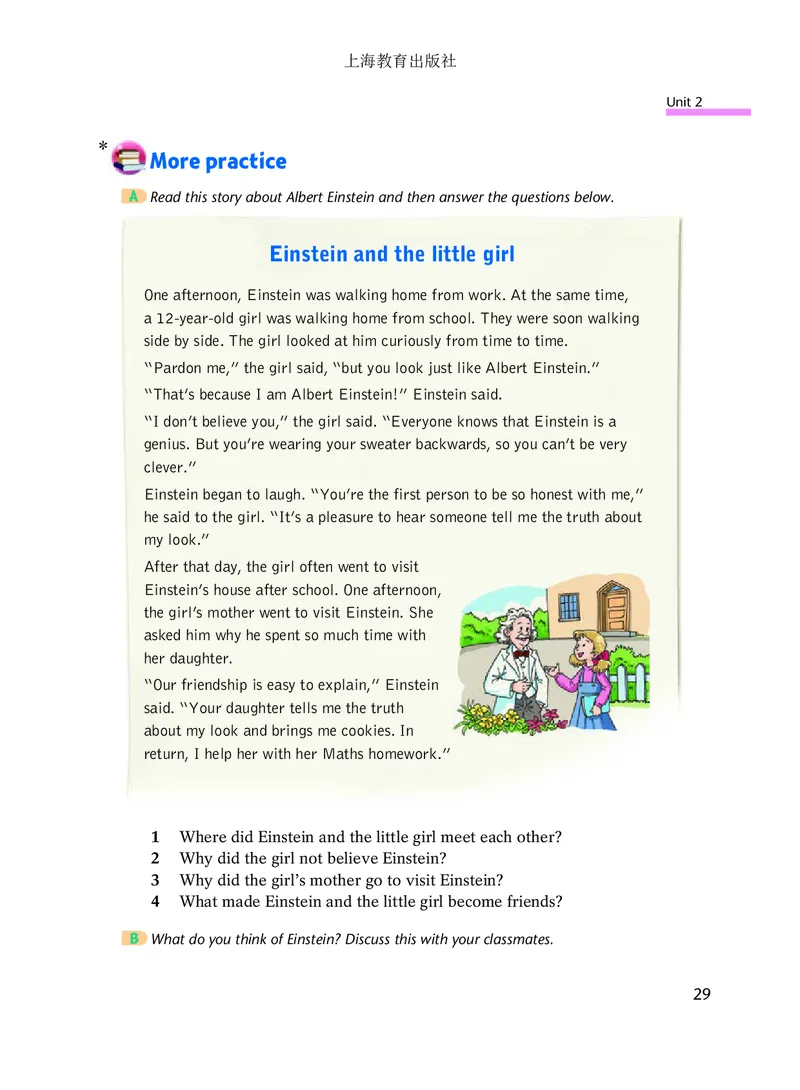
A Read this story about Albert Einstein and then answer the questions below.
Einstein and the little girl
One afternoon, Einstein was walking home from work. At the same time,
a 12-year-old girl was walking home from school. They were soon walking
side by side. The girl looked at him curiously from time to time.
“Pardon me,” the girl said, “but you look just like Albert Einstein.”
“That’s because I am Albert Einstein!” Einstein said.
“I don’t believe you,” the girl said. “Everyone knows that Einstein is a
genius. But you’re wearing your sweater backwards, so you can’t be very
clever.”
Einstein began to laugh. “You’re the first person to be so honest with me,”
he said to the girl. “It’s a pleasure to hear someone tell me the truth about
my look.”
After that day, the girl often went to visit
Einstein’s house after school. One afternoon,
the girl’s mother went to visit Einstein. She
asked him why he spent so much time with
her daughter.
“Our friendship is easy to explain,” Einstein
said. “Your daughter tells me the truth
about my look and brings me cookies. In
return, I help her with her Maths homework.”
1 Where did Einstein and the little girl meet each other?
2 Why did the girl not believe Einstein?
3 Why did the girl’s mother go to visit Einstein?
4 What made Einstein and the little girl become friends?
B What do you think of Einstein? Discuss this with your classmates.
29上海教育出版社
Module 1
Culture corner
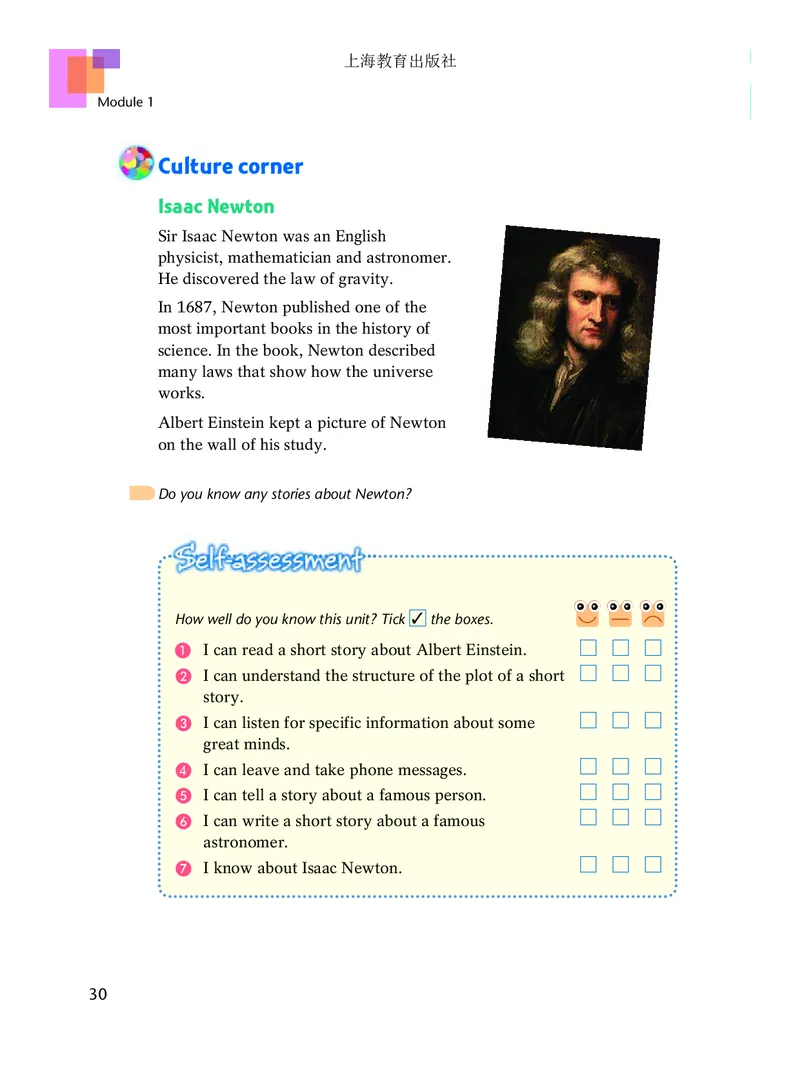
Isaac Newton
Sir Isaac Newton was an English
physicist, mathematician and astronomer.
He discovered the law of gravity.
In 1687, Newton published one of the
most important books in the history of
science. In the book, Newton described
many laws that show how the universe
works.
Albert Einstein kept a picture of Newton
on the wall of his study.
Do you know any stories about Newton?
How well do you know this unit? Tick ✓ the boxes.
❶ I can read a short story about Albert Einstein.
❷ I can understand the structure of the plot of a short
story.
❸ I can listen for specific information about some
great minds.
❹ I can leave and take phone messages.
❺ I can tell a story about a famous person.
❻ I can write a short story about a famous
astronomer.
❼ I know about Isaac Newton.
30上海教育出版社
Unit 2
(cid:43)
PPPrrrooojjjeeecccttt
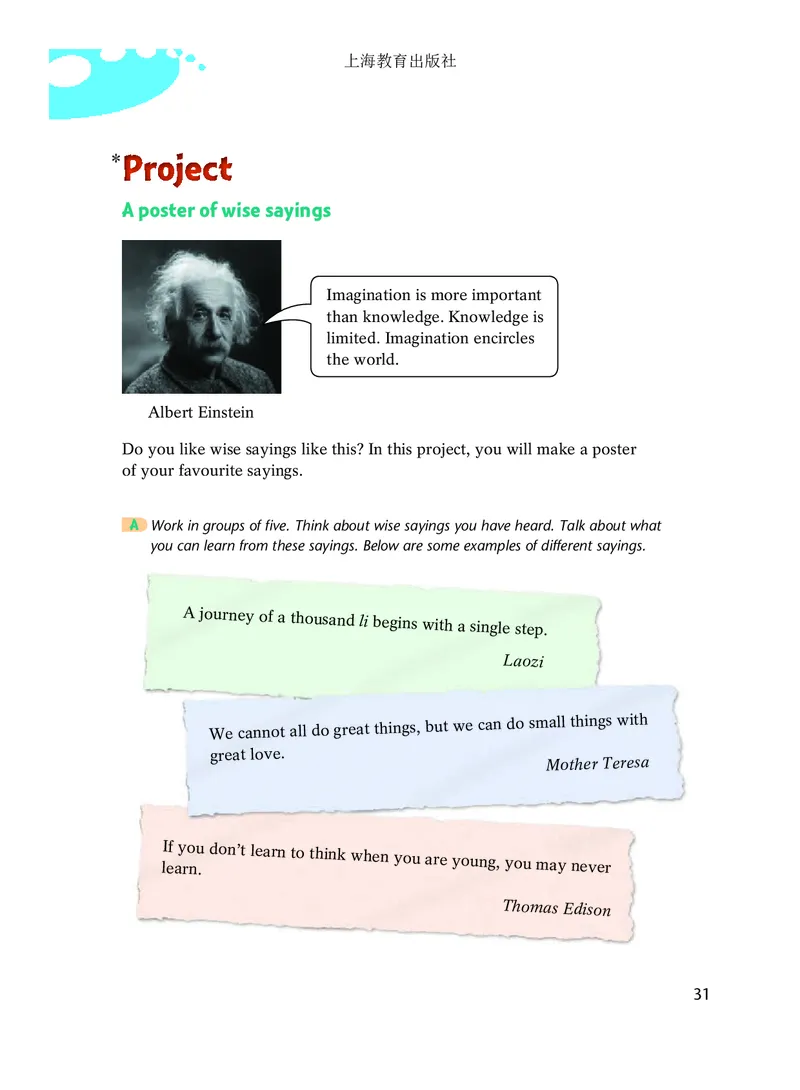
A poster of wise sayings
Imagination is more important
than knowledge. Knowledge is
limited. Imagination encircles
the world.
Albert Einstein
Do you like wise sayings like this? In this project, you will make a poster
of your favourite sayings.
A Work in groups of five. Think about wise sayings you have heard. Talk about what
you can learn from these sayings. Below are some examples of different sayings.
A journey of a thousand li begins with a single step.
Laozi
We cannot all do great things, but we can do small things with
great love.
Mother Teresa
l I e f a y r o n u . don’t learn to think when you are young, you may never
Thomas Edison
31上海教育出版社
Module 1
B Group members should work together to look for more sayings in books and on the
Internet.
• (cid:36)on(cid:71)uc(cid:74)us(cid:13) (cid:34)l(cid:67)e(cid:83)t (cid:38)(cid:74)nste(cid:74)n an(cid:69) (cid:46)a(cid:83)(cid:76) (cid:53)(cid:88)a(cid:74)n a(cid:83)e (cid:71)a(cid:78)ous
for their sayings.
• (cid:54)se (cid:76)e(cid:90) (cid:88)o(cid:83)(cid:69)s suc(cid:73) as (cid:105)(cid:88)(cid:74)se sa(cid:90)(cid:74)n(cid:72)s(cid:119) o(cid:83) (cid:105)(cid:71)a(cid:78)ous
(cid:82)uotes(cid:119) (cid:74)n (cid:90)ou(cid:83) sea(cid:83)c(cid:73)es(cid:15)
• (cid:39)o(cid:83) sa(cid:90)(cid:74)n(cid:72)s (cid:67)(cid:90) (cid:71)a(cid:78)ous (cid:36)(cid:73)(cid:74)nese (cid:81)eo(cid:81)le(cid:13) t(cid:83)(cid:90) to (cid:71)(cid:74)n(cid:69) t(cid:73)e(cid:74)(cid:83)
(cid:38)n(cid:72)l(cid:74)s(cid:73) t(cid:83)anslat(cid:74)ons(cid:15)
• (cid:39)o(cid:83) (cid:38)n(cid:72)l(cid:74)s(cid:73) sa(cid:90)(cid:74)n(cid:72)s(cid:13) t(cid:83)(cid:90) to (cid:71)(cid:74)n(cid:69) t(cid:73)e(cid:74)(cid:83) (cid:36)(cid:73)(cid:74)nese (cid:78)ean(cid:74)n(cid:72)s(cid:15)
C Each group must pick their five favourite sayings. Each student should choose one
saying and talk about why he/she likes it.
Our group’s favourite sayings
1
2
3
4
5
D All groups should tell the class about their five favourite sayings. Then the class
should vote to decide which ten sayings to put on the poster. Follow the example.
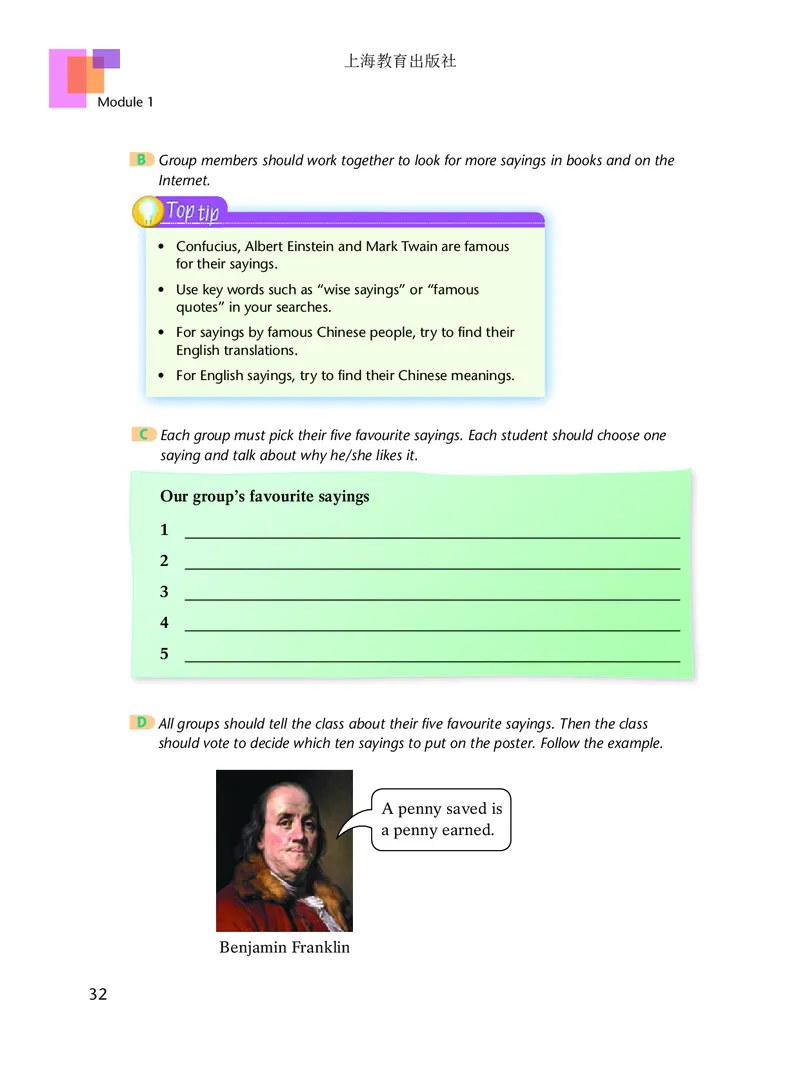
A penny saved is
a penny earned.
Benjamin Franklin
32上海教育出版社
Module 2 Ideas and viewpoints
Unit
3
FFFaaammmiiilllyyy llliiifffeee
Getting ready
In this unit, you will learn about family life.
Reading
• Read interviews with two teenagers about their family lives.
Listening
• Listen to two short conversations between family members.
Grammar
• Learn how to use linking verbs.
Speaking
• Learn to offer, accept and refuse help.
• Discuss how much housework you do.
Writing
•• WWrriittee aa sshhoorrtt aarrttiiccllee aabboouutt yyoouurr ffaammiillyy lliiffee..
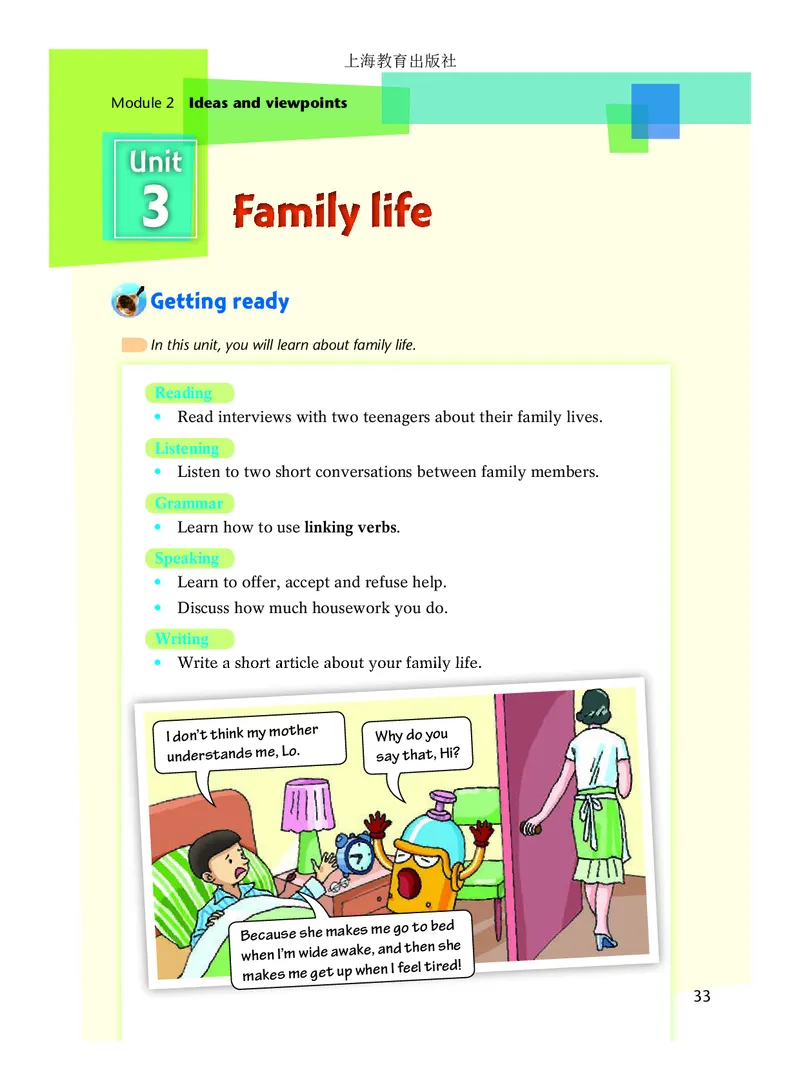
I don’t think my mother Why do you
understands me, Lo. say that, Hi?
Because she makes me go to bed
when I’m wide awake, and then she
makes me get up when I feel tired!
33上海教育出版社
Module 2
Reading
A What do you know about …?
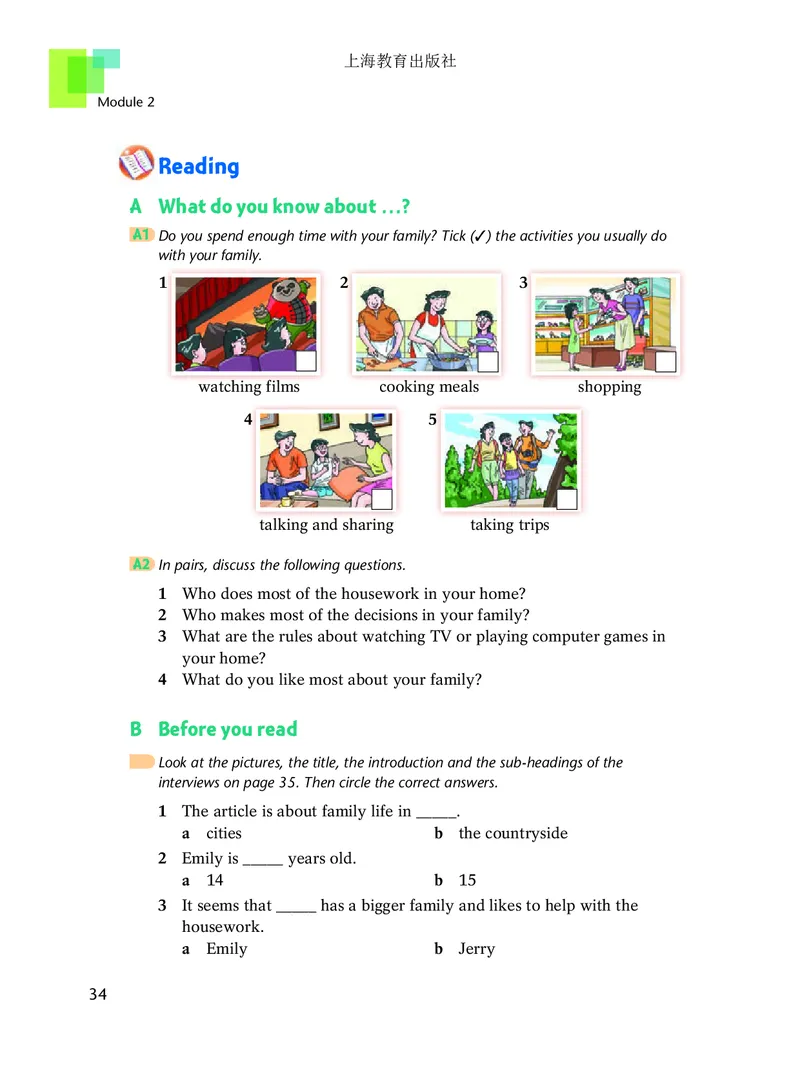
A1 Do you spend enough time with your family? Tick (✓) the activities you usually do
with your family.
1 2 3
watching films cooking meals shopping
4 5
talking and sharing taking trips
A2 In pairs, discuss the following questions.
1 Who does most of the housework in your home?
2 Who makes most of the decisions in your family?
3 What are the rules about watching TV or playing computer games in
your home?
4 What do you like most about your family?
B Before you read
Look at the pictures, the title, the introduction and the sub-headings of the
interviews on page 35. Then circle the correct answers.
1 The article is about family life in _____.
a cities b the countryside
2 Emily is _____ years old.
a 14 b 15
3 It seems that _____ has a bigger family and likes to help with the
housework.
a Emily b Jerry
34上海教育出版社
Unit 3
Family life in cities
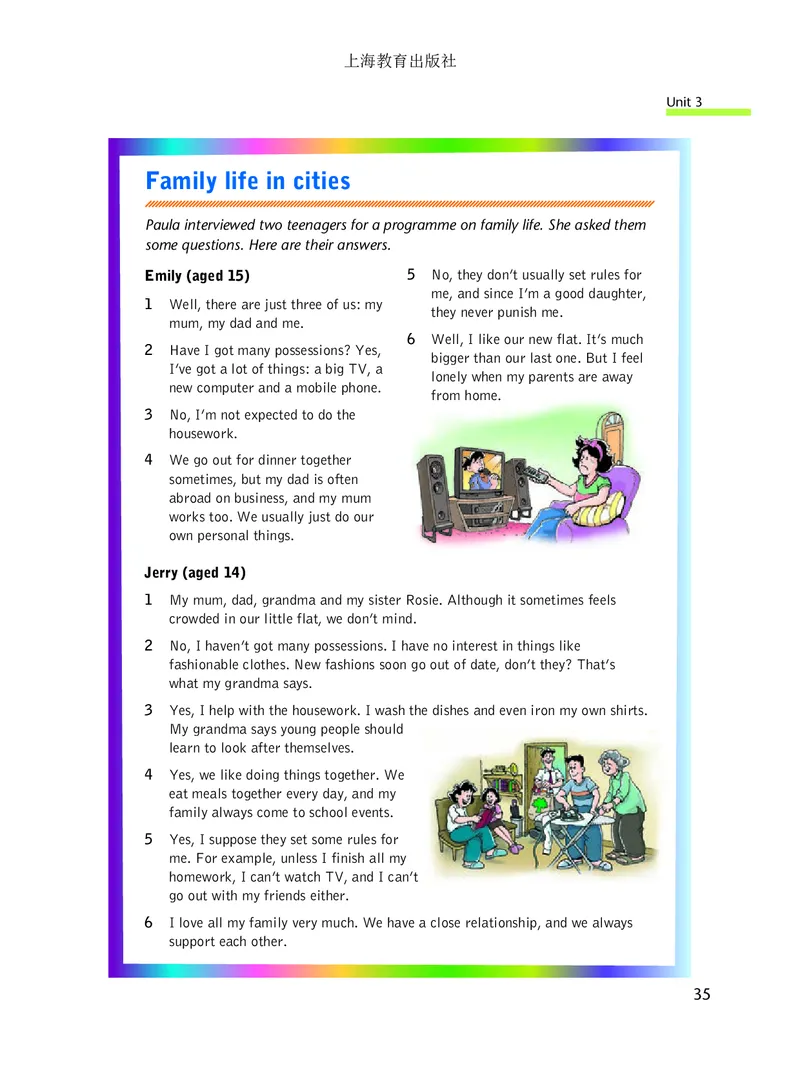
Paula interviewed two teenagers for a programme on family life. She asked them
some questions. Here are their answers.
Emily (aged 15) 5 No, they don’t usually set rules for
me, and since I’m a good daughter,
1 Well, there are just three of us: my
they never punish me.
mum, my dad and me.
6 Well, I like our new flat. It’s much
2 Have I got many possessions? Yes,
bigger than our last one. But I feel
I’ve got a lot of things: a big TV, a
lonely when my parents are away
new computer and a mobile phone.
from home.
3 No, I’m not expected to do the
housework.
4 We go out for dinner together
sometimes, but my dad is often
abroad on business, and my mum
works too. We usually just do our
own personal things.
Jerry (aged 14)
1 My mum, dad, grandma and my sister Rosie. Although it sometimes feels
crowded in our little flat, we don’t mind.
2 No, I haven’t got many possessions. I have no interest in things like
fashionable clothes. New fashions soon go out of date, don’t they? That’s
what my grandma says.
3 Yes, I help with the housework. I wash the dishes and even iron my own shirts.
My grandma says young people should
learn to look after themselves.
4 Yes, we like doing things together. We
eat meals together every day, and my
family always come to school events.
5 Yes, I suppose they set some rules for
me. For example, unless I finish all my
homework, I can’t watch TV, and I can’t
go out with my friends either.
6 I love all my family very much. We have a close relationship, and we always
support each other.
35上海教育出版社
Module 2
C Vocabulary
C1 Find words from the interviews on page 35 that have similar meanings to the
words in italics below.
1 The film was not at all what everyone thought it
would be about. _________
2 Are you here for the activity of making, buying or
selling things for money or pleasure? _________
3 It is important to clear all your own things from the
classroom when the school year ends. _________
4 Many people are not attracted to this subject, but I want
to know more about it. _________
5 I think it is true that Jill will not come to work today
because she is on a trip. _________
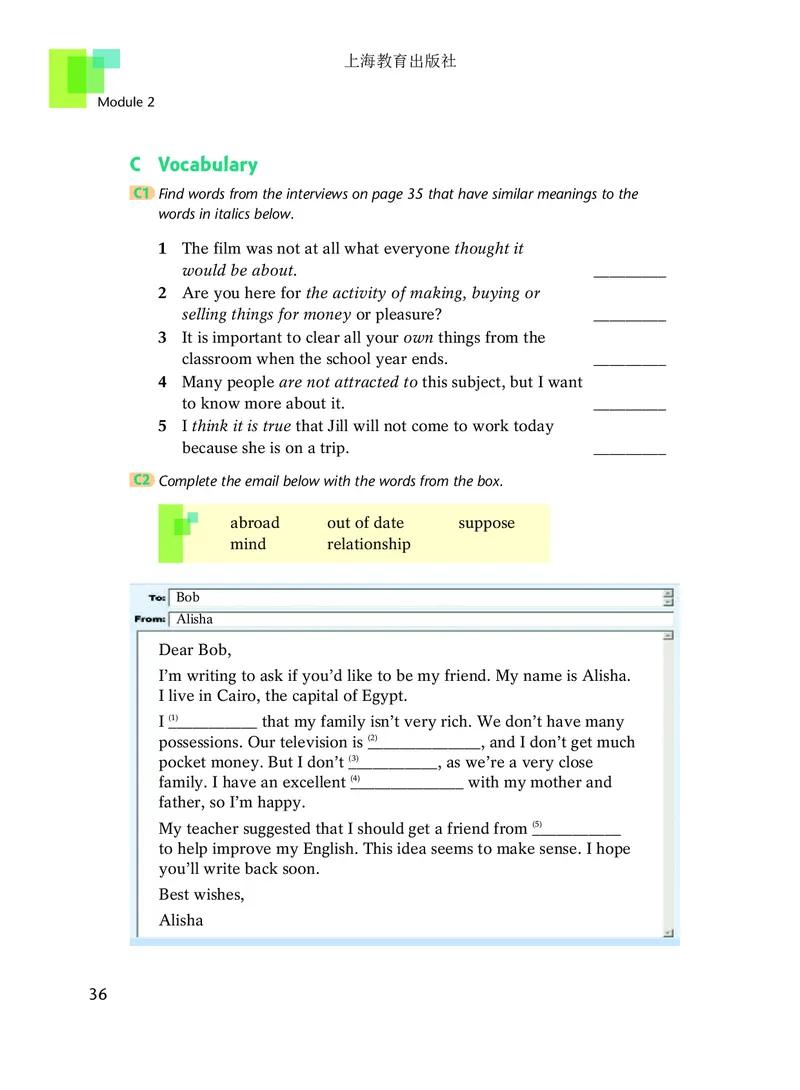
C2 Complete the email below with the words from the box.
abroad out of date suppose
mind relationship
Bob
Alisha
Dear Bob,
I’m writing to ask if you’d like to be my friend. My name is Alisha.
I live in Cairo, the capital of Egypt.
I (_1)__________ that my family isn’t very rich. We don’t have many
possessions. Our television is (_2)_____________, and I don’t get much
pocket money. But I don’t (_3)__________, as we’re a very close
family. I have an excellent _(4)_____________ with my mother and
father, so I’m happy.
My teacher suggested that I should get a friend from (_5)__________
to help improve my English. This idea seems to make sense. I hope
you’ll write back soon.
Best wishes,
Alisha
36上海教育出版社
Unit 3
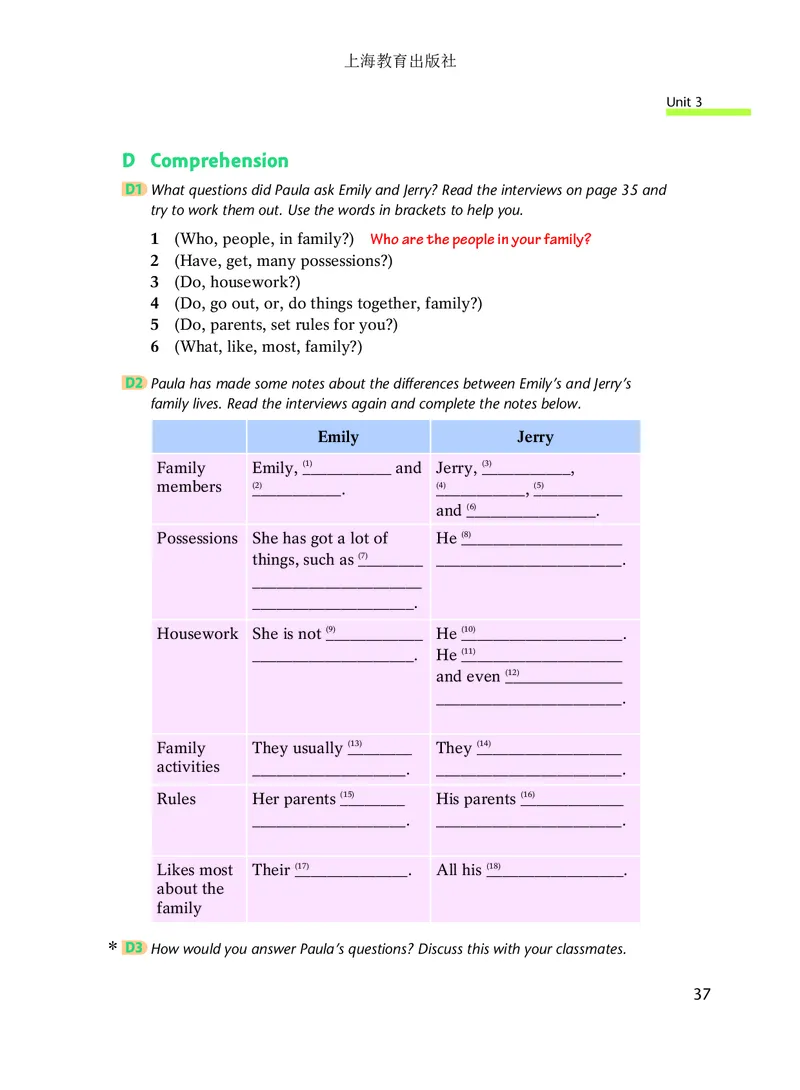
D Comprehension
D1 What questions did Paula ask Emily and Jerry? Read the interviews on page 35 and
try to work them out. Use the words in brackets to help you.
1 (Who, people, in family?) Who are the people in your family?
2 (Have, get, many possessions?)
3 (Do, housework?)
4 (Do, go out, or, do things together, family?)
5 (Do, parents, set rules for you?)
6 (What, like, most, family?)
D2 Paula has made some notes about the differences between Emily’s and Jerry’s
family lives. Read the interviews again and complete the notes below.
Emily Jerry
Family Emily, _(1)__________ and Jerry, (_3)__________,
members _(2)__________. _(4)__________, (_5)__________
and _(6)_______________.
Possessions She has got a lot of He _(8)___________________
things, such as (_7)_______ _______________________.
_____________________
____________________.
Housework She is not (_9)___________ He _(10_)__________________.
____________________. He _(11_)__________________
and even _(12_)_____________
_______________________.
Family They usually (_13_)______ They _(14_)________________
activities ___________________. _______________________.
Rules Her parents (_15_)______ His parents _(16_)___________
___________________. _______________________.
Likes most Their (_17_)____________. All his _(18_)_______________.
about the
family
(cid:43)
D3 How would you answer Paula’s questions? Discuss this with your classmates.
37上海教育出版社
Module 2
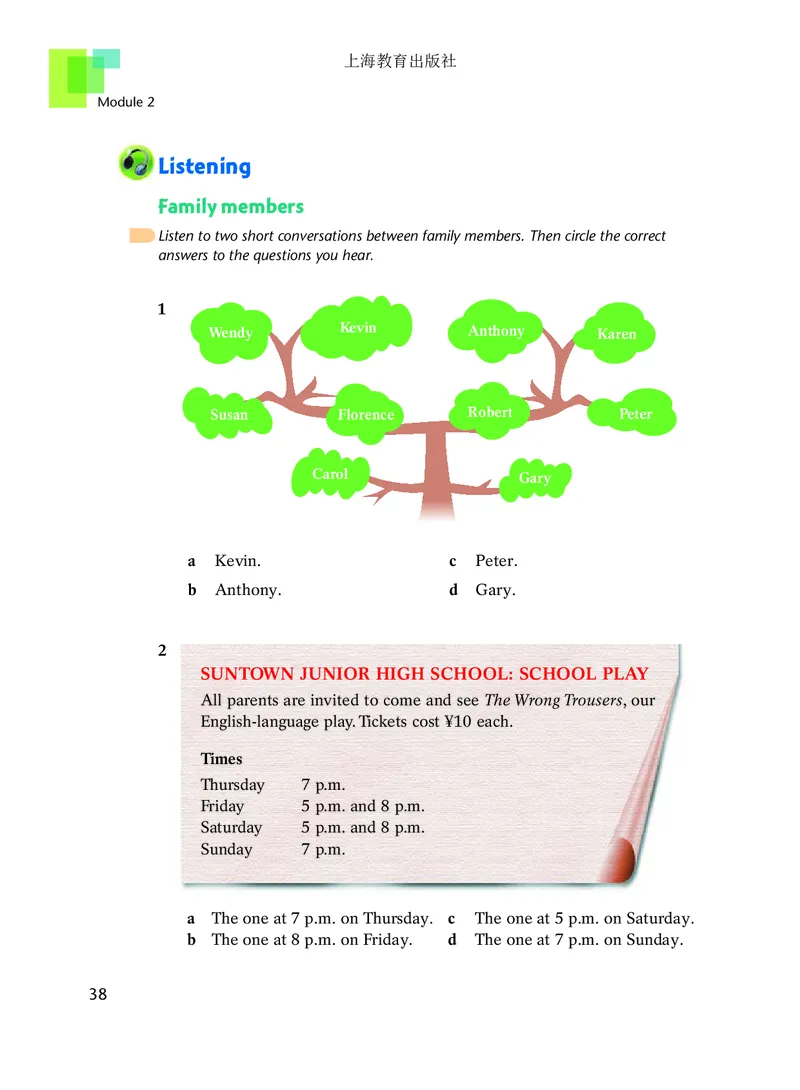
Listening
Family members
Listen to two short conversations between family members. Then circle the correct
answers to the questions you hear.
1
Wendy Kevin Anthony Karen
Susan Florence Robert Peter
Carol
Gary
a Kevin. c Peter.
b Anthony. d Gary.
2
SUNTOWN JUNIOR HIGH SCHOOL: SCHOOL PLAY
All parents are invited to come and see The Wrong Trousers, our
English-language play. Tickets cost ¥10 each.
Times
Thursday 7 p.m.
Friday 5 p.m. and 8 p.m.
Saturday 5 p.m. and 8 p.m.
Sunday 7 p.m.
a The one at 7 p.m. on Thursday. c The one at 5 p.m. on Saturday.
b The one at 8 p.m. on Friday. d The one at 7 p.m. on Sunday.
38上海教育出版社
Unit 3
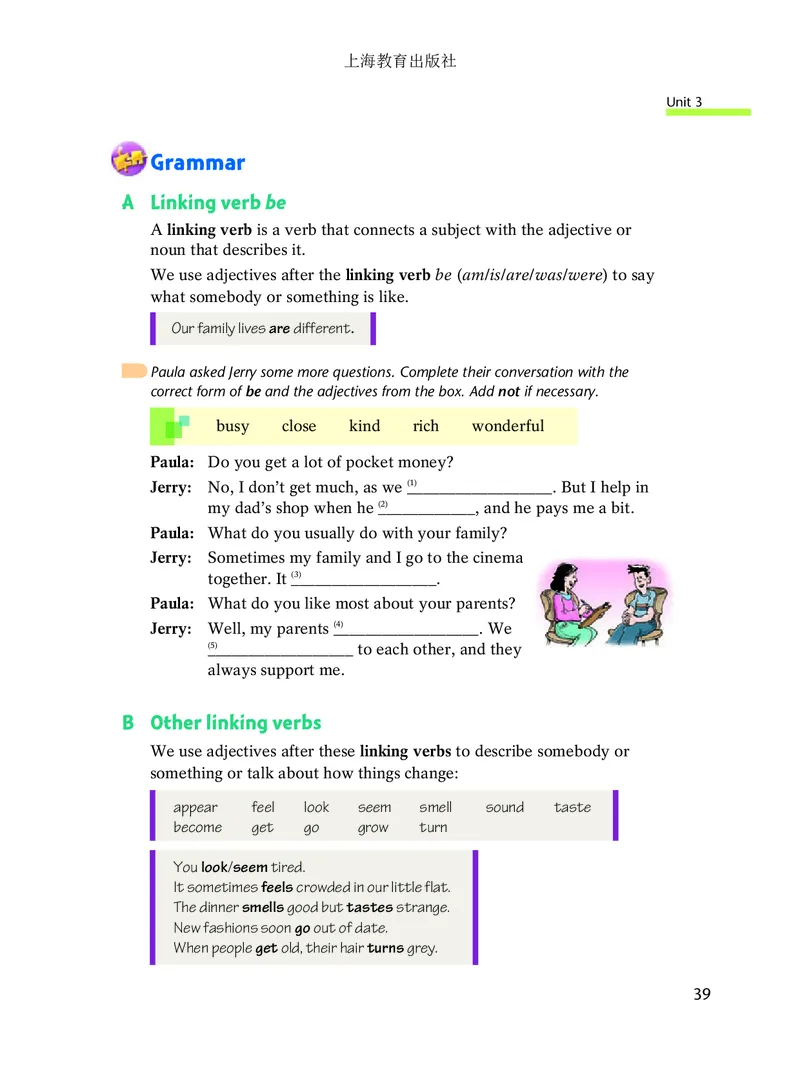
Grammar
A Linking verb be
A linking verb is a verb that connects a subject with the adjective or
noun that describes it.
We use adjectives after the linking verb be (am/is/are/was/were) to say
what somebody or something is like.
Our family lives are different.
Paula asked Jerry some more questions. Complete their conversation with the
correct form of be and the adjectives from the box. Add not if necessary.
busy close kind rich wonderful
Paula: Do you get a lot of pocket money?
Jerry: No, I don’t get much, as we _(1)_________________. But I help in
my dad’s shop when he _(2)___________, and he pays me a bit.
Paula: What do you usually do with your family?
Jerry: Sometimes my family and I go to the cinema
together. It (_3)_________________.
Paula: What do you like most about your parents?
Jerry: Well, my parents _(4)_________________. We
_(5)_________________ to each other, and they
always support me.
B Other linking verbs
We use adjectives after these linking verbs to describe somebody or
something or talk about how things change:
appear feel look seem smell sound taste
become get go grow turn
You look/seem tired.
It sometimes feels crowded in our little flat.
The dinner smells good but tastes strange.
a The one at 7 p.m. on Thursday. c The one at 5 p.m. on Saturday.
New fashions soon go out of date.
b The one at 8 p.m. on Friday. d The one at 7 p.m. on Sunday.
When people get old, their hair turns grey.
39上海教育出版社
Module 2
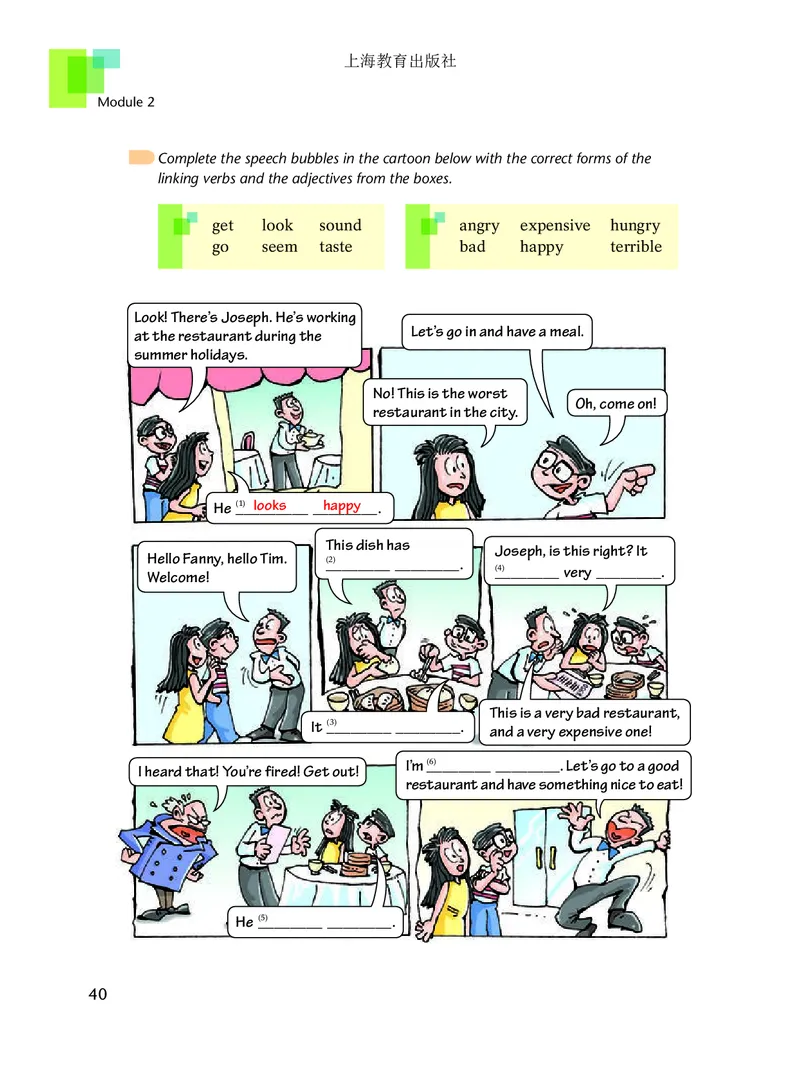
Complete the speech bubbles in the cartoon below with the correct forms of the
linking verbs and the adjectives from the boxes.
get look sound angry expensive hungry
go seem taste bad happy terrible
Look! There’s Joseph. He’s working
Let’s go in and have a meal.
at the restaurant during the
summer holidays.
No! This is the worst
Oh, come on!
restaurant in the city.
He _(1)__lo_o_k_s_ _ _ _ _h_a_p_p_y__.
This dish has
Joseph, is this right? It
Hello Fanny, hello Tim.
_(2)_______ ________.
(_4)_______ very ________.
Welcome!
This is a very bad restaurant,
It (_3)_______ ________.
and a very expensive one!
I’m (_6)_______ ________. Let’s go to a good
I heard that! You’re fired! Get out!
restaurant and have something nice to eat!
He (_5)_______ ________.
40上海教育出版社
Unit 3
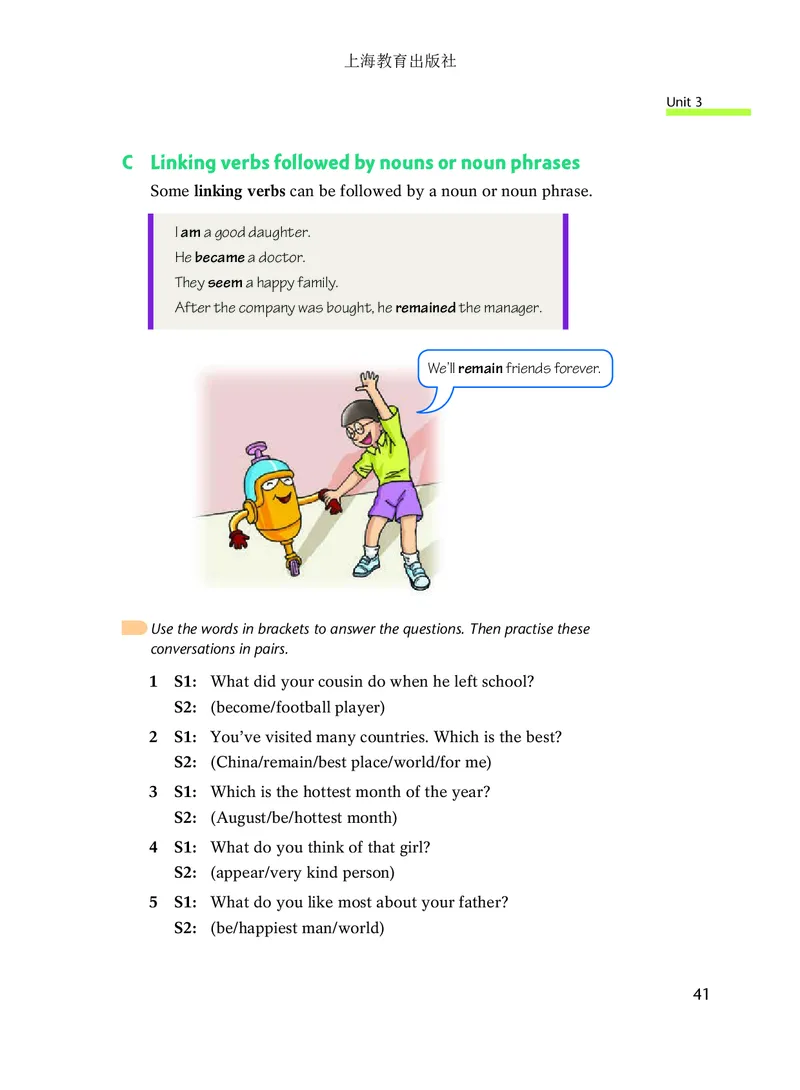
C Linking verbs followed by nouns or noun phrases
Some linking verbs can be followed by a noun or noun phrase.
I am a good daughter.
He became a doctor.
They seem a happy family.
After the company was bought, he remained the manager.
We’ll remain friends forever.
Use the words in brackets to answer the questions. Then practise these
conversations in pairs.
1 S1: What did your cousin do when he left school?
S2: (become/football player)
2 S1: You’ve visited many countries. Which is the best?
S2: (China/remain/best place/world/for me)
3 S1: Which is the hottest month of the year?
S2: (August/be/hottest month)
4 S1: What do you think of that girl?
S2: (appear/very kind person)
5 S1: What do you like most about your father?
S2: (be/happiest man/world)
41上海教育出版社
Module 2
Speaking
A Talk time
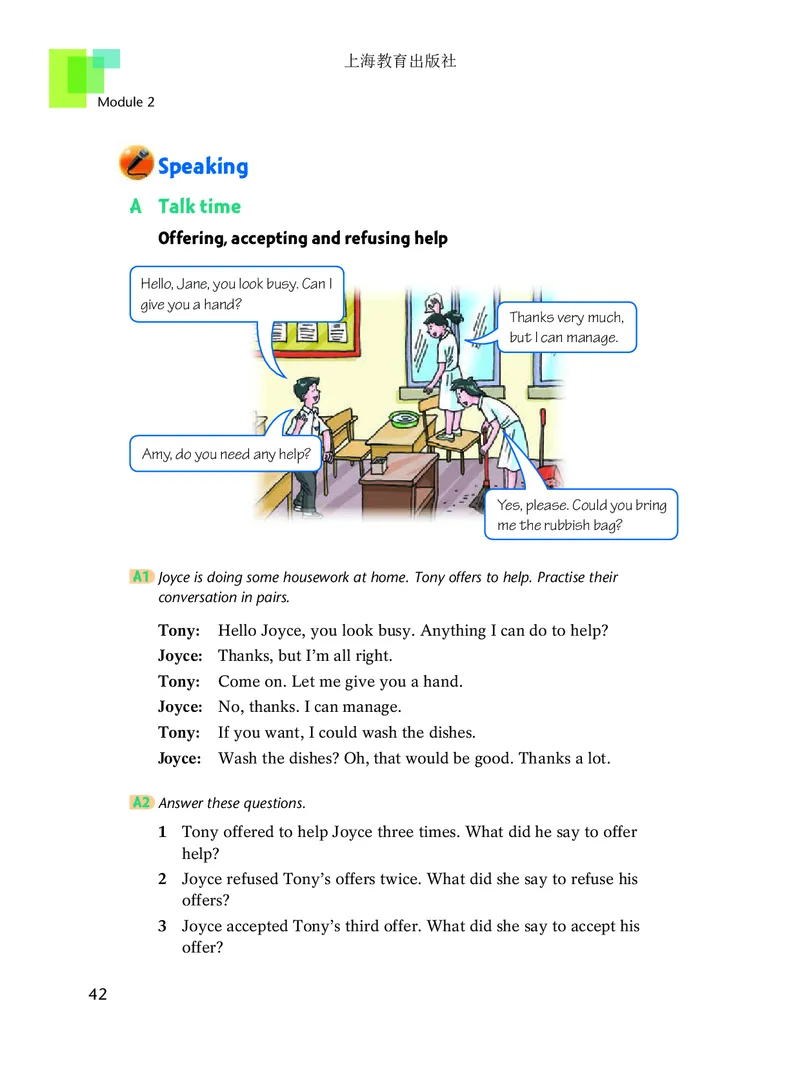
Offering, accepting and refusing help
Hello, Jane, you look busy. Can I
give you a hand?
Thanks very much,
but I can manage.
Amy, do you need any help?
Yes, please. Could you bring
me the rubbish bag?
A1 Joyce is doing some housework at home. Tony offers to help. Practise their
conversation in pairs.
Tony: Hello Joyce, you look busy. Anything I can do to help?
Joyce: Thanks, but I’m all right.
Tony: Come on. Let me give you a hand.
Joyce: No, thanks. I can manage.
Tony: If you want, I could wash the dishes.
Joyce: Wash the dishes? Oh, that would be good. Thanks a lot.
A2 Answer these questions.
1 Tony offered to help Joyce three times. What did he say to offer
help?
2 Joyce refused Tony’s offers twice. What did she say to refuse his
offers?
3 Joyce accepted Tony’s third offer. What did she say to accept his
offer?
42上海教育出版社
Unit 3
B Speak up
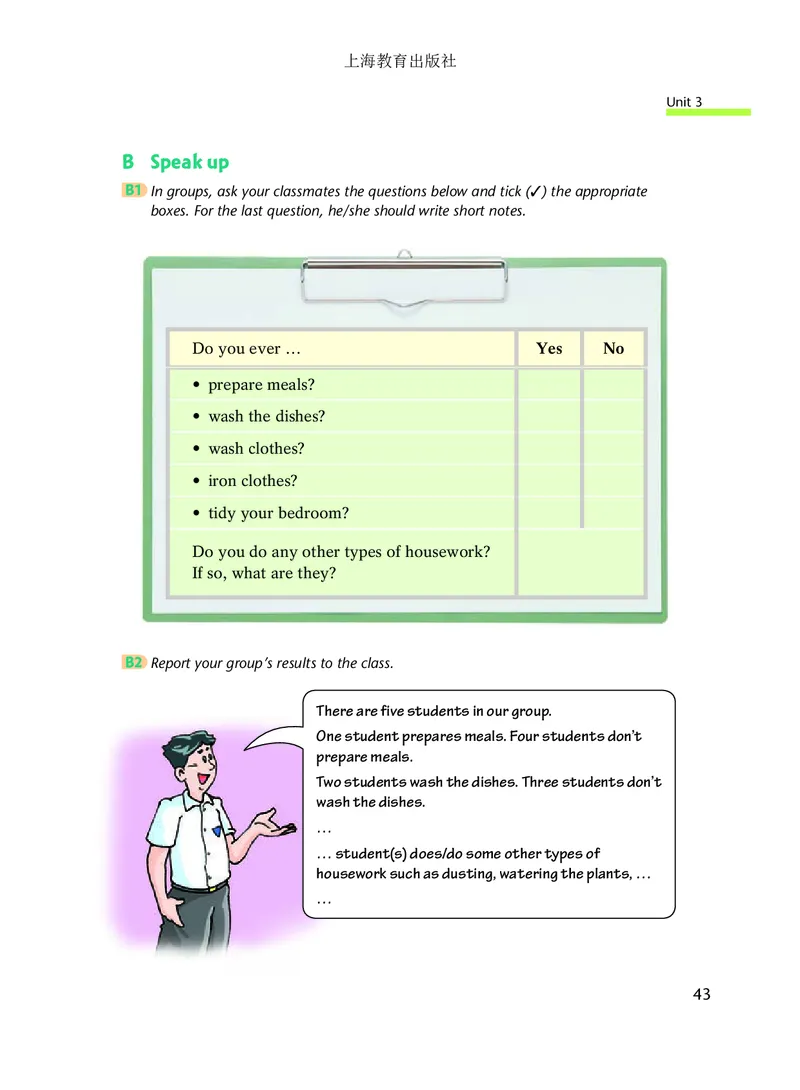
B1 In groups, ask your classmates the questions below and tick (✓) the appropriate
boxes. For the last question, he/she should write short notes.
Do you ever … Yes No
• prepare meals(cid:32)
• wash the dishes(cid:32)
• wash clothes(cid:32)
• iron clothes(cid:32)
• tidy your bedroom(cid:32)
Do you do any other types of housework?
If so, what are they?
B2 Report your group’s results to the class.
There are five students in our group.
One student prepares meals. Four students don’t
prepare meals.
Two students wash the dishes. Three students don’t
wash the dishes.
…
… student(s) does/do some other types of
housework such as dusting, watering the plants, …
…
43上海教育出版社
Module 2
Writing
My family life
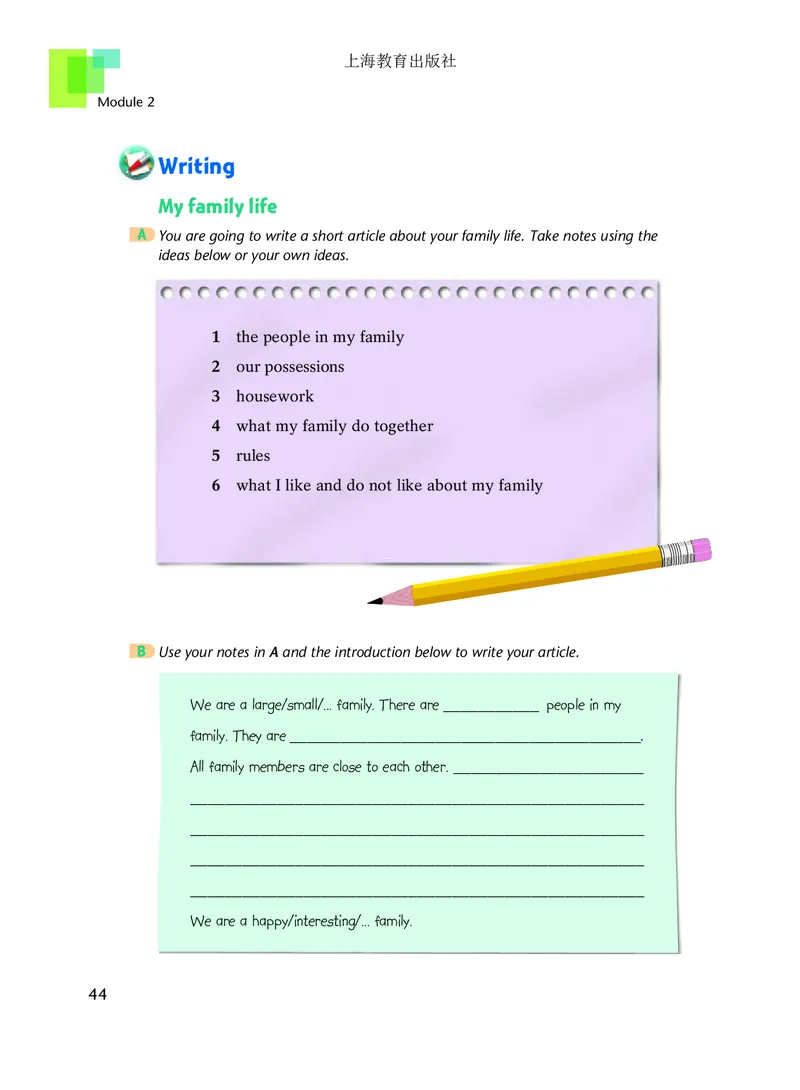
A You are going to write a short article about your family life. Take notes using the
ideas below or your own ideas.
1 the people in my family
2 our possessions
3 housework
4 what my family do together
5 rules
6 what I like and do not like about my family
B Use your notes in A and the introduction below to write your article.
We are a large(cid:38)small(cid:38)... family. There are ___________ people in my
family. They are _________________________________________.
All family members are close to each other. ______________________
____________________________________________________
____________________________________________________
____________________________________________________
____________________________________________________
We are a happy(cid:38)interesting(cid:38)... family.
44上海教育出版社
Unit 3
(cid:43)
More practice
A Read the article and then answer the questions below.
How to communicate with your parents
Many young people have trouble communicating with their parents.
However, there are some very useful tips to help solve this problem.
First, make a list of the things you and your parents disagree about most.
With each of these things, try to find an answer acceptable to both you and
your parents. It is no good for you to require everything to go your way.
You have to be ready to change a little if you want them to change.
Second, talk to your parents when it is convenient for them. Remember
that your parents may have to work long hours and this can make them
tired, so be patient with them.
Third, listen to what your parents have to say. How can
you expect them to listen to you if you are not ready to
listen to them? In addition, your parents were once young
like you, so they understand your situation better than you
expect.
Finally, if you do not get a satisfactory result, try not to get too angry.
Talk with your parents and find out their reasons. Part of growing up
is learning to live with these kinds of disagreements, and learning to
understand another person’s way of looking at things.
With a little hard work, you can learn to communicate better with your
parents.
1 What must you be ready to do if you want your parents to change?
2 Why might your parents understand your situation better than you
expect?
3 What is part of growing up?
B What kinds of problems do you have with your parents? How do you solve them?
Discuss these with your classmates.
45上海教育出版社
Module 2
SSttuuddyy sskkiillllss
Practical writing (3): Making rules and regulations
We have rules and regulations everywhere, e.g. at home, at school, in the
library and at the underground station.
We can express the rules as dos (positive rules) and don’ts (negative
rules). For example:
Library rules
Dos Don’ts
• (cid:56)al(cid:76) (cid:82)uietly. • Don’t eat or drink.
• (cid:51)eplace the boo(cid:76)s you ha(cid:87)e used. • (cid:37)on(cid:8)t dama(cid:72)e the boo(cid:76)s.
A Jerry’s parents have set some rules for him. Read what Jerry’s mother says and
complete the rules.
Listen, Jerry. After school, you mustn’t play with
your friends for too long. You must come back
home by 5 p.m. You’re not allowed to watch TV
when you’re eating dinner. You should help wash the
dishes after dinner. You must finish your homework
and then go to bed before nine. At the weekend, you
may play computer games, but you mustn’t play for
more than 30 minutes at a time.
Family rules for Jerry
1 _D_o_n_’t_ _p_la_y_ w__it_h_ y_o_u_r_ f_r_ie_n_d_s_ f_o_r_ t_o_o_ l_o_n_g_ a_f_t_e_r _s_c_h_o_o_l.______
2 _________________________________________________
3 _________________________________________________
4 _________________________________________________
5 _________________________________________________
6 _________________________________________________
46上海教育出版社
Unit 3
We can also express the rules by using No + a gerund. For example:
No smoking.
No littering.
(cid:43)
B Mr Li is the manager of Central Garden Shopping Centre. He wants to put some
rules on the centre’s noticeboard. Read his words and complete the rules.
People in the centre aren’t
allowed to litter or smoke.
They’re not allowed to cycle
here. They mustn’t play in
the fountains or sleep on the
benches. Oh, one more thing:
Begging isn’t allowed here either.
Central Garden Shopping Centre
Please obey these rules and make the centre pleasant
and safe for everyone.
No littering.
1 ____________________________________________
2 ____________________________________________
3 ____________________________________________
4 ____________________________________________
5 ____________________________________________
6 ____________________________________________
C Work in groups to make five rules on one of the following topics.
• For the family(cid:137)to ma(cid:76)e family life more pleasant
• For usin(cid:72) public transport(cid:137)to ma(cid:76)e tra(cid:87)ellin(cid:72) safer
• For the en(cid:87)ironment(cid:137)to ma(cid:76)e the (cid:38)arth a better place
47上海教育出版社
Module 2
Culture corner
Family trees
Many people use a family tree to show the
history of their family. To do this, they draw
a diagram that looks like the branches of a
tree. Some people can follow their family
tree back in history for a long time.
The family tree of Confucius is the longest
in the world. It covers more than 80
generations and includes over two million
people!
Draw a family tree for your family. How far back in time can you go?
How well do you know this unit? Tick ✓ the boxes.
❶ I can read interviews about two teenagers’ family
lives.
❷ I can listen for specific information about family
members.
❸ I can use linking verbs with adjectives correctly.
❹ I can use linking verbs with nouns and noun
phrases correctly.
❺ I can offer, accept and refuse help.
❻ I can discuss how much housework I do with my
classmates.
❼ I can write a short article about my family life.
❽ I can make rules and regulations.
(cid:29) I know about family trees.
48上海教育出版社
Module 2 Ideas and viewpoints
Unit
4
PPPrrrooobbbllleeemmmsss aaannnddd aaadddvvviiiccceee
Getting ready
In this unit, you will learn about some teenagers’ problems.
Reading
• Read four Internet posts about teenagers’ problems.
Listening
• Listen to a radio programme about a teenager’s problem.
Grammar
• Learn sentence elements such as subjects, verbs, objects,
complements and adverbials.
Speaking
• Learn to ask for and give advice.
• Discuss some teenagers’ problems and give advice.
Writing
• Write an email to ask for advice.
Your uncle has
a problem. He’s
too big.
That’s a good thing.
When he stands up, two
people can sit in his seat!
49上海教育出版社
Module 2
Reading
A What do you know about …?
What would you do in the following situations? Discuss the pictures with your
classmates. Then write the correct piece of advice under each picture.
Call the police. Offer to help carry her bags.
Give it to the police. Take him to the hospital.
1 2
3 4
B Before you read
Look at the introduction, the title and the first sentence of each Internet post on
page 51. Then circle the correct answers.
1 Anna is worried about _____.
a her cousin b her sister c her friend
2 Peter was with his _____ yesterday.
a classmates b friends c relatives
3 Simon has probably got some problems with his _____.
a teeth b feet c heart
4 Julie probably feels _____.
a nervous b excited c unhappy
50上海教育出版社
Unit 4
Many newspapers and magazines have an advice page. People write to
ask for help with their problems. The following Internet posts were written
by four teenagers to an online newspaper.
AAAuuunnnttt LLLiiinnndddaaa’’’sss aaadddvvviiiccceee pppaaagggeee
Anna I’m worried about my friend Jolin. She wants to be a model
and she’s thin, but she thinks she’s fat. She’s always on a
diet. She’s getting too thin, but whenever I talk to her about
this, she gets angry. How can I help her?
Peter I went out with a group of friends yesterday. We saw a lady 5
lying in the street. She looked very sick. My friends made
jokes about her and laughed. Though I wanted to help her,
my friends told me not to. It was awful of them to laugh
at her, and I regret not saying anything. I feel ashamed of
myself. What should I do in this situation? 10
Simon I’ve just started wearing braces, but I hate them. I don’t
see any advantage in wearing them. My friends all laugh at
me and say bad things about me. I feel embarrassed when I
smile or open my mouth. The braces hurt my teeth, and it’s
difficult for me to eat. I feel it was a mistake for my mother 15
to make me wear these ugly braces. What do you suggest?
Julie I have to share a room with my seven-year-old sister, and
she’s driving me mad! She has a habit of playing the piano
when I’m studying, and she always takes my things without
telling me. I try to keep the room tidy, but she always makes 20
a mess. I love my sister, but sometimes she’s so annoying!
What should I do?
51上海教育出版社
Module 2
C Vocabulary
C1 The words in italics explain the meanings of some words on page 51. Find these
words to complete the sentences. Change their forms if necessary.
1 Jill likes wearing new clothes. She wants to be a ____________ when
she grows up. (a person with a job to wear and show new clothes)
(line 1)
2 Cindy had a fight with her mum, and she ____________ it soon after.
(feel sorry about doing something)(line 9)
3 Bob ____________ coffee. He never drinks it. (really do not like)
(line 11)
4 We talked about the problem and Tim ____________ doing some
research first. (put forward an idea or a plan)(line 16)
5 Peter’s neighbour is making a lot of noise at night. He is driving
Peter’s family ____________. (very angry)(line 18)
C2 Complete the conversation below with the words from the box. Change their
forms if necessary.
awful mess suggest
feel ashamed of on a diet
Paul: Hey Joe, why do people write to Aunt Linda?
Joe: Because many people have (_1)_________________ problems.
However, sometimes they (_2)_________________ talking to friends
or parents, so they write to Aunt Linda. She (_3)_________________
ways to help them. People are usually happy to get her advice.
Paul: Well, I have a problem too. Maybe I should write to Aunt Linda.
Joe: What’s your problem? Maybe I can help you.
Paul: It’s about my elder sister. She wants to lose weight. Now she’s
_(4)_________________. She doesn’t eat much all day.
She used to be full of energy, but now she’s always tired, and her
room is a (_5)_________________. I’m worried about her.
52上海教育出版社
Unit 4
D Comprehension
D1 Read the Internet posts on page 51. Which person does each sentence describe?
Write in the blanks.
1 She often plays the piano when her elder sister is
studying. _________________
2 She made Simon wear braces. _________________
3 She has many photos of thin models. _________________
D2 Read the Internet posts again and complete the table below.
Who What Why
Worried about her Jolin is (_1)________________
Anna
friend Jolin ________________________.
His friends laughed at
(_3)_________________________
Peter Ashamed of _(2)___________ _______. He _(4)_____________
____________, but his friends
told him not to.
Embarrassed about His friends (_6)_____________
Simon
(_5)______________________ ________________________.
Her sister is noisy.
She takes her things
Julie Annoyed with her sister (_7)_______________________,
and she always
_(8)_______________________.
(cid:43)
D3 Discuss and answer the questions below with your classmates.
1 Why is Jolin always on a diet? What do you think of her behaviour?
2 Why did Peter not stop his friends? Have you had a similar
experience?
3 Do you think Simon needs braces? Why or why not?
4 Do you like sharing a room with others? Why or why not?
53上海教育出版社
Module 2
Listening
Advice from Aunt Alice
A Listen to Ben calling a radio programme to ask for advice. Then decide whether the
following sentences are T (True) or F (False).
1 The radio programme is on in the evening. T / F
2 Ben felt really afraid when he called. T / F
3 The three students looked very friendly. T / F
4 The young boy was afraid of the three students. T / F
5 Ben fought with the students on the train and took the young T / F
boy home.
B Listen to the recording again and complete the notes below. Write one word in
each blank.
Aunt Alice’s radio programme
Caller(cid:49) (cid:57)en (cid:61)rom(cid:49) (_1)__________ City
Problem(cid:49) (cid:57)en was travelling home on the
_(2)__________ yesterday afternoon. He saw
a young boy travelling (_3)__________. Three older boy students got
on the _(4)__________ train and sat down next to the boy. They began
to make jokes about him. The boy got up and moved to (_5)__________
__________, but the students just _(6)__________ him. At that moment,
the train arrived at (cid:57)en’s station, so (cid:57)en (_7)__________ ___________ and
walked home. (cid:57)en felt _(8)__________ of himself because he didn’t help the
young boy.
Aunt Alice’s advice(cid:49) When something like this happens next time, (cid:57)en should
tell the adults on the train what’s happening. He should make sure he’s
_(9)__________ before he tries to help others.
54上海教育出版社
Unit 4
Grammar
Sentence elements: subjects, verbs, objects, complements
and adverbials
1 SSeenntteenncceess iinn EEnngglliisshh uussuuaallllyy hhaavvee aa ssuubbjjeecctt (S) and a verb (V).
I smile.
S V
The subject is the
person or thing that The verb expresses
does the action. the action.
2 Some sentences also have an object (O).
The braces hurt my teeth.
S V O
The object is the person or thing
that receives the action of the verb.
3 Sentences with verbs such as give, bring, buy and send can have a
direct object (DO) and an indirect object (IO).
The braces have brought me so much trouble.
S V IO DO
The indirect object is the person The direct object is the
or thing that receives something. thing that is received.
Things to remember
When the indirect object comes after the direct object, to or for is used.
The braces have brought so much trouble to me.
S V DO IO
55上海教育出版社
Module 2
4 Some sentences have a linking verb followed by a complement (C).
I ffeeeell embarrassed.
S V C
A linking verb The complement describes the subject.
Some sentences have an object followed by a complement (C).
She is driving me mad.
S V O C
The complement
describes the object.
Things to remember
Verbs such as find, keep and make often use the above pattern.
I try to keep the room tidy.
She makes me angry.
5 Some sentences have an adverbial (A).
I saw a sick lady two days ago.
S V O A
The adverbial adds
information about
time, place, etc.
I am studying at home.
S V A
56上海教育出版社
Unit 4
Look at the pictures below. Complete the sentences with the words in brackets. Add
other words if necessary.
1 T_o_m__ i_s_ a_ j_u_n_io_r_ h_i_g_h_ s_c_h_o_o_l _s_t_ud__en_t__ . (Tom, junior
high school student, be) He ________________
_________________________________________.
(best friends, visit, every weekend) One of
them is a boy called Alex.
Last weekend, ___________________________
2
________________________________________.
(Alex, some new books, showed, Tom, in his
flat) Suddenly Alex knocked a flowerpot out
of his window by accident. This ___________
________________________________________.
(them, made, worried)
3 Luckily, no one was hurt by the flowerpot.
Then ____________________________________
________________________________________.
(for, went out, an hour, Alex and Tom)
Alex and Tom ____________________________
__________________________________________.
4
(later that afternoon, returned) They saw a
policeman questioning a boy about the broken
flowerpot. They __________________________.
(very bad, felt), but they did not know what
to do.
57上海教育出版社
Module 2
Speaking
A Talk time
Asking for and giving advice
I have a problem. My parents
control every part of my life. Perhaps you should
What should I do? tell your parents how
you feel.
Read the conversation below and practise it in pairs. Pay attention to the words in
blue.
Ann: You look unhappy, Sam. Do you have a problem?
Sam: Yes. My mum says I need braces to keep my teeth straight, but
I don’t want to wear them because my friends will laugh at me.
What should I do?
Ann: Your mum just cares about you. Why don’t you tell her how you
feel? I’m sure she’ll understand.
Sam: You’re right, Ann. Thank you for your advice.
B Speak up
In pairs, make conversations according to the situations below. You may use your
own situations.
1 S1 failed his/her Maths test because of some careless mistakes. He/She
is afraid to tell his/her parents.
2 S2 is taller than all his/her classmates. He/She feels so out of place!
58上海教育出版社
Unit 4
Writing
An email to Aunt Linda
We often face problems or difficult situations in daily life. We can ask
our friends, parents or teachers for help or write to the advice page of
newspapers or magazines.
A David has written an email to Aunt Linda to ask for advice. What does his email
include? Read the email and fill in the blanks with the letters of the correct labels
from the box.
a A friendly comment d The subject of the letter
b A friendly ending e The problem
c A request for advice
Aunt Linda
David
Dear Aunt Linda,
I read your advice page every week. It is very
_(1)____
useful.
I have a problem with a classmate, and I need your
_(2)____
advice.
Last week, I saw my classmate in the street. He
was shouting at his mum. I was surprised to see
this. He’s a polite student at school, but he wasn’t
_(3)____ polite to his mum at all! I told my parents about
his behaviour, but they said it was none of my
business.
I want my classmate to stop shouting at his mum.
_(4)____
Should I tell him so? What do you suggest?
Thanks for reading my email. I hope to hear from
_(5)____
you soon.
Yours,
David
59上海教育出版社
Module 2
B Write an email to Aunt Linda to ask for advice on one of the following problems
or a problem of your own. Use the email on page 59 and the expressions below to
help you.
a You fought with a friend.
b You are worried about a difficult exam. You do not want
to fail it.
c Your friend keeps borrowing books from you but never
gives them back.
I’m really worried about … Should I … or should I …?
Can you give me some advice? What would you do in my
situation?
Dear Aunt Linda,
Your advice is very helpful. _________________________________
__________________________________________________________
__________________________________________________________
__________________________________________________________
Let me tell you about my problem. ___________________________
__________________________________________________________
__________________________________________________________
I don’t know who to talk to. _________________________________
__________________________________________________________
Thanks for reading my email. ________________________________
__________________________________________________________
Yours,
________ (your name)
60上海教育出版社
Unit 4
(cid:43)
More practice
Read Aunt Linda’s replies to the Internet posts on page 51. Then complete the table
below.
Dear Anna,
You’re right to be worried about your friend Jolin. She
shouldn’t stay on a diet if she’s already very thin. You
should try to get her to see a doctor. You should also tell
her that she’s not alone—we all worry about our looks
sometimes.
Dear Peter,
I believe you’ve learnt an important lesson—you’ll regret it if you don’t do
the right thing at the right moment. Next time in the same situation, you
should make up your own mind. You shouldn’t listen to your friends. It was
awful of them to laugh at a sick lady.
Dear Simon,
Lots of people wear braces these days, so you’re not alone. If you stop
paying attention to your friends, they’ll stop laughing at you. So don’t
worry! I understand that it hurts sometimes, but think of the beautiful,
straight teeth you’ll have in a few months’ time!
Dear Julie,
You should talk to your sister more. Ask her to play the piano only when
you’re not studying. Let her borrow your things only if she asks you first.
Perhaps she just wants more attention from you. Try spending some time
with her every day and you’ll both learn how to live happily with each
other.
To Anna To Peter To Simon To Julie
Aunt Linda’s
suggestions
61上海教育出版社
Module 2
Culture corner
Agony aunts
In 1691, John Dutton in England had a
problem, but he had no one to ask for
advice. He thought that other people
might be in a similar situation, so he
began his own newspaper to give people
advice. The newspaper proved to be
quite successful, and soon many people
started similar newspapers. Other
newspapers also started to have advice
columns. By 1740, however, most of the people giving advice were
women. Today we call a person giving advice to readers in a newspaper
or magazine an agony “aunt”.
Who do you turn to for advice? Are there any agony aunts in China?
How well do you know this unit? Tick ✓ the boxes.
❶ I can read Internet posts about teenagers’
problems.
❷ I can listen for specific information about a
teenager’s problem.
❸ I can understand sentence elements.
❹ I can ask for and give advice.
❺ I can discuss some teenagers’ problems and give
advice with my classmate.
❻ I can write an email to ask for advice.
❼ I know about agony aunts.
62上海教育出版社
Unit 4
(cid:43)
PPPrrrooojjjeeecccttt
An advice page for the school newspaper
Do you have your own problems? Do some of you share the same problems?
You are going to design an advice page for your school newspaper to give
advice to students.
A What kinds of problems do teenagers usually have? In groups, discuss this and
make a list. Follow the example.
What kinds of
We could talk about
problems should we
problems with …
talk about?
Why not talk about
problems with …?
How about problems
with …?
We can also talk
That’s a good idea!
about problems with
…
1 Problems with parents (cid:42) Problems with ____________
2 Problems with ____________ (cid:43) Problems with ________________________
63上海教育出版社
Module 2
B Each group should choose a kind of problem and discuss what difficulties students
might have. Use the example below to help you.
(cid:71)(cid:105)(cid:102)(cid:89)(cid:99)(cid:92)(cid:100)(cid:106)(cid:23)(cid:110)(cid:96)(cid:107)(cid:95)(cid:23)(cid:103)(cid:88)(cid:105)(cid:92)(cid:101)(cid:107)(cid:106)
(cid:155)(cid:23) (cid:75)(cid:95)(cid:92)(cid:112)(cid:23)(cid:91)(cid:102)(cid:101)(cid:203)(cid:107)(cid:23)(cid:88)(cid:99)(cid:99)(cid:102)(cid:110)(cid:23)(cid:100)(cid:92)(cid:23)(cid:107)(cid:102)(cid:23)(cid:95)(cid:88)(cid:109)(cid:92)(cid:23)(cid:95)(cid:102)(cid:89)(cid:89)(cid:96)(cid:92)(cid:106)(cid:37)
(cid:155)(cid:23) (cid:75)(cid:95)(cid:92)(cid:112)(cid:23)(cid:91)(cid:102)(cid:101)(cid:203)(cid:107)(cid:23)(cid:99)(cid:92)(cid:107)(cid:23)(cid:100)(cid:92)(cid:23)(cid:106)(cid:107)(cid:88)(cid:112)(cid:23)(cid:102)(cid:108)(cid:107)(cid:23)(cid:88)(cid:93)(cid:107)(cid:92)(cid:105)(cid:23)8(cid:23)(cid:103)(cid:37)(cid:100)(cid:37)
(cid:155)(cid:23) (cid:75)(cid:95)(cid:92)(cid:112)(cid:23)(cid:91)(cid:102)(cid:101)(cid:203)(cid:107)(cid:23)(cid:94)(cid:96)(cid:109)(cid:92)(cid:23)(cid:100)(cid:92)(cid:23)(cid:100)(cid:108)(cid:90)(cid:95)(cid:23)(cid:103)(cid:102)(cid:90)(cid:98)(cid:92)(cid:107)(cid:23)(cid:100)(cid:102)(cid:101)(cid:92)(cid:112)(cid:37)
(cid:191)
C Think of ways to solve these problems. You can do research in the following ways.
• (cid:34)s(cid:76) your teachers
• (cid:34)s(cid:76) your parents
• (cid:45)oo(cid:76) for ideas on the Internet
• (cid:51)ead boo(cid:76)s/ma(cid:72)a(cid:91)ines/newspapers about the problems
…
D Work together to design the advice page and write articles for it. Follow the
example.
Advice page ti p m i r m th e o to O p e m o m o m y u w i n r h s y o r a t (cid:68) e o k a y u s a t b n i o t n r n m y d b e o t u o p v i w p e e r t o t a i o a c s f h t s r o e . o r t e t o h t e : . T u i n a m b n s d Y A h t p t t b s y e e o s l e . i g i s y n u e n a d o Y o g s t n d o , s . o o . h d n h W y d u i t ’ n o t o o I k s h u h o u a s h l o a t l d h l o m s h t o b o h u a w t b u s u r o l t l h d y c i d m u e o t h l h t s l u s e d o e e l p d a t y t t e o r ’ a I r n e l e d h k d a a o a v (cid:54) l e l
64上海教育出版社
Module 3 Leisure time
Unit
5
AAAccctttiiiooonnn!!!
Getting ready
(cid:3)In this unit, you will learn about television programmes and the entertainment
industry.
Reading
• Read an article about a TV quiz show.
Listening
• Listen to a conversation about the floor plan of a TV station.
Grammar
• Learn how to use adverbial clauses of concession with although and
though.
Speaking
• Learn to express praise and encouragement.
• Talk about students’ TV viewing habits.
Writing
•• WWrriittee aa ssccrriipptt ffoorr hhoossttiinngg aa sshhooww..
Why are they
watching
the washing
machine?
Because their TV’s broken.
65上海教育出版社
Module 3
Reading
A What do you know about …?
The picture below shows the filming of a TV programme. Write the words in the
correct boxes.
cameraman lighting operator sound operator
director make-up artist
5
1
2
3
4
B Before you read
Look at the picture and the title of the article on page 67. Then answer the
questions below.
1 What type of programme are the people making at the TV studio?
a A quiz show. b A travel show. c A talent show.
2 What is the name of the programme?
3 What surprising thing is happening in the picture?
a A woman is crying.
b A woman has passed out.
c A woman has won the quiz.
66上海教育出版社
Unit 5
“Five minutes to go,” shouted the your host, Lester Li!” said a loud
director. “Is everyone ready?” voice. Lester Li ran out onto the stage.
The quiz show began.
“I’m glad that I’m not one of the
contestants!” Denise said. “I’m not 30 Although Angela was not prepared,
5 that brave.” she seemed relaxed and did really well.
She answered the questions with no
“Oh, I’d love to be a contestant,” said
problems and was soon ahead of the
Angela.
other two contestants.
The three contestants were sitting at
their desks on the stage and waiting. 35 Twenty-five minutes later, Angela just
had to answer six more questions to
10 The hot lights were shining down upon
beat the other contestants and to win
them. Suddenly one of them passed
the prize.
out and fell across her desk.
Denise was so excited that she could
A cameraman helped the woman off
the stage. 40 hardly keep still. Though the questions
were getting more and more difficult,
15 The director hurried down from
Angela kept getting them right.
the control room above. “We need
Soon there was just a single question
another contestant,” he shouted.
between Angela and victory.
“Who among you wants to be on
TV?” 45 “And finally, where’s Big Ben?” asked
Lester.
20 Angela raised her hand. “You’re on!”
“In England,” replied Angela.
the director shouted. He led her onto
the stage, and a make-up artist rushed “Correct!” shouted Lester. “You’re
forward. She quickly put make-up on tonight’s lucky winner. You’ve won
Angela’s face and brushed her hair. 50 tonight’s prize—a trip for two to the
lovely city of Paris!”
25 “Ten seconds,” shouted the director.
“It’s time for Travel Quiz, and here’s
67上海教育出版社
Module 3
C Vocabulary
C1 The words in italics explain the meanings of some words on page 67. Find these
words to complete the sentences.
1 Before an exam, it is important to stay ____________ and calm.
(not worried) (line 31)
2 Our school football team ____________ the team from Riverside
School. (won against) (line 37)
3 The child kept ____________ while she was having a haircut. (not
moving; quiet) (line 40)
4 After the earthquake, there was just a ____________ building still
standing in the neighbourhood. (only one) (line 43)
5 With new players, the football team finally found ____________.
(success) (line 44)
C2 Complete one of the contestants’ diary below with the words from the box. Change
their forms if necessary.
beat director make-up relaxed upon
(cid:41)(cid:45)th August
Today I took part in a (cid:104)uiz show at a T(cid:77) studio. When I arrived, a woman
put _(1)______________ on my face, and brushed my hair.
Then the _(2)______________ came. He told me to stay _(3)______________
and not to worry. It was really kind of him to do that. The hot lights
shone down _(4)______________ us. One of the contestants passed out
before the show started, so the director chose another girl. The girl was
called Angela. She knew a lot of things. She _(5)______________ me and
another contestant and finally won the prize. All of us were happy for
Angela.
I was sorry I didn’t win, but I’ll do better next time.
68上海教育出版社
Unit 5
D Comprehension
D1 Angela was interviewed later by a newspaper reporter. Read the article on page 67
and answer the questions for Angela.
Reporter: Where were you at first?
Angela: _(1)_________________________________________________
Reporter: What happened before the programme started?
Angela: _(2)_________________________________________________
Reporter: Who took the woman’s place?
Angela: _(3)_________________________________________________
Reporter: Who was the host?
Angela: _(4)_________________________________________________
Reporter: Did you do well in the quiz?
Angela: Yes. (_5)______________________
___________________________
Reporter: What did you win?
Angela: _(6)___________________________
___________________________
D2 Read the article again and decide whether these sentences are T (True) or F (False).
Find facts in the article to support your answers. Then write down the facts.
1 Denise probably would not want to be a contestant. T / F
_____________________________________________________________
2 Angela prepared herself well for the quiz. T / F
_____________________________________________________________
3 Denise and Angela are different in character. T / F
_____________________________________________________________
(cid:43)
D3 How many surprises can you find in the story? Discuss this with your classmates.
69上海教育出版社
Module 3
Listening
Visiting the TV station
A Denise and Angela are looking at the floor plan of the TV station (see below). Listen
to their conversation. Then number the places from 1 to 4 according to the order
they are first mentioned.
a Janet Smith’s office ______
b the Travel Quiz studio ______
c the waiting room ______
d the restaurant ______
B Listen to the recording again. Then write the name of each place in the blanks.
Sunshine TV Station
(_1)__t_h_e_ w__a_it_in_g_ _ro_o_m___
_(2)_________________
_(3)_________________
_(4)____________________
70上海教育出版社
Unit 5
Grammar
Adverbial clauses of concession with although and though
We can use although or though to form an adverbial clause of
concession.
Adverbial clause of concession Main clause
Although
she seemed relaxed and
Angela was not prepared,
did really well.
Though
We can also put the adverbial clause of concession after the main clause.
Main clause Adverbial clause of concession
although
Angela seemed relaxed and
she was not prepared.
did really well
though
Work out the rule
We use adverbial clauses of concession to (compare/contrast)
two ideas.
Things to remember
We cannot use although or though together with but in the same sentence.
(7) Although/Though the questions were getting more and more difficult, but Angela
kept getting them right.
(✓) Although/Though the questions were getting more and more difficult, Angela kept
getting them right.
(✓) The questions were getting more and more difficult, but Angela kept getting them
right.
71上海教育出版社
Module 3
A Draw lines to match the first half of the sentences in Column A with the second half
in Column B.
A B
1 Although Simon has done a he still works really hard.
well in his studies,
2 I found it difficult to talk b my mother went to work.
to foreigners in English
3 Though it was Sunday, c you should not drink too
much of it.
4 Although milk is good, d although I thought my
English was quite good.
B Denise is talking about Travel Quiz. Join the sentences with either although or
though.
1 It was a rainy day. Many people came to watch the filming of Travel
Quiz.
_A_lt_h_o_u_g_h_/_T_h_o_u_g_h _it_ _w_a_s_ a_ _ra_i_n_y_ d_a_y_, _m_a_n_y_ p_e_o_p_l_e_ c_a_m_e_ _t_o_ w_a_t_c_h_ t_h_e_ ______
_fi_lm__in_g_ o_f_ T_r_a_v_e_l Q_u_i_z_.____________________________________________
2 A contestant could not take part. The programme had to continue.
_____________________________________________________________
3 There was very little time. The make-up artist did her job well.
_____________________________________________________________
4 The questions were difficult. Angela knew all the answers.
_____________________________________________________________
5 Travel Quiz only lasted 30 minutes. It seemed like hours to me.
_____________________________________________________________
72上海教育出版社
Unit 5
C Write two sentences about each of the following pictures with although or though.
1 (very tired/win the game)
a _A_lt_h_o_u_g_h_/_T_h_o_u_g_h_ h_e_ w_a_s_ _v_e_ry_ _t_ir_e_d_, _
_h_e_ w_o_n_ t_h_e_ _g_a_m_e_.________________
b _H_e_ w__o_n _t_h_e_ g_a_m_e_ _a_lt_h_o_u_g_h_/_th_o_u_g_h_ __
_h_e_ w_a_s_ _ve_r_y_ t_i_r_ed__. _______________
2 (difficult/enjoy skating)
a ______________________________
______________________________
b ______________________________
______________________________
3 (very old/go swimming every day)
a ______________________________
______________________________
b ______________________________
______________________________
4 (dangerous/love climbing mountains)
a ______________________________
______________________________
b ______________________________
______________________________
73上海教育出版社
Module 3
Speaking
A Talk time
Expressing praise and encouragement
You were amazing today! Well done! Don’t worry. You’ll do
better next time.
Thank you. That’s very
kind of you.
A1 The following is a scene from a TV show. Read the conversation below. Pay
attention to the words in blue.
(Mike is playing basketball, but he cannot score any points.)
Mike: Oh, I played badly.
Mr Wang: Don’t worry. Just try your best. You’ll do better.
Mike: That’s very kind of you.
(Mike scores a two-point basket.)
Mr Wang: Well done, Mike! You’re getting better.
Mike: Thank you.
(Mike scores a three-point basket.)
Mr Wang: You’re amazing, Mike! Keep up the good work.
Mike: Thanks.
A2 In pairs, role-play the conversation.
74上海教育出版社
Unit 5
B Speak up
B1 In groups, use the questions about TV viewing habits to interview other students.
1 How many hours do you spend watching TV every week?
a About 5 hours. b About 3 hours. c About 1 hour.
Other: _____________________________
2 When do you usually watch TV?
a On weekdays. b At the weekend. c Every day.
3 What kinds of TV programmes do you like? Tick (✓) the boxes.
news quiz shows travel shows
sport cartoons talent shows
4 Do you like watching TV? Why or why not?
__________________________________________________________
__________________________________________________________
__________________________________________________________
B2 As a group, discuss your survey results. Then the group leader should report the
results to the class. Use the following plan to help you.
We’ve interviewed … students. We found that … students watch TV
for about … hour(s) every week; … students watch TV for about …
hour(s) every week; …
According to our survey, … students usually watch TV on weekdays;
… students usually watch TV at the weekend; ...
We found that their favourite TV programme(s) is/are …
As for the last question, … students like watching TV because …; ...
students don’t like watching TV because …
75上海教育出版社
Module 3
Writing
(cid:43)
A script for hosting a show
A A script is very important for hosting a show successfully. What does such a script
include? Look at Lester Li’s script for hosting Travel Quiz below and fill in the
blanks with the letters of the correct labels from the box.
a Closing words d Contest
b Introduction to the contestants e Opening words
c Introduction to the rules
_(1)____ It’s time for Travel Quiz, and here’s your host, Lester Li.
Today we have three contestants. They’ll try to win our
grand prize—a trip for two to Paris.
Our first contestant is a postman, William Chen. His hobby
is collecting stamps and postcards, and he’s from Beijing.
_(2)____
Our second contestant is a university student from Shanghai.
Her name is Angela Wei. Although Angela is young, she’s
travelled to ten different countries around the world.
Finally, our third contestant loves travelling. She’s a travel
book writer from Nanjing, Michelle Luo.
The rules of Travel Quiz are simple. I’ll read a question, and
the first contestant to push the button on his or her desk will
_(3)____
get to answer. Points are given for correct answers, and are
taken away for wrong answers.
So, are you ready? Our first question is …
…
_(4)____
You’re tonight’s lucky winner. You’ve won tonight’s
prize—a trip for two to the lovely city of Paris!
_(5)____ Thanks, everyone. That’s tonight’s show. See you next time.
B Your school is going to hold a talent show. In pairs, write a script for this event.
Follow the example in A.
76上海教育出版社
Unit 5
(cid:43)
More practice
A Read the interview about two students’ visit to the Film Park and then answer the
questions below.
Reporter: WWhaet wlaosv teh et bheest pFaritl omf yoPura vriskit!, Julia and Roddy?
Julia and Roddy: The tour of the Film Park.
Reporter: What did you like most about the Film Park tour?
Julia: The Dinosaur Jungle was my favourite. It was hot and
smelt like a real jungle. We saw some baby dinosaurs.
Then a really big one appeared. Although it was only a
model, it looked very real! I almost jumped out of my
skin!
Roddy: I really liked the Great Wave. It was wonderful.
Everything was quiet. Then suddenly we saw a huge
wave coming towards us. There was a terrible noise,
and the wave seemed to come over the top of us, but we
didn’t get wet at all! I don’t know how they did it.
Reporter: Did you see any famous stars at the film park?
Roddy: No, we didn’t, but we did visit a film set after the tour.
The crew were shooting a scene showing some students
in a school. They needed some more actors for the
scene. To cut a long story short, the director chose me to
appear in the film.
Reporter: Oh, really? Did you enjoy working as an actor, Roddy?
Roddy: Yes, I did. It was really interesting.
Reporter: Did you have any difficulty in acting?
Roddy: To be honest, it was a piece of cake!
1 What was the best part of the students’ visit?
2 What did Julia like most about the Film Park tour?
3 What happened to Roddy at the film set?
B There are three idioms in italics in the interview. Work in pairs to work out their
meanings.
77上海教育出版社
Module 3
Study skills
Charts and graphs (4): Using tables to give information
Sometimes it is easier to give information in tables than to write it out
in sentences or paragraphs. Information given in tables is often easier to
understand.
A Simon is reporting the results of the survey on his classmates’ TV viewing habits.
Read the paragraphs and the table below. Then answer the questions.
I interviewed my classmates about their T(cid:77) viewing habits. I found
that girls usually watch T(cid:77) for an average of four hours and boys for
an average of two and a half hours every week.
(cid:68)ost girls watch T(cid:77) at the weekend. Their favourite T(cid:77) programmes
are dramas, (cid:104)uiz shows and cartoons. (cid:57)oys often watch T(cid:77) on
weekdays after dinner. Their favourite programmes are cartoons,
sport and news.
TV viewing habits
Average viewing Viewing Favourite
Sex
hours per week time programmes
at the dramas, quiz shows,
Girl 4
weekend cartoons
cartoons, sport,
Boy 2.5 on weekdays
news
1 What is the title of the table? How many columns are there? What are
the column headings?
2 Does the table give the same information as the two paragraphs? Is it
easier to understand?
78上海教育出版社
Unit 5
B Read what Simon has written and complete the table below.
I interviewed some students from (cid:62)rades (cid:46), (cid:47) and (cid:48) about
their T(cid:77) viewing, listening and reading habits. I found that
(cid:62)rade (cid:46) students spend an average of one hour watching T(cid:77),
half an hour listening to music and one hour reading every night.
(cid:57)oth (cid:62)rade (cid:47) and (cid:62)rade (cid:48) students spend half an hour
watching T(cid:77) every night. (cid:62)rade (cid:47) students listen to music for
one hour, and read for one and a half hours every night. (cid:62)rade
(cid:48) students spend half an hour listening to music and two hours
reading every night.
TV viewing, listening and reading habits
Average number of hours every night
Grade
Watching TV
79上海教育出版社
Module 3
Culture corner
International film festivals
There are many international film
festivals around the world. The most
famous are the Venice Film Festival
in Italy and the Cannes Film Festival
in France.
The Shanghai International Film
Festival is another famous film
festival. It was founded in 1993, and
it often takes place in June.
During these festivals, people not only enjoy the latest films from around
the world, but also meet famous film stars and discuss developments in
the film industry.
Do you know any other international film festivals? What are they?
How well do you know this unit? Tick ✓ the boxes.
❶ I can read an article about the filming of a TV quiz
show.
❷ I can listen and find the specific places on a floor
plan.
❸ I can use adverbial clauses of concession with
although and though correctly.
❹ I can express praise and encouragement.
❺ I can interview students and talk about their TV
viewing habits with my classmates.
❻ I can use tables to give information.
❼ I know about international film festivals.
80上海教育出版社
Module 3 Leisure time
Unit
6
HHHeeeaaalllttthhhyyy dddiiieeettt
Getting ready
In this unit, you will learn about people’s views on different kinds of food.
Reading
• Read a conversation about a balanced diet.
Listening
• Listen to a telephone conversation ordering food.
Grammar
• Learn how to use object clauses.
Speaking
• Learn to express preferences.
• Plan a weekly lunch menu for the students at your school.
Writing
•• WWrriittee aa rreessttaauurraanntt rreevviieeww..
My sister failed
her cooking exam
because she burnt
something.
That doesn’t seem fair.
What did she burn?
The desk.
81上海教育出版社
Module 3
Reading
A What do you know about …?
A1 Look at the picture below. Match the food with the right groups. Write the letters in
the boxes.
a apples d bread g fish j oranges
b beans e chicken h milk k potatoes
c beef f eggs i noodles l rice
1
2
3
4
5
A2 Look at the picture in A1 again. In pairs, discuss the questions below.
1 How many food groups are there in the picture? What are they?
(cid:43)
2 The “Vegetables” group is bigger than the “Fruit” group, and the
“Grains” group is bigger than the “Protein” group. What does this
mean?
B Before you read
Look at the pictures, the title and the introduction to the conversation on page 83.
Then answer the questions below.
1 Where does the conversation take place?
2 What are the girl and the boy having for dinner?
3 What are they probably talking about?
82上海教育出版社
UUnniitt 66
What’s a
balanced diet?
Doris and Samuel are having dinner in a restaurant.
Samuel: I think I’ll have a hamburger, some chocolate cake
and a large cola. How does that sound to you?
Doris: That sounds terrible! I’ll have a chicken sandwich, a salad, an apple
5 and a glass of lemon tea. I’ve decided to stay away from fried food
and soft drinks.
Samuel: Since when?
Doris: Since I had my medical examination. The doctor said that I needed
to lose a bit of weight by avoiding fat, oil and sugar. He also stated
10 that it’s necessary for me to have a more balanced diet.
Samuel: What’s a balanced diet?
Doris: A balanced diet means having different kinds of healthy food every
day. Research shows that each day you should have plenty of fruit,
vegetables and grain products such as noodles and bread. And, in
15 general you should have fewer dairy products and eggs, and less meat.
Samuel: But I believe my diet is balanced.
Doris: Really? Do you remember what you had today?
Samuel: Oh, the usual things. For breakfast, I had fried eggs and a large cup
of coffee with a lot of milk and sugar. Then I treated myself to some
20 ice cream for a snack.
Doris: And for lunch?
Samuel: For lunch, I had six chicken wings and a cola.
Doris: I don’t understand how that is a balanced diet!
Samuel: Well, I have many different kinds of
25 food every day.
Doris: But all of these kinds of food are
unhealthy for you.
Samuel: OK, you’re right. I’ll change my
diet … tomorrow. Here comes my
30 hamburger and chocolate cake!
8833上海教育出版社
Module 3
C Vocabulary
C1 Find words from the conversation on page 83 that have similar meanings to the
words in italics below. Change their forms if necessary.
1 Joan should not go near computer games. She has to
study for exams. (line 5) ___________
2 Before going to school, all of the students need a
close look at their body by a doctor. (line 8) ___________
3 The instructions say in a clear way that we need to
cook this for five minutes. (line 9) ___________
4 The film starts at seven and it is only five. We have
a large amount of time to get there. (line 13) ___________
5 After the play, they went to dinner. David paid for Jim
because Jim was out of money. (line 19) ___________
C2 Complete the article below with the words from the box. Change their forms if
necessary.
hamburger in general necessary research usual
Most people think they eat what they want. However,
_(1)____________ this is not really true. Our eyes and ears are filled
with advertisements for new food products. (_2)____________ shows
that these advertisements can change our eating habits.
For example, 20 years ago in China, it was _(3)____________ for people
to eat noodles or dumplings when they wanted fast food. Now,
however, many people eat _(4)____________ or fried food. The reason
for the difference is advertising.
We should be careful when we are choosing our
food. Remember it is (_5)____________
to think before we eat.
84上海教育出版社
Unit 6
D Comprehension
D1 Read the conversation on page 83 and decide whether the sentences are T (True)
or F (False). Then rewrite the false sentences with the correct information.
1 Doris should avoid food with oil, fat and salt in order to T / F
lose weight.
____________________________________________________
2 A balanced diet means eating different kinds of delicious food T / F
every day.
____________________________________________________
3 We should not eat too many dairy products and eggs, or too T / F
much meat.
____________________________________________________
4 Samuel’s diet is not balanced. T / F
____________________________________________________
D2 Read the conversation again and circle the correct answers.
1 Doris does not want fried food and soft drinks because they are _____.
a unhealthy b expensive
2 Doris is having _____ for dinner.
a bread, dairy products, vegetables and fruit
b bread, meat, vegetables and fruit
3 To have a balanced diet, you should eat _____ meat than vegetables
and grain products.
a more b less
4 Samuel’s diet is full of _____.
a fat, oil and sugar
b fruit, vegetables and grains
5 In this conversation, a “diet” is the food _____.
a you usually eat and drink
b you eat in order to lose weight
(cid:43)
D3 What should you eat to have a balanced diet? Discuss this with your classmates.
85上海教育出版社
Module 3
Listening
Ordering food
Mary is calling the Corner Cafe to order lunch. Listen to her conversation with the
waiter and help the waiter complete the order form.
Corner Cafe
Quantity Price
Salad
Fruit salad ¥11 ___________ ___________
Green salad ¥16 ___________ ___________
Potato salad ¥17 ___________ ___________
Sandwiches
Beef sandwich ¥22 ___________ ___________
Chicken sandwich ¥22 ___________ ___________
Egg sandwich ¥9 ___________ ___________
Snacks
Chicken legs (2 pieces) ¥10 ___________ ___________
Chicken wings (4 pieces) ¥20 ___________ ___________
Hamburger ¥15 ___________ ___________
Fruit
Apple ¥4 ___________ ___________
Banana ¥5 ___________ ___________
Orange ¥3 ___________ ___________
Drinks
Cola ¥7 ___________ ___________
Coffee ¥20 ___________ ___________
Lemon tea ¥15 ___________ ___________
Total price: ___________
Time of order: _____________ Ready by: ______________
Customer’s name: ____________________________________
Company’s name: ____________________________________
Address: Room _____________, _____________ Building
86上海教育出版社
Unit 6
Grammar
Object clauses
A Saying what we know, think, believe, etc. (that-clauses)
To say what we know, think, believe, etc., we can use certain verbs with
a that-clause.
I think (that) I’ll have a
Research shows (that) each day
hamburger, some chocolate
you should have plenty of fruit,
cake and a large cola.
vegetables and grain products
such as noodles and bread.
We often use that-clauses after these verbs:
agree explain know suggest
believe feel say think
Work out the rule
We often leave out _________ in an object clause in speech.
In pairs, complete the conversations on the next page. S1 should tell S2 what he/she
and other people eat. S2 should look at the table below and give a suitable reply.
Healthy eating
Food You should/shouldn’t eat …
sweets, fried food too many/much
milk, meat, fish, eggs some
bread, rice, vegetables, fruit more
87上海教育出版社
Module 3
1 S1: _I _e_a_t_ a_ l_o_t_ o_f_ s_w_e_e_t_s_ a_n_d_ _o_n_ly_ a_ _li_t_t_le_ f_r_u_it_. __________________
(I/lot/sweets/little fruit)
S2: _I _t_h_in_k_ (_t_h_a_t_) _y_o_u_ n_e_e_d_ t_o_ e_a_t_ _fe_w__er_ _s_w_e_e_t_s_ a_n_d_ m__o_r_e_ f_ru_i_t_. ____
2 S1: ____________________________________________________
(I/lot/fried food/little bread)
S2: ____________________________________________________
3 S1: ____________________________________________________
(My brother/lot/meat/few vegetables)
S2: ____________________________________________________
4 S1: ____________________________________________________
(I/lot/meat/few oranges)
S2: ____________________________________________________
5 S1: ____________________________________________________
(My sister/lot/eggs/few carrots)
S2: ____________________________________________________
B Saying what we know, think, believe, etc. (wh-clauses)
To say what we know, think, believe, etc., we can also use verbs with
a wh-clause.
We often use wh-clauses after these verbs:
discuss remember
forget understand
know
Do you remember what you had today?
I don’t understand how that is a balanced diet!
Things to remember
The subject comes before the verb in the wh-clause.
(✓) Do you know where he is?
(7) Do you know where is he?
88上海教育出版社
Unit 6
In pairs, ask and answer questions. Follow the example.
1 How many meals do you usually have each day?
(Three big meals./Several small meals./...)
2 Which meal is the most important?
(Breakfast./Lunch./Dinner.)
3 Who do you usually have lunch with at the weekend?
(Parents./Friends./...)
4 Where do you usually have dinner?
(At home./In the restaurant./...)
5 When do you usually have dinner?
(At 6 p.m./At 8 p.m./...)
6 How many glasses of water do you drink every day?
(1–5 glasses./6–8 glasses./...)
S1: Do you know how many meals I usually have each day?
S2: I think (that) you usually have three big meals each day.
89上海教育出版社
Module 3
Speaking
A Talk time
Expressing preferences
When we express our preference for something, we say we like it better
than something else. Sometimes we give a reason why we like it.
Let’s get something to drink,
Paula. They’ve got orange juice, tea I’d prefer a glass
and milk. Which would you like? of orange juice.
What about you?
I’d rather have a cup of tea.
Waiter! A glass of orange juice and
a cup of tea, please.
A1 Role-play the following conversation. Pay attention to the words in blue.
Waiter: Hello. We have chicken noodles, beef noodles, and egg
noodles. What would you like to eat?
Susan: I’d prefer beef noodles. What about you, David?
David: I’d rather have a bowl of chicken noodles.
Waiter: Would you like anything to drink?
David: How about a coffee, Susan?
Susan: I’d prefer tea.
David: OK. Two cups of tea please.
A2 Work in groups of three to make conversations similar to the one in A1. Use the
following words to help you.
• snacks: hamburgers, chicken legs, chicken wings
• sandwiches: chicken sandwich, beef sandwich
• soup: bean soup, potato soup, tomato soup
90上海教育出版社
Unit 6
B Speak up
You are going to plan a weekly lunch menu for the students at your school. In
groups, discuss what food to include on your menu. Then fill in the menu below.
Mon. Tue. Wed. Thur. Fri.
Grains
Meat
Vegetables
Fruit
Dairy products
Drinks
What will you include on your menu?
How many types of grains/meat/vegetables/fruit/dairy products/
drinks will you include?
How much will the lunch cost?
Do you agree that …?
I think (that) we should include …
… is a kind of healthy food.
Let’s include plenty of vegetables/fruit/grains.
91上海教育出版社
Module 3
Writing
A restaurant review
A restaurant review is about your experience of eating at a restaurant.
You can find this kind of review on the Internet easily.
A Doris has written a restaurant review. Read the review below.
Title Excellent English food at the Country House
Last Saturday night, my family and I ate at the
Opening
Country House.
The Country House serves traditional English food.
We paid about 15 to 20 pounds a person to eat
there.
Review The food was wonderful. The fish pie reminded me
Introduction
of the of my grandma. She used to cook it for me. I also
food had some fish and chips, and it was fantastic.
The waiters were polite, but a little slow. We were
Review
seated at 7 p.m., but we did not receive our food
of the
until 7:40 p.m.
service
I would certainly recommend the Country House
for good, traditional English food. However, you
should get there early and be prepared to spend a
lot of time waiting for your food.
Recommendation
B Write your own restaurant review. Use the example in A and the questions below to
help you.
Which restaurant did you eat at and when did you eat there?
What food does the restaurant serve?
What was good about the food and its service, and what was bad?
Would you like to recommend this restaurant to others?
92上海教育出版社
Unit 6
(cid:43)
More practice
A Read these two poems about farming and answer the questions below.
Pity the farmer
by Li Shen (772–846)
The farmer hoes grain in the noonday sun,
With sweat dripping onto the field.
Who realizes that the food on their plate—
Every grain—comes from bitter suffering?
The rice farmer
by Saoirse McCann
The Sun is setting low, the red sky a welcoming sight;
The farmer stands silently in the fading light.
The fields are watered and planted, the buffaloes aarree ffeedd;;
The only thing he thinks of now is finding home and bed.
A gentle wind is whispering of hope and dreams of life;
Every grain of rice requires such effort and such strife.
Remember, when you sit and eat with family or friends,
All the many hours he works, as his fields he tends.
1 In the first poem, what is the farmer doing?
2 In the second poem, what time of the day is it?
3 Why is the farmer now thinking only of home and bed?
4 What do the poets want to tell us?
B What do these two poems have in common? What are the differences between
them? Discuss these with your classmates.
93上海教育出版社
Module 3
Culture corner
The tale of the tomato
Tomatoes were first grown in Central and
South America. They were unknown to the
rest of the world until the 16th century. In the
beginning, many people in Europe refused to
eat tomatoes because they thought the fruit
was dangerous.
Tomatoes first became common in the US in
the 1820s. In one story, a man named Robert
Johnson ate some tomatoes in public. Everyone in the town crowded
around him to watch him die. When he did not die, they realized that
tomatoes were safe to eat and no longer avoided them.
Do you know any other interesting stories about food?
How well do you know this unit? Tick ✓ the boxes.
❶ I can read a conversation about a balanced diet.
❷ I can listen for specific information in a phone
order.
❸ I can use object clauses with that correctly.
❹ I can use object clauses with question words
correctly.
❺ I can express preferences.
❻ I can plan a weekly lunch menu for the students at
our school with my classmates.
❼ I can write a restaurant review.
❽ I know the tale of the tomato.
94上海教育出版社
Unit 6
(cid:43)PPPrrrooojjjeeecccttt
Recipes for food from all over the world
Do you know how to cook? In this project, you will make recipes for food
from all over the world.
A Work in groups. Each group should choose one type of food to work on. Choose
from the list below or use your own idea.
• (cid:36)hina(cid:137)dumplin(cid:72)s(cid:13) sprin(cid:72) rolls
• (cid:43)apan(cid:137)sushi
• the (cid:54)(cid:52)(cid:137)hambur(cid:72)ers(cid:13) sandwiches
• Italy(cid:137)pi(cid:91)(cid:91)a
B Each group should work together to write a recipe for this type of food. Do some
research by asking your parents or looking on the Internet. Use the example on
page 96 and the words from the box to help you.
add … to cut up mix take … out of
cook heat put … in wash
__________ (name of the dish)
You need:
___________________________ Photo of the dish
___________________________
___________________________
Steps
_______________________________________________________________
_______________________________________________________________
_______________________________________________________________
• (cid:53)o (cid:88)(cid:83)(cid:74)te a (cid:83)ec(cid:74)(cid:81)e(cid:13) (cid:90)ou s(cid:73)oul(cid:69) use (cid:74)(cid:78)(cid:81)e(cid:83)at(cid:74)ves(cid:15)
• (cid:58)ou can a(cid:69)(cid:69) so(cid:78)e (cid:81)(cid:74)ctu(cid:83)es to (cid:90)ou(cid:83) (cid:83)ec(cid:74)(cid:81)e to (cid:78)a(cid:76)e (cid:74)t loo(cid:76) (cid:78)o(cid:83)e
interesting.
95上海教育出版社
Module 3
Dumplings
You need:
wrappers
vegetables
pork
salt
oil
Steps
1 Put pork in a bowl.
2 Cut up the vegetables.
3 Add the vegetables to the pork.
Then add a little oil and salt.
4 Mix with chopsticks.
5 Put a spoonful of filling in a wrapper
and fold the wrapper around it.
6 Put the dumplings in the boiling water.
7 Take the dumplings out when they
float to the surface.
8 Put the dumplings on a plate.
C All the groups should put their recipes on display. The class can vote on the best
recipe.
96上海教育出版社
Module 4 A taste of literature
Unit
7
TTThhheee AAAdddvvveeennntttuuurrreeesss ooofff TTTooommm SSSaaawwwyyyeeerrr
Getting ready
In this unit, you will learn about Mark Twain and his famous stories.
Reading
• Read a story from the novel The Adventures of Tom Sawyer.
Listening
• Listen to a story about a jumping frog.
Grammar
• Learn how to use relative clauses with who, that and which.
Speaking
• Learn to express congratulations and sympathy.
• Talk about your favourite story.
Writing
• Write a report on your favourite story.
Do you know
No. Is he your
Tom Sawyer, Lo?
classmate?
97上海教育出版社
Module 4
Reading
A What do you know about …?
The story on page 99 is from a book about boys in the US in the 1830s. Look at
these pictures. Which of these things did people have in the US at that time? Circle
the correct letters.
a b
a car a steamboat
c d
a steam train a bicycle
e f
a plane a carriage
B Before you read
Look at the picture, the introduction and the title of the story on page 99. Then
answer the questions below.
1 This story comes from a novel. What is the name of the novel?
2 Who is the writer of the novel?
3 Which boy in the picture do you think is Tom Sawyer? What is he
doing?
98上海教育出版社
Unit 7
Miss Liu wanted to encourage her students to read famous books, so she showed them
this humorous story from a novel called The Adventures of Tom Sawyer by Mark Twain.
Tom Sawyer paints the fence
On Saturday morning, every boy in 25 became more and more interested.
town was happy, except Tom Sawyer.
After a while, he said, “Tom, will you
Tom’s aunt gave him a task of painting let me do some painting?”
their fence. It was 30 yards long and
Tom said, “No, Ben, I can’t. Aunt
5 3 yards high. He painted one board and Polly warned me to do it well. I’m the
surveyed his progress, and then he sat
30 only person that can do it right.”
down to have a rest.
“Oh, please, Tom,” said Ben. “I can
Tom began to think of the games that
do it. I’ll be really careful. I’ll give you
he wanted to play. He knew the boys
half my apple. Wait, I’ll give you all of
10 who were free would soon come along it.”
and make fun of him. Just then, he had
35 “That’s a deal,” said Tom. “But you
an idea. He picked up his brush and
must be careful.”
went back to work.
Tom gave Ben his brush with worry
Ben Rogers came along the road. He
on his face but joy in his heart. He
15 was singing happily and carrying an
sat down again and started to eat the
apple.
40 apple.
“I’m going swimming,” said Ben. “Do
When Ben got tired, Billy Fisher was
you want to come? Oh, you have to
waiting. He gave Tom a kite for the
work, don’t you? What a pity!”
chance to paint. Then Johnny Miller
20 “Work?” said Tom. “This isn’t work. offered him two toy soldiers.
I’m enjoying myself. Does a boy get a
45 Soon Tom had got many new toys, and
chance to paint a fence like this every
the fence got three coats of paint. Aunt
day?” Then he went on painting.
Polly was so pleased that she gave Tom
Ben watched Tom in silence. He
a big apple!
99上海教育出版社
Module 4
C Vocabulary
C1 The words in italics explain the meanings of some words on page 99. Find these
words to complete the sentences. Change their forms if necessary.
1 Last night, we saw a ___________ TV programme and laughed a lot.
(funny)(introduction)
2 After you complete this ___________, report to the manager. (piece of
work that you have to do)(line 3)
3 Jane ___________ herself in the mirror before she went outside.
(looked carefully at)(line 6)
4 During the lecture, the class sat ___________ and listened carefully.
(without making a noise or sound)(line 24)
5 After making the ___________, the two businessmen shook hands.
(business agreement)(line 35)
C2 Complete the conversation below with the words from the box.
after a while go on think of
careful have a rest
Jill: Hi, Matt. Do you like reading?
Matt: Sure, Jill. I spend most of my free time reading.
Jill: I like reading too, but you need to (_1)_________________ after an
hour or so.
Matt: Yes, I agree. I often read for about an hour, and then I try to
_(2)_________________ something else to do. For example, I
sometimes look out of the window to relax. But (_3)_________
________, I usually decide to _(4)_________________ reading.
Jill: It’s good to read, but not all the time. You must be
_(5)_________________ not to hurt your eyes.
Matt: OK. Thanks for your advice.
100上海教育出版社
Unit 7
Dialogue in stories
Dialogue is the spoken words of the characters in a story. Writers use dialogue
to make stories more believable and to move the plot forward. They also use
dialogue to tell people about the characters. For example, from the dialogue
between Tom and Ben, we know that Tom is clever and naughty.
D Comprehension
D1 Read the story on page 99 and circle the correct answers.
1 We can tell from the second paragraph that Tom did not like _____.
a hard work b painting pictures
2 Tom’s idea was to _____.
a work as quickly as possible
b trick other boys into doing the work for him
3 Tom went on painting while Ben was watching him, because he _____.
a had to finish painting the fence by himself
b wanted to make Ben more interested in painting the fence for him
4 Tom had worry on his face because _____.
a he was trying to fool Ben
b he did not want Ben to paint badly
5 We can tell from the last paragraph that Tom _____.
a told Aunt Polly that other boys helped him
b did not tell the truth
D2 Read the story again and answer the questions below in your own words.
1 Why was Tom Sawyer unhappy on Saturday morning?
_____________________________________________________________
2 Was Tom really enjoying the work when he said “This isn’t work. I’m
enjoying myself”? Why or why not?
_____________________________________________________________
(cid:43)
D3 What do you think of Tom Sawyer? Discuss this with your classmates.
101上海教育出版社
Module 4
Listening
A jumping frog
Mark Twain first became famous for a short story he wrote in 1865. This
interesting story is called “The celebrated jumping frog of Calaveras
County”.
A Listen to the story and put the pictures in the correct order. Write the numbers 1–6
in the boxes.
a b c
1
d e f
B Listen to the recording again and circle the correct answers.
1 Jim Smiley was _____.
a Daniel’s owner
b the man who filled the frog with pieces of lead
c a very happy man
2 Because his frog won, the stranger got _____.
a Daniel c 40 dollars
b 14 dollars
3 Daniel could not jump because he _____.
a was turned over c was too fat
b was too heavy
4 In the end, Jim discovered _____.
a the man’s trick
b that his frog could jump farther
c that the other frog was better at jumping
102上海教育出版社
Unit 7
Grammar
Relative clauses with who, that and which
We use relative clauses to give information about people and things.
This relative clause gives information about “The boys”.
The boys who/that were free would soon come along.
This relative clause gives information about “the games”.
Tom began to think of the games which/that he wanted to play.
Work out the rule
Relative clauses about people start with ________ or ________. Those
about things start with ________ or ________.
Things to remember
• We can use that to replace who and which in relative clauses like those
above. However, who and which are more common in written English, while
that is more often used in speech.
• We can leave out who, which or that in a relative clause when it is the object
of the verb in the clause.
The book (which/that) he likes most is The Adventures of Tom Sawyer.
The writer (who/that) he likes most is Mark Twain.
103上海教育出版社
Module 4
A Underline the relative clause in each sentence. Then draw an arrow to show the
person or thing that the relative clause describes.
1 The novel which the story came from was The Adventures of Tom
Sawyer.
2 The person who wrote the novel was Mark Twain.
3 The stories that were written by Mark Twain are often humorous.
4 Adventures of Huckleberry Finn is another famous novel which Mark
Twain wrote.
5 The only friend that Huckleberry Finn had was Tom Sawyer.
B Here are some more pictures about the story on page 99. Describe the pictures by
adding who, which or that.
1 2 3
This is the boy This is the kite This is the boy
___________ gave ___________ Billy ___________ offered
Tom a kite. Fisher gave Tom. Tom two toy soldiers.
4 5 6
These are the toy This is the woman This is the fence
soldiers ___________ ___________ looks ___________ Tom’s
Johnny Miller gave after Tom. friends painted.
Tom.
104上海教育出版社
Unit 7
C Here is another story from The Adventures of Tom Sawyer. In pairs, read the story
carefully and talk about the pictures below. Use the words from the box to help you.
It was midnight. Tom Sawyer was out with Huck Finn, his best friend.
They were in a graveyard. Suddenly they saw Dr Robinson, Muff
Potter and Injun Joe. Dr Robinson wanted the other two men to dig up
the body of a man called Horse Williams.
The two boys hid and watched. Dr Robinson and the other two men
began to fight. Dr Robinson hit Muff Potter and knocked him out.
Then Injun Joe killed the doctor with Muff Potter’s knife. Injun Joe
then put the knife in Muff’s hand. When Muff woke up, Injun Joe told
him, “You killed the doctor!” Muff believed him. The boys saw it all.
They knew the truth, but they were very afraid.
1 2 3
Tom Sawyer Huck Finn knife
4 5 6
Dr Robinson Muff Potter Injun Joe
S1: Who’s/What’s this?
S2: It’s … He’s/It’s the … who/which/that …
Injun Joe put in Muff’s hand was in the graveyard with
Huck Finn
is Tom’s best friend
was knocked out by the doctor
killed the doctor
was killed
105上海教育出版社
Module 4
Speaking
A Talk time
Expressing congratulations and sympathy
When we are happy about other people’s good luck or success, we
congratulate them.
I’ve won the Best Writer Award.
Congratulations!
I’m happy for you.
When we feel sorry about their bad experiences, we show them sympathy.
I’ve hurt my leg.
Oh, that’s terrible!
Read the conversation below and practise it in pairs. Pay attention to the words
in blue.
Judy: Hi, Paul. Long time no see. What’s new?
Paul: I won first prize in a writing competition.
Judy: Congratulations! That’s wonderful news!
Paul: Thanks. What’s new with you, Judy?
Judy: I lost my favourite book, The Adventures of Tom Sawyer! It was
a birthday gift from my uncle.
Paul: What a shame! I’m sorry to hear that.
106上海教育出版社
Unit 7
B Speak up
B1 You are going to talk about your favourite story. In groups, discuss the following
questions.
What is the name of the story?
Who wrote the story?
What is the story mainly about?
Who is the main character of the story? What does he/she look
like? What do you think of him/her?
Why do you like the story?
B2 Give a report to the rest of the group. Use the following plan to help you.
My favourite story is … It was written by …
The story is mainly about …
The main character of the story is … He/She looks … He/She is …
I like this story because …
107上海教育出版社
Module 4
Writing
A report on a story
We can write a report to tell people basic information about a story and
then give our opinions of it.
A Below is a report on “Tom Sawyer paints the fence”. Read it and fill in the blanks
with the letters of the correct labels from the box.
a The main characters
b The name of the story and the writer
c The plot of the story
d Your personal opinion of the story
This is a report on the story “Tom Sawyer paints
_(1)____
the fence” by (cid:68)ark Twain.
This story has three main characters(cid:49) Tom
Sawyer, his Aunt Polly and (cid:57)en (cid:73)ogers. There are
_(2)____
also some boys from the town who play a small
part in the story.
Aunt Polly wants Tom to paint their fence.
However, Tom is lazy. He would prefer to play
games. Tom is also (cid:104)uite clever. He pretends that
_(3)____
painting the fence is not hard work but fun. He
tricks (cid:57)en (cid:73)ogers and other boys in the town into
painting the fence for him.
The story is enjoyable and full of fun. It helps
readers understand Tom Sawyer’s character _(4)____
better.
B Write a report on your favourite story. Follow the example above.
108上海教育出版社
Unit 7
(cid:43)
More practice
A Read another story from The Adventures of Tom Sawyer and answer the questions
below.
Tom and Becky in the cave
Tom and Becky walked into the cave. They held
their candles high and saw names and dates
which were written on the walls by other people.
Suddenly they were in a part of the cave without
any writing on the walls. They used candle
smoke to write their own names on the rock and
then walked on.
Soon they came to a little stream of water. The
cave wall looked like a frozen waterfall. Tom went behind the stone
waterfall and found an opening in the rock. They started to walk down
into the earth. They went deeper and deeper into the cave. Tom and
Becky made many candle smoke marks on the walls to show the way
back. It was exciting.
They soon found themselves in a huge open space that was full of bats.
There were thousands of them. The light from their candles woke up the
bats, and they flew at the candle flames. Tom knew this was dangerous,
so he took Becky’s hand to hurry her away, but one of the bats followed
and put out Becky’s candle with its wings. The bats followed them for
a long time, but Tom and Becky ran into every new passage that they
came to, and at last they got away from the bats.
1 What did Tom and Becky see on the cave walls?
2 How did Tom and Becky write their names on the rock?
3 What did Tom and Becky do in order to find their way back?
4 What did one of the bats do to Becky’s candle?
5 What did Tom and Becky do to get away from the bats?
B Do you know any other stories by Mark Twain? Discuss them with your classmates.
109上海教育出版社
Module 4
Study skills
Making outlines
An outline is the general plan of an article. It is very helpful in organizing
your thoughts, so you will find it easier to write the article.
For example, if you want to write about your favourite character from
Mark Twain’s stories, you should:
• sum up the topic in one sentence or phrase.
… is my favourite character.
• brainstorm as many sub(cid:14)topics as you can. (cid:58)ou can ma(cid:76)e a spider(cid:72)ram
to help you.
The reasons why I
like this character
Personal
views
My favourite
character from Mark
What I can learn
Twain’s stories
Name from this character
Introduction
to my favourite
character
Personality
Background
• use different series of numbers and letters to or(cid:72)ani(cid:91)e your ideas.
110上海教育出版社
Unit 7
My favourite character from Mark Twain’s stories
I Introduction to my favourite character
A Name — Tom Sawyer
B Background — 12–13 years old, lives in a small
town near the Mississippi River
C Personality — clever, naughty and adventurous
a Example (cid:121) — Tom Sawyer paints the fence
b Example (cid:122) — Tom and Becky in the cave
II Personal views
A The reasons why I like this character
a Reason (cid:121) — smart and naughty, always has
clever ideas
b Reason (cid:122) — always gives his friends courage
B What I can learn from — never give up in the face of
this character difficulty
An outline usually has single words or phrases, not sentences.
Follow the three steps above to make an outline of a report on your favourite
character from a story. Then use the outline to write the report.
111上海教育出版社
Module 4
Culture corner
Adventures of Huckleberry Finn
After his success with The Adventures of Tom
Sawyer, Mark Twain wrote Adventures of
Huckleberry Finn, about Tom Sawyer’s best
friend Huck Finn.
Most of the book is about Huck’s adventures
with a runaway slave who is trying to find
freedom.
Adventures of Huckleberry Finn is considered
to be Mark Twain’s best book, and many people
tthhiinnkk iitt iiss oonnee ooff tthhee bbeesstt nnoovveellss wwrriitttteenn iinn EEnngglliisshh..
What else do you know about Mark Twain and his novels?
How well do you know this unit? Tick ✓ the boxes.
❶ I can read about Tom Sawyer painting the fence.
❷ I can pay attention to dialogue in stories.
❸ I can listen for the sequence of the events in a story.
❹ I can use relative clauses with who, that and which
correctly.
❺ I can express congratulations and sympathy.
❻ I can talk about my favourite story with my
classmates.
❼ I can write a report on my favourite story.
❽ I can organize my ideas by making outlines.
(cid:29) I know about Adventures of Huckleberry Finn.
112上海教育出版社
Module 4 A taste of literature
Unit
8
SSSuuurrrppprrriiissseee eeennndddiiinnngggsss
Getting ready
In this unit, you will read some short stories by O. Henry.
Reading
• Read the short story “The gifts”.
Listening
• Listen to a lecture about the life of O. Henry.
Grammar
• Learn how to use prepositions after adjectives, nouns and verbs.
Speaking
• Learn to disagree in a polite way.
• Discuss the kinds of gifts you usually give on special days.
Writing
• Write a short article about the most valuable gift you have ever
rreecceeiivveedd..
I love the good old days.
I love the
present.
113上海教育出版社
Module 4
Reading
A What do you know about …?
People in the West usually give gifts to others on special days. Match their gift-
giving times in the box with the pictures below. Write the words in the blanks.
birthdays graduation weddings
Christmas Mother’s Day
1 2 3
4 5
B Before you read
Look at the picture, the title and the first paragraph of the short story on page 115.
Then answer the questions below.
1 When did the story take place?
2 Why did Della count her money?
3 What was Della’s problem?
114上海教育出版社
Unit 8
The gifts
by O. Henry
One dollar and eighty-seven cents.
That was all. Three times Della
counted it. One dollar and eighty-
seven cents. And the next day would
5 be Christmas. She could not afford a
present, so she sat down and cried.
Jim and Della had two possessions which they were both proud of. One was
Jim’s gold watch that was from his father and his grandfather. The other was
Della’s beautiful hair. It fell about her, and reached below her knee.
10 Della put on her old brown jacket and her old brown hat. Then she went out of
the door and down the stairs to the street.
She stopped at a store. The sign in front of the store read “Hair Goods”.
“Will you buy my hair?” asked Della.
“Twenty dollars,” the woman said.
15 Then Della searched through the stores looking for a present for Jim.
She found it at last. It was a watch chain. The bill was twenty-one dollars.
At seven o’clock, the coffee was made and dinner was ready.
Jim was never late. Della heard his steps on the stairs.
The door opened and Jim walked in. He stopped inside the door. His eyes were
20 fixed on Della, and there was an expression in them that she could not read.
“Jim,” she cried, “don’t look at me that way. I sold my hair to buy you a
Christmas present.”
Jim drew a box from his pocket and put it on the table.
Della opened it. There lay the set of combs that she had always wanted. Now
25 they were hers, but her hair was gone.
She smiled and held out Jim’s present. “I hunted all over town to find it. Give
me your watch. I want to see how it looks on it.”
Instead of obeying, Jim sat down, put his hands behind his head and smiled.
“Della,” he said, “I sold the watch to get the money to buy your combs.”
115上海教育出版社
Module 4
C Vocabulary
C1 The words in italics explain the meanings of some words on page 115. Find these
words to complete the sentences. Change their forms if necessary.
1 At night, there are too many stars in the sky to __________. (calculate
the total number) (line 3)
2 Paul always rode the bus although he could __________ a car. (have
enough money to buy) (line 5)
3 Jane __________ through the newspaper for the story about her
school football team. (tried to find by looking carefully) (line 15)
4 Tom heard the steps of his father __________, so he rushed to open
the door. (finally) (line 16)
5 Everyone was seated when the teacher __________ the exam papers
from her bag. (took something out) (line 23)
C2 Complete the article below with the words from the box. Change their forms if
necessary.
at last draw fix ... on hold out look for
Jill had to study for an exam, but she could not find her notes. She
_(1)_______________ them on her desk, but they were not there. Then she
remembered her school bag. She opened it and (_2)_______________ some
pieces of paper out of it. However, it was her homework. Just then,
her mother came in. Jill (_3)_______________ her eyes ______________ her
mother and waited for her to speak.
“Are these yours?” she asked. She was _(4)_______________ the notes in her
hand. Jill had her notes _(5)_______________.
Surprise endings
Many short stories have surprise endings that you do not expect. Writers use
surprise endings to tell more about the characters or to make some kind of
point. They help you understand what the stories are about.
116上海教育出版社
Unit 8
D Comprehension
D1 Read the short story on page 115 and complete the sentences below.
Tomorrow will be Christmas, and I
only have _(1)__________________. I
can’t _(2)__________________ for Jim.
I must buy a Christmas
What should I do?
present for my dear Della.
There’s only one
possession which
I’m proud of—my My (_5)_____________ is
_(3)_____________. I can
very valuable, but I have
_(4)_____________ to get to sell it. To me, Della is
the money. more valuable than this.
This (_6)_____________
Della will surely be
looks great! Jim will be
very happy if I give
happy to use it with his
_(7)__________________
watch.
to her.
(cid:43)
D2 Discuss and answer the questions below with your classmates.
1 What did the expression in Jim’s eyes mean when he saw Della?
2 What is the surprise ending in the short story?
3 What do you think of Della and Jim?
117上海教育出版社
Module 4
Listening
How much do you know about O. Henry?
A Listen to a lecture about O. Henry and complete the notes below. Write one word
or figure in each blank.
The life of O. Henry
1862 O. Henry was born as William Sydney Porter.
1887 He began writing for (_1)_________ and magazines.
1896 He was accused of stealing (_2)_________. He ran away to Central
America.
1897 He returned to the US because his wife was (_3)_________. Then he
was sent to _(4)_________. There he began writing (_5)_________
__________ under the name “O. Henry”.
1901 He left prison. Later he moved to (_6)_________ __________
__________ and began a successful writing _(7)_________.
1910 He died at the age of (_8)_________.
B Listen to the recording again and circle the correct answers.
1 Why did O. Henry first begin writing?
a Because he liked writing short stories.
b Because his friend asked him to do so.
c Because he needed money to support his family.
2 Where did O. Henry work before he ran away to Central America?
a In a bank.
b In a bookshop.
c In a prison.
3 Why did William Sydney Porter write under the name “O. Henry”?
a Because he did not like his real name.
b Because his real name was too hard to remember.
c Because he did not want his readers to know he was in prison.
4 What is O. Henry remembered as today?
a One of the writers who invented the short story.
b The greatest short story writer ever.
c A popular English writer.
118上海教育出版社
Unit 8
Grammar
A Using prepositions after adjectives
Some adjectives can be followed by prepositions.
Jim and Della had two possessions which they were both proud of.
Here are some examples of adjectives with prepositions:
bored with happy with ready for tired of
certain about interested in strict with worried about
Things to remember
Some adjectives can be followed by different prepositions.
He is good at Maths. She is good with children. Fruit is good for you.
Luke is a junior high school student. Look at the pictures and complete the
sentences with the correct prepositions.
1 2 3
Luke’s teacher is Luke is interested Luke is very good
strict __________ him. __________ reading. __________ English.
4 5
Luke’s mother will be proud But if Luke fails the exam,
__________ him if he wins the his mother will be worried
reading competition. __________ him.
119上海教育出版社
Module 4
B Using prepositions after nouns
Some nouns can be followed by prepositions.
What’s your opinion
of this book? It’s interesting. I want
to write a report on it.
Here are some examples of nouns with prepositions:
advice on interest in reason for
decision on/about problem with respect for
experience of purpose of success in
Complete the following conversations with the nouns and prepositions from the box.
decision about purpose of success in
interest in respect for
1 Sam: What’s your (_1)______________ joining the Reading Club?
Sandy: I’ve decided to join it next week.
2 Leo: Do you know the _(2)______________ this tool? I saw an
engineer with one, but I don’t know what it’s for.
Lucy: It’s used to calculate distances. I didn’t know that you had
an _(3)______________ engineering.
3 George: These people are really nice.
Jane: Yes. They always show (_4)______________ our feelings.
4 May: Did you hear about Danny’s recent (_5)______________ the
writing competition?
Nick: Yes. He’s a really good writer.
120上海教育出版社
Unit 8
C Using prepositions after verbs
Some verbs can be followed by prepositions.
Della searched through the stores looking for a present for Jim.
Don’t look at me that way.
Here are some examples of verbs with prepositions:
agree with decide on pass by succeed in
arrive at get to point at think about
ask for join in prepare for wait for
Things to remember
Verbs have different meanings with different prepositions.
The police are looking for the lost boy. Look at this flower. It’s beautiful.
The company has set up a team to look into the problem.
Read another short story by O. Henry below. Then complete it with the correct
prepositions.
Soapy was a homeless man looking (_1)____________ somewhere to stay
during the winter. He was thinking _(2)____________ doing something bad
so the police would send him to prison.
First, he planned to eat in a restaurant without paying, but the waiter
looked _(3)____________ his clothes and would not let him in. Then he
broke a store window and waited (_4)____________ the police. When a
police officer arrived (_5)____________ the store, he did not believe Soapy
did it because Soapy did not run away.
Then Soapy passed _(6)____________ a church, and heard people singing.
Soapy was moved and decided to become a good man.
Just then, he felt a hand on his shoulder.
“What are you doing here?” asked a police officer.
“Nothing,” replied Soapy.
“Then come along,” said the officer.
“Three months in prison,” said the judge the next morning.
121上海教育出版社
Module 4
Speaking
A Talk time
Disagreeing in a polite way
Disagreeing with people in a polite way is a very important skill. In
discussions, we need to be able to disagree and present our own opinions
in a friendly way.
I like O. Henry’s short stories. All
Perhaps you’re right, but I think
of them are very interesting.
some of the stories are too simple.
I’m sorry, but I don’t agree. I think
his stories are out of date.
Read the conversation below and practise it in pairs. Pay attention to the words in
blue.
Wendy: I love reading short stories. “The gifts” is fantastic.
Jim: I’m sorry, but I’m afraid I didn’t enjoy it very much. The story
is too simple.
Wendy: I’m sorry, but I don’t agree. I love the surprise ending. I also
like Della and Jim. They gave up something for each other. It
was really touching.
Jim: Perhaps you’re right, but I think the story is out of date. No one
keeps a watch on a chain any more.
Wendy: I’m sorry that you feel that way. It may be old, but many
people still think it’s a moving story.
122上海教育出版社
Unit 8
B Speak up
In groups, talk about the kinds of gifts you usually give on special days. Use the
pictures and the questions below to help you. Follow the example.
1 2 3
flowers moon cakes toys
444 5 6
children’s books cakes snacks
What kinds of gifts do you usually give on Mother’s Day/at the
Mid-Autumn Festival/on Christmas Day/…?
Who do you give the gifts to?
What do you say when you give the gifts?
S1: What kinds of gifts do you give to your mother on Mother’s Day?
S2: I usually choose some flowers.
S1: Does she like your gift?
S2: Yes, she likes it very much.
S1: What do you say when you give her the flowers?
S2: I often say, “Mum, I love you.”
123上海教育出版社
Module 4
Writing
The most valuable gift
A Jimmy has written a short article about the most valuable gift he has ever received.
The most valuable gift I have ever received was
a photo album from my best friend Kevin.
Kevin and I were classmates for all six years of
primary school. We both liked playing football
and listening to music, so we always had a lot ooff
things to talk about. It is wonderful to have ssuucchh
a good friend.
However, last summer, Kevin had to move to another city
because of his father’s job. Then he gave me a photo album.
“It has photos of the memorable events we have experienced
together. I've also written some notes under each photo,” he
said. I was deeply moved.
I put the album beside my bed. I always look at it when I
think of Kevin.
B Write a short article about the most valuable gift you have ever received. Follow the
example in A.
What is the gift?
Who gave it to you?
When did you receive it?
Why was it given to you?
Why is it valuable to you?
124上海教育出版社
Unit 8
(cid:43)
More practice
A Apart from “The gifts”, perhaps the most famous of O. Henry’s short stories is “The
llaasstt lleeaaff””.. RReeaadd iitt aanndd aannsswweerr tthhee qquueessttiioonnss bbeellooww..
The last leaf
At the top of a house Sue and Johnsy had their studio. In November, Johnsy
became very ill, and was lying on her bed and looking through the window at
the wall of the next house.
“Her only chance,” the doctor said, “is for her to want to live.”
After the doctor had gone, Sue came into Johnsy’s room. Johnsy was looking
out of the window and counting.
“Six,” said Johnsy. “There goes another one. There are only five left now.”
“Five what, dear?”
“Leaves. On the ivy vine. I want to see the last one fall. Then I’ll die.”
“Johnsy, dear,” said Sue, “try to sleep. I must go and ask Behrman to be my
model.”
Old Behrman was a painter. He was past 60 and earned a little money by being
a model. Sue found Behrman and told him what Johnsy had said. Johnsy was
sleeping when they went upstairs. They looked out of the window at the ivy
vine. A cold rain was falling.
The next morning, there stood one ivy leaf.
“It’s the last one,” said Johnsy. “It’ll fall today, and I’ll die.”
At night, the wind began to blow. The next morning, the leaf was still there.
“Something has made that last leaf stay there. It’s wrong to want to die,” said
Johnsy to Sue. “Please bring me a little soup now.”
A few days later, the doctor said to Sue, “She’s out of danger.”
That afternoon, Sue came to the bed where Johnsy lay.
“Mr Behrman died today,” she said. “He was wet and icy cold from being out
all night. Do you know why the leaf never moved? Behrman painted it on the
wall the night that the last leaf fell.”
1 Why did Johnsy think that she was going to die?
2 What made Johnsy decide to live?
3 What did Behrman do that cost him his life?
B Both “The gifts” and “The last leaf” are about people sacrificing for others. Can
you think of any other similar stories? Share them with your classmates.
125上海教育出版社
Module 4
Culture corner
White elephants
In ancient Thailand, white elephants were
thought to be a gift from the gods. When
a king had many white elephants, people
believed that the country would have peace
and wealth. However, white elephants were
not allowed to work, and they cost a lot of
money to keep. For this reason, the king
mmiigghhtt ggiivvee aa wwhhiittee eelleepphhaanntt ttoo aa ppeerrssoonn wwhhoo mmaaddee hhiimm
angry. That person would have to spend all his money taking care of the
elephant, and get nothing in return.
Today whenever we have something which costs us a lot of money and
which we do not want or which is useless, we call it a white elephant.
Have you ever received a white elephant? What was it, and what was wrong with it?
How well do you know this unit? Tick ✓ the boxes.
❶ I can read the short story “The gifts”.
❷ I know about surprise endings.
❸ I can listen for specific information about the
life of O. Henry.
❹ I can use prepositions after adjectives, nouns and
verbs correctly.
❺ I can disagree in a polite way.
❻ I can discuss the kinds of gifts I usually give on
special days with my classmates.
❼ I can write about the most valuable gift I have ever
received.
❽ I know about white elephants.
126上海教育出版社
(cid:43)
PPPrrrooojjjeeecccttt
Reading Week
Have you ever taken part in a Reading Week? Your school is going to hold
a Reading Week. Your class is going to prepare a poster to introduce one of
your favourite short stories for the Reading Week.
A Work in groups of four. Discuss and decide which short story you are going to
introduce. You can use a story from the last two units, or a story of your own
choice.
Short stories
Page 99 Tom Sawyer paints the fence
Page 105 The body of Dr Robinson
Page 109 Tom and Becky in the cave
Page 115 The gifts
Page 121 Soapy
Page 125 The last leaf
B Work together to write an introduction to the short story. Do not give away the
ending. Then draw a picture about it.
C Research each of the following points. You can do research by using books in the
library or information from the Internet.
• Information about the writer and his/her life. Find a picture of the
writer if possible.
• The characteristics and importance of this short story.
127上海教育出版社
Module 4
D Make a poster about the short story. Follow the example below.
““TThhee
gifts”
by O. Henry
It is Christmas, and Della and Jim
want to buy presents for each other.
Della wants to buy a chain for Jim’s
watch, while Jim wants to buy a set
of combs for Della’s hair. But how
can they do this when they have no
money? Read this moving story by
O. Henry to find out.
“The gifts” was written by O. Henry
(1862–1910). O. Henry was an American
writer who lived a very poor and difficult
life. However, he loved his wife and
daughter very much, and would do
anything for them. This is very much like
the characters in his stories.
“The gifts”:
• is one of the most famous American short stories.
• has been translated into many languages all over the world.
• is popular with people of different ages.
• is well known for its plot and surprise ending.
E The whole class should then vote for the best poster for the Reading Week.
128上海教育出版社
Appendices
WWWooorrrdddsss aaannnddd eeexxxppprrreeessssssiiiooonnnsss iiinnn eeeaaaccchhh uuunnniiittt
Unit 1
(be) happy with( 对(cid:3095)人(cid:2312)事物)
golden /3GRWldRn/ adj. (cid:2498)的(cid:471)(cid:2498)(cid:3557)的 p. 1
(cid:2978)(cid:4458)的 p. 3
*crown /kraWn/ n. 王(cid:2100)(cid:471)(cid:2272)(cid:2100) p. 1
fill ... with ... (cid:4521)(cid:269)(cid:269)(cid:1245)(cid:269)(cid:269)(cid:4878)(cid:2978) p. 3
Olympics /R3lImpIks/ n. [pl.] (cid:1230)(cid:4623)(cid:2295) p. 1
run over (cid:4463)(cid:1564) p. 3
agreement /R3GrimRnt/ n. (cid:3934)(cid:4458)(cid:471)
send ... to prison (cid:1245)(cid:269)(cid:269)(cid:2098)(cid:2506)(cid:2388)(cid:4578) p. 3
(cid:4492)(cid:4622) p. 1
make sure (cid:3475)(cid:1293)(cid:471)(cid:3618)(cid:1862)(cid:1293)(cid:4772) p. 12
*confirmation /4kBnfR3meISn/ n. (cid:4772)(cid:3661) p. 1
pot /pBt/ n. (cid:2104) p. 2
Unit 2
doubt /daWt/ v. (cid:1411)(cid:3136)(cid:2653)(cid:1768)(cid:471)
mind /maInd/ n. (cid:1619)(cid:3069)人(cid:471)(cid:1975)(cid:4534)(cid:1421)(cid:4807)
对(cid:269)(cid:269)(cid:4078)(cid:1245)(cid:4069) p. 3
的人 p. 17
real /3riRl/ adj. (cid:4744)的(cid:471)(cid:4767)(cid:4920)的 p. 3
astronomer /R3strBnRmR(r)/ n. (cid:3904)(cid:4052)学家 p. 17
truth /truP/ n. (cid:4744)相(cid:471)(cid:3661)(cid:3431) p. 3
*genius /3dZiniRs/ n. (cid:3904)(cid:1421) p. 18
seem /sim/ v. (cid:2171)(cid:4191)(cid:471)(cid:3772)(cid:2221) p. 3
consider /kRn3sIdR(r)/ v. (cid:3499)(cid:4026)(cid:471)(cid:2597)得 p. 19
solve /sBlv/ v. (cid:2484)(cid:2598)(cid:471)(cid:1578)理 p. 3
sense /sens/ n. 理(cid:2484)(cid:2800)(cid:471)(cid:3218)(cid:1807)(cid:2800) p. 19
fill /fIl/ v. (cid:4878)(cid:2978)(cid:471)(cid:4864)(cid:2978) p. 3
humour /3hjumR(r)/ n. 幽默 p. 19
bowl /bRWl/ n. (cid:3997)(cid:471)(cid:3242) p. 3
invitation /4InvI3teISn/ n. (cid:4389)(cid:3433) p. 19
*displace /dIs3pleIs/ v. (cid:3453)(cid:1662)(cid:471)(cid:3898)(cid:1662) p. 3
*theory /3PIRri/ n. 学说(cid:471)论(cid:471)说 p. 19
less /les/ det.( (cid:4561)(cid:1411)(cid:2647)数名(cid:1614)(cid:2806)(cid:4521))
university /4junI3vFsRti/ n.( (cid:4921)(cid:2183)(cid:4256))
(cid:2465)(cid:3603)的(cid:471)(cid:2040)(cid:3603)的 p. 3
大学 p. 19
metal /3metl/ n. (cid:2498)(cid:3724) p. 3
pleasure /3pleZR(r)/ n. (cid:2754)事(cid:471)(cid:2682)事 p. 19
certain /3sFtn/ adj. (cid:3475)(cid:1768)的(cid:471)(cid:2653)(cid:1768)的 p. 3
avoid /R3vOId/ v. (cid:1350)(cid:3048)(cid:471)(cid:1350)(cid:2616) p. 19
prison /3prIzn/ n. (cid:2388)(cid:4578)(cid:471)(cid:2746)(cid:4578) p. 3
lecture /3lektSR(r)/ n. (cid:2436)(cid:4951)(cid:471)演(cid:2436) p. 19
boxing /3bBksIN/ n. (cid:3465)(cid:2317)((cid:4623)(cid:1775)) p. 6
tonight /tR3naIt/ adv. (cid:4638)(cid:2499)(cid:4417)(cid:471)(cid:4638)(cid:2499)(cid:3999) p. 19
racing /3reIsIN/ n. (cid:3544)马((cid:4623)(cid:1775)) p. 6
audience /3OdiRns/ n. (cid:2101)(cid:4826)(cid:471)(cid:3921)(cid:4826) p. 19
*wrestling /3reslIN/ n. (cid:3738)(cid:7733)(cid:4623)(cid:1775) p. 6
trust /trVst/ v. (cid:4241)(cid:3498)(cid:471)(cid:4241)(cid:2721) p. 19
hit /hIt/ v. (hit, hit)( (cid:4521)(cid:3694)(cid:2312)(cid:3351)(cid:2575))
seat /sit/ n. (cid:4951)(cid:4043) p. 19
(cid:2317)(cid:471)(cid:1654) p. 6
*applause /R3plOz/ n. (cid:2078)(cid:4712)(cid:471)(cid:2176)(cid:1426) p. 19
brave /breIv/ adj. (cid:4520)(cid:1998)的(cid:471)(cid:4078)(cid:4039)的 p. 11
pale /peIl/ adj. (cid:1436)(cid:1251)的 p. 19
*punctuation /4pVNktSu3eISn/ n.
achievement /R3tSivmRnt/ n. (cid:1519)(cid:2557)(cid:471)
(cid:1364)(cid:1733)(cid:1945)(cid:2173) p. 12
(cid:1519)(cid:2332) p. 22
correct /kR3rekt/ adj. (cid:4890)(cid:3475)(cid:4078)(cid:4099)的(cid:471)
universe /3junIvFs/ n. (cid:4564)(cid:4838) p. 22
(cid:4767)(cid:3475)的 p. 12
mistake /mI3steIk/ n. (cid:1649)(cid:4099) p. 12
说(cid:3069)(cid:470)本(cid:1614)(cid:2297)(cid:1367)(cid:4476)(cid:1364)(cid:2037)(cid:2573)(cid:278)(cid:3173)(cid:2500)(cid:2011)(cid:2473)英汉(cid:3745)(cid:2484)(cid:1614)(cid:1734)(cid:279)((cid:1724)(cid:55)(cid:1266))(cid:1364)(cid:4864)(cid:259)(cid:1364)*的(cid:1671)(cid:1614)(cid:4795)(cid:4402)(cid:3441)理(cid:2484)(cid:259)
129上海教育出版社
*philosopher /fR3lBsRfR(r)/ n. 哲学家 p. 22 *fashion /3fCSn/ n. 流行款式;
obey /R3beI/ v. 服从;遵守 p. 27 时兴式样 p. 35
reduce /rI3djus/ v. 减少;缩小 p. 27 out of date /4aWt Rv 3deIt/ adj. 过时的 p. 35
exactly /IG3zCktli/ adv. 精确地; iron /3aIRn/ v.( 用熨斗)熨;烫平 p. 35
准确地 p. 27 event /I3vent/ n. 公开活动 p. 35
action /3CkSn/ n.( 故事、戏剧等 suppose /sR3pRWz/ v.( 根据所知)认为 p. 35
中的)情节 p. 27 either /3aIQR(r)/ adv.( 用于否定
词组后)也 p. 35
sense of humour 幽默感 p. 19 relationship /rI3leISnSIp/ n. 关系;联系 p. 35
let ... down 使⋯⋯失望 p. 19 invite /In3vaIt/ v. 邀请 p. 38
by heart 单凭记忆;能背诵 p. 19 cost /kBst/ v. (cost, cost) 需付费;
take a seat 坐下 p. 19 价钱为 p. 38
without difficulty 轻而易举 p. 19 type /taIp/ n. 类型;种类 p. 43
join in 参加;加入 p. 19
have no idea 丝毫不知道 p. 19 help with 帮着做 p. 34
(be) in trouble 倒霉;处于困境 p. 19 (be) on business 出差 p. 35
play a joke on sb. 跟某人开玩笑; have no interest in 对⋯⋯没有
捉弄某人 p. 27 兴趣 p. 35
turning point 转折点 p. 27
Unit 4
a series of 一系列 p. 28
*online /4Bn3laIn/ adj. 在线的 p. 51
Unit 3 model /3mBdl/ n. 模特儿 p. 51
meal /mil/ n. 一顿饭 p. 34 diet /3daIRt/ n. 规定饮食(为健康或减
share /SeR(r)/ v. 把自己的想法(或 肥等目的) p. 51
经历、感情)告诉(某人) p. 34 though /QRW/ conj. 虽然;尽管 p. 51
decision /dI3sIZn/ n. 决定;抉择 p. 34 awful /3Ofl/ adj. 很坏的;极讨厌的 p. 51
*possessions /pR3zeSnz/ n. [pl.] 个人财产; regret /rI3Gret/ v. 懊悔 p. 51
私人物品 p. 35 ashamed /R3SeImd/ adj. 惭愧;羞愧 p. 51
expect /Ik3spekt/ v. 要求;指望 p. 35 situation /4sItSu3eISn/ n. 情况;状况 p. 51
abroad /R3brOd/ adv. 在国外;到国外 p. 35 *braces /3breIsIz/ n. [pl.](儿童)牙箍 p. 51
business /3bIznRs/ n. 商务;公事 p. 35 hate /heIt/ v. 厌恶;憎恶 p. 51
personal /3pFsRnl/ adj. 个人的; advantage /Rd3vAntIdZ/ n. 优势 p. 51
私人的 p. 35 embarrassed /Im3bCrRst/ adj. 窘迫的;
set /set/ v. (set, set) 安排;确定;决定 p. 35 尴尬的 p. 51
daughter /3dOtR(r)/ n. 女儿 p. 35 suggest /sR3dZest/ v. 建议;提议 p. 51
mind /maInd/ v. 介意 p. 35 mad /mCd/ adj. 很生气;气愤 p. 51
*fashionable /3fCSnRbl/ adj. 流行的;
时髦的 p. 35
130上海教育出版社
mess /mes/ n. (cid:4631)(cid:2938)(cid:471)(cid:1411)(cid:4765)(cid:2482) p. 51 beat /bit/ v.( beat, beaten)(cid:4500)(cid:471)
annoying /R3nOIIN/ adj. (cid:3665)(cid:3129)(cid:3183)的(cid:471) (cid:1654)(cid:1256)((cid:3095)人) p. 67
(cid:3665)(cid:3636)(cid:3352)的 p. 51 still /stIl/ adj. (cid:3293)(cid:2530)的(cid:471)安(cid:2530)的 p. 67
fail /feIl/ v. (cid:1411)(cid:2340)格 p. 58 single /3sINGl/ adj. (cid:2504)(cid:4534)一(cid:2034)的(cid:471)
careless /3keRlRs/ adj. (cid:1626)(cid:4240)(cid:4656)(cid:1519)的 p. 58 (cid:1671)(cid:2034)的 p. 67
comment /3kBment/ n. (cid:3296)论 p. 59 victory /3vIktRri/ n. (cid:3644)利(cid:471)(cid:1519)(cid:2048) p. 67
*request /rI3kwest/ n. (cid:4402)(cid:3441)(cid:471)(cid:3433)(cid:3441) p. 59 England /3INGlRnd/ n. 英格兰 p. 67
polite /pR3laIt/ adj. (cid:4534)(cid:2781)(cid:3000)的 p. 59 lucky /3lVki/ adj. (cid:4254)(cid:4623)的(cid:471)(cid:4623)(cid:3352)(cid:2171)的 p. 67
none /nVn/ pron. (cid:3009)(cid:4534)一(cid:2034)(cid:471)(cid:2169)(cid:4078) p. 59 news /njuz/ n. (cid:4238)(cid:4053)(cid:1298)(cid:1698) p. 75
exam /IG3zCm/ n. (cid:2634)(cid:3692) p. 60 survey /3sFveI/ n. (cid:3063)(cid:4458)(cid:1753)查 p. 75
(be) on a diet (cid:2476)(cid:3659) p. 51 floor plan (cid:2893)(cid:1451)(cid:3293)(cid:3052)图 p. 65
laugh at (cid:1494)(cid:4210)(cid:471)(cid:2329)(cid:4210) p. 51 talent show (cid:1651)人(cid:4271) p. 66
feel ashamed of 对(cid:269)(cid:269)(cid:1996)(cid:1695)(cid:1433)(cid:2702) p. 51 pass out (cid:2302)(cid:3034)(cid:471)(cid:3647)(cid:3457)(cid:4778)(cid:2597) p. 66
drive sb. mad (cid:3487)(cid:3095)人(cid:3700)(cid:1411)(cid:2837) p. 51 keep still (cid:1293)(cid:1532)(cid:2530)(cid:4793)(cid:471)(cid:1293)(cid:1532)
make a mess (cid:2015)得一(cid:3824)(cid:2229)(cid:3953) p. 51 (cid:1411)(cid:1775)(的(cid:4882)(cid:3840)) p. 67
out of place 格格(cid:1411)(cid:3527) p. 58 emergency exit (cid:2502)(cid:2341)(cid:1564)(cid:2664) p. 70
none of one’s business (cid:4561)(cid:3095)人(cid:4078)(cid:2098) p. 59 on weekdays (cid:4638)(cid:2046)作(cid:3505)((cid:4828)一(cid:4801)(cid:4828)(cid:4085)) p. 75
hear from (cid:3693)(cid:1695)(cid:3095)人的(cid:4241)(cid:2418)((cid:2312)(cid:1737)子
Unit 6
(cid:4528)(cid:2418)、(cid:1737)(cid:2246)(cid:1706)) p. 59
*preference /3prefrRns/ n. (cid:3275)爱(cid:471)喜爱 p. 81
Unit 5
review /rI3vju/ n. (cid:3296)(cid:2491)(cid:471)(cid:3296)论 p. 81
praise /preIz/ n. (cid:4642)(cid:4377)(cid:471)(cid:1516)(cid:4642) p. 65 bean /bin/ n. (cid:1785)(cid:471) (cid:1785)(cid:2376) p. 82
view /vju/ v. (cid:2626)(cid:471)(cid:2101)(cid:2626) p. 65 beef /bif/ n. (cid:3173)(cid:3518) p. 82
*script /skrIpt/ n. (cid:2109)(cid:1389)((cid:2312)(cid:2436)(cid:2246)(cid:1706))(cid:2017) p. 65 product /3prBdVkt/ n. (cid:1474)(cid:3287)(cid:471)(cid:4806)(cid:3287) p. 82
director /dR3rektR(r)/ n. (cid:1694)演 p. 66 *protein /3prRWtin/ n. (cid:1682)(cid:1251)(cid:4810) p. 82
make-up /3meIk Vp/ n. 化(cid:4879) p. 66 hamburger /3hCmbFGR(r)/ n. 汉(cid:1294)(cid:1288) p. 83
artist /3AtIst/ n. (cid:4445)(cid:3725)家 p. 66 *cola /3kRWlR/ n. 一(cid:1303)((cid:2312)一(cid:2104)、
studio /3stjudiRW/ n. 演(cid:1389)(cid:3690) p. 66 一(cid:3295))(cid:2647)(cid:2754) p. 83
*contestant /kRn3testRnt/ n. 比(cid:3544)者 p. 67 sandwich /3sCnwItS/ n. (cid:3545)(cid:3069)治 p. 83
upon /R3pBn/ prep. (cid:4638)(cid:269)(cid:269)(cid:3593) p. 67 salad /3sClRd/ n. (cid:3557)拉 p. 83
among /R3mVN/ prep. (cid:4638)((cid:3332))中 p. 67 medical /3medIkl/ adj. (cid:4421)(cid:2832)的 p. 83
onto /3BntR/ prep. (cid:4192)(cid:471)(cid:1493) p. 67 fat /fCt/ n. (cid:4780)(cid:1884) p. 83
forward /3fOwRd/ adv. (cid:4192)(cid:3374) p. 67 sugar /3SWGR(r)/ n. (cid:3659)(cid:3867) p. 83
second /3sekRnd/ n. (cid:3057)((cid:3657)(cid:2392)(cid:1671)(cid:4043)) p. 67 state /steIt/ v. 说(cid:3069) p. 83
relaxed /rI3lCkst/ adj. 放(cid:3775)的(cid:471)(cid:2768)(cid:2530)的 p. 67 necessary /3nesRsRri/ adj. (cid:1346)(cid:4276)的(cid:471)
ahead of /R3hed Rv/ prep. (cid:2870)(cid:4150) p. 67 (cid:1346)(cid:4402)的 p. 83
131上海教育出版社
research /rI3sFtS/ n. 研究;调查 p. 83 humorous /3hjumRrRs/ adj.
plenty /3plenti/ pron. 大量;充足 p. 83 滑稽有趣的;有幽默感的 p. 99
usual /3juZuRl/ adj. 通常的;寻常的 p. 83 fence /fens/ n. 栅栏;篱笆 p. 99
coffee /3kBfi/ n. 咖啡 p. 83 task /tAsk/ n. 任务;工作 p. 99
treat /trit/ v. 买(可享受的东西) p. 83 yard /jAd/ n. 码(长度单位) p. 99
customer /3kVstRmR(r)/ n. 顾客 p. 86 board /bOd/ n. 木板 p. 99
title /3taItl/ n. 标题;题目 p. 92 survey /sR3veI/ v. 查看;审视 p. 99
serve /sFv/ v. 提供 p. 92 progress /3prRWGres/ n. 进展 p. 99
pound /paWnd/ n. 英镑 p. 92 rest /rest/ n. 休息时间 p. 99
pie /paI/ n. 果馅饼;果馅派 p. 92 pity /3pIti/ n. 遗憾;可惜 p. 99
*chip /tSIp/ n. 炸薯条 p. 92 silence /3saIlRns/ n. 沉默;缄默 p. 99
service /3sFvIs/ n. 服务 p. 92 while /waIl/ n. 一段时间;一会儿 p. 99
seat /sit/ v.( 使)就座 p. 92 careful /3keRfl/ adj. 小心;谨慎 p. 99
deal /dil/ n. 交易 p. 99
a balanced diet 均衡饮食 p. 81 coat /kRWt/ n. 涂料层;覆盖层 p. 99
dairy product 乳制品 p. 82 celebrated /3selIbreItId/ adj. 著名的;
stay away from 离开;不接近 p. 83 闻名的 p. 102
fried food 油炸食物 p. 83 lead /led/ n. 铅 p. 102
soft drink 软饮料(不含酒精) p. 83 *plot /plBt/ n. 故事情节 p. 108
medical examination 体格检查 p. 83 lazy /3leIzi/ adj. 懒惰的 p. 108
lose weight 减肥 p. 83 pretend /prI3tend/ v. 假装;佯装 p. 108
plenty of 大量;充足 p. 83
in general 通常;大体上 p. 83 have a rest 休息一下 p. 99
treat oneself to sth. 给自己买某物 p. 83 think of 想像到 p. 99
(be) prepared to do sth. 愿意做某事 p. 92 come along 出现 p. 99
what a pity 真可惜 p. 99
Unit 7
go on doing 不停地做 p. 99
adventure /Rd3ventSR(r)/ n. 冒险; in silence 沉默地 p. 99
冒险经历 p. 97 after a while 过了一会儿 p. 99
novel /3nBvl/ n.( 长篇)小说 p. 97 turn sth. over 使翻转 p. 102
frog /frBG/ n. 蛙;青蛙 p. 97 trick sb. into doing sth.
congratulations /kRn4GrCtSu3leISnz/ n. [pl.] 诱使某人做某事 p. 108
祝贺;恭贺 p. 97
*sympathy /3sImpRPi/ n. 同情 p. 97 Unit 8
steamboat /3stimbRWt/ n. 汽船;轮船 p. 98 gift /GIft/ n. 礼物 p. 113
steam /stim/ n. 蒸汽动力;蒸汽 p. 98 graduation /4GrCdZu3eISn/ n.
writer /3raItR(r)/ n. 作家 p. 98 毕业典礼 p. 114
132上海教育出版社
cent /sent/ n. 分;分币 p. 115 accuse /R3kjuz/ v. 控告;控诉 p. 118
count /kaWnt/ v. 计算(或清点)总数 p. 115 America /R3merIkR/ n. 美洲 p. 118
afford /R3fOd/ v. 买得起 p. 115 wife /waIf/ n. 妻子 p. 118
present /3preznt/ n. 礼物 p. 115 *album /3ClbRm/ n. 相册;影集 p. 124
knee /ni/ n. 膝;膝盖 p. 115 note /nRWt/ n. 笔记;记录 p. 124
sign /saIn/ n. 招牌;标牌 p. 115
*goods /GWdz/ n. [pl.] 商品;货品 p. 115 look for 寻找;寻求 p. 115
search /sFtS/ v. 搜寻;查找 p. 115 at last 终于;最终 p. 115
chain /tSeIn/ n. 链子 p. 115 fix ... on 集中(目光、注意力等)于 p. 115
bill /bIl/ n. 账单 p. 115 hold out 递出 p. 115
step /step/ n. 脚步声 p. 115 (be) accused of ... 被控告⋯⋯;
draw /drO/ v. (drew, drawn) 掏出 p. 115 被指责⋯⋯…… p. 118
set /set/ n. 一套;一组 p. 115 under the name (of) ... 用⋯⋯名字;
comb /kRWm/ n.( 作为装饰物的) 以⋯⋯假名 p. 118
发插;梳子 p. 115
133上海教育出版社
WWWooorrrdddsss aaannnddd eeexxxppprrreeessssssiiiooonnnsss iiinnn aaalllppphhhaaabbbeeetttiiicccaaalll ooorrrdddeeerrr
A B
a balanced diet (cid:2601)(cid:2202)(cid:4483)(cid:3659) p. 81 bean /bin/ n. (cid:1785)(cid:471)(cid:1785)(cid:2376) p. 82
a series of 一(cid:4131)(cid:2842) p. 28 beat /bit/ v(. beat, beaten)(cid:4500)(cid:471)
abroad /R3brOd/ adv. (cid:4638)国(cid:3988)(cid:471) (cid:1654)(cid:1256)((cid:3095)人) p. 67
(cid:1695)国(cid:3988) p. 35 beef /bif/ n. (cid:3173)(cid:3518) p. 82
accuse /R3kjuz/ v. (cid:2662)(cid:2018)(cid:471)(cid:2662)(cid:3797) p. 118 bill /bIl/ n. (cid:4717)(cid:1671) p. 115
(be) accused of ... (cid:1317)(cid:2662)(cid:2018)(cid:269)(cid:269)(cid:471) board /bOd/ n. (cid:3106)(cid:1265) p. 99
(cid:1317)(cid:4792)(cid:4660)(cid:269)(cid:269) p. 118 bowl /bRWl/ n. (cid:3997)(cid:471)(cid:3242) p. 3
achievement /R3tSivmRnt/ n. (cid:1519)(cid:2557)(cid:471) boxing /3bBksIN/ n. (cid:3465)(cid:2317)((cid:4623)(cid:1775)) p. 6
(cid:1519)(cid:2332) p. 22 *braces /3breIsIz/ n. [pl.]((cid:1849)(cid:3937))(cid:4330)(cid:2073) p. 51
action /3CkSn/ n(. (cid:2084)事、(cid:4133)剧(cid:1706) brave /breIv/ adj. (cid:4520)(cid:1998)的(cid:471)(cid:4078)(cid:4039)的 p. 11
中的)(cid:3431)(cid:2476) p. 27 business /3bIznRs/ n. (cid:3590)(cid:4097)(cid:471)(cid:2053)事 p. 35
advantage /Rd3vAntIdZ/ n. (cid:4523)(cid:3678) p. 51 by heart (cid:1671)(cid:3294)(cid:2363)(cid:4460)(cid:471)(cid:3136)(cid:1309)(cid:3782) p. 19
adventure /Rd3ventSR(r)/ n. (cid:2998)(cid:4163)(cid:471)
C
(cid:2998)(cid:4163)(cid:2525)(cid:2790) p. 97
afford /R3fOd/ v. (cid:2970)得(cid:3344) p. 115 careful /3keRfl/ adj. 小(cid:4240)(cid:471)(cid:2505)(cid:3633) p. 99
after a while (cid:2135)(cid:2837)一(cid:2295)(cid:1849) p. 99 careless /3keRlRs/ adj. (cid:1626)(cid:4240)(cid:4656)(cid:1519)的 p. 58
agreement /R3GrimRnt/ n. (cid:3934)(cid:4458)(cid:471) celebrated /3selIbreItId/ adj. (cid:4856)名的(cid:471)
(cid:4492)(cid:4622) p. 1 (cid:4053)名的 p. 102
ahead of /R3hed Rv/ prep. (cid:2870)(cid:4150) p. 67 cent /sent/ n. (cid:1908)(cid:471)(cid:1908)(cid:1340) p. 115
*album /3ClbRm/ n. 相(cid:1449)(cid:471)(cid:4502)(cid:2339) p. 124 certain /3sFtn/ adj. (cid:3475)(cid:1768)的(cid:471)(cid:2653)(cid:1768)的 p. 3
America /R3merIkR/ n. 美洲 p. 118 chain /tSeIn/ n. (cid:2814)子 p. 115
among /R3mVN/ prep. (cid:4638)((cid:3332))中 p. 67 *chip /tSIp/ n. (cid:4682)(cid:3717)(cid:3913) p. 92
annoying /R3nOIIN/ adj. (cid:3665)(cid:3129)(cid:3183)的(cid:471) coat /kRWt/ n. (cid:3953)(cid:2841)(cid:1451)(cid:471)(cid:1966)(cid:1987)(cid:1451) p. 99
(cid:3665)(cid:3636)(cid:3352)的 p. 51 coffee /3kBfi/ n. (cid:2613)(cid:1894) p. 83
*applause /R3plOz/ n. (cid:2078)(cid:4712)(cid:471)(cid:2176)(cid:1426) p. 19 *cola /3kRWlR/ n. 一(cid:1303)((cid:2312)一(cid:2104)、
artist /3AtIst/ n. (cid:4445)(cid:3725)家 p. 66 一(cid:3295))(cid:2647)(cid:2754) p. 83
ashamed /R3SeImd/ adj. (cid:1433)(cid:2702)(cid:471)(cid:4267)(cid:2702) p. 51 comb /kRWm/ n.( 作(cid:4026)(cid:4878)(cid:3686)物的)
astronomer /R3strBnRmR(r)/ n. (cid:1856)(cid:1453)(cid:471)(cid:3705)子 p. 115
(cid:3904)(cid:4052)学家 p. 17 come along (cid:1564)(cid:4164) p. 99
at last (cid:4821)(cid:4544)(cid:471)(cid:4940)(cid:4821) p. 115 comment /3kBment/ n. (cid:3296)论 p. 59
audience /3OdiRns/ n. (cid:2101)(cid:4826)(cid:471)(cid:3921)(cid:4826) p. 19 *confirmation /4kBnfR3meISn/ n. (cid:4772)(cid:3661) p. 1
avoid /R3vOId/ v. (cid:1350)(cid:3048)(cid:471)(cid:1350)(cid:2616) p. 19 congratulations /kRn4GrCtSu3leISnz/
awful /3Ofl/ adj. (cid:2196)(cid:2251)的(cid:471)(cid:2335)(cid:3882)(cid:4363)的 p. 51 n. [pl.] (cid:4865)(cid:2192)(cid:471)(cid:2049)(cid:2192) p. 97
134上海教育出版社
consider /kRn3sIdR(r)/ v. 认为;觉得 p. 19 F
*contestant /kRn3testRnt/ n. 比赛者 p. 67
fail /feIl/ v. 不及格 p. 58
correct /kR3rekt/ adj. 准确无误的;
*fashion /3fCSn/ n. 流行款式;
正确的 p. 12
时兴式样 p. 35
cost /kBst/ v. (cost, cost) 需付费;
*fashionable /3fCSnRbl/ adj. 流行的;
价钱为 p. 38
时髦的 p. 35
count /kaWnt/ v. 计算(或清点)总数 p. 115
fat /fCt/ n. 脂肪 p. 83
*crown /kraWn/ n. 王冠;皇冠 p. 1
feel ashamed of 因⋯⋯感到惭愧 p. 51
customer /3kVstRmR(r)/ n. 顾客 p. 86
fence /fens/ n. 栅栏;篱笆 p. 99
fill /fIl/ v. 装满;注满 p. 3
D
fill ... with ... 用⋯⋯把⋯⋯装满 p. 3
dairy product 乳制品 p. 82
fix ... on 集中(目光、注意力等)于 p. 115
daughter /3dOtR(r)/ n. 女儿 p. 35
floor plan 楼层平面图 p. 65
deal /dil/ n. 交易 p. 99
forward /3fOwRd/ adv. 向前 p. 67
decision /dI3sIZn/ n. 决定;抉择 p. 34
fried food 油炸食物 p. 83
diet /3daIRt/ n. 规定饮食(为健康或减
frog /frBG/ n. 蛙;青蛙 p. 97
肥等目的) p. 51
director /dR3rektR(r)/ n. 导演 p. 66 G
*displace /dIs3pleIs/ v. 取代;替代 p. 3
*genius /3dZiniRs/ n. 天才 p. 18
doubt /daWt/ v. 不能肯定;
gift /GIft/ n. 礼物 p. 113
对⋯⋯无把握 p. 3
go on doing 不停地做 p. 99
draw /drO/ v. (drew, drawn) 掏出 p. 115
golden /3GRWldRn/ adj. 金的;金色的 p. 1
drive sb. mad 让某人受不了 p. 51
*goods /GWdz/ n. [pl.] 商品;货品 p. 115
graduation /4GrCdZu3eISn/ n. 毕业典礼 p. 114
E
either /3aIQR(r)/ adv(. 用于否定 H
词组后)也 p. 35
hamburger /3hCmbFGR(r)/ n. 汉堡包 p. 83
embarrassed /Im3bCrRst/ adj. 窘迫的;
(be) happy with( 对某人或事物)
尴尬的 p. 51
满意的 p. 3
emergency exit 紧急出口 p. 70
hate /heIt/ v. 厌恶;憎恶 p. 51
England /3INGlRnd/ n. 英格兰 p. 67
have a rest 休息一下 p. 99
event /I3vent/ n. 公开活动 p. 35
have no idea 丝毫不知道 p. 19
exactly /IG3zCktli/ adv. 精确地;
have no interest in 对⋯⋯没有兴趣 p. 35
准确地 p. 27
hear from 收到某人的信件
exam /IG3zCm/ n. 考试 p. 60
(或电子邮件、电话等) p. 59
expect /Ik3spekt/ v. 要求;指望 p. 35
help with 帮着做 p. 34
hit /hIt/ v. (hit, hit)( 用手或器具)
击;打 p. 6
135上海教育出版社
hold out 递出 p. 115 meal /mil/ n. 一顿饭 p. 34
humorous /3hjumRrRs/ adj. medical /3medIkl/ adj. 医疗的 p. 83
滑稽有趣的;有幽默感的 p. 99 medical examination 体格检查 p. 83
humour /3hjumR(r)/ n. 幽默 p. 19 mess /mes/ n. 杂乱;不整洁 p. 51
metal /3metl/ n. 金属 p. 3
I
mind /maInd/ n. 聪明人;富有
in general 通常;大体上 p. 83 才智的人 p. 17
in silence 沉默地 p. 99 v. 介意 p. 35
(be) in trouble 倒霉;处于困境 p. 19 mistake /mI3steIk/ n. 错误 p. 12
invitation /4InvI3teISn/ n. 邀请 p. 19 model /3mBdl/ n. 模特儿 p. 51
invite /In3vaIt/ v. 邀请 p. 38
iron /3aIRn/ v(. 用熨斗)熨;烫平 p. 35 N
necessary /3nesRsRri/ adj. 必需的;
J
必要的 p. 83
join in 参加;加入 p. 19 news /njuz/ n. 新闻报道 p. 75
none /nVn/ pron. 没有一个;毫无 p. 59
K
none of one’s business 与某人无关 p. 59
keep still 保持静止;保持不动
note /nRWt/ n. 笔记;记录 p. 124
(的状态) p. 67
novel /3nBvl/ n(. 长篇)小说 p. 97
knee /ni/ n. 膝;膝盖 p. 115
O
L
obey /R3beI/ v. 服从;遵守 p. 27
laugh at 嘲笑;讥笑 p. 51
Olympics /R3lImpIks/ n. [pl.] 奥运会 p. 1
lazy /3leIzi/ adj. 懒惰的 p. 108
(be) on a diet 节食 p. 51
lead /led/ n. 铅 p. 102
(be) on business 出差 p. 35
lecture /3lektSR(r)/ n. 讲座;演讲 p. 19
on weekdays 在工作日(周一
less /les/ det(. 与不可数名词连用)
至周五) p. 75
较少的;更少的 p. 3
*online /4Bn3laIn/ adj. 在线的 p. 51
let ... down 使⋯⋯失望 p. 19
onto /3BntR/ prep. 向;朝 p. 67
look for 寻找;寻求 p. 115
out of date /4aWt Rv 3deIt/ adj. 过时的 p. 35
lose weight 减肥 p. 83
out of place 格格不入 p. 58
lucky /3lVki/ adj. 幸运的;运气好的 p. 67
P
M
pale /peIl/ adj. 苍白的 p. 19
mad /mCd/ adj. 很生气;气愤 p. 51
pass out 昏迷;失去知觉 p. 66
make a mess 搞得一塌糊涂 p. 51
personal /3pFsRnl/ adj. 个人的;
make sure 确保;设法保证 p. 12
私人的 p. 35
make-up /3meIk Vp/ n. 化妆 p. 66
136上海教育出版社
*philosopher /fR3lBsRfR(r)/ n. 哲学家 p. 22 rest /rest/ n. 休息时间 p. 99
pie /paI/ n. 果馅饼;果馅派 p. 92 review /rI3vju/ n. 评介;评论 p. 81
pity /3pIti/ n. 遗憾;可惜 p. 99 run over 溢出 p. 3
play a joke on sb. 跟某人开玩笑;
S
捉弄某人 p. 27
pleasure /3pleZR(r)/ n. 乐事;快事 p. 19 salad /3sClRd/ n. 色拉 p. 83
plenty /3plenti/ pron. 大量;充足 p. 83 sandwich /3sCnwItS/ n. 三明治 p. 83
plenty of 大量;充足 p. 83 *script /skrIpt/ n. 广播(或讲话等)稿 p. 65
*plot /plBt/ n. 故事情节 p. 108 search /sFtS/ v. 搜寻;查找 p. 115
polite /pR3laIt/ adj. 有礼貌的 p. 59 seat /sit/ n. 座位 p. 19
*possessions /pR3zeSnz/ n. [pl.] 个人 v.( 使)就座 p. 92
财产;私人物品 p. 35 second /3sekRnd/ n. 秒(时间单位) p. 67
pot /pBt/ n. 罐 p. 2 seem /sim/ v. 好像;似乎 p. 3
pound /paWnd/ n. 英镑 p. 92 send ... to prison 把⋯⋯关进监狱 p. 3
praise /preIz/ n. 赞扬;称赞 p. 65 sense /sens/ n. 理解力;判断力 p. 19
*preference /3prefrRns/ n. 偏爱;喜爱 p. 81 sense of humour 幽默感 p. 19
(be) prepared to do sth. 愿意做某事 p. 92 serve /sFv/ v. 提供 p. 92
present /3preznt/ n. 礼物 p. 115 service /3sFvIs/ n. 服务 p. 92
pretend /prI3tend/ v. 假装;佯装 p. 108 set /set/ v. (set, set) 安排;确定;决定 p. 35
prison /3prIzn/ n. 监狱;牢狱 p. 3 n. 一套;一组 p. 115
product /3prBdVkt/ n. 产品;制品 p. 82 share /SeR(r)/ v. 把自己的想法(或
progress /3prRWGres/ n. 进展 p. 99 经历、感情)告诉(某人) p. 34
*protein /3prRWtin/ n. 蛋白质 p. 82 sign /saIn/ n. 招牌;标牌 p. 115
*punctuation /4pVNktSu3eISn/ n. silence /3saIlRns/ n. 沉默;缄默 p. 99
标点符号 p. 12 single /3sINGl/ adj. 仅有一个的;
单个的 p. 67
R situation /4sItSu3eISn/ n. 情况;状况 p. 51
racing /3reIsIN/ n. 赛马(运动) p. 6 soft drink 软饮料(不含酒精) p. 83
real /3riRl/ adj. 真的;正宗的 p. 3 solve /sBlv/ v. 解决;处理 p. 3
reduce /rI3djus/ v. 减少;缩小 p. 27 state /steIt/ v. 说明 p. 83
regret /rI3Gret/ v. 懊悔 p. 51 stay away from 离开;不接近 p. 83
relationship /rI3leISnSIp/ n. 关系; steam /stim/ n. 蒸汽动力;蒸汽 p. 98
联系 p. 35 steamboat /3stimbRWt/ n. 汽船;轮船 p. 98
relaxed /rI3lCkst/ adj. 放松的; step /step/ n. 脚步声 p. 115
冷静的 p. 67 still /stIl/ adj. 平静的;安静的 p. 67
*request /rI3kwest/ n. 要求;请求 p. 59 studio /3stjudiRW/ n. 演播室 p. 66
research /rI3sFtS/ n. 研究;调查 p. 83 sugar /3SWGR(r)/ n. 食糖 p. 83
137上海教育出版社
suggest /sR3dZest/ v. 建议;提议 p. 51 U
suppose /sR3pRWz/ v.( 根据所知)认为 p. 35
under the name (of) ... 用⋯⋯名字;
survey /3sFveI/ n. 民意调查 p. 75
以⋯⋯假名 p. 118
/sR3veI/ v. 查看;审视 p. 99 universe /3junIvFs/ n. 宇宙 p. 22
*sympathy /3sImpRPi/ n. 同情 p. 97 university /4junI3vFsRti/ n.( 综合性)
大学 p. 19
T
upon /R3pBn/ prep. 在⋯⋯上 p. 67
take a seat 坐下 p. 19
usual /3juZuRl/ adj. 通常的;寻常的 p. 83
talent show 达人秀 p. 66
task /tAsk/ n. 任务;工作 p. 99
V
*theory /3PIRri/ n. 学说;论;说 p. 19
victory /3vIktRri/ n. 胜利;成功 p. 67
think of 想像到 p. 99
view /vju/ v. 看;观看 p. 65
though /QRW/ conj. 虽然;尽管 p. 51
title /3taItl/ n. 标题;题目 p. 92 W
tonight /tR3naIt/ adv. 在今夜;
what a pity 真可惜 p. 99
在今晚 p. 19
while /waIl/ n. 一段时间;一会儿 p. 99
treat /trit/ v. 买(可享受的东西) p. 83
wife /waIf/ n. 妻子 p. 118
treat oneself to sth. 给自己买某物 p. 83
without difficulty 轻而易举 p. 19
trick sb. into doing sth.
*wrestling /3reslIN/ n. 摔跤运动 p. 6
诱使某人做某事 p. 108
writer /3raItR(r)/ n. 作家 p. 98
trust /trVst/ v. 信任;信赖 p. 19
truth /truP/ n. 真相;实情 p. 3 Y
turn sth. over 使翻转 p. 102 yard /jAd/ n. 码(长度单位) p. 99
turning point 转折点 p. 27
type /taIp/ n. 类型;种类 p. 43
138上海教育出版社
PPPrrrooopppeeerrr nnnooouuunnnsss
Names of people Lester /3lestR(r)/ 莱斯特(男名) p. 67
Marie Curie /mR3ri 3kjWRri/
Albert Einstein /3ClbRt 3aInstaIn/
玛丽·居里(物理学家、放射化学家)p. 18
阿尔伯特·爱因斯坦(物理学家,
相对论的创立者) p. 17
Mark Twain /mAk tweIn/ 马克·吐温
(美国幽默大师、小说家、演说家) p. 97
Anthony /3CntRni/ 安东尼(男名) p. 38
Miller /3mIlR(r)/ 米勒(姓) p. 99
Angela /3CndZRlR/ 安杰拉(女名) p. 67
O. Henry /RW 3henri/ 欧·亨利(美国
Archimedes /4AkI3midiz/ 阿基米德
小说家) p. 113
(古希腊哲学家、数学家、
物理学家、科学家) p. 1
Peter /3pitR(r)/ 彼得(男名) p. 38
Polly /3pBli/ 波利(女名) p. 99
Brutus /3brutRs/ 布鲁图(罗马共和国
Robert /3rBbRt/ 罗伯特(男名) p. 38
的一名元老院议员) p. 12
Rodus /rRWdz/ 罗得(男名) p. 11
Carol /3kCrRl/ 卡罗尔(女名) p. 38
Rogers /3rBdZRz/ 罗杰斯(姓) p. 99
Charlie Chaplin /3tSAli 3tSCplIn/
查理· 卓别林(英国喜剧演员) p. 18 Rosie /3rRWzi/ 罗斯(女名) p. 35
Samuel /3sCmjuRl/ 塞缪尔(男名) p. 83
Confucius /kRn3fjuSRs/ 孔子(中国春秋
Smiley /3smaIli/ 斯迈利(姓) p. 102
末期的思想家和教育家) p. 18
Susan /3suzn/ 苏珊(女名) p. 38
Daniel /3dCnjRl/ 丹尼尔(男名) p. 102
Wendy /3wendi/ 温迪(女名) p. 38
Della /3delR/ 黛拉(女名) p. 115
William Shakespeare /3wIljRm
Denise /dR3niz/ 丹尼斯(女名) p. 67
3SeIkspIR(r)/ 威廉·莎士比亚
Emily /3emIli/ 埃米莉(女名) p. 34
(英国剧作家、诗人) p. 22
Fisher /3fISR(r)/ 费希尔(姓) p. 99
William Sydney Porter /3wIljRm 3sIdni
Florence /3flBrRns/ 弗洛伦斯(女名) p. 38
3pOtR(r)/ 威廉·西德尼·波特
Gary /3GCri/ 加里(男名) p. 38
(欧·亨利的本名) p. 118
Hans /hCnz/ 汉斯(男名) p. 19
Hiero /3haIRrRW/ 希伦(古希腊叙
Names of places
拉古的国王) p. 3
Calaveras County /4kClR3verRs 3kaWnti/
Janet /3dZCnIt/ 珍妮特(女名) p. 70
卡拉韦拉斯县(加利福尼亚州) p. 102
Jolin /dZRW3lIn/ 乔琳(女名) p. 51
Central America /3sentrRl R3merIkR/
Julie /3dZuli/ 朱莉(女名) p. 50
中美洲 p. 118
Julius Caesar /3dZuliRs 3sizR/
England /3INGlRnd/ 英格兰 p. 67
尤利乌斯·恺撒 (罗马共和国末期
的军事统帅、政治家) p. 2
Karen /3kCrRn/ 卡伦(女名) p. 38
139上海教育出版社
Names of festivals Romeo and Juliet /3rRWmiRW Rn 3dZuliRt/
《罗密欧与朱丽叶》(威廉·莎士比亚的
April Fool’s Day /3eIprRl fulz deI/
著名戏剧作品之一) p. 22
愚人节 p. 27
Saturn /3sCtFn/ 土星 p. 27
Mother’s Day /3mVQRz deI/
The Adventures of Tom Sawyer
母亲节 p. 114
/Qi Rd3ventSRz Rv tBm 3sOjR(r)/
《汤姆·索亚历险记》(美国小说家
Others
马克·吐温的代表作) p. 97
Jupiter /3dZupItR(r)/ 木星 p. 27
the Senate /QR 3senRt/( 古罗马的)
Olympics /R3lImpIks/ 奥运会 p. 1
元老院 p. 12
GGGlllooossssssaaarrryyy
adverbial 状语 p. 49 full stop 句号 p. 8
adverbial clause of concession indirect object 间接宾语 p. 55
让步状语从句 p. 65 object clause 宾语从句 p. 81
alternative question 选择疑问句 p. 8 question mark 问号 p. 8
complement 补足语;补语 p. 49 question tag 附加疑问成分 p. 1
direct object 直接宾语 p. 55 relative clause 定语从句 p. 97
empty subject 形式主语 p. 24 sentence element 句子成分 p. 49
exclamation mark 感叹号 p. 9 tag question 反意疑问句 p. 8
140上海教育出版社
IIIrrrrrreeeggguuulllaaarrr vvveeerrrbbbsss
Past Past
Base form Simple past Base form Simple past
participle participle
be (am, is,
was, were been fight fought fought
are)
beat beat beaten find found found
become became become fly flew flown
begin began begun forget forgot forgotten
blow blew blown get got got
break broke broken give gave given
bring brought brought go went gone
build built built grow grew grown
burnt, burnt,
burn hang hung hung
burned burned
buy bought bought have had had
catch caught caught hear heard heard
choose chose chosen hide hid hidden
come came come hit hit hit
cost cost cost hold held held
cut cut cut hurt hurt hurt
dig dug dug keep kept kept
do did done know knew known
draw drew drawn lead led led
learnt, learnt,
drink drank drunk learn
learned learned
drive drove driven leave left left
eat ate eaten let let let
fall fell fallen lie lay lain
feed fed fed light lit, lighted lit, lighted
feel felt felt lose lost lost
141上海教育出版社
Past Past
Base form Simple past Base form Simple past
participle participle
make made made sleep slept slept
smelt, smelt,
mean meant meant smell
smelled smelled
meet met met speak spoke spoken
spelt, spelt,
pay paid paid spell
spelled spelled
put put put spend spent spent
read read read spread spread spread
ride rode ridden stand stood stood
ring rang rung steal stole stolen
rise rose risen stick stuck stuck
run ran run swim swam swum
say said said take took taken
see saw seen teach taught taught
sell sold sold tell told told
send sent sent think thought thought
set set set throw threw thrown
shake shook shaken understand understood understood
shine shone shone wake woke woken
shoot shot shot wear wore worn
sing sang sung win won won
sit sat sat write wrote written
142上海教育出版社