








































文档内容
上海教育出版社
(cid:4461)(cid:4097)(cid:2462)(cid:4579)(cid:2462)(cid:2644)(cid:3713)
(cid:2549)(cid:3150)(cid:2346) (cid:4144)(cid:1449)
(cid:3593)(cid:2139)(cid:2462)(cid:4579)(cid:1564)(cid:1266)(cid:3617)上海教育出版社
(cid:4855)(cid:257)(cid:257)(cid:1354)(cid:470) 张(cid:1598)(cid:1252)(cid:257)(cid:3710)运(cid:4183)
(cid:4593) (cid:4949) (cid:4737)(cid:470) (cid:78) (cid:69)(cid:102)(cid:98)(cid:111)(cid:257)(cid:81) (cid:70)(cid:117)(cid:105)(cid:102)(cid:115)(cid:117)(cid:112)(cid:111)(cid:257)(cid:72) (cid:78)(cid:100)(cid:66)(cid:115)(cid:117)(cid:105)(cid:118)(cid:115)
(cid:1354) (cid:4737)(cid:470) (cid:2900)(cid:257)(cid:6480)(cid:257)(cid:4844)(cid:257)正(cid:257)(cid:4007)(cid:1619)(cid:1619) (cid:4844)(cid:257)(cid:3292)
张(cid:257)达(cid:257)(cid:4376)(cid:257)(cid:4377)(cid:257)(cid:4551)(cid:2212)珍
(cid:3173)(cid:2500)大学出(cid:1266)(cid:3617)(中国)有(cid:4172)公(cid:3764)英语教(cid:1420)(cid:1354)(cid:4224)(cid:4031)(cid:4597)(cid:2295)
上海世(cid:2369)出(cid:1266)(cid:2083)(cid:1915)有(cid:4172)公(cid:3764)外语教育(cid:3950)书分公(cid:3764)英语教(cid:1420)(cid:1354)(cid:4224)(cid:4031)(cid:4597)(cid:2295)
(cid:4660)(cid:3498)(cid:1354)(cid:2337)(cid:470) (cid:2268)(cid:257)(cid:4360)(cid:257)(cid:2848)(cid:257)(cid:6269)
©上海(cid:3688)中小学((cid:4541)(cid:1849)(cid:4596))(cid:2652)程(cid:1984)(cid:2027)(cid:4031)(cid:4597)(cid:2295)和(cid:3173)(cid:2500)大学出(cid:1266)(cid:3617)(cid:51)(cid:49)(cid:50)(cid:54)
(cid:272)(cid:80)(cid:121)(cid:103)(cid:112)(cid:115)(cid:101)(cid:273)为(cid:3173)(cid:2500)大学出(cid:1266)(cid:3617)的注册(cid:3590)标(cid:259)
(cid:4036)经上海(cid:3688)中小学((cid:4541)(cid:1849)(cid:4596))(cid:2652)程(cid:1984)(cid:2027)(cid:4031)(cid:4597)(cid:2295)和(cid:3173)(cid:2500)大学出(cid:1266)(cid:3617)(中国)有(cid:4172)公(cid:3764)书面许可,不得
在任何地(cid:3446)以任何形式、任何(cid:3011)介、任何文字(cid:1867)印、(cid:1888)制或(cid:4872)(cid:4636)本书的文字、(cid:3950)(cid:3276)或(cid:4476)(cid:3285)(cid:259)
(cid:2252)(cid:4499)广大师生来电来(cid:2151)指出教(cid:1420)的差(cid:1649)和不足,提出宝(cid:2125)意见(cid:259)电话(cid:470)(cid:49)(cid:51)(cid:50)(cid:46)(cid:55)(cid:53)(cid:52)(cid:50)(cid:58)(cid:51)(cid:53)(cid:50)(cid:259)电子(cid:4528)(cid:4178)(cid:470)
(cid:107)(cid:100)(cid:107)(cid:122)(cid:65)(cid:116)(cid:102)(cid:113)(cid:105)(cid:47)(cid:100)(cid:112)(cid:110)(cid:47)(cid:100)(cid:111)(cid:259)通(cid:4320)地(cid:4791)(cid:470)上海(cid:3688)(cid:6031)行(cid:3446)号(cid:2528)路(cid:50)(cid:54)(cid:58)(cid:3180)(cid:68)座(cid:259)(cid:4528)政(cid:1354)(cid:2963)(cid:470)(cid:51)(cid:49)(cid:50)(cid:50)(cid:49)(cid:50)(cid:259)
(cid:3635)(cid:3069)(cid:257)(cid:1216)照(cid:278)中(cid:2240)人民(cid:2060)和国(cid:4856)作(cid:3460)法(cid:279)(cid:1724)(cid:1854)(cid:3654)(cid:4085)条有关规定,我(cid:3021)(cid:4441)尽量寻找(cid:4856)作(cid:3460)人(cid:4775)(cid:1970)报(cid:1552)(cid:259)
(cid:4856)作(cid:3460)人如有关于(cid:4775)(cid:1970)报(cid:1552)事(cid:4435)可(cid:2340)时与出(cid:1266)(cid:3617)联系(cid:259)
义务教育教科书
英 语
(cid:2549)年级 下册
(cid:266)(cid:266)(cid:266)(cid:266)(cid:266)(cid:266)(cid:266)(cid:266)(cid:266)(cid:266)(cid:266)(cid:266)(cid:266)(cid:266)(cid:266)(cid:266)(cid:266)(cid:266)(cid:266)(cid:266)(cid:266)(cid:266)(cid:266)(cid:266)(cid:266)(cid:266)(cid:266)(cid:266)(cid:266)
上海世(cid:2369)出(cid:1266)(cid:2083)(cid:1915)有(cid:4172)公(cid:3764)
出(cid:1266)发行
上 海 教 育 出 (cid:1266) (cid:3617)
(上海(cid:3688)(cid:6031)行(cid:3446)号(cid:2528)路(cid:50)(cid:54)(cid:58)(cid:3180)(cid:68)座 (cid:4528)政(cid:1354)(cid:2963)(cid:470)(cid:51)(cid:49)(cid:50)(cid:50)(cid:49)(cid:50))
各地 经(cid:4200) 上海(cid:2503)(cid:2373)印(cid:3736)有(cid:4172)公(cid:3764)印(cid:3736)
(cid:266)(cid:266)(cid:266)(cid:266)(cid:266)(cid:266)(cid:266)(cid:266)(cid:266)(cid:266)(cid:266)(cid:266)(cid:266)(cid:266)(cid:266)(cid:266)(cid:266)(cid:266)(cid:266)(cid:266)(cid:266)(cid:266)(cid:266)(cid:266)(cid:266)(cid:266)(cid:266)(cid:266)(cid:266)
开本 (cid:56)(cid:57)(cid:56)(cid:289)(cid:50)(cid:49)(cid:58)(cid:51) (cid:50)(cid:459)(cid:50)(cid:55) 印张 (cid:57)(cid:47)(cid:56)(cid:54)
(cid:51)(cid:49)(cid:50)(cid:54)年(cid:50)(cid:4614)(cid:1724)(cid:50)(cid:1266) (cid:51)(cid:49)(cid:51)(cid:51)年(cid:50)(cid:4614)(cid:1724)(cid:58)次印(cid:3736)
(cid:74)(cid:84)(cid:67)(cid:79) (cid:58)(cid:56)(cid:57)(cid:457)(cid:56)(cid:457)(cid:54)(cid:53)(cid:53)(cid:53)(cid:457)(cid:54)(cid:52)(cid:52)(cid:55)(cid:457)(cid:52)(cid:459)(cid:72)(cid:260)(cid:53)(cid:52)(cid:49)(cid:49)
(cid:266)(cid:266)(cid:266)(cid:266)(cid:266)(cid:266)(cid:266)(cid:266)(cid:266)(cid:266)(cid:266)(cid:266)(cid:266)(cid:266)(cid:266)(cid:266)(cid:266)(cid:266)(cid:266)(cid:266)(cid:266)(cid:266)(cid:266)(cid:266)(cid:266)(cid:266)(cid:266)(cid:266)(cid:266)
定(cid:2383)(cid:470)(cid:57)(cid:47)(cid:56)(cid:49) 元((cid:2871)(cid:3238)(cid:4476)带和练习册)
辽宁省物价局价格审查批准文号:辽价发[2018]30号
全国物价举报电话:12315
此书如有印、装质量问题,请向出版社调换。联系电话:021-64373213上海教育出版社
写写写在在在前前前面面面
初中学习的最后一年,同学(cid:3021)粗略地看一下教(cid:1420)目(cid:2916)(cid:2295)发现,有一(cid:4213)(cid:3772)(cid:4668)相识的(cid:3134)
(cid:3513)(cid:259)为(cid:3658)(cid:3002)(cid:475)(cid:4474)为我(cid:3021)进入了一个为(cid:272)知(cid:4238)(cid:273)(cid:1848)(cid:272)温(cid:2084)(cid:273)的年段(cid:470)一(cid:4213)知识的复现,一
(cid:4213)法则的归(cid:3117),一(cid:4213)话题的(cid:4349)(cid:3622),一(cid:4213)(cid:272)说法(cid:273)的条理化,包括在教(cid:1420)上(cid:2878)出的空间,
(cid:1788)是想让同学(cid:3021)(cid:2339)中精力,把多年英语学习的点点滴滴融(cid:2297)在一起,沉(cid:1743)、凝练,以形
成坚实的(cid:2319)(cid:1573)(cid:259)
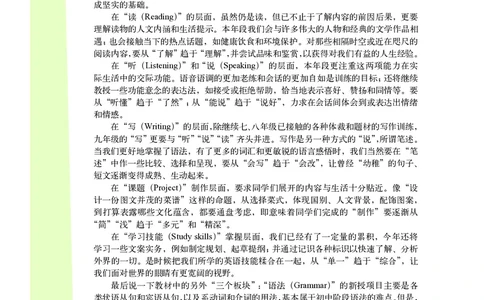
在(cid:272)(cid:1793)(Reading)(cid:273)的层面,虽然仍是(cid:1793),(cid:1677)(cid:4441)不止于了解(cid:3134)(cid:3513)的前(cid:4474)后果,更要
理解(cid:1793)物的人文(cid:3134)(cid:2149)和生活提示(cid:259)本年段我(cid:3021)(cid:2295)与许多(cid:4032)大的人物和经典的文学作品相
(cid:4572);也(cid:2295)接触当下的(cid:3492)点话题,如健康饮食和环境保护(cid:259)对(cid:3115)(cid:4213)相(cid:2032)时空或近在(cid:6253)(cid:1541)的
阅(cid:1793)(cid:3134)(cid:3513),要从(cid:272)了解(cid:273)(cid:3445)于(cid:272)理解(cid:273),(cid:1386)尝试品(cid:4038)和(cid:2412)(cid:3591),以获得对我(cid:3021)有益的人生经(cid:4371)(cid:259)
在(cid:272)(cid:3921)(Listening)(cid:273)和(cid:272) 说(Speaking)(cid:273)的层面,本年段更注重(cid:4740)(cid:2823)(cid:4188)能力在实
际生活中的交际功能(cid:259)语(cid:4476)语调的更加(cid:2747)练和(cid:2295)话的更加自如是训练的目标;还将继续
教授一(cid:4213)功能意(cid:3154)的表达法,如接受或(cid:2572)绝帮助,恰当地表示喜好、赞(cid:4377)和同情等(cid:259)要
从(cid:272)(cid:3921)(cid:1774)(cid:273)(cid:3445)于(cid:272)了然(cid:273);从(cid:272)能说(cid:273)(cid:3445)于(cid:272)说好(cid:273),力求在(cid:2295)话间体(cid:2295)到或表达出情(cid:4291)
和情感(cid:259)
在(cid:272)(cid:4224)(Writing)(cid:273)的层面,除继续(cid:3327)、(cid:1239)年级(cid:4441)接触的各种体(cid:1419)和题(cid:1420)的(cid:4224)作训练,
(cid:2549)年级的(cid:272)(cid:4224)(cid:273)更要与(cid:272)(cid:3921)(cid:273)(cid:272)说(cid:273)(cid:272)(cid:1793)(cid:273)齐头(cid:1386)进(cid:259)(cid:4224)作是(cid:2871)一种方式的(cid:272)说(cid:273),所(cid:4045)(cid:1332)(cid:3726)(cid:259)
当我(cid:3021)更好地(cid:4712)握了语法,有了更多的词(cid:2297)和更(cid:3066)(cid:3533)的语言感(cid:4098)时,我(cid:3021)当然要在(cid:272)(cid:1332)
(cid:3726)(cid:273)中作一(cid:4213)(cid:1330)较、(cid:4299)(cid:4661)和(cid:1520)现,要从(cid:272)(cid:2295)(cid:4224)(cid:273)(cid:3445)于(cid:272)(cid:2295)(cid:1984)(cid:273),让(cid:4668)经(cid:272)(cid:4541)(cid:4809)(cid:273)的(cid:2580)子、
短文(cid:4848)(cid:2423)变得成(cid:3716)、生动起来(cid:259)
在(cid:272)(cid:2652)题(Project)(cid:273)制作层面,要求同学(cid:3021)(cid:4699)开的(cid:3134)(cid:3513)与生活(cid:3654)分(cid:3917)近(cid:259)像(cid:272)设
计一(cid:1915)(cid:3950)文(cid:1386)(cid:2997)的(cid:1427)(cid:3319)(cid:273)(cid:4740)样的命题,从(cid:4299)(cid:4661)(cid:1427)式,体现国别、人文(cid:1309)(cid:2528),(cid:3238)(cid:3686)(cid:3950)(cid:1220),
到打算表(cid:2910)(cid:3112)(cid:4213)文化(cid:4624)含,(cid:1788)要通盘考虑,即意(cid:4038)着同学(cid:3021)(cid:3996)成的(cid:272)制作(cid:273)要(cid:4848)(cid:2423)从
(cid:272)(cid:2406)(cid:273)(cid:272)(cid:3377)(cid:273)(cid:3445)于(cid:272)多元(cid:273)和(cid:272)精(cid:3624)(cid:273)(cid:259)
在(cid:272)学习技能(Study skills)(cid:273)(cid:4712)握层面,我(cid:3021)(cid:4441)经有了一定量的(cid:2759)(cid:2323),今年还将
学习一(cid:4213)文(cid:1220)实务,(cid:2793)如制定规(cid:2244)、起(cid:1445)提(cid:2005);(cid:1386)通过记识各种标识以快速了解、分(cid:4102)
外界的一切(cid:259)是时(cid:2218)把我(cid:3021)所学的英语技能(cid:7647)合在一起,从(cid:272)单一(cid:273)(cid:3445)于(cid:272)(cid:4921)合(cid:273),让
我(cid:3021)面对世界的(cid:4357)(cid:2518)有更(cid:2683)(cid:2711)的视野(cid:259)
最后说一下教(cid:1420)中的(cid:2871)外(cid:272)三个(cid:1265)(cid:2679)(cid:273)(cid:470)(cid:272)语法(Grammar)(cid:273)的(cid:4238)授(cid:4188)目主要是各
(cid:2764)状语从(cid:2580)和(cid:1376)语从(cid:2580),以(cid:2340)系动词和介词的用法,(cid:2319)本属于初中(cid:2473)段语法的难点(cid:259)(cid:1677)是,
当我(cid:3021)(cid:2654)下(cid:4740)(cid:4213)(cid:272)(cid:2081)头(cid:273)以后,我(cid:3021)(cid:4441)然全面(cid:4712)握了英语的初级语法,在阅(cid:1793)和(cid:4224)作
上(cid:2295)有一个(cid:2677)(cid:1413)(cid:259)本年段的(cid:272)补充阅(cid:1793)(More practice)(cid:273)和(cid:272)文化角(Culture corner)(cid:273)
(cid:3654)分(cid:1919)富(cid:470)中国的(cid:2747)子,西方的(cid:3173)(cid:1817);主要英语国家间的英语也有差(cid:4468)(cid:475)多(cid:3002)有趣的(cid:3134)
(cid:3513)(cid:445)一定(cid:2295)给大家有益的(cid:3348)(cid:1713)(cid:259)
同学(cid:3021),(cid:3182)力(cid:1237),一定要让自己微笑着,自信地交出初中年段的最后一(cid:1915)答(cid:2589)(cid:445)
初中(cid:278)英语(cid:279)(cid:1354)(cid:4224)组
2012年12(cid:4614)上海教育出版社
(cid:3071)(cid:4231)
在教(cid:1420)(cid:1354)(cid:4224)的过程中,部分教师对(cid:1615)工作(cid:4558)以极大的帮助,特(cid:1615)感谢(cid:470)
安(cid:1933)(cid:5812)(cid:257)(cid:4844)(cid:257)成(cid:257)(cid:2894)(cid:1384)(cid:2704)(cid:257)(cid:1444)国(cid:2859)
(cid:85)(cid:112)(cid:111)(cid:122) (cid:69)(cid:98)(cid:109)(cid:102)上海教育出版社
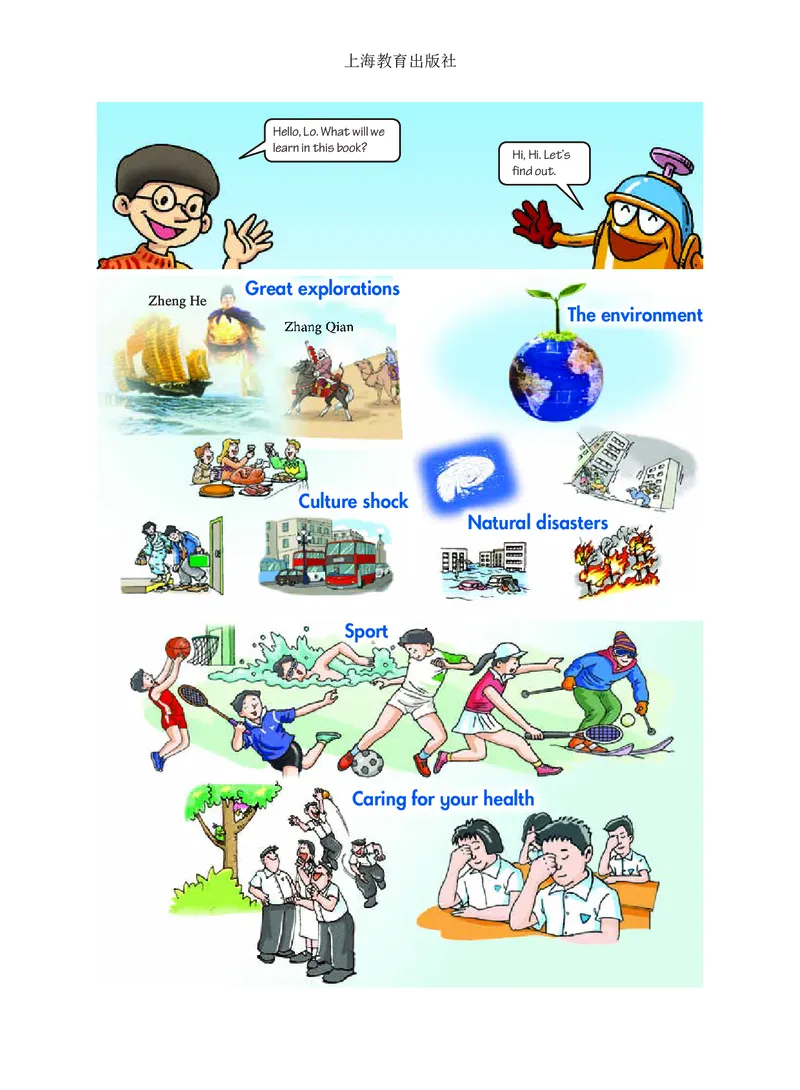
Hello, Lo. What will we
learn in this book?
Hi, Hi. Let’s
find out.
Great explorations
Zheng He
The environment
ZZhhaanngg QQiiaann
Culture shock
Natural disasters
Sport
Caring for your health上海教育出版社
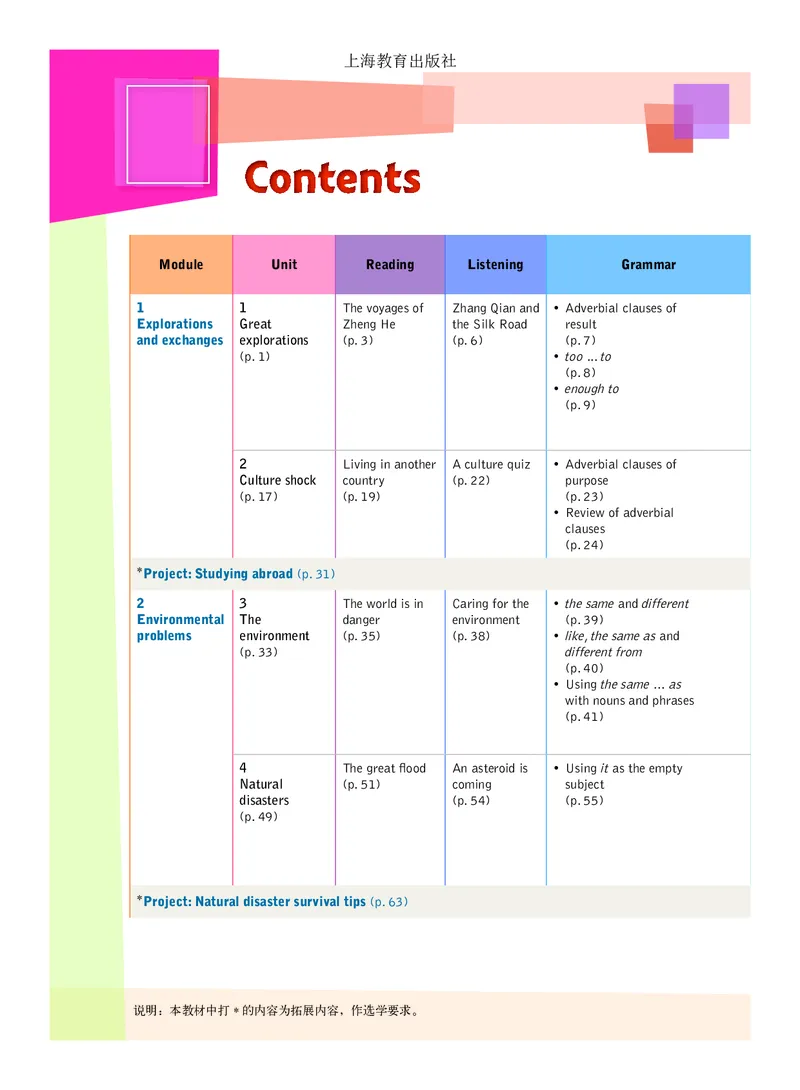
CCCooonnnttteeennntttsss
Speaking Culture corner
(cid:43)
Module Unit Reading Listening Grammar Writing More practice Study skills and
Talk time Speak up Self-assessment
1 1 The voyages of Zhang Qian and • Adverbial clauses of Askin(cid:72) for (cid:39)amous A famous travel (cid:46)arco (cid:49)olo Using • (cid:39)erdinand
Explorations Great Zheng He the Silk Road result repetition explorers writer (p. 13) reference Magellan
and exchanges explorations (p. 3) (p. 6) (p. 7) (p. 10) (p. 10) (p. 11) books (cid:9)(cid:22)(cid:10): (p. 16)
(p. 1) • too ... to Using • Self(cid:14)assessment
(p. 8) directories (p. 16)
• enou(cid:72)h to (p. 14)
(p. 9)
2 (cid:45)ivin(cid:72) in another A culture (cid:82)ui(cid:91) • Adverbial clauses of Discussin(cid:72) A summer A thank(cid:14)you (cid:38)ducation in — • (cid:38)n(cid:72)lish around
Culture shock country (p. 22) purpose similarities camp in China email the UK the world
(p. 17) (p. 19) (p. 23) and (p. 27) (p. 28) (p. 29) (p. 30)
• (cid:51)eview of adverbial differences • Self(cid:14)assessment
clauses (p. 26) (p. 30)
(p. 24)
(cid:43)
Project: Studying abroad (p. 31)
2 3 The world is in Carin(cid:72) for the • the same and different (cid:38)xpressin(cid:72) (cid:38)nvironmental A day in the life The journey of (cid:51)esearch • (cid:58)our carbon
Environmental The dan(cid:72)er environment (p. 39) concern problems in of (cid:40)ary (cid:40)reen a plastic bottle skills (cid:9)(cid:21)(cid:10): footprint
problems environment (cid:9)p. (cid:20)(cid:22)(cid:10) (p. 38) • like, the same as and (p. 42) our city (p. 43) (cid:9)p. (cid:21)(cid:22)(cid:10) Analysin(cid:72) the (p. 48)
(p. 33) different from (p. 42) results of a • Self(cid:14)assessment
(p. 40) (cid:82)uestionnaire (p. 48)
• (cid:54)sin(cid:72) the same ... as (p. 46)
with nouns and phrases
(p. 41)
4 The (cid:72)reat (cid:110)ood An asteroid is • (cid:54)sin(cid:72) it as the empty (cid:38)xpressin(cid:72) An emer(cid:72)ency Helping the The ice storm — • (cid:41)ow a typhoon
Natural (cid:9)p. (cid:22)(cid:18)(cid:10) comin(cid:72) subject feelings situation homeless after (p. 61) gets its name
disasters (cid:9)p. (cid:22)(cid:21)(cid:10) (cid:9)p. (cid:22)(cid:22)(cid:10) (cid:9)p. (cid:22)(cid:25)(cid:10) (cid:9)p. (cid:22)(cid:26)(cid:10) a typhoon (p. 62)
(p. 49) (p. 60) • Self(cid:14)assessment
(p. 62)
(cid:43)
Project: Natural disaster survival tips (p. 63)
说明(cid:470)本教(cid:1420)中打(cid:454)的(cid:3134)(cid:3513)为(cid:3978)(cid:4699)(cid:3134)(cid:3513),作(cid:4299)学要求(cid:259)上海教育出版社
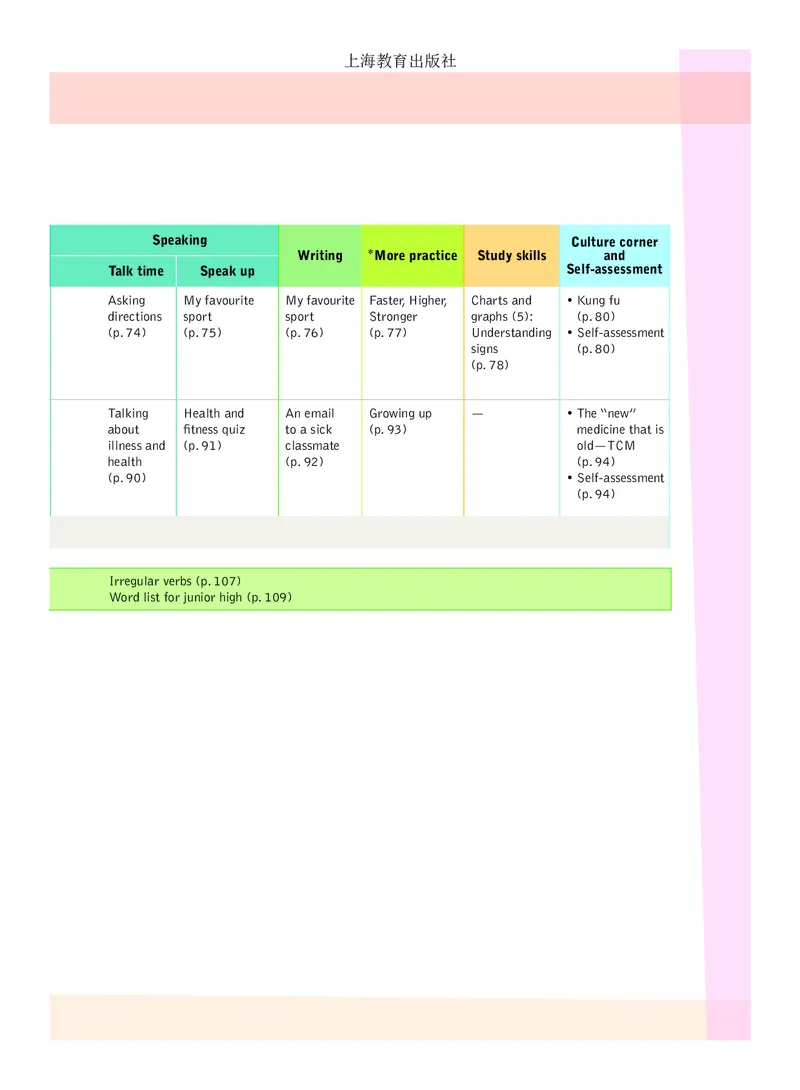
Speaking Culture corner
(cid:43)
Module Unit Reading Listening Grammar Writing More practice Study skills and
Talk time Speak up Self-assessment
1 1 The voyages of Zhang Qian and • Adverbial clauses of Askin(cid:72) for (cid:39)amous A famous travel (cid:46)arco (cid:49)olo (cid:43)Using • (cid:39)erdinand
Explorations Great Zheng He the Silk Road result repetition explorers writer (p. 13) reference Magellan
and exchanges explorations (p. 3) (p. 6) (p. 7) (p. 10) (p. 10) (p. 11) books (cid:9)(cid:22)(cid:10): (p. 16)
(p. 1) • too ... to Using • Self(cid:14)assessment
(p. 8) directories (p. 16)
• enou(cid:72)h to (p. 14)
(p. 9)
2 (cid:45)ivin(cid:72) in another A culture (cid:82)ui(cid:91) • Adverbial clauses of Discussin(cid:72) A summer A thank(cid:14)you (cid:38)ducation in — • (cid:38)n(cid:72)lish around
Culture shock country (p. 22) purpose similarities camp in China email the UK the world
(p. 17) (p. 19) (p. 23) and (p. 27) (p. 28) (p. 29) (p. 30)
• (cid:51)eview of adverbial differences • Self(cid:14)assessment
clauses (p. 26) (p. 30)
(p. 24)
(cid:43)
Project: Studying abroad (p. 31)
2 3 The world is in Carin(cid:72) for the • the same and different (cid:38)xpressin(cid:72) (cid:38)nvironmental A day in the life The journey of (cid:51)esearch • (cid:58)our carbon
Environmental The dan(cid:72)er environment (p. 39) concern problems in of (cid:40)ary (cid:40)reen a plastic bottle skills (cid:9)(cid:20)(cid:10): footprint
problems environment (cid:9)p. (cid:20)(cid:22)(cid:10) (p. 38) • like, the same as and (p. 42) our city (p. 43) (cid:9)p. (cid:21)(cid:22)(cid:10) Analysin(cid:72) the (p. 48)
(p. 33) different from (p. 42) results of a • Self(cid:14)assessment
(p. 40) (cid:82)uestionnaire (p. 48)
• (cid:54)sin(cid:72) the same ... as (p. 46)
with nouns and phrases
(p. 41)
4 The (cid:72)reat (cid:110)ood An asteroid is • (cid:54)sin(cid:72) it as the empty (cid:38)xpressin(cid:72) An emer(cid:72)ency Helping the The ice storm — • (cid:41)ow a typhoon
Natural (cid:9)p. (cid:22)(cid:18)(cid:10) comin(cid:72) subject feelings situation homeless after (p. 61) gets its name
disasters (cid:9)p. (cid:22)(cid:21)(cid:10) (cid:9)p. (cid:22)(cid:22)(cid:10) (cid:9)p. (cid:22)(cid:25)(cid:10) (cid:9)p. (cid:22)(cid:26)(cid:10) a typhoon (p. 62)
(p. 49) (p. 60) • Self(cid:14)assessment
(p. 62)
(cid:43)
Project: Natural disaster survival tips (p. 63)上海教育出版社
Speaking Culture corner
(cid:43)
Module Unit Reading Listening Grammar Writing More practice Study skills and
Talk time Speak up Self-assessment
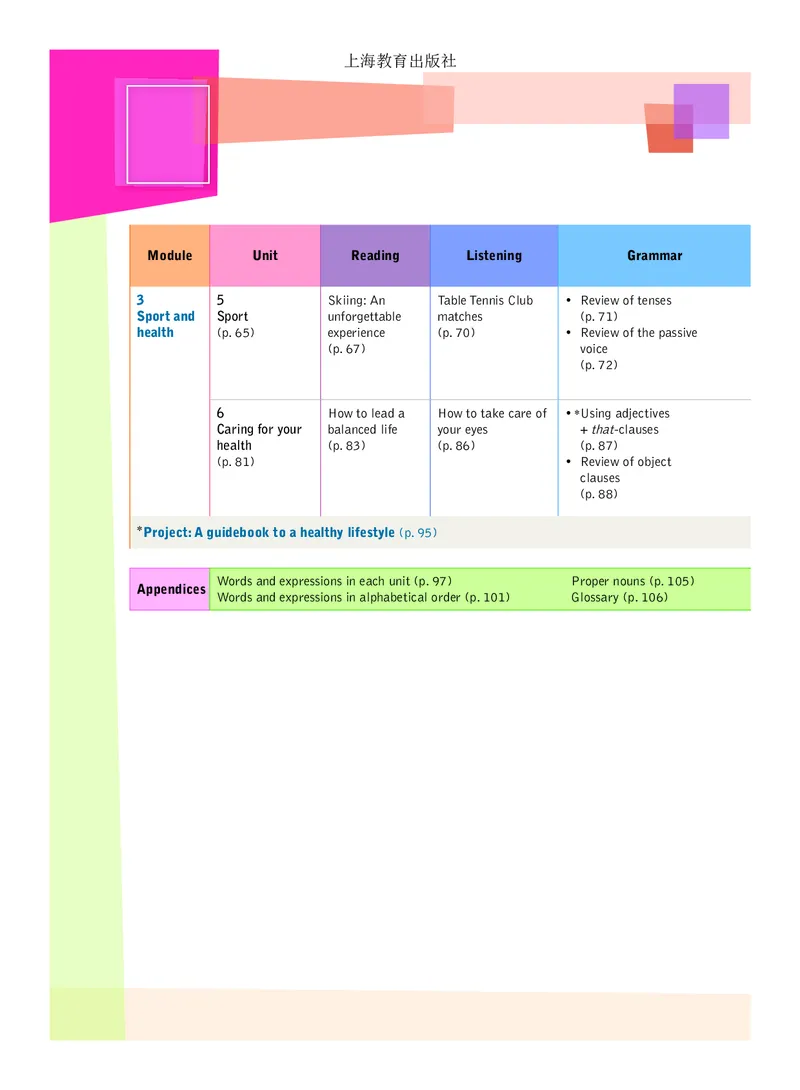
3 5 Skiin(cid:72): An Table Tennis Club • (cid:51)eview of tenses Askin(cid:72) (cid:46)y favourite (cid:46)y favourite (cid:39)aster(cid:13) (cid:41)i(cid:72)her(cid:13) Charts and • (cid:44)un(cid:72) fu
Sport and Sport unfor(cid:72)ettable matches (p. 71) directions sport sport Stron(cid:72)er (cid:72)raphs (cid:9)(cid:22)(cid:10): (p. 80)
health (cid:9)p. (cid:23)(cid:22)(cid:10) experience (p. 70) • (cid:51)eview of the passive (p. 74) (cid:9)p. (cid:24)(cid:22)(cid:10) (p. 76) (p. 77) (cid:54)nderstandin(cid:72) • Self(cid:14)assessment
(p. 67) voice signs (p. 80)
(p. 72) (p. 78)
6 How to lead a (cid:41)ow to take care of • (cid:43)(cid:54)sin(cid:72) adjectives Talking Health and An email (cid:40)rowin(cid:72) up — • The (cid:105)new(cid:119)
Caring for your balanced life your eyes + that(cid:14)clauses about (cid:109)tness (cid:82)ui(cid:91) to a sick (p. 93) medicine that is
health (p. 83) (p. 86) (p. 87) illness and (p. 91) classmate old—TC(cid:46)
(p. 81) • (cid:51)eview of object health (p. 92) (p. 94)
clauses (p. 90) • Self(cid:14)assessment
(p. 88) (p. 94)
(cid:43)
Project: A guidebook to a healthy lifestyle (cid:9)p. (cid:26)(cid:22)(cid:10)
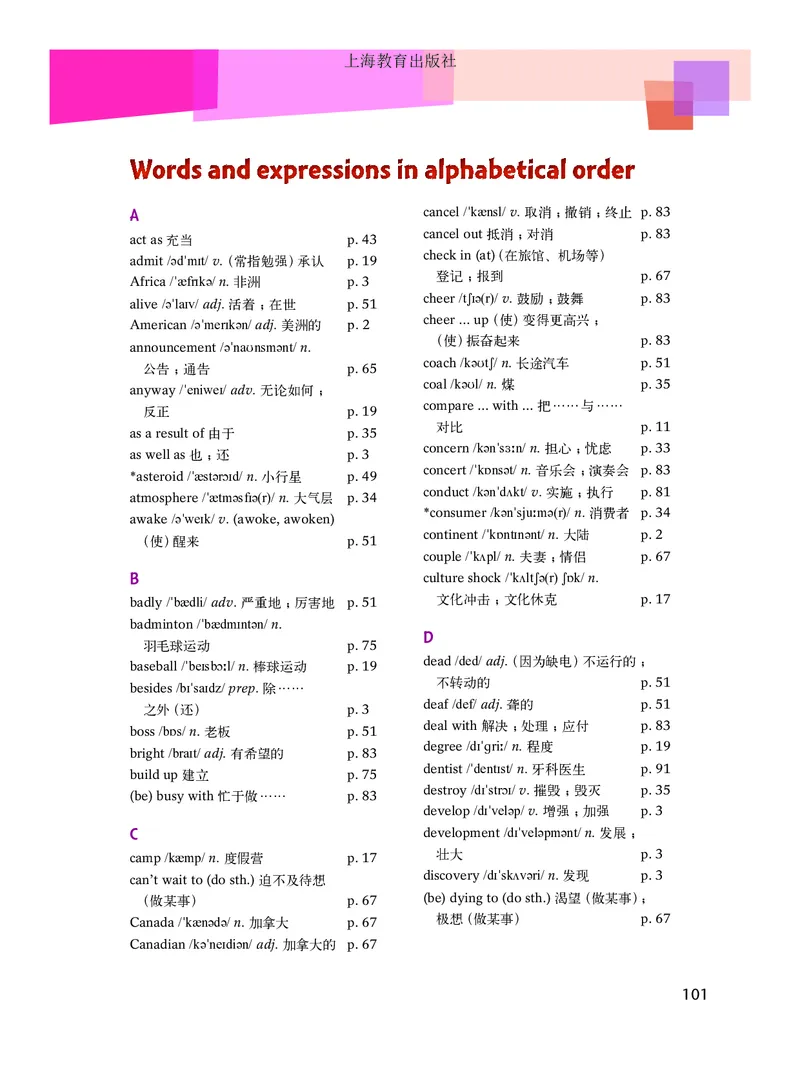
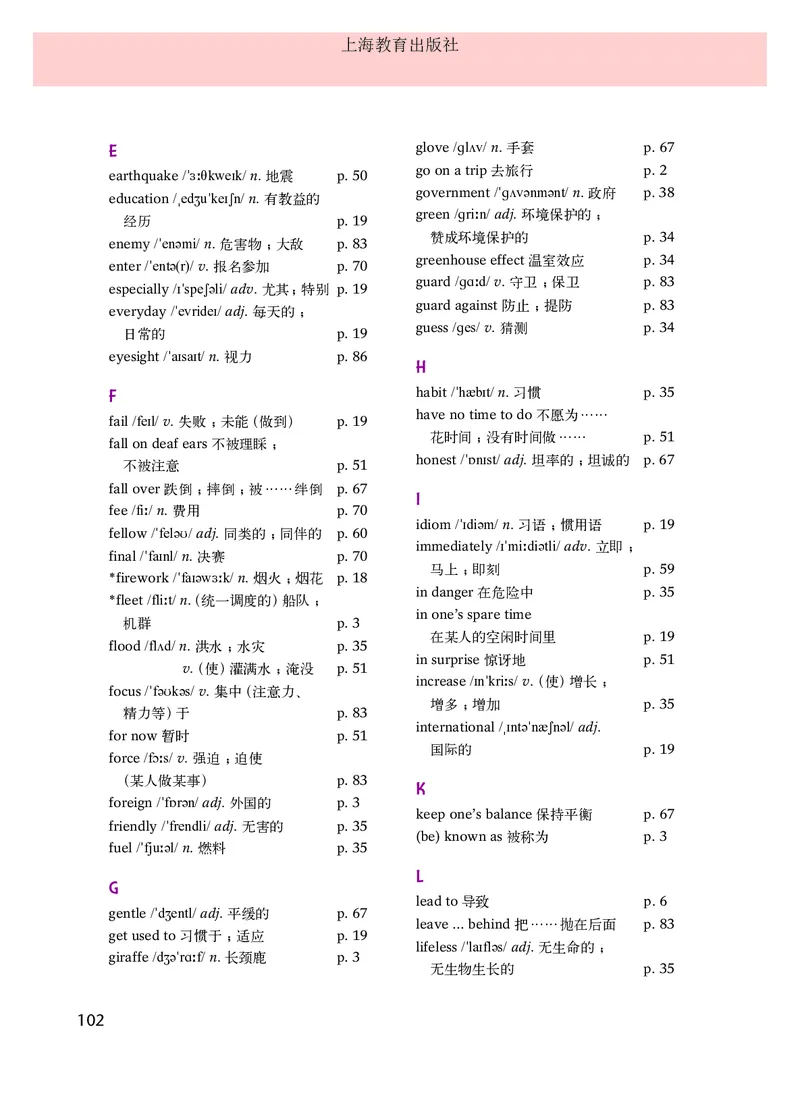
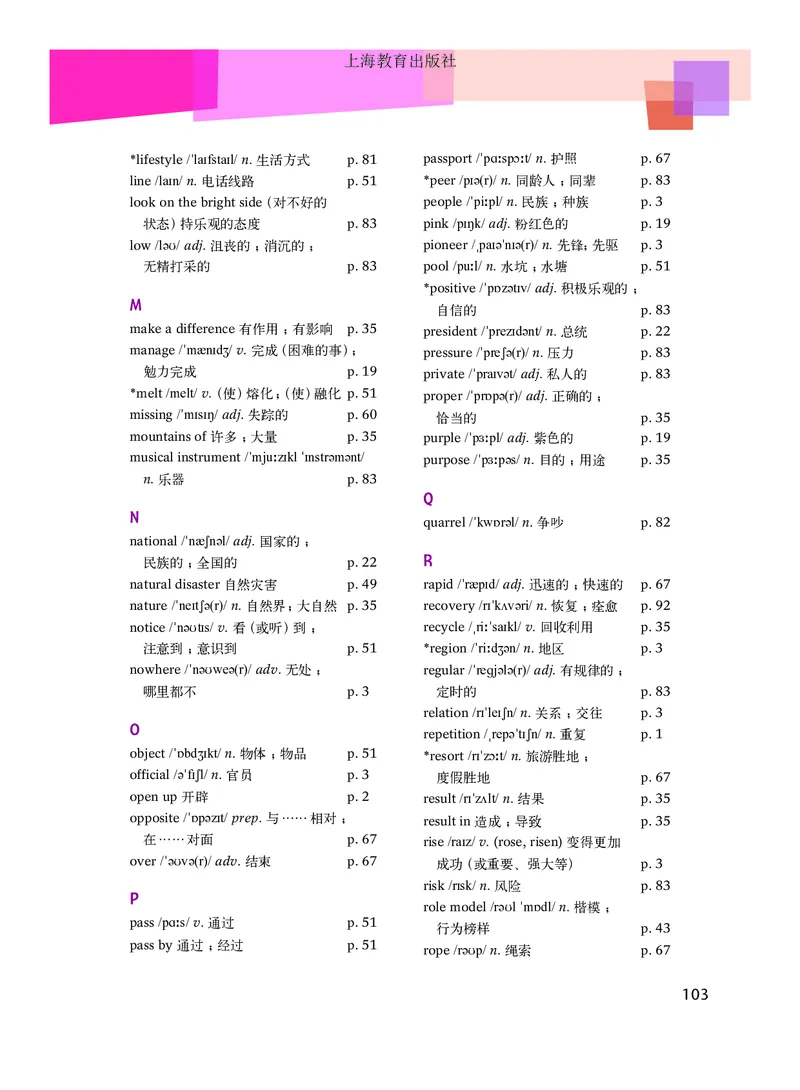
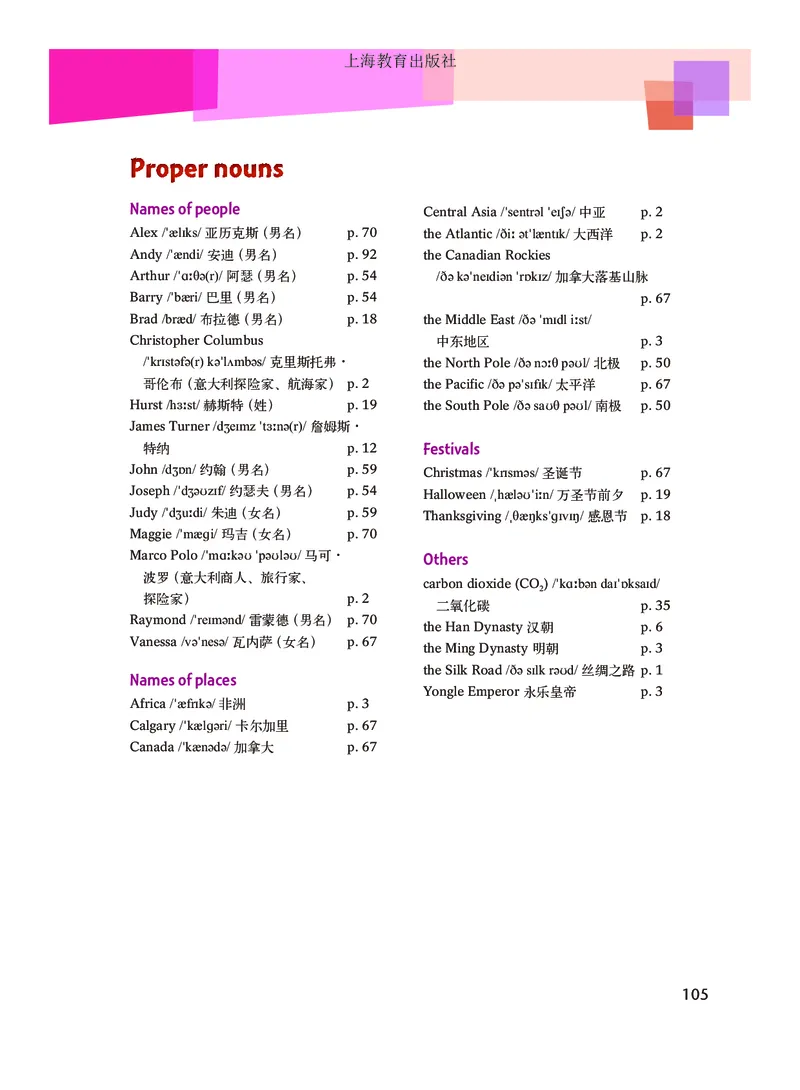
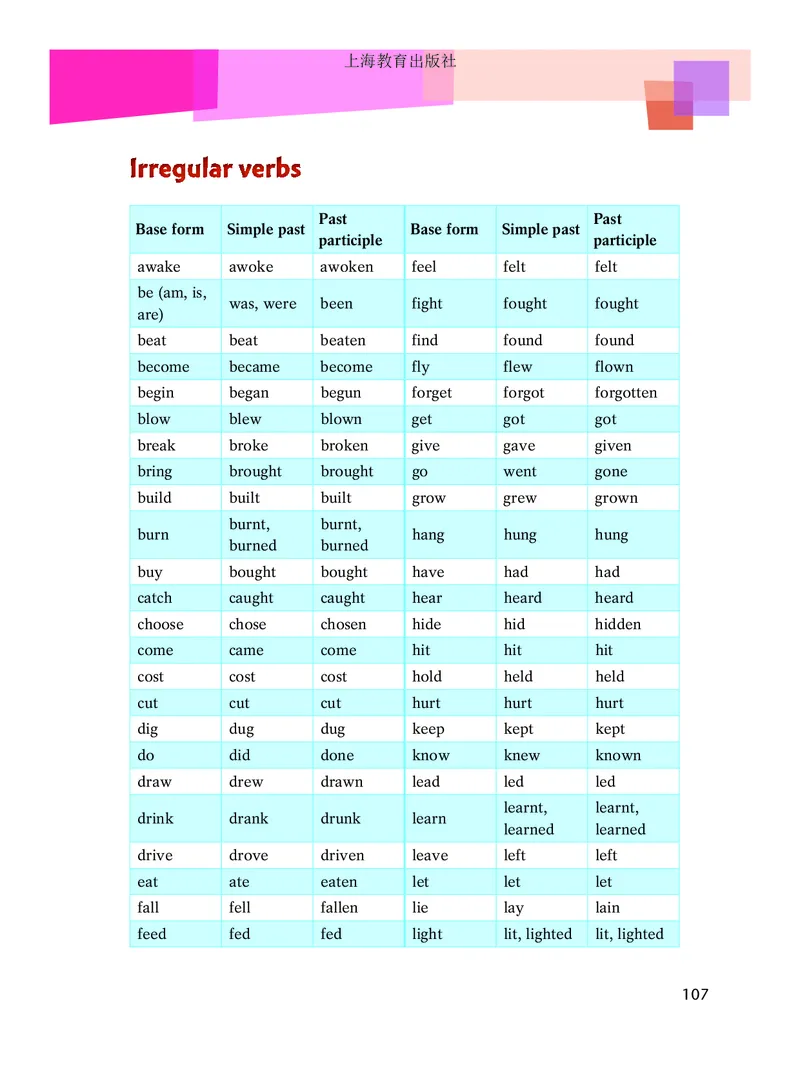
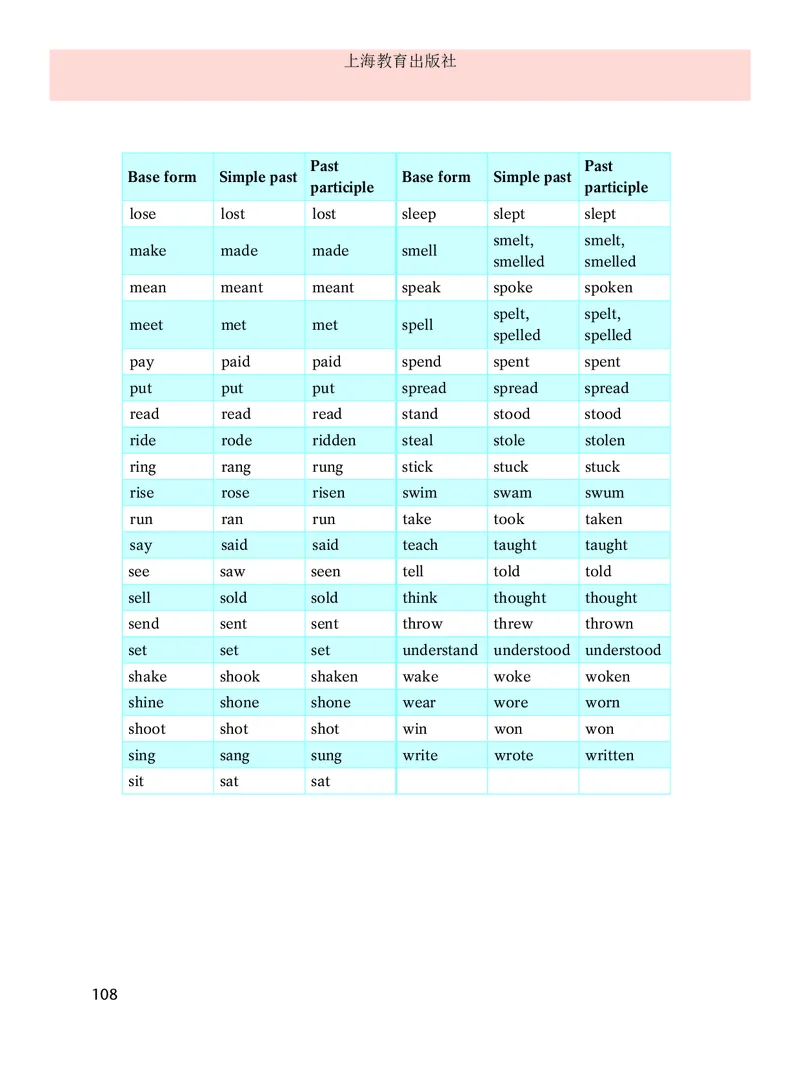
(cid:56)ords and expressions in each unit (cid:9)p. (cid:26)(cid:24)(cid:10) (cid:49)roper nouns (cid:9)p. (cid:18)(cid:17)(cid:22)(cid:10) (cid:42)rre(cid:72)ular verbs (cid:9)p. (cid:18)(cid:17)(cid:24)(cid:10)
Appendices
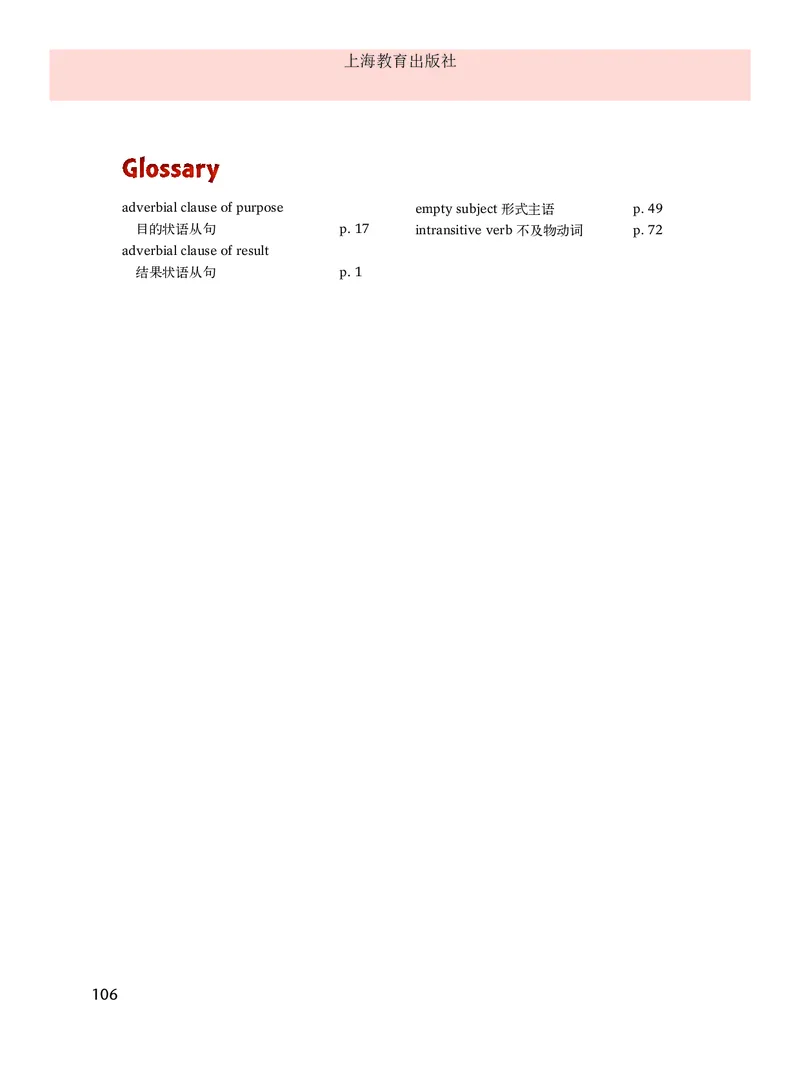
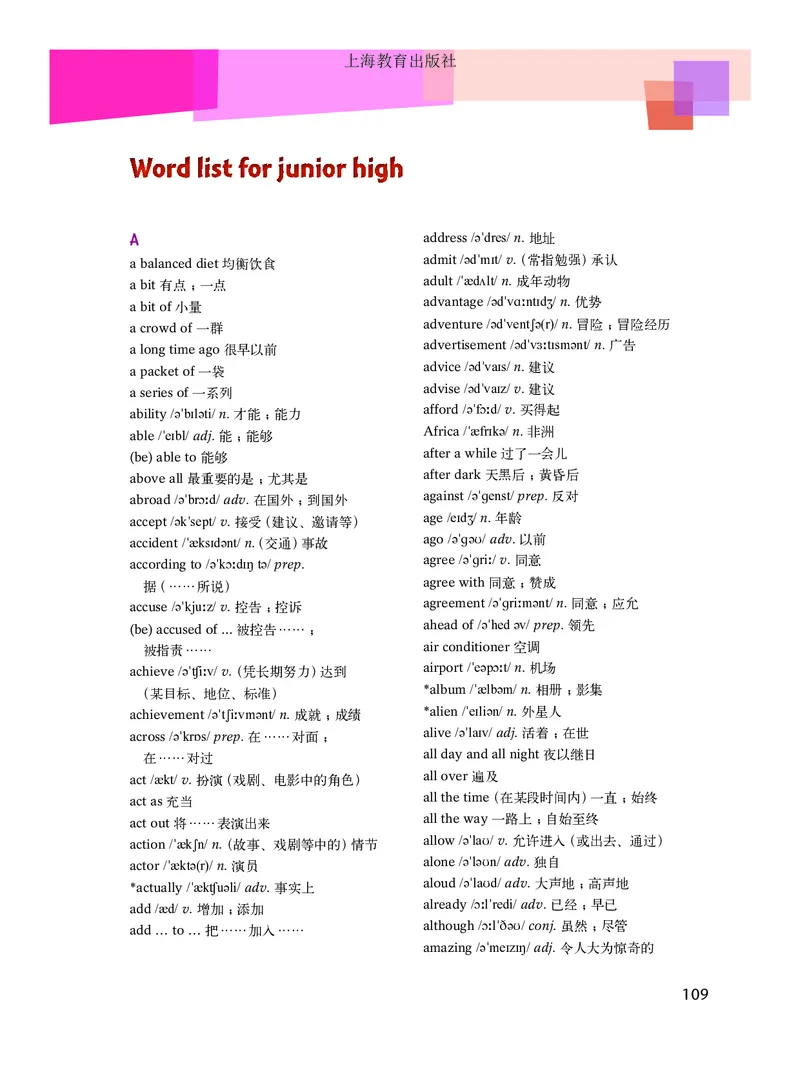
(cid:56)ords and expressions in alphabetical order (cid:9)p. (cid:18)(cid:17)(cid:18)(cid:10) (cid:40)lossary (cid:9)p. (cid:18)(cid:17)(cid:23)(cid:10) (cid:56)ord list for junior hi(cid:72)h (cid:9)p. (cid:18)(cid:17)(cid:26)(cid:10)上海教育出版社
Speaking Culture corner
(cid:43)
Module Unit Reading Listening Grammar Writing More practice Study skills and
Talk time Speak up Self-assessment
3 5 Skiin(cid:72): An Table Tennis Club • (cid:51)eview of tenses Askin(cid:72) (cid:46)y favourite (cid:46)y favourite (cid:39)aster(cid:13) (cid:41)i(cid:72)her(cid:13) Charts and • (cid:44)un(cid:72) fu
Sport and Sport unfor(cid:72)ettable matches (p. 71) directions sport sport Stron(cid:72)er (cid:72)raphs (cid:9)(cid:22)(cid:10): (p. 80)
health (cid:9)p. (cid:23)(cid:22)(cid:10) experience (p. 70) • (cid:51)eview of the passive (p. 74) (cid:9)p. (cid:24)(cid:22)(cid:10) (p. 76) (p. 77) (cid:54)nderstandin(cid:72) • Self(cid:14)assessment
(p. 67) voice signs (p. 80)
(p. 72) (p. 78)
6 How to lead a (cid:41)ow to take care of • (cid:54)sin(cid:72) adjectives Talking Health and An email (cid:40)rowin(cid:72) up — • The (cid:105)new(cid:119)
Caring for your balanced life your eyes + that(cid:14)clauses about (cid:109)tness (cid:82)ui(cid:91) to a sick (p. 93) medicine that is
health (p. 83) (p. 86) (p. 87) illness and (p. 91) classmate old—TC(cid:46)
(p. 81) • (cid:51)eview of object health (p. 92) (p. 94)
clauses (p. 90) • Self(cid:14)assessment
(p. 88) (p. 94)
(cid:43)
Project: A guidebook to a healthy lifestyle (cid:9)p. (cid:26)(cid:22)(cid:10)
(cid:56)ords and expressions in each unit (cid:9)p. (cid:26)(cid:24)(cid:10) (cid:49)roper nouns (cid:9)p. (cid:18)(cid:17)(cid:22)(cid:10) (cid:42)rre(cid:72)ular verbs (cid:9)p. (cid:18)(cid:17)(cid:24)(cid:10)
Appendices
(cid:56)ords and expressions in alphabetical order (cid:9)p. (cid:18)(cid:17)(cid:18)(cid:10) (cid:40)lossary (cid:9)p. (cid:18)(cid:17)(cid:23)(cid:10) (cid:56)ord list for junior hi(cid:72)h (cid:9)p. (cid:18)(cid:17)(cid:26)(cid:10)上海教育出版社上海教育出版社
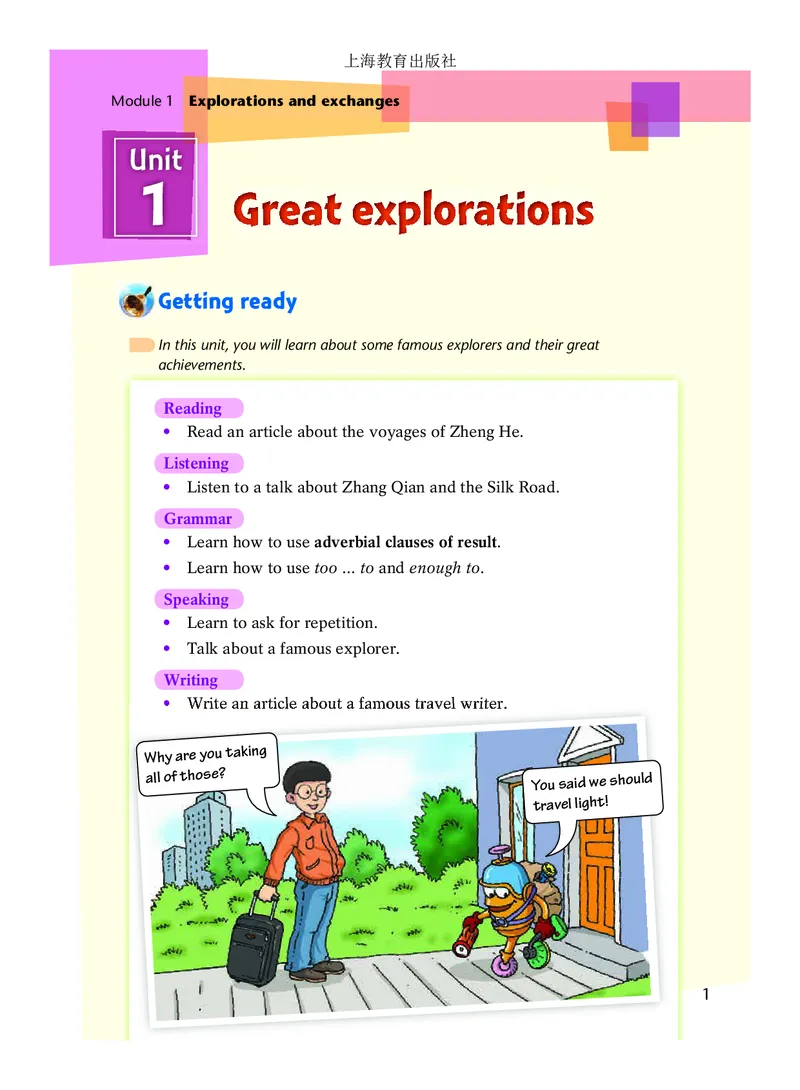
Module 1 Explorations and exchanges
Unit
1
GGGrrreeeaaattt eeexxxppplllooorrraaatttiiiooonnnsss
Getting ready
In this unit, you will learn about some famous explorers and their great
achievements.
Reading
• Read an article about the voyages of Zheng He.
Listening
• Listen to a talk about Zhang Qian and the Silk Road.
Grammar
• Learn how to use adverbial clauses of result.
• Learn how to use too ... to and enough to.
Speaking
• Learn to ask for repetition.
• Talk about a famous explorer.
Writing
•• WWrriittee aann aarrttiiccllee aabboouutt aa ffaammoouuss ttrraavveell wwrriitteerr..
Why are you taking
all of those? You said we should
travel light!
1上海教育出版社
Module 1
Reading
A What do you know about …?
The people in the pictures below are all famous explorers. Match them with their
achievements. Write the correct letters in the blanks.
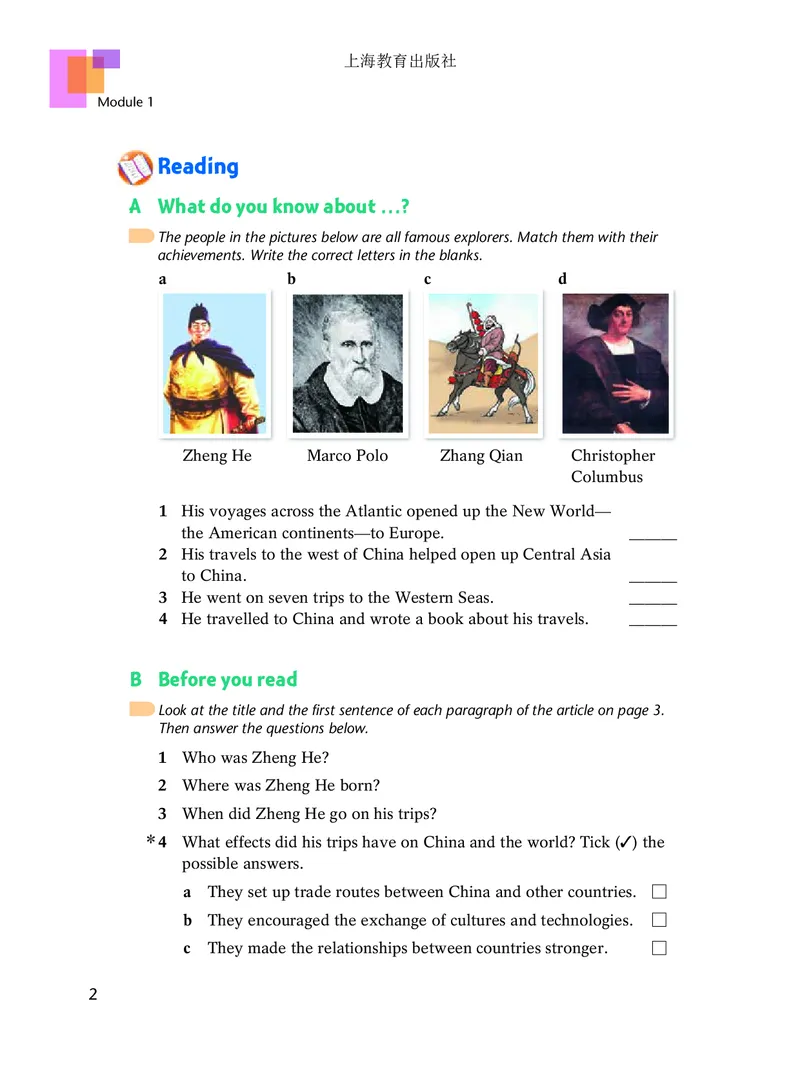
a b c d
Zheng He Marco Polo Zhang Qian Christopher
Columbus
1 His voyages across the Atlantic opened up the New World—
the American continents—to Europe. ______
2 His travels to the west of China helped open up Central Asia
to China. ______
3 He went on seven trips to the Western Seas. ______
4 He travelled to China and wrote a book about his travels. ______
B Before you read
Look at the title and the first sentence of each paragraph of the article on page 3.
Then answer the questions below.
1 Who was Zheng He?
2 Where was Zheng He born?
3 When did Zheng He go on his trips?
(cid:43)
4 What effects did his trips have on China and the world? Tick (3) the
possible answers.
a They set up trade routes between China and other countries.
b They encouraged the exchange of cultures and technologies.
c They made the relationships between countries stronger.
2上海教育出版社
Unit 1
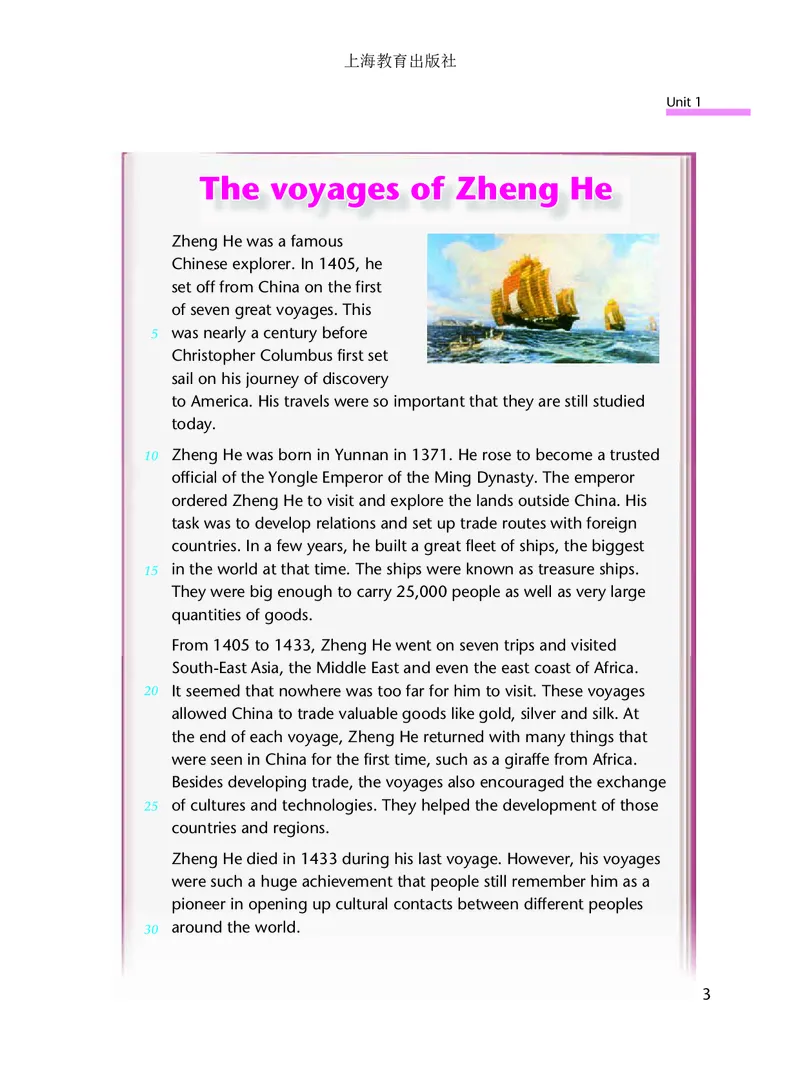
The voyages of Zheng He
Zheng He was a famous
Chinese explorer. In 1405, he
set off from China on the first
of seven great voyages. This
5 was nearly a century before
Christopher Columbus first set
sail on his journey of discovery
to America. His travels were so important that they are still studied
today.
10 Zheng He was born in Yunnan in 1371. He rose to become a trusted
official of the Yongle Emperor of the Ming Dynasty. The emperor
ordered Zheng He to visit and explore the lands outside China. His
task was to develop relations and set up trade routes with foreign
countries. In a few years, he built a great fleet of ships, the biggest
15 in the world at that time. The ships were known as treasure ships.
They were big enough to carry 25,000 people as well as very large
quantities of goods.
From 1405 to 1433, Zheng He went on seven trips and visited
South-East Asia, the Middle East and even the east coast of Africa.
20 It seemed that nowhere was too far for him to visit. These voyages
allowed China to trade valuable goods like gold, silver and silk. At
the end of each voyage, Zheng He returned with many things that
were seen in China for the first time, such as a giraffe from Africa.
Besides developing trade, the voyages also encouraged the exchange
25 of cultures and technologies. They helped the development of those
countries and regions.
Zheng He died in 1433 during his last voyage. However, his voyages
were such a huge achievement that people still remember him as a
pioneer in opening up cultural contacts between different peoples
around the world.
30
3上海教育出版社
Module 1
C Vocabulary
C1 The words in italics explain the meanings of some words on page 3. Find these
words to complete the sentences. Change their forms if necessary.
1 Columbus’s __________ of America began a new age of exploring.
(the act or process of finding)
2 He recently __________ to be a manager in his company. (became
more important or powerful)
3 This is __________ money. You cannot use it here. (from a country
that is not your own)
4 Next week, my family is going to __________ to Beijing, so we are
now getting ready. (make a journey)
5 Since 2000, this company has seen much new __________. It has
become one of the biggest companies in the country. (the process of
growing larger or becoming stronger)
C2 Complete the conversation below with the words from the box.
be known as go on a trip pioneer
develop open up set up
Jim: I want to (_1)____________ a modern Columbus when I grow up.
Julie: But there are no new places to (_2)____________ now.
Jim: That’s not really true. Most places in space haven’t been
explored yet. Who knows? There may be other planets like the
Earth.
Julie: That sounds crazy.
Jim: No, it doesn’t. Perhaps I could (_3)_________________ to space and
find these new planets. I would be a real _(4)____________. And
if I find other people on these planets, I could (_5)____________ a
relationship with them. I could even _(6)____________ trade with
them and make a lot of money.
Julie: Keep dreaming! I don’t think you will travel into space.
Jim: I’m serious. You’ll see.
4上海教育出版社
Unit 1
D Comprehension
D1 What do the italicized words in the following sentences refer to? Read the article on
page 3 to find the answers.
1 In 1405, Zheng He set off from China on
the first of these. ____________________
2 A great fleet of these were built for the
great voyages. ____________________
3 This was traded along with gold and silver. ____________________
4 Zheng He brought this back from Africa. ____________________
5 The voyages developed trade and
encouraged this. ____________________
D2 Read the article again and complete the following notes.
Zheng He
• was a famous Chinese (_1)_________________;
• was (cid:67)orn in (cid:58)unnan in _(2)____________;
• (cid:67)ecame a (_3)__________________________ of the Yongle Emperor;
• (cid:67)uilt a great fleet of treasure ships(cid:137)(cid:67)ig enough to carry
_(4)__________ people;
• went on se(cid:87)en trips from (cid:18)(cid:21)(cid:17)(cid:22) to (cid:18)(cid:21)(cid:20)(cid:20) and (cid:87)isited
_(5)__________________, _(6)______________________ and even
_(7)__________________________________.
Zheng He’s great voyages
• allowed China to trade (_8)__________________________________;
• (cid:67)rought (cid:67)ack _(9)____________________________________________;
• encouraged the exchange of cultures and technologies(cid:28)
• helped _(10_)______________________ of the countries and regions he
travelled to.
(cid:43)
D3 In groups, discuss the following questions.
1 Why is Zheng He called a “pioneer”?
2 Why were Zheng He’s voyages so important in history?
5上海教育出版社
Module 1
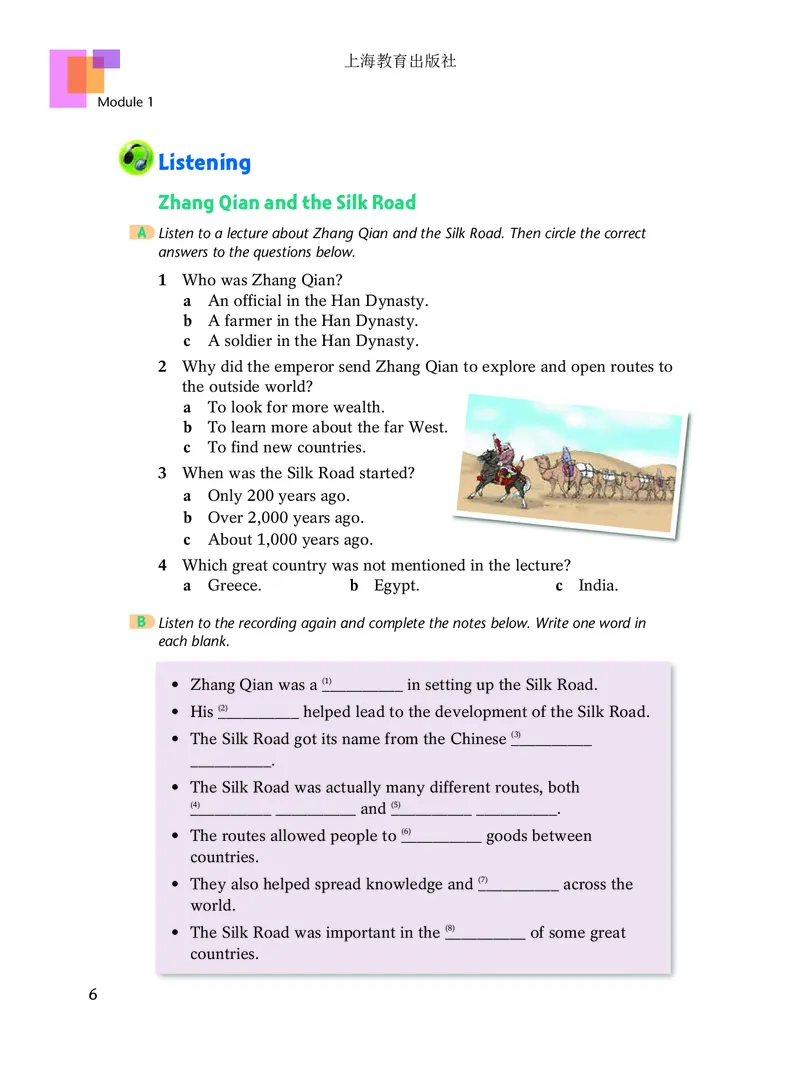
Listening
Zhang Qian and the Silk Road
A Listen to a lecture about Zhang Qian and the Silk Road. Then circle the correct
answers to the questions below.
1 Who was Zhang Qian?
a An official in the Han Dynasty.
b A farmer in the Han Dynasty.
c A soldier in the Han Dynasty.
2 Why did the emperor send Zhang Qian to explore and open routes to
the outside world?
a To look for more wealth.
b To learn more about the far West.
c To find new countries.
3 When was the Silk Road started?
a Only 200 years ago.
b Over 2,000 years ago.
c About 1,000 years ago.
4 Which great country was not mentioned in the lecture?
a Greece. b Egypt. c India.
B Listen to the recording again and complete the notes below. Write one word in
each blank.
• (cid:59)hang (cid:50)ian was a _(1)_________ in setting up the Silk Road.
• (cid:41)is _(2)_________ helped lead to the development of the Silk Road.
• The (cid:52)ilk Road got its name from the Chinese (_3)_________
__________.
• The (cid:52)ilk Road was actually many different routes, (cid:67)oth
_(4)_________ __________ and (_5)_________ __________.
• The routes allowed people to (_6)_________ goods between
countries.
• They also helped spread knowledge and _(7)_________ across the
world.
• The (cid:52)ilk Road was important in the (_8)_________ of some great
countries.
6上海教育出版社
Unit 1
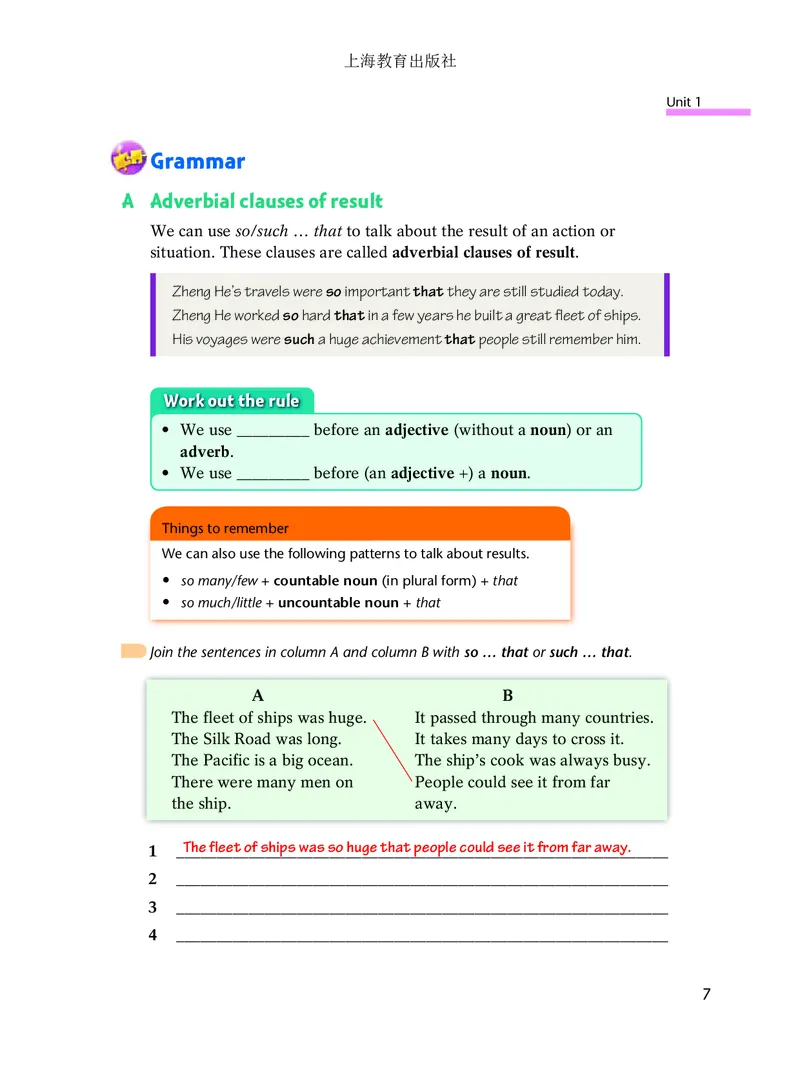
Grammar
A Adverbial clauses of result
We can use so/such … that to talk about the result of an action or
situation. These clauses are called adverbial clauses of result.
Zheng He’s travels were so important that they are still studied today.
Zheng He worked so hard that in a few years he built a great fleet of ships.
His voyages were such a huge achievement that people still remember him.
Work out the rule
• (cid:56)e use (cid:64)(cid:64)(cid:64)(cid:64)(cid:64)(cid:64)(cid:64)(cid:64)(cid:64) (cid:67)efore an adjective (without a noun) or an
adverb.
• (cid:56)e use (cid:64)(cid:64)(cid:64)(cid:64)(cid:64)(cid:64)(cid:64)(cid:64)(cid:64) (cid:67)efore (cid:9)an adjective +) a noun.
Things to remember
We can also use the following patterns to talk about results.
• so many/few + countable noun (in plural form) + that
• so much/little + uncountable noun + that
Join the sentences in column A and column B with so … that or such … that.
A B
The fleet of ships was huge. It passed through many countries.
The Silk Road was long. It takes many days to cross it.
The Pacific is a big ocean. The ship’s cook was always busy.
There were many men on People could see it from far
the ship. away.
1 _T_h_e_ _fl_e_e_t_ o_f_ s_h_ip_s_ _w_a_s_ s_o_ _h_u_ge_ _t_h_a_t_ p_e_o_p_le_ _c_o_ul_d_ s_e_e_ _it_ f_r_o_m_ _fa_r_ a_w__a_y._____
2 _____________________________________________________________
3 _____________________________________________________________
4 _____________________________________________________________
7上海教育出版社
Module 1
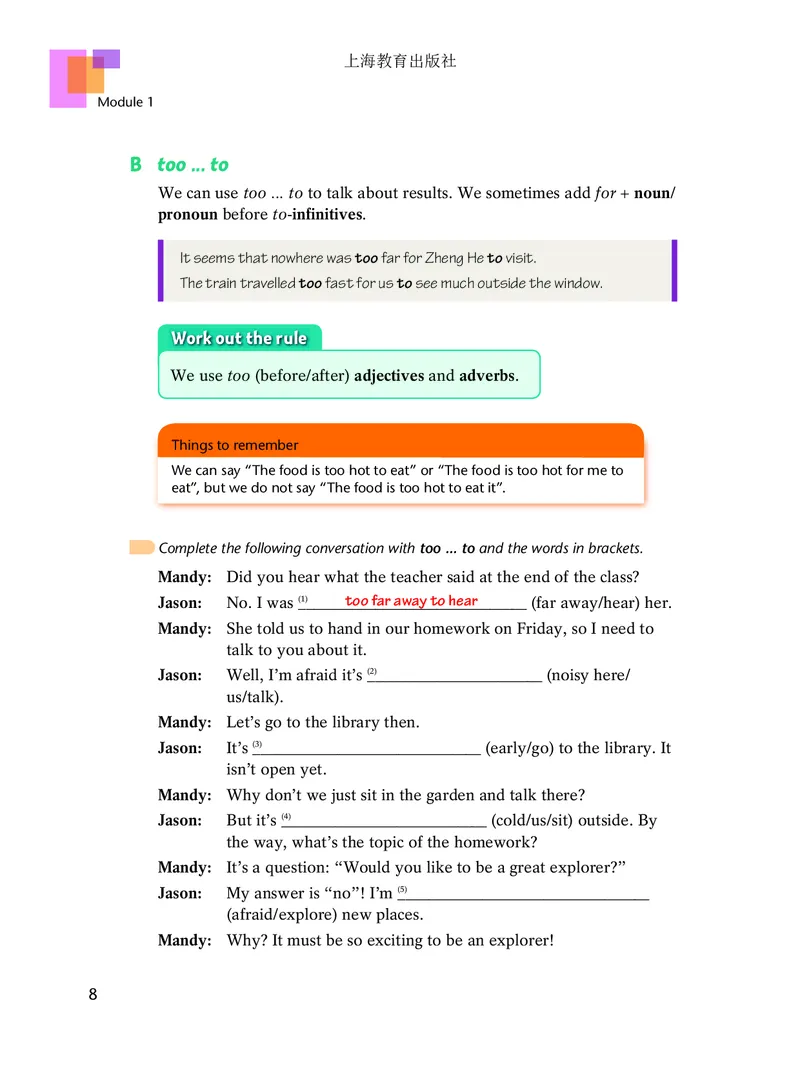
B too ... to
We can use too ... to to talk about results. We sometimes add for + noun/
pronoun before to-infinitives.
It seems that nowhere was too far for Zheng He to visit.
The train travelled too fast for us to see much outside the window.
Work out the rule
We use too (before/after) adjectives and adverbs.
Things to remember
We can say “The food is too hot to eat” or “The food is too hot for me to
eat”, but we do not say “The food is too hot to eat it”.
Complete the following conversation with too ... to and the words in brackets.
Mandy: Did you hear what the teacher said at the end of the class?
Jason: No. I was (_1)______t_o_o_ f_a_r_ a_w_a_y_ _t_o_ h_e_a_r_______ (far away/hear) her.
Mandy: She told us to hand in our homework on Friday, so I need to
talk to you about it.
Jason: Well, I’m afraid it’s (_2)______________________ (noisy here/
us/talk).
Mandy: Let’s go to the library then.
Jason: It’s _(3)_____________________________ (early/go) to the library. It
isn’t open yet.
Mandy: Why don’t we just sit in the garden and talk there?
Jason: But it’s (_4)__________________________ (cold/us/sit) outside. By
the way, what’s the topic of the homework?
Mandy: It’s a question: “Would you like to be a great explorer?”
Jason: My answer is “no”! I’m (_5)________________________________
(afraid/explore) new places.
Mandy: Why? It must be so exciting to be an explorer!
8上海教育出版社
Unit 1
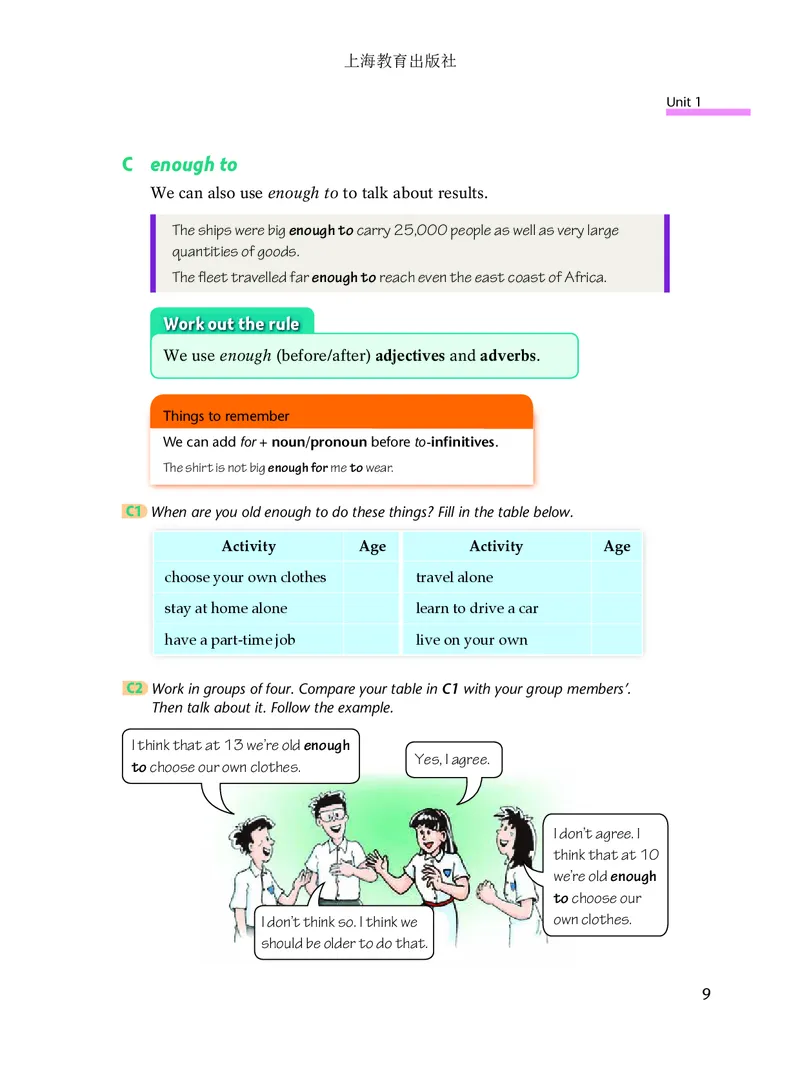
C enough to
We can also use enough to to talk about results.
The ships were big enough to carry 25,000 people as well as very large
quantities of goods.
The fleet travelled far enough to reach even the east coast of Africa.
Work out the rule
We use enough (before/after) adjectives and adverbs.
Things to remember
We can add for + noun/pronoun before to-infinitives.
The shirt is not big enough for me to wear.
C1 When are you old enough to do these things? Fill in the table below.
Activity Age Activity Age
choose your own clothes travel alone
stay at home alone learn to drive a car
have a part-time job live on your own
C2 Work in groups of four. Compare your table in C1 with your group members’.
Then talk about it. Follow the example.
I think that at 13 we’re old enough
Yes, I agree.
to choose our own clothes.
I don’t agree. I
think that at 10
we’re old enough
to choose our
I don’t think so. I think we own clothes.
should be older to do that.
9上海教育出版社
Module 1
Speaking
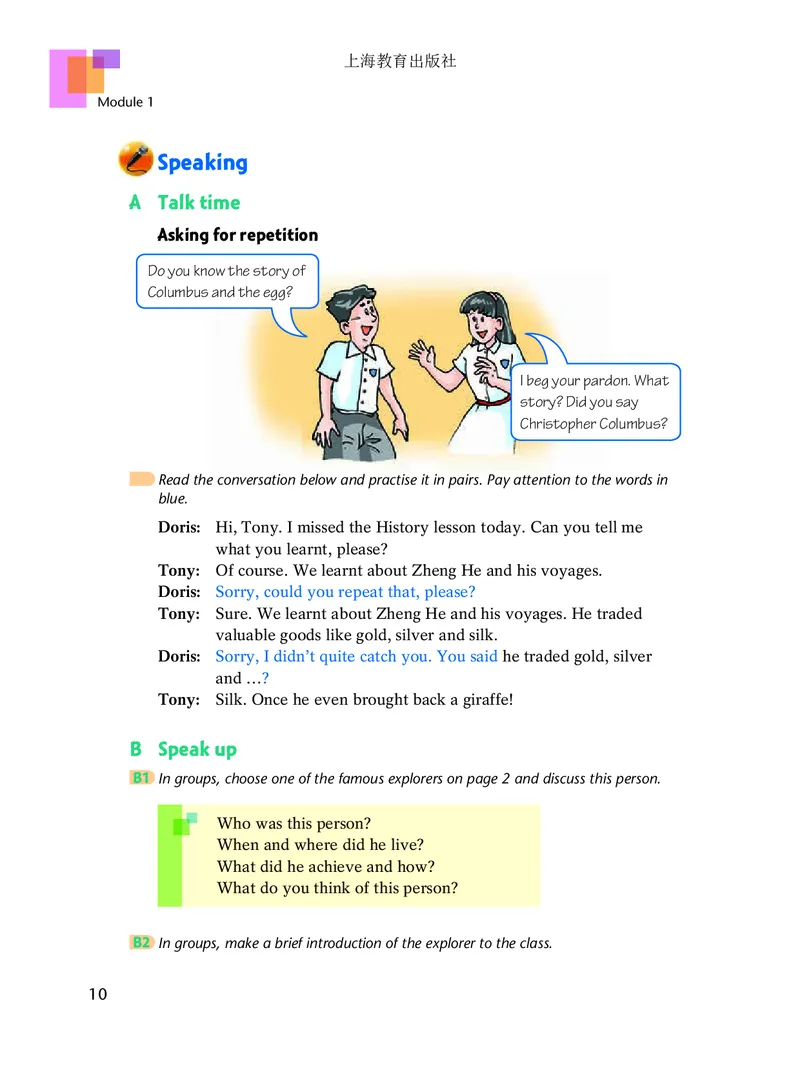
A Talk time
Asking for repetition
Do you know the story of
Columbus and the egg?
I beg your pardon. What
story? Did you say
Christopher Columbus?
Read the conversation below and practise it in pairs. Pay attention to the words in
blue.
Doris: Hi, Tony. I missed the History lesson today. Can you tell me
what you learnt, please?
Tony: Of course. We learnt about Zheng He and his voyages.
Doris: Sorry, could you repeat that, please?
Tony: Sure. We learnt about Zheng He and his voyages. He traded
valuable goods like gold, silver and silk.
Doris: Sorry, I didn’t quite catch you. You said he traded gold, silver
and …?
Tony: Silk. Once he even brought back a giraffe!
B Speak up
B1 In groups, choose one of the famous explorers on page 2 and discuss this person.
Who was this person?
When and where did he live?
What did he achieve and how?
What do you think of this person?
B2 In groups, make a brief introduction of the explorer to the class.
10上海教育出版社
Unit 1
Writing
A famous travel writer
A James Turner is a famous travel writer. Here is part of an interview with him. Work
in pairs to match the answers with the questions. Write the letters in the boxes.
Questions
1 When and where were you born?
2 What did your parents do?
3 What did you do when you left school?
4 How did you start writing your first book?
5 What do you like to write about?
6 What’s your next book about?
Answers
a My father was a cook, and my mother was a writer.
b In London in 1970.
c I’m following the route that was taken by Marco
Polo. I’m planning to write a book about him and his
journey.
d I usually write while I’m
travelling, so my first
book started from the notes I took.
e At first, I got a job at a f I like to write about the
travel company. However, places I visit. I often
I wanted to explore the compare their cultures
world myself! Then I went with my own. It helps
to China to teach English. me learn more about
From there I explored the the world.
rest of Asia.
11上海教育出版社
Module 1
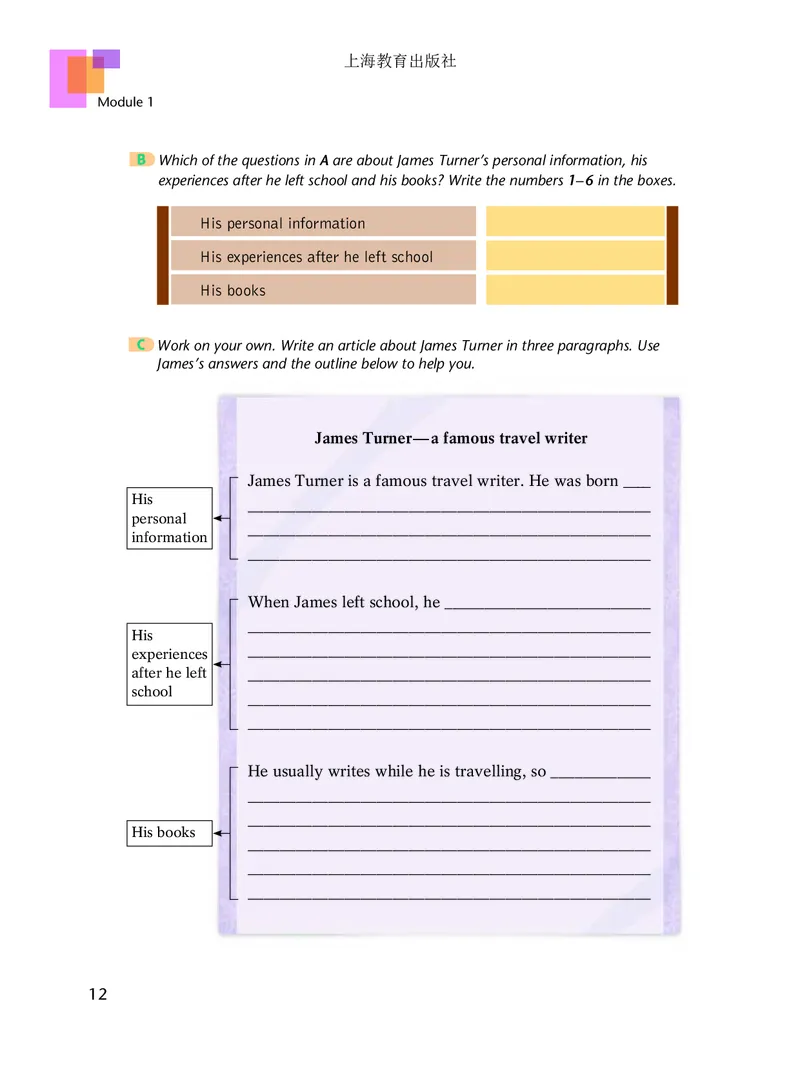
B Which of the questions in A are about James Turner’s personal information, his
experiences after he left school and his books? Write the numbers 1–6 in the boxes.
His personal information
His experiences after he left school
His books
C Work on your own. Write an article about James Turner in three paragraphs. Use
James’s answers and the outline below to help you.
James Turner —a famous travel writer
James Turner is a famous travel writer. He was born ____
His
__________________________________________________
personal
__________________________________________________
information
__________________________________________________
When James left school, he __________________________
__________________________________________________
His
__________________________________________________
experiences
after he left __________________________________________________
school
__________________________________________________
__________________________________________________
He usually writes while he is travelling, so ____________
__________________________________________________
__________________________________________________
His books
__________________________________________________
__________________________________________________
__________________________________________________
12上海教育出版社
Unit 1
(cid:43)
More practice
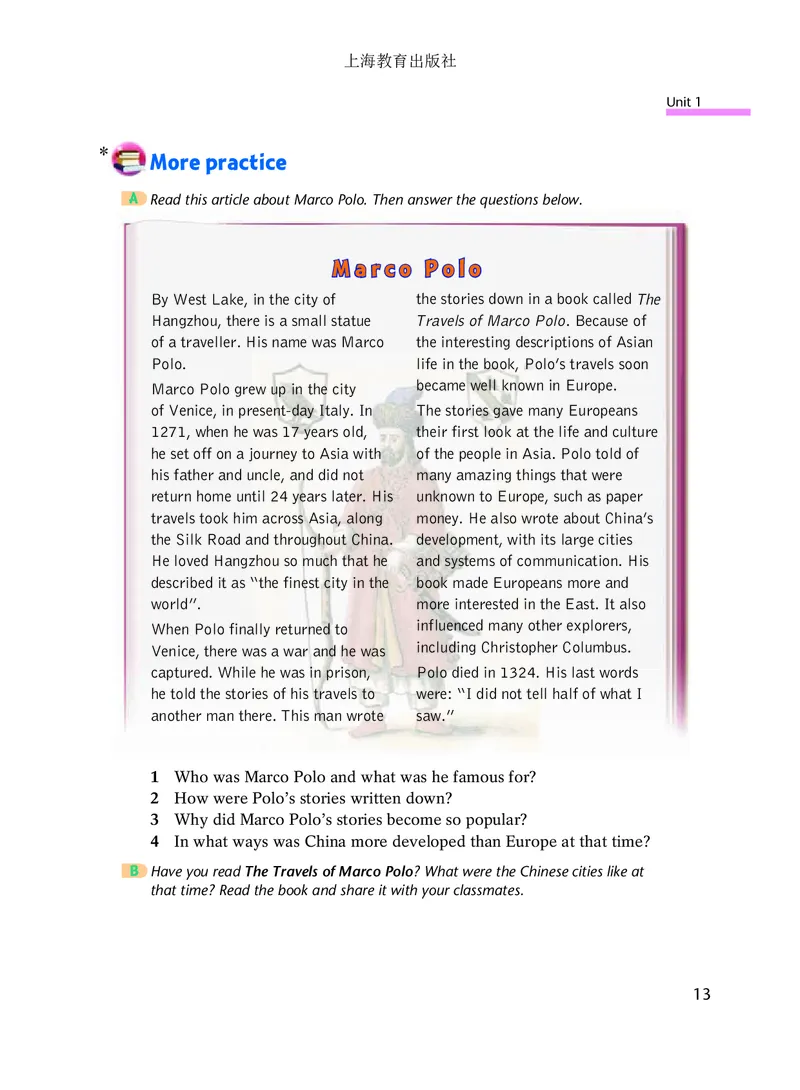
A Read this article about Marco Polo. Then answer the questions below.
M a r c o P o l o
By West Lake, in the city of the stories down in a book called The
Hangzhou, there is a small statue Travels of Marco Polo. Because of
of a traveller. His name was Marco the interesting descriptions of Asian
Polo. life in the book, Polo’s travels soon
Marco Polo grew up in the city became well known in Europe.
of Venice, in present-day Italy. In The stories gave many Europeans
1271, when he was 17 years old, their first look at the life and culture
he set off on a journey to Asia with of the people in Asia. Polo told of
his father and uncle, and did not many amazing things that were
return home until 24 years later. His unknown to Europe, such as paper
travels took him across Asia, along money. He also wrote about China’s
the Silk Road and throughout China. development, with its large cities
He loved Hangzhou so much that he and systems of communication. His
described it as “the finest city in the book made Europeans more and
world”. more interested in the East. It also
When Polo finally returned to influenced many other explorers,
Venice, there was a war and he was including Christopher Columbus.
captured. While he was in prison, Polo died in 1324. His last words
he told the stories of his travels to were: “I did not tell half of what I
another man there. This man wrote saw.”
1 Who was Marco Polo and what was he famous for?
2 How were Polo’s stories written down?
3 Why did Marco Polo’s stories become so popular?
4 In what ways was China more developed than Europe at that time?
B Have you read The Travels of Marco Polo? What were the Chinese cities like at
that time? Read the book and share it with your classmates.
13上海教育出版社
Module 1
Study skills
(cid:43)
Using reference books (5): Using directories
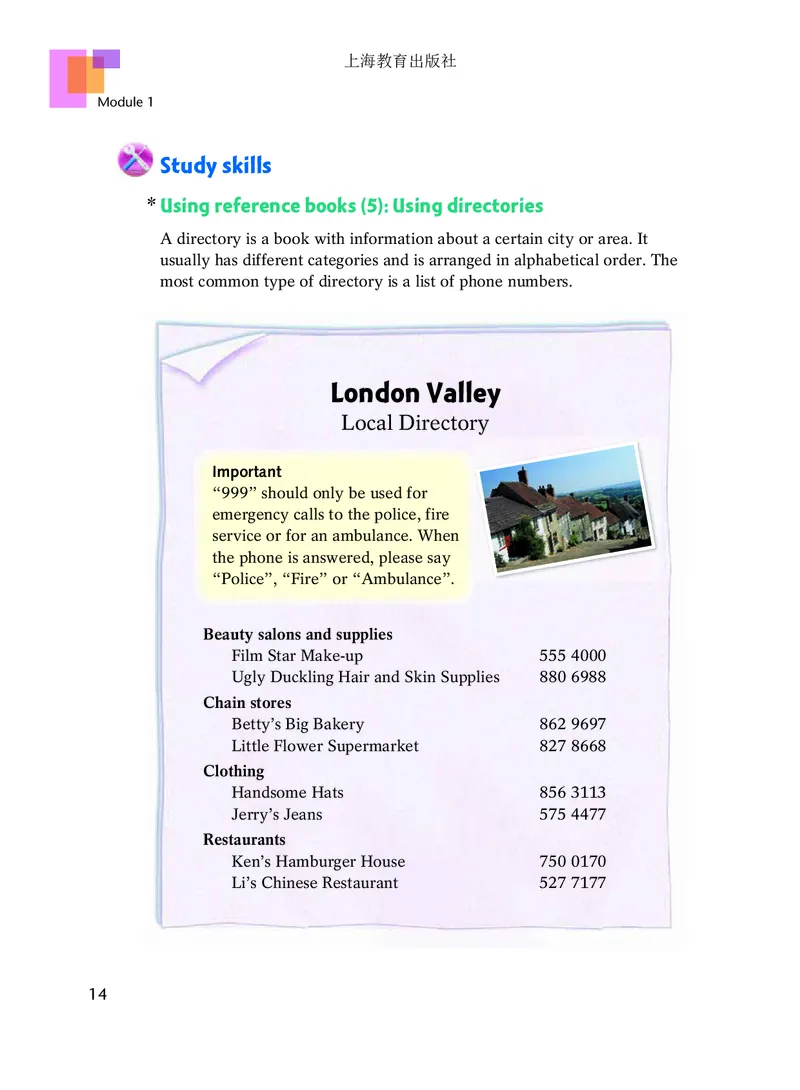
A directory is a book with information about a certain city or area. It
usually has different categories and is arranged in alphabetical order. The
most common type of directory is a list of phone numbers.
London Valley
Local Directory
Important
“999” should only be used for
emergency calls to the police, fire
service or for an ambulance. When
the phone is answered, please say
“Police”, “Fire” or “Ambulance”.
Beauty salons and supplies
Film Star Make-up 555 4000
Ugly Duckling Hair and Skin Supplies 880 6988
Chain stores
Betty’s Big Bakery 862 9697
Little Flower Supermarket 827 8668
Clothing
Handsome Hats 856 3113
Jerry’s Jeans 575 4477
Restaurants
Ken’s Hamburger House 750 0170
Li’s Chinese Restaurant 527 7177
14上海教育出版社
Unit 1
A Scan the directory on page 14 and answer the following questions.
1 What kind of directory is it?
_____________________________________________________________
2 How many categories does it have?
_____________________________________________________________
3 How many places are there in each category?
_____________________________________________________________
B Use the information in the directory to answer the following questions.
1 What number might you call if you wanted to eat some Chinese food?
_____________________________________________________________
2 What would you do if someone stole your bag?
_____________________________________________________________
3 What number might you call if you wanted to find some special
jeans?
_____________________________________________________________
C Read the remarks below and write down the numbers these people called. Use the
information in the directory to help you.
Remark Phone number
1 “Do you sell make-up from the _____________
UK?”
2 “Do you have any hats for babies?” _____________
3 “A chocolate cake, please. My _____________
address is …”
4 “Ambulance.” _____________
15上海教育出版社
Module 1
Culture corner
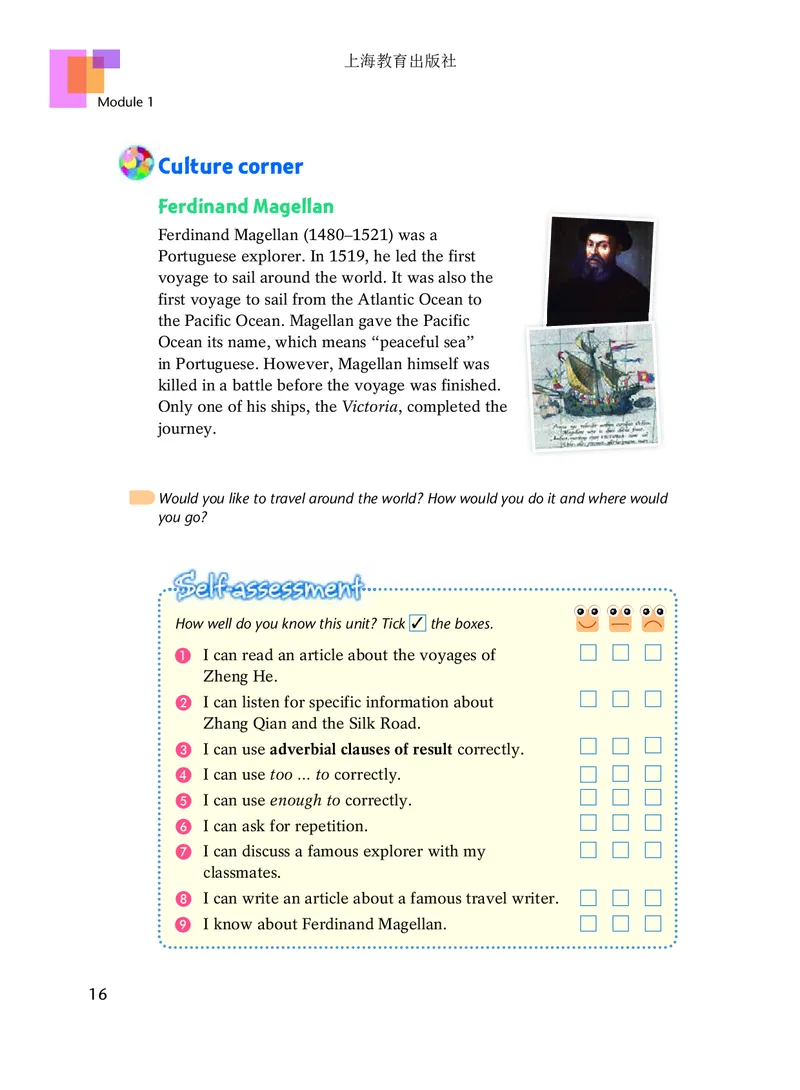
Ferdinand Magellan
Ferdinand Magellan (1480–1521) was a
Portuguese explorer. In 1519, he led the first
voyage to sail around the world. It was also the
first voyage to sail from the Atlantic Ocean to
the Pacific Ocean. Magellan gave the Pacific
Ocean its name, which means “peaceful sea”
in Portuguese. However, Magellan himself was
killed in a battle before the voyage was finished.
Only one of his ships, the Victoria, completed the
journey.
Would you like to travel around the world? How would you do it and where would
you go?
How well do you know this unit? Tick ✓ the boxes.
❶ I can read an article about the voyages of
Zheng He.
❷ I can listen for specific information about
Zhang Qian and the Silk Road.
❸ I can use adverbial clauses of result correctly.
❹ I can use too ... to correctly.
❺ I can use enough to correctly.
❻ I can ask for repetition.
❼ I can discuss a famous explorer with my
classmates.
(cid:28) I can write an article about a famous travel writer.
(cid:29) I know about Ferdinand Magellan.
16上海教育出版社
Module 1 Explorations and exchanges
Unit
2
CCCuuullltttuuurrreee ssshhhoooccckkk
Getting ready
In this unit, you will learn about cultural differences.
Reading
• Read a speech about a Chinese student’s experience in the US.
Listening
• Listen to a quiz about American culture.
Grammar
• Learn how to use adverbial clauses of purpose.
• Review adverbial clauses.
Speaking
• Learn to discuss similarities and differences.
• Talk about a summer camp in China.
Writing
• Write a thank-you email.
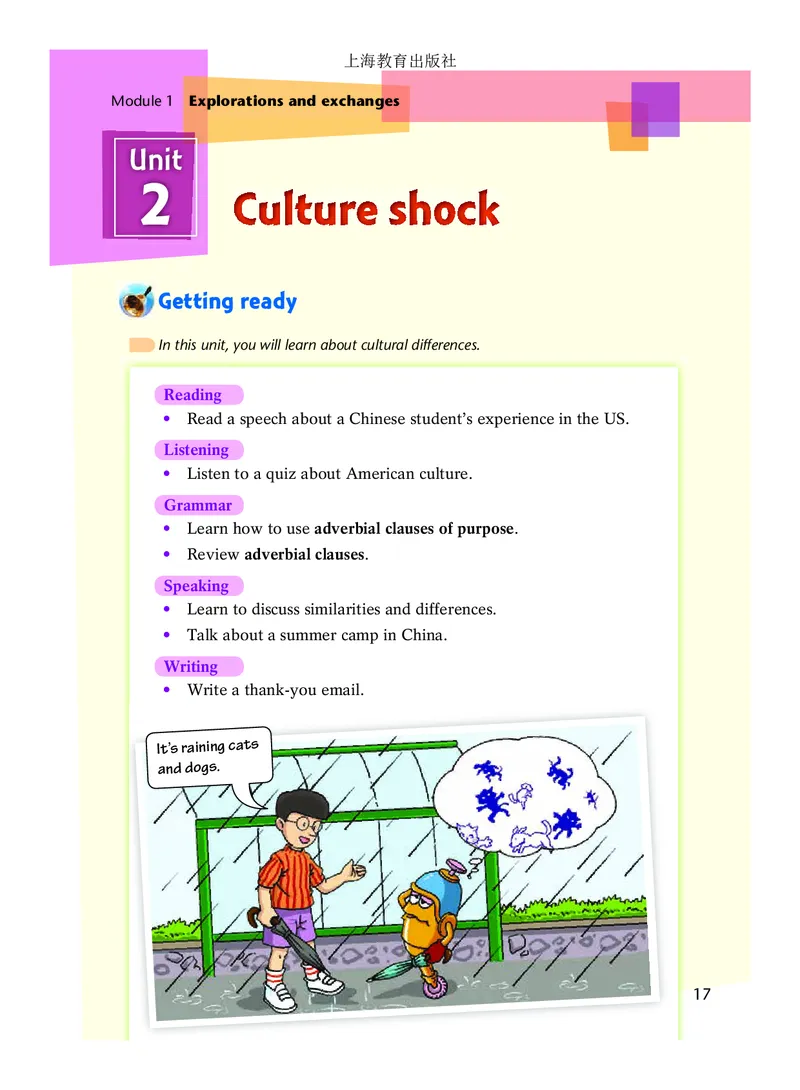
It’s raining cats
and dogs.
17上海教育出版社
Module 1
Reading
A What do you know about …?
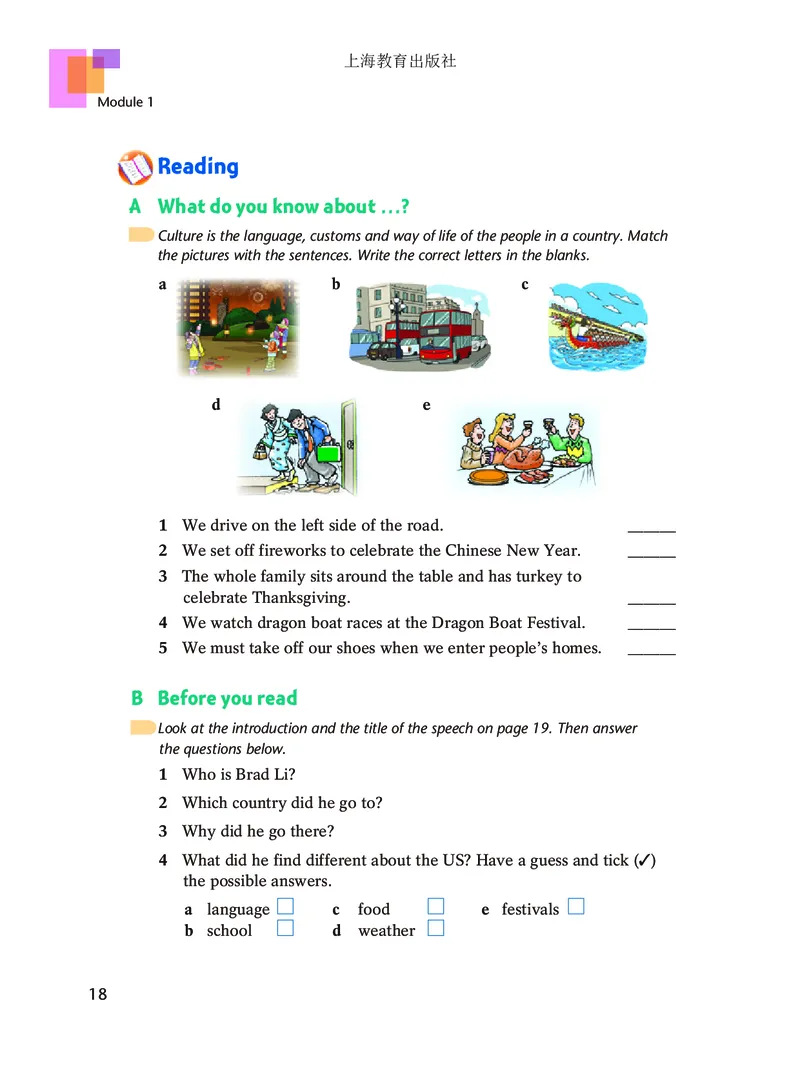
Culture is the language, customs and way of life of the people in a country. Match
the pictures with the sentences. Write the correct letters in the blanks.
a b c
d e
1 We drive on the left side of the road. ______
2 We set off fireworks to celebrate the Chinese New Year. ______
3 The whole family sits around the table and has turkey to
celebrate Thanksgiving. ______
4 We watch dragon boat races at the Dragon Boat Festival. ______
5 We must take off our shoes when we enter people’s homes. ______
B Before you read
Look at the introduction and the title of the speech on page 19. Then answer
the questions below.
1 Who is Brad Li?
2 Which country did he go to?
3 Why did he go there?
4 What did he find different about the US? Have a guess and tick (✓)
the possible answers.
a language c food e festivals
b school d weather
18上海教育出版社
Unit 2
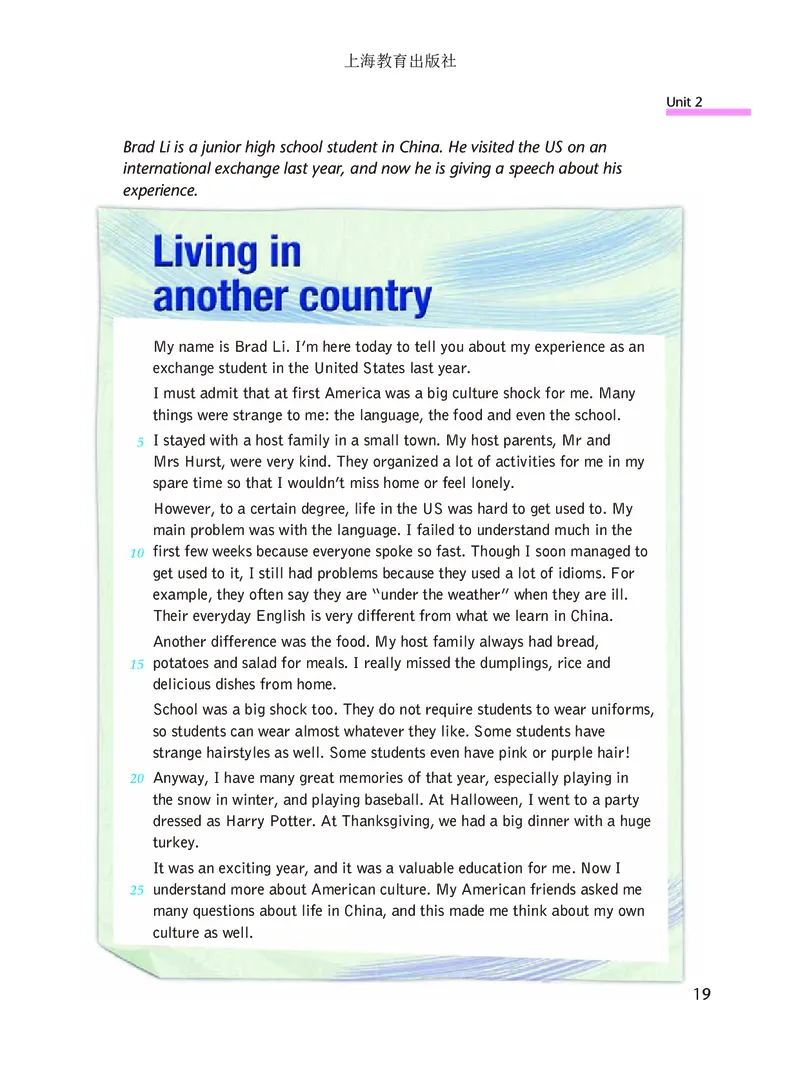
Brad Li is a junior high school student in China. He visited the US on an
international exchange last year, and now he is giving a speech about his
experience.
My name is Brad Li. I’m here today to tell you about my experience as an
exchange student in the United States last year.
I must admit that at first America was a big culture shock for me. Many
things were strange to me: the language, the food and even the school.
5 I stayed with a host family in a small town. My host parents, Mr and
Mrs Hurst, were very kind. They organized a lot of activities for me in my
spare time so that I wouldn’t miss home or feel lonely.
However, to a certain degree, life in the US was hard to get used to. My
main problem was with the language. I failed to understand much in the
10 first few weeks because everyone spoke so fast. Though I soon managed to
get used to it, I still had problems because they used a lot of idioms. For
example, they often say they are “under the weather” when they are ill.
Their everyday English is very different from what we learn in China.
Another difference was the food. My host family always had bread,
15 potatoes and salad for meals. I really missed the dumplings, rice and
delicious dishes from home.
School was a big shock too. They do not require students to wear uniforms,
so students can wear almost whatever they like. Some students have
strange hairstyles as well. Some students even have pink or purple hair!
20 Anyway, I have many great memories of that year, especially playing in
the snow in winter, and playing baseball. At Halloween, I went to a party
dressed as Harry Potter. At Thanksgiving, we had a big dinner with a huge
turkey.
It was an exciting year, and it was a valuable education for me. Now I
25 understand more about American culture. My American friends asked me
many questions about life in China, and this made me think about my own
culture as well.
1199上海教育出版社
Module 1
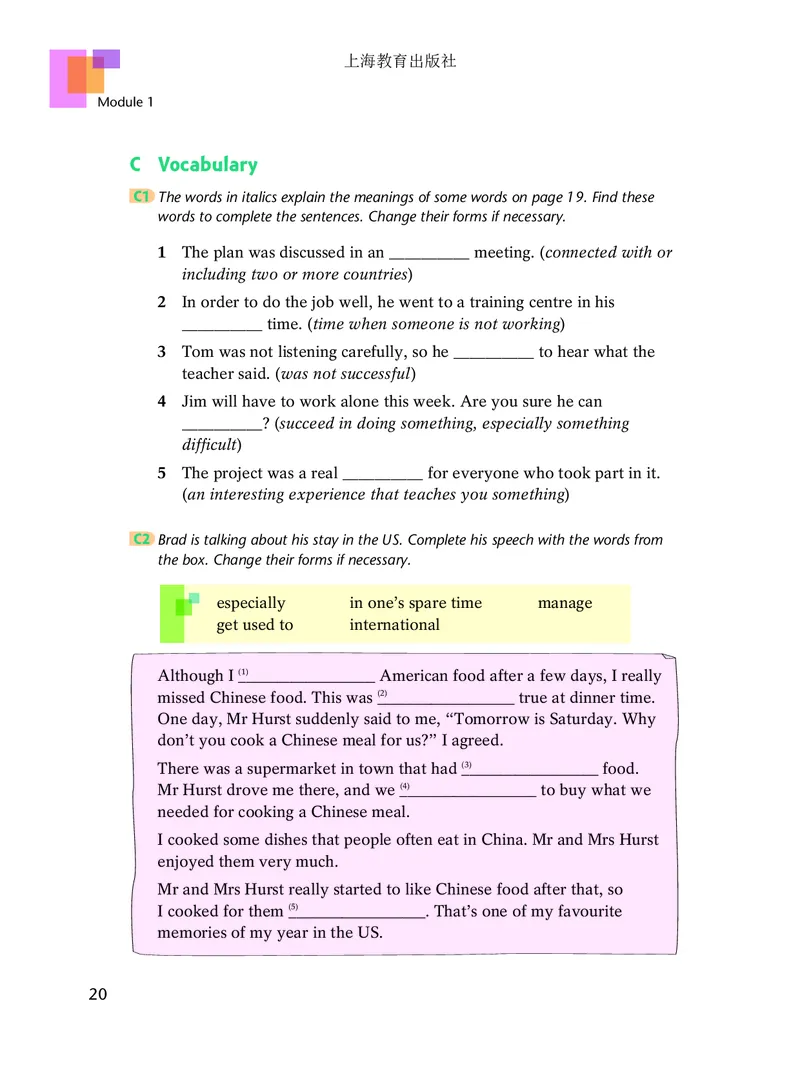
C Vocabulary
C1 The words in italics explain the meanings of some words on page 19. Find these
words to complete the sentences. Change their forms if necessary.
1 The plan was discussed in an __________ meeting. (connected with or
including two or more countries)
2 In order to do the job well, he went to a training centre in his
__________ time. (time when someone is not working)
3 Tom was not listening carefully, so he __________ to hear what the
teacher said. (was not successful)
4 Jim will have to work alone this week. Are you sure he can
__________? (succeed in doing something, especially something
difficult)
5 The project was a real __________ for everyone who took part in it.
(an interesting experience that teaches you something)
C2 Brad is talking about his stay in the US. Complete his speech with the words from
the box. Change their forms if necessary.
especially in one’s spare time manage
get used to international
Although I (_1)_________________ American food after a few days, I really
missed Chinese food. This was (_2)_________________ true at dinner time.
One day, Mr Hurst suddenly said to me, “Tomorrow is Saturday. Why
don’t you cook a Chinese meal for us?” I agreed.
There was a supermarket in town that had (_3)_________________ food.
Mr Hurst drove me there, and we _(4)_________________ to buy what we
needed for cooking a Chinese meal.
I cooked some dishes that people often eat in China. Mr and Mrs Hurst
enjoyed them very much.
Mr and Mrs Hurst really started to like Chinese food after that, so
I cooked for them _(5)_________________. That’s one of my favourite
memories of my year in the US.
20上海教育出版社
Unit 2
D Comprehension
D1 Read Brad’s speech on page 19 and the sentences below. Circle T (True) or F (False).
Find facts in the speech to support your answers. Then write down the facts.
1 Mr and Mrs Hurst organized a lot of activities for Brad T / F
because they wanted his English to improve.
_____________________________________________________
2 Brad found it hard to understand American idioms. T / F
_____________________________________________________
3 Brad preferred American food to Chinese food. T / F
_____________________________________________________
4 Brad’s American friends wanted to learn more about life T / F
in China.
_____________________________________________________
D2 Read the speech again and answer the questions below.
1 How do you know that Brad had never been to the US before this
exchange visit?
_____________________________________________________________
2 What clothes does Brad wear at school in China?
_____________________________________________________________
3 What exciting experience did Brad have at Halloween?
_____________________________________________________________
4 What do Americans eat at Thanksgiving?
_____________________________________________________________
5 What did Brad learn from his experience as an exchange student?
_____________________________________________________________
(cid:43)
D3 What cultural differences did Brad experience? Discuss this with your classmates.
21上海教育出版社
Module 1
Listening
A culture quiz
Listen to some questions about American culture. You will hear three choices (a, b
and c) for each question. Write the correct letters in the blanks.
5 What is the American word
for “trousers”?
Answer: ______
1 Where is the US?
6 When do Americans celebrate
Answer: ___b___
Thanksgiving?
2 What is the capital city of the
Answer: ______
US?
7 Who was the first president of
Answer: ______
the US?
3 How many states are there in
Answer: ______
the US?
8 On April Fool’s Day, what do
Answer: ______
Americans usually do?
4 How many stars are there on
Answer: ______
the national flag of the US?
Answer: ______
22上海教育出版社
Unit 2
Grammar
A Adverbial clauses of purpose
We can use so that + a clause to talk about purpose. This is called an
adverbial clause of purpose.
They organized a lot of activities
for me in my spare time so that I
wouldn’t miss home or feel lonely.
Mary lent me this book so that I could read about Chinese history.
I exercise every morning so that I will stay healthy.
Things to remember
We often use can, may or will (for the present) or could, might or would
(for the past) in an adverbial clause of purpose.
In pairs, ask and answer questions about the pictures below. Follow the example.
S1: Why is he sunbathing?
S2: He’s sunbathing so that he can get browner.
1 2
sunbathe/get browner wear a coat/keep warm
3 4
take a taxi/get to the exercise/keep fit
airport on time
23上海教育出版社
Module 1
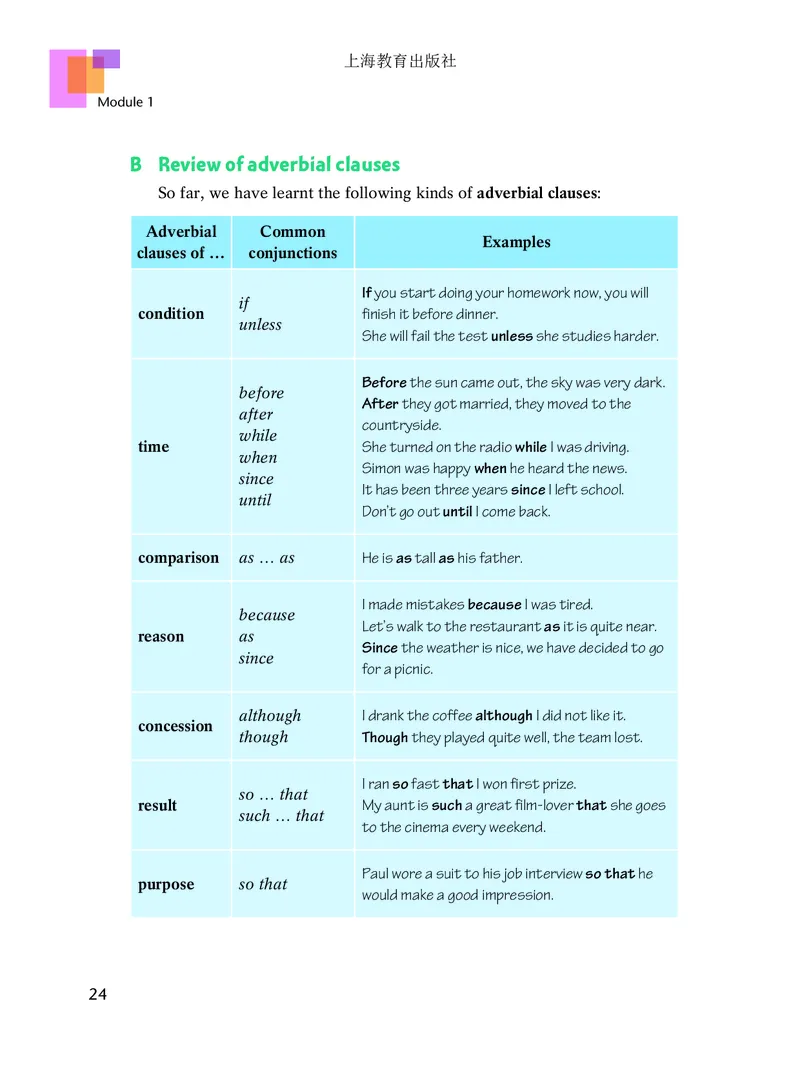
B Review of adverbial clauses
So far, we have learnt the following kinds of adverbial clauses:
Adverbial Common
Examples
clauses of … conjunctions
If you start doing your homework now, you will
if
condition finish it before dinner.
unless
She will fail the test unless she studies harder.
Before the sun came out, the sky was very dark.
before
After they got married, they moved to the
after
countryside.
while
time She turned on the radio while I was driving.
when
Simon was happy when he heard the news.
since
It has been three years since I left school.
until
Don’t go out until I come back.
comparison as … as He is as tall as his father.
I made mistakes because I was tired.
because
Let’s walk to the restaurant as it is quite near.
reason as
Since the weather is nice, we have decided to go
since
for a picnic.
although I drank the coffee although I did not like it.
concession
though Though they played quite well, the team lost.
I ran so fast that I won first prize.
so … that
result My aunt is such a great film-lover that she goes
such … that
to the cinema every weekend.
Paul wore a suit to his job interview so that he
purpose so that
would make a good impression.
24上海教育出版社
Unit 2
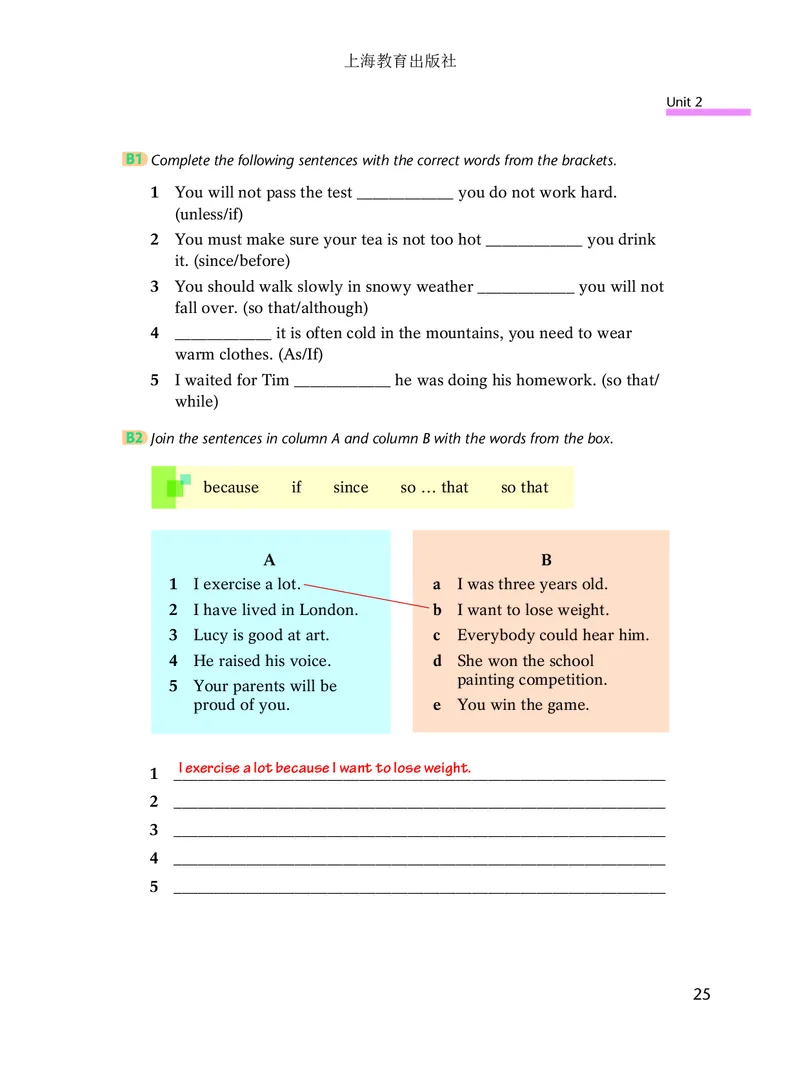
B1 Complete the following sentences with the correct words from the brackets.
1 You will not pass the test ____________ you do not work hard.
(unless/if)
2 You must make sure your tea is not too hot ____________ you drink
it. (since/before)
3 You should walk slowly in snowy weather ____________ you will not
fall over. (so that/although)
4 ____________ it is often cold in the mountains, you need to wear
warm clothes. (As/If)
5 I waited for Tim ____________ he was doing his homework. (so that/
while)
B2 Join the sentences in column A and column B with the words from the box.
because if since so … that so that
A B
1 I exercise a lot. a I was three years old.
2 I have lived in London. b I want to lose weight.
3 Lucy is good at art. c Everybody could hear him.
4 He raised his voice. d She won the school
painting competition.
5 Your parents will be
proud of you. e You win the game.
I exercise a lot because I want to lose weight.
1 _____________________________________________________________
2 _____________________________________________________________
3 _____________________________________________________________
4 _____________________________________________________________
5 _____________________________________________________________
25上海教育出版社
Module 1
Speaking
A Talk time
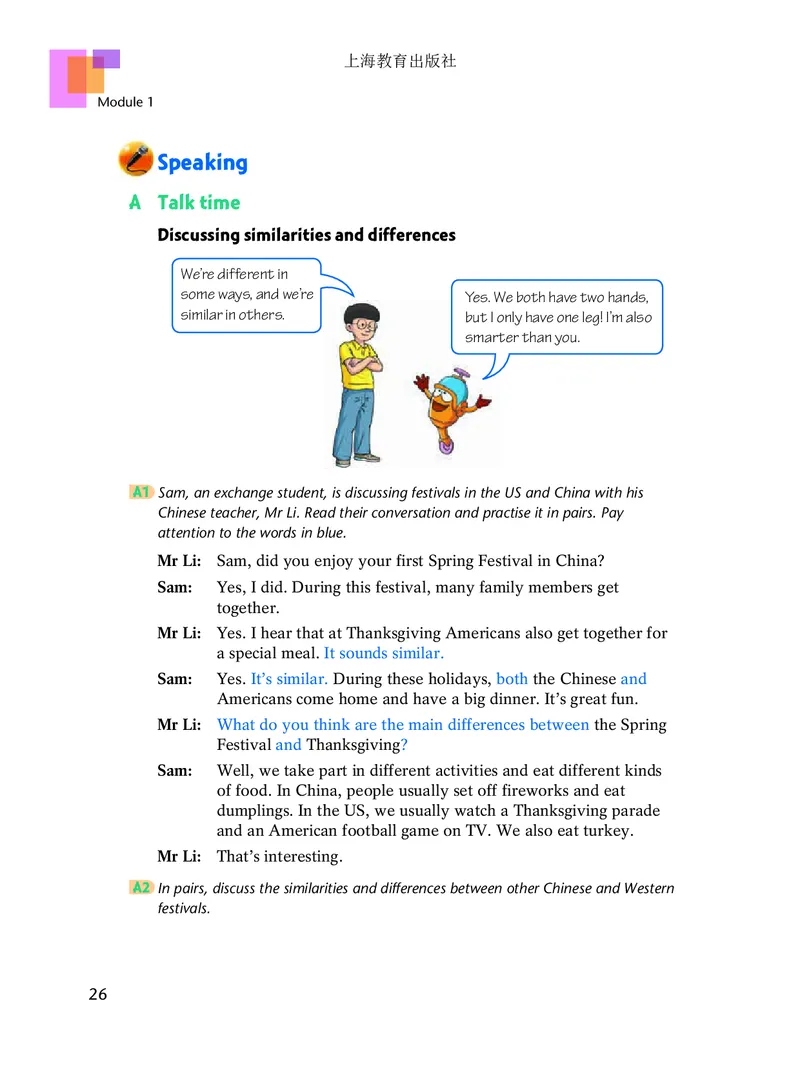
Discussing similarities and differences
We’re different in
some ways, and we’re Yes. We both have two hands,
similar in others. but I only have one leg! I’m also
smarter than you.
A1 Sam, an exchange student, is discussing festivals in the US and China with his
Chinese teacher, Mr Li. Read their conversation and practise it in pairs. Pay
attention to the words in blue.
Mr Li: Sam, did you enjoy your first Spring Festival in China?
Sam: Y es, I did. During this festival, many family members get
together.
Mr Li: Yes. I hear that at Thanksgiving Americans also get together for
a special meal. It sounds similar.
Sam: Y es. It’s similar. During these holidays, both the Chinese and
Americans come home and have a big dinner. It’s great fun.
Mr Li: What do you think are the main differences between the Spring
Festival and Thanksgiving?
Sam: W ell, we take part in different activities and eat different kinds
of food. In China, people usually set off fireworks and eat
dumplings. In the US, we usually watch a Thanksgiving parade
and an American football game on TV. We also eat turkey.
Mr Li: That’s interesting.
A2 In pairs, discuss the similarities and differences between other Chinese and Western
festivals.
26上海教育出版社
Unit 2
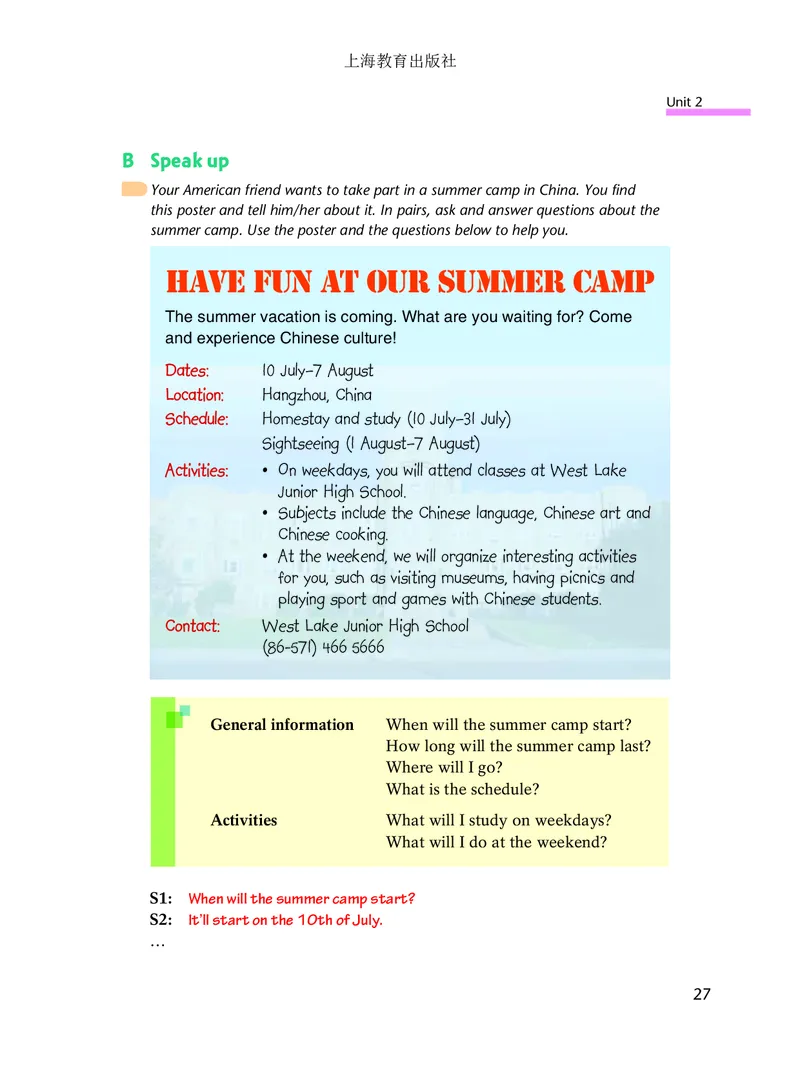
B Speak up
Your American friend wants to take part in a summer camp in China. You find
this poster and tell him/her about it. In pairs, ask and answer questions about the
summer camp. Use the poster and the questions below to help you.
Have FUN at our summer camp
The summer vacation is coming. What are you waiting for? Come
and experience Chinese culture!
Dates: (cid:40)(cid:39) (cid:65)uly(cid:198)(cid:46) August
Location: Hang(cid:113)hou, China
Schedule: Homestay and study (cid:31)(cid:40)(cid:39) (cid:65)uly(cid:198)(cid:42)(cid:40) (cid:65)uly(cid:32)
(cid:74)ightseeing (cid:31)(cid:40) August(cid:198)(cid:46) August(cid:32)
Activities: (cid:155) (cid:70)n weekdays, you will attend classes at West Lake
(cid:65)unior High (cid:74)chool.
(cid:155) (cid:74)ubjects include the Chinese language, Chinese art and
Chinese cooking.
(cid:155) At the weekend, we will organi(cid:113)e interesting activities
for you, such as visiting museums, having picnics and
playing sport and games with Chinese students.
Contact: West Lake (cid:65)unior High (cid:74)chool
(cid:31)(cid:47)(cid:45)(cid:36)(cid:44)(cid:46)(cid:40)(cid:32) (cid:43)(cid:45)(cid:45) (cid:44)(cid:45)(cid:45)(cid:45)
General information When will the summer camp start?
How long will the summer camp last?
Where will I go?
What is the schedule?
Activities What will I study on weekdays?
What will I do at the weekend?
S1: When will the summer camp start?
S2: It’ll start on the 10th of July.
…
27上海教育出版社
Module 1
Writing
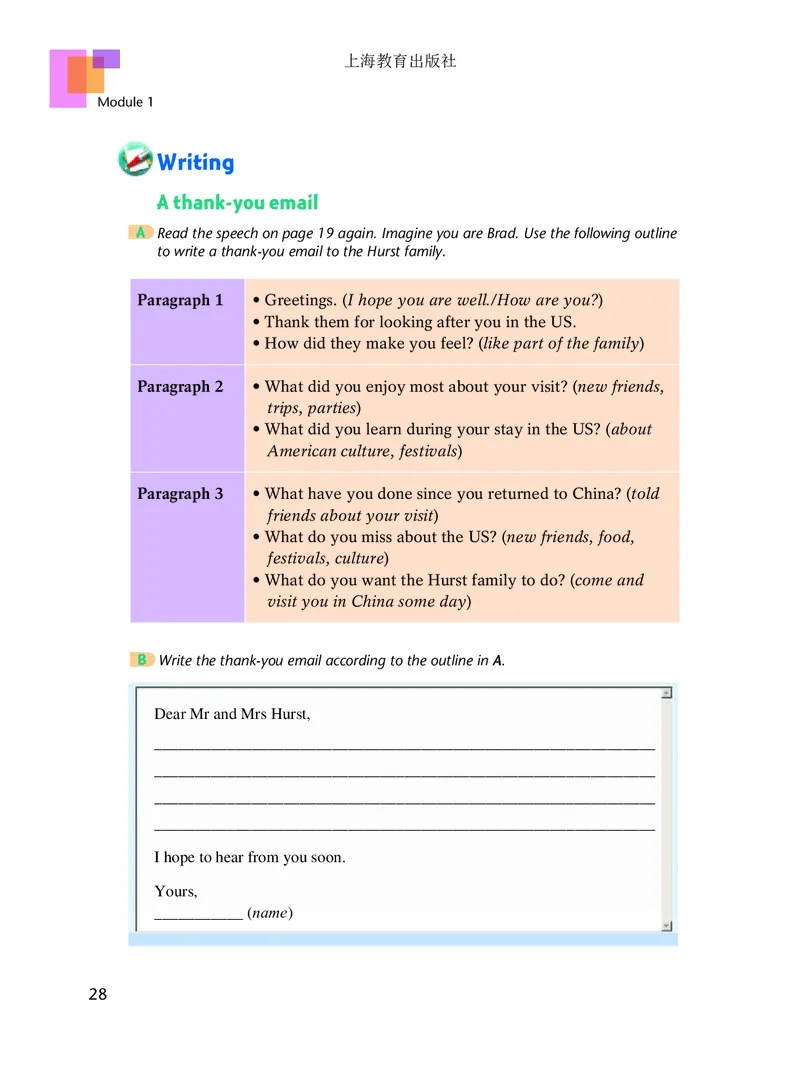
A thank-you email
A Read the speech on page 19 again. Imagine you are Brad. Use the following outline
to write a thank-you email to the Hurst family.
Paragraph 1 • (cid:40)reetings(cid:15) (cid:9)I hope you are well./How are you?)
• Thank them for looking after you in the (cid:54)(cid:52)(cid:15)
• (cid:41)ow did they make you feel(cid:32) (cid:9)like part of the family)
Paragraph 2 • (cid:56)hat did you en(cid:75)oy most a(cid:67)out your (cid:87)isit(cid:32) (cid:9)new friends,
trips, parties)
• (cid:56)hat did you learn during your stay in the (cid:54)(cid:52)(cid:32) (cid:9)about
American culture, festivals)
Paragraph 3 • (cid:56)hat ha(cid:87)e you done since you returned to China(cid:32) (cid:9)told
friends about your visit)
• (cid:56)hat do you miss a(cid:67)out the (cid:54)(cid:52)(cid:32) (cid:9)new friends, food,
festivals, culture)
• (cid:56)hat do you want the (cid:41)urst family to do(cid:32) (cid:9)come and
visit you in China some day)
B Write the thank-you email according to the outline in A.
Dear Mr and Mrs Hurst,
______________________________________________________________
______________________________________________________________
______________________________________________________________
______________________________________________________________
I hope to hear from you soon.
Yours,
___________ (name)
28上海教育出版社
Unit 2
(cid:43)
More practice
Read the article about education in the UK and discuss the differences between
education in the UK and China. Then complete the table below.
Education in the UK
Every child in the UK must receive a full-time education until the age of
16. Parents can choose to send their children either to a state school,
which is free, or to a private school, where a fee is required.
The school year is generally divided into three terms. Each term ends in a
holiday. The summer holiday is the longest and usually lasts from the middle
of July to the beginning of September.
Education has two main stages—primary school and secondary school.
Primary schools are for students from the age of 5 to 11. The main
subjects are Maths, English, History, Geography, Science, Art, Music
and PE. Secondary schools are for students from the age of 11 to 16 or
18. The same subjects are taught there, as well as other subjects such as
foreign languages (usually French, German or Spanish), Technology and
Computer Studies.
After the age of 16, students can either find a job or continue their studies
at a school or college until they are 18. Between the ages of 16 and 18,
students must choose only three or four subjects to study. At the end of the
two years, they must take some important exams. If they do well, they can
then go on to study at university. There are over 100 universities in the
UK, and the most famous are the University of Oxford and the University
of Cambridge.
Schools in the UK Schools in China
Age for starting school
Types of schools
Number of terms in a school year
Main subjects in primary school
Other subjects in secondary school
29上海教育出版社
Module 1
Culture corner
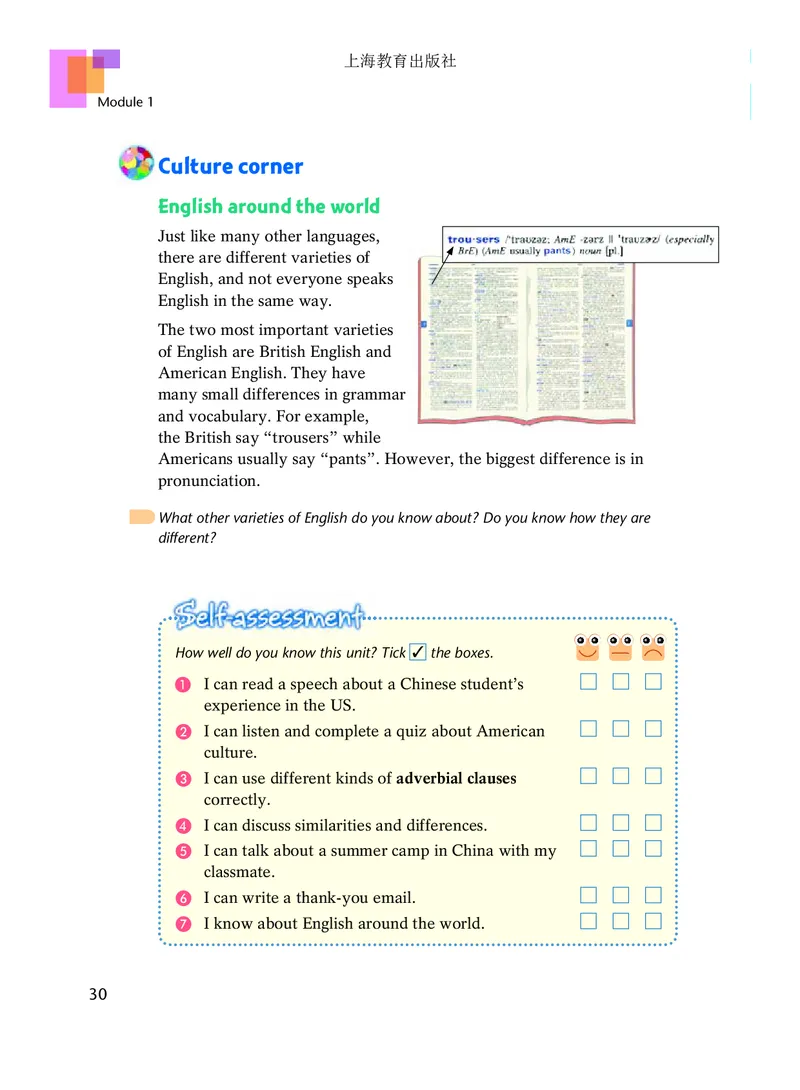
English around the world
Just like many other languages,
there are different varieties of
English, and not everyone speaks
English in the same way.
The two most important varieties
of English are British English and
American English. They have
many small differences in grammar
and vocabulary. For example,
the British say “trousers” while
Americans usually say “pants”. However, the biggest difference is in
pronunciation.
What other varieties of English do you know about? Do you know how they are
different?
How well do you know this unit? Tick ✓ the boxes.
❶ I can read a speech about a Chinese student’s
experience in the US.
❷ I can listen and complete a quiz about American
culture.
❸ I can use different kinds of adverbial clauses
correctly.
❹ I can discuss similarities and differences.
❺ I can talk about a summer camp in China with my
classmate.
❻ I can write a thank-you email.
❼ I know about English around the world.
30上海教育出版社
Unit 2
(cid:43)
PPPrrrooojjjeeecccttt
Studying abroad
Have you ever dreamt of becoming an exchange student? Which country
would you like to go to?
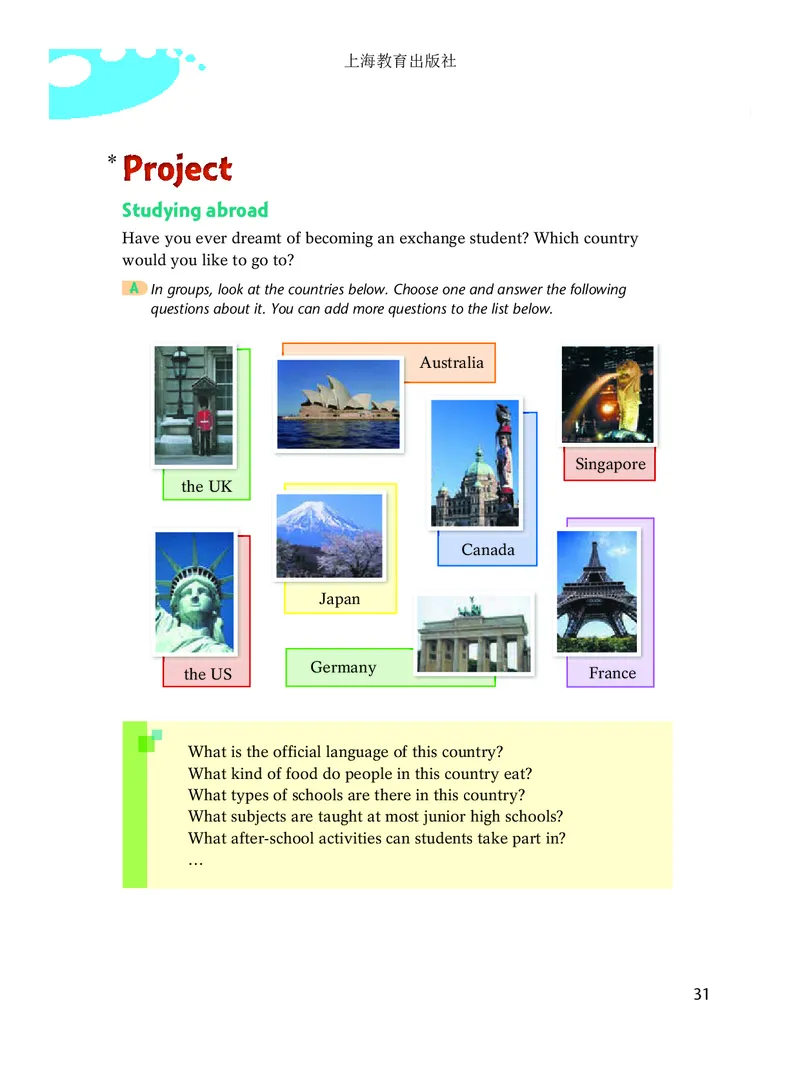
A In groups, look at the countries below. Choose one and answer the following
questions about it. You can add more questions to the list below.
Australia
Singapore
the UK
Canada
Japan
(cid:40)ermany
the US France
What is the official language of this country?
What kind of food do people in this country eat?
What types of schools are there in this country?
What subjects are taught at most junior high schools?
What after-school activities can students take part in?
…
31上海教育出版社
Module 1
B What are the advantages and disadvantages of being an exchange student in this
country? Make a list. Follow the example.
Advantages Disadvantages
1 We can improve our English. 1 We may have difficulty
understanding the American
2 We can learn to take care of
accent.
ourselves and be independent.
2 We may feel lonely and miss
3 We can stay with a host family
home.
and learn more about American
culture. 3 We may not get used to the food
in the US.
4 We can visit some places of
interest in the US. 4 The cost is high.
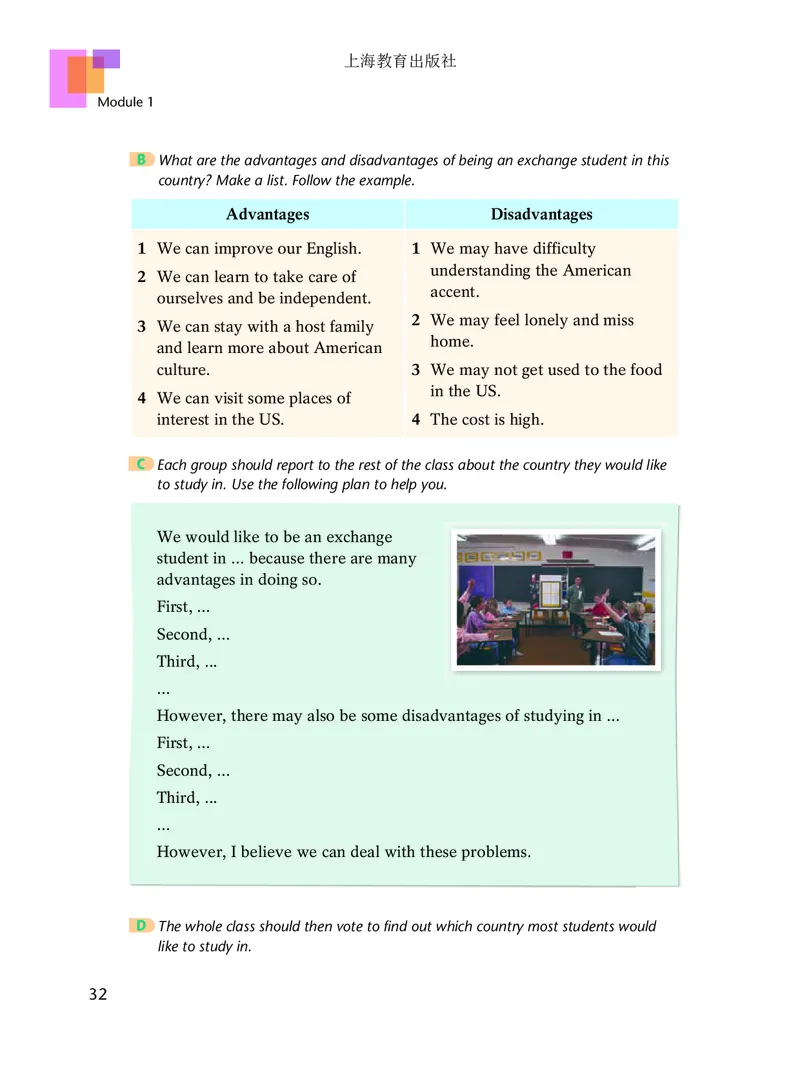
C Each group should report to the rest of the class about the country they would like
to study in. Use the following plan to help you.
We would like to be an exchange
student in ... because there are many
advantages in doing so.
First, ...
Second, ...
Third, ...
...
However, there may also be some disadvantages of studying in ...
First, ...
Second, ...
Third, ...
...
However, I believe we can deal with these problems.
D The whole class should then vote to find out which country most students would
like to study in.
32上海教育出版社
Module 2 Environmental problems
Unit
3
TTThhheee eeennnvvviiirrrooonnnmmmeeennnttt
Getting ready
In this unit, you will learn about environmental problems and solutions.
Reading
• Read an article about protecting the environment.
Listening
• Listen to a radio programme about environmental problems.
Grammar
• Learn how to use the same and different.
• Learn how to use like, the same as and different from.
• Learn how to use the same … as with nouns and phrases.
Speaking
• Learn to express concern.
• Discuss environmental problems in your city.
Writing
•• WWrriittee aann iinnttrroodduuccttiioonn ttoo GGaarryy GGrreeeenn,, aa ccaarrttoooonn cchhaarraacctteerr..
When I told you
to be greener, Lo,
I didn’t mean …
33上海教育出版社
Module 2
Reading
A What do you know about …?
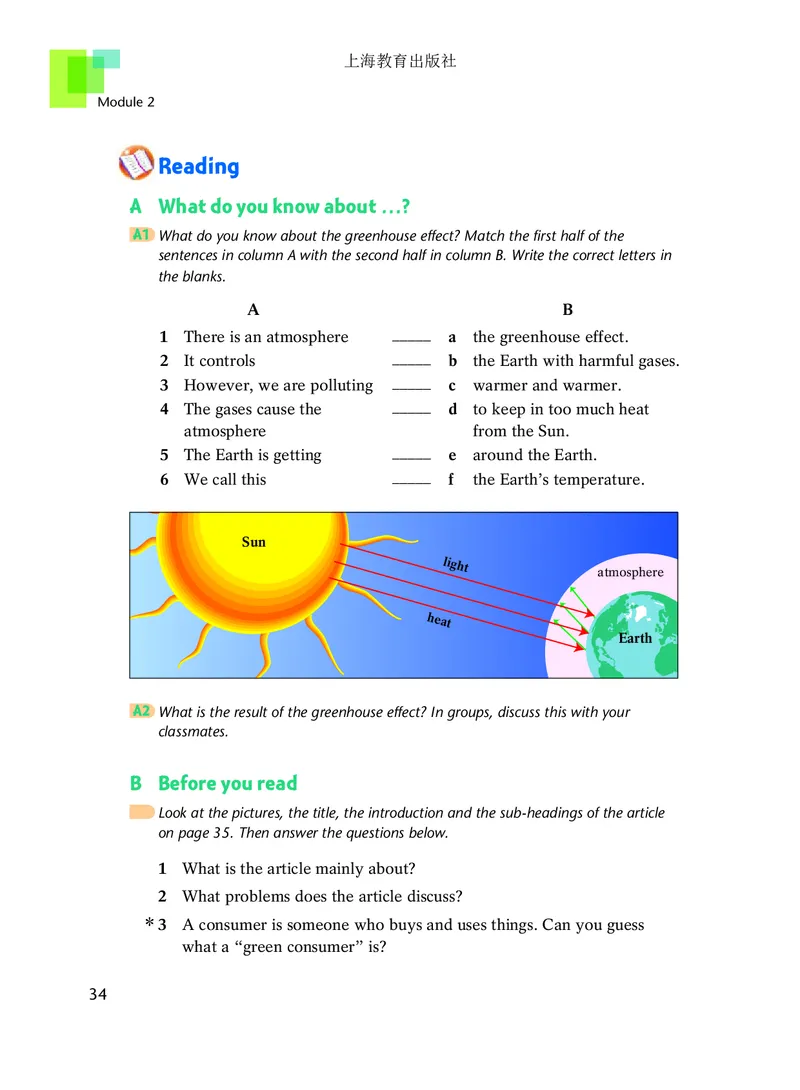
A1 What do you know about the greenhouse effect? Match the first half of the
sentences in column A with the second half in column B. Write the correct letters in
the blanks.
A B
1 There is an atmosphere _____ a the greenhouse effect.
2 It controls _____ b the Earth with harmful gases.
3 However, we are polluting _____ c warmer and warmer.
4 The gases cause the _____ d to keep in too much heat
atmosphere from the Sun.
5 The Earth is getting _____ e around the Earth.
6 We call this _____ f the Earth’s temperature.
Sun
light
atmosphere
heat
Earth
A2 What is the result of the greenhouse effect? In groups, discuss this with your
classmates.
B Before you read
Look at the pictures, the title, the introduction and the sub-headings of the article
on page 35. Then answer the questions below.
1 What is the article mainly about?
2 What problems does the article discuss?
(cid:43)
3 A consumer is someone who buys and uses things. Can you guess
what a “green consumer” is?
34上海教育出版社
Unit 3
Our world is in danger. We must do something to protect the environment.
But, what are the main problems we face?
The greenhouse effect easily destroyed
The atmosphere around the Earth by rain. This can
5 is necessary for all living things. It 35 result in floods
is like the glass of a greenhouse, and even more
letting sunlight in and keeping heat damage to the
from getting out. Without it, the environment.
Earth would be the same as the
Bad habits
10 Moon—cold and lifeless.
40 Many of our habits cause pollution.
When we burn fuels such as petrol
People often use things once and
and coal, we produce a gas called
then throw them away, or leave them
carbon dioxide (CO ). Too much of
on the ground as litter. This creates
2
this gas pollutes
mountains of rubbish and pollutes our
15 the atmosphere, 45 land and seas.
and causes it
In order to protect the environment,
to keep in too
we need to take proper action.
much heat. As a
We should be different from many
result of the greenhouse effect, the
consumers and become “green
20 Earth’s temperature is increasing.
This causes sea level to rise, and 50 consumers”. This means that we
should only buy and use products
in the future may cause cities to
friendly to the environment. We
disappear.
should also recycle as
Cutting down forests
many things as we can.
25 Every year, we destroy nature by 55 We can reuse things for
cutting down huge areas of forests.
the same purpose as
This makes the greenhouse effect
before, or we can use
worse because trees take in CO
them for new purposes.
2
and produce oxygen. Cutting down
If we just learn to live in
30 trees also destroys the homes of the 60 new and different ways, we can make
animals that live in our forests, and
a difference.
causes the surface of the soil to be
3355上海教育出版社
Module 2
C Vocabulary
C1 The words in italics explain the meanings of some words on page 35. Find these
words to complete the sentences. Change their forms if necessary.
1 ______________ the flood, many people were left homeless. (because
of the effect of)
2 The world population will continue to __________ for many years to
come. (to become greater in number)
3 The mountain is high. It is 3,000 metres above _____________. (the
height of the ocean)
4 Man first walked on the __________ of the Moon in 1969. (the top
part of an area of land )
5 There were _____________ toys in the shops during the Christmas
holiday. (a very large number of)
C2 Complete the conversation below with the words from the box. Change their forms if
necessary.
in danger make a difference take action
increase result in
Mark: The burning and cutting down of trees all over the world
_(1)_______________ the loss of our forests. Why do you think
people do that?
Jenny: The world’s population is growing fast. That’s probably the main
reason. People need land to live on.
Mark: I suppose so. But forests are important to us. Trees take in CO .
2
When so many trees are being cut down, the CO in the Earth’s
2
atmosphere (_2)_______________. This causes the temperature to
rise and puts the world (_3)_______________.
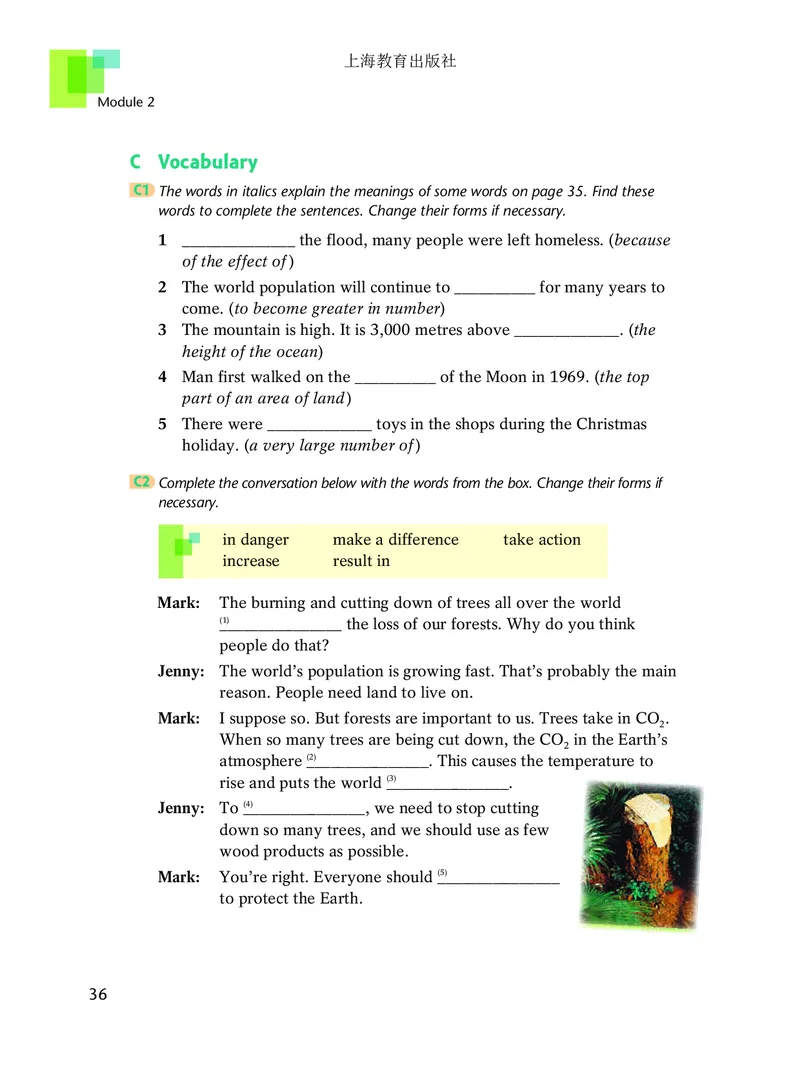
Jenny: To _(4)_______________, we need to stop cutting
down so many trees, and we should use as few
wood products as possible.
Mark: You’re right. Everyone should (_5)_______________
to protect the Earth.
36上海教育出版社
Unit 3
D Comprehension
D1 Replace the italicized words with information from the article on page 35.
1 The writer says that it is in danger. _______________________
2 It is necessary for all living things. _______________________
3 CO comes from burning them. _______________________
2
4 This causes sea level to rise. _______________________
5 It causes the surface of the soil to be
easily destroyed by rain. _______________________
6 Many of our habits cause this. _______________________
D2 Read the article again and circle the correct answers.
1 Because of pollution, ______.
a not enough sunlight is reaching the Earth
b not enough heat is leaving the Earth
c not enough CO is leaving the Earth
2
2 If there are more trees, the amount of CO in the atmosphere will be
2
______.
a greater b less c the same
3 We can help protect the environment if we ______.
a change our bad habits
b become consumers
c buy more products
4 The purpose of the article is to make ______.
a people do more to protect the environment
b more people become consumers
c people learn more about the environment
(cid:43)
D3 The writer gives an example of a bad habit that causes pollution. Can you name
some other bad habits that cause pollution?
37上海教育出版社
Module 2
Listening
Caring for the environment
A Listen to two women calling into a radio programme to talk about environmental
problems. Arrange the pictures below in the correct order by writing the numbers
1–3 in the boxes.
I
II
B Listen to the recording again and fill in the table below. Write one word in
each blank.
Problems Solutions
• Go out with friends and help
Litter on the ground _(2)_________ _________ the litter.
outside the _(1)_________ • Ask the workers at the station to
__________ _(3)_________ _________ a sign saying,
“(_4)_________ __________ __________.”
• Talk to the _(6)_________ __________.
(_5)_________ pollution
• _(7)_________ the city government.
38上海教育出版社
Unit 3
Grammar
A the same and different
If things are exactly like one another, we say they are the same.
If they are not like one another, we say they are different.
These light bulbs look the same, but their effects on the environment
are different.
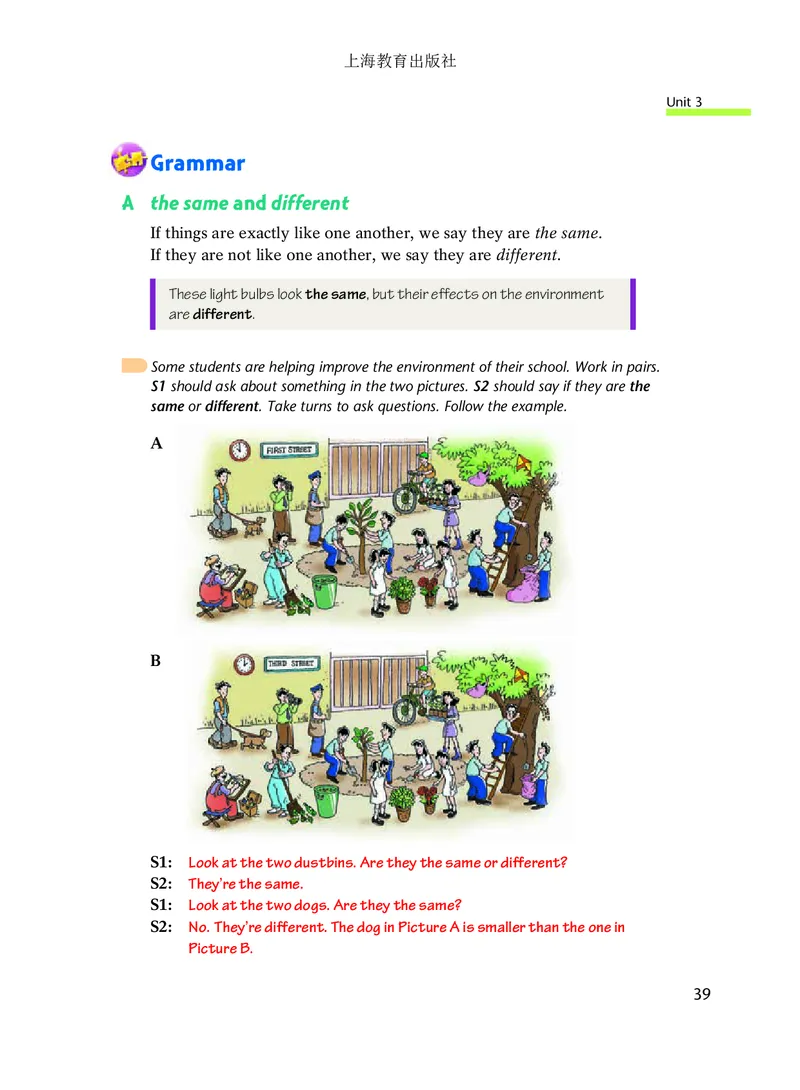
Some students are helping improve the environment of their school. Work in pairs.
S1 should ask about something in the two pictures. S2 should say if they are the
same or different. Take turns to ask questions. Follow the example.
A
B
S1: Look at the two dustbins. Are they the same or different?
S2: They’re the same.
S1: Look at the two dogs. Are they the same?
S2: No. They’re different. The dog in Picture A is smaller than the one in
Picture B.
39上海教育出版社
Module 2
B like, the same as and different from
The atmosphere is like the glass of a greenhouse.
Without the atmosphere, the Earth would be the same as the Moon—
cold and lifeless.
We should be different from many consumers and become “green
consumers”.
Work out the rule
• (cid:56)e use (cid:64)(cid:64)(cid:64)(cid:64)(cid:64)(cid:64)(cid:64)(cid:64)(cid:64)(cid:64)(cid:64)(cid:64) to say things are similar in one or more ways(cid:15)
• (cid:56)e use __________________ to say things are exactly like one
another.
• (cid:56)e use __________________ to say things are not similar or not the
same as one another.
We often use like, the same as and different from with these verbs:
be look seem smell sound taste
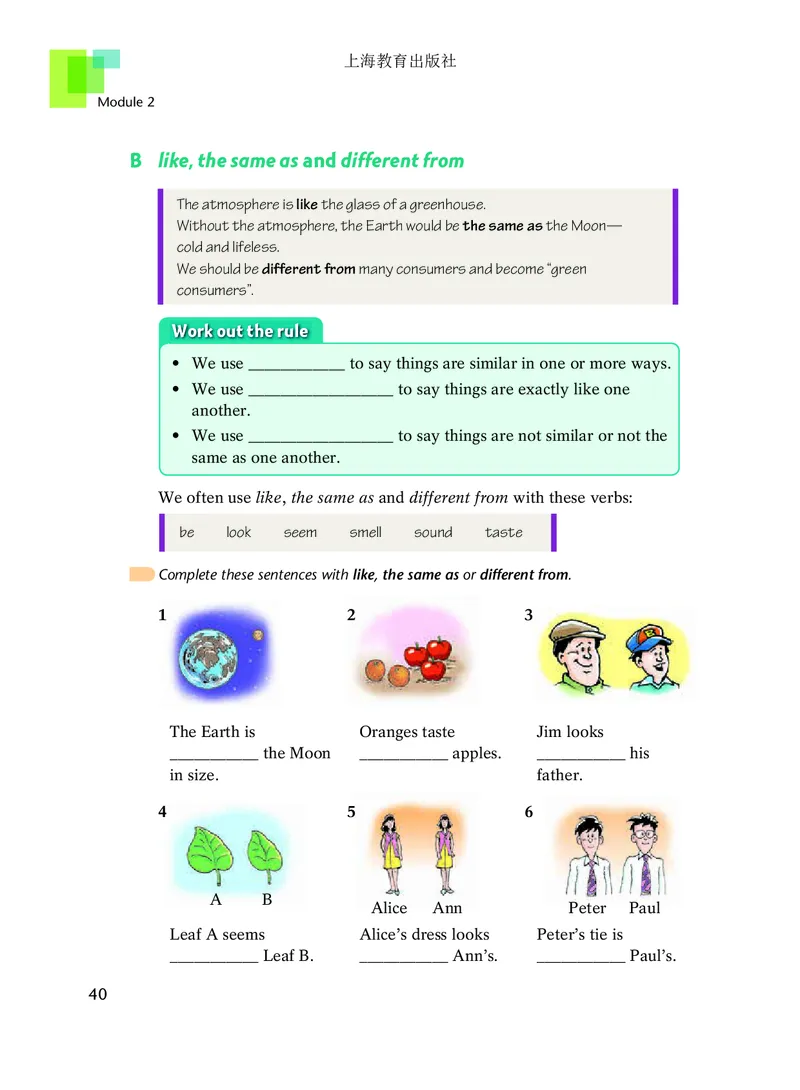
Complete these sentences with like, the same as or different from.
1 2 3
The Earth is Oranges taste Jim looks
___________ the Moon ___________ apples. ___________ his
in size. father.
4 5 6
A B
Alice Ann Peter Paul
Leaf A seems Alice’s dress looks Peter’s tie is
___________ Leaf B. ___________ Ann’s. ___________ Paul’s.
40上海教育出版社
Unit 3
C Using the same … as with nouns and phrases
Sometimes we put a noun or a phrase after the same.
We can reuse things for the same purpose as before.
Jerry uses the same amount of electricity as his neighbour does.
C1 Work in pairs. S1 should ask S2 about Mr Black and Mr Brown. S2 should respond
using information from the table below. Follow the example.
S1: Is Mr Black the same age as Mr Brown?
S2: Yes, he is.
S1: Does he use the same amount of petrol each week as Mr Brown?
S2: No, he doesn’t.
Mr Black Mr Brown
We often use like, the same as and different from with these verbs:
age 32 32
weight 75 kg 84 kg
car AF 626 AF 626
petrol used a week 30 litres 50 litres
water used a week 2,000 litres 2,000 litres
rubbish thrown away
4 kg 9 kg
a week
C2 Use different, the same, the same ... as and the information in C1 to complete the
following paragraph.
Mr Black is (_1)_t_h_e_ s_a_m__e_ a_g_e_ a_s_ Mr Brown, but their weights are
_(2)______________. Their cars are (_3)_______________, but the amounts of
petrol they use each week are (_4)_______________. Mr Black uses
_(5)__________________________________________ Mr Brown, but he
throws away less rubbish each week than Mr Brown. Mr Black is greener
than Mr Brown.
41上海教育出版社
Module 2
Speaking
A Talk time
Expressing concern
I’m worried about
the weather. It’s
too rainy.
I’m concerned too.
There might be a flood.
Read the conversation below and practise it in pairs. Pay attention to the words in
blue.
Amy: Have you noticed that the air in the city is very dirty recently?
Kevin: Yes, I have. I’m worried about that because the smoke makes it
difficult for many people to breathe.
Amy: I’m concerned that the dirty air might make some young
children ill.
Kevin: Me too. I think we should ask people to use public transport
more often.
Amy: I agree.
B Speak up
In groups, talk about environmental problems in your city. Follow the example.
S1: What environmental problems are there in our city?
S2: There is more and more rubbish in our city.
S3: What can we do to solve this problem?
S4: I think we should ask people to recycle as many things as possible.
42上海教育出版社
Unit 3
Writing
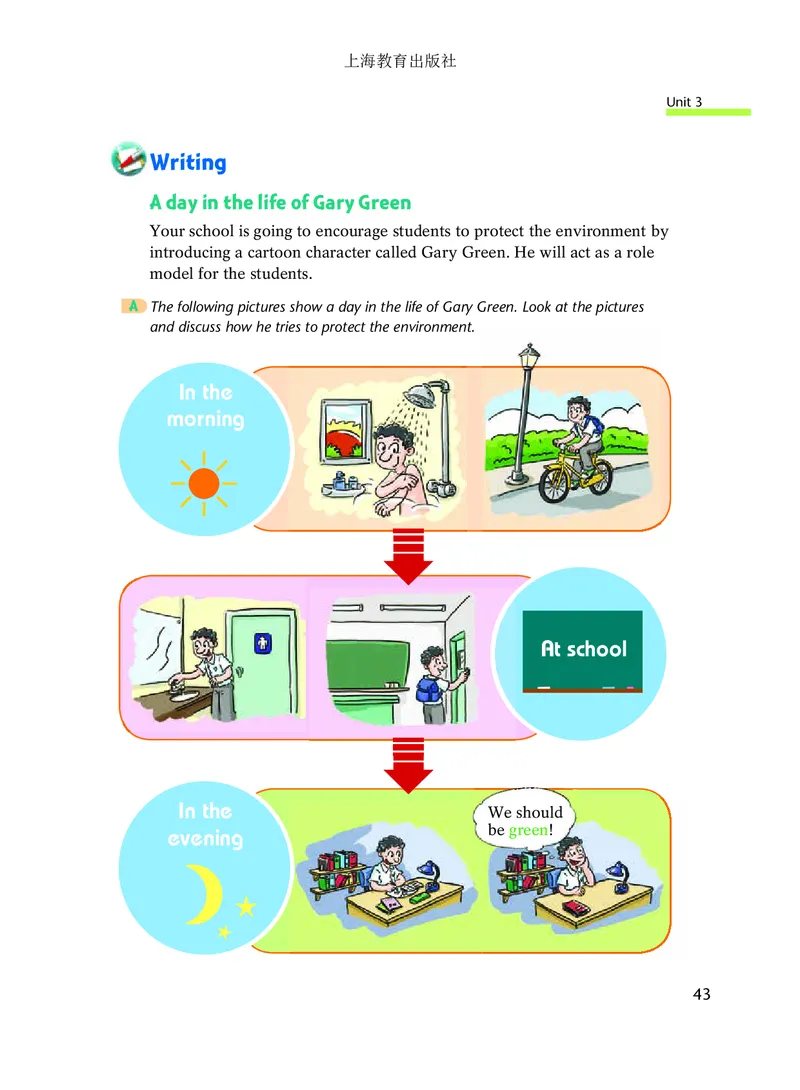
A day in the life of Gary Green
Your school is going to encourage students to protect the environment by
introducing a cartoon character called Gary Green. He will act as a role
model for the students.
A The following pictures show a day in the life of Gary Green. Look at the pictures
and discuss how he tries to protect the environment.
In the
morning
At school
In the
We should
be green!
evening
43上海教育出版社
Module 2
B Use the outline and expressions below to write an introduction to Gary Green.
Paragraph 1 What does Gary Green do in the morning? How does he
go to school?
Paragraph 2 What does Gary Green do after he washes his hands and
when he leaves the classroom?
Paragraph 3 What does Gary Green do when he does his homework?
Paragraph 4 What does Gary Green think people should do?
take a shower, not a bath
ride a bike
turn off the tap
switch off the lights
use both sides of the paper
A day in the life of Gary Green
Every morning, Gary Green starts his day by taking a
shower instead of a bath. ___________________________
__________________________________________________
__________________________________________________
__________________________________________________
__________________________________________________
__________________________________________________
__________________________________________________
__________________________________________________
__________________________________________________
__________________________________________________
__________________________________________________
__________________________________________________
44上海教育出版社
Unit 3
(cid:43)
More practice
A Read the story about the journey of a plastic bottle. Then answer the questions
below.
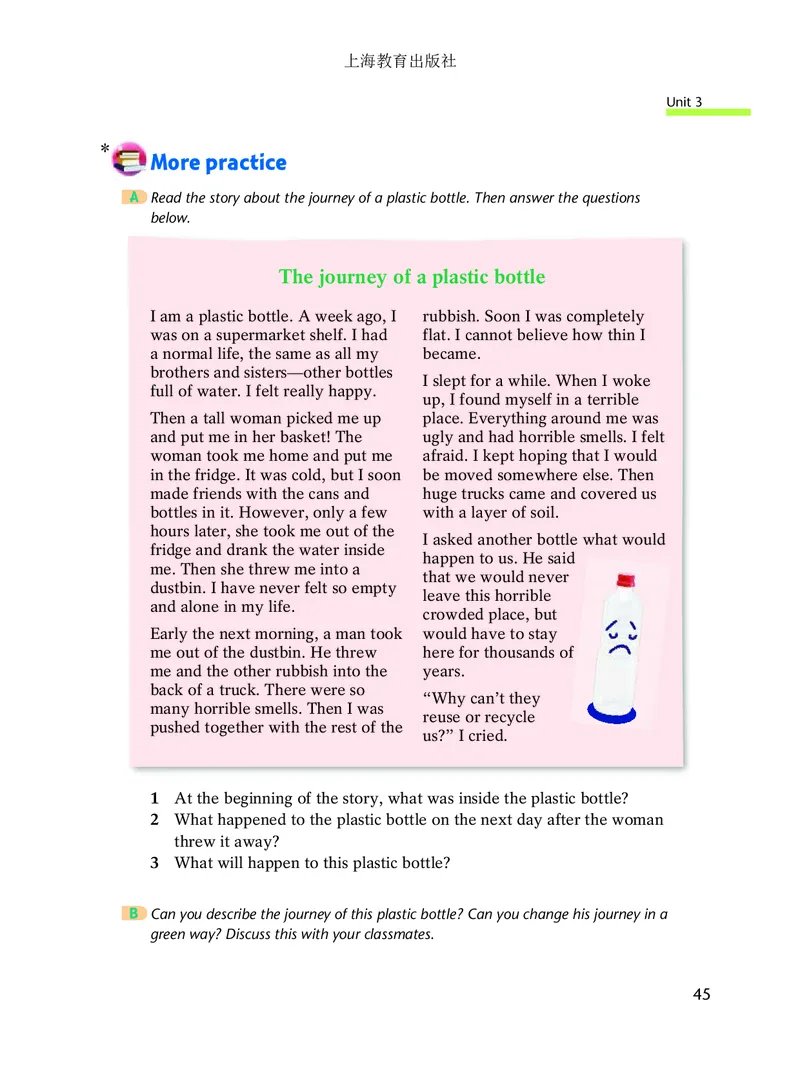
The journey of a plastic bottle
I am a plastic bottle. A week ago, I rubbish. Soon I was completely
was on a supermarket shelf. I had flat. I cannot believe how thin I
a normal life, the same as all my became.
brothers and sisters—other bottles
I slept for a while. When I woke
full of water. I felt really happy.
up, I found myself in a terrible
Then a tall woman picked me up place. Everything around me was
and put me in her basket! The ugly and had horrible smells. I felt
woman took me home and put me afraid. I kept hoping that I would
in the fridge. It was cold, but I soon be moved somewhere else. Then
made friends with the cans and huge trucks came and covered us
bottles in it. However, only a few with a layer of soil.
hours later, she took me out of the
I asked another bottle what would
fridge and drank the water inside
happen to us. He said
me. Then she threw me into a
that we would never
dustbin. I have never felt so empty
leave this horrible
and alone in my life.
crowded place, but
Early the next morning, a man took would have to stay
me out of the dustbin. He threw here for thousands of
me and the other rubbish into the years.
back of a truck. There were so
“Why can’t they
many horrible smells. Then I was
reuse or recycle
pushed together with the rest of the
us?” I cried.
1 At the beginning of the story, what was inside the plastic bottle?
2 What happened to the plastic bottle on the next day after the woman
threw it away?
3 What will happen to this plastic bottle?
B Can you describe the journey of this plastic bottle? Can you change his journey in a
green way? Discuss this with your classmates.
45上海教育出版社
Module 2
Study skills
Research skills (3): Analysing the results of a questionnaire
More and more people, both young and old, are becoming greener today.
This means they are trying to protect the environment.
A How green are you? Answer the questionnaire below. Circle your answers, add up
your score and then check the total with the analysis on page 47.
HOW GREEN ARE YOU?
1 Do you recycle
a newspapers? 1
b tins? 1
c plastic bags? 2
2 When you make a short journey, do you
a walk or cycle? 3
b go by car? 0
c go by public transport? 2
3 What do you use for shopping?
a A basket or a cloth bag. 3
b Reused plastic bags. 1
c New plastic bags. 0
4 How many electrical appliances do you have at
home?
a Ten or more. 0
b Five to nine. 1
c Less than five. 2
5 How often do you switch off the lights and other
electrical appliances when they are not needed?
a Usually. 2
b Seldom. 1
c Never. 0
6 Do you usually take
a a bath? 0
b a shower? 1
46上海教育出版社
Unit 3
Analysis
Score 1 – 3 You have not started turning green yet!
4–7 You are pale green. Try harder!
8–10 You are medium green. Keep going!
11–13 You are bright green. Well done!
B Work in groups to compare your answers. Then produce a short report. You can also
make a pie chart to show the results. Follow the example.
This is our report on the “How green are you?” questionnaire.
The average score for our group is 8.3. This means that we are
medium green. Ten per cent of us have not started turning green yet.
Twenty per cent are pale green. Forty per cent are medium green.
Thirty per cent are bright green.
We scored the most points for questions 2 and 5.
WWee ssccoorreedd tthhee ffeewweesstt ppooiinnttss ffoorr qquueessttiioonn 44..
not green
pale green
medium green
bright green
47上海教育出版社
Module 2
Culture corner
Your carbon footprint
The total amount of carbon dioxide (CO ) you
2
produce a year is called your carbon footprint.
Besides breathing, there are two other ways you
can produce CO . First, you can do it directly, by
2
driving a car or using a gas stove. Second, you
can do it indirectly, by buying or using products
that produced CO when they were made.
2
Generally, you should make your carbon footprint as small as possible.
For example, you can use public transport instead of a car, or you can
walk or cycle.
What other things can you do to reduce your carbon footprint?
How well do you know this unit? Tick ✓ the boxes.
❶ I can read an article about the environment.
❷ I can listen for the sequence of events about two
environmental problems.
❸ I can use the same and different correctly.
❹ I can use like, the same as and different from
correctly.
❺ I can use the same … as with nouns and phrases
correctly.
❻ I can express concern.
❼ I can discuss environmental problems in our city
with my classmates.
(cid:28) I can write an introduction to a cartoon character.
(cid:29) I can analyse the results of a questionnaire.
(cid:30) I know about carbon footprints.
48上海教育出版社
Module 2 Environmental problems
Unit
4
NNNaaatttuuurrraaalll dddiiisssaaasssttteeerrrsss
Getting ready
In this unit, you will learn about natural disasters.
Reading
• Read a story about a great flood.
Listening
• Listen to a conversation about an asteroid hitting the Earth.
Grammar
• Learn how to use it as the empty subject.
Speaking
• Learn to express different feelings.
• Act out a conversation about an emergency.
Writing
• Write a notice asking students to help the homeless after a typhoon.
What are you doing?
I’m packing my
disaster survival kit.
49上海教育出版社
Module 2
Reading
A What do you know about …?
A1 Write the name of the natural disaster under each picture.
earthquake flood forest fire typhoon
1 2
________________________ ________________________
3 4
________________________ ________________________
A2 In pairs, discuss the following questions.
1 What other natural disasters can you think of?
2 What should people do when there is a natural disaster?
B Before you read
Look at the pictures, the title and the first paragraph of the story on page 51. Then
circle the best answers.
1 What is the first word that you can think of to describe the story?
a Dream. b Water. c City.
2 Why did Kevin have this dream?
a Because he is interested in the North and South Poles.
b Because he is worried about the environment.
c Because he likes Geography.
50上海教育出版社
Unit 4
Last week in Geography class, we
learnt that if all the ice in the North
and South Poles melted, sea level
around the world would rise, and
5 many cities would be flooded and
disappear.
It started to worry me. What
would happen if our city was badly can’t afford to sit around and worry
flooded? Would anyone remain 30 about the flood.”
10 alive? Then I emailed my best friend. “What
Last night, I dreamt about a great should we do about the flood?” I
flood: asked. My friend replied, “I have no
time to think about the flood. I’m
It was nine o’clock in the morning. My
playing computer games …”
bedroom floor was a pool of water. I 35
15 looked out of the window. Water was I shouted, “The WATER! Look at the
everywhere. It covered roads, parks WATER!” But my cries fell on deaf
and small houses. Large objects, such ears. In offices and homes, people
as coaches and boats, passed by my just sat and stared at their computer
window. They were floating in the water. 40 screens. It seemed that they did not
want to leave. Computers were more
20 I could not just stand there! I had to do
important than the flood.
something!
Very soon, the water came into
I tried to call my dad, but the line was
people’s rooms. It poured onto their
dead. My computer was still working,
so I sent him an email. I wrote, “Dad, 45 desks and covered their computers.
In surprise, people finally started to
there’s a flood! What should we do?”
25
notice the flood, but it was too late.
He sent me an email back which said,
“Kevin, my boss has given me some Then I awoke. There was no
work. It’s important to stick with it. I water. I was safe—for now.
51上海教育出版社
Module 2
C Vocabulary
C1 The words in italics explain the meanings of some words on page 51. Find these
words to complete the sentences.
1 My computer is ________________, so I will have to buy a new one.
(no longer working)
2 When you are given a difficult task, try to ________________ it and
finish it. (continue with)
3 The girl was ________________, so she had to be very careful when
crossing the road. (not able to hear)
4 The boy was so quiet that often no one would ________________
when he came in the room. (realize)
5 When the man ________________, he found that the window was
open and it was raining heavily. (stopped sleeping)
C2 Kevin is talking about the weather with his sister Kate. Complete their conversation
with the words from the box. Change their forms if necessary.
alive fall on deaf ears object
badly have no time to sit around
Kevin: It’s been raining _(1)_____________ for ten days. What awful
weather!
Kate: I heard on the news that the heavy rain has caused floods in
several towns.
Kevin: Really? Has anyone been hurt?
Kate: Yes. Some people were hit by (_2)_____________ that were floating
in the water. The government asked people to leave for higher
ground, but this _(3)______________________. Many people just
_(4)______________________ and waited for the rain to stop. When
the floods came, they (_5)______________________ pack up and
leave.
Kevin: That was terrible!
Kate: Yes, but fortunately everyone was able to get out (_6)____________.
Nobody was killed.
52上海教育出版社
Unit 4
Recognizing the moral of a story
The moral of a story is what you can learn from it or what the writer
wants to teach you. For example, the moral of the story “The boy who
cried wolf” is that people should not tell lies.
D Comprehension
D1 Read the story on page 51 and complete the scenes below.
Scene 1
It was nine o’clock in the morning.
Kevin’s bedroom floor was a pool of water.
Water covered (_1)_____________, _(2)_____________
and _(3)_________________________.
Scene 2
My boss has
Kevin emailed his dad. given me some
work.
Kevin: Dad, there’s a flood! What should we do?
Dad: My boss has given me some work. It’s
important to _(4)_________________________.
I can’t afford to (_5)_______________________________.
Scene 3
I have no time Kevin emailed his best friend.
to …
Kevin: What should we do about the flood?
His friend: I have no time to _(6)___________________.
I’m _(7)_______________________________.
Scene 4
The water came into _(8)________________________,
poured onto _(9)________________________ and
covered (_10_)_______________________.
(cid:43)
D2 What is the moral of Kevin’s story? Discuss this with your classmates.
53上海教育出版社
Module 2
Listening
An asteroid is coming
A Listen to two government announcements and a conversation. Then tick (3) the
thing each student is going to do when the asteroid hits the Earth.
Arthur Helen Barry Joseph
make a list of
everything he/she
wants to do
prepare a disaster
survival kit
phone his/her
parents
write down all the
good things in life
B Listen to the recording again and decide whether the following sentences are
T (True) or F (False).
1 The government asked people to stay inside when the T / F
asteroid came.
2 Barry cried because he was scared. T / F
3 Joseph wanted to say “I love you” to his parents on T / F
the phone.
4 Barry suggested putting food, water and medicine in a T / F
disaster survival kit.
5 In the end, the asteroid did not hit the Earth. T / F
54上海教育出版社
Unit 4
Grammar
Using it as the empty subject
We can use it as the empty subject like this:
It is one o’clock.
It is summer now.
It rained all day.
It is only a five-minute walk from my home to the school.
It is hot in this room.
It’s nine o’clock in the morning. My
bedroom floor is a pool of water.
Work out the rule
We often use it to refer to the ________, ________, ________,
distance and temperature.
A Answer these questions using it as the subject.
1 What is the weather like today?
___________________________________________________________
2 What is the time now?
___________________________________________________________
3 What is the date today?
___________________________________________________________
4 What is the season now?
___________________________________________________________
5 How far is your home from school?
___________________________________________________________
55上海教育出版社
Module 2
B Put the words in the correct order to make meaningful sentences.
1 now/for supper/it/time/is
___________________________________________________________
2 autumn/in Australia/now/it/is
___________________________________________________________
3 about five kilometres/it/is/to the park
___________________________________________________________
4 windy/was/it/yesterday
___________________________________________________________
We can also use it as the empty subject of a sentence to replace a
to-infinitive.
It’s important to stick with it.
My boss has given
me some work.
It took a long time to build the house. (= To build the house took a long
time.)
It is wrong to pay no attention to Kevin. (= To pay no attention to
Kevin is wrong.)
It is not a good idea to sit around and worry about the flood. (= To sit
around and worry about the flood is not a good idea.)
We can also use it as the empty subject in the following sentence pattern:
It seems/appears that …
It seems/appears that nobody is paying any attention to the flood.
56上海教育出版社
Unit 4
C Write a sentence using it and a to-infinitive under each picture below.
1 2
calm/stay/fire/important forest/start/fire/dangerous
_______________________ _______________________
_______________________ _______________________
3 4
take/umbrella/good idea have/park/picnic/nice
_______________________ _______________________
_______________________ _______________________
D Put the words in brackets in the correct order to complete the conversations.
1 S1: Look at the sky. There are many dark clouds, and the wind is
blowing strongly.
S2: ________________________________________________________
(it/seems/a typhoon/that/coming/is)
2 S1: Is your father going to Beijing today?
S2: No. ____________________________________________________
(it/appears/has been cancelled/the flight/that)
3 S1: Mary looks very sad. _____________________________________
(it/seems/something bad/her/that/has happened to)
S2: I heard that her son died in the flood.
57上海教育出版社
Module 2
Speaking
A Talk time
Expressing feelings
We have different feelings in different situations. Some things make us
happy, while others make us angry or afraid.
Below are some useful expressions for communicating different feelings:
Joy
This is the happiest day of my life.
I can’t believe my luck!
Fear
It made my hair stand on end.
I was so afraid that I couldn’t speak/breathe.
Anger
It really annoyed me.
I can’t believe someone would do that!
Sadness
It’s hard to hold back the tears.
This is the saddest thing I’ve ever heard.
In pairs, make short conversations. Use the expressions above and the example
below to help you.
1 You have won a free ticket to the Film Park. ( joy)
2 You just saw a film that made you afraid.
3 You found someone smoking in the forest.
4 You heard that someone died in a traffic accident yesterday.
S1: This is amazing! I’ve never won anything before in my life. I can’t believe
my luck.
S2: That’s really good news! I’m so happy for you.
S1: Thank you.
58上海教育出版社
Unit 4
B Speak up
B1 Work in groups of four. Decide on an emergency situation. Follow the example.
Time: 2:30 p.m.
Place: In the classroom
Characters: Four students—Judy, Amy, Peter and John
Situation: The students are sitting in the
classroom and suddenly they
feel the building shake. They
immediately know it is an
earthquake.
B2 Make a conversation about the emergency. The characters should express different
feelings, e.g. bravery, fear and worry. Follow the example.
Judy: (very afraid and crying) Oh, no! What are we going to do?
Peter: (brave) Let’s hide under our desks.
John: (worried) It’s not a good idea to hide there. The desks aren’t
strong enough.
Judy: (very afraid and crying) The building is going to fall down. We
can’t do anything.
Peter: (brave) We’d better leave this building at once. Follow me. Let’s
move to an open area.
Amy: (worried) It’s impossible for us to go anywhere. We should stay
here and wait for the earthquake to stop.
…
B3 Act out your conversation in front of the whole class. Ask your classmates to guess
what feelings you have expressed.
59上海教育出版社
Module 2
Writing
Helping the homeless after a typhoon
A Read the short report below about a typhoon. Then discuss with your classmates
what you can do to help the homeless.
Typhoon kills three in Garden City
Garden City was hit by a typhoon last weekend. Three
people were killed and one person is missing. The typhoon
has made about 2,000 people homeless.
B Write a notice asking students to help the homeless after the typhoon. Use the
words below to help you.
do not have enough … organize …
have nowhere to … It is important to … as soon
raise money as possible.
Helping the homeless after a typhoon
Dear fellow students,
Garden City was hit by a typhoon last week. ____
What
____________________________________________
happened?
____________________________________________
What are the The people there ______________________________
problems ____________________________________________
caused? ____________________________________________
We can help them by _________________________
What can you
____________________________________________
do to help?
____________________________________________
These homeless people need our help. Join us and
help them rebuild their homes.
60上海教育出版社
Unit 4
(cid:43)
More practice
A Read the article about a natural disaster in Canada. Then answer the questions
below.
The ice storm
It was a dark day in Canada in 1998 By the third day, many families had
when rain began to fall from the sky. no food to eat. It was a difficult time.
However, this was not ordinary The army sent over 14,000 soldiers
rain—it turned to ice as it fell through to help.
the cold air. It rained for six days, Finally, after six days, the ice storm
and as much as ten centimetres of ice stopped, but the trouble was not
collected on roads, trees and power over. The huge amount of ice made
lines. the whole area very dangerous. As
On 5th January, the people of the ice started to melt, it fell from
Montreal woke up to find they the roofs of buildings and trees like
had no electricity in their homes. knives. Most of the power lines were
It was dark and cold. The roads so badly damaged that they could not
were covered in ice, so it was be repaired.
very dangerous to walk or drive Some families had no electricity for
anywhere. Families had to stay inside a whole month. Many homes were
and burn wood to keep warm. They damaged and many people, especially
expected the power to come back on farmers, lost their businesses. The
at any time. people of Canada will never forget
However, the ice kept falling. It how terrible nature can be. Everyone
caused branches and whole trees hopes that there will never be
to fall down. More power lines fell another ice storm like the one in
down, and the roads became even 1998.
more dangerous.
1 Why was the storm in 1998 unusual in Canada?
2 What problems did the ice storm cause?
3 Did the trouble end when the ice storm stopped? Why or why not?
B Have you ever experienced or heard about a natural disaster? In groups, discuss
the following questions.
1 What was the natural disaster like?
2 What did people experience during the disaster?
61上海教育出版社
Module 2
Culture corner
How a typhoon gets its name
In the old days, every country had a different
system for naming typhoons. Therefore, a
typhoon that hit several different countries
might have different names.
In 2000, 14 countries and regions in the
Pacific Region began to use a new system
for naming typhoons. Each of the countries
and regions offered ten names. These could be names of men, women,
flowers, animals, trees or even food items. Whenever a new typhoon
arises, it is given the next name on the list. When the end of the list is
reached, the same names are used over again.
Do you know the names of any famous typhoons? What else do you know about
them?
How well do you know this unit? Tick ✓ the boxes.
❶ I can read a story about a great flood.
❷ I can recognize the moral of a story.
❸ I can listen and find out what people will do when
an asteroid hits the Earth.
❹ I can use it as the empty subject correctly.
❺ I can express feelings in different situations.
❻ I can act out a conversation about an emergency
with my classmates.
❼ I can write a notice asking students to help the
homeless after a typhoon.
(cid:28) I know about the system for naming typhoons.
62上海教育出版社
(cid:43)PPPrrrooojjjeeecccttt
Natural disaster survival tips
What should you do before, during and after a natural disaster? In this
project, you are going to make a booklet of disaster survival tips.
A In groups of four, decide which natural disaster to talk about. You can use one
from the box below, or a natural disaster of your choice.
a flood
a forest fire
a typhoon
an earthquake
B Each group should do research on how to survive the kind of natural disaster that
they have chosen. Here is an example.
An earthquake
• (cid:56)hat supplies should (cid:67)e stored in case of
an earthquake?
• (cid:42)f you cannot lea(cid:87)e the (cid:67)uilding safely,
what should you do when an earthquake
starts?
• (cid:56)hat should you ne(cid:87)er do during an
earthquake?
• (cid:56)hat should you do if you are trapped(cid:32)
• (cid:56)hat should you do immediately after an
earthquake?
63上海教育出版社
Module 2
C Based on your research, think of at least five tips and write them on a piece of
paper. Find some photos to go with your work. Follow the example.
Earthquake survival tips
Tip 1: Store supplies such as food,
water and medicine.
Tip 2: Stay calm and take cover if
indoors.
Tip 3: NEVER use the lift.
Tip 4: Stay away from anything that
might fall on you.
Tip 5: Leave the building quickly
and stay out in an open area
after the earthquake stops.
D After each group is done, put all the pages together and make a booklet of tips on
surviving a natural disaster.
64上海教育出版社
MMoodduullee 33 Sport and health
Unit
5
SSSpppooorrrttt
Getting ready
In this unit, you will learn about sport.
Reading
• Read an article about a skiing trip.
Listening
• Listen to a conversation and an announcement about the Table
Tennis Club matches.
Grammar
• Review tenses.
• Review the passive voice.
Speaking
• Learn how to ask directions.
• Talk about your favourite sport.
Writing
•• WWrriittee aabboouutt yyoouurr ffaavvoouurriittee ssppoorrtt..
Can you guess my
favourite sport, Lo?
It must be the
“Hi” jump!
65上海教育出版社
Module 3
Reading
A What do you know about …?
A1 Write the correct name of the sport under each picture.
basketball skating swimming
football skiing volleyball
1 2 3
__________________ __________________ __________________
4 5 6
__________________ __________________ __________________
A2 Which sport(s) do you like or dislike? In pairs, discuss this with your classmate.
B Before you read
Look at the photos, the title and the first paragraph of the article on page 67. Then
answer the questions below.
1 What does the writer think of skiing?
2 Who took her on a special holiday?
3 What did they probably do during the holiday?
66上海教育出版社
Unit 5
Skiing: An unforgettable experience
by Vanessa
Last year, my parents took me on a very
special holiday.
My dream was to see some real snow, so
during the Christmas holiday, we took
5 our passports and flew over the Pacific
to Calgary, Canada. We took a bus to
a ski resort in the Canadian Rockies.
As the bus climbed through the mountains, we saw the thick snow
on the trees. I was dying to get out and play with it! At last, we
10 reached the resort and quickly jumped out of the bus. This was our
first experience with snow. We were like little children—we made
snowballs, and threw them at one another! Then we checked in at
the hotel. We could see the ski slope opposite the hotel. We could
not wait to get out and ski.
15 The next day, we put on our ski suits and gloves, took our skis and
went outside onto the snow. Wearing skis for the first time made me
feel strange. Suddenly I found myself unable to walk! Then we had a
skiing lesson with a young couple. Our instructor took us to a gentle
slope, and showed us some basic skills. To be honest, that first lesson
20 was not a great success. I kept on falling over, and I had to hold on to
a rope to keep my balance.
However, the next day, I only fell over a few times, and I managed
to do a few rapid runs. I felt pleased with myself, and my instructor
told me I was doing much better.
25 Although it was very cold, I spent most
of my holiday skiing. I had a wonderful
time.
It was all over too soon. It was a
shame, but we had to leave. I wish my
30 parents would take me back for another
wonderful skiing holiday this year.
6677上海教育出版社
Module 3
C Vocabulary
C1 The words in italics explain the meanings of some words on page 67. Find these
words to complete the sentences. Change their forms if necessary.
1 The group had to wait until after 12 to _________________ at the
hotel. (arrive at a hotel and get the room key)
2 The school hall is __________ the library. (on the other side of)
3 The man returned the wallet to the police. He was __________. (not
lying)
4 Sarah hit her foot on the table leg and _________________. (dropped
to the ground)
5 In order to ski, it is important to learn to _____________________.
(not fall)
C2 Complete the article below with the words from the box. Change their forms if
necessary.
can’t wait to couple opposite
check in fall over over
The Canada Travel Service invites you to a skiing adventure!
• Spend five days at a wonderful resort.
• Arrive by bus and (_1)_________________
at an excellent hotel.
• The slopes are just (_2)____________ the
hotel.
• There are instructors who can show you
how to ski. Don’t worry—you won’t
spend all your time _(3)___________________!
Customer reviews:
“It was so wonderful! I was sad when
“I (_4)___________________ tell
the holiday was (_5)____________.”
my friends how great it was!”
“It’s a great place for (_6)___________________.
My wife and I enjoyed the trip so much!”
68上海教育出版社
Unit 5
D Comprehension
D1 Read the article on page 67 and circle the correct answers.
1 Vanessa and her parents went to Canada because _____.
a it was Christmas c Vanessa’s father was born there
b Vanessa wanted to see snow
2 When they got to the resort, they became excited because _____.
a they were going to climb a mountain
b snow was new to them
c they checked in at the hotel quickly
3 Vanessa had a skiing lesson with _____ other people.
a two b three c four
4 Vanessa kept on falling over because _____.
a she was too excited c she could not keep her balance
b she was tired
5 She wants to have another skiing holiday because _____.
a she likes Canada
b she enjoyed her first skiing holiday very much
c she likes the resort
D2 Find sentences from the article to go with these pictures. Then arrange the pictures
in the correct order. Write the numbers 1–5 in the boxes.
a b c
Well done, Vanessa!
d e
(cid:43)
D3 In groups, discuss the following questions.
1 Have you ever skied? What was it like?
2 Do you want to go on a skiing holiday? Why or why not?
69上海教育出版社
Module 3
Listening
Table Tennis Club matches
A Listen to two students talking about writing a notice for the Table Tennis Club
matches. Then complete the notice with the missing information.
TTaabbllee TTeennnniiss CClluubb mmaattcchheess
Events: Men’s, Women’s, Boys’, Girls’
Fee: _(1)__________ yuan per player
Dates: _(2)__________ May: last day to enter
_(3)__________ May to (_4)____________________ JJuunnee::
matches up to the semi-finals
_(5)__________ July: finals
Times: Men’s final 1:45 Women’s final _(6)__________
Boys’ final _(7)__________ Girls’ final (_8)__________
For any questions, please call Maggie Zhu on (_9)________________________________..
B Listen to the results of the Boys’ semi-finals and final. Write the correct information
in each blank.
Boys’ table tennis results
Semi-finals Final
Alex
Alex
John 11–9;
Mark
_(1)__________
Raymond
_(4)__________;
Mark
_(5)__________;
Mark
_(2)__________; _(6)__________
_(3)__________
70上海教育出版社
Unit 5
Grammar
A Review of tenses
We have learnt the following tenses:
Tenses Examples
I/You/We/They swim every day.
Simple present
He/She/It swims every day.
I am swimming now.
Present Present continuous You/We/They are swimming now.
He/She/It is swimming now.
I/You/We/They have been here since 3 p.m.
Present perfect
He/She/It has been here since 3 p.m.
I/You/We/They/He/She/It will swim tomorrow
morning.
Future Simple future I am going to swim tomorrow morning.
You/We/They are going to swim tomorrow
morning.
He/She/It is going to swim tomorrow morning.
I/You/We/They/He/She/It swam yesterday
Simple past
afternoon.
Past I/He/She/It was swimming at 3 p.m. yesterday
afternoon.
Past continuous
You/We/They were swimming at 3 p.m.
yesterday afternoon.
Complete the paragraph below using the correct forms of the verbs in brackets.
My best friend James (_1)______________ (be) a fan of Manchester United
since he was 12 years old. He _(2)______________ (watch) TV one day
when a football match came on. Manchester United (_3)______________
(play) against another team and _(4)______________ (win). He enjoyed the
game a lot. Now he _(5)______________ (watch) every game they play. He
always _(6)______________ (wear) his red football shirt too. This weekend
is very special for him. He (_7)______________ (travel) to Manchester to
watch a live match. After the match, he (_8)______________ (meet) some of
the players. He is very excited!
71上海教育出版社
Module 3
B Review of the passive voice
We have learnt the passive voice in different tenses.
Tenses Active voice Passive voice
They play a basketball match A basketball match is played
Simple present
every weekend. every weekend.
They have played the The basketball match has been
*Present perfect basketball match for two played for two hours.
hours.
They played the basketball The basketball match was
Simple past
match last month. played last month.
They will play the basketball The basketball match will be
match next week. played next week.
Simple future
They are going to play the The basketball match is
basketball match on Sunday going to be played on Sunday
morning. morning.
Things to remember
Intransitive verbs, such as happen, sleep and run, cannot be used in
the passive voice.
(3) Something happened at the sports field.
((cid:26)) Something was happened at the sports field.
B1 In pairs, ask and answer questions about the pictures below and on the next page.
Follow the example.
S1: Where is bread baked?
S2: Bread is baked in a bakery.
1 2 3
bread baked? reference books stored? money kept?
72上海教育出版社
Unit 5
4 5 6
cars made? football matches played? films shown?
B2 In pairs, ask and answer questions. Follow the example.
1 In 1879, Thomas Edison invented the first practical light bulb.
S1: Who invented the first practical light bulb?
S2: It was invented by Thomas Edison.
S1: When was it invented?
S2: It was invented in 1879.
2 In 1492, Columbus discovered America.
3 The Chinese people played an ancient form of football more than
2,000 years ago.
4 The ancient Greeks held the first Olympic Games more than 2,700
years ago.
B3 Change the sentences below into the passive voice.
1 Paul scored a goal in the last minute.
____________________________________________________________
2 She threw the ball high into the air.
____________________________________________________________
3 Our school will hold the Sports Day on 15th March.
____________________________________________________________
4 He cleans his gloves after every game.
____________________________________________________________
5 Millions of people will watch the Olympic Games.
____________________________________________________________
6 He is going to make a poster about popular sport.
____________________________________________________________
73上海教育出版社
Module 3
Speaking
A Talk time
Asking directions
Excuse me. How can I
get to the ski resort?
You can catch a bus at
the tourist centre. It’ll
take you there directly.
A1 Read the conversation below and practise it in pairs. Pay attention to the words
in blue.
Sandy: Excuse me. How can I get to the National Stadium?
Mike: Go down this road and turn left. Turn right at the second
crossing. You can find the National Stadium on your right.
Sandy: T hank you. I heard that there’s a nice ski resort. I want to go
there after I visit the National Stadium. Do you know where it is?
Mike: Oh, you mean the White Snow Ski Resort? It’s 30 kilometres
away from the city centre. You can take a train to get there.
Sandy: Where’s the railway station? Is it far from the National Stadium?
Mike: No, it’s not too far. You can get there by underground. It’s only
five stations from the National Stadium.
Sandy: OK. Thanks very much.
Mike: You’re welcome.
A2 In pairs, ask your classmate how you can get to the different places around your
school.
74上海教育出版社
Unit 5
B Speak up
In pairs, talk about your favourite sport. Use the words from the box to help you.
Follow the example.
badminton cycling football
swimming volleyball table tennis
interesting/exciting/full of fun
It is good for …/It can make me feel …
help reduce stress/build up my confidence/
help me get to sleep at night/keep me from getting ill/
give me energy/help me become healthy and strong
S1: What sport do you like best?
S2: Badminton.
S1: When did you start playing badminton?
S2: When I was eight.
S1: How often do you play?
S2: About once or twice a week.
S1: Who do you usually play badminton with?
S2: Amy.
S1: Why do you like badminton?
S2: Because I can play it anywhere and at any time. Playing badminton helps
me become healthy and strong.
...
75上海教育出版社
Module 3
Writing
My favourite sport
A Think about your favourite sport. Use the following questions to help you.
What is your favourite sport?
How often do you play/do it?
When do you usually play/do it?
Who do you usually play/do it with?
What happy/special memory/experience do you have
about playing/doing this sport?
Do you have any favourite sport stars/teams? Why do you
like them?
B Write an article about your favourite sport. Use the questions from A and the
outline below to help you.
Paragraph 1 Begin with a topic sentence. (My favourite sport is …/… is
my favourite sport.)
Paragraph 2 Give details about your favourite sport.
Paragraph 3 Include your memory or experience of this sport, or your
favourite sport stars/teams.
76上海教育出版社
Unit 5
(cid:43)
More practice
A Read this article about the Olympic Games. Then answer the questions below.
Faster, Higher, Stronger
The Olympic Games have a long as running, test a person’s speed.
history. They began in Greece and Field events, such as the high
lasted for over a thousand years, jump, long jump and shot put, test
until 394 AD. The ancient Olympic how high or far someone can jump
Games were very different from or throw an object.
the Olympics we have today. In
One of the most exciting events
ancient times, only the Greeks
in the Olympics is the 100-metre
took part in the Olympics, and
race. More than one hundred
women were not allowed to join or
years ago, the world record for
even watch them.
the men’s 100-metre race was
The first modern Olympics were 10.6 seconds. However, athletes
held in Athens, Greece in 1896. have run faster and faster over the
Every four years, athletes from years. In 1960, the record was 10
all over the world take part in seconds. Then at the 2008 Beijing
different sports at the Olympics. Olympics, the record was set at
Many of these athletes are women. 9.69 seconds.
A large group of athletes at the The Olympic motto “Faster,
Olympics takes part in track and Higher, Stronger”(cid:407) is what the
field events. Track events, such Olympics are all about.
1 What are the differences between the ancient and modern Olympics?
2 What is the difference between track events and field events?
3 What does the writer think the Olympics are all about?
B In groups, discuss the following questions with your classmates.
1 What is your favourite Olympic sport? Why?
2 Which is more important: winning lots of medals, or trying your best?
(cid:407) In July 2021, the International Olympic Committee announced the new Olympic motto “Faster, Higher,
Stronger—Together”.
77上海教育出版社
Module 3
SSttuuddyy sskkiillllss
Charts and graphs (5): Understanding signs
There are signs everywhere. We may not be able to understand the
language in a foreign country, but we will probably understand the signs
there.
Different signs tell us different things. They give us:
• instructions (how to do something) take the escalator to
go up
• directions (where to go and how turn right for the
to get to a place) airport
• warnings (what we should not do) no ball games
• information (what we need to know) first aid here
A Robert and Tim have gone to a foreign country to watch the Olympic Games, but
they cannot speak the language there. Circle the letters of the signs they should
look for.
1 Robert and Tim have landed at the airport. Now they need to collect
their bags.
a b c
2 Now Robert and Tim want to take a taxi to their hotel.
a b c
78上海教育出版社
Unit 5
3 Robert and Tim are very hungry after their long journey, so they are
looking for a restaurant.
a b c
4 Now Robert and Tim are looking for the Visitor Information Centre
to get a map for the Olympics.
a b c
B What sports do Robert and Tim want to see? Read what they say and help them
find the correct signs. Write R for Robert and T for Tim in the boxes.
Robert: I really love tennis and basketball!
Tim: I like volleyball and cycling. I want to watch table tennis too!
1 2 3
4 5 6
7 8 9
79上海教育出版社
Module 3
Culture corner
Kung fu
“Kung fu” is the popular name given
to Chinese martial arts in the West.
It refers to a number of different
styles of fighting that have developed
over hundreds of years in China.
These different styles are often called
“schools”. One of the most famous
schools is the Shaolin School. It
comes from the Shaolin Temple at
Songshan in Henan Province.
What do you think of kung fu?
How well do you know this unit? Tick ✓ the boxes.
❶ I can read an article about a skiing trip.
❷ I can listen for specific information about the Table
Tennis Club matches.
❸ I can use different tenses correctly.
❹ I can use the passive voice in different tenses correctly.
❺ I can ask directions.
❻ I can talk about my favourite sport with my classmate.
❼ I can write an article about my favourite sport.
(cid:28) I can understand signs.
(cid:29) I know about kung fu.
80上海教育出版社
Module 3 Sport and health
Unit
6
CCCaaarrriiinnnggg fffooorrr yyyooouuurrr hhheeeaaalllttthhh
Getting ready
In this unit, you will learn how to care for your health.
Reading
• Read an online article about how to lead a balanced life.
Listening
• Listen to a lecture on how to take care of your eyes.
Grammar
• Learn how to use adjectives + that-clauses.
• Review object clauses.
Speaking
• Learn to talk about illness and health.
• Conduct a survey about a healthy lifestyle.
Writing
• Write an email to a sick classmate.
I’m low.
You’re Hi. I’m Lo!
81上海教育出版社
Module 3
Reading
A What do you know about …?
A1 What can cause stress? Match the words in the box with the pictures below. Write
the correct words in the blanks.
being lonely feeling ashamed
exams quarrels
1 2
________________ ________________
3 4
________________ ________________
A2 In pairs, discuss the following questions.
1 Have you ever suffered from stress?
2 What causes you to have stress?
3 How does this stress make you feel?
B Before you read
Look at the title and the sub-headings of the online article on page 83. Then tick (3)
the ways to deal with stress which are probably mentioned in the article.
1 Working harder 5 Thinking good thoughts
2 Seeing a doctor 6 Doing something for pleasure
3 Having a rest 7 Playing games with friends
4 Taking a trip 8 Seeing a funny film
82上海教育出版社
Unit 6
How to lead a balanced life
Many students suffer from stress in their daily lives. They are under stress
because their lives are not balanced. They focus too much on studying,
dealing with peer pressure and worrying about what others think, and
not enough on other things. You may wonder whether stress is a serious
5 matter. The answer is “Yes”. You should be aware that stress is a risk to
your health. If you want to live a long and healthy life, you need to begin
to guard against stress from a young age.
Here are some ways to deal with stress and bring balance to your life:
• Be positive
10 One way to cancel out stress is through positive thinking. You should
always look on the bright side of life, and imagine that you will have
a happy and successful future.
• Learn to relax
Force yourself to take a break from your studies and worries about
15 exams. You can do this by taking a walk, reading a book, going to
a concert or seeing a film, or just sitting in a private place and being
silent for a moment.
• Take up a hobby
Learn to paint, take up skating, or start playing a musical instrument.
20 When you are busy with a hobby, you leave all your worries behind.
• Take care of your body
Stress is your body’s enemy. Taking regular
exercise, eating a healthy diet and getting
enough sleep are all the things that can help
25 you.
• Laugh
Sometimes laughter is the best medicine for
stress. Seeing a funny film or telling jokes
with friends will often cheer you up when
30 you are low.
83上海教育出版社
Module 3
C Vocabulary
C1 The words in italics explain the meanings of some words on page 83. Find these
words to complete the sentences. Change their forms if necessary.
1 There is always a __________ that this plan will not succeed. (chance
that something bad might happen)
2 When you play sport, you need to __________________ accidents.
(protect yourself from)
3 A bad storm hit the city. For this reason, the sports meeting was
__________. (not going to take place)
4 Everyone became __________ when the teacher came into the
classroom. (not making a sound)
5 Many people find that listening to some good music helps them when
they are ___________. (tired and sad)
C2 Tanya is talking to a doctor about her problems. Complete their conversation with
the words from the box. Change their forms if necessary.
be busy with guard against take up
deal with risk whether
Dr Johnson: Well, what seems to be the problem?
Tanya: I just feel too busy, and everything seems too difficult.
I’m having my exams next week, and I’m not sure
(_1)_______________ I can do well in them. My best friend
and I also just had a quarrel. I guess I’m having a lot of
trouble (_2)_______________ stress.
Dr Johnson: So what are you doing to relax?
Tanya: Nothing, really. I (_3)_______________ so many things. I
don’t have time to relax.
Dr Johnson: But are you aware that if you never relax, stress can
become a (_4)________________ to your health?
Tanya: So what should I do?
Dr Johnson: You can _(5)_______________ stress by taking a break now
and then. It would also be good to (_6)_______________ a
hobby or do some exercise.
Tanya: Well, I see. Thanks for your advice.
84上海教育出版社
Unit 6
D Comprehension
D1 Read the online article on page 83 and complete the following notes.
How to fight stress
HHooww ttoo ffiigghhtt ssttrreessss
• Cancel out stress through • Take regular exercise,
_(1)___________________. eat a healthy diet and
(_4)___________________.
• Take a _(2)________________ from
your studies and worries about • _(5)________________ is
exams. sometimes the best medicine
for stress.
• A _(3)________________ can help
you leave your worries behind.
D2 Read the online article again and answer the questions below in complete sentences.
1 Why are many students under stress?
_____________________________________________________________
2 What does “not to have a balanced life” mean?
_____________________________________________________________
3 What is a possible result of stress?
_____________________________________________________________
4 What does “positive thinking” mean?
_____________________________________________________________
5 What can you do to relax?
_____________________________________________________________
6 How can you forget your worries?
_____________________________________________________________
(cid:43)
D3 How do you deal with stress? Discuss this with your classmates.
85上海教育出版社
Module 3
Listening
How to take care of your eyes
A You are going to listen to an eye doctor’s lecture on how to take care of your eyes.
Complete the notes below. Write one word in each blank.
Dos Don’ts
• Take a _(1)_________________ • Don’t spend too much
from using your eyes. time staring at your
• Relax your eyes and _(5)________________
do _(2)_________________ _________________.
_________________. • Don’t read when you do not
• Be careful when you are have _(6)_________________
doing _(3)_________________ _________________.
_________________. • Don’t look into a
• Eat a lot of _(4)_________________ _(7)________________
_________________. _________________, such as the
sun.
B Listen to the recording again and give short answers to the following questions.
1 When do you need to take a break to protect your eyes?
_____________________________________________________________
2 What should you wear if you are going to be out in the sun for a long
time?
_____________________________________________________________
3 Why do many students have their eyesight damaged or even go blind?
_____________________________________________________________
4 What must you do if harmful chemicals get into your eyes?
_____________________________________________________________
5 Why should you protect your eyesight?
_____________________________________________________________
86上海教育出版社
Unit 6
Grammar
(cid:43)
A Using adjectives + that-clauses
Some adjectives can be followed by a that-clause. Note that we can
sometimes leave out that.
You should be aware (that) stress is a risk to your health.
Here are some adjectives we can use in this way:
afraid glad pleased sorry surprised upset
certain happy sad sure unaware worried
Things to remember
We can use a wh-clause after not sure and not certain.
I am not sure how I can deal with this problem.
He is not certain who will come.
You went to see a doctor last week. Write about the visit using the adjectives from
the box and the sentences below. Use a different adjective each time.
glad pleased sure surprised worried
1 I arrived at the hospital on time.
_I w__a_s_ g_la_d_ _t_h_a_t_ I _a_r_ri_v_ed__ a_t_ t_h_e_ h_o_s_p_i_t_a_l o_n_ _t_im__e_. _ _ _ ___________________
2 There were a lot of people.
_____________________________________________________________
3 The doctor might be too busy to see me.
_____________________________________________________________
4 The doctor was very patient.
_____________________________________________________________
5 I would get well soon.
_____________________________________________________________
87上海教育出版社
Module 3
B Review of object clauses
An object clause takes the place of the object in a sentence.
You will find that taking up a hobby can help you reduce stress.
Object clauses
Examples
introduced by …
You should always look on the bright side of life, and
that imagine that you will have a happy and successful
future.
I do not understand what you mean.
what The students are discussing why they are often
under stress.
why
Not many students know how they can fight stress.
how
Do you know where the cinema is? I want to see a
where
funny film.
when
She forgot when she last saw a doctor.
which
Do you remember which vitamin is good for your
who
eyes?
I do not know who will teach us English next term.
if/whether You may wonder whether stress is a serious matter.
Sometimes there is an indirect object or a phrase with to before the object
clause.
Can you tell me how I can deal with stress?
The student reported to the teacher that he did not feel well.
Things to remember
Can you tell me how I can deal with stress?
= Can you tell me how to deal with stress?
88上海教育出版社
Unit 6
B1 Complete the object clauses with the words from the box.
how when whether why
what where which who
1 Do you know __________ fast food is bad for your health?
2 I do not know __________ the stadium is.
3 Can you tell me __________ I can improve my health?
4 They are discussing __________ kinds of exercise are best for our
health.
5 You will not believe __________ I met today!
6 He asked me __________ I got up this morning.
7 I cannot decide __________ drink I should have for lunch.
8 I am not sure __________ I can do well in my exams next week.
B2 Put the words in the correct order to make meaningful sentences.
1 I/stress/such/know/that/is/did not/a big problem
_I _d_id_ n_o_t_ _k_no_w__ t_h_a_t_ s_t_r_e_s_s_ i_s_ s_u_c_h_ a_ _b_ig_ p_r_o_b_le_m__. _ _____________________
2 peer pressure/asked/He/me/how/I/dealt with
_____________________________________________________________
3 my lifestyle/He/is not/says/healthy/enough/that
_____________________________________________________________
4 wonders/how/He/take care of/I/my body
_____________________________________________________________
5 have learnt/that/I/is/stress/a good medicine/for/laughter
_____________________________________________________________
6 a healthy diet/believes/it is important/that/She/to eat
_____________________________________________________________
89上海教育出版社
Module 3
Speaking
A Talk time
Talking about illness and health
What seems to be the
problem?/What can I help
you with?/What brings you
I feel terrible!/I don’t feel
to the hospital?
well./I have a stomach
ache./I have a headache.
Read the conversation below and practise it in pairs. Pay attention to the words
in blue.
Doctor Li: Hello, Ben. What seems to be the problem?
Ben: I have a really bad stomach ache. I feel terrible.
Doctor Li: How long have you felt this way?
Ben: Since I woke up this morning.
Doctor Li: Where does it hurt?
Ben: Here … Ouch! It hurts here.
Doctor Li: All right. What have you eaten in the last few days?
Ben: It was my birthday yesterday, so I ate two hamburgers, a large
piece of chocolate cake and a big box of sweets. Oh, and I drank
two big bottles of cola too.
Doctor Li: I see! Well, you’ve eaten too much. Here’s your medicine. Take
these pills three times a day, and get some rest. You’ll feel better
soon. But remember to eat more healthy food!
Ben: OK, Doctor. Thank you.
90上海教育出版社
Unit 6
B Speak up
B1 In pairs, take turns to survey your classmate. Discuss whether you are healthy or not.
Health and fitness quiz
1 How far do you walk every day?
a Over 3 kilometres. c Under 1 kilometre.
b Between 1 and 3 kilometres.
2 How many hours a week do you spend doing sport or exercise?
a Over 4 hours. c Under 2 hours.
b Between 2 and 4 hours.
3 At the weekend or on holidays, do you do any sport?
a Yes, often. c Not usually.
b Yes, sometimes.
4 How often do you brush your teeth?
a Twice or more a day. c When I remember to.
b Once a day.
5 How often do you visit the dentist?
a Twice or more a year. c Less than once a year.
b Once a year.
6 How long do you sleep every night?
a Between 8 and 10 hours. c Less than 6 hours.
b Between 6 and 8 hours.
7 How long do you watch TV or play computer games every day?
a Less than 1 hour. c More than 3 hours.
b Between 1 and 3 hours.
8 What kinds of food do you eat most?
a Rice, vegetables and fruit. c Ice cream and sweets.
b Meat and fish.
B2 In pairs, come up with two more questions similar to those in B1. Ask these
questions to another pair of students.
91上海教育出版社
Module 3
Writing
An email to a sick classmate
A Jim has written an email to his classmate Andy in hospital.
Andy
Jim
Hi Andy,
I’m so sorry to hear that you fell down some stairs and hurt yourself
yesterday. That sounds terrible. I hope you’re feeling better now.
I understand that you will have to stay in hospital for more than two
weeks, but don’t worry about your studies. I will take notes for you
and help you with your studies when you come back to school. While
you’re in hospital, it’s good to read some books or listen to some
music. This will help you relax and stay positive.
I wish you all the best for a rapid recovery.
Cheers,
Jim
B Imagine a classmate has been absent from school for two days because he/she is
sick. Write an email to him/her. Use the questions below to help you. Follow the
example in A.
Who is this classmate?
What is his/her problem?
What will you do to help him/her?
What advice do you have for him/her to recover soon?
What are your wishes for him/her?
92上海教育出版社
Unit 6
(cid:43)
More practice
A Read the article about puberty from a health magazine. Then answer the
questions below.
Growing up
Puberty is the stage of life when young people leave childhood and head
into adulthood. It is a difficult process for teenagers because it has an effect
on both their minds and bodies. They need to understand what is going on
with their bodies, how to deal with those changes and how to start taking
responsibility for themselves.
A young person may begin puberty at 8, while another may not start
puberty until 14 or 15. In general, girls start puberty two years before boys
do. For both girls and boys, it is usually complete by the age of 18.
During these years, the body develops in many ways. Feelings can also
change quickly.
Teenage boys at this stage often begin to take unnecessary risks. Their
focus is on having fun and being accepted by others. They need to think
before they act and make good decisions for themselves.
A girl’s personality often does not develop in the same way as a boy’s.
Teenage girls sometimes lose confidence in themselves. They are no longer
certain about their own feelings. Yet they are usually afraid to tell their
parents or teachers about their problems. For this reason, teenage girls
should be encouraged to discuss things with trusted adults.
Parents, schools and communities can do a lot to care for and help young
people. It is everyone’s responsibility to make sure that young people grow
into healthy adults.
1 What are some differences between puberty in boys and in girls?
2 Why should teenage boys learn to make good decisions?
3 Why should teenage girls be encouraged to discuss things with trusted
adults?
B What do you think your parents and teachers can do to help you during puberty?
Discuss this with your classmates.
93上海教育出版社
Module 3
Culture corner
The “new” medicine that is old—TCM
TTooddaayy wwhheenn ppeeooppllee iinn tthhee WWeesstt nneeeedd mmeeddiiccaall
help, they often choose a “new” kind of
medicine that is actually quite old. They
choose traditional Chinese medicine (TCM).
TCM uses many different kinds of
treatments. Herbal medicines are used, for
example, to help bring balance to the body.
Many of the treatments used in TCM have
helped people for thousands of years.
Have you or your family ever used TCM? What was it like?
How well do you know this unit? Tick ✓ the boxes.
❶ I can read an online article to learn how to lead a
balanced life.
❷ I can listen for specific information about how to
take care of our eyes.
❸ I can use object clauses correctly.
❹ I can talk about illness and health.
❺ I can conduct a survey about a healthy lifestyle.
❻ I can write an email to a sick classmate.
❼ I know about TCM.
94上海教育出版社
Unit 6
(cid:43)
PPPrrrooojjjeeecccttt
A guidebook to a healthy lifestyle
Do you have a healthy lifestyle? In this project, you are going to make a
guidebook to a healthy lifestyle.
A Below are three important parts of a healthy lifestyle. In groups of four, choose one
part to work on.
exercise healthy diet relaxation
B Each group should brainstorm ideas about the part they have chosen. Use the
following spidergram to help you. Then do some research.
Tips for doing
exercise
Healthy food for
Types of
three meals
exercise and Exercise
their benefits
A healthy
lifestyle
Healthy diet
Travelling Relaxation
Listening
to music
95上海教育出版社
Module 3
C Each group should work together to make a page for the guidebook. Follow the
example. Find some photos to go with your work.
Exercise makes you healthier
Types of exercise Benefits
Jogging good for the heart, lungs and muscles
Table tennis good for hand-eye coordination
Swimming good for the lungs and muscles all over the body
Cycling good for the heart, lungs and leg muscles
Four tips for doing exercise
Tip 1 Get advice from doctors and trainers.
Tip 2 Choose the type of exercise you are really interested in.
Tip 3 Make an exercise plan.
Tip 4 Make exercise fun and interesting.
D All groups should then put their pages together to make a guidebook to a healthy
lifestyle. Design the cover of the guidebook.
96上海教育出版社
Appendices
WWWooorrrdddsss aaannnddd eeexxxppprrreeessssssiiiooonnnsss iiinnn eeeaaaccchhh uuunnniiittt
Unit 1
open up 开辟 p. 2
voyage /3vOIIdZ/ n. 航行 p. 1
go on a trip 去旅行 p. 2
repetition /4repR3tISn/ n. 重(cid:1968) p. 1
set up 建立;(cid:3618)立 p. 2
American /R3merIkRn/ adj. 美(cid:4830)的 p. 2
set sail 起航 p. 3
continent /3kBntInRnt/ n. 大(cid:2917) p. 2
(be) known as 被称为 p. 3
*route /rut/ n. 路线 p. 2
as well as 也;(cid:2255) p. 3
discovery /dI3skVvRri/ n. (cid:1856)(cid:4164) p. 3
lead to 导致 p. 6
rise /raIz/ v. (rose, risen) (cid:1358)得更加
compare … with … 把⋯⋯与⋯⋯
成功(或重要、强大等) p. 3
对(cid:1330) p. 11
official /R3fISl/ n. 官员 p. 3
develop /dI3velRp/ v. 增强;加强 p. 3
Unit 2
relation /rI3leISn/ n. 关(cid:4131);交(cid:4011) p. 3
culture shock /3kVltSR(r) SBk/ n.
trade /treId/ n. (cid:3001)(cid:4447) p. 3
(cid:4052)(cid:2245)(cid:1547)(cid:2317);(cid:4052)(cid:2245)(cid:4265)(cid:2649) p. 17
v. 以物(cid:4447)物;互相交(cid:2257) p. 3
camp /kCmp/ n. 度假(cid:4496) p. 17
foreign /3fBrRn/ adj. 外国的 p. 3
*firework /3faIRwFk/ n. 烟火;烟花 p. 18
*fleet /flit/ n(. 统一调度的)船队(cid:60)
*turkey /3tFki/ n. 火(cid:2330) p. 18
机群 p. 3
international /4IntR3nCSnRl/ adj.
Africa /3CfrIkR/ n. 非(cid:4830) p. 3
国际的 p. 19
nowhere /3nRWweR(r)/ adv. 无处;
admit /Rd3mIt/ v.( 常指(cid:3049)强)(cid:1526)(cid:3499) p. 19
哪里都不 p. 3
spare /speR(r)/ adj. 空闲的;空(cid:4550)的 p. 19
silk /sIlk/ n. 丝织物;丝(cid:1559) p. 3
degree /dI3Gri/ n. 程度 p. 19
giraffe /dZR3rAf/ n. 长颈鹿 p. 3
fail /feIl/ v. 失败;未能(做到) p. 19
besides /bI3saIdz/ prep. 除⋯⋯
manage /3mCnIdZ/ v. 完成((cid:2707)(cid:3125)的事);
之外((cid:2255)) p. 3
(cid:3049)力完成 p. 19
development /dI3velRpmRnt/ n. (cid:1856)展;
idiom /3IdiRm/ n. 习语;惯用语 p. 19
壮大 p. 3
everyday /3evrideI/ adj. 每天的;
*region /3ridZRn/ n. 地(cid:3446) p. 3
日常的 p. 19
pioneer /4paIR3nIR(r)/ n. (cid:4150)(cid:1924);(cid:4150)(cid:3451) p. 3
uniform /3junIfOm/ n. 校服 p. 19
people /3pipl/ n. 民(cid:4931);种(cid:4931) p. 3
whatever /wBt3evR(r)/ pron. 任何事物;
wealth /welP/ n. 财富 p. 6
一切事物 p. 19
spread /spred/ v. (spread, spread)
pink /pINk/ adj. (cid:1913)(cid:2212)色的 p. 19
(cid:1583)(cid:1389) p. 6
purple /3pFpl/ adj. (cid:4909)色的 p. 19
说明(cid:470)本(cid:1614)(cid:2297)表音(cid:1364)(cid:2037)(cid:2573)(cid:278)(cid:3173)(cid:2500)高(cid:2473)英(cid:2162)(cid:3745)解(cid:1614)典(cid:279)((cid:1724)(cid:55)(cid:1266))(cid:1364)注(cid:259)(cid:1364)*的(cid:1671)(cid:1614)(cid:4795)要求理解(cid:259)
97上海教育出版社
anyway /3eniweI/ adv. 无论如何; destroy /dI3strOI/ v. 摧毁;毁灭 p. 35
反正 p. 19 nature /3neItSR(r)/ n. 自然界;大自然 p. 35
especially /I3speSRli/ adv. 尤其;特别 p. 19 surface /3sFfIs/ n. 表面;表层 p. 35
baseball /3beIsbOl/ n. 棒球运动 p. 19 soil /sOIl/ n. 土壤 p. 35
education /4edZu3keISn/ n. 有教益的 flood /flVd/ n. 洪水;水灾 p. 35
经历 p. 19 habit /3hCbIt/ n. 习惯 p. 35
state /steIt/ n. 州 p. 22 proper /3prBpR(r)/ adj. 正确的;
national /3nCSnRl/ adj. 国家的; 恰当的 p. 35
民族的;全国的 p. 22 friendly /3frendli/ adj. 无害的 p. 35
president /3prezIdRnt/ n. 总统 p. 22 recycle /4ri3saIkl/ v. 回收利用 p. 35
vacation /vR3keISn/ n. 假期 p. 27 purpose /3pFpRs/ n. 目的;用途 p. 35
schedule /3Sedjul/ n. 日程安排 p. 27 solution /sR3luSn/ n. 解决办法;
处理手段 p. 38
set off 使(炸弹等)爆炸 p. 18 government /3GVvRnmRnt/ n. 政府 p. 38
take off 脱下 p. 18 role model /rRWl 3mBdl/ n. 楷模;
in one’s spare time 行为榜样 p. 43
在某人的空闲时间里 p. 19
to a certain degree 在某种程度上 p. 19 greenhouse effect 温室效应 p. 34
get used to 习惯于;适应 p. 19 in danger 在危险中 p. 35
under the weather 略有不适;不得劲 p. 19 as a result of 由于 p. 35
result in 造成;导致 p. 35
Unit 3
mountains of 许多;大量 p. 35
concern /kRn3sFn/ n. 担心;忧虑 p. 33 take action 采取行动 p. 35
atmosphere /3CtmRsfIR(r)/ n. 大气层 p. 34 make a difference 有作用;有影响 p. 35
temperature /3temprRtSR(r)/ n. 温度; act as 充当 p. 43
气温 p. 34
Unit 4
*consumer /kRn3sjumR(r)/ n. 消费者 p. 34
guess /Ges/ v. 猜测 p. 34 *asteroid /3CstRrOId/ n. 小行星 p. 49
green /Grin/ adj. 环境保护的; *typhoon /taI3fun/ n. 台风 p. 49
赞成环境保护的 p. 34 earthquake /3FPkweIk/ n. 地震 p. 50
lifeless /3laIflRs/ adj. 无生命的; *melt /melt/ v.( 使)熔化;(使)融化 p. 51
无生物生长的 p. 35 flood /flVd/ v.( 使)灌满水;淹没 p. 51
fuel /3fjuRl/ n. 燃料 p. 35 badly /3bCdli/ adv. 严重地;厉害地 p. 51
coal /kRWl/ n. 煤 p. 35 alive /R3laIv/ adj. 活着;在世 p. 51
result /rI3zVlt/ n. 结果 p. 35 pool /pul/ n. 水坑;水塘 p. 51
increase /In3kris/ v.( 使)增长;增多; object /3BbdZIkt/ n. 物体;物品 p. 51
增加 p. 35 coach /kRWtS/ n. 长途汽车 p. 51
sea level /3si levl/ n. 海平面 p. 35 pass /pAs/ v. 通过 p. 51
98上海教育出版社
line /laIn/ n. 电话线路 p. 51 Canadian /kR3neIdiRn/ adj. 加拿大的 p. 67
dead /ded/ adj.( 因为缺电)不运行的; *slope /slRWp/ n. 斜坡;坡地 p. 67
不转动的 p. 51 opposite /3BpRzIt/ prep. 与⋯⋯相对;
boss /bBs/ n. 老板 p. 51 在⋯⋯对面 p. 67
deaf /def/ adj. 聋的 p. 51 glove /GlVv/ n. 手套 p. 67
stare /steR(r)/ v. 盯着看;凝视;注视 p. 51 couple /3kVpl/ n. 夫妻;情侣 p. 67
screen /skrin/ n. 屏幕;荧光屏 p. 51 gentle /3dZentl/ adj. 平缓的 p. 67
notice /3nRWtIs/ v. 看(或听)到; honest /3BnIst/ adj. 坦率的;坦诚的 p. 67
注意到;意识到 p. 51 rope /rRWp/ n. 绳索 p. 67
awake /R3weIk/ v. (awoke, awoken) rapid /3rCpId/ adj. 迅速的;快速的 p. 67
(使)醒来 p. 51 over /3RWvR(r)/ adv. 结束 p. 67
immediately /I3midiRtli/ adv. 立即; shame /SeIm/ n. 令人惋惜的事;
马上;即刻 p. 59 让人遗憾的事 p. 67
missing /3mIsIN/ adj. 失踪的 p. 60 fee /fi/ n. 费用 p. 70
fellow /3felRW/ adj. 同类的;同伴的 p. 60 enter /3entR(r)/ v. 报名参加 p. 70
*semi-final /4semi 3faInl/ n. 半决赛 p. 70
natural disaster 自然灾害 p. 49 final /3faInl/ n. 决赛 p. 70
pass by 通过;经过 p. 51 badminton /3bCdmIntRn/ n.
stick with 持续;坚持 p. 51 羽毛球运动 p. 75
sit around 无所事事地消磨时间; stress /stres/ n. 精神压力;紧张 p. 75
闲坐 p. 51
have no time to do 不愿为⋯⋯ (be) dying to (do sth.) 渴望(做某事);
花时间;没有时间做⋯⋯ p. 51 极想(做某事) p. 67
fall on deaf ears 不被理睬;不被注意 p. 51 check in (at)(在旅馆、机场等)
stare at 盯着看;凝视;注视 p. 51 登记;报到 p. 67
in surprise 惊讶地 p. 51 can’t wait to (do sth.) 迫不及待想
for now 暂时 p. 51 (做某事) p. 67
survival kit 救生包(装有食物、 to be honest 说实在的 p. 67
医疗用品和工具) p. 54 fall over 跌倒;摔倒;被⋯⋯绊倒 p. 67
keep one’s balance 保持平衡 p. 67
Unit 5
build up 建立 p. 75
announcement /R3naWnsmRnt/ n. 公告;
通告 p. 65 Unit 6
passport /3pAspOt/ n. 护照 p. 67 conduct /kRn3dVkt/ v. 实施;执行 p. 81
the Pacific /QR pR3sIfIk/ n. 太平洋 p. 67 *lifestyle /3laIfstaIl/ n. 生活方式 p. 81
Canada /3kCnRdR/ n. 加拿大 p. 67 quarrel /3kwBrRl/ n. 争吵 p. 82
*resort /rI3zOt/ n. 旅游胜地;度假胜地 p. 67
99上海教育出版社
focus /3fRWkRs/ v. 集中(注意力、 regular /3reGjRlR(r)/ adj. 有(cid:2112)(cid:2929)的;
精力等)于 p. 83 (cid:1768)时的 p. 83
*peer /pIR(r)/ n. 同(cid:2862)人;同(cid:1308) p. 83 cheer /tSIR(r)/ v. (cid:2078)(cid:2788);(cid:2078)(cid:4088) p. 83
pressure /3preSR(r)/ n. 压力 p. 83 low /lRW/ adj. (cid:2570)(cid:3551)的;消(cid:1511)的;
whether /3weQR(r)/ conj. 是否 p. 83 无精打(cid:1425)的 p. 83
risk /rIsk/ n. 风险 p. 83 eyesight /3aIsaIt/ n. 视力 p. 86
guard /GAd/ v. 守卫;保卫 p. 83 dentist /3dentIst/ n. (cid:4330)(cid:2644)医生 p. 91
*positive /3pBzRtIv/ adj. (cid:2323)极(cid:2754)观的; recovery /rI3kVvRri/ n. (cid:2284)(cid:1968);(cid:3464)(cid:4576) p. 92
自(cid:4241)的 p. 83
cancel /3kCnsl/ v. (cid:3453)消;(cid:1501)销;终止 p. 83 deal with 解决;处理;应(cid:1970) p. 83
bright /braIt/ adj. 有(cid:4113)望的 p. 83 guard against 防止;提防 p. 83
force /fOs/ v. 强迫;迫使(某人 cancel out (cid:1720)消;对消 p. 83
做某事) p. 83 look on the bright side( 对不好的
concert /3kBnsRt/ n. 音(cid:2754)会;(cid:4359)(cid:4926)会 p. 83 状态)持(cid:2754)观的态度 p. 83
private /3praIvRt/ adj. (cid:3763)人的 p. 83 take up( 尤指为消(cid:3376))学着做;
silent /3saIlRnt/ adj. 不说话的;(cid:1511)(cid:3088)的 p. 83 开(cid:3668)做 p. 83
musical instrument /3mjuzIkl 3InstrRmRnt/ (be) busy with (cid:2988)于做⋯⋯ p. 83
n. (cid:2754)(cid:3351) p. 83 leave ... behind 把⋯⋯抛在后面 p. 83
enemy /3enRmi/ n. 危害物;大敌 p. 83 cheer ... up( 使)(cid:1358)得更高兴;
(使)(cid:4755)(cid:1914)起来 p. 83
100上海教育出版社
WWWooorrrdddsss aaannnddd eeexxxppprrreeessssssiiiooonnnsss iiinnn aaalllppphhhaaabbbeeetttiiicccaaalll ooorrrdddeeerrr
A cancel /3kCnsl/ v. (cid:3453)消;(cid:1501)销;终止 p. 83
cancel out (cid:1720)消;对消 p. 83
act as (cid:1546)当 p. 43
check in (at)(在旅馆、机场等)
admit /Rd3mIt/ v.( 常指(cid:3049)强)(cid:1526)(cid:3499) p. 19
登记;报到 p. 67
Africa /3CfrIkR/ n. 非(cid:4830) p. 3
cheer /tSIR(r)/ v. (cid:2078)(cid:2788);(cid:2078)(cid:4088) p. 83
alive /R3laIv/ adj. 活着;在(cid:3672) p. 51
cheer ... up( 使)(cid:1358)得更高兴;
American /R3merIkRn/ adj. 美(cid:4830)的 p(cid:12) 2
(使)(cid:4755)(cid:1914)起来 p. 83
announcement /R3naWnsmRnt/ n.
coach /kRWtS/ n. 长(cid:3952)(cid:3355)车 p. 51
公告;通告 p. 65
coal /kRWl/ n. (cid:3008) p. 35
anyway /3eniweI/ adv. 无(cid:2947)如何;
compare ... with ... 把⋯⋯与⋯⋯
(cid:1874)(cid:4767) p. 19
对(cid:1330) p. 11
as a result of (cid:4527)于 p. 35
concern /kRn3sFn/ n. (cid:1669)(cid:4240);(cid:4525)(cid:2927) p. 33
as well as 也;(cid:2255) p. 3
concert /3kBnsRt/ n. 音(cid:2754)会;(cid:4359)(cid:4926)会 p. 83
*asteroid /3CstRrOId/ n. 小行星 p. 49
conduct /kRn3dVkt/ v. 实施;执行 p. 81
atmosphere /3CtmRsfIR(r)/ n. 大气层 p. 34
*consumer /kRn3sjumR(r)/ n. 消费者 p. 34
awake /R3weIk/ v. (awoke, awoken)
continent /3kBntInRnt/ n. 大(cid:2917) p. 2
(使)醒来 p. 51
couple /3kVpl/ n. 夫妻;情侣 p. 67
B culture shock /3kVltSR(r) SBk/ n.
badly /3bCdli/ adv. (cid:4345)重地;(cid:2787)害地 p. 51 (cid:4052)(cid:2245)(cid:1547)(cid:2317);(cid:4052)(cid:2245)(cid:4265)(cid:2649) p. 17
badminton /3bCdmIntRn/ n.
D
羽毛球运动 p. 75
dead /ded/ adj.( 因为缺电)不运行的;
baseball /3beIsbOl/ n. (cid:1280)球运动 p. 19
不转动的 p. 51
besides /bI3saIdz/ prep. 除⋯⋯
deaf /def/ adj. 聋的 p. 51
之外((cid:2255)) p. 3
deal with 解决;处理;应(cid:1970) p. 83
boss /bBs/ n. 老板 p. 51
degree /dI3Gri/ n. 程度 p. 19
bright /braIt/ adj. 有(cid:4113)望的 p. 83
dentist /3dentIst/ n. (cid:4330)(cid:2644)医生 p. 91
build up 建立(cid:256)(cid:256) p. 75
destroy /dI3strOI/ v. (cid:1633)(cid:2287);(cid:2287)(cid:3062) p. 35
(be) busy with (cid:2988)于做⋯⋯(cid:256)(cid:256) p. 83
develop /dI3velRp/ v. 增强;加强 p. 3
C development /dI3velRpmRnt/ n. (cid:1856)展;
camp /kCmp/ n. 度假(cid:4496) p. 17 壮大 p. 3
can’t wait to (do sth.) 迫不及待想 discovery /dI3skVvRri/ n. (cid:1856)(cid:4164) p. 3
(做某事) p. 67 (be) dying to (do sth.) 渴望(做某事);
Canada /3kCnRdR/ n. 加拿大 p. 67 极想(做某事) p. 67
Canadian /kR3neIdiRn/ adj. 加拿大的 p. 67
101上海教育出版社
E glove /GlVv/ n. 手套 p. 67
go on a trip 去旅行 p. 2
earthquake /3FPkweIk/ n. 地震 p. 50
government /3GVvRnmRnt/ n. 政府 p. 38
education /4edZu3keISn/ n. 有教益的
green /Grin/ adj. 环境保护的;
经历 p. 19
赞成环境保护的 p. 34
enemy /3enRmi/ n. 危害物;大敌 p. 83
greenhouse effect 温室效应 p. 34
enter /3entR(r)/ v. 报名参加 p. 70
guard /GAd/ v. 守卫;保卫 p. 83
especially /I3speSRli/ adv. 尤其;特别 p. 19
guard against 防止;提防 p. 83
everyday /3evrideI/ adj. 每天的;
guess /Ges/ v. 猜测 p. 34
日常的 p. 19
eyesight /3aIsaIt/ n. 视力 p. 86
H
F habit /3hCbIt/ n. 习惯 p. 35
have no time to do 不愿为⋯⋯
fail /feIl/ v. 失败;未能(做到) p. 19
花时间;没有时间做⋯⋯ p. 51
fall on deaf ears 不被理睬;
honest /3BnIst/ adj. 坦率的;坦诚的 p. 67
不被注意 p. 51
fall over 跌倒;摔倒;被⋯⋯绊倒 p. 67
I
fee /fi/ n. 费用 p. 70
idiom /3IdiRm/ n. 习语;惯用语 p. 19
fellow /3felRW/ adj. 同类的;同伴的 p. 60
immediately /I3midiRtli/ adv. 立即;
final /3faInl/ n. 决赛 p. 70
马上;即刻 p. 59
*firework /3faIRwFk/ n. 烟火;烟花 p. 18
in danger 在危险中 p. 35
*fleet /flit/ n(. 统一调度的)船队;
in one’s spare time
机群 p. 3
在某人的空闲时间里 p. 19
flood /flVd/ n. 洪水;水灾 p. 35
in surprise 惊讶地 p. 51
v.( 使)灌满水;淹没 p. 51
increase /In3kris/ v.( 使)增长;
focus /3fRWkRs/ v. 集中(注意力、
增多;增加 p. 35
精力等)于 p. 83
international /4IntR3nCSnRl/ adj.
for now 暂时 p. 51
国际的 p. 19
force /fOs/ v. 强迫;迫使
(某人做某事) p. 83
K
foreign /3fBrRn/ adj. 外国的 p. 3
keep one’s balance 保持平衡 p. 67
friendly /3frendli/ adj. 无害的 p. 35
(be) known as 被称为 p. 3
fuel /3fjuRl/ n. 燃料 p. 35
L
G
lead to 导致 p(cid:12) 6
gentle /3dZentl/ adj. 平缓的 p. 67
leave ... behind 把⋯⋯抛在后面 p. 83
get used to 习惯于;适应 p. 19
lifeless /3laIflRs/ adj. 无生命的;
giraffe /dZR3rAf/ n. 长颈鹿 p. 3
无生物生长的 p. 35
102上海教育出版社
*lifestyle /3laIfstaIl/ n. 生活方式 p. 81 passport /3pAspOt/ n. 护照 p. 67
line /laIn/ n. 电话线路 p. 51 *peer /pIR(r)/ n. 同(cid:2862)人;同(cid:1308) p. 83
look on the bright side( 对不好的 people /3pipl/ n. 民(cid:4931);种(cid:4931) p. 3
状态)持(cid:2754)观的态度 p. 83 pink /pINk/ adj. (cid:1913)(cid:2212)色的 p. 19
low /lRW/ adj. (cid:2570)(cid:3551)的;消(cid:1511)的; pioneer /4paIR3nIR(r)/ n. (cid:4150)(cid:1924);(cid:4150)(cid:3451) p. 3
无精打(cid:1425)的 p. 83 pool /pul/ n. 水(cid:2657);水(cid:3861) p. 51
*positive /3pBzRtIv/ adj. (cid:2323)极(cid:2754)观的;
M
自(cid:4241)的 p. 83
make a difference 有作用;有(cid:4502)(cid:4186) p. 35 president /3prezIdRnt/ n. (cid:4922)统 p. 22
manage /3mCnIdZ/ v. 完成((cid:2707)(cid:3125)的事); pressure /3preSR(r)/ n. 压力 p. 83
(cid:3049)力完成 p. 19 private /3praIvRt/ adj. (cid:3763)人的 p. 83
*melt /melt/ v.( 使)(cid:3511)(cid:2245);(使)(cid:3510)(cid:2245) p. 51 proper /3prBpR(r)/ adj. (cid:4767)确的;
missing /3mIsIN/ adj. 失踪的 p. 60 (cid:3359)当的 p. 35
mountains of (cid:4281)多;大量 p. 35 purple /3pFpl/ adj. (cid:4909)色的 p. 19
musical instrument /3mjuzIkl 3InstrRmRnt/ purpose /3pFpRs/ n. 目的;用(cid:3952) p. 35
n. (cid:2754)(cid:3351) p. 83
Q
N
quarrel /3kwBrRl/ n. 争吵 p. 82
national /3nCSnRl/ adj. 国(cid:2374)的;
民(cid:4931)的;(cid:3463)国的 p. 22 R
natural disaster 自然灾害 p. 49 rapid /3rCpId/ adj. 迅速的;快速的 p. 67
nature /3neItSR(r)/ n. 自然(cid:2489);大自然 p. 35 recovery /rI3kVvRri/ n. (cid:2284)(cid:1968);(cid:3464)(cid:4576) p. 92
notice /3nRWtIs/ v. 看(或听)到; recycle /4ri3saIkl/ v. (cid:2286)(cid:3693)利用 p. 35
注意到;意识到 p. 51 *region /3ridZRn/ n. 地(cid:3446) p. 3
nowhere /3nRWweR(r)/ adv. 无处; regular /3reGjRlR(r)/ adj. 有(cid:2112)(cid:2929)的;
哪里都不 p. 3 (cid:1768)时的 p. 83
relation /rI3leISn/ n. 关(cid:4131);交(cid:4011) p. 3
O
repetition /4repR3tISn/ n. 重(cid:1968) p. 1
object /3BbdZIkt/ n. 物体;物品 p. 51 *resort /rI3zOt/ n. 旅游胜地;
official /R3fISl/ n. 官员 p. 3 度假胜地 p. 67
open up 开辟 p. 2 result /rI3zVlt/ n. 结(cid:2133) p. 35
opposite /3BpRzIt/ prep. 与⋯⋯相对; result in (cid:4656)成;导致 p. 35
在⋯⋯对面 p. 67 rise /raIz/ v. (rose, risen) (cid:1358)得更加
over /3RWvR(r)/ adv. 结束 p. 67 成功(或重要、强大等) p. 3
risk /rIsk/ n. 风险 p. 83
P
role model /rRWl 3mBdl/ n. (cid:2618)(cid:3079);
pass /pAs/ v. 通过 p. 51
行为(cid:1277)样 p. 43
pass by 通过;经过 p. 51
rope /rRWp/ n. 绳索 p. 67
103上海教育出版社
*route /rut/ n. 路线 p. 2 survival kit 救生包(装有食物、
医疗用品和工具) p. 54
S
T
schedule /3Sedjul/ n. 日程安排 p. 27
take action 采取行动 p. 35
screen /skrin/ n. 屏幕;荧光屏 p. 51
take off 脱下 p. 18
sea level /3si levl/ n. 海平面 p. 35
take up( 尤指为消遣)学着做;
*semi-final /4semi 3faInl/ n. 半决赛 p. 70
开始做 p. 83
set off 使(炸弹等)爆炸 p. 18
temperature /3temprRtSR(r)/ n. 温度;
set sail 起航 p. 3
气温 p. 34
set up 建立;设立 p. 2
the Pacific /QR pR3sIfIk/ n. 太平洋 p. 67
shame /SeIm/ n. 令人惋惜的事;
to a certain degree 在某种程度上 p. 19
让人遗憾的事 p. 67
to be honest 说实在的 p. 67
silent /3saIlRnt/ adj. 不说话的;
trade /treId/ n. 贸易 p. 3
沉默的 p. 83
v. 以物易物;互相交换 p. 3
silk /sIlk/ n. 丝织物;丝绸 p. 3
*turkey /3tFki/ n. 火鸡 p. 18
sit around 无所事事地消磨时间;
*typhoon /taI3fun/ n. 台风 p. 49
闲坐 p. 51
*slope /slRWp/ n. 斜坡;坡地 p. 67
U
soil /sOIl/ n. 土壤 p. 35
under the weather 略有不适;不得劲 p. 19
solution /sR3luSn/ n. 解决办法;
uniform /3junIfOm/ n. 校服 p. 19
处理手段 p. 38
spare /speR(r)/ adj. 空闲的;空余的 p. 19
V
spread /spred/ v. (spread, spread)
vacation /vR3keISn/ n. 假期 p. 27
传播 p. 6
voyage /3vOIIdZ/ n. 航行 p. 1
stare /steR(r)/ v. 盯着看;凝视;注视 p. 51
stare at 盯着看;凝视;注视 p. 51
W
state /steIt/ n. 州 p. 22
wealth /welP/ n. 财富 p. 6
stick with 持续;坚持 p. 51
whatever /wBt3evR(r)/ pron. 任何事物;
stress /stres/ n. 精神压力;紧张 p. 75
一切事物 p. 19
surface /3sFfIs/ n. 表面;表层 p. 35
whether /3weQR(r)/ conj. 是否 p. 83
104上海教育出版社
PPPrrrooopppeeerrr nnnooouuunnnsss
Names of people
Central Asia /3sentrRl 3eISR/ 中(cid:4337) p. 2
Alex /3ClIks/ (cid:4337)历克(cid:3759)((cid:3124)名) p. 70 the Atlantic /Qi Rt3lCntIk/ 大西洋 p. 2
Andy /3Cndi/ 安(cid:1713)((cid:3124)名) p. 92 the Canadian Rockies
Arthur /3APR(r)/ (cid:1198)(cid:3556)((cid:3124)名) p. 54 /QR kR3neIdiRn 3rBkIz/ 加拿大落(cid:2319)(cid:3575)(cid:2974)
Barry /3bCri/ (cid:1241)里((cid:3124)名) p. 54 p. 67
Brad /brCd/ (cid:1412)拉(cid:1700)((cid:3124)名) p. 18 the Middle East /QR 3mIdl ist/
Christopher Columbus 中东地(cid:3446) p. 3
/3krIstRfR(r) kR3lVmbRs/ 克里(cid:3759)(cid:3970)(cid:1953)· the North Pole /QR nOP pRWl/ 北极 p. 50
(cid:2019)(cid:2943)(cid:1412)(意大利(cid:3857)险家、航海家) p. 2 the Pacific /QR pR3sIfIk/ 太平洋 p. 67
Hurst /hFst/ (cid:2189)(cid:3759)特((cid:4257)) p. 19 the South Pole /QR saWP pRWl/ (cid:3123)极 p. 50
James Turner /dZeImz 3tFnR(r)/ (cid:4692)(cid:3099)(cid:3759)·
特(cid:3117) p. 12 Festivals
John /dZBn/ (cid:4608)(cid:2154)((cid:3124)名) p. 59 Christmas /3krIsmRs/ (cid:3645)(cid:1680)节 p. 67
Joseph /3dZRWzIf/ (cid:4608)(cid:3556)(cid:1936)((cid:3124)名) p. 54 Halloween /4hClRW3in/ (cid:4004)(cid:3645)节前(cid:4116) p. 19
Judy /3dZudi/ (cid:4844)(cid:1713)(女名) p. 59 Thanksgiving /4PCNks3GIvIN/ 感(cid:1847)节 p. 18
Maggie /3mCGi/ (cid:2962)(cid:2334)(女名) p. 70
Marco Polo /3mAkRW 3pRWlRW/ (cid:2965)可· Others
(cid:1392)(cid:2950)(意大利(cid:3590)人、旅行家、
carbon dioxide (CO ) /3kAbRn daI3BksaId/
2
(cid:3857)险家) p. 2
(cid:1854)(cid:4383)化(cid:3856) p. 35
Raymond /3reImRnd/ (cid:2755)(cid:3023)(cid:1700)((cid:3124)名) p. 70
the Han Dynasty (cid:2162)朝 p. 6
Vanessa /vR3nesR/ (cid:3985)(cid:3134)(cid:3540)(女名) p. 67
the Ming Dynasty 明朝 p. 3
the Silk Road /QR sIlk rRWd/ 丝绸之路 p. 1
Names of places
Yongle Emperor (cid:4518)乐(cid:2272)(cid:1725) p. 3
Africa /3CfrIkR/ 非洲 p. 3
Calgary /3kClGRri/ (cid:2614)(cid:1851)加里 p. 67
Canada /3kCnRdR/ 加拿大 p. 67
105上海教育出版社
GGGlllooossssssaaarrryyy
adverbial clause of purpose empty subject (cid:4250)式主语 p. 49
目的状语从(cid:2580) p. 17 intransitive verb 不及物动(cid:1614) p. 72
adverbial clause of result
结(cid:2133)状语从(cid:2580) p. 1
106上海教育出版社
IIIrrrrrreeeggguuulllaaarrr vvveeerrrbbbsss
Past Past
Base form Simple past Base form Simple past
participle participle
awake awoke awoken feel felt felt
be (am, is,
was, were been fight fought fought
are)
beat beat beaten find found found
become became become fly flew flown
begin began begun forget forgot forgotten
blow blew blown get got got
break broke broken give gave given
bring brought brought go went gone
build built built grow grew grown
burnt, burnt,
burn hang hung hung
burned burned
buy bought bought have had had
catch caught caught hear heard heard
choose chose chosen hide hid hidden
come came come hit hit hit
cost cost cost hold held held
cut cut cut hurt hurt hurt
dig dug dug keep kept kept
do did done know knew known
draw drew drawn lead led led
learnt, learnt,
drink drank drunk learn
learned learned
drive drove driven leave left left
eat ate eaten let let let
fall fell fallen lie lay lain
feed fed fed light lit, lighted lit, lighted
107上海教育出版社
Past Past
Base form Simple past Base form Simple past
participle participle
lose lost lost sleep slept slept
smelt, smelt,
make made made smell
smelled smelled
mean meant meant speak spoke spoken
spelt, spelt,
meet met met spell
spelled spelled
pay paid paid spend spent spent
put put put spread spread spread
read read read stand stood stood
ride rode ridden steal stole stolen
ring rang rung stick stuck stuck
rise rose risen swim swam swum
run ran run take took taken
say said said teach taught taught
see saw seen tell told told
sell sold sold think thought thought
send sent sent throw threw thrown
set set set understand understood understood
shake shook shaken wake woke woken
shine shone shone wear wore worn
shoot shot shot win won won
sing sang sung write wrote written
sit sat sat
108上海教育出版社
WWWooorrrddd llliiisssttt fffooorrr jjjuuunnniiiooorrr hhhiiiggghhh
A address /R3dres/ n. 地(cid:4791)
a balanced diet (cid:2601)衡(cid:4483)食 admit /Rd3mIt/ v.( 常指(cid:3049)强)(cid:1526)(cid:3499)
a bit 有点;一点 adult /3CdVlt/ n. 成(cid:3150)动物
a bit of 小量
advantage /Rd3vAntIdZ/ n. 优(cid:3678)
a crowd of 一群 adventure /Rd3ventSR(r)/ n. (cid:2998)险;(cid:2998)险经历
a long time ago 很(cid:4651)以(cid:3374)
advertisement /Rd3vFtIsmRnt/ n. (cid:2109)告
a packet of 一袋 advice /Rd3vaIs/ n. 建(cid:4465)
a series of 一(cid:4131)(cid:2842) advise /Rd3vaIz/ v. 建(cid:4465)
ability /R3bIlRti/ n. (cid:1421)能;能力
afford /R3fOd/ v. (cid:2970)得起
able /3eIbl/ adj. 能;能(cid:2069) Africa /3CfrIkR/ n. 非(cid:4830)
(be) able to 能(cid:2069) after a while 过了一会儿
above all 最重要的是;尤其是 after dark 天(cid:2194)后;(cid:2268)(cid:2302)后
abroad /R3brOd/ adv. 在国外;到国外 against /R3Genst/ prep. (cid:1874)对
accept /Rk3sept/ v. 接(cid:3700)(建(cid:4465)、(cid:4389)(cid:3433)等) age /eIdZ/ n. (cid:3150)(cid:2862)
accident /3CksIdRnt/ n(. 交通)事(cid:2084) ago /R3GRW/ adv. 以(cid:3374)
according to /R3kOdIN tR/ prep. agree /R3Gri/ v. 同意
(cid:2573)(⋯⋯所说) agree with 同意;赞成
accuse /R3kjuz/ v. 控告;控(cid:3797) agreement /R3GrimRnt/ n. 同意;应(cid:4622)
(be) accused of ... 被控告⋯⋯; ahead of /R3hed Rv/ prep. (cid:2870)(cid:4150)
被指责⋯⋯(cid:256)(cid:256) air conditioner 空调
achieve /R3Tiv/ v.( (cid:3294)长期(cid:3182)力)达到 airport /3eRpOt/ n. 机场
(某目(cid:1364)、地(cid:4043)、(cid:1364)准) *album /3ClbRm/ n. 相(cid:1449);(cid:4502)集
achievement /R3tSivmRnt/ n. 成(cid:2557);成(cid:2332) *alien /3eIliRn/ n. 外星人
across /R3krBs/ prep. 在⋯⋯对面; alive /R3laIv/ adj. 活着;在(cid:3672)
在⋯⋯对过 all day and all night (cid:4417)以(cid:2368)日
act /Ckt/ v. (cid:1267)(cid:4359)((cid:4133)(cid:2583)、电(cid:4502)中的(cid:2457)色) all over (cid:1363)及
act as (cid:1546)当 all the time( 在某段时间(cid:3134))一直;(cid:3668)终
act out (cid:2429)⋯⋯表(cid:4359)出来 all the way 一路上;自(cid:3668)至终
action /3CkSn/ n.( (cid:2084)事、(cid:4133)(cid:2583)等中的)情节 allow /R3laW/ v. (cid:4622)(cid:4281)(cid:2506)入(或出去、通过)
actor /3CktR(r)/ n. (cid:4359)员 alone /R3lRWn/ adv. 独自
*actually /3CkTuRli/ adv. 事实上 aloud /R3laWd/ adv. 大声地;高声地
add /Cd/ v. 增加;(cid:3905)加
already /Ol3redi/ adv. 已经;(cid:4651)已
add … to … 把⋯⋯加入⋯⋯
although /Ol3QRW/ conj. (cid:3802)然;(cid:2513)(cid:2102)
amazing /R3meIzIN/ adj. 令人大为惊(cid:3334)的
109上海教育出版社
America /R3merIkR/ n. 美洲 Asia /3eISR/ n. (cid:4337)洲
American /R3merIkRn/ adj. 美洲的 Asian /3eISn/ adj. (cid:4337)洲的
among /R3mVN/ prep. 在(其)中 ask permission 报请(cid:3260)(cid:4890)
amount /R3maWnt/ n. 数量;数额 *asteroid /3CstRrOId/ n. 小行星
ancient /3eInSRnt/ adj. (cid:2079)代的 astronaut /3CstrRnOt/ n. (cid:4564)航(cid:4597);航天(cid:4597)
and so on ……等等 astronomer /R3strBnRmR(r)/ n. 天文学家
announcement /R3naWnsmRnt/ n. 公告;通告 (not) at all 一点也(不);(cid:3996)全(不)
annoying /R3nOIIN/ adj. 使(cid:3129)(cid:3183)的;使生气的 at birth 出生时
another /R3nVQR(r)/ det. (cid:4540)一; at first 起初;起(cid:4150)
(cid:2871)一(事物或人) at last 终于;最终
ant /Cnt/ n. (cid:2964)(cid:4439) at the front 在前面
anybody /3enibBdi/ pron. 任何人 at the same time 同时
anyone /3eniwVn/ pron. 任何人 atmosphere /3CtmRsfIR(r)/ n. 大气层
anything /3eniPIN/ pron. 任何东西; attack /R3tCk/ v. (cid:4124)(cid:2317);(cid:2047)(cid:2317)
任何事物 attend /R3tend/ v. 参加
anytime /3enitaIm/ adv. 在任何时(cid:2218); attention /R3tenSn/ n. 注意力;(cid:2878)心
(cid:3804)(cid:1357)(cid:3658)(cid:3002)时(cid:2218) attract /R3trCkt/ v. 吸引;使喜(cid:1210)
anyway /3eniweI/ adv. 无论如何;反正 audience /3OdiRns/ n. 观(cid:4826);(cid:3921)(cid:4826)
anywhere /3eniweR(r)/ adv. 任何地方 Australia /B3streIliR/ n. (cid:1232)大利(cid:4337)
apologize /R3pBlRdZaIz/ v. (cid:1698)(cid:3382) avoid /R3vOId/ v. (cid:1350)(cid:3048);(cid:1350)开
apology /R3pBlRdZi/ n. (cid:1698)(cid:3382) awake /R3weIk/ v. (awoke, awoken)
appear /R3pIR(r)/ v. 出现 (使)醒来
v. (cid:4162)得;看来;(cid:3772)乎 away /R3weI/ adv. 去别处;朝(cid:2871)一个方向
appearance /R3pIRrRns/ n. 外(cid:3000);外表 awful /3Ofl/ adj. 很(cid:2251)的;极讨厌的
*applause /R3plOz/ n. 鼓(cid:4712);(cid:2176)(cid:1426)
B
area /3eRriR/ n. 地(cid:4568);地(cid:3446)
army /3Ami/ n. 陆(cid:2604)部队 (be) bad for 对……有害的
arrive at 到达 badly /3bCdli/ adv. 严重地;厉害地
article /3AtIkl/ n. 文(cid:4708) badminton /3bCdmIntRn/ n. (cid:4566)毛球运动
artist /3AtIst/ n. 艺(cid:3725)家 *ballet /3bCleI/ n. (cid:1233)(cid:2757)(cid:4088)
*artistic /A3tIstIk/ adj. 有艺(cid:3725)天(cid:1967)的 bamboo /4bCm3bu/ n. (cid:4849);(cid:4849)子
as … as 像……一样;如同 band /bCnd/ n. 乐队
as a result of 由于 bank /bCNk/ n. 银行
as soon as possible 尽快 bark /bAk/ v.( (cid:2065))(cid:1899)(cid:2466)
as well 除……之外;也 baseball /3beIsbOl/ n. 棒球运动
as well as 也;还 basic /3beIsIk/ adj. (cid:2319)本的;(cid:2319)(cid:1573)的
ashamed /R3SeImd/ adj. (cid:1433)(cid:2702);(cid:4267)(cid:2702) basket /3bAskIt/ n. (cid:2726);(cid:2686)
110上海教育出版社
battery /3bCtRri/ n. 电(cid:1534) brightly /3braItli/ adv. 明(cid:2827)地
bean /bin/ n. (cid:1785);(cid:1785)(cid:2376) British /3brItIS/ adj. 英国的
beat /bit/ v.( beat, beaten)(cid:4500);打败(某人) *bubble /3bVbl/ n. (cid:3231);气(cid:3231)
beauty /3bjuti/ n. 美;美(cid:2786) build up 建立
because of 因为 building /3bIldIN/ n. 建(cid:4862)
bee /bi/ n. (cid:3041)(cid:1922) *bulb /bVlb/ n. 电(cid:1704)(cid:3231)
beef (cid:13)(cid:63)i(cid:67)(cid:13) n. (cid:3173)(cid:3518) burn /bFn/ v. (burnt, burnt) 燃(cid:3599)
behaviour /bI3heIvjR(r)/ n.( 动(cid:4786)物的) bush /bWS/ n. 灌(cid:3106)
活动方式 business /3bIznRs/ n. (cid:3590)务;公事
believe /bI3liv/ v. 相(cid:4241) (be) busy with (cid:2988)于做⋯⋯
bell /bel/ n. (cid:4819);(cid:2863) butterfly /3bVtRflaI/ n. (cid:2227)(cid:1757)
besides /bI3saIdz/ prep. 除⋯⋯之外((cid:2255)) by heart (cid:1671)(cid:3294)记(cid:4460);能(cid:1309)(cid:3782)
bill /bIl/ n. (cid:4717)(cid:1671) by oneself 独自
birth /bFP/ n. 出生;(cid:1680)生
bit /bIt/ n. 有点;一点 C
blind /blaInd/ adj. (cid:4135)的;失明的
*cable /3keIbl/ n. 电(cid:2734)
*blog /blBG/ n. (cid:1393)(cid:2651)
cafe /3kCfeI/ n. (cid:2613)(cid:1894)馆;小(cid:1429)馆
blow /blRW/ v. (blew, blown) (cid:1593)
*calculate /3kClkjuleIt/ v. (cid:2362)(cid:3801)
board /bOd/ n. (cid:3106)板
camera /3kCmRrR/ n. 照相机
body language (cid:3623)(cid:3678)语;(cid:4779)体语(cid:4350)
camp /kCmp/ n. 度假(cid:4496)
bored /bOd/ adj.( 对某人(cid:48)某物)(cid:4363)(cid:2587)的;
can’t wait to (do sth.) 迫不及待想(做某事)
(cid:1873)(cid:3020)的
Canada /3kCnRdR/ n. 加拿大
boring /3bOrIN/ adj. 令人(cid:4363)(cid:2587)(或(cid:4363)(cid:1873))的;
Canadian /kR3neIdiRn/ adj. 加拿大的
(cid:1860)(cid:4038)的
cancel /3kCnsl/ v. (cid:3453)消;(cid:1501)销;终止
born /bOn/ v. (be born) 出生
cancel out (cid:1720)消;对消
boss /bBs/ n. 老板
candle /3kCndl/ n. (cid:2715)(cid:4850)
bottom /3bBtRm/ n. (cid:1721)部
captain /3kCptIn/ n. (cid:3695)(cid:2870)
bowl /bRWl/ n. (cid:3997);(cid:3242)
*capture /3kCptSR(r)/ v. 用(cid:4084)力(cid:1825)(cid:3453);(cid:2047)(cid:4702)
boxing /3bBksIN/ n. (cid:3465)(cid:2317)(运动)
care /keR(r)/ n. 照(cid:2085);照料
*braces /3breIsIz/ n. [pl.](儿(cid:3937))(cid:4330)(cid:2073)
care for 照(cid:2085);照料
brain /breIn/ n. (cid:3128)
career /kR3rIR(r)/ n. 事(cid:4413)
branch /brAnT/ n. (cid:3727)(cid:4774)
careful /3keRfl/ adj. 小(cid:4240);(cid:2505)(cid:3633)
brave /breIv/ adj. (cid:4520)(cid:1998)的;无(cid:4039)的
careless /3keRlRs/ adj. (cid:1626)(cid:4240)(cid:4656)成的
break /breIk/ n. (cid:4265)(cid:4112)
carriage /3kCrIdZ/ n.( (cid:2553)时(cid:4636)(cid:2651)的)(cid:3770)轮马车
breathe /briQ/ v. (cid:2220)(cid:4108)
carry /3kCri/ v. (cid:1261);(cid:2630);(cid:1309)
bridge /brIdZ/ n. (cid:3395) cartoon /kA3tun/ n. 动(cid:2243)(cid:3276);(cid:2614)通(cid:3276)
bright /braIt/ adj. 有(cid:4113)望的
catch /kCtS/ v. (caught, caught) (cid:1406)(cid:4891)
111上海教育出版社
cause /kOz/ v. (cid:4656)成;(cid:4485)起 coast /kRWst/ n. 海(cid:1218);海(cid:1375)
celebrate /3selIbreIt/ v. 庆(cid:4865);庆(cid:2192) coat /kRWt/ n. (cid:3953)料层;(cid:1966)(cid:1987)层
celebrated /3selIbreItId/ adj. (cid:4856)名的;闻名的 coffee /3kBfi/ n. (cid:2613)(cid:1894)
cent /sent/ n. 分;分币 *cola /3kRWlR/ n. 一(cid:1303)(或一(cid:2104)、一(cid:3295))可(cid:2754)
central /3sentrRl/ adj. 在中(cid:4240)的;中(cid:4373)的 comb /kRWm/ n.( 作为装(cid:3686)物的)(cid:1856)(cid:1453);
centre /3sentR(r)/ n. 中(cid:4240)点;中(cid:4240) (cid:3705)子
century /3sentSRri/ n. (cid:3672)(cid:2369) come along 出(cid:4164)
certain /3sFtn/ adj. 确(cid:1768)的;(cid:2653)(cid:1768)的 come from 来自
certainly /3sFtnli/ adv. 无(cid:4433);(cid:2653)(cid:1768);当然 come on( 用于命令)快;加(cid:4531);加把劲
chain /tSeIn/ n. (cid:2814)子 come over (to ...)( 通常(cid:4602)(cid:2576)(cid:2775)地)从⋯⋯
challenge /3tSClIndZ/ v. 向(某人)(cid:3912)战 到⋯⋯
challenge … to … 向(某人)(cid:3912)战 comfortable /3kVmftRbl/ adj. 使人(cid:3710)服的;
chance /tSAns/ n. 机会;机(cid:4572) (cid:3710)适的
change /TeIndZ/ n. (cid:4724)给的(cid:2861)钱;(cid:4724)头 comic strip 连环(cid:2982)(cid:2243)
character /3kCrRktR(r)/ n. 人物;(cid:2457)色 comment /3kBment/ n. (cid:3296)(cid:2947)
n. (cid:4052)字;(cid:1945)(cid:2173) common /3kBmRn/ adj. 常见的;通常的;
check /tSek/ v. (cid:2400)(cid:1457);(cid:2179)实 普(cid:1363)的
check in (at)( 在旅馆、机场等)登记;报到 communicate /kR3mjunIkeIt/ v.( 与某人)交
cheer /tSIR(r)/ v. (cid:2078)(cid:2788);(cid:2078)(cid:4088) 流(cid:4241)(cid:4112);(cid:2063)通
cheer ... up( 使)(cid:1358)得更高兴; communication /kR4mjunI3keISn/ n. 交流;
(使)(cid:4755)(cid:1914)起来 交际
cheerful /3TIRfl/ adj. 快(cid:2754)的;高兴的 community /kR3mjunRti/ n. (cid:3617)(cid:3446)
chemical /3kemIkl/ n. (cid:2245)学品 company /3kVmpRni/ n. 公(cid:3764)
chess /tSes/ n. 国际(cid:4193)(cid:3333) compare /kRm3peR(r)/ v. (cid:1330)(cid:2465);对(cid:1330)
chessboard /3tSesbOd/ n. 国际(cid:4193)(cid:3333)(cid:3333)(cid:3214) compare … with … 把⋯⋯与⋯⋯对(cid:1330)
*chip /tSIp/ n. (cid:4682)(cid:3717)(cid:3913) competition /4kBmpR3tISn/ n. (cid:1330)赛;(cid:2538)赛
chocolate /3tSBklRt/ n. (cid:3399)(cid:2649)力 *complaint /kRm3pleInt/ n. (cid:3944)(cid:3797);(cid:1297)(cid:4605)
choice /tSOIs/ n. (cid:4299)(cid:4661);(cid:2593)(cid:4661) complete /kRm3plit/ adj. 完(cid:4765)的;(cid:4765)个的
choose /tSuz/ v. (chose, chosen) (cid:4299)(cid:4661); v. 完成
(cid:3912)(cid:4299) concern /kRn3sFn/ n. (cid:1669)(cid:4240);(cid:4525)(cid:2927)
chopstick /3tSBpstIk/ n. (cid:2680)子 concert /3kBnsRt/ n. 音(cid:2754)会;(cid:4359)(cid:4926)会
*click /klIk/ v. 使(cid:1856)出(cid:5653)(cid:5667)声 conduct /kRn3dVkt/ v. 实施;执行
climb /klaIm/ v. (cid:3212)登;(cid:3212)(cid:3202) confidently /3kBnfIdRntli/ adv. 自(cid:4241)地
close to 几乎;接(cid:2510) *confirmation /4kBnfR3meISn/ n. (cid:4772)实
(在空间、时间上)接(cid:2510) congratulations /kRn4GrCtSu3leISnz/ n. [pl.]
coach /kRWtS/ n. 长(cid:3952)(cid:3355)车 (cid:4865)(cid:2192);(cid:2049)(cid:2192)
coal /kRWl/ n. (cid:3008) connect /kR3nekt/ v.( 使)连接
112上海教育出版社
(be) connected to 连接到 cute /kjut/ adj. 可(cid:1210)的
consider /kRn3sIdR(r)/ v. (cid:3499)为;觉得 cycle /3saIkl/ n. (cid:4311)环
*consumer /kRn3sjumR(r)/ n. 消费者
*container /kRn3teInR(r)/ n. (cid:3513)(cid:3351) D
*contestant /kRn3testRnt/ n. (cid:1330)赛者
’d like to = would like to 愿意
continent /3kBntInRnt/ n. 大(cid:2917)
daily /3deIli/ adj. 每日的;日常的
continue /kRn3tInju/ v. (cid:2368)续
dairy product (cid:3525)制品
control /kRn3trRWl/ v. 操(cid:4923),
damage /3dCmIdZ/ v. (cid:2287)(cid:2251);(cid:3302)(cid:2251)
控制(机(cid:3351)或(cid:4131)统等)
danger /3deIndZR(r)/ n. 危险;风险
convenient /kRn3viniRnt/ adj. 方(cid:1357)的
dark /dAk/ adj. (cid:2194)(cid:1217)的
conversation /4kBnvR3seISn/ n. (cid:3852)话
date /deIt/ n. 日期
cooker /3kWkR(r)/ n. (cid:1566)(cid:4658);(cid:2903)具
daughter /3dOtR(r)/ n. (cid:3184)儿
copy /3kBpi/ v. (cid:1491)(cid:4224);(cid:3888)(cid:4224)
daytime /3deItaIm/ n. 白天;日间
copy down (cid:1491)(cid:4224);(cid:3888)(cid:4224)
dead /ded/ adj.( 因为缺电)不运行的;
*cormorant /3kOmRrRnt/ n. (cid:7233)(cid:7255)
不转动的
corner /3kOnR(r)/ n. (cid:2457)
deaf /def/ adj. 聋的
correct /kR3rekt/ adj. 准确无(cid:4099)的;(cid:4767)确的
deal /dil/ n. 交(cid:4447)
correctly /kR3rektli/ adv. 准确无(cid:4099)地;
deal with 解决;处理;应(cid:1970)
(cid:4767)确地
decide /dI3saId/ v. 决(cid:1768)
cost /kBst/ v. (cost, cost) 需(cid:1970)费;价钱为
decide on 决(cid:1768);(cid:4299)(cid:1768)
count /kaWnt/ v. (cid:2362)(cid:3801)(或清点)(cid:4922)数
decision /dI3sIZn/ n. 决(cid:1768);(cid:2593)(cid:4661)
country /3kVntri/ n. 国(cid:2374)
degree /dI3Gri/ n. 程度
countryside /3kVntrisaId/ n. (cid:4181)(cid:1641);(cid:3179)(cid:1641)
dentist /3dentIst/ n. (cid:4330)(cid:2644)医生
couple /3kVpl/ n. 夫妻;情侣
department store (cid:1253)货(cid:3590)(cid:1740)
courage /3kVrIdZ/ n. (cid:4520)气;(cid:4520)(cid:1998)
depend /dI3pend/ v. (cid:4424)(cid:2637);(cid:4424)(cid:2721)
*crash /krCS/ n. (cid:3256)(cid:4880);相(cid:4880)
depend on (cid:4424)(cid:2637)
create /kri3eIt/ v. (cid:1592)(cid:4656);(cid:1592)作
describe /dI3skraIb/ v. (cid:3054)(cid:3726);(cid:4250)(cid:3513)
creature /3kritSR(r)/ n. 生物;动物
description /dI3skrIpSn/ n. 说明;(cid:4250)(cid:3513)
cross /krBs/ v. 使交(cid:1454);使交(cid:1760)
desert /3dezRt/ n. (cid:3565)(cid:3090);(cid:2266)(cid:3090)
crowd /kraWd/ n. 人群
destroy /dI3strOI/ v. (cid:1633)(cid:2287);(cid:3302)(cid:2251)
*crown /kraWn/ n. (cid:4007)(cid:2100);(cid:2272)(cid:2100)
*detailed /3diteIld/ adj. (cid:4184)(cid:4134)的;(cid:4134)致的
cruel /kruRl/ adj. (cid:1432)(cid:3496)的;(cid:1432)(cid:2671)的
develop /dI3velRp/ v. 开(cid:1856);(cid:4346)制
*crystal /3krIstl/ n. 结(cid:2519)(体)
v. 增强;加强
culture /3kVltSR(r)/ n. (cid:4052)(cid:2245)
development /dI3velRpmRnt/ n. (cid:1856)展;壮大
culture shock /3kVltSR(r) SBk/ n. (cid:4052)(cid:2245)(cid:1547)(cid:2317);
diamond /3daIRmRnd/ n. (cid:4936)(cid:3655)
(cid:4052)(cid:2245)(cid:4265)(cid:2649)
diary /3daIRri/ n. 日记;日记(cid:1414)
customer /3kVstRmR(r)/ n. (cid:2085)(cid:2651)
die of (cid:3766)于
113上海教育出版社
die out 灭绝;消失 (be) dying to (do sth.) 渴望(做某事);
diet /3daIRt/ n. 规定饮食(为健康或减肥等目的) 极想(做某事)
difference /3dIfrRns/ n. 差别;不同(之处)
difficulty /3dIfIkRlti/ n. 困难;费劲 E
dig /dIG/ v. (dug, dug) 挖
Earth /FP/ n. 地球
dinosaur /3daInRsO(r)/ n. 恐龙
earthquake /3FPkweIk/ n. 地震
direction /dI3rekSn/ n. 方向
education /4edZu3keISn/ n. 有教益的经历
director /dR3rektR(r)/ n. 导演
educational /4edZu3keISRnl/ adj. 有关教育的;
disabled /dIs3eIbld/ adj. 丧失能力的;
有教育意义的
有残疾的
*effect /I3fekt/ n. 效果
disagree /4dIsR3Gri/ v. 不同意
either /3aIQR(r)/ adv.( 用于否定词组后)也
disagree with 不同意;持不同意见;有分歧
elder /3eldR(r)/ adj. 年长的
disappear /4dIsR3pIR(r)/ v. 消失;消散
electricity /I4lek3trIsRti/ n. 电
discover /dI3skVvR(r)/ v. 发现;找到;发觉
electronic /I4lek3trBnIk/ adj. 电子的
discovery /dI3skVvRri/ n. 发现
else /els/ adv. 其他的;别的
discuss /dI3skVs/ v. 讨论
embarrassed /Im3bCrRst/ adj. 窘迫的;尴尬的
disease /dI3ziz/ n. 疾病
emergency exit 紧急出口
*displace /dIs3pleIs/ v. 取代;替代
empty /3empti/ adj. 空的
distance /3dIstRns/ n. 距离;间距
encourage /In3kVrIdZ/ v. 鼓励
dive /daIv/ v. 下潜
*encyclopaedia /In4saIklR3pidiR/ n. 百科全书
dollar /3dBlR(r)/ n. 元
end /end/ v. 结束;终止
(美国、加拿大等国货币单位)
*endangered /In3deIndZRd/ adj. 濒危的
*dolphin /3dBlfIn/ n. 海豚
enemy /3enRmi/ n. 危害物;大敌
doorbell /3dObel/ n. 门铃
energy /3enRdZi/ n. 能量;能源
double /3dVbl/ v.( 使)加倍
engineer /4endZI3nIR(r)/ n. 工程师
doubt /daWt/ v. 不能肯定;对……无把握
England /3INGlRnd/ n. 英格兰
*dough /dRW/ n. 生面团
enter /3entR(r)/ v. 报名参加
draw /drO/ v. (drew, drawn) 掏出
v. 进来;进入
dream /drim/ n. 梦想
especially /I3speSRli/ adv. 尤其;特别
drive sb. mad 让某人受不了
Europe /3jWRrRp/ n. 欧洲
drop /drBp/ n. 滴
even /3ivn/ adv.( 强调出乎意料)甚至
v. 掉下;落下
event /I3vent/ n. 公开活动
dry /draI/ adj. 干旱的;干燥的
everyday /3evrideI/ adj. 每天的;日常的
dry up 干涸
everyone /3evriwVn/ pron. 人人;所有人
dumpling /3dVmplIN/ n. 饺子;汤团
everything /3evriPIN/ pron. 所有事物;一切
during /3djWRrIN/ prep. 在……期间
everywhere /3evriweR(r)/ adv. 处处;到处;
dust /dVst/ n. 灰尘;尘土
各个地方
114上海教育出版社
exactly /IG3zCktli/ adv. 精确地;准确地 feed /fid/ v. (fed, fed) 给(人或动物)食物;
exam /IG3zCm/ n. 考试 喂养
example /IG3zAmpl/ n. 例子 feel ashamed of 对⋯⋯感到惭愧
excellent /3eksRlRnt/ adj. 优秀的 feeling /3filIN/ n. 感觉;情感
except /Ik3sept/ prep. 除⋯⋯之外 fellow /3felRW/ adj. 同类的;同伴的
except for 除⋯⋯之外 fence /fens/ n. 栅栏;篱笆
exchange /Iks3tSeIndZ/ n. 交流;互访 few /fju/ adj. 不多;很少
excuse /Ik3skjus/ n. 借口;辩解 field /fild/ n. 田地;田野
expect /Ik3spekt/ v. 要求;指望 fight /faIt/ v. (fought, fought) 与⋯⋯作斗争
expensive /Ik3spensIv/ adj. 昂贵的;价格高的 file /faIl/ n. 档案
experience /Ik3spIRriRns/ n.( 一次)经历,体验 fill /fIl/ v. 装满;注满
experiment /Ik3sperImRnt/ n. 实验;试验 fill ... with ... 用⋯⋯把⋯⋯装满
explain /Ik3spleIn/ v. 解释;说明 final /3faInl/ n. 决赛
*explore /Ik3splO(r)/ v. 探索 finally /3faInRli/ adv. 终于;最后
express /Ik3spres/ v. 表达;表露 find out 了解(到);弄清
expression /Ik3spreSn/ n. 表情;神色 finish /3fInIS/ v. 完成
eyesight /3aIsaIt/ n. 视力 fire engine 消防车
*firework /3faIRwFk/ n. 烟火;烟花
F
fisherman /3fISRmRn/ n. 渔民
face /feIs/ v. 面对 fit /fIt/ adj. 健壮的;健康的
fact /fCkt/ n. 事实 fix ... on 集中(目光、注意力等)于
fail /feIl/ v. 不及格 flag /flCG/ n. 旗帜
v. 失败;未能(做到) flat /flCt/ n. 公寓
fair /feR(r)/ n. 展览会;展销会 *fleet /flit/ n.( 统一调度的)船队;机群
(be) faithful to ... 对⋯⋯忠诚的 *float /flRWt/ v. 漂浮;浮动
*faithfully /3feIPfRli/ adv. 忠实地;忠诚地 flood /flVd/ n. 洪水;水灾
fall asleep 入睡 v.( 使)灌满水;淹没
fall on deaf ears 不被理睬;不被注意 floor plan 楼层平面图
fall over 跌倒;摔倒;被⋯⋯绊倒 fly kites 放风筝
(be) famous for 以⋯⋯而闻名 focus /3fRWkRs/ v. 集中(注意力、精力等)于
fantastic /fCn3tCstIk/ adj. 极好的;了不起的 follow /3fBlRW/ v. 跟随
*fashion /3fCSn/ n. 流行款式;时兴式样 foolish /3fulIS/ adj. 愚蠢的
*fashionable /3fCSnRbl/ adj. 流行的;时髦的 footprint /3fWtprInt/ n. 脚印;足迹
fat /fCt/ n. 脂肪 for example 例如
fear /fIR(r)/ n. 害怕;惧怕 for now 暂时
feather /3feQR(r)/ n. 羽毛 force /fOs/ v. 强迫;迫使(某人做某事)
fee /fi/ n. 费用
115上海教育出版社
foreign /3fBrRn/ adj. 外国的 giant panda /3dZaIRnt 3pCndR/ n. 大(cid:4264)(cid:2990)
forever /fRr3evR(r)/ adv. (cid:4518)(cid:4602) gift /GIft/ n. 礼物
forget /fR3Get/ v. (forgot, forgotten) (cid:4014)记 giraffe /dZR3rAf/ n. 长颈鹿
form /fOm/ v. (cid:4250)成;构成 give up 放(cid:3354)
forward /3fOwRd/ adv. 向(cid:3374) glad /GlCd/ adj. 高兴;(cid:4554)快
*fossil /3fBsl/ n. (cid:2245)(cid:3655) glove /GlVv/ n. 手套
*fountain /3faWntRn/ n. (cid:3241)(cid:3462) go for a walk 去(cid:3548)步
France /frAns/ n. 法国 go on a picnic 去野(cid:1429)
free /fri/ adj. 空闲的 go on a trip 去旅行
French /frenT/ adj. 法国的 go on doing 不(cid:3925)地做
fresh /freS/ adj. (cid:1679)的;无(cid:4344)的 go on holiday 去度假
fridge /frIdZ/ n. (cid:1379)(cid:4178) go outside 外出
fried food (cid:4531)(cid:4682)食物 go sailing 去(cid:2506)行(cid:1865)船运动
friendly /3frendli/ adj. 无害的 go sightseeing 去观光
adj. (cid:4535)(cid:1210)的;(cid:4535)好的 go swimming 去游(cid:4516)
friendship /3frendSIp/ n. (cid:4535)情;(cid:4535)(cid:4466) go to bed 去睡觉
frightened /9fraItnd/ adj. 惊(cid:4147)的;害怕的 go to school 去上学
frog /frBG/ n. (cid:3982);(cid:3422)(cid:3982) go to work 上(cid:1260)
front /frVnt/ adj. (cid:3374)面的 gold /GRWld/ n. (cid:2498)子;(cid:2268)(cid:2498)
fuel /3fjuRl/ n. 燃料 golden /3GRWldRn/ adj. (cid:2498)的;(cid:2498)色的
(be) full of (cid:41)有(cid:42)大量的;(有)(cid:4281)多的 (be) good at (cid:3581)长
funny /3fVni/ adj. (cid:2242)(cid:2322)的;好(cid:4210)的 (be) good for 对⋯⋯有用,有好处
fur /fF(r)/ n.( 动物的)毛皮 *goods /GWdz/ n. [pl.] (cid:3590)品;货品
furniture /3fFnITR(r)/ n. (cid:2374)具 government /3GVvRnmRnt/ n. 政府
grade /GreId/ n. (cid:3150)(cid:2346)
G
graduation /4GrCdZu3eISn/ n. (cid:1337)(cid:4413)典礼
garden /3GAdn/ n. 花园 grain /GreIn/ n. (cid:2082)(cid:2797)
gas /GCs/ n. 气体 gram /GrCm/ n. (cid:2649)(重量(cid:1671)(cid:4043))
*genius /3dZiniRs/ n. 天(cid:1421) grammar /3GrCmR(r)/ n. 语法
gentle /3dZentl/ adj. 平缓的 grand total (cid:4922)(cid:2362);(cid:2060)(cid:2362)
Geography /dZi3BGrRfi/ n. 地理 granddaughter /3GrCndOtR(r)/ n. (cid:3813)(cid:3184);外(cid:3813)(cid:3184)
German /3dZFmRn/ adj. (cid:1700)国的 grandparent /3GrCnpeRrRnt/ n. (cid:4932)(cid:1972)((cid:3100));
Germany /3dZFmRni/ n. (cid:1700)国 外(cid:4932)(cid:1972)((cid:3100))
gesture /3dZestSR(r)/ n. 手(cid:3678) grandson /3GrCnsVn/ n. (cid:3813)子;外(cid:3813)
get down (cid:1815)下;(cid:3201)下 *gravity /3GrCvRti/ n. 重力;地球(cid:4485)力
get up 起(cid:1590) *Greek /Grik/ n. (cid:4113)(cid:2716)人
get used to 习惯于;适应 green /Grin/ adj. 环境保护的;
赞成环境保护的
116上海教育出版社
greenhouse effect 温室效应 height /haIt/ n. 高度
greeting /3GritIN/ n. (cid:4058)候 help with (cid:1275)着做
ground /GraWnd/ n. 地面 helpful /3helpfl/ adj. 有用的;有(cid:1275)(cid:4858)的
group /Grup/ n. 组;群 hide /haId/ v. (hid, hidden) (cid:1440);(cid:4486)(cid:1336)
grow up 长大 hill /hIl/ n. (cid:3575)(cid:3438);小(cid:3575)
guard /GAd/ v. 守卫;保卫 hit /hIt/ v. (hit, hit) (cid:41)用手或(cid:3351)具)(cid:2317);打
guard against 防止;提防 hobby /3hBbi/ n. (cid:1210)好
guess /Ges/ v. 猜测 hold /hRWld/ v. (held, held) 使保持
guest /Gest/ n. (cid:2651)人;(cid:1376)(cid:2651) (在某(cid:4043)(cid:4803))
guide /GaId/ n. 手(cid:1449);指(cid:3123) hold out (cid:1727)出
guitar /GI3tA(r)/ n. (cid:2334)(cid:3825) hole /hRWl/ n. (cid:1780)
honest /3BnIst/ adj. 坦率的;坦诚的
H host /hRWst/ n. 主人
v. 主持
habit /3hCbIt/ n. 习惯
hamburger /3hCmbFGR(r)/ n. (cid:2162)(cid:1294)包 however /haW3evR(r)/ adv. 然而
hang /hCN/ v. (hung, hung) (cid:4296)(cid:2092);(cid:1751)
huge /hjudZ/ adj. (cid:2574)大的
(be) happy with( 对某人或事物)满意的
human /3hjumRn/ adj. 人的
hardly /3hAdli/ adv. 几乎不;几乎没有 human being 人
humorous /3hju:mRrRs/ adj. (cid:2242)(cid:2322)有(cid:3456)的;
hard-working /4hAd3wFkIN/ adj.
有(cid:4522)(cid:3088)感的
工作(cid:3182)力的;(cid:3416)(cid:3049)的
harmful /3hAmfl/ adj. 有害的
humour /3hjumR(r)/ n. (cid:4522)(cid:3088)
hate /heIt/ v. (cid:4363)(cid:1841);(cid:4667)(cid:1841)
hurt /hFt/ v. (hurt, hurt)( 使)(cid:3887)痛;(cid:3700)(cid:3589)
*hydrogen /3haIdrRdZRn/ n. (cid:3424);(cid:3424)气
have a good time 过得(cid:4554)快
have a picnic 野(cid:1429)
have a rest (cid:4265)(cid:4112)一下 I
have no choice but to do 除了⋯⋯别无(cid:4299)(cid:4661) *identify /aI3dentIfaI/ v. 确(cid:3499);(cid:3499)出
have no idea 丝毫不知道 idiom /3IdiRm/ n. 习语;惯用语
have no interest in 对⋯⋯没有兴(cid:3456) if /If/ conj. 如(cid:2133)
have no time to do 不愿为⋯⋯花时间; illness /3IlnRs/ n. (cid:41)某种(cid:42) 病
没有时间做⋯⋯ imagine /I3mCdZIn/ v. 想像;(cid:3618)想
have to 不得不;必(cid:4279) immediately /I3midiRtli/ adv. 立即;马上;
headline /3hedlaIn/ n. 大字(cid:1364)(cid:3894) 即刻
health /helP/ n. 健康 important /Im3pOtnt/ adj. 重要的
hear from (cid:3693)到某人的(cid:4241)件(或电子(cid:4528)件、 impression /Im3preSn/ n. 印(cid:4193)
电话等) improve /Im3pruv/ v. (cid:1984)(cid:2506);(cid:1984)(cid:3584)
heart /hAt/ n. (cid:4240);(cid:4240)(cid:4644) in a second (cid:3276)刻;(cid:3752)间
heart attack /hAt R3tCk/ n. (cid:4240)(cid:4644)病(cid:1856)作 in a way 在某种程度上
117上海教育出版社
in addition 除……以外(还) into /3IntR/ prep. 到……里面;进入
in danger 在危险中 introduce /4IntrR3djus/ v. 使……初次
in fact( 补充细节)确切地说 了解……;使尝试
in fear 恐惧地;害怕地 introduce … to … 使……初次了解……;
in general 通常;大体上 使尝试
in my opinion 依我看 introduction /4IntrR3dVkSn/ n. 引言
in need 需要帮助的 invent /In3vent/ v. 发明;创造
in one’s spare time 在某人的空闲时间里 invention /In3venSn/ n. 发明
in order to 目的在于;为了 inventor /In3ventR(r)/ n. 发明家
in public 公开地;在别人(尤指生人)面前 invitation /4InvI3teISn/ n. 邀请
in silence 沉默地 invite /In3vaIt/ v. 邀请
in surprise 惊讶地 iron /3aIRn/ v.( 用熨斗)熨;烫平
in the centre of 在……的中心 island /3aIlRnd/ n. 岛
in the countryside 在乡村;在农村 *Italian /I3tCliRn/ n. 意大利人
in the daytime 在白天
in the end 最后 J
in the future 将来
jacket /3dZCkIt/ n. 夹克衫;短上衣
in the north-west of 在……的西北部
Japan /dZR3pCn/ n. 日本
in the present 现在
join in 参加;加入
in the shape of ……的形状
joke /dZRWk/ n. 玩笑
in the wild 在野生环境中
journey /3dZFni/ n. 旅行;旅程
(be) in trouble 倒霉;处于困境
joy /dZOI/ n. 愉快;喜悦
inch /IntS/ n. 英寸
junior high school 初级中学
include /In3klud/ v. 包括;包含
just /dZVst/ adv. 正好;恰好
increase /In3kris/ v.( 使)增长;增多;增加
India /3IndiR/ n. 印度
K
information /4InfR3meISn/ n. 消息;资料
keep sb. from (doing) sth. 阻止(或防止、
inside /4In3saId/ adv. 向里面
阻碍)某人(做)某事
instead /In3sted/ adv. 代替;顶替
keep in touch with 与……保持联系
instead of /In3sted Rv/ prep. 代替;作为……
keep … off 使……不接近(或不接触、
的替换
远离)……
instructions /In3strVkSnz/ n. [pl.] 指示;命令
keep on 继续
intelligence /In3telIdZRns/ n. 才智;智慧
keep one’s balance 保持平衡
(be) interested in 对……感兴趣
keep quiet 保持安静
international /4IntR3nCSnRl/ adj. 国际的
keep still 保持静止;保持不动(的状态)
Internet /3IntRnet/ n.( 国际)互联网
keyboard /3kibOd/ n.( 计算机或打字机的)
interview /3IntRvju/ n. & v. 采访
键盘
118上海教育出版社
kick /kIk/ v. 踢 lifeless /3laIflRs/ adj. 无生命的;无生物生长的
kill /kIl/ v. 杀死 *lifestyle /3laIfstaIl/ n. 生活方式
kilogram /3kIlRGrCm/ n. 千克;公斤 lift /lIft/ n. 电梯;升降机
kilometre /3kIlRmitR(r)/ n. 公里;千米 light /laIt/ v. (lit, lit) 照亮;使明亮
knee /ni/ n. 膝;膝盖 light up 点亮;照亮
knife /naIf/ n. 刀 line /laIn/ n. 电话线路
knowledge /3nBlIdZ/ n. 知识 n. 线;线条
(be) known as 被称为 list /lIst/ n. 清单
lively /3laIvli/ adj. 生动的
L living room 客厅;起居室
lady /3leIdi/ n. 女士;女子 local /3lRWkl/ adj. 地方的;当地的
lamp /lCmp/ n. 灯 lock /lBk/ v.( 用锁)锁上
land /lCnd/ n. 陆地 lonely /3lRWnli/ adj. 孤独的;寂寞的
landing site 降落场 look around 环顾四周
language /3lCNGwIdZ/ n. 语言 look for 寻找;寻求
large /lAdZ/ adj. 大的 look forward to 盼望;期待
last /lAst/ v. 持续 look like 看起来像……
later /3leItR(r)/ adv. 以后;后来 look on the bright side( 对不好的状态)
laugh /lAf/ v. 笑
持乐观的态度
look out 小心;当心
laugh at 嘲笑;讥笑
look up( 在词典、参考书中或通过电脑)查
*launch /lOntS/ v. 发射
阅,查检
lazy /3leIzi/ adj. 懒惰的
lose /luz/ v. (lost, lost) 丧失;失去
lead /led/ n. 铅
lose weight 减肥
/lid/ v. (led, led) 带领
loud /laWd/ adj. 响亮的;大声的
lead (sb.) to 带着(某人)到……
lovely /3lVvli/ adj. 有吸引力的;迷人的
lead to 导致
low /lRW/ adj. 沮丧的;消沉的;无精打采的
learn about 得知;获悉
luck /lVk/ n. 幸运
leave /liv/ v. (left, left) 离开
lucky /3lVki/ adj. 幸运的;运气好的
leave ... behind 把……抛在后面
lecture /3lektSR(r)/ n. 讲座;演讲
M
less /les/ det.( 与不可数名词连用)较少的;
machine /mR3Sin/ n. 机器
更少的
mad /mCd/ adj. 很生气;气愤
let ... down 使……失望
(be) made of 由……制成
letter /3letR(r)/ n. 字母
(be) made up of 由……组成
lie /laI/ v. (lay, lain) 躺
magazine /4mCGR3zin/ n. 杂志
v. (lay, lain) 位于;坐落在
main /meIn/ adj. 主要的
lie around 无所事事地混日子;懒散度日
main unit /meIn 3junIt/ n.( 计算机)主机
life jacket 救生衣
119上海教育出版社
major /3meIdZR(r)/ adj. 主要的 method /3mePRd/ n. 方法;办法
make a difference 有作用;有影响 midnight /3mIdnaIt/ n. (cid:4087)夜;子夜
make a good impression on ... mile /maIl/ n. 英里
给……(cid:2878)下好印(cid:4193) millions of 大量的;数以百(cid:4004)计的
make a mess (cid:2015)得一(cid:3824)(cid:2229)(cid:3953) mind /maInd/ n. 头脑;大脑
make friends with 与……交(cid:3253)(cid:4535) n. (cid:1619)明人;富有才智的人
make fun of 嘲(cid:3180);取笑 v. 介意
make jokes about 拿……开玩笑; miss /mIs/ v. 想(cid:3154);(cid:2249)(cid:3154)
以……为笑(cid:1380) missing /3mIsIN/ adj. 失(cid:4919)的
make it 获得成功 mistake /mI3steIk/ n. (cid:1649)(cid:4099)
make snowmen (cid:1809)(cid:4307)人 mix /mIks/ v.( 使)混合
make sure 确保;设法保(cid:4772) mix … with …( 使……与……)相混合
make-up /3meIk Vp/ n. 化(cid:4879) mobile phone /4mRWbaIl 3fRWn/ n. 移动电话;
manage /3mCnIdZ/ v. (cid:3996)成(困难的事); 手机
(cid:3049)力(cid:3996)成 model /3mBdl/ n. 模特(cid:1849)
manager /3mCnIdZR(r)/ n.( (cid:3347)(cid:4413)的)经理 n. 模(cid:4249)
mark /mAk/ n. (cid:1945)号;记号 modern /3mBdn/ adj. 现代的;近代的;
market /3mAkIt/ n. (cid:2339)(cid:3688);(cid:3688)场 现代化的
match /mCtS/ v. 与……相(cid:3238) moment /3mRWmRnt/ n. (cid:3752)间;(cid:3276)(cid:2650)
matter /3mCtR(r)/ n. (用于(cid:4313)(cid:4058)某人的情(cid:2692)) monitor /3mBnItR(r)/ n.( 计算机)(cid:4162)示器
(cid:4058)题;(cid:2961)(cid:1873) more and more (cid:4609)来(cid:4609)多
meal /mil/ n. 一(cid:1817)(cid:1879) more than 多于
mean /min/ v. (meant, meant) mountain /3maWntRn/ n. (cid:3575);(cid:3575)(cid:2974)
表示……的意思 mountains of 许多;大量
meaning /3minIN/ n. 意义;意思 mouse /maWs/ n.( 计算机)(cid:3723)标
medical /3medIkl/ adj. 医疗的 musical instrument /3mju(cid:44)zIkl 3InstrRmRnt/ n.
medical examination 体格检查 乐器
*melt /melt/ v.( 使)熔化;(使)融化 musician /mju3zISn/ n. (cid:4476)乐家
member /3membR(r)/ n. 成(cid:4597) must /mVst/ modal v. (cid:1346)(cid:4279)
memory /3memRri/ n. 回(cid:4460);记(cid:4460) *mystery /3mIstri/ n. 神(cid:3038)
n. 记(cid:4460)力;记(cid:4256)
mention /3menSn/ v. 提到;说到 N
menu /3menju/ n. (cid:1427)单
narrow /3nCrRW/ adj. (cid:4143)(cid:4687)的
mess /mes/ n. 杂(cid:2938);不整洁
national /3nCSnRl/ adj. 国家的;民族的;
message /3mesIdZ/ n.( 书面或口头的)
全国的
信息;消息
natural /3nCtSrRl/ adj. 自然的;天然的
metal /3metl/ n. (cid:2498)属
natural disaster 自然灾害
120上海教育出版社
nature /3neItSR(r)/ n. 大自然 on /Bn/ adv.( 表示已连接、处于工作状态
nearly /3nIRli/ adv. 几乎;差不多 或使用中)
necessary /3nesRsRri/ adj. 必需的;必要的 (be) on a diet 节食
neck /nek/ n. 颈;脖子 (be) on business 出差
nervous /3nFvRs/ adj. 紧张的 on foot 步行
net /net/ n. 网 on one’s own 独自
never /3nevR(r)/ adv. 从不 on the Internet 在互联网上
news /njuz/ n. 新闻报道 on weekdays 在工作日(周一至周五)
newspaper /3njuzpeIpR(r)/ n. 报纸 *online /4Bn3laIn/ adj. 在线的
newspaper stand 报摊 onto /3BntR/ prep. 向;朝
no more 不再;再也不 open up 开辟
nobody /3nRWbRdi/ pron. 没有人 operate /3BpRreIt/ v. 操作;控制
nod /nBd/ v. 点头 opinion /R3pInjRn/ n. 意见;想法
noisy /3nOIzi/ adj. 吵闹的 opposite /3BpRzIt/ prep. 与⋯⋯相对;
none /nVn/ pron. 没有一个;毫无 在⋯⋯对面
none of one’s business 与某人无关 order /3O:dR(r)/ n. 命令
note /nRWt/ n. 笔记;记录 n. 订货;订购
n. 纸币 ordinary /3Odnri/ adj. 普通的;平凡的
notebook /3nRWtbWk/ n. 笔记本 organization /4OGRnaI3zeISn/ n. 组织;机构
nothing /3nVPIN/ pron. 没有什么; organize /3OGRnaIz/ v. 组织;筹备
没有一件东西 ourselves /4aWR3selvz/ pron. 我们自己
notice /3nRWtIs/ n. 通告;布告 out of date /4aWt Rv 3deIt/ adj. 过时的
v. 看(或听)到;注意到; out of place 格格不入
意识到 outside /4aWt3saId/ prep. 在⋯⋯外面
novel /3nBvl/ n.( 长篇)小说 over /3RWvR(r)/ adv. 结束
nowhere /3nRWweR(r)/ adv. 无处;哪里都不 prep. 多于(某时间、数量、
number /3nVmbR(r)/ n. 数字 花费等)
own /RWn/ adj. 自己的
O oxygen /3BksIdZRn/ n. 氧气
obey /R3beI/ v. 服从;遵守
P
object /3BbdZIkt/ n. 物体;物品
*packet /3pCkIt/ n. 小包装纸袋
*obligation /4BblI3GeISn/ n. 义务;责任
pain /peIn/ n. 痛苦;苦恼
of course 当然
pale /peIl/ adj. 苍白的
offer /3BfR(r)/ v. 主动提出
paper cutting 剪纸
official /R3fISl/ n. 官员
Olympics /R3lImpIks/ n. [pl.] 奥运会
paragraph /3pCrRGrAf/ n. 段落
part /pAt/ n. 部分
part of ⋯⋯ 的一部分
121上海教育出版社
part-time /4pAt 3taIm/ adj. (cid:2394)(cid:4784)的 pleased /plizd/ adj. (cid:2011)兴;满意;愉快
pass /pAs/ v. 通过 pleasure /3pleZR(r)/ n. 乐事;快事
pass by 通过;经过 plenty /3plenti/ pron. 大量;充足
pass out (cid:2302)迷;失去知觉 plenty of 大量;充足
passenger /3pCsIndZR(r)/ n. (cid:1521)客;旅客 *plot /plBt/ n. (cid:2084)事情节
passport /3pAspOt/ n. 护照 pocket money( (cid:1972)母给(cid:2138)子的)(cid:2861)(cid:2238)(cid:3372)
past /pAst/ n. 过去 poem /3pRWIm/ n. (cid:3651)歌
*patch /pCtS/ n. 色(cid:1259);(cid:1259)点 polite /pR3laIt/ adj. 有(cid:2781)(cid:3000)的
patient /3peISnt/ adj. (cid:3121)心的 pollute /pR3lut/ v. (cid:4075)(cid:3482)
pattern /3pCtn/ n. 模式;形式 pollution /pR3luSn/ n. (cid:4075)(cid:3482)
n. (cid:3950)(cid:1220) pond /pBnd/ n. (cid:1534)塘
pay /peI/ v. (paid, paid) (cid:1970)费 pool /pul/ n. 水坑;水塘
peace /pis/ n. 平静;(cid:3170)静 poor /pO(cid:44)(r)/ adj. (cid:3286)(cid:3436)的;(cid:3286)(cid:2150)的
*peer /pIR(r)/ n. 同(cid:2862)人;同(cid:1308) pop out( (cid:4357)(cid:2518))((cid:4474)(cid:2328)动、惊(cid:3334))张大;
people /3pipl/ n. 民族;种族 (cid:4760)大;(cid:1707)起
perfect /3pFfIkt/ adj. (cid:3996)美的 popular /3pBpjRlR(r)/ adj. 受喜(cid:1210)的;受(cid:2252)(cid:4499)的
perhaps /pR3hCps/ adv. 可能;大(cid:1985) population /4pBpju3leISn/ n.( 统称)某领(cid:4568)的
permission /pR3mISn/ n. (cid:4890)许;(cid:3260)(cid:4890) 生物;族(cid:3478);人口
person /3pFsn/ n. 人 *positive /3pBzRtIv/ adj. (cid:2323)极乐观的;自信的
personal /3pFsRnl/ adj. 个人的;(cid:3763)人的 *possessions /pR3zeSnz/ n. [pl.] 个人财(cid:1474);
pet /pet/ n. (cid:1550)物 (cid:3763)人物品
petrol /3petrRl/ n. 汽(cid:4531) possible /3pBsRbl/ adj. 可能的
*philosopher /fR3lBsRfR(r)/ n. (cid:4734)学家 post /pRWst/ n. (cid:4857);(cid:1991);(cid:4876)
*photography /fR3tBGrRfi/ n. (cid:3613)影 n.( 发在网上的)(cid:3919)子
picnic /3pIknIk/ n. 野(cid:1429) n. (cid:4528)(cid:1727)
pie /paI/ n. 果(cid:4168)(cid:1383);果(cid:4168)(cid:3211) postcard /3pRWstkAd/ n. 明信(cid:3276)
pine /paIn/ n. 松(cid:3727) pot /pBt/ n. (cid:2104)
pink /pINk/ adj. (cid:1913)(cid:2212)色的 pound /paWnd/ n. 英(cid:1283)
pioneer /4paIR3nIR(r)/ n. (cid:4150)(cid:1924);带头人 pour out (cid:4517)出
pipe /paIp/ n. 管(cid:1698) power /3paWR(r)/ n. 能;能量
pity /3pIti/ n. 遗憾;可惜 power station 发电(cid:4704)
place of interest 名胜 practical /3prCktIkl/ adj. 有用的;适用的
planet /3plCnIt/ n. 行星 practice /3prCktIs/ n. 练习
play /pleI/ v. 播放 practise /3prCktIs/ v. 从事
play a joke on sb. (cid:2038)某人开玩笑;(cid:4891)(cid:3180)某人 praise /preIz/ n. 赞(cid:4377);称赞
play against 同……(cid:1330)赛 prefer /prI3fF(r)/ v. 更喜(cid:2252)
pleasant /3pleznt/ adj. (cid:4535)好的;和(cid:3584)的; prefer to 更喜(cid:2252)
文(cid:4335)的 *preference /3prefrRns/ n. (cid:3275)(cid:1210);喜(cid:1210)
122上海教育出版社
prepare /prI3peR(r)/ v. 使(自己)有准备 Q
prepare for 准备 quantity /3kwBntRti/ n. 数量
(be) prepared to do sth. 愿意做某事 quarrel /3kwBrRl/ n. 争吵
present /3preznt/ n. 礼物 queen /kwin/ n. (cid:4007)后
n. 目(cid:3374);(cid:4164)在 quiet /3kwaIRt/ adj. (cid:1214)(cid:2530)的
president /3prezIdRnt/ n. (cid:4922)统 quietly /3kwaIRtli/ adv. (cid:1214)(cid:2530)地
pressure /3preSR(r)/ n. 压力 quiz /kwIz/ n. 知识(cid:2538)赛;小测验
pretend /prI3tend/ v. 假装;(cid:4378)装
price /praIs/ n. 价格
R
prince /prIns/ n. (cid:4007)子
racing /3reIsIN/ n. 赛马(运动)
prison /3prIzn/ n. (cid:2388)(cid:4578);(cid:2746)(cid:4578)
radio /3reIdiRW/ n. 无线电(cid:2109)(cid:1389)
private /3praIvRt/ adj. (cid:3763)人的
railway /3reIlweI/ n. (cid:3918)路(cid:4131)统
prize /praIz/ n. (cid:2435)(cid:3591);(cid:2435)品
raise /reIz/ v. 筹(cid:3104)
probably /3prBbRbli/ adv. 很可能
v. 增加;提高
problem /3prBblRm/ n. (cid:4058)(cid:3894);(cid:3125)(cid:3894)
raise one’s spirits 使(cid:4755)(cid:1914);使(cid:2078)起(cid:4520)气
produce /prR3djus/ v. (cid:1474)生;生(cid:1474)
rapid /3rCpId/ adj. 迅速的;快速的
product /3prBdVkt/ n. (cid:1474)品;制品
reach /ritS/ v. 到达;(cid:1720)达
program /3prRWGrCm/ n. 程(cid:4286)
ready /9redi/ adj. 准备好
programme /3prRWGrCm/ n. 节目
real /3riRl/ adj. 真的;(cid:4767)(cid:4920)的
progress /3prRWGres/ n. (cid:2506)展
realize /3riRlaIz/ v. (cid:3499)识到;意识到
promise /3prBmIs/ v. (cid:4281)(cid:3191);(cid:1526)(cid:3191)
really /3rIRli/ adv.( 强调观点等)确实,的确
proper /3prBpR(r)/ adj. (cid:4767)确的;(cid:3359)当的
reason /9rizn/ n. (cid:4593)因;理(cid:4527)
protect /prR3tekt/ v. 保护
receive /rI3siv/ v. (cid:3693)到
*protein /3prRWtin/ n. (cid:1682)白(cid:4810)
receiver /rI3sivR(r)/ n. 接(cid:3693)者
provide /prR3vaId/ v. 提(cid:2051)
recent /3risnt/ adj. (cid:2510)来的;新(cid:2510)的
provide … with … 为⋯⋯提(cid:2051)⋯⋯
recently /3risntli/ adv. 不(cid:2547)(cid:3374);最(cid:2510)
*puddle /3pVdl/ n. 水(cid:2657)
*receptionist /rI3sepSRnIst/ n. 接待员
pull /pWl/ v.( 向某方向)(cid:3969),(cid:2713)动
*recommend /4rekR3mend/ v. (cid:3960)(cid:2410)
*punctuation /4pVNktSu3eISn/ n. (cid:1364)点(cid:1945)(cid:2173)
record /rI3kOd/ v. 录制;录(音)
punish /3pVnIS/ v. 处(cid:1857);(cid:1523)(cid:1857)
recovery /rI3kVvRri/ n. (cid:2284)(cid:1968);(cid:3464)(cid:4576)
purple /3pFpl/ adj. (cid:4909)色的
recycle /4ri3saIkl/ v. (cid:2286)(cid:3693)利用
purpose /3pFpRs/ n. 目的;用(cid:3952)
reduce /rI3djus/ v. (cid:2409)少;(cid:3819)小
push /pWS/ v. (cid:1216);(cid:5596);(cid:5604)
refuse /rI3fjuz/ v. (cid:2572)(cid:2600)
put ... into ... 把⋯⋯倒入⋯⋯
*region /3ridZRn/ n. 地(cid:3446)
put ... together 组织;(cid:2297)集
regret /rI3Gret/ v. (cid:1231)(cid:2288)
put on 上(cid:4359)
regular /3reGjRlR(r)/ adj. 有(cid:2112)(cid:2929)的;(cid:1768)时的
*pyramid /3pIrRmId/ n.( (cid:2079)(cid:1199)及的)(cid:2498)字(cid:3828)
*reject /rI3dZekt/ v. (cid:2572)(cid:2600)接(cid:3700);不(cid:4558)考(cid:2927)
123上海教育出版社
relation /rI3leISn/ n. 关系;交往 rock /rBk/ n. 岩石
relationship /rI3leISnSIp/ n. 关系;联系 rocket /3rBkIt/ n. 火箭
relative /3relRtIv/ n. 亲戚;亲属 role model /rRWl 3mBdl/ n. 楷模;行为榜样
relax /rI3lCks/ v. 放松;休息 role-play /3rRWl pleI/ v. 角色扮演
relaxed /rI3lCkst/ adj. 放松的;冷静的 *root /rut/ n. 根
remain /rI3meIn/ v. 仍然是;保持不变 rope /rRWp/ n. 绳索
remind /rI3maInd/ v. 提醒;使想起 *rough /rVf/ adj. 粗糙的
remind sb. about sth. 提醒某人某事 adj. 粗略的
remote control 遥控器 round /raWnd/ adj. 圆形的;球形的
repetition /4repR3tISn/ n. 重复 *route /rut/ n. 路线
reply /rI3plaI/ v. 回答 rule /rul/ n. 规则
report /rI3pOt/ n. 报告 run free( 动物)四处自由走动;自由自在
*request /rI3kwest/ n. 要求;请求 run over 溢出
require /rI3kwaIR(r)/ v. 需要;依靠 rush /rVS/ v. 迅速移动
*rescue /3reskju/ n. 营救 rush out 冲出去
research /rI3sFtS/ n. 研究;调查
*reservoir /3rezRvwA(r)/ n. 水库 S
*resort /rI3zOt/ n. 旅游胜地;度假胜地
sail /seIl/ v. 驾驶帆船航行
respect /rI3spekt/ v. 慎重对待;尊重
salad /3sClRd/ n. 色拉
respond /rI3spBnd/ v.( 口头或书面)回答;
salt /sOlt/ n. 盐
回应
sandwich /3sCnwItS/ n. 三明治
responsibility /rI4spBnsR3bIlRti/ n. 责任
satellite /3sCtRlaIt/ n. 卫星
rest /rest/ n. 剩余部分
satisfy /3sCtIsfaI/ v. 使满意;使满足
n. 休息时间
save /seIv/ v. 拯救
result /rI3zVlt/ n. 结果
scene /sin/ n.( 戏剧或歌剧的)场
result in 造成;导致
*scare /skeR(r)/ v. 使害怕;使恐惧
return /rI3tFn/ v. 返回
schedule /3Sedjul/ n. 日程安排
v. 归还
scientist /3saIRntIst/ n. 科学家
review /rI3vju/ n. 评介;评论
scissors /3sIzRz/ n. [pl.] 剪刀
*rhyme /raIm/ n. 押韵词
score /skO(r)/ v. 得分
rich /rItS/ adj. 富有的;富裕的
screen /skrin/ n. 屏幕;荧光屏
ride /raId/ v. (rode, ridden) 骑;驾驶
*script /skrIpt/ n. 广播(或讲话等)稿
ring /rIN/ v. (rang, rung) (使)发出钟声,
sea level /3si levl/ n. 海平面
响起铃声
search /sFtS/ v. 搜寻;查找
rise /raIz/ v. (rose, risen) 变得更加成功(或
seat /sit/ n. 座位
重要、强大等)
v.( 使)就座
risk /rIsk/ n. 风险
second /3sekRnd/ n. 秒(时间单位)
124上海教育出版社
secret /3sikrRt/ adj. (cid:3038)(cid:3042)的 sightseeing /3saItsiIN/ n. 观光;游览
seem /sim/ v. 好像;(cid:3772)乎 sign /saIn/ n. (cid:4722)(cid:3208);(cid:1364)(cid:3208)
seldom /3seldRm/ adv. 不常;很少 silence /3saIlRns/ n. (cid:1511)(cid:3088);(cid:2398)(cid:3088)
sell /sel/ v. (sold, sold) 出(cid:3699);(cid:3699)(cid:2972) silent /3saIlRnt/ adj. 不说话的;(cid:1511)(cid:3088)的
seller /3selR(r)/ n. (cid:2972)者;(cid:2972)方 silk /sIlk/ n. 丝织物;丝(cid:1559)
*semi-final /4semi 3faInl/ n. 半决赛 silly /3sIli/ adj. 可(cid:4210)的
send ... to prison 把⋯⋯关(cid:2506)(cid:2388)(cid:4578) silver /3sIlvR(r)/ adj. (cid:4480)色的;(cid:4480)白色的
sense /sens/ n. 理解力;(cid:3218)(cid:1807)力 similar /3sImRlR(r)/ adj. 相像的;类(cid:3772)的
sense of humour (cid:4522)(cid:3088)感 simple /9sImpl/ adj. (cid:2406)(cid:1671)的
sentence /3sentRns/ n. (cid:2580)子 since /sIns/ prep. 从⋯⋯以后;自⋯⋯以来
separately /3seprRtli/ adv. (cid:1671)独地;分别地 since then 自(cid:3115)以来
serious /3sIRriRs/ adj. (cid:4345)重的 single /3sINGl/ adj. (cid:2504)有一个的;(cid:1671)个的
serve /sFv/ v. 提(cid:2051) sir /sF(r)/ n. (cid:4150)生
service /3sFvIs/ n. 服务 sit around 无所事事地消磨时间;闲坐
set /set/ v. (set, set) (cid:1214)(cid:3207);确(cid:1768);决(cid:1768) sit up 坐起来;坐直
n. 一套;一组 *site /saIt/ n. 建(cid:4862)工地
set off 出(cid:1856);动(cid:3623) situation /4sItSu3eISn/ n. 情况;状况
使((cid:4682)(cid:1681)等)(cid:1302)(cid:4682) size /saIz/ n. 大小
set sail 起航 *sketch /sketS/ n. 速(cid:4224);(cid:1985)(cid:3726)
set up 建立;(cid:3618)立 ski /ski/ v. (cid:2242)(cid:4307)
several /3sevrRl/ det. 几个; 一(cid:4213) skill /skIl/ n. (cid:2352)(cid:3725)
shake /SeIk/ v. (shook, shaken)( 与某人) *slope /slRWp/ n. 斜坡;坡地
(cid:4069)手 smart /smAt/ adj. (cid:1619)明的;机(cid:3066)的
v. (shook, shaken) (cid:4393)头 smell /smel/ n. 气(cid:4038)
shame /SeIm/ n. 令人惋惜的事;让人遗憾的事 smile /smaIl/ v. & n. (cid:4018)(cid:4210)
shape /SeIp/ n. (cid:4250)状;外(cid:4250) *snack /snCk/ n. 小(cid:1530)
share /SeR(r)/ v. 把自己的想法(或经历、感 snowy /3snRWi/ adj. 下(cid:4307)多的
情)告(cid:3797)(某人) so /sRW/ conj. 因(cid:1615);所以
shine /SaIn/ v. (shone, shone) 照(cid:4403) so far 到目(cid:3374)为止;(cid:3353)(cid:2499)为止
shoot /Sut/ v. (shot, shot)( 朝某个方向) so that 以(cid:1357)
(cid:3614),(cid:1547),(cid:1895)(cid:1537) sofa /3sRWfR/ n. 长(cid:3565)(cid:1856)
should /SWd/ modal v. 应(cid:1983) soft drink (cid:3529)(cid:4483)料(不(cid:2148)(cid:2550)精)
shoulder /3SRWldR(r)/ n. (cid:2395);(cid:2395)(cid:1278) software /3sBftweR(r)/ n. (cid:3529)件
shower /3SaWR(r)/ n. (cid:2854)(cid:4581) soil /sOIl/ n. (cid:3955)(cid:3484)
shy /SaI/ adj. (cid:4267)(cid:3409)的;(cid:6821)(cid:3911)的 *solar /3sRWlR(r)/ adj. 太(cid:4382)的
side /saId/ n. (cid:1448)面 soldier /3sRWldZR(r)/ n. (cid:3671)(cid:1378)
sigh /saI/ v. (cid:3858)气;(cid:3858)(cid:4112) solution /sR3luSn/ n. 解决(cid:1272)法;处理手段
125上海教育出版社
solve /sBlv/ v. 解决;处理 stick with 持续;坚持
something /3sVmPIN/ pron. 某事;某物 still /stIl/ adj. 平(cid:2530)的;(cid:1214)(cid:2530)的
son /sVn/ n. 儿子 *stir /stF(r)/ v. (cid:2451)(cid:1268)
soon /sun/ adv. 不(cid:2547) store /stO(r)/ n.( 大型)(cid:1253)货(cid:3590)(cid:1740)
sound /saWnd/ n. 声音 storm /stOm/ n. (cid:1299)风(cid:4560)
south /saWP/ n. (cid:3123)部;(cid:3123)方 stranger /3streIndZR(r)/ n. (cid:3092)生人
space /speIs/ n. 太空 stress /stres/ n. 精神压力;紧张
n. 空间 strict /strIkt/ adj. (cid:4345)格的;(cid:4345)(cid:2787)的
spaceship /3speIsSIp/ n. 宇宙(cid:1895)船 (be) strict about 对⋯⋯要求(cid:4345)格
spacesuit /3speIssut/ n. 宇航服;航天服 studio /3stjudiRW/ n. (cid:4359)(cid:1389)室
spare /speR(r)/ adj. 空闲的;空(cid:4550)的 stupid /3stjupId/ adj. (cid:1321)的;(cid:3567)的
speaker /3spikR(r)/ n. (cid:4377)声(cid:3351) succeed /sRk3sid/ v. 达到目的;实(cid:4164)目(cid:1364)
special /3speSl/ adj. 特(cid:3706)的;特别的 success /sRk3ses/ n. 成功
speech /spitS/ n. (cid:4359)说;(cid:1856)(cid:4350) successful /sRk3sesfl/ adj. (cid:2311)得成功的
speed /spid/ n. 速度 such as 例如
spell /spel/ v(. spelt, spelt)用字(cid:3100)(cid:3284);(cid:3284)(cid:4224) suddenly /3sVdRnli/ adv. (cid:3949)然;(cid:2222)然
spelling /3spelIN/ n. (cid:3284)(cid:4224);(cid:3284)法 suffer /3sVfR(r)/ v(. 因(cid:2342)病等)(cid:3700)苦;(cid:3700)折磨
spend /spend/ v. (spent, spent) 花(时间); suffer from 因⋯⋯(cid:3700)苦;(cid:3700)折磨
度过 sugar /3SWGR(r)/ n. 食(cid:3867)
spirits /3spIrIts/ n. (cid:92)pl.(cid:94) 情(cid:4291);(cid:4240)境 suggest /sR3dZest/ v. 建(cid:4465);提(cid:4465)
spread /spred/ v. (spread, spread) 张开 suggestion /sR3dZestSRn/ n. 建(cid:4465);提(cid:4465)
v. (spread, spread) (cid:1583)(cid:1389) superman /3supRmCn/ n. (cid:1490)人
stage /steIdZ/ n. 段;步;步(cid:4840) support /sR3pOt/ n. (cid:4775)持
stairs /steRz/ n. [pl.] 楼(cid:3889) suppose /sR3pRWz/ v.( (cid:2037)(cid:2573)所知)(cid:3499)为
stamp /stCmp/ n. (cid:4528)(cid:3281) sure /SWR(r)/ adj. 确(cid:4241);(cid:2653)(cid:1768)
star /stA(r)/ n. 明星;体(cid:3847)高手 surface /3sFfIs/ n. 表面;表层
stare /steR(r)/ v. 盯着看;凝视;注视 surprised /sR3praIzd/ adj. (cid:1530)惊的;感到惊讶的
stare at 盯着看;凝视;注视 survey /3sFveI/ n. 民意调(cid:1457)
state /steIt/ v. 说明 /sR3veI/ v. (cid:1457)看;(cid:3629)视
n. (cid:4829) survival kit 救生包(装有食物、医疗用品和
stay away from (cid:2775)开;不接(cid:2510) 工具)
steal /stil/ v. (stole, stolen) (cid:3943);(cid:3410)(cid:3453) switch off 关(电(cid:1704)、机(cid:3351)等)
steam /stim/ n. 蒸(cid:3355)动力;蒸(cid:3355) symbol /3sImbl/ n. (cid:1945)(cid:2173)
steamboat /3stimbRWt/ n. (cid:3355)船;轮船 *sympathy /3sImpRPi/ n. 同情
step /step/ n. 步(cid:4840)
n. 脚步声 T
n. 台(cid:2473)
*t’ai chi /4taI 3tSi/ n. 太极((cid:3465))
126上海教育出版社
table tennis /3teIbl 4tenIs/ n. 乒乓球运动 tidy /3taIdi/ v. 使整洁;使整齐
take a seat 坐下 tidy up 收拾妥;整理好
take a trip 去旅行 tie /taI/ v. 系;捆;绑
take action 采取行动 tiny /3taIni/ adj. 极小的;微小的
take care of 照顾;照料 title /3taItl/ n. 标题;题目
take in 吸收 to a certain degree 在某种程度上
take off 脱下 to be honest 说实在的
take out( 从银行账户中)提取(款) together /tR3GeQR(r)/ adv. 在一起
take part in 参加 tonight /tR3naIt/ adv. 在今夜;在今晚
take photos 拍照 tool /tul/ n. 用具;器具
take place 发生 topic /3tBpIk/ n. 话题
take up( 尤指为消遣)学着做;开始做 total /3tRWtl/ n. 总额;合计
talent show 达人秀 touch /tVT/ v. 触摸;碰
task /tAsk/ n. 任务;工作 tour /tWR(r)/ v. 在……旅游
teach /titS/ v. (taught, taught) 教;讲授 towards /tR3wOdz/ prep. 向;朝;对着
team /tim/ n. 队 towel /3taWRl/ n. 毛巾
technology /tek3nBlRdZi/ n. 科技;工艺 tower /3taWR(r)/ n. 塔
teenager /3tineIdZR(r)/ n. 青少年 town /taWn/ n. 镇
telephone /3telIfRWn/ n. 电话;电话机 trade /treId/ n. 贸易
tell jokes 讲笑话 v. 互相交换;以物易物
temperature /3temprRtSR(r)/ n. 温度;气温 traditional /trR3dISRnl/ adj. 传统的
*temple /3templ/ n. 庙;寺 traffic /3trCfIk/ n. 交通
tent /tent/ n. 帐篷 train /treIn/ v. 训练;接受训练
terrible /3terRbl/ adj. 非常讨厌的; travel guide 旅游手册
令人极不快的;可怕的 treasure /3treZR(r)/ n. 珍宝;宝物
test /test/ v. 测试 treasure hunt 寻宝游戏
text /tekst/ n. 文本 treat /trit/ v. 买(可享受的东西)
thank goodness 谢天谢地 treat oneself to sth. 给自己买某物
that is 也就是说;即 trick /trIk/ n. 计谋
the Pacific /QR pR3sIfIk/ n. 太平洋 trick sb. into doing sth. 诱使某人做某事
*theory /3PIRri/ n. 学说;论;说 trip /trIp/ n. 旅行
think of 想像到 *Trojan /3trRWdZRn/ adj. 特洛伊的
though /QRW/ conj. 虽然;尽管 n. 特洛伊人
thought /POt/ n. 心思;思想 trouble /3trVbl/ n. 困难
through /Pru/ prep. 通过;穿过 trust /trVst/ v. 信任;信赖
throw away 扔掉 truth /truP/ n. 真相;实情
tick /tIk/ v. 标记号;打上钩 *turkey /3tFki/ n. 火鸡
127上海教育出版社
turn off 关掉 view /vju/ v. 看;观看
turn sth. over 使翻转 *vineyard /3vInjRd/ n. 葡萄园
turning point n. 转折点 *virus /3vaIrRs/ n. 病毒
type /taIp/ n. 类型;种类 voice /vOIs/ n. 嗓音;说话声
v. 打字 voluntary work 义务性工作
*typhoon /taI3fun/ n. 台风 voyage /3vOIIdZ/ n. 航行
U
W
UK /4ju 3keI/ n. 英国
wake /weIk/ v. (woke, woken) 醒来
(be) unaware of 没意识到;未察觉
wake up 醒来
under the name (of) ... 用⋯⋯名字;
wallet /3wBlIt/ n. 钱包;皮夹子
以⋯⋯假名
war /wO(r)/ n. 战争
under the weather 略有不适;不得劲
warning /3wOnIN/ n. 警告;警示
understand /4VndR3stCnd/ v. (understood,
washing machine 洗衣机
understood) 懂;理解
wave /weIv/ n. 海浪;波浪;波涛
uniform /3junIfOm/ n. 校服
weak /wik/ adj. 虚弱的;无力的
universe /3junIvFs/ n. 宇宙
wealth /welP/ n. 财富
university /4junI3vFsRti/ n.( 综合性)大学
weather forecast 天气预报
unknown /4Vn3nRWn/ adj. 未知的
*wedding /3wedIN/ n. 婚礼;结婚庆典
unless /Rn3les/ conj. 除非
weekday /3wikdeI/ n. 工作日
until /Rn9tIl/ conj. 到⋯⋯时;直到⋯⋯为止
(星期一至星期五的某一天)
unusual /Vn3juZuRl/ adj. 与众不同的;
weigh /weI/ v. 有⋯⋯重;重
不寻常的
weight /weIt/ n. 重量
up and down 起伏;上下波动
well /wel/ n. 井;水井
up to 到达(某数量、程度等);至多有
well-dressed /4wel 3drest/ adj. 衣着入时的;
upon /R3pBn/ prep. 在⋯⋯上
穿着讲究的
US /4ju 3es/ n. 美国
wet /wet/ adj. 湿的
used to 曾经
what a pity 真可惜
usual /3juZuRl/ adj. 通常的;寻常的
whatever /wBt3evR(r)/ pron. 任何事物;
usually /3juZuRli/ adv. 通常地
一切事物
what’s more 更有甚者;更为重要的是
V
wheel /wil/ n. 车轮;轮子
vacation /vR3keISn/ n. 假期 whenever /wen3evR(r)/ conj. 在任何⋯⋯的
valuable /3vCljuRbl/ adj. 宝贵的;很有用的 时候;在任何⋯⋯的情况下
*vapour /3veIpR(r)/ n. 蒸气;雾气 whether /3weQR(r)/ conj. 是否
*velvet /3velvIt/ n. 丝绒;天鹅绒 while /waIl/ conj. 在⋯⋯期间;当⋯⋯的
victory /3vIktRri/ n. 胜利;成功 时候
video camera 摄像机 n. 一段时间;一会儿
128上海教育出版社
whole /hRWl/ adj. (cid:4765)个的;(cid:3463)部的 work /wFk/ v. 运转;运行
wide /waId/ adj. (cid:2683)的;(cid:2683)(cid:2711)的 work as 从事⋯⋯工作
wife /waIf/ n. 妻子 work of art( (cid:2300)(cid:2243)、(cid:1747)(cid:3794)等)(cid:4445)(cid:3725)作品
wild /waIld/ n. 自然环境;野生状态 world /wFld/ n. (cid:3672)(cid:2489)
win /wIn/ v. (won, won)( 在(cid:1330)赛中)(cid:2311)胜, (be) worried about 为⋯⋯(cid:1669)(cid:4525)
(cid:4500) worth /wFP/ adj. (cid:4789)得;有价(cid:4789)
wine /waIn/ n. 葡萄(cid:2550) *wrestling /3reslIN/ n. 摔(cid:7733)运动
wing /wIN/ n.( (cid:1895)行(cid:3351)的)(cid:1543)(cid:1278);机(cid:4469) writer /3raItR(r)/ n. 作(cid:2374)
winner /3wInR(r)/ n. 优胜者
wire /3waIR(r)/ n. 电线 Y
wise /waIz/ adj. (cid:1546)满(cid:4807)(cid:2289)的
yard /jAd/ n. (cid:2963)(长度(cid:1671)(cid:4043))
without /wI3QaWt/ prep. 没有;缺(cid:1860)
yet /jet/ adv. (cid:3594)未;(cid:3504)未
without difficulty (cid:3423)而(cid:4447)(cid:2569)
yourself /jO3self/ pron. (cid:3143)自己
wonder /3wVndR(r)/ v. 想知道;想弄明白
129上海教育出版社义
务
(cid:4660)(cid:3498)(cid:1354)(cid:2337)(cid:470)(cid:2268) (cid:4360) (cid:2848) (cid:6269)
教
育
(cid:4461)(cid:4097)(cid:2462)(cid:4579)(cid:2462)(cid:2644)(cid:3713)
教
科
書
(cid:2549)(cid:3150)(cid:2346) (cid:4144)(cid:1449)
(cid:3593)(cid:2139)(cid:2462)(cid:4579)(cid:1564)(cid:1266)(cid:3617)
英
語
九
年
級
下
冊
上海教育出版社
上
海
教
育
出
定(cid:2383)(cid:470)(cid:57)(cid:47)(cid:56)(cid:49) 元 版
绿色印刷产品 (本书(cid:2871)(cid:3238)(cid:4476)带和练习册) 社
全国版9B课本(沈阳版).indd 1 2019/8/15 下午1:36