★启用前注意保密 试卷类型:A
2025 年广州市高三毕业班考前冲刺训练题(三)
英 语
本试卷共10页,满分120分。考试用时120分钟。
注意事项:1.答卷前,考生务必将自己的姓名、考生号、试室号和座位号填写在答题卡上。用 2B铅笔将
试卷类型(A)填涂在答题卡相应位置上。并在答题卡相应位置上填涂考生号。因笔试不考
听力,试卷从第二部分开始,试题序号从“21”开始。
2.作答选择题时,选出每小题答案后,用 2B铅笔把答题卡对应题目选项的答案信息点涂黑;
如需改动,用橡皮擦干净后,再选涂其他答案。答案不能答在试卷上。
3.非选择题必须用黑色字迹的钢笔或签字笔作答,答案必须写在答题卡各题目指定区域内相应
位置上;如需改动,先划掉原来的答案,然后再写上新答案;不准使用铅笔和涂改液。不按
以上要求作答无效。
4.考生必须保持答题卡的整洁。考试结束后,将试卷和答题卡一并交回。
第二部分 阅读(共两节,满分50分)
第一节(共15小题;每小题2.5分,满分37.5分)
阅读下列短文,从每题所给的A、B、C、D四个选项中选出最佳选项。
A
Welcome to the Museum of Archaeology (考古学) and Anthropology.
Two million years of human history, one million treasures and countless amazing stories.
Discover the earliest African stone tools, recent Cambridge archaeological finds, and tattoo instruments
collected during Captain Cook’s voyages to the Pacific. Collection Highlights also include freeze-dried potatoes
from Peru that are at least 500 years old.
SPECIAL CONSIDERATIONS AND SERVICES
We actively encourage all visitors to the Museum.
• For those visiting with an autistic (自闭症) child, we have prepared a Visual Story that you can download or
print to create a Social Story for your child. This is a visual guide which will help your child know what to expect
and ease the anxiety which often accompanies a visit to somewhere new and unfamiliar. It has been designed for
you, the parent/carer, to decide which pages would be most beneficial for your individual circumstances.
• For research visits, please email research.visits@maa.cam.ac.uk. More information for visiting researchers
and research enquiries is available on the Museum’s Research web page.• For image permissions, please email images@maa.cam.ac.uk.
• Disabled parking can be arranged. Please contact the Museum in advance at 01223-333516.
• Assistance dogs are very welcome.
• For other inquiries, contact us at admin@maa.cam.ac.uk.
OPENING HOURS AND ADMISSION
• Open Tuesday – Sunday (10:00 AM - 05:00 PM)
• Free entry
21. What can visitors see in the museum?
A. The earliest bone tools in Africa. B. Archaeological finds by Captain Cook.
C. Modern instruments from Cambridge. D. Special vegetables from ancient Peru.
22. What is the major function of the Visual Story?
A. To help locate exhibit items quickly. B. To help feel less worried in new places.
C. To facilitate memory of important dates. D. To enable easier talk with children.
23. Which service does the museum provide?
A. Pre-arranged research visits. B. Photo-taking tours.
C. Disabled parking upon arrival. D. Assistance dogs.
B
My fingers trembled as I signed the pre-medical application form. The watercolor brushes on my desk stared
back at me like abandoned friends. I’m Lora, an 18-year-old who secretly drew brain diagrams on napkins while
classmates drew cartoons. “Art feeds the soul but starves the body,” Mom always said. Her words haunted me as
my biology textbooks slowly buried my drawing pads.
Then came the school career fair that changed everything. Dr. Eleanor Whitman from Harvard asked us to list
our “hidden skills”. My hand shook as I wrote “observing details”— something I’d learned from painting flower
petals. “That’s medical research’s most needed skill!” she exclaimed, sharing how a student turned microbiology
notes into textbook illustrations. My lab partner whispered, “Remember our photosynthesis (光合作用) comic?”
For the first time, my two worlds didn’t feel so separate.
The real surprise came during hospital volunteering. Watching surgeries, I noticed something—the steady
hands of doctors reminded me of my brush work. When a boy struggled to describe his pain, I drew a fire-breathing
dragon on his cast. “You made medicine speak,” the nurse said. Slowly, my drawing pads filled with cells that
looked like colored-glass art and X-rays arranged like abstract paintings.
Mr. Dawson, our career counselor, helped connect these dots. On his white board, my medical knowledge and
art skills overlapped in a bright yellow circle labeled “Medical Illustration”. He showed me job listings I never
knew existed—graphic designers for science apps, 3D modelers for anatomy (解剖) classes. “Your ‘impractical’skill makes you stand out,” he said, pointing to my dragon drawing now used in pain management workshops.
Today, my microscope and paintbrushes share the same desk. The same hands that once hesitated between
them now create 3D models of viruses for vaccine education. Sometimes I teach young patients to draw their
feelings instead of describing them. My story isn’t about heart and reality cancelling each other out—they just
multiply possibilities.
24. What can be inferred about Lora from paragraph 1?
A. She had given up the hobby of drawing.
B. She was excited about studying medicine.
C. She felt torn between art and medical study.
D. She regretted not practicing painting earlier.
25. Dr. Eleanor thought of Lora’s “hidden skills” as ______.
A. a plus B. a leisure C. a distraction D. a burden
26. How did Lora’s hospital experience influence her?
A. It helped develop her surgical skills.
B. It directed her toward doctor training.
C. It boosted her enthusiasm for abstract art.
D. It convinced her of art’s role in health care.
27. What message does the author want to convey?
A. Follow the beaten track to success. B. A picture is worth a thousand words.
C. Don’t put all your eggs in one basket. D. Two strings to your bow light the way.
C
The world’s first-ever floating farm is expected to open soon. The farm is located in Rotterdam, a
port city about 50 miles away from Amsterdam.
Built near the mouth of the river Meuse, the farm consists of three levels. About 40 cows will be
moved to the second level of the farm in November. The level above them will house greenhouses that
grow grass and crops needed to feed the cows. Meanwhile, the bottom level will hold any necessary
machines and packaging for the milk and yogurt. By December, the farm is expected to be producing
more than 200 gallons of milk per day.
In addition to producing fresh milk and yogurt, the farm produces and sells fresh food that runs
through a closed cycle and ends up at the customer. This causes almost no waste, bringing the reduction
of food’s travel from production to consumers.
The farm is the idea of Minke van Wingerden, a partner in the development company behind the
project, Beladon. In 2012, she and her husband got caught in Hurricane Sandy during a business trip toNew. York City. With the storm preventing food delivery trucks from getting on the road, local people
were unable to find fresh produce in stores.
The event pushed Wingerden and her partners to find a way to produce food closer to peoples’
locations in order to avoid losses of supplies in the future. They eventually came up with the idea of
floating farms, which would make use of otherwise. unused space in. the water and meanwhile shorten
the distance between stores: and farms.
After launching the Rotterdarn: project, Beladon will work on opening more floating farms. The
company is designing floating chicken farms and floating vertical farming greenhouses. The company is in
talks with another Dutch city for a second farm.
Wingerden and her husband also believe that new communities should be built with food access in
mind. The area by the Port of Rotterdam. for example, is on track to be filled with residential space and
offices-in the next several years, and Wingerden said food production should be at “the heart of that
community.”
28. What does paragraph 2 mainly talk about?
A. The equipment needed in the floating farm.
B. The key role cows play in the floating farm.
C. The structure and constitution of the floating farm.
D. The differences among the levels of the floating farm.
29. What is the main advantage of the floating farm?
A. It plays a role in recycling wastes. B. It offers custom-made foods.
C. It acts as a shelter in a hurricane. D. It cuts the cost of shipping.
30. How did Wingerden get the idea of the floating farm?
A. With the help of the scientists. B. Through her personal experience.
C. Getting encouraged by news. D. By making research on technology.
31. What can we infer about the floating farm according to Wingerden?
A. It makes people get food more easily.
B. It saves more residential and working space.
C. It helps people learn about food production.
D. It improves the attraction of new communities.
D
Babies appear to know how to help those in need, according to researchers who studied signs of altruism in
almost 100 children.
Researchers who wanted to see whether children would give up their food to a stranger without
encouragement found the kids did just that — even when they were hungry.
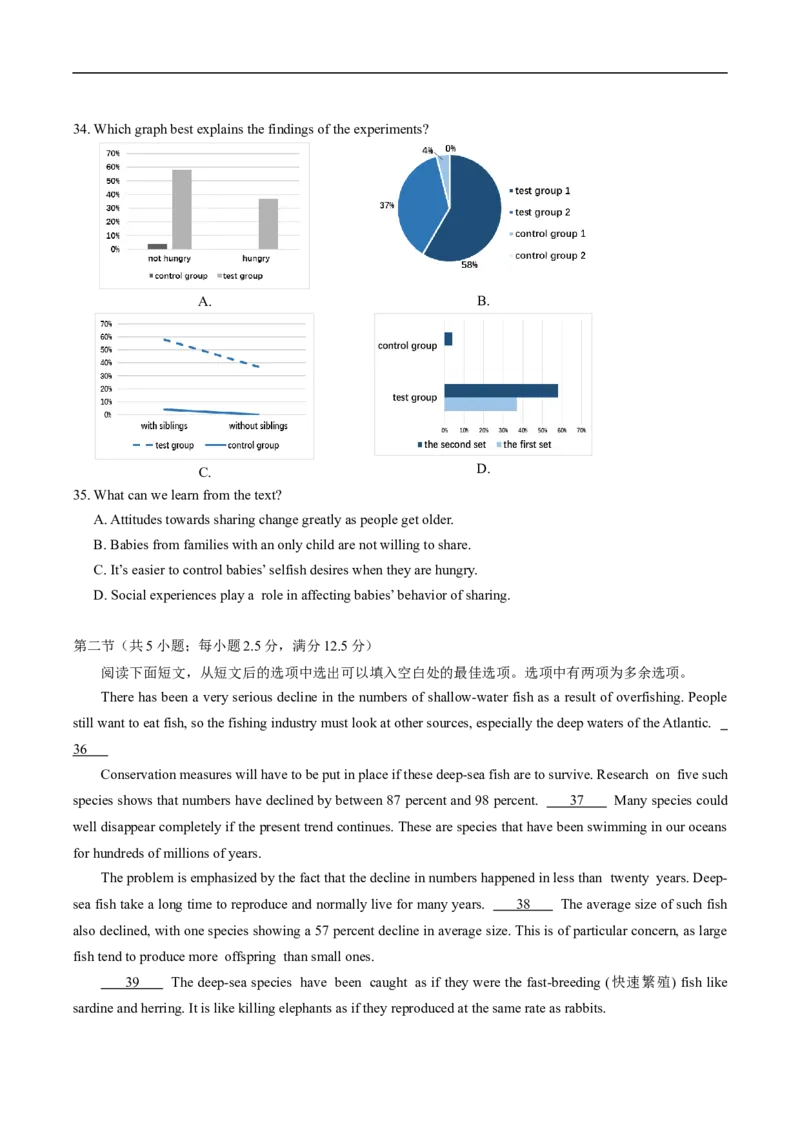
The scientists recruited 96 19-month-old children. During the experiments, a child and a researcher sat acrossfrom each other. In the control group of the first set of experiments, researchers threw a piece of fruit onto a plate
where they couldn’t reach, but the child could. They then waited. In contrast, researchers in the test group
pretended to drop the fruit on the plate, then tried and failed to reach it. This signaled to the child that the adult
wanted the food.
Among the control group, only 4 percent of the children gave the piece of fruit to the researchers, compared with
58 percent, or over half, in the test group.
Next, the team explored if children would still be generous when it was at a cost to themselves. The first set of
experiments was repeated with a separate group of kids before their lunchtime, when they were likely to be hungry.
Similarly, 37 percent of the test group handed over their fruit, compared with none in the control group.
The experiments were repeated four times. Researchers got similar results each time. Babies with siblings (兄
弟姐妹) and babies from Latino or Asian families shared more of the fruit, the team also found.
Carter Morgan, lead professor of the study, said, “We often think of babies as selfish. But here we find that
they are willing to help others even when it comes at some ‘cost’ to the self.”
Addressing why children with siblings or from certain cultural backgrounds were more likely to share their
fruit, Morgan said, “We believe this partly reflects what social psychologists call ‘interdependence’, which stresses
on the importance of interpersonal connections and adjusting to others. These social experiences that shape
attitudes towards sharing appear to have an effect very early in life.”
32. The underlined word “altruism” most probably means ________.
A. generosity B. creativity C. friendliness D. confidence
33. What can be inferred about 19-month-old babies?
A. They know when to have lunch.
B. They understand signals for help.
C. They can classify different fruits.
D. They can express their needs freely.34. Which graph best explains the findings of the experiments?
A. B.
C. D.
35. What can we learn from the text?
A. Attitudes towards sharing change greatly as people get older.
B. Babies from families with an only child are not willing to share.
C. It’s easier to control babies’ selfish desires when they are hungry.
D. Social experiences play a role in affecting babies’ behavior of sharing.
第二节(共5小题;每小题2.5分,满分12.5分)
阅读下面短文,从短文后的选项中选出可以填入空白处的最佳选项。选项中有两项为多余选项。
There has been a very serious decline in the numbers of shallow-water fish as a result of overfishing. People
still want to eat fish, so the fishing industry must look at other sources, especially the deep waters of the Atlantic.
36
Conservation measures will have to be put in place if these deep-sea fish are to survive. Research on five such
species shows that numbers have declined by between 87 percent and 98 percent. 37 Many species could
well disappear completely if the present trend continues. These are species that have been swimming in our oceans
for hundreds of millions of years.
The problem is emphasized by the fact that the decline in numbers happened in less than twenty years. Deep-
sea fish take a long time to reproduce and normally live for many years. 38 The average size of such fish
also declined, with one species showing a 57 percent decline in average size. This is of particular concern, as large
fish tend to produce more offspring than small ones.
39 The deep-sea species have been caught as if they were the fast-breeding (快速繁殖) fish like
sardine and herring. It is like killing elephants as if they reproduced at the same rate as rabbits.The damage done by overfishing goes beyond the sea environment. Millions of people make a living in the
fishing industry. 40 Measures must be taken to not only conserve ecosystems, but also sustain livelihoods
and ensure food security.
A. Billions of people rely on fish for protein.
B. Many people now choose not to eat deep-sea fish.
C. Unfortunately, their reproduction rate is very low.
D. This puts them in the category of “critically endangered”.
E. None of these facts has been taken into account by the fishing industry.
F. Overfishing is a major cause of decline in populations of ocean wildlife.
G. This has resulted in a sharp decline in the numbers of many of the species caught.
第三部分 语言运用(共两节,满分30分)
第一节(共15小题;每小题1分,满分15分)
阅读下面短文,从每题所给的A、B、C、D四个选项中选出可以填入空白处的最佳选项。
Since the beginning of my Ph.D., my life had been packed with activities. Besides working full time on my
own research, I 41 my colleagues’ experiments by helping with tasks like data analysis. I attended every
course that I could, believing my ability to 42 a tight schedule was a measure of my 43 .
However, behind my busyness lay an undeniable truth —I was burnt out. My attention was
44 — I couldn’t put my best work into all the 45 .
Then after a major error in my research paper, a colleague came and 46 , “You need to reassess your
working approach, but more importantly, you need to 47 .” I took his advice. I purchased a separate work
phone, which I would leave 48 in the evenings. I also started to set clear 49 around my work hours
and became more 50 about the projects I took on.
Initially, I felt I was doing less than others, fearing this choice might 51 my carcer. But my priorities
became clearer as I took more time to 52 and reflect on my work.
53 , I realized I really enjoyed training the students in our laboratory, so I started to invest more time and
effort in them. Ultimately, this 54 made me more productive.
Creating space for yourself isn’t a sign of 55 ; it’s a way to focus on what truly matters to you.
41. A. graded B. aided C. funded D. scheduled
42. A. assign B. manage C. delay D. decline
43. A. patience B. competence C. knowledge D. ambition
44. A. drawn B. focused C. divided D. directed
45. A. achievements B. courses C. rewards D. tasks
46. A. ordered B. blamed C. suggested D. investigated
47. A. slow down B. hang on C. cheer up D. fight back48. A. untouched B. uncharged C. unpaid D. unlocked
49. A. guidelines B. deadlines C. goals D. boundaries
50. A. selective B. curious C. confident D. anxious
51. A. launch B. improve C. affect D. lengthen
52. A. research B. experiment C. breathe D. battle
53. A. For instance B. In addition C. By contrast D. As always
54. A. belief B. training C. purchase D. change
55. A. showing off B. breaking down C. fading away D. falling behind
第二节 (共10小题;每小题1.5分,满分15分)
阅读下面短文,在空白处填入1个适当的单词或括号内单词的正确形式。
Lu Qi, noted as chief scientist of the Chinese Academy of Forestry and director of the Institute of
Great Green Wall, 5 6 (announce) to be entitled the Champions of the Earth.
Highly praised 57 his contributions to global desertification control, Lu became the first
Chinese person to receive the title, 58 achievements have shown through practice that by
combining science and policy, humanity can address land degradation issues.
Almost 40 percent of the world’s land is already degraded, desertification is on the rise and
destructive 59 (drought) are becoming more regular. The good news is that solutions already exist
today, and across 6 0 globe, extraordinary individuals and organizations are showing that it is 6 1
(whole) possible to defend and heal the planet.
Lu has led over 50 desertification control-related research projects, 62 (assist) China in
carrying out the relevant policies and providing expert technology to international organizations at the
forefront of global desertification action.
Lu’s receiving the honor can remind the younger generation as long as they remember their mission
and keep to innovating, they will definitely gain 63 (recognize) from society and that the weight
of responsibility on their shoulders has increased, and the duty has grown
6 4 (heavy).
Lu’s team is devoted to sharing the successful experiences and models of the ecological projects.
There already are cooperation centers and research centers, as well as forums for cooperation, all 65
(design) to spread China’s wisdom and experiences worldwide.
第四部分 写作(共两节,满分40分)
第一节(满分15分)
你是李华。你看到《中国日报》“印象中国”英文作品征集的信息。请给交换生Susan写一封邮件,
向她推荐这个活动。内容包括;
(1)活动简介;(2)鼓励参加。
注意:
1. 写作词数应为80个左右;
2.请按如下格式在答题纸的相应位置作答。
Dear Susan,
I have some exciting news to share with you.
Best regards,
Li Hua
第二节(满分25分)
阅读下面材料,根据其内容和所给段落开头语续写两段,使之构成一篇完整的短文。
One sunny afternoon, Josh sat alone in his room, staring at a chessboard in front of him. The black
and white squares made him think of his dreams and problems. His parents had different ideas about his
future in chess.
His mum was excited and had high hopes. She was already finding the best chess coaches and
making a strict training plan for him. She believed he could become a famous chess master and even
win championship, which brings honor to the family. His dad, on the other hand, had always emphasized
the importance of a balanced life. He thought chess was a great hobby but shouldn’t take over other
parts of Josh’s life, like school and friendships.
Josh felt torn. He loved chess with all his heart. The feeling of strategizing and outwitting his
opponents on the board was exciting. But he also cherished the carefree days of playing basketball with
his friends at the park and the evenings spent reading adventure novels.
As days went by, tension grew at home. His mum kept talking about chess tournaments, while his
dad tried to change the subject. Josh found it hard to focus on school or even enjoy chess.
One evening, after a big argument between his parents, Josh went to the park. He used to play chessthere with his dad. Sitting on a bench, he watched the sunset and thought about what he really wanted.
An old man with a kind face came over. He saw the chessboard and asked if he could play a game.
As they played, the man told Josh about his past, when he had to choose between his passion and
others’ expectations. “Son,” the old man said, “listen to your heart. Whatever you choose, do your best
and don’t regret it.”
That night, Josh went home with a clear mind. He knew what he had to do.
注意:
1.续写词数应为150左右;
2.请按如下格式在答题卡的相应位置作答。
The next morning, Josh sat his parents down at the kitchen table.
Josh’s Dad nodded in agreement, a look of relief on his face.2025 年广州市普通高中毕业班冲刺训练题(三)
英语试题参考答案
第二部分 阅读
第一节(共15小题;每小题2.5分,满分37.5分)
21. D 22. B 23. A 24. C 25. A
26. D 27. D 28. C 29. D 30. B
31. A 32. A 33. B 34. A 35. D
第二节(共5小题;每小题2.5分, 满分12.5分)
36. G 37. D 38. C 39. E 40. A
第三部分 语言运用
第一节(共15小题;每小题1分,满分15分)
41. B 42. B 43. B 44. C 45. D
46. C 47. A 48. A 49. D 50. A
51. C 52. C 53. A 54. D 55. D
第二节 (共10小题;每小题1.5分,满分15分)
56. was announced 57. for 58. whose 59. droughts
60. the 61. wholly 62. Assisting 63. recognition
64. heavier 65. designed
第四部分 写作
第一节
【作文示例】
Dear Susan,
I have some exciting news to share with you. I just saw an announcement in China Daily about their
“Impressions of China” writing contest and immediately thought of you.
This contest invites international students to share their experiences in China through English essays,
photos, or videos. The theme is “My Unique China Story,” and submissions are due by June 30. Winners will
get their works published and even receive prizes.As an exchange student, you’ve had so many memorable moments here—from trying hotpot to learning
calligraphy. Your firsthand experiences and perspectives can make for a truly interesting and insightful piece,
which will let more people know about the real China through your eyes.
Let me know if you’re interested—I’d love to brainstorm ideas with you.
Best,
Li Hua
第二节(满分25分)
【作答示例】
The next morning, Josh sat his parents down at the kitchen table. Taking a deep breath, he said, “I’ve decided
to keep chess as a passion, not a profession.” His mother’s smile faded, but Josh continued, “I love chess, but I also
want time for friends, school, and other things that make me happy.” He shared the old man’s advice, adding, “If I
force myself to only play chess, I might end up hating it.” His mum sighed, her eyes glistening. “I just want you to
succeed,” she admitted. Josh reached for her hand. “I will—but in my own way. Maybe I’ll join local tournaments
for fun, not pressure.”
Josh’s dad nodded in agreement, a look of relief on his face. “Balance is success too,” he said, patting Josh’s
shoulder. The tension in the room melted as they compromised: Josh would train twice a week, leaving weekends
free for other activities. That afternoon, Josh met his friends at the park, chessboard under one arm and a basketball
in the other. For the first time in weeks, he laughed freely, knowing he’d honored both his heart and his family. The
chessboard remained a symbol of joy—not a battlefield of expectations.