Numerical Comprehension Test 4
Solutions Booklet
Instructions
This numerical reasoning test comprises 18 questions, and you will have 18 minutes in
which to correctly answer as many as you can. Calculators are permitted for this test, and it is
recommended you have some rough paper to work on.
You will have to work quickly and accurately to perform well in this test. If you don't know the
answer to a question, leave it and come back to it if you have time. Each question will have
five possible answers, one of which is correct. If the exact correct answer is not provided,
select the closest possible answer. You may click Back and Next during the test to review or
skip questions.
You can submit your test at any time. If the time limit is up before you click submit the test will
automatically be submitted with the answers you have selected. It is recommended to keep
working until the time limit is up.
Try to find a time and place where you will not be interrupted during the test.The test will
begin on the next page.
AssessmentDay
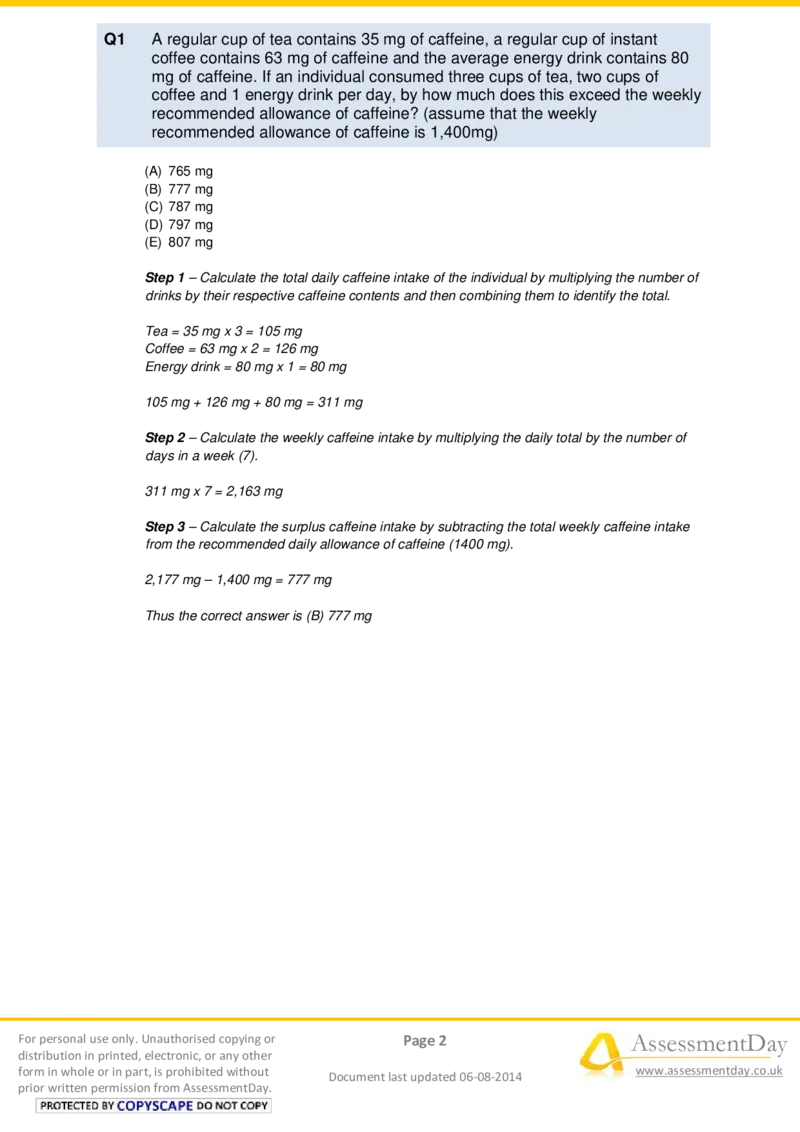
Practice Aptitude TestsQ1 A regular cup of tea contains 35 mg of caffeine, a regular cup of instant
coffee contains 63 mg of caffeine and the average energy drink contains 80
mg of caffeine. If an individual consumed three cups of tea, two cups of
coffee and 1 energy drink per day, by how much does this exceed the weekly
recommended allowance of caffeine? (assume that the weekly
recommended allowance of caffeine is 1,400mg)
(A) 765mg
(B) 777mg
(C) 787mg
(D) 797mg
(E) 807mg
Step 1–Calculate the total daily caffeine intake of the individual by multiplying the number of
drinks by their respective caffeine contentsand then combining them to identify the total.
Tea = 35 mgx 3 = 105mg
Coffee = 63mgx 2 = 126mg
Energy drink = 80mgx 1 = 80mg
105mg+ 126mg+ 80mg= 311mg
Step 2–Calculate the weekly caffeine intake by multiplying the daily total by the number of
days in a week (7).
311mgx 7 = 2,163mg
Step 3–Calculate the surplus caffeine intake by subtracting the total weekly caffeine intake
from the recommended daily allowance of caffeine (1400 mg).
2,177mg–1,400 mg = 777mg
Thus the correct answer is(B)777mg
For personal use only.Unauthorised copying or Page2 AssessmentDay
distribution in printed, electronic, or any other
form in whole or in part, is prohibited without www.assessmentday.co.uk
Document last updated06-08-2014
prior written permission from AssessmentDay.Q2 In an email marketing campaign, a company sent out 120,050 emails inviting
potential customers to buy their product. Of these 120,050 customers, 24%
opened their email, ¼ followed the link in the email and 35% of customers
following the link made a purchase. If the advertised product costs £9.99,
how much revenue was generated by this email marketing campaign?
(A) £25,184.79
(B) £26,458.21
(C) £27,655.36
(D) £28,658.32
(E) £29,321.58
Step 1–Calculate thenumberof potential customersthat opened the email by identifying
24% (0.24) of the total number of emails sent (120,050).
120,050 x 0.24 = 28,812
Step 2–Calculate the number of potential customers that opened the link in the email by
identifying ¼ (0.25) of the number of customers that opened the email.
28,812 x 0.25 = 7,203
Step 3–Calculate the number of customers whoactually made a purchase by identifying
35% (0.35) of the number of potential customers that followed the link in the email (7,203)
7,203 x 0.35 = 2,521.05 =2,521
Step 4–Calculate the revenue generated by the email marketing campaign by multiplying the
number of sales (2,521) by theprice of the product (£9.99).
2,521 x £9.99 = £25,184.79
Thus the correct answer is(A)£25,184.79
For personal use only.Unauthorised copying or Page3 AssessmentDay
distribution in printed, electronic, or any other
form in whole or in part, is prohibited without www.assessmentday.co.uk
Document last updated06-08-2014
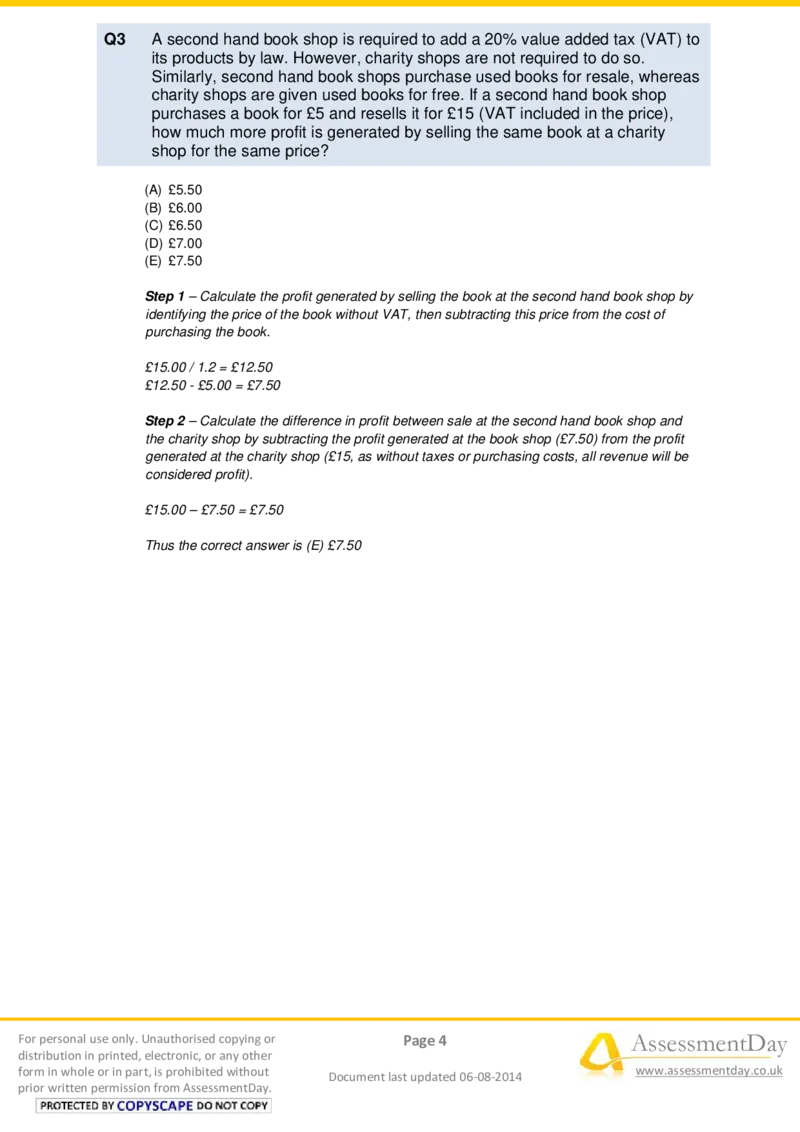
prior written permission from AssessmentDay.Q3 A second hand book shop is required to add a 20% value added tax (VAT) to
its products by law. However, charity shops are not required to do so.
Similarly, second hand book shops purchase used books for resale, whereas
charity shops are given used books for free. If a second hand book shop
purchases a book for £5 and resells it for £15 (VAT included in the price),
how much more profit is generated by selling the same book at a charity
shop for the same price?
(A) £5.50
(B) £6.00
(C) £6.50
(D) £7.00
(E) £7.50
Step 1–Calculate the profit generated by selling the book at the second hand book shop by
identifying the price of the book without VAT, then subtracting this price from the cost of
purchasing the book.
£15.00/1.2 = £12.50
£12.50-£5.00= £7.50
Step 2–Calculate the difference in profit between sale at the second hand book shop and
the charity shop by subtracting the profit generated at the book shop (£7.50) from the profit
generated at the charity shop (£15,as without taxes or purchasing costs, all revenue will be
considered profit).
£15.00–£7.50=£7.50
Thus the correct answer is(E)£7.50
For personal use only.Unauthorised copying or Page4 AssessmentDay
distribution in printed, electronic, or any other
form in whole or in part, is prohibited without www.assessmentday.co.uk
Document last updated06-08-2014
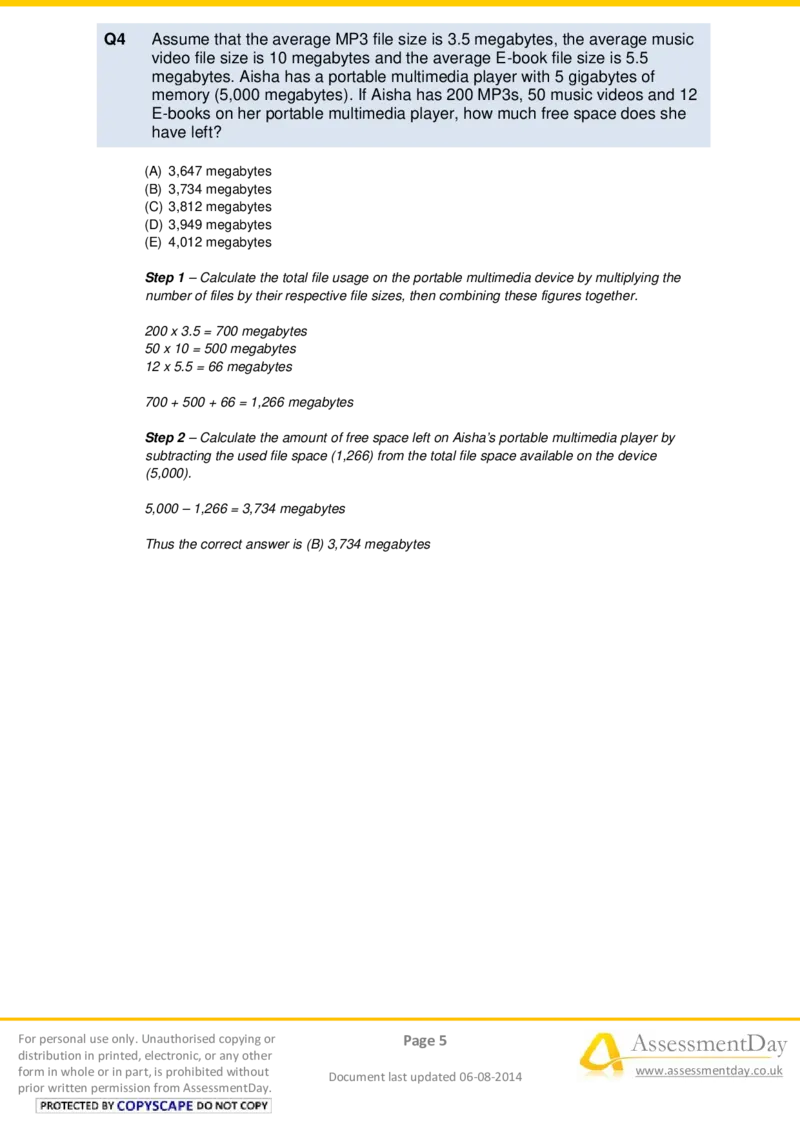
prior written permission from AssessmentDay.Q4 Assume that the average MP3 file size is 3.5 megabytes, the average music
video file size is 10 megabytes and the average E-book file size is 5.5
megabytes. Aisha has a portable multimedia player with 5 gigabytes of
memory (5,000 megabytes). If Aisha has 200 MP3s, 50 music videos and 12
E-books on her portable multimedia player, how much free space does she
have left?
(A) 3,647megabytes
(B) 3,734 megabytes
(C) 3,812megabytes
(D) 3,949megabytes
(E) 4,012megabytes
Step 1–Calculate the total file usage on the portable multimedia device by multiplying the
number of files by their respective file sizes, then combining these figures together.
200 x 3.5 =700megabytes
50 x 10 =500megabytes
12 x 5.5 =66megabytes
700+500+66= 1,266megabytes
Step 2–Calculate the amount of free space left on Aisha’s portable multimedia player by
subtracting the used file space (1,266) from the total file space available on the device
(5,000).
5,000–1,266 = 3,734 megabytes
Thusthe correct answer is(B)3,734 megabytes
For personal use only.Unauthorised copying or Page5 AssessmentDay
distribution in printed, electronic, or any other
form in whole or in part, is prohibited without www.assessmentday.co.uk
Document last updated06-08-2014
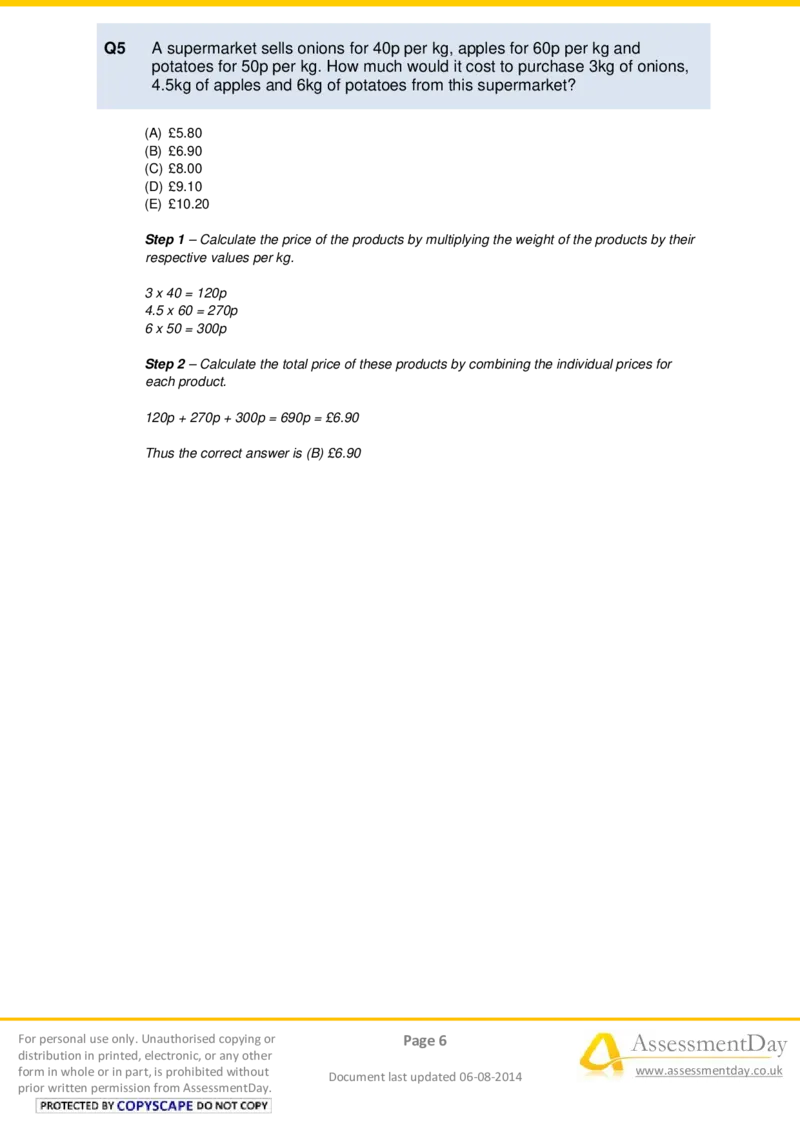
prior written permission from AssessmentDay.Q5 A supermarket sells onions for 40p per kg, apples for 60p per kg and
potatoes for 50p per kg. How much would it cost to purchase 3kg of onions,
4.5kg of apples and 6kg of potatoes from this supermarket?
(A) £5.80
(B) £6.90
(C) £8.00
(D) £9.10
(E) £10.20
Step 1–Calculate the price ofthe productsby multiplying the weight of the products by their
respective valuesper kg.
3 x 40 = 120p
4.5 x 60 = 270p
6 x 50 = 300p
Step 2–Calculate the total price of these products by combining the individual prices for
each product.
120p + 270p + 300p = 690p = £6.90
Thus the correct answer is(B)£6.90
For personal use only.Unauthorised copying or Page6 AssessmentDay
distribution in printed, electronic, or any other
form in whole or in part, is prohibited without www.assessmentday.co.uk
Document last updated06-08-2014
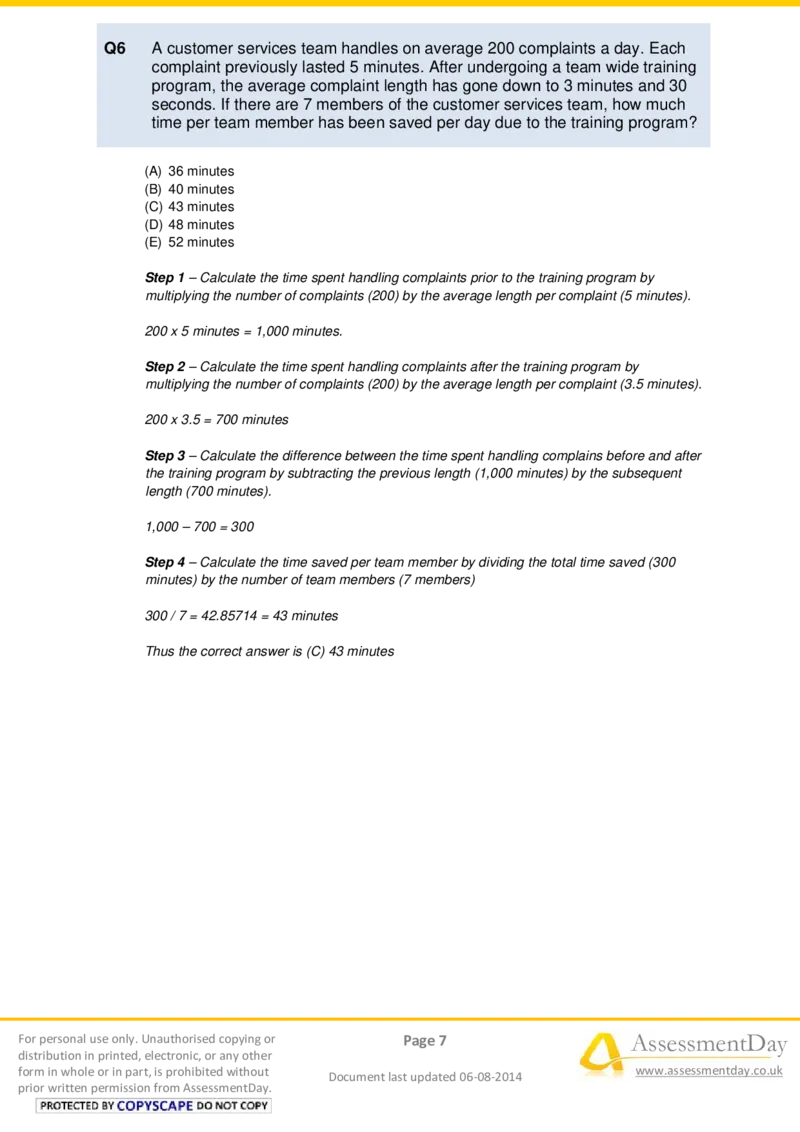
prior written permission from AssessmentDay.Q6 A customer services team handles on average 200 complaints a day. Each
complaint previously lasted 5 minutes. After undergoing a team wide training
program, the average complaint length has gone down to 3 minutes and 30
seconds. If there are 7 members of the customer services team, how much
time per team member has been saved per day due to the training program?
(A) 36 minutes
(B) 40 minutes
(C) 43minutes
(D) 48 minutes
(E) 52 minutes
Step 1–Calculate the time spent handling complaints prior to the training program by
multiplying the number of complaints (200) by the average length per complaint (5 minutes).
200 x 5 minutes = 1,000 minutes.
Step 2–Calculate thetime spent handling complaintsafterthe training program by
multiplying the number of complaints(200)by the average length per complaint(3.5 minutes).
200 x 3.5 = 700 minutes
Step 3–Calculate the difference between the time spent handling complains before and after
the training program by subtracting the previous length (1,000 minutes) by the subsequent
length (700 minutes).
1,000–700 = 300
Step 4–Calculate the time saved per team member by dividing the total time saved (300
minutes) by the number of team members (7members)
300 / 7 = 42.85714 = 43minutes
Thus the correct answer is(C)43minutes
For personal use only.Unauthorised copying or Page7 AssessmentDay
distribution in printed, electronic, or any other
form in whole or in part, is prohibited without www.assessmentday.co.uk
Document last updated06-08-2014
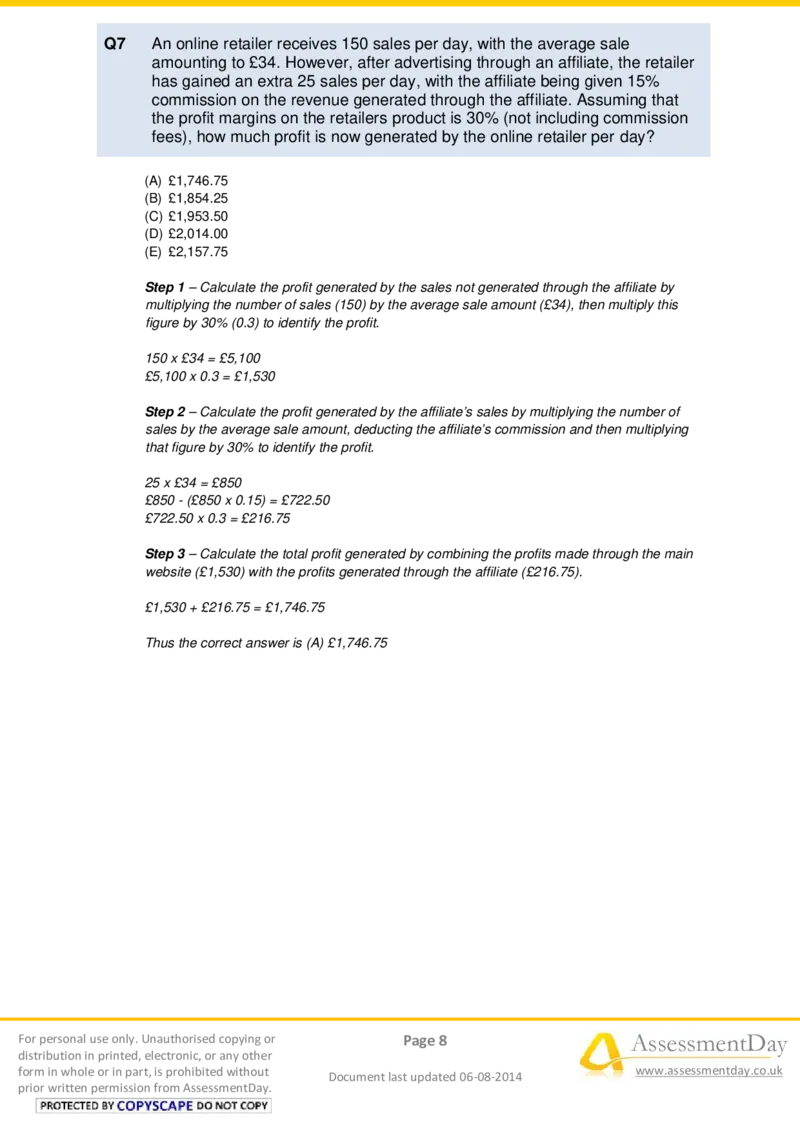
prior written permission from AssessmentDay.Q7 An online retailer receives 150 sales per day, with the average sale
amounting to £34. However, after advertising through an affiliate, the retailer
has gained an extra 25 sales per day, with the affiliate being given 15%
commission on the revenue generated through the affiliate. Assuming that
the profit margins on the retailers product is 30% (not including commission
fees), how much profit is now generated by the online retailer per day?
(A) £1,746.75
(B) £1,854.25
(C) £1,953.50
(D) £2,014.00
(E) £2,157.75
Step 1–Calculate the profit generated by the sales not generated through the affiliate by
multiplying the number of sales (150) by the average sale amount (£34), then multiply this
figure by 30% (0.3) to identify the profit.
150 x £34 = £5,100
£5,100x 0.3 = £1,530
Step 2–Calculate the profit generatedby the affiliate’ssales by multiplying the number of
sales bythe average sale amount, deducting the affiliate’s commission and then multiplying
that figure by 30% to identify the profit.
25 x £34 = £850
£850-(£850 x 0.15) = £722.50
£722.50x 0.3 = £216.75
Step 3–Calculate the total profit generated by combining the profits made through the main
website (£1,530) with the profits generated through the affiliate (£216.75).
£1,530+£216.75= £1,746.75
Thus the correct answer is(A)£1,746.75
For personal use only.Unauthorised copying or Page8 AssessmentDay
distribution in printed, electronic, or any other
form in whole or in part, is prohibited without www.assessmentday.co.uk
Document last updated06-08-2014
prior written permission from AssessmentDay.Q8 A commercial sea fishing ship catches three metric tons of fish per day, with
the voyage lasting two weeks at sea. Assuming that 1/4 of all fish caught are
suitable for human consumption, how much fish suitable for human
consumption could be caught by a 5 ship fleet of fishing ships? (Assume all
ships catch the same amount of fish).
(A) 70tons
(B) 62.5tons
(C) 65tons
(D) 45tons
(E) 52.5tons
Step1–Calculate the amount of fish caught in total by the fleet by multiplying the daily catch
per ship (3 tons) by the number of ships (5) and the length of the voyage (14 days).
3 x 5 x 14 =210tons
Step 2–Calculate the proportion of fish suitablefor human consumption by multiplying the
total catch (210 tons) by the fraction suitable for human consumption (0.25).
210x 0.25 =52.5tons
Thus the correct answer is(E)52.5tons
For personal use only.Unauthorised copying or Page9 AssessmentDay
distribution in printed, electronic, or any other
form in whole or in part, is prohibited without www.assessmentday.co.uk
Document last updated06-08-2014
prior written permission from AssessmentDay.Q9 Half of the company’s employees have a workplace pension. Of this half, 1/3
has contributed to this pension for over 5 years. Employees that have
contributed for over 5 years have the option to be paid a lump sum pension
payment upon retirement and 20% of eligible employees have elected to
receive the optional lump sum. If there are 2,690 employees at this
organization, how many employees have elected to take the optional lump
sum pension payment?
(A) 90
(B) 95
(C) 100
(D) 105
(E) 110
Step 1–Calculate the number ofemployees with a workplace pension my dividing the
number of employees (2,690) by half.
2,690/ 2 = 1,345
Step 2–Calculate the number of employees that have contributed to their pensions for over 5
years by identifying1/3 (0.333) of employees with workplace pensions.
1,345x 0.333 = 447.885= 448
Step 3–Calculate the number of staff thatopted to take the lump sum by identifying 20% of
staff that have contributed to their pensions for over 5 years (448).
448 x 0.2 = 89.6 = 90
Thus the correctanswer is(A)90
For personal use only.Unauthorised copying or Page10 AssessmentDay
distribution in printed, electronic, or any other
form in whole or in part, is prohibited without www.assessmentday.co.uk
Document last updated06-08-2014
prior written permission from AssessmentDay.Q10 An employee earns £7.29 per hour for their contracted hours. The employee
is also paid 1.5 times standard pay when working overtime. Similarly,
employees are offered a £30 cash bonus every time they meet or exceed
their weekly sales targets. If in one week, an employee works 37.5
contracted hours, 9 hours of overtime and meets their weekly target, how
much can the employee expect to be paid?
(A) £401.80
(B) £412.40
(C) £425.70
(D) £436.20
(E) £447.50
Step 1–Calculate the amount in which the employee is paid from theircontracted hours by
multiplying the total number of hours worked (37.5) by the pay per hour (£7.29).
37.5 x£7.29= £273.375= £273.38
Step 2–Calculate the amount in which the employee is paid from their overtime hoursby
multiplying the total numberof hours worked (9) by the standard pay per hour(£7.29)
multipliedby 1.5.
9 x (£7.29x 1.5) =£98.415=£98.42
Step 3–Calculate the employee’s total pay by combining the employee’spay from their
contracted (£273.38) and overtime hours (98.42), and then adding£30 (for meeting their
target).
£273.38+ £98.42 + £30 = £401.80
Thus the correct answer is(A)£401.80
For personal use only.Unauthorised copying or Page11 AssessmentDay
distribution in printed, electronic, or any other
form in whole or in part, is prohibited without www.assessmentday.co.uk
Document last updated06-08-2014
prior written permission from AssessmentDay.Q11 A travel agent sells Euros (€ ) at an exchange rate of 1.12 Euros (€ ) to the
British Pound Sterling (£). However, the official exchange rate is 1.17 Euros
to the British pound (£), making a profit on the difference. If a customer
exchanges £1,300 for Euros at the travel agent, how much profit does the
travel agent gain from this transaction?
(A) € 45
(B) € 50
(C) € 55
(D) € 60
(E) € 65
Step 1–Calculate the number of Euros the customer receives from the travel agent by
multiplying the amount in pounds (£1,300) by the travel agents exchange rate (1.12)
£1,300 x 1.12 =€ 1,456
Step 2–Calculate the number of Euros which would have been purchased using the actual
official exchange rate by multiplying the amount in pounds (£1,300) by the official exchange
rate (1.17).
£1,300 x 1.17 =€ 1,521
Step 3–Calculate the profit gained by thetravel agent by subtracting the number of Euros
purchased from the travel agent (€ 1,456) from the number of Euros which can be purchased
using the official exchange rate (€ 1,521).
€ 1,521-€ 1,456=€ 65
Thus the correct answer is(E)€ 65
For personal use only.Unauthorised copying or Page12 AssessmentDay
distribution in printed, electronic, or any other
form in whole or in part, is prohibited without www.assessmentday.co.uk
Document last updated06-08-2014
prior written permission from AssessmentDay.Q12 The Cassava root contains 38 grams of carbohydrates per 100 grams and
each individual root has an average weight of 350 grams. If carbohydrates
contain 4 calories per gram, how many calories from carbohydrates can be
found in 250 Cassava roots?
(A) 126,000calories
(B) 133,000 calories
(C) 139,000calories
(D) 145,000calories
(E) 161,000calories
Step 1–Calculate how many grams of carbohydrates can be found in a single Cassava root
by multiplying the number of grams of carbohydrates by 3.5 (350 grams)
38 x 3.5= 133 grams
Step 2–Calculate the total number of grams of carbohydrates by multiplying the number of
grams of carbohydrates in a cassava root (133) by the number of roots (250).
133 x 250 = 33,250 grams
Step 3–calculate the total number ofcalories by multiplying the total number of grams
(33,250) by the number of calories per gram (4).
33,250 x 4 =133,000 calories
Thus the correct answer is(B)133,000 calories
For personal use only.Unauthorised copying or Page13 AssessmentDay
distribution in printed, electronic, or any other
form in whole or in part, is prohibited without www.assessmentday.co.uk
Document last updated06-08-2014
prior written permission from AssessmentDay.Q13 For a £200 payday loan, a company charges 0.95% of the value of the loan
per day as interest. The loan needs to be paid back in full in one lump sum
and the interest does not compound. How many days will it take for the
interest on the loan to equal the initial loan amount?
(A) 90 days
(B) 95 days
(C) 100 days
(D) 105 days
(E) 110 days
Step 1–Calculate the daily interest payments by identifying 0.95% of the total loan amount
(£200).
£200 x 0.0095 = £1.90
Step 2–Calculate the number of days it would take for the interest to equal the initial loan
amount by dividing the initial loanamount (£200) by the daily interest payment (£1.90).
£200 / £1.90 =105.2631579= 105 days
Thus the correct answer is(D)105 days
For personal use only.Unauthorised copying or Page14 AssessmentDay
distribution in printed, electronic, or any other
form in whole or in part, is prohibited without www.assessmentday.co.uk
Document last updated06-08-2014
prior written permission from AssessmentDay.Q14 A coins-to-cash machine converts unwanted small change into banknotes for
a fee. On the first £5, a 10% fee is charged, on the next £5, a 7.5% fee is
charged and on all change afterwards, a 5% fee is charged. If a customer
cashes in £30 worth of change, how much money will the coins-to-cash gain
from this transaction?
(A) £1.55
(B) £1.66
(C) £1.77
(D) £1.88
(E) £1.99
Step 1–Calculate the fee charged on the first £5 by identifying 10% (0.1) of £5.
£5.00x 0.1 = £0.50
Step 2–Calculate the fee charged on the second £5 by identifying 7.5%(0.075)of £5.
£5 x 0.075 =£0.375= £0.38
Step 3–Calculate the fee charged on theremaining amount by identifying 5%(0.05)of £20
(£30–10).
£20 x 0.05 = £1.00
Step 4–Calculate the total fee charged by combining the three figures above.
£0.50+ £0.38 + £1.00 = £1.88
Thus the correct answer is(D)£1.88
For personal use only.Unauthorised copying or Page15 AssessmentDay
distribution in printed, electronic, or any other
form in whole or in part, is prohibited without www.assessmentday.co.uk
Document last updated06-08-2014
prior written permission from AssessmentDay.Q15 A company pays an annual dividend of 3.56% of the value of the shares
held. If the dividends are re-invested after each dividend payment, how much
dividend income would have been received on an initial investment £3,500
over three annual dividend payments?
(A) £361.68
(B) £368.10
(C) £373.80
(D) £381.85
(E) £387.27
Step 1–Calculate thedividendpayment on the first year by multiplying the value of the
shares (£3,500) by the dividend yield (3.56%).
£3,500 x 0.0356 = £124.60
Step 2–Calculate the second dividend payment by multiplying thenew value of the shares
(£3,500 + 124.6) by the dividend yield (3.56%).
£3,500 + £124.60 = £3,624.60
£3,624.60x0.0356= 129.03576 = £129.04
Step 3–Calculate the third dividend payment by multiplying the new values of the shares
(£3,624.60+£129.04)by the dividend yield (3.56%).
£3,624.60 + £129.04= £3,753.64
£3,753.64x 0.0356 = £133.629584= £133.63
Step 4–Calculate the total dividend income received by combing the figures across all three
years.
£124.60+£129.04+£133.63=£387.27
Thusthe correct answer is(E)£387.27
For personal use only.Unauthorised copying or Page16 AssessmentDay
distribution in printed, electronic, or any other
form in whole or in part, is prohibited without www.assessmentday.co.uk
Document last updated06-08-2014
prior written permission from AssessmentDay.Q16 The common cold is a viral infection in which 70% of all cases are mainly due
to Rhinovirus, 15% are mainly due to Coronavirus, 10% mainly due to
influenza and 5% mainly due to other viruses. Often, more than one virus is
present. If 90% of the world population (7,000,000,000) suffers from the
common cold at least once a year, how many individuals are infected with
the Rhinovirus?
(A) 4,500,000,000people
(B) 5,040,000,000people
(C) 5,800,000,000people
(D) 6,300,000,000people
(E) Cannot say
Step 1–Because we are told that more than one virus is often present, and the figures given
are only for when rhinovirus is the main cause (and not a minor cause), we do not have
enough information to answer the question.
Thus the correct answer is(E)cannotsay
For personal use only.Unauthorised copying or Page17 AssessmentDay
distribution in printed, electronic, or any other
form in whole or in part, is prohibited without www.assessmentday.co.uk
Document last updated06-08-2014
prior written permission from AssessmentDay.Q17 A freelance web developer charges £100 per hour, or £600 for a full day (8
hours). Their latest contract requires the web developer to work three full
days and two half days (4 hours). Assuming the web developer pays 30%
income tax, how much income will the web developer receive from this
contract? (after tax)
(A) £1,600
(B) £1,710
(C) £1,820
(D) £1,930
(E) £2,040
Step 1–Calculate the income earned from the three fullday’s work by multiplying the
developers day rate (£600) by the number of days worked (3).
£600 x 3 = £1,800
Step 2–Calculate the income earned from the two half days work by multiplying the
developers hourly rate (£100) by the number of hours worked (4+4 = 8).
£100 x 8 = £800
Step 3–Combine the two figures above and subtract 30% from that figure to remove the
developer’s income tax, giving us the total income earned after tax.
£1,800 + £800 = £2,600
£2,600-(£2,600 x 0.3) =£1,820
Thus the correct answer is(C)£1,820
For personal use only.Unauthorised copying or Page18 AssessmentDay
distribution in printed, electronic, or any other
form in whole or in part, is prohibited without www.assessmentday.co.uk
Document last updated06-08-2014
prior written permission from AssessmentDay.Q18 A shop is willing to purchase used entertainment products for resale. The
shop will purchase CDs for £1 each, DVDs for £2.50 each and video games
for £7.50 each. Similarly, every £0.50 worth of products sold to the shop
accrues 1 loyalty point. If a customer sells 26 CDs, 10 DVDs and 5 video
games, how many loyalty points has the customer accrued from this
transaction?
(A) 142points
(B) 165points
(C) 177points
(D) 175points
(E) 158points
Step 1–Calculate the value of the CDs by multiplying the number of CDs (26) bythe value of
each CD (£1).
26 x £1 = £26
Step 2–Calculate the value of the DVDs by multiplying the number of DVDs by the value of
each DVD (£2.50).
£2.50 x 10 = £25.00
Step 3–Calculate the value of the video games by multiplying the number of videogames (5)
by the value of each video game (£7.50).
7.5 x 5 = £37.50
Step 4–Calculate the number of loyalty points accrued by dividing the total value of all
products by 2, then rounding down to the nearest whole point.
£26.00 + £25.00 + £37.50 =£88.50
88.50 x2 =177 = 177points
Thus the correct answer is(C)177points
-- End of Test --
For personal use only.Unauthorised copying or Page19 AssessmentDay
distribution in printed, electronic, or any other
form in whole or in part, is prohibited without www.assessmentday.co.uk
Document last updated06-08-2014
prior written permission from AssessmentDay.