文档文本内容
课时分层作业(十一)
Ⅰ.单句语法填空
1.Occupying (occupy) herself with routine office tasks, she had no time to
attend to her children.
2.What was it that distinguished her from her classmates?
3.The actor got embarrassed (embarrass) when asked about his personal things.
4.He was ashamed (shame) that he had not finished the task on time.
5 . Why bother to go(go) abroad to study, when there are so many good
universities at home?
6.It looks as though you are ill today.
7.A chemist can separate a medicine into its components(component).
8.He inquired(inquire) whether there had been any messages for him.
9.You made good grades in school and perform well at work.
10.Tom's anxiety(anxious) to succeed led him to work hard.
Ⅱ.语言运用
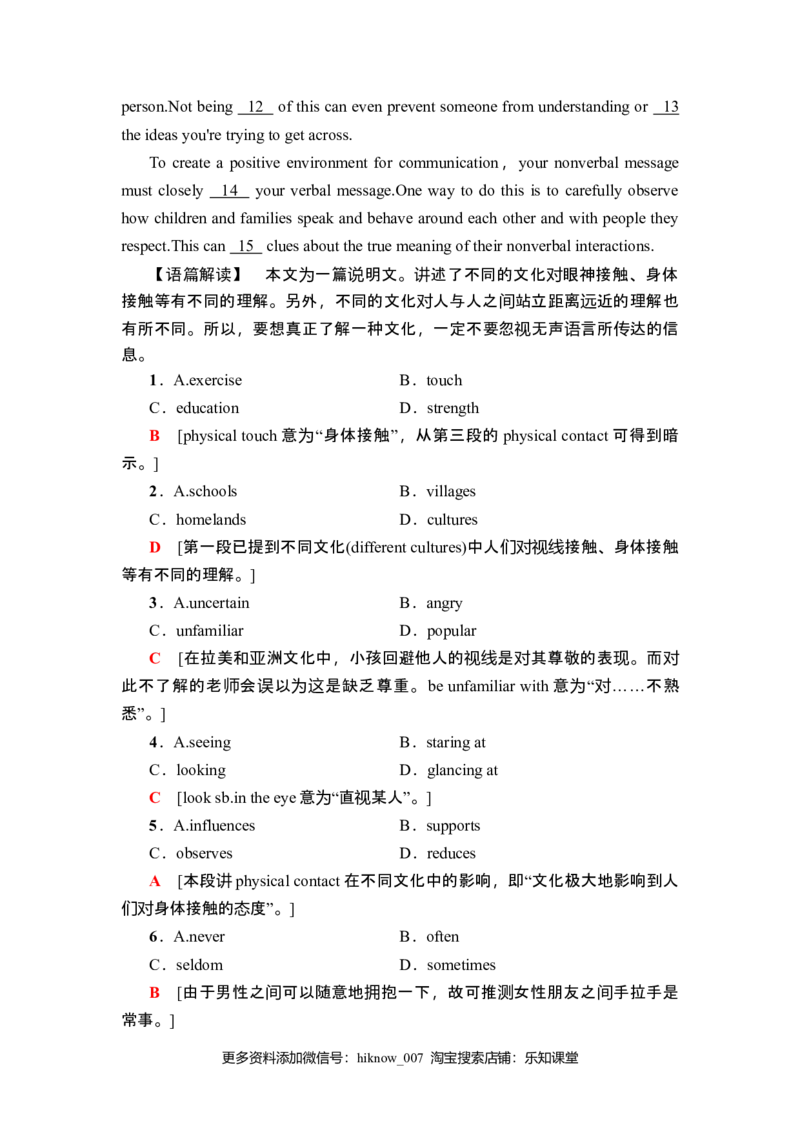
It may be difficult to understand nonverbal messages because different cultures
have different expectations about eye contact,physical 1 ,etc.
Let's consider eye contact.Children from many Latin American and Asian 2
show respect by avoiding the glance of important persons.A teacher who's 3 with
this,however,might consider the lack of eye contact as a sign of disrespect.For
many American Indian children, 4 a teacher in the eye and answering her question
in front of the class is “showing off”.
Culture greatly 5 attitudes towards physical contact , whether it's a
handshake,hug,or pat on the back.In Asia,female friends 6 hold hands and
men casually(随便地) hug one another as they walk down the street.Americans,
however , may feel uncomfortable with such public behavior.In some Asian
cultures,affectionately patting a(n) 7 head is strictly taboo(禁忌的), 8 it can be
acceptable behavior between adults and young children.
How close should people stand to each other when they're having a conversation?
In areas of the Middle East and South America,people stand very close when 9 .
Europeans like to have 10 distance between them,while some Africans 11 even
more space.You can create great discomfort by standing too close to another
更多资料添加微信号:hiknow_007 淘宝搜索店铺:乐知课堂person.Not being 12 of this can even prevent someone from understanding or 13
the ideas you're trying to get across.
To create a positive environment for communication,your nonverbal message
must closely 14 your verbal message.One way to do this is to carefully observe
how children and families speak and behave around each other and with people they
respect.This can 15 clues about the true meaning of their nonverbal interactions.
【语篇解读】 本文为一篇说明文。讲述了不同的文化对眼神接触、身体
接触等有不同的理解。另外,不同的文化对人与人之间站立距离远近的理解也
有所不同。所以,要想真正了解一种文化,一定不要忽视无声语言所传达的信
息。
1.A.exercise B.touch
C.education D.strength
B [physical touch 意为“身体接触”,从第三段的 physical contact 可得到暗
示。]
2.A.schools B.villages
C.homelands D.cultures
D [第一段已提到不同文化(different cultures)中人们对视线接触、身体接触
等有不同的理解。]
3.A.uncertain B.angry
C.unfamiliar D.popular
C [在拉美和亚洲文化中,小孩回避他人的视线是对其尊敬的表现。而对
此不了解的老师会误以为这是缺乏尊重。be unfamiliar with 意为“对……不熟
悉”。]
4.A.seeing B.staring at
C.looking D.glancing at
C [look sb.in the eye意为“直视某人”。]
5.A.influences B.supports
C.observes D.reduces
A [本段讲physical contact在不同文化中的影响,即“文化极大地影响到人
们对身体接触的态度”。]
6.A.never B.often
C.seldom D.sometimes
B [由于男性之间可以随意地拥抱一下,故可推测女性朋友之间手拉手是
常事。]
更多资料添加微信号:hiknow_007 淘宝搜索店铺:乐知课堂7.A.child's B.baby's
C.adult's D.man's
C [在一些亚洲文化中,摸成人的头是严格禁止的,但是成人和小孩之间
摸头是可以接受的。]
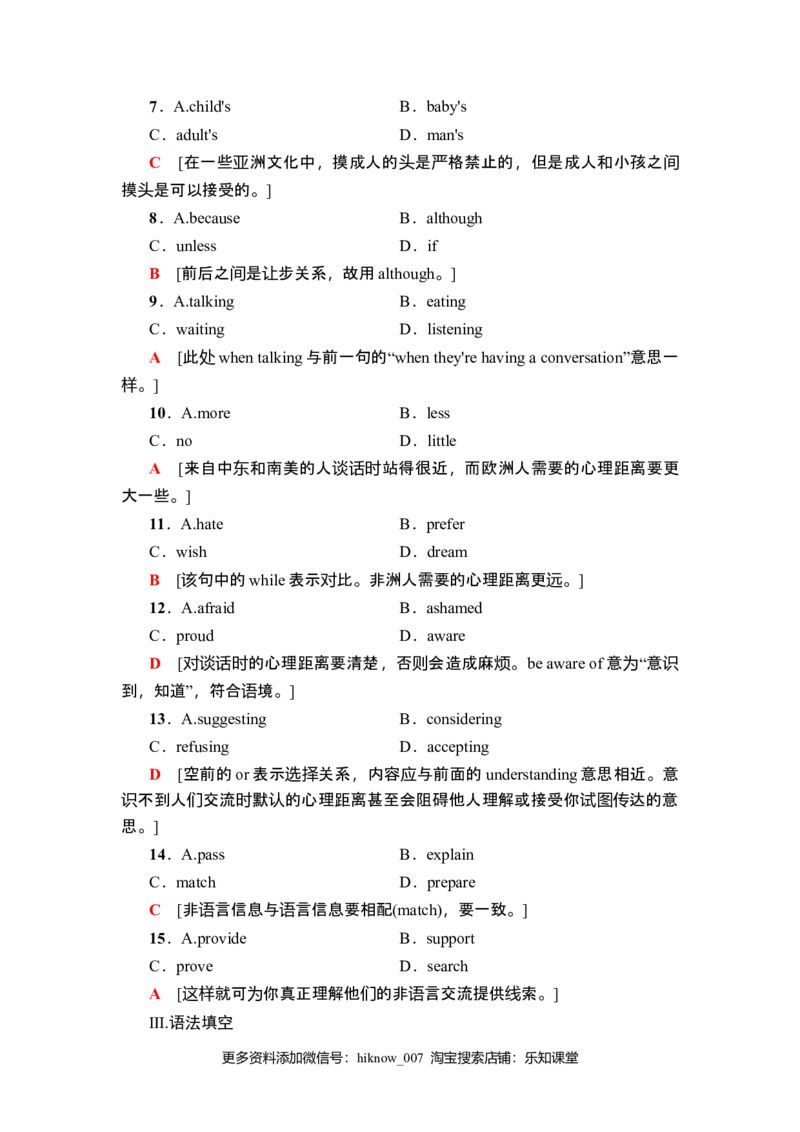
8.A.because B.although
C.unless D.if
B [前后之间是让步关系,故用although。]
9.A.talking B.eating
C.waiting D.listening
A [此处when talking与前一句的“when they're having a conversation”意思一
样。]
10.A.more B.less
C.no D.little
A [来自中东和南美的人谈话时站得很近,而欧洲人需要的心理距离要更
大一些。]
11.A.hate B.prefer
C.wish D.dream
B [该句中的while表示对比。非洲人需要的心理距离更远。]
12.A.afraid B.ashamed
C.proud D.aware
D [对谈话时的心理距离要清楚,否则会造成麻烦。be aware of意为“意识
到,知道”,符合语境。]
13.A.suggesting B.considering
C.refusing D.accepting
D [空前的or表示选择关系,内容应与前面的understanding意思相近。意
识不到人们交流时默认的心理距离甚至会阻碍他人理解或接受你试图传达的意
思。]
14.A.pass B.explain
C.match D.prepare
C [非语言信息与语言信息要相配(match),要一致。]
15.A.provide B.support
C.prove D.search
A [这样就可为你真正理解他们的非语言交流提供线索。]
Ⅲ.语法填空
更多资料添加微信号:hiknow_007 淘宝搜索店铺:乐知课堂Your body language will give out a lot more information.1.________ (base) on
your body language it can be seen whether you are selfconfident.It can also show if
you are a busy or a quiet type and it 2.________(help) give the impression of whether
you are speaking 3.________ (truthful) or not.Body language can show how
enthusiastic you are and if you are a nice person,someone who 4.________ (take)
his work seriously or who has a sense of humour and can enjoy a joke from time
5.________ time.The members of the application committee will ask you questions,
6.________ your answers won't only be oral.
The committee will not only pay attention to 7.________ you say,but also to
how you say it!Body language will determine first if it “clicks”,and sometimes all
it takes is just a few 8.________(second) . Everybody 9.________(use) body
language,but it takes place mostly at a subconscious (下意识的) level.Using body
language appropriately , you can definitely increase your chances of
10.________(get) a job.
【语篇解读】 你的身体语言能给出许多信息。
1.Based [考查非谓语动词。it can be seen whether you are selfconfident为
句子的主干,此处应用base的非谓语动词形式,和后面的on your body language
一起作状语,be based on意为“以……为基础”。故填Based。]
2.helps [考查时态和主谓一致。根据语境可知此处用一般现在时,主语
为it,故填helps。]
3.truthfully [考查词性转换。修饰speaking应用副词,故填truthfully。]
4.takes [who his work seriously为定语从句,修饰someone,设空处
在定语从句中作谓语。根据 or后面的定语从句用一般现在时可知此处也用一般
现在时,故填takes。]
5.to [考查固定搭配。from time to time为固定搭配,意为“有时;不时”,
故填to。]
6.but [考查并列连词。句意:申请委员会的成员们会问你问题,但是你
的回答并不只是口述的。根据句意可知,设空处前后内容在意思上存在转折关
系,故填but。]
7.what [考查宾语从句。 you say为宾语从句,设空处引导从句
并且在从句中作宾语,指事物,故填what。]
8.seconds [考查名词复数。a few 修饰可数名词的复数形式,故填
seconds。]
9.uses [考查主谓一致和时态。根据语境可知此处用一般现在时,
更多资料添加微信号:hiknow_007 淘宝搜索店铺:乐知课堂everybody作主语,谓语动词要用单数形式,故填uses。]
10.getting [考查非谓语动词。介词of后要跟动名词形式,故填getting。]
更多资料添加微信号:hiknow_007 淘宝搜索店铺:乐知课堂