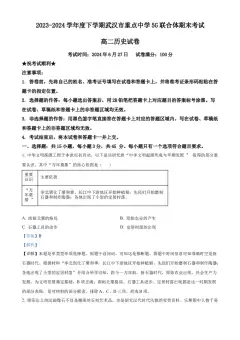
武汉市部分重点中学 2023—2024 学年度下学期期末联考
高二英语试卷
本试卷共10页, 满分150分。考试用时120分钟。 考试时间: 2024年6月26日下午14: 00-
16: 00
祝考试顺利
注意事项:
1. 答题前, 先将自己的姓名、准考证号填写在试卷和答题卡上, 并将准考证号条形码贴在答
题卡上的指定位置。
2. 选择题的作答: 每小题选出答案后, 用 2B 铅笔把答题卡上对应题目的答案标号涂黑。写
在试卷、草稿纸和答题卡上的非答题区域均无效。
3. 非选择题的作答: 用黑色签字笔直接答在答题卡上对应的答题区域内。写在试卷、草稿纸
和答题卡上的非答题区域均无效。
4. 考试结束后, 请将本试卷和答题卡一并上交。
第一部分 听力(共两节, 满分30分)
第一节(共5小题; 每小题 1.5 分, 满分7.5分)
听下面5段对话。每段对话后有一个小题, 从题中所给的A、B、C三个选项中选出最佳选项。
听完每段对话后, 你都有 10 秒钟的时间来回答有关小题和阅读下一小题。每段对话仅读一
遍。
1. What is the woman busy doing?
A. Taking dance classes. B. Finishing reports. C. Preparing for a long race.
2. What does the man think of his job?
A. It's enjoyable. B. It's boring. C. It's worrying.
3. What is the woman mainly doing?
A. Sharing experience in checking price labels.
B. Giving tips on washing clothes properly.
C. Praising the man's laundry service.
4. Who might Sarah be?
A. An HR director. B. A saleswoman. C. An accountant.
5. How did the man go to work today?
A. On foot. B. By subway. C. By car.
第二节(共15小题;每小题1.5分,满分22.5分)听下面5段对话或独白。每段对话或独白后有几个小题, 从题中所给的A、B、C三个选项中
选出最佳选项。听每段对话或独白前, 你将有时间阅读各个小题, 每小题5秒钟; 听完后, 各
小题将给出5秒钟的作答时间。每段对话或独白读两遍。
听下面一段较长对话, 回答以下小题。
6. Why is the woman unwilling to get electronic locks?
A. They are too expensive.
B. She might forget the password.
C. They may have some technical problems.
7. What does the man suggest doing?
A. Picking a top brand.
B. Carrying a spare traditional key.
C. Downloading a special mobile app.
听下面一段较长对话, 回答以下小题。
8. What has impressed Lisa most about her dormitory life?
A. Having discussions on courses.
B. Watching late-night movies.
C. Taking part in DIY projects.
9. What has Lisa learned from her dormitory life?
A. Calmness. B. Independence. C. Responsibility.
听下面一段较长对话, 回答以下小题。
10 What subject does the man teach?
A. World history. B. Literature. C. Science.
11. How does the man help students engage in preservation?
A. By holding some competitions.
B. By organizing field trips to museums.
C. By encouraging them to do volunteer work.
12. What does the woman think of preserving cultural heritage?
A. It teaches people about diversity.
B. It connects people to their roots.
C. It positively influences the future.
听下面一段较长对话, 回答以下小题。
13. What is the man's first piece of advice for the woman?
A. Setting off at her own speed.B. Wearing a helmet at all times.
C. Exploring different routes.
14. Where does the man normally go cycling?
A. Along the coast. B. In the nearby park. C. In the mountains.
15. What is the longest distance the man has cycled?
A. 50 kilometers. B. 100 kilometers. C. 150 kilometers.
16. Why does the man enjoy group rides?
A. They help break his cycling record.
B. They give him a sense of belonging.
C. They usually involve intense competition.
听下面一段独白, 回答以下小题。
17. What was mentioned in the open letter?
A. The concern about AI affecting writing.
B. The impact of Al on science fiction films.
C. The benefits of Al in the field of writing.
18. What is the main topic of the book Hum?
A. A fact-checking program.
B. A poet working with AI.
C. A story of Job loss due to AI.
19. Who is Ryan Doherty?
.
A A government worker. B. A doctor. C. A director.
20. Which work was created with the help of AI?
A. Sike. B. Death of an Author. C. In Our Likeness.
第二部分阅读理解(共20小题,每小题2.5分,满分50分)
第一节(共15小题,每小题2.5分,满分37.5分)
阅读下列短文, 从每题所给的A、B、C、D四个选项中, 选出最佳选项。
A
Music is universal. Take a moment to think about what music you like as you read our beginners’ guide to the
history of music.
Middle Ages
The Middle Ages, which ranges from the 6th century to the 16th century, featured medieval (中世纪的) music.
During this time, there were two general types of music styles — the monophonic and the polyphonic. The main
forms of music included Gregorian chanting and plainchant.Classical Period
The music forms and styles of the Classical period, which ranges from 1750 to 1820, are characterized by
simpler melodies and forms like the sonatas. During this time, the middle class had more access to music. So
composers began to create music that was easier to understand. Most especially, Mozart wrote his first symphony
and Beethoven was born during this period.
Romantic Period
Historiographers define the Romantic music period to be from 1800 to 1900. Music forms of the Romantic
period used music to tell a story or express an idea. Various instruments including wind instruments were used.
Instruments that were invented or improved during this time included the flute and the saxophone.
The 20th Century
Music during the 20th century brought about many innovations on how music was performed and appreciated.
Artists were more willing to experiment with new music forms and used technology to improve their compositions.
The 20th century music has various styles.
1. In which period were Mozart’s compositions created?
A. Middle Ages. B. Classical period.
C. Romantic period. D. The 20th century.
2. What can we know about music from the Romantic period?
A. This period lasted over 100 years. B. Musicians only used wind instruments.
C. Music was related to a story or an idea. D. The music forms were harder to understand.
3. How did artists improve their music during the 20 century?
A. By inventing new instruments. B. By practicing new music styles.
.
C By writing complex compositions. D. By improving traditional music styles.
【答案】1. B 2. C 3. B
【解析】
【导语】这是一篇应用文。文章是一篇音乐史入门指南,分别介绍了中世纪、古典时期、浪漫主义时期和
20世纪的音乐特点。
【1题详解】
细节理解题。根据第三段最后一句“Most especially, Mozart wrote his first symphony and Beethoven was born
during this period.(尤其值得一提的是,莫扎特创作了他的第一部交响曲,贝多芬也在这一时期出生。)”可
知,莫扎特的作品创作于古典时期。故选B。
【2题详解】
细节理解题。根据第四段第二句“Music forms of the Romantic period used music to tell a story or express anidea.(浪漫主义时期的音乐形式用音乐来讲述故事或表达思想。)”可知,浪漫主义时期的音乐与故事或思
想有关。故选C。
【3题详解】
细节理解题。根据最后一段第二句“Artists were more willing to experiment with new music forms and used
technology to improve their compositions.(艺术家们更愿意尝试新的音乐形式,并使用技术来改进他们的作
品。)”可知,在20世纪,艺术家通过尝试新的音乐风格改进他们的音乐。故选B。
B
Texan 81-year-old good friends Ellie Hamby and Sandy Hazelip toured the world in 80 days, proving that
adventure doesn’t have an age limit.
Their first stop was a location that challenges even many experienced travelers: the Antarctic. Getting to the
southernmost continent first required crossing the Drake Passage. “For almost two days, we were rocking and
rolling, slipping and sliding through the Drake Passage and we were holding onto dear life.” Hamby said. The
voyage, however, faded from their mind as they set foot on the ground of the Antarctic, fascinated by the
breathtaking beauty of penguins, icebergs and glaciers.
Since that first venture, the pair have visited 18 countries across all seven continents. They rode camels in
Egypt, met elephants in Bali, danced in Nepal and observed the Northern Lights in Finland. And despite the
challenges international travel presented, the good friends said they finished their trip without any argument.
Though they’re both independent and stubborn, they respected each other’s feelings. And what they remember the
most are the people that they encountered. “We got to know some of the most wonderful, kindest, friendliest
people. We just have friends now all over the world that we love dearly.” Hamby said.
The two shared a crucial piece of advice for travelers worrying about the language barrier on their own
adventure. “You know, people often ask us about it.” said Hamby. “We tell them there's one universal language, and
that’s the smile. We found it worked wonders because we were often aware that English was not always spoken and
that that could cover all languages.”
They also encouraged other older people not to let age hold them back. Aside from some minor changes in
plans — like deciding not to ride a motorbike in Bali because of concerns about falling-their age didn’t affect their
journey abroad. They said they felt confident that if they were injured during their trip, their children would have
been at peace knowing that they were doing what they wanted. And Hazelip described 81 as the perfect age to
embark on a trip. “Getting older does give us a little bit of wisdom of making decisions.” she said.
4. What might the pair think of their trip to the Antarctic?
.
A Challenging but worthy. B. Expensive but exciting.
C. Interesting but fruitless. D. Unpleasant but impressive.5. What is the highlight of the pair’s adventures for themselves?
A. Learning about different cultures.
B. Meeting nice people along the way.
C. Experiencing many challenging activities.
D. Avoiding conflicts despite their stubborn nature.
6. What does the underlined word “that” in paragraph 4 refer to?
A. English. B. The pair’s advice.
C. The smile. D. The language barrier.
7. What can we infer about the pair from the last paragraph?
A. They once fell off a motorbike in Bali.
B. Their family understood and supported them.
C. They regretted not exploring the world earlier.
D. Their wisdom saved them lots of time on the trip.
【答案】4. A 5. B 6. C 7. B
【解析】
【导语】这是一篇记叙文。81岁的得克萨斯好朋友艾莉·汉比和桑迪·哈泽利普用80天环游世界,证明
了冒险没有年龄限制。
【4题详解】
推理判断题。根据第二段第一句“Their first stop was a location that challenges even many experienced
travelers: the Antarctic.(他们的第一站是一个甚至对许多有经验的旅行者都有挑战的地方:南极。)”和最后
一句“The voyage, however, faded from their mind as they set foot on the ground of the Antarctic, fascinated by
the breathtaking beauty of penguins, icebergs and glaciers.(然而,当他们踏上南极的土地,被企鹅、冰山和冰
川的惊人美景所吸引时,这次航行就从他们的脑海中淡去了。)”可知,这对伙伴可能会他们的南极之旅有
挑战性但值得。故选A。
【5题详解】
细节理解题。根据第三段最后两句“And what they remember the most are the people that they encountered.
“We got to know some of the most wonderful, kindest, friendliest people. We just have friends now all over the
world that we love dearly.” Hamby said.(他们记得最清楚的是他们遇到的人。“我们认识了一些最优秀、最
善良、最友好的人。我们现在在世界各地都有我们深爱的朋友。”汉比说。)”可知,对他们自己来说这对
伙伴的冒险的亮点是一路上遇到了很好的人们。故选B。
【6题详解】
词句猜测题。根据第四段第三句中的“We tell them there's one universal language, and that’s the smile.(我们告诉他们世界上有一种通用语言,那就是微笑。)”可知,此处是指微笑可以涵盖一切语言,that代指“微
笑”。故选C。
【7题详解】
推理判断题。根据最后一段第三句“They said they felt confident that if they were injured during their trip, their
children would have been at peace knowing that they were doing what they wanted.(他们说,他们很有信心,如
果他们在旅行中受伤,他们的孩子会很平静,知道他们在做自己想做的事。)”可知,这对伙伴得到了家人
的理解和支持。故选B。
C
Swedish Midsommar, also known as Midsummer, is a beloved holiday in Sweden that marks the Summer
Solstice, the longest day of the year. This usually takes place around mid-June in the Northern Hemisphere.
With Midsummer being the longest day of the year, it was often considered a magical night to the agricultural
society within Sweden. Full of mystery and enchantment (魅力) it’s believed to be a time when plants gained
healing powers and were used to predict the future. Today, it is more about celebrating the beginning of summer
and the good times ahead.
Like all major holidays, Midsummer focuses on sharing food and drinks with loved ones. Traditional Swedish
dishes you’ll find on a Midsummer table include herring in all forms served with chives and sour cream, boiled
new potatoes with fresh dill, cured salmon, rustic breads, potato dumplings, meatballs, and a dessert involving
strawberries.
Everyone has their own Midsummer traditions, but many stick to the more traditional options when it comes
to celebrating. For a grand Midsummer lunch-party, no celebration would be complete without dancing with
flowers in your hair, singing songs, while feasting on a delicious selection of Swedish dishes. Another form of
celebrating Midsummer was the raising of a pole which was then danced around. This lovely tradition is still very
much a part of Midsummer celebrations with the maypole decorated in garlands of leaves and fresh flowers.
At the heart of Swedish Midsummer lies the spirit of togetherness and human connection. Families, friends,
and communities gather in joyful union, creating a shared experience that goes beyond individual boundaries. The
dances around the maypole, the laughter, and the heartfelt conversations produce a sense of belonging and
interdependence. Midsummer reminds us of the fundamental need for social bonds and the fulfillment gained from
genuine human interaction. It serves as a reminder that in the complexities of modern life, the simplest connections
can bring us deep joy and fulfillment.
8. What can we know about Swedish Midsummer?
A. It marks the hottest day of the year. B. It celebrates the arrival of summer.
C. It is used to predict the near future. D. It is based on a mysterious old tale.9. What is mainly discussed Midsummer in paragraph 4?
A. Its dishes. B. Its origins. C. Its customs. D. Its influences.
10. What is the significance of celebrating Midsummer?
A. Learning the value of teamwork. B. Appreciating the warmth of unity.
C. Keeping in touch with old friends. D. Passing on the traditional lifestyle.
11. In which part of a magazine may you read this passage?
A. Culture. B. Wellbeing. C. Event. D. Fashion.
【答案】8. B 9. C 10. B 11. A
【解析】
【导语】这是一篇说明文。瑞典仲夏节,也被称为仲夏节,是瑞典一个受人喜爱的节日,标志着夏至,一
年中最长的一天。文章对其进行了详细介绍。
【8题详解】
细节理解题。根据第二段最后一句“Today, it is more about celebrating the beginning of summer and the good
times ahead.(今天,它更多的是庆祝夏天的开始和未来的美好时光。)”可知,瑞典的仲夏庆祝夏天的到来。
故选B。
【9题详解】
主旨大意题。根据第四段第一句“Everyone has their own Midsummer traditions, but many stick to the more
traditional options when it comes to celebrating.(每个人都有自己的仲夏传统,但许多人在庆祝时坚持更传统
的选择。)”和最后一句“This lovely tradition is still very much a part of Midsummer celebrations with the
maypole decorated in garlands of leaves and fresh flowers.(这个可爱的传统仍然是盛夏庆祝活动的一部分,人
们在五月柱上装饰着树叶和鲜花的花环。)”可知,第四段主要是讲仲夏的习俗。故选C。
【10题详解】
细节理解题。根据最后一段第一句“At the heart of Swedish Midsummer lies the spirit of togetherness and
human connection.(瑞典仲夏节的核心是团结精神和人与人之间的联系。)”可知,庆祝仲夏节的意义是感受
团结的温暖。故选B。
【11题详解】
推理判断题。根据第一段“Swedish Midsommar, also known as Midsummer, is a beloved holiday in Sweden
that marks the Summer Solstice, the longest day of the year. This usually takes place around mid-June in the
Northern Hemisphere.(瑞典仲夏节,也被称为仲夏节,是瑞典一个受人喜爱的节日,标志着夏至,一年中最
长的一天。这通常发生在北半球的6月中旬左右。)”可知,文章主要是介绍瑞典仲夏节,是一篇关于文化
习俗的文章。故选A。
DSince the start of the industrial revolution, there have been threats that new machines — from mechanized
looms (织布机) to microchips would take human jobs.
A March report from Goldman Sachs estimated that AI capable of content generation could do a quarter of all
the work currently done by humans. Across the European Union and the US, the report further notes, 300 million
jobs could be lost to automation.
Thankfully, it’s not all bad news. The experts issue their warnings with a relief: there are still things AI isn’t
capable of — tasks that involve distinctly human qualities, like emotional intelligence and outside-the-box
thinking.
“I think there are generally three categories that will remain unaffected in the coming future.” says Martin
Ford, a related author. “The first would be jobs that are genuinely creative: you’re not engaged in repetitive work or
just rearranging things, but you’re genuinely coming up with new ideas and building something new.”
That doesn’t necessarily mean all jobs that are considered “creative” are safe. In fact, things like graphic
design and visual art-related roles may be among the first to go. Basic algorithms can direct a robot to analyze
millions of images, allowing AI to rapidly acquire a sense of beauty. “But there’s some security in other kinds of
creativity, in science, and medicine and law people whose job is coming up with a new legal strategy or business
strategy.” says Ford.
“The second category,” he continues, “is jobs that require complicated interpersonal relationships.” He points
to nurses, business consultants and investigative journalists. “These are jobs to interact in the kinds of ways that
really build relationships.” he says.
“The third safe zone is jobs that really require lots of mobility and problem-solving ability in unpredictable
environments.” says Ford. Many trade jobs — think electricians, plumbers, engineers and where you need a very
deep understanding of people. I think it’ll be a long time before AI has the ability the like — fall under this
umbrella. “These are the kinds of jobs where you’re dealing with a new situation all the time.” he adds.
In short, seeking roles in dynamic, shifting environments that include unpredictable tasks is a good way to
avoid job loss to AI, at least, for a while.
12. What has been a historical concern regarding new machines?
A. The need for increased human skills. B. The possibility of human losing jobs.
C. The fear of increased automation costs. D. The potential for machine malfunctions.
13. What can we know from the March report?
A. AI is not capable of content generation. B. AI can imitate distinctly human qualities.
C. AI poses no threat to human employment. D. AI has no outside-the-box thinking abilities.
14. Which of the following statement will Martin Ford disagree with?A. All creative jobs are not safe from AI.
B. Graphic designers tend to be affected.
C. Problem-solving jobs will remain unaffected.
D. Jobs focusing on repetitive tasks will still have a place.
15. What is the author’s attitude towards the potential job loss caused by AI?
A. Optimistic. B. Pessimistic. C. Indifferent. D. Uncertain.
【答案】12. B 13. D 14. D 15. A
【解析】
【导语】这是一篇说明文。高盛3月份的一份报告估计,能够生成内容的人工智能可以完成目前人类所做
工作的四分之一。报告进一步指出,在整个欧盟和美国,自动化可能会导致3亿个工作岗位流失。但是人
工智能仍有一些事情是无法胜任的——那些涉及明显人类品质的任务,比如情商和创新思维。文章对此进
行了介绍。
【12题详解】
细节理解题。根据第一段“Since the start of the industrial revolution, there have been threats that new machines
— from mechanized looms (织布机) to microchips would take human jobs.(自从工业革命开始以来,新机器
——从机械化织布机到微芯片——就一直威胁着人类的工作。)”可知,对于新机器的传统担忧是人类失去
工作的可能性。故选B。
【13题详解】
细节理解题。根据第三段第二句“The experts issue their warnings with a relief: there are still things AI isn’t
capable of — tasks that involve distinctly human qualities, like emotional intelligence and outside-the-box
thinking.(专家们在发出警告时也给出了安慰:人工智能仍有一些事情是无法胜任的——那些涉及明显人类
品质的任务,比如情商和创新思维。)”可知,人工智能没有创新思维。故选D。
【14题详解】
推理判断题。根据第四段第二句“The first would be jobs that are genuinely creative: you’re not engaged in
repetitive work or just rearranging things, but you’re genuinely coming up with new ideas and building something
new.(第一种是真正具有创造性的工作:你不是在从事重复性的工作,也不是在重新安排东西,而是在真正
地提出新想法,创造新东西。)”可知,马丁·福特会不认同“专注于重复性任务的工作仍将有一席之地”
的观点。故选D。
【15题详解】
推理判断题。根据最后一段“In short, seeking roles in dynamic, shifting environments that include
unpredictable tasks is a good way to avoid job loss to AI, at least, for a while.(简而言之,在包括不可预测任务在
内的动态、不断变化的环境中寻找职位,是避免被人工智能抢走工作的好方法,至少在一段时间内是这样。)”可知,作者对人工智能可能造成的失业持乐观态度。故选A。
第二节(共5小题; 每小题2.5分, 满分12.5分)
阅读下面短文, 从短文后的选项中选出能填入空白处的最佳选项; 选项中有两项为多余选项。
Organizing your room can help you feel calmer and in control of your life. Going about your day will be much
easier if you know exactly where everything is. You will not have to waste time searching for your favorite pairs of
jeans. ___16___.
Take all of your belongings out of their current locations. ___17___, but if you really want to organize your
room, you will have to start from the beginning. Though you may be surprised by the giant pile of mess you’ve
created on your floor, desk or bed, don’t worry. You’ll find the right place for everything soon enough.
Organize your belongings. Before you begin to figure out where everything should go, you should get a number
of boxes for different purposes. Boxes are best because you can just recycle them when you’re done organizing and
won’t have to deal with more things. ___18___.
Try to get rid of as many items as possible. This is an important step. Though you may want to throw everything in
the Keep box, or have put every last extra item in the Store box, this won’t help you get organized. You need to do
some searching to figure out what you really need in your room right there where you spend your time. ___19___.
The less things you have, the easier it will be to organize your bedroom.
___20___ Now that you’ve organized your room, you can begin to get rid of all the things you don’t need,
throw away the Rubbish box and give the Donate box to the charity organization. The sooner you get rid of or store
the other boxes, the easier it will be to move on with your organization.
A. Remember that less really is more
B. Put all the boxes in the right place
C. Here is the first step for you to organize your room
D. This could help you sort out different items in the room
E. This may seem painful and like you’re creating a bigger mess
F. Make a new plan to throw away these boxes as soon as possible
G. Stick to small pieces of paper with Keep, Store, Donate, and Rubbish
【答案】16. C 17. E 18. G 19. A 20. B
【解析】
【导语】本文是一篇说明文。文章主要介绍了如何开始整理自己的房间,让房间变得整洁。
【16题详解】
前文“Organizing your room can help you feel calmer and in control of your life. Going about your day will be much
easier if you know exactly where everything is. You will not have to waste time searching for your favorite pairs ofjeans. (整理你的房间可以让你感觉更平静,控制你的生活。如果你清楚地知道每样东西在哪里,你的一天
就会容易得多。你不必浪费时间去寻找你最喜欢的牛仔裤)”介绍整理房间的各种好处,后文各段落主要介
绍了整理房间的各种方法,空处应该会引出整理房间的步骤,因此 C项“Here is the first step for you to
organize your room (这里是你整理房间的第一步)”符合语境,承接前文,其中的organize your room与前文
的Organizing your room呼应。故选C。
【17题详解】
前文“Take all of your belongings out of their current locations. (把你所有的东西从现在的地方拿出来)”建议
拿出所有东西,后文“but if you really want to organize your room, you will have to start from the beginning.
Though you may be surprised by the giant pile of mess you’ve created on your floor, desk or bed, don’t worry. (但
如果你真的想整理你的房间,你必须从头开始。虽然你可能会对你在地板上、桌子上或床上制造的一大堆
乱七八糟的东西感到惊讶,但不要担心)”提醒要从头开始,不要为乱七八糟的东西担心,空处应该和制造
混乱相关,因此E项“This may seem painful and like you’re creating a bigger mess (这可能看起来很痛苦,好
像你正在制造更大的混乱)”符合语境,承上启下,其中的This指代前一句内容,a bigger mess和后文的the
giant pile of mess呼应。故选E。
【18题详解】
前文“Before you begin to figure out where everything should go, you should get a number of boxes for different
purposes. Boxes are best because you can just recycle them when you’re done organizing and won’t have to deal with
more things. (在你开始弄清楚所有东西应该放在哪里之前,你应该为不同的目的准备一些盒子。盒子是最好
的选择,因为当你完成整理工作时,你可以回收它们,而不必处理更多的东西)”建议为不同目的的东西准
备不同的盒子,空处应该和如何分类盒子相关,因此 G项“Stick to small pieces of paper with Keep, Store,
Donate, and Rubbish (把小纸片贴上“保留”、“储存”、“捐赠”和“垃圾”的标签)”符合语境,承接前
文。故选G。
【19题详解】
前文“You need to do some searching to figure out what you really need in your room right there where you spend
your time. (你需要搜索一下,在你消磨时间的房间里,你真正需要的是什么)”建议思考自己真正需要的东
西,后文“The less things you have, the easier it will be to organize your bedroom. (你拥有的东西越少,就越
容易整理你的卧室)”提到东西少的好处,空处应该是强调东西要少,因此A项“Remember that less really
is more (记住,少即是多)”符合语境,承上启下,其中的less在后文有同词复现。故选A。
【20题详解】
根据后文“Now that you’ve organized your room, you can begin to get rid of all the things you don’t need, throw
away the Rubbish box and give the Donate box to the charity organization. The sooner you get rid of or store theother boxes, the easier it will be to move on with your organization. (现在你已经整理好了你的房间,你可以开
始摆脱所有你不需要的东西,扔掉垃圾箱,把捐赠箱交给慈善组织。你越早摆脱或储存其他盒子,你的整
理就越容易继续前进)”可知,本段主要建议妥善处理各类箱子,空处位于段首,是段落主旨句,需和其他
段首句一样使用祈使句的形式,应该是总的说明如何处理各类箱子,因此B项“Put all the boxes in the right
place (把所有的箱子放在该放的地方)”符合语境,契合段落内容。故选B。
第三部分 语言运用(共两节, 满分30分)
第一节(共15小题, 每小题1分, 满分15分)
阅读下面短文, 从短文后各题所给的A、B、C、D四个选项中, 选出可以填入空白处的最佳
选项。
Lasse Stolley, a 17-year-old German teen, has been living on trains for over a year and a half. After ___21___
his parents that he had finished his school ___22___ to allow him to leave their home, he was already packing.
Though worried, his parent eventually ___23___ to his decision. Then he began a ___24___ train-hopping
adventure.
,
For over a year and a half Stolley has traveled all over Germany. During the day he ___25___ in a seat,
working as a self-employed programmer, and slept on night trains at night. He has been ___26___ the whole
Germany and has sold most of his ___27___ in the past year, packing what was left in a ___28___. Minimalism
and resisting the urge to acquire new things are ___29___ parts of his lifestyle.
Stolley’s laptop and noise-canceling headphones provide some ___30___ room on the train. The early
months of his adventure were ___31___, as he had to learn about how everything worked and sometimes had to
reschedule ___32___. Living on trains allows him to visit almost every part of Germany, from the sea in the north
to the Alps for a ___33___, as well as some famous and ___34___ cities like Berlin and Munich to take in their
past. When not working on his laptop, Stolley ___35___ in first-class carriages and mostly have meals at
Deutsche Bahn waiting rooms at train stations around the country.
21. A. informing B. convincing C. announcing D. serving
22. A. appointments B. performances C. inspections D. assignments
23. A. sighed B. submitted C. subscribed D. objected
24. A. unique B. lonely C. dangerous D. disappointing
25. A. sank B. rested C. settled D. suspended
26. A. understanding B. exploring C. checking D. remembering
27. A. books B. possessions C. clothes D. games
28. A. room B. computer C. backpack D. station
29. A. typical B. decent C. extra D. essential30. A. private B. public C. tolerant D. restricted
31. A. complicated B. adaptable C. available D. tough
32. A. planes B. jobs C. relations D. trains
33. A. hike B. swim C. break D. jog
34. A. huge B. modern C. historic D. busy
35. A. sets about B. hangs out C. shows off D. blocks out
【答案】21. B 22. D 23. C 24. A 25. C 26. B 27. B 28. C 29. D 30. A 31. D 32. D 33. A 34. C
35. B
【解析】
【导语】这是一篇记叙文。17岁的德国少年拉斯·斯托利已经在火车上生活了一年半多,这是一趟独特的
跳火车冒险。文章对此进行了讲述。
【21题详解】
考查动词词义辨析。句意:在说服他的父母他已经完成了学校的任务,允许他离开家之后,他已经开始收
拾行李了。A. informing通知;B. convincing使相信;C. announcing宣布;D. serving服务。根据前文“
Lasse Stolley, a 17-year-old German teen, has been living on trains for over a year and a half. (17岁的德国青
少年Lasse Stolley已经在火车上生活了一年半。)”和第二段“ For over a year and a half, Stolley has
traveled all over Germany.(一年半以来,Stolley走遍了德国各地。)可知,因为Lasse Stolley已经在火车上生
活了一年半,走遍了德国,没有在学校上学,所以此处表示他要说服父母,自己已经完成学校的任务,可
以毕业了。故选B。
【22题详解】
考查名词词义辨析。句意:同上。A. appointments约定;B. performances表现;C. inspections检查;D.
assignments任务。根据“to allow him to leave their home”可知,此处是指完成了学校的任务。故选D。
【23题详解】
考查动词词义辨析。句意:尽管担心,他的父母最终还是同意了他的决定。A. sighed叹气;B. submitted提
交;C. subscribed同意;D. objected反对。根据“Though worried”可知,此处是指同意了他的决定。故选
C。
【24题详解】
考查形容词词义辨析。句意:然后,他开始了一次独特的跳火车冒险。A. unique独特的;B. lonely孤单的;
C. dangerous危险的;D. disappointing令人失望的。根据“train-hopping adventure”可知,此处是指独特的
跳火车冒险。故选A。
【25题详解】
考查动词词义辨析。句意:白天,他坐在一个座位上,自己当程序员,晚上睡在夜车上。A. sank沉没;B.rested休息;C. settled安置;D. suspended暂停。根据“working as a self-employed programmer”可知,此
处是指坐在座位上。故选C。
【26题详解】
考查动词词义辨析。句意:他一直在探索整个德国,在过去的一年里,他卖掉了大部分东西,把剩下的东
西装进了一个背包。A. understanding理解;B. exploring探索;C. checking检查;D. remembering记得。根
据“the whole Germany”可知,此处是指探索整个德国。故选B。
【27题详解】
考查名词词义辨析。句意:他一直在探索整个德国,在过去的一年里,他卖掉了大部分东西,把剩下的东
西装进了一个背包。A. books书;B. possessions所有物;C. clothes衣物;D. games游戏。根据后文
“Minimalism and resisting the urge to acquire new things(极简主义和抵制获取新事物的冲动)”可知,此处是
指他卖掉了大部分东西。故选B。
【28题详解】
考查名词词义辨析。句意:他一直在探索整个德国,在过去的一年里,他卖掉了大部分东西,把剩下的东
西装进了一个背包。A. room房间;B. computer电脑;C. backpack背包;D. station车站。根据“packing
what was left”可知,此处是指把剩下的东西装进了一个背包。故选C。
【29题详解】
考查形容词词义辨析。句意:极简主义和抵制获取新事物的冲动是他生活方式的重要组成部分。A. typical
典型的;B. decent正派的;C. extra额外的;D. essential重要的。根据“parts of his lifestyle”可知,此处是
指是他生活方式的重要组成部分。故选D。
【30题详解】
考查形容词词义辨析。句意:斯托利的笔记本电脑和降噪耳机在火车上提供了一些私人空间。A. private私
人的;B. public公共的;C. tolerant耐受的;D. restricted有限的。根据“Stolley’s laptop and noise-canceling
headphones”可知,此处是指提供了一些私人空间。故选A。
【31题详解】
考查形容词词义辨析。句意:他冒险的最初几个月很艰难,因为他必须了解每件事是如何运作的,有时还
不得不重新安排火车的时间。A. complicated复杂的;B. adaptable可适应的;C. available可获得的;D.
tough艰难的。根据“as he had to learn about how everything worked”可知,此处是指冒险的最初几个月很
艰难。故选D。
【32题详解】
考查名词词义辨析。句意:他冒险的最初几个月很艰难,因为他必须了解每件事是如何运作的,有时还不
得不重新安排火车的时间。A. planes飞机;B. jobs工作;C. relations联系;D. trains火车。根据
“sometimes had to reschedule”可知,此处是指不得不重新安排火车的时间。故选D。【33题详解】
考查动词词义辨析。句意:住在火车上让他几乎可以游览德国 的每一个地方,从北部的海边到去阿尔卑斯
山徒步旅行,以及一些历史名城,如柏林和慕尼黑,去感受它们的过去。A. hike徒步旅行;B. swim游泳;
C. break休息;D. jog慢跑。根据“to the Alps”可知,此处是指去阿尔卑斯山徒步旅行。故选A。
【34题详解】
考查形容词词义辨析。句意:住在火车上让他几乎可以游览德国的每一个地方,从北部的海边到徒步旅行
的阿尔卑斯山,以及一些历史名城,如柏林和慕尼黑,去感受它们的过去。A. huge巨大的;B. modern现
代的;C. historic历史上著名的;D. busy忙碌的。根据“like Berlin and Munich to take in their past”可知,
此处是指一些历史名城。故选C。
【35题详解】
考查动词短语辨析。句意:在不使用笔记本电脑的时候,斯托利在头等车厢里闲逛,大部分时间在德国铁
路公司在全国各地火车站的候车室用餐。A. sets about出发;B. hangs out闲逛;C. shows off炫耀;D.
blocks out遮挡。根据“When not working on his laptop”可知,此处是指在头等车厢里闲逛。故选B。
第二节(共 10 小题, 每小题1.5分, 满分15分)
阅读下面短文, 在空白处填入1个适当的单词或括号内单词的正确形式。
Mango sticky rice is one of Thailand’s most beloved summer ___36___ (dish). Slices of sweet, ripe mango
___37___ (set) next to a pile of glutinous rice that’s topped with a coconut-based cream sauce and a light
sprinkling of yellow mung (绿豆) beans. If ___38___ (do) right, the dish is pure magic, the perfect balance of
flavors and textures. And few have perfected that balance as well as 63-year-old Varee Jeensuwan, the undeniable
queen of mango sticky rice in Bangkok. Her shop in Bangkok’s busy downtown, Mae Varee, ___39___ (function)
well since 1981. “We focus ___40___ the quality of the raw materials, and even the salt used in the cream, we
order it from Samut Sakorn,” she says, ___41___ (refer) to a coastal province south of Bangkok. Thailand’s nam
dok mai (water of the flower) mangoes are ___42___ most popular variety for the dish, as they possess a sweet
flavor and smooth texture. ___43___ mangoes play the starring role, the other ingredients are just as important,
says Varee. In her shop, they use sticky rice grains ___44___ (special) selected from Thailand’s northernmost
province, Chiang Rai. For those ___45___ just want to buy whole, uncut mangoes, Varee allows its suppliers to
set up outside the shop and sell their products.
【答案】36. dishes
37. are set
38. done 39. has been functioning 40. on
41. referring
42. the 43. Though##Although##While44. specially
45. who
【解析】
【导语】这是一篇说明文。芒果糯米饭是泰国最受欢迎的夏季美食之一,文章对其进行了介绍。
【36题详解】
考查可数名词的单复数。句意:芒果糯米饭是泰国最受欢迎的夏季美食之一。dish意为“菜肴”,为可数
名词,在one of后应用复数形式。故填dishes。
【37题详解】
考查一般现在时的被动语态。句意:把成熟的甜芒果片放在一堆糯米旁边,上面撒上椰子奶油酱和少量的
黄色绿豆。此处描述客观事实,应用一般现在时。动词set意为“放置”,和主语构成被动关系,且主语
是复数,be动词应用are。故填are set。
【38题详解】
考查状语从句的省略。句意:如果做得好,这道菜是纯粹的魔法,味道和质地的完美平衡。在if引导的状
语从句中,主语和主句相同,且从句含有be动词,可以省略从句的主语和系动词。动词do意为“做”,
和主语构成被动关系,且动作已完成,应用过去分词形式。故填done。
【39题详解】
考查现在完成进行时和主谓一致。句意:她的店铺Mae Varee位于曼谷繁忙的市中心,自1981年以来一直
运作良好。根据since 1981可知,此处是指动作发生在过去,一直持续到现在,并在将来的某段时间里仍
将继续,应用现在完成进行时。主语为第三人称单数。动词function意为“运作”。故填has been
functioning。
【40题详解】
考查介词。句意:她说:“我们注重原材料的质量,甚至奶油中使用的盐,我们都是从曼谷以南的一个沿
海省份Samut Sakorn订购的。”focus on意为“专注于”,为固定搭配,此处应用介词on。故填on。
【41题详解】
考查现在分词。她说:“我们注重原材料的质量,甚至奶油中使用的盐,我们都是从曼谷以南的一个沿海
省份Samut Sakorn订购的。”动词refer意为“提到,谈及”,和谓语之间没有连词,且和主语构成主动关
系,应用现在分词形式作状语。故填referring。
【42题详解】
考查冠词。句意:泰国的nam dok mai(花水)芒果是这道菜最受欢迎的品种,因为它们味道甜美,质地
光滑。形容词最高级most popular前应用定冠词the。故填the。
【43题详解】
考查连词。句意:瓦丽说,虽然芒果是主要成分,但其他成分也同样重要。根据“mangoes play the starringrole”和“the other ingredients are just as important”可知,此处应用连词though/although/while表示“尽
管”引导让步状语从句。句首首字母应大写。故填Though/Although/While。
【44题详解】
考查副词。句意:在她的店里,他们使用的糯米是从泰国最北部的清莱省特别挑选的。此处修饰动词应用
副词specially表示“特意”作状语。故填specially。
【45题详解】
考查定语从句。句意:对于那些只想买完整的、没有切开的芒果的人来说,Varee允许供应商在店外开店
销售他们的产品。在定语从句中缺少主语,且先行词为those,应用关系代词who。故填who。
第四部分 写作(共两节, 满分40分)
第一节(满分15分)
46. 假定你是学校文学社社长李华,你邀请到了著名诗人Smith教授作主题为“探索诗歌之美”的专题讲
座。请你在讲座前作简要发言,内容包括:
1. 表示欢迎;
2. 简要介绍;
3. 对听众的要求。
注意:
1. 词数80左右;
2. 可适当增加细节,以使行文连贯。
____________________________________________________________________________________________
____________________________________________________________________________________________
____________________________________________________________________________________________
____________________________________________________________________________________________
____________________________________________________________________________________________
_______________
【答案】
Dear fellow students,
We feel honored and wish to express our heartfelt appreciation to Professor Smith for his graciously agreeing to
give the lecture. So let’s show our warm welcome!
Prof. Smith is a well-known poet, who will illustrate the connotations of poems in structure, imagery, and rhyme
by sharing his own poems. Thus, it’s a great opportunity to improve our writing procedures and skills and I am sure
it will be of significant benefit to us all.
I hope all in attendance will participate positively and follow his instructions as requested. You may also takenotes. There will be a minute question-and-answer session following the lecture, which will allow you an opportunity
to ask questions and actively participate in the discussion.
That’s all, thank you.
【解析】
【导语】本篇书面表达属于应用文,要求考生在著名诗人Smith教授的“探索诗歌之美”专题讲座前作简
要发言。
【详解】1.词汇积累
表达:express→convey
感激:appreciation→gratitude
因此:thus→as a consequence
改善:improve→enhance
2.句式拓展
简单句变复合句
原句:You may also take notes.
拓展句:It is recommended that you also take notes.
【点睛】[高分句型1] Prof. Smith is a well-known poet, who will illustrate the connotations of poems in structure,
imagery, and rhyme by sharing his own poems. (运用了who引导的非限制性定语从句)
[高分句型2] There will be a minute question-and-answer session following the lecture, which will allow you an
opportunity to ask questions and actively participate in the discussion. (运用了which引导的非限制性定语从句)
第二节 读后续写(满分25分)
47. 阅读下面材料,根据其内容和所给段落开头语续写两段, 使之构成一篇完整的短文。
Amy loved to draw, and her hands, always dirty from the pencil lead, moved on the paper, showing the
pictures in her mind. She would sit for hours, lost in art. Trees on her pages seemed to swing in an unseen wind,
and the faces she drew wore lifelike expressions. Her clothes were old and had many patches (补丁), which were
laughed at by her classmates. Their laughter was a clear contrast to the quiet dignity with which Amy carried
herself. Amy’s family did not have much money, but they loved each other very much. Her mother worked hard at
many jobs to take care of them after Amy’s father got sick and died.
One day, the school announced an art contest. The announcement, with the theme “Nature and Humanity,” was
met with a wave of children’s excitement, Amy in particular. The school would select the top three winners, and the
head teacher would award them prizes. Children enthusiastically registered for the contest and, after thoughtful
consideration, finished their own art pieces. The contest organizers gathered all submissions one week later and set
up an exhibit showcasing every participant’s work in the school gym.The school gym was filled with viewers as the walls displayed the efforts of the young artists. There were
paintings of colorful landscapes where the sun burst through thick clouds. Some students had created portraits (肖
像) of their heroes. In this sea of creativity, one painting stood out. In the painting, a community garden was drawn,
a place where people from diverse backgrounds came together in a joint effort, their hands united in the act of
planting seeds of hope and unity: Each figure was painted with such care and attention to detail that they seemed to
step off the canvas, inviting the viewer to join them in their labor of love.
The exhibition would last a week, and all the students and teachers could vote for their favorite work.
注意:
1. 续写词数应为 150 左右;
2. 请按如下格式在答题卡的相应位置作答。
Paragraph 1: Finally came the day when the winners were announced.
____________________________________________________________________________________________
____________________________________________________________________________________________
____________________________________________________________________________________________
____________________________________________________________________________________________
____________________________________________________________________________________________
_______________
Paragraph 2: The children who had laughed at Amy started to see her in a new way.
____________________________________________________________________________________________
____________________________________________________________________________________________
____________________________________________________________________________________________
____________________________________________________________________________________________
____________________________________________________________________________________________
______________
【答案】范文
Finally came the day when the winners were announced. The day of the winners’ announcement was met with
a mix of excitement and anxiety. Amy stood nervously, her patched dress becoming a sharp contrast to the vibrant
paintings surrounding her. The head teacher’s voice echoed through the gym as he announced the third and second
place winners, each recipient receiving a round of applause. The room fell silent for the grand announcement. And
the first prize goes to Amy for her captivating portrayal of Nature and Humanity, the head teacher announced. A
wave of cheers washed over Amy as she stepped forward, tears of joy streaming down her face.
The children who had laughed at Amy started to see her in a new way. The tease that once followed Amy wasreplaced with admiration. Her classmates, who had laughed at her, now saw her as a beacon of talent and
inspiration. Her painting, a simple garden where diversity thrived, became a symbol of unity and harmony. Amy’s
triumph resonated with her peers, who began to appreciate the inherent gifts in every individual. The whispers of
disdain were replaced with praises, and Amy’s name echoed with respect. Her success not only earned her praises
but also a newfound status among her peers, who now looked at her with awe and inspiration.
【解析】
【导语】本文以人物为线索展开,讲述了艾米喜欢画画,她参加了学校的艺术比赛,并且最终获得了一等
奖,因为她对自然与人性的刻画引人入胜。艾米十分激动,那些嘲笑过她的孩子也开始以一种新的方式看
待她。
【详解】1.段落续写:
①由第一段首句内容“终于到了宣布获奖名单的那一天。”可知,第一段可描写艾米获得了一等奖以及艾
米的反应。
②由第二段首句内容“那些曾经嘲笑过艾米的孩子们开始以一种新的方式看待她。”可知,第二段可描写
艾米的成功引起了同龄人的共鸣,他们开始欣赏每个人与生俱来的天赋。
2.续写线索:宣布获奖名单——宣布第三名和第二名——艾米获得第一名——艾米激动——同学欣赏——
感悟
3.词汇激活
行为类
①欣赏:appreciate/admire
②淹没:wash over/flood over
③宣布:announce/declare
情绪类
①激动:excitement/thrill
②迷人:captivating/appealing
【点睛】[高分句型1] The head teacher’s voice echoed through the gym as he announced the third and second
place winners, each recipient receiving a round of applause. (运用了as引导时间状语从句)
[高分句型2] Amy’s triumph resonated with her peers, who began to appreciate the inherent gifts in every
individual. (运用了who引导非限制性定语从句)