文档内容
2024 年高考英语一轮复习模拟卷
第二模拟(江苏专用)
注意事项: 1. 答题前, 考生先将自己的姓名、准考证号码填写清楚, 将条形码准确粘贴在考生信息条形码粘
贴区。
2. 选择题必须使用2B铅笔填涂; 非选择题必须使用0.5毫米黑色字迹的签字笔书写, 字体工整、笔迹清楚。
3. 请按照题号顺序在答题卡各题目的答题区域内作答, 超出答题区域书写的答案无效; 在草稿纸、试卷上
答题无效。
4. 作图可先使用铅笔画出, 确定后必须用黑色字迹的签字笔描黑。
5. 保持卡面清洁, 不要折叠, 不要弄破、弄皱, 不准使用涂改液、修正带、刮纸刀。
第一部分 听力(共两节,满分30分)
第一节 (共5小题;每小题1.5分,满分7.5分)
听下面5段对话。每段对话后有一个小题,从题中所给的A、B、C三个选项中选出最佳选项。听完每段
对话后,你都有10秒钟的时间来回答有关小题和阅读下一小题。每段对话仅读一遍。
1.Where does the conversation probably take place?
A.At a ticket office. B.In a restaurant. C.On a train.
2.What are the speakers mainly talking about?
A.What to eat. B.How to cook. C.Who to invite for dinner.
3.How does Barbara sound?
A.Content. B.Worried. C.Confused.
4.What does the woman intend to do?
A.Go to the 11th Street. B.Take a bus to Jacksonville. C.Put up a sign at the bus stop.
5.How much will the woman pay for the glasses?
A.$90. B.$150. C.$240.
第二节 (共15小题;每小题1.5分,满分22.5分)
听下面5段对话。每段对话或独白后有一个小题,从题中所给的A、B、C三个选项中选出最佳选项。听
完每段对话后,你将时间阅读各个小题,每小题5秒钟;听完后,各小题将给出5秒钟的做答时间。每段
对话或独白读两遍。
听第6段材料,回答第6、7题。6.What has the man been doing recently?
A.Making TV shows. B.Acting in a film. C.Training dogs.
7.What does the man think is mainly needed in his job?
A.Patience. B.Skills. C.Talents.
听第7段材料,回答第8至9题。
8.What is the woman going to do?
A.Have a class. B.Attend a meeting. C.Take an exam.
9.What is the woman interested in?
A.Biochemistry. B.History. C.Medicine.
听第8段材料,回答第10至12题。
10.What might Mr.Wells be?
A.An athlete. B.A business owner. C.An advertising expert.
11.What do we know about the product?
A.It is from family business.
B.Its main buyers are runners.
C.It is designed to be used by a team.
12.According to the woman, what does Mr. Wells need most?
A.The budget of the advertising.
B.The name of the chosen person.
C.The artwork of the advertisement.
听第9段材料,回答第13至16题。
13.What day is it today ?
A.Friday.
B.Saturday.
C.Sunday.
14.What does Claire think helped her get the letter from Harvard ?
A.Formig good learning habits.
B.Attending extra courses.
C.Staying up late to study.
15.Why did Glaire choose Harvard University ?
A.Her aunt was studying there.B.She has won a scholarship to it.
C.She wants to be Madelyn’s schoolmate.
16.What does Claire plan to do before September ?
A.Visit her aunt. B.Travel abroad. C.Visit some colleges.
听第10段材料,回答第17至20题。
17.What was Wanda’s childhood dream?
A.To be a doctor. B.To be a physicist. C.To be an astronomer.
18.What happened to Wanda at university?
A.She changed her major. B.She lost her sight entirely. C.She failed to get a degree.
19.Which best describes Wanda?
A.Warm-hearted. B.Demanding. C.Determined.
20.Where does Wanda work now?
A.Japan. B.Italy. C.USA.
第二部分 阅读(共两节, 满分50分)
第一节(共15小题; 每小题2.5分, 满分37.5分)
阅读下列短文,从每题所给的A、B、C、D四个选项中选出最佳选项。
A
GET A BIRD’S-EYE VIEW OF THE WORLD’S MOST ATTRACTIVE FEATHERED ANIMALS WITH
THESE BOOKS
Flamingo (火烈鸟)
Biologist and photographer Claudio Contreras Koob spent 20 years travelling deep into the wet lands and
forests of his native Mexico—and beyond—to feed his flamingo attraction. This book offers a unique window into
the behavior and life of red-feathered birds, with more than 120 show-stopping shots displaying their beauty.
teNeues, £35.
Around the World in 80 Birds
Inspiring secrets, national pride or scientific discoveries, every bird has a story to tell, from the weaver bird
building multi-nest “apartment blocks” in Namibia to the bar-headed goose taking on a twice-yearly trans-
Himalayan journey at an extreme altitude. Mike Unwin’s tour is accompanied by beautiful illustrations from Ryuto
Miyake. Laurence King Publishing, £22.
A World on the Wing
Pulitzer-shortlisted Weidensaul, who’s at the forefront of research into bird migration, here tracks some ofnature’s most remarkable journeys. He sails through the stormy Bering Sea, encounters trappers in the
Mediterranean and visits former headhunters in northeast India, where a bird migration crisis has become a
conservation success story. Pan Macmillan, £9.99.
Galapagos Crusoes: A Year Alone with the Birds
Explore this updated version of the 1968 title, Galapagos: Islands of Birds, by late bird expert Bryan Nelson,
with previously unpublished material from his wife, June. The couple spent a year living on two Galapagos islands,
studying birds, including the Galapagos albatross (信天翁). This is their clever and amusing account. Bradt Guides,
£11.99.
21.By whom is the second costliest book illustrated?
A.Claudio Contreras Koob. B.Mike Unwin.
C.Ryuto Miyake. D.Weidensaul.
22.Which book best suits those concerned about the survival of migratory birds?
A.Flamingo. B.Around the World in 80 Birds.
C.A World on the Wing. D.Galapagos: Island of Birds.
23.What feature may Galapagos Crusoes: A Year Alone with the Birds have?
A.Its humorous description. B.Its romantic style.
C.Its vivid imagination. D.Its moving plot.
B
Most 13-year-olds might have spent those three years preoccupied with schoolwork or hanging out with mates.
One teenager, however, spent his nights sleeping in a tent to raise money for the hospice (临终安养院) that looked
after his friend. Now, Max Woosey — who became known as the Boy in the Tent during his years-long fundraising
campaign — has decided to go back indoors after three years and more than £700,000 in charitable donations.
“I love camping, it’s one of my favourite things and I’m definitely going to miss it,” he said. “I think the
highlight would have to be the second camp out, because that year was the hardest.”
“The first year was quite nice but the second was colder and there were worse storms. It was really meaningful
for me because all my friends and family were there.”
He said that although the wind and rain proved to be tricky adversaries (对手), it was last summer’s heatwave
that almost forced him to return to the comforts of his bedroom. “Honestly, it was horrible, and when there’s a
heatwave your tent turns into a greenhouse. It was absolutely boiling,” he said.
On the prospect of sleeping inside on a regular basis again, he said: “I think it’s going to be weird (怪异的) thefirst few nights but I think it is time to come inside now. There are future adventures we are hoping can become
possible. It is going to be strange but I’m just going to have to get over it.”
Speaking to ITV’s Good Morning Britain, he said: “My friend Rick was absolutely amazing. He loved the
outdoors, he loved sports and we got along really well. The North Devon hospice just took brilliant care of him and
I wanted to say thank you in the biggest way I could. So I started sleeping outside and I tried to raise as much
money as I could for them.”
Donations will go to North Devon hospice. Stephen Roberts, its chief executive, told the ITV: “The funds he
raised for North Devon hospice in this time will make a real difference to the patients and families we support.”
24.What has Max been engaged in for three years?
A.Doing charity camping. B.Hanging out with friends.
C.Finishing his homework. D.Looking after his friend.
25.What was the biggest challenge for Max while he camped out?
A.Terrible storms. B.Extreme heat.
C.Freezing weather. D.Desperate loneliness.
26.What is Max’s attitude to future adventures?
A.Worried. B.Doubtful. C.Unclear. D.Expectant.
27.Why did Max raise money for North Devon hospice?
A.To pay the medical bill of his friend.
B.To appreciate its loving care for his friend.
C.To improve the welfare of its medical staff.
D.To update its medical equipment and service.
C
The Roman Colosseum was built almost two thousand years ago. Despite its age and a 14th century
earthquake that knocked down the south side, most of the 150-some foot building is still standing. Scientists and
engineers have long suspected a key to the building’s durability (使用年限) is the use of a specific Roman
concrete. But exactly how this solid concrete has contributed to the architecture’s strength has been a mystery to
researchers across the globe.
A team of researchers recently discovered a potential answer to why these ancient Roman buildings have been
able to weather the test of time while many modern concrete structures seem to fall apart after a few decades. The
answer is self-healing concrete.
The material has three components: limestone (石灰石), volcanic material and water. What the researchersfound was that the self-healing feature might be simply caused by chemistry accidentally. The limestone in the
concrete is likely the secret.
When the ancient Romans made mortar (灰浆), they heated up the lime to turn it into a substance called
“quicklime”. And, because they introduced water to the quicklime during mixing, the heat it produced set up a
chemical foundation that could strengthen the concrete later. When tiny cracks start to form later, the quicklime
stops them from becoming bigger. When it rains, the lime reacts with the water to recombine as various forms of
calcium carbonate (碳酸钙), quickly filling the crack or reacting with the volcanic ash to “heal” the material.
For materials scientist Ainissa Ramirez, this new understanding of ancient Roman concrete is a welcome
discovery. “This is one way that the material can be more environmentally friendly,” says Ramirez. “It’s sort of like
a message in a bottle. The Romans made the material. We had to kind of figure out how they did it so that we can
make better materials — and then, you know, in turn, be better protectors of our environment.”
28.What can we learn from Paragraph 1?
A.The secret of Roman concrete has been revealed.
B.The Roman Colosseum was built in the 14th century.
C.The whole Roman Colosseum survived the earthquake.
D.Roman concrete is essential to the architecture’s strength.
29.What does the underlined word “weather” in Paragraph 2 mean?
A.Take. B.Stand. C.Avoid. D.Fail.
30.What do we know about the self-healing process?
A.The lime itself could fill the crack later.
B.The quicklime should be made on rainy days.
C.The chemical foundation could weaken the concrete.
D.Combining water and quicklime would produce heat.
31.What can be inferred from Ramirez’s words?
A.People can be inspired to make greener materials.
B.The secret of Roman concrete is hidden in a bottle.
C.Roman concrete has greatly improved the environment.
D.Roman concrete is popular in making modern architecture.
D
A growing body of research suggests that the gut microbiome (消化道菌群) could play a major role in a rising
chronic disease that makes us physically weaker. The illness, which is commonly called chronic fatigue syndrome(CFS), is characterized by intense fatigue, gastrointestinal (胃肠道的) issues, muscle pain, and cognitive challenges
such as headaches and difficulty concentrating, among other symptoms. It often follows a viral infection which can
lead to a “disruption” in a balanced gut ecosystem. Actually, an increasing number of Americans have been the
sufferers since the outbreak of COVID-19.
Two recent studies published in Cell Host &Microbe point to changes in the microbiome as a possible
cause of CFS. Research groups at Columbia University and the Jackson Laboratory performed detailed analyses of
the microbes in stool (粪便) samples from patients with CFS and compared them to healthy controls.
The two groups found similar bacteria species were less present in CFS patients compared to control patients.
They focused on bacteria that produce butyrate, a fatty acid involved in regulating metabolism and the immune
system. “Butyrate plays several roles in directing the body’s response to infections, while also protecting the barrier
between the intestine (肠) and the circulatory system, regulating genetic changes in cells, and more,” says Brent
Williams, lead author on the Columbia study. Williams and his colleagues extensively analyzed the role of butyrate
in CFS patients’ guts, even identifying a correlation between low levels of bacteria that produce this acid and more
severe symptoms.
Parallel findings from the Jackson Laboratory team suggest the bacteria that produce butyrate could be used to
diagnose CFS. Previous research has identified microbiome issues in CFS patients, but the new findings help
clarify which microbes could be related to the illness.
More research on butyrate-producing bacteria and other species identified in the studies is necessary to
investigate these potential biomarkers of CFS, the authors say. If the findings are replicated, specific gut bacteria
could be used to diagnose the illness, which is currently identified based on symptoms alone.
The findings additionally point toward possible treatments, such as probiotics or microbiome-focused diet
adjustments—though patients who have been sick for long periods may require drugs that alleviate the damage
done to their metabolism or immune system.
32.What do we know about CFS?
A.It is caused by COVID-19 only. B.It is an illness with systemic symptoms.
C.It breaks the balance of the gut ecosystem. D.The number of the infected is on the decrease.
33.How did the researcher carry out the recent studies?
A.By controlling data. B.By identifying genes.
C.By analyzing samples. D.By comparing symptoms.
34.Which of the following is NOT the significance of the recent researches?A.Butyrate’s multiple functions are promoted.
B.Targeted gut microbes may be used to diagnose CFS.
C.Certain microbes responsible for CFS are narrowed down.
D.Probiotics supplement with drugs can be a treatment for CFS.
35.What is the text mainly about?
A.Gut microbiome may be the key to CFS.B.Microbes help digest food and aid absorption.
C.Man’s gut is a rich, diverse tropical rainforest.D.New method for diagnosing CFS are provided.
第二节(共5小题; 每小题2.5分, 满分12.5分)
阅读下面短文, 从短文后的选项中选出可以填入空白处的最佳选项。选项中有两项为多余选项。
In some ways, it is surprising that languages change. After all, they are passed down through the generations
reliably enough for parents and children to communicate with each other. 36 For example, while
Japanese has changed relatively little over a thousand years, English evolved rapidly in just a few centuries. Many
present day speakers find Shakespear’s sixteenth-century plays difficult and Chaucer’s fourteenth-century The
Canterbury Tales nearly impossible to read.
Languages change for a variety of reasons. Large-scale shifts often occur in response to social, economic, and
political pressures, as there are many examples of language change fueled by invasions, colonization, and
migration. 37 Frequently, the needs of speakers drive language change. New technologies industries,
products and experiences simply require new words. By using new and emerging terms, we all drive language
change. But the unique way that individuals speak also fuels language change because no two individuals use a
language in exactly the same way. 38 Through our day-to-day interactions, we pick up words and savings
from other people and integrate them into our speech. Teens and young adults, for example, often use different
words and phrases from their parents. Some of them spread through the population and slowly change the language.
39 Vocabulary can change quickly as new words are borrowed from other languages, or as words get
coined, combined, or shortened. Some words are even created through misinterpretation of form. As noted in the
Linguistic Society of America’s publication Is English Changing?, the word pea is one such example. Up until
about four hundred years ago, pease could refer to either a single pea or many peas. At some point, people assumed
that pease was the plural form of a new word, pea, based on the way pease sounded. While vocabulary can change
quickly, sentence structure — the order of words in a sentence changes more slowly. 40 For example,
during the Great Vowel Shift five hundred years ago, the pronunciation of vowels in English changed dramatically.
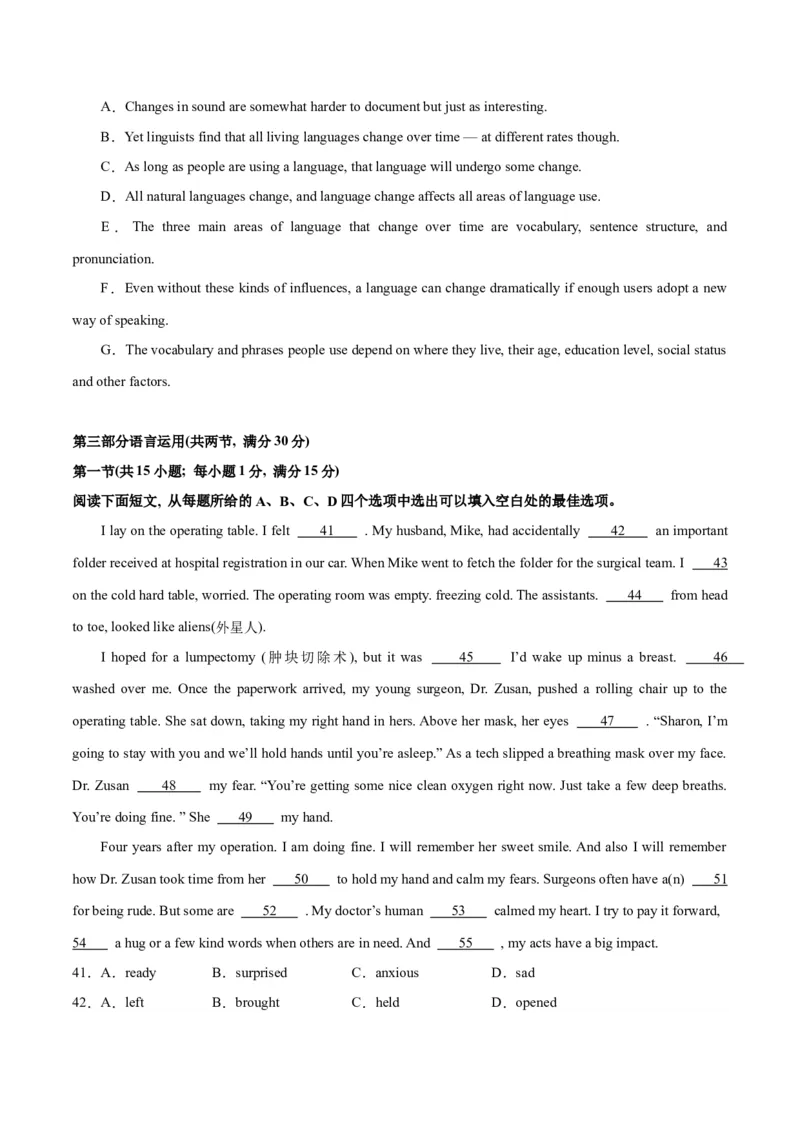
This shift represents the biggest difference between the pronunciation of Middle English and Modern English.A.Changes in sound are somewhat harder to document but just as interesting.
B.Yet linguists find that all living languages change over time — at different rates though.
C.As long as people are using a language, that language will undergo some change.
D.All natural languages change, and language change affects all areas of language use.
E . The three main areas of language that change over time are vocabulary, sentence structure, and
pronunciation.
F.Even without these kinds of influences, a language can change dramatically if enough users adopt a new
way of speaking.
G.The vocabulary and phrases people use depend on where they live, their age, education level, social status
and other factors.
第三部分语言运用(共两节, 满分30分)
第一节(共15小题; 每小题1分, 满分15分)
阅读下面短文, 从每题所给的A、B、C、D四个选项中选出可以填入空白处的最佳选项。
I lay on the operating table. I felt 41 . My husband, Mike, had accidentally 42 an important
folder received at hospital registration in our car. When Mike went to fetch the folder for the surgical team. I 43
on the cold hard table, worried. The operating room was empty. freezing cold. The assistants. 44 from head
to toe, looked like aliens(外星人).
I hoped for a lumpectomy (肿块切除术), but it was 45 I’d wake up minus a breast. 46
washed over me. Once the paperwork arrived, my young surgeon, Dr. Zusan, pushed a rolling chair up to the
operating table. She sat down, taking my right hand in hers. Above her mask, her eyes 47 . “Sharon, I’m
going to stay with you and we’ll hold hands until you’re asleep.” As a tech slipped a breathing mask over my face.
Dr. Zusan 48 my fear. “You’re getting some nice clean oxygen right now. Just take a few deep breaths.
You’re doing fine. ” She 49 my hand.
Four years after my operation. I am doing fine. I will remember her sweet smile. And also I will remember
how Dr. Zusan took time from her 50 to hold my hand and calm my fears. Surgeons often have a(n) 51
for being rude. But some are 52 . My doctor’s human 53 calmed my heart. I try to pay it forward,
54 a hug or a few kind words when others are in need. And 55 , my acts have a big impact.
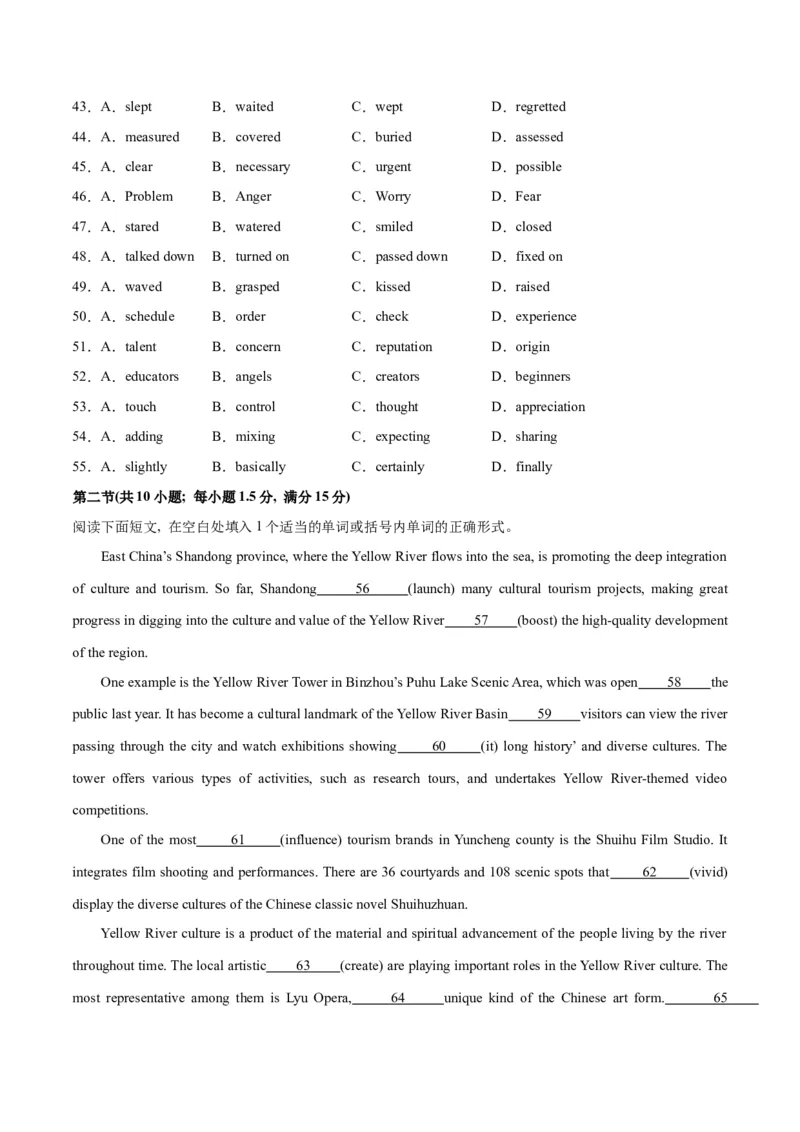
41.A.ready B.surprised C.anxious D.sad
42.A.left B.brought C.held D.opened43.A.slept B.waited C.wept D.regretted
44.A.measured B.covered C.buried D.assessed
45.A.clear B.necessary C.urgent D.possible
46.A.Problem B.Anger C.Worry D.Fear
47.A.stared B.watered C.smiled D.closed
48.A.talked down B.turned on C.passed down D.fixed on
49.A.waved B.grasped C.kissed D.raised
50.A.schedule B.order C.check D.experience
51.A.talent B.concern C.reputation D.origin
52.A.educators B.angels C.creators D.beginners
53.A.touch B.control C.thought D.appreciation
54.A.adding B.mixing C.expecting D.sharing
55.A.slightly B.basically C.certainly D.finally
第二节(共10小题; 每小题1.5分, 满分15分)
阅读下面短文, 在空白处填入1个适当的单词或括号内单词的正确形式。
East China’s Shandong province, where the Yellow River flows into the sea, is promoting the deep integration
of culture and tourism. So far, Shandong 56 (launch) many cultural tourism projects, making great
progress in digging into the culture and value of the Yellow River 57 (boost) the high-quality development
of the region.
One example is the Yellow River Tower in Binzhou’s Puhu Lake Scenic Area, which was open 58 the
public last year. It has become a cultural landmark of the Yellow River Basin 59 visitors can view the river
passing through the city and watch exhibitions showing 60 (it) long history’ and diverse cultures. The
tower offers various types of activities, such as research tours, and undertakes Yellow River-themed video
competitions.
One of the most 61 (influence) tourism brands in Yuncheng county is the Shuihu Film Studio. It
integrates film shooting and performances. There are 36 courtyards and 108 scenic spots that 62 (vivid)
display the diverse cultures of the Chinese classic novel Shuihuzhuan.
Yellow River culture is a product of the material and spiritual advancement of the people living by the river
throughout time. The local artistic 63 (create) are playing important roles in the Yellow River culture. The
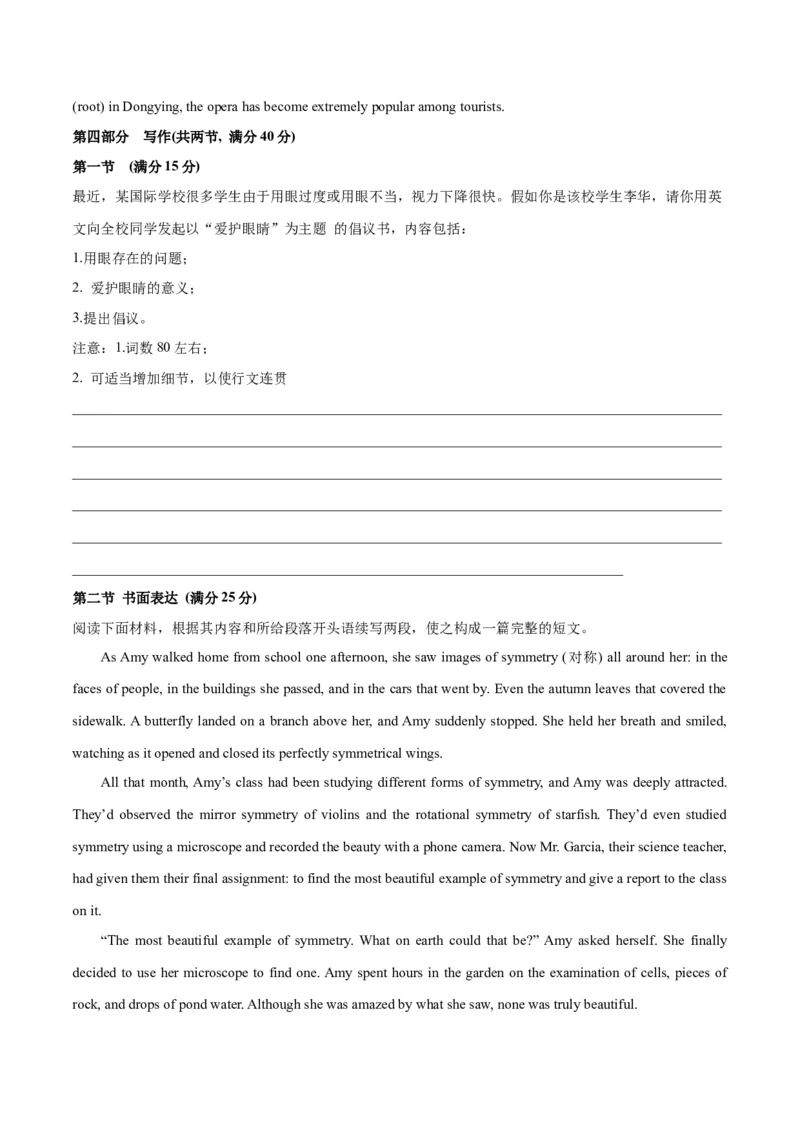
most representative among them is Lyu Opera, 64 unique kind of the Chinese art form. 65(root) in Dongying, the opera has become extremely popular among tourists.
第四部分 写作(共两节, 满分40分)
第一节 (满分15分)
最近,某国际学校很多学生由于用眼过度或用眼不当,视力下降很快。假如你是该校学生李华,请你用英
文向全校同学发起以“爱护眼睛”为主题 的倡议书,内容包括:
1.用眼存在的问题;
2. 爱护眼睛的意义;
3.提出倡议。
注意:1.词数80左右;
2. 可适当增加细节,以使行文连贯
____________________________________________________________________________________________
____________________________________________________________________________________________
____________________________________________________________________________________________
____________________________________________________________________________________________
____________________________________________________________________________________________
______________________________________________________________________________
第二节 书面表达 (满分25分)
阅读下面材料,根据其内容和所给段落开头语续写两段,使之构成一篇完整的短文。
As Amy walked home from school one afternoon, she saw images of symmetry (对称) all around her: in the
faces of people, in the buildings she passed, and in the cars that went by. Even the autumn leaves that covered the
sidewalk. A butterfly landed on a branch above her, and Amy suddenly stopped. She held her breath and smiled,
watching as it opened and closed its perfectly symmetrical wings.
All that month, Amy’s class had been studying different forms of symmetry, and Amy was deeply attracted.
They’d observed the mirror symmetry of violins and the rotational symmetry of starfish. They’d even studied
symmetry using a microscope and recorded the beauty with a phone camera. Now Mr. Garcia, their science teacher,
had given them their final assignment: to find the most beautiful example of symmetry and give a report to the class
on it.
“The most beautiful example of symmetry. What on earth could that be?” Amy asked herself. She finally
decided to use her microscope to find one. Amy spent hours in the garden on the examination of cells, pieces of
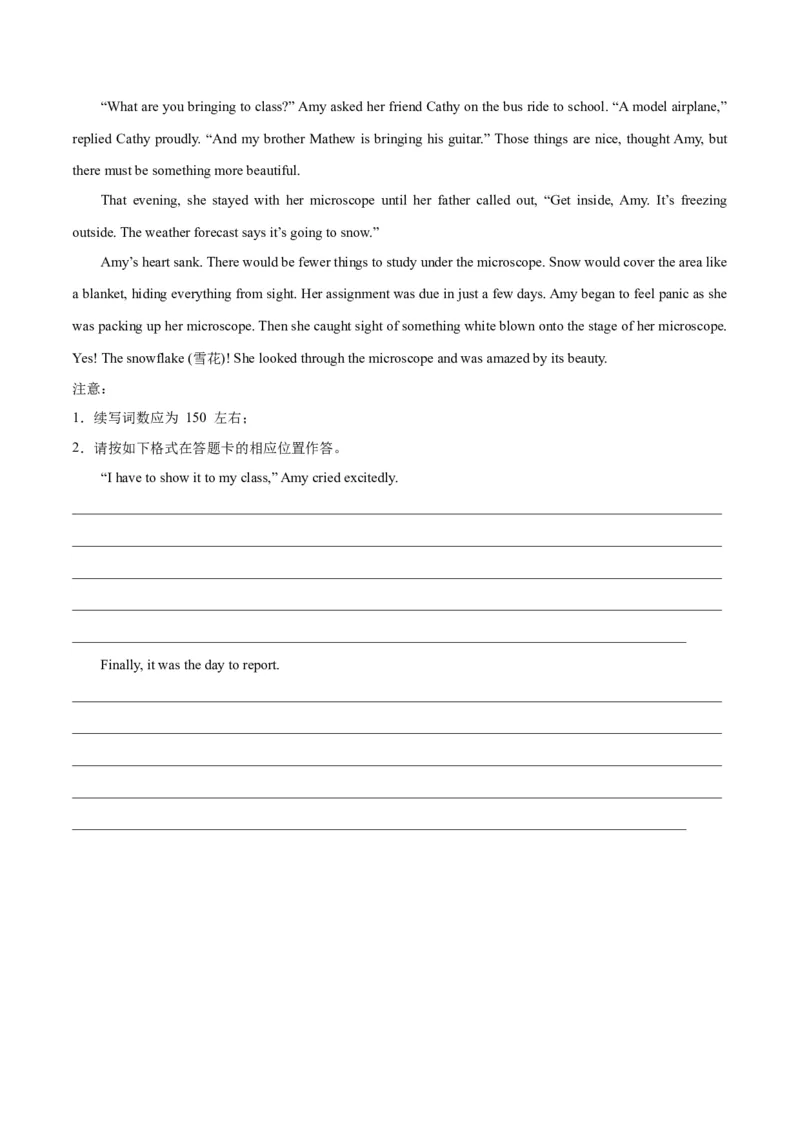
rock, and drops of pond water. Although she was amazed by what she saw, none was truly beautiful.“What are you bringing to class?” Amy asked her friend Cathy on the bus ride to school. “A model airplane,”
replied Cathy proudly. “And my brother Mathew is bringing his guitar.” Those things are nice, thought Amy, but
there must be something more beautiful.
That evening, she stayed with her microscope until her father called out, “Get inside, Amy. It’s freezing
outside. The weather forecast says it’s going to snow.”
Amy’s heart sank. There would be fewer things to study under the microscope. Snow would cover the area like
a blanket, hiding everything from sight. Her assignment was due in just a few days. Amy began to feel panic as she
was packing up her microscope. Then she caught sight of something white blown onto the stage of her microscope.
Yes! The snowflake (雪花)! She looked through the microscope and was amazed by its beauty.
注意:
1.续写词数应为 150 左右;
2.请按如下格式在答题卡的相应位置作答。
“I have to show it to my class,” Amy cried excitedly.
____________________________________________________________________________________________
____________________________________________________________________________________________
____________________________________________________________________________________________
____________________________________________________________________________________________
_______________________________________________________________________________________
Finally, it was the day to report.
____________________________________________________________________________________________
____________________________________________________________________________________________
____________________________________________________________________________________________
____________________________________________________________________________________________
_______________________________________________________________________________________