专题02 非谓语动词
目录
一、考情解读............................................................................................................................................1
二、命题分析预测....................................................................................................................................1
三、考点必备知识通关............................................................................................................................1
四、考法解题能力提升..........................................................................................................................20
五、 精选考点题型专练........................................................................................................................22
一、考情解读
1.了解三种非谓语动词的基本用法、时态与语态的变化及其句法功能,并能在具体的语境中
正确运用。
2.掌握非谓语动词作主语、宾语、定语、状语、表语及补语时的区别。
二、命题分析预测
1.非谓语动词仍是今后高考的必考点。
2.从形式上看,动词-ing和不定式是常考点,过去分词也有涉及。
3.从功能上看,非谓语动词作宾语和状语是考查的重点,作定语是常考点,作补语、表语、主语
虽然考查频次不高,但考生在备考时不能忽视。
4.考生在备考时,还要注意用不定式和动词-ing的主动形式表示被动含义这一用法。
三、考点必备知识通关
考点1 非谓语动词作宾语
能作宾语的非谓语动词只有不定式和动词-ing(此处指动名词)。
知识1 动词不定式作宾语
1. 后接动词不定式作宾语的动词有很多,常见的以口诀形式列举如下:
期希渴望expect/hope/desire想want承诺promise
愿望wish碰巧happen又出现appear
假装pretend安排arrange不拒绝refuse准备prepare计划plan/intend未做到fail
试图attempt提供offer又犹豫hesitate
设法manage要求ask/demand作选择choose
同意agree等待wait像seem承担afford
决定determine/decide学习learn订目标aim
►They managed to finish the work on time.他们设法按时完成了工作。
►Don't pretend to know what you don't know.不要不懂装懂。
►I happen to know the answer to your question.我碰巧知道你那道问题的答案。
But some students didn't want _______ (wear) the uniform.
【解析】 want to do sth."想要做某事",此处应用不定式作want的宾语, 故填to wear。
【特别提醒】
1."特殊疑问词/whether + 动词不定式"结构
(1)该结构可以在consider, decide, learn, know, forget, remember等动词后作宾语,也可以作主
语、表语等。
(2)该结构中特殊疑问词常见的有:how, where, when, what, which, who等。
►I had a cold and couldn't decide whether to go to see a doctor.我感冒了,拿不定主意是否要去
看医生。(作宾语)
►How to solve these problems is very important.怎样解决这些问题很重要。(作主语,谓语动词
用单数)
2.不定式可作介词but/except/than的宾语
动词作介词的宾语时,大多用动词-ing形式,不用不定式。但在but, except, than等少数几个介
词后则跟不定式作宾语。若这些介词前有实义动词do,则不定式常省略to。
►He had no choice but to accept the fact.他别无选择,只有接受这个事实。
►He did nothing but/except wait.除了等,他什么也没做。
知识2 动词-ing作宾语
1.后接动词-ing作宾语的动词
此类词有很多,常见的以口诀形式列举如下:
建议suggest /advise考虑consider保持keep练 practise
允许permit/allow想象imagine否deny冒险 risk
阻止prevent错过miss完finish避开avoid/escape介意mind抵制resist承admit喜欢enjoy
►I often practise listening and speaking.我经常练习听和说。
►Do you mind passing me that dictionary?你介意递给我那本词典吗?
2.后接动词-ing作宾语的动词短语
此类短语有很多,如:feel like(想),can't help(忍不住),give up(放 弃),put off(推迟),insist on(坚持)
等。
►When he doesn't feel like talking, we just let him be. 他不想说话时,我们就任其自便吧。
►She couldn't help crying when she heard the news. 听到那则消息她忍不住哭起来。
【特别提醒】 容易被忽视的短语后接动词-ing的情况列举如下:
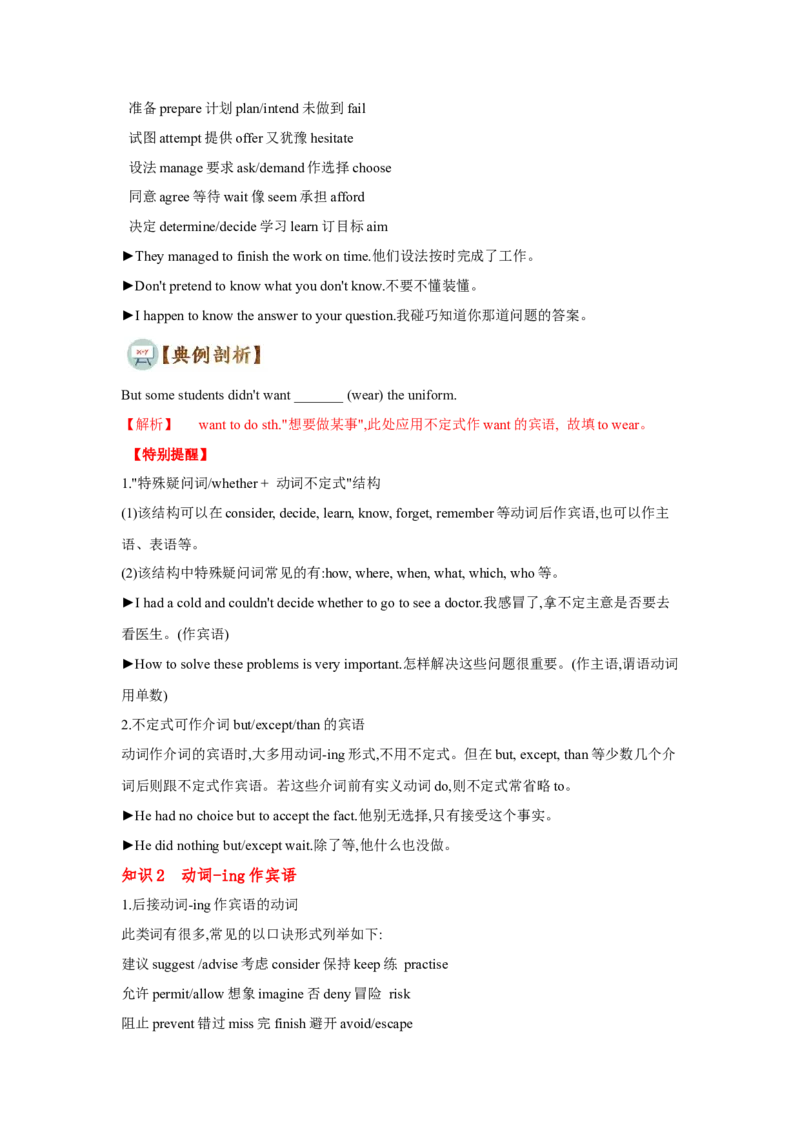
1.有些短语其后to不是不定式符号,而是介词,后面可接动词-ing
2.有些短语或句式中介词经常省略,要注意此时后面仍接动词-ing
You can't imagine what difficulty the freshmen had _______ (consult) the French dictionary.
【解析】 句意:你无法想象大一新生查阅法语词典有多困难。结合句意可知此处表示"做
某事有困难",difficulty前置了,此处考查了have difficulty (in) doing sth.结构,故填consulting。
知识3 动词不定式和动词-ing作宾语的异同
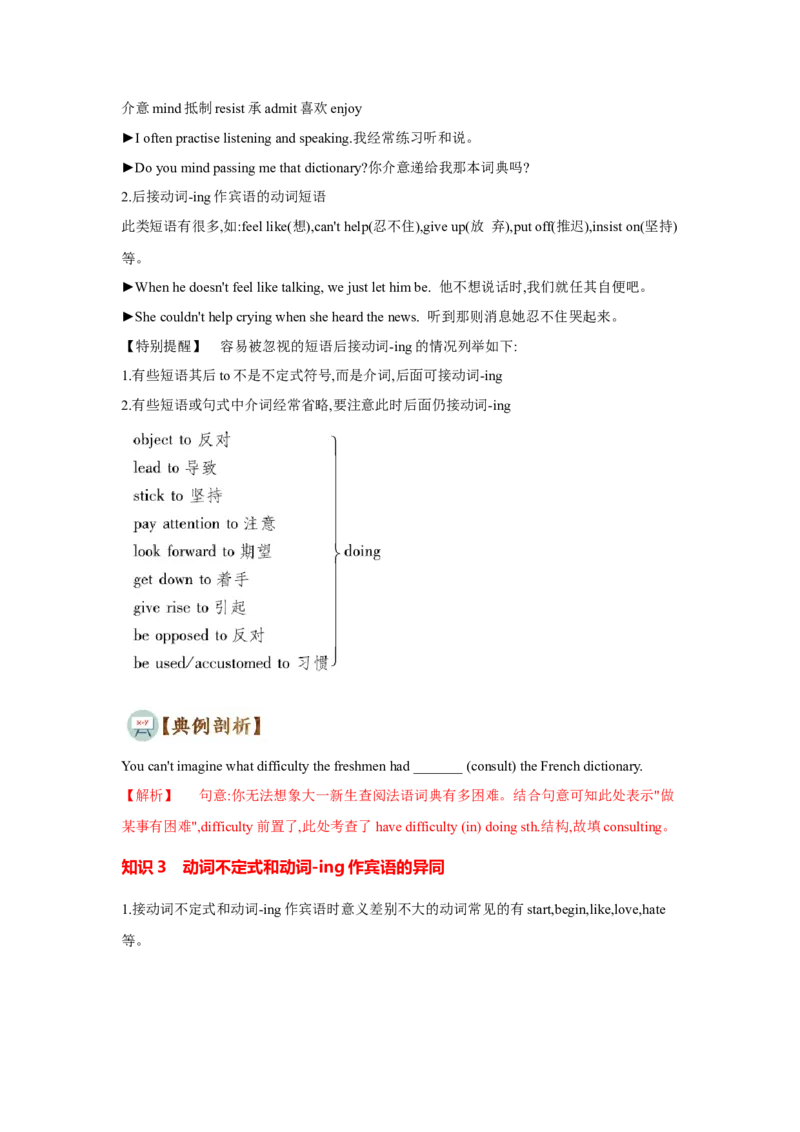
1.接动词不定式和动词-ing作宾语时意义差别不大的动词常见的有start,begin,like,love,hate
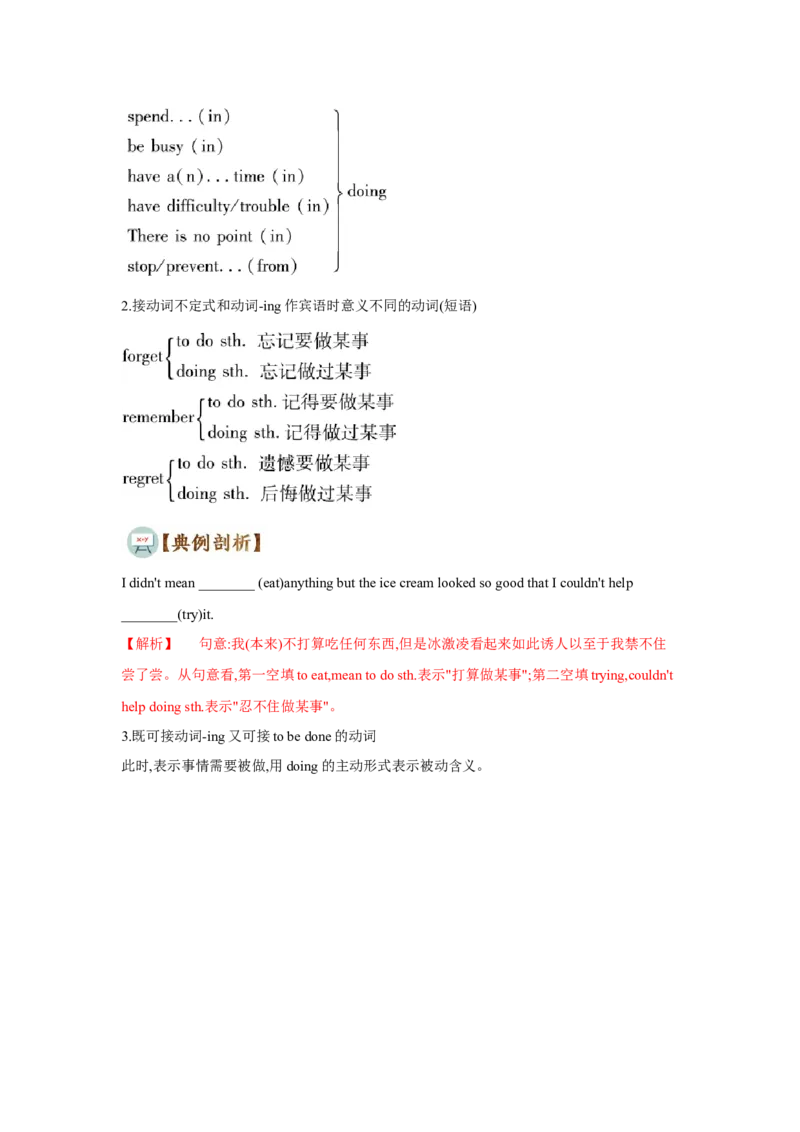
等。2.接动词不定式和动词-ing作宾语时意义不同的动词(短语)
I didn't mean ________ (eat)anything but the ice cream looked so good that I couldn't help
________(try)it.
【解析】 句意:我(本来)不打算吃任何东西,但是冰激凌看起来如此诱人以至于我禁不住
尝了尝。从句意看,第一空填to eat,mean to do sth.表示"打算做某事";第二空填trying,couldn't
help doing sth.表示"忍不住做某事"。
3.既可接动词-ing又可接to be done的动词
此时,表示事情需要被做,用doing的主动形式表示被动含义。►These flowers need watering.=These flowers need to be watered.这些花需要浇水。
►Your suggestion deserves considering. = Your suggestion deserves to be considered. 你的建议
值得考虑。
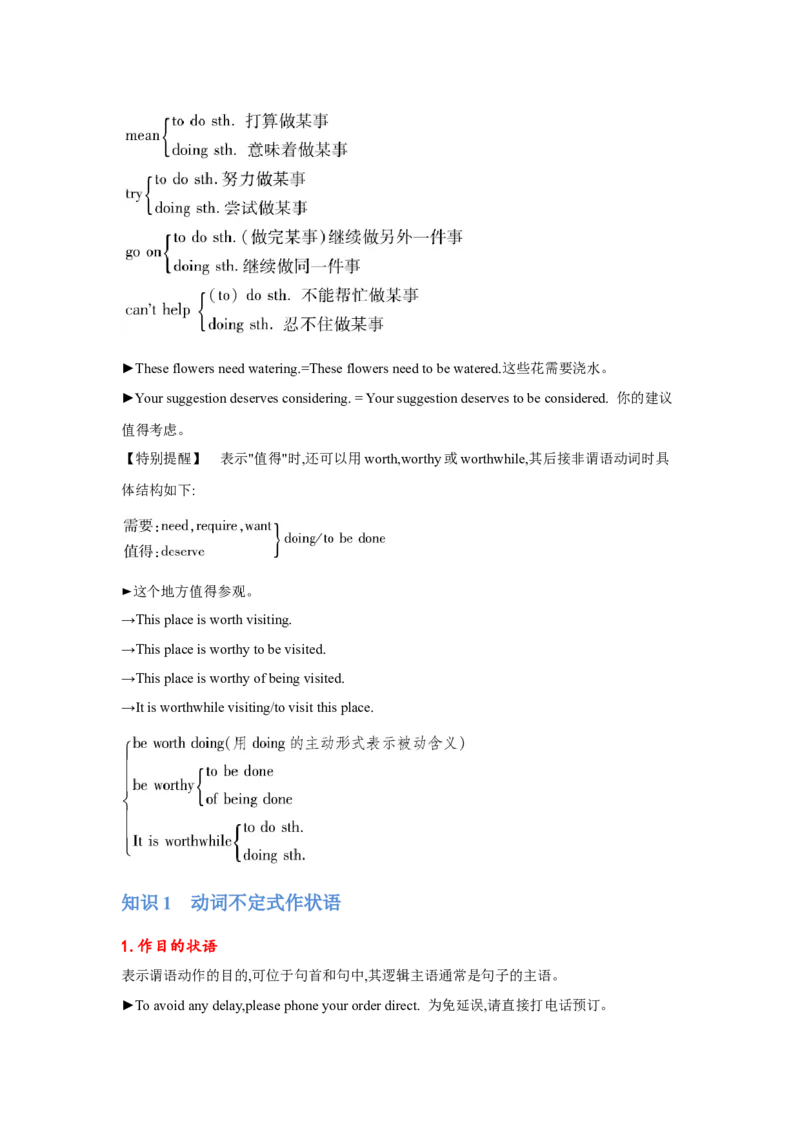
【特别提醒】 表示"值得"时,还可以用worth,worthy或worthwhile,其后接非谓语动词时具
体结构如下:
►这个地方值得参观。
→This place is worth visiting.
→This place is worthy to be visited.
→This place is worthy of being visited.
→It is worthwhile visiting/to visit this place.
知识1 动词不定式作状语
1.作目的状语
表示谓语动作的目的,可位于句首和句中,其逻辑主语通常是句子的主语。
►To avoid any delay,please phone your order direct. 为免延误,请直接打电话预订。►Doctors worked through the night to save the injured man. 医生彻夜工作以拯救那位伤者。
【特别提醒】 有时为了特别强调目的状语,可以在不定式前加上in order或so as,即构成in
order to do(可位于句首和句中)或so as to do(只可位于句中)结构。
►Many farmers fertilize their crops in order to/so as to make them grow more quickly. 许多农民
给庄稼施肥,为的是让庄稼长得更快些。
Moreover, some presses did their part by publishing all sorts of books _______ (enrich) people's
daily life.
【解析】 句意:此外,有些出版社通过出版各种各样的书籍来丰富人们的日常生活,尽到了
职责。根据句意可知,此处用不定式短语作目的状语,故填to enrich。
2.作结果状语
其逻辑主语通常是句子的主语。不定式作结果状语时常用于以下结构:
形式 意义
to do sth. 结果……
only to do sth. 不料/竟然……
so...as to do sth. 如此……以至于……
...enough to do sth. 足够……做某事
too...to do sth. 太……而不能做某事
►I rushed to the station,only to find the train had already left.我匆忙赶到车站,不料发现火车已
经开走了。
►He walks too slowly to get there on time. 他走得太慢,不能按时到达那里。
【特别提醒】 only too...to...结构,only too相当于very,表示"非常",与之搭配的形容词常见
的有pleased, ready, willing, glad, happy等。
►I'm only too glad to have passed the exam.考试及格了,我非常高兴。
3.作原因状语
不定式与情感类形容词连用时,多表示原因,常构成"Sb.+be+情感类形容词+to do sth."结构,常
见的此类形容词有: happy, kind, surprised, frightened, shocked, glad, delighted, disappointed等。
►She was very happy to hear that her son had been promoted.听说儿子升职了,她很高兴。
4.构成"Sth.+be+形容词+不定式"结构(其中不定式用主动形式表示被动含义)
此类形容词常见的有:easy, hard, difficult, pleasant, good, fit, comfortable等。
►This book is difficult to understand.这本书很难懂。【特别提醒】 如果不定式中的动词是不及物动词,与之相搭配的介词不可丢掉。
►The picture is pleasant to look at.这张画很好看。
知识2 动词-ing作状语
1.动词-ing作状语时其形式的选择
形式 内在含义
doing 与句子主语构成逻辑上的主谓关系,与谓语动
作同时 或几乎同时发生。
having done 与句子主语构成逻辑上的主谓关系,且先于谓
语动作发生。
having been done 与句子主语构成逻辑上的动宾关系,且先于谓
语动作发生。
2.动词-ing作状语的语法功能
动词-ing作状语 用法
作时间状语 相当于when/while/after等引导的时间状语从
句
作原因状语 相当于as/since/because引导的原因状语从句
作条件状语 相当于if/unless引导的条件状语从句
作让步状语 相当于though/although等引导的让步状语从
句
作结果状语 表示自然而然的结果,可扩展为并列分句或定
语从句
作方式或伴随状语 表示与谓语动作同时发生的次要(或伴随)动
作,通常可扩展为并列分句。
►Hearing the news, they immediately set off for Shanghai.
→When they heard the news, they immediately set off for Shanghai.听到这个消息,他们立即出
发去上海了。(时间)
►Being tired, I stopped to have a rest.→Because I was tired, I stopped to have a rest.我累了,停下
来休息。(原因)
►He comes home very late every evening, making his wife very angry.→He comes home very
late every evening, and it makes his wife very angry.→He comes home very late every evening,
which makes his wife very angry.他每天晚上回家都很晚,这使他妻子很生气。(结果)
►I stood there, waiting for her.→I stood there, and waited for her.我站在那儿等她。(伴随)
【特别提醒】 动词-ing作结果状语时,表示一种自然而然的结果,通常放在句末,与句子其他
部分用逗号隔开;不定式作结果状语时往往表示不好的或出乎意料的结果。In these years, he led a hard life, _______ (write) poems about the events he witnessed.
【解析】 句意:这些年他过着艰苦的生活,写诗记录他所目睹的事件。分析句子结构,该句
已有谓语动词led,空处应填非谓语动词,又因主语he与write为主谓关系,且此处表示伴随,应
用动词-ing作伴随状语,故填writing。
He arrived an hour late, completely _______ (upset) our plan for the picnic.
【解析】 句意:他迟到了一小时,彻底打乱了我们的野餐计划。分析句子结构可知,此处用
非谓语动词作状语,"迟到一小时"造成的结果是"彻底破坏了我们的野餐计划",故用动词-ing
作状语表示自然而然的结果。故填upsetting。
知识3 过去分词作状语
其逻辑主语通常就是句子的主语,构成过去分词的动词与主语之间存在逻辑上的动宾关系。
过去分词(短语)作状语可表示时间、原因、让步、
条件、伴随和方式,可转化为相应的状语从句(作方式或伴随状语时除外)。
►Given more time,I'll catch up with you.→If I am given more time,
I'll catch up with you.如果多给我一些时间,我就能赶上你。(条件)
【特别提醒】 有些及物动词的-ed形式形容词化了,并不强调被动意味,主要表示一种状态。
►Dressed in white, she suddenly appeared.她穿着白色的衣服突然出现了。
►Lost in thought,he didn't notice us come in. 由于陷入深思,他没注意到我们进来了。
【易混辩解】 动词-ing与过去分词作状语的区别
1.与逻辑主语的关系方面
(1)动词-ing作状语时,若用主动形式,则动词-ing的逻辑主语(一般为句子 的主语)与构成动
词-ing的动词为主谓关系;
若用被动形式,则动词-ing的逻辑主语(一般为句子的主语)与构成动词
-ing的动词为动宾关系。
►He went out, shutting the door behind him.他出去了,并随手把门关上了。
►Having been told to stay at home, he couldn't go out.他被告知待在家里,所以他不能出去。
(2)过去分词作状语时,构成过去分词的动词与过去分词的逻辑主语(一般为句子的主语)之间
为动宾关系。►Written in a hurry, this article was not so good.因为写得匆忙,这篇文章不是很好。
2.时间方面
动词-ing的一般式(doing)表示与谓语动作(几乎)同时发生的动作;动词
-ing的完成式(having done/having been done)表示在谓语动作之前
发生的动作。过去分词通常表示被动、已完成的动作。
►Reading carefully, he found something he hadn't known before.仔细阅读时,他发现了一些他
以前不知道的东西。
►Bitten by the dog, the boy doesn't dare to get close to it.因被那条狗咬过,这个男孩儿不敢靠近
它。
知识1 动词不定式作定语
动词不定式作定语时,通常放在被修饰的名词或代词之后。以下几种情况常使用不定式作定
语:
1.表示将来的动作时。根据需要,不定式可用主动或被动形式。如果句中的主语或另一名
词/代词是不定式的逻辑主语,不定式用主动形式表示被动含义。
►I have a lot of homework to do.我有很多家庭作业要做。(虽然homework与不定式是动宾
关系,但是句子主语I是不定式的逻辑主语,所以不定式用主动形式)
►The building to be built next month will be a modern hospital.下个月要建的那栋楼将是一个
现代化的医院。(build与building之间是逻辑上的动宾关系,且动作还未完成,故用不定式的
被动形式)
2.用于序数词、形容词最高级以及the last, the only, no, any, all等词(短语)后或被这些词(短
语)修饰的名词/代词后,此时不定式常用主动形式。
►He is the best man to do the job.他是做这项工作的最佳人选。
In 1936,Ruth Harkness became the first westerner _______ (bring)a live giant panda named Su
Lin to the Brookfield Zoo in Chicago.
【解析】 分析句子结构可知,此处作westerner的后置定语,由于westerner被序数词(first)
修饰,所以其后需用不定式作后置定语,故填to bring。
3.被修饰词是表示抽象意义的名词时。其后不定式常用主动形式。常见的此类名词有
ability, chance, idea, right(权利), evidence, attempt, plan, way, reason, opportunity, time等。
►I want to have a chance to further my study abroad.我想有个机会去国外进修。【特别提醒】
1.动词不定式作定语时,如果其中的动词是不及物动词,与之相搭配的介词不可丢掉。
►Do you have enough paper to write on?你有足够的纸来写字吗?
2.如果被不定式修饰的名词为place,time,way等, 不定式后面的介词习惯上可以省去。
►He has no place to live (in).他没有地方住。
知识2 动词-ing作定语
动词-ing作定语,通常表示动作正在进行或与谓语动作同时发生。通常有两种形式:
doing 被修饰词与do是主谓关系 The professor giving a speech
about pollution is from
Harvard University.正在做关
于污染报告的教授来自哈佛
大学。
being done 被修饰词与do是动宾关系 The film being shown in the
cinema is great.正在电影院上
映的那部电影很不错。
The astronomy has explained mysteries (神秘的事物) ________ (confuse) us for thousands of
years, but even more significantly, it has opened up more mysteries than any of us can study in our
lifetime.
【解析】 句意:天文学解释了困扰我们几千年的谜团,但更重要的是,它所开启的谜团比我
们任何人有生之年所能研究的还要多。分析句子结构可知,空处修饰前面的名词
mysteries,mysteries和动词confuse之间为逻辑上的主谓关系,且表示一直的状态,故用动词-
ing作后置定语。故填confusing。
【特别提醒】 动词-ing作定语,还可用于说明被修饰词的用途、功能或目的,常放在被修饰
词之前。
a changing room 一间更衣室 a waiting room一间候车室/候诊室
a racing bicycle一辆赛车 a writing desk一张写字桌
a swimming pool一个游泳池 a reading room一间阅览室
知识3 过去分词作定语
1.及物动词的过去分词作定语表示被动和完成,不及物动词的过去分词作定 语只表示该动作
已经完成。
a broken cup一个打碎的杯子(强调被动)a retired worker一位退休工人(强调完成)
2.构成过去分词的动词与其被修饰的词(逻辑主语)之间是动宾关系。单个过 去分词作定语
时常前置;过去分词短语作定语时常后置,可转化为定语从句。
►The stolen car was found by the police last week.上周警察找到了被偷走的汽车。
►He likes the gift bought by his father(=which/that was bought by his father).他喜欢父亲买的那
个礼物。(buy与the gift为逻辑上的动宾关系,
且"买"这一动作已经完成)
This year, Hellobike, a popular bike-sharing company, launched two new bike models
________(equip) with the positioning service.
【解析】 分析句子结构可知,此处为非谓语动词短语作后置定语,修饰名词bike models。
equip...with sth."给……配备某物",equip与bike models构成逻辑上的动宾关系,故用过去分词
equipped。
【特别提醒】 一些表示感觉的动词(如interest, bore, worry, frighten, surprise等)的-ing形式
和-ed形式大多已转化为形容词,-ing形式的形容词表示"令人……的",-ed形式的形容词表
示"感到……的"。如:a boring man(惹人烦的人);a bored expression(厌倦的表情)。
考点4 非谓语动词作补语
知识1 动词不定式作补语
1.带to的不定式作补语
有些动词(短语)后跟带to的不定式作补语(宾补和主补),形式为:
常见的这类动词(短语)有:advise, allow, permit, forbid, consider, ask, beg, cause, encourage,
expect, force, get(使,让), intend(打算), invite, order, persuade, prefer, remind, require, teach, tell,
want, warn, wish, wait for, call on(要求), appeal to(呼吁), arrange for(安排), depend on等。
►We have invited Professor Wang to give us a report tomorrow.我们已经邀请王教授明天给我
们做报告。(作宾补)
►All passengers are required to show their tickets.所有乘客都要出示车票。(作主补)
【特别提醒】 advise, allow, permit, forbid, consider后可跟带to的不定式作补语,还可直接
跟动词-ing作宾语。
►They don't allow smoking in the hall.他们不准(有人)在大厅里吸烟。►Her parents don't allow her to stay out late.她的父母不允许她在外面待到很晚。
Chinatowns are an important part of the diverse culture of the USA.They allow visitors who have
never been to China ________(experience) traditional Chinese culture first-hand.
【解析】 句意:唐人街是美国多元文化的重要组成部分。它们让从未到过中国的游客亲
身体验中国传统文化。allow sb. to do sth."允许某人做某事"是常见搭配,故填to experience。
2.不带to的不定式(即动词原形)作补语
使役动词(make, have, let等)及感官动词(see, watch, observe, hear, notice等)后作宾补的不定
式不带to,但用于被动语态(let一般不用于被动语
态)时,作主补的不定式一定要加上to。注意:help后接不定式作宾补时带不带to均可。
►He made a face and made everybody laugh.他做了一个鬼脸,让所有人都笑了。
►He was seen to go upstairs.有人看见他上楼了。
巧学妙记 我们可用一句话来巧记有以上用法的动词:
吾看三室两厅一感觉。
"吾看"指"5看"(look at, watch, see, notice, observe);"三室"指"3使"(let, make, have);"两厅"指"2
听"(listen to,hear);一感觉(feel)。
知识2 动词-ing和过去分词作补语
动词-ing和过去分词作补语(宾补和主补),用来说明宾语或主语的状态或性质。把含有宾补
的句子改为被动句,原来的宾补就变为主补了。
以下重点讲解动词-ing和过去分词作宾补的情况:
动词-ing和过去分词通常在两类动词后作宾补:①感觉、感官类动词;
②使役动词。此时动词-ing表示正在进行的主动意义,过去分词表示已经完成的被动意义。
1.在感觉、感官类动词后作宾补
常见的词有see, notice, watch, look at, hear, listen to, find, feel, smell等。
►He heard the wind blowing outside.他听到外边在刮风。
►I felt my heart beating faster.我感到我的心跳得更快了。
►He didn't notice his wallet stolen.他没注意到他的钱包被偷了。
【特别提醒】 作宾补的动词-ing如果表示正在发生的被动动作,其前要加being。
►He found himself being followed by a wolf. 他发现自己正被一头狼跟踪着。
【易混辩解】 感觉、感官类动词后动词-ing和不定式(不带to)作宾补的区别
►—Do you hear door bell ringing? 你听见门铃在响吗?—Yes,I heard it ring three times. 是的,我听见门铃响了三下。
另外,短暂性动词的-ing形式作宾补表示动作的反复,而不定式(不带to)表示动作的一次性。
试比较:
Listening to music at home is one thing; going to hear it _________ (perform)live is quite
another.
【解析】 句意:在家里听音乐是一回事,去听现场演奏的音乐是另一回事。本空在句中作
宾补,且perform与宾语it构成逻辑上的动宾关系,故此处用过去分词作宾补,表示被动含义。
故填performed。
2.在使役动词后作宾补
常见的词有keep, get, leave, have, make, set等。
【特别提醒】 make后的宾补只能用过去分词,不能用动词-ing;而set后的宾补通常用动词-
ing,不用过去分词。
►He had to shout to make himself heard 他得大声喊才能让人听见。
►Her words set me thinking deeply.她的话让我深思。
深化拓展 1.使役动词have, get后接非谓语动词作补语的异同点
(1)have sth. done =get sth. done
宾语sth.与do之间是逻辑上的动宾关系。该结构常表示三种含义:
①让别人做某事
►I have/get my hair cut.我理了发。(头发是主语让别人理的,不是主语自己理的)
②使某物被……(不强调动作是谁发出的)
►He had/got the file typed.他把文件打出来了。(强调文件被打出来这一结果)
③主语遭遇不幸
►The lady had/got her bag stolen on the bus yesterday.昨天,这位女士的包在公共汽车上被偷了。(2)have sb./sth. doing让……一直做某事,使……正处于……;get sb./sth. doing 使……(开始)做
某事。sb./sth.与do之间是逻辑上的主谓关系。
►Don't have the water running while brushing your teeth.刷牙时,别让水一直流着。
►Let's get the machine running.我们让这台机器运转起来吧。
(3)have sb. do sth./get sb. to do sth.让某人做某事; have sth. to do 有某事要做(to do作后置定
语)。
►My parents always get me to do some housework.父母总是让我做些家务。
►The manager had his secretary collect some information.经理让他的秘书收集一些信息。
2.with复合结构中作宾补的非谓语动词
"with+宾语+宾补"结构可在句中作定语或状语(表示原因、时间、条件、伴随、方式等),宾
补可以是名词/形容词/副词/介词短语/动词-ing/过去分词/不定式。 在此我们重点讲解宾补
是动词-ing、过去分词和不定式的情况。
(1)with +名词/代词+动词-ing
动词-ing表示主动和动作正在进行。
►He lay on the grass with his eyes looking at the sky.他躺在草地上, 望着天空。(伴随状语)
(2)with +名词/代词+过去分词
过去分词表示被动和动作已完成。
►With his hair cut, he looked much younger.理了发, 他看起来年轻多了。(原因状语)
(3)with +名词/代词+不定式
不定式表示动作尚未发生。切记:不定式一般情况下都用主动形式。
►With a lot of homework to do, I can't go skating with you.因为有很多家庭作业要做,我不能和
你一起去滑冰。(原因状语)
考点 5 非谓语动词作主语和表语知识1 非谓语动词作主语
非谓语动词(不定式和动词-ing)作主语时,谓语动词通常用单数形式;有时为保持句子结构平
衡,常用it作形式主语,将非谓语动词后置。
1.不定式作主语
(1)多表示具体的、一次性的或尚未做的动作
(2)it作形式主语的常用句式:
►To say is one thing; to do is another.说是一回事,做是另一回事。
►To talk with him is a great pleasure.→It is a great pleasure to talk with him.与他谈话是一件很
快乐的事。
►It's very difficult for him to understand the theory.对他来说,理解这个理论很难。
►It's kind of you to help me.你太好了,愿意帮我。
In Vancouver it is unusual _______ (see)a bear, but in some cities you can see big animals on
the city streets every day.
【解析】 此处表示"在温哥华,看到熊是不寻常的"。分析句子结构可知,空处所在分句中
的"it"为形式主语,真正的主语应为动词不定式,故填to see。
2.动词-ing作主语
(1)多表示一般性的、抽象的动作或状态
(2)it作形式主语的常用句式:
►Living in the city brings him lots of job opportunities.住在城市给他带来很多工作机会。
►Jack's sudden disappearing made them worried.杰克的突然失踪使他们担忧。
►It's no good worrying about it now.现在为此发愁是没用的。
知识2 非谓语动词作表语
1.不定式作表语不定式在系动词后作表语,可表示主语的内容、将来的动作、命令、建议、事态发展的结果
等。
►His job is to write reports for the newspaper.他的工作是为报纸写报道。
►The problem remains to be unsettled.问题还没有解决。
【特别提醒】 下列情况下不定式作表语可以省略to:
1.主语是all(其后有that引导的定语从句)或what引导的从句,且从句中含有实义动词do的某
种形式时。
►All you need to do now is (to) complete the form.你现在需要做的一切是把这张表填好。
►What I want to do most in high school is (to) improve my English.我在高中最想做的事是提
高我的英语水平。
2.主语是the only/the first/the last及形容词最高级或被这些词修饰,或主语后有定语(从句),且
定语(从句)中含有实义动词do的某种形式时。
►The first thing to do now is (to) keep her calm.现在首要做的事是让她保持平静。
2.动词-ing作表语
(1)动名词作表语时相当于名词,用于解释主语的内容,通常可以与主语互换位置。
►The most important thing is giving them a good education.最重要的事是给他们良好的教育。
(2)现在分词作表语时相当于形容词,用于说明主语的性质、特征,不可与主语互换位置。
►The result is very disappointing.这个结果非常令人失望。
3.过去分词作表语
过去分词作表语时位于系动词之后,多用于表示主语的状态或状况,所体现的是形容词的特性。
►The shops have remained shut for a week.这些商店关门一周了。
【特别提醒】 过去分词作表语时强调主语所处的状态;动词的被动语态则表示主语是动作
的承受者,强调动作。
►The cup is broken.杯子破了。(强调杯子"破了"的状态)
►The cup was broken by Jim.杯子被吉姆打破了。(强调"打破"这一动作)
1.非谓语动词作状语时,其逻辑主语通常要与句子的主语保持一致。▶环顾四周,我发现附近没有人。
【正】 Looking around, I found there was no one nearby.
【误】 Looking around, there was no one nearby.
2. 若非谓语动词的逻辑主语与句子的主语不一致,则要在非谓语动词前加上其自身的逻辑
主语,"逻辑主语(名词/代词)+非谓语动词"被称为独立主格结构。
考生的难点
具体形式如下:
(1)名词/代词+动词-ing。动词-ing可有语态和时态的变化。
►Winter coming, it gets colder and colder.冬天来了,天气越来越冷。
The moon rose elegantly from the valley, the whole mountain _______ (bathe) itself in
mysterious moonlight.
【解析】 句意:月亮从山谷里优雅地升起,整座山沐浴在神秘的月光中。分析句子结构可
知,逗号后没有连词,且逗号前的句子已有谓语rose,故逗号后的内容是独立主格结构,在此作
状语,mountain与bathe之间是逻辑上的主谓关系,且不表示将来的动作,故用动词-ing形式
bathing。
(2)名词/代词+过去分词。构成过去分词的动词与名词/代词为动宾关系,且过去分词表示动作
已完成。
►The test finished, we began our holiday.考试结束了,我们的假期开始了。
No agreement _______ (reach), the representatives wanted another round of talks.
【解析】 分析句子结构可知,逗号前后两部分之间没有连词,且前后主语不一致,"the
representatives...talks"为完整的句子,故逗号前的部分为独立主格结构;且reach与其逻辑主语
agreement之间是动宾关系,所以用过去分词reached。
(3)名词/代词+不定式。不定式表示将来的动作,有语态的变化。
►The two boys said goodbye to each other, one to go home and the other to go to his friend's. 两
个男孩彼此道了别,一个回家,另一个去朋友家。
【特别提醒】 独立主格结构除了非谓语的形式,还有以下形式:名词/代词+形容词/副词/介
词短语;with/without+名词/代词+宾补。
►He came out of the library, (with) a book under his arm.他腋下夹着一本书走出了图书馆。3.有些分词/不定式短语作状语时,它们的逻辑主语与句子的主语不一致,但并不作为语法错误
来处理,常作为固定用法来记忆。
(1)常见的这类分词短语有generally/frankly/roughly/strictly speaking, talking of, speaking of,
judging from, taking everything into consideration, seeing/considering/given(鉴于)等。
►Generally speaking, girls are more interested in literature than boys.一般来说,女孩比男孩对文
学更感兴趣。
(2)常见的这类不定式短语有to be frank/honest, to be sure, to tell (you) the truth, to make things
worse等。
►To tell you the truth, it's all Greek to me.说实话,我对此一窍不通。
1.动词-ing的形式有一般式(doing/being done)和完成式(having done/having been done)。
(1)一般式表示非谓语动作与谓语动作(几乎)同时发生,可用作状语、定语、表语和补语;完成
式表示非谓语动作先于谓语动作发生,通常用作状语。
(2)主动形式表示do与其逻辑主语是主谓关系,被动形式表示两者是动宾关系。表示否定时
直接在动词-ing前加not。
►Hearing the good news, they burst into cheers.听到这个好消息,他们欢呼起来。
►Having been trapped in traffic, he was late for work.因为堵车,他上班迟到了。
►Not having heard from him for years, I felt surprised when I saw him in the street.很多年没有
收到他的信,所以在街上看到他时我感到意外。
2.过去分词的形式只有done,可作定语、状语、表语和补语,既可表示被动关系又可表示动
作已完成。
►Trapped in the cave for three days, he began to feel desperate.
被困在山洞里三天,他开始感到绝望了。
Tsinghua University,______(found) in 1911, is one of the best universities in China.
【解析】 分析句子结构可知,空处用非谓语动词作后置定语,且found(建立)与
其逻辑主语Tsinghua University为动宾关系,故填其过去分词形式,表示被动和动作已经完成。
故填founded。
3.不定式的形式有一般式(to do/to be done)、进行式(to be doing)和完成式(to have done/to
have been done)。
不定式可作定语、主语、表语、宾语、状语和补语。表示否定时在不定式符号to前面加not或never即可。
►He is said to have left Shanghai.(=It is said that he has left Shanghai.)据说他已经离开上海了。
►We decided not to buy that house.我们决定不买那个房子了。
五、考法解题能力提升
命题透视
非谓语动词作宾语是高考常考点:作介词宾语时常用动词-ing,作动词宾语时可用动词-ing也
可用不定式。
方法点拨
1.判定"谓语与非谓语"
分析句子结构,判断所给提示词是否充当句子的谓语,如果句子不缺少谓语,就用非谓语动词。
2.确定非谓语动词在句中所作成分
要根据非谓语动词的语法功能和所给提示词所在句的句意,确定非谓语动词在句中所作成分,
3.非谓语动词作宾语时要注意以下几点:
(1)若空前有介词,需用动词-ing形式;
(2)若空前有动词,要考虑动词后接动词-ing还是to do,这需要考生结合动词的具体用法牢记
后接动词-ing或to do作宾语的动词(短语)。尤其要注意一些既可接to do又可接动词-ing作
宾语的动词(短语),需根据具体语境来选择适当的非谓语形式;
(3)重视一些短语或结构后容易忽略接动词-ing的情况。 动词-ing作宾语中的"【特别
提醒】"
A 90-year-old has been awarded "Woman Of The Year" for _______ (be) Britain's oldest full-time
employee — still working 40 hours a week.
【解析】 句意:一位90岁的老人被授予"年度女性奖",因为她是英国年龄最大的全职员工
——(目前)仍然每周工作40个小时。分析句子结构可知,空处作介词for的宾语,应用动词-
ing形式。故填being。
This included digging up the road,_______ (lay) the track and then building a strong roof over the
top.
【解析】 句意:这包括掘开道路,铺设轨道,然后在顶端建造一个结实的顶。设空处与digging up和building并列,共同作included的宾语,形式应保持一致,故应用所给词的-ing形
式。又lay与the track为动宾关系,故填laying。
考法总结 分析句子结构可知,设空处应用非谓语动词;设空处与digging up和building并列,
三者都作included的宾语,由此可判断此处应用动词-ing形式。看到提示词lay,考生可能会联
想到lie,结合高考题的设题特点,提示词均是动词原形,故此处只要考虑lay在句中的意思及
用何种非谓语形式即可。
命题透视
非谓语动词作定语是高考重点,通常考查三种非谓语形式(动词-ing、过去分词和动词不定式)
作定语时的区别。
方法点拨
1.首先确定非谓语动词在句中作定语,对其所修饰成分起限定作用。
2.判定所给动词与其逻辑主语之间的关系(主谓还是动宾)
(1)若是主谓关系,表示将来的动作,通常用to do;不表示将来的动作,通常用动词-ing。
(2)若是动宾关系,表示完成的动作,通常用过去分词;表示将来的动作,通常用to be done。
3. 牢记一些用动词不定式作定语的标志性词。
动词不定式作定语中的第2条和第3条
Earth Day, _______ (mark) on 22 April, is an annual event aiming to raise public awareness about
environmental protection.
【解析】 句意:地球日在4月22日庆祝,它是旨在提高公众环保意识的年度盛事。mark
在此作及物动词,意为"庆祝,纪念"。mark与Earth Day是逻辑上的动宾关系,故应用过去分词
作定语。此处相当于定语从句"which is marked on 22 April"。故填marked。
命题透视 非谓语动词作状语是高考常考点,其中对不定式作目的状语的考查居多,在未来它
仍是主要考查对象;同时,非谓语动词作伴随状语、时间状语等其他状语的情况也有涉及。
1.首先确定非谓语动词在句中作状语,通常是对主句进行补充说明。
2.判断非谓语动词在语境中所表示的意义:
(1)若表示目的,通常用to do。
(2)若表示时间、伴随、结果等其他情况,要考虑所给动词与其逻辑主语的关系(主谓还是动
宾),且还要考虑非谓语动作发生的时间来判断非谓语的具体形式。
3.牢记不定式作结果状语、原因状语的一些常用结构或用不定式的某些固定句型。动词不定式作状语中的第2、3、4条
The hospital has recently obtained new medical equipment, _______ (allow) more patients to be
treated.
【解析】 句意:这家医院最近得到新的医疗设备,这使更多的病人能够得到治疗。分析句
子结构可知,本空应用非谓语动词;动词allow与其逻辑主语(即逗号前的整个句子)是主谓关
系,再结合语境可知,此处用动词-ing作结果状语,表示自然而然的结果。故填allowing。
五、精选考点题型专练
1. Fred hopes ________ his spoken English, so he practices it every day.
A improve B. improves C. improving D. to improve
2..—I have trouble _______ the new word . Can you help me?
—Sure. You can look it up in the dictionary.
A. understanding B. to understand C. understand D. understood
3. You’d better ______ hard from now on, ______ you will fail in the exam.
A. work; and B. working; or C. working; and D. work; or
4. A friend in need is a friend indeed. All of us need a friend ________.
A. to talk with B. talking with C. to talk
5. Yunnan Museum is such an interesting place that many kids have fun ______ it.
A. visiting B. to visit C. reading D. to read
6. —Why were you angry with your daughter?
— She was busy ______ and taking selfies (自拍) when I was talking to her.
A. texting B. to text C. text D. texted
7.Yao Ming, a basketball giant, _______water polo when he was young.
A.is playing B. used to play C. is used to playing D. was playing
8.—Hello, Lucy, please give me some ______ on how to improve my English!
—You’d better keep ______ more English books.
A.advices; read B. advice; read C. advice; reading D. advices; reading
9. These foreigners are practicing _______ Chinese
A. to speak B. speaking C. speak D. speaks10.I saw her ______ flowers in the garden when I passed by.
A.to water B.water C.watering D.watered
11.I like the TV program The Reader best. I think we should spend as much time as we can
in our spare time.
A.read B. to read C. reading D. reads
12. Miss Chen, my dear English teacher, often encourages me _____ the challenges in my study.
A. face B. faces C. facing D. to face
13. Mother asks me English every morning.
A. read B. to read C. reading D. not read
14. —My uncle is against wasting anything.
—No wonder he would rather the old bike than a new one.
A. repair;to buy B. to repair;buy C. repair;buy
15. He took off his expensive watch ______ the fact that he was rich.
A. to hide B. hid C. hide D. hidden
16. The teachers often tell us ________ in the river. It’s dangerous.
A. not swim B. don’t swim C. not swimming D. not to swim
17. My parents don’t allow me _______ TV on school nights.
A. to watch B. watch C. watches D. watching
18. Betty is often seen ______ the lonely old man with his housework.
A.help. B. helping C. helps D. helped
19. Lily enjoys ________ a film at the weekend.
A.see B. to see C. seeing
20. Kids like reading stories which can make them ______.
A. laugh B. to laugh C. laughing
21.—Jimmy, I don’t like my classmate Bob. He is so noisy.
—Oh, so he is. But you cannot avoid _______ him. He sits next to you.
A. meet B. to meet C. meeting D. to meeting
22. — Come and see! The baby is crying.
—Please do something to make him _______.
A.stop crying B. stop to cry C. crying D. cry
23. _________, he has to listen to tapes every day.
A. To learn English well B. Learn English well C. Learning English well24. Mr Wu keeps _________ his students that the future belongs to the well-educated.
A. telling B. to tell C. ordering D. to order
25. —Where is Mike?
—I saw him ________ with Mr. Smith in the hallway just now.
A. to talk B. talking C. talked D. talks
26.—What a heavy rain!
—So it is. I prefer ________ rather than ________ on such a rainy day.
A. to go out, staying at home B. staying at home, go out
C. going out, stay at home D. to stay at home, go out
27. —How do you practice your spoken English, Andrew?
—By _______ English with my classmates.
A.to speak B. speaking C. speak
28.—How do you improve your spoken English?
—By practicing ______ to my teachers and classmates.
A. talking B. to talk C. talk
29.We are supposed ______ some housework with our parents when we have free time.
A. to share B. sharing C. shared D. share
30. He explained again and again in order to make what he did ________.
A. understand B. understood C. to understand D. understanding
31.—Do you still remember _______ this group of friends in 2013?
—Yes. But I forget where I _______them.
A. seeing;meet B. to see;met C. seeing;met D. seeing;meeting
32. Our teacher often tells us in the river. It's dangerous.
A. not swim B. not to swim C. to swim D. swimming
33. This afternoon we’re going to have an English class, remember ______ your book.
A. to finish B. to bring C. bringing
34.Please stop________ and go out for a walk. Remember ________ warm clothes.
A. to study; wearing B. studying; to wear
C. to study; to wear D. studying; wearing
35.—Excuse me. Do you know _______?
—Sorry, I don’t know, either.A. how to check out a book B. when will the concert begin
C. that there is a bank near here D. how long the meeting would last
36. — Mr Wu has recommended many books. Have you decided ______ first?
— Yes. The Little Prince.
A. how to read B. which to read C. when to read D. where to read
37.It took us one week this article by Mo Yan.
A.read, written B.to read, written
C.reading, to write D.to read, to write
38.—Jack,remember ______ off the lights when ______ your bedroom.
—OK,I won’t forget,Mom.
A.turning;leaving B.to turn;leave C.turning;left D.to turn;leaving
39.— Julia, your mobile phone is ringing.
— Wait a minute. It’s dangerous ______ it while crossing the street.
A. answering B. answer C. to answer
40.—You can only keep the books for two weeks, Tom. Remember ________ them on time.
—I will.
A. return B. returning C. to return
41.(2020全国П,65)They make great gifts and you see them many times (decorate)
with red envelopes and messages of good fortune.
42.(2020全国Ш,69)And when he saw the mists rising from the river and the soft clouds
(surround) the mountain tops, he was reduced to tears.
43.(2020浙江,63)Later, they learned to work with the seasons, planting at the right time and,
in dry areas, (make) use of annual floods to irrigate(灌溉) their fields.
44.(2020北京,5)It takes them hundreds of years (break) down.
45.(2020 天津,4) (help)us prepare for the exam, the teacher suggested reading
through our notes.
46.(2020江苏,31)Technological innovations, (combine)with good marketing, will
promote the sales of these products.
47.(2020浙江1月,57)The median(中位数的) age of an American in 1950 was 30 — today it
is 41 and is expected (increase) to 42 by 2050.48.(2019全国Ι,64)Modern methods...are expensive (perform) consistently over a
large area.
49.(2019全国П,65)…she had no plans (retire) from her 36-year-old business.
50.(2019全国П,68)When we got a call (say) she was short-listed, we thought it
was a joke.
51.(2019 全国 Ш,62)On our way to the house, it was raining so hard that we couldn’t help
wondering how long it would take (get) there.
52.(2019 天津,10)Most colleges now offer first-year students a course specially
(design)to help them succeed academically and personally.
53. ( 2019 江 苏 ,32 ) China’s image is improving steadily, with more countries
(recognize) its role in international affairs.
54.(2018全国Ш,64 & 65)I quickly lower myself, ducking my head to avoid (look)
directly into his eyes so he doesn’t feel (challenge).
55.(2018全国П,70)China’s approach to protecting its environment while (feed) its
citizens "offers useful lessons for agriculture and food policymakers worldwide," says the bank’s
Juergen Voegele.
56.(2018 浙江 11 月,62)Larger amounts of caffeine can cause a problem (call)
caffeinism.
57.(2018全国Ι,62)You don’t have to run fast or for long (see) the benefit.
58.(2018北京,10)Ordinary soap, (use) correctly, can deal with bacteria effectively.
59. ( 2018 江 苏 ,26 ) Around 13,500 new jobs were created during the period,
(exceed)the expected number of 12,000 held by market analysts.
60.(2018 全国 Ш,70)Once his message was delivered, he allowed me (stay) and
watch.
61.(2018天津,7)I need a new passport so I will have to have my photograph (take).
62.(2018北京,3) (travel) along the old Silk Road is an interesting and rewarding
experience.
63.(2018浙江,59)I still remember (visit) a friend who’d lived here for five years…
64.(2017乙卷(全国Ι),63)Fat and salt are very important parts of a diet. They are required
(process) the food that we eat...65.(2017丙卷(全国Ш),61)But unlike her school friends, 16-year-old Sarah is not spending
half-term (rest).
66.(2017北京,27)Many airlines now allow passengers to print their boarding passes online
(save) their valuable time.
67.(2017北京,30)The national park has a large collection of wildlife, (range) from
butterflies to elephants.
68.(2017 天津,10)I was watching the clock all through the meeting, as I had a train
(catch).
A专项语篇型填空(非谓语动词)
Standing at the window of an expensive shop was a young woman 1 (dress)in blue
jeans. She went in and asked 2 (see) a dress in the window. The assistant 3 (serve)
her did not like the way she dressed and told her the dress was sold. The woman walked out of
the shop angrily. 4 (decide) to punish the assistant, the woman returned to the shop the
following morning. Finding the rude assistant, she asked for the same dress. Not realizing who
she was, he was eager 5 (serve)her this time. With great difficulty, he climbed into the
shop window 6 (get) the dress. Seeing this, the woman said that she didn’t like it. She
made the assistant 7 (bring) almost everything in the window before finally 8 (buy) the
dress she had asked for at first. She was very pleased with what she had done.
9 (recognize)the woman by now, the assistant didn’t feel angry. Instead, he felt sorry for
what he had done the day before, 1 0 (apologize) to her for what he had done. The woman
forgave him and later became a regular customer of the shop.
B语法填空
(2021山东部分重点中学综合测试)Kang Yu, a 24-year-old volunteer teacher in a remote
town in the mountains of Yunnan province, was teaching calligraphy to the eighth graders when
all of 1 sudden, the clouds seemed to burst and the electricity went out. 2 (see) that the
students were staring at the rain, Kang 3 (immediate) got a burst of inspiration.
She told them to go outside, under a shelter, to enjoy the rain and come back to write
something like a poem. Much __4 her surprise, the works written by the students were far
beyond her expectations!Inspired by that class, Kang founded the non-profit organization, Enlighten Our Future, to
help Chinese youngsters improve their mental well-being and their exam grades through poetry
composition and 5 (appreciate). She managed to persuade 13 schools 6 (adopt) the
"Four-Season Poetry Lessons" project, with a teaching plan, content and methods she provided. So
far, the poetry lessons 7 (design) by the organization have helped 68,000 students in 823
primary and middle schools, mostly in poor areas. Now Enlighten Our Future 8 (run) by three
full-time workers, including Kang, 60 part-time workers, 280 backups and more than 1,000
volunteers.
What’s great about poetry is that it can help one to find an 9 (effect) way to
communicate with oneself, she says. "What they need is not sympathy, but recognition, 10 I
think will influence their whole life."