文档文本内容
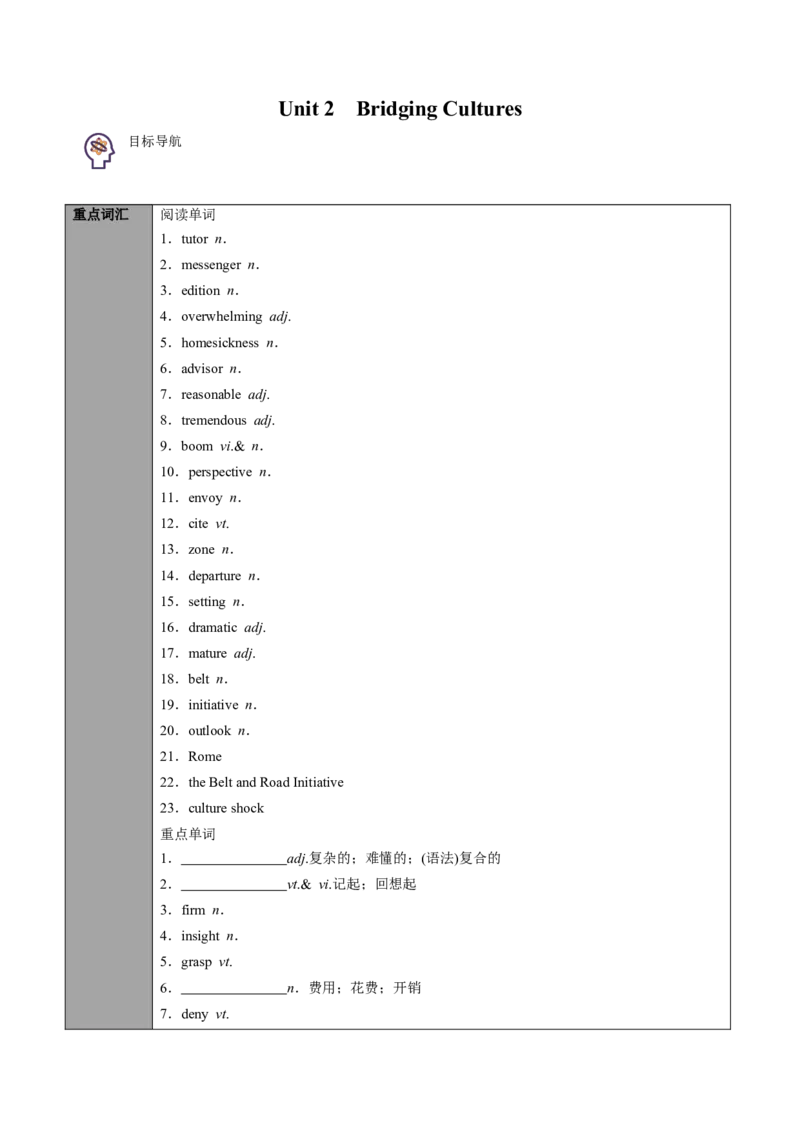
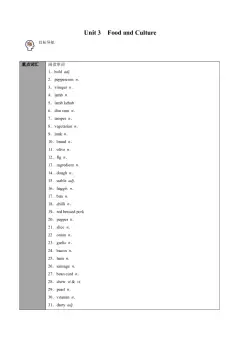
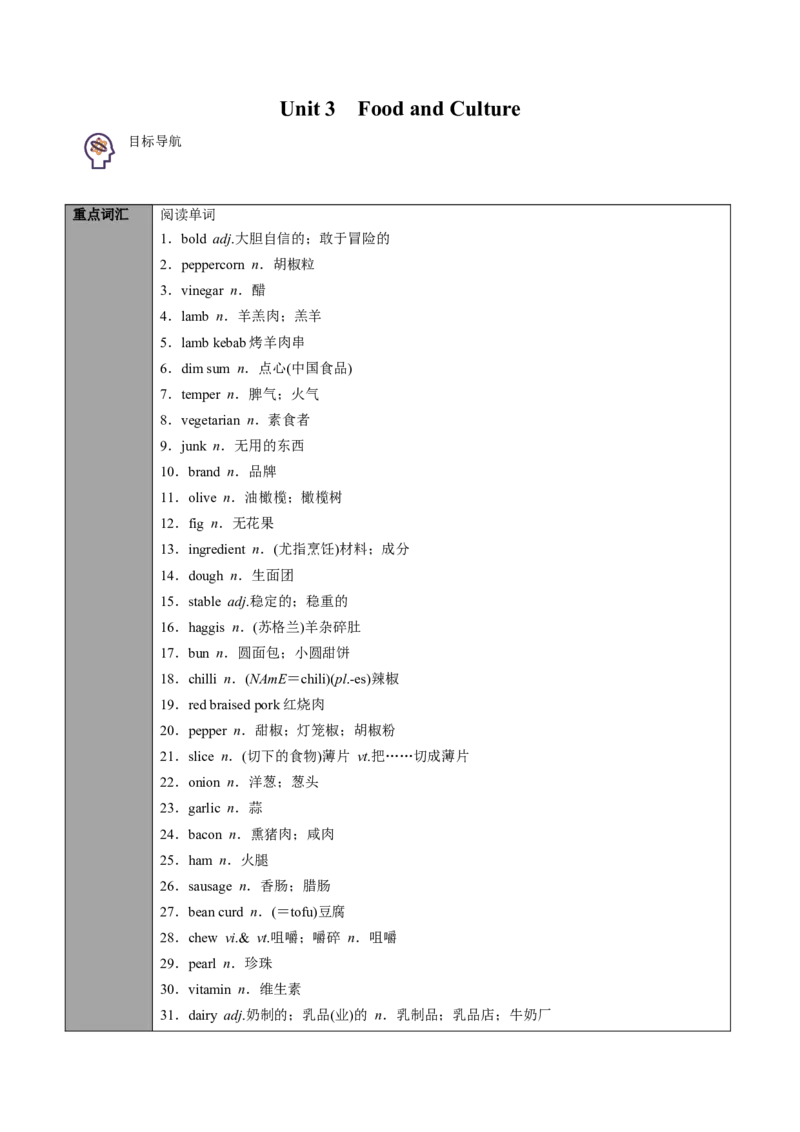
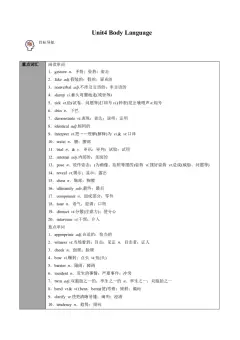
Unit 2 Bridging Cultures
目标导航
重点词汇 阅读单词
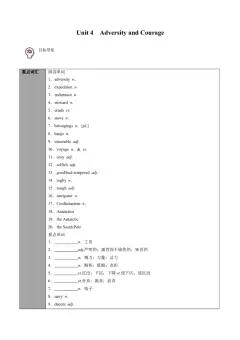
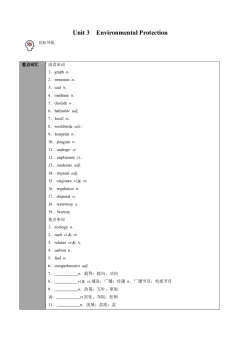
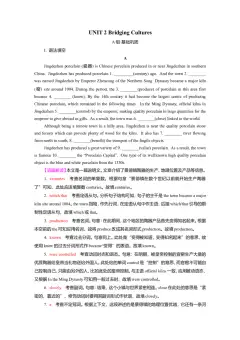
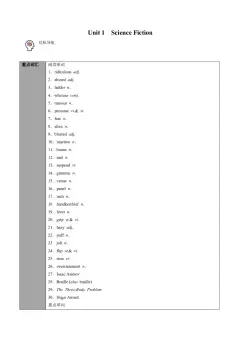
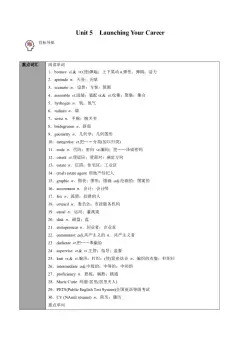
1.tutor n.
2.messenger n.
3.edition n.
4.overwhelming adj.
5.homesickness n.
6.advisor n.
7.reasonable adj.
8.tremendous adj.
9.boom vi.& n.
10.perspective n.
11.envoy n.
12.cite vt.
13.zone n.
14.departure n.
15.setting n.
16.dramatic adj.
17.mature adj.
18.belt n.
19.initiative n.
20.outlook n.
21.Rome
22.the Belt and Road Initiative
23.culture shock
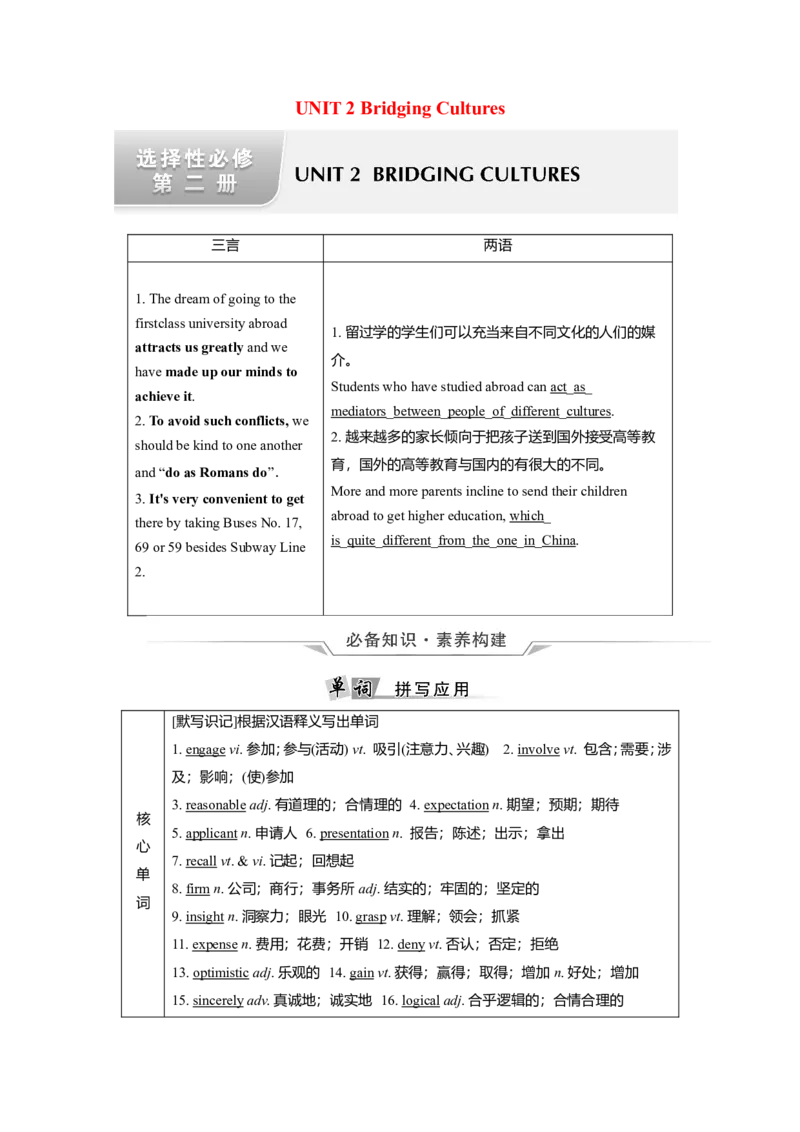
重点单词
1. adj.复杂的;难懂的;(语法)复合的
2. vt.& vi.记起;回想起
3.firm n.
4.insight n.
5.grasp vt.
6. n.费用;花费;开销
7.deny vt.8. adj.乐观的
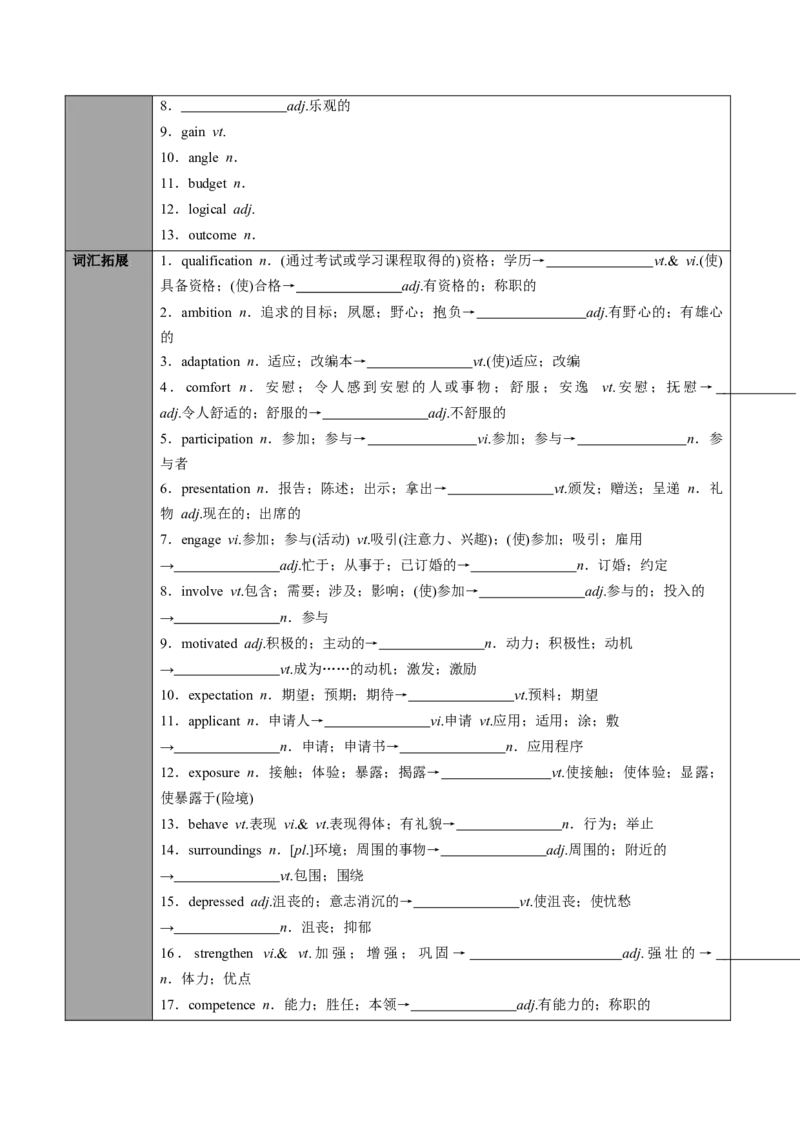
9.gain vt.
10.angle n.
11.budget n.
12.logical adj.
13.outcome n.
词汇拓展 1.qualification n.(通过考试或学习课程取得的)资格;学历→ vt.& vi.(使)
具备资格;(使)合格→ adj.有资格的;称职的
2.ambition n.追求的目标;夙愿;野心;抱负→ adj.有野心的;有雄心
的
3.adaptation n.适应;改编本→ vt.(使)适应;改编
4.comfort n.安慰;令人感到安慰的人或事物;舒服;安逸 vt.安慰;抚慰→
adj.令人舒适的;舒服的→ adj.不舒服的
5.participation n.参加;参与→ vi.参加;参与→ n.参
与者
6.presentation n.报告;陈述;出示;拿出→ vt.颁发;赠送;呈递 n.礼
物 adj.现在的;出席的
7.engage vi.参加;参与(活动) vt.吸引(注意力、兴趣);(使)参加;吸引;雇用
→ adj.忙于;从事于;已订婚的→ n.订婚;约定
8.involve vt.包含;需要;涉及;影响;(使)参加→ adj.参与的;投入的
→ n.参与
9.motivated adj.积极的;主动的→ n.动力;积极性;动机
→ vt.成为……的动机;激发;激励
10.expectation n.期望;预期;期待→ vt.预料;期望
11.applicant n.申请人→ vi.申请 vt.应用;适用;涂;敷
→ n.申请;申请书→ n.应用程序
12.exposure n.接触;体验;暴露;揭露→ vt.使接触;使体验;显露;
使暴露于(险境)
13.behave vt.表现 vi.& vt.表现得体;有礼貌→ n.行为;举止
14.surroundings n.[pl.]环境;周围的事物→ adj.周围的;附近的
→ vt.包围;围绕
15.depressed adj.沮丧的;意志消沉的→ vt.使沮丧;使忧愁
→ n.沮丧;抑郁
16.strengthen vi.& vt.加强;增强;巩固→ adj.强壮的→
n.体力;优点
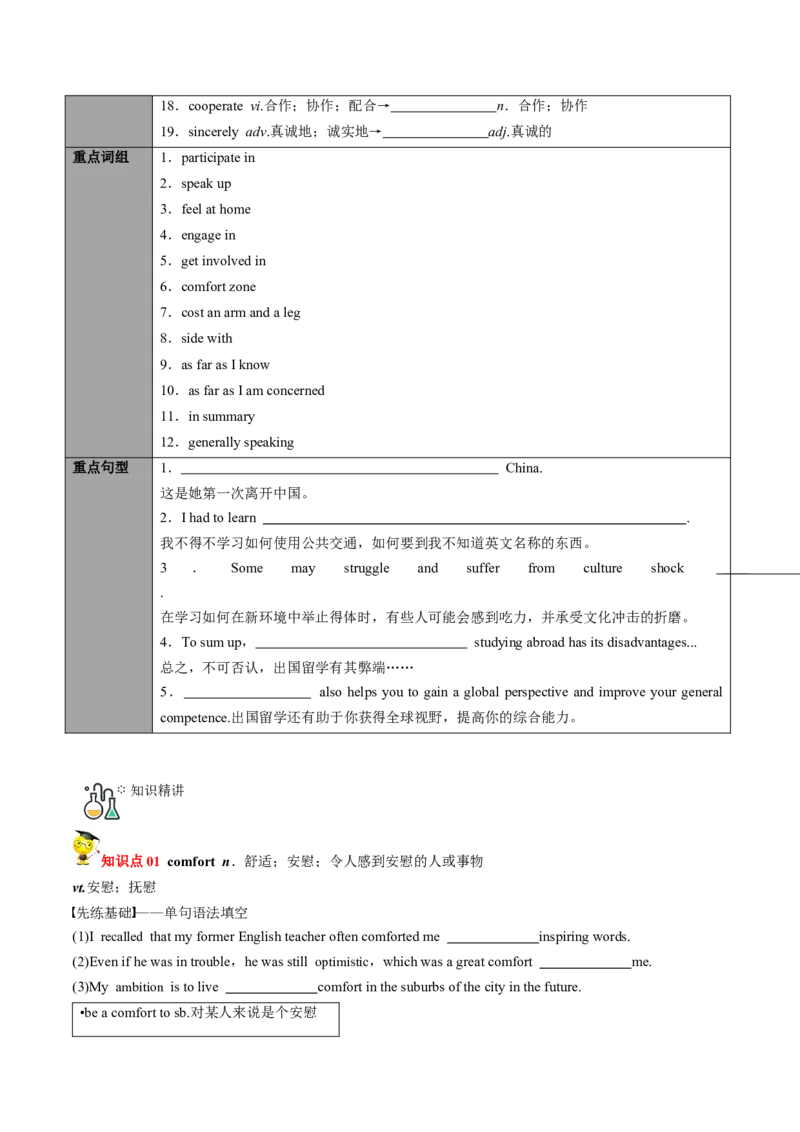
17.competence n.能力;胜任;本领→ adj.有能力的;称职的18.cooperate vi.合作;协作;配合→ n.合作;协作
19.sincerely adv.真诚地;诚实地→ adj.真诚的
重点词组 1.participate in
2.speak up
3.feel at home
4.engage in
5.get involved in
6.comfort zone
7.cost an arm and a leg
8.side with
9.as far as I know
10.as far as I am concerned
11.in summary
12.generally speaking
重点句型 1. China.
这是她第一次离开中国。
2.I had to learn .
我不得不学习如何使用公共交通,如何要到我不知道英文名称的东西。
3 . Some may struggle and suffer from culture shock
.
在学习如何在新环境中举止得体时,有些人可能会感到吃力,并承受文化冲击的折磨。
4.To sum up, studying abroad has its disadvantages...
总之,不可否认,出国留学有其弊端……
5. also helps you to gain a global perspective and improve your general
competence.出国留学还有助于你获得全球视野,提高你的综合能力。
知识精讲
知识点01 comfort n.舒适;安慰;令人感到安慰的人或事物
vt.安慰;抚慰
先练基础——单句语法填空
(1)I recalled that my former English teacher often comforted me inspiring words.
(2)Even if he was in trouble,he was still optimistic,which was a great comfort me.
(3)My ambition is to live comfort in the suburbs of the city in the future.
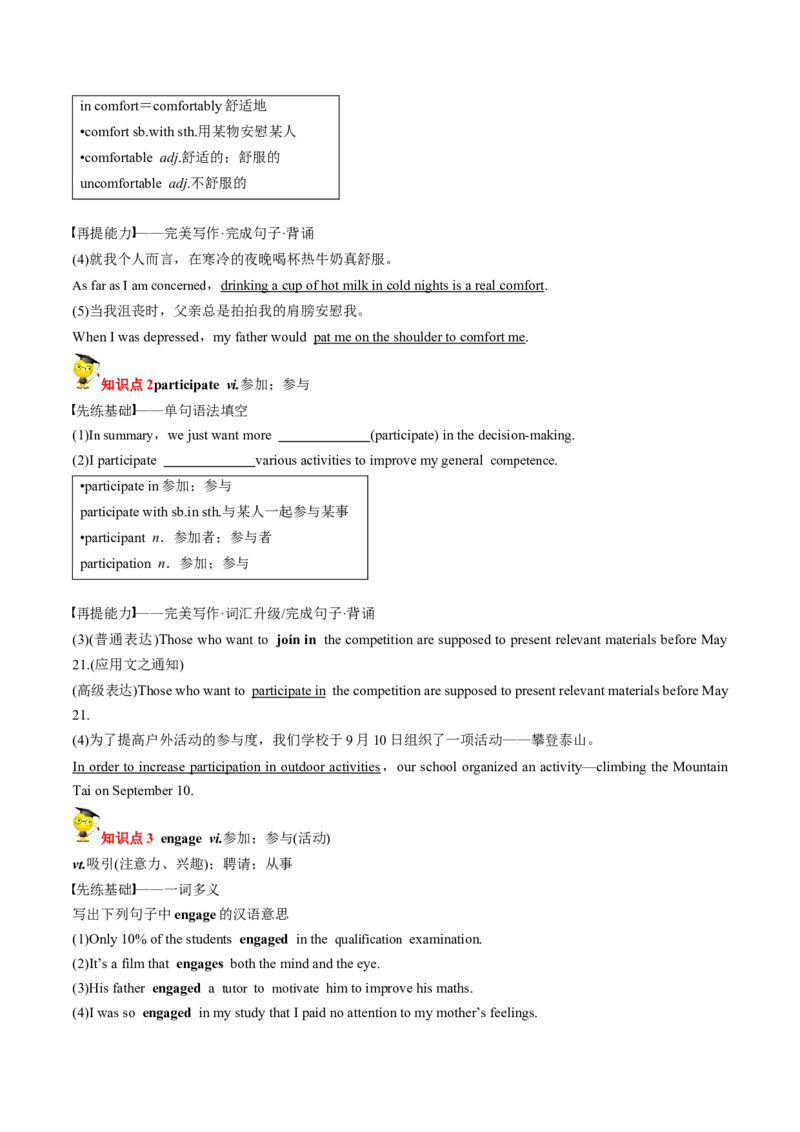
•be a comfort to sb.对某人来说是个安慰in comfort=comfortably舒适地
•comfort sb.with sth.用某物安慰某人
•comfortable adj.舒适的;舒服的
uncomfortable adj.不舒服的
再提能力——完美写作·完成句子·背诵
(4)就我个人而言,在寒冷的夜晚喝杯热牛奶真舒服。
As far as I am concerned,drinking a cup of hot milk in cold nights is a real comfort.
(5)当我沮丧时,父亲总是拍拍我的肩膀安慰我。
When I was depressed,my father would pat me on the shoulder to comfort me.
知识点2participate vi.参加;参与
先练基础——单句语法填空
(1)In summary,we just want more (participate) in the decision-making.
(2)I participate various activities to improve my general competence.
•participate in参加;参与
participate with sb.in sth.与某人一起参与某事
•participant n.参加者;参与者
participation n.参加;参与
再提能力——完美写作·词汇升级/完成句子·背诵
(3)(普通表达)Those who want to join in the competition are supposed to present relevant materials before May
21.(应用文之通知)
(高级表达)Those who want to participate in the competition are supposed to present relevant materials before May
21.
(4)为了提高户外活动的参与度,我们学校于9月10日组织了一项活动——攀登泰山。
In order to increase participation in outdoor activities,our school organized an activity—climbing the Mountain
Tai on September 10.
知识点3 engage vi.参加;参与(活动)
vt.吸引(注意力、兴趣);聘请;从事
先练基础——一词多义
写出下列句子中engage的汉语意思
(1)Only 10% of the students engaged in the qualification examination.
(2)It’s a film that engages both the mind and the eye.
(3)His father engaged a tutor to motivate him to improve his maths.
(4)I was so engaged in my study that I paid no attention to my mother’s feelings.(5)She was engaged to Peter,which was beyond our expectations.
•engage sb.to do sth.雇用某人做某事
engage (sb.) in (使某人)从事;参与
•engaged adj.已订婚的;占线的;使用中的
be engaged to sb.与某人订婚
be engaged in忙于;从事于
•engagement n.订婚;婚约;约会
再提能力——完美写作·词汇升级·背诵
(6)(普通表达)Although you are busy with your study,you should set aside some time to take part in some
outdoor activities.
(高级表达)Although you are engaged in your study,you should set aside some time to take part in some outdoor
activities.
知识点4 involve vt.包含;需要;涉及;影响;(使)参加
先练基础——一词多义
写出下列句子中involve的汉语意思
(1)As we all know,the work of a teacher involves love and devotion.
(2)If your work involves other people,put yourself in their positions.
(3)I grasp every chance to involve myself in after-class activities.
•involve (doing) sth.包含;需要(做)某事
involve oneself in sth.参加……
•be/get involved in参与;卷入;与……有关联;专注于
•involvement n.参与;卷入;牵连
再提能力——完美写作·完成句子/句式升级·背诵
(4)不可否认,参加社会活动可以开阔我们的视野。
One cannot deny the fact that being involved in social activities can broaden our horizons.
(5)I have learnt that you welcome students from different countries.I’d like to be involved in the summer camp.(应
用文之申请信)
Learning that you welcome students from different countries,I’d like to be involved in the summer camp.(用现在
分词短语作状语改写)
知识点5 expose vt.使接触;使体验;显露;使暴露于(险境)
先练基础——单句语法填空
(1)As far as I am concerned,for the sake of the babies’ safety,don’t expose them to strong sunlight.
(2)As far as I know,being exposed(expose) to sunlight for a long time will hurt our skin.•expose...to...使……暴露于……;使……体验……
be exposed to暴露于;接触
•exposure n.接触;体验;暴露;揭露
再提能力——完美写作·句式升级·背诵
(3)(普通表达)I have been exposed to foreign teachers since a young age.I can communicate freely with others in
English.
(高级表达)Having been exposed to foreign teachers since a young age,I can communicate freely with others in
English.(用现在分词短语作状语改写)
知识点6 behave vt.表现
vi.& vt.表现得体;有礼貌
先练基础——单句语法填空
(1)What do you think of our advisor’s (behave) at the meeting that day?
(2)Applicants must behave (them) towards the interviewers.
•behave oneself/well守规矩/举止得体
•well-behaved adj.表现好的
badly-behaved adj.表现差的
•behaviour n.(=behavior)行为;举止;习性
再提能力——完美写作·语段填空·背诵
(3)强烈建议你参加晚宴时,举止得体。作为举止得体的客人,你不应该把筷子插在食物里,或者用筷子指
着其他人。(应用文之传统习俗)
It is highly suggested that you (should) behave yourself when attending feasts.As a well-behaved guest,you
shouldn’t stick your chopsticks in the food or point them at others.
知识点7 疑问词+to do
I had to learn how to use public transport and how to ask for things I didn’t know the English names for.我
不得不学习如何使用公共交通,如何要到我不知道英语名字的东西。
•“疑问词+不定式”结构可在句中作主语、宾语、表语、宾语补足语等句子成
分。
•在“疑问词+不定式”结构中,不定式必须用主动式而不能用被动式。
•why或why not后加不定式时,省略不定式符号to。
•whether后可接不定式,而if不可。
能力提升——完美写作·完成句子·背诵
(1)由于他们流露出极强的兴趣,我开始教他们如何泡茶。With their interest greatly sparked,I then began to teach them .
(2)如果你能给我们一些改进机器人的建议,我会感激不尽的。(应用文之征求建议)
I would appreciate it if you could give us some advice on .
(3)我真不知道是否接受她的邀请。
I really have no idea .
(4)为何不参加讨论小组,以便找到志同道合的朋友呢?
so that you can find friends with similar interests?
知识点8 状语从句的省略
Some may struggle and suffer from culture shock when learning how to behave in new surroundings.
在学习如何在新环境中举止得体时,有些人可能会感到吃力,并承受文化冲击的折磨。
先练基础——单句语法填空
(1)You must keep these points in mind when (comfort) others.
(2)If (admit) as a volunteer,I will do all I can to do the work well.
状语从句的省略有两种形式:
•当状语从句的主语和主句的主语一致,且从句中含有 be动词时,可将从句的主语和be
动词一起省略。
•当从句中含有“it+be动词”时,可将it和be动词省略。
再提能力——完美写作·句型转换/完成句子·背诵
(3)If I am accepted,I will introduce Chinese painting skills to visitors,which can help them know more about
Chinese culture.(应用文之传统文化)
→ ,I will introduce Chinese painting skills to visitors,which can help them know more about
Chinese culture.
(4)If it is possible,I am going to visit some homes of the old in the city.
→ ,I am going to visit some homes of the old in the city.
(5)工作的时候,我意识到烈日下在田间工作是多么地辛苦。 (2019·北京,书面表达)
,I realized how hard it was to work in the fields under a hot sun.
语法精讲
名词性从句
[观察例句]
1.What seemed strange before now appears quite normal to Xie Lei.
2.It's important that Xie Lei keeps a balance between her studies and her social life.
3.That is why today over 40% of Californians speak Spanish as a first or second language.
4.Her tutor explained that she was supposed to read lots of information to help form a wise opinion of
her own.5.He made it quite clear that he preferred to study English.
6.The fact that she seemed to develop normally was very encouraging.
[归纳用法]
1.以上所有例句皆为主从复合句,句中用了相当于名词作用的从句(即名词性从句)在句中充当成分。
2.例句1为what引导的主语从句。例句2中it为形式主语,真正的主语为后面that引导的主语从句。
3.例句3为why引导的表语从句。
4.例句4为that引导的宾语从句。例句5中it为形式宾语,真正的宾语为后面that引导的宾语从句。
5.例句6为that引导的同位语从句。
名词性从句是在句子中起名词作用的句子。名词性从句的功能相当于名词词组,它在复合句中能担任
主语、宾语、表语、同位语等,因此根据它在句中不同的语法功能,名词性从句又可分别称为主语从句、
宾语从句、表语从句和同位语从句。
一、名词性从句的连接词
引导名词性从句的连接词有三个连词、五个连接代词、四个连接副词。
连接词 词形 词义 在从句中所作的成分
that × ×
连词
if/whether 是否 ×
who(ever) (无论)谁(主格) 主语、表语、宾语
whom(ever) (无论)谁(宾格) 表语、宾语
连接代词
whose(ever) (无论)谁的(所有格) 定语
what(ever) (无论)什么 主语、宾语、表语、定语
which(ever) (无论)哪个 主语、宾语、定语
when(ever) (无论)什么时候 状语
where(ever) (无论)在哪里 状语
连接副词
how(ever) (无论)怎样,怎么 状语
why 为什么 状语
二、主语从句
主语从句是指在句中作主语的从句,位置与陈述句的主语相同。
What is not to our satisfaction is that the price of the meal is a little too high.
我们不满意的是饭菜的价格稍微有点高。
How the book will sell depends on its author.
这本书如何销售取决于作者本人。
Where we shall have the meeting makes no difference.
我们在哪儿开会都无所谓。
1.that引导主语从句,在从句中不充当任何成分,仅起连接作用,但不可省略。
That you will win the medal seems unlikely.
你想获得奖牌看起来是不可能的。
2.whether引导的主语从句既可放在句首也可放在句尾,但if引导的主语从句只能放在句尾,前面需要用it作形式主语。
Whether the sports meeting will be held is not certain now.
运动会是否将举行现在不能确定。
Whether the work can be completed on time is doubtful.
=It is doubtful whether/if the work can be completed on time.
这项工作能否按时完成还不确定。
3.若主语部分结构较长,可以使用形式主语it,把真正的主语从句放于后面。
It is announced that our school is going to start an activity of “Crazy English” before daily morning
exercises.
学校通知每日早操前将开展“疯狂英语”活动。
It is necessary that people should learn to face the reality.
人们应该学会面对现实是有必要的。
[即学即练1] 单句语法填空
① is certain that she will do well in her exam.
② we understand things has a lot to do with what we feel.
③It is reported a new film will be put on in the cinema.
三、宾语从句
在主从复合句中作宾语的从句叫宾语从句。宾语从句在句中可以作及物动词、介词或一些形容词的宾
语。
Everyone knows that the earth is made up of matter.
每个人都知道地球是由物质构成的。
I doubt whether he will be elected as chairman.
我怀疑他是否会当选为主席。
These two areas are similar in that they both have high rainfall in summer.
这两个地区相似,因为在夏天降水都很多。
I'm not certain whether the train will arrive on time.
我不确信火车是否将会按时到达。
1.that引导宾语从句,既无语法功能,也无词汇意义,常被省略。但多个并列从句出现时,第一个
that可以省略,其他的不能省略。
She said (that) she would come here and that I should wait for her till Monday.
她说她将会来这儿并让我等到星期一。
2.if和whether引导宾语从句的区别:
①在动词不定式之前只能用 whether。
②在whether...or not 的固定搭配中,只用 whether。
③在介词后,只能用whether。
④作 discuss 的宾语时,只能用 whether。
⑤宾语从句放在句首表示强调时,只能用 whether。
3.带复合宾语(宾语+宾语补足语)的句子,that引导的宾语从句经常移到句子后面,而用it作形式宾语。
4.表示喜欢、憎恶等心理活动的动词后习惯上先加个形式宾语 it,再接宾语从句。例如:hate,
dislike,love,don't mind,feel like,appreciate,rely on,count on,see to等。
We think it possible that you can finish the work today.我们认为你今天能够完成这项工作。
5.宾语从句的否定转移:think,believe,suppose,imagine等动词后的宾语从句中的否定词要转移到
主句中,即主句的谓语动词用否定式,而从句的谓语动词用肯定式。
I don't think we need to waste much time on it.
我想我们不必在这上面浪费太多时间。(形式上否定)
[即学即练2] 单句语法填空
①I hate it when they talk with their mouths full of food.
②Once we were left to decide whether to have a picnic in a park or go to a museum.
③I want to be liked and loved for what I am inside.
四、表语从句
表语从句在复合句中作表语,出现在连系动词之后,一般结构为“主语+连系动词+表语从句”。可
接表语从句的连系动词有be,look,remain,seem等。
The question is whether we can finish the work in time.
问题在于我们是否能及时完成这项工作。
1.that在引导表语从句时无词义,在从句中不充当任何成分,仅起连接作用,不可以省略。
The fact remains that we are still not advanced enough.
事实依然是我们还是不够先进。
2.whether可引导表语从句,但if却通常不用于引导表语从句。
His first question was whether Tom had arrived yet.
他的首要问题是汤姆是否已经到达。
3.引导表语从句的引导词还可用because,as if,as though,as。
The sky is overcast with dark clouds.It seems as if it is going to rain soon.
天空乌云密布,似乎很快就要下雨了。
[即学即练3] 单句语法填空
①The problem is we can get to replace her.
②I'm afraid he's more of a talker than a doer,which is he never finishes anything.
③The system works well in the lab,but the question is it will work in reality.
五、同位语从句
在复合句中用作同位语的从句叫同位语从句。它一般跟在某个名词后面,用来说明前面名词的具体内
容。常见的这类名词有:fact,news,hope,truth,idea,suggestion,thought,question,promise,order,
problem,belief,word,message,information,proof,announcement,desire,doubt,proposal,advice,
possibility等。
The news that he was admitted to Peking University is exciting.
他被北京大学录取了的消息真是令人激动。
The question who should do the work requires consideration.谁应当做这份工作,这个问题需要考虑。
I have no idea that you have applied for the post.
我不知道你已经申请了这个职位。
[名师点津] 同位语从句和定语从句的区别
同位语从句 定语从句
与先行词是修饰与被修饰的关系,起连
功能不同 对名词加以补充说明
接作用
作主语或宾语,起连接作用;并且作从
that 不作成分,只起连接作用,不可省略
句的宾语时可省略
whether/ 起连接作用,其中whether不作成分,
不引导定语从句
how/what 而how和what作成分
作成分;起连接作用;有自己的含义, 作成分;起连接作用;没有自己的含
其他wh类词
但与先行词无关 义,但是代替先行词在从句中作成分
Jim got to know the news that the whole village was in great danger.
吉姆得知整个村子都处在极度危险中的消息。(that引导同位语从句,解释说明the news的内容)
Do you know the news(that/which)Jim told me?
你知道吉姆告诉我的那个消息吗?(that/which引导定语从句,且在从句中作宾语)
[即学即练4] 将下列句子合并为同位语从句
①Will the sports meeting be held on time?The question will be discussed tomorrow.
.
②The headmaster will join us in hiking this Sunday.We are glad at the news.
.
③A new teacher will teach us English next term.The message reached me yesterday.
.
Ⅰ.单句语法填空
1.There is no doubt he will succeed in time.
2.We can't solve the problem we can travel faster than light.
3.Pick yourself up.Courage is doing you're afraid to do.
4.Upon graduation he asked to be sent to he was most needed.
5.It is reported the government is going to close the factory.
6. surprises me most is that he is too vain.
7. Mike didn't turn up at the meeting yesterday made the chairman of the meeting unhappy.
8.You may depend on it I shall always help you.
9.The problem is we can get in touch with her.
10.The message responsibility it was is known to all.
Ⅱ.完成句子
1.我已经读了这个通知,我们学校广播站需要两名英语播音员。I have read the notice .
2.谁能赢得这场比赛还不得而知。
is still unknown.
3.你通过考试了,真棒。
It's splendid .
4.她总是在想怎样能把工作做好。
She always thinks of .
5.司令员命令部队马上出发。
The commander ordered .
6.我认为每天多喝开水是有必要的。
I think it necessary .
7.他能否准时参加派对得看交通情况。
depends on the traffic.
8.原材料是我们所急需的。
Raw material is .
9.我们赢得这场比赛的消息令人激动。
The news is exciting.
10.我尚不能肯定她为什么拒绝他们的邀请。
I'm not sure .
写作园地
如何写一封有争议性话题的信
有争议性话题都是很容易引起大家关注的话题,并且是跟随着时代的潮流而来的话题。争议性话题当
然有很大的争议性,写作时,你必然会有一个关于这个话题的态度,支持或反对。
[基本框架]
1.开头——引出话题,综述大家对此话题的不同态度。
2.主体——提出自己的观点,并对此话题的利弊进行深入的分析。
3.结尾——总结自己的观点,扣题。
[常用词块]
1.have a good understanding of很好地理解或了解
2.go to study abroad出国留学
3.know more about foreign countries更多地了解外国
4.have both advantages and disadvantages有优点也有缺点
5.bring serious problems带来严重的问题
6.some effective measures一些有效的措施
7.make the most of充分利用
8.witness the fast development of见证了……的快速发展[常用语句]
1.I'm writing to tell you about my opinion on Chinese students going abroad for further studies at an early
age.
我写信是想告诉你我对中国学生留学低龄化的看法。
2.It's universally acknowledged that computers are commonly used nowadays.
现在人们普遍使用电脑,这是公认的。
3.Some people believe that students should be given one long vacation each year.Others believe that students
should have several short vacations throughout the year.
有些人认为学生每年应该有一个长假,另外有些人认为学生应该有几个短假。
4.Some effective measures should be taken to ensure that computers are used in right ways.
应该采取一些有效的措施来确保电脑的正确使用。
5.Only in this way can we improve our English.
只有这样,我们才能提高英语水平。
6.And this has aroused hot debate recently.
最近这引起了热议。
某英文报就近年来我国学生出国留学低龄化的利弊在报上展开讨论,希望广大读者畅所欲言,就此事
发表自己的看法。假设你是中学生李华,请用英语给编辑写一封信,谈谈你的看法,并说明理由。80词左
右。
注意:信的开头和结尾已给出,词数不计算在内。
Dear editor,
I'm writing to tell you my opinion on Chinese students going abroad for further studies at an early age.
Yours,
Li Hua
分层提分
题组A 基础过关练
Ⅰ.单词拼写(根据汉语提示或首字母提示写单词)(每小题1分,共8分)
1.Thanks to his help,I (回想起) what happened two years ago.
2.Through the activity,I gained a high level of (能力) in English.
3 . Being an outgoing student , I’m easy to get along with and always have a sense of duty and
(合作).
4.I am writing to (真诚地) invite you to take part in our party on the Belt and Road Initiative.(应用文之邀请信)
5.Speaking up and giving presentations loudly in class have my confidence.
6.As far as I know,studying English great patience and determination.
7.I must work as a tutor to cover my daily ,which will cost an arm and a leg.
8.Faced with hardships,our monitor is rather than depressed.
Ⅱ.词形变化填空(用括号内所给词的适当形式填空)(每小题2分,共10分)
9.All the who want to for the job have handed in their letters of
. (apply)
10.As was ,all of us achieved our goals and met our teachers’ .(expect)
11.As an boss,his is to open ten branches of his company in China this year.
(ambition)
12.When I was ,he would me gently,which made me quite
. (comfort)
13.What made him also me greatly.Our made us in a bad
mood.(depress)
Ⅲ.经典句型仿写(每小题4分,共20分)
14.那是我第一次参加交换生项目。那次经历不仅让我开阔了眼界,而且增强了我的信心。(It was the first
time that...)
participated ,which not only broadened my
view but also strengthened my confidence.
15.不知道如何解决这个问题,因此,我别无选择只能向你求助。(疑问词+to do)
I didn’t know ,so I had no alternative but to turn to you for help.
16.不可否认,我们可以从电视节目“中国诗词大会”上获益良多。(deny)
we can benefit a lot from the television programme “Chinese Poetry
Competition.”
17.按照安排,我们早上7点将在学校门口乘公共汽车出发。(状语从句的省略)
,we will leave at 7:00 am at the school gate.
18.由于擅长剪纸,他报名参加了剪纸比赛。(动名词短语作主语)
made him sign up for the paper-cutting competition.
题组B 能力提升练
请先从表格中选用本单元所学词汇完成下列短文,然后核对答案并背诵该短文。(文中加波浪线的句子
为本单元的语法项目:名词性从句)
I have studied for business qualification at Peking University for one year.I recalled that faced with
complex surroundings and dramatic changes,I suffered from tremendous pressure and homesickness,
which made me
1. in the beginning.But being an ambitious,optimistic and mature student,I managed to2. myself to step out of my comfort zone.I grasped every chance to speak up and offer
logical presentations in class,enabling myself to become 3. .I engaged in the Literature Club
to strengthen my literary outlook on life.I got involved in the Basketball Association so that I could learn to
4. with others.I participated in some other meaningful activities.There is no denying that all of
them could make me see things from different angles and have more reasonable insights into daily affairs .As
far as I’m concerned,5. to the surrounding settings,I gradually felt at home.Just as the old
saying goes,“No pains,no gains.” Now I can behave perfectly at university.Furthermore,because I was on a
tight budget,I took up a position as a tutor to cover my daily expenses and tuition fees,which cost my
family an arm and a leg.Now my ambition is to become an advisor for exchange students to broaden my global
perspective.Among so many 6. ,I believe that I am qualified for the job because I have firm
determination.Whatever the outcome is,I’ll side with the school’s decision.In summary,now I am confident
in my expectation of setting my own firm in the future.
题组C 培优拔尖练
A
Admission and School Policies
The enrollment(注册) of a pupil to the school is subject to the school’ s admission and entry policies and other
policies and procedures revised by the school from time to time.
Withdrawal by a Parent/Guardian
If a parent/guardian desires to withdraw a child for any reason from the school,that parent/guardian shall
give a minimum of six weeks written withdrawal notice to the school.Notice received during a school holiday will
be considered to have been received on the first day of the following term.
Refundable Deposit(押金)
When a pupil is offered a place the parent/guardian shall immediately pay the required Refundable
Deposit.This is to secure enrollment at the school until the termly or annual fees have been paid.The Refundable
Deposit is refundable,and shall be without interest and without taking into account changes in exchange rates.
Fees
School Fees are listed on the Fee Schedule and vary from time to time.A full term’s tuition must be paid for
any term during which the pupil is in attendance regardless of the number of days attended.If tuition fees have not
been paid,the Refundable Deposit shall be used to pay the tuition fees and the parents/guardians remain
responsible for the rest.The school reserves the right to exclude(开除) a pupil if tuition or other fees are not paid in
full by the due date.
Termination by the School
The school may terminate(终止) this agreement when permanent exclusion or removal is required.The school
shall not take such action without good cause and full consultation with parents/guardians and the
pupil.Parents/guardians have the right to appeal on a decision to permanently exclude a pupil.
1.How long in advance should a written withdrawal notice be given?
A.A whole holiday. B.At least six weeks.C.A whole term. D.At least one day.
2.What do we know about tuition fees?
A.They must be fully paid.
B.They stay the same every year.
C.They vary with the number of days attended.
D.They can’t be paid with the refundable deposit.
3.In which section of a school’s brochure might the text appear?
A.Study Tips.
B.Application Procedures.
C.Terms and Conditions.
D.Frequently Asked Questions.
B
Most kids can walk into a library or bookstore and find hundreds of books to read.But it’s not that simple for
kids who are blind.They read in a different way.Jenny Lee and other braille(盲文) transcribers take the printed
words of a book and change them into a code of raised dots.Blind people can read these dots with their fingers.To
know what braille feels like,take a ballpoint pen and press hard onto a piece of paper.Now turn the paper over and
touch the raised dot made by the pen point.
When Lee first saw the dots of the braille alphabet,she wondered if she’d ever be able to read and write them
easily.She took a class and practised hard for about six months before she passed the final exam:she had to
convert 35 pages of a book into braille.Today,Lee works for a publisher.One of her jobs is to change children’s
books into braille.
To do this,Lee first types the story into a computer and then uses a computer program to translate it into the
braille code.Next,she looks over the translation several times to make sure it’s mistake-free.After that,a copy of
the braille story is printed with a special printer.Then Lee and a proof reader work together to find and correct any
mistakes.When a book is ready,many copies of it are printed.Afterwards,some are sold through websites and
others are sent to libraries.
Sometimes,going over a story again and again gets tiring.That’s when Lee takes a break.Several of Jenny
Lee’s co-workers,who are blind,use guide dogs.When the animals aren’t working,Lee likes spending a few
minutes with them.To her,playing with dogs “is always a pick-me-up in the middle of the day”.
“I love this mission,” Lee says.“Through my brain power and my fingers,I am putting the dots into some
kid’s hands.”
4.How does the writer explain what braille feels like?
A.By explaining what braille words look like.
B.By describing how blind people read books.
C.By asking readers to experience it themselves.
D.By giving examples of different braille words.
5.What was Lee’s first reaction to braille?A.She was excited to get a new skill.
B.She was amazed at the clever idea.
C.She realized she could teach it herself.
D.She believed it would be difficult to learn.
6.What does the underlined word “pick-me-up” in Paragraph 4 most probably mean?
A.A discussion to release work stress.
B.Something to improve one’s appetite.
C.Something to help restore one’s spirit.
D.A free ride accompanied with a guide dog.
7.What does Lee think of her job?
A.Profitable and hopeful.
B.Tiring but meaningful.
C.Relaxing and helpful.
D.Boring but challenging.
C
A new app aims to help parents interpret what their babies want based on the sound of their cry.The free app
ChatterBaby,which was released last month,analyzes the features of a baby’s cry,to help parents understand
whether their children might be hungry,fussy(大惊小怪) or in pain.While critics say caregivers should not rely
too much on their smartphones,others say it’s a helpful tool for new or tired parents.
Ariana Anderson,a mother of four,developed the app.She originally designed the technology to help deaf
parents better understand why their babies were upset,but soon realized it could be a helpful tool for all new
parents.
To build a database,Anderson and her team uploaded 2,000 audio samples of baby cries.She used cries
recorded during ear piercings and vaccinations(接种) to distinguish pain cries.And to create a baseline for the other
two categories,a group of moms had to agree on whether the cry was hungry or fussy.
Anderson’s team continues to collect data and hopes to make the app more accurate by asking parents to get
specific about what certain sounds mean.
Pediatrician Eric Ball pointed out that evaluating cries can never be an exact science.“I think that all of the
apps and technology that new parents are using now can be helpful but need to be taken seriously,” Ball said.“I
do worry,that some parents will get stuck in big data and turn their parenting into basically a spreadsheet(电子表
格) which I think will take away the love and caring that parents are supposed to be providing for their children.”
But Anderson says the aim of the app is to have parents interpret the results,not to provide a yes or no
answer.The Bells say it’s a win-win.They believe they are helping not only their babies now but potentially others
in the future.
8.How does the app judge what babies want?
A.By collecting data.B.By recording all the sounds.
C.By analyzing the sound of their crying.
D.By asking parents about specific messages.
9.Who was the app designed for in the beginning?
A.Deaf parents. B.All new parents.
C.Ariana Anderson. D.Babies often crying.
10.What can we know according to Ball?
A.Parents should use the app wisely.
B.The app can provide an accurate result.
C.Parents and babies are addicted to the app.
D.The app makes babies love their parents.
11.What can be a suitable title for the text?
A.App Knows Why Babies Cry
B.App Prevents Babies from Crying
C.Parents Build Babies’ Database
D.Parents Over-rely on Smartphones