练习 19 单句改错+阅读理解
Ⅰ.单句改错(定语从句和状语从句)
1.Before I could say anything, she smiled at me and said she wanted to take me to another
place where was special to her.________________
2.But there are some among us which are ready to give up when they come to a hard
example in mathematics.________________
3.The original hamburger can be traced back to the middle ages, which Russians ate raw
meat that was cut into small pieces and formed into a small round flat shape.________________
4.I led them to the nearby bus stop and told them to take Bus No. 305, that could take them
there directly.________________
5.There was a time while misunderstanding occured between my friend and me, and we
quarreled terribly at that time.________________
6.He told me that my goldfish would die though they couldn't adapt to the environment in
the wild.________________
7.I didn't begin to like our houseparents when something happened one night.________ _
8 . It is a long time since they separated, but it won't be long when they meet
again._________ _
9.He said, “I was in the kitchen with my wife and children while we heard a loud
noise.”________________
10.You shouldn't spend your time in playing computer games even you have finished your
homework.________________
Ⅱ.阅读理解
A
2022·湖南名校联考 说明文 295词 ★★☆☆☆
Make the Best of a Bad Situation
Since COVID-19 spreads all over the world, many people have to stay indoors and work
from home. For most of us, it greatly challenges our lives and brings boredom. But for a few
people, working at home brings more creativity. Here are three famous historical figures who let
their creativity flow during past pandemics.
Giovanni Boccaccio (1313—1375)
When a plague(瘟疫) hit Florence in 1348, Italian writer Giovanni Boccaccio lost his father
and stepmother. In order to survive, he left the city and hid in the countryside. Inspired by the
experience, Boccaccio wrote The Decameron (《十日谈》), a collection of short novels framed
as stories told by a group of friends, while he was quarantined (隔离) inside a house during the
plague.
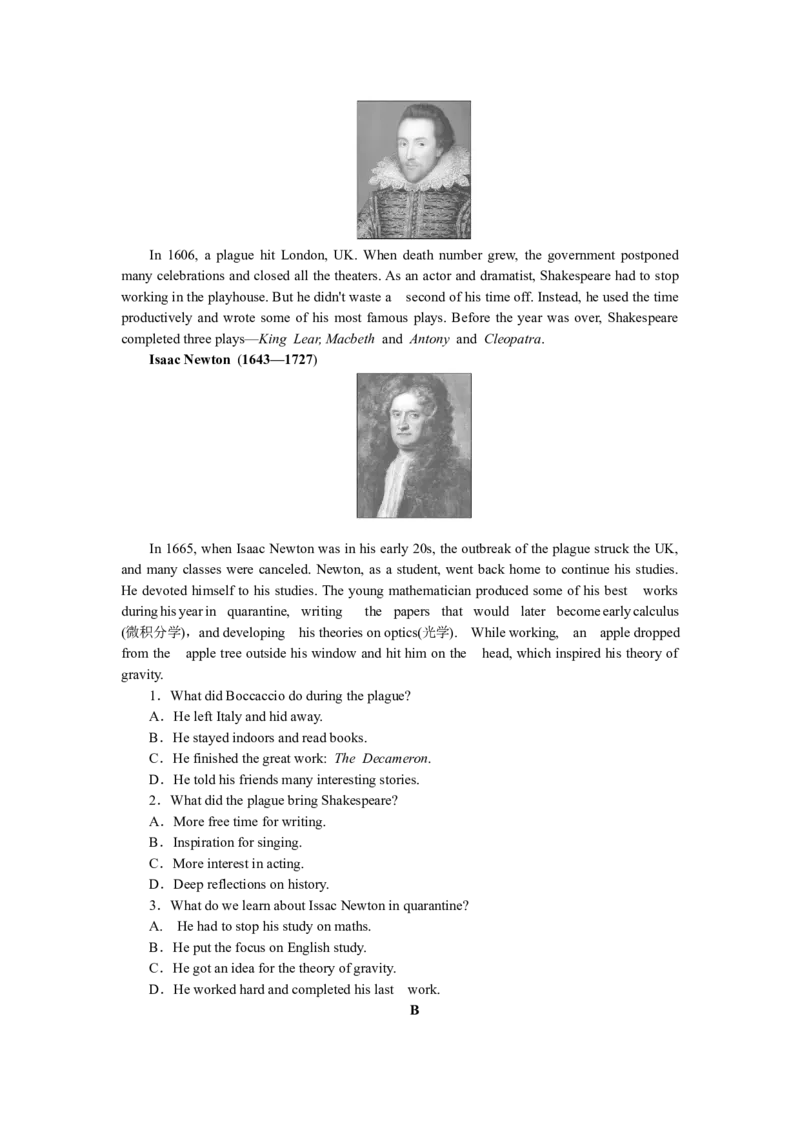
William Shakespeare (1564—1616)In 1606, a plague hit London, UK. When death number grew, the government postponed
many celebrations and closed all the theaters. As an actor and dramatist, Shakespeare had to stop
working in the playhouse. But he didn't waste a second of his time off. Instead, he used the time
productively and wrote some of his most famous plays. Before the year was over, Shakespeare
completed three plays—King Lear, Macbeth and Antony and Cleopatra.
Isaac Newton (1643—1727)
In 1665, when Isaac Newton was in his early 20s, the outbreak of the plague struck the UK,
and many classes were canceled. Newton, as a student, went back home to continue his studies.
He devoted himself to his studies. The young mathematician produced some of his best works
during his year in quarantine, writing the papers that would later become early calculus
(微积分学),and developing his theories on optics(光学). While working, an apple dropped
from the apple tree outside his window and hit him on the head, which inspired his theory of
gravity.
1.What did Boccaccio do during the plague?
A.He left Italy and hid away.
B.He stayed indoors and read books.
C.He finished the great work: The Decameron.
D.He told his friends many interesting stories.
2.What did the plague bring Shakespeare?
A.More free time for writing.
B.Inspiration for singing.
C.More interest in acting.
D.Deep reflections on history.
3.What do we learn about Issac Newton in quarantine?
A. He had to stop his study on maths.
B.He put the focus on English study.
C.He got an idea for the theory of gravity.
D.He worked hard and completed his last work.
B2022·河南联盟调研 说明文 282词 ★★☆☆☆
Eyes are significant organs of our body. Having a good eyesight is sometimes a must in
applying for a university or a job. So many researches have been done about eyes, especially about
near-sight.
Being nearsighted is far more common than it once was. It has gone up by 66 percent in
Americans since the early 1970s, according to a recent study by the National Eye Institute. In
China and other East Asian countries, as many as 90 percent of high school graduates are thought
to be nearsighted.
Near-sight happens when eyeballs are longer than normal, changing the angle at which light
enters the eye and therefore the ability to focus on distant objects. The disorder involves a
complex interplay(相互作用) of genetics and
environment and usually begins before adolescence when the eye is growing, but it can
worsen in early adulthood.
Some experts connect the rising rates to the many hours young people stare at computers and
other screens. But a recent study published in JAMA Ophthalmology suggests that a greater factor
may be a side effect of all that screen-watching—it's keeping children inside.
This new study joins a growing body of research indicating that inadequate direct sunlight
may reshape the human eye and do harm to vision. Strong evidence was found between current
eyesight and volunteers' lifetime exposure to sunlight.
Those who had gotten the most sun, particularly between the ages of 14 and 19, were about
25 percent less likely to have developed myopia (近视眼) by middle age. Exposure to sunlight
up to the age of 30 can also confer a protective benefit.
4.What do we learn from paragraphs 2—3?
A.The rate of near-sight has been on the decline.
B. Near-sight happens when eyeballs are abnormal.
C. Near-sight is only caused by environment.
D.Near-sight usually begins in early adulthood.
5.What is the main cause of near-sight according to the recent study?
A.Lack of sleep.
B.Using smartphones too much.
C.Reading too much.
D.Lack of direct sunlight exposure.
6.What does the underlined word “confer” in the last paragraph mean?
A.Provide. B.Damage.
C.Avoid. D.Reduce.
7.Where is the text most likely from?
A.A diary. B.A magazine.C.A novel. D.A notebook.
黄金考点
短文改错——介词
考点35 介词的基本用法
考例 At the end of our trip, I told my father that I planned to return for every two years.
every two years独立作状语,表示频率,不表示时间,其前不用表示时间的介词,
点拨
故去掉介词for。
考点36 介词用于固定搭配
考例 It was a relief and I came to a sudden stop just in the middle on the road.
点拨 in the middle of... “在……的中间”,为固定短语, 故把on改成of。