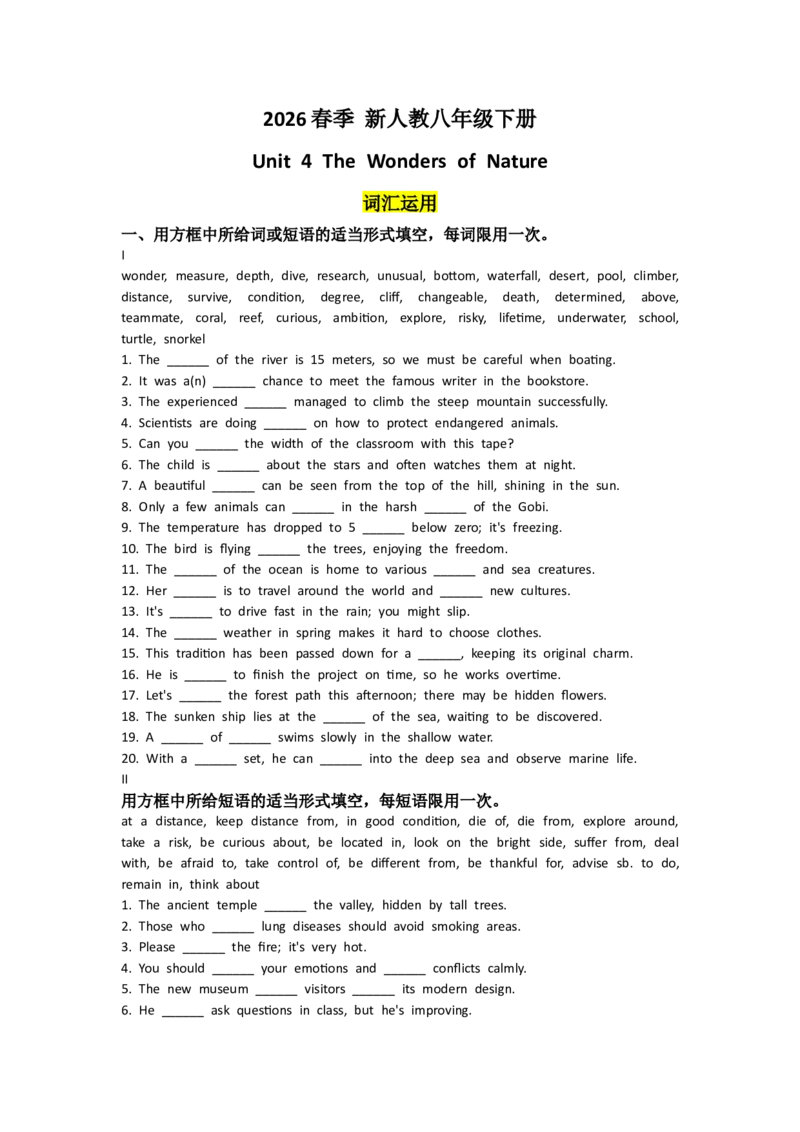
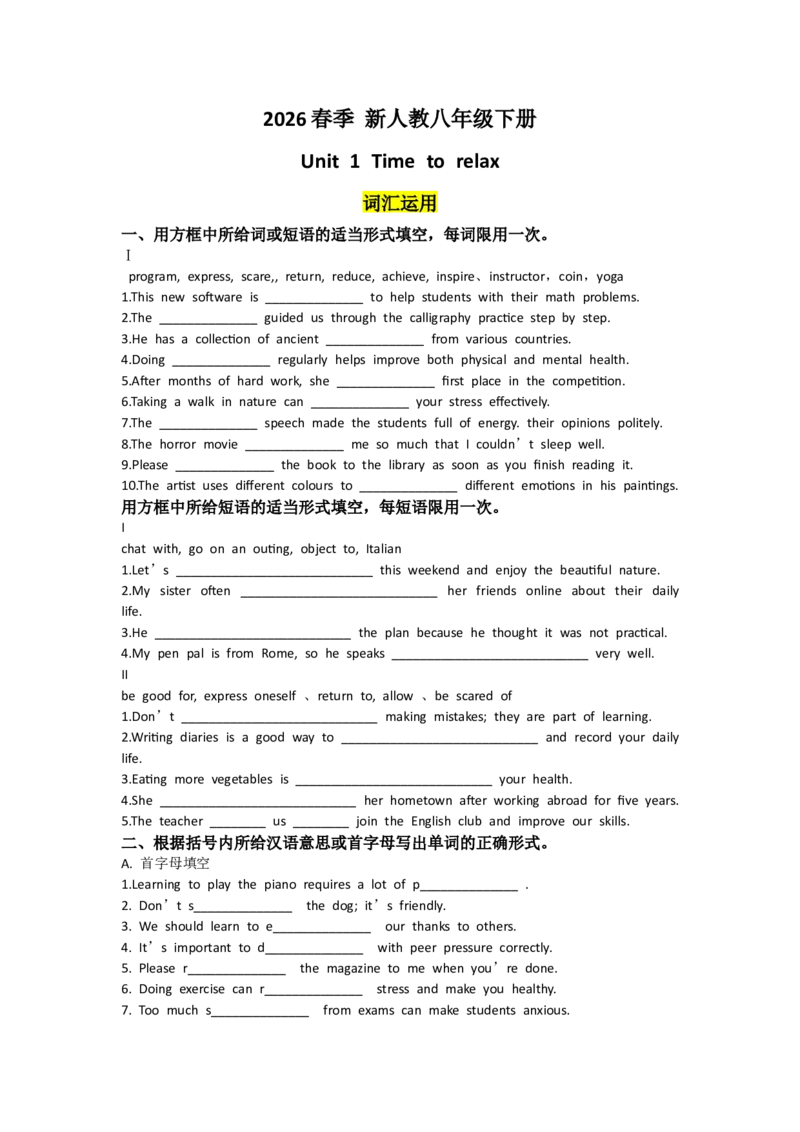
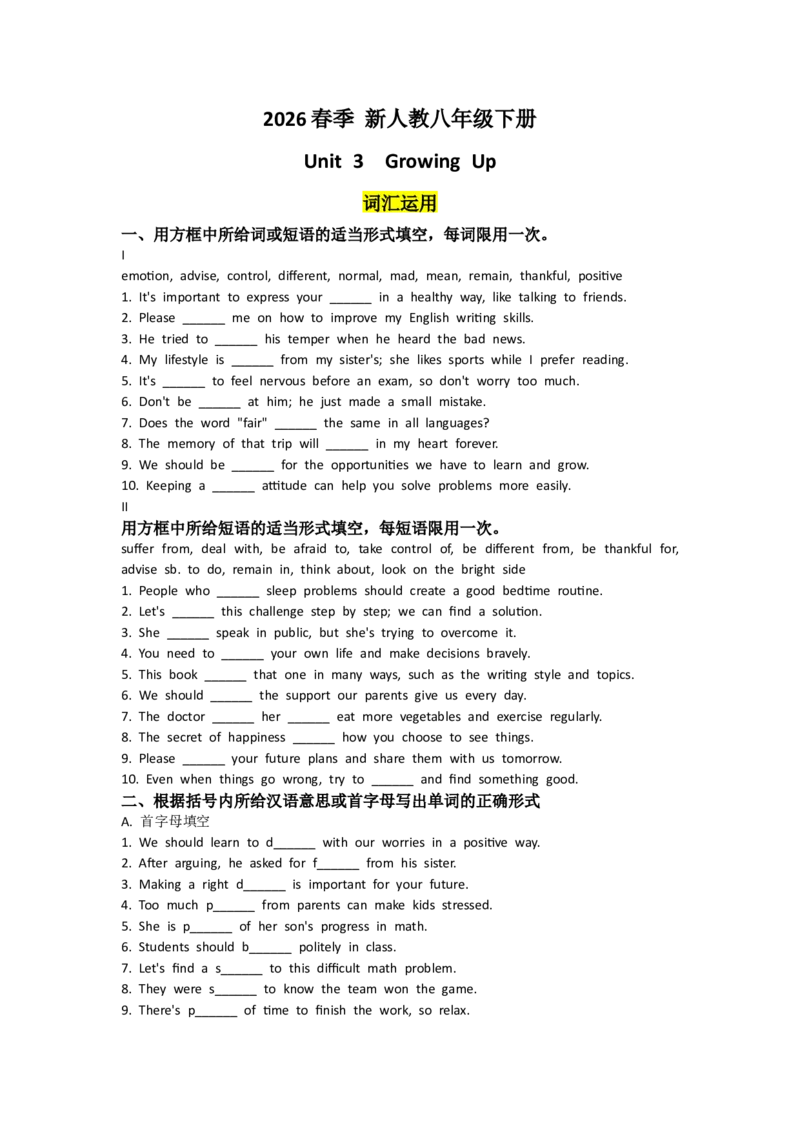
2026 春季 新人教八年级下册
Unit 2 Stay Healthy
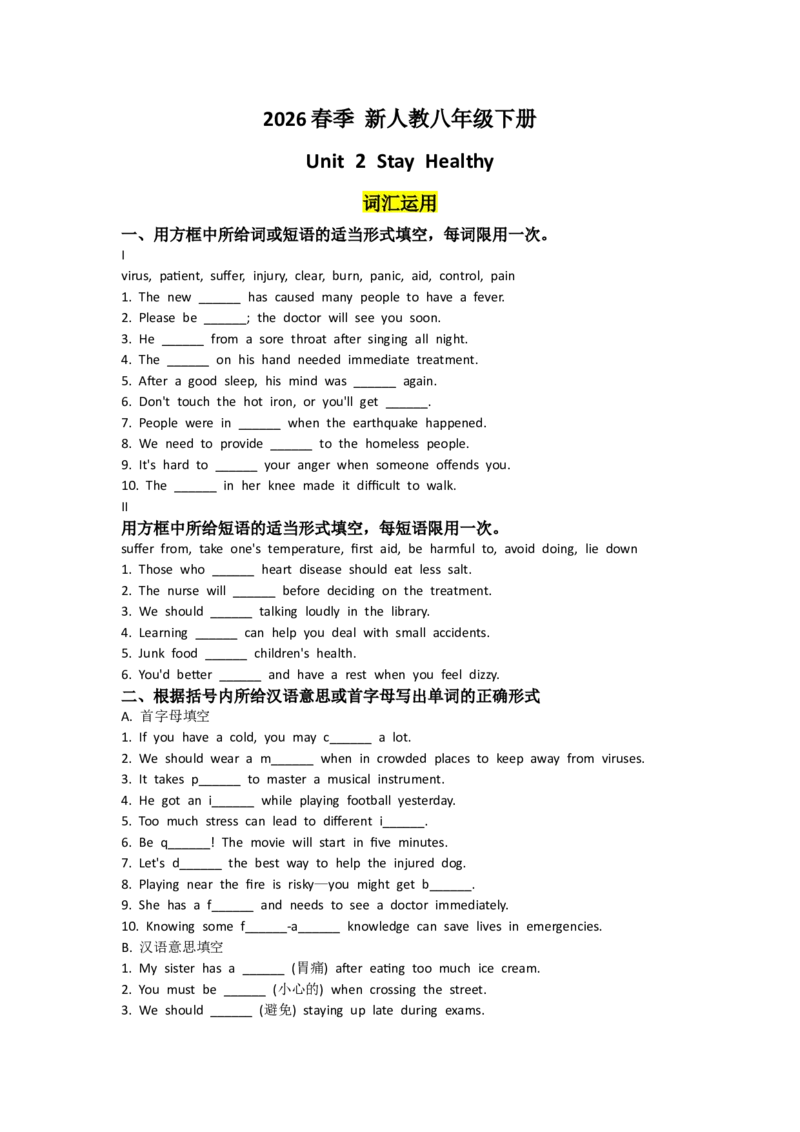
词汇运用
一、用方框中所给词或短语的适当形式填空,每词限用一次。
I
virus, patient, suffer, injury, clear, burn, panic, aid, control, pain
1. The new ______ has caused many people to have a fever.
2. Please be ______; the doctor will see you soon.
3. He ______ from a sore throat after singing all night.
4. The ______ on his hand needed immediate treatment.
5. After a good sleep, his mind was ______ again.
6. Don't touch the hot iron, or you'll get ______.
7. People were in ______ when the earthquake happened.
8. We need to provide ______ to the homeless people.
9. It's hard to ______ your anger when someone offends you.
10. The ______ in her knee made it difficult to walk.
II
用方框中所给短语的适当形式填空,每短语限用一次。
suffer from, take one's temperature, first aid, be harmful to, avoid doing, lie down
1. Those who ______ heart disease should eat less salt.
2. The nurse will ______ before deciding on the treatment.
3. We should ______ talking loudly in the library.
4. Learning ______ can help you deal with small accidents.
5. Junk food ______ children's health.
6. You'd better ______ and have a rest when you feel dizzy.
二、根据括号内所给汉语意思或首字母写出单词的正确形式
A. 首字母填空
1. If you have a cold, you may c______ a lot.
2. We should wear a m______ when in crowded places to keep away from viruses.
3. It takes p______ to master a musical instrument.
4. He got an i______ while playing football yesterday.
5. Too much stress can lead to different i______.
6. Be q______! The movie will start in five minutes.
7. Let's d______ the best way to help the injured dog.
8. Playing near the fire is risky—you might get b______.
9. She has a f______ and needs to see a doctor immediately.
10. Knowing some f______-a______ knowledge can save lives in emergencies.
B. 汉语意思填空
1. My sister has a ______ (胃痛) after eating too much ice cream.
2. You must be ______ (小心的) when crossing the street.
3. We should ______ (避免) staying up late during exams.4. The ______ (医疗的) equipment in this clinic is very advanced.
5. Please ______ (描述) your travel experience to us.
6. He often has a ______ (头痛) because of long-time computer work.
7. Polluted water ______ (有害的) to fish and plants.
8. The ______ (志愿者) are cleaning the park this weekend.
9. Remember to take this ______ (药片) after meals.
10. She felt ______ (难过的) when her pet cat was lost.
三、完成文章用should、shouldn't、could、couldn't
Xiao Hua's Sudden Stomachache
Last Sunday morning, Xiao Hua suddenly felt a sharp pain in her stomach while doing
homework. Her parents were at work, so she had to deal with it first and then ask for
help. Let's follow her story and fill in the blanks with "should", "shouldn't", "could" or
"couldn't".
1. When Xiao Hua felt stomachache, she ______ lie on the sofa and rest first instead of
standing up and moving around.
2. She ______ eat any snacks or drink cold cola at that moment, because they would
make her stomach feel worse.
3. Xiao Hua remembered her mom left a phone number, so she ______ call her mom
to tell about the pain.
4. She ______ call the doctor directly at first, because she didn't know what caused the
stomachache.
5. After talking with her mom, her mom told her she ______ wait at home and not go
out alone.
6. When her mom came back, they went to the hospital. The doctor asked about her
diet, and Xiao Hua said she ate a lot of fried food the night before. The doctor told
her she ______ eat so much fried food regularly—it's bad for the stomach.
7. The doctor checked her and said it was a mild stomachache. She ______ take some
gentle medicine and get enough rest to get better.
8. Xiao Hua asked if she could go to school the next day, but the doctor said she
______—she needed to stay at home and observe her condition for one more day.
9. Before leaving the hospital, the doctor reminded her that if the pain came again, she
______ ignore it and should come to the hospital quickly.
10. Xiao Hua's dad later said he ______ have bought more fresh vegetables instead of
fried snacks last week, so that Xiao Hua wouldn't have this problem.
四、请在下列句子的空格中填入正确的介词,使句子完整且语法正确。
1. Many patients in the past suffered ______ serious illnesses because of poor medical
care.
2. When you have a toothache, you should be careful ______ your diet and avoid
eating sweets.
3. Traditional Chinese medicine has been very important ______ treating some chronic
diseases.
4. The writer was inspired ______ real-life stories and wrote a moving novel.
5. It's not easy to deal ______ peer pressure, but you can talk to your parents or
teachers for help.五、请用括号内所给单词的适当形式填空,每空一词。
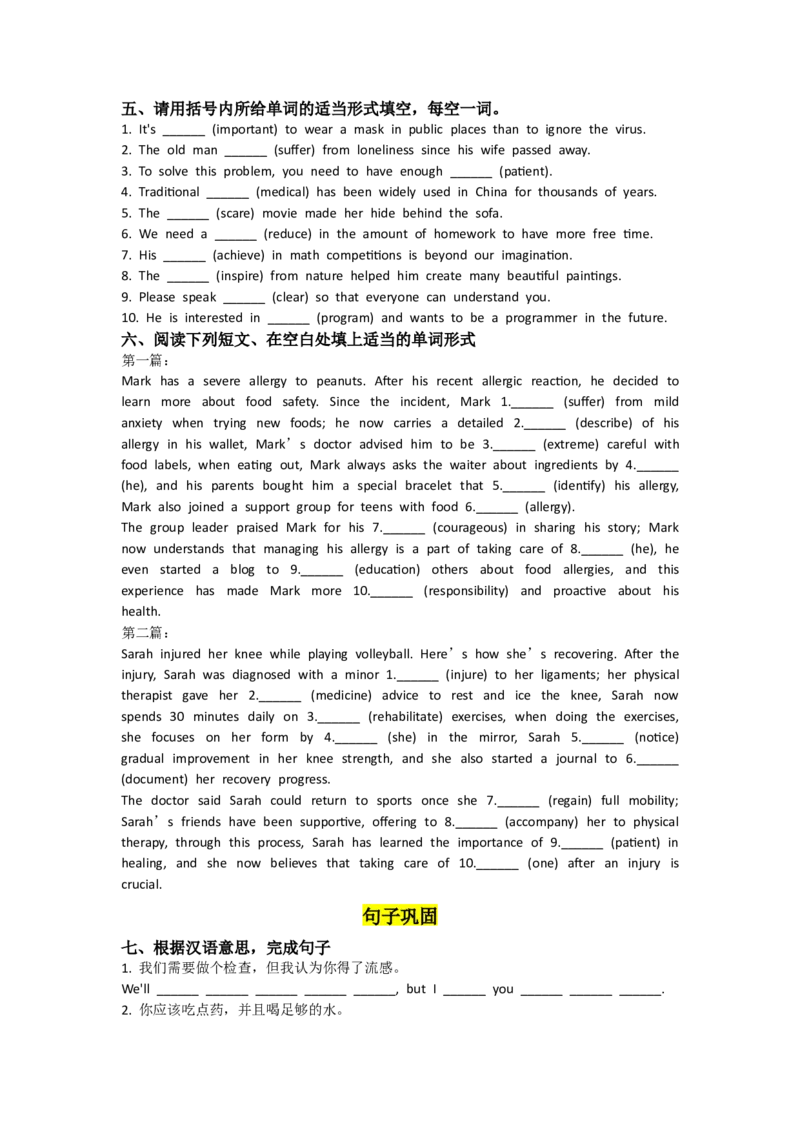
1. It's ______ (important) to wear a mask in public places than to ignore the virus.
2. The old man ______ (suffer) from loneliness since his wife passed away.
3. To solve this problem, you need to have enough ______ (patient).
4. Traditional ______ (medical) has been widely used in China for thousands of years.
5. The ______ (scare) movie made her hide behind the sofa.
6. We need a ______ (reduce) in the amount of homework to have more free time.
7. His ______ (achieve) in math competitions is beyond our imagination.
8. The ______ (inspire) from nature helped him create many beautiful paintings.
9. Please speak ______ (clear) so that everyone can understand you.
10. He is interested in ______ (program) and wants to be a programmer in the future.
六、阅读下列短文、在空白处填上适当的单词形式
第一篇:
Mark has a severe allergy to peanuts. After his recent allergic reaction, he decided to
learn more about food safety. Since the incident, Mark 1.______ (suffer) from mild
anxiety when trying new foods; he now carries a detailed 2.______ (describe) of his
allergy in his wallet, Mark’s doctor advised him to be 3.______ (extreme) careful with
food labels, when eating out, Mark always asks the waiter about ingredients by 4.______
(he), and his parents bought him a special bracelet that 5.______ (identify) his allergy,
Mark also joined a support group for teens with food 6.______ (allergy).
The group leader praised Mark for his 7.______ (courageous) in sharing his story; Mark
now understands that managing his allergy is a part of taking care of 8.______ (he), he
even started a blog to 9.______ (education) others about food allergies, and this
experience has made Mark more 10.______ (responsibility) and proactive about his
health.
第二篇:
Sarah injured her knee while playing volleyball. Here’s how she’s recovering. After the
injury, Sarah was diagnosed with a minor 1.______ (injure) to her ligaments; her physical
therapist gave her 2.______ (medicine) advice to rest and ice the knee, Sarah now
spends 30 minutes daily on 3.______ (rehabilitate) exercises, when doing the exercises,
she focuses on her form by 4.______ (she) in the mirror, Sarah 5.______ (notice)
gradual improvement in her knee strength, and she also started a journal to 6.______
(document) her recovery progress.
The doctor said Sarah could return to sports once she 7.______ (regain) full mobility;
Sarah’s friends have been supportive, offering to 8.______ (accompany) her to physical
therapy, through this process, Sarah has learned the importance of 9.______ (patient) in
healing, and she now believes that taking care of 10.______ (one) after an injury is
crucial.
句子巩固
七、根据汉语意思,完成句子
1. 我们需要做个检查,但我认为你得了流感。
We'll ______ ______ ______ ______ ______, but I ______ you ______ ______ ______.
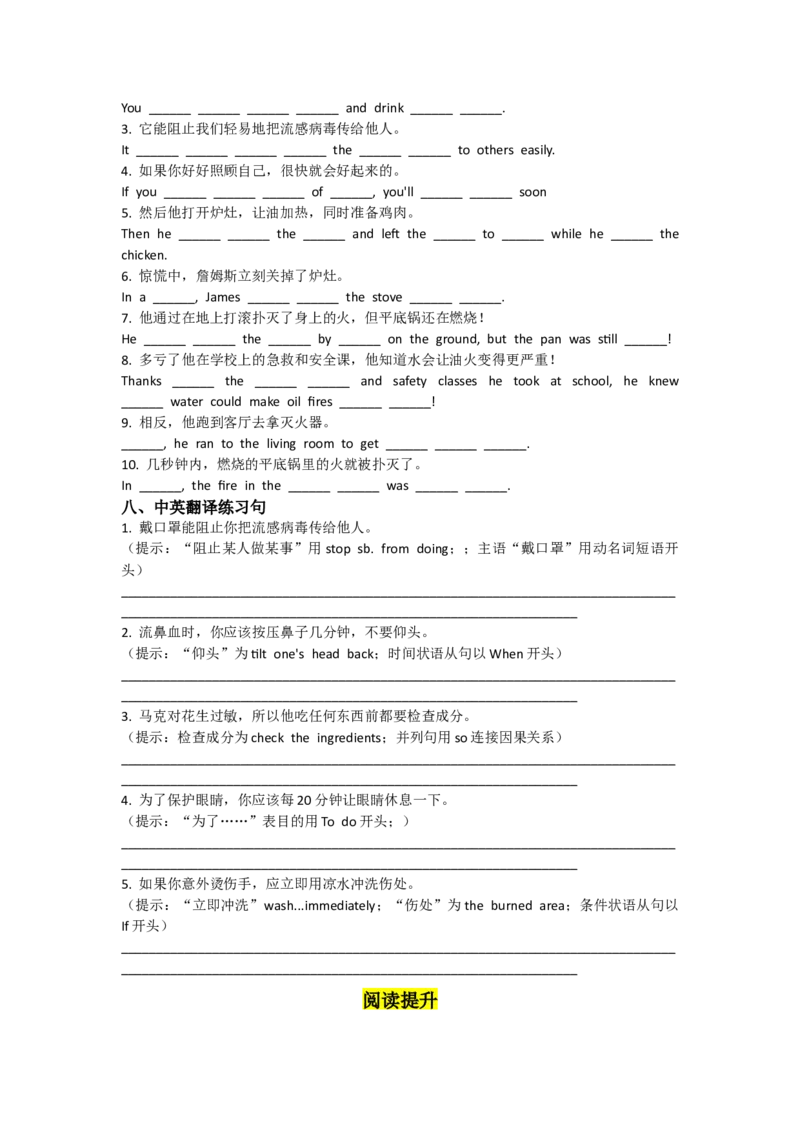
2. 你应该吃点药,并且喝足够的水。You ______ ______ ______ ______ and drink ______ ______.
3. 它能阻止我们轻易地把流感病毒传给他人。
It ______ ______ ______ ______ the ______ ______ to others easily.
4. 如果你好好照顾自己,很快就会好起来的。
If you ______ ______ ______ of ______, you'll ______ ______ soon
5. 然后他打开炉灶,让油加热,同时准备鸡肉。
Then he ______ ______ the ______ and left the ______ to ______ while he ______ the
chicken.
6. 惊慌中,詹姆斯立刻关掉了炉灶。
In a ______, James ______ ______ the stove ______ ______.
7. 他通过在地上打滚扑灭了身上的火,但平底锅还在燃烧!
He ______ ______ the ______ by ______ on the ground, but the pan was still ______!
8. 多亏了他在学校上的急救和安全课,他知道水会让油火变得更严重!
Thanks ______ the ______ ______ and safety classes he took at school, he knew
______ water could make oil fires ______ ______!
9. 相反,他跑到客厅去拿灭火器。
______, he ran to the living room to get ______ ______ ______.
10. 几秒钟内,燃烧的平底锅里的火就被扑灭了。
In ______, the fire in the ______ ______ was ______ ______.
八、中英翻译练习句
1. 戴口罩能阻止你把流感病毒传给他人。
(提示:“阻止某人做某事”用stop sb. from doing;;主语“戴口罩”用动名词短语开
头)
_______________________________________________________________________________
_________________________________________________________________
2. 流鼻血时,你应该按压鼻子几分钟,不要仰头。
(提示:“仰头”为tilt one's head back;时间状语从句以When开头)
_______________________________________________________________________________
_________________________________________________________________
3. 马克对花生过敏,所以他吃任何东西前都要检查成分。
(提示:检查成分为check the ingredients;并列句用so连接因果关系)
_______________________________________________________________________________
_________________________________________________________________
4. 为了保护眼睛,你应该每20分钟让眼睛休息一下。
(提示:“为了……”表目的用To do开头;)
_______________________________________________________________________________
_________________________________________________________________
5. 如果你意外烫伤手,应立即用凉水冲洗伤处。
(提示:“立即冲洗”wash...immediately;“伤处”为the burned area;条件状语从句以
If开头)
_______________________________________________________________________________
_________________________________________________________________
阅读提升九、阅读理解
阅读理解一
James and Allen, two 8th-graders, lived in a school dormitory. Last weekend, they
decided to cook fried chicken for the first time. James poured some oil into a pan,
turned on the stove, and then left to get chicken from the fridge—he forgot the oil
was heating. Suddenly, smoke rose from the pan, and the oil caught fire.
James froze at first, then shouted in fear. “Water! Let’s use water to put it out!”
he cried and reached for the water bottle. But Allen stopped him quickly. “No! Water
will make oil fires worse!” Allen remembered what he learned in the school first-aid
class. He told James to turn off the stove at once, then ran to the dorm’s first-aid
box to get the small fire extinguisher.
With Allen’s guidance, they pointed the extinguisher at the base of the fire and
pressed the handle. In less than 10 seconds, the fire was gone. Their dorm manager,
Mr. Smith, heard the noise and came over. After checking, he said, “You did the right
thing—most people make the mistake of using water for oil fires. Your first-aid class
really helped.”
From that day on, James and Allen never left the stove unattended when cooking. They
also shared their experience with classmates to remind everyone of first-aid rules.
题目
1. Why did the oil catch fire?( )
A. James poured too much oil into the pan.
B. Allen forgot to turn off the stove after cooking.
C. James left the heating oil unattended to get chicken.
D. The pan was broken and couldn’t hold the oil.
2. What does the underlined phrase “froze at first” mean in Paragraph 2?( )
A. 立刻逃跑 B. 吓得愣住 C. 大声呼救 D. 伸手帮忙
3. Which of the following is NOT what Allen did to put out the fire?( )
A. He stopped James from using water.
B. He asked James to turn off the stove quickly.
C. He got the fire extinguisher from the first-aid box.
D. He poured cold water on the burning oil secretly.
4. What can we infer from Mr. Smith’s words?( )
A. Most students in the dorm know how to put out oil fires.
B. The school’s first-aid class is useful for students’ daily life.
C. James and Allen should have told him before cooking.
D. The dorm’s fire extinguisher was broken before the accident.
5. What’s the main idea of the passage?( )
A. Two students learned to cook fried chicken safely in the dorm.
B. A dorm fire was put out with the help of the dorm manager.
C. Two students used school-taught first-aid skills to put out an oil fire.
D. The school started first-aid classes to keep students safe.
阅读理解二
Mark, a 14-year-old student, has had a severe peanut allergy since he was 5. His doctor
told him that even a tiny bit of peanut could make him feel sick—his face would getred, his throat would feel tight, and he might have trouble breathing. For this reason,
Mark’s life is different from his classmates’ in some ways.
Every morning, Mark’s mom packs his lunch and checks the ingredients of all food
carefully to make sure there’s no peanut. At school, he never eats food from the
school canteen or shares snacks with classmates, even if they say “there’s no peanut
in it”. He also carries a small “allergy bag” with him every day—it has an anti-
allergy spray and a note with his allergy information and his mom’s phone number.
Last month, Mark’s school started an “Allergy-Friendly Campus” program. Teachers
gave lessons about food allergies to all students, telling them not to share food with
classmates who have allergies and to call the nurse at once if someone has an allergy
reaction. The school canteen also added special signs for “peanut-free” food, so Mark
can finally buy food there sometimes.
Mark said, “Before the program, I was worried about eating at school. Now I feel
safer, and my classmates understand my situation better. It’s important for schools to
care about students with allergies.”
题目
1. What will happen to Mark if he eats a little peanut?( )
A. He will have a bad headache.
B. He will have difficulty breathing.
C. He will get a high fever quickly.
D. He will feel pain in his stomach.
2. Why does Mark never share snacks with his classmates?( )
A. He doesn’t like the snacks his classmates bring.
B. His mom tells him not to eat food from others.
C. He is afraid the snacks have peanut in them.
D. He wants to save money for his own snacks.
3. What is NOT in Mark’s “allergy bag”?( )
A. An anti-allergy spray.
B. His allergy information note.
C. A small bottle of water.
D. His mom’s phone number.
4. What can we infer from the “Allergy-Friendly Campus” program?( )
A. Mark’s school didn’t care about students with allergies before.
B. The program helps Mark and other allergic students feel safer at school.
C. All students in Mark’s school have different kinds of food allergies.
D. The school canteen stopped selling food with peanut after the program.
5. Which of the following statements is TRUE according to the passage?( )
A. Mark has had a peanut allergy for 14 years.
B. Mark can now buy food from the school canteen sometimes.
C. Mark’s classmates knew how to help allergic students before the program.
D. Mark’s “allergy bag” is kept by his teacher at school.
十、完形填空
Mark is an 8th-grader. He used to have good eyesight, but recently he found it hard to
see the blackboard clearly. His mom took him to the hospital, and the doctor said hiseyesight got worse because he used electronic devices (设备) too much.
The doctor ______ Mark a pair of glasses and gave him some important advice. First,
he shouldn’t ______ more than 2 hours on his phone or computer every day. Second,
when reading or using a device, he should stop every 20 minutes to do the “20-20-20
rule”: look at something 20 feet (about 6 meters) away for 20 seconds. This helps his
eyes ______ . Third, he should keep the screen brightness (亮度) the same as the room
light—too bright or too dark light is bad for his ______ .
At school, Mark’s teacher, Ms. Lee, also noticed his problem. She told Mark to sit in
the front row so he could see the blackboard ______ . She also reminded the whole
class to follow the “20-20-20 rule” during class breaks. “Many students now have
eye problems ______ they don’t protect their eyes well,” Ms. Lee said. “We must
learn to take care of our eyes early.”
Mark followed the doctor’s and teacher’s advice. Every time he wanted to play his
phone for a long time, he ______ himself of the doctor’s words. He also did the
“20-20-20 rule” strictly. After two weeks, Mark found it easier to see the blackboard,
and his eyes didn’t feel ______ as often as before.
______ , Mark realized that small changes in habits could make a big difference to his
eyesight. His doctor checked his eyes again and said his eyesight got ______ . “It’s
really ______ to protect your eyes from an early age,” the doctor told him. “If you
______ these good habits, your eyes will stay healthy.”
Mark also shared his experience with his classmates. He told them how to follow the
“20-20-20 rule” and why they should protect their eyes. “Let’s all work together to
______ our eyes ______ harm,” Mark said. His classmates agreed, and they started to
pay more attention to eye protection in daily life. Now, Mark and his classmates not
only have better eyesight ______ also know more about health care.
选项
1. A. sold B. made C. gave D. lent
2. A. spend B. take C. pay D. cost
3. A. work B. rest C. move D. open
4. A. ears B. eyes C. hands D. feet
5. A. clearly B. quietly C. loudly D. slowly
6. A. so B. because C. but D. though
7. A. thought B. reminded C. forgot D. asked
8. A. happy B. sad C. tired D. excited
9. A. Finally B. Suddenly C. Quickly D. Recently
10. A. worse B. better C. harder D. easier
11. A. interesting B. dangerous C. important D. boring
12. A. stop B. start C. keep D. finish
13. A. for B. with C. about D. from
14. A. for B. with C. about D. from
15. A. and B. or C. so D. but答案与解析
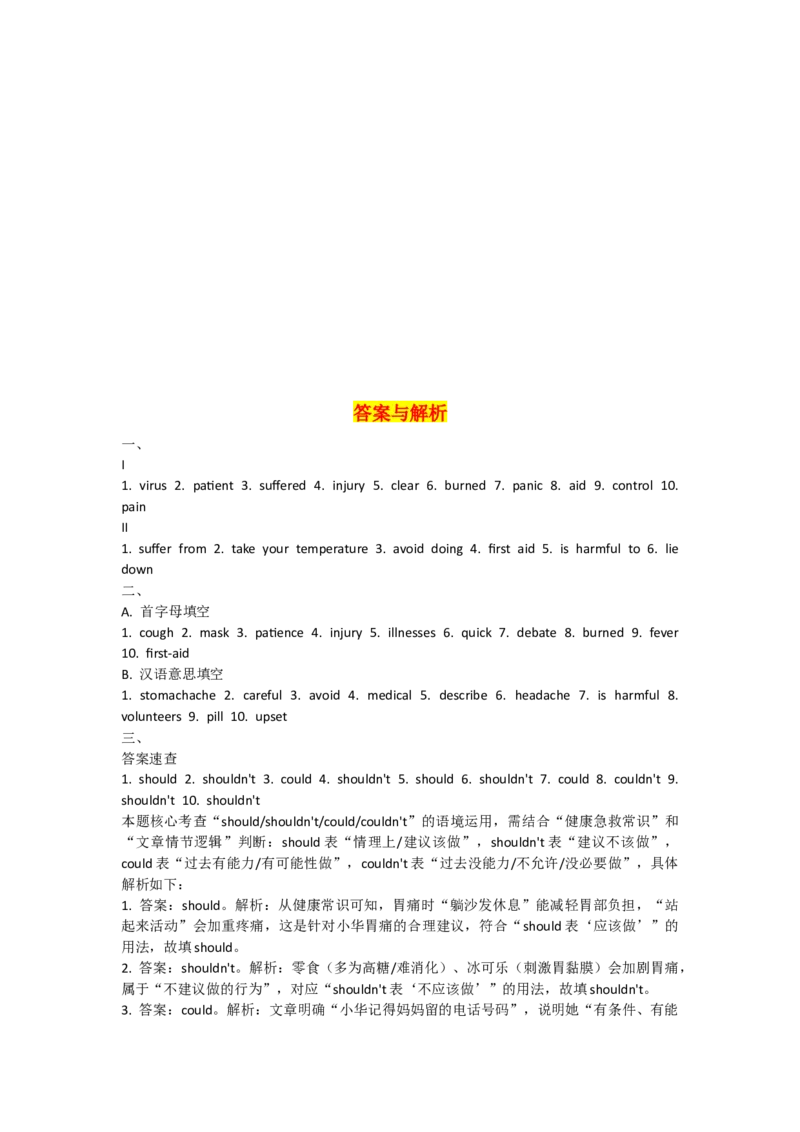
一、
I
1. virus 2. patient 3. suffered 4. injury 5. clear 6. burned 7. panic 8. aid 9. control 10.
pain
II
1. suffer from 2. take your temperature 3. avoid doing 4. first aid 5. is harmful to 6. lie
down
二、
A. 首字母填空
1. cough 2. mask 3. patience 4. injury 5. illnesses 6. quick 7. debate 8. burned 9. fever
10. first-aid
B. 汉语意思填空
1. stomachache 2. careful 3. avoid 4. medical 5. describe 6. headache 7. is harmful 8.
volunteers 9. pill 10. upset
三、
答案速查
1. should 2. shouldn't 3. could 4. shouldn't 5. should 6. shouldn't 7. could 8. couldn't 9.
shouldn't 10. shouldn't
本题核心考查“should/shouldn't/could/couldn't”的语境运用,需结合“健康急救常识”和
“文章情节逻辑”判断:should表“情理上/建议该做”,shouldn't表“建议不该做”,
could表“过去有能力/有可能性做”,couldn't表“过去没能力/不允许/没必要做”,具体
解析如下:
1. 答案:should。解析:从健康常识可知,胃痛时“躺沙发休息”能减轻胃部负担,“站
起来活动”会加重疼痛,这是针对小华胃痛的合理建议,符合“should表‘应该做’”的
用法,故填should。
2. 答案:shouldn't。解析:零食(多为高糖/难消化)、冰可乐(刺激胃黏膜)会加剧胃痛,
属于“不建议做的行为”,对应“shouldn't表‘不应该做’”的用法,故填shouldn't。
3. 答案:could。解析:文章明确“小华记得妈妈留的电话号码”,说明她“有条件、有能力”给妈妈打电话,体现过去的可能性,符合“could 表‘能够做’”的用法,故填
could。
4. 答案:shouldn't。解析:因“不知道胃痛的原因”,直接给医生打电话无法准确说明情
况,且父母不在家时,先联系家人更稳妥,属于“不建议优先做的事”,对应
“shouldn't”的用法,故填shouldn't。
5. 答案:should。解析:小华胃痛且独自在家,“出门独自行动”有摔倒、病情加重的风
险,“在家等待”是妈妈给出的安全、合理的建议,符合“should表‘应该做’”的用法,
故填should。
6. 答案:shouldn't。解析:医生已知小华胃痛与“前一晚吃太多油炸食品”有关,且油炸
食品会损伤胃黏膜,属于“长期不建议做的健康行为”,对应“shouldn't”的用法,故填
shouldn't。
7. 答案:could。解析:医生诊断为“轻微胃痛”,说明“吃温和的药、充分休息”是“可
行、有能力做到”的恢复方式,体现过去的可能性,符合“could表‘可以做’”的用法,
故填could。
8. 答案:couldn't。解析:医生建议“在家观察一天”,是因为担心上学后病情变化无法
及时处理,即“不允许、不能”第二天上学,符合“couldn't表‘不能做’”的用法,故填
couldn't。
9. 答案:shouldn't。解析:若胃痛再次发作,“忽视疼痛”可能延误潜在问题(如病情加
重),“及时就医”才合理,因此“忽视疼痛”是“不建议做的事”,对应“shouldn't”
的用法,故填shouldn't。
10. 答案:shouldn't。解析:此处“shouldn't have bought”是八年级需掌握的固定结构,
表“过去本不该做某事(却做了)”;爸爸反思“买油炸零食、没多买新鲜蔬菜”间接导
致小华胃痛,符合该结构的语境和用法,故填shouldn't。
四、
答案速查
1. from2. about3. in4. by5. with
1. 答案:from
解析:“suffer from”是八年级需掌握的固定搭配,意为“遭受(疾病、痛苦等);
患……病”。句中表示“过去很多病人因医疗条件差而患上严重疾病”,因此填
“from”。
2. 答案:about
解析:“be careful about”是固定结构,意为“对……小心;关注……”。句中表示“牙
痛时应关注饮食,避免吃甜食”,因此填“about”。
3. 答案:in
解析:“be important in (doing) sth.”表示“在……方面很重要”。句中说明“中医在治
疗慢性病方面很重要”,因此填“in”。
4. 答案:by
解析:“be inspired by”是固定搭配,意为“被……启发;受……鼓舞”。句中表示“作
家被真实故事启发,写出了感人的小说”,因此填“by”。
5. 答案:with
解析:“deal with”是八年级核心短语,意为“处理;应对”。句中表示“应对同伴压力
并不容易”,因此填“with”。
五、
1. more important2. has suffered3. patience 4. medicine5. scary6. reduction7.achievement8. inspiration9. clearly10. programming
1. 答案:more important
解析:由“than”可知需用形容词比较级,“important”是多音节形容词,比较级为
“more important”,考查形容词比较级的构成。
2. 答案:has suffered
解析:由“since”可知时态为现在完成时,结构为“have/has + 过去分词”,主语“the
old man”是第三人称单数,故填“has suffered”,考查现在完成时的用法。
3. 答案:patience
解析:“patient”的名词形式是“patience”,意为“耐心”,此处作“have”的宾语,考
查词性转换(形容词变名词)。
4. 答案:medicine
解析:“medical”的名词形式是“medicine”,意为“医学;药”,“Traditional
medicine”表示“传统医学”,考查词性转换(形容词变名词)。
5. 答案:scary
解析:“scare”的形容词形式“scary”意为“吓人的”,用来修饰物(movie),考查词
性转换(动词变形容词)。
6. 答案:reduction
解析:“reduce”的名词形式是“reduction”,意为“减少”,由“a”可知用名词单数,
考查词性转换(动词变名词)。
7. 答案:achievement
解析:“achieve”的名词形式是“achievement”,意为“成就”,考查词性转换(动词变
名词)。
8. 答案:inspiration
解析:“inspire”的名词形式是“inspiration”,意为“灵感”,考查词性转换(动词变名
词)。
9. 答案:clearly
解析:“clear”的副词形式是“clearly”,用来修饰动词“speak”,考查词性转换(形容
词变副词)。
10. 答案:programming
解析:“program”的动名词形式是“programming”,“be interested in doing sth.”表
示“对做某事感兴趣”,考查动名词的用法。
六、
答案速查
第一篇:
1. has suffered 2. description 3. extremely 4. himself 5. identifies 6. allergies 7.
courage 8. himself 9. educate 10. responsible
第二篇:
1. injury 2. medical 3. rehabilitation 4. herself 5. has noticed 6. document 7.
regains 8. accompany 9. patience 10. oneself
第一篇:
1. 答案:has suffered
解析:考点为现在完成时,标志词“since the incident”(自从那次事件后)表示动作从
过去开始,持续到现在,需用“have/has + 动词过去分词”结构;主语Mark是第三人称
单数,故用“has”,“suffer”的过去分词为“suffered”。2. 答案:description
解析:考点为词性转换(动词→名词) ,空前“detailed”(详细的)是形容词,后需接
名词;“describe”(描述,动词)对应的名词形式为“description”,表示“过敏情况的
说明”,符合语境。
3. 答案:extremely
解析:考点为词性转换(形容词→副词) ,空后“careful”(小心的,形容词)需用副词
修饰;“extreme”(极度的,形容词)对应的副词形式为“extremely”,表示“极度小心
地核对食品标签”。
4. 答案:himself
解析:考点为反身代词的用法,固定搭配“by oneself”表示“独自地”;主语是 Mark
(男性),故用“he”对应的反身代词“himself”,表示“独自向服务员询问食材”。
5. 答案:identifies
解析:考点为一般现在时的动词第三人称单数,句子描述Mark日常携带的手环的功能,用
一般现在时;主语“a special bracelet”(一个特制手环)是第三人称单数,故
“identify”(标识,动词)需变三单形式“identifies”。
6. 答案:allergies
解析:考点为名词复数变化,“food allergies”(食物过敏)是泛指“各类食物过敏情
况”,且“allergy”(过敏,可数名词)的复数形式为“allergies”(以“y”结尾,变
“y”为“i”加“es”),符合语境。
7. 答案:courage
解析:考点为词性转换(形容词→名词) ,空前“his”(他的,形容词性物主代词)后
需接名词;“courageous”(勇敢的,形容词)对应的名词形式为“courage”(勇气,不
可数名词),表示“因分享经历的勇气而受到表扬”。
8. 答案:himself
解析:考点为反身代词的用法,固定搭配“take care of oneself”表示“照顾自己”;主
语是Mark,故用“he”对应的反身代词“himself”,表示“管理过敏是照顾自己的一部
分”。
9. 答案:educate
解析:考点为词性转换(名词→动词) ,空前“to”是不定式符号(表目的),后需接动
词原形;“education”(教育,名词)对应的动词形式为“educate”(普及、教育),表
示“开博客来向他人普及食物过敏知识”。
10. 答案:responsible
解析:考点为词性转换(名词→形容词) ,空前“more”(更)后需接形容词,构成比
较级;“responsibility”(责任,名词)对应的形容词形式为“responsible”(有责任心
的),表示“变得更有责任心”,符合语境。
第二篇:
1. 答案:injury
解析:考点为词性转换(动词→名词) ,空前“a minor”(一处轻微的)后需接可数名
词单数;“injure”(伤害,动词)对应的名词形式为“injury”(伤口、损伤),表示
“韧带处有一处轻微损伤”。
2. 答案:medical
解析:考点为词性转换(名词→形容词) ,空后“advice”(建议,名词)需用形容词修
饰;“medicine”(医学、药,名词)对应的形容词形式为“medical”(医疗的),表示
“物理治疗师给出医疗建议”。3. 答案:rehabilitation
解析:考点为词性转换(动词→名词) ,空前“on”是介词,后需接名词;
“rehabilitate”(康复,动词)对应的名词形式为“rehabilitation”(康复,不可数名词),
“rehabilitation exercises”表示“康复训练”,符合语境。
4. 答案:herself
解析:考点为反身代词的用法,固定搭配“by oneself”表示“独自地”;主语是 Sarah
(女性),故用“she”对应的反身代词“herself”,表示“独自对着镜子关注动作形态”。
5. 答案:has noticed
解析:考点为现在完成时,句子强调“Sarah从受伤恢复到现在,已经注意到膝盖力量的改
善”,动作对现在有影响,需用“have/has + 动词过去分词”;主语Sarah是第三人称单
数,故用“has”,“notice”的过去分词为“noticed”。
6. 答案:document
解析:考点为动词原形的用法,空前“to”是不定式符号(表目的),后需接动词原形;
“document”可作动词,意为“记录”,表示“写日记来记录恢复进度”,无需变形(此
处并非名词变动词,原词可兼作动名词)。
7. 答案:regains
解析:考点为一般现在时的动词第三人称单数(条件状语从句) ,“once”(一旦)引导
条件状语从句,主句“could return”(能回归)用情态动词表可能性,从句需用一般现在
时表将来;主语“she”是第三人称单数,故“regain”(恢复,动词)需变三单形式
“regains”。
8. 答案:accompany
解析:考点为动词原形的用法,固定搭配“offer to do sth.”(主动提出做某事)中,
“to”是不定式符号,后需接动词原形;“accompany”(陪同,动词)无需变形,意为
“主动提出陪她去做物理治疗”。
9. 答案:patience
解析:考点为词性转换(形容词→名词) ,空前“the importance of”(……的重要性)
中,“of”后需接名词;“patient”(有耐心的,形容词)对应的名词形式为
“patience”(耐心,不可数名词),表示“明白康复中耐心的重要性”。
10. 答案:oneself
解析:考点为不定反身代词的用法,固定搭配“take care of oneself”表示“照顾自己”;
句子主语是“one”(任何人),故用对应的不定反身代词“oneself”,意为“任何人受伤
后都要照顾好自己”。
七、
1. need to do a test believe have the flu
2. should take some medicine enough water
3. stops us from passing flu virus
4. take good care yourself, get better
5. turned on stove oil heat prepared
6. panic, turned off at once.
7. put out fire rolling, but burning!
8. to first aid that much worse!
9. the fire extinguisher.
10. seconds, burning pan put out
八、1. Wearing a mask can stop you from passing the flu virus to others.
2. When you have a nosebleed, you should press your nose for a few minutes and not
tilt your head back.
3. Mark is allergic to peanuts, so he checks the ingredients before eating anything.
4.To protect your eyes, you should let your eyes rest every 20 minutes.
5.If you have a bad toothache, you should see a dentist and get an X-ray.
九、
一、1. C 2. B 3. D 4. B 5. C
二、1. B 2. C 3. C 4. B 5. B
阅读理解一解析
1. 细节题。根据短文第一段“James poured some oil into a pan, turned on the stove,
and then left to get chicken from the fridge—he forgot the oil was heating... the oil
caught fire”可知,起火原因是詹姆斯让加热的油无人看管,去拿鸡肉,故选C。
2. 词义猜测题。根据后文“then shouted in fear”(然后害怕地大喊)可知,詹姆斯一开
始的反应是“愣住”,而非逃跑、呼救或帮忙,“froze at first”意为“吓得愣住”,故选
B。
3. 细节判断题。根据第二段“Allen stopped him quickly. ‘No! Water will make oil fires
worse!’”可知,艾伦阻止了用用水灭火,自己更不会偷偷用水,D选项与原文不符,故
选D。
4. 推理题。根据第三段Mr. Smith的话“Your first-aid class really helped”可推断,学校
的急救课对学生日常生活有用,A(多数学生懂灭油火)、C(做饭前应告知经理)、D
(灭火器之前坏了)均无原文依据,故选B。
5. 主旨题。短文核心是詹姆斯和艾伦用学校教的急救知识扑灭油火,A(学做炸鸡)、B
(在经理帮助下灭火)、D(学校开设急救课)均未涵盖核心,故选C。
阅读理解二解析
1. 细节题。根据第一段“even a tiny bit of peanut could make him feel sick—his face
would get red, his throat would feel tight, and he might have trouble breathing”可知,
马克吃少量花生可能呼吸困难,A(头痛)、C(高烧)、D(胃痛)均未提及,故选B。
2. 细节题。根据第二段“he never eats food from the school canteen or shares snacks
with classmates, even if they say ‘there’s no peanut in it’”可知,马克不分享零食
是怕里面有花生,A(不喜欢)、B(妈妈不让吃别人的)、D(省钱)均无依据,故选C。
3. 细节判断题。根据第二段“it has an anti-allergy spray and a note with his allergy
information and his mom’s phone number”可知,过敏包里没有小瓶水,故选C。
4. 推理题。根据第三段“so Mark can finally buy food there sometimes”和第四段“Now
I feel safer”可推断,该项目让马克等过敏学生在学校更安全,A(之前不关心)过于绝对,
C(所有学生都过敏)错误,D(停止卖含花生食品)与“加无花生标识”不符,故选B。
5. 细节判断题。根据第一段“Mark, a 14-year-old student, has had a severe peanut
allergy since he was 5”可知,马克过敏9年(A错);根据第三段“the school canteen
also added special signs for ‘peanut-free’ food, so Mark can finally buy food there
sometimes”可知,B正确;根据第四段“my classmates understand my situation better”
可知,之前同学不了解(C错);根据第二段“he also carries a small ‘allergy bag’
with him every day”可知,过敏包自己带(D错),故选B。
十、1. C 2. A 3. B 4. B 5. A 6. B 7. B 8. C 9. A 10. B 11. C 12. C 13. C
14. D 15. A第1题
• 题干语境:医生______马克一副眼镜,还给他提了重要建议。后文“gave him some
important advice”(给他提建议)用了“gave”,前后动作并列,均为医生对马克的行为。
• 选项辨析:
A. sold(卖):医生的核心动作是诊疗,而非“卖眼镜”,不符合医疗场景,排除;
◦
B. made(制作):医生不直接“制作眼镜”,通常由眼镜店制作,语境不符,排除;
◦
C. gave(给):与后文“gave him advice”并列,“给眼镜”符合医生诊疗后提供辅
◦
助工具的场景,正确;
D. lent(借):“借眼镜”暗示需归还,而医生给患者眼镜是长期使用(非临时借用),
◦
逻辑不符,排除。
• 答案:C
第2题
• 题干语境:首先,他每天在手机或电脑上的时间不应该______超过2小时。空格后接
“more than 2 hours”(时间)和“on his phone”(具体事物),核心考“花费时间”
的固定搭配。
• 选项辨析(重点:“花费”类动词的主语与搭配差异):
A. spend:固定结构“sb spend + 时间/金钱 + on sth”(某人在某物上花时间/钱)
◦
主语是人(此处主语是“he”),搭配“on”完全契合题干,正确;
B. take:固定结构“it takes sb + 时间 + to do sth”(做某事花费某人时间),主语
◦
是形式主语“it”,而非人,且不搭配“on”,题干无“it”和“to do”,排除;
C. pay:固定搭配“pay + 金钱 + for sth”(为某物付钱),仅搭配“金钱”,不搭配
◦
“时间”,题干是“2小时”(时间),排除;
D. cost:固定结构“sth cost sb + 时间/金钱”(某物花费某人时间/钱),主语是
◦
“事物”(如the phone),而非人(题干主语是“he”),搭配逻辑颠倒,排除。
• 答案:A
第3题
• 题干语境:每20分钟停下做“20-20-20规则”,这能帮助他的眼睛______。前文明确
“stop every 20 minutes”(每20分钟停下),核心目的是让眼睛“休息”,而非其他动
作。
• 选项辨析:
A. work(工作):停下的目的不是“让眼睛工作”,与“stop”的动作逻辑相反,排
◦
除;
B. rest(休息):“停下看远处”的核心作用是缓解眼疲劳、让眼睛休息,符合语境,
◦
正确;
C. move(移动):题干未提及“眼睛移动”的需求,看远处是“固定注视”而非“移
◦
动”,排除;
D. open(睁开):眼睛本身是睁开的,“停下”不是为了“让眼睛睁开”,语义无意
◦
义,排除。
• 答案:B
第4题
• 题干语境:屏幕亮度要和室内光一致——太亮或太暗的光对他的______不好。全文核心
主题是“视力保护”,所有建议均围绕“眼睛”展开,此处光的影响对象必然是眼睛。
• 选项辨析(主题关联度判断):
A. ears(耳朵):光与耳朵无直接关联,排除;
◦B. eyes(眼睛):“光对眼睛的影响”是视力保护的核心内容,与全文主题完全契合,
◦
正确;
C. hands(手):光不会直接伤害手,排除;
◦
D. feet(脚):光与脚无关联,排除。
◦
• 答案:B
第5题
• 题干语境:李老师让马克坐前排,这样他能______看黑板。前文提到马克“看不清黑
板”,坐前排的目的是“看清”,需填表“清晰程度”的副词。
• 选项辨析(副词语义与语境匹配):
A. clearly(清楚地):“坐前排看清黑板”符合逻辑,解决马克“看不清”的核心问题,
◦
正确;
B. quietly(安静地):“安静地看黑板”与“坐前排”的目的无关,排除;
◦
C. loudly(大声地):“看黑板”是视觉动作,“大声地”修饰听觉动作(如说话),
◦
搭配错误,排除;
D. slowly(慢慢地):“慢慢地看黑板”不解决“看不清”的问题,与语境无关,排除。
◦
• 答案:A
第6题
• 题干语境:“现在很多学生有眼疾,______他们没有好好保护眼睛。” 前半句“有眼
疾”是结果,后半句“不保护眼睛”是原因,核心考“因果关系”连词。
• 选项辨析(连词逻辑关系判断):
A. so(所以):表“结果”,需用于“原因+so+结果”,而题干是“结果+so+原因”,
◦
逻辑颠倒,排除;
B. because(因为):表“原因”,用于“结果+because+原因”,完全匹配题干“有眼
◦
疾(结果),因为不保护眼睛(原因)”的逻辑,正确;
C. but(但是):表“转折”,题干无“相反、对立”的语义,排除;
◦
D. though(尽管):表“让步”,需用于“尽管(让步),还是(结果)”,题干无
◦
“让步”逻辑,排除。
• 答案:B
第7题
• 题干语境:每次想长时间玩手机时,他都会______自己想起医生的话。核心考“提醒自
己”的固定搭配,且需符合“避免长时间玩手机”的语境(即通过提醒约束自己)。
• 选项辨析(固定搭配+语境匹配):
A. thought(认为):“thought oneself of sth”不是固定搭配,“think of”是“想
◦
起”,但主语是“he”,正确表达是“he thought of the doctor’s words”(他想起医生
的话),无法接“himself”,排除;
B. reminded(提醒):固定搭配“remind oneself of sth”(提醒自己某事),“he
◦
reminded himself of the doctor’s words”(他提醒自己想起医生的话),符合“约束自
己不玩手机”的语境,正确;
C. forgot(忘记):“forgot himself of sth”无此搭配,且“忘记医生的话”与“遵循
◦
建议”的语境相反,排除;
D. asked(问):“asked himself of sth”无此搭配,“ask sb about sth”(问某人关
◦
于某事),语义与语境不符,排除。
• 答案:B
第8题• 题干语境:两周后,马克发现看黑板更容易了,眼睛也不像以前那样经常觉得______。
前文提到“长时间用电子设备伤眼”,眼疲劳的核心感受是“累”,遵循建议后应缓解
“累”的感觉。
• 选项辨析(形容词与“眼睛”的语义匹配):
A. happy(开心的):“眼睛开心”语义不通,排除;
◦
B. sad(难过的):“眼睛难过”无实际语义,排除;
◦
C. tired(累的):“眼睛累”是眼疲劳的常用表达,遵循建议后“不常累”符合逻辑,
◦
正确;
D. excited(兴奋的):“眼睛兴奋”语义不通,排除。
◦
• 答案:C
第9题
• 题干语境:______,马克意识到习惯上的小改变能对视力产生大影响。前文铺垫“遵循
建议两周”“视力变好”,此处是“经过一段时间后得出的结论”,需填表“最终、最
后”的副词。
• 选项辨析(副词的时间逻辑衔接):
A. Finally(最后):呼应前文“After two weeks”(两周后),体现“经过一段时间
◦
实践,最终得出结论”的逻辑,正确;
B. Suddenly(突然):“突然意识到”与“坚持两周”的“渐变过程”不符,排除;
◦
C. Quickly(快速地):“快速意识到”未体现“两周实践”的时间积累,逻辑不连贯,
◦
排除;
D. Recently(最近):前文已明确“After two weeks”(两周后),“recently”(最
◦
近)时间范围模糊,且无法体现“实践后的结论”,排除。
• 答案:A
第10题
• 题干语境:医生再次检查眼睛,说他的视力变______了。前文提到“看黑板更容易”
“眼睛不常累”,均为视力好转的表现,此处医生的结论必然是“视力变好”。
• 选项辨析(形容词比较级与语境逻辑):
A. worse(更差):与“看黑板更容易”的语境完全相反,排除;
◦
B. better(更好):“视力变好”呼应前文“遵循建议后的积极变化”,逻辑连贯,正
◦
确;
C. harder(更难):“视力更难”语义不通,“视力”需用“好/差”修饰,排除;
◦
D. easier(更容易):“视力更容易”语义不通,“更容易”修饰“做某事”(如看黑
◦
板),不修饰“视力”,排除。
• 答案:B
第11题
• 题干语境:医生告诉他:“从小保护眼睛真的很______。” 结合前文“视力变好”“习
惯改变影响视力”,医生的核心是强调“保护眼睛的重要性”,需填表“重要性”的形容
词。
• 选项辨析(形容词与“保护眼睛”的语义匹配):
A. interesting(有趣的):“保护眼睛有趣”不是医生强调的核心,排除;
◦
B. dangerous(危险的):“从小保护眼睛危险”与语境完全相反,排除;
◦
C. important(重要的):“强调保护眼睛的重要性”符合医生的诊疗建议场景,正确;
◦
D. boring(无聊的):“保护眼睛无聊”与医生引导“积极保护眼睛”的目的不符,排
◦
除。• 答案:C
第12题
• 题干语境:“如果你______这些好习惯,你的眼睛会一直健康。” 前文提到“遵循好习
惯(follow the advice)”,此处医生的建议是“继续保持好习惯”,需填表“保持”的动
词。
• 选项辨析(动词与“习惯”的搭配逻辑):
A. stop(停止):“停止好习惯”与“眼睛健康”的目的相反,排除;
◦
B. start(开始):前文已“开始遵循好习惯”,此处是“继续保持”,而非“重新开
◦
始”,语境不符,排除;
C. keep(保持):“keep good habits”(保持好习惯)是固定搭配,呼应前文
◦
“follow the advice”,且符合“眼睛健康”的逻辑,正确;
D. finish(完成):“完成好习惯”语义不通,习惯是“长期坚持”,而非“完成一
◦
次”,排除。
• 答案:C
第13题
• 题干语境:“让我们一起努力,______我们的眼睛______伤害。” 核心考“保护……免
受伤害”的固定搭配,结合全文“视力保护”主题,此处是“保护眼睛免受伤害”。
• 选项辨析(固定短语“protect...from...”的拆分考查):
先明确固定结构:“protect sb/sth from sth”(保护某人/某物免受某物伤害),题干
◦
前半部分“to ______ our eyes”,空格1需填“protect”(但选项中无,结合前文“work
together to”,此处实际是“keep our eyes from harm”——“keep...from...”也表
“使……免受……”,与“protect”语义一致);
空格2需填“from”,对应“keep/protect...from...”的固定搭配,其他选项:
◦
A. for(为了):“keep eyes for harm”(为了伤害留着眼睛),语义相反,排除;
◦
B. with(和):“keep eyes with harm”(带着伤害留着眼睛),语义不符,排除;
◦
C. about(关于):“keep eyes about harm”(关注伤害留着眼睛),语义不通,排
◦
除;
D. from(免受):符合“keep...from...”的固定搭配,正确。
◦
• 答案:D
第14题
• 题干语境:承接上一题“keep our eyes ______ harm”,核心仍为“使眼睛免受伤害”,
固定搭配需填“from”。
• 选项辨析与13题一致,最终确定“from”为正确答案,对应选项D。
• 答案:D
第15题
• 题干语境:现在,马克和同学们不仅视力变好了,______还懂了更多健康知识。核心考
固定并列结构“not only...but also...”(不仅……而且……),空格需填“but”。
• 选项辨析(固定连词结构考查):
A. and(和):“not only...and also...”不是固定结构,语法错误,排除;
◦
B. or(或者):表“选择”,与“不仅……而且……”的“递进并列”逻辑不符,排
◦
除;
C. so(所以):表“结果”,题干无“因果”逻辑,排除;
◦
D. but(而且):符合“not only...but also...”的固定结构,语法正确,语义连贯,正
◦
确。• 答案:D