课程主题: 6B 时态专题(一) 授课时间:
学习目标 掌握一般现在时和一般过去时
教学内容
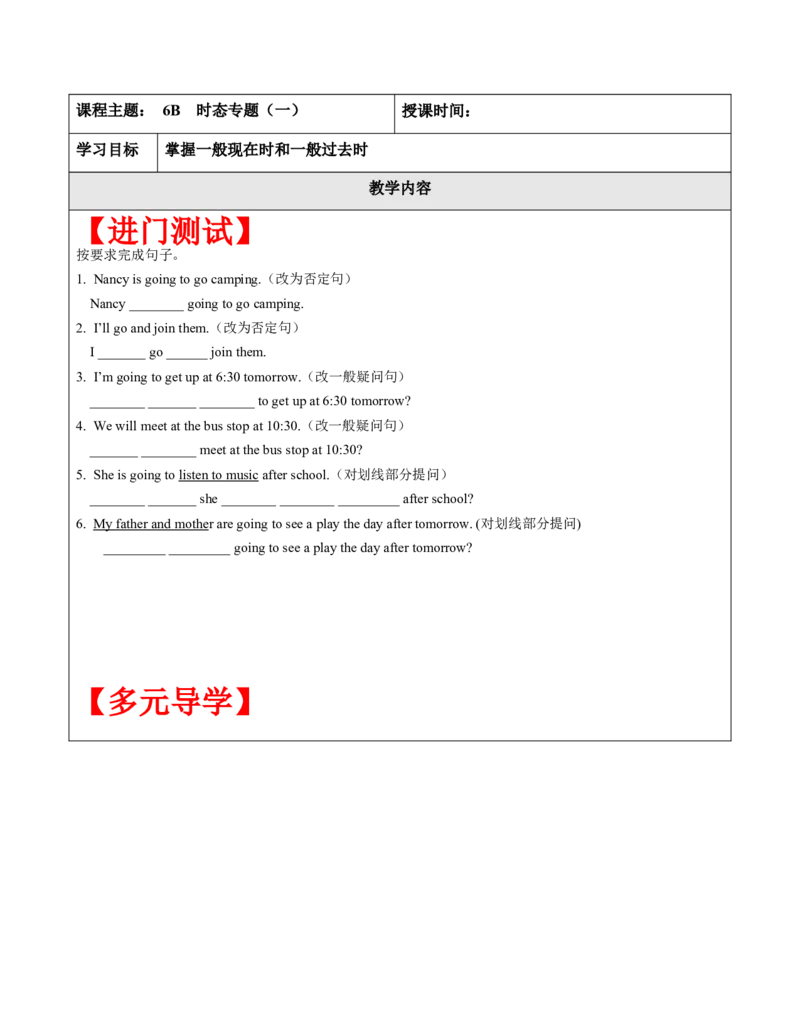
【进门测试】
按要求完成句子。
1. Nancy is going to go camping.(改为否定句)
Nancy ________ going to go camping.
2. I’ll go and join them.(改为否定句)
I _______ go ______ join them.
3. I’m going to get up at 6:30 tomorrow.(改一般疑问句)
________ _______ ________ to get up at 6:30 tomorrow?
4. We will meet at the bus stop at 10:30.(改一般疑问句)
_______ ________ meet at the bus stop at 10:30?
5. She is going to listen to music after school.(对划线部分提问)
________ _______ she ________ ________ _________ after school?
6. My father and mother are going to see a play the day after tomorrow. (对划线部分提问)
_________ _________ going to see a play the day after tomorrow?
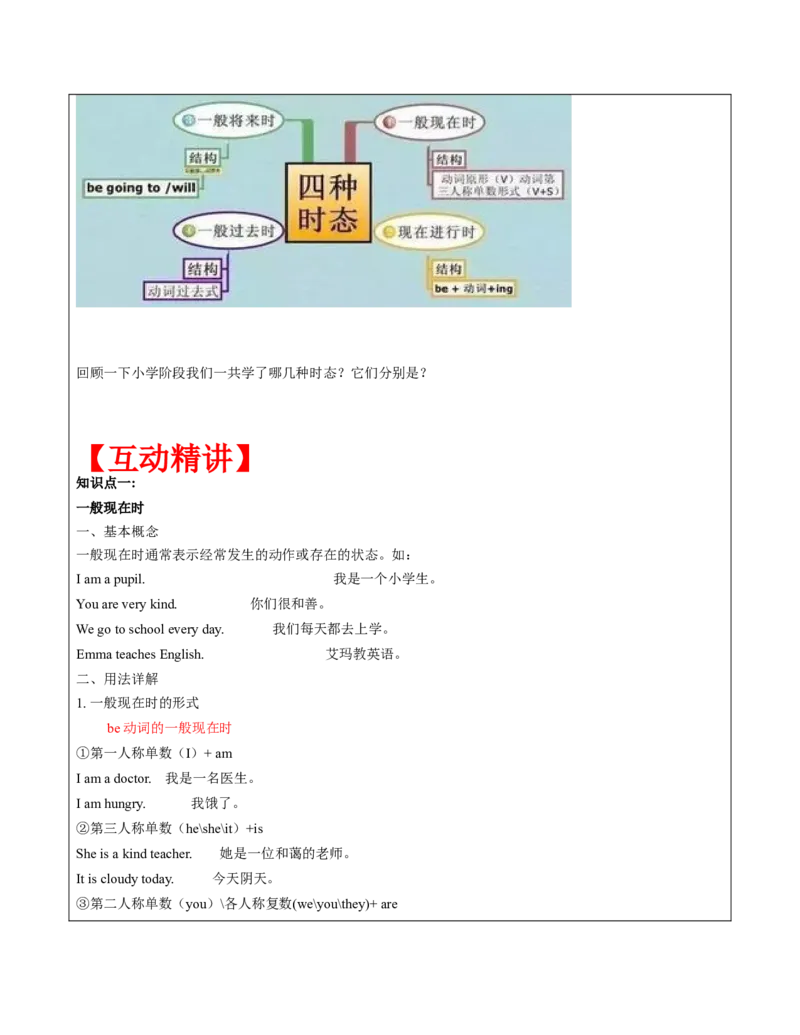
【多元导学】回顾一下小学阶段我们一共学了哪几种时态?它们分别是?
【互动精讲】
知识点一:
一般现在时
一、基本概念
一般现在时通常表示经常发生的动作或存在的状态。如:
I am a pupil. 我是一个小学生。
You are very kind. 你们很和善。
We go to school every day. 我们每天都去上学。
Emma teaches English. 艾玛教英语。
二、用法详解
1. 一般现在时的形式
be动词的一般现在时
①第一人称单数(I)+ am
I am a doctor. 我是一名医生。
I am hungry. 我饿了。
②第三人称单数(he\she\it)+is
She is a kind teacher. 她是一位和蔼的老师。
It is cloudy today. 今天阴天。
③第二人称单数(you)\各人称复数(we\you\they)+ areYou are a handsome boy. 你是一个帅气的男孩。
They are busy with their homework every day. 们每天忙于做功课。
注意 be动词有以下几种缩写形式:
I am = I’m he is = he’s she is = she’s it is = it’s
we are =we’re you are = you’re they are = they’re
【例题精讲】
用am, is或are填空。
例:Penguins are animals. 企鹅是动物。
1. I Peter. I ten years old.
2. Martin a football player.
3. Excuse me. you Mr. Baker?
4. Tom and dick good friends. They in the same classroom.
5. The dolphin a sea animal.
① 第三人称单数(he\she\it)+动词第三人称单数现在式
Ann gets up at 8 o’clock every morning. 安每天早上八点起床。
She studies hard. 她学习努力。
② 第一二人称单数(I\you)各人称复数(we\you\they)+动词原形
We want to take a trip during the holiday. 我们想在假期去旅行。
You do a very good job in cooking. 你的厨艺很棒。
They all run fast in the sports meet. 他们在运动会上跑的都很快。
【例题精讲】
用括号内动词的一般现在形式填空。
例:We have (have) breakfast at 7:00 a.m.
1. I (sleep) eight hours every day.
2. Polar bears (live) in the North Pole.
3. Miss white (teach) us English.
4. It seldom (snow) here in winter.
5. Mr. Lee doesn’t (like) butter and cheese.
6. My shoes (be) dirty. They (need) polishing.
2. 一般现在时的基本用法
① 表示经常性或习惯性的动作,常与always(总是) often(经常) usually(通常) seldom(很少)
every day(每天) sometimes(有时)等连用。如:
I leave home for school at 7 every day. 我每天七点钟离开家去学校。Bob always helps the old man. 鲍勃一直帮助这位老人。
It seldom rains here in summer. 这里夏天很少下雨。
We usually go home on foot. 我们通常不行回家。
They sometimes go swimming on Sundays. 他们有时周日去游泳。
② 表示永恒不变的事实或真理。如:
A bird flies with wings. 鸟用翅膀飞翔。
Beijing lies in the north of China. 北京位于中国北方。
③ 用在格言、谚语中。如:
Prides goes before a fall. 骄者必败。
Knowledge is power. 知识就是力量。
注意:
在口语中,一般现在时也可以表示即将发生的动作或按计划将要发生的动作。如:
I’m off. 我要走了。
We start school tomorrow. 我们明天开学
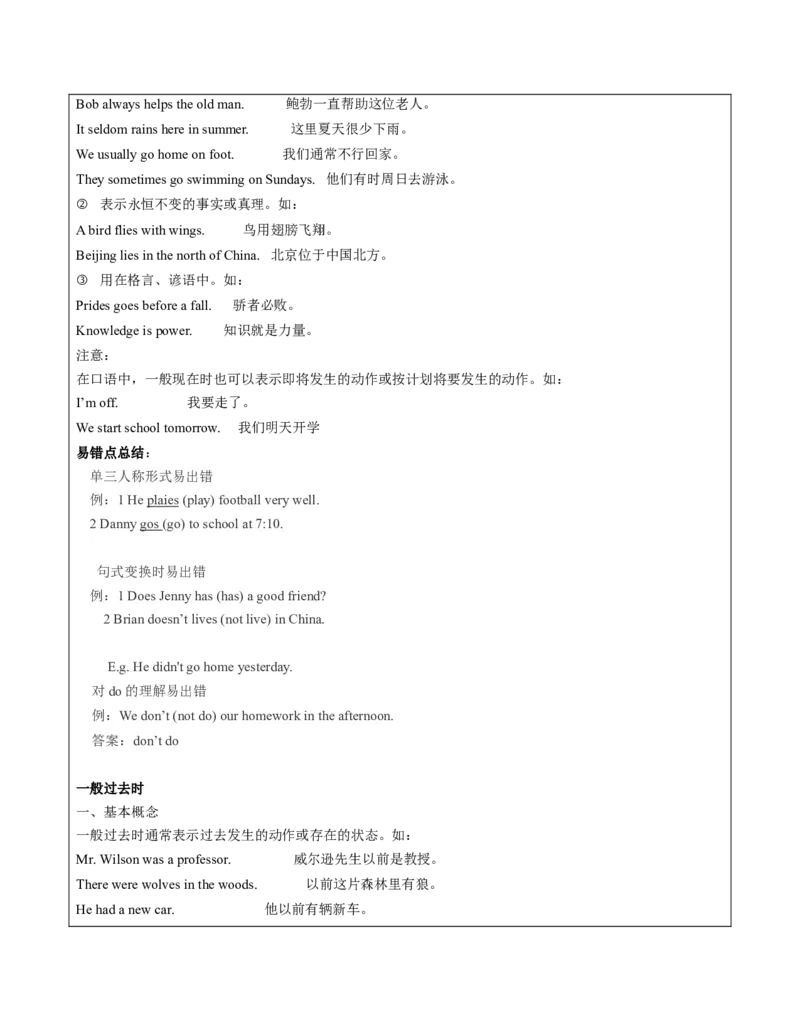
易错点总结:
单三人称形式易出错
例:1 He plaies (play) football very well.
2 Danny gos (go) to school at 7:10.
句式变换时易出错
例:1 Does Jenny has (has) a good friend?
2 Brian doesn’t lives (not live) in China.
E.g. He didn't go home yesterday.
对do的理解易出错
例:We don’t (not do) our homework in the afternoon.
答案:don’t do
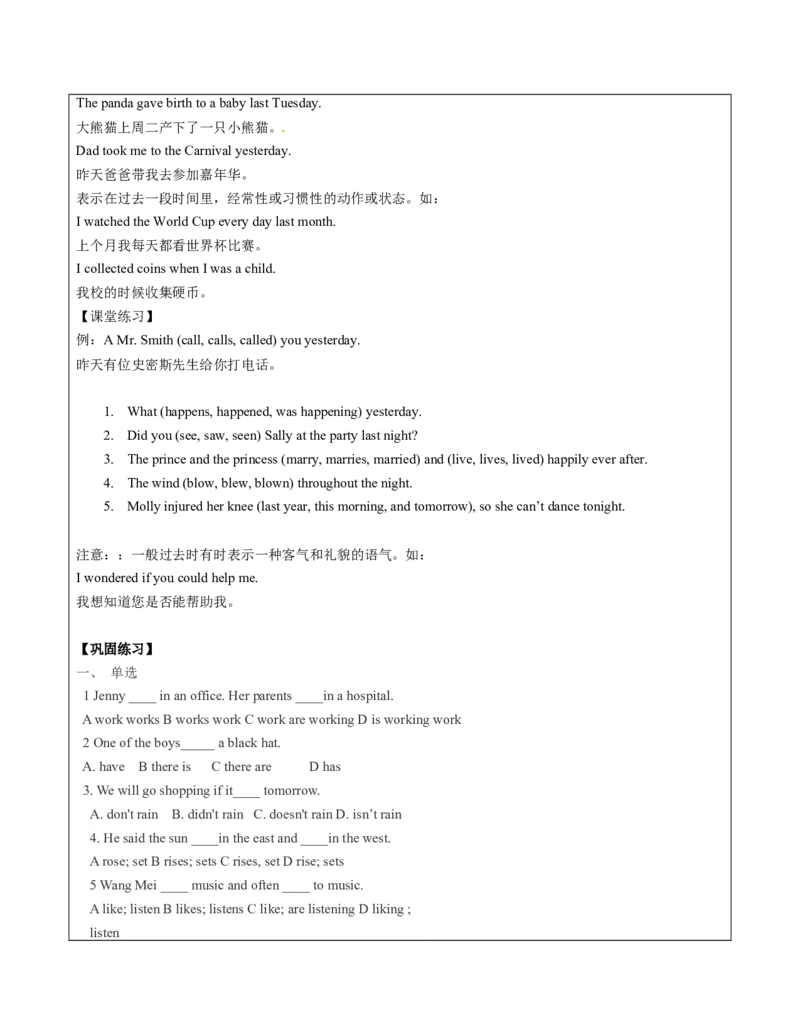
一般过去时
一、基本概念
一般过去时通常表示过去发生的动作或存在的状态。如:
Mr. Wilson was a professor. 威尔逊先生以前是教授。
There were wolves in the woods. 以前这片森林里有狼。
He had a new car. 他以前有辆新车。They bought beautiful dresses for the party. 她们为聚会买了漂亮的裙子。
二、用法详解
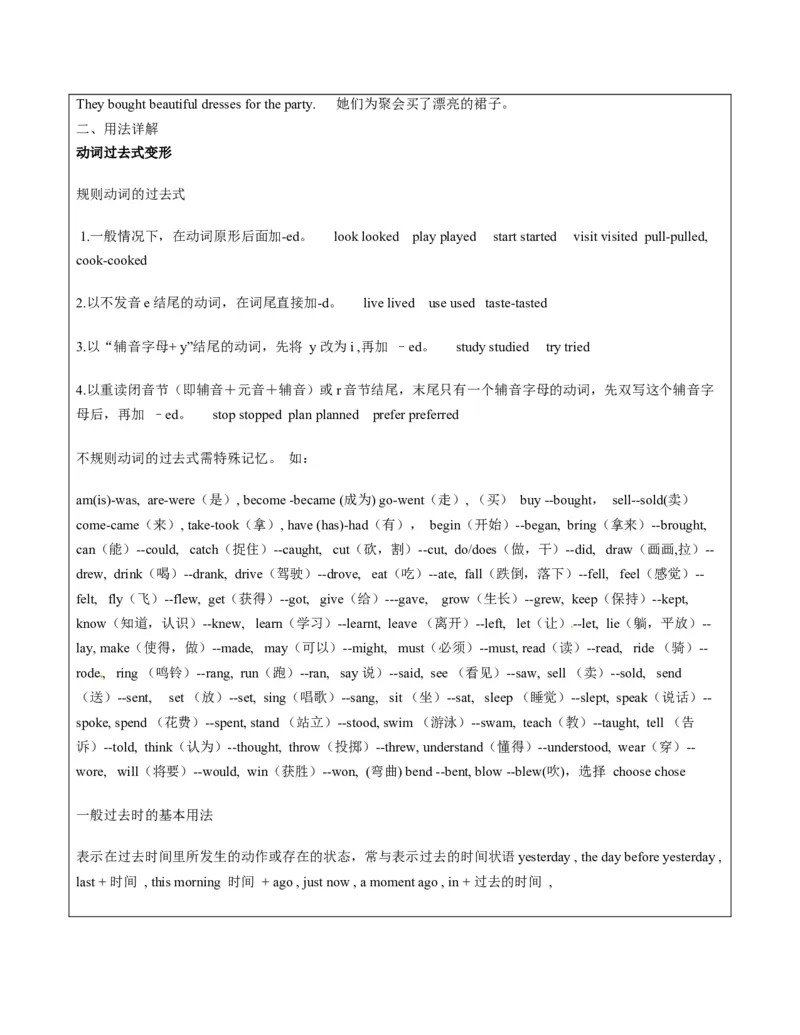
动词过去式变形
规则动词的过去式
1.一般情况下,在动词原形后面加-ed。 look looked play played start started visit visited pull-pulled,
cook-cooked
2.以不发音e结尾的动词,在词尾直接加-d。 live lived use used taste-tasted
3.以“辅音字母+ y”结尾的动词,先将 y 改为i ,再加 –ed。 study studied try tried
4.以重读闭音节(即辅音+元音+辅音)或r音节结尾,末尾只有一个辅音字母的动词,先双写这个辅音字
母后,再加 –ed。 stop stopped plan planned prefer preferred
不规则动词的过去式需特殊记忆。 如:
am(is)-was, are-were(是), become -became (成为) go-went(走), (买) buy --bought, sell--sold(卖)
come-came(来), take-took(拿), have (has)-had(有), begin(开始)--began, bring(拿来)--brought,
can(能)--could, catch(捉住)--caught, cut(砍,割)--cut, do/does(做,干)--did, draw(画画,拉)--
drew, drink(喝)--drank, drive(驾驶)--drove, eat(吃)--ate, fall(跌倒,落下)--fell, feel(感觉)--
felt, fly(飞)--flew, get(获得)--got, give(给)---gave, grow(生长)--grew, keep(保持)--kept,
know(知道,认识)--knew, learn(学习)--learnt, leave (离开)--left, let(让)--let, lie(躺,平放)--
lay, make(使得,做)--made, may(可以)--might, must(必须)--must, read(读)--read, ride (骑)--
rode, ring (鸣铃)--rang, run(跑)--ran, say 说)--said, see (看见)--saw, sell (卖)--sold, send
(送)--sent, set (放)--set, sing(唱歌)--sang, sit (坐)--sat, sleep (睡觉)--slept, speak(说话)--
spoke, spend (花费)--spent, stand (站立)--stood, swim (游泳)--swam, teach(教)--taught, tell (告
诉)--told, think(认为)--thought, throw(投掷)--threw, understand(懂得)--understood, wear(穿)--
wore, will(将要)--would, win(获胜)--won, (弯曲) bend --bent, blow --blew(吹),选择 choose chose
一般过去时的基本用法
表示在过去时间里所发生的动作或存在的状态,常与表示过去的时间状语yesterday , the day before yesterday ,
last + 时间 , this morning 时间 + ago , just now , a moment ago , in + 过去的时间 ,The panda gave birth to a baby last Tuesday.
大熊猫上周二产下了一只小熊猫。
Dad took me to the Carnival yesterday.
昨天爸爸带我去参加嘉年华。
表示在过去一段时间里,经常性或习惯性的动作或状态。如:
I watched the World Cup every day last month.
上个月我每天都看世界杯比赛。
I collected coins when I was a child.
我校的时候收集硬币。
【课堂练习】
例:A Mr. Smith (call, calls, called) you yesterday.
昨天有位史密斯先生给你打电话。
1. What (happens, happened, was happening) yesterday.
2. Did you (see, saw, seen) Sally at the party last night?
3. The prince and the princess (marry, marries, married) and (live, lives, lived) happily ever after.
4. The wind (blow, blew, blown) throughout the night.
5. Molly injured her knee (last year, this morning, and tomorrow), so she can’t dance tonight.
注意::一般过去时有时表示一种客气和礼貌的语气。如:
I wondered if you could help me.
我想知道您是否能帮助我。
【巩固练习】
一、 单选
1 Jenny ____ in an office. Her parents ____in a hospital.
A work works B works work C work are working D is working work
2 One of the boys_____ a black hat.
A. have B there is C there are D has
3. We will go shopping if it____ tomorrow.
A. don't rain B. didn't rain C. doesn't rain D. isn’t rain
4. He said the sun ____in the east and ____in the west.
A rose; set B rises; sets C rises, set D rise; sets
5 Wang Mei ____ music and often ____ to music.
A like; listen B likes; listens C like; are listening D liking ;
listen6 Jenny____ English every evening.
A has study B studies C study D studied
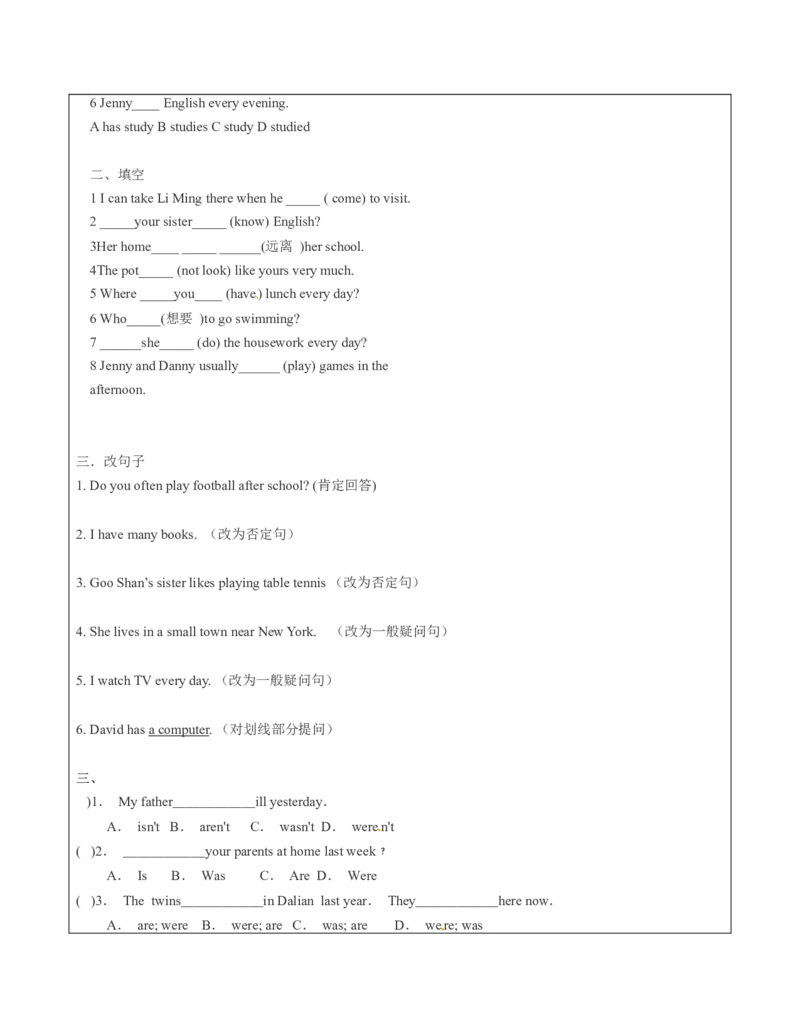
二、填空
1 I can take Li Ming there when he _____ ( come) to visit.
2 _____your sister_____ (know) English?
3Her home____ _____ ______(远离 )her school.
4The pot_____ (not look) like yours very much.
5 Where _____you____ (have) lunch every day?
6 Who_____(想要 )to go swimming?
7 ______she_____ (do) the housework every day?
8 Jenny and Danny usually______ (play) games in the
afternoon.
三.改句子
1. Do you often play football after school? (肯定回答)
2. I have many books. (改为否定句)
3. Goo Shan’s sister likes playing table tennis (改为否定句)
4. She lives in a small town near New York. (改为一般疑问句)
5. I watch TV every day. (改为一般疑问句)
6. David has a computer. (对划线部分提问)
三、
)1. My father______ill yesterday.
A. isn't B. aren't C. wasn't D. weren't
( )2. ______your parents at home last week﹖
A. Is B. Was C. Are D. Were
( )3. The twins______in Dalian last year. They______here now.
A. are; were B. were; are C. was; are D. were; was( )4. ______your father at work the day_____yesterday(前天)﹖
A. Was; before B. Is; before C. Was; after D. Is; after
( )5. —Who was on duty last Friday﹖
—______.
A. I am B. I was C. Yes, I was D. No, I wasn't
( ) 6. I cleaned my classroom ___________.
A with three hours B three hours ago
C in three hours D three hours before
( ) 7. I came _______ my house two days ago.
A back on B back to C to back D back
( ) 8 . ___________? He did some reading at home.
A What does your father do yesterday evening
B What does your brother do in the school
C What did your brother do over the weekend
D Where did your brother go last Sunday
( ) 9. What did you do ________? I went to the movies.
A next morning B over the weekend C in the weekend D next Monday
( ) 10. The koala sleeps _______,but gets up _________.
A during the day; at the evening B at day ;during night
C in the day ;during the evening D during the day ; at night
四、请用正确动词形式填空。(10)
1. I _________ (have) an exciting party last weekend.
2. _________ she _________(practice) her guitar yesterday? No, she _________.
3. What ________ Tom ________ (do) on Saturday evening?
He ________(watch) TV and __________(read) an interesting book.
4. They all _________(go) to the mountains yesterday morning.
5. She _________(not visit) her aunt last weekend.
She ________ (stay) at home and _________(do) some cleaning.
6. When ________ you _________(write) this song? I __________(write) it last year.
7. My friend, Carol, ________(study) for the math test and ________(practice) English last night.
8. ________ Mr. Li __________(do) the project on Monday morning? Yes, he _________.
9. How _________(be) Jim's weekend? It _________(be not) bad.
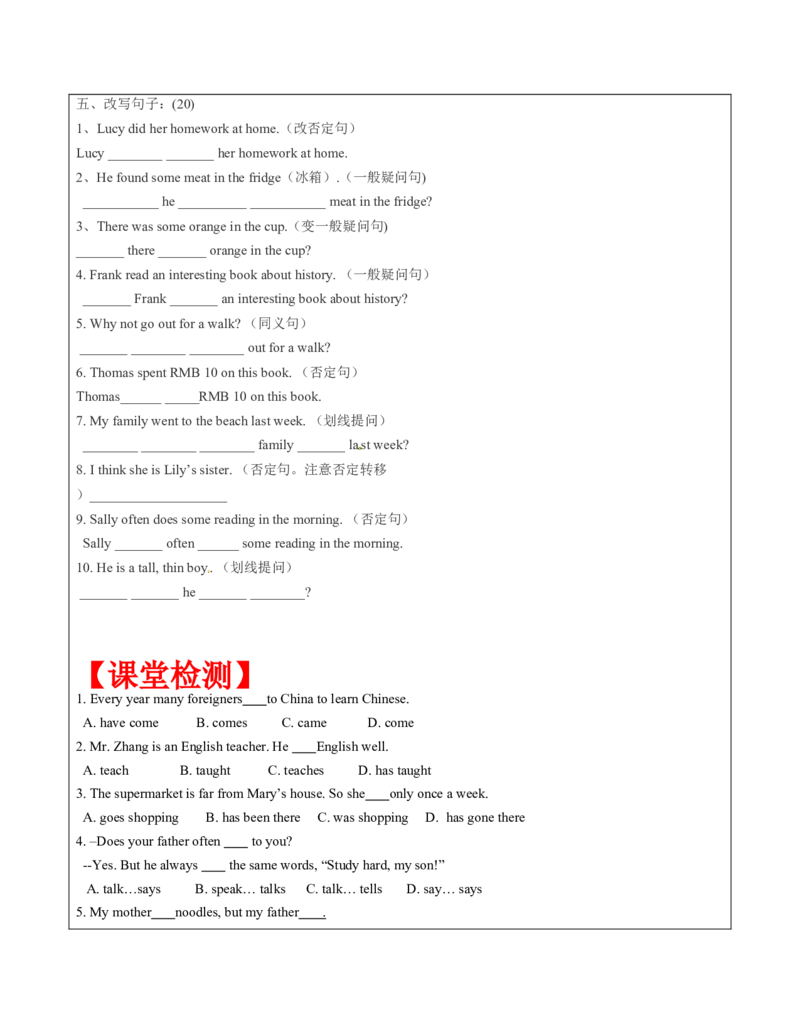
10. ________ (be) your mother a sales assistant last year? No. she __________.五、改写句子:(20)
1、Lucy did her homework at home.(改否定句)
Lucy ________ _______ her homework at home.
2、He found some meat in the fridge(冰箱).(一般疑问句)
___________ he __________ ___________ meat in the fridge?
3、There was some orange in the cup.(变一般疑问句)
_______ there _______ orange in the cup?
4. Frank read an interesting book about history. (一般疑问句)
_______ Frank _______ an interesting book about history?
5. Why not go out for a walk? (同义句)
_______ ________ ________ out for a walk?
6. Thomas spent RMB 10 on this book. (否定句)
Thomas______ _____RMB 10 on this book.
7. My family went to the beach last week. (划线提问)
________ ________ ________ family _______ last week?
8. I think she is Lily’s sister. (否定句。注意否定转移
)____________________
9. Sally often does some reading in the morning. (否定句)
Sally _______ often ______ some reading in the morning.
10. He is a tall, thin boy. (划线提问)
_______ _______ he _______ ________?
【课堂检测】
1. Every year many foreigners to China to learn Chinese.
A. have come B. comes C. came D. come
2. Mr. Zhang is an English teacher. He English well.
A. teach B. taught C. teaches D. has taught
3. The supermarket is far from Mary’s house. So she only once a week.
A. goes shopping B. has been there C. was shopping D. has gone there
4. –Does your father often to you?
--Yes. But he always the same words, “Study hard, my son!”
A. talk…says B. speak… talks C. talk… tells D. say… says
5. My mother noodles, but my father .A. likes…doesn’t B. don’t like…do C. likes…didn’t D. didn’t like…do
6—Susan didn’t like popular music, did she?
--- .
A. Yes, but she didn’t B. No, but she did. C. Yes, but she did D. No, but she does.
7---What’s on the plate?
---There some bread on it .
A. is B. are C. has D. have
8.-- you free this evening?
--No, I have much work to do this evening.
A. Do B.Is C. Are D. Will
9. The teacher told us yesterday that December 25 Christmas Day.
A. is B. was C. has been D. will be
10. The teacher told us that light much faster than sound.
A. travels B. traveled D. was D. will be
11. The children will climb the hill if it tomorrow.
A. won’t rain B. didn’t rain C. doesn’t rain D. isn’t raining
12. If he harder, he will catch up with us soon.
A. study B. studies C. studying D. studied
13. Bill might phone while I’m out this evening. If he , could you take a message?
A. does B. might C. phoned D. will
14.—I won’t come to the party unless Sue , too.
---You mean if Sue comes, you‘ll come?
A. will invite B. invites C. invited D is invited
15. Do you know if back next week? If he back, please let me know.
A. he comes… will come B. will he come… comes
C. he will come…comes D. will he come… will come
16. –Could you tell me when ?
--At 10:25, in ten minutes.
A. the bus will leave B. will the bus leave
C. the bus has left D. the bus had left
17.—Could you please tell Peter that I want to talk to him?
----Sure. I will let him know as soon as he back.
A. comes B. came C. has come D. will come
18.—Would you like to play volleyball with me ?
----Sorry,, I have to finish my diary before my mother back.A. comes B. come C. will come D. came
19.---I won’t go to bed until the TV play over.
----You’d better not do that.
A. is B. was C. will D. will be
20. Please don’t leave until your teacher back.
A. will come B .came C. comes D. is coming
【要点回顾】【温故知新】
一、写出下列单词的过去式形式
1. look 2. live 3. stop 4. play
5. hope 6. trip 7. wash 8. want
9. watch 10. plan 11. clean 12. study
13. dance 14. cry 15. visit 16. is
17.see 18. eat 19. read 20.take
二、用所给动词的适当形式填空
1. Tom and Mary ___________ (come) to China last month.
2. Mike _________________(not go) to bed until 12 o’clock last night. So I _______ (get) up late.
3. Mary __________ (read) English yesterday morning.
4. There _________ (be) no one here a moment ago.
5. I ___________ (call) Mike this morning.
6. I listened but ___________ (hear) nothing.
7. Tom ___________ (begin) to learn Chinese last year.
8. Last week we _________ (pick) many apples on the farm.
9. My mother ________________ (not do) housework yesterday.
10. She watches TV every evening. But she _______________ (not watch) TV last night.
11.________ your father ________ (go) to work every day last year?
12. —What time _______ you _______ (get) to Beijing yesterday? —We __________ (get) to Beijing at 9:00 in the
evening.13. What __________ (make) him cry (哭) just now?
14. Last year the teacher ___________ (tell) us that the earth moves around the sun.
15. There ____________ a telephone call for you just now. (be)
16. There __________ not enough people to pick apples that day. (be)
17. There _____________ any hospitals (医院) in my hometown (家乡) in 1940. (be not)
18. There ____________ enough milk at home last week, wasn’t there?
19. Eli ____________ to Japan last week. (move)
20. –When _______ you _________ (come) to China? - Last year.
21. Did she ________ (have) supper at home?
22. Jack ____________ (not clean) the room just now.
23. _________ (be) it cold in your city yesterday?
24. How many people ________ (be) there in your class last term?
25. It ________ (be) hot yesterday and most children _______ (be) outside.
26. There ________ (be) a football match on TV yesterday evening, but I _________ (have) no time to watch it.
27. He ate some bread and _________ (drink) some milk.
28. ________ he __________ (finish) his homework last night?
29. I__________(be) tired yesterday.
30. What _________ you ___________ (do) last night?
三、选择题
1. He is very tired. He doesn’t want to do _______.
A. something B. nothing C. everything D. anything
2. Everyone ______ here last Monday.
A. were B.is C. are D. was
3. It’s time ____class.
A. for have B. have C. to have D. to having
4. He helped his mother clean the rooms and then ____ his homework yesterday afternoon.
A. do B. doing C. does D. did
5. Jenny ____ in an office. Her parents ____in a hospital.
A. work; works B. works; work C. work; are working D. is working; work
6. One of the boys_____ a black hat.
A. have B. there is C. there are D. has
7. Wang Mei ____ music and often ____ to music.
A. like; listen B. likes; listens C. like; are listening D. liking listen
8. Jenny____ English every evening.A has study B. studies C. study D. studied
9. My father______ill yesterday.
A. isn't B. aren't C. wasn't D. weren't
10. ____your parents at home last week﹖
A. Is B. Was C. Are D. Were
三、句型转换
1. My English teacher went to the movies with her sister.(改为一般疑问句)
_________ your English teacher ___________ to the movies with her sister?
2. He didn’t have any money for a bike.(改为肯定句)
He _________ __________ money for a bike.
3. The man takes the subway to work every day.(改为否定句)
The man ______ ______ the subway to work every day.
[来源:学科网]
4. I walk home after school.(改为同义句)
I go home _________ _________ after school.
5. It’s time for lunch.(改为同义句)
It’s time __________ __________ lunch.
6. Lucy did her homework at home.(改否定句)
Lucy ________ _______ her homework at home.
7.He found some meat in the fridge(冰箱).(变一般疑问句)
_______ he _______ _______ meat in the fridge?
8. There was some orange in the cup.(变一般疑问句)
________________________________________________
四、用括号内所给动词的适当形式填空
1. Jane often ________ (take) the bus to school.
2. Did you enjoy _______ (go) shopping.
3. —What did you do last Sunday?—I ________(study) for the English test.
4. The boy likes English very much, so he ________ (practice) reading English every morning.
5. Look! Liu Ying _________ (do) her homework.
6. He ______ (play) football very well.
7. Danny ________ (go) to school at 7:10.
8. _____your sister_____(know)English?9. Her home____ _____ ______(远离 )her school.
10. The pot_____(not look) like your pot very much.
11.______she_____(do) the housework every day?
12. Jenny and Danny usually______(play) games in the afternoon .
13. I _________ (have) an exciting party last weekend.
14. _________ she _________(practice) her guitar yesterday? No, she _________.
15. What ________ Tom ________ (do) on Saturday evening?
He ________(watch) TV and __________(read) an interesting book.
16. They all _________(go) to the mountains yesterday morning.
17. She _________(not visit) her aunt last weekend.
She ________ (stay) at home and _________(do) some cleaning.
预习思考
下节课我们将复习现在进行时和一般将来时,回忆一下吧!
[来源:Z|xx|k.Com]
[来源:Z,xx,k.Com]
【康奈尔笔记法——5R笔记法】
5R笔记法,又叫做康奈尔笔记法,是用产生这种笔记法的大学校名命名的。这一方法几乎适用于一切
讲授或阅读课,特别是对于听课笔记,5R笔记法应是最佳首选。这种方法是记与学,思考与运用相结合的有
效方法。
1.记录(Record)在听讲或阅读过程中,在记录栏(有称为主栏,及最大的一个区域)内尽量多记有意义的论据、概念等讲课
内容。
2.简化(Reduce)
下课以后,尽可能及早将这些论据、概念简明扼要地概括(简化)在回忆栏,即副栏。
3.背诵(Recite)
把主栏遮住,只用回忆栏中的摘记提示,尽量完满地叙述课堂上讲过的内容。
4.思考(Reflect)
将自己的听课随感、意见、经验体会之类的内容,与讲课内容区分开,写在卡片或笔记本的某一单独部分,
加上标题和索引,编制成提纲、摘要,分成类目。并随时归档。
5.复习(Review)
每周花十分钟左右时间,快速复习笔记,主要是先看回忆栏,适当看主栏,并在复习栏绘制这部分内容的知
识思维导图。
康奈尔Cornell笔记法使用说明
[来源:学科网]康奈尔Cornell笔记法使用说明[来源:Zxxk.Com]