文档文本内容
冀教版五年级下册单元知识汇总
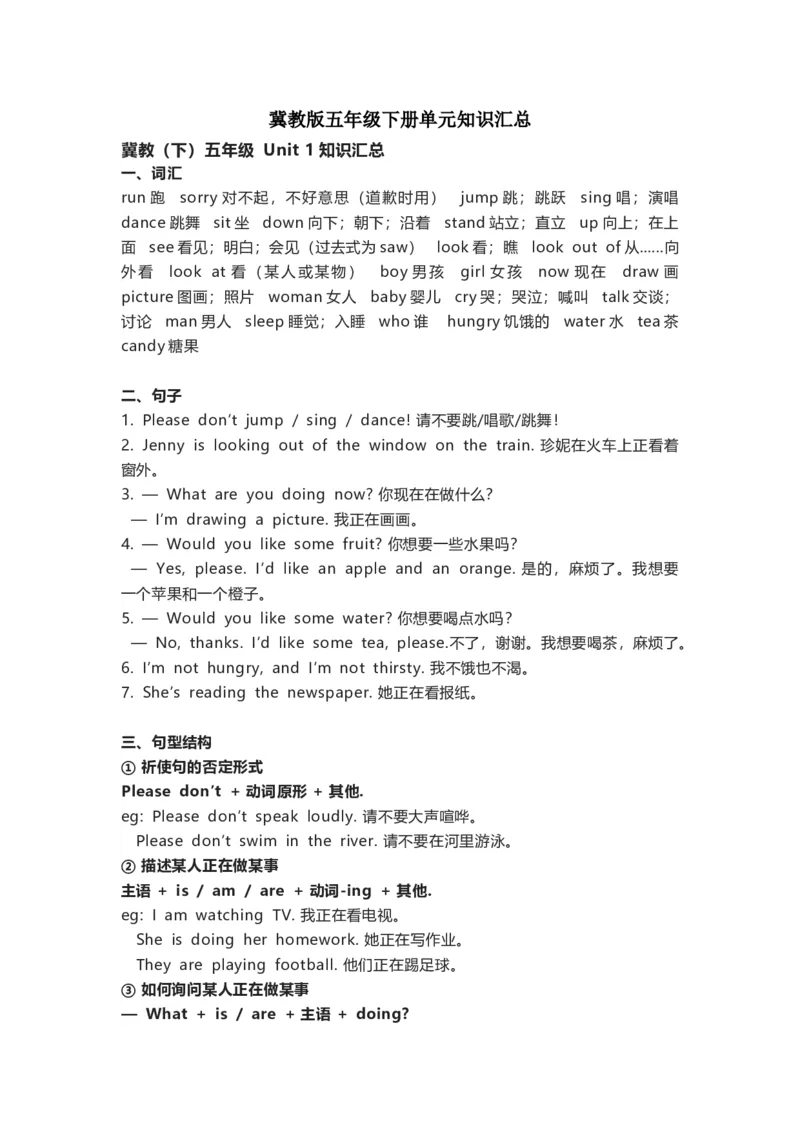
冀教(下)五年级 Unit 1知识汇总
一、词汇
run 跑 sorry 对不起,不好意思(道歉时用) jump 跳;跳跃 sing 唱;演唱
dance跳舞 sit坐 down向下;朝下;沿着 stand站立;直立 up向上;在上
面 see看见;明白;会见(过去式为 saw) look看;瞧 look out of从......向
外看 look at 看(某人或某物) boy 男孩 girl 女孩 now 现在 draw 画
picture图画;照片 woman女人 baby婴儿 cry哭;哭泣;喊叫 talk交谈;
讨论 man男人 sleep睡觉;入睡 who谁 hungry饥饿的 water水 tea茶
candy糖果
二、句子
1. Please don’t jump / sing / dance! 请不要跳/唱歌/跳舞!
2. Jenny is looking out of the window on the train. 珍妮在火车上正看着
窗外。
3. — What are you doing now? 你现在在做什么?
— I’m drawing a picture. 我正在画画。
4. — Would you like some fruit? 你想要一些水果吗?
— Yes, please. I’d like an apple and an orange. 是的,麻烦了。我想要
一个苹果和一个橙子。
5. — Would you like some water? 你想要喝点水吗?
— No, thanks. I’d like some tea, please.不了,谢谢。我想要喝茶,麻烦了。
6. I’m not hungry, and I’m not thirsty. 我不饿也不渴。
7. She’s reading the newspaper. 她正在看报纸。
三、句型结构
① 祈使句的否定形式
Please don’t + 动词原形 + 其他.
eg: Please don’t speak loudly. 请不要大声喧哗。
Please don’t swim in the river. 请不要在河里游泳。
② 描述某人正在做某事
主语 + is / am / are + 动词-ing + 其他.
eg: I am watching TV. 我正在看电视。
She is doing her homework. 她正在写作业。
They are playing football. 他们正在踢足球。
③ 如何询问某人正在做某事
— What + is / are + 主语 + doing?— 主语 + is / am / are + 动词-ing + 其他.
eg: 1. — What are you doing? 你正在做什么?
— I’m reading my storybook. 我正在看故事书。
2. — What is your mother doing? 你妈妈正在做什么?
— She is cooking dinner. 她正在做晚饭。
④ 询问对方是否想要某物
— Would you like ...?
— Yes, please. / No, thanks.
eg: — Would you like a cup of water? 你想要喝杯水吗?
— Yes, please. 是的,麻烦了。
— Would you like some noodles? 你想要吃点面条吗?
— No, thanks. 不用了,谢谢。
四、语法知识
现在进行时
含义:描述现在正在进行或发生的动作或状态,常与now连用
句型结构:
肯定句:主语 + be动词 + 动词-ing + 其他.
否定句:主语 + be动词 + not + 动词-ing + 其他.
一般疑问句:— Be动词 + 主语 + 动词-ing + 其他?
— Yes, 主语 + be动词. / No, 主语 + be动词 + not.
特殊疑问句:特殊疑问词 + be动词 + 主语 + 动词-ing + 其他?
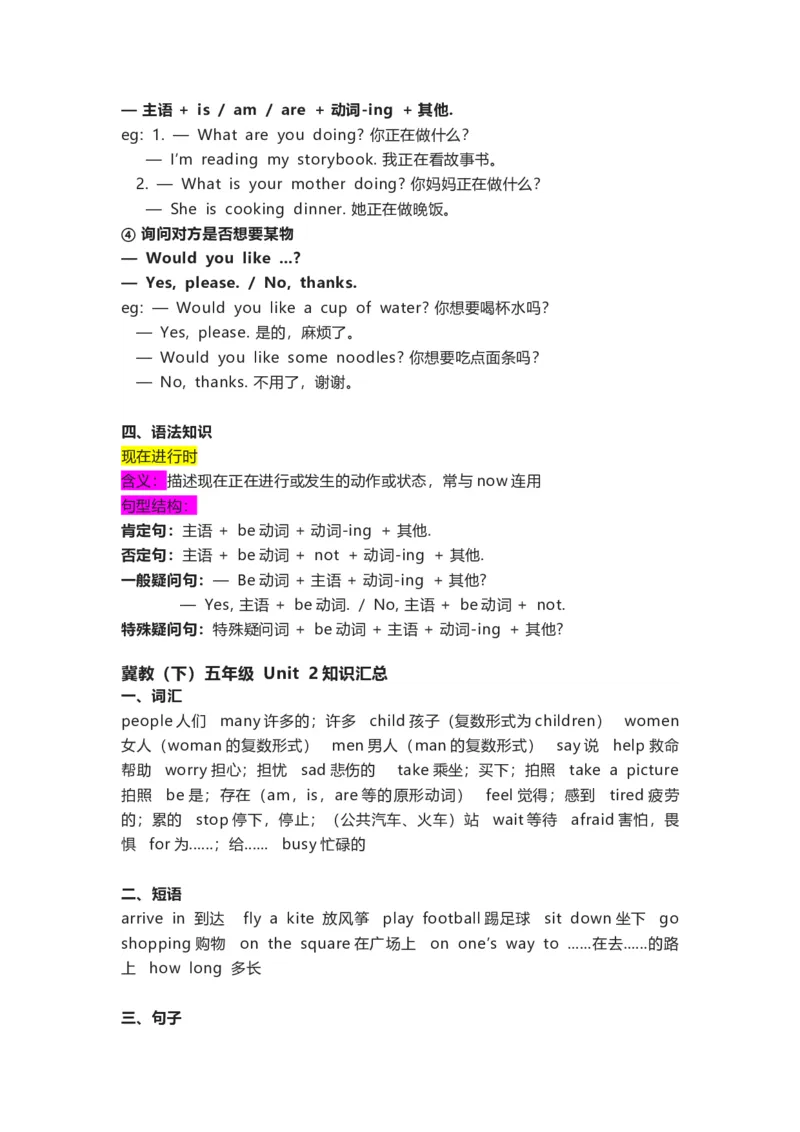
冀教(下)五年级 Unit 2知识汇总
一、词汇
people人们 many许多的;许多 child孩子(复数形式为children) women
女人(woman的复数形式) men男人(man的复数形式) say说 help救命
帮助 worry担心;担忧 sad悲伤的 take乘坐;买下;拍照 take a picture
拍照 be是;存在(am,is,are等的原形动词) feel 觉得;感到 tired 疲劳
的;累的 stop停下,停止;(公共汽车、火车)站 wait等待 afraid害怕,畏
惧 for为......;给...... busy忙碌的
二、短语
arrive in 到达 fly a kite 放风筝 play football踢足球 sit down坐下 go
shopping购物 on the square在广场上 on one’s way to ......在去......的路
上 how long 多长
三、句子1. There are many people in the park. 公园里有许多人。
2. A child is flying a kite. 有个小孩正在放风筝。
3. Children are playing football. 孩子们正在踢足球。
4. Tian’anmen Square is very big! Some people are taking pictures
on the square. 天安门广场非常大!一些人们正在广场上拍照片。
5. It’s sunny today. The sky is blue. 今天是晴天。天空很蓝。
6. — How old is the Palace Museum? 故宫多少年历史了?
— It’s about six hundred years old. 大约六百年的历史了。
7. On the way back to the hotel, Danny feels tired and hungry. 在回
酒店的路上,丹尼感到又累又饿。
8. — What time is it? 几点了?
— It’s 3:00. 三点。
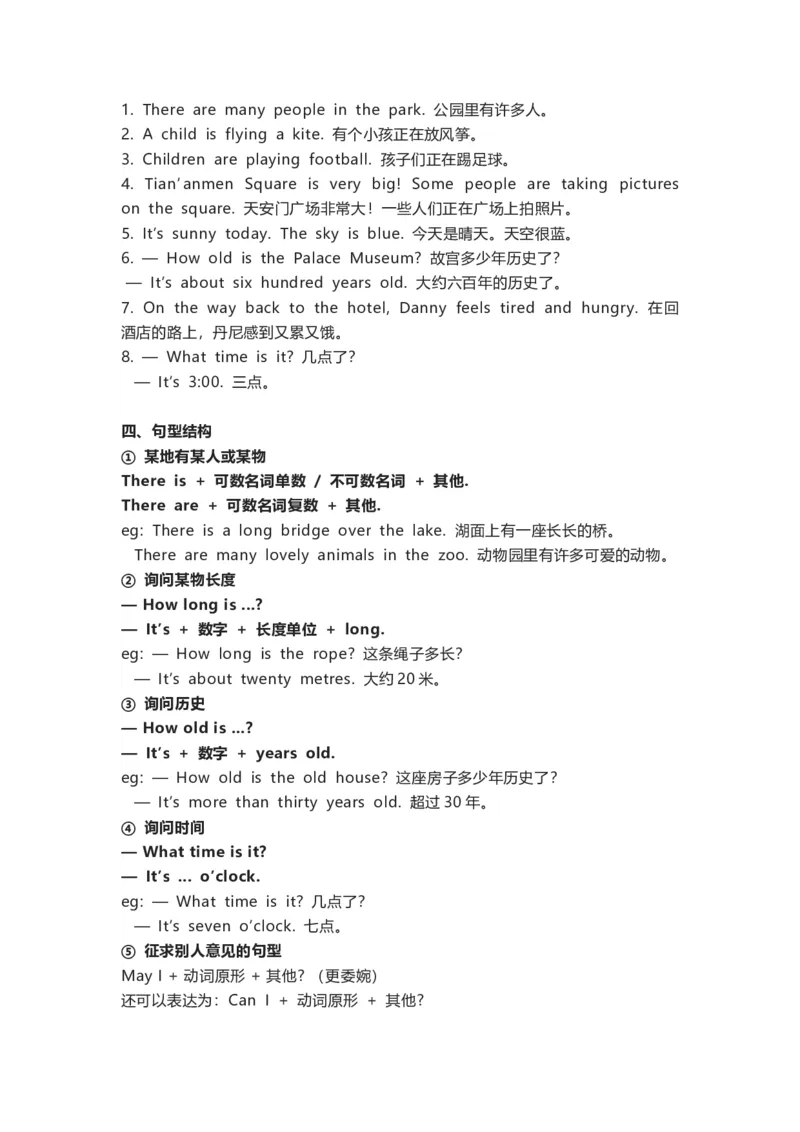
四、句型结构
① 某地有某人或某物
There is + 可数名词单数 / 不可数名词 + 其他.
There are + 可数名词复数 + 其他.
eg: There is a long bridge over the lake. 湖面上有一座长长的桥。
There are many lovely animals in the zoo. 动物园里有许多可爱的动物。
② 询问某物长度
— How long is ...?
— It’s + 数字 + 长度单位 + long.
eg: — How long is the rope? 这条绳子多长?
— It’s about twenty metres. 大约20米。
③ 询问历史
— How old is ...?
— It’s + 数字 + years old.
eg: — How old is the old house? 这座房子多少年历史了?
— It’s more than thirty years old. 超过30年。
④ 询问时间
— What time is it?
— It’s ... o’clock.
eg: — What time is it? 几点了?
— It’s seven o’clock. 七点。
⑤ 征求别人意见的句型
May I + 动词原形 + 其他? (更委婉)
还可以表达为:Can I + 动词原形 + 其他?eg: — May I come into your room? 我可以进去你的房间吗?
— Sure. Please. 当然,请进。
五、语法知识
现在进行时
1. 含义:表示现在正在进行或存在的状态。
2. 现在进行时常用于下列情况中:
①句子中有now
②以look / listen开头的句子,提示动作正在进行,要用现在进行时
3. 结构:
肯定句:主语 + is / am / are + 动词-ing + 其他.
否定句:主语 + is / am / are + not + 动词-ing + 其他.
一般疑问句:— Is / Am / Are + 主语 +动词-ing+其他?
— Yes, 主语+ is / am. / No, 主语 + is / am+ not.
特殊疑问句:特殊疑问词 + is / am / are + 主语 + 动词-ing + 其他?
4. 动词-ing的变化形式
①一般直接在动词词尾加-ing
eg: do - doing
②以不发音的 e 结尾的动词,先去掉末尾的 e,再加 -ing
eg: like - liking
③以重读闭音节结尾且末尾只有一个辅音字母的动词,先双写末尾的辅音字母,再
加 -ing
eg: sit - sitting
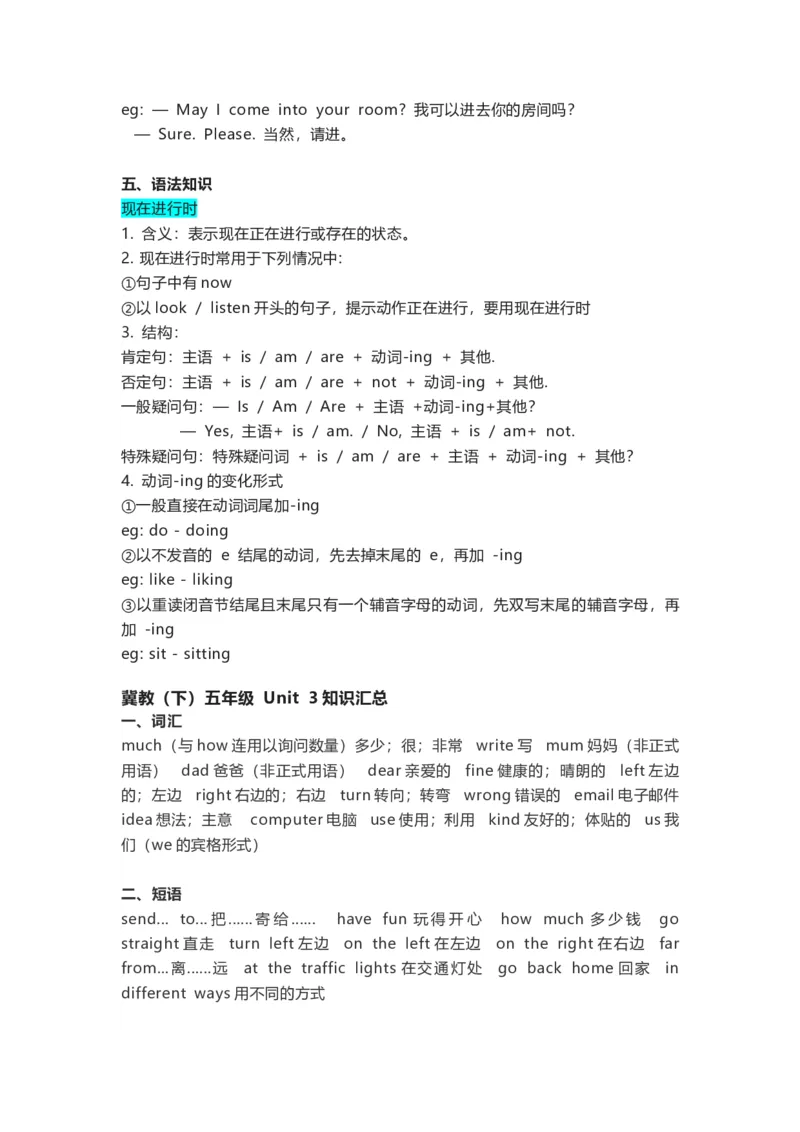
冀教(下)五年级 Unit 3知识汇总
一、词汇
much(与how连用以询问数量)多少;很;非常 write写 mum妈妈(非正式
用语) dad爸爸(非正式用语) dear亲爱的 fine健康的;晴朗的 left左边
的;左边 right右边的;右边 turn转向;转弯 wrong错误的 email电子邮件
idea想法;主意 computer电脑 use使用;利用 kind友好的;体贴的 us我
们(we的宾格形式)
二、短语
send... to...把......寄给...... have fun 玩得开心 how much 多少钱 go
straight 直走 turn left 左边 on the left 在左边 on the right 在右边 far
from...离......远 at the traffic lights 在交通灯处 go back home 回家 in
different ways用不同的方式三、句子
1. I want to send this postcard to my mum and dad. 我想把这张明信片
送给我爸爸妈妈。
2. — How much is this postcard? 这张明信片多少钱?
— It’s two yuan. 两元。
3. It has a picture of the Palace Museum. 它有故宫的照片。
4. It’s not far from Tian’anmen Square. 它离天安门广场不远。
5. — Excuse me. Where is the post office? 打扰一下,请问邮局在哪?
— Go straight. Turn left at the traffic lights. 直走。在交通信号灯左转。
6. A postcard is slow. An email is fast. 明信片很慢。电子邮件很快。
7. What a great trip! 多么美妙的旅行!
四、句型结构
① 询问价格
— How much is / are ...?
— It’s / They’re + 数字 + 价格单位.
eg: — How much is this book? 这本书多少钱?
— It’s fifteen yuan. 十五元。
— How much are these pants? 这条裤子多少钱?
— They’re thirty yuan. 三十元。
② 问路
— Where is ...?
— Go straight. / Turn left / right.
eg: — Where is the zoo? 动物园在哪?
— Go straight and turn right at Renming Road. 直走在人民路右转。
③ 提出建议
Let’s + 动词原形 + 其他.
eg: Let’s play football in the playground. 让我们在操场踢足球吧。
④ 询问某地天气
— How’s the weather in + 地点?
— It’s + 描写天气情况的形容词.
eg: — How’s the weather in Sanya? 三亚天气怎么样?
— It’s warm and rainy. 温暖而且多雨。
冀教(下)五年级 Unit 4知识汇总
一、词汇story故事 did做,干;助动词(do的过去式) yesterday昨天 night夜晚,
晚上 had有;吃;进行(活动)(have的过去式) went去;走;离开(go的
过去式) saw 看见(see 的过去式) ate 吃(eat 的过去式) photo 照片
were是;存在(are的过去式) was是;存在(am, is的过去式) happy快
乐的;高兴的 bought买(buy的过去式) back回原处;向后
二、短语
try on试穿 buy a gift for you给你买一份礼物 walk to school步行去学校
watch a film看电影 go shopping购物 last week上周
三、句子
1. I often walk to school. 我经常步行上学。
2. I walked to the park yesterday. 我昨天步行去了公园。
3. — What did you do yesterday? 你昨天做了什么?
— I called my friend. 我给我朋友打了电话。
4. I go to the library on Sundays. 我星期天去图书馆。
5. I went to the cinema yesterday. 我昨天去了电影院。
6. — What happened? 怎么了?
— I hurt my tail. 我弄伤了我的尾巴。
7. He is eight years old this year. 他今年八岁了。
8. He was seven years old last year. 他去年七岁。
四、句型结构
① 询问对方过去的某个时间做了什么
— What did you do + 过去的时间?
— I + 动词过去式 + 其他.
eg: — What did you do yesterday? 你昨天做了什么?
— I had a English class. 我上了英语课。
— What did you do last week? 你上周做了什么?
— I visited my grandparents. 我拜访了我祖父母。
② 询问对方过去是否做过某事
— Did you + 动词原形 + 其他?
— Yes, I did. / No, I didn’t.
eg: — Did you play football yesterday? 你昨天踢足球了吗?
— No, I didn’t. 不,没有。
五、语法知识一般过去时:
1. 含义:表示过去某个时间里发生的动作或状态;过去习惯性、经常性的动作、行
为
2. 一般过去时常与表示过去的时间状语连用。常见的表示过去的时间状语有:
yesterday(昨天)、last weekend (上周末)、ago(之前)、just now(刚
才)......
3. 结构:
① 含 be 动词的一般过去时结构
肯定句: 主语 + was / were + 其他.
否定句:主语 + was / were + not + 其他.
一般疑问句: — Was / Were + 主语 + 其他?
— Yes, 主语 + was/ were.
No, 主语 + was / were + not.
特殊疑问句: 特殊疑问词 + was / were + 主语 +其他?
② 谓语动词是实义动词的一般过去时结构
肯定句: 主语 + 动词过去式 + 其他.
否定句:主语 + didn't + 动词原形 + 其他.
一般疑问句: — Did + 主语 + 动词原形 + 其他?
— Yes, 主语 + did.
No, 主语 + did + not.
特殊疑问句: 特殊疑问词 + did + 主语 +动词原形+其他?