Unit 3 My weekend plan
教材分析 本单元学习的主题是周末活动计划。教学内容主要是通过展示陈杰和Amy的对话,以及张
鹏朋友们的周末活动展开的。教学重点是能够听、说、读、写并运用核心句型“—What are/is…
going to do? —We’re/I’m going to…/He/ She is going to…”“—Where are/is…going? —
We’re/I’m going…/He/ She is going…”“—When are/is…going? —We’re/I’m going…/He/ She
is going…”;听、说、读、写单词和词组:take a trip, go to the supermarket, visit my
grandparents, see a film, tonight, this morning, this afternoon, this evening, next week,
postcard, dictionary, comic book, word book
教学内容
· 听、说、读、写句型“—What are you going to do tomorrow? —I’m going to have an art
lesson“—Where are you going? —I’m going to the cinema.”“—When are you going?
—Next Wednesday.”
·在情景中运用句型“—What are/is…going to do? —We’re/I’m going to…/He/ She is
going…”“—Where are/is…going? —We’re/I’m going…/He/ She is going…”“—When
are/is…going? —We’re/I’m going…/He/ She is going…”谈论活动计划的内容、地点和时
间
·在图片的帮助下正确理解并按照正确的意群及语音、语调朗读吴斌斌的日记,运用本单元所
学核心句型口头描述并能写出自己中秋节的安排
·听、说、读、写单词和词组:take a trip, go to the supermarket, visit my grandparents, see a
film, tonight, this morning, this afternoon, this evening, next week, postcard, dictionary,
comic book, word book
·正确使用上述单词和词组谈论或描述自己的活动计划
·在图片和文字的支持下完成表格和仿写语句
·知道英语多音节单词有重音,且需重读的语言现象
课时安排 第一课时: Part A Let’s try & Let’s talk
第二课时: Part A Let’s learn & Make a plan
第三课时: Part B Let’s try & Let’s talk
第四课时: Part B Let’s learn & Role-play
第五课时: Part B Read and write
第六课时: Part B Let’s check & Let’s wrap it up & Part C Story time
3The first period(第一课时)
Part A Let’ s try & Let’s talk
教学内容
▶
Let’s try ·读懂题目要求,学会听前预测要听的重点内容
·运用基本听力技巧完成本部分的听力任务
Let’s talk ·通过观察、谈论Let’s talk板块的图片,并在PPT和老师的帮助下理解对话大意
·通过听录音,学会按照正确的意群及语音、语调朗读对话,并在小组中进行角色表演
·听、说、读、写并在情景中恰当运用句型“—What are/is…going to do? —We’re/ I’m going
to…/He /She is going to…/They are going to…”提问及作答
·用所学语言谈论自己和朋友的周末活动计划重点
教学重点
▶
1.能理解和掌握本课重点句型“—What are you going to do…? —I’m going to…”并在真
实情景中灵活运用。
2.能够用所学语言谈论自己和朋友的周末活动计划。
教学难点
▶
正确运用“be going to”谈论自己和朋友的活动计划并与他人进行交流。
教学准备
▶
1.预习《状元大课堂》《创优作业100分》《状元作业本》中本课时的相关内容。
2.PPT课件、课文录音、视频、单词卡片、日历等。
教学过程
▶
Step 1: Warm-up & Lead-in
1. Greetings.
2. Play a game: Sharp eyes.① Teaching purpose①
Show some verbs and verb phrases “draw a picture, swim, 通过游戏复习之前学过
dance, see a film, do homework, have a lesson, watch TV, cook,
的动词和动词词组,为接下
来的学习做铺垫。接着把本
wash clothes, clean the room, go for a picnic, read books, play
课中出现的动词词组编成一
football, go shopping, play computer games…” quickly on the
首chant,不仅能对新知进行
PPT. (出示课件) Students try to speak out the right word or phrase as
预热,也能在一定程度上活
soon as possible when it shows up. 跃课堂气氛。
3. Enjoy a chant together.
44. Lead-in.②
Teaching purpose②
(1)T: Do you like today’s chant?
通过让学生观察主情景
Ss: Yes.
图,并对图片内容进行问答,
T : Are you going to draw a picture/see a film… this
引 入 本 课 的 主 题 : My
weekend? Weekend Plan。并引导学生
Ss: Yes./No. 对此主题展开讨论。
T: The weekend is coming! Zhang Peng’s friends are going
to different places and they are going to do different things. Let’s go
and have a look.
(2) Show the picture of the main scene in this unit on the PPT. Ask
students to observe it carefully and try to think about three questions:
(3) Check the answers together. (课件出示:前两个问题的答案)
Encourage students to think out more answers about the last
question.
T: Zhang Peng’s friends have different plans for this weekend.
What are you going to do this weekend? Today we are going to make a
weekend plan.
Step 2: Presentation
Teaching purpose③
1. Listen and circle.③
引导学生在听听力前
(1) Show the two questions of “Let’s try” on the PPT. (课件出示: 预测练习的答案,对要听的
教材P24 Let’s try板块的两个问题) Let students read the questions 内容进行热身。接着带着问
题去听对话,增强听的目的
and guess the answers.
性,有效地训练学生的听力
T: Can Mike go swimming today? What do you think of this
能力。
question?
Ss: Yes, he can./No, he can’t.
T: Why do you think he can/can’t go swimming today?
Ss: Because…
Encourage students to think out more reasons.
(2 )Play the recording of “Let’s try”. (课件出示:教材P24 Let’s
try板块的音频) Ask students to get the key information. Then ask them
5to choose the right answers.
(3)Check the answers. Show the listening material to help students
understand further. (课件出示:教材P24 Let’s try板块的答案及听力
材料)
(4)After checking the second answer, provide one more question:
What is Mike going to do this afternoon? Lead students to choose the
right picture and speak out the sentence: He is going fishing this
afternoon.
2. Look and say.④
Take out a calendar of this month and show it through the video
Teaching purpose④
display desk.
通过实物展示和对话
T: What day is it today?
帮助学生理解 tomorrow的
S1: It is Monday/… 含义,为学生下一步学习对
Ask this student to circle the day of today on the calendar. Then 于明天的计划和安排打下
write down the word “today” beside the circle. 一定的基础。
T: Clever! Who knows what day it is tomorrow?
S2: It’s Tuesday/…
T: Super!
Ask that student to circle the day of tomorrow on the calendar.
Then write down the word “tomorrow” beside that circle. Lead students
to read the word “tomorrow” three times.
3. “Let’s talk”.⑤
(1)Show the pictures of “Let’s talk”.( 课件出示:教材P24 Let’s Teaching purpose⑤
talk板块的图片) 从呈现整体对话,让
学生整体感知对话,到逐步
T: Sarah is on the phone with Mike. What are they talking about
处理局部语言,使学生深入
this time?
了解对话的内容,对本课的
S1: They are talking about tomorrow’s plan.
重点词组、句型和语法点都
T: Good answer! They are talking about their plans for tomorrow. 有切实的理解。
What are they going to do tomorrow? Look at the pictures and guess the
answers.
Ss: Mike/Sarah is going to…
(2)Show the first question: What are Mike and Sarah going to do
tomorrow? Let students watch the video of “Let’s talk” and try to fill in
the blanks. (课件出示:教材P24 Let’s talk板块的视频)
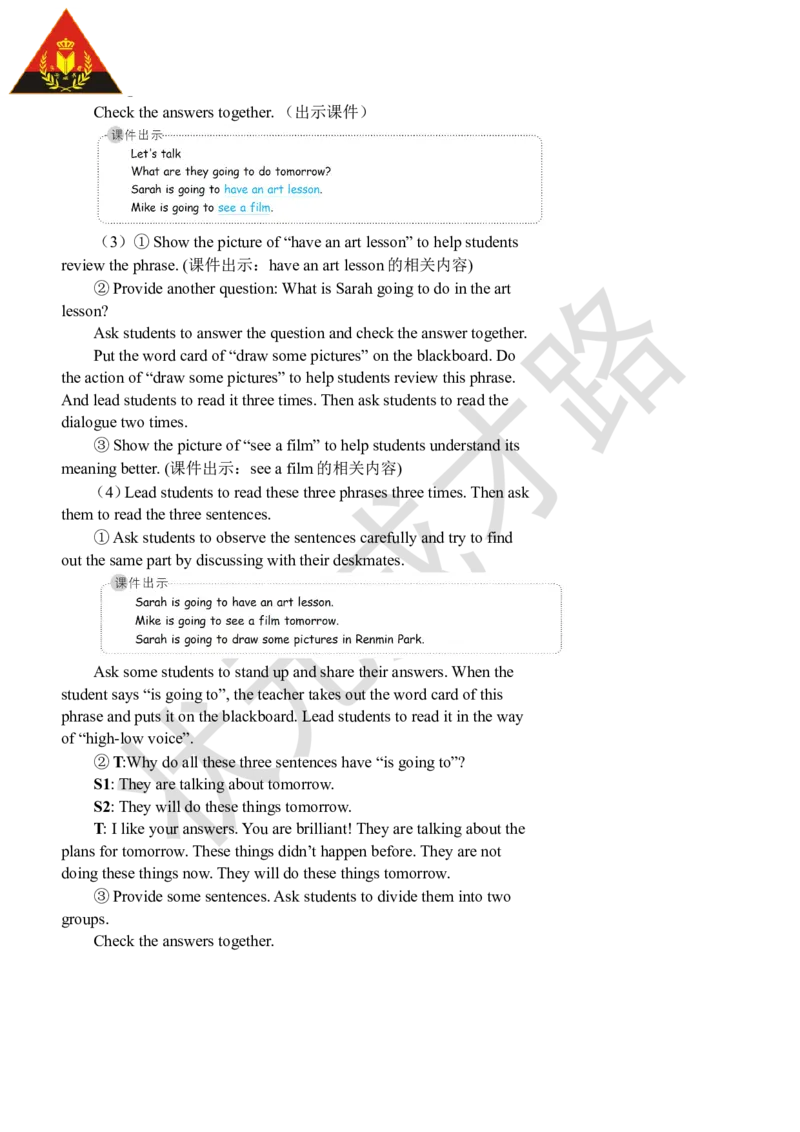
6Check the answers together. (出示课件)
(3)①Show the picture of “have an art lesson” to help students
review the phrase. (课件出示:have an art lesson的相关内容)
②Provide another question: What is Sarah going to do in the art
lesson?
Ask students to answer the question and check the answer together.
Put the word card of “draw some pictures” on the blackboard. Do
the action of “draw some pictures” to help students review this phrase.
And lead students to read it three times. Then ask students to read the
dialogue two times.
③Show the picture of “see a film” to help students understand its
meaning better. (课件出示:see a film的相关内容)
(4)Lead students to read these three phrases three times. Then ask
them to read the three sentences.
①Ask students to observe the sentences carefully and try to find
out the same part by discussing with their deskmates.
Ask some students to stand up and share their answers. When the
student says “is going to”, the teacher takes out the word card of this
phrase and puts it on the blackboard. Lead students to read it in the way
of “high-low voice”.
②T:Why do all these three sentences have “is going to”?
S1: They are talking about tomorrow.
S2: They will do these things tomorrow.
T: I like your answers. You are brilliant! They are talking about the
plans for tomorrow. These things didn’t happen before. They are not
doing these things now. They will do these things tomorrow.
③Provide some sentences. Ask students to divide them into two
groups.
Check the answers together.
7Lead students to conclude the rules of the two groups.
T: Group One is about the structure of “be going to”. They are all
about plans for the future. Group Two is about the structure of “be+ v-
ing”. They are all about doing something now.
4. Read and act.
(1)Students read after the recording. Pay attention to the
pronunciation and the intonation.
(2)Let students practice the dialogue in pairs.
(3)Act out the dialogue.
Step 3: Practice⑥
Teaching purpose⑥
1. A matching task.
练习部分的设计由认
Show different pictures and phrases: go ice-skating, wash clothes,
词组到组句子,再到使用不
draw pictures, make a snowman, go for a picnic. (课件出示:上述动词
同的人称描述不同的计划,
词组及其图片的连线题) Ask students to complete the matching task. 层层递进,帮助学生逐步掌
2. Pick apples. 握本课重点句型,并能够进
Divide students into several groups. Show a big apple tree and a
一步体会be动词与不同的
人称搭配,达到举一反三的
question on the PPT: What am I going to do tomorrow? Each apple has a
作用。
phrase in it, such as go ice-skating, wash clothes, draw pictures, make a
snowman, go for a picnic. (课件以摘苹果的方式出示上述动词词组)
The teacher picks one apple each time. Students try to make a sentence
with the phrase in it to answer the question. Make a model:
T: What am I going to do tomorrow?
S1: You’re going to draw pictures.
…
The first student who speaks out the right sentence can get a score
for his/her group.
3. Look and say.
Show some pictures of the phrases on page 24 on the PPT.( 课件出
示:教材P24下方词组及其相应的图片) Lead students to talk about
the pictures with the sentence structures “— What is/are…going to do?
—…is/are going to…” Make a model.
T: What is he going to do?
S1: He is going to go ice-skating.
8The first student who speaks out the right sentence can get a score
for his/her group.
Step 4: Consolidation & Extension⑦
“Weekend Plan”
Teaching purpose⑦
1. Play a game: A Miming Game.
引导学生运用所学的
Each time ask one student to come to the front of the platform. Give 内容谈论自己和他人的周
him/her a picture about an activity. Let him/her mime it. Through the 末计划,将所学的重点词组
miming activity, the others try to guess: What is this student going to do 和句型灵活运用到真实的
情景中,以达到语言输出的
this weekend? And try to describe the plan with the sentence structure
目的,进一步巩固一般将来
“You’re going to…” The winner can get a score for his/her group.
时的用法。
2. Do a survey.
Ask students to talk about the weekend plan by using the sentence
structures “—What are you going to do? —I’m/We’re going to…” in
groups. Write down the result on the paper.
The leader in each group collects all the answers. Fill in the chart
below. (课件出示:调查表模板)
3. Show time.
Ask two or three groups to give reports like this: I’m going to see a
film. Student 1 is going to read books this weekend. Student 2 and
Student 3 are going to play basketball…
The group which does a good job can get a score.
4. Evaluation.
Count the total scores of each group. Find the best group. Give each
member of this group a big hug.
板书设计
▶
作业设计
▶
1. Practice the dialogue.
92. Do the exercises. (见“状元成才路”系列丛书《创优作业100分》或《状元作业本》对
应课时作业)
教学反思
▶
1.本课通过游戏和歌谣引入主题,活跃了课堂气氛,也让学生通过旧知初步了解了新知,温故
而知新。
2.本课主要锻炼了学生的听、说、读、写英语的能力,使学生能够更加流利地使用英语进行交
流。
3.教师利用图片、日历、卡片和动作等方式将学生带入真实的语言环境中,让学生身临其境,
自发地融入到课堂中来。
4.本课设置多个环节,环环相扣,层层深入,抽丝剥茧,帮助学生逐步理解并使用所学语言来
谈论自己及他人的周末计划。
5.板书设计清晰明了,重点突出,起到了很好的辅助作用。
▶Teaching Contents
Let’s try
·Understand the questions and predict the key points before listening.
·Use basic listening skills to complete the listening task in this section.
Let’s talk
· Understand the main idea of the dialogue by observing and talking about the pictures with the
help of the teacher.
·Read the dialogue with the correct pronunciation and intonation and act it out in groups.
·Lsten, speak, read, write and use the sentence structures “—What are/is…going to do? —We’re/I’m
going to…/He/ She is going to…/They are going to…” to ask and answer questions.
·Talk about the weekend plans freely.
▶Teaching Priorities
·Be able to understand and master the key sentence structures in this lesson, and use them flexibly in
real situations.
·Be able to talk about the weekend plans freely.
▶Teaching Difficulties
·Use the sentence structure “be going to” correctly to talk about plans for activities and communicate
with others.
▶Teaching Procedures
10Teaching
Teacher’ s Activities Students Activities Teaching Purposes
Stages
Warm-up 1. Greetings. 1. Greetings. Review the verbs and the
& 2. Play a game: Sharp eyes. 2. Try to speak out the right verb phrases learned
Lead-in Show some verbs and verb phrases word or phrase as soon as before. Lay a foundation
on the PPT. possible when it shows up. for the following study.
3. Enjoy a chant together. 3. Enjoy a chant together.
4. Lead-in. Think about and answer the Lead in the topic of this
Freely talk and provide some questions about the main lesson.
questions. scene.
Check the answers together. Check the answers together.
Presentation 1. Listen and circle. (1) Read the two questions Lead students to predict
(1) Show the two questions. Let and guess the answers. the answers to the
students read them and guess the (2) Listen to the recording exercises before listening.
answers. and choose the right options. Then listen to the
(2) Play the recording. (3) Check the answers. dialogue with questions.
(3) Check the answers. (4) Think about and answer Enhance the purpose of
Show the listening material. the question. listening, and train
(4) Provide one more question. students’ listening ability
effectively.
2. Look and say. Observe the calendar and Help students understand
Use a calendar to teach the word answer the teacher’s the word “tomorrow”
“tomorrow”. questions to learn the word through the physical
“tomorrow”. display and the dialogue.
Lay a certain foundation
for further study.
3. “Let’s talk”. (1) Look at the pictures and Let students perceive the
(1) Show the pictures. guess the answers. dialogue as a whole and
Ask students to guess the answers. (2) Watch the video and fill process the local language
(2) Show the first question and ask in the blanks. Check the step by step. Help
students to watch the video and fill answers. students to get a deep
in the blanks. Check the answers. (3) Learn and practice the understanding of the
(3) Teach the key phrases. key phrases and sentences. dialogue and a practical
(4) Lead students to learn the (4) Find out the same part of understanding of the key
structure of “be going to”. the key sentences. phrases, sentence
Classify the sentences into structures and grammar
two groups and conclude the points of the lesson.
rules of the two groups.
Read after the recording.
4. Read and act.
Practice and act out.
11(续表)
Teaching
Teacher’ s Activities Students’ Activities Teaching Purposes
Stages
Practice 1. A matching task. 1. Finish the matching task. Help students master
Show different pictures and 2. Make sentences with the the key sentence
phrases on the PPT. phrases in the apples. structures of this
2. Pick apples. 3. Talk about the pictures lesson step by step,
Show a big apple tree and a with the sentence structures. and further
question on the PPT. Pick understand the verb
one apple each time. “be”.
3. Look and say.
Show some pictures of the
phrases.
Consolidation “Weekend Plan” 1. Guess and try to describe Apply the key
& 1. Play a game: A Miming the plan in the structure of phrases and sentence
Extension Game. “You’re going to…” structures to the real
Ask students to mime the 2. Talk about the weekend situation. Achieve the
activities on the pictures. plan with the sentence purpose of language
2. Do a survey. structures in groups and fill output, and further
Let students ask and answer in the chart. consolidate the use of
in groups and fill in the 3. Show their works. the simple future
chart. 4. Evaluation. tense.
3. Show time.
Ask two or three groups to
show their works.
4. Evaluation.
Homework 1. Practice the dialogue.
2. Do the exercises.
12