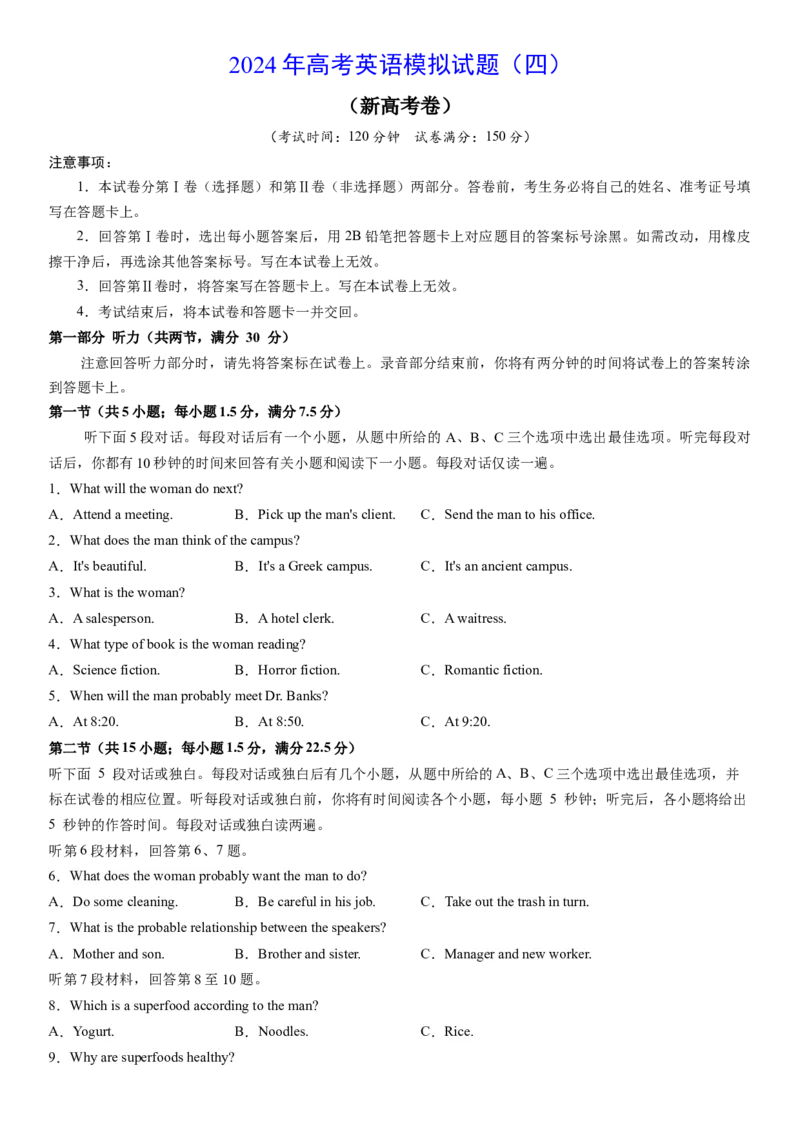
2024 年高考英语模拟试题(四)
(新高考卷)
(考试时间:120分钟 试卷满分:150分)
注意事项:
1.本试卷分第Ⅰ卷(选择题)和第Ⅱ卷(非选择题)两部分。答卷前,考生务必将自己的姓名、准考证号填
写在答题卡上。
2.回答第Ⅰ卷时,选出每小题答案后,用2B铅笔把答题卡上对应题目的答案标号涂黑。如需改动,用橡皮
擦干净后,再选涂其他答案标号。写在本试卷上无效。
3.回答第Ⅱ卷时,将答案写在答题卡上。写在本试卷上无效。
4.考试结束后,将本试卷和答题卡一并交回。
第一部分 听力(共两节,满分 30 分)
注意回答听力部分时,请先将答案标在试卷上。录音部分结束前,你将有两分钟的时间将试卷上的答案转涂
到答题卡上。
第一节(共5小题;每小题1.5分,满分7.5分)
听下面5段对话。每段对话后有一个小题,从题中所给的 A、B、C三个选项中选出最佳选项。听完每段对
话后,你都有10秒钟的时间来回答有关小题和阅读下一小题。每段对话仅读一遍。
1.What will the woman do next?
A.Attend a meeting. B.Pick up the man's client. C.Send the man to his office.
2.What does the man think of the campus?
A.It's beautiful. B.It's a Greek campus. C.It's an ancient campus.
3.What is the woman?
A.A salesperson. B.A hotel clerk. C.A waitress.
4.What type of book is the woman reading?
A.Science fiction. B.Horror fiction. C.Romantic fiction.
5.When will the man probably meet Dr. Banks?
A.At 8:20. B.At 8:50. C.At 9:20.
第二节(共15小题;每小题1.5分,满分22.5分)
听下面 5 段对话或独白。每段对话或独白后有几个小题,从题中所给的A、B、C三个选项中选出最佳选项,并
标在试卷的相应位置。听每段对话或独白前,你将有时间阅读各个小题,每小题 5 秒钟;听完后,各小题将给出
5 秒钟的作答时间。每段对话或独白读两遍。
听第6段材料,回答第6、7题。
6.What does the woman probably want the man to do?
A.Do some cleaning. B.Be careful in his job. C.Take out the trash in turn.
7.What is the probable relationship between the speakers?
A.Mother and son. B.Brother and sister. C.Manager and new worker.
听第7段材料,回答第8至10题。
8.Which is a superfood according to the man?
A.Yogurt. B.Noodles. C.Rice.
9.Why are superfoods healthy?A.Because they cure some terrible diseases.
B.Because they fight against some cancers.
C.Because they reduce the risks of some diseases.
10.Which food will the woman be adding to their family diet?
A.Fish. B.Tomatoes. C.Brown rice.
听第8段材料,回答第11至13题。
11.What was the woman doing when she heard a noise'?
A.She was doing the dishes.
B.She was cleaning the living room.
C.She was polishing the table
12.Who may be the man speaker?
A.A police officer. B.The woman's husband. C.The woman's friend.
13.When does the conversation probably take place?
A.On an early morning. B.Around noon. C.In the evening.
听第9段材料,回答第14至17题。
14.How did the man notice the problem first?
A.His bank called him. B.His bill showed him. C.His credit card was stolen.
15.What did the bank do to fix the problem?
A.They gave the man his money back at once.
B.They decided to talk to the bank’s owner.
C.They asked the man to provide the evidence.
16.What might have caused the problem according to the man?
A.Online shopping. B.Overdue debt. C.Unskilled operation.
17.What do the two speakers mainly talk about?
A.Information safety. B.Shopping habits. C.Money management.
听第10段材料,回答第18至20题。
18.What will Todd Messegee be responsible for?
A.Writing a play. B.Directing a play. C.Starring in a play.
19.What will participants mainly do by the fourth day?
A.Practice the play. B.Attend a lecture on acting. C.Perform on stage formally.
20.What is the speaker doing?
A.Advertising an acting program.
B.Drawing up a plan for a program.
C.Announcing arrangements for a play.
第二部分 阅读(共两节,满分50分)
第一节(共15小题;每小题2.5分,满分37.5分)
阅读下列短文,从每题所给的A、B、C、D四个选项中选出最佳选项。
A
Louis Pasteur once said, “Chance favors the prepared mind.” That’s the truth behind the following inventions — the
scientists were prepared and were able to see the magic in a mistake.Mauve
In 1856, William Perkin was trying to come up with an artificial medicine, but his experiments produced a thick mess.
But the more Perkin looked at it, the more he saw a beautiful color in his mess. Turns out he had made mauve, the first-ever
synthetic dye (合成染料), which was far better than any natural dyes: the color was brighter, clearer, and didn’t fade or
wash out.
Superglue
This super-sticky substance was discovered by accident — twice! Chemist Harry Coover had been attempting to make
clear plastic gun sights, and in 1942 one method he tested produced an extremely quick bonding adhesive (黏合剂). It was
useless for his gun sights, though, and he forgot about it until almost ten years later, when he came across it again while
developing heat-resistant parts for airplanes. This time he realised its potential, and the product was put on the market.
Plastic
In 1907, shellac (虫胶) was used in electronics. It was costly, so American chemist Leo Hendrik Baekeland tried to
produce an alternative. Instead, his experiments produced a material that could take high temperatures. He later developed it
into plastic, and it was soon used in the production of almost everything.
Teflon
Back in the 1930s, Young DuPont chemist Roy Plunkett was working to make a new kind of CFC for refrigeration.
After storing the gas in certain containers, he opened one to discover that it had changed into a white powder that was
extremely sticky and had a very high melting point. Three years later, the substance, which was named Teflon, was patented.
21.Which invention came out earliest?
A.Mauve. B.Superglue. C.Plastic. D.Teflon.
22.Who recognized the value of his original invention when developing airplane parts?
A.William Perkin.B.Harry Coover. C.Leo Hendrik. D.Roy Plunkett.
23.What do the inventions have in common?
A.They were made by accident. B.They could take high temperatures.
C.They received no recognition at first. D.They could be used in medical fields.
B
Sagarika Sriram was 10 years old when she started reading newspaper stories about a planet in trouble, one of which
was about turtles with plastic in their stomachs. Sagarika knew she needed to do something. First, she joined a group which
organized cleanup campaigns in her home city, Dubai “The group helped me understand what an individual can do and how
I can really make a difference,” she says.
Then Sagarika created Kids for a Better World. It’s a digital platform which has brought together nearly 10,000 youths
from all over the world with the goal to create a greener world.
Sagarika is now 16. She’s part of a growing number of young climate activists. “We’re the generation that is going to
face the results if the climate crisis is not dealt with,” she says. She believes even individual actions can create a “ripple
effect”. Sagarika says this can build momentum and can move things in the right direction.
Kids for a Better World is for people aged 8 to 16. It teaches them about what they can do to reverse climate change.
They can grow food, plant trees, collect recyclables and avoid using plastic bags. “This is the information which can help
change our future,” Sagarika says.
Dubai is a desert metropolis. Growing up there has made Sagarika very aware of the need for action. Her city faces the
risk of rising temperatures and its water supply is shrinking. She believes young people can bring attention to these
environmental challenges.
Sagarika is all about small actions, but she has big plans. She’d like to go to college in California. While she’s there,she’ll continue being an activist. She’ll also be running Kids for a Better World. She hopes to inspire others to fight for a
greener planet. Others have inspired her. “We’re creating our own system of inspirational change-makers,” she says.
24.Why did the author mention “turtles with plastic in their stomachs” in paragraph 1?
A.To make a comparison B.To give an example.
C.To analyze the problem. D.To introduce the topic.
25.Why did Sagarika created Kids for a Better World?
A.Because she wanted to create a greener world.
B.Because she wanted to bring together nearly1000 youths.
C.Because she wanted to read newspaper stories.
D.Because she wanted to save the turtle.
26.What does the fourth paragraph mainly tell us?
A.What can help change our future. B.What people should do at present.
C.What Kids for a Better World does. D.What courses are taught on the platform.
27.Which of the following words can best describe Sagarika?
A.Generous and friendly. B.Brave and smart.
C.Persistent and inspirational. D.Noble-minded and careful.
C
After being driven to near extinction, wolves are back in Washington state.
Wolf 32M, called The Old Guy by wolf specialist Ben Maletzke, lived some 12 years as the patriarch (族长) of the
Teanaway Pack, kicking off the recovery of wolves in Washington. The pack’s territory was roasted by wildfire in 2014. But
wolf 32M and his family remained in existence, bringing the call of the wild back for the first time in a century. These
wolves are what Maletzke calls stepping stones in recovery — the animals that could help lead the way to new territory not
yet repopulated by wolves.
Wolves spread to new territory to find mates and begin packs of their own. It is this pack dynamic that wildlife
biologists are counting on, in time, to urge wolves into areas where they do not presently live. “We just need a couple to
pick up and go,” Maletzke says.
All along, the Teanaway pack has stayed mostly out of trouble probably, helped by a lot of range riding (牧区巡逻)
intended to help reduce conflicts over wolf recovery by keeping wolves away from cattle. “He is an example of wolves
living and doing what they do, even around people,” Maletzke says of wolf 32M.
Story Warren, a student at the University of Montana, was just a girl when she first saw 32M’s tracks in the Teanaway
River Valley — an exciting encounter that helped generate a serious interest in wildlife that now fuels her studies. To her,
the return of the wolf is about more than the species; it is about recovering something even bigger: hope.
“Growing up in my generation, there is so much bad ecological news, a lot of hopelessness about climate change and
loss of biodiversity and extinctions,” Warren says, “To have something as wild as wolves coming back to Washington is
very encouraging for me — just to know such an amazing and powerful creature exists.”
28.Why does Maletzke call Wolf 32M family “stepping stones”?
A.They are nearly dying out. B.They are victims of wildfire.
C.They are worth protection. D.They are pioneers in wolf recovery.
29.What function does paragraph 3 serve?
A.To present a result. B.To clarify a concept.
C.To offer an explanation. D.To make a prediction30.What can be learned from the example of the Teanaway pack?
A.Wolves face a lot of trouble.
B.Wolf recovery counts on its population.
C.Certain measures to ensure cattle safety are required.
D.Wolves should be forbidden from human residence.
31.What does Warren think of the coming back of wolves?
A.It fuels more studies on wildlife. B.It clears up bad ecological news.
C.It worsens climate change. D.It excites hope for the ecosystem.
D
A new research in Nature reveals that a warming world is increasing human-wildlife conflicts. “We found evidence of
conflicts between people and wildlife exacerbated by climate change on six continents, in five different oceans, in marine
systems, in freshwater systems-involving mammals, birds, fish and so on,” said lead author Briana Abrahms.
To identify trends, the team studied published, peer—reviewed incidents of human—wildlife conflicts and identified
cases that were linked specifically to the effects of climate change. These include both short-term climate events-such as a
drought-as well as longer-term changes. Warming in the Arctic, for example, is leading to loss of sea ice which has left polar
bears short of food. They increasingly travel on land, sometimes entering human settlements and attacking people, as a
recent incident in Alaska illustrates.
Most cases of human-wildlife conflicts linked to climate involve a shift in resources—not just for wildlife, but also for
people.
A majority of cases on land also involved a change in precipitation (降水), which will continue to be affected by
climate change. Many resulted in human deaths or injuries, as well as property damage. “Identifying and understanding this
link between human-wildlife conflicts is not only a conservation issue,” said Abrahms. “It is also a social justice and human
safety issue. These types of conflicts are likely to rise as climate change intensifies (加剧), particularly as mass migrations
of people and wildlife increase and resources shift.”
But, it doesn’t have to be all bad news. “One major motivation in studying the link between climate change and
human-wildlife conflicts is finding solutions,” said Abrahms. “As we learn about specific incidents, we can identify patterns
and tends-and come up with interventions (干预) to try to address these conflicts.”
Some interventions may be as simple as public-awareness campaigns. Governments can also plan for times when
extreme climate events will bring people and wildlife into closer contact. “Once you know the root causes of a conflict, you
can design interventions to help both people and wildlife,” said Abrahms. “We can change.”
32.What does the underlined word “exacerbated” in paragraph 1 mean?
A.Anticipated. B.Perceived. C.Worsened. D.Faded.
33.Why does the author mention the case of polar bears in paragraph 2?
A.To show climate change can drive conflicts by altering animal habitats.
B.To compare humans’ behaviors with animal’s in increasing conflicts.
C.To inform humans of protecting wildlife in response to climate change.
D.To prove animals have a hard life in face of global warming nowadays.
34.Which of the following statements would Abrahms agree with?
A.Human-wildlife conflicts will be settled soon.
B.Human-wildlife conflicts can increase as resources shift.C.There will be no conflicts if people and wildlife stay where they are.
D.The goal in studying human-wildlife conflicts is gaining support.
35.What does Abrahms think of interventions?
A.They are too simple. B.They are out-of-date.
C.They are changeable. D.They are beneficial.
第二节(共5小题;每小题2.5分,满分12.5分)
阅读下面短文,从短文后的选项中选出可以填入空白处的最佳选项。选项中有两项为多余选项。
For some people, practicing gratitude is part of their spiritual practice or religion, while for others, it’s about cultivating
a more positive outlook on life. 36 , there is no doubt about the benefits to be gained.
Improved mood
When you practice gratitude, you shift your focus from negative thoughts and feelings to positive ones. Instead of
thinking about everything that makes you unhappy, gratitude makes you think about all the things that are good — no
matter how big or small. Practicing gratitude will make you feel more optimistic. 37 .
Better relationship
When you think about all the things you are grateful for, you will think of the people in your life that you care for —
your family and friends. 38 , chances are that you’ll want to show them how much they mean to you and how
much you appreciate them. And that can strengthen your connection with them.
Reduced stress
39 . So they often feel stressed. Maybe they’re having trouble at work, maybe they’re in financial difficulty,
or maybe they feel like they’re just not good enough at something. But by practicing gratitude, they’re able to view things
properly.
40
Instead of focusing on all the things that you’re bad at or things you’ve failed at, practicing gratitude will shift your
focus on all the amazing things you’ve accomplished. And once you realize that, you’ll boost your feelings of achievement.
Just focus on what you are grateful for in yourself. It will help you to appreciate your own strengths and talents.
A.Increased focus
B.Improved self-worth
C.People are facing a certain problem
D.You have plenty of reasons to be happy
E.That helps you realize life isn’t as bad as you thought
F.Whatever someone’s reason for practicing gratitude is
G.Once you realize how grateful you are to have them in your life
第三部分 语言运用(共两节,满分30分)
第一节 (共15小题;每小题1分,满分15分)
阅读下面短文,从每题所给的A、B、C、D四个选项中选出可以填入空白处的最佳选项。
I would be regretful if I did not write about the incredible people we met in Thailand. The staff at the hotels we stayed
in went out of their way to make us feel 41 .It could be argued that they were just doing their 42 , but this is
not how it felt to us.
At the IuDia Hotel in Ayutthaya the staff went above and 43 what we would have expected. The dining room was
not open in the evening and when we asked where we could get a takeaway meal, the front desk clerk 44 us to the
nearby restaurant. After we returned, the hotel staff 45 us with what we needed—plates and cutlery. Not only did theyput our food in servicing bowls, but also they 46 the clean-up while we slept. We were 47 and deeply touched
by their kindness and 48
On one of our walks my brother and I were offered bottles of freshwater by one of the locals. She felt that we needed it
and did not want to take 49 for the two bottles she offered. She 50 agreed to take 10 Thai bahts; instead, we
gave her 20. My brother 51 that her kindness deserved more than the 20 Thai bahts. We all laughed, sharing a moment
of comradery that still 52 my heart.
Our experiences were a 53 to be open, willing to interact with 54 and to share parts of ourselves with them
as well—a 55 worth learning and remembering.254
41.A.relaxed B.amused C.welcome D.surprised
42.A.affair B.share C.problems D.matters
43.A.across B.besides C.over D.beyond
44.A.urged B.watched C.walked D.informed
45.A.granted B.delivered C.purchased D.provided
46.A.kept track of B.took care of C.caught up with D.put up with
47.A.dreadful B.grateful C.regretful D.hopeful
48.A.care B.passion C.generosity D.awareness
49.A.place B.charge C.responsibility D.payment
50.A.carefully B.quickly C.eventually D.reluctantly
51.A.insisted B.involved C.persuaded D.proposed
52.A.warms B.moves C.races D.strikes
53.A.principle B.memory C.thought D.reminder
54.A.strangers B.acquaintances C.waiters D.givers
55.A.task B.lesson C.moment D.subject
第二节(共10小题;每小题1. 5分, 满分15分)
阅读下面材料,在空白处填入适当的内容(1个单词)或所给单词的正确形式。
Woodblock printing is an ancient printing technique that boosted human civilization. As Buddhism gained popularity
in China during the Tang Dynasty, a strong need 56 (arise) to produce numerous Buddhist scriptures(经书), and
copying by hand could not meet 57 rising demand. Ancient Chinese craftsmen thus invented woodblock printing
for mass production, 58 (mark) a major turning point in printing history.
There are four steps involved in 59 (tradition) woodblock printing, with each step sub-divided into several
procedures. 60 lies at the center of the technique is carving. Characters and images 61 (carve) to
produce raised areas or lines that will eventually apply ink to paper.
A five-meter scroll of the Buddhist scripture Diamond Sutra, 62 (make) in868, is the “earliest dated printed
book” in the words of the British Library 63 it is stored. It is just one example of ancient works of art that not
only tell the wisdom of our ancestors, but also demonstrate the 64 (pursue) of beauty by Chinese craftsmen
throughout centuries.
The invention of writing gave life 65 great thoughts, but it is the invention of printing that made
knowledge a shareable fruit for all humankind.
第四部分 写作(共两节, 满分40分)
假定你是李华,你的外国留学生朋友James想在中国进行社会实践,现有如下两种选择:博物馆讲解员或乡村中
学志愿者。James来信向你寻求建议,请你给他回信,内容包括:1.建议其中一项活动;
2.说明至少两点理由。
注意:
1.写作词数应为80左右;
2.请按如下格式在答题卡的相应位置作答。
Dear James,
How is everything going?
___________________________________________________________________________________________________
___________________________________________________________________________________________________
___________________________________________________________________________________________________
___________________________________________________________________________________________________
____________________________________________________________
Best regards,
Li Hua
第二节(满分25分)
阅读下面材料,根据其内容和所给段落开头语续写两段,使之构成一篇完整的短文。
Paula started working as part of the janitorial (保洁的) staff at a big office building. As Mr. Alexander, the janitorial
manager said, the job was difficult for a disabled granny like her. And some of her coworkers worried about having to take
on extra work to make up for what she couldn’t do, but the older woman proved them all wrong.
She was efficient, almost better than those who could walk perfectly. She was always on time, made no excuses, and
learned from her mistakes. Her teenage grandkids helped her, and together, they proved to the state that Paula was their best
guardian.
For years, Paula had lived on her pension and disability benefits, which were only enough for bills and a few
necessities. Also, being at home with nothing to do made her feel worthless.
But her life brightened when her grandkids visited, and her daughter and son-in-law had been fantastic parents. Their
passing in a car accident was tragic, especially when it looked like the three kids would be separated into different foster
homes and shelters.
Paula knew she had to do something, and she did. Mr. Alexander praised her work ethic often, and she made friends
with her colleagues. It was a good situation. Tiring but better than not being able to see her grandkids ever again.
It was getting close to the end of the business day, and Paula was already done with her responsibilities. She placed
everything in its proper place and looked around in case she had forgotten something. A misplaced trash bag was sitting in a
corner. It wasn’t supposed to be there. Paula shook her head, smiling. “Someone forgot,” she commented as she approached
the bag. She decided to take the trash out herself. However, it was heavier than usual. She couldn’t even lit it properly.
“Jesus, what’s in here?” she wondered as her fingers untied the knot.
注意:
1.续写词数应为150左右;
2.请按如下格式在答题卡的相应位置作答。
To her surprise, the bag contained big piles of money, which could set a person up for life!
___________________________________________________________________________________________________
___________________________________________________________________________________________________
___________________________________________________________________________________________________
_______________________________________________________________________________________________________________________________________________________________
The police came immediately.
___________________________________________________________________________________________________
___________________________________________________________________________________________________
___________________________________________________________________________________________________
___________________________________________________________________________________________________
____________________________________________________________