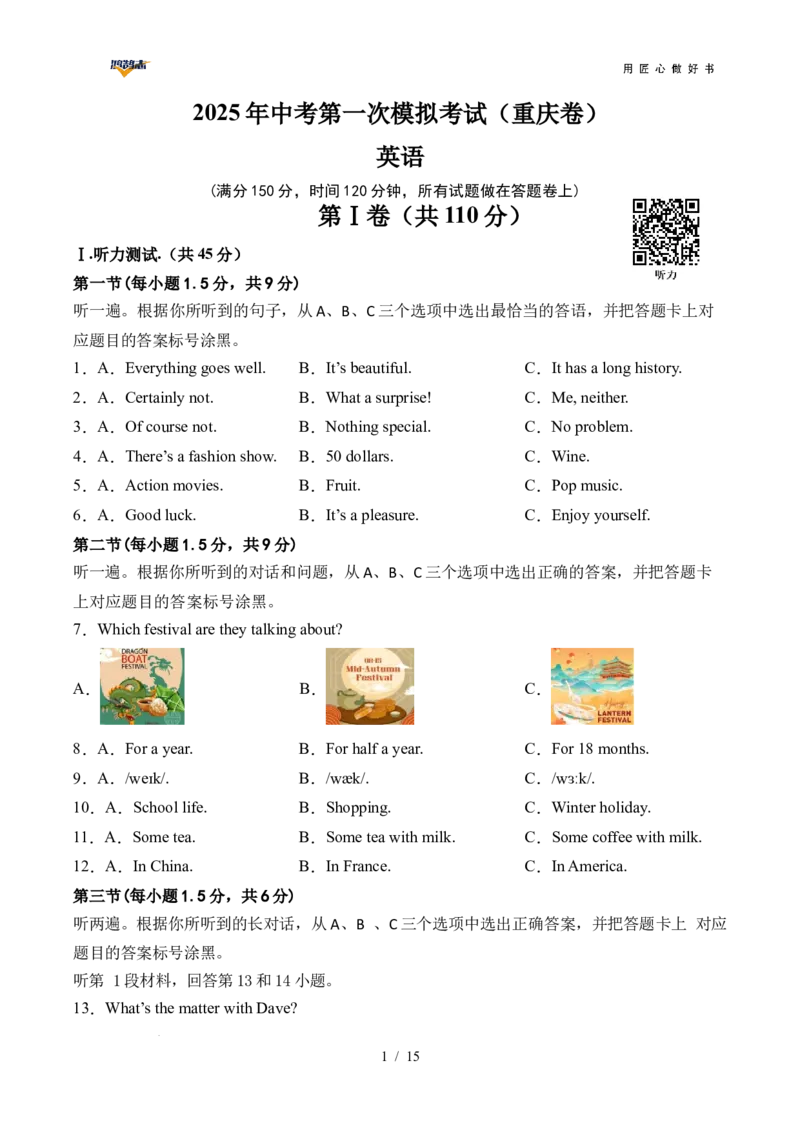
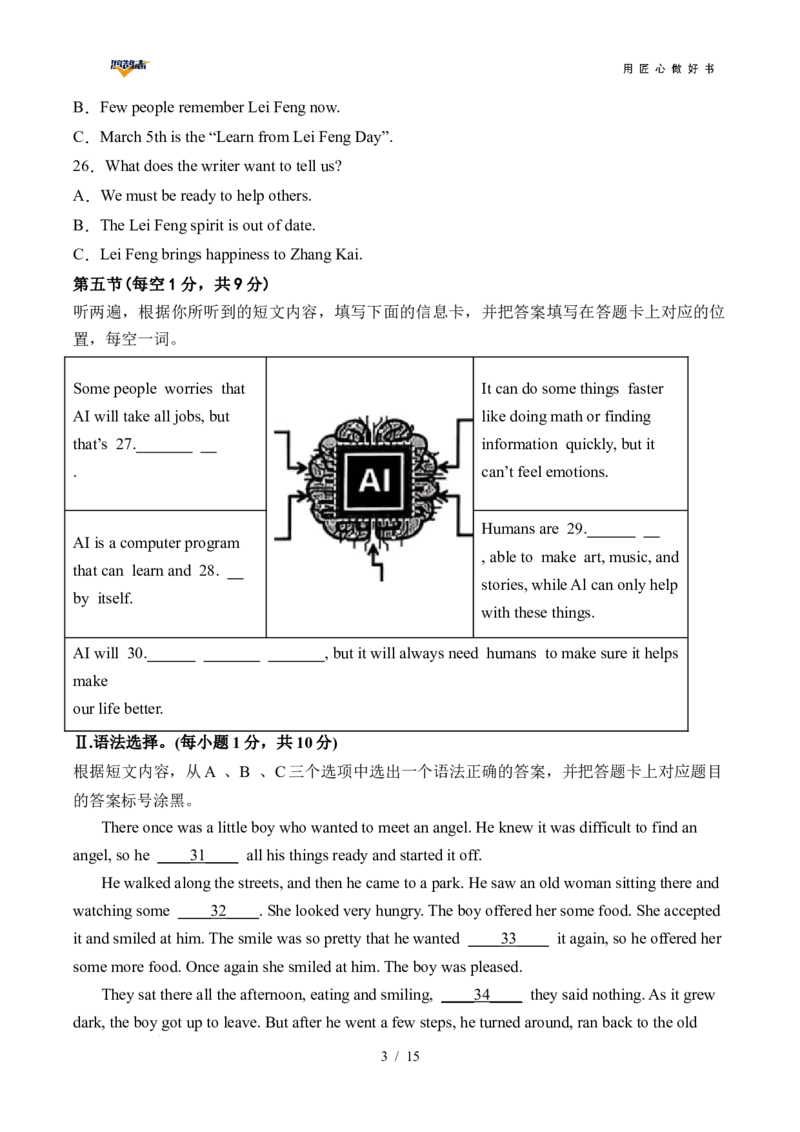
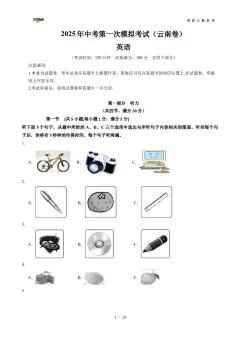
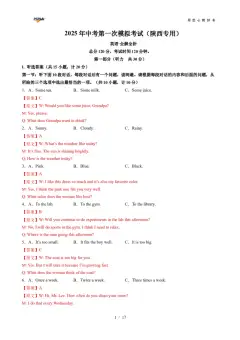
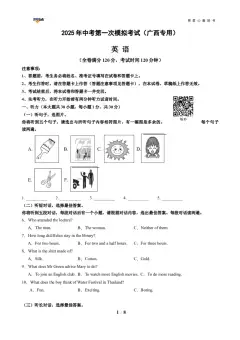
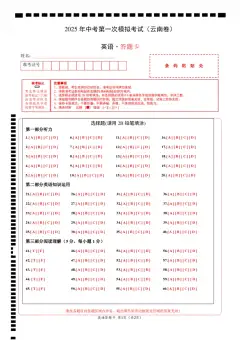
2025 年中考第一次模拟考试(重庆卷)
英语
(满分150分,时间120分钟,所有试题做在答题卷上)
第Ⅰ卷(共 110 分)
Ⅰ.听力测试.(共45分)
第一节(每小题1.5分,共9分)
听一遍。根据你所听到的句子,从A、B、C三个选项中选出最恰当的答语,并把答题卡上对
应题目的答案标号涂黑。
1.A.Everything goes well. B.It’s beautiful. C.It has a long history.
2.A.Certainly not. B.What a surprise! C.Me, neither.
3.A.Of course not. B.Nothing special. C.No problem.
4.A.There’s a fashion show. B.50 dollars. C.Wine.
5.A.Action movies. B.Fruit. C.Pop music.
6.A.Good luck. B.It’s a pleasure. C.Enjoy yourself.
第二节(每小题1.5分,共9分)
听一遍。根据你所听到的对话和问题,从A、B、C三个选项中选出正确的答案,并把答题卡
上对应题目的答案标号涂黑。
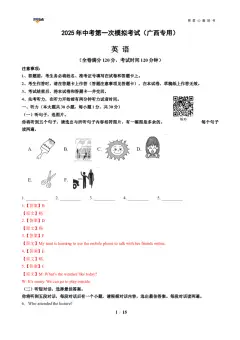
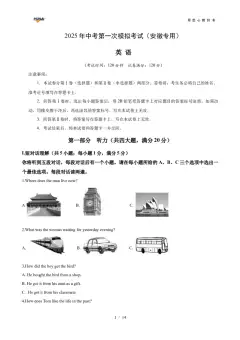
7.Which festival are they talking about?
A. B. C.
8.A.For a year. B.For half a year. C.For 18 months.
9.A./weɪk/. B./wæk/. C./wɜːk/.
10.A.School life. B.Shopping. C.Winter holiday.
11.A.Some tea. B.Some tea with milk. C.Some coffee with milk.
12.A.In China. B.In France. C.In America.
第三节(每小题1.5分,共6分)
听两遍。根据你所听到的长对话,从A、B 、C三个选项中选出正确答案,并把答题卡上 对应
题目的答案标号涂黑。
听第 1段材料,回答第13和14小题。
13.What’s the matter with Dave?
1 / 15
学科网(北京)股份有限公司A.His leg hurts. B.He has a cold. C.His head hurts.
14.Which of the following is right about Dave?
A.He didn’t play basketball.B.He didn’t do his homework. C.He didn’t go to a movie.
听第 2段材料,回答第15—18小题。
15.What is the woman doing?
A.Visiting a library. B.Interviewing a person. C.Reading a newspaper .
16.What is the man going to make?
A.A tie. B.A box. C.A tree.
17.Why does the man decide to make this art piece?
A.To show off his art talent.
B.To call on people to plant more trees.
C.To encourage people to recycle more.
18.What are the two speakers mainly talking about?
A.Used things. B.Different art pieces. C.An activity on Earth Day.
听第 3段材料,回答第19—22小题。
19.What gift does the man give the woman this year for her birthday?
A.Some flowers. B.A novel. C.A magazine.
20.What does the man do for a living?
A.A writer. B.A painter. C.A designer.
21.What did the man do yesterday?
A.He hurt himself. B.He went to the pet hospital. C.He visited his brother.
22.Which words can best describe Ben?
A.Modest and shy. B.honest and humorous. C.Caring and helpful.
第四节(每小题1.5分,共6分)
听两遍,根据你所听到的短文内容,从A、B、C三个选项中选出正确答案,并把答题卡上对
应题目的答案标号涂黑。
23.Who gets help from Zhang Kai and his group?
A.The poor. B.The old man. C.The primary school students.
24.What did Lei Feng give to the parents of another soldier?
A.Tickets. B.Money. C.Letters.
25.Which of the following is TRUE?
A.Lei Feng died 22 years ago.
2 / 15
学科网(北京)股份有限公司B.Few people remember Lei Feng now.
C.March 5th is the “Learn from Lei Feng Day”.
26.What does the writer want to tell us?
A.We must be ready to help others.
B.The Lei Feng spirit is out of date.
C.Lei Feng brings happiness to Zhang Kai.
第五节(每空1分,共9分)
听两遍,根据你所听到的短文内容,填写下面的信息卡,并把答案填写在答题卡上对应的位
置,每空一词。
Some people worries that It can do some things faster
AI will take all jobs, but like doing math or finding
that’s 27. information quickly, but it
. can’t feel emotions.
Humans are 29.
AI is a computer program
, able to make art, music, and
that can learn and 28.
stories, while Al can only help
by itself.
with these things.
AI will 30. , but it will always need humans to make sure it helps
make
our life better.
Ⅱ.语法选择。(每小题1分,共10分)
根据短文内容,从A 、B 、C三个选项中选出一个语法正确的答案,并把答题卡上对应题目
的答案标号涂黑。
There once was a little boy who wanted to meet an angel. He knew it was difficult to find an
angel, so he ____ 31 ____ all his things ready and started it off.
He walked along the streets, and then he came to a park. He saw an old woman sitting there and
watching some ____ 32 ____ . She looked very hungry. The boy offered her some food. She accepted
it and smiled at him. The smile was so pretty that he wanted ____3 3 ____ it again, so he offered her
some more food. Once again she smiled at him. The boy was pleased.
They sat there all the afternoon, eating and smiling, ____ 34 ____ they said nothing. As it grew
dark, the boy got up to leave. But after he went a few steps, he turned around, ran back to the old
3 / 15
学科网(北京)股份有限公司woman and gave ____ 35 ____ a hug. The woman gave him her biggest smile ever.
When the boy came back home, his mother ____ 36 ____ by the look of joy on his face, and she
asked ____ 37 ____ made him so happy. “I had lunch with an angel. She has got the most beautiful
smile in the world.” ____ 38 ____ the same time, the old woman’s son also noticed his mother’s
pleasure and asked why.
“I ate some nice food in the park with an angel,” she said, “and he is much ____ 39 ____ than I
expected.”
Angels are everywhere. We just need to share our ____ 40 ____ and smile at others to meet
them.
31.A. got B. gets C. will get
32.A. bird B. bird’s C. birds
33.A. see B. to see C. seeing
34.A. but B. so C. or
35.A. hers B. her C. she
36.A. surprises B. surprised C. was surprised
37.A. when B. what C. how
38.A. Of B. To C. At
39.A. nice B. nicer C. nicest
40.A. kindness B. kindly C. kind
Ⅲ .完型填空。(每小题1.5分,共15分)
根据短文内容,从A、B、C、D四个选项中选出一个能填入相应空格内的最佳答案,并把答
题卡上对应题目的答案标号涂黑。
Deepseek: Releasing the Power of AI
In the fast - developing world of technology, Deepseek has emerged as a remarkable
41 . It is an advanced artificial intelligence system that has been making waves in various
fields.
Deepseek is designed to process vast amounts of 42 quickly and accurately. For
example, in the medical field, it can 43 through patient records, symptoms, and
research data to help doctors make more precise diagnoses. In education, it can offer
personalized learning plans for students, based on their learning 4 4 and performance.
One of the most amazing features of Deepseek is its 45 to understand natural
language. This allows it to communicate with people in a more 4 6 way. Whether you
are asking for information, seeking advice, or just having a casual chat, Deepseek can
4 / 15
学科网(北京)股份有限公司respond appropriately.
However, like any new technology, Deepseek also 47 some challenges. Some
people are 48 about its potential impact on jobs. They worry that as AI systems like
Deepseek become more capable, they might 49 human workers in certain positions.
But on the other hand, new jobs are also being created in the field of AI development and
maintenance.
50 , Deepseek is a powerful tool that has the potential to bring about great
changes. As long as we use it wisely, it can be a valuable asset for our society.
41. A. invention B. discovery C. project D. plan
42. A. energy B. information C. knowledge D. money
43. A. walk B. look C. search D. pass
44. A. habits B. hobbies C. dreams D. goals
45. A. thought B. ability C. decision D. choice
46. A. strange B. friendly C. normal D. formal
47. A. faces B. solves C. creates D. overcomes
48. A. excited B. happy C. worried D. curious
49. A. replace B. help C. teach D. train
50. A. In a word B. In the end C. At first D. By the way
IV. 阅读理解。(51-53每小题1分,54-69每小题2分,共35分)
阅读下列材料,从A、B、C、D四个选项中选出最佳答案,并把答题卡上对应题目的答案标
号涂黑。
A
JOIN A WILD JOURNEY!
JOIN in The Wild Escape and help create one big digital (数字的) artwork that’s all about
showing how much you care for the nature around us.
This month, you’re invited to take part in The Wild Escape, a new project to inspire creativity
around wildlife for pupils aged 7 to 11 years old, to find an animal you like in a local museum and
create your own picture.
These pictures will then be uploaded and shown as part of a Wild World one big digital artwork
at the end of this month.
Hope you’ll come and take action to care for nature.
5 / 15
学科网(北京)股份有限公司Ready for a journey?
Here’s how to take part:
◆Head along to your local museum and find one of the many animals waiting for you there.
◆What do you see? It could be an animal crouching (蹲伏) in a painting or sitting in a photo!
Whatever you find, make sure you have a good, long look at it.
◆Create a picture that imagines your animal coming to life and taking a wild journey to a new
world.
◆Now, visit www. art fund. org/firstnews to send your picture to a huge digital artwork.
51. We can learn from the text that The Wild Escape ________.
A. expects pupils to care for nature B. tries to find creative pupils aged 12
C. plans to start a new project next month D. is going to raise money for museums
52. To take part in The Wild Escape, you have to ________.
A. study an animal in the wild B. take a drawing lesson
C. hand in your picture online D. pay a visit to a local zoo
53.What is the text?
A. A diary. B. An advertisement. C. A news report. D. A book review.
B
Huang Xuhua is a remarkable figure in China's history of national defense. He is widely
known as the "Father of China's Nuclear - powered Submarines".
In the 1950s, China faced great challenges in national defense. To strengthen the
country's naval power, Huang Xuhua dedicated himself to the research and development of
nuclear - powered submarines. At that time, the research conditions were extremely difficult.
There was a lack of advanced technology and experience, and the international community
imposed strict technological blockades. But Huang Xuhua and his team did not give up.
They spent countless days and nights in the laboratory and on the construction site.
Huang Xuhua often worked around the clock, sacrificing his personal time and family life.
Through their unremitting efforts, in 1970, China's first nuclear - powered submarine was
successfully launched. This was a huge milestone in China's naval development, greatly
enhancing China's national defense capabilities.
6 / 15
学科网(北京)股份有限公司Huang Xuhua's contributions are not only limited to the successful development of
nuclear - powered submarines. He also trained a large number of outstanding scientific and
technological talents for China. His spirit of dedication, perseverance, and innovation has
inspired generations of Chinese people. Even in his later years, he still cares about the
development of China's submarine technology and is always ready to offer his wisdom and
experience.
54. Why is Huang Xuhua called the "Father of China's Nuclear - powered Submarines"?
A. Because he was the first to propose the idea of building nuclear - powered
submarines.
B. Because he made great contributions to the research and development of China's
nuclear - powered submarines.
C. Because he was the leader of the international submarine research team.
D. Because he designed the most advanced nuclear - powered submarines in the world.
55. What difficulties did Huang Xuhua and his team face in the 1950s?
A. They had too much advanced technology to choose from.
B. There was a lack of technology and experience, and they faced international
technological blockades.
C. They didn't have enough workers to build the submarines.
D. The government didn't support their research work.
56. When was China's first nuclear - powered submarine successfully launched?
A. In the 1950s. B. In 1970.
C. In his later years. D. In the 1960s.
57. What can we learn from Huang Xuhua?
A. We should only focus on our personal interests.
B. We should give up easily when facing difficulties.
C. We should have the spirit of dedication, perseverance, and innovation.
D. We should not care about the development of our country.
C
"Nezha 2" has recently become a hot - topic among movie - goers, continuing the epic
tale of the fearless young hero Nezha. This sequel not only brings back the beloved
characters but also unfolds a more complex and engaging story.
The movie begins with Nezha facing new challenges. After the events of the first film,
where he defied fate and saved his hometown, Nezha has gained fame, but also new
7 / 15
学科网(北京)股份有限公司enemies. A powerful and mysterious dark force emerges, threatening to plunge the world
into chaos. This dark force has unique magical abilities that can disrupt the balance of the
three realms - the celestial realm, the human realm, and the demon realm.
Nezha, along with his loyal friends including Ao Bing, sets out on a new adventure to
stop this threat. However, their journey is filled with hardships. They have to travel through
dangerous and uncharted lands, encounter strange creatures, and solve ancient puzzles. Nezha,
who is known for his impulsive nature, must learn to control his emotions and use his
powerful magic more wisely. For example, in one scene, when they are trapped in a magical
maze, Nezha's initial attempt to break through with brute force only makes the situation
worse. It is through teamwork and his new - found patience that they manage to find a
way out.
The visual effects in "Nezha 2" are truly stunning. The battles between the forces of
good and evil are depicted with vivid colors and spectacular magical displays. The animation
team has outdone themselves in creating detailed and imaginative landscapes, from the
floating islands of the celestial realm to the fiery depths of the demon world.
Moreover, the movie delves deeper into the themes of friendship, responsibility, and the
true meaning of heroism. Nezha and his friends' unwavering loyalty to each other is tested
time and time again, but they always stand by one another. And Nezha's growing
understanding of his responsibility as a hero, not just to his hometown but to the entire
world, adds a profound layer to the story.
58. What is the main threat in "Nezha 2"?
A. Nezha's own impulsive nature. B. A powerful and mysterious dark
force.
C. The jealousy of other heroes. D. The lack of trust among Nezha's
friends.
59. Why does Nezha need to control his emotions?
A. Because his emotions can trigger natural disasters.
B. Because his friends are tired of his bad temper.
C. Because uncontrolled emotions make it harder to solve problems.
D. Because the dark force can use his emotions against him.
60. What can we learn about the visual effects in "Nezha 2"?
A. They are simple but effective.
B. They are mainly focused on the characters' expressions.
8 / 15
学科网(北京)股份有限公司C. They are stunning with vivid colors and spectacular magical displays.
D. They are not as good as those in the first movie.
61. What themes does "Nezha 2" explore?
A. Love, betrayal, and revenge.
B. Friendship, responsibility, and the true meaning of heroism.
C. Greed, power, and corruption.
D. Luck, destiny, and the afterlife.
D
Resting my head on Helen's shoulder, I put my arms round her waist(腰). She drew me
to her, and we rested in silence.
We had not sat long before another person came in. Some heavy clouds, swept from the
sky by a rising wind, had left the moon bright; and her light, coming in through a window
near, shone full both on us and on the coming person, Miss Temple.
“I came on purpose to find you, Jane Eyre,” said she. “I want you in my room,
and as Helen Burns is with you, she may come too.”
We followed Miss Temple to her apartment. It had a good fire, and looked cheerful.
Miss Temple told Helen Burns to be seated in a low arm - chair on one side of the
fireplace, and herself taking another, she called me to her side.
“Is it all over?” she asked, looking down at my face. “Have you cried your sadness
away?”
“I am afraid I never shall do that.”
“Why?”
“Because I have been wrongly accused(指责), and you and everybody else, will now
think me a bad girl.”
“We shall think you what you prove yourself to be, my child. Continue to act as a
good girl, and you will satisfy us.”
“Shall I, Miss Temple?”
“You will.” said Miss Temple, “You have been accused of lying when you were
little. Tell us the truth, but add nothing and exaggerate(夸大)nothing.”
I made up my mind that I would be most modest and most correct. Having thought for
a few minutes about where to start, I told her all the story of my sad childhood.
—Adapted from Jane Eyre
62. What can we infer from the underlined part “Some heavy clouds, swept from the sky
9 / 15
学科网(北京)股份有限公司by a rising wind, had left the moon bright”?
A. Jane's sad mood would last long. B. Something good would happen to
Jane.
C. The weather would influence Jane's feelings. D. Miss Temple liked the moonlight.
63. Why did Jane think she couldn't cry her sadness away?
A. She was too sad to stop crying.
B. She didn't believe Miss Temple.
C. She thought people would consider her bad.
D. She was wrongly accused and couldn't explain.
64. What did Miss Temple ask Jane to do?
A. To admit her mistake.
B. To prove she was a good girl by her actions.
C. To tell lies to make herself look better.
D. To share her happy childhood memories.
65. Which of the following words can best describe Miss Temple?
A. Unkind. B. Careless.
C. Thoughtful. D. Humorous.
E
In Chinese culture, the snake, as one of the twelve Chinese zodiac animals(十二生
肖), holds a complex and profound symbolic meaning.
The snake is often associated with wisdom and mystery. In ancient Chinese mythology,
the Nüwa and Fuxi, two of the most important deities, were depicted as having the bodies
of snakes. Nüwa, known for creating humans and mending the sky, and Fuxi, credited with
inventing the eight - trigrams, symbolize the origin of Chinese civilization. Their snake -
like forms suggest a connection to the ancient wisdom that laid the foundation for Chinese
culture. This long - standing mythological connection has made the snake a symbol of the
deep - seated wisdom passed down through generations.
However, the snake also has a dual - natured symbolism. In some aspects, it is linked
to negative connotations such as cunningness(狡猾) and treachery. This perception may
have roots in the snake's natural hunting behavior and its somewhat secretive nature. In
folktales, there are stories where the snake character tricks other animals to achieve its own
goals, which contributes to this less - favorable view. But this is just one side of the coin,
and the overall symbolism of the snake is far more nuanced.
10 / 15
学科网(北京)股份有限公司The snake in the Chinese zodiac cycle represents people born in certain years. Those
born in the Year of the Snake are believed to possess characteristics related to the snake's
symbolic traits. They are thought to be intelligent, intuitive, and resourceful, much like the
wisdom - associated side of the snake. At the same time, they may also be seen as having
a certain air of mystery, mirroring the snake's enigmatic nature.
The cultural significance of the snake extends to various festivals and traditions. For
example, during the Spring Festival, which coincides with the beginning of a new zodiac
year, the image of the snake may appear in decorations, artworks, and traditional
performances if it is the Year of the Snake. These representations not only serve as a
celebration of the new year but also as a reminder of the rich cultural heritage associated
with the zodiac.
66. Why is the snake associated with wisdom in Chinese culture?
A. Because snakes are very smart animals in nature.
B. Because in ancient Chinese mythology, important deities with snake - like forms
symbolize the origin of Chinese civilization.
C. Because people born in the Year of the Snake are all very intelligent.
D. Because snakes can survive in various harsh environments, showing their wisdom.
67. What are the negative connotations of the snake in Chinese culture?
A. Laziness and greed. B. Cunningness and treachery.
C. Weakness and timidity. D. Stubbornness and arrogance.
68. What characteristics are people born in the Year of the Snake believed to have?
A. They are believed to be lazy but lucky.
B. They are thought to be stupid and clumsy.
C. They are considered to be intelligent, intuitive, and resourceful with an air of mystery.
D. They are regarded as brave but impulsive.
69. Which of the following best describes the structure of the passage?
A. It first introduces the general symbolic meaning of the snake, then elaborates on its
positive and negative symbolic aspects, followed by its relation to people born in the Year
of the Snake, and finally mentions its significance in festivals and traditions.
B. It starts with the significance of the snake in festivals, then analyzes the symbolic
meaning of the snake, and ends with the characteristics of people born in the Year of the
Snake.
C. It first lists the negative connotations of the snake, then the positive ones, and finally
11 / 15
学科网(北京)股份有限公司how the snake is related to Chinese festivals.
D. It begins with the story of Nüwa and Fuxi, then tells about the snake's role in folktales,
and ends with the cultural significance of the snake in modern times.
V. 口语运用。(每小题1分,共5分)
阅读下面对话,从方框内 7个选项中选择 5个恰当的句子完成此对话,并把答题卡上对应
题目的答案标号涂黑。
(Li Ming is talking with Daniel, a British exchange student.)
Li Ming: Hello, Daniel! Are you free this Thursday?
Daniel: Yes! 70
Li Ming: It’s our Duanwu Festival. It falls on the 5th day of the 5th month in the Chinese lunar
calendar. We’ll have a celebration. 71
Daniel: Great, I’d love to! 72
Li Ming: We eat a special kind of food zongzi. We have dragon boat races too.
Daniel: 73 I can’t wait for it. I’ve never watched such races.
Li Ming: That’s a deal! 74
Daniel: OK! By the way, what’s the festival for?
Li Ming: To remember Qu Yuan, a great poet in Chinese history. I’ll tell you more that day.
Daniel: OK! See you then.
A.What’s up?
B.Sounds wonderful!
C.Would you like to come?
D.Anything special about the festival?
E.Let’s meet at the school gate at 9 a.m. that day.
F. It's kind of you to say so.
G.But I acted like a fool.
第Ⅱ卷(共 40 分)
VI.完成句子。(每小题 2 分,共 10 分)
根据所给提示,完成句子。每空一词,含缩略词。
75.The news about the aliens spread across the country like wildfire. (改为否定句)
The news about the aliens across the country like wildfire.
76.It is about 20 kilometres from our school to the National Forest Park.(对划线部分提问)
is it from our school to the National Forest Park?
12 / 15
学科网(北京)股份有限公司77.这个山村里的孩子们渴望知识。我们应该尽最大努力来帮助他们。
The children in this mountain village are knowledge. We should try our best
to help them.
78.一位叫“无名”的德国小伙现在正在河南学习中医,他将为帮助更多的人做出努力。
A German young man named “Wu Ming” is learning Chinese medicine in Henan now and he will
great to help more people.
79.happen, guess, will, can, what, you
?
Ⅶ. 任务型阅读。(80-81每题2分;82-83每题3分;共10分)
阅读下文并回答问题。
After celebrating his 40th birthday on Nov 5, 2024, Kenyan marathon runner Eliud
Kipchoge began his fifth trip to China. He visited cities such as Beijing and Shenzhen,
connecting with local runners."The plan is to meet as many Chinese people as possible
before I conclude my tour," Kipchoge said.
Kipchoge was raised on a farm. As a child, he would often ride his bicycle to sell milk
and run to and from school each day.
In 2002, he started running races, focusing on the 5,000 meters for 11 years. In 2013,
Kipchoge turned to running marathons, which he did for another 11 years.
Kipchoge has often said: "Marathons are like life because both are full of challenges."
From his first marathon in 2013 to breaking the world record twice and winning two
Olympic gold medals, Kipchoge has not only achieved great success but also inspired (激
励)a global community of runners.
For years, Kipchoge has followed a strict daily routine(日常安排). His day begins at 5
am when he rises for a morning run. Then, he returns home for a tea break. In the
afternoon, he heads out for another run, then spends the rest of the day focusing on
recovery (恢复)before getting ready for bed.
Besides his love for the sport, Kipchoge's amazing career (职业生涯)comes from his
drive to push the limits of human endurance (耐力).In 2019,he became the first athlete(运动
员)torun a marathon in under two hours.
"It's not just about running to win or breaking records. It's about the satisfaction you
feel after finishing a marathon - knowing that you can run anything, that you can
accomplish (实现) anything in this world," Kipchoge told China Daily.
80.How many times has Kipchoge visited China?
13 / 15
学科网(北京)股份有限公司81.What has Kipchoge achieved since he started running marathons?
82.Why did Kipchoge choose marathon running as his career according to the text?
83. According to Kipchoge, what can marathons bring to runners?
Ⅷ.书面表达(20分)
饮食不当,可能会诱发多种疾病。以下图片是李华同学的一次就诊经历,请结合图片及
所给提示词,发挥你的想象,用英语写一篇短文,讲述一下他经历了什么,以后要注意些什
么。要求:
(1)80—120 词;
(2)文中不能出现自己的姓名和所在学校的名称。
提示词:at the clinic (诊所);junk food;stomachache;medicine
_________________________________________________________________________________
_________________________________________________________________________________
_________________________________________________________________________________
_________________________________________________________________________________
_________________________________________________________________________________
_________________________________________________________________________________
_________________________________________________________________________________
_________________________________________________________________________________
_________________________________________________________________________________
_________________________________________________________________________________
_________________________________________________________________________________
14 / 15
学科网(北京)股份有限公司________________________________________________________________________________
15 / 15
学科网(北京)股份有限公司