1. �-�. ��ffifr�BMffikmir����-%���tt�;ft�B�ffi
kmir��-�-m, ��tt����ffi%, #����ffi%ffi��o
2. ��ffiffi�BMr� "���ID�" �M�*�. �Mft�B�� "��
�%��MmI" ��o �mmk�M�%�W��W��*�· Mff�
��El'.fho
3.
fil1'fB��*&,ffi��ft�-�f§mB%�:izP.mr, ��filffB��*&,ffi
��ft�B�ffikmI������o &ili�B������*x�;ft
1fLfilifB;;, �BMr �Bx5fio
4. �(�)
�®*�ffi�fflffl�*��*���. *�Im, ��M�;�
2B
ffl�tj�
�®*&,ffi�ffl o
s. ���*. ��-���BMmmkx@o
I :::: I
11111111111111
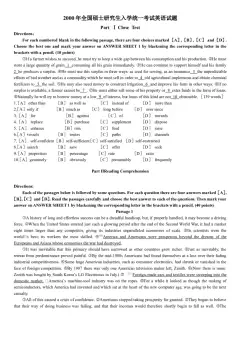
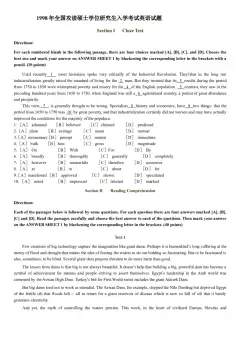
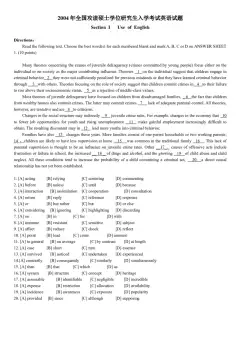
1Section I Use of English
Directions:
Read the following text. Choose the best word ( s) for each numbered blank and
mark A, B , C or D on ANSWER SHEET 1. ( 10 points)
The homeless make up a growing percentage of America's population. _1_,
homelessness has reached such proportions that local governments can't possibly
_2_. To help homeless people _3_ independence, the federal government
must support job training programs, _4_ the minimum wage, and fund more
low-cost housing.
_5_ everyone agrees on the number of Americans who are homeless.
Estimates _6_anywhere from 600,000 to 3 million. _7_the figure may vary,
analysts do agree on another matter: that the number of the homeless is _8_. One
of the federal government's studies _9_ that the number of the homeless will
reach nearly 19 million by the end of this decade.
Finding ways to _lQ_ this growing homeless population has become
increasingly difficult. _1_1 _when homeless individuals manage to find a _lL
that will give them three meals a day and a place to sleep at night, a good number
still spend the bulk of each day _1..L_ the street. Part of the problem is that many
homeless adults are addicted to alcohol or drugs. And a significant number of the
homeless have serious mental disorders. Many others, 14 not addicted or
mentally ill, simply lack the everyday ___!L skills needed to tum their lives __1L.
Boston Globe reporter Chris Reidy notes that the situation will improve only when
there are ___11_ programs that address the many needs of the homeless. __lL
Edward Zlotkowski, director of community service at Bentley College in
Massachusetts, __!2__ it, "There has to be __1L of programs. What's needed
is a package deal. "1. A. Indeed B. Likewise C.T herefore D. Furthermore
2. A.s tand B.c ope C.a pprove D. retain
3.
A.i n B. for C.w ith D.t oward
4. A. raise B. add C.t ake D.k eep
5. A. Generally B. Almost C.H ardly D.N ot
6. A.c over B. change C. range D. differ
7. A. Now that B. Although C. Provided D. Except that
8. A. inflating B . expanding C. increasing D. extending
9. A. predicts B. displays C.p roves D. discovers
10. A. assist B. track C.s ustain D. dismiss
11. A. Hence B. But C. Even D. Only
12. A. lodging B. shelter C.d welling D.h ouse
13. A.s earching B . strolling C.c rowding D. wandering
14. A. when B. once C. while D. whereas
15. A. life B . existence C.s urvival D. maintenance
16. A. around B. over C.o n D.up
17. A. complex B. comprehensive C. complementary D. compensating
18. A.S o B.S ince C.As D. Thus
19. A.p uts B.i nterprets C. assumes D. makes
20. A.s upervision B.m anipulation C.r egulation D.c oordination
Section II Reading Comprehension
Part A
Directions:
Read the following four texts. Answer the questions below each text by choosing
A, B, C, or D. Mark your answers on ANSWER SHEET 1. ( 40 points)Text 1
In spite of " endless talk of difference," American society is an amazing
machine for homogenizing people. There is "the democratizing uniformity of
dress and discourse, and the casualness and absence of deference" characteristic
of popular culture. People are absorbed into "a culture of consumption" launched
by the 19th-century department stores that offered "vast arrays of goods in an
elegant atmosphere. Instead of intimate shops catering to a knowledgeable elite"
these were stores " anyone could enter, regardless of class or background. This
turned shopping into a public and democratic act. " The mass media, advertising
and sports are other forces for homogenization.
Immigrants are quickly fitting into this common culture, which may not be
altogether elevating but is hardly poisonous. Writing for the National Immigration
Forum, Gregory Rodriguez reports that today's immigration is neither at
unprecedented levels nor resistant to assimilation. In 1998 immigrants were 9. 8
percent of the population; in 1900 , 13. 6 percent. In the 10 years prior to 1990,
3. 1 immigrants arrived for every 1,000 residents; in the 10 years prior to 1890,
9. 2 for every 1 , 000. Now, consider three indices of assimilation-language,
home ownership and intermarriage.
The 1990 Census revealed that " a majority of immigrants from each of the
fifteen most common countries of origin spoke English 'well' or 'very well' after
ten years of residence. " The children of immigrants tend to be bilingual and
proficient in English. "By the third generation, the original language is lost in
the majority of immigrant families. " Hence the description of America as a
"graveyard" for languages. By 1996 foreign-born immigrants who had arrived
before 1970 had a home ownership rate of 75. 6 percent, higher than the 69. 8
percent rate among native-born Americans.
Foreign-born Asians and Hispanics "have higher rates of intermarriage than
do U.S.-born whites and blacks." By the third generation, one third of Hispanic
women are married to non-Hispanics, and 41 percent of Asian-American women
are married to non-Asians.
Rodriguez notes that children in remote villages around the world are fans of
superstars like Arnold Schwarzenegger and Garth Brooks, yet " some Americans
fear that immigrants living within the United States remain somehow immune to
the nation's assimilative power. "
Are there divisive issues and pockets of seething anger in America? Indeed.
It is big enough to have a bit of everything. But particularly when viewed against
America's turbulent past, today's social indices hardly suggest a dark and
deteriorating social environment.21. The word " homogenizing " ( Line 2, Paragraph 1 ) most probably
means _ __
A. identifying
B . associating
C. assimilating
D. monopolizing
22. According to the author, the department stores of the 19th century ___
A.p layed a role in the spread of popular culture
B. became intimate shops for common consumers
C. satisfied the needs of a knowledgeable elite
D.o wed its emergence to the culture of consumption
23. The text suggests that immigrants now in the U.S. ___
A.a re resistant to homogenization
B. exert a great influence on American culture
C. are hardly a threat to the common culture
D. constitute the majority of the population
24. Why are Arnold Schwarzenegger and Garth Brooks mentioned in Paragraph 5?
A. To prove their popularity around the world.
B. To reveal the public's fear of immigrants.
C. To give examples of successful immigrants.
D. To show the powerful influence of American culture.
25. In the author's opinion, the absorption of immigrants into American society is
A.r ewarding
B. successful
C. fruitless
D.h armfulText 2
Stratford-on-Avon, as we all know, has only one industry-William
Shakespeare-but there are two distinctly separate and increasingly hostile
branches. There is the Royal Shakespeare Company ( RSC), which presents
superb productions of the plays at the Shakespeare Memorial Theatre on the
Avon. And there are the townsfolk who largely live off the tourists who come,
not to see the plays., but to look at Anne Hathaway's Cottage, Shakespeare's
birthplace and the other sights.
The worthy residents of Stratford doubt that the theatre adds a penny to their
revenue. They frankly dislike the RSC's actors, them with their long hair and
beards and sandals and noisiness. It's all deliciously ironic when you consider that
Shakespeare, who earns their living, was himself an actor ( with a beard) and did
his share of noise-making.
The tourist streams are not entirely separate. The sightseers who come by
bus-and often take in Warwick Castle and Blenheim Palace on the side-don't
usually see the plays, and some of them are even surprised to find a theatre in
Stratford. However, the playgoers do manage a little sight-seeing along with their
playgoing. It is the playgoers, the RSC contends, who bring in much of the
town's revenue because they spend the night ( some of them four or five nights)
pouring cash into the hotels and restaurants. The sightseers can take in everything
and get out of town by nightfall.
The townsfolk don't see it this way and the local council does not contribute
directly to the subsidy of the Royal Shakespeare Company. Stratford cries poor
traditionally. Nevertheless every hotel in town seems to be adding a new wing or
cocktail lounge. Hilton is building its own hotel there, which you may be sure
will be decorated with Hamlet Hamburger Bars, the Lear Lounge, the Banquo
Banqueting Room, and so forth, and will be very expensive.
Anyway, the townsfolk can't understand why the Royal Shakespeare
Company needs a subsidy. ( The theatre has broken attendance records for three
years in a row. Last year its 1,431 seats were 94 per cent occupied all year long
and this year they' 11 do better. ) The reason, of course , is that costs have
rocketed and ticket prices have stayed low.
It would be a shame to raise prices too much because it would drive away the
young people who are Stratford's most attractive clientele. They come entirely for
the plays, not the sights. They all seem to look alike ( though they come from all
over )-lean, pointed, dedicated faces, wearing jeans and sandals, eating their
buns and bedding down for the night on the flagstones outside the theatre to buy
the 20 seats and 80 standing-room tickets held for the sleepers and sold to them
when the box office opens at 10: 30 a.m.26. From the first two paragraphs, we learn that ___
A. the townsfolk deny the RSC's contribution to the town's revenue
B. the actors of the RSC imitate Shakespeare on and off stage
C. the two branches of the RSC are not on good terms
D. the townsfolk earn little from tourism
27. It can be inferred from Paragraph 3 that ___
A. the sightseers cannot visit the Castle and the Palace separately
B. the playgoers spend more money than the sightseers
C. the sightseers do more shopping than the playgoers
D. the playgoers go to no other places in town than the theater
28. By saying "Stratford cries poor traditionally" ( Line 2-3, Paragraph 4) , the
author implies that ___
A. Stratford cannot afford the expansion projects
B. Stratford has long been in financial difficulties
C. the town is not really short of money
D. the townsfolk used to be poorly paid
29. According to the townsfolk, the RSC deserves no subsidy because ___
A. ticket prices can be raised to cover the spending
B. the company is financially ill-managed
C. the behavior of the actors is not socially acceptable
D. the theatre attendance is on the rise
30. From the text we can conclude that the author ___
A. is supportive of both sides
B. favors the townsfolk's view
C. takes a detached attitude
D. is sympathetic to the RSCText 3
When prehistoric man arrived in new parts of the world, something strange
happened to the large animals : they suddenly became extinct. Smaller species
survived. The large, slow-growing animals were easy game, and were quickly
hunted to extinction. Now something similar could be happening in the oceans.
That the seas are being overfished has been known for years. What researchers
such as Ransom Myers and Boris Worm have shown is just how fast things are
changing. They have looked at half a century of data from fisheries around the
world. Their methods do not attempt to estimate the actual biomass ( the amount of
living biological matter) of fish species in particular parts of the ocean, but rather
changes in that biomass over time. According to their latest paper published in
Nature, the biomass of large predators ( animals that kill and eat other animals) in
a new fishery is reduced on average by 80% within 15 years of the start of
exploitation. In some long-fished areas, it has halved again since then.
Dr. Worm acknowledges that these figures are conservative. One reason for
this is that fishing technology has improved. Today's vessels can find their prey
using satellites and sonar, which were not available 50 years ago. That means a
higher proportion of what is in the sea is being caught, so the real difference
between present and past is likely to be worse than the one recorded by changes in
catch sizes. In the early days, too, longlines would have been more saturated
with fish. Some individuals would therefore not have been caught, since no
baited hooks would have been available to trap them, leading to an underestimate
of fish stocks in the past. Furthermore, in the early days of longline fishing, a lot
of fish were lost to sharks after they had been hooked. That is no longer a
problem, because there are fewer sharks around now.
Dr. Myers and Dr. Worm argue that their work gives a correct baseline,
which future management efforts must take into account. They believe the data
support an idea current among marine biologists , that of the "s hifting baseline" .
The notion is that people have failed to detect the massive changes which have
happened in the ocean because they have been looking back only a relatively short
time into the past. That matters because theory suggests that the maximum
sustainable yield that can be cropped from a fishery comes when the biomass of a
target species is about 50% of its original levels. Most fisheries are well below
that, which is a bad way to do business.31. The extinction of large prehistoric animals is noted to suggest tha_t __
A. large animals were vulnerable to the changing environment
B . small species survived as large animals disappeared
C. large sea animals may face the same threat today
D. slow-growing fish outlive fast-growing ones
32. We can infer from Dr. Myers and Dr. Worm's paper that ___
A. the stock of large predators in some old fisheries has reduced by 90%
B. there are only half as many fisheries as there were 15 years ago
C. the catch sizes in new fisheries are only 20% of the original amount
D. the number of large predators dropped faster in new fisheries than in the old
33. By saying "these figures are conservative" (Line 1, Paragraph 3), Dr. Worm
means that ___
A. fishing technology has improved rapidly
B. the catch-sizes are actually smaller than recorded
C. the marine biomass has suffered a greater loss
D. the data collected so far are out of date
34. Dr. Myers and other researchers hold that ___
A. people should look for a baseline that can work for a longer time
B.f isheries should keep their yields below 50% of the biomass
C. the ocean biomass should be restored to its original level
D.p eople should adjust the fishing baseline to the changing situation
35. The author seems to be mainly concerned with most fisheries' ___
A.m anagement efficiency
B . biomass level
C. catch-size limits
D. technological applicationText 4
Many things make people think artists are weird. But the weirdest may be
this: artists' only job is to explore emotions, and yet they choose to focus on the
ones that feel bad.
This wasn't always so. The earliest forms of art, like painting and music,
are those best suited for expressing joy. But somewhere from the 19th century
onward, more artists began seeing happiness as meaningless, phony or, worst of
all, boring, as we went from Wordsworth's daffodils to Baudelaire's flowers of
evil.
You could argue that art became more skeptical of happiness because modem
times have seen so much misery. But it's not as if earlier times didn't know
perpetual war, disaster and the massacre of innocents. The reason, in fact, may be
just the opposite: there is too much damn happiness in the world today.
After all, what is the one modem form of expression almost completely
dedicated to depicting happiness? Advertising. The rise of anti-happy art almost
exactly tracks the emergence of mass media, and with it, a commercial culture in
which happiness is not just an ideal but an ideology.
People in earlier eras were surrounded by reminders of misery. They worked
until exhausted, lived with few protections and died young. In the West, before
mass communication and literacy, the most powerful mass medium was the
church , which reminded worshippers that their souls were in danger and that they
would someday be meat for worms. Given all this, they did not exactly need
their art to be a bummer too.
Today the messages the average Westerner is surrounded with are not
religious but commercial, and forever happy. Fast-food eaters, news anchors,
text messengers, all smiling, smiling, smiling. Our magazines feature beaming
celebrities and happy families in perfect homes. And since these messages have
an agenda-to lure us to open our wallets-they make the very idea of happiness
seem unreliable. "Celebrate!" commanded the ads for the arthritis drug Celebrex,
before we found out it could increase the risk of heart attacks.
But what we forget-what our economy depends on us forgetting-is that
happiness is more than pleasure without pain. The things that bring the greatest
joy carry the greatest potential for loss and disappointment. Today, surrounded
by promises of easy happiness , we need art to tell us, as religion once did,
Memento mori: remember that you will die, that everything ends, and that
happiness comes not in denying this but in living with it. It's a message even
more bitter than a clove cigarette, yet, somehow, a breath of fresh air.36. By citing the examples of poets Wordsworth and Baudelaire, the author
intends to show that
---
A. poetry is not as expressive of joy as painting or music
B. art grows out of both positive and negative feelings
C. poets today are less skeptical of happiness
D. artists have changed their focus of interest
37. The word "bummer" ( Line 6, Paragraph 5) most probably means something
A. religious
B. unpleasant
C.e ntertaining
D. commercial
38. In the author's opinion, advertising ___
A. emerges in the wake of the anti-happy art
B. is a cause of disappointment for the general public
C. replaces the church as a major source of information
D. creates an illusion of happiness rather than happiness itself
39. We can learn from the last paragraph that the author believes ___
A. happiness more often than not ends in sadness
B. the anti-happy art is distasteful but refreshing
C. misery should be enjoyed rather than denied
D. the anti-happy art flourishes when economy booms
40.W hich of the following is true of the text?
A. Religion once functioned as a reminder of misery.
B.A rt provides a balance between expectation and reality.
C. People feel disappointed at the realities of modem society.
D. Mass media are inclined to cover disasters and deaths.Part B
Directions:
In the following article, some sentences have been removed. For Questions
41-45, choose the most suitable one from the list A-G to fit into each of the
numbered gaps. There are two extra choices, which you do not need to use.
Mark your answers on ANSWER SHEET 1. ( 10 points)
On the north bank of the Ohio river sits Evansville, Ind., home of David
Williams, 52, and of a riverboat casino ( a place where gambling games are
played) . During several years of gambling in that casino, Williams, a state
auditor earning $35,000 a year, lost approximately $175,000. He had never
gambled before the casino sent him a coupon for $20 worth of gambling.
He visited the casino, lost the $20 and left. On his second visit he lost
$800. The casino issued to him, as a good customer, a "Fun Card," which
when used in the casino earns points for meals and drinks, and enables the casino
to track the user's gambling activities. For Williams, those activities became
what he calls "electronic heroin. "
(41 ) _ _ ________________ _
In 1997 he lost $21,000 to one slot machine in two days. In March 1997 he lost
$72,186. He sometimes played two slot machines at a time, all night, until the
boat docked at 5 a.m., then went back aboard when the casino opened at 9 a.m.
Now he is suing the casino, charging that it should have refused his patronage
because it knew he was addicted. It did know he had a problem.
In March 1998, a friend of Williams's got him involuntarily confined to a
treatment center for addictions, and wrote to inform the casino of Williams's
gambling problem. The casino included a photo of Williams among those of
banned gamblers, and wrote to him a " cease admissions" letter. Noting the
"medicaV psychological" nature of problem gambling behavior, the letter said
that before being readmitted to the casino he would have to present medicaV
psychological information demonstrating that patronizing the casino would pose
no threat to his safety or well-being.
(42) ___________________
The Wall Street Journal reports that the casino has 24 signs warning: "Enjoy
the fun. .. and always bet with your head, not over it. " Every entrance ticket lists
a toll-free number for counseling from the Indiana Department of Mental Health.
Nevertheless, Williams's suit charges that the casino, knowing he was
"helplessly addicted to gambling," intentionally worked to " lure " him to
"engage in conduct against his will. " Well.
( 43) ---------------------------The fourth edition of the Diagnostic and Statistical Manual of Mental Disorders
says " pathological gambling" involves persistent, recurring and uncontrollable
pursuit less of money than of the thrill of taking risks in quest of a windfall.
(44) __________________ _
Pushed by science, or what claims to be science, society is reclassifying what
once were considered character flaws or moral failings as personality disorders
akin to physical disabilities.
(45)_ ________________
_
Forty-four states have lotteries, 29 have casinos, and most of these states are
to varying degrees dependent on-you might say addicted to-revenues from
wagering. And since the first Internet gambling site was created in 1995,
competition for gamblers' dollars has become intense. The Oct. 28 issue of
Newsweek reported that 2 million gamblers patronize 1 ,8 00 virtual casinos every
week. With $3.5 billion being lost on Internet wagers this year, gambling has
passed pornography as the Web's most profitable business.
A. Although no such evidence was presented, the casino's marketing department
continued to pepper him with mailings. And he entered the casino and used his
Fun Card without being detected.
B. It is unclear what luring was required, given his compulsive behavior. And in
what sense was his will operative?
C. By the time he had lost $5 , 000 he said to himself that if he could get back to
even, he would quit. One night he won $5 ,5 00, but he did not quit.
D. Gambling has been a common feature of American life forever, but for a long
time it was broadly considered a sin, or a social disease. Now it is a social
policy : the most important and aggressive promoter of gambling in America is
the government.
E. David Williams's suit should trouble this gambling nation. But don't bet on it.
F. It is worrisome that society is medicalizing more and more behavioral
problems, often defining as addictions what earlier, sterner generations
explained as weakness of will.
G. The anonymous, lonely, undistracted nature of online gambling is especially
conducive to compulsive behavior. But even if the government knew how to
move against Internet gambling, what would be its grounds for doing so?
Part C
Directions:
Read the following text carefully, and then translate the underlined segments
into Chinese. Your translation should be written clearly on ANSWER SHEET 2.
( 10 points)Is it true that the American intellectual is rejected and considered of no account
in his society? I am going to suggest that it is not true. Father Bruckberger told part
of the story when he observed that it is the intellectuals who have rejected America.
But they have done more than that. They have grown dissatisfied with the role of
the intellectual. It is they, not America, who have become anti-intellectual.
First, the object of our study pleads for definition. What is an intellectual?
( 46) I shall define him as an individual who has elected as his primary duty and
tft �
pleasure in life the activity of thinking in Socratic ( $ � 13'9) way about
moral problems. He explores such problems consciously, articulately, and
frankly, first by asking factual questions, then by asking moral questions, finally
by suggesting action which seems appropriate in the light of the factual and moral
information which he has obtained. ( 47) His function is analogous to that of a
'ud e, who must acce t the obli ation of revealin in as obvious a manner as
possible the course of reasoning which led him to his decision.
This definition excludes many individuals usually referred to as intellectuals
the average scientist, for one. ( 48 ) I have excluded him because, while his
accomplishments may contribute to the solution of moral problems, he has not been
charged with the task of approaching any but the factual aspects of those problems.
Like other human beings, he encounters moral issues even in the everyday
performance of his routine duties-he is not supposed to cook his experiments,
manufacture evidence, or doctor his reports. ( 49 ) But his primary task is not to
think about the moral code which governs his activity, any more than a
businessman is expected to dedicate his energies to an exploration of rules of
conduct in business. During most of his waking life he will take his code for
granted, as the businessman takes his ethics.
The definition also excludes the majority of teachers, despite the fact that
teaching has traditionally been the method whereby many intellectuals earn their
living. ( 50) They may teach very well, and more than earn their salaries, but
most of them make little or no independent reflections on human problems which
involve moral judgment. This description even fits the majority of eminent
scholars. Being learned in some branch of human knowledge is one thing; living
in "public and illustrious thoughts," as Emerson would say, is something else.
m
Section Writing
Part A
51. Directions:
You want to contribute to Project Hope by offering financial aid to a child in
a remote area. Write a letter to the department concerned, asking them to help
find a candidate. You should specify what kind of child you want to help andhow you will carry out your plan.
Write your letter in no less than 100 words. Write it neatly on ANSWER
SHEET 2.
Do not sign your own name at the end of the letter; use "Li Ming" instead.
Do not write the address. ( 10 points)
Part B
52. Directions:
Study the following photos carefully and write an essay in which you should
1 ) describe the photos briefly,
2 ) interpret the social phenomenon reflected by them, and
3) give your point of view.
You should write 160-200 words neatly on ANSWER SHEET 2. (20 points)
1 -5 ABDAD 6 -10 CBCAA 11 - 15 CBDCC 16 -20 ABCAD 21 -25 CACDB
26 -30 ABCDD 31 -35 CACDB 36 -40 DBDBA 41 -45 CABFD
�-ft�ffi�**r����ffl-�B*fi$����m�*����§ BA�B<J•�-{f
5fll 5fot� B<J Ao
47. �-J,�*rs<JllR.-'=i?!'§Ei<JllR.tfilM, &P{ili::ff �:%-ffl,@!. PJ��� T B<J:1J�*�� § Bfqit±Hk:
� B<J 1fUJI!:i1� o
48. ft z.Mr � �ttilU4� �tJ=II: � 10� , ¾ � �,@!.ff f m B<J nx::W= PJ �� ::ff M r fflHlc m tt i'iiJ a , f§. fm ff(
ffls<Jff:%-R�u¾M��®�BB<J$��ffio
49. {El.¾, 'll:tillH4�*Ei<J§�{f:%-*�¾,l[!,�Jtr!c § Bfi� B<Jfflilll!J!Ll, )¥)Um Im ���m� 1ff)" A
-4zti:r��lff)"�fi�?ft!J!Ll-�o
·*
50. {iliffJPJ��1lHlt:�� H� R¾� Tlmlf!iKir:6':t, {El. {iliffJ rep B<J:k��AtlJJL-3¥-:EJx:ti:21s:��
■
���ffl �-B<JA��B*fi��m�o