2017 年 12 月大学英语四级考试真题(第 1 套)
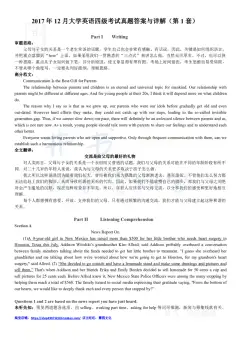
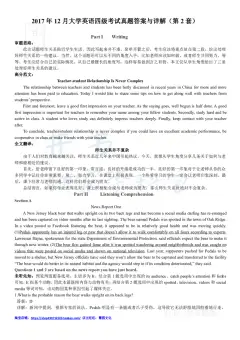
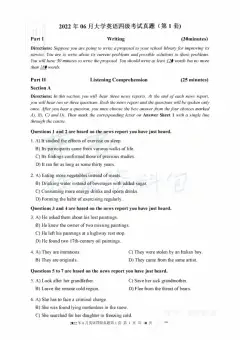
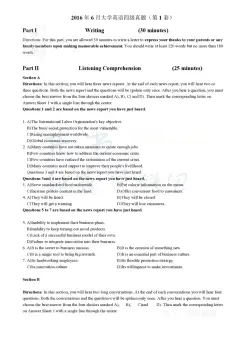
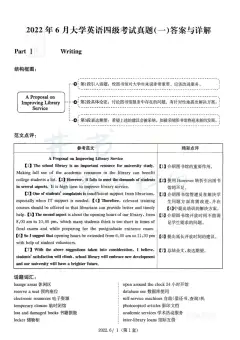
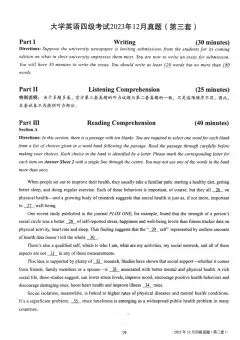
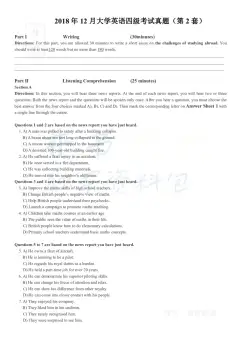
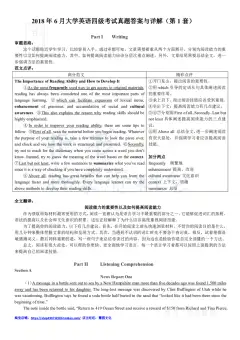
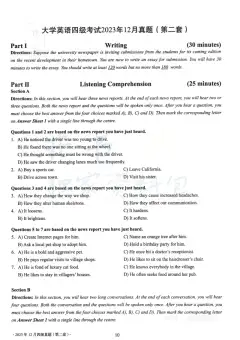
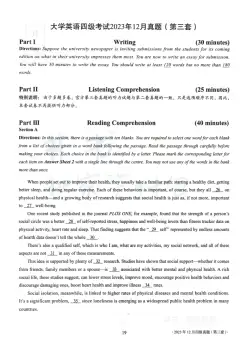
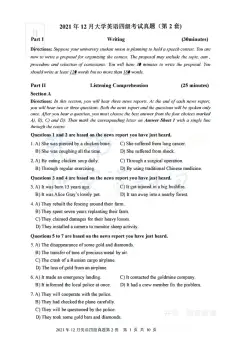
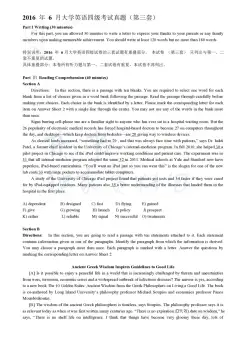
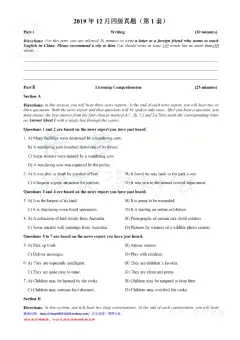
Part I Writing (30minutes)
(请于正式开考后半小时内完成该部分,之后将进行听力考试)
Directions: For this part, you are allowed 30 minutes to write a short essay on how to best handle the relationship
betweenparentsandchildren.Youshouldwriteatleast120wordsbutnomorethan180words.
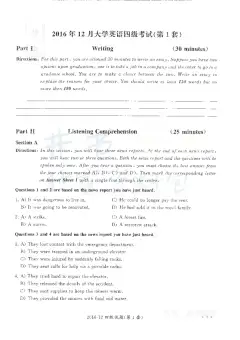
Part II Listening Comprehension (25 minutes)
SectionA
Directions: In this section, you will hear three news reports. At the end of each news report, you will hear two or three
questions.Boththe newsreportandthe questionswillbespoken onlyonce.After you hearaquestion,you mustchoosethe
bestanswerfromthefourchoicesmarkedA),B),C)andD).Thenmarkthecorrespondingletter onAnswer Sheet 1with
asinglelinethroughthecentre.
Questions1and2arebasedonthenewsreportyouhavejustheard.
1.A)Hergrandfather. C)HerfriendErika.
B)Hergrandmother. D)Herlittlebrother.
2.A)Bytakingpicturesforpassers-by. C)Byworkingparttimeatahospital.
B)Bysellinglemonadeandpictures. D)Byaskingforhelponsocialmedia.
Questions3and4arebasedonthenewsreportyouhavejustheard.
3.A)Testingtheefficiencyofthenewsolarpanel.
B)Providingcleanenergytofivemillionpeople.
C)Generatingelectricpowerforpassingvehicles.
D)Findingcheaperwaysofhighwayconstruction.
4.A)Theyareonlyabouthalfaninchthick.
B)Theyaremadefromcheapmaterials.
C)Theycanbelaidrightontopofexistinghighways.
D)Theycanstandthewearandtearofnaturalelements.
Questions5to7arebasedonthenewsreportyouhavejustheard.
5.A)Thelackofcluesaboutthespecies. C)Endlessfightingintheregion.
B)Inadequatefundingforresearch. D)Thehazardsfromthedesert.
6.A)Toobservethewildlifeinthetwonationalparks.
B)TostudythehabitatoflionsinSudanandEthiopia.
C)Toidentifythereasonsforthelions’disappearance.
D)Tofindevidenceoftheexistenceofthe“lostlions”.
7.A)Lions’tracks. C)Somecampingfacilities.
B)Lionswalking. D)Trapssetbylocalhunters.
SectionB
Directions:In this section, you will hear two long conversations. At the end of each conversation, you will hear four
questions.Boththeconversationandthequestionswillbespokenonlyonce.Afteryouhearaquestion,youmustchoosethe
best answer from the four choices marked A), B), C), and D). Then mark the corresponding letter on Answer Sheet 1
withasinglelinethroughthecentre.
Questions8to11arebasedontheconversationyouhavejustheard.
8.A)Aspecialgiftfromtheman. C)Acallfromherdad.
B)Herweddinganniversary. D)Her‘luckybirthday’.
9.A)Threwherasurpriseparty. C)Boughtheragoldnecklace.
淘宝店铺:https://shop249445206.taobao.com/ 掌柜旺旺:新一文化B)Tookheronatripoverseas. D)Gaveherabigmodelplane.
10.A)Whatherhusbandandthemanareupto.
B)Whathasbeentroublingherhusband.
C)Thetripherhusbandhasplanned.
D)Thegiftherhusbandhasbought.
11.A)Hewantstofindoutaboutthecouple’sholidayplan.
B)Heiseagertolearnhowthecouple’sholidayturnsout.
C)Hewilltellthewomenthesecretifherhusbandagrees.
D)Hewillbegladtobeaguideforthecouple’sholidaytrip.
Questions12to15arebasedontheconversationyouhavejustheard.
12.A)Theytaketherival’sattitudeintoaccount.
B)Theyknowwhentoadoptatoughattitude.
C)Theyseetheimportanceofmakingcompromises.
D)Theyaresensitivetothedynamicsofanegotiation.
13.A)Theyknowwhentostop. C)Theyknowwhentomakecompromises.
B)Theyknowhowtoadapt. D)Theyknowhowtocontroltheiremotion.
14.A)Theyarepatient. C)Theyaregoodatexpression.
B)Theylearnquickly. D)Theyupholdtheirprinciples.
15.A)Clarifyitemsofnegotiation. C)Gettoknowtheotherside.
B)Makeclearone'sintentions. D)Formulateone'sstrategy.
SectionC
Directions:Inthissection,youwillhearthreepassages.Attheendofeachpassage,youwill
hearthreeorfourquestions.Boththepassageandthequestionswillbespokenonly
once.Afteryouhearaquestion,youmustchoosethebestanswerfromthefour
choicesmarkedA),B),C),D).ThenmarkthecorrespondingletteronAnswer
Sheet 1withasinglelinethroughthecentre.
Questions16to18arebasedonthepassageyouhavejustheard.
16.A)HowspaceresearchbenefitspeopleonEarth.
B)WhentheInternationalSpaceStationwasbuilt.
C)Howmanyspaceshuttlemissionstherewillbe.
D)WhenAmerica'searliestspaceprogramstarted.
17.A)Theytriedtomakebestuseofthelatesttechnology.
B)Theytriedtomeetastronauts'specificrequirements.
C)Theydevelopedobjectsforastronautstouseinouterspace.
D)Theyaccuratelycalculatedthespeedoftheorbitingshuttles.
18.A)Theyareexpensivetomake. C)Theywerefirstmadeinspace.
B)Theyareextremelyaccurate. D)Theywereinventedinthe1970s.
Questions19to21arebasedonthepassageyouhavejustheard.
19.A)Everythingwasnaturalandgenuinethen.
B)Peoplehadplentyoflandtocultivatethen.
C)Itmarkedthebeginningofsomethingnew.
D)ItwaswhenherancestorscametoAmerica.
20.A)Theywereknowntobecreative. C)Theyhadallkindsofentertainment.
B)Theyenjoyedlivingalivingalifeofease.D)Theybelievedinworkingforgoals.
21.A)Chattingwithherancestors. C)Furnishinghercountryhouse.
B)Doingneedleworkbythefire. D)Polishingallthesilverwork.
Questions22to25arebasedonthepassageyouhavejustheard.
22.A)Sitdownandtrytocalmyourself. C)Useamaptoidentifyyourlocation.B)Callyourfamilyorfriendsforhelp. D)Trytofollowyourfootprintsback.
23.A)Youmayendupenteringawonderland.
B)Youmaygetdrownedinasuddenflood.
C)Youmayexposeyourselftounexpecteddangers.
D)Youmayfindawayoutwithoutyourknowingit.
24.A)Waitpatiently. C)Startafire.
B)Lookforfood. D)Walkuphill.
25.A)Checkthelocalweather. C)Prepareenoughfoodanddrink.
B)Findamapandacompass. D)Informsomebodyofyourplan.
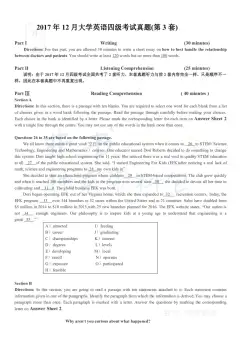
Part Ⅲ Reading Comprehension ( 40minutes )
SectionA
Directions:In this section,there is apassagewith tenblanks.Youarerequiredtoselectonewordforeachblankfrom alist
of choices given in a word bank following the passage. Read the passage through carefully before making your choices.
Each choice in the bank is identified by a letter. Please mark the corresponding letter for each item on Answer Sheet 2
withasinglelinethroughthecentre.Youmaynotuseanyofthewordsinthebankmorethanonce.
Questions26to35arebasedonthefollowingpassage.
Aratorpigeonmightnotbetheobviouschoicetotendtosomeonewhoissick,butthesecreatureshavesome26skills
thatcouldhelpthetreatmentofhumandiseases.
Pigeons are often seen as dirty birds and an urban 27 , but they are just the latest in a long line of animals that have
beenfoundtohaveabilitiestohelphumans.Despitehavingabrainnobiggerthanthe28ofyourindexfinger,pigeonshave
a very impressive 29 memory. Recently it was shown that they could be trained to be as accurate as humans at detecting
breastcancerinimages.
Rats are often 30 with spreading disease rather than 31 it, but this long-tailed animal is highly 32 . Inside a rat's nose
areupto1,000differenttypesofolfactoryreceptors(嗅觉感受器),whereashumansonlyhave100to200types.Thisgives
rats the ability to detect 33 smells.As a result, some rats are being putto work to detectTB(肺结核). When the rats detect
thesmell,theystopandrubtheirlegsto34asampleisinfected.
Traditionally, a hundred samples would take lab technicians more than two days to 35 , but for a rat it takes less than
20 minutes. This rat detection method doesn't rely on specialist equipment. It is also more accurate — the rats are able to
findmoreTBinfectionsand,therefore,savemorelives.
A)associated I)slight
B)examine J)specify
C)indicate K)superior
D)nuisance L)suspicious
E)peak M)tip
F)preventing N)treated
G)prohibiting O)visual
H)sensitive
SectionB
Directions: In this section, you are going to read a passage with ten statements attached to it. Each statement contains
informationgiveninoneoftheparagraphs.Identifytheparagraphfromwhichtheinformationisderived.Youmaychoosea
paragraph more than once. Each paragraph is marked with a letter. Answer the questions by marking the corresponding
letteronAnswerSheet 2.
DoIn-ClassExamsMakeStudentsStudyHarder?
Researchsuggeststheymaystudymorebroadlyfortheunexpectedratherthansearchforanswers.[A] I have always been a poor test-taker. So it may seem rather strange that I have returned to college to finish the
degree I left undone some four decades ago. I am making my way through Columbia University, surrounded by students
whoquicklysupplytheverbalanswerwhileIamstillprocessingthequestion.
[B] Since there is no way for me to avoid exams, I am currently questioning what kind are the most taxing and
ultimately beneficial. I have already sweated through numerous in-class midterms and finals, and now I have a professor
who issues take-home ones. I was excited when I learned this, figuring I had a full week to do the research, read the texts,
andwrite itall up.In fact, I was still rewriting my midterm themorning itwas due.TosayI had lostthe threadis putting it
mildly.
[C]As I was suffering through my week of anxiety, overthinking the material and guessing my grasp of it, I did some
of my own polling among students and professors. David Eisenbach, who teaches a popular class on U.S. presidents at
Columbia,prefersthein-classvariety.Hebelievesstudentsultimatelylearnmoreandencouragesthemtoformstudygroups.
“That way they socialize over history outside the class, which wouldn’t happen without the pressure of an in-class exam,”
heexplained,“Furthermore,in-classexamsforcestudentstolearnhowtoperformunderpressure,andessentialworkskill.”
[D]Healsosaysthereislesschanceofcheatingwiththein-classvariety.In2012,125studentsatHarvardwerecaught
up in a scandal when it was discovered they had cheated on a take-home exam for a class entitled “Introduction To
Congress.” Some colleges have what they call an “honor code,” though if you are smart enough to get into these schools,
you are either smart enough to get around any codes or hopefully, too ethical to consider doing so. As I sat blocked and
clueless for two solid days, I momentarily wondered if I couldn’t just call an expert on the subject matter which I was
tackling,orsomeonewhotooktheclasspreviously,togetmegoing.
[E] Following the Harvard scandal, Mary Miller, the former dean of students atYale, made an impassioned appeal to
her school’s professors to refrain from take-hone exams. “Students risk health and well being, as well as performance in
other end-of-term work, when faculty offers take-home exams without clear, time-limited boundaries,” she told me.
“Research now shows that regular quizzes, short essays, and other assignments over the course of a term better enhance
learningandretention.”
[F] Most college professors agree the kind of exam they choose largely depends on the subject.Aquantitative-based
one, for example, is unlikely to be sent home, where one could ask their older brothers and sisters to help. Vocational-type
classes, suchas computer scienceorjournalism, onthe other hand,are often more research-oriented andlend themselves to
take-home testing. Chris Koch, who teaches “History of Broadcast Journalism” at Montgomery Community College in
Rockville, Maryland, points outthat reporting is aboutinvestigation rather than the memorization ofminute details. “In my
field, it’s not what you know—it’s what you know how to find out,” says Koch. “There is way too much information, and
more coming all the time, for anyone to remember. I want my students to search out the answers to questions by using all
theresourcesavailabletothem.
[G] Students’test-form preferences vary,too, oftendependingon thesubjectandcourse difficulty.“Iprefer take-home
essays because it is then really aboutthe writing, so you have time to edit and do more research,” says Elizabeth Dresser,a
junior atBarnard.Thenthere is thestress factor.FrancescaHaass, a senior atMiddlebury,says, “I find the in-class ones are
more stressful in the short term, but there is immediate relief as you swallow information like mad, and then you get to
forget it all. Take-homes require thoughtful engagement which can lead to longer term stress as there is never a moment
when the time is up.” Meanwhile, Olivia Rubin, a sophomore at Emory, says she hardly even considers take-homes true
exams.“Ifyouunderstandthematerialandhavetheabilitytoarticulate(说出)yourthoughts,theyshouldbeabreeze.”
[H] How students ultimately handle stress may depend on their personal test-taking abilities. There are people who
always waituntilthelastminute,andmake itmuchharderthanitneedstobe.Andthentherethosewho,notknowing what
questions are coming at them, andhaving no resources to refer to, can freeze.And then there are we rare folks who fit both
thosedescriptions.
[I]Yes,myadvancedagemustfactorintotheequation(等式),inpartbecauseofmyinabilitytoaccesstheinformation
as quickly.As another returning student at Columbia, Kate Marber, told me, “Weare learning not only all this information,
butessentially how to learn again. Our fellow students have just come out of high school.Alot has changed since we were
lastinschool.”
[J]Ifnothingelse,thesituationhasgiven mycollege sonandmesomethingtoshare,WhenIaskedhisopiniononthis
matter,heresponded, “I like in-class exams because the time is alreadyreserved, asopposed to using my free time athometo work on a test,” he responded. It seems to me that a compromise would be receiving the exam questions a day or two in
advance,andthendoingtheactualtestinclassthetickingclockoverhead.
[K] Better yet, how about what one Hunter College professor reportedly did recently for her final exam: She
encouraged the class not to stress or even study,promising that, “It is going to be apiece of cake.”When the students came
in,sharpenedpencilsinhand,therewasnotabluebookinsight. Rather,theysawalargechocolatecake andtheyeachwere
givenaslice.
36.Elderlystudentsfindithardtokeepupwiththerapidchangesineducation.
37.Somebelievetake-homeexamsmayaffectstudents'performanceinothercourses.
38.Certainprofessorsbelievein-classexamsareultimatelymorehelpfultostudents.
39.In-classexamsarebelievedtodiscouragecheatinginexams.
40.Theauthorwashappytolearnshecoulddosomeexamsathome.
41.Studentswhoputofftheirworkuntilthelastmomentoftenfindtheexamsmoredifficultthantheyactuallyare.
42.Differentstudentsmaypreferdifferenttypesofexams.
43.Mostprofessorsagreewhethertogiveanin-classoratake-homeexamdependsontypeofcoursebeingtaught.
44.Theauthordroppedoutofcollegesomefortyyearsago.
45.Somestudentsthinktake-homeexamswilleatuptheirfreetime.
SectionC
Directions: There are 2 passages in this section. Each passage is followed by some questions or unfinished statements. For
each of them there are four choices marked A), B), C) and D). You should decide on the best choice and mark the
correspondingletteronAnswerSheet2withasinglelinethroughthecentre.
PassageOne
Questions46and50arebasedonthefollowingpassage.
Thatpeopleoften experiencetrouble sleepingin adifferentbedin unfamiliar surroundings is a phenomenonknown as
the “first-night” effect. If a personstays in the same room thefollowing night theytend to sleep more soundly.Yuka Sasaki
andhercolleaguesatBrownUniversitysetouttoinvestigatetheoriginsofthiseffect.
Dr. Sasaki knew the first-night effect probably has something to do with how humans evolved. The puzzle was what
benefitwould be gained from it when performance might be affected the following day.She also knew from previous work
conducted on birds and dolphins that these animals put half of their brains to sleep at a time so that they can rest while
remainingalertenoughtoavoidpredators(捕食者).Thisledhertowonderifpeoplemightbedoingthesamething.Totake
acloser look, herteam studied35healthypeopleasthey sleptin theunfamiliar environmentof theuniversity’sDepartment
of Psychological Sciences. The participants each slept in the department for two nights and were carefully monitored with
techniques that looked at the activity of their brains. Dr. Sasaki found, as expected, the participants slept less well on their
firstnightthantheydidontheirsecond,takingmorethantwice aslongto fallasleepandsleepinglessoverall. Duringdeep
sleep, the participants’ brains behaved in a similar manner seen in birds and dolphins. On the first night only, the left
hemispheres(半球)oftheirbrainsdidnotsleepnearlyasdeeplyastheirrighthemispheresdid.
Curious if the left hemispheres were indeed remaining awake to process information detected in the surrounding
environment, Dr. Sasaki re-ran the experiment while presenting the sleeping participants with a mix of regularly timed
beeps (蜂鸣声) of the same tone and irregular beeps of a different tone during the night. She worked out that, if the left
hemisphere was staying alert to keep guard in a strange environment, then it would react to the irregular beeps by stirring
peoplefromsleepandwouldignoretheregularlytimedones.Thisispreciselywhatshefound.
46.Whatdidresearchersfindpuzzlingaboutthefirst-nighteffect?
A)Towhatextentitcantroublepeople. C)Whatcircumstancesmaytriggerit.
B)Whatroleithasplayedinevolution. D)Inwhatwayitcanbebeneficial.
47.WhatdowelearnaboutDr.YukaSasakidoingherresearch?
A)Shefoundbirdsanddolphinsremainalertwhileasleep.
B)Shefoundbirdsanddolphinssleepinmuchthesameway.
C)ShegotsomeideafrompreviousstudiesonbirdsanddolphinsD)Sheconductedstudiesonbirds’anddolphins’sleepingpatterns.
48.WhatdidDr.Sasakidowhenshefirstdidherexperiment?
A)Shemonitoredthebrainactivityofparticipantssleepinginanewenvironment.
B)Sherecruited35participantsfromherDepartmentofPsychologicalSciences.
C)Shestudiedthedifferencesbetweenthetwosidesofparticipants’brains.
D)Shetestedherfindingsaboutbirdsanddolphinsonhumansubjects.
49.WhatdidDr.Sasakidowhenre-runningherexperiment?
A)Sheanalyzedthenegativeeffectofirregulartonesonbrains.
B)Sherecordedparticipants’adaptationtochangedenvironment.
C)Sheexposedherparticipantstotwodifferentstimuli.
D)Shecomparedtheresponsesofdifferentparticipants.
50.WhatdidDr.Sasakifindabouttheparticipantsinherexperiment?
A)Theytendedtoenjoycertaintonesmorethanothers.
B)Theytendedtoperceiveirregularbeepsasathreat.
C)Theyfeltsleepywhenexposedtoregularbeeps.
D)Theydifferedintheirtoleranceofirregulartones.
PassageTwo
Questions51to55arebasedonthefollowingpassage.
It’s time to reevaluate how women handle conflict at work. Being overworked or over-committed at home and on the
jobwillnotgetyouwhereyouwanttobeinlife.Itwillonlyslowyoudownandhinderyourcareergoals.
Did you know women aremorelikely thanmen tofeelexhausted?Nearly twice asmanywomen thanmen ages 18-44
reportedfeeling“verytired”or“exhausted”,accordingtoarecentstudy.
This may not be surprising given that this is the age range when women have children. It's also the age range when
many women are trying to balance careers and home. One reason women may feel exhausted is that they have a hard time
saying "no."Women want to be able to do it all volunteer for schoolparties or cook delicious meals-and so their answer to
anyrequestisoften“Yes,Ican.”
Women struggle to say “no” in the workplace for similar reasons, including the desire to be liked by their colleagues.
Unfortunately,thisinabilitytosay"no"maybehurtingwomen'sheathaswellastheircareer.
At the workplace, men use conflict as a way to position themselves, while women often avoid conflict or strive to be
the peacemaker, because they don't want to be viewed as aggressive or disruptive at work. For example, there’s a problem
that needs to be addressed immediately, resulting in a dispute over should be the one to fix it. Men are more likely to face
that dispute from the perspective of what benefits them most, whereas women may approach the same dispute from the
perspective of what's the easiest and quickest way to resolve the problem-even if that means doing the boring work
themselves.
This difference in handling conflict could be the deciding factor on who gets promoted to a leadership position and
who does not. Leaders have to be able to delegate and manage resources wisely – including staff expertise. Shouldering
moreoftheworkloadmaynotearnyouthatpromotion.Instead,itmayhighlightyourinabilitytodelegateeffectively.
51.Whatdoestheauthorsayistheproblemwithwomen?
A)Theyareoftenunclearaboutthecareergoalstoreach.
B)Theyareusuallymorecommittedathomethanonthejob.
C)Theytendtobeover-optimisticabouthowfartheycouldgo.
D)Theytendtopushthemselvesbeyondthelimitsoftheirability.
52.Whydoworkingwomenofchild-bearingagetendtofeeldrainedofenergy?
A)Theystruggletosatisfythedemandsofbothworkandhome.
B)Theyaretoodevotedtoworkandunabletorelaxasaresult.
C)Theydotheirbesttocooperatewiththeirworkmates.
D)Theyareobligedtotakeuptoomanyresponsibilities.53.Whatmayhinderthefutureprospectsofcareerwomen?
A)Theirunwillingnesstosay“no”.
B)Theirdesiretobeconsideredpowerful.
C)Anunderestimateoftheirownability.
D)Alackofcouragetofacechallenges.
54.Menandwomandifferintheirapproachtoresolvingworkplaceconflictsinthat______.
A)womentendtobeeasilysatisfied
B)menaregenerallymorepersuasive
C)mentendtoputtheirpersonalinterestsfirst
D)womenaremuchmorereadytocompromise
55.Whatisimportanttoagoodleader?
A)Adominantpersonality. C)Thecouragetoadmitfailure
B)Theabilitytodelegate. D)Astrongsenseofresponsibility.
Part Ⅳ Translation (30minutes)
Directions:Forthispart,youareallowed30minutestotranslateapassagefromChineseinto
English.YoushouldwriteyouransweronAnswerSheet2.
泰山位于山东省西部。海拔1500余米,方圆约400平方公里。泰山不仅雄伟壮观,而且是一座历史文化名山,过去
3000多年一直是人们前往朝拜的地方。据记载,共有72位帝王曾来此游览。许多作家到泰山获取灵感,写诗作文,艺
术家也来此绘画。山上因此留下了许许多多的文物古迹。泰山如今已成为中国一处主要的旅游景点。