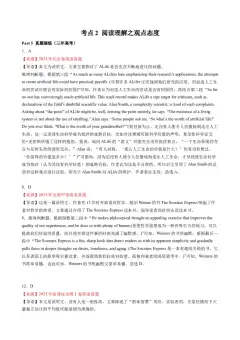
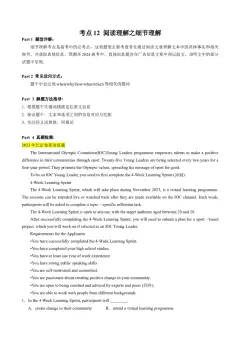
考点 2 阅读理解之观点态度
Part 1 题型详解:
观点态度是高考中的常考点。作者写文章总有自己的观点和主张,也会自然流露出对某事的态度;篇章中个
别人物也会对某事表达观点。做这类题时,我们一定要站在文章作者或者文章中人物的角度上看问题,寻找相关
题目中作者或者某个人物说过的话,做过的事,从而根据所做作为判断人物的态度。预测在 2024高考中,观点态
度可能会在高考阅读理解中呈现。
Part 2 常见设问方式:
The author’s attitude towards ... is _____________. What is sb’s attitude towards ...?
Which word best describes the author’s attitude to......? Regarding..., sb. is ___________.
Part 3 解题方法指导:
1. 熟练掌握选项中表示观点态度的形容词,并能区分积极、消极等对立的形容词。
2. 关注作者的主观评论和感受,如相关的形容词、副词和动词。
3. 作者如列举一定的事例,要理清所举的例子与其观点、态度是否一致。
Part 4 常见的表示观点态度的词:
envious__________ positive_________ objection__________
irritated__________ negative__________ criticism__________
sympathetic________ doubtful__________ puzzling_________
uneasy___________ hopeful_________ neutral_____
tolerant_________ relieved__________ unprejudiced___________
cautious___________ worried___________ reserved__________
responsible___________ ambiguous___________ ironic___________
ambitious____________ unfavorable___________ mixed__________
considerate__________ intolerant___________
indifferent__________ uninterested____________
objective__________ dismissive ____________
critical___________ approving________
optimistic__________ unclear_________
concerned___________ supportive ___________
suspicious_________ favorable__________
uncaring______ disapproval___________Part 5 真题演练(三年高考)
2023年北京卷英语真题
What is life? Like most great questions, this one is easy to ask but difficult to answer. The reason is simple: we
know of just one type of life and it’s challenging to do science with a sample size of one. The field of artificial life-
called ALife for short — is the systematic attempt to spell out life’s fundamental principles. Many of these
practitioners, so-called ALifers, think that somehow making life is the surest way to really understand what life is.
So far no one has convincingly made artificial life. This track record makes ALife a ripe target for criticism,
such as declarations of the field’s doubtful scientific value. Alan Smith, a complexity scientist, is tired of such
complaints. Asking about “the point” of ALife might be, well, missing the point entirely, he says. “The existence of
a living system is not about the use of anything.” Alan says. “Some people ask me, ‘So what’s the worth of artificial
life?’ Do you ever think, ‘What is the worth of your grandmother?’”
As much as many ALifers hate emphasizing their research’s applications, the attempts to create artificial life
could have practical payoffs. Artificial intelligence may be considered ALife’s cousin in that researchers in both
fields are enamored by a concept called open-ended evolution (演化). This is the capacity for a system to create
essentially endless complexity, to be a sort of “novelty generator”. The only system known to exhibit this is Earth’s
biosphere. If the field of ALife manages to reproduce life’s endless “creativity” in some virtual model, those same
principles could give rise to truly inventive machines.
Compared with the developments of Al, advances in ALife are harder to recognize. One reason is that ALife is
a field in which the central concept — life itself — is undefined. The lack of agreement among ALifers doesn’t help
either. The result is a diverse line of projects that each advance along their unique paths. For better or worse, ALife
mirrors the very subject it studies. Its muddled (混乱的) progression is a striking parallel (平行线) to the
evolutionary struggles that have shaped Earth biosphere.
Undefined and uncontrolled, ALife drives its followers to repurpose old ideas and generated novelty. It may
be, of course, that these characteristics aren’t in any way surprising or singular. They may apply universally to all
acts of evolution. Ultimately ALife may be nothing special. But even this dismissal suggests something:perhaps,
just like life itself throughout the universe, the rise of ALife will prove unavoidable.
1.Regarding Alan Smith’s defence of ALife, the author is .
A.supportive B.puzzled C.unconcerned D.doubtful
2023年全国甲卷英语真题
I was about 13 when an uncle gave me a copy of Jostein Gaarder’s Sophie’s World. It was full of ideas that
were new to me, so I spent the summer with my head in and out of that book. It spoke to me and brought me into a
world of philosophy (哲学).
That love for philosophy lasted until I got to college. Nothing kills the love for philosophy faster than people
who think they understand Foucault, Baudrillard, or Confucius better than you — and then try to explain them.
Eric Weiner’s The Socrates Express: In Search of Life Lessons from Dead Philosophers reawakened my love
for philosophy. It is not an explanation, but an invitation to think and experience philosophy.Weiner starts each chapter with a scene on a train ride between cities and then frames each philosopher’s work
in the context (背景) of one thing they can help us do better. The end result is a read in which we learn to wonder
like Socrates, see like Thoreau, listen like Schopenhauer, and have no regrets like Nietzsche. This, more than a
book about understanding philosophy, is a book about learning to use philosophy to improve a life.
He makes philosophical thought an appealing exercise that improves the quality of our experiences, and he
does so with plenty of humor. Weiner enters into conversation with some of the most important philosophers in
history, and he becomes part of that crowd in the process by decoding (解读) their messages and adding his own
interpretation.
The Socrates Express is a fun, sharp book that draws readers in with its apparent simplicity and gradually pulls
them in deeper thoughts on desire, loneliness, and aging. The invitation is clear: Weiner wants you to pick up a
coffee or tea and sit down with this book. I encourage you to take his offer. It’s worth your time, even if time is
something we don’t have a lot of.
8.What does the author think of Weiner’s book?
A.Objective and plain.
B.Daring and ambitious.
C.Serious and hard to follow.
D.Humorous and straightforward.
2023年新课标全国Ⅰ卷英语真题
On March 7, 1907, the English statistician Francis Galton published a paper which illustrated what has come
to be known as the “wisdom of crowds” effect. The experiment of estimation he conducted showed that in some
cases, the average of a large number of independent estimates could be quite accurate.
This effect capitalizes on the fact that when people make errors, those errors aren’t always the same. Some
people will tend to overestimate, and some to underestimate. When enough of these errors are averaged together,
they cancel each other out, resulting in a more accurate estimate. If people are similar and tend to make the same
errors, then their errors won’t cancel each other out. In more technical terms, the wisdom of crowds requires that
people’s estimates be independent. If for whatever reasons, people’s errors become correlated or dependent, the
accuracy of the estimate will go down.
But a new study led by Joaquin Navajas offered an interesting twist (转折) on this classic phenomenon. The
key finding of the study was that when crowds were further divided into smaller groups that were allowed to have a
discussion, the averages from these groups were more accurate than those from an equal number of independent
individuals. For instance, the average obtained from the estimates of four discussion groups of five was
significantly more accurate than the average obtained from 20 independent individuals.
In a follow-up study with 100 university students, the researchers tried to get a better sense of what the group
members actually did in their discussion. Did they tend to go with those most confident about their estimates? Did
they follow those least willing to change their minds? This happened some of the time, but it wasn’t the dominant
response. Most frequently, the groups reported that they “shared arguments and reasoned together”. Somehow,
these arguments and reasoning resulted in a global reduction in error. Although the studies led by Navajas havelimitations and many questions remain, the potential implications for group discussion and decision-making are
enormous.
12.What is the author’s attitude toward Navajas’ studies?
A.Unclear. B.Dismissive. C.Doubtful. D.Approving.
2022年北京卷英语真题
Quantum ( 量子 ) computers have been on my mind a lot lately. A friend has been sending me articles on
how quantum computers might help solve some of the biggest challenges we face as humans. I’ve also had
exchanges with two quantum-computing experts. One is computer scientist Chris Johnson who I see as someone
who helps keep the field honest. The other is physicist Philip Taylor.
For decades, quantum computing has been little more than a laboratory curiosity. Now, big tech companies
have invested in quantum computing, as have many smaller ones. According to Business Weekly, quantum
machines could help us “cure cancer, and even take steps to turn climate change in the opposite direction.” This is
the sort of hype ( 炒作 ) that annoys Johnson. He worries that researchers are making promises they can’t keep.
“What’s new,” Johnson wrote, “is that millions of dollars are now potentially available to quantum computing
researchers.”
As quantum computing attracts more attention and funding, researchers may mislead investors, journalists, the
public and, worst of all, themselves about their work’s potential. If researchers can’t keep their promises,
excitement might give way to doubt, disappointment and anger, Johnson warns. Lots of other technologies have
gone through stages of excitement. But something about quantum computing makes it especially prone to hype,
Johnson suggests, perhaps because “‘quantum’ stands for something cool you shouldn’t be able to understand.” And
that brings me back to Taylor, who suggested that I read his book Q for Quantum.
After I read the book, Taylor patiently answered my questions about it. He also answered my questions about
PyQuantum, the firm he co-founded in 2016. Taylor shares Johnson’s concerns about hype, but he says those
concerns do not apply to PyQuantum.
The company, he says, is closer than any other firm “by a very large margin ( 幅度 )” to building a “useful”
quantum computer, one that “solves an impactful problem that we would not have been able to solve otherwise.”
He adds, “People will naturally discount my opinions, but I have spent a lot of time quantitatively comparing what
we are doing with others.”
Could PyQuantum really be leading all the competition “by a wide margin”, as Taylor claims? I don’t know.
I’m certainly not going to advise my friend or anyone else to invest in quantum computers. But I trust Taylor, just
as I trust Johnson.
13.Regarding Johnson’s concerns, the author feels ________.
A.sympathetic B.unconcerned C.doubtful D.excited
2021年北京市英语高考真题
Hundreds of scientists, writers and academics sounded a warning to humanity in an open letter published last
December: Policymakers and the rest of us must engage openly with the risk of global collapse. Researchers inmany areas have projected the widespread collapse as “a credible scenario(情景) this century”.
A survey of scientists found that extreme weather events, food insecurity, and freshwater shortages might
create global collapse. Of course, if you are a non-human species, collapse is well underway.
The call for public engagement with the unthinkable is especially germane in this moment of still-
uncontrolled pandemic and economic crises in the world's most technologically advanced nations. Not very long
ago, it was also unthinkable that a virus would shut down nations and that safety nets would be proven so
disastrously lacking in flexibility.
The international scholars’ warning letter doesn't say exactly what collapse will look like or when it might
happen. Collapseology, the study of collapse, is more concerned with identifying trends and with them the dangers
of everyday civilization. Among the signatories(签署者) of the warning was Bob Johnson, the originator of the
“ecological footprint” concept, which measures the total amount of environmental input needed to maintain a given
lifestyle. With the current footprint of humanity, “it seems that global collapse is certain to happen in some form,
possibly within a decade, certainly within this century,” Johnson said in an email.
“Only if we discuss the consequences of our biophysical limits,” the December warning letter says, “can we
have the hope to reduce their speed, severity and harm”. And yet messengers of the coming disturbance are likely to
be ignored. We all want to hope things will turn out fine. As a poet wrote,
Man is a victim of dope(麻醉品)
In the incurable form of hope.
The hundreds of scholars who signed the letter are intent(执着) on quieting hope that ignores preparedness.
“Let's look directly into the issue of collapse,” they say, “and deal with the terrible possibilities of what we see there
to make the best of a troubling future.”
18.As for the public awareness of global collapse, the author is________.
A.worried B.puzzled C.surprised D.scared
Part 6 模拟练习
2024届广东省河源中学高三上学期一调考试英语试题
Could a new treatment developed by the US company Lilly mean “the beginning of the end” of Alzheimer’s?
Could we even cure it some day? These are headlines and questions swirling (流传) around after news of a new
drug, called donanemab, showed promising results in phase-3 trials.
The brain science behind Alzheimer’s is complex, but CT and MRJ scans suggest that poisonous changes
occur in the brain, including the abnormal build-up of proteins called amyloid plaques and tau tangles. The damage
starts in the parts of the brain essential for forming memories but then spreads throughout the organ, with brain
tissue shrinking significantly.
Developing treatments for Alzheimer’s has been a challenge, with almost 20 years passing with no new drugs.
But in the last year, two new ones have emerged: donanemab and lecanemab. Neither are cures or magic bullets for
the disease, but they do address key symptoms. They target the amyloid proteins that can accumulate in the brain
and damage neurons, slowing down its progression.
While this news is exciting, there are major caveats. One is whether it will ever become available on the NHS.The cost is estimated to be about £20,000 per person per year of treatment.
Another is the serious side effects: in the study, brain swelling occurred in 24% of participants and brain
bleeding occurred in 31.4% on the drug compared with 13.6% in the placebo (安慰剂) group. There were also three
deaths during the trial.
Part of the problem for me, as an academic, in assessing the drug is that the full results of the trial haven’t yet
been shared publicly or published in a peer-review journal. We cannot access the full data or examine the trial yet,
and there is always a motivation for private companies to overstate the effectiveness of new drugs. Trial results
need to be assessed by an independent body of experts.
While it is unlikely to change clinical practice until at least 2025, the news of donanemab is again an
indication that science is continuing to make progress when it comes to treating the major causes of illness and
death, even one related to the highly complex inner workings of the brain, So, there are caveats and the need for
caution, but these new drugs are indeed the grounds for that rare thing these days: hope.
4.What is the author’s attitude towards the new drug?
A.Approving. B.Doubtful. C.Unclear. D.Indifferent.
2024届湖南省永州市高三上学期第一次模拟考试英语试题
The blanket of pollution resulting from carbon dioxide emissions from fossil fuels is already warming the
planet and causing more extreme weather disasters. One way to keep climate change from getting worse is to take
some of those historic emissions out of the atmosphere. More than 200 scientists have signed onto a letter pushing
for “responsible” research into ways to trap planet-heating carbon dioxide in the world’s oceans.
Oceans already do that for us, absorbing and holding around 50 times more carbon than the atmosphere. What
if humans could supercharge that ability? That’s what scientists want to better understand, along with any side
effects that might come with messing with the chemistry of our oceans.Startups are already developing new
technologies to sequester(隔绝)more CO2 in the sea. But there’s still a lot we don’t know about what impact that
might have or what strategies might be most successful, the letter says.
These are all pretty early efforts, and hacking the high seas is no replacement for preventing greenhouse gas
emissions from accumulating in the atmosphere by getting rid of fossil fuels. Some environmental advocates are
also worried about new CO2-filtering technologies harming marine life.
The letter today calls for controlled field trials to evaluate carbon removal strategies, along with a third-party
review of the results. There also need to be safety measures in place to address any “unintended or harmful
consequences” and inclusive policies to engage different stakeholders(利益相关者).Some big names in climate and
environmental sciences have signed on.
“I have seen these massive declines in ocean health...Doing nothing is unethical(不道德的) essentially,” says
Débora, Ecology, Evolution, and Marine Biology department chair at the University of California, Santa Barbara,
who signed the letter released today. When it comes to studying new ways to use oceans to tackle climate change,
she says,“ We need to at least figure out the risks and the benefits, see whether we can help resolve the problem we
have created.”
8.What is Débora’s attitude toward the studies of new ways?A.Unclear. B.Approving. C.Dismissive. D.Doubtful.
2024届辽宁省本溪市平山区本溪市高级中学高三一模英语试题
When I mentioned to some friends that we all have accents, most of them proudly replied, “Well, I speak
perfect English/Chinese/etc.” But this kind of misses the point.
More often than not, what we mean when we say someone “has an accent” is that their accent is different from
the local one, or that pronunciations are different from our own. But this definition of accents is limiting and could
give rise to prejudice. Funnily enough, in terms of the language study, every person speaks with an accent. It is the
regular differences in how we produce sounds that define our accents. Even if you don’t hear it yourself, you speak
with some sort of accent. In this sense, it’s pointless to point out that someone“has an accent“. We all do!
Every person speaks a dialect , too. In the field of language study, a dialect is a version of a language that is
characterized by its variations of structure, phrases and words. For instance,“ You got eat or not? ”(meaning “Have
you eaten?” ) is an acceptable and understood question in Singapore Oral English. The fact that this expression
would cause a standard American English speaker to take pause doesn’t mean that Singapore Oral English is
“wrong” or “ungrammatical”. The sentence is well-formed and clearly communicative, according to native
Singapore English speakers’ solid system of grammar. Why should it be wrong just because it’s different?
We need to move beyond a narrow conception of accents and dialects — for the benefit of everyone.
Language differences like these provide insights into people’s cultural experiences and backgrounds. In a
global age, the way one speaks is a distinct part of one’s identity. Most people would be happy to talk about the
cultures behind their speech. We’d learn more about the world we live in and make friends along the way.
12.What is the author’s attitude towards accent?
A.Favourable B.Intolerant C.Doubtful D.Unclear
2023届广东省广州市荔湾区广州市协和中学高三下学期一模英语试题
Although social media can be enjoyable and beneficial, online relationships simply cannot replace real life
connection. But simply being in the flesh with someone does not make a lasting, meaningful relationship, which got
me thinking: what, exactly, does? My search to answer this question took me back more than 2,000 years to
Aristotle’s Nichomachean Ethics. What I found couldn’t be more insightful, and it rings just as true today as it must
have then.
Aristotle writes that there are three different kinds of friendship:
FRIENDSHIPS BASED ON UTILITY, in which one or both of the parties gain something as a result of the
friendship (think: much of the modern “networking” enterprise, or becoming friends with someone because you
think they can help you).
FRIENDSHIPS BASED ON PLEASURE, or those centered around pleasant experiences (think: people with
whom you can have a good, carefree time).
FRIENDSHIPS BASED ON VIRTUE, in which both individuals share the same values (think: people whom
you admire and respect, and with whom you share what you find most important in life).
It’s fascinating that, centuries ago, Aristotle offered that many individual often pursue friendships primarily forutility. And it’s easy to see that some things never change.
Likewise, he wrote, “Those who love because of what is good for themselves, and those who love because of
pleasure do so because of what is pleasant to themselves. Yet what one finds useful or pleasurable, is not permanent
but is always changing; thus, when the reason for the friendship is done away, the friendship is dissolved.”
It’s OK to have some friendships mainly for utility and pleasure, but it’s important to realize that these fill a
different purpose and are likely to have a shorter lifespan than one built upon shared virtue. And it is the friendships
based on virtue that are worth protecting and cherishing. But they require considerable energy to maintain -- as
Aristotle wrote, “lack of conversation has broken many a friendship” -- but what you get out of these friendships
easily outweighs what you put in.
13.What is the author’s attitude towards Aristotle’s grouping of friendship?
A.Supportive. B.Opposed. C.Doubtful. D.Unclear.
2023届浙江省杭州市高三下学期教学质量检测(二模)英语试题
ChatGPT, designed by OpenAI to carry on conversations just like humans, has become a viral excitement. The
AI-powered tool went from zero to a million users in just five days! Its ability to provide in-depth answers to user
questions has even drawn the attention of distinguished technology companies.
The intelligent robot understands what the user says or types and then responds in a way that makes sense. Its
vast body of knowledge has been gathered from the internet and archived books. It is further trained by humans.
This makes ChatGPT a useful tool for researching almost any topic.
“We have a lot of information on the internet, but you normally have to Google it, then read it and then do
something with it,” says Ricardo, chief science officer and co-founder of AI company Erudit. “Now you’ll have this
resource that can process the whole internet and all of the information it contains for you to answer your question.”
ChatGPT cannot think on its own. It depends on the information that it has been trained on. As a result, the AI
tool works well for things that have accurate data available. However, when unsure, ChatGPT can get creative and
flow out incorrect responses. OpenAI cautions users to check the information no matter how logical it sounds. Also,
ChatGPT has only been trained with information till 2021. Hence, it cannot be relied upon for anything that
happened after that.
Experts believe ChatGPT has limitless potential to solve real-world problems. It can translate long texts into
different languages, create content on almost any topic, and even summarize books.
However, ChatGPT has received mixed reactions from educators. Some believe it could serve as a valuable
tool to help build literacy skills in the classroom. It could also be used to teach students difficult science or math
concepts. But other educators think ChatGPT will encourage students to cheat. They fear this will prevent them
from building critical thinking and problem-solving skills. As a result, many districts are starting to ban its use in
schools.
20.What is the author’s attitude towards ChatGPT?
A.Favorable. B.Disapproving. C.Objective. D.Intolerant.
浙江省金华十校2022-2023学年下学期高三4月模拟考试(二模)预演英语试题Solar farms offer one way to meet the world’s decarbonization targets, but they could also be used to deal with
another of the planet’s big problems: loss of biodiversity. The approach is starting to take off. Residents of
Barnsdale, for example, will soon play host to a new solar farm lined with grass field of wildflowers and native
grasses, which Banks Group, the developer, says will promote pollinating insects.
The idea comes from the combination of two long-term trends: declining numbers of pollinating insects and
the growing amount of land distributed to solar farms. According to the Center for Biological Diversity in Arizona,
more than 40 percent of insect pollinators globally are listed as “highly threatened”—an issue that could seriously
threaten food security. Meanwhile, solar-energy competence has been increasing. Matthew O’Neal, a scientist at
Iowa State University, would like to see more solar developers seize this opportunity.
The benefits of such projects don’t stop at the insects. Research from Yale’s Center for Business and the
Environment indicates that pollinator-friendly solar farms can raise crop output on nearby farmland, increase the
recharging of groundwater and reduce soil erosion. In 2018, a US Department of Energy study found that if all
existing and planned solar facilities near soybean and cranberry crops included pollinator home and increased
output by just one percent, annual crop values could rise by US $1.75 million, US $4 million and US $233,000,
respectively.
“Farmers could identify unprofitable areas, such as poor, highly erodible lands, as candidates for a pollinator-
friendly solar farm. There’s the potential to increase their net income with pollinator motivation projects,” says
O’Neal.
With enough forward thinking, these studies show, clean energy can provide new environmental opportunities.
“We’re at a turning point with energy production and we’re seeing more opportunities to provide extra benefits that
wouldn’t have been considered with older methods of energy generation,” says O’Neal. “You never heard of a coal
mine planning pollinator conservation.”
23.What is O’Neal’s attitude towards the solar farm?
A.Supportive. B.Conservative. C.Skeptical. D.Uncertain.
2023届浙江省金华十校高三下学期二模英语试题
As the climate crisis speeds up, Europe is warming faster than any other region, according to a new State of
the Climate in Europe report from the World Meteorological Organization.
The WMO report comes ahead of the UN’s international climate summit in Egypt, and is one in a series of
reports over the past several weeks that show how the world is off-track on its climate goals. Not only are
countries missing the mark on their efforts to reduce planet-warming fossil fuel emissions ( 排放物), but
measurements show temperatures are already skyrocketing.
Some continents are feeling that rise more than others. Wednesday’s report shows temperatures in Europe have
increased at more than twice the global average over the past 30 years — at a rate of about 0.5 degrees Celsius per
decade.
Recent reports show how the region’s temperature rise is fueling extreme weather.
Year-to-date through July, the number of wildfires in the EU was four times the 15-year average. A deadly,
record-breaking heatwave in the UK harmed public health and bent infrastructure (基础设施). Exceptional droughttroubled the continent this summer, drying up some of the world’s most economically important rivers. And that
drought that came on the heels of some of the most destructive floods Europe has ever seen.
“Europe presents a live picture of a warming world and reminds us that even well-prepared societies are not
safe from impacts of extreme weather events,” said WMO Secretary-General Petteri Taalas in a forward on the
report.
“European society is vulnerable (易受伤害的) to climate variability and change, but Europe is also at
the forefront of the international effort to address climate change and to develop innovative solutions to adapt to
the new climate Europeans will have to live with,” Carlo Buontempo, director of the Copernicus Climate Change
Service, said in a statement.
Taalas said in his forward that although Europe’s pace on cutting planet-warming emissions has been “good,”
their ambition on this front “should be further increased.”
27.What is Buontempo’s attitude towards Europe’s effort to fight climate change?
A.Doubtful. B.Favorable.
C.Unclear. D.Intolerant.
2023届浙江省台州市高三下学期第二次教学质量评估英语试题
Alarming levels of dangerous chemicals known as Perfluorinated Alkylated Substances (PFAS) were
discovered in food packaging at a number of well-known fast-food restaurants and grocery store chains, a new
report found. The report comes more than two years into the Covid-19 pandemic, when the public has relied
heavily on takeout and grocery deliveries.
Often called “forever chemicals” because they do not break down in the environment, PFAS are used in food
packaging to prevent grease (油脂) and water from soaking through food wrappers and cups. PFAS can also be
found in the ink used to print logos and instructions on food containers.
The US Centers for Disease Control and Prevention calls exposure to PFAS a “public health concern”, citing
that the human-made chemicals can harm the immune system and reduce a person’s resistance to infectious
diseases.
Regulatory limits for how much PFAS food packaging should contain can vary greatly. For instance, a new
law in California set the limit at less than 100 ppm. “Compared to America, Denmark sets a much lower regulatory
limit of 20 ppm with great success,” said Xenia Trier, an expert at the European Environment Agency. “It does
work to set limits and enforce them. PFAS do migrate from the paper into the food. Even though it was not 100%,
we still saw considerable transmission. In general, transmission from packaging to food is increased as the
temperature of the food rises. It is the same with the time spent in wrapping materials.” Trier told NBS, one of the
major American mass-media companies.
In response to the issue, Whole Foods became the first grocery chain to publicly commit to remove PFAS from
takeout containers and bakery paper. Many other companies followed suit. Experts say people who want to avoid
PFAS in their takeout and food delivery packaging should favor companies that have promised to remove the
chemicals. “As soon as you receive your takeout, you’d better take food out of the container immediately, and
never reheat food in its original container. Instead, remove your food and heat it in ceramic (陶瓷的) or glasscontainers.” Trier said.
30.What is Xenia Trier’s attitude to setting a lower limit of PFAS?
A.Favorable. B.Neutral.
C.Ambiguous. D.Opposed.
2023届浙江省高考临海、新昌两地适应性考试5月模考英语试题
New technological tools are enabling a global community of biologists and amateur scientists to explore the
natural world of sound in richer detail and at greater range than ever before. Just as microscopes helped humans
observe things not visible to the naked eye, widely used microphones and machine learning models allow us to
listen to sounds we cannot otherwise hear.
Billions of dollars are pouring into so-called generative artificial intelligence, such as OpenAI’s ChatGPT,
with scores of new companies being launched to commercialize these foundation models. But in one sense, these
models are mostly used to rearrange existing human knowledge in new combinations rather than to generate
anything really new. What may have a bigger scientific impact is “additive AI”, using machine learning to explore
specific, newly created data sets and extend the frontiers of human knowledge. When it comes to sonic (声音的)
data, there is an incredible potential for cross-species communication through the use of machines that can translate
and copy animal sounds exactly, effectively creating a “Google Translate for the zoo”.
This sonic revolution has been promoted by advances in both hardware and software. Cheap, durable, long-
lasting microphones and sensors can be attached to trees in the Amazon, rocks in the Arctic or to dolphins’ backs,
enabling real-time monitoring. That stream of sonic data is then processed by “additive AI”. However, this data
only makes sense when combined with human observations about natural behaviors gained from painstaking
fieldwork by biologists or crowdsourced analysis from amateurs.
Scientists have discovered fascinating information about the sonic universe, which has already led to practical
and commercial outcomes. For example, cryptographers (密码专家) have been studying the buzzes, clicks, creaks
and squeaks of whales to understand whether their “bionic Morse code” could be copied to encrypt (加密)
communications. However, this is just the beginning of our exploration of sound, and there is no telling what other
discoveries await us.
35.What’s the author’s attitude towards sound exploration?
A.Optimistic. B.Reserved. C.Critical. D.Indifferent