橙啦,大学生学习成长平台
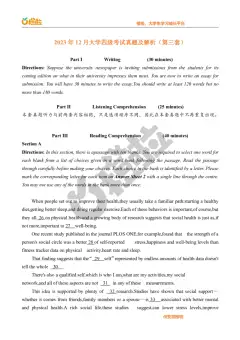
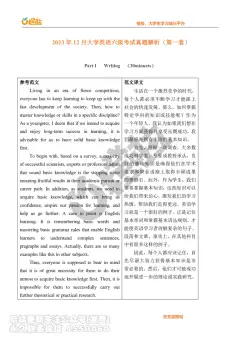
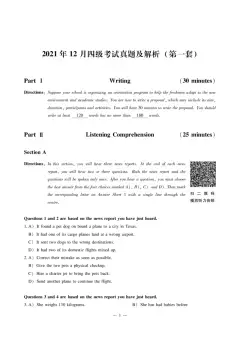
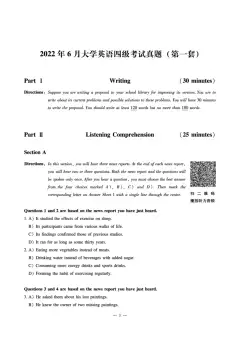
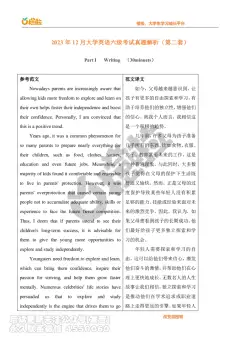
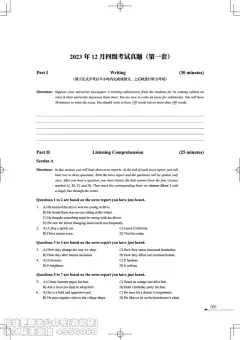
2023 年 12 月大学四级考试真题及解析(第一套)
Part Ⅰ Writing (30 minutes)
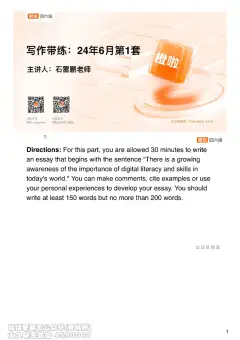
Directions: Suppose the university newspaper is inviting submissions from the students for its
coming edition on a campus event that has impressed them most.You are now to write an essay for
submission.You will have 30 minutes to write the essay.You should write at least 120words but no
morethan 180words
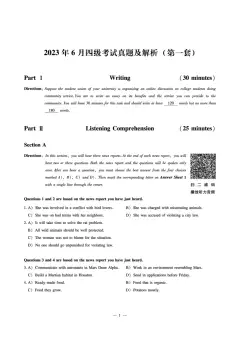
Part Ⅱ ListeningComprehension (25 minutes)
SectionA
Directions: In this section, you will hear three news reports.At the end of each news report, you will
hear two or three questions. Both the news report and the questions will be spoken only once. After
you hear a question, you must choose the best answer from the four choices marked A), B), C) and
D). Then mark thecorrespondingletter onAnswer Sheet1with asinglelinethrough thecentre.
Questions1and2arebased onthe news reportyou havejustheard.
1.A)Their brains work inharmony. B)They are generally the sameage.
C)Their interests are quitesimilar. D)They have the same ethnic background.
2.A) It can betouching. B) It ishard topredict.
C)It can work bothways. D)It resembles family ties.
Questions3and4arebased onthe news reportyou havejustheard.
3.A)Search fortheir half-brothers.
B) Identify their biological fathers..
C)Findout moreabout theirancestry.
D)See whether they are actually related.
4.A)They were bothgiven upforadoption.
B)They were born to thesame mother.
C)They flew 737airplanes as pilots.
D)They were both60years ofage.
Questions5to 7arebased onthe newsreportyou havejustheard.
5.A) Oneof hisfriends was caught littering.
B) Othertourists refused to join inthe cleanup.
C)Thebeautiful beach was spoiled with lots oftrash.
D)The kilometer-longbeach was practically deserted.
改变就橙啦橙啦,大学生学习成长平台
6.A)Apasserby.
B)Alocal woman.
C)Thebeach authorities.
D)One ofthefive tourists.
7.A)Thetourists' good deed was not noticed bythe locals.
B) Somenatives were selling poor-qualityfood to tourists.
C)Thenumber oftourists to thebeach is onasteady decline.
D)It was touristsnot natives who were cleaning upthe beach.
Section B
Directions: In this section, you will hear two long conversations. At the end of each conversation,
you will hear four questions. Both the conversation and the questions will be spoken only once. After
you hear a question, you must choose the best answer from the four choices marked A), B), C) and
D). Then mark thecorrespondingletter onAnswer Sheet 1withasinglelinethrough thecentre.
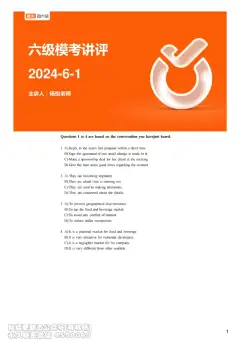
Questions8to 11arebasedon theconversation youhavejustheard.
8. A)He has toplay football with workmates. B)Hehas got some booksto read.
C)Heis going to visitafriend. D)He is physically unfitfor it.
9.A)Toteach kids about animal protection.
B)Tolearn howpopular zoos could be.
C)Tosee somerare animals in cages.
D)Togive herlittle nephew atreat.
10.A) Heenjoys excellent health.
B) Heis keen onextreme sports.
C)Hecoaches tennis players every week.
D)He spends most ofhis timein thegym..
11.A)Tending to his swollen ankle.
B) Concentrating onreading.
C)Writing three bookreports.
D)Planning Christmascelebrations.
Questions12to 15arebased onthe conversation you havejustheard.
12. A)It is being debated byhundreds ofretirees.
B) It isattracting many people's attention.
C)It partly records his own experience.
D)It argues for postponing retirement.
改变就橙啦橙啦,大学生学习成长平台
13.A) Oneshouldforesee afinancial crisis.
B)Oneshouldtrust financial planners' figures.
C)Oneshouldhave onemillion dollars to retire.
D)One should start saving as early as possible.
14.A) It doesn't need to bepermanent.
B) It shouldn't be considered risky.
C)It helps to reduce travel expenses.
D)It is theway to quita jobone hates.
15.A) By keeping closecontact with one's employers.
B)By retiring when one reaches sixtyyears old.
C)By investinghalf ofone's monthly income.
D)By following thecounsel of financial planners.
Section C
Directions: In this section, you will hear three passages. At the end of each passage, you will hear
three or four questions. Both the passage and the questions will be spoken only once. After you hear
a question, you must choose the best answer from the four choices marked A), B), C) and D). Then
markthecorresponding letter onAnswer Sheet 1with asinglelinethrough thecentre.
Questions16to 18arebased onthe passageyouhavejustheard.
16.A)They tended to beeasily anticipated bythosebelonging to theirown race.
B)They tended tobearbitrarily judged byindividuals ofopposing groups.
C)They were readily shared amongmembers ofthesame social orracial group.
D)They were influenced bythepresence ofsomeone from an outsidergroup.
17.A)When they tried to make apositiveimpression onthe researchers.
B)When anunknown student from another university was present.
C)When anexperimenterfrom theresearch team tooknotice.
D)When they were offered bothcandy and fruit as asnack.
18.A)By advertising itssocial benefits.
B)By teaching consumers diet strategies.
C)By supportingstruggling consumers.
D)By maintaining itspositiveimage.
Questions19to 21arebased onthe passageyouhavejustheard.
19. A)The academic and learning issues struggling students encounter
B)Therisk students face dueto ahistory ofmental health problems.
改变就橙啦橙啦,大学生学习成长平台
C)Theeffect ofinteracting with therapy dogs onstudents under pressure.
D)The work universities are doingto help students succeed academically.
20.A)Their communicative skills.
B)Their executivefunctioning.
C)Theiracademic networking.
D)Their leadership capacities.
21.A) Ridstudents oftheir anxiety.
B)Add to somestudents' stress.
C)Contributelittle to typical students' success.
D)Help studentswith mental issues pull through.
Questions22to 25arebased onthe passageyouhavejustheard.
22.A)Workhard and plan carefully.
B)Attemptto succeed at anycost.
C)Aim high and expect great results.
D)Remain optimisticeven indifficulty.
23.A) Regarding failure as something inevitable.
B)Trying out innovativemarketing strategies.
C)Venturinginto sectors never explored before.
D)Being willingto experiment with novel ideas.
24.A) Expectfuture success so as to moveforward.
B) Learnfrom our failure and forge ahead.
C)Distinguish between good andbad risks.
D)Examineourstrategies and find out weaknesses.
25.A) Fresher offers. B)Safer operation.
C)Morechallenges. D)Less competition.
Part Ⅲ Reading Comprehension (40 minutes)
SectionA
Directions:In thissection, thereis apassagewith ten blanks. Youarerequired to select one wordfor
each blank from a list of choices given in a word bank following the passage. Read the passage
through carefullybeforemaking your choices. Each choiceinthe bankis identified byaletter.Please
mark the corresponding letter for each item onAnswer Sheet 2 with a single line through the centre.
Youmay notuse anyof thewords in thebankmorethanonce.
改变就橙啦橙啦,大学生学习成长平台
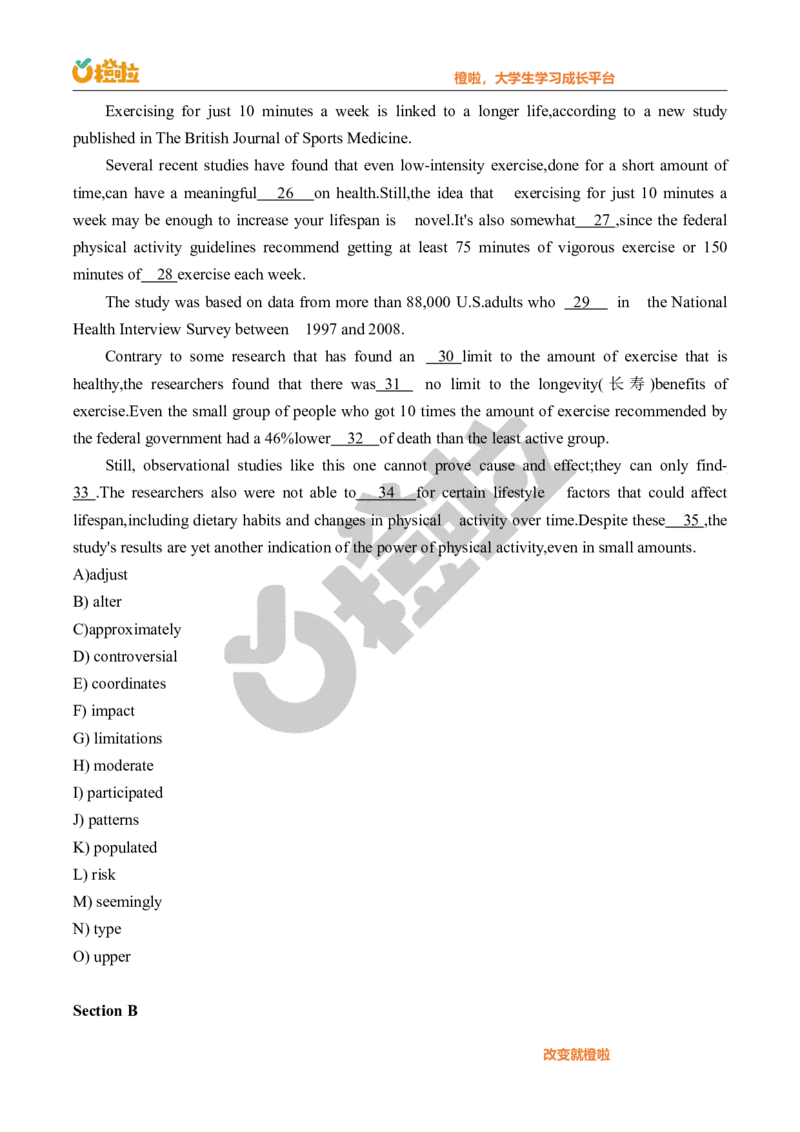
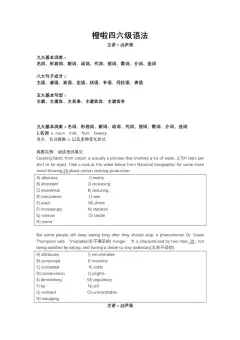
Exercising for just 10 minutes a week is linked to a longer life,according to a new study
published inTheBritish Journal ofSports Medicine.
Several recent studies have found that even low-intensity exercise,done for a short amount of
time,can have a meaningful 26 on health.Still,the idea that exercising for just 10 minutes a
week may be enough to increase your lifespan is novel.It's also somewhat 27 ,since the federal
physical activity guidelines recommend getting at least 75 minutes of vigorous exercise or 150
minutesof 28exerciseeach week.
The study was based on data from more than 88,000 U.S.adults who 29 in the National
Health Interview Survey between 1997and 2008.
Contrary to some research that has found an 30 limit to the amount of exercise that is
healthy,the researchers found that there was 31 no limit to the longevity( 长 寿 )benefits of
exercise.Even the small group of people who got 10 times the amount of exercise recommended by
thefederal government had a46%lower 32 ofdeath than theleast active group.
Still, observational studies like this one cannot prove cause and effect;they can only find-
33 .The researchers also were not able to 34 for certain lifestyle factors that could affect
lifespan,including dietary habits and changes in physical activity over time.Despite these 35 ,the
study's results are yet another indicationof thepower ofphysical activity,even in small amounts.
A)adjust
B) alter
C)approximately
D)controversial
E)coordinates
F) impact
G)limitations
H)moderate
I) participated
J)patterns
K)populated
L) risk
M)seemingly
N)type
O)upper
Section B
改变就橙啦橙啦,大学生学习成长平台
Directions: In this section, you are going to read a passage with ten statements attached to it. Each
statement contains information given in one of the paragraphs. Identify the paragraph from which
the information is derived. You may choose a paragraph more than once. Each paragraph is marked
withaletter.Answer thequestions by marking thecorresponding letter onAnswer Sheet 2.
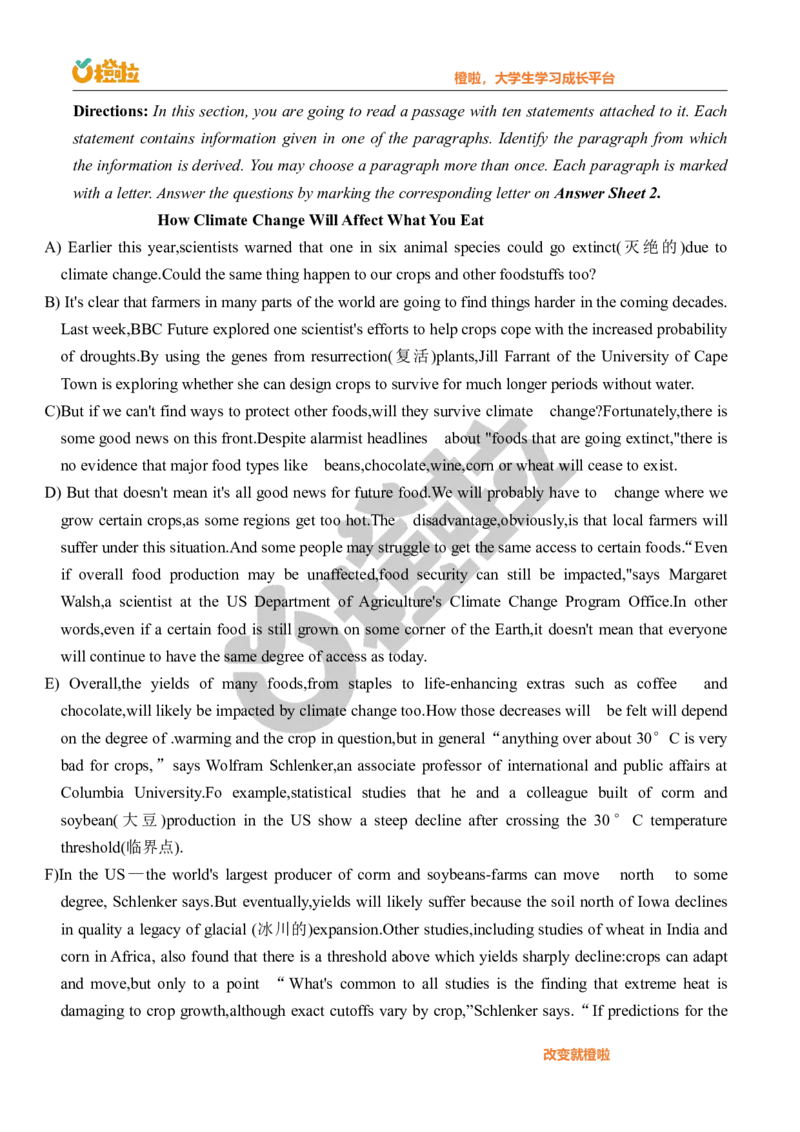
HowClimate ChangeWillAffectWhatYouEat
A) Earlier this year,scientists warned that one in six animal species could go extinct(灭绝的)due to
climatechange.Could thesamething happen to ourcrops and otherfoodstuffs too?
B) It's clear that farmers in many parts ofthe world are going to find things harder in thecoming decades.
Last week,BBC Future explored one scientist's efforts to help crops cope with the increased probability
of droughts.By using the genes from resurrection(复活)plants,Jill Farrant of the University of Cape
Townis exploringwhether shecan design crops to survivefor much longer periods withoutwater.
C)But if we can't find ways to protect other foods,will they survive climate change?Fortunately,there is
some good news on this front.Despite alarmist headlines about "foods that are going extinct,"there is
noevidence that majorfood types like beans,chocolate,wine,corn or wheat will cease toexist.
D) But that doesn't mean it's all good news for future food.We will probably have to change where we
grow certain crops,as some regions get too hot.The disadvantage,obviously,is that local farmers will
sufferunder thissituation.And somepeoplemay struggle to get thesame access tocertain foods“. Even
if overall food production may be unaffected,food security can still be impacted,"says Margaret
Walsh,a scientist at the US Department of Agriculture's Climate Change Program Office.In other
words,even if a certain food is still grown on some corner of the Earth,it doesn't mean that everyone
willcontinue tohave thesame degree of access as today.
E) Overall,the yields of many foods,from staples to life-enhancing extras such as coffee and
chocolate,will likely be impacted by climate change too.How those decreases will be felt will depend
on the degree of .warming and the crop in question,but in general“anything over about 30°C is very
bad for crops,”says Wolfram Schlenker,an associate professor of international and public affairs at
Columbia University.Fo example,statistical studies that he and a colleague built of corm and
soybean(大豆)production in the US show a steep decline after crossing the 30°C temperature
threshold(临界点).
F)In the US—the world's largest producer of corm and soybeans-farms can move north to some
degree, Schlenker says.But eventually,yields will likely suffer because the soil north of Iowa declines
in quality a legacy of glacial (冰川的)expansion.Other studies,including studies of wheat in India and
corn inAfrica, also found that there is a threshold above which yields sharply decline:crops can adapt
and move,but only to a point “What's common to all studies is the finding that extreme heat is
damaging to crop growth,although exact cutoffs vary by crop,”Schlenker says.“If predictions for the
改变就橙啦橙啦,大学生学习成长平台
end ofthe century are true,though,I think alot ofagricultural areas in theUS will seesignificant hits.”
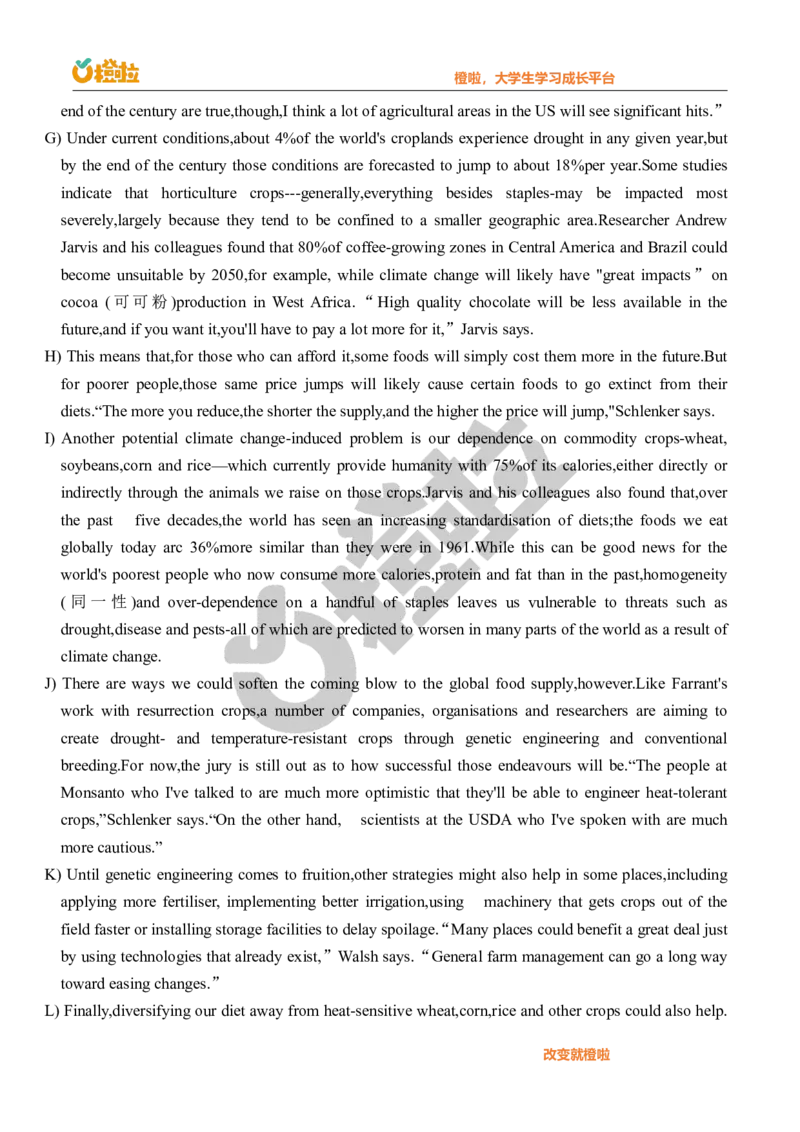
G) Under current conditions,about 4%of the world's croplands experience drought in any given year,but
by the end of the century those conditions are forecasted to jump to about 18%per year.Some studies
indicate that horticulture crops---generally,everything besides staples-may be impacted most
severely,largely because they tend to be confined to a smaller geographic area.Researcher Andrew
Jarvis and his colleagues found that 80%of coffee-growing zones in CentralAmerica and Brazil could
become unsuitable by 2050,for example, while climate change will likely have "great impacts”on
cocoa (可可粉)production in West Africa.“High quality chocolate will be less available in the
future,and ifyou want it,you'll have to paya lotmore forit,”Jarvis says.
H) This means that,for those who can afford it,some foods will simply cost them more in the future.But
for poorer people,those same price jumps will likely cause certain foods to go extinct from their
diets.“Themore you reduce,theshorter thesupply,and thehigher theprice willjump,"Schlenker says.
I) Another potential climate change-induced problem is our dependence on commodity crops-wheat,
soybeans,corn and rice—which currently provide humanity with 75%of its calories,either directly or
indirectly through the animals we raise on those crops.Jarvis and his colleagues also found that,over
the past five decades,the world has seen an increasing standardisation of diets;the foods we eat
globally today arc 36%more similar than they were in 1961.While this can be good news for the
world's poorest people who now consume more calories,protein and fat than in the past,homogeneity
( 同 一 性 )and over-dependence on a handful of staples leaves us vulnerable to threats such as
drought,disease and pests-all of which are predicted to worsen in many parts of the world as a result of
climatechange.
J) There are ways we could soften the coming blow to the global food supply,however.Like Farrant's
work with resurrection crops,a number of companies, organisations and researchers are aiming to
create drought- and temperature-resistant crops through genetic engineering and conventional
breeding.For now,the jury is still out as to how successful those endeavours will be.“The people at
Monsanto who I've talked to are much more optimistic that they'll be able to engineer heat-tolerant
crops,”Schlenker says.“On the other hand, scientists at the USDA who I've spoken with are much
morecautious.”
K) Until genetic engineering comes to fruition,other strategies might also help in some places,including
applying more fertiliser, implementing better irrigation,using machinery that gets crops out of the
field faster orinstalling storage facilities to delay spoilage.“Many places could benefit a great deal just
by using technologies that already exist,”Walsh says.“General farm management can go a long way
toward easing changes.”
L) Finally,diversifying our diet away from heat-sensitive wheat,corn,rice and other crops could also help.
改变就橙啦橙啦,大学生学习成长平台
“We've seen profound changes in the last decades in what we eat largely as a result of international
trade,and I think that trend toward more diversification will continue,”Jarvis says.“Depending on a
greater number of plant species creates a more vigorous and less risky food system—and one that
provides a broader range ofnutritional requirements.”
36. One consequence of climate change is that some people may not have adequate access to certain
foods.
37.Peoplearound theworld are eating foods more similarthan what theyused toeat.
38.Arecent news report talked about scientific efforts to help crops survive droughts through genetic
engineering.
39.It is predicted that climatechange will affect theavailability and price ofquality chocolate.
40. People wonder if certain crops and foodstuffs could disappear like some animal species due to
climate change.
41.Although farms intheUS can moveabit northward,crop yields may decrease.
42.One possiblesolution to thefood security problem is diversification ofdiet.
43.It remains unsettled whether the global food supply problem can be solved by creating heat-tolerant
crops through genetic engineering.
44.Poorpeoplemay have to give upeating certain foods because oftheir highprices.
45. A number of existing farming technologies could be used to reduce the negative effect of climate
change onfood production.
Section C
Directions: There are 2 passages in this section. Each passage is followed by some questions or
unfinished statements. For each of them there are four choices marked A), B), C) and D). You should
decide on the best choice and mark the corresponding letter on Answer Sheet 2 with a single line
through thecentre.
PassageOne
Questions 46to 50arebased onthe followingpassage.
One of my bad habits is saying"busy"when people ask me how I'm doing.Sometimes it's
because I actually am busy,but other times it's because that's what I think I'm supposed to say.That's
what important people say.That's what people who get promoted say.But working long hours
doesn't drive better results. Never taking a vacation won't lead to a promotion.So why are we so
proudto talk about howbusy we are all thetime?
In 2016,researchers from Columbia,Harvard,and Georgetown conducted a study to figure it
out.They found busy people are perceived to be of high status,and interestingly,these status
改变就橙啦橙啦,大学生学习成长平台
attribution are heavily influenced by our own beliefs about social mobility.In other words,the more
we believe that one has the opportunity for success based on hard work,the more we tend to think
that peoplewhoskip leisure and work all thetimeare ofhigherstanding.
That's why we feel like we have to appear busy,and there's a real perception that if someone is
knee-deep in meetings,emails,and stress,then they're probably a big deal.This culture of busyness is
making it hard for employees to find work-life balance.According to a recent study,onein five highly
engagedemployees is at risk ofburnout (精疲力竭).
Personally,I'm going to stop saying "busy"when people ask me how I am.It sounds
self-righteous(自以为是的)and sets thewrong tone.Phrases like"I have limited access to email”and
"I'll respond as soon as I get back”sound like you're being held against your will from working as
opposedto making themostof your timeoff.
That's why we recently launched the Out of Office Email Generator,a free tool you can use
before your next long weekend or trip.You can share loud and proud that you won't be checking
email until you're back. Managers need to think twice about emailing their teams on the weekend
and talking about how busy they are. Leaders should take time off themselves and encourage
employees to dothesame.
46.Whatis areason for theauthorto be inthe habit ofsaying "busy"when asked howheis doing?
A)He justfollows successful people's example.
B) Heis actually proudto befully occupied.
C)Hethinks everyone should bedevoted towork.
D)He believes busyness ensures accomplishments.
47.Whydowe tend to think that busypeople are ofhigh status?
A)Our status can be attributed tooursocial mobility.
B)Wehold thebeliefthat hard work leads tosuccess.
C)Ourown opportunity for success never comes easily.
D)Wefind few people ofhigh status have timefor leisure.
48.What dowelearn about theculture ofbusyness from arecent study?
A)It places employees in endless meetings,emails and stress.
B) It compels some20%of employees toappear always busy.
C)It distortsmany employees' belief ofwhat a satisfying lifeis.
D)It does much harm to many busy employees' well-being.
改变就橙啦橙啦,大学生学习成长平台
49.Whatdosuch utterances as “I havelimited access to email”soundlikeaccording to theauthor?
A)One is toobusy tocheck all emails in time.
B) Oneis opposed to theprevailing work culture
C)Oneis forced bycircumstances tostop working.
D)One is simplyenjoying theirtimeoffwork.
50.Whydid theauthor and his colleagues launch the Out ofOffice EmailGenerator?
A)Toenablebusy employees to spendless timechecking emails.
B)Toensure employees as well as employers truly have timeoff.
C)Tostop managers from talking about howbusy theirteams usually are.
D)Toencouragebothemployers and employees to answeremails promptly.
PassageTwo
Questions51to 55arebased onthe followingpassage.
Female employees consistently pay lower airfares than men dofor the sameflights because they
tend to bookearlier.
Wecompared the airfare paid byemployees in the same position within a company for the same
class of travel and used a common statistical technique to account for other factors that might affect
differences in airfares.We found that women paid on average $18 less per ticket than their male
colleagues.Further investigation allowed us to conclude that this gap is largely explained by the fact
that women tended tobookearlier than men,1.8days onaverage.
Wewanted to determine what was causing these gender differences in booking business trips so
we tested a variety of possible explanations,such as women choosing to plan ahead or male frequent
travelers being inclined to book late.None of these explained away the gender gap,so we applied
data collected from surveys that express consumer preferences that play a central role in economic
decisions,such as patience and risk avoidance.
We found that only the concept of "negative reciprocity"-in which an employee who feels
unfairly treated engages in negative behaviors,such as spending their company's money less
carefully-explains these differences.The surveys showed men tend to exhibit more of these negative
behaviors than women.This isn't to say that all men engage in these behaviors—or that booking
relatively late is a sign of abnormal behavior.It only means that the gender gap disappears when we
plugin thenegative reciprocity variable.
Prior research on negative reciprocity among workers found that it can result in lower employee
改变就橙啦橙啦,大学生学习成长平台
motivation,business performance and workplace morale(士气)and culture.
Our results show another way these negative behaviors can manifest themselves,like in airline
bookings,and add toevidence that women are less likelyto engage in them.
Companies spend significant sums of money on business travel.While that $18 difference per
ticket may seem small,it adds up.Our analysis suggests early booking by women can translate into
savings of$1million ayear for a largemultinational company with 20,000regular travelers.
51. What did the author's team conclude about the gender difference in airfares from their further
investigation?
A)It is largely attributed to women booking earlierthan men.
B)It islargely explained bywomen's choosing cheaperflights.
C)It ismainly accounted forbymale employees' readiness to pay more.
D)It is dueto thefact that women care more about theircompany's money.
52.Whatdid theresearchers want todetermine bytesting avariety ofpossibleexplanations?
A)What made malefrequent travelers bookair tickets late.
B)What caused women to plan ahead in booking business trips.
C)What motivated women to bookcheaperflights.
D)What accounted for thegender gap inairfares.
53.What happened when the negativereciprocity variable was taken into account?
A)Both men and women were foundto engage in negative behaviors.
B)Neither men norwomen viewed booking lateas abad behavior.
C)Thegender difference inairfare expenses nolonger existed.
D)The gender gap tended to narrow toa significant degree.
54.What didprior research onnegativereciprocity among workers find?
A)It can domore harm to theworkplacethan toemployees.
B)It contributes tothemale-female divideinthe workplace.
C)It proves to be counterproductivein anumber ofways.
D)It can result in increasing labor-management conflicts.
55.Whatdoes theauthoremphasizeabout theiranalysis in thelast paragraph?
A)It can help companies increasetheir savings significantly.
改变就橙啦橙啦,大学生学习成长平台
B)It can dulycontribute to companies' business performance.
C)It can translatewomen's bookingpractice into men's behavior.
D)It can enhancelarge multinational companies' competitiveness.
Part Ⅳ Translation (30 minutes)
Directions: For this part, you are allowed 30 minutes to translate a passage from Chinese into
English.You shouldwriteyour answer onAnswer Sheet 2.
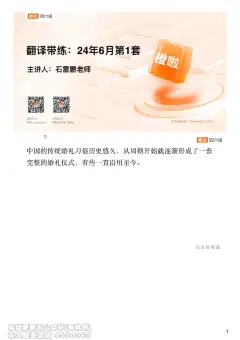
中国政府十分重视人民的健康饮食(diet)。 通过大力提倡健康饮食,人们对合理营养增进
健康的重 要性有了更加深刻的认识。“吃得安全、吃得营养、吃得健康”是人民对美好生活
的基本需要,是提升 人民幸福感的必然要求,也为食品产业的发展提供了新机遇。目前,各
级政府都在采取多种举措确保人 民饮食健康,推进健康中国的建设。
改变就橙啦橙啦,大学生学习成长平台
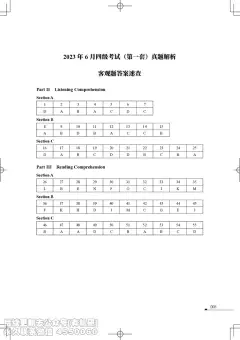
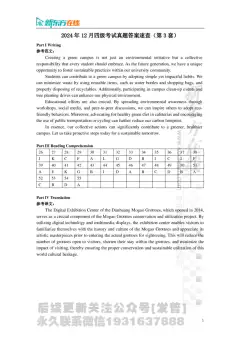
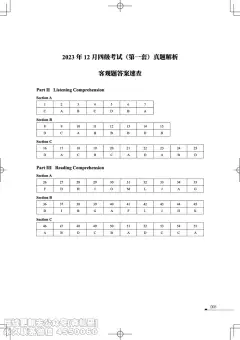
2023 年 12 月大学英语四级考试真题答案速查表(第一套)
Part Ⅰ Writing
(见真题解析)
PartⅡ Listening Comprehension
SectionA
1.A 2.C 3.C 4.B 5.C 6.A 7.D
Section B
8.D 9.D 10.A 11. B 12.B 13.C 14.A 15.C
Section C
16. D 17.B 18.A 19.C 20.B 21.B 22.A 23.D 24.B
25.D
Part Ⅲ Reading Comprehension
SectionA
26. F 27.D 28.H 29.I 30.O 31.M 32.L 33.J 34.A
35.G
Section B
36. D 37.I 38.B 39.G 40.A 41.F 42.L 43.J 44.H
45.K
Section C
46. A 47.B 48.D 49.C 50.B 51.A 52.D 53.C 54.C
55.A
Part Ⅳ Translation
(见真题解析)
改变就橙啦