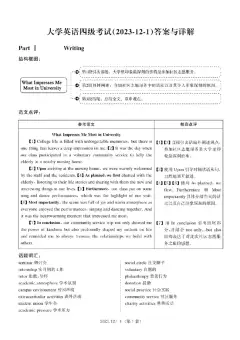
2023 年 12 月大学英语四级考试真题(第 1 套)
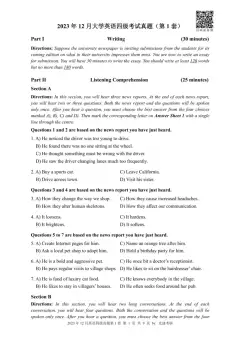
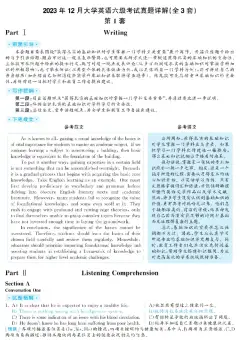
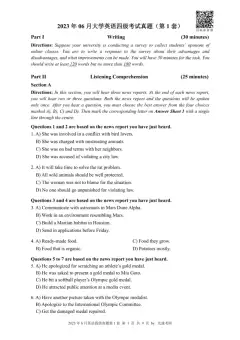
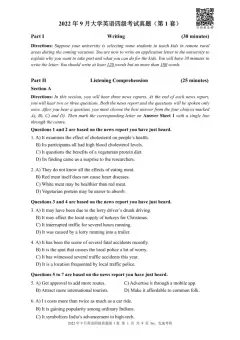
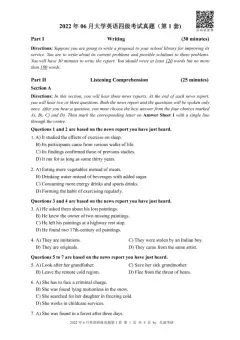
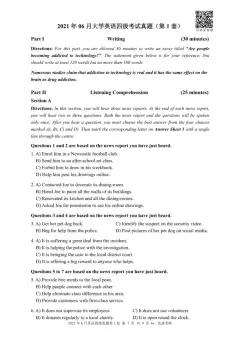
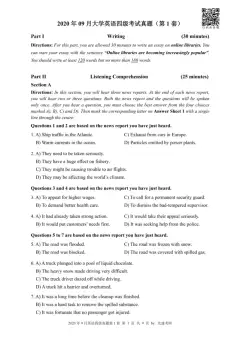
Part I Writing (30 minutes)
Directions: Suppose the university newspaper is inviting submissions from the students for its
coming edition on a campus event that has impressed them most. You are now to write an
essay for submission. You will have 30 minutes to write the essay. You should write at least
120 words but no more than 180 words.
PartⅡ Listening Comprehension (25 minutes)
Section A
Directions: In this section, you will hear three news reports. At the end of each news report,
you will hear two or three questions. Both the news report and the questions will be spoken
only once. After you hear a question, you must choose the best answer from the four choices
marked A), B), C) and D).Then mark the corresponding letter on Answer Sheet 1 with a
single line through the centre.
Questions 1 and 2 are based on the news report you have just heard.
1.A) Their brains work in harmony. C) Their interests are quite similar.
B)They are generally the same age. D) They have the same ethnic background.
2. A) It can be touching. C) It can work both ways.
B)It is hard to predict. D) It resembles family ties.
Questions 3 and 4 are based on the news report you have just heard.
3.A) Search for their half-brothers. C) Find out more about their ancestry.
B)Identify their biological fathers. D) See whether they are actually related.
4.A) They were both given up for adoption. C) They flew 737 airplanes as pilots.
B)They were born to the same mother. D) They were both 60 years of age.
Questions 5 to 7 are based on the news report you have just heard.
5.A) One of his friends was caught littering.
B)Other tourists refused to join in the cleanup.
C)The beautiful beach was spoiled with lots of trash.
D)The kilometer-long beach was practically deserted.
6.A) A passerby.
B)A local woman.
C)The beach authorities.
D)One of the five tourists.
7.A) The tourists’ good deed was not noticed by the locals.
B)Some natives were selling poor-quality food to tourists.
C)The number of tourists to the beach is on a steady decline.
D)It was tourists not natives who were cleaning up the beach.
Section B
Directions: In this section, you will hear two long conversations. At the end of each
conversation, you will hear four questions. Both the conversation and the questions will be
spoken only once. After you hear a question, you must choose the best answer from the four
choices marked A),B),C)and D). Then mark the corresponding letter on Answer Sheet
1 with a single line through the centre.
Questions 8 to 11 are based on the conversation you have just heard.8. A) He has to play football with workmates. C) He is going to visit a friend.
B)He has got some books to read. D) He is physically unfit for it.
9.A) To teach kids about animal protection. C) To see some rare animals in cages.
B)To learn how popular zoos could be. D) To give her little nephew a treat.
10.A) He enjoys excellent health. C) He coaches tennis players every week.
B)He is keen on extreme sports. D) He spends most of his time in the gym.
11.A) Tending to his swollen ankle. C) Writing three book reports.
B)Concentrating on reading. D) Planning Christmas celebrations.
Questions 12 to 15 are based on the conversation you have just heard.
12.A) It is being debated by hundreds of retirees.
B)It is attracting many people’s attention.
C)It partly records his own experience.
D)It argues for postponing retirement.
13.A) One should foresee a financial crisis.
B)One should trust financial planners’ figures.
C)One should have one million dollars to retire.
D)One should start saving as early as possible.
14.A) It doesn’t need to be permanent.
B)It shouldn’t be considered risky.
C)It helps to reduce travel expenses.
D)It is the way to quit a job one hates.
15.A) By keeping close contact with one’s employers.
B)By retiring when one reaches sixty years old.
C)By investing half of one’s monthly income.
D)By following the counsel of financial planners.
Section C
Directions: In this section, you will hear three passages. At the end of each passage, you will
hear three or four questions. Both the passage and the questions will be spoken only once.
After you hear a question, you must choose the best answer from the four choices marked A),
B), C) and D). Then mark the corresponding letter on Answer Sheet 1 with a single line
through the centre.
Questions 16 to 18 are based on the passage you have just heard.
16.A) They tended to be easily anticipated by those belonging to their own race.
B)They tended to be arbitrarily judged by individuals of opposing groups.
C)They were readily shared among members of the same social or racial group.
D)They were influenced by the presence of someone from an outsider group.
17.A) When they tried to make a positive impression on the researchers.
B)When an unknown student from another university was present.
C)When an experimenter from the research team took notice.
D)When they were offered both candy and fruit as a snack.
18.A) By advertising its social benefits. C) By supporting struggling consumers.
B)By teaching consumers diet strategies. D) By maintaining its positive image.
Questions 19 to 21 are based on the passage you have just heard.
19.A) The academic and learning issues struggling students encounter.
B)The risk students face due to a history of mental health problems.
C)The effect of interacting with therapy dogs on students under pressure.
D)The work universities are doing to help students succeed academically.
20.A) Their communicative skills.B)Their executive functioning.
C)Their academic networking.
D)Their leadership capacities.
21.A) Rid students of their anxiety.
B)Add to some students’ stress.
C)Contribute little to typical students’ success.
D)Help students with mental issues pull through.
Questions 22 to 25 are based on the passage you have just heard.
22.A) Work hard and plan carefully.
B)Attempt to succeed at any cost.
C)Aim high and expect great results.
D)Remain optimistic even in difficulty.
23.A) Regarding failure as something inevitable
B)Trying out innovative marketing strategies.
C)Venturing into sectors never explored before.
D)Being willing to experiment with novel ideas.
24.A) Expect future success so as to move forward.
B)Learn from our failure and forge ahead.
C)Distinguish between good and bad risks.
D)Examine our strategies and find out weaknesses.
25.A) Fresher offers.
B)Safer operation.
C)More challenges.
D)Less competition.
Part III Reading Comprehension (40 minutes)
Section A
Directions: In this section, there is a passage with ten blanks. You are required to select one
word for each blank from a list of choices given in a word bank following the passage. Read
the passage through carefully before making your choices. Each choice in the bank is
identified by a letter. Please mark the corresponding letter for each item on Answer Sheet 2
with a single line through the centre. You may not use any of the words in the bank more than
once.
Exercising for just 10 minutes a week is linked to a longer life, according to a new study
published in The British Journal of Sports Medicine.
Several recent studies have found that even low-intensity exercise, done for a short
amount of time, can have a meaningful 26 on health. Still, the idea that exercising for just
10 minutes a week may be enough to increase your lifespan is novel. It’s also somewhat 27 ,
since the federal physical activity guidelines recommend getting at least 75 minutes of
vigorous exercise or 150 minutes of 28 exercise each week.
The study was based on data from more than 88,000 U.S. adults who 29 in the
National Health Interview Survey between 1997 and 2008.
Contrary to some research that has found an 30 limit to the amount of exercise that
is healthy, the researchers found that there was 31 no limit to the longevity (长寿) benefits of
exercise. Even the small group of people who got 10 times the amount of exercise
recommended by the federal government had a 46% lower 32 of death than the least
active group.
Still, observational studies like this one cannot prove cause and effect; they can only find
33 . The researchers also were not able to 34 for certain lifestyle factors that couldaffect lifespan, including dietary habits and changes in physical activity over time. Despite
these 35 , the study’s results are yet another indication of the power of physical activity,
even in small amounts.
A) adjust F) impact K) populated
B) alter G) limitations L) risk
C) approximately H) moderate M) seemingly
D) controversial I) participated N) type
E) coordinates J) patterns O) upper
Section B
Directions: In this section, you are going to read a passage with ten statements attached to it.
Each statement contains information given in one of the paragraphs. Identify the paragraph
from which the information is derived. You may choose a paragraph more than once. Each
paragraph is marked with a letter. Answer the questions by marking the corresponding letter
on Answer Sheet 2.
How Climate Change Will Affect What You Eat
A) Earlier this year, scientists warned that one in six animal species could go extinct (灭绝
的) due to climate change. Could the same thing happen to our crops and other foodstuffs
too?
B) It’s clear that farmers in many parts of the world are going to find things harder in the
coming decades. Last week, BBC Future explored one scientist’s efforts to help crops
cope with the increased probability of droughts. By using the genes from resurrection (复
活)plants, Jill Farrant of the University of Cape Town is exploring whether she can design
crops to survive for much longer periods without water.
C) But if we can’t find ways to protect other foods, will they survive climate change?
Fortunately, there is some good news on this front. Despite alarmist headlines about
“foods that are going extinct,” there is no evidence that major food types like beans,
chocolate, wine, corn or wheat will cease to exist.
D) But that doesn’t mean it’s all good news for future food. We will probably have to change
where we grow certain crops, as some regions get too hot. The disadvantage, obviously, is
that local farmers will suffer under this situation. And some people may struggle to get
the same access to certain foods. “Even if overall food production may be unaffected,
food security can still be impacted,” says Margaret Walsh, a scientist at the US
Department of Agriculture’s Climate Change Program Office. In other words, even if a
certain food is still grown on some corner of the Earth, it doesn’t mean that everyone will
continue to have the same degree of access as today.
E) Overall, the yields of many foods, from staples to life-enhancing extras such as coffee and
chocolate, will likely be impacted by climate change too. How those decreases will be felt
will depend on the degree of warming and the crop in question, but in general, “anything
over about 30℃ is very bad for crops,” says Wolfram Schlenker, an associate professor of
international and public affairs at Columbia University. For example, statistical studies
that he and a colleague built of corn and soybean (大豆) production in the US show a
steep decline after crossing the 30℃ temperature threshold (临界点).
F) In the US—the world’s largest producer of corn and soybeans—farms can move north tosome degree, Schlenker says. But eventually, yields will likely suffer because the soil
north of Iowa declines in quality—a legacy of glacial ( 冰川的) expansion. Other studies,
including studies of wheat in India and corn in Africa, also found that there is a threshold
above which yields sharply decline: crops can adapt and move, but only to a point.
“What’s common to all studies is the finding that extreme heat is damaging to crop
growth, although exact cutoffs vary by crop,” Schlenker says. “If predictions for the end
of the century are true, though, I think a lot of agricultural areas in the US will see
significant hits.”
G) Under current conditions, about 4% of the world’s croplands experience drought in any
given year, but by the end of the century those conditions are forecasted to jump to about
18% per year. Some studies indicate that horticulture crops—generally, everything
besides staples—may be impacted most severely, largely because they tend to be confined
to a smaller geographic area. Researcher Andrew Jarvis and his colleagues found that
80% of coffee-growing zones in Central America and Brazil could become unsuitable by
2050, for example, while climate change will likely have “great impacts” on cocoa (可
可粉) production in West Africa. “High quality chocolate will be less available in the
future, and if you want it, you’ll have to pay a lot more for it,” Jarvis says.
H) This means that, for those who can afford it, some foods will simply cost them more in
the future. But for poorer people, those same price jumps will likely cause certain foods to
go extinct from their diets. “The more you reduce, the shorter the supply, and the higher
the price will jump,” Schlenker says.
I) Another potential climate change-induced problem is our dependence on commodity
crops—wheat, soybeans, corn and rice—which currently provide humanity with 75% of
its calories, either directly or indirectly through the animals we raise on those crops.
Jarvis and his colleagues also found that, over the past five decades, the world has seen an
increasing standardisation of diets; the foods we eat globally today are 36% more similar
than they
were in 1961. While this can be good news for the world’s poorest people who now
consume more calories, protein and fat than in the past, homogeneity (同一性) and over-
dependence on a handful of staples leaves us vulnerable to threats such as drought,
disease
and pests—all of which are predicted to worsen in many parts of the world as a result of
climate change.
J) There are ways we could soften the coming blow to the global food supply, however.
Like Farrant’s work with resurrection crops, a number of companies, organisations and
researchers are aiming to create drought-and temperature-resistant crops through genetic
engineering and conventional breeding. For now, the jury is still out as to how successful
those endeavours will be. “The people at Monsanto who I’ve talked to are much more
optimistic that they’ll be able to engineer heat-tolerant crops,” Schlenker says. “On the
other hand, scientists at the USDA who I’ve spoken with are much more cautious.”
K) Until genetic engineering comes to fruition, other strategies might also help in some
places, including applying more fertiliser, implementing better irrigation, using
machinery that gets crops out of the field faster or installing storage facilities to delay
spoilage. “Many places could benefit a great deal just by using technologies that already
exist,” Walsh says. “General farm management can go a long way toward easing
changes.”
L) Finally, diversifying our diet away from heat-sensitive wheat, corn, rice and other crops
could also help.“We’ve seen profound changes in the last decades in what we eat largely
as a result of international trade, and I think that trend toward more diversification willcontinue,” Jarvis says. “Depending on a greater number of plant species creates a more
vigorous and less risky food system—and one that provides a broader range of nutritional
requirements.”
36. One consequence of climate change is that some people may not have adequate access to
certain foods.
37.People around the world are eating foods more similar than what they used to eat.
38. A recent news report talked about scientific efforts to help crops survive droughts through
genetic engineering.
39.It is predicted that climate change will affect the availability and price of quality chocolate.
40.People wonder if certain crops and foodstuffs could disappear like some animal species
due to climate change.
41.Although farms in the US can move a bit northward, crop yields may decrease.
42.One possible solution to the food security problem is diversification of diet.
43.It remains unsettled whether the global food supply problem can be solved by creating
heat- tolerant crops through genetic engineering.
44.Poor people may have to give up eating certain foods because of their high prices.
45. A number of existing farming technologies could be used to reduce the negative effect of
climate change on food production.
Section C
Directions: There are 2 passages in this section. Each passage is followed by some questions
or unfinished statements. For each of them there are four choices marked A), B), C) and D).
You should decide on the best choice and mark the corresponding letter on Answer Sheet 2
with a single line through the centre.
Passage One
Questions 46 to 50 are based on the following passage.
One of my bad habits is saying “busy” when people ask me how I’m doing. Sometimes
it’s because I actually am busy, but other times it’s because that’s what I think I’m supposed
to say. That’s what important people say. That’s what people who get promoted say. But
working long hours doesn’t drive better results. Never taking a vacation won’t lead to a
promotion. So why are we so proud to talk about how busy we are all the time?
In 2016, researchers from Columbia, Harvard, and Georgetown conducted a study to
figure it out. They found busy people are perceived to be of high status, and interestingly,
these status attributions are heavily influenced by our own beliefs about social mobility. In
other words, the more we believe that one has the opportunity for success based on hard work,
the more we tend to think that people who skip leisure and work all the time are of higher
standing. That’s why we feel like we have to appear busy, and there’s a real perception that if
someone is knee-deep in meetings, emails, and stress, then they’re probably a big deal. This
culture of busyness is making it hard for employees to find work-life balance. According to a
recent study, one in five highly engaged employees is at risk of burnout (精疲力竭).
Personally, I’m going to stop saying “busy” when people ask me how I am. It sounds
self- righteous (自以为是的) and sets the wrong tone. Phrases like “I have limited access to
email” and “I’ll respond as soon as I get back” sound like you’re being held against your will
from working as opposed to making the most of your time off.
That’s why we recently launched the Out of Office Email Generator, a free tool you can
use before your next long weekend or trip. You can share loud and proud that you won’t be
checking email until you’re back. Managers need to think twice about emailing their teams on
the weekend and talking about how busy they are. Leaders should take time off themselves
and encourage employees to do the same.46. What is a reason for the author to be in the habit of saying “busy” when asked how he is
doing?
A)He just follows successful people’s example.
B)He is actually proud to be fully occupied.
C)He thinks everyone should be devoted to work.
D)He believes busyness ensures accomplishments.
47.Why do we tend to think that busy people are of high status?
A)Our status can be attributed to our social mobility.
B)We hold the belief that hard work leads to success.
C)Our own opportunity for success never comes easily.
D)We find few people of high status have time for leisure.
48.What do we learn about the culture of busyness from a recent study?
A)It places employees in endless meetings, emails and stress.
B)It compels some 20% of employees to appear always busy.
C)It distorts many employees’ belief of what a satisfying life is.
D)It does much harm to many busy employees’ well-being.
49. What do such utterances as “I have limited access to email” sound like according to the
author?
A)One is too busy to check all emails in time.
B)One is opposed to the prevailing work culture.
C)One is forced by circumstances to stop working.
D)One is simply enjoying their time off work.
50.Why did the author and his colleagues launch the Out of Office Email Generator?
A)To enable busy employees to spend less time checking emails.
B)To ensure employees as well as employers truly have time off.
C)To stop managers from talking about how busy their teams usually are.
D)To encourage both employers and employees to answer emails promptly.
Passage Two
Questions 51 to 55 are based on the following passage.
Female employees consistently pay lower airfares than men do for the same flights
because they tend to book earlier.
We compared the airfare paid by employees in the same position within a company for
the same class of travel and used a common statistical technique to account for other factors
that might affect differences in airfares. We found that women paid on average $18 less per
ticket than their male colleagues. Further investigation allowed us to conclude that this gap is
largely explained by the fact that women tended to book earlier than men, 1.8 days on
average.
We wanted to determine what was causing these gender differences in booking business
trips so we tested a variety of possible explanations, such as women choosing to plan ahead or
male frequent travelers being inclined to book late. None of these explained away the gender
gap, so we applied data collected from surveys that express consumer preferences that play a
central role in economic decisions, such as patience and risk avoidance.
We found that only the concept of “negative reciprocity”—in which an employee who
feels unfairly treated engages in negative behaviors, such as spending their company’s money
less carefully—explains these differences. The surveys showed men tend to exhibit more of
these negative behaviors than women. This isn’t to say that all men engage in these behaviors
— or that booking relatively late is a sign of abnormal behavior. It only means that the gendergap disappears when we plug in the negative reciprocity variable.
Prior research on negative reciprocity among workers found that it can result in lower
employee motivation, business performance and workplace morale (士气) and culture.
Our results show another way these negative behaviors can manifest themselves, like in
airline bookings, and add to evidence that women are less likely to engage in them.
Companies spend significant sums of money on business travel. While that $18
difference per ticket may seem small, it adds up. Our analysis suggests early booking by
women can translate into savings of $1 million a year for a large multinational company with
20,000 regular travelers.
51.What did the author’s team conclude about the gender difference in airfares from
their further investigation?
A)It is largely attributed to women booking earlier than men.
B)It is largely explained by women’s choosing cheaper flights.
C)It is mainly accounted for by male employees’ readiness to pay more.
D)It is due to the fact that women care more about their company’s money.
52.What did the researchers want to determine by testing a variety of possible explanations?
A)What made male frequent travelers book air tickets late.
B)What caused women to plan ahead in booking business trips.
C)What motivated women to book cheaper flights.
D)What accounted for the gender gap in airfares.
53.What happened when the negative reciprocity variable was taken into account?
A)Both men and women were found to engage in negative behaviors.
B)Neither men nor women viewed booking late as a bad behavior.
C)The gender difference in airfare expenses no longer existed.
D)The gender gap tended to narrow to a significant degree.
54.What did prior research on negative reciprocity among workers find?
A)It can do more harm to the workplace than to employees.
B)It contributes to the male-female divide in the workplace.
C)It proves to be counterproductive in a number of ways.
D)It can result in increasing labor-management conflicts.
55.What does the author emphasize about their analysis in the last paragraph?
A)It can help companies increase their savings significantly.
B)It can duly contribute to companies’ business performance.
C)It can translate women’s booking practice into men’s behavior.
D)It can enhance large multinational companies’ competitiveness.
Part Ⅳ Translation (30 minutes)
Directions: For this part, you are allowed 30 minutes to translate a passage from Chinese
into English. You should write your answer on Answer Sheet 2.
中国政府十分重视人民的健康饮食(diet)。通过大力提倡健康饮食,人们对合理营
养增进健康的重要性有了更加深刻的认识。“吃得安全、吃得营养、吃得健康”是人民对美
好生活的基本需要,是提升人民幸福感的必然要求,也为食品产业的发展提供了新机遇。
目前,各级政府都在采取多种举措确保人民饮食健康,推进健康中国的建设。2023 年 12 月大学英语四级考试真题(第 2 套)
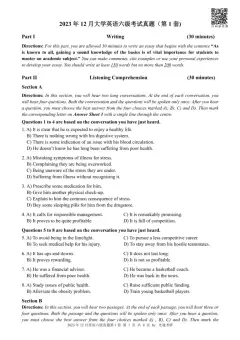
Part I Writing (30 minutes)
Directions: Suppose the university newspaper is inviting submissions from the students for its
coming edition on the recent development in their hometown. You are now to write an essay
for submission. You will have 30 minutes to write the essay. You should write at least 120
words but no more than 180 words.
PartⅡ Listening Comprehension (25 minutes)
Section A
Directions: In this section, you will hear three news reports. At the end of each news report,
you will hear two or three questions. Both the news report and the questions will be spoken
only once. After you hear a question, you must choose the best answer from the four choices
marked A), B), C) and D).Then mark the corresponding letter on Answer Sheet 1 with a
single line through the centre.
Questions 1 and 2 are based on the news report you have just heard.
1.A) He noticed the driver was too young to drive.
B)He found there was no one sitting at the wheel.
C)He thought something must be wrong with the driver.
D)He saw the driver changing lanes much too frequently.
2.A) Buy a sports car.
B)Drive across town.
C)Leave California.
D)Visit his sister.
Questions 3 and 4 are based on the news report you have just heard.
3.A) How they change the way we shop.
B)How they alter human skeletons.
C)How they cause increased headaches.
D)How they affect our communication.
4.A) It loosens.
B)It brightens.
C)It hardens.
D)It softens.
Questions 5 to 7 are based on the news report you have just heard.
5.A) Create Internet pages for him.
B)Ask a local pet shop to adopt him.
C)Name an orange tree after him.
D)Hold a birthday party for him.
6.A) He is a bold and aggressive pet.
B)He pays regular visits to village shops.
He once bit a doctor’s receptionist.
C) He likes to sit on the hairdresser’s chair.
7.A) He is fond of luxury cat food.
B)He likes to stay in villagers’ houses.
C)He knows everybody in the village.
D)He often seeks food around her pub.Section B
Directions: In this section, you will hear two long conversations. At the end of each
conversation, you will hear four questions. Both the conversation and the questions will be
spoken only once. After you hear a question, you must choose the best answer from the four
choices marked A),B),C)and D). Then mark the corresponding letter on Answer Sheet
1 with a single line through the centre.
Questions 8 to 11 are based on the conversation you have just heard.
8.A) Who to order the food.
B)Whether to have sandwiches.
C)When to go for their meal.
D)Where to have their lunch.
9.A) In the shopping center nearby.
B)In the expensive Italian style diner.
C)At the Sandwich Place on Camden Street.
D)At the American restaurant they frequent.
10.A) There is to be a conference call.
B)She has to meet with her boss then.
C)There will be crowds of people waiting for her.
D)She will have a photo taken with Brigette Clark.
11.A) She doesn’t deem homemade soup tasty.
B)She doesn’t think his wife cooks well.
C)She feels Jeremy would rather dine out.
D)She has found the soup smells terrible.
Questions 12 to 15 are based on the conversation you have just heard.
12.A) A landlady.
B)A waitress.
C)A receptionist.
D)A saleswoman.
13.A) He was involved in a terrible car accident last April.
B)He has much difficulty getting up and down stairs.
C)He is expected to undergo a knee operation.
D)He prefers to stay next door to the children.
14.A) To please his parents-in-law.
B)To find the best trip for his kids.
C)To satisfy his curiosity.
D)To compare prices.
15.A) Visit a local art gallery.
B)Go on a boat trip.
C)Take some photos of the islands.
D)Try her hand-made clothing.
Section C
Directions: In this section, you will hear three passages. At the end of each passage, you will
hear three or four questions. Both the passage and the questions will be spoken only once.
After you hear a question, you must choose the best answer from the four choices marked A),
B), C) and D). Then mark the corresponding letter on Answer Sheet 1 with a single line
through the centre.
Questions 16 to 18 are based on the passage you have just heard.
16.A) They are more intelligent than many of us.B)They have already become our new friends.
C)They have begun to affect our social behavior.
D)They play increasingly more important roles.
17.A) Whether it might have any effect on the way we negotiate.
B)Whether it might actually outperform human negotiators.
C)Whether it can facilitate business transactions.
D)Whether it can speed up legal procedures.
18.A) Choose to be tough.
B)Sympathize with their opponent.
C)Use deceptive strategies.
D)Appear to be pleasant.
Questions 19 to 21 are based on the passage you have just heard.
19.A) They were perceived differently by some academics.
B)They still existed six months after the course ended.
C)They varied greatly among the course participants.
D)They were only measurable within seven weeks.
20.A) They can be easily seen among participants in a healthy weight range.
B)They should be attributed to participants’ change in diet behaviors.
C)They are linked to cooking confidence and cooking satisfaction.
D)They actually result from eating more fruits and vegetables.
21.A) Gender.
B)Confidence.
C)Health.
D)Practice.
Questions 22 to 25 are based on the passage you have just heard.
22.A) It keeps others away. C) It remains visible.
B) It causes discomfort. D) It varies in size.
23.A) It makes us feel uncomfortable. C) It brings the acquaintance closer to us.
B) It renders the acquaintance a stranger. D) It causes the bubble around us to vanish.
24.A) In personal space. C) Within a distance of 18 inches.
B) In social space. D) Over 2 feet away from one another.
25.A) When we begin to feel fear. C) When we are 3 or 4 years old.
B) When we develop a sense of space. D) When we enter our teens.
Part III Reading Comprehension (40 minutes)
Section A
Directions: In this section, there is a passage with ten blanks. You are required to select one
word for each blank from a list of choices given in a word bank following the passage. Read
the passage through carefully before making your choices. Each choice in the bank is
identified by a letter. Please mark the corresponding letter for each item on Answer Sheet 2
with a single line through the centre. You may not use any of the words in the bank more than
once.
A number of studies have looked at how family life can affect productivity and
satisfaction in the workplace. However, there has been 26 little research on the influence of
leisure activities. So Ciara Kelly and colleagues recruited 129 hobbyists to look at how the
time spent on their hobbies 27 their work life.
The researchers found that when participants spent longer than 28 on their leisure
activity, their belief in their ability to perform their job was strengthened. But this was onlythe 29 when they had a serious hobby that was dissimilar to their job, or when their hobby
was similar to their work but they only did it 30 . When their hobby was both serious and
similar to their job, then spending more time on it actually decreased their work 31 .
Why might that be? To maintain a serious hobby, people need to invest significant
psychological resources, say the authors—so if the activity has the same kinds of demands as
their work, they may be left 32 and unable to perform well at their job. But if their hobby
is quite different from their career, it may not 33 in the same way but instead help them
develop other knowledge and skills that can 34 their confidence at work. “Consider a
scientist who is a keen rock climber,” says Kelly. “Since climbing is so far 35 from their day-
to-day work activities, they can still recover from the demands of their job with plenty of
resources.”
A) boost F) exhausted K) relative
B) case G) faculty L) removed
C) casually H) interfere M) scratch
D) efficiency I) normal N) shaped
E) estate J) prevalent O) surprisingly
Section B
Directions: In this section, you are going to read a passage with ten statements attached to it.
Each statement contains information given in one of the paragraphs. Identify the paragraph
from which the information is derived. You may choose a paragraph more than once. Each
paragraph is marked with a letter. Answer the questions by marking the corresponding letter
on Answer Sheet 2.
More fathers are taking paternity leave, but mothers are still doing all the work
A) Attitudes towards paternity leave (陪产假) have drastically changed in America in the last
five years as more fathers feel comfortable taking extended time off, but gender bias persists
when it comes to career prospects and the home, according to a new study of working parents.
B) Research by the Boston College Center for Work & Family, which surveyed new parents at
four large US companies who were qualified for taking at least six weeks paid parental leave,
found that 81% of the 1,240 employees surveyed said the notion of fathers taking leave has
become more acceptable.
C) Of those surveyed, 62% of fathers took the maximum amount of time off compared to 93% of
mothers, and around three-quarters of workers said their employer was equally supportive of
mothers and fathers taking parental leave and over half said leave policies had made
workplace culture better.
D) The US is one of only three countries in the world not to offer statutory (法定的) paid
leave,
but increasingly states and companies are starting to take up the issue. So far, eight states
and the District of Columbia have their own paid family leave laws.
E) Brad Harrington, executive director of the center and lead author of the study, estimates
only 20% to 30% of companies in the US offer paid parental leave. He feels the research
findings reflect an obvious change in corporate attitudes to new fathers taking time off.F) “We did a study on paternity leave five years ago. Compared with those findings, these
numbers were shocking to me. I did not expect 80% of people to say the organisation
finds dads taking this leave acceptable and three-quarters to say it’s equally supportive of
women and men taking leave,” Harrington said.
G) The previous study found that nearly three-quarters of fathers saw two to four weeks as an
appropriate duration for paternity leave and 76% said they would prefer not to take all
their time off at once.
H) Since then, there have been a number of legal cases against companies involving paternity
leave—including cases against JPMorgan Chase and Estée Lauder —which have helped
put pressure on companies to make their parental leave policies gender neutral.
I) However, the study also shows how traditional gender roles endure both at work, where
more women than men reported changes in their perceived career potential, and at home
— even among workers who claim to have a strong desire for equality.
J) The vast majority of men, 97%, said one of the top reasons to take leave was to share
caregiving with their partner. But when they were asked about how caregiving and
household tasks were divided, their answers painted a different picture. While about 75%
of employees said both genders should give the same amount of care, the majority of men
and nearly half of women admitted that in reality the female actually did most of it. A tiny
fraction, 2%, of men said they did more of the childcare.
K) Men and women’s experiences of the return to work following parental leave were also
considerably different. Of the women surveyed, 32% reported a downturn in their job
satisfaction, while 14% said it increased. In comparison, 17% of men said their job
satisfaction went down and 20% said it went up. Meanwhile, more women reported an
increase in their responsibilities and manager expectations after childbirth. Half of the
women said they used flexible work arrangements after becoming a parent, while just
27% of men did. Similar percentages of men and women said they enjoyed their careers
and that it gave them a sense of achievement, while around half of women and 44% of
men said it was a key part of their identity.
L) On the subject of career advancement, 59% of women and 49% of men said leave could
be limiting and both genders said they feared it would have an impact on their progress
long- term. But on opportunity for promotion, more than double the number of women,
30% compared with 15% of men, believed their chances to be lower after becoming a
parent. Despite progress, the struggle for women to reach the highest positions of power
is demonstrated in this year’s Fortune 500 list, which featured a record 33 female CEOs,
but this still represents a tiny fraction of the total.
M) Harrington said culture change depends on companies putting more focus on men and
their responsibilities. “By that I mean companies need to give men paternity leave and
encourage men to take time off to be with their kids early on in the kids’ life. They also
need to recognise that men have to make significant adjustments when they become
parents. Companies cannot do all these things to enhance women’s advancement and then
turn around and say, ‘Oh, but we don’t expect the men to take over for the women at
home.’”
N) In May, the American Civil Liberties Union (ACLU) and Outten & Golden LLP
announced a historic classaction $5m settlement with JPMorgan Chase on behalf of male
employees who claim they were illegally denied access to paid parental leave. Derek
Rotondo, 35, filed the discrimination charge against his company after he was allegedly
told by his HR department that mothers were considered primary caregivers. Thus, they
were allowed to take 16 weeks of paid parental leave. Fathers, however, could take justtwo weeks.
O) The father of two from Columbus, Ohio, who still works at the company as an associate
and investigator, said he has witnessed a “domino effect (多米诺效应)” across companies
since the settlement, but that there is still substantial progress to be made towards
changing
attitudes towards paternity leave.
P) “I do think there’s still some way to go...there’s still going to be sort of the unstated
expectation for new dads to essentially come right back to work, but I think the research
is showing that’s starting to change.” He said equal parental leave is an essential
component to creating gender equality in the workplace. “The old standard of women
staying home, having babies and cooking doesn’t apply and hasn’t applied for a long
time.”
36. In the absence of Federal legislation, some states in the US have passed laws concerning
paid family leave.
37. Most fathers admitted that even during their paternity leave they actually did much less
childcare than the mother.
38.According to one father, equal parental leave is indispensable to achieving gender equality
in the workplace.
39.One survey indicated there is now less objection to paternity leave.
40.Compared to five years ago, according to one researcher, many more people said their
organisation gave the same support to men and women taking parental leave.
41. One study finds that even workers who claim to desire gender equality stick to traditional
gender roles both at work and at home.
42. The majority of workers surveyed said parental leave policies had improved workplace
culture.
43. In spite of progress, the number of women in top positions of big companies remains
extremely small.
44.According to one estimate, less than one third of companies in the US provide paid
parental leave.
45. A number of lawsuits have pressured companies to formulate gender neutral policies on
parental leave.
Section C
Directions: There are 2 passages in this section. Each passage is followed by some questions
or unfinished statements. For each of them there are four choices marked A), B), C) and D).
You should decide on the best choice and mark the corresponding letter on Answer Sheet 2
with a single line through the centre.
Passage One
Questions 46 to 50 are based on the following passage.
Having a rival can keep you committed to achieving your goals and enhance your overall
performance. But before you go out and find an entrepreneur to outcompete, it’s important to
understand and avoid the traps that often come with rivalry. After all, competitive rivalry can
also hinder effective decision-making and increase your willingness to take risks, behaviors
that can ultimately hurt your venture’s success.
Finding someone you’re committed to outcompeting can be a great way to stay focused
on your goals and push your venture to the next level. But when you’re intently focused on
outperforming your rivals, you may begin to develop a “win-at-all-costs” mentality that
causes you to ignore how you achieve success. One group of researchers, for example,
examined the link between rivalry and unethical behavior. They found that when peoplecompete against their rivals, they are more willing to behave unethically to win. But such
behavior may stain your reputation and strain relationships important to your success. One
way to avoid this trap is to stop and reflect on what’s important. While outperforming your
rivals may provide short-term benefits, the loss of your integrity will have long-term
consequences.
One reason having a rival can enhance your venture’s performance is that it creates a
level of excitement that drives you to work harder. But this eagerness to win may also hurt
your venture’s success, particularly when it causes you to make impulsive, insensible
decisions. But it’s possible to avoid such costly mistakes by making a habit of engaging in
critical thinking, such as considering opposing viewpoints and conducting cost-benefit
analyses, especially for those decisions that are complex and can determine the future of your
venture.
The sense of eagerness that comes with having a rival can not only cause you to make
poorer decisions, but it can also lead you to take greater risks that put your venture in peril.
One way you can overcome the risk-inducing effects of rivalry that stand to endanger your
venture’s success is to remain attentive to your emotional state and actively monitor how such
feelings are affecting your decision-making.
46.How can competitive rivalry benefit entrepreneurs according to the passage?
A)By enabling them to outcompete other entrepreneurs.
B)By enabling them to make their venture a success.
C)By helping them to reach long-term goals.
D)By helping them to stay goal-oriented.
47.What is one of the traps entrepreneurs may often fall into when competing with rivals?
A)They may adopt strategies that are bound to ruin their venture.
B)They may resort to unethical means to outperform their rivals.
C)They may be too eager to succeed while ignoring the huge labor cost.
D)They may be intently focused on winning at the current market level.
48.What are entrepreneurs advised to do to avoid traps that often accompany rivalry?
A)Deliberate on what really matters.
B)Prioritize reaping immediate benefits.
C)Estimate the long-term consequences.
D)Reflect on what successes are achievable.
49.How can entrepreneurs avoid making impulsive and insensible decisions?
A)By engaging themselves in critical reasoning.
B)By developing a habit of keeping their integrity.
C)By criticizing themselves for previous poor performances.
D)By refraining from being too excited about their successes.
50.How can entrepreneurs overcome the risk-inducing effects of rivalry?
A)By paying close attention to their current performance.
B)By taking steps that stand to endanger their rivals’ success.
C)By monitoring how their decision-making impacts their mentality.
D)By keeping their emotions in check to avoid making poor decisions.Passage Two
Questions 51 to 55 are based on the following passage.
A multitasker is one who can perform two or more tasks effectively at the same time,
which—apart from the obvious differences—is similar to what a computer does. The concept
does indeed come from the realms of technology, where it is used to refer to an operating
system that can execute multiple tasks at the same time. However, the question is: can a
person really be a multitasker?
For most scientists, the answer is no. So much so that, according to experts in
neuroscience (神经系统科学), our brains do not handle multitasking situations well. As soon
as two tasks require our attention, productivity suffers. What we call multitasking, therefore,
is in reality the ability to move more or less quickly from one task to another. This requires
two essential conditions: that one of the tasks needs to be automatic, like walking or eating,
and that they both need different mental processes. Answering the phone and writing at the
same time, for example.
However, on the other side of the coin there are people who maintain that it is possible to
be, or at least seem to be, multitasking. A recent study concluded that regardless of whether
people are actually handling several tasks or not, the mere fact that they perceive this activity
as multitasking has a positive effect on their performance.
The business perspective offers a different view: multitasking is understood as the ability
to adapt to all types of environment within a company and effectively undertake different
activities within a set time frame. Indeed, many companies look for people who are skilled in
multitasking to improve their productivity. From this different perspective, you can not only
be multitasking but this ability can also be taught: something that is easier in fluid
organisations, which favour flexibility in their working practices.
The benefits of multitasking are clear. Being quicker and more efficient increases our
performance and the number of tasks completed. But having to pay attention to several things
at once means that the powers of concentration are reduced and that can lead to more
mistakes.
51.What does a “multitasker” originally refer to?
A)An operating system capable of doing several tasks at once.
B)A skilled worker executing more than one task at the same time.
C)A sophisticated technology doing several tasks effectively at once.
D)An efficient person able to perform multiple tasks at the same time.
52.Why can’t people really be multitaskers according to neuroscientists?
A)They are not sufficiently exposed to multitasking situations.
B)They are not comparable to mechanical operating systems.
C)Their brains do not allow them to multitask.
D)Their attention span cannot be expanded.
53.What do we learn from the conclusion of a recent study on multitasking?
A)People make greater achievements by maintaining whatever they are doing is
multitasking.
B)People’s performance benefits from the perception of what they are doing as multitasking.
C)People’s active mental processes exert a positive effect on their multitasking.
D)People can improve their capabilities by handling multitasking situations.
54.How does the business world view multitasking?
A)It is a rare skill often found in fluid organisations.B)It is an adaptable capability required of all workers.
C)It is an essential quality many employees lack.
D)It is a desirable ability that can be developed.
55.What does the author imply we should do if we have to focus on some task and do it well?
A)Work in a flexible way.
B)Learn from mistakes.
C)Avoid multitasking.
D)Increase efficiency.
Part Ⅳ Translation (30 minutes)
Directions: For this part, you are allowed 30 minutes to translate a passage from Chinese
into English. You should write your answer on Answer Sheet 2.
改革开放以来,中国人的饮食(diet)发生了显著变化。过去由于经济落后,食品
种类有限、数量不足,人们仅仅满足于吃得饱。如今中国经济快速发展,食品不仅更
加丰富多样,质量也大幅提高。随着生活水平不断提升,人们对饮食的要求越来越
高,更加注重吃得营养健康。因此,目前市场上推出的低脂、低糖、有机食品受到人
们的普遍欢迎。2023 年 12 月大学英语四级考试真题(第 3 套)
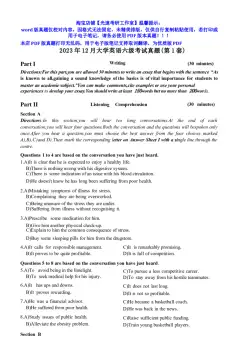
Part I Writing (30 minutes)
Directions: Suppose the university newspaper is inviting submissions from the students for its
coming edition on what in their university impresses them most. You are now to write an
essay for submission. You will have 30 minutes to write the essay. You should write at least
120 words but no more than 180 words.
PartⅡ Listening Comprehension (25 minutes)
特殊说明:由于多题多卷,官方第三套真题的听力试题与第二套真题的一致,只是选
项顺序不同,因此,本套试卷不再提供听力部分。
Part III Reading Comprehension (40 minutes)
Section A
Directions: In this section, there is a passage with ten blanks. You are required to select one
word for each blank from a list of choices given in a word bank following the passage. Read
the passage through carefully before making your choices. Each choice in the bank is
identified by a letter. Please mark the corresponding letter for each item on Answer Sheet 2
with a single line through the centre. You may not use any of the words in the bank more than
once.
When people set out to improve their health, they usually take a familiar path: starting a
healthy diet, getting better sleep, and doing regular exercise. Each of these behaviors is
important, of course, but they all 26 on physical health—and a growing body of research
suggests that social health is just as, if not more, important to 27 well-being.
One recent study published in the journal PLOS ONE, for example, found that the
strength of a person’s social circle was a better 28 of self-reported stress, happiness and
well- being levels than fitness tracker data on physical activity, heart rate and sleep. That
finding suggests that the “ 29 self ” represented by endless amounts of health data doesn’t tell
the whole 30 .
There’s also a qualified self, which is who I am, what are my activities, my social
network, and all of these aspects are not 31 in any of these measurements.
This idea is supported by plenty of 32 research. Studies have shown that social support—
whether it comes from friends, family members or a spouse—is 33 associated with better
mental and physical health. A rich social life, these studies suggest, can lower stress levels,
improve mood, encourage positive health behaviors and discourage damaging ones, boost
heart health and improve illness 34 rates.
Social isolation, meanwhile, is linked to higher rates of physical diseases and mental
health conditions. It’s a significant problem, 35 since loneliness is emerging as a
widespread public health problem in many countries.A) base F) overall K) quantified
B) eagerly G) preached L) recovery
C) especially H) prior M) reflected
D) focus I) prompt N) story
E) indicator J) puzzle O) strongly
Section B
Directions: In this section, you are going to read a passage with ten statements attached to it.
Each statement contains information given in one of the paragraphs. Identify the paragraph
from which the information is derived. You may choose a paragraph more than once. Each
paragraph is marked with a letter. Answer the questions by marking the corresponding letter
on Answer Sheet 2.
Teenagers and social networking
A) As a parent of two boys at primary school, I worry about the issues associated with
teenagers and social media. Newspapers are constantly filled with frightening accounts of
drug addiction and aggressive behaviour supposedly caused by violent videogames. But
even when these accounts touch on real concerns, they do not really reflect the great mass
of everyday teenage social behaviour: the online chat, the texting, the surfing, and the
emergence of a new teenage sphere that is conducted digitally.
B) New technologies always provoke generational panic, which usually has more to do with
adult fears than with the lives of teenagers. In the 1930s, parents worried that radio was
gaining “an irresistible hold of their children”. In the 80s, the great danger was the Sony
Walkman (随身听). When you look at today’s digital activity, the facts are much more
positive than you might expect.
C) Indeed, social scientists who study young people have found that their digital use can be
inventive and even beneficial. This is true not just in terms of their social lives, but their
education too. So if you use a ton of social media, do you become unable, or unwilling, to
engage in face-to-face contact? The evidence suggests not. Research by Amanda Lenhart
of the Pew Research Centre, a US think tank, found that the most passionate texters are
also the kids most likely to spend time with friends in person. One form of socialising
doesn’t replace the other. It expands it.
D) “Kids still spend time face to face,” Lenhart says. Indeed, as they get older and are given
more freedom, they often ease up on social networking. Early on, the web is their “third
space”, but by the late teens, it’s replaced in reaction to greater independence. They have
to be on Facebook, to know what’s going on among friends and family, but they are
ambivalent (有矛盾心理的) about it, says Rebecca Eynon, a research fellow at the Oxford
Internet Institute, who has interviewed about 200 British teenagers over three years. As
they gain experience with living online, they begin to adjust their behaviour, struggling
with new communication skills, as they do in the real world.
E) Parents are wrong to worry that kids don’t care about privacy. In fact, they spend hours
changing Facebook settings or using quick-delete sharing tools, such as Snapchat, to
minimise their traces. Or they post a photograph on Instagram, have a pleasant
conversation with friends and then delete it so that no traces remain.
F) This is not to say that kids always use good judgment. Like everyone else, they makemistakes—sometimes serious ones. But working out how to behave online is a new social
skill. While there’s plenty of drama and messiness online, it is not, for most teens, a cycle
of non-stop abuse: a Pew study found only 15% of teens said someone had bullied them
online in the last 12 months.
G) But surely all this short-form writing is affecting literacy? Certainly, teachers worry. They
say that kids use overly casual language and text-speak in writing, and don’t have as
much patience for long reading and complex arguments. Yet studies of first-year college
papers suggest these anxieties may be partly based on misguided nostalgia (怀旧). When
Stanford
University scholar Andrea Lunsford gathered data on the rates of errors in “freshman
composition” papers going back to 1917, she found that they were virtually identical to
today.
H) But even as error rates stayed stable, student essays have blossomed in size and
complexity. They are now six times longer and, unlike older “what I did this summer”
essays, they offer arguments supported by evidence. Why? Computers have vastly
increased the ability of students to gather information, sample different points of view and
write more fluidly.
I) When linguist Naomi Baron studied students’ instant messaging even there she found
surprisingly rare usage of short forms such as “u” for “you”, and as students got older,
they began to write in more grammatical sentences. That is because they want to appear
more adult, and they know how adults are expected to write. Clearly, teaching teens
formal writing is still crucial, but texting probably isn’t destroying their ability to learn it.
J) It is probably true that fewer kids are heavy readers compared with two generations ago,
when cheap paperbacks boosted rates of reading. But even back then, a minority of
people—perhaps 20%—were lifelong heavy readers, and it was cable TV, not the
internet, that struck a blow at that culture in the 1980s. Still, 15% or more of kids are
found to be deeply bookish. In fact, the online world offers kids remarkable opportunities
to become literate and creative because young people can now publish ideas not just to
their friends, but to the world. And it turns out that when they write for strangers, their
sense of “authentic audience” makes them work harder, push themselves further, and
create powerful new communicative forms.
K) Few would deny that too much time online can be harmful. Some of the dangers are
emotional: hurting someone from a distance is not the same as hurting them face to face.
If we’re lucky, the legal environment will change to make teenagers’ online lives less
likely to haunt them later on. Just last week, California passed a law allowing minors to
demand that internet firms erase their digital past and the EU has considered similar
legislation.
L) Distraction is also a serious issue. When kids switch from chat to music to homework,
they are indeed likely to have trouble doing each task well. And studies show that pupils
don’t fact-check information online— “smart searching” is a skill schools need to teach
urgently. It’s also true that too much social networking and game playing can cut into
schoolwork and sleep. This is precisely why parents still need to set firm boundaries
around it, as with any other distraction.
M) So what’s the best way to cope? The same boring old advice that applies to everything in
parenting: moderation. Rebecca Eynon argues that it’s key to model good behaviour.
Parents who stare non-stop at their phones and don’t read books are likely to breed kids
who will do the same. As ever, we ought to be careful about our own behaviour.
36. Research has found the use of digital technology benefits not only teenagers’ social livesbut also their studies.
37.It is urgent that schools teach kids how to verify online information.
38. Students now write longer and more complex essays than their counterparts in previous
decades while the error rates remain unchanged.
39.Newspaper reports of teenagers give a false picture of their behaviour.
40. Parents are advised to mind their own digital behaviour and set a good example for their
kids.
41.Contrary to parents’ belief, kids try hard to leave as few traces as possible on the web.
42.Students’ ability to learn formal writing is unlikely to be affected by texting.
43.Historically, new technologies have always caused great fears among parents.
44.The reading culture was seriously affected by cable television some four decades ago.
45.Teachers say that kids’ writing is too casual, using language characteristic of text messages.
Section C
Directions: There are 2 passages in this section. Each passage is followed by some questions
or unfinished statements. For each of them there are four choices marked A), B), C) and D).
You should decide on the best choice and mark the corresponding letter on Answer Sheet 2
with a single line through the centre.
Passage One
Questions 46 to 50 are based on the following passage.
In the history of horse racing, few horses have captured the affection of the British public
like Red Rum. Today, three decades after his retirement, he is still one of the best-known and
most beloved racehorses of all time.
Red Rum was passed around to several owners before being purchased for Noel Le Mar.
The agent who made the purchase was the now-legendary horse trainer Donald “Ginger”
McCain.
It wasn’t apparent at the time, but Red Rum had a serious bone disease in his foot. For
many horses (and many trainers) this would mean the end of a racing career before it even
began. For Ginger and Red Rum, though, it was just an obstacle to greatness that had to be
overcome.
Red Rum’s true talent came out in steeplechases (障碍赛马). His power, speed and
jumping ability carried him to his first Grand National title in 1973. The very next year, Red
Rum returned to take his second title. He was the first horse to take successive firsts since
Reynoldstown in 1935-1936. Red Rum’s spirit and grace had already begun to charm the leagues
of Grand National fans.
In the following two years, Red Rum lost out on the title, coming in second both times.
When he returned in 1977 to try again, he was largely regarded as past his prime. He was 12
years old and not expected to place highly. He surprised sporting fans around the world when
he came in a remarkable 25 lengths ahead of the nearest horse, taking his third Grand
National win. To this day, Red Rum’s third win is known as one of the greatest moments in
horse racing history.
Red Rum was headed for the Grand National once again in 1978 but suffered an injury in
one of his heels shortly before the race. He was retired soon after, but his public life and fame
by no means decreased with the end of his career. Red Rum traveled all over the country for
various engagements. He often led pre-race parades at Aintree Racecourse and was a popular
guest at charity benefits and public events.46.What do we learn from the passage about Red Rum the racehorse?
A)He captured public affection long before he won national titles.
B)He won enormous fame and love from British people.
C)He became a myth three decades after his retirement.
D)He owed his great success to several well-known horse trainers.
47.What did the serious bone disease in Red Rum’s foot mean to himself and his trainer?
A)It was simply a hindrance they had to get over to excel.
B)It was surely a disadvantage though not considered fatal.
C)It was actually the end of a racing career that had just begun.
D)It was really a major obstacle hard to overcome on their own.
48.What does the author say Red Rum did with his power, speed and jumping ability?
A)He won his first Grand National title at 12.
B)He took two firsts successively in 1935-1936.
C)He surprised sporting fans worldwide in 1973.
D)He took three Grand National wins in the 1970s.
49.What did people generally think of Red Rum when he returned to the racecourse in 1977?
A)He had already passed the peak of his racing life.
B)He would have no rival in Grand National steeplechases.
C)He had lost his charm with the leagues of Grand National fans.
D)He could be expected to repeat his glory in the prime of his career.
50.What became of Red Rum after his career ended?
A)He suffered from severe pain in a heel.
B)He spent almost all his time traveling.
C)He lived on various charity benefits.
D)He remained famous and popular.
Passage Two
Questions 51 to 55 are based on the following passage.
People in business often make decisions based on their own personal feelings or
instincts. It is quite horrifying to see people being guided by some unknown force. But how
wise is it, really, to let your instincts drive your decisions?
In the decision-making process, relying on instincts only makes sense when you have a
vast experience to support you. Simply “feeling” that something is right or should be done is
highly subjective and can drown you.
On the other hand, there is a more rational approach to making decisions. Data and
analysis have long been associated with informed decisions. These reduce the likelihood of
errors and increase the chances of success. Big, systematic data is mostly the foundation of
most of our decisions, personal and business alike. But with its extreme usability comes a
complication: what do you do if you strongly feel something should not be done, even if the
data insists that it should?
This seemingly easy question is what drives the need to understand the relationship
between instincts and data in the decision-making process. Without making things
complicated, the solution to this dilemma is using data and instincts in conjunction to arrive at
the best possible decisions.
Instinctive decisions are always backed by previous experiences or information, which
acknowledges that instinctive decisions have worked in the past. Decisions are not about
making the choice and braving the consequences because you want to blindly trust your
instincts. They are about combining your inner wisdom with the knowledge of systematic datato make the best decisions.
Sometimes, rational analysis and data are impractical to be employed in certain
situations. Absence of definitive criteria, and time and resource constraints, and novel
situations are instances which limit the practicality of data. The only feasible option is to rely
on what your instincts tell you. In these situations, instincts can help you make effective and
quick decisions. Combining instinctive and rational analysis produces well-rounded decisions.
It reduces the chances of making mistakes, and has increasingly become a favorite approach
to decision- making among leaders of today.
51.What does the author say businesspeople often do?
A)Strive to make sense of some unknown forces.
B)Avoid being driven by their own feelings.
C)Draw on a vast wealth of past experience.
D)Rely on instincts in decision-making.
52.What should we take into account in order to make informed decisions?
A)The likelihood of errors.
B)Systematic data and analysis.
C)The complexity of circumstances.
D)Personal feelings and business strategies.
53.What should people do in a decision-making process if instincts disagree with data?
A)Resolve the dilemma with previous experience.
B)Figure out which of the two is more reliable.
C)Combine the two together.
D)Prioritize instincts over data.
54.What should we do when facing various factors that limit the practicality of data?
A)Make a rational and systematic analysis.
B)Explore the most feasible options.
C)Resort to our inner wisdom.
D)Apply definitive criteria.
55.What does it take for decisions to become the best according to the author?
A)Applying instincts and data in conjunction.
B)Assessing all factors when making a choice.
C)Recalling what has actually worked in the past.
D)Refraining from trusting instincts arbitrarily.
Part Ⅳ Translation (30 minutes)
Directions: For this part, you are allowed 30 minutes to translate a passage from Chinese
into English. You should write your answer on Answer Sheet 2.
改革开放以来,中国人民生活水平不断提高,这在人们的饮食(diet)变化上得到
充分体现。如今,人们不再满足于吃得饱,而是追求吃得更加安全、更加营养、更加
健康, 食物也愈来愈丰富多样,不再限于本地的农产品。物流业(logistics industry)
的发展使人们很容易品尝到全国各地的特产。毫无疑问,食品质量与饮食结构的改善
为增进人们健康提供了有力的保障。