









































































文档内容
2016年 06月大学英语四级考试真题(第 1 套)
说明:本套真题采用特殊排版,阅读真题刷题不翻页,写作与翻译预留书写空间。
Part II Listening Comprehension (25 minutes)
Section A
Directions: In this section, you will hear three news reports. At the end of each news report, you will
hear two or three questions. Both the news report and the questions will be spoken only once. After
you hear a question, you must choose the best answer from the four choices marked A), B), C) and
D). Then mark the corresponding letter on Answer Sheet 1 with a single line through the centre.
Questions 1 and 2 are based on the news report you have just heard.
1. A) The International Labour Organization's key objective.
B) The basic social protection for the most vulnerable.
C) Rising unemployment worldwide. 扫码获音频
D) Global economic recovery.
2. A) Many countries have not taken measures to create enough jobs.
B) Few countries know how to address the current economic crisis.
C) Few countries have realised the seriousness of the current crisis.
D) Many countries need support to improve their people's livelihood.
Questions 3 and 4 are based on the news report you have just heard.
3. A) Serve standardised food nationwide. C) Increase protein content in the food.
B) Put calorie information on the menu. D) Offer convenient food to customers.
4. A) They will be fined. C) They will get a warning.
B) They will be closed. D) They will lose customers.
Questions 5 to 7 are based on the news report you have just heard.
5. A) Inability to implement their business plans.
B) Inability to keep turning out novel products.
C) Lack of a successful business model of their own.
D) Failure to integrate innovation into their business.
6. A) It is the secret to business success. C) It is a magic tool to bring big rewards.
B) It is the creation of something new. D) It is an essential part of business culture.
7. A) Its hardworking employees. C) Its innovation culture.
B) Its flexible promotion strategy. D) Its willingness to make investments.
Section B
Directions: In this section, you will hear two long conversations. At the end of each conversation,
you will hear four questions. Both the conversation and the questions will be spoken only once. After
you hear a question, you must choose the best answer from the four choices marked A), B), C) and
D). Then mark the corresponding letter on Answer Sheet 1 with a single line through the centre.
Questions 8 to 11 are based on the conversation you have just heard.
8. A) He's got addicted to technology. C) He is crazy about text-messaging.
B) He is not very good at socializing. D) He does not talk long on the phone.
9. A) Talk big. C) Gossip a lot.
B) Talk at length. D) Forget herself.
10. A) He thought it was cool. C) He wanted to stay connected with them.
B) He needed the practice. D) He had an urgent message to send.
2016年6月英语四级真题第1套 第 1 页 共 8 页 by:光速考研11. A) It poses a challenge to seniors. C) It is childish and unprofessional.
B) It saves both time and money. D) It is cool and convenient.
Questions 12 to 15 are based on the conversation you have just heard.
12. A) He wants to change his job assignment.
B) He is unhappy with his department manager.
C) He thinks he deserves extra pay for overtime.
D) He is often singled out for criticism by his boss.
13. A) His workload was much too heavy.
B) His immediate boss did not trust him.
C) His colleagues often refused to cooperate.
D) His salary was too low for his responsibility.
14. A) He never knows how to refuse. C) His boss has a lot of trust in him.
B) He is always ready to help others. D) His boss has no sense of fairness.
15. A) Put all his complaints in writing. C) Learn to say no when necessary.
B) Wait and see what happens next. D) Talk to his boss in person first.
Section C
Directions: In this section, you will hear three passages. At the end of each passage, you will hear
three or four questions. Both the passage and the questions will be spoken only once. After you hear
a question, you must choose the best answer from the four choices marked A), B), C) and D). Then
mark the corresponding letter on Answer Sheet 1 with a single line through the centre.
Questions 16 to 18 are based on the passage you have just heard.
16. A) The importance of sleep to a healthy life.
B) Reasons for Americans? decline in sleep.
C) Some tips to improve the quality of sleep
D) Diseases associated with lack of sleep.
17. A) They are more health-conscious. C) They get less and less sleep.
B) They are changing their living habits. D) They know the dangers of lack of sleep.
18. A) Their weight will go down. C) Their work efficiency will decrease.
B) Their mind function will deteriorate. D) Their blood pressure will rise.
Questions 19 to 21 are based on the passage you have just heard.
19. A) How much you can afford to pay.
B) What course you are going to choose.
C) Which university you are going to apply to.
D) When you are going to submit your application.
20. A) The list of courses studied. C) The references from teachers.
B) The full record of scores. D) The personal statement.
21. A) Specify what they would like to do after graduation.
B) Describe in detail how much they would enjoy studying.
C) Indicate they have reflected and thought about the subject.
D) Emphasize that they admire the professors in the university.
Questions 22 to 25 are based on the passage you have just heard.
22. A) It was equipped with rubber tyres. C) It was purchased by the Royal family.
B) It was built in the late 1 9th century. D) It was designed by an English engineer.
2016年6月英语四级真题第1套 第 2 页 共 8 页 by:光速考研23. A) They consumed lots of petrol. C) They were difficult to drive.
B) They took two passengers only. D) They often broke down.
24. A) They were produced on the assembly line.
B) They were built with less costly materials.
C) They were modeled after British cars.
D) They were made for ordinary use.
25. A) It made news all over the world. C) It marked a new era in motor travel.
B) It was built for the Royal family. D) It attracted large numbers of motorists.
Part III Reading Comprehension (40 minutes)
Section A
Directions: In this section, there is a passage with ten blanks. You are required to select one word
for each blank from a list of choices given in a word bank following the passage. Read the passage
through carefully before making your choices. Each choice in the bank is identified by a letter.
Please mark the corresponding letter for each item on Answer Sheet 2 with a single line through
the centre. You may not use any of the words in the bank more than once.
Questions 26 to 35 are based on the following passage.
Physical activity does the body good, and there's growing evidence that it helps the brain
too. Researchers in the Netherlands report that children who get more exercise, whether at
school or on their own, 26 to have higher GPAs and better scores on standardized tests. In
a 27 of 14 studies that looked at physical activity and academic 28 investigators
found that the more children moved, the better their grades were in school, 29 in the basic
subjects of math, English and reading.
The data will certainly fuel the ongoing debate over whether physical education classes
should be cut as schools struggle to 30 on smaller budgets. The arguments against
physical education have included concerns that gym time may be taking away from study time.
With standardized test scores in the U.S. 31 in recent years, some administrators believe
students need to spend more time in the classroom instead of on the playground. But as these
findings show, exercise and academics may not be 32 exclusive. Physical activity can
improve blood 33 to the brain, fueling memory, attention and creativity, which are 34
to learning. And exercise releases hormones that can improve 35 and relieve stress, which
can also help learning. So while it may seem as if kids are just exercising their bodies when
they5re running around, they may actually be exercising their brains as well.
A) attendance I) mood
B) consequently J) mutually
C) current K) particularly
D) depressing L) performance
E) dropping M) review
F) essential N) survive
G) feasible 0) tend
H) flow
Section B
Directions: In this section, you are going to read a passage with ten statements attached to it. Each
statement contains information given in one of the paragraphs. Identify the paragraph from which
the information is derived. You may choose a paragraph more than once. Each paragraph is marked
with a letter. Answer the questions by marking the corresponding letter on Answer Sheet 2.
2016年6月英语四级真题第1套 第 3 页 共 8 页 by:光速考研Finding the Right Home- and Contentment, Too
A) When your elderly relative needs to enter some sort of long-term care facility- a moment
few parents or children approach without fear-what you would like is to have everything
made clear.
B) Does assisted living really mark a great improvement over a nursing home, or has the
industry simply hired better interior designers? Are nursing homes as bad as people fear, or
is that an out-moded stereotype (固定看法)? Can doing one's homework really steer
families to the best places? It is genuinely hard to know.
C) I am about to make things more complicated by suggesting that what kind of facility an
older person lives in may matter less than we have assumed. And that the characteristics
adult children look for when they begin the search are not necessarily the things that make a
difference to the people who are going to move in. I am not talking about the quality of care,
let me hastily add. Nobody flourishes in a gloomy environment with irresponsible staff and a
poor safety record. But an accumulating body of research indicates that some distinctions
between one type of elder care and another have little real bearing on how well residents do.
D) The most recent of these studies, published in The Journal of Applied Gerontology, surveyed
150 Connecticut residents of assisted living, nursing homes and smaller residential care
homes (known in some states as board and care homes or adult care homes). Researchers
from the University of Connecticut Health Center asked the residents a large number of
questions about their quality of life, emotional well-being and social interaction, as well as
about the quality of the facilities.
E) “We thought we would see diflferences based on the housing types,55 said the lead author of the
study, Julie Robison, an associate professor of medicine at the university. A reasonable
assumption- don't families struggle to avoid nursing homes and suffer real guilt if they can't?
F) In the initial results, assisted living residents did paint the most positive picture. They were
less likely to report symptoms of depression than those in the other facilities, for instance,
and less likely to be bored or lonely. They scored higher on social interaction.
G) But when the researchers plugged in a number of other variables, such diflerences
disappeared. It is not the housing type, they found, that creates differences in residents5
responses. tcIt is the characteristics of the specific environment they are in, combined with
their own personal characteristics- how healthy they feel they are, their age and marital
status/5 Dr. Robison explained. Whether residents felt involved in the decision to move and
how long they had lived there also proved significant.
H) An elderly person who describes herself as in poor health, therefore, might be no less
depressed in assisted living (even if her children preferred it) than in a nursing home. A
person who had input into where he would move and has had time to adapt to it might do as
well in a nursing home as in a small residential care home, other factors being equal. It is an
interaction between the person and the place, not the sort of place in itself, that leads to better
or worse experiences. "You can?t just say, 'Let's put this person in a residential care home
instead of a nursing home—she will be much better off,' " Dr. Robison said. What matters,
she added, t4is a combination of what people bring in with them, and what they find there.^^
I) Such findings, which run counter to common sense, have surfaced before. In a multi-state
study of assisted living, for instance, University of North Carolina researchers found that a
host of variables—the facility's type, size or age; whether a chain owned it; how attractive
the neighborhood was- had no significant relationship to how the residents fared in terms of
illness, mental decline, hospitalizations or mortality. What mattered most was the resident5s
physical health and mental status. What people were like when they came in had greater
consequence than what happened once they were there.
J) As I was considering all this, a press release from a respected research firm crossed my desk,
2016年6月英语四级真题第1套 第 4 页 共 8 页 by:光速考研announcing that the five-star rating system that Medicare developed in 2008 to help families
compare nursing home quality also has little relationship to how satisfied its residents or
their family members are. As a matter of fact, consumers expressed higher satisfaction with
the one-star facilities, the lowest rated, than with the five-star ones. (More on this study and
the star ratings will appear in a subsequent post.)
K) Before we collectively tear our hair out~~how are we supposed to find our way in a landscape
this confusing?- here is a thought from Dr. Philip Sloane, a geriatrician (老年病学专家)at
the University of North Carolina: "In a way, that could be liberating for families.
L) Of course, sons and daughters want to visit the facilities, talk to the administrators and
residents and other families, and do everything possible to fulfill their duties. But perhaps
they don't have to turn themselves into private investigators or Congressional subcommittees.
“Families can look a bit more for where the residents are going to be happy," Dr. Sloane said.
And involving the future resident in the process can be very important.
M) We all have our own ideas about what would bring our parents happiness. They have their
ideas, too. A friend recently took her mother to visit an expensive assisted living/nursing
home near my town. I have seen this place—it is elegant, inside and out. But nobody greeted
the daughter and mother when they arrived, though the visit had been planned; nobody
introduced them to the other residents. When they had lunch in the dining room, they sat
alone at a table.
N) The daughter feared her mother would be ignored there, and so she decided to move her into
a more welcoming facility. Based on what is emerging from some of this research, that
might have been as rational a way as any to reach a decision.
36. Many people feel guilty when they cannot find a place other than a nursing home for their
parents.
37. Though it helps for children to investigate care facilities, involving their parents in the
decision-making process may prove very important.
38. It is really difficult to tell if assisted living is better than a nursing home.
39. How a resident feels depends on an interaction between themselves and the care facility they
live in.
40. The author thinks her friend made a rational decision in choosing a more hospitable place
over an apparently elegant assisted living home.
41. The system Medicare developed to rate nursing home quality is of little help to finding a
satisfactory place.
42. At first the researchers of the most recent study found residents in assisted living facilities
gave higher scores on social interaction.
43. What kind of care facility old people live in may be less important than we think.
44. The findings of the latest research were similar to an earlier multi-state study of assisted
living.
45. A resident5s satisfaction with a care facility has much to do with whether they had
participated in the decision to move in and how long they had stayed there.
Section C
Directions: There are 2 passages in this section. Each passage is followed by some questions or
unfinished statements. For each of them there are four choices marked A), B), C) and D). You
should decide on the best choice and mark the corresponding letter on Answer Sheet 2 with a single
line through the centre.
Passage One
Questions 46 to 50 are based on the following passage.
2016年6月英语四级真题第1套 第 5 页 共 8 页 by:光速考研As Artificial Intelligence (AI) becomes increasingly sophisticated, there are growing
concerns that robots could become a threat. This danger can be avoided, according to
computer science professor Stuart Russell, if we figure out how to turn human values into a
programmable code.
Russell argues that as robots take on more complicated tasks, ifs necessary to translate our
morals into AI language.
For example, if a robot does chores around the house, you wouldn't want it to put the pet
cat in the oven to make dinner for the hungry children. "You would want that robot preloaded
with a good set of values/5 said Russell.
Some robots are already programmed with basic human values. For example, mobile robots
have been programmed to keep a comfortable distance from humans. Obviously there are cultural
differences, but if you were talking to another person and they came up close in your personal
space, you wouldn't think thafs the kind of thing a properly brought_up person would do.
It will be possible to create more sophisticated moral machines, if only we can find a way
to set out human values as clear rules.
Robots could also learn values from drawing patterns from large sets of data on human
behavior. They are dangerous only if programmers are careless.
The biggest concern with robots going against human values is that human beings foil to do
sufficient testing and they've produced a system that will break some kind of taboo (禁忌).
One simple check would be to program a robot to check the correct course of action with a
human when presented with an unusual situation.
If the robot is unsure whether an animal is suitable fbr the micro wave, it has the
opportunity to stop, send out beeps (嘟嘟声),and ask fbr directions from a human. If we
humans aren't quite sure about a decision, we go and ask somebody else.
The most difficult step in programming values will be deciding exactly what we believe is
moral, and how to create a set of ethical rules. But if we come up with an answer, robots could
be good for humanity.
46. What does the author say about the threat of robots?
A) It may constitute a challenge to computer programmers.
B) It accompanies all machinery involving high technology.
C) It Can be avoided if human values are translated into their language.
D) It has become an inevitable peril as technology gets more sophisticated.
47. What would we think of a person who invades our personal space according to the author?
A) They are aggressive. C) They are ignorant.
B) They are outgoing. D) They are ill-bred.
48. How do robots learn human values?
A) By interacting with humans in everyday life situations.
B) By following the daily routines of civilized human beings.
C) By picking up patterns from massive data on human behavior.
D) By imitating the behavior of properly brought-up human beings.
49. What will a well-programmed robot do when facing an unusual situation?
A) Keep a distance from possible dangers.
B) Stop to seek advice from a human being.
C) Trigger its built-in alarm system at once.
D) Do sufficient testing before taking action.
50. What is most difficult to do when we turn human values into a programmable code?
A) Determine what is moral and ethical. C) Set rules for man-machine interaction.
B) Design some large-scale experiments. D) Develop a more sophisticated program.
Passage Two
Questions 46 to 50 are based on the following passage.
2016年6月英语四级真题第1套 第 6 页 共 8 页 by:光速考研Why do some people live to be older than others? You know the standard explanations:
keeping a moderate diet, engaging in regular exercise, etc. But what effect does your personality
have on your longevity (长寿)? Do some kinds of personalities lead to longer lives? A new
study in the Journal of the American Geriatrics Society looked at this question by examining the
personality characteristics of 246 children of people who had lived to be at least 100.
The study shows that those living the longest are more outgoing, more active and less
neurotic (神经质 的 )than other people. Long-living women are also more likely to be
sympathetic and cooperative than women with a normal life span. These findings are in
agreement with what you would expect from the evolutionary theory: those who like to make
friends and help others can gather enough resources to make it through tough times.
Interestingly, however, other characteristics that you might consider advantageous had no
impact on whether study participants were likely to live longer. Those who were more
sell-disciplined, for instance, were no more likely to live to be very old. Also, being open to new
ideas had no relationship to long life, which might explain all those bad-tempered old people
who are fixed in their ways.
Whether you can successfully change your personality as an adult is the subject of a
longstanding psychological debate. But the new paper suggests that if you want long life, you
should strive to be as outgoing as possible.
Unfortunately, another recent study shows that your mother's personality may also help
determine your longevity. That study looked at nearly 28, 000 Norwegian mothers and found
that those moms who were more anxious, depressed and angry were more likely to feed their
kids unhealthy diets. Patterns of childhood eating can be hard to break when we're adults, which
may mean that kids of depressed moms end up dying younger.
Personality isn't destiny (命运),and everyone knows that individuals can learn to change.
But both studies show that long life isn't just a matter of your physical health but of your mental
health.
51. The aim of the study in the Journal of the American Geriatrics Society is .
A) to see whether people's personality affects their life span
B) to find out if one's lifestyle has any effect on their health
C) to investigate the role of exercise in living a long life
D) to examine all the factors contributing to longevity
52. What does the author imply about outgoing and sympathetic people?
A) They have a good understanding of evolution.
B) They are better at negotiating an agreement.
C) They generally appear more resourceful.
D) They are more likely to get over hardship.
53. What finding of the study might prove somewhat out of our expectation?
A) Easy-going people can also live a relatively long life.
B) Personality characteristics that prove advantageous actually vary with times.
C) Such personality characteristics as self-discipline have no effect on longevity.
D) Readiness to accept new ideas helps one enjoy longevity.
54. What does the recent study of Norwegian mothers show?
A) Children's personality characteristics are invariably determined by their mothers.
B) People with unhealthy eating habits are likely to die sooner.
C) Mothers' influence on children may last longer than fathers5.
D) Mothers5 negative personality characteristics may affect their children's life spans.
55. What can we learn from the findings of the two new studies?
A) Anxiety and depression more often than not cut short one's life span.
B) Longevity results from a combination of mental and physical health.
C) Personality plays a decisive role in how healthy one is.
D) Health is in large part related to one's lifestyle.
2016年6月英语四级真题第1套 第 7 页 共 8 页 by:光速考研Part IV Translation (30 minutes)
Directions: For this part, you are allowed 30 minutes to translate a passage from Chinese into
English. You should write your answer on Answer Sheet 2.
功夫(Kimg凡)是中国武龙(martial arts)的俗称。中国武术的起源可以追溯到自卫的需要、狩猎
活动以及古代中国的军事训练。它是中国传统体育运动的一种,年轻人和老年人都练。它已逐渐演
变成了中国文化的独特元素。作为中国的国宝,功夫有上百种不同的风格,是世界上练得最多的武
术形式。有些风格模仿了动物的动作,还有一些则受到了中国哲学思想、神话和传说的启发。
Part I Writing (30 minutes)
Directions: For this part, you are allowed 30 minutes to write a letter to express your thanks to one
of your school teachers upon entering college. You should write at least 120 words but no more
than 180 words.
2016年6月英语四级真题第1套 第 8 页 共 8 页 by:光速考研2016年 06月大学英语四级考试真题(第 2 套)
Part II Listening Comprehension (25 minutes)
Section A
Directions: In this section, you will hear three news reports. At the end of each news report, you will
hear two or three questions. Both the news report and the questions will be spoken only once. After
you hear a question, you must choose the best answer from the four choices marked A), B), C) and
D), Then mark the corresponding letter on Answer Sheet 1 with a single line through the centre.
瞿蕾蒯
Questions 1 and 2 are based on the news report you have just heard.
1. A) How college students can handle their psychological problems.
B) Why college students are more likely to have stress problems.
扫码获音频
C) Why sufficient sleep is important for college students.
D) How college students can improve their sleep habits.
2. A) It is not easy to improve one's sleep habits.
B) It is not good for students to play video games.
C) Making last-minute preparations for tests may be less effective than sleeping.
D) Students who are better prepared generally get higher scores in examinations.
Questions 3 and 4 are based on the news report you have just heard.
3. A) Whether adequate investment is being made to improve airport facilities.
B) Whether the British Airports Authority should sell off some of its assets.
C) Whether the Spanish company could offer better service.
D) Whether more airports should be built around London.
4. A) Poor ownership structure. C) Lack of innovation and competition.
B) Inefficient management. D) Lack of runway and terminal capacity.
Questions 5 to 7 are based on the news report you have just heard.
5. A) Study the effects of nicotine on young smokers.
B) Set a limit to the production of their cigarettes.
C) Take steps to reduce nicotine in their products.
D) Report the nicotine content of their cigarettes.
6. A) The biggest increase in nicotine content tended to be in brands young smokers like.
B) Brands which contain higher nicotine content were found to be much more popular.
C) Tobacco companies refused to discuss the detailed nicotine content of their products.
D) Big tobacco companies were frank with their customers about the hazards of smoking.
7. A) They will pay more attention to the quality of their products.
B) They were not prepared to comment on the cigarette study.
C) They promised to reduce the nicotine content in cigarettes.
D) They have not fully realized the harmful effect of nicotine.
Section B
Directions: In this section, you yvill hear two long conversations. At the end of each conversation,
you will hear four questions. Both the conversation and the questions will be spoken only once. After
you hear a question, you must choose the best answer from the four choices marked A), B), C) and
D). Then mark the corresponding letter on Answer Sheet 1 with a single line through the centre.
Questions 8 to 11 are based on the conversation you have just heard.
8. A) Holland. B) Indonesia. C) England. D) Sweden.
9. A) Talking with her boyfriend in Dutch. C) Acquiring the necessary ability to socialize.
B) Getting a coach who can offer real help. D) Learning a language where it is not spoken.
2016年6月英语四级真题第2套 第 1 页 共 8 页 by:光速考研10. A) Practicing reading aloud as often as possible.
B) Listening to language programs on the radio.
C) Trying to speak it as much as one can.
D) Making friends with native speakers.
11. A) It provides opportunities for language practice.
B) It trains young people's leadership abilities.
C) It offers various courses with credit points.
D) It creates an environment for socializing.
Questions 12 to 15 are based on the conversation you have just heard.
12. A) A sense of freedom driving gives. C) The role policemen play in traffic safety.
B) Rules and regulations for driving. D) The impact of engine design on road safety.
13. A) Make cars with automatic control. C) Make cars that are less powerful.
B) Make cars with higher standards. D) Make cars that have better brakes.
14. A) They follow traffic rules closely. C) They like to go at high speed.
B) They keep within speed limits. D) They tend to drive responsibly.
15. A) It is a bad idea. C) It is not useful.
B) It is as effective as speed bumps. D) It should be combined with education.
Section C
Directions: In this section, you will hear three passages. At the end of each passage, you will hear
three or four questions. Both the passage and the questions will be spoken only once. After you hear
a question, you must choose the best answer from the four choices marked A), B), C) and D). Then
mark the corresponding letter on Answer Sheet 1 with a single line through the centre.
Questions 16 to 18 are based on the passage you have just heard.
16. A) The card got damaged. C) The card reader broke down unexpectedly.
B) The card was found invalid. D) The card reader failed to do the scanning .
17. A) By seeking help from the card reader maker Verifbne.
B) By covering the credit card with a layer of plastic.
C) By calling the credit card company for confirmation.
D) By typing the credit card number into the cash register.
18. A) Produce many low-tech fixes for high-tech failures.
B) Give birth to many new technological inventions.
C) Change the life style of many Americans.
D) Affect the sales of high-tech appliances.
Questions 19 to 21 are based on the passage you have just heard.
19. A) They vary among different departments.
B) They leave much room fbr improvement.
C) They are determined by the advising board.
D) They are set by the dean of the graduate school.
20. A) By consulting the examining committee. C) By visiting the university's website.
B) By reading the Bulletin of Information. D) By contacting the departmental office.
21. A) They are harder to meet than those for undergraduates.
B) They specify the number of credits students must earn.
C) They have to be approved by the examining committee.
D) They are the same among various divisions of the university.
2016年6月英语四级真题第2套 第 2 页 共 8 页 by:光速考研Questions 22 to 25 are based on the passage you have just heard.
22. A) Ph. D. candidates in dieting. C) Students in health classes.
B) Students majoring in nutrition. D) Middle and high school teachers.
23. A) Its overemphasis on thinness. C) Its mistaken conception of nutrition.
B) Its changing criteria for beauty. D) Its overestimate of the effect of dieting.
24. A) To demonstrate the magic effect of dieting on women.
B) To explain how computer images can be misleading.
C) To prove that technology has impacted our culture.
D) To illustrate her point that beauty is but skin deep.
25. A) To help students rid themselves of bad living habits.
B) To establish an emotional connection with students.
C) To promote her own concept of beauty.
D) To persuade girls to stop dieting.
Part III Reading Comprehension (40 minutes)
Section A
Directions; In this section, there is a passage with ten blanks. You are required to select one word
for each blank from a list of choices given in a word bank following the passage. Read the passage
through carefully before making your choices, Each choice in the bank is identified by a letter.
Please mark the corresponding letter for each item on Answer Sheet 2 with a single line through the
centre. You may not use any of the words in the bank more than once.
Questions 26 to 35 are based on the following passage.
Signs barring cell- phone use are a familiar sight to anyone who has ever sat in a
hospital waiting room. But the 26 popularity of electronic medical records has forced
hospital-based doctors to become 27 on computers throughout the day, and desktops一
which keep doctors from bedsides- are 28 giving way to wireless devices.
As clerical loads increased, "something had to 29 . and that was always face time with
patients,5, says Dr. Bhakti Patel, a former chief resident in the University of Chicago's
internal-medicine program. In fall 2010, she helped 30 a pilot project in Chicago to see
if the iPad could improve working conditions and patient care. The experiment was so 31
that all internal-medicine residents at the university now get iPads when they begin the program.
Johns Hopkin?s internal-medicine program adopted the same 32 in 2011. Medical schools
at Yale and Stanford now have paperless, iPad-based curriculums. ''You511 want an iPad just so
you can wear this“ is the slogan for one of the new lab coats 33 with large pockets to
accommodate tablet computers.
A study of the University of Chicago iPad project found that patients got tests and 34
faster if they were cared for by iPad-equipped residents. Many patients also 35 a better
understanding of the illnesses that landed them in the hospital in the first place.
A) dependent I) policy
B) designed J) prospect
C) fast K) rather
D) flying L) reliable
E) gained M) signal
F) give N) successful
G) growing O) treatments
H) launch
2016年6月英语四级真题第2套 第 3 页 共 8 页 by:光速考研Section B
Directions: In this section, you are going to read a passage with ten statements attached to it. Each
statement contains information given in one of the paragraphs. Identify the paragraph from which
the information is derived. You may choose a paragraph more than once. Each paragraph is marked
with a letter. Answer the questions by marking the corresponding letter on Answer Sheet 2.
Ancient Greek Wisdom Inspires Guidelines to Good Life
A) Is it possible to enjoy a peaceful life in a world that is increasingly challenged by threats and
uncertainties from wars, terrorism, economic crises and a widespread outbreak of infectious
diseases? The answer is yes, according to a new book The 10 Golden Rules: Ancient Wisdom
from the Greek Philosophers on Living a Good Life. The book is co-authored by Long Island
University's philosophy professor Michael Soupios and economics professor Panos
Mourdoukoutas.
B) The wisdom of the ancient Greek philosophers is timeless, says Soupios. The philosophy
professor says it is as relevant today as when it was first written many centuries ago. "There
is no expiration (失效)date on wisdom,5, he says. "There is no shelf life on intelligence. I
think that things have become very gloomy these days, lots of misunderstanding, misleading
cues, a lot of what the ancients would have called sophistry (诡辩).The nice thing about
ancient philosophy as offered by the Greeks is that they tended to see life clear and whole, in
a way that we tend not to see life today.5,
Examine your life
C) Soupios, along with his co-author Panos Mourdoukoutas, developed their 10 golden rules by
turning to the men behind that philosophy- Aristotle, Socrates, Epictetus and Pythagoras,
among others. The first rule- examine your life- is the common thread that runs through
the entire book. Soupios says that it is based on Plato's observation that the unexamined life
is not worth living. t4The Greeks are always concerned about boxing themselves in, in terms
of convictions (信 念 )he says. "So take a step back, switch off the automatic pilot and
actually stop and reflect about things like our priorities, our values, and our relationships.
Stop worrying about what you can not control
D) As we begin to examine our life, Soupios says, we come to Rule No.2: Worry only about
things that you can control. 4tThe individual who promoted this idea was a Stoic philosopher.
His name is Epictetus,“ he says. "And what the Stoics say in general is simply this: There is
a larger plan in life. You are not really going to be able to understand all of the dimensions
of this plan. You are not going to be able to control the dimensions of this plan.^^
E) So, Soupios explains, it is not worth it to waste our physical, intellectual and spiritual energy
worrying about things that are beyond our control. 4tI can not control whether or not I wind
up getting the disease swine flu, for example, “he says. "I mean, there are some cautious
steps I can take, but ultimately I can not guarantee myself that. So what Epictetus would say
is sitting at home worrying about that would be wrong and wasteful and irrational. You
should live your life attempting to identify and control those things which you can genuinely
control.5,
Seek true pleasure
F) To have a meaningful, happy life we need friends. But according to Aristotle- a student of
Plato and teacher of Alexander the Great- most relationships don't qualify as true
friendships. 4tJust because I have a business relationship with an individual and I can profit
from that relationship, it does not necessarily mean that this person is my friend,Soupios
says. "Real friendship is when two individuals share the same soul. It is a beautiful and
uncharacteristically poetic image that Aristotle offers.
G) In our pursuit of the good life, he says, it is important to seek out true pleasures- advice
which was originally offered by Epicurus. But unlike the modem definition of Epicureanism
2016年6月英语四级真题第2套 第 4 页 共 8 页 by:光速考研as a life of indulgence (放纵)and luxury, for the ancient Greeks, it meant finding a state of
calm, peace and mental ease.
H) “This was the highest and most desirable form of pleasure and happiness fbr the ancient
Epicureans,“ Soupios says. "This is something that is very much well worth considering
here in the modem era. I do not think that we spend nearly enough time trying to concentrate
on achieving a sort of calmness, a sort of contentment in a mental and spiritual way, which
was identified by these people as the highest form of happiness and pleasure.
Do good to others
I) Other golden rules counsel us to master ourselves, to avoid excess and not to be a
prosperous (发迹的)fool. There are also rules dealing with interpersonal relationships. Be a
responsible human being and do not do evil things to others.
J) “This is Hesiod, of course, a younger contemporary poet, we believe, with Homer,“ Soupios
says. "Hesiod offers an idea- which you very often find in some of the world's great
religions, in the Judeo-Christian tradition and in Islam and others- that in some sense, when
you hurt another human being, you hurt yourself. That damaging other people in your
community and in your life, trashing relationships, results in a kind of self-inflicted (自 己招
致的)spiritual wound.”
K) Instead, Soupios says, ancient wisdom urges us to do good. Golden Rule No.10 for a good
life is that kindness toward others tends to be rewarded.
L) “This is Aesop, the fabulist (寓言家),the man of these charming little tales, often told in
terms of animals and animal relationships,he says. "I think what Aesop was suggesting is
that when you offer a good turn to another human being, one can hope that that good deed
will come back and sort of pay a profit to you, the doer of the good deed. Even if there is no
concrete benefit paid in response to your good deed, at the very least, the doer of the good
deed has the opportunity to enjoy a kind of spiritually enlightened moment.
M) Soupios says following the 10 Golden Rules based on ancient wisdom can guide us to the
path of the good life where we stop living as onlookers and become engaged and happier
human beings. And that, he notes, is a life worth living.
36. According to an ancient Greek philosopher, it is impossible for us to understand every aspect
of our life.
37. Ancient philosophers saw life in a different light from people of today.
38. Not all your business partners are your soul mates.
39. We can live a peaceful life despite the various challenges of the modem world.
40. The doer of a good deed can feel spiritually rewarded even when they gain no concrete
benefits.
41. How to achieve mental calmness and contentment is well worth our consideration today.
42. Michael Soupios suggests that we should stop and think carefully about our priorities in life.
43. Ancient philosophers strongly advise that we do good.
44. The wise teachings of ancient Greek thinkers are timeless, and are applicable to
contemporary life.
45. Do harm to others and you do harm to yourself.
Section C
Directions: There are 2 passages in this section. Each passage is followed by some questions or
unfinished statements. For each of them there are four choices marked A), B), C) and D). You
should decide on the best choice and mark the corresponding letter on Answer Sheet 2 with a single
line through the centre.
2016年6月英语四级真题第2套 第 5 页 共 8 页 by:光速考研Passage One
Questions 46 to 50 are based on the following passage.
Attitudes toward new technologies often fall along generational lines. That is, generally,
younger people tend to outnumber older people on the front end of a technological shift.
It is not always the case, though. When you look at attitudes toward driverless cars, there
doesn,t seem to be a clear generational divide. The public overall is split on whether they'd like
to use a driverless car. In a study last year, of all people surveyed, 48 percent said they wanted
to ride in one, while 50 percent did not.
The fact that attitudes toward sei住driving cars appear to be so steady across generations
suggests how transformative the shift to driverless cars could be. Not everyone wants a driverless
car now- and no one can get one yet_but among those who are open to them, every age group
is similarly engaged.
Actually, this isn't surprising. Whereas older generations are sometimes reluctant to adopt
new technologies, driverless cars promise real value to these age groups in particular. Older
adults, especially those with limited mobility or difficulty driving on their own, are one of the
classic use-cases for driverless cars.
This is especially interesting when you consider that younger people are generally more
interested in travel-related technologies than older ones.
When it comes to driverless cars, differences in attitude are more pronounced based on
factors not related to age. College graduates, fbr example, are particularly interested in
driverless cars compared with those who have less education: 59 percent of college graduates
said they would like to use a driverless car compared with 38 percent of those with a
high-school diploma or less.
Where a person lives matters, too. More people who lived in cities and suburbs said they
wanted to try driverless cars than those who lived in rural areas.
While there5s reason to believe that interest in self-driving cars is going up across the board,
a person's age will have little to do with how self-driving cars can become mainstream. Once
driverless cars are actually available for sale, the early adopters will be the people who can
afford to buy them.
46. What happens when a new technology emerges?
A) It further widens the gap between the old and the young.
B) It often leads to innovations in other related fields.
C) It contributes greatly to the advance of society as a whole.
D) It usually draws different reactions from different age groups.
47. What does the author say about the driverless car?
A) It does not seem to create a generational divide.
B) It will not necessarily reduce road accidents.
C) It may start a revolution in the car industry.
D) It has given rise to unrealistic expectations.
48. Why does the driverless car appeal to some old people?
A) It saves their energy. C) It adds to the safety of their travel.
B) It helps with their mobility. D) It stirs up their interest in life.
49. What is likely to aflect one's attitude toward the driverless car?
A) The location of their residence. C) The amount of training they received.
B) The field of their special interest. D) The length of their driving experience.
50. Who are likely to be the first to buy the driverless car?
A) The seniors. C) The wealthy.
B) The educated. D) The tech fans.
2016年6月英语四级真题第2套 第 6 页 共 8 页 by:光速考研Passage Two
Questions 51 to 55 are based on the following passage.
In agrarian (农业的),pre-industrial Europe, "you'd want to wake up early, start working
with the sunrise, have a break to have the largest meal, and then you'd go back to work,5, says
Ken Albala, a professor of history at the University of the Pacific. "Later, at 5 or 6, you'd have a
smaller supper.”
This comfortable cycle, in which the rhythms of the day helped shape the rhythms of the
meals, gave rise to the custom of the large midday meal, eaten with the extended family. "Meals
are the foundation of the family,says Carole Counihan, a professor at Millersville University in
Pennsylvania, “so there was a very important interconnection between eating together^and
strengthening family ties.
Since industrialization, maintaining such a slow cultural metabolism has been much harder,
with the long midday meal shrinking to whatever could be stuffed into a lunch bucket or bought
at a food stand. Certainly, there were benefits. Modem techniques for producing and shipping
food led to greater variety and quantity, including a tremendous increase in the amount of
animal protein and dairy products available, making us more vigorous than our ancestors.
Yet plenty has been lost too, even in cultures that still live to eat. Take Italy. Ifs no secret
that the Mediterranean diet is healthy, but it was also a joy to prepare and eat. Italians, says
Counihan, traditionally began the day with a small meal. The big meal came at around 1 p.m. In
between the midday meal and a late, smaller dinner came a small snack. Today, when time
zones have less and less meaning, there is little tolerance for offices' closing for lunch, and
worsening traffic in cities means workers can't make it home and back fast enough anyway. So
the formerly small supper after sundown becomes the big meal of the day, the only one at which
the family has a chance to get together. t6The evening meal carries the full burden that used to be
spread over two meals,“ says Counihan.
51. What do we learn from the passage about people in pre-industrial Europe?
A) They had to work from early morning till late at night.
B) They were so busy working that they only ate simple meals.
C) Their daily routine followed the rhythm of the natural cycle.
D) Their life was much more comfortable than that of today.
52. What does Professor Carole Counihan say about pre-industrial European families eating
meals together?
A) It was helpful to maintaining a nation's tradition.
B) It brought family members closer to each other.
C) It was characteristic of the agrarian culture.
D) It enabled families to save a lot of money.
53. What doesctcultural metabolism^^ (Line 1, Para.3) refer to?
A) Evolutionary adaptation.
B) Changes in lifestyle.
C) Social progress.
D) Pace of life.
54. What does the author think of the food people eat today?
A) Its quality is usually guaranteed.
B) It is varied, abundant and nutritious.
C) It is more costly than what our ancestors ate.
D) Its production depends too much on technology.
55. What does the author say about Italians of the old days?
A) They enjoyed cooking as well as eating.
B) They ate a big dinner late in the evening.
C) They ate three meals regularly every day.
D) They were expert at cooking meals.
2016年6月英语四级真题第2套 第 7 页 共 8 页 by:光速考研Part IV Translation (30 minutes)
Directions: For this part, you are allowed 30 minutes to translate a passage from Chinese into
English. You should write your answer on Answer Sheet 2.
在山东省潍坊市,风筝不仅仅是玩具,而且还是这座城市文化的标志。潍坊以“风筝之都”而闻
名,已有将近2,400年放飞风筝的历史。传说中国古代哲学家墨子用了三年时间在潍坊制作了世界
上首个风筝,但放飞的第一天风筝就坠落并摔坏了。也有人相信风筝是中国古代木匠鲁班发明的。
据说他的风筝用木头和竹子制作,飞了三天后才落地。
Part I Writing (30 minutes)
Directions: For this part, you are allowed 30 minutes to write a letter to express your thanks to one
ofyour friends who helped you most when you were in difficulty. You should write at least 120 words
but no more than 180 words.
2016年6月英语四级真题第2套 第 8 页 共 8 页 by:光速考研2016年 06月大学英语四级考试真题(第 3 套)
Part II Listening Comprehension (25 minutes)
淘宝店铺【光速考研工作室】温馨提示:由于2016年6 月大学英语四级考试共考了 2 套听力,本套真题
听力与第2 套内容完全相同,只是选项顺序不同,因此在本套真题中不再重复出现。
Part III Reading Comprehension (40 minutes)
Section A
Directionsr In this section, there is a passage with ten blanks. You are required to select one word
for each blank from a list of choices given in a word bank following the passage. Read the passage
through carefully before making your choices, Each choice in the bank is identified by a letter.
Please mark the corresponding letter for each item on Answer Sheet 2 with a single line through the
centre. You may not use any of the words in the bank more than once.
Questions 26 to 35 are based on the following passage.
Contrary to popular belief older people generally do not want to live with their children.
Moreover, most adult children 26 every bit as much care and support to their aging
parents as was the case in the“good old days",and most older people do not feel 27 .
About 80% of people 65 years and older have living children, and about 90% of them
have 28 contact with their children. About 75% of elderly parents who don't go to nursing
homes live within 30 minutes of at least one of their children.
However, 29 having contact with children does not guarantee happiness in old age.
In fact, some research has found that people who are most involved with their families have the
lowest spirits. This research may be 30 however, as ill health often makes older people
more 31 and thereby increases contact with family members. So it is more likely that poor
health, not just family involvement, 32 spirits.
Increasingly, researchers have begun to look at the quality of relationships, rather than at
the frequency of contact, between the elderly and their children. If parents and children share
interests and values and agree on childrearing practices and religious 33 、they are likely to
enjoy each other5s company. Disagreements on such matters can 34 cause problems. If
parents are angered by their daughter's divorce, dislike her new husband, and disapprove of how
she is raising their grandchildren, 35 are that they are not going to enjoy her visits.
A)abandoned I) frequent
B) advanced J) fulfillment
C) biased K) grant
D) chances L) merely
E) commitment M) provide
F) dampens N) understandably
G) dependent O) unrealistically
H) distant
Section B
Directions: In this section, you are going to read a passage with ten statements attached to it. Each
statement contains information given in one of the paragraphs. Identify the paragraph from which
the information is derived. You may choose a paragraph more than once. Each paragraph is marked
with a letter. Answer the questions by marking the corresponding letter on Answer Sheet 2.
2016年6月英语四级真题第3套 第 1 页 共 6 页 by:光速考研Could Food Shortages Bring Down Civilization?
A) For many years I have studied global agricultural, population, environmental and economic
trends and their interactions. The combined effects of those trends and the political tensions
they generate point to the breakdown of governments and societies. Yet I, too, have resisted
the idea that food shortages could bring down not only individual governments but also our
global civilization.
B) I can no longer ignore that risk. Our continuing failure to deal with the environmental
declines that are undermining the world food economy forces me to conclude that such a
collapse is possible.
C) As demand for food rises faster than supplies are growing, the resulting food-price inflation
puts severe stress on the governments of many countries. Unable to buy grain or grow their
own, hungry people take to the streets. Indeed, even before the steep climb in grain prices in
2008, the number of failing states was expanding. If the food situation continues to worsen,
entire nations will break down at an ever increasing rate. In the 20th century the main threat
to international security was superpower conflict; today it is failing states.
D) States fail when national governments can no longer provide personal security, food security
and basic social services such as education and health care. When governments lose their
control on power, law and order begin to disintegrate. After a point, countries can become so
dangerous that food relief workers are no longer safe and their programs are halted. Failing
states are of international concern because they are a source of terrorists, drugs, weapons and
refugees (难民),threatening political stability everywhere.
E) The surge in world grain prices in 2007 and 2008一and the threat they pose to food
security-has a different, more troubling quality than the increases of the past. During the
second half of the 20th century, grain prices rose dramatically several times. In 1972, for
instance, the Soviets, recognizing their poor harvest early, quietly cornered the world wheat
market. As a result, wheat prices elsewhere more than doubled, pulling rice and com prices
up with them. But this and other price shocks were event-driven - drought in the Soviet
Union, crop-shrinking heat in the U.S. Com Belt. And the rises were short-lived: prices
typically returned to normal with the next harvest.
F) In contrast, the recent surge in world grain prices is trend-driven, making it unlikely to
reverse without a reversal in the trends themselves. On the demand side, those trends include
the ongoing addition of more than 70 million people a year, a growing number of people
wanting to move up the food chain to consume highly grain-intensive meat products, and the
massive diversion (转向)of U.S. grain to the production of bio-fuel.
G) As incomes rise among low-income consumers, the potential for further grain consumption
is huge. But that potential pales beside the never-ending demand for crop-based fuels. A
fourth of this year's U.S. grain harvest will go to fuel cars.
H) What about supply? The three environmental trends- the shortage of fresh water, the loss of
topsoil and the rising temperatures- are making it increasingly hard to expand the world5 s
grain supply fast enough to keep up with demand. Of all those trends, however, the spread of
water shortages poses the most immediate threat. The biggest challenge here is irrigation,
which consumes 70% of the world's fresh water. Millions of irrigation wells in many
countries are now pumping water out of underground sources faster than rainfall can refill
them. The result is falling water tables (地下水位)in countries with half the world's people,
including the three big grain producers- China, India and the U.S.
I) As water tables have fallen and irrigation wells have gone dry, China's wheat crop, the
world's largest, has declined by 8% since it peaked at 123 million tons in 1997. But water
shortages are even more worrying in India. Millions of irrigation wells have significantly
lowered water tables in almost every state.
2016年6月英语四级真题第3套 第 2 页 共 6 页 by:光速考研J) As the world's food security falls to pieces, individual countries acting in their own
seli-interest are actually worsening the troubles of many. The trend began in 2007, when
leading wheat-exporting countries such as Russia and Argentina limited or banned their
exports, in hopes of increasing local food supplies and thereby bringing down domestic food
prices. Vietnam banned its exports for several months for the same reason. Such moves may
eliminate the fears of those living in the exporting countries, but they are creating panic in
importing countries that must rely on what is then left for export.
K) In response to those restrictions, grain-importing countries are trying to nail down long-term
trade agreements that would lock up future grain supplies. Food-import anxiety is even
leading to new efforts by food-importing countries to buy or lease farmland in other
countries. In spite of such temporary measures, soaring food prices and spreading hunger in
many other countries are beginning to break down the social order.
L) Since the current world food shortage is trend-driven, the environmental trends that cause it
must be reversed. We must cut carbon emissions by 80% from their 2006 levels by 2020,
stabilize the world's population at eight billion by 2040, completely remove poverty, and
restore forests and soils. There is nothing new about the four objectives. Indeed, we have
made substantial progress in some parts of the world on at least one of these- the
distribution of family-planning services and the associated shift to smaller families.
M) For many in the development community, the four objectives were seen as positive,
promoting development as long as they did not cost too much. Others saw them as politically
correct and morally appropriate. Now a third and far more significant motivation presents
itself: meeting these goals may be necessary to prevent the collapse of our civilization. Yet
the cost we project for saving civilization would amount to less than $200 billion a year, 1/6
of current global military spending. In effect, our plan is the new security budget.
36. The more recent steep climb in grain prices partly results from the fact that more and more
people want to consume meat products.
37. Social order is breaking down in many countries because of food shortages.
38. Rather than superpower conflict, countries unable to cope with food shortages now
constitute the main threat to world security.
39. Some parts of the world have seen successful implementation of family planning.
40. The author has come to agree that food shortages could ultimately lead to the collapse of
world civilization.
41. Increasing water shortages prove to be the biggest obstacle to boosting the world's grain
production.
42. The cost for saving our civilization would be considerably less than the world's current
military spending.
43. To lower domestic food prices, some countries limited or stopped their grain exports.
44. Environmental problems must be solved to ease the current global food shortage.
45. A quarter of this year's American grain harvest will be used to produce bio-fiiel for cars.
Section C
Directions: There are 2 passages in this section. Each passage is followed by some questions or
unfinished statements. For each of them there are four choices marked A), B), C) and D). You
should decide on the best choice and mark the corresponding letter on Answer Sheet 2 with a single
line through the centre.
Passage One
Questions 46 to 50 are based on the following passage.
2016年6月英语四级真题第3套 第 3 页 共 6 页 by:光速考研Declining mental function is often seen as a problem of old age, but certain aspects of brain
function actually begin their decline in young adulthood, a new study suggests.
The study, which followed more than 2,000 healthy adults between the ages of 18 and 60,
found that certain mental fiinctions-including measures of abstract reasoning, mental speed and
puzzle-solving-started to dull as early as age 27.
Dips in memory, meanwhile, generally became apparent around age 37.
On the other hand, indicators of a person's accumulated knowledge- like performance on
tests of vocabulary and general knowledge- kept improving with age, according to findings
published in the journal Neurobiology of Aging.
The results do not mean that young adults need to start worrying about their memories.
Most people's minds function at a high level even in their later years, according to researcher
Timothy Salthouse.
“These patterns suggest that some types of mental flexibility decrease relatively early in
adulthood, but that the amount of knowledge one has, and the effectiveness of integrating it with
one's abilities, may increase throughout all of adulthood if there are no diseases/ Salthouse said
in a news release.
The study included healthy, educated adults who took standard tests of memory, reasoning
and perception at the outset and at some point over the next seven years.
The tests are designed to detect subtle (细微的)changes in mental function, and involve
solving puzzles, recalling words and details from stories, and identifying patterns in collections
of letters and symbols.
In general, Salthouse and his colleagues found, certain aspects of cognition (认矢口 能力)
generally started to decline in the late 20s to 30s.
The findings shed light on normal age-related changes in mental function, which could aid
in understanding the process of dementia (痴呆),according to the researchers.
“By following individuals over time,“ Salthouse said, “we gain insight in cognition
changes, and may possibly discover ways to slow the rate of decline.5,
The researchers are currently analyzing the study participants5 health and lifestyle to see
which factors might influence age-related cognitive changes.
46. What is the common view of mental function?
A) It varies from person to person. C) It gradually expands with age.
B) It weakens in one's later years. D) It indicates one's health condition.
47. What does the new study find about mental functions?
A) Some diseases inevitably lead to their decline.
B) They reach a peak at the age of 20 for most people.
C) They are closely related to physical and mental exercise.
D) Some of them begin to decline when people are still young.
48. What does Timothy Salthouse say about people's minds in most cases?
A) They tend to decline in people's later years.
B) Their flexibility determines one's abilities.
C) They function quite well even in old age.
D) Their functioning is still a puzzle to be solved.
49. Although people's minds may function less flexibly as they age, t h e y .
A) may be better at solving puzzles
B) can memorize things with more ease
C) may have greater facility in abstract reasoning
D) can put what they have learnt into more effective use
50. According to Salthouse, their study may help us .
A) find ways to slow down our mental decline
B) find ways to boost our memories
C) understand the complex process of mental functioning
D) understand the relation between physical and mental health
2016年6月英语四级真题第3套 第 4 页 共 6 页 by:光速考研Passage Two
Questions 51 to 55 are based on the following passage.
The most important thing in the news last week was the rising discussion in Nashville
about the educational needs of children. The shorthand (简写)educators use for this is “pre-K”
- meaning instruction before kindergarten-and the big idea is to prepare 4-year-olds and even
younger kids to be ready to succeed on their K-12 journey.
But it gets complicated. The concept has multiple forms, and scholars and policymakers
argue about the shape, scope and cost of the ideal program.
The federal Head Start program, launched 50 years ago, has served more than 30 million
children. It was based on concepts developed at Vanderbilt University5 s Peabody College by
Susan Gray, the legendary pioneer in early childhood education research.
A new Peabody study of the Tennessee Voluntary Pre-K program reports that pre-K works,
but the gains are not sustained through the third grade. It seems to me this highlights quality
issues in elementary schools more than pre-K, and indicates longer-term success must connect
pre-K with all the other issues related to educating a child.
Pre-K is controversial. Some critics say it is a luxury and shouldn't be free to families able
to Pay. Pre-K advocates insist it is proven and will succeed if integrated with the rest of the
child5 s schooling. I lean toward the latter view.
This is, in any case, the right conversation to be having now as Mayor Megan Barry takes
office. She was the first candidate to speak out for strong pre-K programming. The important
thing is for all of us to keep in mind the real goal and the longer, bigger picture.
The weight of the evidence is on the side of pre-K that early intervention (干预)works.
What government has not yet found is the political will to put that understanding into full
practice with a sequence of smart schooling that provides the early foundation.
For this purpose, our schools need both the talent and the organization to educate each
child who arrives at the schoolhouse door. Some show up ready, but many do not at this critical
time when young brains are developing rapidly.
51. What does the author say about pre-kindergarten education?
A) It should cater to the needs of individual children.
B) It is essential to a person's future academic Success.
C) Scholars and policymakers have different opinions about it.
D) Parents regard it as the first phase of children's development.
52. What does the new Peabody study find?
A) Pre-K achievements usually do not last long.
B) The third grade marks a new phase of learning.
C) The third grade is critical to children's development.
D) Quality has not been the top concern of pre-K programs.
53. When does the author think pre-K works the best?
A) When it is accessible to kids of all families.
B) When it is made part of kids' education.
C) When it is no longer considered a luxury.
D) When it is made fun and enjoyable to kids.
54. What do we learn about Mayor Megan Barry?
A) She knows the real goal of education.
B) She is a mayor of insight and vision.
C) She has once run a pre-K program.
D) She is a finn supporter of pre-K.
55. What does the author think is critical to kids' education?
A) Teaching method. C) Early intervention.
B) Kids, interest. D) Parents5 involvement.
2016年6月英语四级真题第3套 第 5 页 共 6 页 by:光速考研Part IV Translation (30 minutes)
Directions: For this part, you are allowed 30 minutes to translate a passage from Chinese into
English. You should write your answer on Answer Sheet 2.
乌镇是浙江的一座古老水镇,坐落在京杭大运河畔。这是一处迷人的地方,有许多古桥、中式
旅店和餐馆。在过去一千年里,乌镇的水系和生活方式并未经历多少变化,是一座展现古文明的博
物馆。乌镇所有房屋都用石木建造。数百年来,当地人沿着河边建起了住宅和集市。无数宽敞美丽
的庭院藏身于屋舍之间,游客们每到一处都会有惊喜的发现。
Part I Writing (30 minutes)
Directions: For this part, you are allowed 30 minutes to write a letter to express your thanks to your
parents or any other family member upon making a memorable achievement. You should write at
least 120 words but no more than 180 words.
2016年6月英语四级真题第3套 第 6 页 共 6 页 by:光速考研2016年 1 2 月大学英语四级考试真题(一 )鬻
扫码获音频
Writing (30 minutes)
Part I
Directions: For this part, you are allowed 30 minutes to write an essay. Suppose you have two options upon
graduation : one is to find a job somewhere and the other to start a business of your own. You are to make
a decision. Write an essay to explain the reasons for your decision. You should write at least 120 words but
no more than 180 words.
Part H Listening Comprehension (25 minutes)
Section A
Directions: In this section, you will hear three news reports. At the end of each news report, you will hear
two or three questions. Both the news report and the questions will be spoken only once. After you hear a
question, you must choose the best answer from the four choices marked A'), B ), C) and D ). Then mark
the corresponding letter on Answer Sheet 1 with a single line through the centre.
Questions 1 and 2 are based on the news report you have just heard.
1. A) It was dangerous to live in. C) He could no longer pay the rent.
B) It was going to ber enovated. D) He had sold it to the royal family.
2. A) A strike. C) A forest fire.
B) A storm. D) A terrorist attack.
Questions 3 and 4 are based on the news report you have just heard.
3. A) They lost contact with the emergency department.
B) They were trapped in an underground elevator.
C) They were injured by suddenly falling rocks.
D) They sent calls for help via a portable radio.
4. A) They tried hard to repair the elevator.
B) They released the details of the accident.
C) They sent supplies to keep the miners warm.
D) They provided the miners with food and water.
Questions 5 to 7 are based on the news report you have just heard.
5. A) Raise postage rates. C) Redesign delivery routes.
B) Improve its services. D) Close some of its post offices.
6. A) Shortening business hours. C) Stopping mail delivery on Saturdays.
B) Closing offices on holidays. D) Computerizing mail sorting processes.
四级2016年 12月 17. A) Many post office staff will lose their jobs.
B) Many people will begin to complain.
C) Taxpayers will be very pleased.
D) A lot of controversy will arise.
Section B
Directions: In this section, you will hear two long conversations. At the end of each conversation, you will
hear four questions. Both the conversation and the questions will be spoken only once. After you hear a
question, you must choose the best answer from the four choices marked A ), B), C) and D). Then mark
the corresponding letter on Answer Sheet 1 with a single line through the centre.
Questions 8 to 11 are based on the conversation you have just heard.
8. A) He will be kept from promotion. C) He will be given a warning.
B) He will go through retraining. D) He will lose part of his pay.
9. A) He is always on time. C) He is an experienced press operator.
B) He is a trustworthy guy. D) He is on good terms with his workmates.
10. A) She is a trade union representative. C) She is a senior manager of the shop.
B) She is in charge of public relations. D) She is better at handling such matters.
11. A) He is skilled and experienced.
B) He is very close to the manager.
C) He is always trying to stir up trouble.
D) He is always complaining about low wages.
Questions 12 to 15 are based on the conversation you have just heard.
12. A) Open. C) Selfish.
B) Friendly. D) Reserved.
13. A) They stay quiet. C) They talk about the weather.
B) They read a book. D) They chat with fellow passengers.
14. A) She was always treated as a foreigner.
B) She was eager to visit an English castle.
C) She was never invited to a colleague's home.
D) She was unwilling to make friends with workmates.
15. A) Houses are much more quiet. C) They want to have more space.
B) Houses provide more privacy. D) They want a garden of their own.
Section C
Directions: In this section, you will hear three passages. At the end of each passage, you will hear three or
four questions. Both the passage and the questions will be spoken only once. After you hear a question, you
must choose the best answer from the four choices marked A ), B ), C) and D ). Then mark the
corresponding letter on Answer Sheet 1 with a single line through the centre.
Questions 16 to 18 are based on the passage you have just heard.
16. A) They don't have much choice of jobs.
B) They are likely to get much higher pay.
C) They don't have to go through job interviews.
D) They will automatically be given hiring priority.
四级2016年12月 217. A) Ask their professors for help. C) Visit the school careers service.
B) Look at school bulletin boards. D) Go through campus newspapers.
18. A) Helping students find the books and journals they need.
B) Supervising study spaces to ensure a quiet atmosphere.
C) Helping students arrange appointments with librarians.
D) Providing students with information about the library.
Questions 19 to 21 are based on the passage you have just heard.
19. A) It tastes better. C) It may be sold at a higher price.
B) It is easier to grow. D) It can better survive extreme weathers.
20. A) It is healthier than green tea. C) It will replace green tea one day.
B) It can grow in drier soil. D) It is immune to various diseases.
21. A) It has been well received bym any tea drinkers.
B) It does not bring the promised health benefits.
C) It has made tea farmers5 life easier.
D) It does not have a stable market.
Questions 22 to 25 are based on the passage you have just heard.
22. A) They need decorations to show their status.
B) They prefer unique objects of high quality.
C) They decorate their homes themselves.
D) They care more about environment.
23. A) They were proud of their creations.
B) They could only try to create at night.
C) They made great contributions to society.
D) They focused on the quality of their products.
24. A) Make wise choices. C) Design handicrafts themselves.
B) Identify fake crafts. D) Learn the importance of creation.
25. A) To boost the local economy. C) To arouse public interest in crafts.
B) To attract foreign investments. D) To preserve the traditional culture
Part IK Reading Comprehension (40 minutes)
Section A
Directions: In this section, there is a passage with ten blanks. You are required to select one word for each
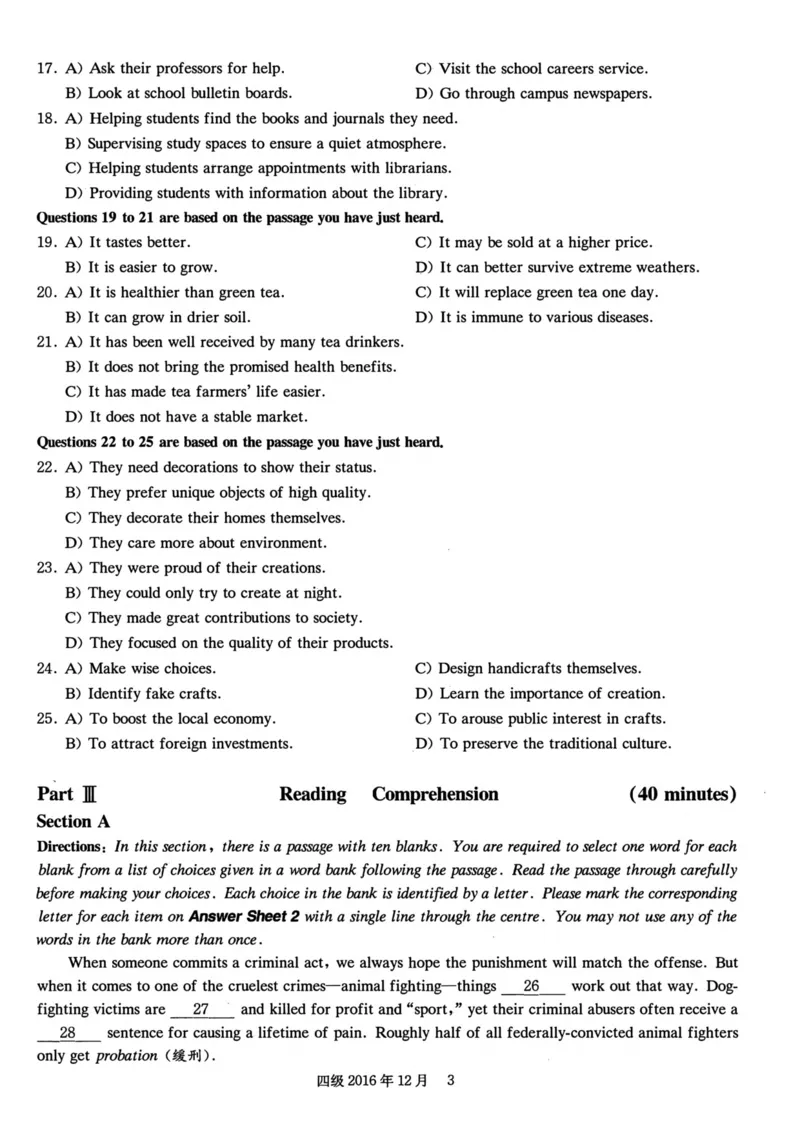
blank from a list of choices given in a word bank following the passage. Read the passage through carefully
before making your choices. Each choice in the bank is identified by a letter. Please mark the corresponding
letter for each item on Answer Sheet 2 with a single line through the centre. You may not use any of the
words in the bank more than once.
When someone commits a criminal act, we always hope the punishment will match the offense. But
when it comes to one of the crudest crimes- animal fighting- things 26 work out that way. Dog
fighting victims are 27 and killed for profit and “sport,“ yet their criminal abusers often receive a
28 sentence for causing a lifetime of pain. Roughly half of all federally-convicted animal fighters
only get probation (缓刑).
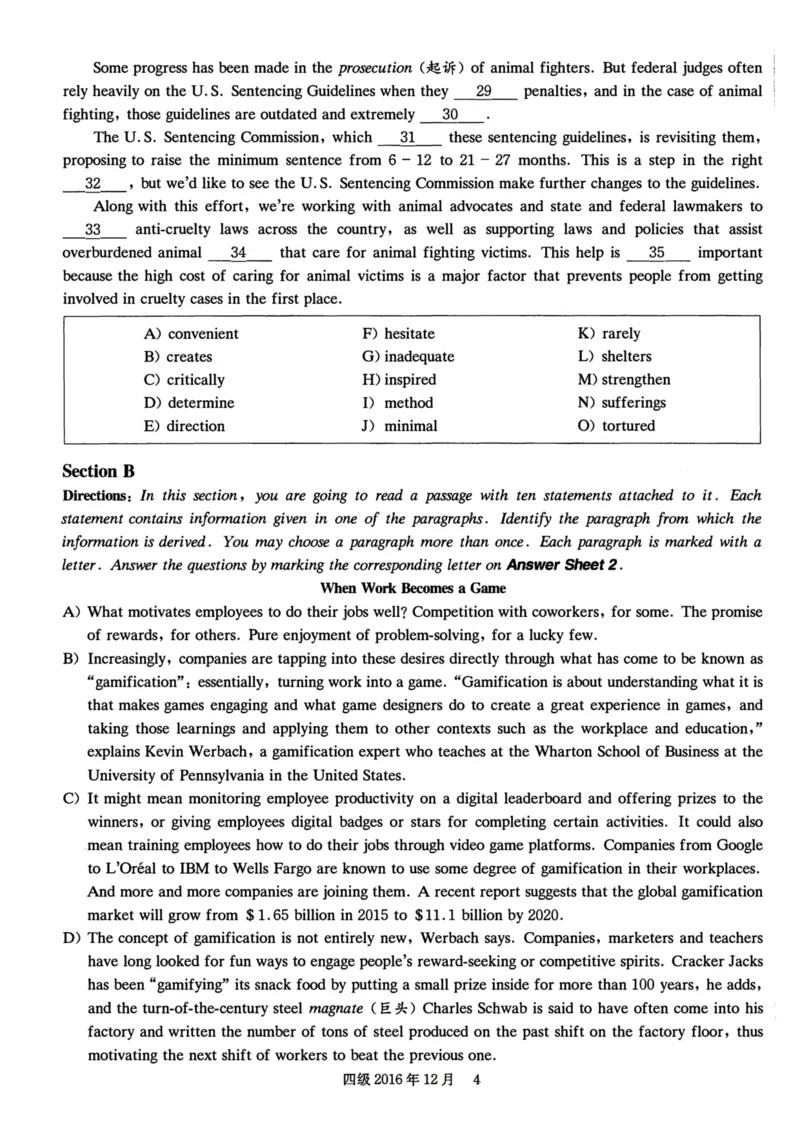
四级2016年12月 3Some progress has been made in the prosecution (起诉)of animal fighters. But federal judges often
rely heavily on the U. S. Sentencing Guidelines when they 29 penalties, and in the case of animal
fighting, those guidelines are outdated and extremely 3 0 .
The U. S. Sentencing Commission, which 31 these sentencing guidelines, is revisiting them,
proposing to raise the minimum sentence from 6-12 to 21 - 27 months. This is a step in the right
3 2 , but we'd like to see the U.S. Sentencing Commission make further changes to the guidelines.
Along with this effort, we're working with animal advocates and state and federal lawmakers to
3 3 anti-cruelty laws across the country, as well as supporting laws and policies that assist
overburdened animal 3 4 that care for animal fighting victims. This help is 3 5 important
because the high cost of caring for animal victims is a major factor that prevents people from getting
involved in cruelty cases in the first place.
A) convenient F) hesitate K) rarely
B) creates G) inadequate L) shelters
C) critically H) inspired M) strengthen
D) determine I) method N) sufferings
E) direction J) minimal O) tortured
Section B
Directions: In this section, you are going to read a passage with ten statements attached to it. Each
statement contains information given in one of the paragraphs. Identify the paragraph from which the
information is derived. You may choose a paragraph more than once. Each paragraph is marked with a
letter. Answer the questions by marking the corresponding letter on Answer Sheet 2.
When Work Becomes a Game
A) What motivates employees to do their jobs well? Competition with coworkers, for some. The promise
of rewards, for others. Pure enjoyment of problem-solving, for a lucky few.
B) Increasingly, companies are tapping into these desires directly through what has come to be known as
“gamification": essentially, turning work into a game. ^Gamification is about understanding what it is
that makes games engaging and what game designers do to create a great experience in games, and
taking those learnings and applying them to other contexts such as the workplace and education,w
explains Kevin Werbach, a gamification expert who teaches at the Wharton School of Business at the
University of Pennsylvania in the United States.
C) It might mean monitoring employee productivity on a digital leaderboard and offering prizes to the
winners, or giving employees digital badges or stars for completing certain activities. It could also
mean training employees how to do their jobs through video game platforms. Companies from Google
to L5Oreal to IBM to Wells Fargo are known to use some degree of gamification in their workplaces.
And more and more companies are joining them. A recent report suggests that the global gamification
market will grow from $1.65 billion in 2015 to $11.1 billion by 2020.
D) The concept of gamification is not entirely new, Werbach says. Companies, marketers and teachers
have long looked for fun ways to engage people's reward-seeking or competitive spirits. Cracker Jacks
has been “gamifying“ its snack food by putting a small prize inside for more than 100 years, he adds,
and the turn-of-the-century steel magnate (巨头)Charles Schwab is said to have often come into his
factory and written the number of tons of steel produced on the past shift on the factory floor, thus
motivating the next shift of workers to beat the previous one.
四级2016年12月 4E) But the word “gamification“ and the widespread, conscious application of the concept only began in
earnest about five years ago, Werbach says. Thanks in part to video games, the generation now
entering the workforce is especially open to the idea of having their work gamified. "We are at a point
where in much of the developed world the vast majority of young people grew up playing video games,
and an increasingly high percentage of adults play these video games too,“ Werbach says.
F) A number of companies have sprung up- GamEffective, Bunchball and Badgeville, to name a few一in
recent years offering gamification platforms for businesses. The platforms that are most effective turn
employees5 ordinary job tasks into part of a rich adventure narrative. "What makes a game game-like is
that the player actually cares about the outcome,w Werbach says. "The principle is about
understanding what is motivating to this group of players, which requires some understanding of
psychology.n
G) Some people, Werbach says, are motivated by competition. Sales people often fall into this category.
For them, the right kind of gamification might be turning their sales pitches into a competition with
other team members, complete with a digital leaderboard showing who is winning at all times. Others
are more motivated by collaboration and social experiences. One company Werbach has studied uses
gamification to create a sense of community and boost employees, morale (士气). When employees log
in to their computers, they're shown a picture of one of their coworkers and asked to guess that
person's name.
H) Gamification does not have to be digital. Monica Cornetti runs a company that gamifies employee
trainings. Sometimes this involves technology, but often it does not. She recently designed a
gamification strategy for a sales training company with a storm-chasing theme. Employees formed
storm chaser teams^^ and competed in storm-themed educational exercises to earn various rewards.
“Rewards do not have to be stuff Cornetti says. "Rewards can be flexible working hours.M Another
training, this one for pay roll law, used a Snow White and the Seven Dwarfs theme. "Snow White” is
available for everyone to use, but the “dwarfs“ are still under copyright, so Cornetti invented sound-
alike characters (Grumpy Gus, Dopey Dan) to illustrate specific pay roll law principles.
I) Some people do not take naturally to gamified work environments, Cornetti says. In her experience,
• people in positions of power or people in finance or engineering do not tend to like the sound of the
word. "If we are designing for engineers, Fm not talking about a 'game' at all,“ Cornetti says. "I'm
talking about a 4 simulation, (模才以),Fm talking about 4 being able to solve this problem.,M
J) Gamification is “not a magic bullet,w Werbach warns. A gamification strategy that is not sufficiently
thought through or well tailored to its players may engage people for a little while, but it will not
motivate people in the long term. It can also be exploitative, especially when used with vulnerable
populations. For workers, especially low-paid workers, who desperately need their jobs yet know they
can be easily replaced, gamification may feel more like the Hunger Games. Werbach gives the
example of several Disneyland hotels in Anaheim, California, which used large digital leaderboards to
display how efficiently laundry workers were working compared to one another. Some employees
found the board motivating. To others, it was the opposite of fun. Some began to stop taking
bathroom breaks, worried that if their productivity fell they would be fired. Pregnant employees
struggled to keep up. In a Los Angeles Times article, one employee referred to the board as a “digital
whip.n "It actually had a very negative effect on morale and performance,w Werbach says.
K) Still, gamification only stands to become more popular, he says, “as more and more people come into
the workforce who are familiar with the structures and expressions of digital games.n "We are far
from reaching the peak,^^ Cornetti agrees. "There is no reason this will go away.”
四级2016年 12月 536. Some famous companies are already using gamification and more are trying to do the same.
37. Gamification is not a miracle cure for all workplaces as it may have negative results.
38. To enhance morale, one company asks its employees to identify their fellow workers when starting
their computers.
39. The idea of gamification was practiced by some businesses more than a century ago.
40. There is reason to believe that gamification will be here to stay.
41. Video games contributed in some ways to the wide application of gamification.
42. When turning work into a game, it is necessary to understand what makes games interesting.
43. Gamification in employee training does not always need technology.
44. The most successful gamification platforms transform daily work assignments into fun experiences.
45. It is necessary to use terms other than “gamification“ for some professions.
Section C
Directions: There are 2 passages in this section. Each passage is followed by some questions or unfinished
statements. For each of them there are four choices marked A ) , B), C) and D). You should decide on
the best choice and mark the corresponding letter on Answer Sheet 2 with a single line through the centre.
Passage One
Questions 46 to 50 are based on the following pass阻e.
Recently I attended several meetings where we talked about ways to retain students and keep younger
faculty members from going elsewhere.
It seems higher education has become an industry of meeting-holders whose task it is to “solve”
problems- real or imagined. And in my position as a professor at three different colleges, the actual
problems in educating our young people and older students have deepened, while the number of people
hired- not to teach but to hold meetings- has increased significantly. Every new problem creates a new
job for an administrative fixer. Take our Center for Teaching Excellence. Contrary to its title, the center
is a clearing house (信息交流中心)for using technology in classrooms and in online courses. It's an
administrative sham (欺诈)of the kind that has multiplied over the last 30 years.
I offer a simple proposition in response: Many of our problems- class attendance, educational
success, student happiness and well-being- might be improved by cutting down the bureaucratic (官僚的)
mechanisms and meetings and instead hiring an army of good teachers. If we replaced half of our
administrative staff with classroom teachers, we might actually get a majority of our classes back to 20 or
fewer students per teacher. This would be an environment in which teachers and students actually knew
each other.
The teachers must be free to teach in their own way- the curriculum should be flexible enough so that
they can use their individual talents to achieve the goals of the course. Additionally, they should be
allowed to teach, and be rewarded for doing it well. Teachers are not people who are great at and
consumed by research and happen to appear in a classroom. Good teaching and research are not exclusive,
but they are also not automatic companions. Teaching is an art and a craft, talent and practice; it is not
something that just anyone can be good at. It is utterly confusing to me that people do not recognize this,
despite the fact that pretty much anyone who has been a student can tell the difference between their best
and worst teachers.
四级2016年12月 646. What does the author say about present-day universities?
A) They are effectively tackling real or imagined problems.
B) They often fail to combine teaching with research.
C) They are over-burdened with administrative staff.
D) They lack talent to fix their deepening problems.
47. According to the author, what kind of people do universities lack most?
A) Good classroom teachers. C) Talented researchers.
B) Efficient administrators. D) Motivated students.
48. What does the author imply about the classes at present?
A) They facilitate students, independent learning.
B) They help students form closer relationships.
C) They have more older students than before.
D) They are much bigger than is desirable.
49. What does the author think of teaching ability?
A) It requires talent and practice.
B) It is closely related to research.
C) It is a chief factor affecting students5 learning.
D) It can be acquired through persistent practice.
50. What is the author's suggestion for improving university teaching?
A) Creating an environment for teachers to share their teaching experiences.
B) Hiring more classroom teachers and allowing them to teach in their own way.
C) Using high technology in classrooms and promoting exchange of information.
D) Cutting down meetings and encouraging administrative staff to go to classrooms.
Passage Two
Questions 51 to 55 are based on the following passage.
The secret to eating less and being happy about it may have been cracked years ago- by McDonald's.
According to a new study from Cornell University's Food and Brand Lab, small non-food rewards- like
the toys in McDonald's Happy Meals一stimulate the same reward centers in the brain as food does.
The researchers, led by Martin Reimann, carried out a series of experiments to see if people would
choose a smaller meal if it was paired with a non-food item.
They found that the majority of both kids and adults opted for a half-sized portion when combined
with a prize. Both options were priced the same.
Even more interesting is that the promise of a future reward was enough to make adults choose the
smaller portion. One of the prizes used was a lottery ticket (彩票),with a $10, $50 or $100 payout, and
this was as effective as a tangible gift in persuading people to eat less.
“The fact that participants were willing to substitute part of a food item for the mere prospect of a
relatively small monetary award is interesting,M says Reimann.
He theorizes that it is the emotional component of these intangible prizes that make them effective.
In fact, vaguely-stated possibilities of winning a prize were more effective than options with hard odds
included.
“One explanation for this finding is that possible awards may be more emotionally provoking than
certainty awards,w says Reimann. "The uncertainty of winning provides added attraction and desirability
四级2016年12月 7through emotional 4 thrills., The possibility of receiving an award also produces a state of hope- a state
that is in itself psychologically rewarding.w In other words, there,s a reason why people like to gamble.
How might this knowledge be used to help people eat more healthily?
One possibility is a healthy option that offers the chance to win a spa (温泉疗养)weekend. Or maybe
the reward of a half-sized portion could be a half-sized dessert to be claimed only on a future date. That
would get you back in the restaurant—and make you eat a little less.
51. What do we learn about McDonald 5s inclusion of toys in its Happy Meals?
A) It may shed light on people's desire to crack a secret.
B) It has proved to be key to McDonald's business success.
C) It appeals to kid's curiosity to find out what is hidden inside.
D) It may be a pleasant way for kids to reduce their food intake.
52. What is the finding of the researchers led by Martin Reimann?
A) Reducing food intake is not that difficult if people go to McDonald's more.
B) Most kids and adults don't actually feel hungry when they eat half of their meal.
C) Eating a smaller portion of food does good to the health of kids and adults alike.
D) Most kids and adults would choose a smaller meal that came with a non-food item.
53. What is most interesting in Martin Reimann's finding?
A) Kids preferred an award in the form of money to one in the form of a toy.
B) Adults chose the smaller portion on the mere promise of a future award.
C) Both kids and adults felt satisfied with only half of their meal portions.
D) Neither children nor adults could resist the temptation of a free toy.
54. How does Martin Reimann interpret his finding?
A) The emotional component of the prizes is at work.
B) People now care more about quality than quantity.
C) People prefer certainty awards to possible awards.
D) The desire for a future reward is overwhelming.
55. What can we infer from Martin Reimann's finding?
A) People should eat much less if they wish to stay healthy and happy.
B) More fast food restaurants are likely to follow McDonald's example.
C) We can lead people to eat less while helping the restaurant business.
D) More studies are needed to find out the impact of emotion on behavior.
Part N Translation (30 minutes)
Directions: For this part, you are allowed 30 minutes to translate a passage from Chinese into English. You
should write your answer on Answer Sheet 2.
在中国文化中,红色通常象征着好运、长寿和幸福。在春节和其他喜庆场合,红色到处可见。人们把
现金作为礼物送给家人或亲密朋友时,通常放在红信封里。红色在中国流行的另一个原因是人们把它与
中国革命和共产党相联系。然而,红色并不总是代表好运和快乐。因为从前死者的名字常用红色书写,用
红墨水书写中国人名被看成是一种冒犯行为。
四级2016年12月 82016年 1 2 月大学英语四级考试真题(二)
回:鹫回
回濡弼里
Part I Writing (30 minutes)
扫码获音频
Directions: For this part, you are allowed 30 minutes to write an essay. Suppose you have two options upon
graduation : one is to take a job in a company and the other to go to a graduate school. You are to make a
choice between the two. Write an essay to explain the reasons for your choice. You should write at least 120
words but no more than 180 words.
Part ][ Listening Comprehension (25 minutes)
Section A
Directions: In this section, you will hear three news reports. At the end of each news report, you will hear
two or three questions. Both the news report and the questions will be spoken only once. After you hear a
question, you must choose the best answer from the four choices marked A ), B), C) and D). Then mark
the corresponding letter on Answer Sheet 1 with a single line through the centre.
Questions 1 and 2 are based on the news report you have just heard.
1. A) To satisfy the curiosity of tourists. C) To enable tourists to visit Goat Island.
B) To replace two old stone bridges. D) To improve utility services in the state.
2. A) Countless tree limbs.
B) A few skeletons.
C) Lots of wrecked boats and ships.
D) Millions of coins on the bottom.
Questions 3 and 4 are based on the news report you have just heard.
3. A) It suspended diplomatic relations with Libya.
B) It urged tourists to leave Tunisia immediately.
C) It shut down two border crossings with Libya.
D) It launched a fierce attack against Islamic State.
4. A) Advise Tunisian civilians on how to take safety precautions.
B) Track down the organization responsible for the terrorist attack.
C) Train qualified security personnel for the Tunisian government.
D) Devise a monitoring system on the Tunisian border with Libya.
Questions 5 to 7 are based on the news report you have just heard.
5. A) An environment-friendly battery. C) A plant-powered mobile phone charger.
B) An energy-saving mobile phone. D) A device to help plants absorb sunlight.
四级2016年 12月 256. A) While sitting in their schoofs courtyard.
B) While playing games on their phones.
C) While solving a mathematical problem.
D) While doing a chemical experiment.
7. A) It increases the applications of mobile phones.
B) It speeds up the process of photosynthesis.
C) It improves the reception of mobile phones.
D) It collects the energy released by plants.
Section B
Directions: In this section, you will hear two long conversations. At the end of each conversation, you will
hear four questions. Both the conversation and the questions will be spoken only once. After you hear a
question, you must choose the best answer from the four choices marked A ), B), C) and D). Then mark
the corresponding letter on Answer Sheet 1 with a single line through the centre.
Questions 8 to 11 are based on the conversation you have just heard.
8. A) He visited the workshops in the Grimsby plant.
B) He called the woman and left her a message.
C) He used stand-ins as replacements on all lines.
D) He asked a technician to fix the broken production line.
9. A) It is the most modern production line. C) It has stopped working completely.
B) It assembles super-intelligent robots. D) It is going to be upgraded soon.
10. A) To seek her permission. C) To request her to return at once.
B) To place an order for robots. D) To ask for Tom5s phone number.
11. A) She is on duty. C) She is on sick leave.
B) She is having her day off. D) She is abroad on business.
Questions 12 to 15 are based on the conversation you have just heard.
12. A) He saved a baby boy's life. C) He prevented a train crash.
B) He wanted to be a superhero. D) He was a witness to an accident.
13. A) He has a 9-month-old boy. C) He enjoys the interview.
B) He is currently unemployed. D) He commutes by subway.
14. A) A rock on the tracks. C) A strong wind.
B) A misplaced pushchair. D) A speeding car.
15. A) She stood motionless in shock. C) She called the police at once.
B) She cried bitterly. D) She shouted for help.
Section C
Directions: In this section, you will hear three passages. At the end of each passage, you will hear three or
four questions. Both the passage and the questions will be spoken only once. After you hear a question, you
must choose the best answer from the four choices marked A ), B), C) and D ). Then mark the
corresponding letter on Answer Sheet 1 with a single line through the centre.
四级2016年12月 26Questions 16 to 18 are based on the pass晔 you have just heard.
16. A) She inherited her family ice-cream business in Billings.
B) She loved the ice-cream business more than teaching primary school.
C) She started an ice-cream business to finance her daughter's education.
D) She wanted to have an ice-cream truck when she was a little girl.
17. A) To preserve a tradition. C) To help local education.
B) To amuse her daughter. D) To make some extra money.
18. A) To raise money for business expansion. C) To allow poor kids to have ice-cream too.
B) To make her truck attractive to children. D) lb teach kids the value of mutual support.
Questions 19 to 21 are based on the passage you have just heard.
19. A) The reasons for imposing taxes.
B) The various services money can buy.
C) The various burdens on ordinary citizens.
D) The function of money in the modern world.
20. A) Educating and training citizens. C) Protecting people's life and property.
B) Improving public transportation. D) Building hospitals and public libraries.
21. A) By asking for donations. C) By selling government bonds.
B) By selling public lands. D) By exploiting natural resources.
Questions 22 to 25 are based on the passage you have just heard.
22. A) It is located at the center of the European continent.
B) It relies on tourism as its chief source of revenues.
C) It contains less than a square mile of land.
D) It is surrounded by France on three sides.
23. A) Its beauty is frequently mentioned in American media.
B) Its ruler Prince Rainier married an American actress.
C) It is where many American movies are shot.
D) It is a favorite place Americans like to visit.
24. A) Tobacco. B) Potatoes. C) Machinery. D) Clothing.
25. A) European history. C) Small countries in Europe.
B) European geography. D) Tourist attractions in Europe.
Part U[ Reading Comprehension (40 minutes)
Section A
Directions: In this section, there is a passage with ten blanks. You are required to select one word for each
blank from a list of choices given in a word bank following the passage. Read the passage through carefully
before making your choices. Each choice in the bank is identified by a letter. Please mark the corresponding
letter for each item on Answer Sheet 2 with a single line through the centre. You may not use any of the
words in the bank more than once.
The ocean is heating up. That's the conclusion of a new study that finds that Earth's oceans now
26 heat at twice the rate they did 18 years ago. Around half of ocean heat intake since 1865 has
taken place since 1997, researchers report online in Nature Climate Change.
四级2016年12月 27Warming waters are known to 27 to coral bleaching (珊瑚白化)and they take up more space
than cooler waters, raising sea 2 8 . While the top of the ocean is well studied, its depths are more
difficult to 2 9 . The researchers gathered 150 years of ocean temperature data in order to get a better
30 of heat absorption from surface to seabed. They gathered together temperature readings collected by
everything from a 19th century 3 1 of British naval ships to modern automated ocean probes. The
extensive data sources, 3 2 with computer simulations (计 算机模拟),created a timeline of ocean
temperature changes, including cooling from volcanic outbreaks and warming from fossil fuel 3 3 .
About 35 percent of the heat taken in by the oceans during the industrial era now resides at a 34 of
more than 700 meters, the researchers found. They say they're 3 5 whether the deep-sea warming
canceled out warming at the sea's surface.
A) absorb F) excursion K) levels
B) combined G) explore L) mixed
C) contribute H) floor M) picture
D) depth I) heights N) unsure
E) emissions J) indifferent O) voyage
Section B
Directions: In this section, you are going to read a passage with ten statements attached to it. Each
statement contains information given in one of the paragraphs. Identify the paragraph from which the
information is derived. You may choose a paragraph more than once. Each paragraph is marked with a
letter. Answer the questions by marking the corresponding letter on Answer Sheet 2.
The Secret to Raising Smart Kids
A) I first began to investigate the basis of human motivation- and how people persevere after setbacks—
as a psychology graduate student at Yale University in the 1960s. Animal experiments by psychologists
at the University of Pennsylvania had shown that after repeated failures, most animals conclude that a
situation is hopeless and beyond their control. After such an experience an animal often remains
passive even when it can effect change- a state they called learned helplessness.
B) People can learn to be helpless, too. Why do some students give up when they encounter difficulty,
whereas others who are no more skilled continue to strive and learn? One answer, I soon discovered,
lay in people's beliefs about why they had failed.
C) In particular, attributing poor performance to a lack of ability depresses motivation more than does the
belief that lack of effort is to blame. When I told a group of school children who displayed helpless
behavior that a lack of effort led to their mistakes in math, they learned to keep trying when the
problems got tough. Another group of helpless children who were simply rewarded for their success on
easier problems did not improve their ability to solve hard math problems. These experiments indicated
that a focus on effort can help resolve helplessness and generate success.
D) Later, I developed a broader theory of what separates the two general classes of learners- helpless
versus mastery-oriented. I realized these different types of students not only explain their failures
differently, but they also hold different u theoriesn of intelligence. The helpless ones believe
intelligence is a fixed characteristic: you have only a certain amount, and that's that. I call this a
“fixed mind-set (思 维 模 式 )Mistakes crack their self-confidence because they attribute errors to a
lack of ability, which they feel powerless to change. They avoid challenges because challenges make
mistakes more likely. The mastery-oriented children, on the other hand, think intelligence is not fixed
and can be developed through education and hard work. Such children believe challenges are
四级2016年 12月 28energizing rather than intimidating (令人生畏);they offer opportunities to learn. Students with such
a growth mind-set were destined (注 定 )for greater academic success and were quite likely to
outperform their counterparts.
E) We validated these expectations in a study in which two other psychologists and I monitored 373
students for two years during the transition to junior high school, when the work gets more difficult
and the grading more strict, to determine how their mind-sets might affect their math grades. At the
beginning of seventh grade, we assessed the students5 mind-sets by asking them to agree or disagree
with statements such as “Your intelligence is something very basic about you that you can't really
change.n We then assessed their beliefs about other aspects of learning and looked to see what
happened to their grades.
F) As predicted, the students with a growth mind-set felt that learning was a more important goal than
getting good grades. In addition, they held hard work in high regard. They understood that even
geniuses have to work hard. Confronted by a setback such as a disappointing test grade, students with
a growth mind-set said they would study harder or try a different strategy. The students who held a
fixed mind-set, however, were concerned about looking smart with less regard for learning. They had
negative views of effort, believing that having to work hard was a sign of low ability. They thought
that a person with talent or intelligence did not need to work hard to do well. Attributing a bad grade
to their own lack of ability, those with a fixed mind-set said that they would study less in the future,
try never to take that subject again and consider cheating on future tests.
G) Such different outlooks had a dramatic impact on performance. At the start of junior high, the math
achievement test scores of the students with a growth mind-set were comparable to those of students
who displayed a fixed mind-set. But as the work became more difficult, the students with a growth
mind-set showed greater persistence. As a result, their math grades overtook those of the other
students by the end of the first semester—and the gap between the two groups continued to widen
during the two years we followed them.
H) A fixed mind-set can also hinder communication and progress in the workplace and discourage or
ignore constructive criticism and advice. Research shows that managers who have a fixed mind-set are
less likely to seek or welcome feedback from their employees than are managers with a growth
mind-set.
I) How do we transmit a growth mind-set to our children? One way is by telling stories about
achievements that result from hard work. For instance, talking about mathematical geniuses who were
more or less born that way puts students in a fixed mind-set, but descriptions of great mathematicians
who fell in love with math and developed amazing skills produce a growth mind-set.
J) In addition, parents and teachers can help children by providing explicit instruction regarding the mind
as a learning machine. I designed an eight-session workshop for 91 students whose math grades were
declining in their first year of. junior high. Forty-eight of the students received instruction in study
skills only, whereas the others attended a combination of study skills sessions and classes in which they
learned about the growth mind-set and how to apply it to schoolwork. In the growth mind-set classes,
students read and discussed an article entitled “You Can Grow Your Brain.n They were taught that the
brain is like a muscle that gets stronger with use and that learning prompts the brain to grow new
connections. From such instruction, many students began to see themselves as agents of their own
brain development. Despite being unaware that there were two types of instruction, teachers reported
significant motivational changes in 27% of the children in the growth mind-set workshop as compared
with only 9% of students in the control group.
四级2016年 12月 29K) Research is converging (5匚聚)on the conclusion that great accomplishment and even genius is typically
the result of years of passion and dedication and not something that flows naturally from a gift.
36. The author's experiment shows that students with a fixed mind-set believe having to work hard is an
indication of low ability.
37. Focusing on effort is effective in helping children overcome frustration and achieve success.
38. We can cultivate a growth mind-set in children by telling success stories that emphasize hard work and
love of learning.
39. Students* belief about the cause of their failure explains their attitude toward setbacks.
40. In the author's experiment, students with a growth mind-set showed greater perseverance in solving
difficult math problems.
41. The author conducted an experiment to find out about the influence of students* mind-sets on math
learning.
42. After failing again and again, most animals give up hope.
43. Informing students about the brain as a learning machine is a good strategy to enhance their motivation
for learning.
44. People with a fixed mind-set believe that one's intelligence is unchangeable.
45. In the workplace, feedback may not be so welcome to managers with a fixed mind-set.
Section C
Directions: There are 2 passages in this section. Each passage is followed by some questions or unfinished
statements. For each of them there are four choices marked A) , B ), C) and D ). You should decide on
the best choice and mark the corresponding letter on Answer Sheet 2 with a single line through, the centre.
Passage One
Questions 46 to 50 are based on the following passage.
“Sugar, alcohol and tobacco,M economist Adam Smith once wrote, u are commodities which are
nowhere necessaries of life, which have become objects of almost universal consumption, and which are,
therefore, extremely popular subjects of taxation.M
Two and a half centuries on, most countries impose some sort of tax on alcohol and tobacco. With
surging obesity levels putting increasing strain on public health systems, governments around the world
have begun to toy with the idea of taxing sugar as well.
Whether such taxes work is a matter of debate. A preliminary review of Mexico's taxation found a
fall in purchases of taxed drinks as well as a rise in sales of untaxed and healthier drinks. By contrast, a
Danish tax on foods high in fats was abandoned a year after its introduction, amid claims that consumers
were avoiding it by crossing the border to Germany to satisfy their desire for cheaper, fattier fare.
The food industry has, in general, been firmly opposed to such direct government action.
Nonetheless, the renewed focus on waistlines means that industry groups are under pressure to demonstrate
their products are healthy as well as tasty.
Over the past three decades, the industry has made some efforts to improve the quality of its
offerings. For example, some drink manufacturers have cut the amount of sugar in their beverages.
Many of the reductions over the past 30 years have been achieved either by reducing the amount of
sugar, salt or fat in a product, or by finding an alternative ingredient. More recently, however, some
companies have been investing money in a more ambitious undertaking: learning how to adjust the
fundamental make-up of the food they sell. For example, having salt on the outside, but none on the
inside, reduces the salt content without changing the taste.
四级2016年12月 30While reformulating recipes (酉己方)is one way to improve public health, it should be part of a
multi-sided approach. The key is to remember that there is not just one solution. To deal with obesity,
a mixture of approaches- including reformulation, taxation and adjusting portion sizes- will be
needed. There is no silver bullet.
46. What did Adam Smith say about sugar, alcohol and tobacco?
A) They were profitable to manufacture.
B) They were in ever-increasing demand.
C) They were subject to taxation almost everywhere.
D) They were no longer considered necessities of life.
47. Why have many countries started to consider taxing sugar?
A) They are under growing pressure to balance their national budgets.
B) They find it ever harder to cope with sugar-induced health problems.
C) The practice of taxing alcohol and tobacco has proved both popular and profitable.
D) The sugar industry is overtaking alcohol and tobacco business in generating profits.
48. What do we learn about Danish taxation on fat-rich foods?
A) It did not work out as well as was expected.
B) It gave rise to a lot of problems on the border.
C) It could not succeed without German cooperation.
D) It met with firm opposition from the food industry.
49. What is the more recent effort by food companies to make foods and drinks both healthy and tasty?
A) Replacing sugar or salt with alternative ingredients.
B) Setting a limit on the amount of sugar or salt in their products.
C) Investing in research to find ways to adapt to consumers5 needs.
D) Adjusting the physical composition of their products.
50. What does the author mean by saying, at the end of the passage/"There is no silver bullet”(Line 4,
Para. 7)?
A) There is no single easy quick solution to the problem.
B) There is no hope of success without public cooperation.
C) There is no hurry in finding ways to solve the obesity problem.
D) There is no effective way to reduce people's sugar consumption.
Passage Two
Questions 51 to 55 are based on the following passage.
You may have heard some of the fashion industry horror stories: models eating tissues or cotton balls
to hold off hunger, and models collapsing from hunger-induced heart attacks just seconds after they step
off the runway.
Excessively skinny models have been a point of controversy for decades, and two researchers say a
modefs body mass should be a workplace health and safety issue. In an editorial released Monday in the
American Journal of Public Health, Katherine Record and Bryn Austin made their case for government
regulation of the fashion industry.
The average international runway model has a body mass index (BMI) under 16- low enough to
indicate starvation by the World Health Organization's standard. And Record and Austin are worried not
just about the models themselves, but about the vast number of girls and women their images influence.
“Especially girls and teens,w says Record. Seventy percent of girls aged 10 to 18 report that they
四级2016年 12月 31define perfect body image based on what they see in magazines.w That's especially worrying, she says,
given that anorexia (厌食症)results in more deaths than does any other mental illness, according to the
National Institute of Mental Health.
It's commonly known that certain diseases are linked with occupations like lung disease in coal
miners. Professional fashion models are particularly vulnerable to eating disorders resulting from
occupational demands to maintain extreme thinness.
Record's suggestion is to prohibit agents from hiring models with a BMI below 18.
In April, France passed a law setting lower limits for a models weight. Agents and fashion houses
who hire models with a BMI under 18 could pay $ 82,000 in fines and spend up to 6 months in jail.
Regulating the fashion industry in the United States won't be easy, Record says. But with the new rules in
France, U. S. support could make a difference. "A designer can't survive without participating in Paris
Fashion Week”, she says, adding,“Our argument is that the same would be true of New York Fashion
Week. ”
51. What do Record and Austin say about fashion models5 body mass?
A) It has caused needless controversy. C) It is the focus of the modeling business.
B) It is but a matter of personal taste. D) It affects models5 health and safety.
52. What are Record and Austin advocating in the Monday editorial?
A) A change in the public's view of female beauty.
B) Government legislation about models, weight.
C) Elimination of forced weight loss by models.
D) Prohibition of models eating non-food stuff.
53. Why are Record and Austin especially worried about the low body mass index of models?
A) It contributes to many mental illnesses.
B) It defines the future of the fashion industry.
C) It has great influence on numerous girls and women.
D) It keeps many otherwise qualified women off the runway.
54. What do we learn about France's fashion industry?
A) It has difficulty hiring models. C) It allows girls under 18 on the runway.
B) It has now a new law to follow. D) It has overtaken that of the United States.
55. What does Record expect of New York Fashion Week?
A) It will create a completely new set of rules.
B) It will do better than Paris Fashion Week.
C) It will differ from Paris Fashion Week.
D) It will have models with a higher BMI.
Part N Translation (30 minutes)
Directions: For this part, you are allowed 30 minutes to translate a passage from Chinese into English. You
should write your answer on Answer Sheet 2.
在中国文化中,黄颜色是一种很重要的颜色,因为它具有独特的象征意义。在封建中eudaD社会中,它
象征统治者的权力和权威。那时,黄色是专为皇帝使用的颜色,皇家宫殿全都漆成黄色,皇袍总是黄色的,
而普通老百姓是禁止穿黄色衣服的。在中国,黄色也是收获的象征。秋天庄稼成熟时,田野变得一片金
黄。人们兴高采烈,庆祝丰收。
四级2016年12月 322016年 1 2 月大学英语四级考试真题(三)
Part I Writing (30 minutes)
Directions: For this part, you are allowed 30 minutes to write an essay. Suppose you have two options upon
graduation : one is to work in a state-owned business and the other in a joint venture. You are to make a
choice between the two. Write an essay to explain the reasons for your choice. You should write at least 120
words but no more than 180 words.
Part I Listening Comprehension (25 minutes)
说明:由于2016年 12月四级考试全国共考了两套听力,本套真题听力与前两套内容相同,只是选项顺序不
同,因此在本套真题中不再重复出现。
Part IE Reading Comprehension (40 minutes)
Section A
Directions: In this section, there is a passage with ten blanks. You are required to select one word for each
blank from a list of choices given in a word bank following the passage. Read the passage through carefully
before making your choices. Each choice in the bank is identified by a letter. Please mark the corresponding
letter for each item on Answer Sheet 2 with a single line through the centre. You may not use any of the
words in the bank more than once.
Many men and women have long bought into the idea that there are "male" and "female“ brains,
believing that explains just about every difference between the sexes. A new study 26 that belief,
questioning whether brains really can be distinguished by gender.
In the study, Tel Aviv University researchers 2 7 for sex differences throughout the entire
human brain.
And what did they find? Not much. Rather than offer evidence for 28 brains as "male" or
“female,“ research shows that brains fall into a wide range, with most people falling right in the middle.
Daphna Joel, who led the study, said her research found that while there are some gender-based
2 9 , many different types of brain can't always be distinguished by gender.
While the “average“ male and “average“ female brains were 30 different, you couldn't tell it
by looking at individual brain scans. Only a small 3 1 of people had “all-male" or "all-female”
characteristics.
Larry Cahill, an American neuroscientist (神经科学家),said the study is an important addition to a
growing body of research questioning 32 beliefs about gender and brain function. But he cautioned
against concluding from this study that all brains are the s a m e ,33 of gender.
“There's a mountain of evidence 3 4 the importance of sex influences at all levels of brain
function/5 he told The Seattle Times.
If anything, he said, the study 35 that gender plays a very important role in the brain—“even
when we are not clear exactly how.”
四级2016年12月 49A) abnormal F) figure K) similarities
B) applied G) percentage L) slightly
C) briefly H) proving M) suggests
D) categorizing I) regardless N) tastes
E) challenges J) searched O) traditional
Section B
Directions: In this section, you are going to read a passage with ten statements attached to it. Each
statement contains information given in one of the paragraphs. Identify the paragraph from which the
information is derived. You may choose a paragraph more than once. Each paragraph is marked with a
letter. Answer the questions by marking the corresponding letter on Answer Sheet 2.
Can Burglars Jam Your Wireless Security System?
A) Any product that promises to protect your home deserves careful examination. So it isn't surprising that
you'll find plenty of strong opinions about the potential vulnerabilities of popular home-security
systems.
B) The most likely type of burglary (入室盗窃)by far is the unsophisticated crime of opportunity, usually
involving a broken window or some forced entry. According to the FBI, crimes like these accounted
for roughly two-thirds of all household burglaries in the US in 2013. The wide majority of the rest were
illegal, unforced entries that resulted from something like a window being left open. The odds of a
criminal using technical means to bypass a security system are so small that the FBI doesn't even track
those statistics.
C) One of the main theoretical home-security concerns is whether or not a given system is vulnerable to
being blocked from working altogether. With wired setups, the fear is that a burglar (入室盗贼)
might be able to shut your system down simply by cutting the right cable. With a wireless setup, you
stick battery-powered sensors up around your home that keep an eye on windows, doors, motion, and
more. If they detect something wrong while the system is armed, they'll transmit a wireless alert signal
to a base station that will then raise the alarm. That approach will eliminate most cord-cutting
concerns■—but what about their wireless equivalent, jamming? With the right device tuned to the right
frequency, what5s to stop a thief from jamming your setup and blocking that alert signal from ever
reaching the base station?
D) Jamming concerns are nothing new, and they're not unique to security systems. Any device that's built
to receive a wireless signal at a specific frequency can be overwhelmed by a stronger signal coming in
on the same frequency. For comparison, let's say you wanted to "jam" a conversation between two
people—all you5d need to do is yell in the listener's ear.
E) Security devices are required to list the frequencies they broadcast on—that means that a potential thief
can find what they need to know with minimal Googling. They will, however, need to know what
system they're looking for. If you have a sign in your yard declaring what setup you use, that5d point
them in the right direction, though at that point, we're talking about a highly targeted, semi
sophisticated attack, and not the sort of forced-entry attack that makes up the majority of burglaries.
It's easier to find and acquire jamming equipment for some frequencies than it is for others.
四级2016年12月 50F) Wireless security providers will often take steps to help combat the threat of jamming attacks.
SimpliSafe, winner of our Editors5 Choice distinction, utilizes a special system that's capable of
separating incidental RF interference from targeted jamming attacks. When the system thinks it's
being jammed, it'll notify you via push alert (推送警报0. From there, it's up to you to sound the
alarm manually.
G) SimpliSafe was singled out in one recent article on jamming, complete with a video showing the entire
system being effectively bypassed with handheld jamming equipment. After taking appropriate
measures to contain the RF interference to our test lab, we tested the attack out for ourselves, and
were able to verify that it's possible with the right equipment. However, we also verified that
SimpliSafe^ anti-jamming system works. It caught us in the act, sent an alert to my smartphone, and
also listed our RF interference on the system's event log. The team behind the article and video in
question make no mention of the system, or whether or not it detected them.
H) We like the unique nature of that software. It means that a thief likely wouldn't be able to Google how
the system works, then figure out a way around it. Even if they could, SimpliSafe claims that its
system is always evolving, and that it varies slightly from system to system, which means there
wouldn't be a universal magic formula for cracking it. Other systems also seem confident on the subject
of jamming. The team at Frontpoint addresses the issue in a blog on its site, citing their own jam
protection software and claiming that there aren't any documented cases of a successful jam attack
since the company began offering wireless security sensors in the 1980s.
I) Jamming attacks are absolutely possible. As said before, with the right equipment and the right know
how, it's possible to jam any wireless transmission. But how probable is it that someone will
successfully jam their way into your home and steal your stuff?
J) Let's imagine that you live in a small home with a wireless security setup that offers a functional anti
jamming system. First, a thief is going to need to target your home, specifically. Then, he's going to
need to know the technical details of your system and acquire the specific equipment necessary for
jamming your specific setup. Presumably, you keep your doors locked at night and while you're away,
so the thief will still need to break in. That means defeating the lock somehow, or breaking a window.
He'll need to be jamming you at this point, as a broken window or opened door would normally release
the alarm. So, too, would the motion detectors in your home, so the thief will need to continue
jamming once he's inside and searching for things to steal. However, he'll need to do so without
tripping the anti-jamming system, the details of which he almost certainly does not have access to.
K) At the end of the day, these kinds of systems are primarily designed to protect against the sort of
opportunistic smash-and-grab attack that makes up the majority of burglaries. They're also only a
single layer in what should ideally be a many-sided approach to securing your home, one that includes
common sense things like sound locks and proper exterior lighting at night. No system is impenetrable,
and none can promise to eliminate the worst case completely. Every one of them has vulnerabilities
that a knowledgeable thief could theoretically exploit. A good system is one that keeps that worst-case
setting as improbable as possible while also offering strong protection in the event of a less-
extraordinary attack.
36. It is possible for burglars to make jamming attacks with the necessary equipment and skill.
37. Interfering with a wireless security system is similar to interfering with a conversation.
四级2016年12月 5138. A burglar has to continuously jam the wireless security device to avoid triggering the alarm, both inside
, and outside the house.
39. SimpliSafe provides devices that are able to distinguish incidental radio interference from targeted
jamming attacks.
40. Only a very small proportion of burglaries are committed by technical means.
41. It is difficult to crack SimpliSafe as its system keeps changing.
42. Wireless devices will transmit signals so as to activate the alarm once something wrong is detected.
43. Different measures should be taken to protect one's home from burglary in addition to the wireless
security system.
44. SimpliSafe's device can send a warning to the house owner's cellphone.
45. Burglars can easily get a security device5s frequency by Internet search.
Section C
Directions: There are 2 passages in this section. Each passage is followed by some questions or unfinished
statements. For each of them there are four choices marked A ), B) , C) and D) . You should decide on
the best choice and mark the corresponding letter on Answer Sheet 2 with a single line through the centre.
Passage One
Questions 46 to 50 are based on the following passage.
As a person who writes about food and drink for a living, I couldn't tell you the first thing about
Bill Perry or whether the beers he sells are that great. But I can tell you that I like this guy. That's because
he plans to ban tipping in favor of paying his servers an actual living wage.
I hate tipping.
I hate it because it's an obligation disguised as an option. I hate it for the post-dinner math it requires
of me. But mostly, I hate tipping because I believe I would be in a better place if pay decisions regarding
employees were simply left up to their employers, as is the custom in virtually every other industry.
Most of you probably think that you hate tipping, too. Research suggests otherwise. You actually love
tipping! You like to feel that you have a voice in how much money your server makes. No matter how the
math works out, you persistently view restaurants with voluntary tipping systems as being a better value,
which makes it extremely difficult for restaurants and bars to do away with the tipping system.
One argument that you tend to hear a lot from the pro-tipping crowd seems logical enough: the service
is better when waiters depend on tips, presumably because they see a benefit to successfully veiling their
contempt for you. Well, if this were true, we would all be slipping a few 100-dollar bills to our doctors on
the way out their doors, too. But as it turns out, waiters see only a tiny bump in tips when they do an
exceptional job compared to a passable one. Waiters, keen observers of humanity that they are, are
catching on to this; in one poll, a full 30% said they didn't believe the job they did had any impact on the
tips they received.
So come on, folks: get on board with ditching the outdated tip system. Pay a little more upfront for
your beer or burger. Support Bill Perry's pub, and any other bar or restaurant that doesn't ask you to do
drunken math.
46. What can we learn about Bill Perry from the passage?
A) He runs a pub that serves excellent beer.
B) He intends to get rid of the tipping practice.
四级2016年 12月 52C) He gives his staff a considerable sum for tips.
D) He lives comfortably without getting any tips.
47. What is the main reason why the author hates tipping?
A) It sets a bad example for other industries.
B) It adds to the burden of ordinary customers.
C) It forces the customer to compensate the waiter.
D) It poses a great challenge for customers to do math.
48. Why do many people love tipping according to the author?
A) They help improve the quality of the restaurants they dine in.
B) They believe waiters deserve such rewards for good service.
C) They want to preserve a wonderful tradition of the industry.
D) They can have some say in how much their servers earn.
49. What have some waiters come to realize according to a survey?
A) Service quality has little effect on tip size.
B) It is in human nature to try to save on tips.
C) Tips make it more difficult to please customers.
D) Tips benefit the boss rather than the employees.
50. What does the author argue for in the passage?
A) Restaurants should calculate the tips for customers.
B) Customers should pay more tips to help improve service.
C) Waiters deserve better than just relying on tips for a living.
D) Waiters should be paid by employers instead of customers.
Passage Two
Questions 51 to 55 are based on the following passage.
In the past, falling oil prices have given a boost to the world economy, but recent forecasts for global
growth have been toned down, even as oil prices sink lower and lower. Does that mean the link between
lower oil prices and growth has weakened?
Some experts say there are still good reasons to believe cheap oil should heat up the world economy.
Consumers have more money in their pockets when they5re paying less at the pump. They spend that
money on other things, which stimulates the economy.
The biggest gains go to countries that import most of their oil like China, Japan, and India. But
doesn5t the extra money in the pockets of those countries5 consumers mean an equal loss in oil-producing
countries, cancelling out the gains? Not necessarily, say economic researcher Sara Johnson. "Many oil
producers built up huge reserve funds when prices were high, so when prices fall they will draw on their
reserves to support government spending and subsidies (不卜贝占)for their consumers.w
But not all oil producers have big reserves. In Venezuela, collapsing oil prices have sent its economy
into free-fall.
Economist Carl Weinberg believes the negative effects of plunging oil prices are overwhelming the
positive effects of cheaper oil. The implication is a sharp decline in global trade, which has plunged partly
because oil-producing nations can't afford to import as much as they used to.
四级2016年 12月 53Sara Johnson acknowledges that the global economic benefit from a fall in oil prices today is likely
lower than it was in the past. One reason is that more countries are big oil producers now, so the nations
suffering from the price drop account for a larger share of the global economy.
Consumers, in the U. S. at least, are acting cautiously with the savings they5re getting at the gas
pump» as the memory of the recent great recession is still fresh in their mind. And a number of
oil-producing countries are trimming their gasoline subsidies and raising taxes, so the net savings for global
consumers is not as big as the oil price plunge might suggest.
51. What does the author mainly discuss in the passage?
A) The reasons behind the plunge of oil prices.
B) Possible ways to stimulate the global economy.
C) The impact of cheap oil on global economic growth.
D) The effect of falling oil prices on consumer spending.
52. Why do some experts believe cheap oil will stimulate the global economy?
A) Manufacturers can produce consumer goods at a much lower cost.
B) Lower oil prices have always given a big boost to the global economy.
C) Oil prices may rise or fall but economic laws are not subject to change.
D) Consumers will spend their savings from cheap oil on other commodities.
53. What happens in many oil-exporting countries when oil prices go down?
A) They suspend import of necessities from overseas.
B) They reduce production drastically to boost oil prices.
C) They use their money reserves to back up consumption.
D) They try to stop their economy from going into free-fall.
54. How does Carl Weinberg view the current oil price plunge?
A) It is one that has seen no parallel in economic history.
B) Its negative effects more than cancel out its positive effects.
C) It still has a chance to give rise to a boom in the global economy.
D) Its effects on the global economy go against existing economic laws.
55. Why haven't falling oil prices boosted the global economy as they did before?
A) People are not spending all the money they save on gas.
B) The global economy is likely to undergo another recession.
C) Oil importers account for a larger portion of the global economy.
D) People the world over are afraid of a further plunge in oil prices.
Part N Translation (30 minutes)
Directions: For this part, you are allowed 30 minutes to translate a passage from Chinese into English. You
should write your answer on Answer Sheet 2.
随着中国的改革开放,如今很多年轻人都喜欢举行西式婚礼。新娘在婚礼上穿着白色婚纱,因为白色
被认为是纯洁的象征。然而,在中国传统文化中,白色经常是葬礼上使用的颜色。因此务必记住,白花一
定不要用作祝人康复的礼物,尤其不要送给老年人或危重病人。同样,礼金也不能装在白色的信封里,而
要装在红色的信封里。
四级2016年12月 542017年 6 月大学英语四级考试真题(第 1 套 )
Part I Writing (30 minutes)
Directions : For this part, you are allowed 30 minutes to write a/n advertisement on your campus
website to sell a bicycle you used at college. Your advertisement may include its brand,
features, condition and price, and your contact information. You should write at least
120 words but no more them 180 words.
Part n Listening Comprehension (25 minutes)
Section A
Directions : In this section, you will hear three news reports. At the end of each news
report, you will hear two or three questions. Both the news report and the
questions will be spoken only once. After you hear a question, you must
choose the best answer from the four choices marked A ), B) C) emd D).
9 扫码获音频
Then mark the corresponding letter on Answer Sheet 1 with a single li/ne
through the centre.
Questions 1 and 2 are based on the news report you have just heard.
1. A) The self-driving system was faulty. C) The man in the car was absent-minded.
B) The car was moving at a fast speed. D) The test driver made a wrong judgment.
2. A) They have generally done quite well.
B) They have caused several severe crashes.
C) They have posed a threat to other drivers.
D) They have done better than conventional cars.
Questions 3 and 4 are based on the news report you have just heard.
3. A) He is a queen bee specialist. C) He removed the bees from the boot.
B) He works at a national park. D) He drove the bees away from his car.
4. A) They were making a lot of noise. C) They were dancing in a unique way.
B) They were looking after the queen. D) They were looking for a new box to live in.
Questions 5 to 7 are based on the news report you have just heard.
5. A) The latest test on a rare animal species. C) The second trip to a small remote island.
B) The finding of two new species of frog. D) The discovery of a new species of snake.
6. A) He fell from a tall palm tree by accident.
B) A snake crawled onto his head in his sleep.
C) He discovered a rare frog on a deserted island.
D) A poisonous snake attacked him on his field trip.
2017.6/ 1 (第 1 套)7. A) From its origin. C) From its colour.
B) From its length. D) From its genes.
Section B
Directions : In this section you will hear two long conversations. At the end of each corwersation, you
9
will hear four questions. Both the conversation and the questions will be spoken only
once. After you hear a question, you must choose the best answer from the four choices
marked A), B), C) and D). Then mark the corresponding letter on Answer Sheet 1 with
a single line through the centre.
Questions 8 to 11 are based on the conversation you have just heard.
8. A) The airport is a long way from the hotel. C) He has to check a lot of luggage.
B) His flight is leaving in less than 2 hours. D) The security check takes time.
9. A) In cash. C) With his smart phone.
B) By credit card. D) With a traveler's check.
10. A) Look after his luggage. C) Give him a receipt.
B) Find a porter for him. D) Confirm his flight.
11. A) Posting a comment on the hoteVs webpage.
B) Staying in the same hotel next time he comes.
C) Signing up for membership of Sheraton Hotel.
D) Loading her luggage onto the airport shuttle.
Questions 12 to 15 are based on the conversation you have just heard.
12. A) He becomes tearful in wind. C) He is his teacher's favorite student.
B) He is the only boy in his family. D) He has stopped making terrible faces.
13. A) Warn him of danger by making up a stoiy. C) Do something funny to amuse him.
B) Give him some cherry stones to play with. D) Tell him to play in her backyard.
14. A) They could knock people unconscious. C) They could sometimes terrify adults.
B) They could fly against a strong wind. D) They could break people's legs.
15. A) One would have curly hair if they ate too much stale bread.
B) One would go to prison if they put a stamp on upside down.
C) One would have to shave their head to remove a bat in their hair.
D) One would get a spot on their tongue if they told a lie deliberately.
Section C
Directions: In this section, you will hear three passages. At the end of each passage, you will hear
three or four questions. Both the passage cmd the questions will be spoken only once.
After you hear a question, you miist choose the best answer from the four choices marked
A ), B ), C) and D). Then mark the corresponding letter on Answer Sheet 1 with a
svngle li/ne through the centre.
Questions 16 to 18 are based on the passage you have just heard.
16. A) Everything seemed to be changing. C) People were excited to go traveling overseas.
B) People were formal and disciplined. D) Things from the Victorian era came back alive.
2017.6/ 2 (第 1 套)17. A) Watching TV at home. C) Drinking coffee.
B) Meeting people. D) Trying new foods.
18. A) He was interested in stylish dresses. C) He was a young student in the 1960s.
B) He was able to make a lot of money. D) He was a man full of imagination.
Questions 19 to 21 are based on the passage you have just heard.
19. A) They avoid looking at them. C) They show anger on their faces.
B) They run away immediately. D) They make threatening sounds.
20. A) It turns to its owner for help. C) It looks away and gets angry too.
B) It turns away to avoid conflict. D) It focuses its eyes on their mouths.
21. A) By observing their facial features carefully.
B) By focusing on a particular body movement.
C) By taking in their facial expressions as a whole.
D) By interpreting different emotions in different ways.
Questions 22 to 25 are based on the passage you have just heard.
22. A) They have to look for food and shelter underground.
B) They take little notice of the changes in temperature.
C) They resort to different means to survive the bitter cold.
D) They have difficulty adapting to the changed environment.
23. A) They have their weight reduced to the minimum.
B) They consume energy stored before the long sleep.
C) They can maintain their heart beat at the normal rate.
D) They can keep their body temperature warm and stable.
24. A) By staying in hiding places and eating veiy little.
B) By seeking food and shelter in people's houses.
C) By growing thicker hair to stay warm.
D) By storing enough food beforehand.
25. A) To stay safe. C) To keep company.
B) To save energy. D) To protect the young.
Part UI Reading Comprehension (40 minutes)
Section A
Directions: In this section, there is a passage with ten blanks. You are required to select one word
for each blank from a list of choices given in a word bank following the passage. Read the
passage through carefully before making your choices. Each choice vn the bcmk is
identified by a letter. Please mark the corresponding letter for each item on Answer
Sheet 2 with a single line through the centre. You may not use cmy of the words in the
bank more tha/n once.
Questions 26 to 35 are based on the following passage.
The method for making beer has changed over time. Hops (啤酒花),for example, which give
many a modem beer its bitter flavor, are a 26 recent addition to the beverage. This was first
mentioned in reference to brewing in the ninth century. Now, researchers have found a 27
2017.6/ 3 (第 1 套)ingredient in residue (残留物)from 5,000-year-old beer brewing equipment. While digging two pits at
a site in the central plains of China, scientists discovered fragments from pots and vessels. The
different shapes of the containers 28 they were used to brew, filter, and store beer. They may be
ancient beer-making tools,“ and the earliest 29 evidence of beer brewing in China, the
researchers reported in the Proceedings of the National Academy of Sciences. To 30 that theory,
the team examined the yellowish, dried 31 inside the vessels. The majority of the grains, about
80% , were from cereal crops like barley (大麦),and about 10% were bits of roots 32 lily, which
?
would have made the beer sweeter, the scientists say. Barley was an unexpected find: the crop was
domesticated in Western Eurasia and didn't become a 33 food in central China until about 2,000
years ago, according to the researchers. Based on that timing, they indicate barley may have 34 in
the region not as food, but as 35 material for beer brewing.
A) arrived I) relatively
B) consuming J) remains
C) direct K) resources
D) exclusively L) staple
E) including M) suggest
F) inform N) surprising
G) raw 0) test
H) reached
Section B
Directions : In this section, you are going to read a passage with ten statements attached to it. Each
statement contains 讽formation given in one of the paragraphs. Identify the paragraph
from which the information is derived. You may choose a paragraph more them once.
Each paragraph is marked with a letter. Answer the questions by marking the
corresponding letter on Answer Sheet 2.
The Blessing and Curse of the People Who Never Forget
A handful of people ccm recall almost every day of their lives vn enormous detail—and after years
of research, neuroscientists are fi/nally begi/nning to understand how they do it.
A) For most of us, memory is a mess of blurred and faded pictures of our lives. As much as we would
like to cling on to our past, even the saddest moments can be washed away with time.
B) Ask Nima Veiseh what he was doing for any day in the past 15 years, however, and he will give you
the details of the weather, what he was wearing, or even what side of the train he was sitting on his
journey to work. " My memory is like a library of video tapes, walk-throughs of every day of my life
from waking to sleeping, “ he explains.
C) Veiseh can even put a date on when those tapes started recording: 15 December 2000, when he met
his first girlftiend at his best friend's 16th birthday party. He had always had a good memory, but
the thrill of young love seems to have shifted a gear in his mind: from now on, he would start
recording his whole life in detail. "I could tell you everything about every day after that. ”
D) Needless to say, people like Veiseh are of great interest to neuroscientists (神经科学专家)hoping
to understand the way the brain records our lives. A couple of recent papers have finally opened a
window on these people's extraordinary minds. And such research might even suggest ways for us
2017.6/ 4 (第 1 套)all to relive our past with greater clarity.
E) 4 Highly superior autobiographical memoiy' (or HSAM for short), first came to light in the early
2000s, with a young woman named Jill Price. Emailing the neuroscientist and memory researcher
Jim McGaugh one day, she claimed that she could recall every day of her life since the age of 12.
Could he help explain her experiences?
F) McGaugh invited her to his lab, and began to test her: he would give her a date and ask her to tell
him about the world events on that day. True to her word, she was correct almost every time.
G) It didn't take long for magazines and documentary film-makers to come to understand her u total
recall” ,and thanks to the subsequent media interest, a few dozen other subjects (including
Veiseh) have since come forward and contacted the team at the University of California, Irvine.
H) Interestingly, their memories are highly self-centred: although they can remember uautobiographicalw
life events in extraordinary detail, they seem to be no better than average at recalling impersonal
information, such as random (任意选取的)lists of words. Nor are they necessarily better at
remembering a round of drinks, say. And although their memories are vast, they are still likely to
suffer from a false memories”. Clearly, there is no such thing as a u perfectn memory- their
extraordinary minds are still using the same flawed tools that the rest of us rely on. The question is,
how?
I) Lawrence Patihis at the University of Southern Mississippi recently studied around 20 people with
HSAM and found that they scored particularly high on two measures : fantasy proneness (倾向)and
absorption. Fantasy proneness could be considered a tendency to imagine and daydream, whereas
absorption is the tendency to allow your mind to become fully absorbed in an activity一to pay
complete attention to the sensations (感 受 )and the experiences. “I'm extremely sensitive to
sounds, smells and visual detail J explains Nicole Donohue, who has taken part in many of these
studies. "I definitely feel things more strongly than the average person.”
J) The absorption helps them to establish strong foundations for recollection, says Patihis, and the
fantasy proneness means that they revisit those memories again and again in the coming weeks and
months. Each time this initial memory trace is “replayed” , it becomes even stronger. In some
ways, you probably go through that process after a big event like your wedding day- but the
difference is that thanks to their other psychological tendencies, the HSAM subjects are doing it day
in, day out, for the whole of their lives.
K) Not everyone with a tendency to fantasise will develop HSAM, though, so Patihis suggests that
something must have caused them to think so much about their past. " Maybe some experience in
their childhood meant that they became obsessed (着 迷)with calendars and what happened to
them, " says Patihis.
L) The people with HSAM I've interviewed would certainly agree that it can be a mixed blessing. On
the plus side, it allows you to relive the most transformative and enriching experiences. Veiseh, for
instance, travelled a lot in his youth. In his spare time, he visited the local art galleries, and the
paintings are now lodged deep in his autobiographical memories.
M) Imagine being able to remember every painting, on every wall, in every gallery space, between
nearly 40 countries, “ he says. " Thafs a big education in art by itself. " With this comprehensive
knowledge of the history of art, he has since become a professional painter.
N) Donohue, now a histoiy teacher, agrees that it helped during certain parts of her education:aI can
definitely remember what I learned on certain days at school. I could imagine what the teacher was
2017.6/ 5 (第 1 套)saying or what it looked like in the book. ”
O) Not everyone with HSAM has experienced these benefits, however. Viewing the past in high
definition can make it veiy difficult to get over pain and regret. "It can be veiy hard to forget
embarrassing moments, “ says Donohue. " You feel the same emotions- it is just as raw, just as
fresh... You can't turn off that stream of memories, no matter how hard you try. ” Veiseh agrees :a It
is like having these open wounds- they are just a part of you, “ he says.
P) This means they often have to make a special effort to lay the past to rest. Bill, for instance, often
gets painful “flashbacks",in which unwanted memories intrude into his consciousness, but overall
he has chosen to see it as the best way of avoiding repeating the same mistakes. " Some people are
absorbed in the past but not open to new memories, but thafs not the case for me. I look forward
to each day and experiencing something new. ”
36. People with HSAM have the same memory as ordinary people when it comes to impersonal
information.
37. Fantasy proneness will not necessarily cause people to develop HSAM.
38. Veiseh began to remember the details of his everyday experiences after he met his first young love.
39. Many more people with HSAM started to contact researchers due to the mass media.
40. People with HSAM often have to make efforts to avoid focusing on the past.
41. Most people do not have clear memories of past events.
42. HSAM can be both a curse and a blessing.
43. A young woman sought explanation from a brain scientist when she noticed her unusual memoiy.
44. Some people with HSAM find it very hard to get rid of unpleasant memories.
45. A recent study of people with HSAM reveals that they are liable to fantasy and full absorption in an
activity.
Section C
Directions : There are 2 passages in this section. Each passage is followed by some questions or
unfinished statements. For each of them there are four choices marked A) B ), C) and
9
D). You should decide on the best choice and mark the corresponding letter on Answer
Sheet 2 with a single li/ne through the centre.
Passage One
Questions 46 to 50 are based on the following passage.
The phrase almost completes itself: midlife crisis. It's the stage in the middle of the journey when
people feel youth vanishing, their prospects narrowing and death approaching.
There's only one problem with the cliche (套话).It isn't true.
“In fact, there is almost no hard evidence for midlife crisis other than a few small pilot studies
conducted decades ago,“ Barbara Hagerty writes in her new book, Life Reimagined. The bulk of the
research shows that there may be a pause, or a shifting of gears in the 40s or 50s, but this shift “ can be
exciting, rather than terrifying.
Barbara Hagerty looks at some of the features of people who turn midlife into a rebirth. They break
routines, because “ autopilot is death. n They choose purpose over happiness- having a clear sense of
purpose even reduces the risk of Alzheimer's disease. They give priority to relationships, as careers
often recede (逐渐淡化).
2017.6/ 6 (第 1 套)Life Rei/magi/ned paints a picture of middle age that is far from gloomy. Midlife seems like the
second big phase of decision-making. Your identity has been formed ; you've built up your resources ;
and now you have the chance to take the big risks precisely because your foundation is already secure.
Karl Barth described midlife precisely this way. At middle age, he wrote, “the sowing is behind;
now is the time to reap. The run has been taken; now is the time to leap. Preparation has been made;
now is the time for the venture of the work itself. v
The middle-aged person, Barth continued, can see death in the distance, but moves with a
u measured hastew to get big new things done while there is still time.
What Barth wrote decades ago is even truer today. People are healthy and energetic longer. We have
presidential candidates running for their first term in office at age 68, 69 and 74. A longer lifespan is
changing the narrative structure of life itself. What could have been considered the beginning of a descent
is now a potential turning point—the turning point you are most equipped to take full advantage of.
46. What does the author think of the phrase amidlife crisis”?
A) It has led to a lot of debate. C) It is no longer fashionable.
B) It is widely acknowledged. D) It misrepresents real life.
47. How does Barbara Hagerty view midlife?
A) It may be the beginning of a crisis. C) It can be terrifying for the unprepared.
B) It can be a new phase of one's life. D) It may see old-age diseases approaching.
48. How is midlife pictured in the book Life Reimagined2
A) It can be quite rosy. C) It undergoes radical transformation.
B) It can be burdensome. D) It makes for the best part of one's life.
49. According to Karl Barth, midlife is the t i m e .
A) to relax B) to mature C) to harvest D) to reflect
50. What does the author say about midlife today?
A) It is more meaningful than other stages of life.
B) It is likely to change the narrative of one's life.
C) It is more important to those with a longer lifespan.
D) It is likely to be a critical turning point in one's life.
Passage Two
Questions 51 to 55 are based on the following passage.
In spring, chickens start laying again, bringing a welcome source of protein at winter's end. So it's
no surprise that cultures around the world celebrate spring by honoring the egg.
Some traditions are simple, like the red eggs that get baked into Greek Easter breads. Others
elevate the egg into a fancy art, like the heavily jewel-covered “eggs” that were favored by the
Russians starting in the 19th century.
One ancient form of egg art comes to us from Ukraine. For centuries, Ukrainians have been
drawing complicated patterns on eggs. Contemporary artists have followed this tradition to create eggs
that speak to the anxieties of our age : Life is precious, and delicate. Eggs are, too.
“There's something about their delicate nature that appeals to me," says New Yorker cartoonist
Roz Chast. Several years ago, she became interested in eggs and learned the traditional Ukrainian
technique to draw her very modem characters. "I've broken eggs at every stage of the process- from
the very beginning to the very, very end. ”
2017.6/ 7 (第 1 套)But there's an appeal in that vulnerability. "There's part of this sickening horror of knowing you're
walking on the edge with this, that I kind of like, knowing that it could all fall apart at any second.
Chast's designs, such as a worried man alone in a tiny rowboat, reflect that delicateness.
Traditional Ukrainian decorated eggs also spoke to those fears. The elaborate patterns were
believed to offer protection against evil.
“There's an ancient legend that as long as these eggs are made, evil will not prevail in the world,“
says Joan Brander, a Canadian egg-painter who has been painting eggs for over 60 years, having
learned the art from her Ukrainian relatives.
The tradition, dating back to 300 B. C. , was later incorporated into the Christian church. The old
symbols, however, still endure. A decorated egg with a bird on it, given to a young married couple, is
a wish for children. A decorated egg thrown into the field would be a wish for a good harvest.
51. Why do people in many cultures prize the egg?
A) It is a welcome sign of the coming of spring.
B) It is their mgjor source of protein in winter.
C) It can easily be made into a work of art.
D) It can bring wealth and honor to them.
52. What do we learn about the decorated “eggs” in Russia?
A) They are shaped like jewel cases. C) They are heavily painted in red.
B) They are cherished by the rich. D) They are favored as a form of art.
53. Why have contemporary artists continued the egg art tradition?
A) Eggs serve as an enduring symbol of new life.
B) Eggs have an oval shape appealing to artists.
C) Eggs reflect the anxieties of people today.
D) Eggs provide a unique surface to paint on.
54. Why does Chast enjoy the process of decorating eggs?
A) She never knows if the egg will break before the design is completed.
B) She can add multiple details to the design to communicate her idea.
C) She always derives great pleasure from designing something new.
D) She is never sure what the final design will look like until the end.
55. What do we learn from the passage about egg-painting?
A) It originated in the eastern part of Europe.
B) It has a history of over two thousand years.
C) It is the most time-honored form of fancy art.
D) It is especially favored as a church decoration.
Part IV Translation (30 minutes)
Directions: For this part, you are allowed 30 minutes to trcmslate a passage from Chinese into
English. You should write your cmswer on Answer Sheet 2.
黄河是亚洲第三、世界第六长的河流。“黄”这个字描述的是其河水浑浊的颜色。黄河发源于青海,
流经九个省份,最后注入渤海。黄河是中国赖以生存的几条河流之一。黄河漉域(Hver basin)是中国古
代文明的诞生地,也是中国早期历史上最繁荣的地区。然而,由于极具破坏力的洪水频发,黄河曾造成多
次灾害。在过去几十年里,政府采取了各种措施防止灾害发生。
2017.6/ 8 (第 1 套)2017年 6 月大学英语四级考试真题(第 2 套 )
Part I Writing (30 minutes)
Directions : For this part, you are allowed 30 minutes to write an advertisement on your ca/mpus
website to sell some of the course books you used at college. Your advertisement may
inchide a brief description of their content, their condition and price, and your contact
information. You should write at least 720 words but no more than 180 words.
Part n Listening Comprehension (25 minutes)
Section A
Directions : In this section, you will hear three news reports. At the end of each news
report, you will hear two or three questions. Both the news report and the
questions will be spoken only once. After you hea/r a question, you m/ust
choose the best answer from the four choices marked A), B), C) and D).
扫码获音频
Then mark the corresponding letter on Answer Sheet 1 with a single line
through the centre.
Questions 1 and 2 are based on the news report you have just heard.
1. A) The majority of drivers prefer to drive and park themselves.
B) Human drivers become easily distracted or tired while driving.
C) Most drivers feel uncertain about the safety of self-driving cars.
D) Most drivers have test driven cars with automatic braking features.
2. A) Their drivers would feel safe after getting used to the automatic devices.
B) They would be unpopular with drivers who only trust their own skills.
C) Their increased comfort levels have boosted their sales.
D) They are not actually as safe as automakers advertise.
Questions 3 and 4 are based on the news report you have just heard.
3. A) Thefts of snowmobile dogs in Alaska.
B) A series of ir\juries to snowmobile drivers.
C) Attacks on some Iditarod Race competitors.
D) A serious accident in the Alaska sports event.
4. A) He stayed behind to look after his injured dogs.
B) He has won the Alaska Iditarod Race four times.
C) He received a minor injury in the Iditarod Race.
D) He has quit the competition in Alaska for good.
Questions 5 to 7 are based on the news report you have just heard.
5. A) It sank into the sea due to overloading. C) It disappeared between two large islands.
B) It ran into Nicaragua's Big Com Island. D) It turned over because of strong winds.
2017.6/ 1 (第 2 套)6. A) 13. B) 25. C) 30. D) 32.
7. A) He has helped with the rescue effort. C) He was drowned with the passengers.
B) He is being investigated by the police. D) He is among those people missing.
Section B
Directions: In this section, you will hear two long conversations. At the end of each conversation,
you will hear four questions. Both the conversation and the questions will be spoken only
once. After you hear a question, you must choose the best answer from the four choices
marked A) B ), C) and Z>). Then mark the corresponding letter on Answer Sheet 1
9
with a single line through the centre.
Questions 8 to 11 are based on the conversation you have just heard.
8. A) At a shopping centre. C) At an accountancy firm.
B) At a community college. D) At an IT company.
9. A) Helping out with data input. C) Sorting application fonns.
B) Arranging interviews. D) Making phone calls.
10. A) He enjoys using computers. C) He wants to work in the city centre.
B) He needs the money badly. D) He has relevant working experience.
11. A) Purchase some business suits. C) Improve his programming skills.
B) Learn some computer language. D) Review some accountancy terms.
Questions 12 to 15 are based on the conversation you have just heard.
12. A) They are keen on high technology.
B) They are poor at technology skills.
C) They often listen to National Public Radio.
D) They feel superior in science and technology.
13. A) Japanese. C) Poles.
B) Germans. D) Americans.
14. A) Emailing. C) Science.
B) Texting. D) Literacy.
15. A) It is undergoing a drastic reform. C) It has much room for improvement.
B) It lays emphasis on creative thinking. D) It prioritizes training of practical skills.
Section C
Directions: In this section, you will hear three passages. At the end of each passage, you will hear
three or four questions. Both the passage and the questions will be spoken only once.
After you hear a question, you m/ust choose the best cmswerfrom the four choices marked
A ), B ), C) and D). Then mark the corresponding letter on Answer Sheet 1 with a
single line through the centre.
Questions 16 to 18 are based on the passage you have just heard.
16. A) They have small roots. C) They taste like apples.
B) They grow white flowers. D) They come from Central Africa.
17. A) They turned from white to purple in color.
B) They became popular on the world market.
C) They became an important food for humans.
D) They began to look like modern-day carrots.
2017.6/ 2 (第 2 套)18. A) They were found quite nutritious. C) People discovered their medicinal value.
B) There were serious food shortages. D) Farm machines helped lower their prices.
Questions 19 to 21 are based on the passage you have just heard.
19. A) She could update her family any time she liked.
B) She could call up her family whenever she liked.
C) She could locate her friends wherever they were.
D) She could download as many pictures as she liked.
20. A) She liked to inform her friends about her success.
B) She eryoyed reading her friends' status updates.
C) She felt quite popular among them.
D) She felt she was a teenager again.
21. A) She could barely respond to all her 500 Facebook friends.
B) She spent more time updating her friends than her family.
C) She could barely balance Facebook updates and her work.
D) She didn't seem to be doing as well as her Facebook friends.
Questions 22 to 25 are based on the passage you have just heard.
22. A) They have strong muscles. C) They eat much less in winter.
B) They live a longer life than horses. D) They can work longer than donkeys.
23. A) It was a pet of a Spanish king. C) It was brought over from Spain.
B) It was bought by George Washington. D) It was donated by a U. S. ambassador.
24. A) They met and exchanged ideas on animal breeding.
B) They participated in a mule-driving competition.
C) They showed and traded animals in the market.
D) They fed mules with the best food they could find.
25. A) The wider use of horses. C) A shrinking animal trade.
B) The arrival of tractors. D) A growing donkey population.
Part DI Reading Comprehension (40 minutes)
Section A
Directions: In this section, there is a passage with ten blanks. You are required to select one word
for each blank from a list of choices given in a word bcmk following the passage. Read the
passage through carefully before making yowr choices. Each choice in the bank is
identified by a letter. Please mark the corresponding letter for each item on Answer
Sheet 2 with a single line through the centre. You may not use any of the words in the
bank more than once.
Questions 26 to 35 are based on the following passage.
As if you needed another reason to hate the gym, it now turns out that exercise can exhaust not
only your muscles, but also your eyes. Fear not, however, for coffee can stimulate them again. During
26 exercise, our muscles tire as they run out of fuel and build up waste products. Muscle
performance can also be affected by a 27 called “ central fatigue, “ in which an imbalance in the
body's chemical messengers prevents the central nervous system from directing muscle movements
28 . It was not known, however, whether central fatigue might also affect motor systems not
2017.6/ 3 (第 2 套)directly 29 in the exercise itself, such as those that move the eyes. To find out, researchers gave
11 volunteer cyclists a carbohydrate (碳水化合物的) 30 either with a moderate dose of caffeine
(咖啡因),which is known to stimulate the central nervous system, or as a placebo (安慰剂)without,
during 3 hours of 31 , After exercising, the scientists tested the cyclists with eye-tracking cameras
to see how well their brains could still 32 their visual system. The team found that exercise
reduced the speed of rapid eye movements by about 8% , 33 their ability to capture new visual
information. The caffeine, the equivalent of two strong cups of coffee, was 34 to reverse this
effect, with some cyclists even displaying 35 eye movement speeds. So it might be a good idea to
get someone else to drive you home after that marathon.
A) cautiously I) phenomenon
B) commit J) preventing
C) control K) sensitive
D) cycling L) slowing
E) effectively M) solution
F) increased N) sufficient
G) involved O) vigorous
H) limited
Section B
Directions : In this section, you are going to read a passage with ten statements attached to it. Each
statement contains information given in one of the paragraphs. Identify the paragraph
from which the information is derived. You may choose a paragraph more them once.
Each paragraph is marked with a letter. Answer the questions by marking the
corresponding letter on Answer Sheet 2.
Team Spirit
A) Teams have become the basic building blocks of organisations. Recruitment advertisements
routinely call for “team players”. Business schools grade their students in part on their performance
in group projects. Office managers knock down walls to encourage team building. Teams are as old
as civilisation, of course : even Jesus had 12 co-workers. But a new report by Deloitte, “ Global
Human Capital Trends",based on a survey of more than 7,000 executives in over 130 countries,
suggests that the fashion for teamwork has reached a new high. Almost half of those surveyed said
their companies were either in the middle of restructuring or about to embark on (开始)it; and for
the most part, restructuring meant putting more emphasis on teams.
B) Companies are abandoning conventional functional departments and organising employees into
cross-disciplinary teams that focus on particular products, problems or customers. These teams are
gaining more power to run their own affairs. They are also spending more time working with each
other rather than reporting upwards. Deloitte argues that a new organisational form is on the rise : a
network of teams is replacing the conventional hierarchy (等级体制).
C) The fashion for teams is driven by a sense that the old way of organising people is too rigid for both
the modem marketplace and the expectations of employees. Technological innovation places
greater value on agility (灵活,性). John Chambers, chairman of Cisco Systems Inc. , a worldwide
leader in electronics products, says that “ we compete against market transitions (过渡),not
2017.6/ 4 (第 2 套)competitors. Product transitions used to take five or seven years; now they take one or two. ”
Digital technology also makes it easier for people to co-ordinate their activities without resorting to
hierarchy. The “ miUeTmials ”(千禧一代)who will soon make up half the workforce in rich
countries were raised from nursery school onwards to work in groups.
D) The fashion for teams is also spreading from the usual corporate suspects (such as GE and IBM) to
some more unusual ones. The Cleveland Clinic, a hospital operator, has reorganised its medical
staff into teams to focus on particular treatment areas ; consultants, nurses and others collaborate
closely instead of being separated by speciality (专业)and rank. The US Army has gone the same
way. In his book, Tea/m of Teams, General Stanley McChrystal describes how the army's
hierarchical structure hindered its operations during the early stages of the Iraq war. His solution
was to learn something from the rebels it was fighting : decentralising authority to self-organising
teams.
E) A good rule of thumb is that as soon as generals and hospital administrators jump on a management
bcmdwagon (追随一种管理潮流),it is time to ask questions. Leigh Thompson of Kellogg School of
Management in Illinois warns that, “Teams are not always the answer- teams may provide insight,
creativity and knowledge in a way that a person working independently cannot ; but teamwork may
also lead to confusion, delay and poor decision-making.The late Richard Hackman of Harvard
University once argued, “I have no question that when you have a team, the possibility exists that
it will generate magic, producing something extraordinary... But don't count on it. ”
F) Hackman (who died in 2013) noted that teams are hindered by problems of co-ordination and
motivation that chip away at the benefits of collaboration. Highflyers (能干的人)who are forced
to work in teams may be undervalued and free-riders empowered. Group-think may be
unavoidable. In a study of 120 teams of senior executives, he discovered that less than 10% of their
supposed members agreed on who exactly was on the team. If it is hard enough to define a team's
membership, agreeing on its purpose is harder still.
G) Profound changes in the workforce are making teams trickier to manage. Teams work best if their
members have a strong common culture. This is hard to achieve when, as is now the case in many
big firms, a large proportion of staff are temporary contractors. Teamwork improves with time:
America's National Transportation Safety Board found that 73% of the incidents in its civil-aviation
database occurred on a crew's first day of flying together. However, as Amy Edmondson of Harvard
points out, organisations increasingly use “team” as a verb rather than a noun: they form teams for
specific purposes and then quickly disband them.
H) The least that can be concluded from this research is that companies need to think harder about
managing teams. They need to rid their minds of sentimentalism (感情用事):the most successful
teams have leaders who are able to set an overall direction and take immediate action. They need to
keep teams small and focused : giving in to pressure to be more u inclusiveis a guarantee of
dysfunction. Jeff Bezos, Amazon's boss, says that “ If I see more than two pizzas for lunch, the
team is too big. " They need to immunise teams against group-think: Hackman argued that the best
ones contain “ devicmt” (离经叛道者)who are willing to do something that may be upsetting to
others.
I) A new study of 12,000 workers in 17 countries by Steelcase, a furniture-maker which also does
consulting, finds that the best way to ensure employees are “ engaged" is to give them more control
over where and how they do their work一which may mean liberating them from having to do
2017.6/ 5 (第 2 套)everything in collaboration with others.
J) However, organisations need to learn something bigger than how to manage teams better: they
need to be in the habit of asking themselves whether teams are the best tools for the job. Team
building skills are in short supply: Deloitte reports that only 12% of the executives they contacted
feel they understand the way people work together in networks and only 21% feel confident in their
ability to build cross-functional teams. Loosely managed teams can become hotbeds of distraction一
employees routinely complain that they can't get their work done because they are forced to spend
too much time in meetings or compelled to work in noisy offices. Even in the age of open-plan
offices and social networks some work is best left to the individual.
36. Successful team leaders know exactly where the team should go and are able to take prompt
action.
37. Decentralisation of authority was also found to be more effective in military operations.
38. In many companies, the conventional form of organisation is giving way to a network of teams.
39. Members of poorly managed teams are easily distracted from their work.
40. Teamwork is most effective when team members share the same culture.
41. According to a report by Deloitte, teamwork is becoming increasingly popular among companies.
42. Some team members find it hard to agree on questions like membership and the team's purpose.
43. Some scholars think teamwork may not always be reliable, despite its potential to work wonders.
44. To ensure employees' commitment, it is advisable to give them more flexibility as to where and
how they work.
45. Product transitions take much less time now than in the past.
Section C
Directions : There are 2 passages in this section. Each passage is followed by some questions or
unfinished statements. For each of them there are four choices marked A), 8), C) and
D). You should decide on the best choice and mark the corresponding letter on Answer
Sheet 2 with a single line through the centre.
Passage One
Questions 46 to 50 are based on the following passage.
Shoppers in the UK are spending less money on toilet paper to save money, research has shown.
Penny-pinching UK consumers choose cheaper products from discounters such as Aldi and Lidl
rather than luxury alternatives.
This has wiped 6% off the value of the soft tissue paper market in the UK. It has shrunk from
£ L 19 billion in 2011 to £ 1.12 billion in 2015, according to a new report from market research company
Mintel. Furthermore, the future of the market looks far from rosy, with sales expected to fall further to
£1.11 bilUon in 2016.
In the last year alone, despite an increase in the UK population and a subsequent rise in the
number of households, sales of toilet paper fell by 2% , with the average household reducing their toilet
roll spending from £43 in 2014 to £41 in 2015.
Overall, almost three in five people say they try to limit their usage of paper- including facial
tissue and kitchen roll—to save money. "Strength, softness and thickness remain the leading indicators
of toilet paper quality, with just a small proportion of consumers preferring more luxurious
alternatives, such as those with flower patterns or perfume,“ said Mintel analyst Jack Duckett. "These
2017.6/ 6 (第 2 套)extra features are deemed unnecessary by the majority of shoppers, which probably reflects how these
types of products are typically more expensive than regular toilet paper, even when on special offer.
While consumers are spending less on toilet paper, they remain fussy- in theory at least一when it
comes to paper quality. Top of Britons' toilet paper wish list is softness (57% ) followed by strength
(45% ) and thickness (36% ).
One in 10 buyers rank toilet rolls made from recycled paper among their top considerations,
highlighting how overall the environment is much less of a consideration for shoppers than product
quality. In a challenge for manufacturers, 81% of paper product users said they would consider buying
recycled toilet tissue if it were comparable in quality to standard paper.
46. The market sales of toilet paper have decreased b e c a u s e .
A) Britons have cut their spending on it
B) its prices have gone up over the years
C) its quality has seen marked improvement
D) Britons have developed the habit of saving
47. What does the author think of the future of the tissue paper market in the UK?
A) It will expand in time. C) It will experience ups and downs.
B) It will remain gloomy. D) It will recover as population grows.
48. What does Jack Duckett say about toilet paper?
A) Special offers would promote its sales.
B) Consumers are loyal to certain brands.
C) Luxurious features add much to the price.
D) Consumers have a variety to choose from.
49. What do we learn about Britons concerning toilet paper?
A) They are particular about the quality of toilet paper.
B) They emphasize the strength of toilet paper the most.
C) They prefer cheap toilet paper to recycled toilet paper.
D) They reject using toilet paper with urmecessary features.
50. What can we infer from the last paragraph?
A) More and more Britons buy recycled toilet paper to protect the environment.
B) Toilet paper manufacturers are facing a great challenge in promoting its sales.
C) Toilet paper manufacturers compete with one another to improve product quality.
D) Environmental protection is not much of a concern when Britons buy toilet paper.
Passage Two
Questions 51 to 55 are based on the following passage.
“ One of the reasons I find this topic very interesting is because my mom was a smoker when I was
younger," says Lindson-Hawley, who studies tobacco and health at the University of Oxford.
By studying about 700 adult smokers, she found out that her mom quit the right way- by stopping
abruptly and completely.
In her study, participants were rcmdondy (随机地)assigned to two groups. One had to quit
abruptly on a given day, going from about a pack a day to zero. The other cut down gradually over the
course of two weeks. People in both groups used nicotine (尼古丁) patches before they quit, in
addition to a second form of nicotme replacement, like gum or spray. They also had talk therapy with
a nurse before and after quit day.
2017.6/ 7 (第 2 套)Six months out, more people who had quit abruptly had stuck with it一more than one-fifth of
them, compared to about one-seventh in the other group. Although these numbers appear low, it is
much higher than if people try without support.
And the quit rates were particularly convmcing given that before the study started, most of the
people had said they'd rather cut down gradually before quitting. "If you're training for a marathon,
you wouldn't expect to turn up and just be able to run it. And I think people see that for smoking as
well. They think, 4 Well, if I gradually reduce, ifs like practice, , n says Lindson-Hawley. But that
wasn't the case. Instead of giving people practice, the gradual reduction likely gave them cravings
(瘾)and withdrawal symptoms before they even reached quit day, which could be why fewer people in
that group actually made it to that point. " Regardless of your stated preference, if you're ready to quit,
quitting abruptly is more effective, “ says Dr. Gabriela Ferreira. " When you can quote a specific
number like a fifth of the patients were able to quit, that's compelling. It gives them the
encouragement, I think, to really go for it,“ Ferreira says.
People rarely manage to quit the first time they tiy. But at least, she says, they can maximize the
odds of success.
51. What does Lindson-Hawley say about her mother?
A) She quit smoking with her daughter's help.
B) She succeeded in quitting smoking abruptly.
C) She was also a researcher of tobacco and health.
D) She studied the smoking patterns of adult smokers.
52. What kind of support 祖d smokers receive to quit smoking in Lindson-Hawley^ study?
A) They were given physical training. C) They were encouraged by psychologists.
B) They were looked after by physicians. D) They were offered nicotine replacements.
53. How does Dr. Gabriela Ferreira view the result of Lindson-Hawle/s experiment?
A) It is idealized. C) It is encouraging.
B) It is unexpected. D) It is misleading.
54. The idea of “a marathon,, (Line 2, Para. 5) illustrates the popular belief that quitting smoking
A) is something few can accomplish C) requires a lot of patience
B) needs some practice first D) is a challenge at the beginning
55. What happens when people try to quit smoking gradually?
A) They find it even more difficult.
B) They are simply unable to make it.
C) They show fewer withdrawal symptoms.
D) They feel much less pam in the process.
Part IV Translation (30 minutes)
Directions: For this part, you are allowed 30 minutes to translate a passage from Chinese into
English. You should write your answer on Answer Sheet 2.
长江是亚洲最长、世界上第三长的河流。长江流经多种不同的生态系统,是诸多濒危物种的栖息地,
灌溉了中国五分之一的土地。长江漉域(river basin)居住着中国三分之一的人口。长江在中国历史、文
化和经济上起着很大的作用。长江三兔洲(delta)产出多达20%的中国国民生产总值。几千年来,长江一
直被用于供水、运输和工业生产。长江上还坐落着世界最大的水电站。
2017.6/ 8 (第 2 套)2017年 6 月大学英语四级考试真题(第 3 套 )
Part I Writing (30 minutes)
Directions : For ihis part, you are (Mowed 30 mmutes to write cm advertisement on your campus
website to sell a computer you used at college. Your advertisement may inchide its
brand, specifications/features, condition and price and your contact wformation. You
should write at least 120 words but no more than 180 words.
Part II Listening Comprehension (25 minutes)
说明:由于2017年6 月四级考试全国共考了 2套听力,本套真题听力与前2套内容完全一样,只是顺
序不一样,因此在本套真题中不再重复出现。
Part DI Reading Comprehension (40 minutes)
Section A
Directions: In this section, there is a passage with ten blanks. You are required to select one word
for each blank from a list of choices given in a word ba/nk following the passage. Read the
passage through carefully before making your choices. Each choice vn the bank is
identified by a letter. Please mark the corresponding letter for each item on Answer
Sheet 2 with a single line through the centre. You may not use cmy of the words in the
bank more them once.
Questions 26 to 35 are based on the following passage.
America's Internet is faster than ever before, but people still complain about their Internet being
too slow.
New York's Attorney General's office 26 an investigation in the fall into whether or not
Verizon, Cablevision and Time Warner are delivering broadband thafs as fast as the providers 27 it
is. Earlier this month, the office asked for the public's help to measure their speed results, saying
consumers 28 to get the speeds they were promised. " Too many of us may be paying for one
thing, and getting another,the Attorney General said.
If the investigation uncovers anything, it wouldn't be the first time a telecom provider got into
29 over the broadband speeds it promised and delivered customers. Back in June, the Federal
Communications Commission fined AT