2026 届 第 11 次适应性训练
高三英语
第一部分 听力(共两节,满分 30 分)
注意:做题时,请先将答案标在试卷上。听力部分结束前,你将有两分钟的时间将试卷上的
答案转涂到答题卡上。
第一节(共 5 小题;每小题 1.5 分,满分 7.5 分)
听下面 5 段对话。每段对话后有一个小题,从题中所给的 A、B、C 三个选项中选出最佳选项。
听完每段对话后,你都有 10 秒钟的时间来回答有关小题和阅读
下一小题。每段对话读两遍。
1. Why is Jessica mentioned?
A. She is unreliable.
B. She needs some help.
C. She is looking for Jack.
2. What is the man doing?
A Attending a class.
B. Having a job interview.
C. Sharing his learning experience
3. How does the man feel about his decision?
A. Excited.
B. Regretful.
C Nervous.
4. What are the speakers mainly talking about?
A. A present.
B. Christmas shopping.
C. Their trip to Moscow.
5. What does the woman imply about Robert?
A. He should buy a new laptop.
B. He should open a bank account.
C. He should think about these later.
第 1页/共 25页第二节(共 15 小题;每小题 1.5 分,满分 22.5 分)
听下面 5 段对话或独白。每段对话或独白后有几个小题,从题中所给的 A、B、C 三个选项中
选出最佳选项,并标在试卷的相应位置。听每段对话或独白前,你将有时间阅读各个小题,
每小题 5 秒钟;听完后,各小题将给出 5 秒钟的作答时间。每段对话或独白读两遍。
听第 6 段材料,回答第 6、7 题。
6. Where does the conversation take place?
A. At a bakery. B. At a restaurant. C. At a supermarket.
7. What problem does the woman run into?
A. She is overcharged.
B. The food goes bad.
C. The milk is past its sell - by date.
听第 7 段材料,回答第 8 至 10 题。
8. What do the camps aim to do?
A. Develop children’s interest.
B. Encourage children to be brave.
C. Inspire children to think creatively.
9. Why does the man think his son will love the camps?
A. His son is very interested in robots.
B. His son expects an unusual experience.
C. His son is preparing for a competition.
10. What is the man’s last question about?
A. The cost. B. The age limit. C. The duration.
听第 8 段材料,回答第 11 至第 13 题。
11. What is the probable relationship between the speakers?
A. Neighbors. B. Colleagues. C. Husband and wife.
12. What will Bruce help Tina do?
A. Order lunch. B. Do the housework. C. Carry a bookshelf.
13. What will Bruce do this afternoon?
A. Go shopping.
B. Go to a high school.
第 2页/共 25页C. Go downtown with Tina.
听第 9 段材料,回答第 14 至 16 题。
14. Where does the woman’s mother live?
A. In Madrid. B. In Mexico City. C. In New York.
15. What do the speakers plan to do on November 2nd?
A. Travel to Madrid.
B. Visit some friends.
C. Attend a holiday event.
16. When will the speakers leave New York?
A. On October 22nd. B. On October 28th. C. On November 3rd.
听第 10 段材料,回答第 17 至第 20 题。
17. What do all readers have to do every two years?
A. Register in the library again.
B. Pay for a new membership card.
C. Renew their personal information.
18. What should a reader do if the book is unavailable?
A. Call the librarian.
B. Go to another library.
C. Reserve it ahead of time.
19. What can be kept for the shortest time?
A. DVDs. B. Dictionaries. C. Children’s books.
20. How long will the library be open on Sundays?
A. 4 hours. B. 8 hours. C. 9 hours.
第二部分 阅读理解(共两节,满分 50 分)
第一节(共 15 题;每小题 2.5 分,满分 37.5 分)
阅读下列短文,从每题所给的 A、B、C、D 四个选项中选出最佳选项。
A
Swimming and Beach Activities at Prince Edward Island National Park
Prince Edward Island National Park features some of the most beautiful beaches in Canada, with miles of
white sand and warm saltwater. Whether you prefer an active beach day or quiet time by the water, here’s what you
第 3页/共 25页need to know for your visit.
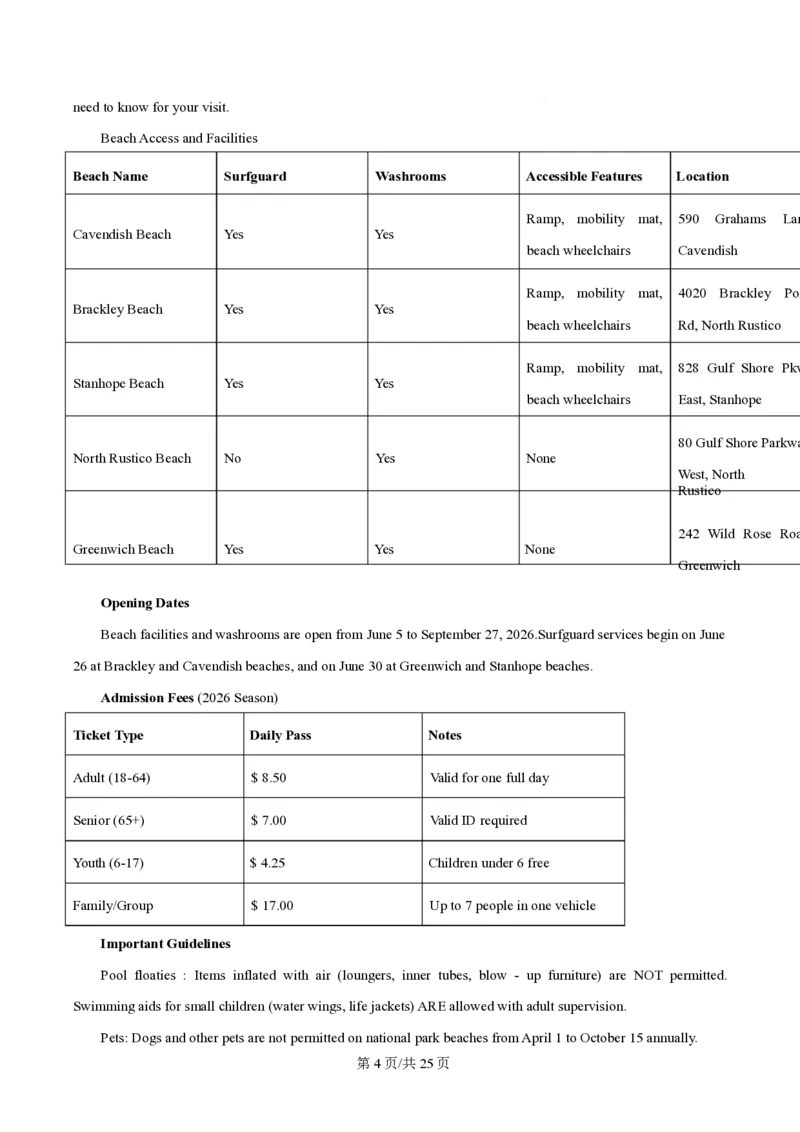
Beach Access and Facilities
Beach Name Surfguard Washrooms Accessible Features Location
Ramp, mobility mat, 590 Grahams Lan
Cavendish Beach Yes Yes
beach wheelchairs Cavendish
Ramp, mobility mat, 4020 Brackley Poi
Brackley Beach Yes Yes
beach wheelchairs Rd, North Rustico
Ramp, mobility mat, 828 Gulf Shore Pkw
Stanhope Beach Yes Yes
beach wheelchairs East, Stanhope
80 Gulf Shore Parkwa
North Rustico Beach No Yes None
West, North
Rustico
242 Wild Rose Roa
Greenwich Beach Yes Yes None
Greenwich
Opening Dates
Beach facilities and washrooms are open from June 5 to September 27, 2026.Surfguard services begin on June
26 at Brackley and Cavendish beaches, and on June 30 at Greenwich and Stanhope beaches.
Admission Fees (2026 Season)
Ticket Type Daily Pass Notes
Adult (18-64) $ 8.50 Valid for one full day
Senior (65+) $ 7.00 Valid ID required
Youth (6-17) $ 4.25 Children under 6 free
Family/Group $ 17.00 Up to 7 people in one vehicle
Important Guidelines
Pool floaties : Items inflated with air (loungers, inner tubes, blow - up furniture) are NOT permitted.
Swimming aids for small children (water wings, life jackets) ARE allowed with adult supervision.
Pets: Dogs and other pets are not permitted on national park beaches from April 1 to October 15 annually.
第 4页/共 25页Water safety: Surf conditions are posted daily by approximately 11 am from July 1 to Labour Day. Check
PEINow app for updates.
Accessibility: Beach wheelchairs and mobility mats are available at most beaches. Reservations recommended.
Beach Activities
The Coastie Initiative: Take photos of the coastal landscape and share on social media with Coastie PEINP to
help track coastal erosion.
Interpretive programs: Educational and cultural activities offered throughout the summer.
Trails: The Gulf Shore Way multi - use trail offers 12km of paved path for cycling and walking.
For more information, visit parks.canada.ca/pci - activities or call 902 - 672 - 6350.
1. How much will a family of two adults (ages: 40 and 42) and three children (ages: 5, 10, and 15) pay for a daily
pass in July 2026?
A. $ 17.00 B. $ 21.25 C. $ 25.50 D. $ 29.75
2. What item is permitted to bring into the water at park beaches?
A. An inflatable lounger for floating
B. An inner tube for relaxation
C. A life jacket for a 4 - year - old child
D. A blow - up furniture piece
3. What can visitors learn from the passage about the park’s facilities?
A. All beaches have surfguard services every day of the summer
B. Beach wheelchairs are available without any advance notice
C. Dogs are allowed on all beaches if kept on a leash
D. Some beaches offer accessibility features like ramps and mobility mats
【答案】1. A 2. C 3. D
B
It was the fifth of September, 2023. The street where I was standing was full of people, most of them on their
way in or out of London’s British Museum. Everything around me cried summer — the tourists wore shorts,
T-shirts, skirts — but the sensation I had was of autumn. It wasn’t the date, it was something about the light,
which had a different fullness, and that created a different space.
I was there to meet Celia Paul. I had been interested in her paintings for a long time, in their distinctive
combination of weightlessness and heaviness. I knew from her autobiography that she also worked there, and that
only people she had explicitly invited were allowed to set foot inside. I had been invited, but even so I had to wipe
the sweat from my palms before pressing the intercom button. A reply came immediately. The kindness in thevoice was apparent even through the small, crackly speaker. There was a buzz, I went in and walked up and Celia
Paul stood waiting in the hallway inside.
When I followed her into the flat, I recognized the floor, worn and dark and made of linoleum, I recognized
the plain, white walls, I recognized the window facing the museum, the light that fell through it. And Paul’s face
was so familiar that it might have belonged to one of my close friends. Then I saw a painting.
The painting seems alive. The chair is not alive, the wall and the floor are not alive. And yet the painting
seems just that, alive. This is, I think, because the painting consists of encounters. It emerges brushstroke by
brushstroke, in a long-drawn-out moment, continually adjusted. The painting is alive in the sense that it arises out
of a process, led and corrected by the artist’s gaze, but also by her ideas, emotions, and expectations, until she
considers the painting finished. We see not the chair in itself, as that is for sitting on, but the moment it represents
not the world, but our connection to the world.
4. What does the author mean by saying “the sensation I had was of autumn” in Paragraph 1?
A. The date was September, so it was already autumn.
B. The light had a special quality that felt like autumn.
C. The weather was cold and windy, typical of autumn.
D. The museum’s white stone walls looked like autumn scenery.
5. We can infer from the text that Celia Paul is ________.
A. an open-minded artist who welcomes visitors
B. a painter who only creates works for strangers
C. a person who values privacy in her life and work
D. a friend of the author who often meets in the flat
6. The underlined word “encounters” in Paragraph 4 most probably means________.
A. formal meetings B. mutual gazes C. creative ideas D. physical touches
7. What is the main idea of the passage?
A. The author’s visit to the British Museum on an autumn day.
B. Celia Paul’s unique painting style and artistic achievements.
C. The special connection between the author and Celia Paul.
D. The author’s experience of meeting Celia Paul and understanding her art.
【答案】4. B 5. C 6. B 7. DC
An AI-powered robot was able to separate a gall bladder (胆 囊 ) from the liver of a dead pig in what
researchers claim is the first realistic surgery by a machine with almost no human intervention.
The robot is powered by a two-tier AI system trained on 17 hours of video containing 16,000 motions
performed by human surgeons during operations. When put to work, the first layer of the AI system watches video,
monitors the surgery and issues plain-language instructions, while the second AI layer turns each instruction into
3D tool motions. In all, the gall bladder surgery requires 17 separate tasks. The robotic system has performed the
operation eight times, achieving 100 percent success in all of the tasks.
“Current surgical robotic technology has made some procedures less invasive, but risks haven’t really dropped
from previous laparoscopic (使用腹腔镜的) surgeries by human surgeons,” says team member Axel Krieger at
Johns Hopkins University in Maryland. “This made us look into what is the next generation of robotic systems that
can help patients and surgeons.” “The study really highlights the art of the possibility with AI and surgical robotics,”
says Danail Stoyanov at University College London. “Incredible advances in computer vision for surgical video
with the availability of open robotic platforms for research make it possible to demonstrate surgical automation.”
But many challenges remain to make the system practical in clinical use. “While the robot completed the task
with 100% success, it had to self-correct six times per case. For example, this could mean a gripper (夹持器)
designed to grasp an artery missed its hold on the first try,” Stoyanov said.
“There were a lot of instances where it had to self-correct, but this was all fully autonomous,” says Krieger. “It
would correctly identify the initial mistake and then fix itself.” The robot also had to ask a human to change one of
its surgical instruments for another, meaning some level of human intervention was required. The next step, says
Krieger, is to let a robot operate autonomously on a live animal, where breathing and bleeding could complicate
things. “But with continued research, we’re confident that we can overcome these obstacles step by step.”
8. What are the two-tier tasks that the AI system is trained to perform?
A. Giving instructions and performing motions. B. Monitoring the surgery and issuing commands.
C. Analyzing video and choosing surgical tools. D. Imitating human surgeons and separating tasks.
9. What breakthrough does the new robot achieve over traditional laparoscopic surgeries?
A. Minimal invasiveness with no danger.
B. Near autonomy with high success rate.
C Low risks in complex surgical tasks.
D Faster self - correction speed in operations.10. What may prove challenging in a robot operation according to the last paragraph?
A. Adapting to real-time variability. B. Identifying surgical mistakes quicker.
C. Reducing human help for crucial tasks. D. Dealing with complicated surgeries.
11. Which of the following title best summarizes the passage?
A. The Robotic Surgery: Cutting Medical Risks
B. The Robotic Surgery: Great Clinical Progress
C. The Robotic Surgery: Simplifying Surgery
D. The Robotic Surgery: Success and Ongoing Issues
【答案】8. A 9. B 10. A 11. D
D
Today GSN has 450 accounts around the UK, with freezers in universities, coffee shops and gyms. And on top
of that, there are online sales of its chicken bites, wraps and ready meals.
When Craig Allen began driving around Manchester 12 years ago selling steam-cooked chicken direct to gyms,
he was laying the foundations for the frozen food brand. The company began with 10 repurposed freezers, which he
branded with the GSN logo. Allen drove to independent gyms in an old supermarket truck to persuade them to host
his freezers, and then provided regular deliveries of steamed chicken. Inspired by early success, he expanded into
ready meals, focusing on “healthy, tasty, easy” cuisine.
Iain Blackburn, a former football teammate of Allen and now operations director, says, “We’ve always been
into exercise and keeping fit. It’s where a lot of the product development comes from.”
Over the years, they’ve faced multiple challenges. Now, they focus on selling direct to customers online and
look at how to improve that side of the business.
Blackburn says, “As a small business you want to have a trustworthy process that can help reassure new
customers. That’s why we have always worked with PayPal.” They saw a huge return on investment, directly
reaching a whole new audience. Part of that success, they say, was down to the confidence instilled in new buyers
by the robustness of their online checkout system.
A year ago, Blackburn decided to move to PayPal’s complete payments solution, so all payments — whether
by cards, Apple Pay or Google Pay — could be managed on one platform. The change has saved GSN so much
time. Allen says, “About two days a week that we used to spend reconciling payments.”
Allen adds, “The customer service claims and cases area is really useful for us, too. While we have 99.2%
success rate for deliveries, that leaves a 0.8% that can get lost or damaged in transit and so on. On those occasions,
PayPal has a fair and unbiased way to interact between yourself and the customer to help reach a resolution.”GSN has big plans for the future. There are even plans to expand internationally.
12. What is the development path of GSN in the article?
A. It started as an online sales platform.
B. It focused on product development.
C. It partnered with other shops to distribute its products.
D. It began with selling food in gyms and grew into an independent brand.
13. According to Blackburn, what’s the significant inspiration for GSN’s product development?
A. The emphasis on exercise and keeping fit.
B. The goal of selling to customers directly.
C. The desire to create a trustworthy payment progress.
D. The challenge of managing payment platforms.
14. How does GSN’s partnership with PayPal reflect its business strategy and values?
A. It shows GSN’s priority for local sales over online ones.
B. It demonstrates GSN’s focus on traditional payment methods.
C. It highlights GSN’s commitment to customer convenience and trust.
D. It indicates GSN’s unwillingness to embrace new payment technologies.
15. Why is the customer service claims and cases area really useful for the business?
A. It ensures 100% successful delivery.
B. It offers a favorable way to cope with delivery problems.
C. It allows the business to track all deliveries in real time.
D. It provides a platform for customers to complain about the service.
【答案】12. D 13. A 14. C 15. B
第二节 (共 5 小题;每小题 2.5 分,满分 12.5 分)
阅读下面短文,从短文后的选项中选出可以填入空白处的最佳选项。选项中有两项为多余选项。
You don’t have to be Leonardo da Vinci or Albert Einstein to think like a genius. There are plenty of ways to
hone your creativity and sharpen your critical thinking skills.
Stimulate Your Brain. Even if a random thought isn’t totally formed, writing it down will help you keep it in
mind instead of just forgetting about it. ____16____ Eventually, it could turn into an inspiration for a work of art,
an invention, or a solution to a problem at work, school, or in your personal life.
Be productive. Nothing worthwhile is achieved by passive consumption. Do something productive related to
the type of genius you want to cultivate every day. If you want to be an exceptional musician, practice yourinstrument as much as possible. If you want to be a great novelist, try to write a story every day. ____17____
Make connections with a broad range of people. ____18____ Inspiration and innovation don’t happen in a
vacuum. Having frequent conversations with friends, family, colleagues, and mentors will expose you to a range of
perspectives and give you more grain for your mill.
____19____ When you’re confronted with an abstract problem or feel like your thoughts are jumbled, use
visual aids to help see the bigger picture. They can help you organize information and spot connections between
concepts that you might not have noticed.
Educate yourself about diverse topics. Learning about a broad range of topics can help you get a bird’s eye
view of how things work. From documentaries to how — to articles, there are plenty of resources at your disposal.
____20____
Thinking like a genius is not about being born brilliant — it is about practicing the right habits every single
day.
A. As you learn about different disciplines, think about how they connect to one another.
B. Visual tools are more useful than traditional ways in dealing with all kinds of problems.
C. The idea that a genius is a solitary, isolated figure is a myth.
D. Given some time, you might think it over and bring it into focus.
E. Only talented people can develop creativity and critical thinking in daily life.
F. As Thomas Edison said, “Genius is one percent inspiration and 99 percent perspiration.”
G. Use diagrams and images to visualize problems.
【答案】16. D 17. F 18. C 19. G 20. A
第三部分 语言运用(共两节,满分 30 分)
第一节 (共 15 小题;每小题 1 分,满分 15 分)
阅读下面短文,从每题所给的 A、B、C、D 四个选项中选出最佳选项。
It was my last class before summer break, and I was finishing up the first year of a Master of Fine Arts (MFA)
program in poetry. Unsure if I deserved a place in the program, I worried I wasn’t as talented as my peers. When
the professor asked about our summer plans, I panicked. I didn’t want to appear ____21____, so without much
thought, I blurted out “gardening”. Surprisingly, my professor nodded and mentioned Emily Dickinson loved
gardening.
Emily Dickinson a great American poet, studied plants as a child. But I was in my late twenties, lived in a
New York apartment and had no gardening ____22____ .A few days later, I was standing in line at a store and spotted some seedlings. I thought I should get something.
At least I could say I had ____23____ gardening. Wait, was that a jalapeno (墨西哥胡椒) ? I picked it up.
Back home, I called an urban farmer friend. He told me that jalapenos aren’t houseplants and need plenty of
sunlight to ____24____. I didn’t have outdoor garden space, but I had a pot, some soil and plenty of ____25____.
Over the summer, the plant grew, not enormous but bigger. I was ____26____. Maybe I didn’t have a black
thumb after all.
I started the second year of my MFA, and then — as sometimes happens in New York — I had
to____27____ out of my apartment. I stayed with my friends for a while, and my jalapeno came with me. By the
time I found my own apartment, it was almost December and my jalapeno was ____28____: many of its leaves had
fallen off. I set it next to a window by the kitchen sink, and hoped for the best.
I continued to work hard in school. Then spring came. My jalapeno plant ____29____ back to life. It grew
bigger, with new leaves. And it flowered when I ____30____my graduate thesis — a book of poems — in May.
I was washing some dishes one day when my professor called. “Your poems are strong,” he said. “You’ve
come very far.” I’d done it! I went back to the dishes, but something was ____31____. The flowers on my jalapeno
were gone. Had I done something wrong? I peered ____32____. Where a flower had been, a tiny green fruit pushed
through.
Looking at that tiny fruit, I realized my journey with the jalapeno had ____33____ my growth as a poet. Both
had started with a small, uncertain step — a casual ____34____ in class, a single seedling bought on a whim (一
时的兴致) . Both had faced setbacks and required patience. And both had ultimately borne____35____, in their
own time and in their own way.
21. A. lazy B. fortunate C. busy D. ambitious
22. A. interest B. time C. experience D. desire
23. A. tried B. avoided C. forgotten D. considered
24. A. survive B. thrive C. arrive D. die
25. A. money B. fear C. doubt D. ambition
26. A. ashamed B. proud C. nervous D. grateful
27. A. look B. come C. move D. walk
28. A. suffering B. growing C. improving D. flowering
29. A. gave B. came C. looked D. turned
30. A. read B. bought C. borrowed D. submitted31. A. right B. off C. normal D. common
32. A. closer B. further C. higher D. faster
33. A. prevented B. reflected C. delayed D. ruined
34. A. lie B. joke C. response D. invitation
35. A. fruit B. flowers C. leaves D. roots
【答案】21. A 22. C 23. A 24. B 25. D 26. B 27. C 28. A 29. B 30. D
31. B 32. A 33. B 34. C 35. A
非选择题部分
第二节 (共 10 小题;每小题 1.5 分,满分 15 分)
阅读下面短文,在空白处填入 1 个适当的单词或括号内单词的正确形式。
In a study, the researchers found the decline was reduced by about 15%-20% among those who either
volunteered formally or helped in informal ways, such as supporting neighbors, family, or friends. The____36____
(strong) and most consistent benefit appeared when people spent about two to four hours per week helping others.
“Everyday acts of support — whether organized or personal — can have lasting cognitive (认知的) impact,”
said Sae Hwang Han, an assistant professor ____37____led the study. “What stood out to me was that the cognitive
benefits of helping others weren’t just short-term improvements but cumulative (积累的) over time with sustained
engagement, and these benefits were evident for both formal volunteering and informal helping. Moderate
engagement of just two to four hours was ____38____ (consistent) linked to benefits.”
To study these patterns over time, the researchers analyzed data from the national Health and Retirement
Study. The dataset includes____39____representative sample of U.S. residents over age 51, with information
____40____ (date) back to 1998. The researchers accounted for other factors that can shape both helping
____41____ (behave) and cognitive health, wealth, physical and mental health, and education. Even after
considering those influences, cognitive decline tended to slow when people started helping others and continued to
do so.
The researchers argue these results strengthen the case for thinking about volunteering, helping, and
neighborhood connection as public health issues. This may be especially important later in life, when conditions
tied to cognitive decline and harm ____42____ (be) more likely to develop.
____43____ (take) together, these findings suggest helping others may support brain health in more than one
way. As societies age and concerns about loneliness grow, the results also support continued efforts to keep people
involved in ways that let them contribute, even after cognitive decline has begun. “Many older adults in a low state
of health often continue to make valuable contributions to____44____ around them,” Han said, “and they mayespecially benefit from providing with opportunities_____45_____ (help) .”
【答案】36. strongest
37. who##that
38. consistently
39. a 40. dating
41. behavior## behaviors##behaviour## behaviours
42. are 43. Taken
44. those 45. to help
第四部分 写作(共两节,满分 40 分)
第一节(满分 15 分)
46. 你在校英语学习论坛上看到一则关于“更喜欢云旅游(Online Travel)还是传统旅游”的英文讨论帖。
请写一篇短文跟帖,内容包括:
(1)你的看法;
(2)你的理由。
注意:
(1)写作词数应为 80 个左右;
(2)请按如下格式在答题卡的相应位置作答。
____________________________________________________________________________________________
____________________________________________________________________________________________
____________________________________________________________________________________________
____________________________________________________________________________________________
____________________________________________________________________________________________
【答案】
Recently, online travel has become a growing trend thanks to the developments in science and technology.
However, I prefer to travel in traditional ways for several reasons.
Firstly, traditional travel allows me to truly engage with the local culture by interacting with the locals and
tasting authentic food. These are experiences that a screen cannot fully provide. Secondly, the personal growth
gained from overcoming travel challenges and exploring new environments is irreplaceable. Finally, face-to-face
experiences enable a deeper understanding of the world while online travel focuses mostly on scenic spots.
In conclusion, while online travel offers convenience, the richness of real-world exploration makes traditional
travel uniquely valuable.第二节(满分 25 分)
47. 阅读下面材料,根据其内容和所给段落开头语续写两段,使之构成一篇完整的短文。
Mary was the art teacher for primary school students. On this particular day, she was guiding them through the
process of drawing a scenic landscape. Akila yawned(打哈欠), clearly disinterested - drawing wasn’t her thing. A
small group of students gathered around Tina, laughing at her unusual drawing: a sun sporting sunglasses and trees
topped with ice cream cones.
Mary instructed Tina firmly but with unease, “Draw it the way I showed you.” As the lesson continued, doubt
crept into Mary’s mind. Had the joy of creativity been overshadowed by the pressure to fit in? She scanned the
room, observing her students’ faces – some concentrated, others uncertain. Akila’s disinterest was clear and Tina’s
imaginative drawing had been met with ridicule instead of praise.
After class, Mary sat down with Tina, her tone softening, “Why did you draw the sun with sunglasses and the
trees with ice creams?” she asked gently.
Tina’s eyes sparkled with a touch of rebellion (叛逆)-“I love ice cream, and I thought the sun would look cool
with sunglasses. Why do we always have to draw like everyone else?”
Mary paused, her thoughts racing. Tina’s drawings weren’t just curious —they were a window into a world
where imagination ruled, where rales could be bent into delightful chaos. Was she, by enforcing a rigid style, killing
that very creativity?
The next morning, Mary walked into the classroom with a renewed sense of purpose. She placed a large sheet
of paper in front of the class and announced a new project: they would create a collective(集体的)artwork titled
“Our Dream World” with no rules. They were free to use colors, shapes, and patterns however they wished.
At first, the students hesitated, unsure of this newfound freedom. Akila leaned back, skeptical of what seemed
like another pointless exercise. But Tina, her creativity no longer restricted, eagerly grabbed her crayons and began
to draw with abandon. Then, Maya joined in. And then Michael...
注意:
1.所续写短文的词数应为 150 左右;
2.请按如下格式在答题卡的相应位置作答。
As the students worked, Mary observed them with curiosity.
____________________________________________________________________________________________
____________________________________________________________________________________________
____________________________________________________________________________________________
_________________________________________________________________________________________________________________________________________________________________________
Mary stood back and surveyed the creation.
____________________________________________________________________________________________
____________________________________________________________________________________________
____________________________________________________________________________________________
____________________________________________________________________________________________
_____________________________________________________________________________
【答案】Paragraph 1: As the students worked. Mary observed them with curiosity. She noticed how Akila, initially
disinterested, had quietly chosen vibrant colors and was now blending them together to create a swirling sky filled
with fantastical creatures that flew over a stone castle. Meanwhile, Tina was enthusiastically adding playful details
to her section of the paper-a whimsical garden where flowers wore hats and creatures rested on the ice
cream-topped trees. Mary felt a wave of relief washed over her. The room was alive with chatter and laughter, as
Akila and Tina frequently exchanged ideas and inspired one another. Akila even leaned over to admire Tina’s ice
cream trees and said, “That is mind-blowing!” It was wonderful to see them cooperate, their initial differences
melting away in the warmth of shared creativity.
Paragraph 2: Mary stood back and surveyed the creation. The enomious canvas had transformed into a magnificent
portrayal of each student’s imagination, forming a breathtaking landscape that reflected their individuality yet
spoke to their collective spirit. Mary felt a sense of pride swell within her; she realized that in letting go of rigid
structures, her students gave their painting an unrealistic but dream-like quality. Akila, Tina, and the rest of the
class had not only embraced their own creative paths but had also nurtured each other’s ideas. They were thrilled,
“It was the best painting ever! We should definitely hang it on the wall!” Inspired by the moment, Mary decided to
host an exhibition of their dream world, inviting parents and other classes to admire the beauty of imagination
unleashed in her classroom.