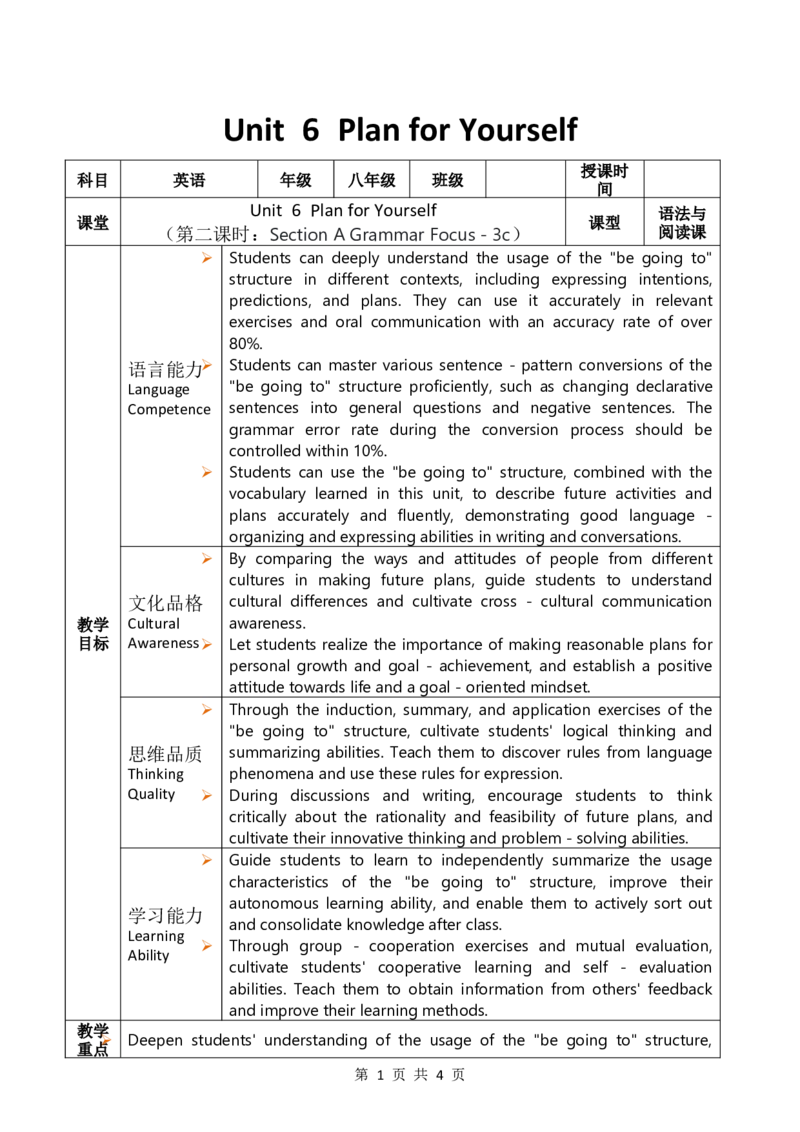
Unit 6 Plan for Yourself
授课时
科目 英语 年级 八年级 班级
间
Unit 6 Plan for Yourself 语法与
课堂 课型
(第二课时:Section A Grammar Focus - 3c) 阅读课
Students can deeply understand the usage of the "be going to"
structure in different contexts, including expressing intentions,
predictions, and plans. They can use it accurately in relevant
exercises and oral communication with an accuracy rate of over
80%.
语言能力 Students can master various sentence - pattern conversions of the
Language "be going to" structure proficiently, such as changing declarative
Competence sentences into general questions and negative sentences. The
grammar error rate during the conversion process should be
controlled within 10%.
Students can use the "be going to" structure, combined with the
vocabulary learned in this unit, to describe future activities and
plans accurately and fluently, demonstrating good language -
organizing and expressing abilities in writing and conversations.
By comparing the ways and attitudes of people from different
cultures in making future plans, guide students to understand
文化品格 cultural differences and cultivate cross - cultural communication
教学 Cultural awareness.
目标 Awareness Let students realize the importance of making reasonable plans for
personal growth and goal - achievement, and establish a positive
attitude towards life and a goal - oriented mindset.
Through the induction, summary, and application exercises of the
"be going to" structure, cultivate students' logical thinking and
思维品质 summarizing abilities. Teach them to discover rules from language
Thinking phenomena and use these rules for expression.
Quality During discussions and writing, encourage students to think
critically about the rationality and feasibility of future plans, and
cultivate their innovative thinking and problem - solving abilities.
Guide students to learn to independently summarize the usage
characteristics of the "be going to" structure, improve their
autonomous learning ability, and enable them to actively sort out
学习能力
and consolidate knowledge after class.
Learning
Through group - cooperation exercises and mutual evaluation,
Ability
cultivate students' cooperative learning and self - evaluation
abilities. Teach them to obtain information from others' feedback
and improve their learning methods.
教学
Deepen students' understanding of the usage of the "be going to" structure,
重点
第 1 页 共 4 页especially its accurate application in different situations.
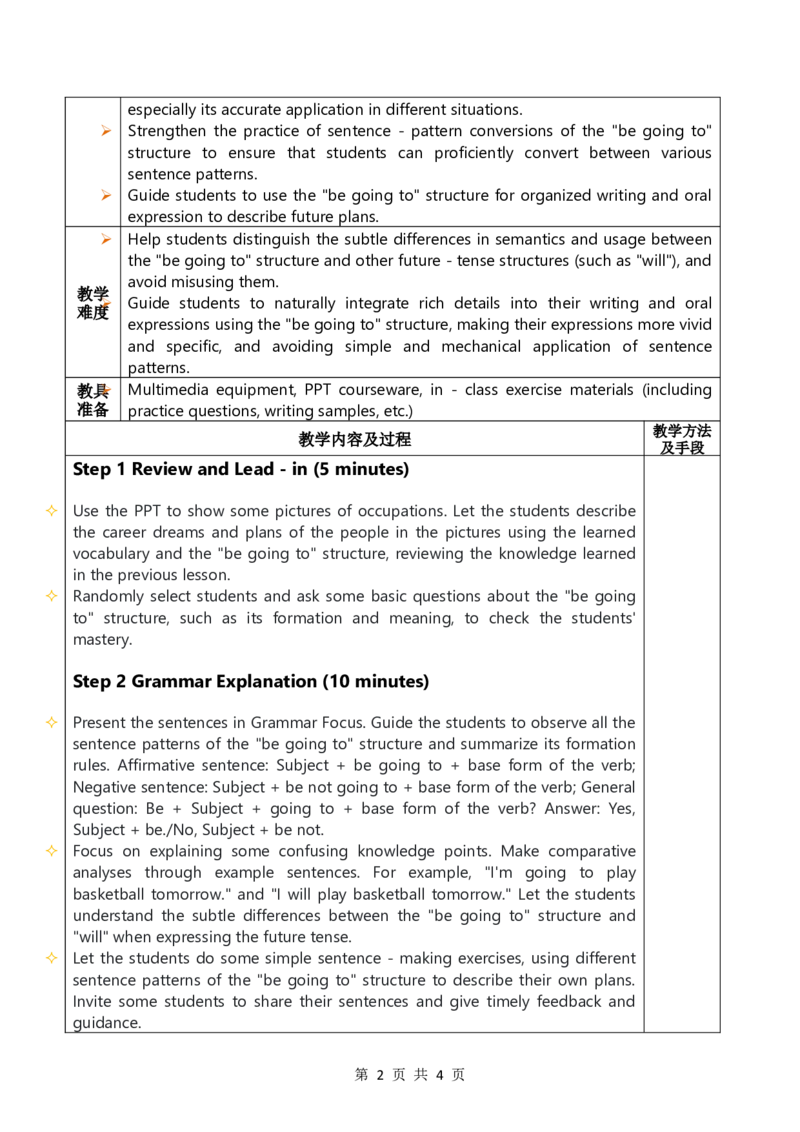
Strengthen the practice of sentence - pattern conversions of the "be going to"
structure to ensure that students can proficiently convert between various
sentence patterns.
Guide students to use the "be going to" structure for organized writing and oral
expression to describe future plans.
Help students distinguish the subtle differences in semantics and usage between
the "be going to" structure and other future - tense structures (such as "will"), and
avoid misusing them.
教学
Guide students to naturally integrate rich details into their writing and oral
难度
expressions using the "be going to" structure, making their expressions more vivid
and specific, and avoiding simple and mechanical application of sentence
patterns.
教具 Multimedia equipment, PPT courseware, in - class exercise materials (including
准备 practice questions, writing samples, etc.)
教学方法
教学内容及过程
及手段
Step 1 Review and Lead - in (5 minutes)
Use the PPT to show some pictures of occupations. Let the students describe
the career dreams and plans of the people in the pictures using the learned
vocabulary and the "be going to" structure, reviewing the knowledge learned
in the previous lesson.
Randomly select students and ask some basic questions about the "be going
to" structure, such as its formation and meaning, to check the students'
mastery.
Step 2 Grammar Explanation (10 minutes)
Present the sentences in Grammar Focus. Guide the students to observe all the
sentence patterns of the "be going to" structure and summarize its formation
rules. Affirmative sentence: Subject + be going to + base form of the verb;
Negative sentence: Subject + be not going to + base form of the verb; General
question: Be + Subject + going to + base form of the verb? Answer: Yes,
Subject + be./No, Subject + be not.
Focus on explaining some confusing knowledge points. Make comparative
analyses through example sentences. For example, "I'm going to play
basketball tomorrow." and "I will play basketball tomorrow." Let the students
understand the subtle differences between the "be going to" structure and
"will" when expressing the future tense.
Let the students do some simple sentence - making exercises, using different
sentence patterns of the "be going to" structure to describe their own plans.
Invite some students to share their sentences and give timely feedback and
guidance.
第 2 页 共 4 页Step 3 Practice Exercises (15 minutes)
Let the students complete the exercise in 3b of the textbook, matching the
situations with the corresponding plans. The teacher walks around to correct
the students' mistakes in time. After that, invite the students to share their
answers and explain. For common problems among students, conduct
centralized explanations and intensive exercises.
Show some short passages about future plans. Let the students read and find
the sentences with the "be going to" structure, analyze their usages and the
meanings expressed. Then, let the students answer questions according to the
passage content to cultivate their reading - comprehension ability.
Carry out a group - competition activity. The teacher gives some scenarios
describing future plans, and each group is required to make sentences with the
"be going to" structure within a specified time. See which group can make the
most and most accurate sentences. Through the competition, stimulate the
students' learning enthusiasm and competitive awareness.
Step 4 Writing Practice (10 minutes)
Writing Guidance: Based on the content learned in this lesson, guide the
students to do a writing practice. Give the writing topic, such as "My Weekend
Plan", help the students sort out their writing ideas, and list the writing points.
For example, the things you plan to do on the weekend, the specific time
arrangement, etc. Encourage students to use the "be going to" structure to
enhance the expressive effect.
Students' Writing: Let the students write according to the points they listed.
Require them to use the learned vocabulary, sentence patterns, and grammar
knowledge, and try to make the sentences smooth and the expression clear.
The teacher walks around to observe the students' writing and gives timely
guidance and help. Encourage the students to express their ideas boldly.
Presentation and Evaluation: Invite some students to share their
compositions. The other students listen carefully and give evaluations, putting
forward suggestions from aspects such as content integrity, language accuracy,
grammatical correctness, and the use of the "be going to" structure. The
teacher finally summarizes and evaluates, affirms the students' advantages,
points out the existing problems, and gives directions for improvement.
Complete the unfinished part of 3c in the textbook. According to your actual
situation, use the "be going to" structure to describe in detail the aspects you
want to improve in the future and your specific plans, with no less than 80 words.
布置
Make an English poster about "My Future Plan". Require the use of the "be going
作业
to" structure and make it illustrated. The content can include career plans, study
plans, life goals, etc. Share it in the next class.
Review the usage of the "be going to" structure learned in this lesson, preview the
第 3 页 共 4 页content of Section B, try to find the sentences with the "be going to" structure in
it, and analyze their usages.
1. The "be going to" Structure:
Affirmative sentence: Subject + be going to + base form of the verb
Negative sentence: Subject + be not going to + base form of the verb
General question: Be + Subject + going to + base form of the verb?
Answer: Yes, Subject + be./No, Subject + be not.
板书
2. Practice Examples:
设计
I'm going to visit my grandparents this weekend.
Are you going to have a party? Yes, I am.
3. Writing Points:
Describe the things you plan to do on the weekend.
Explain the specific time arrangement.
Use the "be going to" structure.
第 4 页 共 4 页