Unit 9 I like music that I can dance to.
Section B 2a-2e 教学设计
Class Type
Reading
Key words & phrases:sadness, moving, pity, pain, sense, master, praise,
painful
Key sentences:
Objectives 1. The piece which was played on the erhu especially moved me.
2. It was one of the most moving pieces of music that I’ve ever heard.
Difficulties and points:
运用nothing supporting details的阅读策略解读文本。
Key
1. The piece which was played on the erhu especially moved me.
structure
2. It was one of the most moving pieces of music that I’ve ever heard.
Difficulties 运用nothing supporting details的阅读策略解读文本。
Vocabulary
sadness, moving, pity, pain, sense, master, praise, painful
Period 4
Procedure
Let students watch a video, how many Chinese instruments do you
Lead-in
know?
Presentation: Students listen to different sounds carefully, and guess
what kind of Chinese instruments they are. While showing them
answers, present pictures of these instruments.
Activity 2a: How many Chinese musical instruments do you know about? Do you know
any famous pieces of music that are played on these instruments? Make a list with your
partner.
The famous songs played by Dizi 梁祝之化蝶、梦里水乡、分飞燕
故乡原风景、春江花月夜、枣园春
色、大悲咒、······
The famous songs played by Sheng 微山湖船歌、苗族歌曲、马蹄声、
笙 婚誓、芦笙恋歌
Ten famous songs played by Guqin 广陵散、高山流水、平沙落雁、酒
狂、关山月、潇湘水云
The famous songs played by Pipa 塞上曲 、夕阳箫鼓 、十面埋伏、
霸王卸甲、大浪淘沙 、昭君出塞
、阳春白雪
Songs played by Bianzhong 竹枝词(编钟与编磬) 、春江花
月夜(古乐合奏) 、屈原问渡
(古乐合奏) 、楚殇(古乐合
奏)
Famous songs played by Erhu 二泉映月、红梅随想、江南春色、望星空、江河水
Activity 2b: Listen to the passage and answer the questions.
1) Which musician does the passage mainly talk about?
2) What is the name of his most famous piece of music?
3) How does the writer feel about this piece of music?
NOTING SUPPORTING DETAILS
Supporting details can be examples, reasons, opinions or other detailed
information in each paragraph.
阅读指导:
尝试使用阅读的策略帮助学生养成好习惯,培养自主学习,大胆尝试良
好的阅读氛围。通读全文,先找出或总结出每段的主题大意。阅读策
略:在阅读中注意具体的细节。具体的细节可能是举出的例子,涉及的
原因,表达的观点或每段文章中的其他详细信息。
Look through and match each paragraph with its main idea.
Para.1 a. Abing's amazing musical skills
Step 1
Para.2 b. feelings about Abing's music
Para.3 c. Abing's hard life
Para.1. Fill in the blanks.
The writer's feelings about Erquan Yingyue:
1.The music was strangely beautiful, but under the beauty I____________.
2.It was _________________________ of music that I have ever heard.
3.The Erhu sounded ____________ I almost cried along with it as I listened.
4.I was _______ by the piece of music named Erquan Yingyue.
Para.2 Abing's hard life
In 1893 ,Abing was____ ___ ____. When he was very young, his
mother ______.
By age 17,Abing was known for his After his father died,Abing's life
musical ________. ____ ______.
For several years,he had___ ____ After Abing got married, he____
and lived ______ _____ and played ____ ____ again and continued to
music to ____ ______. ___ and ____on the streets.
Para.3 Abing's amazing musical skills
Read carefully and correct these sentences.
1. By the end of his life,he could play less 600 pieces of music.
2. It is a pity that only sixteen pieces of music in total were recorded for the
future world to hear.
3. Today, Erquan Yingyue has become one of China's popular treasures.
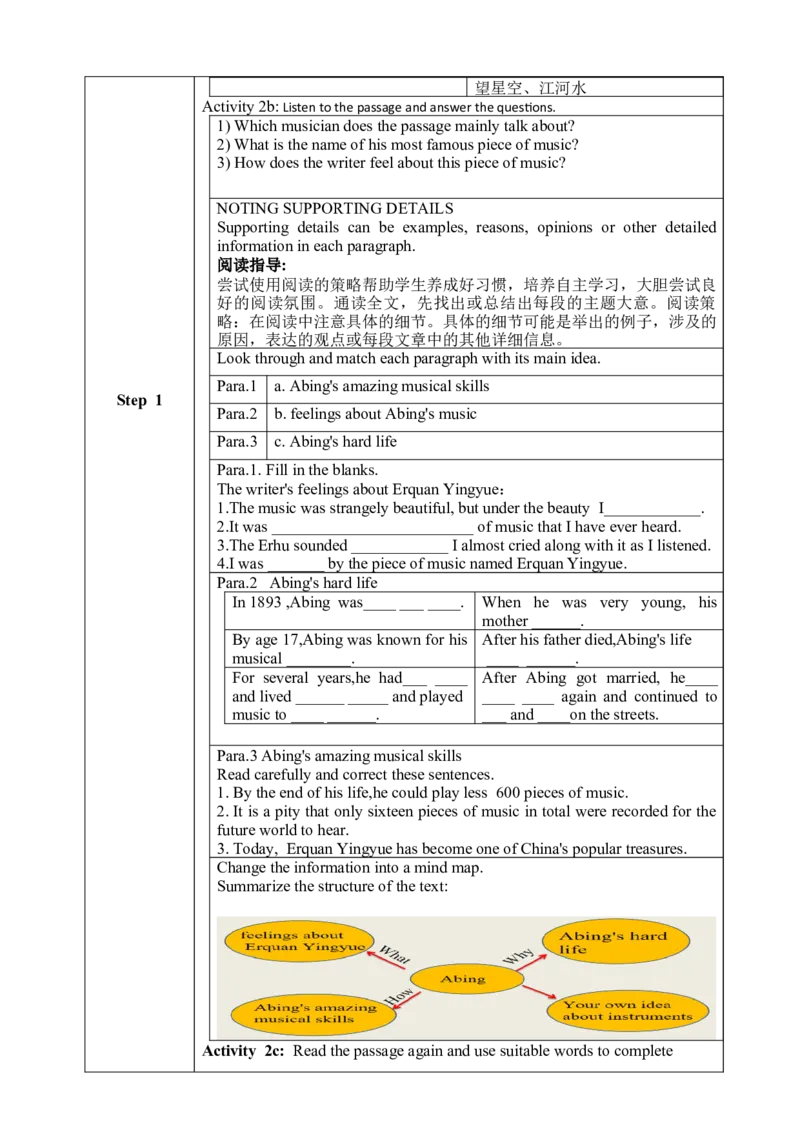
Change the information into a mind map.
Summarize the structure of the text:
Activity 2c: Read the passage again and use suitable words to completethe main idea of each paragraph. Then list the supporting details in each
paragraph.
Paragraph Main idea
1 I was _______ by a piece of music named Erquan Yingyue.
2 Abing lived a very ______ life.
3 Abing’s musical skills made him very __________.
Paragraph Supporting details
作者听到二泉映月时被深深感动。支持这个观点的具体细
节:
The music was strangely beautiful but under the beauty I
1 sensed a strong sadness and pain.
It was one of the most moving pieces of music that I’ve ever
heard.
I almost cried along with it as I listened.
阿炳早期过着贫穷的生活。支持这个观点的具体细节:
His mother died when he was very young.
His father died when he was a teenager.
2
He was poor and homeless.
He developed an illness and became blind.
He lived on the streets and played music to make money.
阿炳的音乐才能使他成为很受欢迎的人。
支持这个观点的具体细节:
He could play over 600 pieces, and he wrote many of them
himself.
3
His most famous piece is still played and praised by erhu
master today.
Erquan Yingyue has become one of China’s national
treasures.
Activity 2d: Circle that or who and fill in the blanks with the words in the box.
指导:
1) 在定语从句中,如果先行词是物,关系代词可选用 that, 如果先行词
是人, 关系代词可选用who/that。
2) Try to guess the meaning of these words in the box.
Abing played music (that/who) could touch the hearts of people.
pain When we listen to his music, we can ______ both the beauty and
wounds the sadness in it. It makes us think about the _____ and ______
sense (that/who) we have experienced in the past. For this reason, many
pity people _____ him as the musician (that/who) has greatly
praise influenced erhu music. So it is really a ______ that not many
pieces of his music were recorded.
Activity 2e: Student A is a foreign visitor who is interested in Abing and his
music. Student B is a Chinese student who knows about Abing. Use the
information in the passage to make a conversation.
A: What kind of musical instruments did Abing play?
B: He could play many instruments, but he is best known for playing
the erhu.Summary:
1. …I sensed a strong sadness and pain.
1) sense v. 感觉到, 意识到
e.g. I can sense the____________________________ of his songs.
我能感觉到他歌曲里的快乐和悲伤。
sense n. 意识,感觉
e.g. People have five_______, sight, hearing, smell, taste, and touch.
人有五种感觉:视觉,听觉,嗅觉,味觉和触觉。
2) sadness n. 悲哀
e.g. Don't give yourself up to sadness, I believe you can do it!
不要太悲伤,我相信你能做到!
-ness是个名词后缀,一些形容词后加 -ness可变成名词。
e.g. happy—happiness幸福 kind—kindness善良
*sad adj. 悲伤的,忧愁的
e.g. The old woman__________________ alone.
这位老太太独自过着悲伤的生活。
3) pain n. 疼痛,努力
e.g. I have pains in the stomach. 我肚子痛。
painful adj. 痛苦的;疼痛的;令人不快的
e.g. The man had a_________ life experience when he was a small
boy.(pain)
这个人小时候有一段痛苦的生活经历。
Step 2 2. The piece had a simple name, Erquan Yingyue (Moon Reflected on
Second Spring),…
piece表示音乐作品,相当于汉语的“一首歌;一支乐曲”等。“一
首曲子” a piece of music , “几首曲子” some pieces of music
e.g. When he was a small boy, he could play these difficult pieces
of music.
当他还是个小孩子,就会演奏这几首颇有难度的乐曲。
3. Later I looked up the history of Erquan Yingyue…
look up (在字典,参考书中,通过电脑)查阅,抬头看
e.g. She oftens___________________ while she is reading.
阅读碰到生词时,她经常在词典中查阅。
You can_______________ in that dictionary if you don’t know
these new words.
如果遇到生词,你可以查在那本词典里看一下。
5. It is a pity that only six pieces of music in total were recorded for
the future world to hear, but his popularity continues to this day.
1) pity n. 遗憾,怜悯
e.g. It’s a pity that you missed the beginning of the movie.
很遗憾你错过了电影的开头。
— Jim failed the math test yesterday again.
—___________.
A. That’ good B. Thank you
C. Don’t tell me D. What a pity2) in total 总共;合计
e.g. There are over 100 people in total in the conference now.
现在共计有百余人参加了这个会议。
total adj. 总的,全体的
e.g. What is the total number of students in your shcool?
你们学校的学生总数为多少?
Exercises:
用“who”或“that”填空。
1. The man ________ is talking with my mother is from China.
2. That book is the one ______ I wanted to buy for a long time.
3. I know the man ________ works in a big company.
4. I can’t find the house ______ you told me on the phone.
5. Is there a zoo _____ we can see pandas?
同义句改写。
1. I like music. The music is written by Jackie.
I like music _____ _____ ______by Jackie.
2. What do you think of the musician?
______ ______ _____ _____ the musician?
3. I like friendly children.
I like children _____ _____ ________.
Homework:
Step 3 完成课后跟踪练习。