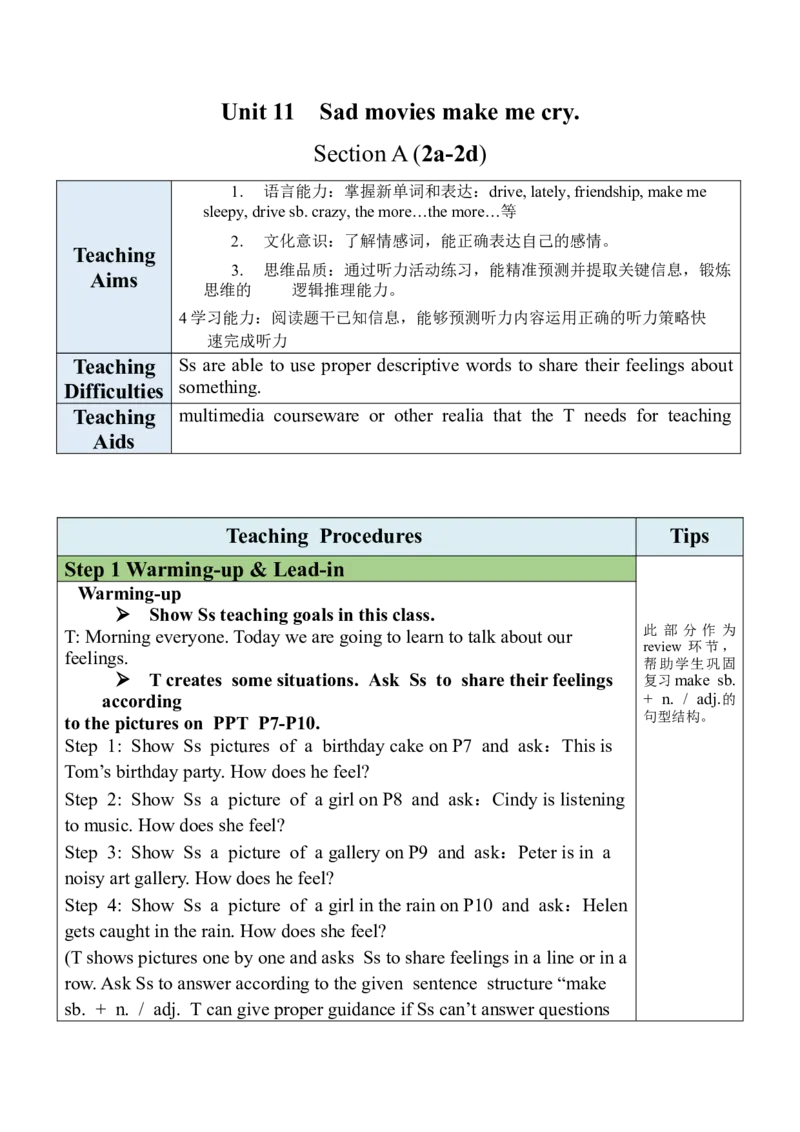
文档文本内容
Unit 11 Sad movies make me cry.
Section A (2a-2d)
1. 语言能力:掌握新单词和表达:drive, lately, friendship, make me
sleepy, drive sb. crazy, the more…the more…等
2. 文化意识:了解情感词,能正确表达自己的感情。
Teaching
3. 思维品质:通过听力活动练习,能精准预测并提取关键信息,锻炼
Aims
思维的 逻辑推理能力。
4学习能力:阅读题干已知信息,能够预测听力内容运用正确的听力策略快
速完成听力
Teaching Ss are able to use proper descriptive words to share their feelings about
Difficulties something.
Teaching multimedia courseware or other realia that the T needs for teaching
Aids
Teaching Procedures Tips
Step 1 Warming-up & Lead-in
Warming-up
Show Ss teaching goals in this class.
此 部 分 作 为
T: Morning everyone. Today we are going to learn to talk about our
review 环节,
feelings.
帮助学生巩固
T creates some situations. Ask Ss to share their feelings 复习make sb.
according + n. / adj.的
to the pictures on PPT P7-P10.
句型结构。
Step 1: Show Ss pictures of a birthday cake on P7 and ask:This is
Tom’s birthday party. How does he feel?
Step 2: Show Ss a picture of a girl on P8 and ask:Cindy is listening
to music. How does she feel?
Step 3: Show Ss a picture of a gallery on P9 and ask:Peter is in a
noisy art gallery. How does he feel?
Step 4: Show Ss a picture of a girl in the rain on P10 and ask:Helen
gets caught in the rain. How does she feel?
(T shows pictures one by one and asks Ss to share feelings in a line or in a
row. Ask Ss to answer according to the given sentence structure “make
sb. + n. / adj. T can give proper guidance if Ss can’t answer questionscorrectly. Lead Ss to review the sentence structure “make sb. + n. /
adj.” at the end of P10)
通 过 创 设 情
景,让学生在
Lead-in 真实场景中练
习 make 句
Ask Ss to imagine the three situations on P11 and share
型。
their feelings.
Step 1: Ask Ss to think of the situation: You are waiting for someone for
a long time, but your friend still don’t show up. How do you feel?
Step 2: Ask Ss to think of the situation: You are listening to loud music.
How do you feel?
Step 3: Ask Ss to think of the situation: You are watching sad movies.
How do you feel?
(Ss think for a minute and share their feelings voluntarily. T gives
comments according to their answers.)
Step 2 While-listening
While-listening
2a-2b
Ask Ss to listen to the tape and finish the listening tasks.
While-reading
Step 1: Ask Ss to listen and finish 2a.
部分的听力部
分对于学困生
T: Amy and Tina have a date today. What happened during the day? Now
来说可能成为
let’s listen to the tape and number the pictures in order. 障碍。通过反
复
(T asks one S to share the answer, and ask another S to talk about what
听读,让学生
they did on that day.) 更加精准的了
解到材料的具
Answers: 3, 2, 4, 1
体内容。并通
Step 2: Ask Ss to listen and finish 2b.
过让学生角色
扮演,从而对
T: Now, let’s come to know more about their day. Listen again and 文本有了更深
刻的了解,并
complete the statements in 2b.
且让学生通过
(T asks Ss to share the answers one by one. T can walk around when Ss 口语输出充分
了解句式。
are listening to the tape. Then T can ask Ss to listen for the second time if
the material is difficult.)
Answers: 1. crazy 2. stay 3. dance 4. cry 5. leave
Step 3: Ask Ss to listen again and answer questions on P14.
T: Listen again and answer questions. When you are listening, please pay
attention to the pronunciation.
Answers: 1. B 2. B 3. C
T asks Ss to listen and read after the tape.
(T shows the listening script to Ss. T highlights some sentences whichare difficult to understand.)
Post-listening
2c
Ask Ss to role-play a conversation between Tina and
John. Use the given example to begin your conversation.
Step 1: T shows Ss the conversation between Tina and John. Then
asks them to pay attention to the key sentence structure.
Step2: T asks Ss to role-play the conversation in pairs.
T: Now let’s look at the conversation and read it carefully. Here are
four sentences that you need to pay attention to: No.1 It made me a
little impatient. No.2 It made us very satisfied and happy. No.3 It made
us cry! No.4 Sad movies always make people cry. Now it is your time
to role-play. Work with your partner in pairs. One will be John, and
the other will be Tina.
(When Ss are practicing, T can walk around and give guidance to
them to make sure they can use correct sentence patterns to make a
conversation.)
2d
Ask Ss to listen and read the conversation in 2d and
finish the tasks.
Step1: Ask Ss to listen to the conversation in 2d and underline
Nancy’s problem.
Step2: Ask Ss to read by themselves and find out the cause of
Nancy’s problem.
Step3:Ask Ss to read the conversation and answer three questions.
T: Well, Nancy has a problem, so she asks Bert for help. Now let’s
listen to the conversation in 2d to see what is Nancy’s problem.
Let’s read the conversation together to find out Bert’s advice. Let’s
come to know more details. Now read again and answer the
following questions.
(T can use a mind map to help Ss to understand the conversation
clearly. T can also write down Nancy’s problem and Bert’s advice
to help Ss get familiar with the conversation.)Step 3 Language points learning
Drive的含义和用法 本部分
language points
drive 作及物动词,在此处意为“迫使”,其过去式和过去分词分别
环节中的每个
为 drove 和 driven。常用搭配:drive sb. crazy/mad 使某人发疯/发 知识点进行了
造句,在真实
狂;
语境中,让学
drive sb. to do sth. 迫使某人做某事;rive作动词时,还可意为“驾
生对这些知识
驶,开车;驱赶”。 点进行了充分
练习。
the more... , the more... 句式的含义和用法
the more... , the more...越......越......;愈……愈…….... 属于“the + 比
较级,the + 比较级”结构。前一部分表示条件,后一部分表示结
果。
have... in common句式的含义和用法
have... in common 有......共同之处;have a lot/much in common 有很多
共同之处;
have little/nothing in common几乎没有/没有共同之处。
leave out 的含义和用法
leave out意为“忽略;不提及;不包括”;be/feel left out意为“被遗
忘;被忽略”。
friendship的含义和用法
friendship n. 友谊;友情 friendship 作名词,由“friend + -ship (名
词后缀)”构成。【拓展延伸】名词后缀-ship通常表示“状态;性质;
地位;资格;职位”等,常见的以其结尾的词还有:hardship 艰苦,
艰难;citizenship 公民资格;
professorship 教授职位; membership 会员资格
Step 4 Exercises & Homework Exercises的任
务是对本节课
重点知识点的
Exercises
总结与回顾,
Ask Ss to do the exercises on PPT P29. 如果老师也可
T ask Ss to make a summary about language points they 以根据学生情
况适当增加练
learned today.
习量。
Homework
Preview the passage on Page 83.
Preview the new words and phrases. Do the exercises in students’ book.
In this lesson, Ss have listened to the tape for many times, so they
can read the conversation correctly and understand the dialogue well.
Teaching Ss also have enough time to speak more, which means they have
Reflection enough time to practice. More exercise should be given to Ss because
there are many key language points for Ss to master, which is also
difficult to understand.