Unit 13 We’re trying to save the earth!
Section A(1a-1c)
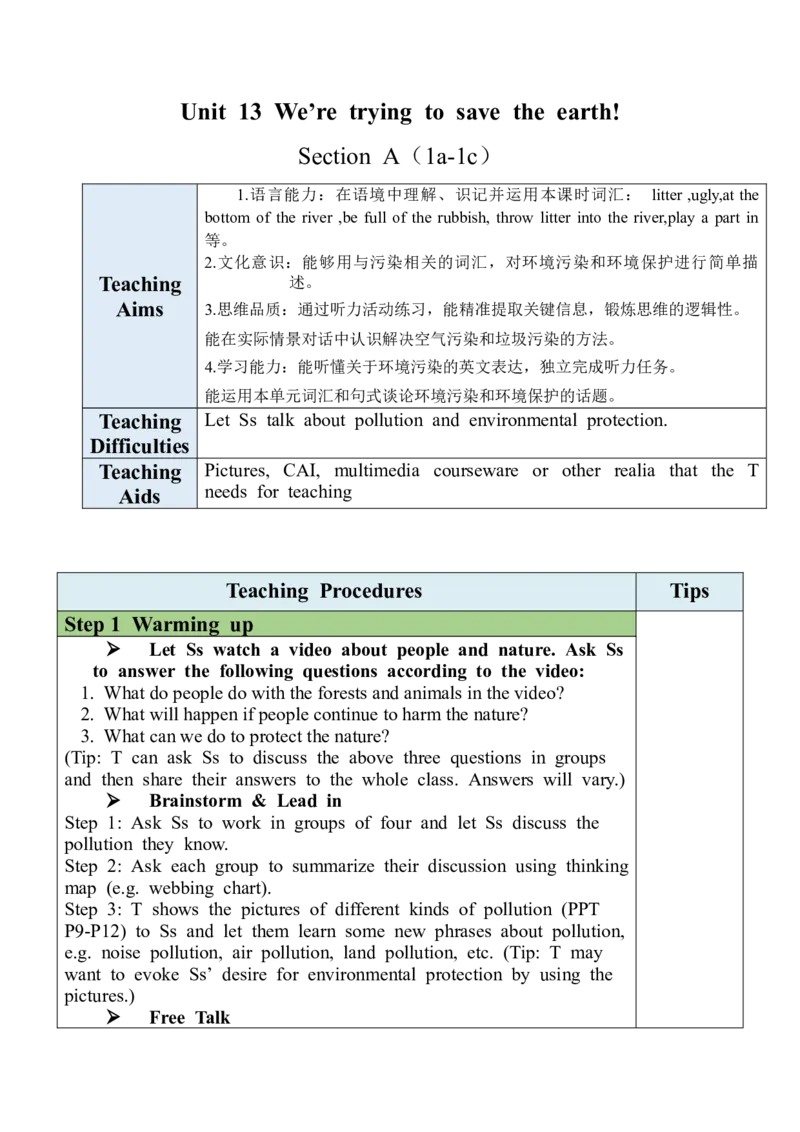
1.语言能力:在语境中理解、识记并运用本课时词汇: litter ,ugly,at the
bottom of the river ,be full of the rubbish, throw litter into the river,play a part in
等。
2.文化意识:能够用与污染相关的词汇,对环境污染和环境保护进行简单描
Teaching 述。
Aims 3.思维品质:通过听力活动练习,能精准提取关键信息,锻炼思维的逻辑性。
能在实际情景对话中认识解决空气污染和垃圾污染的方法。
4.学习能力:能听懂关于环境污染的英文表达,独立完成听力任务。
能运用本单元词汇和句式谈论环境污染和环境保护的话题。
Teaching Let Ss talk about pollution and environmental protection.
Difficulties
Teaching Pictures, CAI, multimedia courseware or other realia that the T
Aids needs for teaching
Teaching Procedures Tips
Step 1 Warming up
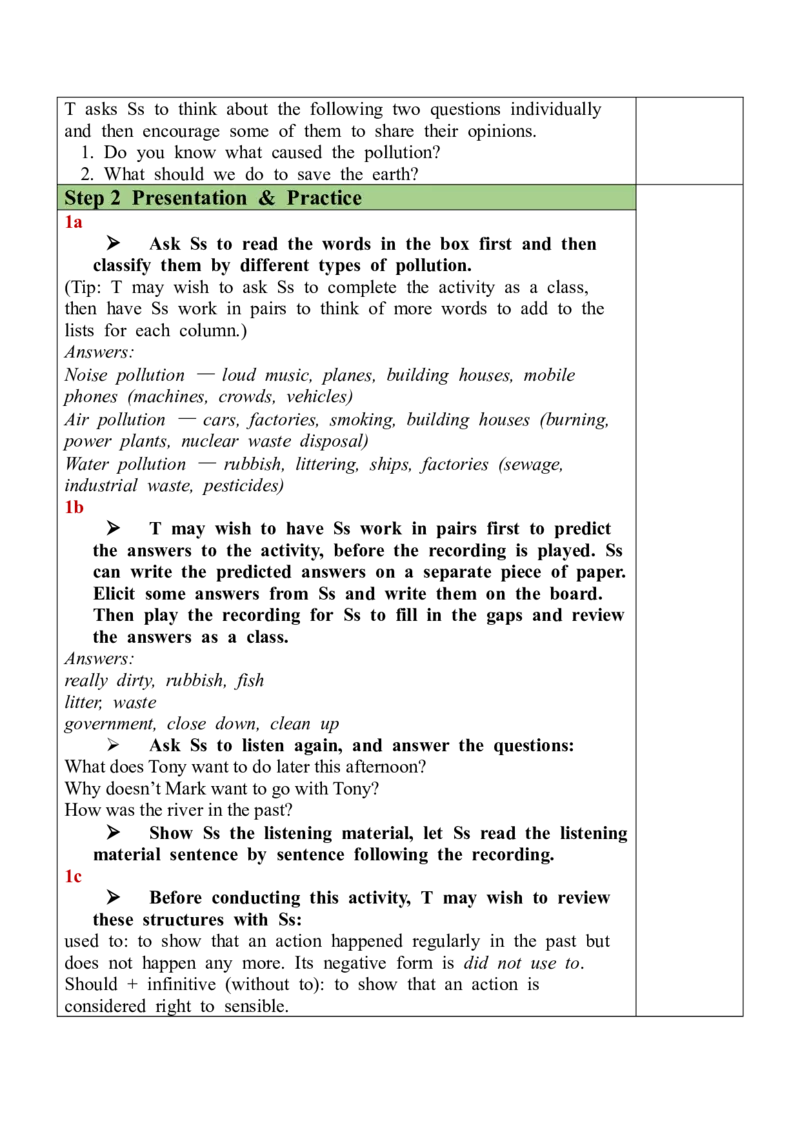
Let Ss watch a video about people and nature. Ask Ss
to answer the following questions according to the video:
1. What do people do with the forests and animals in the video?
2. What will happen if people continue to harm the nature?
3. What can we do to protect the nature?
(Tip: T can ask Ss to discuss the above three questions in groups
and then share their answers to the whole class. Answers will vary.)
Brainstorm & Lead in
Step 1: Ask Ss to work in groups of four and let Ss discuss the
pollution they know.
Step 2: Ask each group to summarize their discussion using thinking
map (e.g. webbing chart).
Step 3: T shows the pictures of different kinds of pollution (PPT
P9-P12) to Ss and let them learn some new phrases about pollution,
e.g. noise pollution, air pollution, land pollution, etc. (Tip: T may
want to evoke Ss’ desire for environmental protection by using the
pictures.)
Free TalkT asks Ss to think about the following two questions individually
and then encourage some of them to share their opinions.
1. Do you know what caused the pollution?
2. What should we do to save the earth?
Step 2 Presentation & Practice
1a
Ask Ss to read the words in the box first and then
classify them by different types of pollution.
(Tip: T may wish to ask Ss to complete the activity as a class,
then have Ss work in pairs to think of more words to add to the
lists for each column.)
Answers:
Noise pollution — loud music, planes, building houses, mobile
phones (machines, crowds, vehicles)
Air pollution — cars, factories, smoking, building houses (burning,
power plants, nuclear waste disposal)
Water pollution — rubbish, littering, ships, factories (sewage,
industrial waste, pesticides)
1b
T may wish to have Ss work in pairs first to predict
the answers to the activity, before the recording is played. Ss
can write the predicted answers on a separate piece of paper.
Elicit some answers from Ss and write them on the board.
Then play the recording for Ss to fill in the gaps and review
the answers as a class.
Answers:
really dirty, rubbish, fish
litter, waste
government, close down, clean up
Ask Ss to listen again, and answer the questions:
What does Tony want to do later this afternoon?
Why doesn’t Mark want to go with Tony?
How was the river in the past?
Show Ss the listening material, let Ss read the listening
material sentence by sentence following the recording.
1c
Before conducting this activity, T may wish to review
these structures with Ss:
used to: to show that an action happened regularly in the past but
does not happen any more. Its negative form is did not use to.
Should + infinitive (without to): to show that an action is
considered right to sensible.Step 3 Language points learning
try to do = try one’s best to do 努力去做某事
be related to 与……有关
litter和rubbish都可指“垃圾”,用作不可数名词。
litter指“(室内或公共场所)乱扔的废物(纸屑、不要的包装纸、
废瓶等)”还可回收。
rubbish指“没用的东西(被扔或将要丢弃的无用的东西)”不可回
收。
play a part in 在……方面起作用
Step 4 Summary & Homework
Homework
Preview the conversation in 2d.
Do the exercises in students’ book.
This is the first period of the unit. In the unit we talk about pollution and
environmental protection. So it is important to get the students to learn
words and phrases about the topics in this unit. We will review some
structures and tenses and get the students to practice them in listening and
Teaching
Reflection speaking. They are “should+do; used to+do; have/has+done; be+
done; be+doing” .The topic is an important content in our life and
students should learn to use the words and structures to talk about and write
about it. So much practice should be done in the period and in later periods.