2025年军队文职人员招聘《英语语言文学》
模拟试卷1
即刻题库 www.jike.vip
1 、 单选题
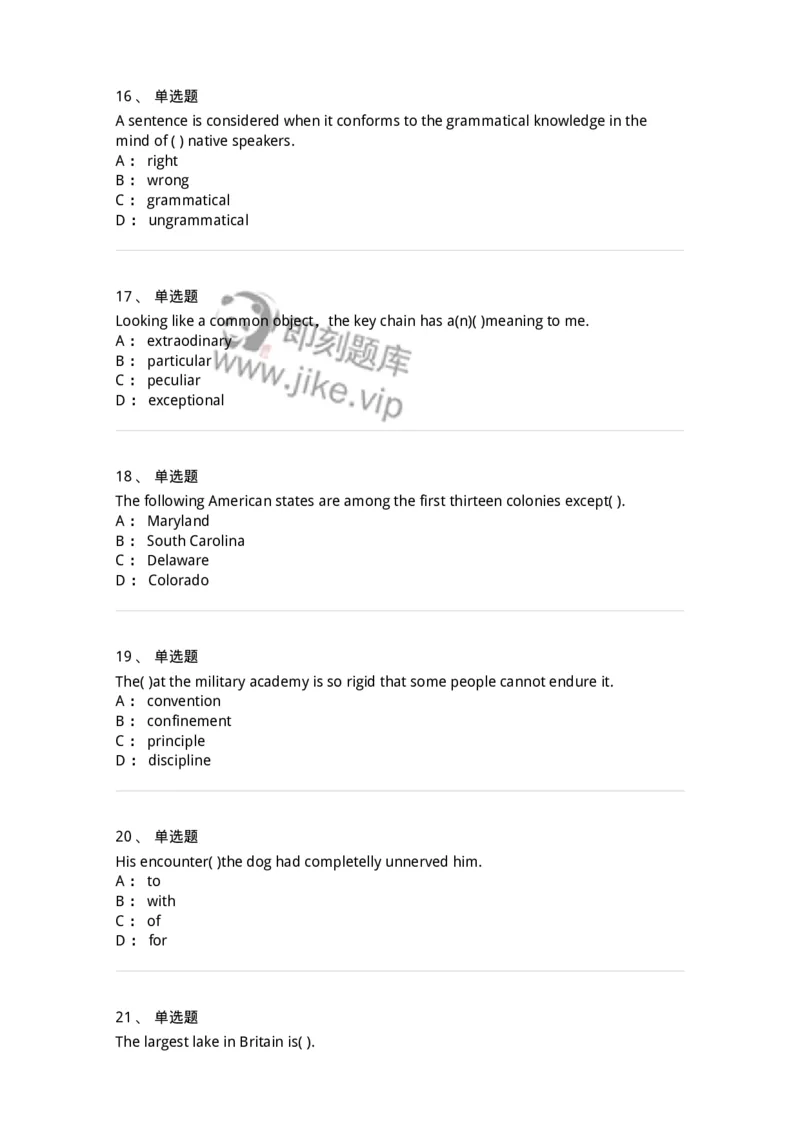
Henry James was most famous for( )
A : his poems
B : his plays
C : his novels
D : his short stories
2 、 单选题
( ) are bound morphemes because they can not be used as separate words.
A : Roots
B : Stems
C : Affixes
D : Compounds
3 、 单选题
Conceptual meaning is not ( )
A : affective
B : cognitive
C : logic
D : denotation
4 、 单选题
Of Dickens′ novels,( )is considered most autobiographical.
A : Tale of Two Cities
B : David Copperfield
C : Oliver Twist
D : Great Expectations5 、 单选题
The army is too( )to strike back.
A : weak
B : feeble
C : fragile
D : vulnerable
6 、 单选题
My father often works( )into the night,which moves me( ).
A : deeply,deely
B : deep,deep
C : deeply,deep
D : deep,deeply
7 、 单选题
Which of the following is not the function of the Australian parliament?( )
A : Making laws
B : Authorising the Government to spend public money
C : Scrutinising govermment activities
D : Interpreting constitutional provisions
8 、 单选题
Lexemeis( ).
A : a physically defmable unit
B : the common factor underlying a set of forms
C : a grammatical unit
D : an indefinable unit
9 、 单选题
-Would you mind telling me your address?-Somewhere in the southern of
Handan.Which maxim of the Cooperative Principle that above example violates?( )
A : The maxim of quality
B : The maxim of relation
C : The maxim of quantity
D : The maxim of manner
10 、 单选题
The noun "tear" and the verb "tear"are( ).A : homophones
B : allophones
C : complete homonyms
D : homographs
11 、 单选题
President Jefferson bought ( ) from France and doubled the countrys territory.
A : New Mexico
B : the Louisiana Territory
C : Kansas
D : Ohio
12 、 单选题
It was the training that he had as a young man( )made him such a good engineer.
A : has
B : later
C : which
D : that
13 、 单选题
The original New Zealand residentsare( )
A : Eskimos
B : Maoris
C : Indians
D : Inuits
14 、 单选题
The distinction between competence and performance was made by( ).
A : Halliday
B : Saussure
C : Bloomfield
D : Chomsky
15 、 单选题
Typical of the grassland dwellers of the continent( ),or pronghorn.
A : it is the American antelope
B : the American antelope is
C : is the American antelope
D : the American antelope16 、 单选题
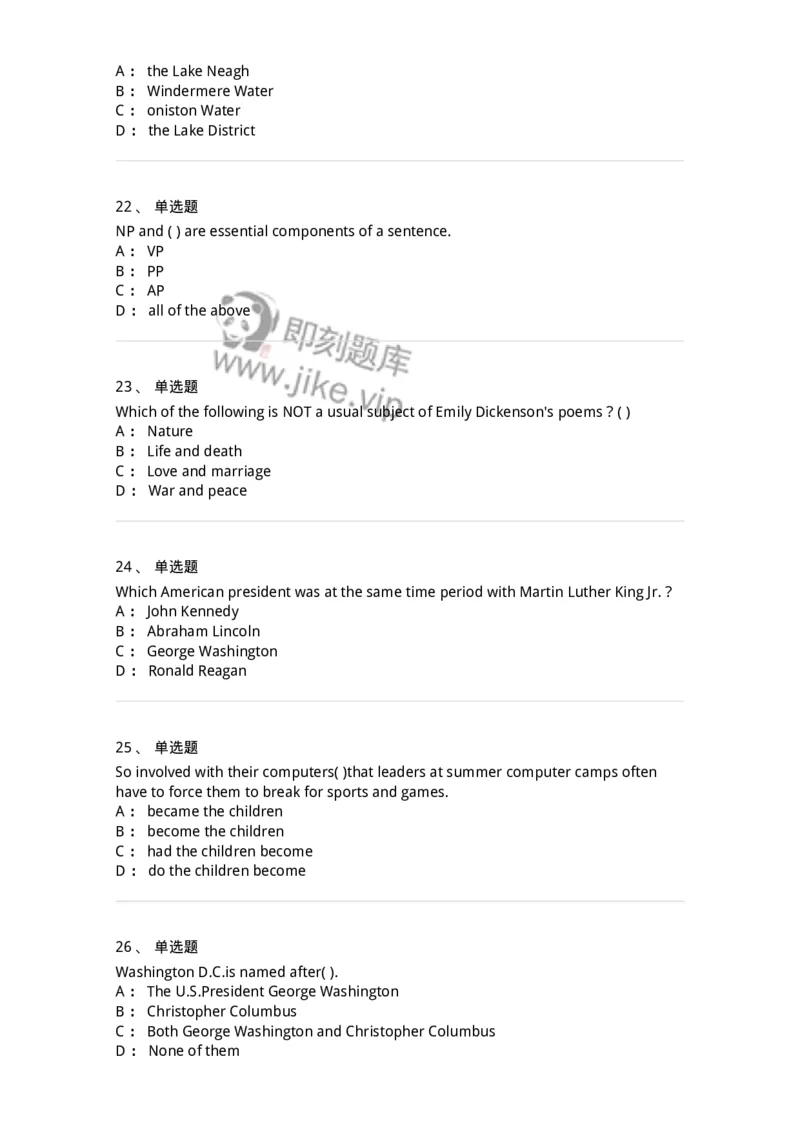
A sentence is considered when it conforms to the grammatical knowledge in the
mind of ( ) native speakers.
A : right
B : wrong
C : grammatical
D : ungrammatical
17 、 单选题
Looking like a common object,the key chain has a(n)( )meaning to me.
A : extraodinary
B : particular
C : peculiar
D : exceptional
18 、 单选题
The following American states are among the first thirteen colonies except( ).
A : Maryland
B : South Carolina
C : Delaware
D : Colorado
19 、 单选题
The( )at the military academy is so rigid that some people cannot endure it.
A : convention
B : confinement
C : principle
D : discipline
20 、 单选题
His encounter( )the dog had completelly unnerved him.
A : to
B : with
C : of
D : for
21 、 单选题
The largest lake in Britain is( ).A : the Lake Neagh
B : Windermere Water
C : oniston Water
D : the Lake District
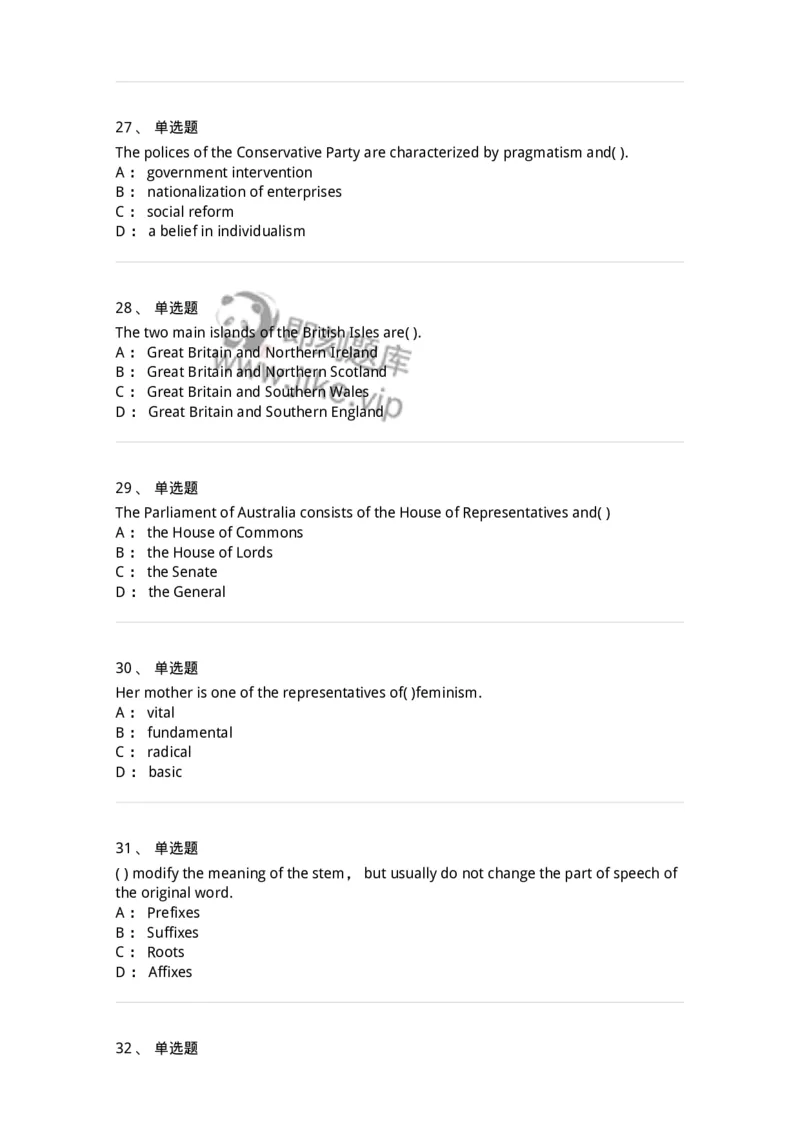
22 、 单选题
NP and ( ) are essential components of a sentence.
A : VP
B : PP
C : AP
D : all of the above
23 、 单选题
Which of the following is NOT a usual subject of Emily Dickenson′s poems?( )
A : Nature
B : Life and death
C : Love and marriage
D : War and peace
24 、 单选题
Which American president was at the same time period with Martin Luther King Jr.?
A : John Kennedy
B : Abraham Lincoln
C : George Washington
D : Ronald Reagan
25 、 单选题
So involved with their computers( )that leaders at summer computer camps often
have to force them to break for sports and games.
A : became the children
B : become the children
C : had the children become
D : do the children become
26 、 单选题
Washington D.C.is named after( ).
A : The U.S.President George Washington
B : Christopher Columbus
C : Both George Washington and Christopher Columbus
D : None of them27 、 单选题
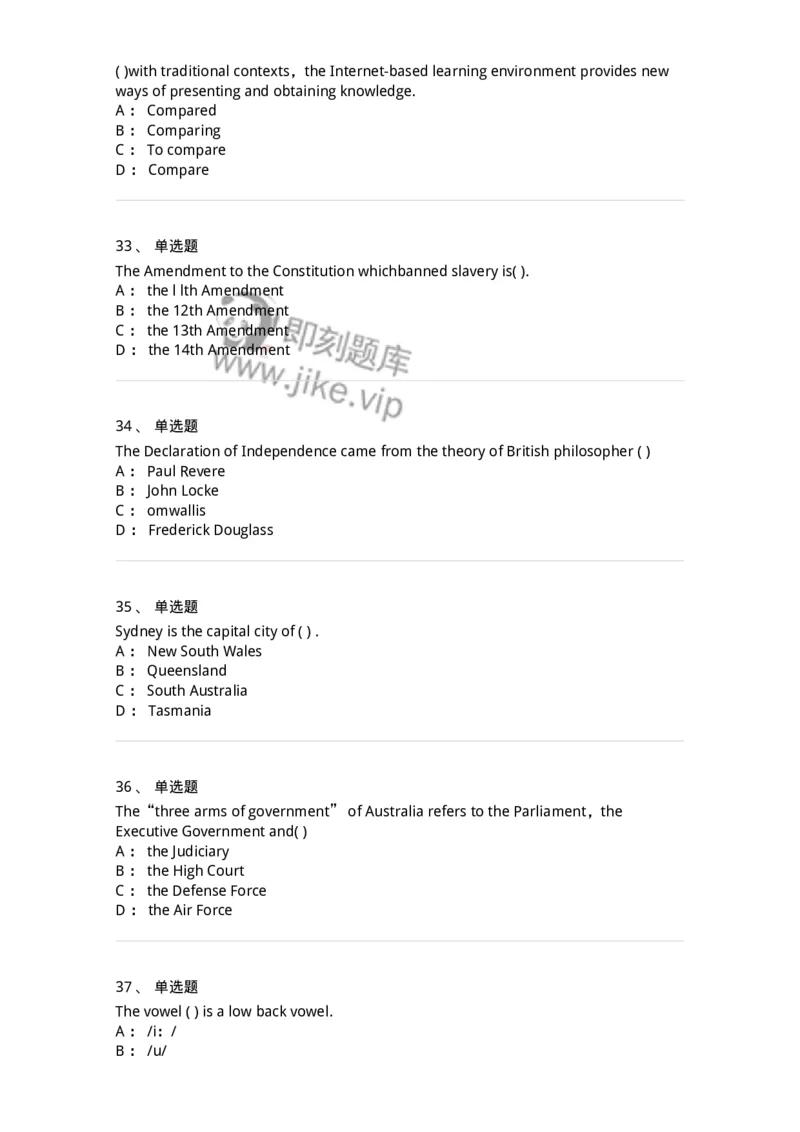
The polices of the Conservative Party are characterized by pragmatism and( ).
A : government intervention
B : nationalization of enterprises
C : social reform
D : a belief in individualism
28 、 单选题
The two main islands of the British Isles are( ).
A : Great Britain and Northern Ireland
B : Great Britain and Northern Scotland
C : Great Britain and Southern Wales
D : Great Britain and Southern England
29 、 单选题
The Parliament of Australia consists of the House of Representatives and( )
A : the House of Commons
B : the House of Lords
C : the Senate
D : the General
30 、 单选题
Her mother is one of the representatives of( )feminism.
A : vital
B : fundamental
C : radical
D : basic
31 、 单选题
( ) modify the meaning of the stem, but usually do not change the part of speech of
the original word.
A : Prefixes
B : Suffixes
C : Roots
D : Affixes
32 、 单选题( )with traditional contexts,the Internet-based learning environment provides new
ways of presenting and obtaining knowledge.
A : Compared
B : Comparing
C : To compare
D : Compare
33 、 单选题
The Amendment to the Constitution whichbanned slavery is( ).
A : the l lth Amendment
B : the 12th Amendment
C : the 13th Amendment
D : the 14th Amendment
34 、 单选题
The Declaration of Independence came from the theory of British philosopher ( )
A : Paul Revere
B : John Locke
C : omwallis
D : Frederick Douglass
35 、 单选题
Sydney is the capital city of ( ) .
A : New South Wales
B : Queensland
C : South Australia
D : Tasmania
36 、 单选题
The“three arms of government” of Australia refers to the Parliament,the
Executive Government and( )
A : the Judiciary
B : the High Court
C : the Defense Force
D : the Air Force
37 、 单选题
The vowel ( ) is a low back vowel.
A : /i:/
B : /u/C : /a:/
D : /e/
38 、 单选题
( )is the dividing line between the South and North of America.
A : The Hudson River
B : The Potomac River
C : The Ohio River
D : The Missouri River
39 、 单选题
The direct cause for the Reformation was King Henry VIII’s effort to( )
A : divorce his wife
B : break with Rome
C : support the Protestants
D : declare his supreme power over the church
40 、 单选题
Firth insisted that the object of linguistics is ( )
A : language itself
B : language in actual use
C : language variation
D : language skills
41 、 单选题
According to the maxim of ( ) suggested by Grice, one should speak truthfully.
A : quality
B : manner
C : relation
D : quantity
42 、 单选题
The Commonwealth of Australia was established in( )
A : 1875
B : 1862
C : 1900
D : 190143 、 单选题
The old man has developed a( )headache which cannot be cured in a short time.
A : perpetual
B : permanent
C : chronic
D : sustained
44 、 单选题
An allophone refers to any of the different forms of a ( ).
A : phoneme
B : morpheme
C : word
D : root
45 、 单选题
Quebec province in Canada has a strong( ) culture.
A : British
B : German
C : French
D : Italian
46 、 单选题
The passengers in missing airplane were( )dead after several months of search.
A : rectified
B : testified
C : certified
D : verified
47 、 单选题
Which American university is with the longest history?
A : Yale
B : Oxford
C : Harvard
D : Stanford
48 、 单选题
Mike was one of my( )customers.
A : normalB : regular
C : ordinary
D : usual
49 、 单选题
In which day is Halloween celebrated?( )
A : 5 November
B : 31 October
C : 17 March
D : 25 December
50 、 单选题
John is reading an interesting book on evolution theory which was written by Charles
Darwin,who was a British naturalist who developed a theory of evolution based on
natural selection.What design feature of language is reflected in the example?( )
A : Creativity
B : Arbitrariness
C : Displacement
D : uality
51 、 单选题
Theodore Dreiser ′s works include the following EXCEPT ( )
A : n American Tragedy
B : Trilogy of Desire
C : Sister Carrie
D : The Adventures of Hucklebery Finn
52 、 单选题
My( )your proposal speaks volumes for my will.
A : consent to
B : consent with
C : hatred of
D : admission of
53 、 单选题
Of the following books,( )is Not written by Thomas Hardy.
A : Tess of the d′Urbervilles
B : Far from the Madding Crowd
C : Jude the Obscure
D : Break, Break, Break54 、 单选题
Of the following writers,( )is NOT included in the group of naturalists.
A : Stephen Crane
B : Frank Norris
C : Theodore Dreiser
D : Herman Melville
55 、 单选题
The Canterbury Tales was written by( ).
A : lfred the Great
B : Thomas Malory
C : Geoffrey Chaucer
D : Edmund Spencer
56 、 单选题
The unique island( )of Hainan attracts hundreds of thousands of tourists every year.
A : scenery
B : sight
C : scene
D : landscape
57 、 单选题
The two main islands of the British Isles are( ).
A : Great Britain and Northern Ireland
B : Great Britain and Northern Scotland
C : Great Britain and Southern Wales
D : Great Britain and Southern England
58 、 单选题
Perhaps the most significant postwar trend was the decentralization of cities
throughout the UnitedStates,( )when massive highway-building programs permitted
greater suburban growth.
A : and accelerated a phenomenon
B : a phenomenon that accelerated
C : accelerating a phenomenon which
D : the acceleration of which phenomenon59 、 单选题
In the Canadian parliamentary system,( )holds the highest position.
A : The British Crown
B : The President
C : The Governor General
D : The Prime Minister
60 、 单选题
Although the teacher has explained to us,the meaning of the article is still( )to me.
A : faint
B : obscure
C : ambiguous
D : vague
61 、 不定项选择题
“When more and more people are thrown out of work, unemployment results,”
Calvin Coolidge once observed. As the U. S. economy crumbles, Coolidge’s silly
maxim might appear to be as apt as ever: the number of unemployment insurance
claims is rising, and overall joblessness is creeping upward. But in today’s vast and
complex labor market, things aren’t always what they seem. More and more people
are indeed losing their jobs but not necessarily because the economy appears to be
in recession. And old-fashioned unemployment isn’t the inevitable result of job loss.
New work, at less pay, often is.
Call it new-wave unemployment: structural changes in the economy are
overlapping the business downturn, giving joblessness a grim new twist. Small
wonder that the U. S. unemployment rate is rising. Now at 5.7 percent, it is widely
expected to edge toward 7 percent by the end of next year. But statistics alone can’t
fully capture a complex reality. The unemployment rate has been held down by slow
growth in the labor force—the number of people working or looking for work—since
few people sense attractive job opportunities in a weak economy. In addition, many
more people are losing their jobs than are actually ending up unemployed. Faced
with hungry mouths to feed, thousands of women, for example, are taking two or
more part-time positions or agreeing to shave the hours they work in service-sector
jobs. For better and for worse, work in America clearly isn’t what it used to be. Now
unemployment isn’t, either.
Like sour old wine in new bottles, this downturn blends a little of the old and the
new reflecting a decade’s worth of change in the dynamic U. S. economy. Yet, in
many respects the decline is following the classic pattern, with new layoffs
concentrated among blue-collar workers in the most “cyclical” industries, whose
ups and downs track the economy most closely.
As the downturn attracts attention on workers’ ill fortunes, some analysts
predict that political upheaval may lie ahead. Real wages for the average U. S. worker
peaked in 1973 and have been falling almost ever since. As a result, a growing group
of downwardly mobile Americans could soon begin pressing policymakers to help
produce better-paying jobs. Just how loud the outcry becomes will depend partly onthe course of the recession. But in the long run, there’s little doubt that the bleak
outlook for jobs and joblessness is “politically, socially and psychologically
dynamite”.
According to the passage, under the great pressure of life, many women _____.
A : will do a part-time job along with the full-time job
B : would rather stay at home than apply for a part-time position
C : would be fired if they can not finish the job quickly
D : will agree to have their working hours shortened if required
62 、 不定项选择题
Children as young as four will study Shakespeare in a project being launched today
by the Royal Shakespeare Company.
The RSC is holding its first national conference for primary school teachers to
encourage them to use the Bard’s plays imaginatively in the classroom from
reception classes onwards. The conference will be told that they should learn how
Shakespearian characters like Puck in?A Midsummer Night’s Dream?are “jolly
characters” and how to write about them.
At present, the national curriculum does not require pupils to approach
Shakespeare until secondary school. All it says is that pupils should study “texts
drawn from a variety of cultures and traditions” and “myths, legends and
traditional stories”.
However, educationists at the RSC believe children will gain a better appreciation
of Shakespeare if they are introduced to him at a much younger age. “Even very
young children can enjoy Shakespeare’s plays,” said Mary Johnson, head of the
learning department. “It is just a question of pitching it for the age group. Even
reception classes and key stage one pupils (five-to-seven-year-olds) can enjoy his
stories. For instance, if you build up Puck as a character who skips, children of that
age can enjoy the character. They can be inspired by Puck and they could even start
writing about him at that age.”
It is the RSC’s belief that building the Bard up as a fun playwright in primary
school could counter some of the negative images conjured up about teaching
Shakespeare in secondary schools. Then, pupils have to concentrate on scenes from
the plays to answer questions for compulsory English national-curriculum tests for
14-year-olds. Critics of the tests have complained that pupils no longer have the time
to study or read the whole play—and therefore lose interest in Shakespeare.
However, Ms. Johnson is encouraging teachers to present 20-minute versions of
the plays—a classroom version of the?Reduced Shakespeare Company’s Complete
Works of Shakespeare (Abridged)?which told his 37 plays in 97 minutes—to give
pupils a flavour of the whole drama.
The RSC’s venture coincides with a call for schools to allow pupils to be more
creative in writing about Shakespeare. Professor Kate McLuskie, the new director of
the University of Birmingham’s Shakespeare Institute - also based in
Stratford—said it was time to get away from the idea that there was “a right
answer” to any question about Shakespeare. Her first foray into the world of
Shakespeare was to berate him as a misogynist in a 1985 essay but she now insists
this should not be interpreted as a criticism of his works—although she admits: “I
probably wouldn’t have written it quite the same way if I had been writing it now.What we should be doing is making sure that someone is getting something out of
Shakespeare,” she said. “People are very scared about getting the right answer. I
know it’s difficult but I don’t care if they come up with a right answer that I can
agree with about Shakespeare.”
What is this passage mainly concerned with?
A : How to give pupils a flavor of Shakespeare drama.
B : The fun of reading Shakespeare.
C : RSC project will teach children how to write on Shakespeare.
D : RSC project will help four-year-old children find the fun in Shakespeare.
63 、 不定项选择题
“When more and more people are thrown out of work, unemployment results,”
Calvin Coolidge once observed. As the U. S. economy crumbles, Coolidge’s silly
maxim might appear to be as apt as ever: the number of unemployment insurance
claims is rising, and overall joblessness is creeping upward. But in today’s vast and
complex labor market, things aren’t always what they seem. More and more people
are indeed losing their jobs but not necessarily because the economy appears to be
in recession. And old-fashioned unemployment isn’t the inevitable result of job loss.
New work, at less pay, often is.
Call it new-wave unemployment: structural changes in the economy are
overlapping the business downturn, giving joblessness a grim new twist. Small
wonder that the U. S. unemployment rate is rising. Now at 5.7 percent, it is widely
expected to edge toward 7 percent by the end of next year. But statistics alone can’t
fully capture a complex reality. The unemployment rate has been held down by slow
growth in the labor force—the number of people working or looking for work—since
few people sense attractive job opportunities in a weak economy. In addition, many
more people are losing their jobs than are actually ending up unemployed. Faced
with hungry mouths to feed, thousands of women, for example, are taking two or
more part-time positions or agreeing to shave the hours they work in service-sector
jobs. For better and for worse, work in America clearly isn’t what it used to be. Now
unemployment isn’t, either.
Like sour old wine in new bottles, this downturn blends a little of the old and the
new reflecting a decade’s worth of change in the dynamic U. S. economy. Yet, in
many respects the decline is following the classic pattern, with new layoffs
concentrated among blue-collar workers in the most “cyclical” industries, whose
ups and downs track the economy most closely.
As the downturn attracts attention on workers’ ill fortunes, some analysts
predict that political upheaval may lie ahead. Real wages for the average U. S. worker
peaked in 1973 and have been falling almost ever since. As a result, a growing group
of downwardly mobile Americans could soon begin pressing policymakers to help
produce better-paying jobs. Just how loud the outcry becomes will depend partly on
the course of the recession. But in the long run, there’s little doubt that the bleak
outlook for jobs and joblessness is “politically, socially and psychologically
dynamite”.
What can be inferred from the last paragraph?
A : Blue-collar workers are given less and less wages in recent years.B : The unemployment problem may lead to serious social problems.
C : The unemployment problem will probably become less serious in no time.
D : The government will create more jobs with better pay in the near future.
64 、 不定项选择题
“When more and more people are thrown out of work, unemployment results,”
Calvin Coolidge once observed. As the U. S. economy crumbles, Coolidge’s silly
maxim might appear to be as apt as ever: the number of unemployment insurance
claims is rising, and overall joblessness is creeping upward. But in today’s vast and
complex labor market, things aren’t always what they seem. More and more people
are indeed losing their jobs but not necessarily because the economy appears to be
in recession. And old-fashioned unemployment isn’t the inevitable result of job loss.
New work, at less pay, often is.
Call it new-wave unemployment: structural changes in the economy are
overlapping the business downturn, giving joblessness a grim new twist. Small
wonder that the U. S. unemployment rate is rising. Now at 5.7 percent, it is widely
expected to edge toward 7 percent by the end of next year. But statistics alone can’t
fully capture a complex reality. The unemployment rate has been held down by slow
growth in the labor force—the number of people working or looking for work—since
few people sense attractive job opportunities in a weak economy. In addition, many
more people are losing their jobs than are actually ending up unemployed. Faced
with hungry mouths to feed, thousands of women, for example, are taking two or
more part-time positions or agreeing to shave the hours they work in service-sector
jobs. For better and for worse, work in America clearly isn’t what it used to be. Now
unemployment isn’t, either.
Like sour old wine in new bottles, this downturn blends a little of the old and the
new reflecting a decade’s worth of change in the dynamic U. S. economy. Yet, in
many respects the decline is following the classic pattern, with new layoffs
concentrated among blue-collar workers in the most “cyclical” industries, whose
ups and downs track the economy most closely.
As the downturn attracts attention on workers’ ill fortunes, some analysts
predict that political upheaval may lie ahead. Real wages for the average U. S. worker
peaked in 1973 and have been falling almost ever since. As a result, a growing group
of downwardly mobile Americans could soon begin pressing policymakers to help
produce better-paying jobs. Just how loud the outcry becomes will depend partly on
the course of the recession. But in the long run, there’s little doubt that the bleak
outlook for jobs and joblessness is “politically, socially and psychologically
dynamite”.
The present downturn is similar to traditional ones in that _____.
A : we can never predict which way the economy will head
B : the economic prospects have been unfavorable for 10 years
C : the government has done relatively little to intervene the market
D : physical laborers are the chief victims of the economic decline
65 、 不定项选择题There is substantial evidence that by 1926, with the publication of The Weary Blues,
Langston Hughes had broken with two well-established traditions in African American
literature. In The Weary Blues, Hughes chose to modify the traditions that decreed
that African American literature must promote racial acceptance and integration, and
that, in order to do so, it must reflect an understanding and mastery of Western
European literary techniques and styles. Necessarily excluded by this decree,
linguistically and thematically, was the vast amount of secular folk material in the
oral tradition that had been created by Black people in the years of slavery and after.
It might be pointed out that even the spirituals or “sorrow songs” of the slaves—as
distinct from their secular songs and stories—had been Europeanized to make them
acceptable within these African American traditions after the Civil War. In 1862
northern White writers had commented favorably on the unique and provocative
melodies of these “sorrow songs” when they first heard them sung by slaves in the
Carolina sea islands. But by 1916, ten years before the publication of The Weary
Blues, Hurry T. Burleigh, the Black baritone soloist at New York’s ultrafashionable
Saint George’s Episcopal Church, had published Jubilee Songs of the United States,
with every spiritual arranged so that a concert singer could sing it “in the manner of
an art song.” Clearly, the artistic work of Black people could be used to promote
racial acceptance and integration only on the condition that it became Europeanized.
Even more than his rebellion against this restrictive tradition in African American
art, Hughes’s expression of the vibrant folk culture of Black people established his
writing as a landmark in the history of African American literature. Most of his folk
poems have the distinctive marks of this folk culture’s oral tradition: they contain
many instances of naming and enumeration, considerable hyperbole and
understatement, and a strong infusion of street-talk rhyming. There is a deceptive
veil of artlessness in these poems. Hughes prided himself on being an impromptu
and impressionistic writer of poetry. His, he insisted, was not an artfully constructed
poetry. Yet an analysis of his dramatic monologues and other poems reveals that his
poetry was carefully and artfully crafted. In his folk poetry we find features common
to all folk literature, such as dramatic ellipsis, narrative compression, rhythmic
repetition, and monosyllabic emphasis. The peculiar mixture of irony and humor we
find in his writing is a distinguishing feature of his folk poetry. Together, these
aspects, of Hughes’s writing helped to modify the previous restrictions on the
techniques and subject matter of Black writers and consequently to broaden the
linguistic and thematic range of African American literature.
The passage suggests that the author would be most likely to agree with which one of
the following statements about the requirement that Black writers employ Western
European literary techniques?
A : The requirement was imposed more for social than for aesthetic reasons.
B : The requirement was a relatively unimportant aspect of the African American
tradition.
C : The requirement was the chief reason for Hughes’s success as a writer.
D : The requirement was appropriated for some forms of expression but not for
others.
66 、 不定项选择题
Hormones in the Body Up to the beginning of the twentieth century, the nervoussystem was thought to control all communication within the body and the resulting
integration of behavior. Scientists had determined that nerves ran, essentially, on
electrical impulses. These impulses were thought to be the engine for thought,
emotion, movement, and internal processes such as digestion. However, experiments
by William Bayliss and Ernest Starling on the chemical secretin, which is produced in
the small intestine when food enters the stomach, eventually challenged that view.
From the small intestine, secretin travels through the bloodstream to the pancreas.
There, it stimulates the release of digestive chemicals. In this fashion, the intestinal
cells that produce secretin ultimately regulate the production of different chemicals
in a different organ, the pancreas.
Such a coordination of processes had been thought to require control by the
nervous system; Bayliss and Starling showed that it could occur through chemicals
alone. This discovery spurred Starting to coin the term hormone to refer to secretin,
taking it from the Greek word hormon, meaning “to excite” or “to set in
motion.” A hormone is a chemical produced by one tissue to make things happen
elsewhere.
As more hormones were discovered, they were categorized, primarily according
to the process by which they operated on the body. Some glands (which make up the
endocrine system) secrete hormones directly into the bloodstream. Such glands
include the thyroid and the pituitary. The exocrine system consists of organs and
glands that produce substances that are used outside the bloodstream, primarily for
digestion. The pancreas is one such organ, although it secretes some chemicals into
the blood and thus is also part of the endocrine system.
Much has been learned about hormones since their discovery. Some play such
key roles in regulating bodily processes or behavior that their absence would cause
immediate death. The most abundant hormones have effects that are less obviously
urgent but can be more far-reaching and difficult to track: They modify moods and
affect human behavior, even some behavior we normally think of as voluntary.
Hormonal systems are very intricate. Even minute amounts of the right chemicals can
suppress appetite, calm aggression, and change the attitude of a parent toward a
child. Certain hormones accelerate the development of the body, regulating growth
and form; others may even define an individual’s personality characteristics. The
quantities and proportions of hormones produce change with age, so scientists have
given a great deal of study to shifts in the endocrine system over time in the hopes of
alleviating ailments associated with aging.
In fact, some hormone therapies are already very common. A combination of
estrogen and progesterone has been prescribed for decades to women who want to
reduce mood swings, sudden changes in body temperature, and other discomforts
caused by lower natural levels of those hormones as they enter middle age. Known
as hormone replacement therapy (HRT), the treatment was also believed to prevent
weakening of the bones. At least one study has linked HRT with a heightened risk of
heart disease and certain types of cancer. HRT may also increase the likelihood that
blood clots—dangerous because they could travel through the bloodstream and
block major blood vessels—will form. Some proponents of HRT have tempered their
enthusiasm in the face of this new evidence, recommending it only to patients whose
symptoms interfere with their abilities to live normal lives.
Human growth hormone may also be given to patients who are secreting
abnormally low amounts on their own. Because of the complicated effects growth
hormone has on the body, such treatments are generally restricted to children who
would be pathologically small in stature without it. Growth hormone affects not just
physical size but also the digestion of food and the aging process. Researchers andfamily physicians tend to agree that it is foolhardy to dispense it in cases in which the
risks are not clearly outweighed by the benefits.
Which of the following sentences explains the primary goal of hormone replacement
therapy?
A : The quantities and proportions of hormones produce change with age, so
scientists have given a great deal of study to shifts in the endocrine system over time
in the hopes of alleviating ailments associated with aging.
B : A combination of estrogen and progesterone has been prescribed for decades to
women who want to reduce mood swings, sudden changes in body temperature, and
other discomforts caused by lower natural levels of those hormones as they enter
middle age.
C : HRT may also increase the likelihood that blood clots—dangerous because they
could travel through the bloodstream and block major blood vessels—will form.
D : Because of the complicated effects growth hormone has on the body, such
treatments are generally restricted to children who would be pathologically small in
stature without it.
67 、 不定项选择题
Children as young as four will study Shakespeare in a project being launched today
by the Royal Shakespeare Company.
The RSC is holding its first national conference for primary school teachers to
encourage them to use the Bard’s plays imaginatively in the classroom from
reception classes onwards. The conference will be told that they should learn how
Shakespearian characters like Puck in?A Midsummer Night’s Dream?are “jolly
characters” and how to write about them.
At present, the national curriculum does not require pupils to approach
Shakespeare until secondary school. All it says is that pupils should study “texts
drawn from a variety of cultures and traditions” and “myths, legends and
traditional stories”.
However, educationists at the RSC believe children will gain a better appreciation
of Shakespeare if they are introduced to him at a much younger age. “Even very
young children can enjoy Shakespeare’s plays,” said Mary Johnson, head of the
learning department. “It is just a question of pitching it for the age group. Even
reception classes and key stage one pupils (five-to-seven-year-olds) can enjoy his
stories. For instance, if you build up Puck as a character who skips, children of that
age can enjoy the character. They can be inspired by Puck and they could even start
writing about him at that age.”
It is the RSC’s belief that building the Bard up as a fun playwright in primary
school could counter some of the negative images conjured up about teaching
Shakespeare in secondary schools. Then, pupils have to concentrate on scenes from
the plays to answer questions for compulsory English national-curriculum tests for
14-year-olds. Critics of the tests have complained that pupils no longer have the time
to study or read the whole play—and therefore lose interest in Shakespeare.
However, Ms. Johnson is encouraging teachers to present 20-minute versions of
the plays—a classroom version of the?Reduced Shakespeare Company’s Complete
Works of Shakespeare (Abridged)?which told his 37 plays in 97 minutes—to give
pupils a flavour of the whole drama.The RSC’s venture coincides with a call for schools to allow pupils to be more
creative in writing about Shakespeare. Professor Kate McLuskie, the new director of
the University of Birmingham’s Shakespeare Institute - also based in
Stratford—said it was time to get away from the idea that there was “a right
answer” to any question about Shakespeare. Her first foray into the world of
Shakespeare was to berate him as a misogynist in a 1985 essay but she now insists
this should not be interpreted as a criticism of his works—although she admits: “I
probably wouldn’t have written it quite the same way if I had been writing it now.
What we should be doing is making sure that someone is getting something out of
Shakespeare,” she said. “People are very scared about getting the right answer. I
know it’s difficult but I don’t care if they come up with a right answer that I can
agree with about Shakespeare.”
What’s Puck’s characteristic according to your understanding of the passage?
A : Rude, rush and impolite.
B : Happy, interesting and full of fun.
C : Dull, absurd and ridiculous.
D : Shrewd, cunning and tricky.
68 、 不定项选择题
Every man is a philosopher. Every man has his own philosophy of life and his special
view of the universe. Moreover, his philosophy is important, more important perhaps
that he himself knows. It determines his treatment of friends and enemies, his
conduct when alone and in society, his attitude towards his home, his work, and his
country, his religious beliefs, his ethical standards, his social adjustment and his
personal happiness.
Nations, too, through the political or military party in power, have their
philosophers of thought and action. Wars are waged and revolutions incited because
of the clash of ideologies, the conflict of philippics. It has always been so. World War
II is but the latest and most dramatic illustration of the combustible nature of
differences in social and political philosophy.
Philosophy, says Plato, begins with wonder. We wonder about the destructive
fury of earthquakes, floods, storms, drought, pestilence, famine, and fire, the
mysteries of birth and death, pleasure and pain, change and permanence, cruelly and
kindness, instincts and ideals, mind and body, the size of the universe and man’s
place in it. Our questions are endless. What is man? What is Nature? What is justice?
What is duty? Alone among the animals man is concerned about his origin and end,
about his purposes and goals, about the meaning of life and the nature of reality. He
alone distinguishes between beauty and ugliness, good and evil, the better and the
worse. He may be a member of the animal kingdom, but he is also a citizen of the
world of ideas and values.
Some of man’s questions have had answers. Where the answer is clear, we call
it science or art and move on to higher ground and a new vista of the world. Many of
our questions, however, will never have final answers. Men will always discuss the
nature of justice and right, the significance of evil, the art of government, the relation
of mind and matter, the search for truth, the quest for happiness, the idea of God,
and the meaning of reality.
The human race has reflected so long and often on these problems that thesame patterns of thought recur in almost every age. We should know what these
thoughts are. We should know what answers have been suggested by those who have
most influenced ancient and modern thought. We shall want to do our own thinking
and find our own answers. It is, however, neither necessary nor advisable to travel
alone. Others have helped dispel the darkness, and the light they have kindled may
also illuminate our way.
In the passage, the author implies that _____.
A : it is not good for people to travel alone
B : one should explore philosophical problems under the guidance of other
philosophers
C : one should follow the path of other philosophers
D : one would study philosophy with others
69 、 不定项选择题
There is substantial evidence that by 1926, with the publication of The Weary Blues,
Langston Hughes had broken with two well-established traditions in African American
literature. In The Weary Blues, Hughes chose to modify the traditions that decreed
that African American literature must promote racial acceptance and integration, and
that, in order to do so, it must reflect an understanding and mastery of Western
European literary techniques and styles. Necessarily excluded by this decree,
linguistically and thematically, was the vast amount of secular folk material in the
oral tradition that had been created by Black people in the years of slavery and after.
It might be pointed out that even the spirituals or “sorrow songs” of the slaves—as
distinct from their secular songs and stories—had been Europeanized to make them
acceptable within these African American traditions after the Civil War. In 1862
northern White writers had commented favorably on the unique and provocative
melodies of these “sorrow songs” when they first heard them sung by slaves in the
Carolina sea islands. But by 1916, ten years before the publication of The Weary
Blues, Hurry T. Burleigh, the Black baritone soloist at New York’s ultrafashionable
Saint George’s Episcopal Church, had published Jubilee Songs of the United States,
with every spiritual arranged so that a concert singer could sing it “in the manner of
an art song.” Clearly, the artistic work of Black people could be used to promote
racial acceptance and integration only on the condition that it became Europeanized.
Even more than his rebellion against this restrictive tradition in African American
art, Hughes’s expression of the vibrant folk culture of Black people established his
writing as a landmark in the history of African American literature. Most of his folk
poems have the distinctive marks of this folk culture’s oral tradition: they contain
many instances of naming and enumeration, considerable hyperbole and
understatement, and a strong infusion of street-talk rhyming. There is a deceptive
veil of artlessness in these poems. Hughes prided himself on being an impromptu
and impressionistic writer of poetry. His, he insisted, was not an artfully constructed
poetry. Yet an analysis of his dramatic monologues and other poems reveals that his
poetry was carefully and artfully crafted. In his folk poetry we find features common
to all folk literature, such as dramatic ellipsis, narrative compression, rhythmic
repetition, and monosyllabic emphasis. The peculiar mixture of irony and humor we
find in his writing is a distinguishing feature of his folk poetry. Together, these
aspects, of Hughes’s writing helped to modify the previous restrictions on thetechniques and subject matter of Black writers and consequently to broaden the
linguistic and thematic range of African American literature.
The author mentions which one of the following as an example of the influence of
Black folk culture on Hughes’s poetry?
A : his exploitation of ambiguous and deceptive meanings
B : his strong religious beliefs
C : his use of naming and enumeration
D : his use of first-person narrative
70 、 不定项选择题
Nobody ever went into academic circles to make a fast fortune. Professors, especially
those in medical-and technology-related fields, typically earn a fraction of what their
colleagues in industry do. But suddenly, big money is starting to flow into the ivory
tower, as university administrators make up to the commercial potential of academic
research. And the institutions are wrestling with a whole new set of issues.
The profits are impressive: the Association of University Technology Managers
surveyed 132 universities and found that they earned a combined $576 million from
patent royalties in 1998, a number that promises to keep rising dramatically. Schools
like Columbia University in New York have aggressively marketed their inventions to
corporations, particularly pharmaceutical and high-tech companies.
Now Columbia is going retail—on the Web. It plans to go beyond the typical
“dot. edu” model, free sites listing courses and professors’ research interests.
Instead, it will offer the expertise of its faculty on a new for-profit site which will be
spun off as an independent company. The site will provide free access to educational
and research content, say administrators, as well as advanced features that are
already available to Columbia students, such as a simulation of the construction and
architecture of a French cathedral and interactive 3-D models of organic chemicals.
Free pages will feed into profit-generating areas, such as online courses and
seminars, and related books and tapes. Columbia executive vice president Michael
Crow imagines “millions of visitors” to the new site, including retirees and students
willing to pay to tap into this educational resource. “We can offer the best of
what’s thought and written and researched,” says Ann Kirschner, who heads the
project. Columbia also is anxious not be beaten by some of the other for-profit
“knowledge sites,” such as About.com and Hungry Minds. “If they capture this
space,” says Crow, “they’ll begin to cherry-pick our best faculty.”
Profits from the sale of patents typically have been divided between the
researcher, the department and the university, and Web profits would work the same
way, so many faculty members are delighted. But others find the trend worrisome: is
a professor who stands to profit from his or her research as credible as one who
doesn’t? Will universities provide more support to researchers working in profitable
fields than to scholars toiling in more musty areas?
“If there’s the perception that we might be making money from our efforts,
the authority of the university could be diminished,” worries Herve Varenne, a
cultural anthropology professor at Columbia’s education school. Says Kirschner:
“we would never compromise the integrity of the university.” Whether the new site
can add to the growing profits from patents remains to be seen, but one thing is
clear. It’s going to take the best minds on camps to find a new balance betweenprofit and purity.
Which of the following will those worrying about the trend support?
A : Professors working in profitable fields are less reliable.
B : More support should be given to musty areas other than profit-generating ones.
C : Professors in technology-related fields should earn more than their counterparts
do in industry.
D : People working in pharmaceutical and high-tech companies should earn the
biggest money.
71 、 不定项选择题
Children as young as four will study Shakespeare in a project being launched today
by the Royal Shakespeare Company.
The RSC is holding its first national conference for primary school teachers to
encourage them to use the Bard’s plays imaginatively in the classroom from
reception classes onwards. The conference will be told that they should learn how
Shakespearian characters like Puck in?A Midsummer Night’s Dream?are “jolly
characters” and how to write about them.
At present, the national curriculum does not require pupils to approach
Shakespeare until secondary school. All it says is that pupils should study “texts
drawn from a variety of cultures and traditions” and “myths, legends and
traditional stories”.
However, educationists at the RSC believe children will gain a better appreciation
of Shakespeare if they are introduced to him at a much younger age. “Even very
young children can enjoy Shakespeare’s plays,” said Mary Johnson, head of the
learning department. “It is just a question of pitching it for the age group. Even
reception classes and key stage one pupils (five-to-seven-year-olds) can enjoy his
stories. For instance, if you build up Puck as a character who skips, children of that
age can enjoy the character. They can be inspired by Puck and they could even start
writing about him at that age.”
It is the RSC’s belief that building the Bard up as a fun playwright in primary
school could counter some of the negative images conjured up about teaching
Shakespeare in secondary schools. Then, pupils have to concentrate on scenes from
the plays to answer questions for compulsory English national-curriculum tests for
14-year-olds. Critics of the tests have complained that pupils no longer have the time
to study or read the whole play—and therefore lose interest in Shakespeare.
However, Ms. Johnson is encouraging teachers to present 20-minute versions of
the plays—a classroom version of the?Reduced Shakespeare Company’s Complete
Works of Shakespeare (Abridged)?which told his 37 plays in 97 minutes—to give
pupils a flavour of the whole drama.
The RSC’s venture coincides with a call for schools to allow pupils to be more
creative in writing about Shakespeare. Professor Kate McLuskie, the new director of
the University of Birmingham’s Shakespeare Institute - also based in
Stratford—said it was time to get away from the idea that there was “a right
answer” to any question about Shakespeare. Her first foray into the world of
Shakespeare was to berate him as a misogynist in a 1985 essay but she now insists
this should not be interpreted as a criticism of his works—although she admits: “I
probably wouldn’t have written it quite the same way if I had been writing it now.What we should be doing is making sure that someone is getting something out of
Shakespeare,” she said. “People are very scared about getting the right answer. I
know it’s difficult but I don’t care if they come up with a right answer that I can
agree with about Shakespeare.”
Which of the following is NOT true according to the passage?
A : The RSC insists on teaching Shakespeare from the secondary school.
B : Pupils should study “texts drawn from a variety of cultures and traditions”
required by the national curriculum.
C : The national curriculum does not require pupils to approach Shakespeare until
secondary school now.
D : RSC believes children will gain a better appreciation of Shakespeare if they are
introduced to him at a much younger age.
72 、 不定项选择题
Nobody ever went into academic circles to make a fast fortune. Professors, especially
those in medical-and technology-related fields, typically earn a fraction of what their
colleagues in industry do. But suddenly, big money is starting to flow into the ivory
tower, as university administrators make up to the commercial potential of academic
research. And the institutions are wrestling with a whole new set of issues.
The profits are impressive: the Association of University Technology Managers
surveyed 132 universities and found that they earned a combined $576 million from
patent royalties in 1998, a number that promises to keep rising dramatically. Schools
like Columbia University in New York have aggressively marketed their inventions to
corporations, particularly pharmaceutical and high-tech companies.
Now Columbia is going retail—on the Web. It plans to go beyond the typical
“dot. edu” model, free sites listing courses and professors’ research interests.
Instead, it will offer the expertise of its faculty on a new for-profit site which will be
spun off as an independent company. The site will provide free access to educational
and research content, say administrators, as well as advanced features that are
already available to Columbia students, such as a simulation of the construction and
architecture of a French cathedral and interactive 3-D models of organic chemicals.
Free pages will feed into profit-generating areas, such as online courses and
seminars, and related books and tapes. Columbia executive vice president Michael
Crow imagines “millions of visitors” to the new site, including retirees and students
willing to pay to tap into this educational resource. “We can offer the best of
what’s thought and written and researched,” says Ann Kirschner, who heads the
project. Columbia also is anxious not be beaten by some of the other for-profit
“knowledge sites,” such as About.com and Hungry Minds. “If they capture this
space,” says Crow, “they’ll begin to cherry-pick our best faculty.”
Profits from the sale of patents typically have been divided between the
researcher, the department and the university, and Web profits would work the same
way, so many faculty members are delighted. But others find the trend worrisome: is
a professor who stands to profit from his or her research as credible as one who
doesn’t? Will universities provide more support to researchers working in profitable
fields than to scholars toiling in more musty areas?
“If there’s the perception that we might be making money from our efforts,
the authority of the university could be diminished,” worries Herve Varenne, acultural anthropology professor at Columbia’s education school. Says Kirschner:
“we would never compromise the integrity of the university.” Whether the new site
can add to the growing profits from patents remains to be seen, but one thing is
clear. It’s going to take the best minds on camps to find a new balance between
profit and purity.
In the past, professors _____.
A : could earn as much as doctors
B : were able to earn more than engineers
C : were not good at earning money
D : did not intend to earn money easily
73 、 不定项选择题
Every man is a philosopher. Every man has his own philosophy of life and his special
view of the universe. Moreover, his philosophy is important, more important perhaps
that he himself knows. It determines his treatment of friends and enemies, his
conduct when alone and in society, his attitude towards his home, his work, and his
country, his religious beliefs, his ethical standards, his social adjustment and his
personal happiness.
Nations, too, through the political or military party in power, have their
philosophers of thought and action. Wars are waged and revolutions incited because
of the clash of ideologies, the conflict of philippics. It has always been so. World War
II is but the latest and most dramatic illustration of the combustible nature of
differences in social and political philosophy.
Philosophy, says Plato, begins with wonder. We wonder about the destructive
fury of earthquakes, floods, storms, drought, pestilence, famine, and fire, the
mysteries of birth and death, pleasure and pain, change and permanence, cruelly and
kindness, instincts and ideals, mind and body, the size of the universe and man’s
place in it. Our questions are endless. What is man? What is Nature? What is justice?
What is duty? Alone among the animals man is concerned about his origin and end,
about his purposes and goals, about the meaning of life and the nature of reality. He
alone distinguishes between beauty and ugliness, good and evil, the better and the
worse. He may be a member of the animal kingdom, but he is also a citizen of the
world of ideas and values.
Some of man’s questions have had answers. Where the answer is clear, we call
it science or art and move on to higher ground and a new vista of the world. Many of
our questions, however, will never have final answers. Men will always discuss the
nature of justice and right, the significance of evil, the art of government, the relation
of mind and matter, the search for truth, the quest for happiness, the idea of God,
and the meaning of reality.
The human race has reflected so long and often on these problems that the
same patterns of thought recur in almost every age. We should know what these
thoughts are. We should know what answers have been suggested by those who have
most influenced ancient and modern thought. We shall want to do our own thinking
and find our own answers. It is, however, neither necessary nor advisable to travel
alone. Others have helped dispel the darkness, and the light they have kindled may
also illuminate our way.According to Plato, philosophy originated from _____.
A : what we don’t know
B : some miracles
C : the question on what man is
D : moral values
74 、 不定项选择题
Some believe that in the age of identikit computer games, mass entertainment and
conformity on the supermarket shelves, truly inspired thinking has gone out of the
window. But, there are others who hold the view that there is still plenty of scope for
innovation, lateral thought and creative solutions. Despite the standardization of
modern life, there is an unabated appetite for great ideas, visionary thinking and
inspired debate. In the first of a series of monthly debates on contemporary issues,
we ask two original thinkers to discuss the nature of creativity. Here is the first one.
Yes. Absolutely. Since I started working as an inventor 10 or 12 years ago, I’ve
seen a big change in attitudes to creativity and invention. Back then, there was hardly
any support for inventors, apart from the national organization the Institute of
Patentees and Inventors. Today, there are lots of little inventors’ clubs popping up
all over the place, my last count was 19 nationally and growing. These non-profit
clubs, run by inventors for inventors, are an indication that people are once again
interested in invention.
I’ve been a project leader, a croupier, an IT consultant and I’ve written a
motor mandrel. I spent my teens under a 1950s two-tone Riley RME ear, learning to
put it together. Back in the Sixties, kids like me were always out doing things, making
go-karts, riding bicycles or exploring. We learned to overcome challenges and solve
problems. We weren’t just sitting at a PlayStation, like many kids do today.
But I think, and hope, things are shifting back. There’s a lot more internl in
design and creativity and such talents are getting a much higher profile in the media.
It’s evident with TV programmes such as Channe14’s?Scrapheap Challenge?or
BBC2’s?The Apprentice and Dragon’s Den, where people are given a task to solve
or face the challenge of selling their idea to a panel.
And. thankfully, the image of the mad scientist with electrified hair working in
the garden shed is long gone—although, there are still a few exceptions!
That’s not to say there aren’t problems. With the decline in manufacturing we
are losing the ability to know how to make things. There’s a real skills gap
developing. In my opinion, the Government does little or nothing to help innovation
at the lone-inventor or small or medium enterprise level. I would love to see more
money spent on teaching our school kids how to be inventive. But, despite
everything, if you have a good idea and real determination, you can still do very well.
My own specialist area is packaging closures—almost every product needs it. I
got the idea for Squeezeopen after looking at an old tin of boot polish when my
mother complained she couldn’t get the lid off. If you can do something cheaper,
better, and you are 100 percent committed, there is a chance it will be a success.
I see a fantastic amount of innovation and opportunities out there. People
don’t realise how much is going on. New materials are coming out all the time and
the space programme and scientific research are producing a variety of spin-offs.
Innovation doesn’t have to be high-tech: creativity and inventing is about finding
the right solution to a problem, whatever it is. There’s a lot of talent out there and,thankfully, some of the more progressive companies are suddenly realizing they
don’t want to miss out—it’s an exciting time.
Which of the following is the suggestion of the interviewer to the problem?
A : The government should spend more money helping innovation.
B : The kids should cultivate their love of science and invention.
C : More inventors’ clubs should be set up.
D : Invention courses are necessary to children.
75 、 不定项选择题
Students of United States history, seeking to identify the circumstances that
encouraged the emergence of feminist movements, have thoroughly investigated the
mid-nineteenth-century American economic and social conditions that affected the
status of women. These historians, however, have analyzed less fully the
development of specifically feminist ideas and activities during the same period.
Furthermore, the ideological origins of feminism in the United States have been
obscured because, even when historians did take into account those feminist ideas
and activities occurring within the United States, they failed to recognize that
feminism was then a truly international movement actually centered in Europe.
American feminist activists who have been described as “solitary” and “individual
theorists” were in reality connected to a movement —utopian socialism—which was
already popularizing feminist ideas in Europe during the two decades that
cachinnated in the first women’s rights conference held at Seneca Falls, New York,
in 1848. Thus, a complete understanding of the origins and development of
nineteenth-century feminism in the United States requires that the geographical
focus be widened to include Europe and that the detailed study already made of
social conditions be expanded to include the ideological development of feminism.
The earliest and most popular of the utopian socialists were the Saint-Simonians.
The specifically feminist part of Saint-Simonianism has, however, been less studied
than the group’s contribution to early socialism. This is regrettable on two accounts.
By 1832 feminism was the central concern of Saint-Simonianism and entirely
absorbed its adherents’ energy; hence, by ignoring its feminism, European
historians have misunderstood Saint-Simonianism. Moreover, since many feminist
ideas can be traced to Saint-Simonianism, European historians’ appreciation of later
feminism in France and the United States remained limited.
Saint-Simon’s followers, many of whom were women, based their feminism on
an interpretation of his project to reorganize the globe by replacing brute force with
the rule of spiritual powers. The new world order would be ruled together by a male,
to represent reflection, and a female, to represent sentiment. This complementarity
reflects the fact that, while the Saint-Simonians did not reject the belief that there
were innate differences between men and women, they nevertheless foresaw an
equally important social and political role for both sexes in their Utopia.
Only a few Saint-Simonians opposed a definition of sexual equality based on
gender distinction. This minority believed that individuals of both sexes were born
similar in capacity and character, and they ascribed male-female differences to
socialization and education. The envisioned result of both currents of thought,
however, was that women would enter public life in the new age and that sexual
equality would reward men as well as women with an improved way of life.The author’s attitude toward most European historians who have studied the Saint-
Simonians is primarily one of _____.
A : approval of the specific focus of their research
B : disapproval of their lack of attention to the issue that absorbed most of the
Saint-Simonians’ energy after 1832
C : approval of their general focus on social conditions
D : disapproval of their lack of attention to links between the Saint-Simonians and
their American counterparts
76 、 不定项选择题
Every man is a philosopher. Every man has his own philosophy of life and his special
view of the universe. Moreover, his philosophy is important, more important perhaps
that he himself knows. It determines his treatment of friends and enemies, his
conduct when alone and in society, his attitude towards his home, his work, and his
country, his religious beliefs, his ethical standards, his social adjustment and his
personal happiness.
Nations, too, through the political or military party in power, have their
philosophers of thought and action. Wars are waged and revolutions incited because
of the clash of ideologies, the conflict of philippics. It has always been so. World War
II is but the latest and most dramatic illustration of the combustible nature of
differences in social and political philosophy.
Philosophy, says Plato, begins with wonder. We wonder about the destructive
fury of earthquakes, floods, storms, drought, pestilence, famine, and fire, the
mysteries of birth and death, pleasure and pain, change and permanence, cruelly and
kindness, instincts and ideals, mind and body, the size of the universe and man’s
place in it. Our questions are endless. What is man? What is Nature? What is justice?
What is duty? Alone among the animals man is concerned about his origin and end,
about his purposes and goals, about the meaning of life and the nature of reality. He
alone distinguishes between beauty and ugliness, good and evil, the better and the
worse. He may be a member of the animal kingdom, but he is also a citizen of the
world of ideas and values.
Some of man’s questions have had answers. Where the answer is clear, we call
it science or art and move on to higher ground and a new vista of the world. Many of
our questions, however, will never have final answers. Men will always discuss the
nature of justice and right, the significance of evil, the art of government, the relation
of mind and matter, the search for truth, the quest for happiness, the idea of God,
and the meaning of reality.
The human race has reflected so long and often on these problems that the
same patterns of thought recur in almost every age. We should know what these
thoughts are. We should know what answers have been suggested by those who have
most influenced ancient and modern thought. We shall want to do our own thinking
and find our own answers. It is, however, neither necessary nor advisable to travel
alone. Others have helped dispel the darkness, and the light they have kindled may
also illuminate our way.
What is called science or art, according to the author?
A : the deficit answers of some of man’s questions
B : Man’s thoughtsC : all of man’s questions
D : the meaning of reality
77 、 不定项选择题
Nobody ever went into academic circles to make a fast fortune. Professors, especially
those in medical-and technology-related fields, typically earn a fraction of what their
colleagues in industry do. But suddenly, big money is starting to flow into the ivory
tower, as university administrators make up to the commercial potential of academic
research. And the institutions are wrestling with a whole new set of issues.
The profits are impressive: the Association of University Technology Managers
surveyed 132 universities and found that they earned a combined $576 million from
patent royalties in 1998, a number that promises to keep rising dramatically. Schools
like Columbia University in New York have aggressively marketed their inventions to
corporations, particularly pharmaceutical and high-tech companies.
Now Columbia is going retail—on the Web. It plans to go beyond the typical
“dot. edu” model, free sites listing courses and professors’ research interests.
Instead, it will offer the expertise of its faculty on a new for-profit site which will be
spun off as an independent company. The site will provide free access to educational
and research content, say administrators, as well as advanced features that are
already available to Columbia students, such as a simulation of the construction and
architecture of a French cathedral and interactive 3-D models of organic chemicals.
Free pages will feed into profit-generating areas, such as online courses and
seminars, and related books and tapes. Columbia executive vice president Michael
Crow imagines “millions of visitors” to the new site, including retirees and students
willing to pay to tap into this educational resource. “We can offer the best of
what’s thought and written and researched,” says Ann Kirschner, who heads the
project. Columbia also is anxious not be beaten by some of the other for-profit
“knowledge sites,” such as About.com and Hungry Minds. “If they capture this
space,” says Crow, “they’ll begin to cherry-pick our best faculty.”
Profits from the sale of patents typically have been divided between the
researcher, the department and the university, and Web profits would work the same
way, so many faculty members are delighted. But others find the trend worrisome: is
a professor who stands to profit from his or her research as credible as one who
doesn’t? Will universities provide more support to researchers working in profitable
fields than to scholars toiling in more musty areas?
“If there’s the perception that we might be making money from our efforts,
the authority of the university could be diminished,” worries Herve Varenne, a
cultural anthropology professor at Columbia’s education school. Says Kirschner:
“we would never compromise the integrity of the university.” Whether the new site
can add to the growing profits from patents remains to be seen, but one thing is
clear. It’s going to take the best minds on camps to find a new balance between
profit and purity.
What worries Michael Crow most is _____.
A : that they’ll not beat other educational “knowledge sites”
B : that the spun-off company will remain independent
C : that their educational resource will be tapped into
D : that their faculty’s brains will be picked by their competitors78 、 不定项选择题
Some believe that in the age of identikit computer games, mass entertainment and
conformity on the supermarket shelves, truly inspired thinking has gone out of the
window. But, there are others who hold the view that there is still plenty of scope for
innovation, lateral thought and creative solutions. Despite the standardization of
modern life, there is an unabated appetite for great ideas, visionary thinking and
inspired debate. In the first of a series of monthly debates on contemporary issues,
we ask two original thinkers to discuss the nature of creativity. Here is the first one.
Yes. Absolutely. Since I started working as an inventor 10 or 12 years ago, I’ve
seen a big change in attitudes to creativity and invention. Back then, there was hardly
any support for inventors, apart from the national organization the Institute of
Patentees and Inventors. Today, there are lots of little inventors’ clubs popping up
all over the place, my last count was 19 nationally and growing. These non-profit
clubs, run by inventors for inventors, are an indication that people are once again
interested in invention.
I’ve been a project leader, a croupier, an IT consultant and I’ve written a
motor mandrel. I spent my teens under a 1950s two-tone Riley RME ear, learning to
put it together. Back in the Sixties, kids like me were always out doing things, making
go-karts, riding bicycles or exploring. We learned to overcome challenges and solve
problems. We weren’t just sitting at a PlayStation, like many kids do today.
But I think, and hope, things are shifting back. There’s a lot more internl in
design and creativity and such talents are getting a much higher profile in the media.
It’s evident with TV programmes such as Channe14’s?Scrapheap Challenge?or
BBC2’s?The Apprentice and Dragon’s Den, where people are given a task to solve
or face the challenge of selling their idea to a panel.
And. thankfully, the image of the mad scientist with electrified hair working in
the garden shed is long gone—although, there are still a few exceptions!
That’s not to say there aren’t problems. With the decline in manufacturing we
are losing the ability to know how to make things. There’s a real skills gap
developing. In my opinion, the Government does little or nothing to help innovation
at the lone-inventor or small or medium enterprise level. I would love to see more
money spent on teaching our school kids how to be inventive. But, despite
everything, if you have a good idea and real determination, you can still do very well.
My own specialist area is packaging closures—almost every product needs it. I
got the idea for Squeezeopen after looking at an old tin of boot polish when my
mother complained she couldn’t get the lid off. If you can do something cheaper,
better, and you are 100 percent committed, there is a chance it will be a success.
I see a fantastic amount of innovation and opportunities out there. People
don’t realise how much is going on. New materials are coming out all the time and
the space programme and scientific research are producing a variety of spin-offs.
Innovation doesn’t have to be high-tech: creativity and inventing is about finding
the right solution to a problem, whatever it is. There’s a lot of talent out there and,
thankfully, some of the more progressive companies are suddenly realizing they
don’t want to miss out—it’s an exciting time.
According to the opinion of the interviewer _____.
A : the future for invention depends
B : there is still a future for invention and inspiration
C : there is no future for invention and inspiration in modern societyD : the future for invention and inspiration is unclear
79 、 不定项选择题
Hormones in the Body Up to the beginning of the twentieth century, the nervous
system was thought to control all communication within the body and the resulting
integration of behavior. Scientists had determined that nerves ran, essentially, on
electrical impulses. These impulses were thought to be the engine for thought,
emotion, movement, and internal processes such as digestion. However, experiments
by William Bayliss and Ernest Starling on the chemical secretin, which is produced in
the small intestine when food enters the stomach, eventually challenged that view.
From the small intestine, secretin travels through the bloodstream to the pancreas.
There, it stimulates the release of digestive chemicals. In this fashion, the intestinal
cells that produce secretin ultimately regulate the production of different chemicals
in a different organ, the pancreas.
Such a coordination of processes had been thought to require control by the
nervous system; Bayliss and Starling showed that it could occur through chemicals
alone. This discovery spurred Starting to coin the term hormone to refer to secretin,
taking it from the Greek word hormon, meaning “to excite” or “to set in
motion.” A hormone is a chemical produced by one tissue to make things happen
elsewhere.
As more hormones were discovered, they were categorized, primarily according
to the process by which they operated on the body. Some glands (which make up the
endocrine system) secrete hormones directly into the bloodstream. Such glands
include the thyroid and the pituitary. The exocrine system consists of organs and
glands that produce substances that are used outside the bloodstream, primarily for
digestion. The pancreas is one such organ, although it secretes some chemicals into
the blood and thus is also part of the endocrine system.
Much has been learned about hormones since their discovery. Some play such
key roles in regulating bodily processes or behavior that their absence would cause
immediate death. The most abundant hormones have effects that are less obviously
urgent but can be more far-reaching and difficult to track: They modify moods and
affect human behavior, even some behavior we normally think of as voluntary.
Hormonal systems are very intricate. Even minute amounts of the right chemicals can
suppress appetite, calm aggression, and change the attitude of a parent toward a
child. Certain hormones accelerate the development of the body, regulating growth
and form; others may even define an individual’s personality characteristics. The
quantities and proportions of hormones produce change with age, so scientists have
given a great deal of study to shifts in the endocrine system over time in the hopes of
alleviating ailments associated with aging.
In fact, some hormone therapies are already very common. A combination of
estrogen and progesterone has been prescribed for decades to women who want to
reduce mood swings, sudden changes in body temperature, and other discomforts
caused by lower natural levels of those hormones as they enter middle age. Known
as hormone replacement therapy (HRT), the treatment was also believed to prevent
weakening of the bones. At least one study has linked HRT with a heightened risk of
heart disease and certain types of cancer. HRT may also increase the likelihood that
blood clots—dangerous because they could travel through the bloodstream and
block major blood vessels—will form. Some proponents of HRT have tempered theirenthusiasm in the face of this new evidence, recommending it only to patients whose
symptoms interfere with their abilities to live normal lives.
Human growth hormone may also be given to patients who are secreting
abnormally low amounts on their own. Because of the complicated effects growth
hormone has on the body, such treatments are generally restricted to children who
would be pathologically small in stature without it. Growth hormone affects not just
physical size but also the digestion of food and the aging process. Researchers and
family physicians tend to agree that it is foolhardy to dispense it in cases in which the
risks are not clearly outweighed by the benefits.
Which of the sentences below best expresses the essential information in the
highlighted sentence in the passage?
A : Most moods and actions are not voluntary because they are actually produced
by the production of hormones in the body.
B : ecause the effects of hormones are difficult to measure, scientists remain
unsure how far-reaching their effects on moods and actions are.
C : When the body is not producing enough hormones, urgent treatment may be
necessary to avoid psychological damage.
D : The influence of many hormones is not easy to measure, but they can affect
both people’s psychology and actions extensively.
80 、 不定项选择题
Every man is a philosopher. Every man has his own philosophy of life and his special
view of the universe. Moreover, his philosophy is important, more important perhaps
that he himself knows. It determines his treatment of friends and enemies, his
conduct when alone and in society, his attitude towards his home, his work, and his
country, his religious beliefs, his ethical standards, his social adjustment and his
personal happiness.
Nations, too, through the political or military party in power, have their
philosophers of thought and action. Wars are waged and revolutions incited because
of the clash of ideologies, the conflict of philippics. It has always been so. World War
II is but the latest and most dramatic illustration of the combustible nature of
differences in social and political philosophy.
Philosophy, says Plato, begins with wonder. We wonder about the destructive
fury of earthquakes, floods, storms, drought, pestilence, famine, and fire, the
mysteries of birth and death, pleasure and pain, change and permanence, cruelly and
kindness, instincts and ideals, mind and body, the size of the universe and man’s
place in it. Our questions are endless. What is man? What is Nature? What is justice?
What is duty? Alone among the animals man is concerned about his origin and end,
about his purposes and goals, about the meaning of life and the nature of reality. He
alone distinguishes between beauty and ugliness, good and evil, the better and the
worse. He may be a member of the animal kingdom, but he is also a citizen of the
world of ideas and values.
Some of man’s questions have had answers. Where the answer is clear, we call
it science or art and move on to higher ground and a new vista of the world. Many of
our questions, however, will never have final answers. Men will always discuss the
nature of justice and right, the significance of evil, the art of government, the relation
of mind and matter, the search for truth, the quest for happiness, the idea of God,and the meaning of reality.
The human race has reflected so long and often on these problems that the
same patterns of thought recur in almost every age. We should know what these
thoughts are. We should know what answers have been suggested by those who have
most influenced ancient and modern thought. We shall want to do our own thinking
and find our own answers. It is, however, neither necessary nor advisable to travel
alone. Others have helped dispel the darkness, and the light they have kindled may
also illuminate our way.
According to the author, we can trace the root of war in _____.
A : the power struggle
B : the military competition
C : the conflict of ideas
D : the racial contradiction
81 、 不定项选择题
Students of United States history, seeking to identify the circumstances that
encouraged the emergence of feminist movements, have thoroughly investigated the
mid-nineteenth-century American economic and social conditions that affected the
status of women. These historians, however, have analyzed less fully the
development of specifically feminist ideas and activities during the same period.
Furthermore, the ideological origins of feminism in the United States have been
obscured because, even when historians did take into account those feminist ideas
and activities occurring within the United States, they failed to recognize that
feminism was then a truly international movement actually centered in Europe.
American feminist activists who have been described as “solitary” and “individual
theorists” were in reality connected to a movement —utopian socialism—which was
already popularizing feminist ideas in Europe during the two decades that
cachinnated in the first women’s rights conference held at Seneca Falls, New York,
in 1848. Thus, a complete understanding of the origins and development of
nineteenth-century feminism in the United States requires that the geographical
focus be widened to include Europe and that the detailed study already made of
social conditions be expanded to include the ideological development of feminism.
The earliest and most popular of the utopian socialists were the Saint-Simonians.
The specifically feminist part of Saint-Simonianism has, however, been less studied
than the group’s contribution to early socialism. This is regrettable on two accounts.
By 1832 feminism was the central concern of Saint-Simonianism and entirely
absorbed its adherents’ energy; hence, by ignoring its feminism, European
historians have misunderstood Saint-Simonianism. Moreover, since many feminist
ideas can be traced to Saint-Simonianism, European historians’ appreciation of later
feminism in France and the United States remained limited.
Saint-Simon’s followers, many of whom were women, based their feminism on
an interpretation of his project to reorganize the globe by replacing brute force with
the rule of spiritual powers. The new world order would be ruled together by a male,
to represent reflection, and a female, to represent sentiment. This complementarity
reflects the fact that, while the Saint-Simonians did not reject the belief that there
were innate differences between men and women, they nevertheless foresaw an
equally important social and political role for both sexes in their Utopia.Only a few Saint-Simonians opposed a definition of sexual equality based on
gender distinction. This minority believed that individuals of both sexes were born
similar in capacity and character, and they ascribed male-female differences to
socialization and education. The envisioned result of both currents of thought,
however, was that women would enter public life in the new age and that sexual
equality would reward men as well as women with an improved way of life.
According to the passage, which of the following is true of the Seneca Falls
conference on women’s rights?
A : It was primarily a product of nineteenth-century Saint-Simonian feminist
thought.
B : It was the work of American activists who were independent of feminists abroad.
C : It was the culminating achievement of the Utopian socialist movement.
D : It was a manifestation of an international movement for social change and
feminism
82 、 不定项选择题
Hormones in the Body Up to the beginning of the twentieth century, the nervous
system was thought to control all communication within the body and the resulting
integration of behavior. Scientists had determined that nerves ran, essentially, on
electrical impulses. These impulses were thought to be the engine for thought,
emotion, movement, and internal processes such as digestion. However, experiments
by William Bayliss and Ernest Starling on the chemical secretin, which is produced in
the small intestine when food enters the stomach, eventually challenged that view.
From the small intestine, secretin travels through the bloodstream to the pancreas.
There, it stimulates the release of digestive chemicals. In this fashion, the intestinal
cells that produce secretin ultimately regulate the production of different chemicals
in a different organ, the pancreas.
Such a coordination of processes had been thought to require control by the
nervous system; Bayliss and Starling showed that it could occur through chemicals
alone. This discovery spurred Starting to coin the term hormone to refer to secretin,
taking it from the Greek word hormon, meaning “to excite” or “to set in
motion.” A hormone is a chemical produced by one tissue to make things happen
elsewhere.
As more hormones were discovered, they were categorized, primarily according
to the process by which they operated on the body. Some glands (which make up the
endocrine system) secrete hormones directly into the bloodstream. Such glands
include the thyroid and the pituitary. The exocrine system consists of organs and
glands that produce substances that are used outside the bloodstream, primarily for
digestion. The pancreas is one such organ, although it secretes some chemicals into
the blood and thus is also part of the endocrine system.
Much has been learned about hormones since their discovery. Some play such
key roles in regulating bodily processes or behavior that their absence would cause
immediate death. The most abundant hormones have effects that are less obviously
urgent but can be more far-reaching and difficult to track: They modify moods and
affect human behavior, even some behavior we normally think of as voluntary.
Hormonal systems are very intricate. Even minute amounts of the right chemicals can
suppress appetite, calm aggression, and change the attitude of a parent toward achild. Certain hormones accelerate the development of the body, regulating growth
and form; others may even define an individual’s personality characteristics. The
quantities and proportions of hormones produce change with age, so scientists have
given a great deal of study to shifts in the endocrine system over time in the hopes of
alleviating ailments associated with aging.
In fact, some hormone therapies are already very common. A combination of
estrogen and progesterone has been prescribed for decades to women who want to
reduce mood swings, sudden changes in body temperature, and other discomforts
caused by lower natural levels of those hormones as they enter middle age. Known
as hormone replacement therapy (HRT), the treatment was also believed to prevent
weakening of the bones. At least one study has linked HRT with a heightened risk of
heart disease and certain types of cancer. HRT may also increase the likelihood that
blood clots—dangerous because they could travel through the bloodstream and
block major blood vessels—will form. Some proponents of HRT have tempered their
enthusiasm in the face of this new evidence, recommending it only to patients whose
symptoms interfere with their abilities to live normal lives.
Human growth hormone may also be given to patients who are secreting
abnormally low amounts on their own. Because of the complicated effects growth
hormone has on the body, such treatments are generally restricted to children who
would be pathologically small in stature without it. Growth hormone affects not just
physical size but also the digestion of food and the aging process. Researchers and
family physicians tend to agree that it is foolhardy to dispense it in cases in which the
risks are not clearly outweighed by the benefits.
Which patients are usually treated with growth hormone?
A : dults of smaller statue than normal
B : Adults with strong digestive systems
C : hildren who are not at risk from the treatment
D : Children who may remain abnormally small
83 、 不定项选择题
Hormones in the Body Up to the beginning of the twentieth century, the nervous
system was thought to control all communication within the body and the resulting
integration of behavior. Scientists had determined that nerves ran, essentially, on
electrical impulses. These impulses were thought to be the engine for thought,
emotion, movement, and internal processes such as digestion. However, experiments
by William Bayliss and Ernest Starling on the chemical secretin, which is produced in
the small intestine when food enters the stomach, eventually challenged that view.
From the small intestine, secretin travels through the bloodstream to the pancreas.
There, it stimulates the release of digestive chemicals. In this fashion, the intestinal
cells that produce secretin ultimately regulate the production of different chemicals
in a different organ, the pancreas.
Such a coordination of processes had been thought to require control by the
nervous system; Bayliss and Starling showed that it could occur through chemicals
alone. This discovery spurred Starting to coin the term hormone to refer to secretin,
taking it from the Greek word hormon, meaning “to excite” or “to set in
motion.” A hormone is a chemical produced by one tissue to make things happen
elsewhere.As more hormones were discovered, they were categorized, primarily according
to the process by which they operated on the body. Some glands (which make up the
endocrine system) secrete hormones directly into the bloodstream. Such glands
include the thyroid and the pituitary. The exocrine system consists of organs and
glands that produce substances that are used outside the bloodstream, primarily for
digestion. The pancreas is one such organ, although it secretes some chemicals into
the blood and thus is also part of the endocrine system.
Much has been learned about hormones since their discovery. Some play such
key roles in regulating bodily processes or behavior that their absence would cause
immediate death. The most abundant hormones have effects that are less obviously
urgent but can be more far-reaching and difficult to track: They modify moods and
affect human behavior, even some behavior we normally think of as voluntary.
Hormonal systems are very intricate. Even minute amounts of the right chemicals can
suppress appetite, calm aggression, and change the attitude of a parent toward a
child. Certain hormones accelerate the development of the body, regulating growth
and form; others may even define an individual’s personality characteristics. The
quantities and proportions of hormones produce change with age, so scientists have
given a great deal of study to shifts in the endocrine system over time in the hopes of
alleviating ailments associated with aging.
In fact, some hormone therapies are already very common. A combination of
estrogen and progesterone has been prescribed for decades to women who want to
reduce mood swings, sudden changes in body temperature, and other discomforts
caused by lower natural levels of those hormones as they enter middle age. Known
as hormone replacement therapy (HRT), the treatment was also believed to prevent
weakening of the bones. At least one study has linked HRT with a heightened risk of
heart disease and certain types of cancer. HRT may also increase the likelihood that
blood clots—dangerous because they could travel through the bloodstream and
block major blood vessels—will form. Some proponents of HRT have tempered their
enthusiasm in the face of this new evidence, recommending it only to patients whose
symptoms interfere with their abilities to live normal lives.
Human growth hormone may also be given to patients who are secreting
abnormally low amounts on their own. Because of the complicated effects growth
hormone has on the body, such treatments are generally restricted to children who
would be pathologically small in stature without it. Growth hormone affects not just
physical size but also the digestion of food and the aging process. Researchers and
family physicians tend to agree that it is foolhardy to dispense it in cases in which the
risks are not clearly outweighed by the benefits.
The glands and organs mentioned in paragraph 3 are categorized according to _____.
A : whether scientists understand their function
B : how frequently they release hormones into the body
C : whether the hormones they secrete influence the aging process
D : whether they secrete chemicals into the blood
84 、 不定项选择题
Some believe that in the age of identikit computer games, mass entertainment and
conformity on the supermarket shelves, truly inspired thinking has gone out of the
window. But, there are others who hold the view that there is still plenty of scope forinnovation, lateral thought and creative solutions. Despite the standardization of
modern life, there is an unabated appetite for great ideas, visionary thinking and
inspired debate. In the first of a series of monthly debates on contemporary issues,
we ask two original thinkers to discuss the nature of creativity. Here is the first one.
Yes. Absolutely. Since I started working as an inventor 10 or 12 years ago, I’ve
seen a big change in attitudes to creativity and invention. Back then, there was hardly
any support for inventors, apart from the national organization the Institute of
Patentees and Inventors. Today, there are lots of little inventors’ clubs popping up
all over the place, my last count was 19 nationally and growing. These non-profit
clubs, run by inventors for inventors, are an indication that people are once again
interested in invention.
I’ve been a project leader, a croupier, an IT consultant and I’ve written a
motor mandrel. I spent my teens under a 1950s two-tone Riley RME ear, learning to
put it together. Back in the Sixties, kids like me were always out doing things, making
go-karts, riding bicycles or exploring. We learned to overcome challenges and solve
problems. We weren’t just sitting at a PlayStation, like many kids do today.
But I think, and hope, things are shifting back. There’s a lot more internl in
design and creativity and such talents are getting a much higher profile in the media.
It’s evident with TV programmes such as Channe14’s?Scrapheap Challenge?or
BBC2’s?The Apprentice and Dragon’s Den, where people are given a task to solve
or face the challenge of selling their idea to a panel.
And. thankfully, the image of the mad scientist with electrified hair working in
the garden shed is long gone—although, there are still a few exceptions!
That’s not to say there aren’t problems. With the decline in manufacturing we
are losing the ability to know how to make things. There’s a real skills gap
developing. In my opinion, the Government does little or nothing to help innovation
at the lone-inventor or small or medium enterprise level. I would love to see more
money spent on teaching our school kids how to be inventive. But, despite
everything, if you have a good idea and real determination, you can still do very well.
My own specialist area is packaging closures—almost every product needs it. I
got the idea for Squeezeopen after looking at an old tin of boot polish when my
mother complained she couldn’t get the lid off. If you can do something cheaper,
better, and you are 100 percent committed, there is a chance it will be a success.
I see a fantastic amount of innovation and opportunities out there. People
don’t realise how much is going on. New materials are coming out all the time and
the space programme and scientific research are producing a variety of spin-offs.
Innovation doesn’t have to be high-tech: creativity and inventing is about finding
the right solution to a problem, whatever it is. There’s a lot of talent out there and,
thankfully, some of the more progressive companies are suddenly realizing they
don’t want to miss out—it’s an exciting time.
Which of the following is NOT true about the kids in the sixties?
A : Out doing things, making go-karts.
B : Riding bicycle and exploring.
C : Sitting before computers to play games.
D : Like to overcome challenges and solve problems.
85 、 不定项选择题Students of United States history, seeking to identify the circumstances that
encouraged the emergence of feminist movements, have thoroughly investigated the
mid-nineteenth-century American economic and social conditions that affected the
status of women. These historians, however, have analyzed less fully the
development of specifically feminist ideas and activities during the same period.
Furthermore, the ideological origins of feminism in the United States have been
obscured because, even when historians did take into account those feminist ideas
and activities occurring within the United States, they failed to recognize that
feminism was then a truly international movement actually centered in Europe.
American feminist activists who have been described as “solitary” and “individual
theorists” were in reality connected to a movement —utopian socialism—which was
already popularizing feminist ideas in Europe during the two decades that
cachinnated in the first women’s rights conference held at Seneca Falls, New York,
in 1848. Thus, a complete understanding of the origins and development of
nineteenth-century feminism in the United States requires that the geographical
focus be widened to include Europe and that the detailed study already made of
social conditions be expanded to include the ideological development of feminism.
The earliest and most popular of the utopian socialists were the Saint-Simonians.
The specifically feminist part of Saint-Simonianism has, however, been less studied
than the group’s contribution to early socialism. This is regrettable on two accounts.
By 1832 feminism was the central concern of Saint-Simonianism and entirely
absorbed its adherents’ energy; hence, by ignoring its feminism, European
historians have misunderstood Saint-Simonianism. Moreover, since many feminist
ideas can be traced to Saint-Simonianism, European historians’ appreciation of later
feminism in France and the United States remained limited.
Saint-Simon’s followers, many of whom were women, based their feminism on
an interpretation of his project to reorganize the globe by replacing brute force with
the rule of spiritual powers. The new world order would be ruled together by a male,
to represent reflection, and a female, to represent sentiment. This complementarity
reflects the fact that, while the Saint-Simonians did not reject the belief that there
were innate differences between men and women, they nevertheless foresaw an
equally important social and political role for both sexes in their Utopia.
Only a few Saint-Simonians opposed a definition of sexual equality based on
gender distinction. This minority believed that individuals of both sexes were born
similar in capacity and character, and they ascribed male-female differences to
socialization and education. The envisioned result of both currents of thought,
however, was that women would enter public life in the new age and that sexual
equality would reward men as well as women with an improved way of life.
It can be inferred that the author considers those historians who describe early
feminists in the Unrated States as “solitary” to be _____.
A : insufficiently familiar with the international origins of nineteenth-century
American feminist thought
B : overly concerned with the regional diversity of feminist ideas in the period
before 1848
C : not focused narrowly enough in their geo-graphical scope
D : insufficiently aware of the ideological consequences of the Seneca Falls
conference86 、 不定项选择题
Students of United States history, seeking to identify the circumstances that
encouraged the emergence of feminist movements, have thoroughly investigated the
mid-nineteenth-century American economic and social conditions that affected the
status of women. These historians, however, have analyzed less fully the
development of specifically feminist ideas and activities during the same period.
Furthermore, the ideological origins of feminism in the United States have been
obscured because, even when historians did take into account those feminist ideas
and activities occurring within the United States, they failed to recognize that
feminism was then a truly international movement actually centered in Europe.
American feminist activists who have been described as “solitary” and “individual
theorists” were in reality connected to a movement —utopian socialism—which was
already popularizing feminist ideas in Europe during the two decades that
cachinnated in the first women’s rights conference held at Seneca Falls, New York,
in 1848. Thus, a complete understanding of the origins and development of
nineteenth-century feminism in the United States requires that the geographical
focus be widened to include Europe and that the detailed study already made of
social conditions be expanded to include the ideological development of feminism.
The earliest and most popular of the utopian socialists were the Saint-Simonians.
The specifically feminist part of Saint-Simonianism has, however, been less studied
than the group’s contribution to early socialism. This is regrettable on two accounts.
By 1832 feminism was the central concern of Saint-Simonianism and entirely
absorbed its adherents’ energy; hence, by ignoring its feminism, European
historians have misunderstood Saint-Simonianism. Moreover, since many feminist
ideas can be traced to Saint-Simonianism, European historians’ appreciation of later
feminism in France and the United States remained limited.
Saint-Simon’s followers, many of whom were women, based their feminism on
an interpretation of his project to reorganize the globe by replacing brute force with
the rule of spiritual powers. The new world order would be ruled together by a male,
to represent reflection, and a female, to represent sentiment. This complementarity
reflects the fact that, while the Saint-Simonians did not reject the belief that there
were innate differences between men and women, they nevertheless foresaw an
equally important social and political role for both sexes in their Utopia.
Only a few Saint-Simonians opposed a definition of sexual equality based on
gender distinction. This minority believed that individuals of both sexes were born
similar in capacity and character, and they ascribed male-female differences to
socialization and education. The envisioned result of both currents of thought,
however, was that women would enter public life in the new age and that sexual
equality would reward men as well as women with an improved way of life.
It can be inferred from the passage that the author believes that study of Saint-
Simonianism is necessary for historians of American feminism because such study
_____.
A : would clarify the ideological origins of those feminist ideas that influenced
American feminism
B : would increase understanding of a movement that deeply influenced the
Utopian socialism of early American feminists
C : would focus attention on the most important aspect of Saint-Simonian thought
before 1832D : promises to offer insight into a movement that was a direct outgrowth of the
Seneca Falls conference of 1848
87 、 不定项选择题
Some believe that in the age of identikit computer games, mass entertainment and
conformity on the supermarket shelves, truly inspired thinking has gone out of the
window. But, there are others who hold the view that there is still plenty of scope for
innovation, lateral thought and creative solutions. Despite the standardization of
modern life, there is an unabated appetite for great ideas, visionary thinking and
inspired debate. In the first of a series of monthly debates on contemporary issues,
we ask two original thinkers to discuss the nature of creativity. Here is the first one.
Yes. Absolutely. Since I started working as an inventor 10 or 12 years ago, I’ve
seen a big change in attitudes to creativity and invention. Back then, there was hardly
any support for inventors, apart from the national organization the Institute of
Patentees and Inventors. Today, there are lots of little inventors’ clubs popping up
all over the place, my last count was 19 nationally and growing. These non-profit
clubs, run by inventors for inventors, are an indication that people are once again
interested in invention.
I’ve been a project leader, a croupier, an IT consultant and I’ve written a
motor mandrel. I spent my teens under a 1950s two-tone Riley RME ear, learning to
put it together. Back in the Sixties, kids like me were always out doing things, making
go-karts, riding bicycles or exploring. We learned to overcome challenges and solve
problems. We weren’t just sitting at a PlayStation, like many kids do today.
But I think, and hope, things are shifting back. There’s a lot more internl in
design and creativity and such talents are getting a much higher profile in the media.
It’s evident with TV programmes such as Channe14’s?Scrapheap Challenge?or
BBC2’s?The Apprentice and Dragon’s Den, where people are given a task to solve
or face the challenge of selling their idea to a panel.
And. thankfully, the image of the mad scientist with electrified hair working in
the garden shed is long gone—although, there are still a few exceptions!
That’s not to say there aren’t problems. With the decline in manufacturing we
are losing the ability to know how to make things. There’s a real skills gap
developing. In my opinion, the Government does little or nothing to help innovation
at the lone-inventor or small or medium enterprise level. I would love to see more
money spent on teaching our school kids how to be inventive. But, despite
everything, if you have a good idea and real determination, you can still do very well.
My own specialist area is packaging closures—almost every product needs it. I
got the idea for Squeezeopen after looking at an old tin of boot polish when my
mother complained she couldn’t get the lid off. If you can do something cheaper,
better, and you are 100 percent committed, there is a chance it will be a success.
I see a fantastic amount of innovation and opportunities out there. People
don’t realise how much is going on. New materials are coming out all the time and
the space programme and scientific research are producing a variety of spin-offs.
Innovation doesn’t have to be high-tech: creativity and inventing is about finding
the right solution to a problem, whatever it is. There’s a lot of talent out there and,
thankfully, some of the more progressive companies are suddenly realizing they
don’t want to miss out—it’s an exciting time.What is the debate concerned with?
A : What should we do to inspire people’s creativity?
B : Will people’s invention and inspiration be exhausted in the future?
C : Is there still a future for invention and inspiration?
D : Who will be winner of the future technology?
88 、 不定项选择题
Nobody ever went into academic circles to make a fast fortune. Professors, especially
those in medical-and technology-related fields, typically earn a fraction of what their
colleagues in industry do. But suddenly, big money is starting to flow into the ivory
tower, as university administrators make up to the commercial potential of academic
research. And the institutions are wrestling with a whole new set of issues.
The profits are impressive: the Association of University Technology Managers
surveyed 132 universities and found that they earned a combined $576 million from
patent royalties in 1998, a number that promises to keep rising dramatically. Schools
like Columbia University in New York have aggressively marketed their inventions to
corporations, particularly pharmaceutical and high-tech companies.
Now Columbia is going retail—on the Web. It plans to go beyond the typical
“dot. edu” model, free sites listing courses and professors’ research interests.
Instead, it will offer the expertise of its faculty on a new for-profit site which will be
spun off as an independent company. The site will provide free access to educational
and research content, say administrators, as well as advanced features that are
already available to Columbia students, such as a simulation of the construction and
architecture of a French cathedral and interactive 3-D models of organic chemicals.
Free pages will feed into profit-generating areas, such as online courses and
seminars, and related books and tapes. Columbia executive vice president Michael
Crow imagines “millions of visitors” to the new site, including retirees and students
willing to pay to tap into this educational resource. “We can offer the best of
what’s thought and written and researched,” says Ann Kirschner, who heads the
project. Columbia also is anxious not be beaten by some of the other for-profit
“knowledge sites,” such as About.com and Hungry Minds. “If they capture this
space,” says Crow, “they’ll begin to cherry-pick our best faculty.”
Profits from the sale of patents typically have been divided between the
researcher, the department and the university, and Web profits would work the same
way, so many faculty members are delighted. But others find the trend worrisome: is
a professor who stands to profit from his or her research as credible as one who
doesn’t? Will universities provide more support to researchers working in profitable
fields than to scholars toiling in more musty areas?
“If there’s the perception that we might be making money from our efforts,
the authority of the university could be diminished,” worries Herve Varenne, a
cultural anthropology professor at Columbia’s education school. Says Kirschner:
“we would never compromise the integrity of the university.” Whether the new site
can add to the growing profits from patents remains to be seen, but one thing is
clear. It’s going to take the best minds on camps to find a new balance between
profit and purity.
Columbia’s Web site can provide free _____.
A : expertise of its professorsB : listing of courses and professors’ research interests
C : online courses and seminars
D : books and tapes related to the course
89 、 不定项选择题
Children as young as four will study Shakespeare in a project being launched today
by the Royal Shakespeare Company.
The RSC is holding its first national conference for primary school teachers to
encourage them to use the Bard’s plays imaginatively in the classroom from
reception classes onwards. The conference will be told that they should learn how
Shakespearian characters like Puck in?A Midsummer Night’s Dream?are “jolly
characters” and how to write about them.
At present, the national curriculum does not require pupils to approach
Shakespeare until secondary school. All it says is that pupils should study “texts
drawn from a variety of cultures and traditions” and “myths, legends and
traditional stories”.
However, educationists at the RSC believe children will gain a better appreciation
of Shakespeare if they are introduced to him at a much younger age. “Even very
young children can enjoy Shakespeare’s plays,” said Mary Johnson, head of the
learning department. “It is just a question of pitching it for the age group. Even
reception classes and key stage one pupils (five-to-seven-year-olds) can enjoy his
stories. For instance, if you build up Puck as a character who skips, children of that
age can enjoy the character. They can be inspired by Puck and they could even start
writing about him at that age.”
It is the RSC’s belief that building the Bard up as a fun playwright in primary
school could counter some of the negative images conjured up about teaching
Shakespeare in secondary schools. Then, pupils have to concentrate on scenes from
the plays to answer questions for compulsory English national-curriculum tests for
14-year-olds. Critics of the tests have complained that pupils no longer have the time
to study or read the whole play—and therefore lose interest in Shakespeare.
However, Ms. Johnson is encouraging teachers to present 20-minute versions of
the plays—a classroom version of the?Reduced Shakespeare Company’s Complete
Works of Shakespeare (Abridged)?which told his 37 plays in 97 minutes—to give
pupils a flavour of the whole drama.
The RSC’s venture coincides with a call for schools to allow pupils to be more
creative in writing about Shakespeare. Professor Kate McLuskie, the new director of
the University of Birmingham’s Shakespeare Institute - also based in
Stratford—said it was time to get away from the idea that there was “a right
answer” to any question about Shakespeare. Her first foray into the world of
Shakespeare was to berate him as a misogynist in a 1985 essay but she now insists
this should not be interpreted as a criticism of his works—although she admits: “I
probably wouldn’t have written it quite the same way if I had been writing it now.
What we should be doing is making sure that someone is getting something out of
Shakespeare,” she said. “People are very scared about getting the right answer. I
know it’s difficult but I don’t care if they come up with a right answer that I can
agree with about Shakespeare.”
Which of the following is NOT true according to the last paragraph?A : Professor Kate McLuskie once scolded Shakespeare in her essay.
B : Professor Kate McLuskie insisted on her view on Shakespeare till now.
C : Professor Kate McLuskie has changed her idea now.
D : Ms. Kate thinks it was time to get away from the idea that there was “a right
answer” to any question about Shakespeare.
90 、 不定项选择题
There is substantial evidence that by 1926, with the publication of The Weary Blues,
Langston Hughes had broken with two well-established traditions in African American
literature. In The Weary Blues, Hughes chose to modify the traditions that decreed
that African American literature must promote racial acceptance and integration, and
that, in order to do so, it must reflect an understanding and mastery of Western
European literary techniques and styles. Necessarily excluded by this decree,
linguistically and thematically, was the vast amount of secular folk material in the
oral tradition that had been created by Black people in the years of slavery and after.
It might be pointed out that even the spirituals or “sorrow songs” of the slaves—as
distinct from their secular songs and stories—had been Europeanized to make them
acceptable within these African American traditions after the Civil War. In 1862
northern White writers had commented favorably on the unique and provocative
melodies of these “sorrow songs” when they first heard them sung by slaves in the
Carolina sea islands. But by 1916, ten years before the publication of The Weary
Blues, Hurry T. Burleigh, the Black baritone soloist at New York’s ultrafashionable
Saint George’s Episcopal Church, had published Jubilee Songs of the United States,
with every spiritual arranged so that a concert singer could sing it “in the manner of
an art song.” Clearly, the artistic work of Black people could be used to promote
racial acceptance and integration only on the condition that it became Europeanized.
Even more than his rebellion against this restrictive tradition in African American
art, Hughes’s expression of the vibrant folk culture of Black people established his
writing as a landmark in the history of African American literature. Most of his folk
poems have the distinctive marks of this folk culture’s oral tradition: they contain
many instances of naming and enumeration, considerable hyperbole and
understatement, and a strong infusion of street-talk rhyming. There is a deceptive
veil of artlessness in these poems. Hughes prided himself on being an impromptu
and impressionistic writer of poetry. His, he insisted, was not an artfully constructed
poetry. Yet an analysis of his dramatic monologues and other poems reveals that his
poetry was carefully and artfully crafted. In his folk poetry we find features common
to all folk literature, such as dramatic ellipsis, narrative compression, rhythmic
repetition, and monosyllabic emphasis. The peculiar mixture of irony and humor we
find in his writing is a distinguishing feature of his folk poetry. Together, these
aspects, of Hughes’s writing helped to modify the previous restrictions on the
techniques and subject matter of Black writers and consequently to broaden the
linguistic and thematic range of African American literature.
Which one of the following aspects of Hughes’s poetry does the author appear to
value most highly?
A : its novelty compared to other works of African American literature
B : its subtle understatement compared to that of other kinds of folk literature
C : its virtuosity in adapting musical forms to languageD : its expression of the folk culture of Black People
91 、 不定项选择题
Children as young as four will study Shakespeare in a project being launched today
by the Royal Shakespeare Company.
The RSC is holding its first national conference for primary school teachers to
encourage them to use the Bard’s plays imaginatively in the classroom from
reception classes onwards. The conference will be told that they should learn how
Shakespearian characters like Puck in?A Midsummer Night’s Dream?are “jolly
characters” and how to write about them.
At present, the national curriculum does not require pupils to approach
Shakespeare until secondary school. All it says is that pupils should study “texts
drawn from a variety of cultures and traditions” and “myths, legends and
traditional stories”.
However, educationists at the RSC believe children will gain a better appreciation
of Shakespeare if they are introduced to him at a much younger age. “Even very
young children can enjoy Shakespeare’s plays,” said Mary Johnson, head of the
learning department. “It is just a question of pitching it for the age group. Even
reception classes and key stage one pupils (five-to-seven-year-olds) can enjoy his
stories. For instance, if you build up Puck as a character who skips, children of that
age can enjoy the character. They can be inspired by Puck and they could even start
writing about him at that age.”
It is the RSC’s belief that building the Bard up as a fun playwright in primary
school could counter some of the negative images conjured up about teaching
Shakespeare in secondary schools. Then, pupils have to concentrate on scenes from
the plays to answer questions for compulsory English national-curriculum tests for
14-year-olds. Critics of the tests have complained that pupils no longer have the time
to study or read the whole play—and therefore lose interest in Shakespeare.
However, Ms. Johnson is encouraging teachers to present 20-minute versions of
the plays—a classroom version of the?Reduced Shakespeare Company’s Complete
Works of Shakespeare (Abridged)?which told his 37 plays in 97 minutes—to give
pupils a flavour of the whole drama.
The RSC’s venture coincides with a call for schools to allow pupils to be more
creative in writing about Shakespeare. Professor Kate McLuskie, the new director of
the University of Birmingham’s Shakespeare Institute - also based in
Stratford—said it was time to get away from the idea that there was “a right
answer” to any question about Shakespeare. Her first foray into the world of
Shakespeare was to berate him as a misogynist in a 1985 essay but she now insists
this should not be interpreted as a criticism of his works—although she admits: “I
probably wouldn’t have written it quite the same way if I had been writing it now.
What we should be doing is making sure that someone is getting something out of
Shakespeare,” she said. “People are very scared about getting the right answer. I
know it’s difficult but I don’t care if they come up with a right answer that I can
agree with about Shakespeare.”
Ms. Johnson encourages teachers to present 20-minute versions of the plays in order
to _____.
A : introduce them into the world of ShakespeareB : deal with the final examination on Shakespeare
C : give pupils a flavour of the whole drama
D : strengthen the students with the knowledge of Shakespeare
92 、 不定项选择题
Some believe that in the age of identikit computer games, mass entertainment and
conformity on the supermarket shelves, truly inspired thinking has gone out of the
window. But, there are others who hold the view that there is still plenty of scope for
innovation, lateral thought and creative solutions. Despite the standardization of
modern life, there is an unabated appetite for great ideas, visionary thinking and
inspired debate. In the first of a series of monthly debates on contemporary issues,
we ask two original thinkers to discuss the nature of creativity. Here is the first one.
Yes. Absolutely. Since I started working as an inventor 10 or 12 years ago, I’ve
seen a big change in attitudes to creativity and invention. Back then, there was hardly
any support for inventors, apart from the national organization the Institute of
Patentees and Inventors. Today, there are lots of little inventors’ clubs popping up
all over the place, my last count was 19 nationally and growing. These non-profit
clubs, run by inventors for inventors, are an indication that people are once again
interested in invention.
I’ve been a project leader, a croupier, an IT consultant and I’ve written a
motor mandrel. I spent my teens under a 1950s two-tone Riley RME ear, learning to
put it together. Back in the Sixties, kids like me were always out doing things, making
go-karts, riding bicycles or exploring. We learned to overcome challenges and solve
problems. We weren’t just sitting at a PlayStation, like many kids do today.
But I think, and hope, things are shifting back. There’s a lot more internl in
design and creativity and such talents are getting a much higher profile in the media.
It’s evident with TV programmes such as Channe14’s?Scrapheap Challenge?or
BBC2’s?The Apprentice and Dragon’s Den, where people are given a task to solve
or face the challenge of selling their idea to a panel.
And. thankfully, the image of the mad scientist with electrified hair working in
the garden shed is long gone—although, there are still a few exceptions!
That’s not to say there aren’t problems. With the decline in manufacturing we
are losing the ability to know how to make things. There’s a real skills gap
developing. In my opinion, the Government does little or nothing to help innovation
at the lone-inventor or small or medium enterprise level. I would love to see more
money spent on teaching our school kids how to be inventive. But, despite
everything, if you have a good idea and real determination, you can still do very well.
My own specialist area is packaging closures—almost every product needs it. I
got the idea for Squeezeopen after looking at an old tin of boot polish when my
mother complained she couldn’t get the lid off. If you can do something cheaper,
better, and you are 100 percent committed, there is a chance it will be a success.
I see a fantastic amount of innovation and opportunities out there. People
don’t realise how much is going on. New materials are coming out all the time and
the space programme and scientific research are producing a variety of spin-offs.
Innovation doesn’t have to be high-tech: creativity and inventing is about finding
the right solution to a problem, whatever it is. There’s a lot of talent out there and,
thankfully, some of the more progressive companies are suddenly realizing they
don’t want to miss out—it’s an exciting time.What’s the central idea of the last paragraph?
A : We should miss out the exciting time.
B : A variety of spin-offs ate produced by the scientific research.
C : The nature of innovation.
D : The nature of talent.
93 、 不定项选择题
“When more and more people are thrown out of work, unemployment results,”
Calvin Coolidge once observed. As the U. S. economy crumbles, Coolidge’s silly
maxim might appear to be as apt as ever: the number of unemployment insurance
claims is rising, and overall joblessness is creeping upward. But in today’s vast and
complex labor market, things aren’t always what they seem. More and more people
are indeed losing their jobs but not necessarily because the economy appears to be
in recession. And old-fashioned unemployment isn’t the inevitable result of job loss.
New work, at less pay, often is.
Call it new-wave unemployment: structural changes in the economy are
overlapping the business downturn, giving joblessness a grim new twist. Small
wonder that the U. S. unemployment rate is rising. Now at 5.7 percent, it is widely
expected to edge toward 7 percent by the end of next year. But statistics alone can’t
fully capture a complex reality. The unemployment rate has been held down by slow
growth in the labor force—the number of people working or looking for work—since
few people sense attractive job opportunities in a weak economy. In addition, many
more people are losing their jobs than are actually ending up unemployed. Faced
with hungry mouths to feed, thousands of women, for example, are taking two or
more part-time positions or agreeing to shave the hours they work in service-sector
jobs. For better and for worse, work in America clearly isn’t what it used to be. Now
unemployment isn’t, either.
Like sour old wine in new bottles, this downturn blends a little of the old and the
new reflecting a decade’s worth of change in the dynamic U. S. economy. Yet, in
many respects the decline is following the classic pattern, with new layoffs
concentrated among blue-collar workers in the most “cyclical” industries, whose
ups and downs track the economy most closely.
As the downturn attracts attention on workers’ ill fortunes, some analysts
predict that political upheaval may lie ahead. Real wages for the average U. S. worker
peaked in 1973 and have been falling almost ever since. As a result, a growing group
of downwardly mobile Americans could soon begin pressing policymakers to help
produce better-paying jobs. Just how loud the outcry becomes will depend partly on
the course of the recession. But in the long run, there’s little doubt that the bleak
outlook for jobs and joblessness is “politically, socially and psychologically
dynamite”.
According to the passage, the unemployment rate has been kept under limits
because _____.
A : the number of the people in the work force slowly increases
B : very few people really lose their original jobs
C : less and less people are out finding new jobs
D : the government has taken strong measures to control the unemployment rate94 、 不定项选择题
“When more and more people are thrown out of work, unemployment results,”
Calvin Coolidge once observed. As the U. S. economy crumbles, Coolidge’s silly
maxim might appear to be as apt as ever: the number of unemployment insurance
claims is rising, and overall joblessness is creeping upward. But in today’s vast and
complex labor market, things aren’t always what they seem. More and more people
are indeed losing their jobs but not necessarily because the economy appears to be
in recession. And old-fashioned unemployment isn’t the inevitable result of job loss.
New work, at less pay, often is.
Call it new-wave unemployment: structural changes in the economy are
overlapping the business downturn, giving joblessness a grim new twist. Small
wonder that the U. S. unemployment rate is rising. Now at 5.7 percent, it is widely
expected to edge toward 7 percent by the end of next year. But statistics alone can’t
fully capture a complex reality. The unemployment rate has been held down by slow
growth in the labor force—the number of people working or looking for work—since
few people sense attractive job opportunities in a weak economy. In addition, many
more people are losing their jobs than are actually ending up unemployed. Faced
with hungry mouths to feed, thousands of women, for example, are taking two or
more part-time positions or agreeing to shave the hours they work in service-sector
jobs. For better and for worse, work in America clearly isn’t what it used to be. Now
unemployment isn’t, either.
Like sour old wine in new bottles, this downturn blends a little of the old and the
new reflecting a decade’s worth of change in the dynamic U. S. economy. Yet, in
many respects the decline is following the classic pattern, with new layoffs
concentrated among blue-collar workers in the most “cyclical” industries, whose
ups and downs track the economy most closely.
As the downturn attracts attention on workers’ ill fortunes, some analysts
predict that political upheaval may lie ahead. Real wages for the average U. S. worker
peaked in 1973 and have been falling almost ever since. As a result, a growing group
of downwardly mobile Americans could soon begin pressing policymakers to help
produce better-paying jobs. Just how loud the outcry becomes will depend partly on
the course of the recession. But in the long run, there’s little doubt that the bleak
outlook for jobs and joblessness is “politically, socially and psychologically
dynamite”.
Why does the author refer to Coolidge’s maxim as silly?
A : More and more people are applying for unemployment insurance.
B : Unemployment rate is not likely to rise quickly nowadays.
C : Losing jobs doesn’t necessarily lead to unemployment.
D : Today’s labor market is much too complicated than Coolidge’s time.
95 、 不定项选择题
There is substantial evidence that by 1926, with the publication of The Weary Blues,
Langston Hughes had broken with two well-established traditions in African American
literature. In The Weary Blues, Hughes chose to modify the traditions that decreed
that African American literature must promote racial acceptance and integration, and
that, in order to do so, it must reflect an understanding and mastery of WesternEuropean literary techniques and styles. Necessarily excluded by this decree,
linguistically and thematically, was the vast amount of secular folk material in the
oral tradition that had been created by Black people in the years of slavery and after.
It might be pointed out that even the spirituals or “sorrow songs” of the slaves—as
distinct from their secular songs and stories—had been Europeanized to make them
acceptable within these African American traditions after the Civil War. In 1862
northern White writers had commented favorably on the unique and provocative
melodies of these “sorrow songs” when they first heard them sung by slaves in the
Carolina sea islands. But by 1916, ten years before the publication of The Weary
Blues, Hurry T. Burleigh, the Black baritone soloist at New York’s ultrafashionable
Saint George’s Episcopal Church, had published Jubilee Songs of the United States,
with every spiritual arranged so that a concert singer could sing it “in the manner of
an art song.” Clearly, the artistic work of Black people could be used to promote
racial acceptance and integration only on the condition that it became Europeanized.
Even more than his rebellion against this restrictive tradition in African American
art, Hughes’s expression of the vibrant folk culture of Black people established his
writing as a landmark in the history of African American literature. Most of his folk
poems have the distinctive marks of this folk culture’s oral tradition: they contain
many instances of naming and enumeration, considerable hyperbole and
understatement, and a strong infusion of street-talk rhyming. There is a deceptive
veil of artlessness in these poems. Hughes prided himself on being an impromptu
and impressionistic writer of poetry. His, he insisted, was not an artfully constructed
poetry. Yet an analysis of his dramatic monologues and other poems reveals that his
poetry was carefully and artfully crafted. In his folk poetry we find features common
to all folk literature, such as dramatic ellipsis, narrative compression, rhythmic
repetition, and monosyllabic emphasis. The peculiar mixture of irony and humor we
find in his writing is a distinguishing feature of his folk poetry. Together, these
aspects, of Hughes’s writing helped to modify the previous restrictions on the
techniques and subject matter of Black writers and consequently to broaden the
linguistic and thematic range of African American literature.
The author suggests that the “deceptive veil”(Paragraph 2) in Hughes’s poetry
obscures _____.
A : evidence of his use of oral techniques in his poetry
B : evidence of his thoughtful deliberation in composing his poems
C : his scrupulous concern for representative details in his poetry
D : his incorporation of Western European literary techniques in his poetry
96 、 不定项选择题
Every man is a philosopher. Every man has his own philosophy of life and his special
view of the universe. Moreover, his philosophy is important, more important perhaps
that he himself knows. It determines his treatment of friends and enemies, his
conduct when alone and in society, his attitude towards his home, his work, and his
country, his religious beliefs, his ethical standards, his social adjustment and his
personal happiness.
Nations, too, through the political or military party in power, have their
philosophers of thought and action. Wars are waged and revolutions incited because
of the clash of ideologies, the conflict of philippics. It has always been so. World WarII is but the latest and most dramatic illustration of the combustible nature of
differences in social and political philosophy.
Philosophy, says Plato, begins with wonder. We wonder about the destructive
fury of earthquakes, floods, storms, drought, pestilence, famine, and fire, the
mysteries of birth and death, pleasure and pain, change and permanence, cruelly and
kindness, instincts and ideals, mind and body, the size of the universe and man’s
place in it. Our questions are endless. What is man? What is Nature? What is justice?
What is duty? Alone among the animals man is concerned about his origin and end,
about his purposes and goals, about the meaning of life and the nature of reality. He
alone distinguishes between beauty and ugliness, good and evil, the better and the
worse. He may be a member of the animal kingdom, but he is also a citizen of the
world of ideas and values.
Some of man’s questions have had answers. Where the answer is clear, we call
it science or art and move on to higher ground and a new vista of the world. Many of
our questions, however, will never have final answers. Men will always discuss the
nature of justice and right, the significance of evil, the art of government, the relation
of mind and matter, the search for truth, the quest for happiness, the idea of God,
and the meaning of reality.
The human race has reflected so long and often on these problems that the
same patterns of thought recur in almost every age. We should know what these
thoughts are. We should know what answers have been suggested by those who have
most influenced ancient and modern thought. We shall want to do our own thinking
and find our own answers. It is, however, neither necessary nor advisable to travel
alone. Others have helped dispel the darkness, and the light they have kindled may
also illuminate our way.
In the passage, the author says that every man is a philosopher. This is because _____.
A : every man lives like a philosopher
B : every man is aware of the importance of philosophy
C : every man lives in accordance with his world outlook
D : every man lives consciously
97 、 不定项选择题
Hormones in the Body Up to the beginning of the twentieth century, the nervous
system was thought to control all communication within the body and the resulting
integration of behavior. Scientists had determined that nerves ran, essentially, on
electrical impulses. These impulses were thought to be the engine for thought,
emotion, movement, and internal processes such as digestion. However, experiments
by William Bayliss and Ernest Starling on the chemical secretin, which is produced in
the small intestine when food enters the stomach, eventually challenged that view.
From the small intestine, secretin travels through the bloodstream to the pancreas.
There, it stimulates the release of digestive chemicals. In this fashion, the intestinal
cells that produce secretin ultimately regulate the production of different chemicals
in a different organ, the pancreas.
Such a coordination of processes had been thought to require control by the
nervous system; Bayliss and Starling showed that it could occur through chemicals
alone. This discovery spurred Starting to coin the term hormone to refer to secretin,
taking it from the Greek word hormon, meaning “to excite” or “to set inmotion.” A hormone is a chemical produced by one tissue to make things happen
elsewhere.
As more hormones were discovered, they were categorized, primarily according
to the process by which they operated on the body. Some glands (which make up the
endocrine system) secrete hormones directly into the bloodstream. Such glands
include the thyroid and the pituitary. The exocrine system consists of organs and
glands that produce substances that are used outside the bloodstream, primarily for
digestion. The pancreas is one such organ, although it secretes some chemicals into
the blood and thus is also part of the endocrine system.
Much has been learned about hormones since their discovery. Some play such
key roles in regulating bodily processes or behavior that their absence would cause
immediate death. The most abundant hormones have effects that are less obviously
urgent but can be more far-reaching and difficult to track: They modify moods and
affect human behavior, even some behavior we normally think of as voluntary.
Hormonal systems are very intricate. Even minute amounts of the right chemicals can
suppress appetite, calm aggression, and change the attitude of a parent toward a
child. Certain hormones accelerate the development of the body, regulating growth
and form; others may even define an individual’s personality characteristics. The
quantities and proportions of hormones produce change with age, so scientists have
given a great deal of study to shifts in the endocrine system over time in the hopes of
alleviating ailments associated with aging.
In fact, some hormone therapies are already very common. A combination of
estrogen and progesterone has been prescribed for decades to women who want to
reduce mood swings, sudden changes in body temperature, and other discomforts
caused by lower natural levels of those hormones as they enter middle age. Known
as hormone replacement therapy (HRT), the treatment was also believed to prevent
weakening of the bones. At least one study has linked HRT with a heightened risk of
heart disease and certain types of cancer. HRT may also increase the likelihood that
blood clots—dangerous because they could travel through the bloodstream and
block major blood vessels—will form. Some proponents of HRT have tempered their
enthusiasm in the face of this new evidence, recommending it only to patients whose
symptoms interfere with their abilities to live normal lives.
Human growth hormone may also be given to patients who are secreting
abnormally low amounts on their own. Because of the complicated effects growth
hormone has on the body, such treatments are generally restricted to children who
would be pathologically small in stature without it. Growth hormone affects not just
physical size but also the digestion of food and the aging process. Researchers and
family physicians tend to agree that it is foolhardy to dispense it in cases in which the
risks are not clearly outweighed by the benefits.
To be considered a hormone, a chemical produced in the body must _____.
A : be part of the digestive process
B : influence the operations of the nervous system
C : affect processes in a different part of the body
D : regulate attitudes and behavior
98 、 不定项选择题
Nobody ever went into academic circles to make a fast fortune. Professors, especiallythose in medical-and technology-related fields, typically earn a fraction of what their
colleagues in industry do. But suddenly, big money is starting to flow into the ivory
tower, as university administrators make up to the commercial potential of academic
research. And the institutions are wrestling with a whole new set of issues.
The profits are impressive: the Association of University Technology Managers
surveyed 132 universities and found that they earned a combined $576 million from
patent royalties in 1998, a number that promises to keep rising dramatically. Schools
like Columbia University in New York have aggressively marketed their inventions to
corporations, particularly pharmaceutical and high-tech companies.
Now Columbia is going retail—on the Web. It plans to go beyond the typical
“dot. edu” model, free sites listing courses and professors’ research interests.
Instead, it will offer the expertise of its faculty on a new for-profit site which will be
spun off as an independent company. The site will provide free access to educational
and research content, say administrators, as well as advanced features that are
already available to Columbia students, such as a simulation of the construction and
architecture of a French cathedral and interactive 3-D models of organic chemicals.
Free pages will feed into profit-generating areas, such as online courses and
seminars, and related books and tapes. Columbia executive vice president Michael
Crow imagines “millions of visitors” to the new site, including retirees and students
willing to pay to tap into this educational resource. “We can offer the best of
what’s thought and written and researched,” says Ann Kirschner, who heads the
project. Columbia also is anxious not be beaten by some of the other for-profit
“knowledge sites,” such as About.com and Hungry Minds. “If they capture this
space,” says Crow, “they’ll begin to cherry-pick our best faculty.”
Profits from the sale of patents typically have been divided between the
researcher, the department and the university, and Web profits would work the same
way, so many faculty members are delighted. But others find the trend worrisome: is
a professor who stands to profit from his or her research as credible as one who
doesn’t? Will universities provide more support to researchers working in profitable
fields than to scholars toiling in more musty areas?
“If there’s the perception that we might be making money from our efforts,
the authority of the university could be diminished,” worries Herve Varenne, a
cultural anthropology professor at Columbia’s education school. Says Kirschner:
“we would never compromise the integrity of the university.” Whether the new site
can add to the growing profits from patents remains to be seen, but one thing is
clear. It’s going to take the best minds on camps to find a new balance between
profit and purity.
Which of the following is the main idea of the passage?
A : The impressive profits tend to undermine the integrity of the university.
B : Some universities are struggling with new ways to turn ideas into cash.
C : It’s important to make use of bright ideas to make more profits.
D : Columbia’s new site is to create profits.
99 、 不定项选择题
There is substantial evidence that by 1926, with the publication of The Weary Blues,
Langston Hughes had broken with two well-established traditions in African American
literature. In The Weary Blues, Hughes chose to modify the traditions that decreedthat African American literature must promote racial acceptance and integration, and
that, in order to do so, it must reflect an understanding and mastery of Western
European literary techniques and styles. Necessarily excluded by this decree,
linguistically and thematically, was the vast amount of secular folk material in the
oral tradition that had been created by Black people in the years of slavery and after.
It might be pointed out that even the spirituals or “sorrow songs” of the slaves—as
distinct from their secular songs and stories—had been Europeanized to make them
acceptable within these African American traditions after the Civil War. In 1862
northern White writers had commented favorably on the unique and provocative
melodies of these “sorrow songs” when they first heard them sung by slaves in the
Carolina sea islands. But by 1916, ten years before the publication of The Weary
Blues, Hurry T. Burleigh, the Black baritone soloist at New York’s ultrafashionable
Saint George’s Episcopal Church, had published Jubilee Songs of the United States,
with every spiritual arranged so that a concert singer could sing it “in the manner of
an art song.” Clearly, the artistic work of Black people could be used to promote
racial acceptance and integration only on the condition that it became Europeanized.
Even more than his rebellion against this restrictive tradition in African American
art, Hughes’s expression of the vibrant folk culture of Black people established his
writing as a landmark in the history of African American literature. Most of his folk
poems have the distinctive marks of this folk culture’s oral tradition: they contain
many instances of naming and enumeration, considerable hyperbole and
understatement, and a strong infusion of street-talk rhyming. There is a deceptive
veil of artlessness in these poems. Hughes prided himself on being an impromptu
and impressionistic writer of poetry. His, he insisted, was not an artfully constructed
poetry. Yet an analysis of his dramatic monologues and other poems reveals that his
poetry was carefully and artfully crafted. In his folk poetry we find features common
to all folk literature, such as dramatic ellipsis, narrative compression, rhythmic
repetition, and monosyllabic emphasis. The peculiar mixture of irony and humor we
find in his writing is a distinguishing feature of his folk poetry. Together, these
aspects, of Hughes’s writing helped to modify the previous restrictions on the
techniques and subject matter of Black writers and consequently to broaden the
linguistic and thematic range of African American literature.
The author most probably mentions the reactions of northern White writers to non-
Europeanized “sorrow songs” in order to _____.
A : suggest that White writers benefited more from exposure to African American
art forms than Black writers did from exposure to European art forms
B : contrast White writers’ earlier appreciation of these songs with the growing
tendency after the Civil War to regard Europeanized versions of the songs as more
acceptable
C : show that the requirement that such songs be Europeanized was internal to the
African American tradition and was unrelated to the literary standards or attitudes of
White writers
D : demonstrate that such songs in their non-Europeanized form were more
imaginative
100 、 不定项选择题
Students of United States history, seeking to identify the circumstances thatencouraged the emergence of feminist movements, have thoroughly investigated the
mid-nineteenth-century American economic and social conditions that affected the
status of women. These historians, however, have analyzed less fully the
development of specifically feminist ideas and activities during the same period.
Furthermore, the ideological origins of feminism in the United States have been
obscured because, even when historians did take into account those feminist ideas
and activities occurring within the United States, they failed to recognize that
feminism was then a truly international movement actually centered in Europe.
American feminist activists who have been described as “solitary” and “individual
theorists” were in reality connected to a movement —utopian socialism—which was
already popularizing feminist ideas in Europe during the two decades that
cachinnated in the first women’s rights conference held at Seneca Falls, New York,
in 1848. Thus, a complete understanding of the origins and development of
nineteenth-century feminism in the United States requires that the geographical
focus be widened to include Europe and that the detailed study already made of
social conditions be expanded to include the ideological development of feminism.
The earliest and most popular of the utopian socialists were the Saint-Simonians.
The specifically feminist part of Saint-Simonianism has, however, been less studied
than the group’s contribution to early socialism. This is regrettable on two accounts.
By 1832 feminism was the central concern of Saint-Simonianism and entirely
absorbed its adherents’ energy; hence, by ignoring its feminism, European
historians have misunderstood Saint-Simonianism. Moreover, since many feminist
ideas can be traced to Saint-Simonianism, European historians’ appreciation of later
feminism in France and the United States remained limited.
Saint-Simon’s followers, many of whom were women, based their feminism on
an interpretation of his project to reorganize the globe by replacing brute force with
the rule of spiritual powers. The new world order would be ruled together by a male,
to represent reflection, and a female, to represent sentiment. This complementarity
reflects the fact that, while the Saint-Simonians did not reject the belief that there
were innate differences between men and women, they nevertheless foresaw an
equally important social and political role for both sexes in their Utopia.
Only a few Saint-Simonians opposed a definition of sexual equality based on
gender distinction. This minority believed that individuals of both sexes were born
similar in capacity and character, and they ascribed male-female differences to
socialization and education. The envisioned result of both currents of thought,
however, was that women would enter public life in the new age and that sexual
equality would reward men as well as women with an improved way of life.
According to the passage, which of the following would be the most accurate
description of the society envisioned by most Saint-Simonians?
A : society in which women were highly regarded for their extensive education.
B : A society in which the two genders played complementary roles and had equal
status.
C : A society in which women did not enter public life.
D : A social order in which a body of men and women would rule together on the
basis of their spiritual power.