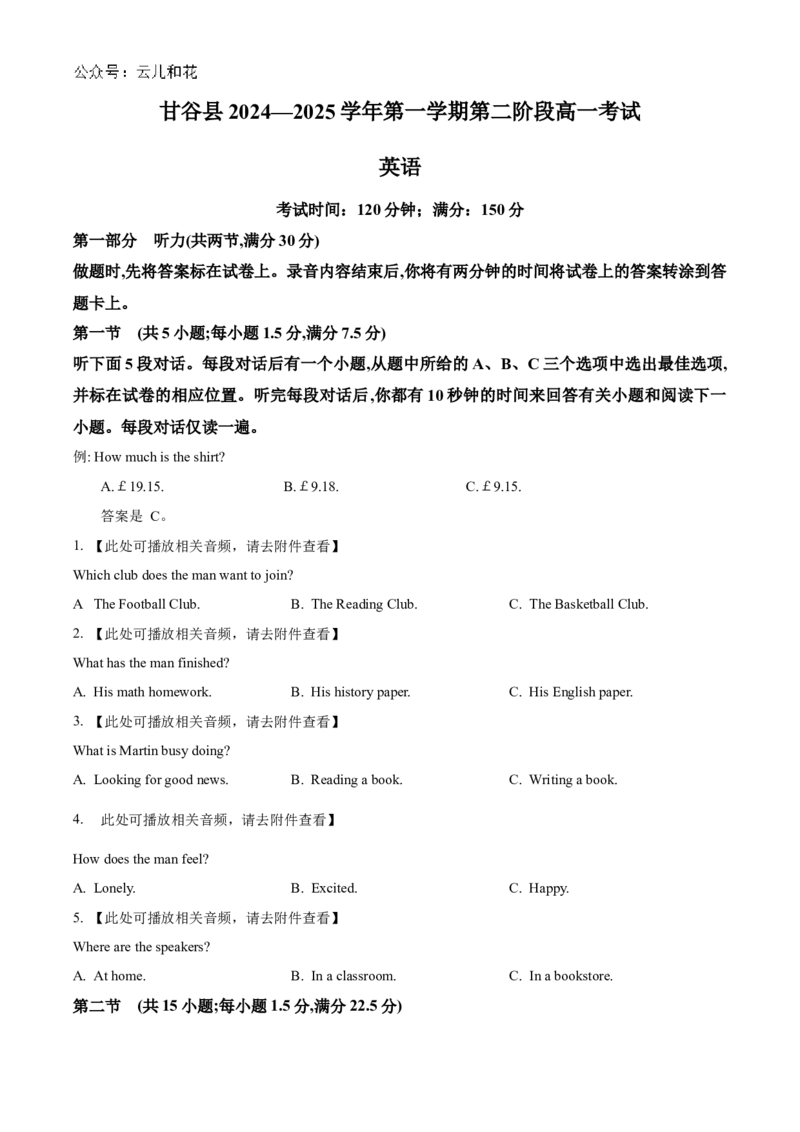
甘谷县 2024—2025 学年第一学期第二阶段高一考试
英语
考试时间:120分钟;满分:150分
第一部分 听力(共两节,满分30分)
做题时,先将答案标在试卷上。录音内容结束后,你将有两分钟的时间将试卷上的答案转涂到答
题卡上。
第一节 (共5小题;每小题1.5分,满分7.5分)
听下面5段对话。每段对话后有一个小题,从题中所给的A、B、C三个选项中选出最佳选项,
并标在试卷的相应位置。听完每段对话后,你都有10秒钟的时间来回答有关小题和阅读下一
小题。每段对话仅读一遍。
例: How much is the shirt?
A.£19.15. B.£9.18. C.£9.15.
答案是 C。
1. 【此处可播放相关音频,请去附件查看】
Which club does the man want to join?
.
A The Football Club. B. The Reading Club. C. The Basketball Club.
2. 【此处可播放相关音频,请去附件查看】
What has the man finished?
A. His math homework. B. His history paper. C. His English paper.
3. 【此处可播放相关音频,请去附件查看】
What is Martin busy doing?
A. Looking for good news. B. Reading a book. C. Writing a book.
【
4. 此处可播放相关音频,请去附件查看】
How does the man feel?
A. Lonely. B. Excited. C. Happy.
5. 【此处可播放相关音频,请去附件查看】
Where are the speakers?
A. At home. B. In a classroom. C. In a bookstore.
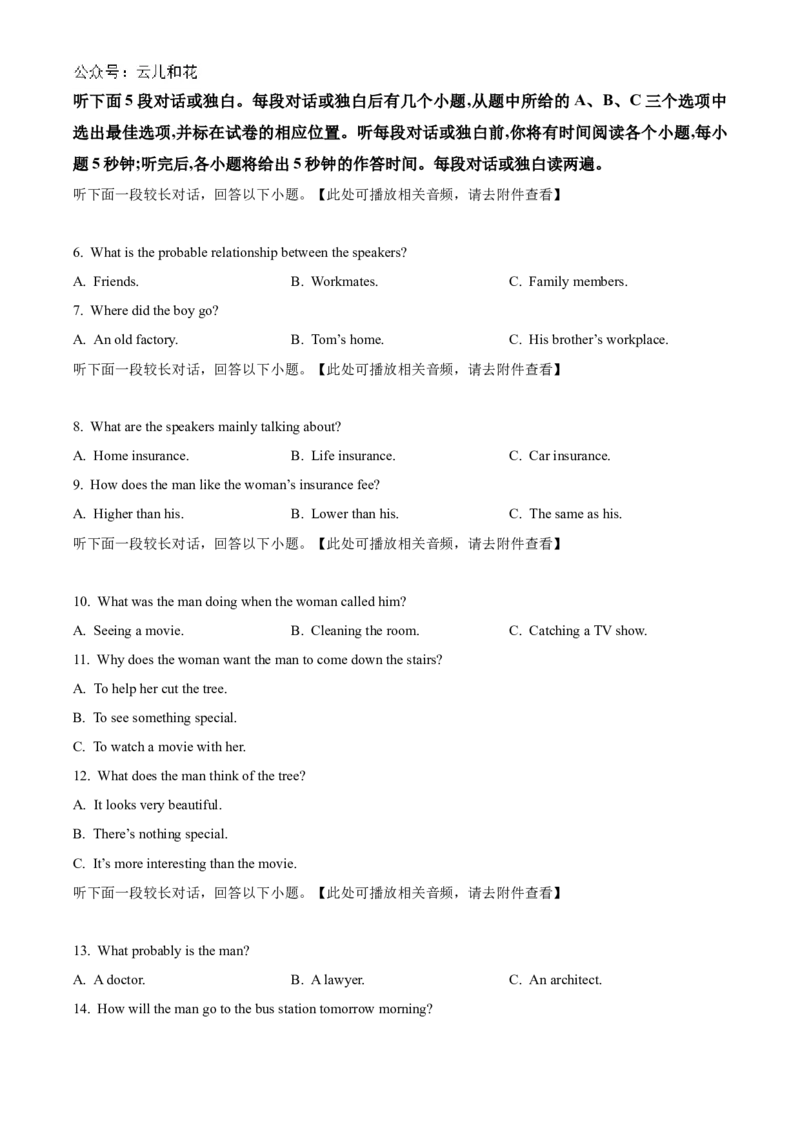
第二节 (共15小题;每小题1.5分,满分22.5分)听下面5段对话或独白。每段对话或独白后有几个小题,从题中所给的A、B、C三个选项中
选出最佳选项,并标在试卷的相应位置。听每段对话或独白前,你将有时间阅读各个小题,每小
题5秒钟;听完后,各小题将给出5秒钟的作答时间。每段对话或独白读两遍。
听下面一段较长对话,回答以下小题。【此处可播放相关音频,请去附件查看】
6. What is the probable relationship between the speakers?
A. Friends. B. Workmates. C. Family members.
7. Where did the boy go?
A. An old factory. B. Tom’s home. C. His brother’s workplace.
听下面一段较长对话,回答以下小题。【此处可播放相关音频,请去附件查看】
8. What are the speakers mainly talking about?
A. Home insurance. B. Life insurance. C. Car insurance.
9. How does the man like the woman’s insurance fee?
A. Higher than his. B. Lower than his. C. The same as his.
听下面一段较长对话,回答以下小题。【此处可播放相关音频,请去附件查看】
10. What was the man doing when the woman called him?
A. Seeing a movie. B. Cleaning the room. C. Catching a TV show.
11. Why does the woman want the man to come down the stairs?
A. To help her cut the tree.
B. To see something special.
C. To watch a movie with her.
12. What does the man think of the tree?
A. It looks very beautiful.
B. There’s nothing special.
C. It’s more interesting than the movie.
听下面一段较长对话,回答以下小题。【此处可播放相关音频,请去附件查看】
13. What probably is the man?
A. A doctor. B. A lawyer. C. An architect.
14. How will the man go to the bus station tomorrow morning?A. He will walk there.
B. He will go there in his car.
C. His wife will drive him there.
15. When will the man take the return bus tomorrow?
.
A At 6:30 pm. B. At 8:00 pm. C. At 9:30 pm.
16. What will the man do after coming back?
A. See a movie with his wife.
B. Go to a party with his wife.
C. Have dinner with the woman.
听下面一段独白,回答以下小题。【此处可播放相关音频,请去附件查看】
17. Where did the speaker prefer to get the information?
A. From magazines. B. From the Internet. C. From books.
18. What field did the speaker’s team work in?
A. Chemistry. B. Physics. C. Biology.
19. What did the teacher advise the speaker’s team to do?
A. Do the experiment at least three times.
B. Write each part of the process.
C. Work with other groups.
20. What was the difference between the speaker’s team and the others?
A. They designed a display.
B. They took a lot of photos.
C. They wrote little about the experiment.
第二部分 阅读理解(共两节,满分50分)
第一节(共15小题;每小题2.5分,满分37.5分)
阅读下列短文,从每题所给的A、B、C、D四个选项中选出最佳选项。
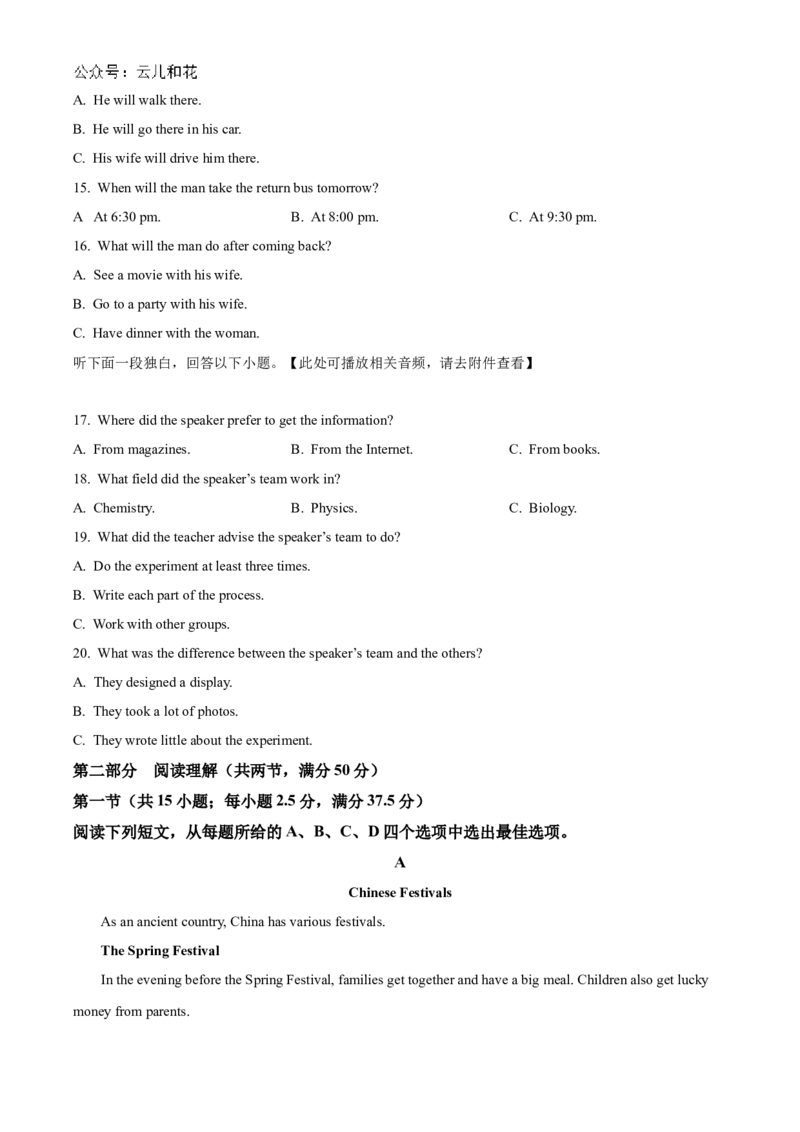
A
Chinese Festivals
As an ancient country, China has various festivals.
The Spring Festival
In the evening before the Spring Festival, families get together and have a big meal. Children also get lucky
money from parents.The Lantern Festival
During this festival, there is special food called “tang yuan”, which is said to symbolize both the first full
moon and family unity and completeness. Part of the Lantern Festival tradition involves a game to guess riddles
attached to the lanterns.
Stilt walking, drumming and dragon and lion dancing are the main entertainment forms of the Lantern
Festival.
The Dragon Boat Festival
The day is to celebrate the patriotic (爱国的) poet Qu Yuan, a loyal and highly respected minister, who
brought peace and prosperity to the state but ended up drowning himself in a river as a result of being vilified (诽
谤).
The Double Seventh Festival
On the 7th day of the 7th lunar month, there is a traditional festival full of romance.Recently the youth have
celebrated it as Valentine’s Day in China.
The MidAutumn Festival
It is a conventional festival for both the Han and minority nationalities in China.The custom of worshipping
the moon can be traced back to the ancient Xia and Shang Dynasties.The MidAutumn Festival is also a holiday for
members of a family to get together.
The Double Ninth Festival
On the ninth day of the ninth month in the Chinese lunar calendar, people celebrate the Double Ninth Festival.
People usually climb mountains and eat doubleninth cakes, which means our life will become better and better.
21. Which is NOT involved in the entertainments of the Lantern Festival?
A. Guessing riddles. B. Dragon dancing.
C. Stilt walking. D. Delicious food and lucky money.
22. Which of the following tells about a Chinese ancestor who is the symbol of devotees of his homeland?
A. The Spring Festival. B. The Dragon Boat Festival.
C. The Double Seventh Festival. D. The Double Ninth Festival.
23. What aspect is the MidAutumn Festival unique in?
A. Families’ getting together. B. A festival for the Han nationality.
C. Worshipping the moon. D. Symbolizing the first full moon.
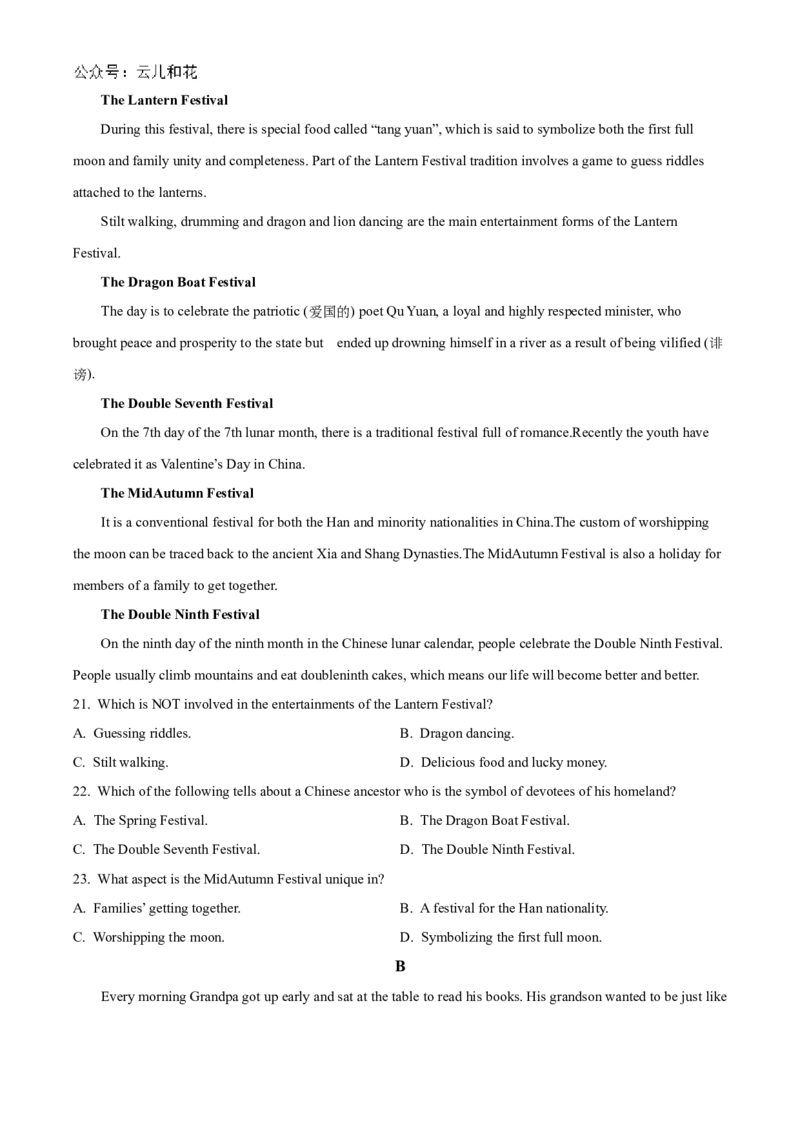
B
Every morning Grandpa got up early and sat at the table to read his books. His grandson wanted to be just likehim so he tried to imitate him in any way he could.
One day, grandson said, “Grandpa, I tried to read those books just like you did, but I forgot what I had read as
soon as I closed the books. What benefits does the reading have?”
Turning around, the old man pointed to a dirty basket beside the table and replied, “Take this basket down to the
river and bring back a basket of water.”
The boy did as he was told, but all the water was all gone before he got back to the house. Grandpa laughed and
said, “You have to run a little faster next time.”
Again, the boy did as he was told. But the basket was still empty before he reached the house. Out of breath, he
told grandpa that it was impossible to carry water in a basket. He decided to get a bucket instead.
But Grandpa said, “I don’t want a bucket of water. I just want a basket of water. Maybe, you’re not trying hard
enough.”
Again, the boy did as he was told. But when he ran back, the basket was still empty. He said breathlessly,
“Grandpa, it’s useless!”
“Do you think so?” Grandpa asked, “Look at the basket again.”
The boy looked at the basket and for the first time he realized that the basket was different. It had been changed
from a dirty basket to a clean one.
The lesson: We might not remember everything, but when we keep reading, we’ll be changed, inside and
outside.
24. Why did Grandpa ask his grandson to use a basket to carry water?
A. To train him to run faster. B. To show what benefits reading can have.
C. To clean the dirty basket. D. To punish him for not reading carefully.
25. What does the underline word “imitate” in Paragraph 1 most probably mean?
A. copy. B. encourage. C. challenge. D. admire.
26. Which of the following best describes Grandpa?
A. Funny. B. Stupid. C. Curious. D. Wise.
27. What lesson does the author want us to learn from the story?
A. Reading can change a person slowly.
B. It is foolish to carry water with a basket.
C. The old are always smarter than the young.
D. It is important to remember what we read.
C
Lion dance, which mimics (模仿) a lion with kung fu and acrobatic (杂技的) styles, is a traditional Chineseperforming art that could often be seen during festive occasions like Spring Festival. It’s believed to have started in
the Three Kingdoms period and peaked in the Southern and Northern Dynasties. In ancient China, the lion was
regarded as a symbol of good luck. The lion dance is often performed in celebrations to this day and in 2006, it was
listed as a national intangible cultural heritage (非物质文化遗产).
Qiu Haiwei, 17, and Huang Qingliang, 16, are two lion dance lovers in Guangxi Zhuang autonomous region.
They started learning the dance two years ago. Though lion dance performances are breathtaking, learning the art is
another matter.
Dancing on the poles makes the art a fascinating sight. There are 21 poles of heights between 1.2 meters and
2.5 meters with up to 1.8 meters between them. A single false step will send the performers falling to the ground
below.
As a result, the ancient art form has fallen out of favor with the young generation, as the skills take years to
master while only a low wage can be earned. Also, coaches and funding can be hard to find, so it’s difficult for a
lion dance troupe (表演队) to survive. But since 2017, local authorities in Guangxi have teamed up with companies
and schools to help reboot the ancient art.
“We must work hard to help pass on the heritage and its spirit to future generations,” Deng Minghua, a
national inheritor of the cultural heritage, told Xinhua.
28. What’s the longest distance between two poles used for lion dance?
A. 1.8 meters. B. 2.5 meters. C. 1.2 meters. D. 2.4 meters.
29. Why is it difficult for the lion dance troupe to survive?
A. No one wants to learn lion dance.
B. Mastering lion dance takes decades.
.
C The payment is not satisfying enough.
D. Coaches are not professional enough.
30. What can be learned about lion dance according to the text?
A. People will perform it only in spring festival.
B. Local authorities attach great importance to it.
C. It started in the Southern and Northern Dynasties.
D. It has been added to the list of tangible cultural heritage.
31. What’s the text mainly about?
A. The future development of lion dance.
B. How to perform lion dance successfully.C. Why young generations don’t prefer lion dance.
D. The importance of keeping lion dance culture alive.
D
Teenagers’ fitness is now a major concern, to which physical exercise is very important. It reduces stress and
improves fitness. Exercise makes your body strong, and helps you to keep the right body weight. Sports scientist Dr.
Helen Lopez offers the following advice to teenagers: “Firstly, you need to find out your present level of fitness. Then
you can design a programme that will help you become healthier.”
Dr. Lopez suggests that there are three levels of fitness that need a change of lifestyle. “Overweight” means that
the person gets very little exercise and often has a serious weight problem. “Inactive” means that the person does not
join in many physical activities, but is not seriously overweight. “Active” refers to people who take part in sports and
other physical activities, but do not have a high fitness level.
According to Dr. Lopez, overweight teenagers should keep active to keep healthy. Ride a bike, play volleyball
or basketball for a while, and go for a twenty-minute walk each day. All these will help to burn up calories. Inactive
teenagers should do similar activities, but add some bending and stretching exercises, such as push-ups (俯卧撑) and
sit-ups (仰卧起坐), starting with twenty of each a day. “Inactive people can take a little more exercise than overweight
people because their bodies are stronger,” said Dr. Lopez. The same principle applies to active teenagers.
,
Dr. Lopez suggests one hour a week or more on running and other forms of intensive exercise together with
fifteen minutes a day spent on stretching and bending activities. “These are really important in order to prevent
injuries,” Dr. Lopez said. Some weight-training and other body-strengthening exercises could also be planned in the
programme in order to increase the person’s strength.
32. What can we learn from the passage?
A. Active people always have a high fitness level.
B. Overweight people always take more exercise.
C. Inactive teenagers are not seriously overweight.
D. Keeping fit means changing teenagers’ lifestyle.
33. Which of the following statements is NOT mentioned in the text?
A. Physical exercise can make the teenagers grow taller.
B. Physical exercise can help teenagers become healthier.
C. Physical exercise can help to burn up calories.
D. Physical exercise can increase teenagers’ strength.
34. In order to prevent injuries, you should do some ________ exercises.A. walking B. stretching and bending
C. riding D. weight-training
35. What is the best title for the passage?
A. Doing exercises B. Teenagers’ fitness
C. Different lifestyles D. Overweight teenagers
第二节(共5小题;每小题2.5分,满分12.5分)
根据下面短文,从短文后的选项中选出可以填入空白处的最佳选项。选项中有两项为多余选
项。
Double Ninth Festival is celebrated on the ninth day of the ninth lunar month, which is a traditional festival first
mentioned in records before the Eastern Han Dynasty. ____36____
Climbing Mountains
People like to climb mountains on this festival, so Double Ninth Festival is also called “Mountain-climbing
Festival”. The early ninth lunar month, with clear autumn sky and fresh air, is a good time for sightseeing. ____37____
It is really refreshing to climb mountains and enjoy the beauty of nature at this bright and clear time in autumn.
Climbing mountains also indicates “climbing for a higher position”. Another reason why climbing mountains is
valued by people, especially by the elderly is that it has a meaning of “climbing for longevity (长寿)”. Climbing
mountains on Double Ninth Festival was already popular in the Tang Dynasty. ____38____
Drinking Chrysanthemum (菊花) Wine
The chrysanthemum is usually in full blossom at the ninth lunar month, therefore, it is also named for “flower
of longevity”. The chrysanthemum wine is unique in making. In ancient times, people usually picked fresh
chrysanthemums and leaves on the ninth day of the ninth lunar month, and made the mixture of them into the wine.
____39____ The wine is said to have great effects on the sharpness of eyes, loss of weight and decrease of stomach
trouble, thus contributing to longevity.
____40____
The Double Ninth cake is also known as “the flower cake”. It is said that the cake was originally prepared after
autumn harvests for farmers to have a taste of what was just in season, and it gradually grew into the present cake for
people to eat on the Double Ninth Festival.
A. Eating Double Ninth Cakes
B. Making the “Flower Cake” with Friends
C. A lot of poems were related to this custom.
D. So people love to go sightseeing this month.E. It would not be drunk until the same day next year.
F. Here are some traditional customs of the Double Ninth Festival.
G. But few Chinese people are aware of the importance of the festival.
第二部分 英语知识运用(共两节,满分45分)
第一节 (共15小题;每小题1分,满分15分)
During my first three years of college, I put on weight quickly. Between classwork and a part-time job, I had
zero time for ___41___. Besides, I ate a lot of fast food. Not surprisingly, I ___42___ a fat stomach.
After leaving college, I ____43____ to take exercise. Invited by a friend, I ____44____ working out with
exercise machines three times a week. I was the kind of person who did not try something ____45____. I ate the
same food; I did the same thing. Clearly, I ____46____ my routines (习惯). My friend, however, became ____47____
One day, he said, “We’re not getting enough exercise. We should play tennis instead.”
Me? Play tennis? No way. I was strongly against his ____48____ .I was not good at sports and I was
____49____ the exercise machines. ______50______, weeks later, I found myself standing on a tennis court.As I
held my racket (球拍), I felt ______51______. I ran after every ball he served to me, completely ______52______
about 90%of them, and hitting the rest into the other court. The first few months were quite ______53______. But
one day as the ball came flying toward me, my racket and the ball finally met in the place where it is most effective
to hit a ball. I watched in ______54______ as my return landed where I had aimed it. I had finally ______55______
how to play tennis properly!
41. A. games B. holidays C. research D. exercise
42. A. wanted B. got C. hated D. protected
43. A. decided B. agreed C. regretted D. continued
44. A. avoided B. imagined C. began D. minded
45. A. important B. new C. simple D. similar
46. A. liked B. changed C. hid D. completed
47. A. busy B. careless C. bored D. lazy
48. A. rule B. job C. reply D. idea
49. A. worried about B. satisfied with C. sure of D. ashamed of
50. A. However B. Additionally C. Besides D. Therefore
51. A. silly B. relaxed C. proud D. satisfied
52. A. controlling B. throwing C. missing D. playing
53. A. interesting B. tough C. different D. easy54. A. secret B. anger C. fear D. surprise
55. A. asked B. learned C. taught D. remembered
第二节(共10小题;每小题1.5分,满分15分)
阅读下面短文,在空白处填入1个适当的单词或括号内单词的正确形式。
I still remember the last Christmas Granny ____56____ (spend) with us. When she moved in, I was too young and
too excited to notice she was in poor ____57____ (healthy). When I wrote a letter to Father Christmas telling him
about the presents I wanted, Granny made an effort ____58____ (help) me. With our ____59____ (excite) growing
each day, we made sugar biscuits and sang Christmas songs. ____60____ Christmas Eve, we hung most of the
decorations on the Christmas tree. “That’s ____61____ (beautiful) tree I’ve ever seen,” Granny said. Before bed,
we left ____62____ plate of sugar biscuits out for Father Christmas and put a stocking at the end of my bed. I
remember Granny sitting on my bed and singing softly ____63____ I fell asleep. On Christmas Day, Granny gave
me a music box with a ballet dancer inside. Lunch was late, but it was a loud and exciting affair. A few ____64____
(week) after that Christmas, Granny passed away. I miss her and always think about what makes Christmas so magical,
it’s not only gifts and Father Christmas ______65______ also my memory of Granny that comes to mind.
第四部分 书面表达(满分40分)
第一节(满分15分)
66. 假设你是李华,正在美国一所高中交换学习。近日联合国通过决议,将农历新年列为联合国假日。因
此,你所在的学校邀请你为校报写一篇关于春节的主题短文。内容包括:
1.春节的时间;
2.春节的习俗;
3.春节的意义。
注意:
1.写作词数应为80左右;
2.请按如下格式在答题卡的相应位置作答。
Festive China: The Spring Festival
____________________________________________________________________________________________
____________________________________________________________________________________________
____________________________________________________________________________________________
___________________________________________________________________
第二节(满分25分)
67. 阅读下面材料,根据其内容和所给段落开头语续写两段,使之构成一篇完整的短文。Peter woke up early in the morning. He went downstairs in a hurry and started to have hisbreakfast as quickly
as possible.
“Why are you in such a hurry, early bird?" Mum asked him. “We will have an English spelling test today,
Mum," Peter said. “Mr. White promised to offer prizes to those who get 100 scores. I've been studying the word list
since last week. Although the words are difficult, I am well prepared for them.”
Peter reviewed the spelling of each word once more carefully when Dad drove down.
Thirty words later, the test papers were collected by Mr. White. “I am to mark your papers now," he told the
class. After marking the test papers, Mr. White said, “Three of you won a prize today for excellent test scores. Peter.
David and Mary got 100 percent on the spelling test!" Mr. White praised them. Meanwhile, he gave the three
students each a dictionary. Peter's was an English-Chinese dictionary—the one he liked best. Peter was so excited
that he held it high when his classmates cheered. "This is my happiest moment,” Peter thought.
After Mr. White gave the test paper back, Peter had a look at the words, feeling proud of his spelling. All of a
sudden, the word “contribution" confused him. It didn't seem right. Peter began to compare them after taking out
the wordlist. “C-o-n-t-r-i-b-u-s-i-o-n,”he whispered. He had spelledit wrong.
“What am I to do?” Peter said to himself. “I expect my classmates to think I'm a master in spelling. If I tell Mr.
White one of my spelling words is wrong, I'll have to give my prize back, or I will become an example for telling a
lie". Staring at the red sign “100%” which was written at his test paper, Peter was lost in thought. After a while, he
remembered a lesson Mum used to teach him, “We ought to be an honest person.”
注意:
1.续写词数应为150左右;
2.请按如下格式作答。
Slowly, Peter raised his hand.
____________________________________________________________________________________________
__________________________________________________________________
Peter looked around and found many of his classmates were smiling at him.
____________________________________________________________________________________________
__________________________________________________________________