机密*启用前
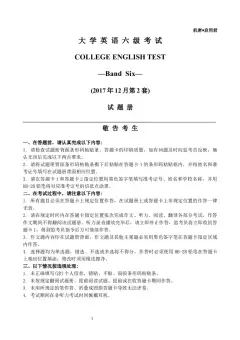
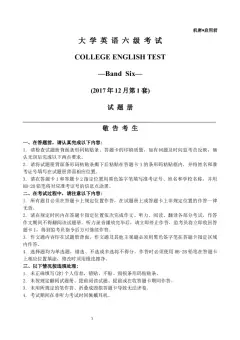
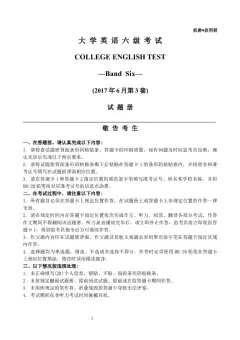
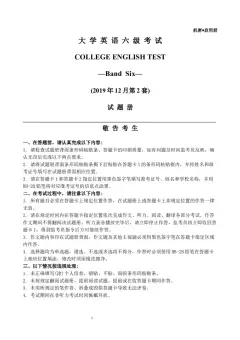
大 学 英 语 六 级 考 试
COLLEGE ENGLISH TEST
—Band Six—
(2017 年 12 月第 3 套)
试 题 册
敬 告 考 生
一、在答题前,请认真完成以下内容:
1. 请检查试题册背面条形码粘贴条、答题卡的印刷质量,如有问题及时向监考员反映,确
认无误后完成以下两点要求。
2. 请将试题册背面条形码粘贴条揭下后粘贴在答题卡 1的条形码粘贴框内,并将姓名和准
考证号填写在试题册背面相应位置。
3. 请在答题卡1和答题卡2指定位置用黑色签字笔填写准考证号、姓名和学校名称,并用
HB-2B铅笔将对应准考证号的信息点涂黑。
二、在考试过程中,请注意以下内容:
1. 所有题目必须在答题卡上规定位置作答,在试题册上或答题卡上非规定位置的作答一律
无效。
2. 请在规定时间内在答题卡指定位置依次完成作文、听力、阅读、翻译各部分考试,作答
作文期间不得翻阅该试题册。听力录音播放完毕后,请立即停止作答,监考员将立即收回答
题卡1,得到监考员指令后方可继续作答。
3. 作文题内容印在试题册背面,作文题及其他主观题必须用黑色签字笔在答题卡指定区域
内作答。
4. 选择题均为单选题,错选、不选或多选将不得分,作答时必须使用 HB-2B铅笔在答题卡
上相应位置填涂,修改时须用橡皮擦净。
三、以下情况按违规处理:
1. 未正确填写(涂)个人信息,错贴、不贴、毁损条形码粘贴条。
2. 未按规定翻阅试题册、提前阅读试题、提前或在收答题卡期间作答。
3. 未用所规定的笔作答、折叠成毁损答题卡导致无法评卷。
4. 考试期间在非听力考试时间佩戴耳机。
1全国大学英语四、六级考试委员会
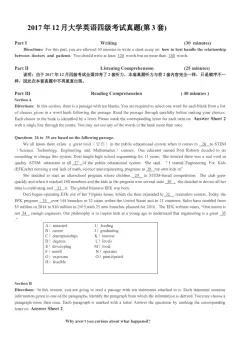
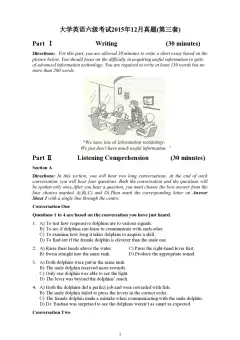
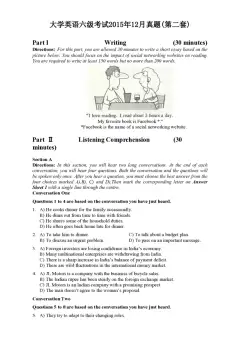
2Part I Writing (30 minutes)
Directions: For this part, you are allowed 30 minutes to write an essay commenting on the saying "Help others,
and you will be helped when you are in need." You can cite examples to illustrate your views. You should write at
least 150 words but no more than 200 words.
Part II Listening Comprehension (30 minutes)
特别说明:由于 2017 年 12月六级考试全国共考了 2 套听力,本套听力试题同第1套或第2套试题一致,
因此在本套真题中不再重复出现。
Part III Reading Comprehension (40 minutes)
Section A
Directions: In this section, there is a passage with ten blanks. You are required to select one word for each blank
from a list of choices given in a word bank following the passage. Read the passage through carefully before
making your choices. Each choice in the bank is identified by a letter. Please mark the corresponding letter for
each item on Answer Sheet 2 with a single line through the centre. You may not use any of the words in the bank
more than once.
Many European countries have been making the shift to electric vehicles and Germany has just stated that
they plan to ban the sale of vehicles using gasoline and diesel as fuel by 2030. The country is also planning to
reduce its carbon footprint by 80-95% by 2050, 26 a shift to green energy in the country. Effectively, the ban will
include the registration of new cars in the country as they will not allow any gasoline 27 vehicle to be registered
after 2030.
Part of the reason this ban is being discussed and 28 is because energy officials see that they will not reach
their emissions goals by 2050 if they do not 29 a large portion of vehicle emissions. The country is still 30 that it
will meet its emissions goals, like reducing emissions by 40% by 2020, but the 31 of electric cars in the country
has not occurred as fast as ejected.
Other efforts to increase the use of electric vehicles include plans to build over 1 million hybrid and electric
car battery changing stations across the country. By 2030, Germany plans on having over 6 million charging
stations 32 . According to the International Business Times, electric car sales are expected to increase as
Volkswagen is still recovering from its emissions scandal.
There are 33 around 155,000 registered hybrid and electric vehicles on German roads, dwarfed by the 45
million gasoline and diesel cars driving there now. As countries continue setting goals of reducing emissions,
greater steps need to be taken to have a 34 effect on the surrounding environment. While the efforts are certainly
not 35 , the results of such bans will likely only start to be seen by generations down the line, bettering the world
for the future.
3A) acceptance I) incidentally
B) currently J) installed
C) disrupting K) noticeable
D) eliminate L) powered
E) exhaust M) restoration
F) futile N) skeptical
G) hopeful O) sparking
H) implemented
Section B
Directions: In this section, you are going to read a passage with ten statements attached to it. Each statement
contains information given in one of the paragraphs. Identify the paragraph from which the information is
derived. You may choose a paragraph more than once. Each paragraph is marked with a letter. Answer the
questions by marking the corresponding letter on Answer Sheet 2.
Apple's Stance Highlights a More Confrontational Tech Industry
[A] The battle between Apple and law enforcement officials over unlocking a terrorist's smartphone is the
culmination of a slow turning of the tables between the technology industry and the United States government.
[B] After revelations by the former National Security Agency contractor Edward J. Snowden in 2013 that the
government both cozied up to (讨好) certain tech companies and hacked into others to gain access to private data
on an enormous scale, tech giants began to recognize the United States government as a hostile actor. But if the
confrontation has crystallized in this latest battle, it may already be heading toward a predictable conclusion: In
the long run, the tech companies are destined to emerge victorious.
[C] It may not seem that way at the moment. On the one side, you have the United States government's mighty
legal and security apparatus fighting for data of the most sympathetic sort: the secrets buried in a dead mass
murderer's phone. The action steins from a federal court order issued on Tuesday requiring Apple to help the
Federal Bureau of Investigation (FBI) to unlock an iPhone used by one of the two attackers who killed 14 people
in San Bernardino, California, in December.
[D] In the other corner is the world's most valuable company, whose chief executive, Timothy Cook, has said he
will appeal the court's order. Apple argues that it is fighting to preserve a principle that most of us who are
addicted to our smartphones can defend: Weaken a single iPhone so that its contents can be viewed by the
American government and you risk weakening all iPhones for any government intruder, anywhere.
4[E] There will probably be months of legal confrontation, and it is not at all clear which side will prevail in court,
nor in the battle for public opinion and legislative favor. Yet underlying all of this is a simple dynamic: Apple,
Google, Facebook and other companies hold most of the cards in this confrontation. They have our data, and their
businesses depend on the global public's collective belief that they will do everything they can to protect that data.
[F] Any crack in that front could be fatal for tech companies that must operate worldwide. If Apple is forced to
open up an iPhone for an American law enforcement investigation, what is to prevent it from doing so for a
request from the Russians or the Iranians? If Apple is forced to write code that lets the FBI get into the Phone 5c
used by Syed Rizwan Farook, the male attacker in the San Bernardino attack, who would be responsible if some
hacker got hold of that code and broke into its other devices?
[G] Apple's stance on these issues emerged post-Snowden, when the company started putting in place a series of
technologies that, by default, make use of encryption (加密)to limit access to people's data. More than that,
Apple—and, in different ways, other tech companies, including Google, Facebook, Twitter and Microsoft—have
made their opposition to the government's claims a point of corporate pride.
[H] Apple's emerging global brand is privacy; it has staked its corporate reputation, not to mention the investment
of considerable technical and financial resources, on limiting the sort of mass surveillance that was uncovered by
Mr. Snowden. So now, for many cases involving governmental intrusions into data, once-lonely privacy advocates
find themselves fighting alongside the most powerful company in the world.
[I] "A comparison point is in the 1990s battles over encryption," said Kurt Opsahl, general counsel of the
Electronic Frontier Foundation, a privacy watchdog group. "Then you had a few companies involved, but not one
of the largest companies in the world coming out with a lengthy and impassioned post, like we saw yesterday
from Timothy Cook. Its profile has really been raised."
[J] Apple and oilier tech companies hold another ace: the technical means to keep making their devices more and
more inaccessible. Note that Apple's public opposition to the government's request is itself a hindrance to mass
government intrusion. And to get at the contents of a single iPhone, the government says it needs a court order and
Apple's help to write new code; in earlier versions of the iPhone, ones that were created before Apple found
religion on (热衷于) privacy, the FBI might have been able to break into the device by itself.
[K] You can expect that noose (束缚) to continue to tighten. Experts said that whether or not Apple loses this
specific case, measures that it could put into place in the future will almost certainly be able to further limit the
government's reach.
[L] That is not to say that the outcome of the San Bernardino case is insignificant. As apple and several security
experts have argued, an order compelling Apple to write software that gives the FBI access to the iPhone in
question would establish an unsettling precedent. The order essentially asks Apple to hack its own devices, and
5once it is in place, the precedent could be used to justify law enforcement efforts to get around encryption
technologies in other investigations far removed from national security threats.
[M] Once aimed with a method for gaining access to iPhones, the government could ask to use it proactively (先
发制人地), before a suspected terrorist attack—leaving Apple in a bind as to whether to comply or risk an attack
and suffer a public-relations nightmare. "This is a brand new move in the war against encryption," Mr. Opsahl
said. "We have had plenty of debates in Congress and the media over whether the government should have a
backdoor, and this is an end run (迂回战术) around that—here they come with an order to create that backdoor."
[N] Yet it is worth noting that even if Apple ultimately loses this case, it has plenty of technical means to close a
backdoor over time. "If they are anywhere near worth their salt as engineers, I bet they are rethinking their threat
model as we speak," said Jonathan Zdziarski, a digital expert who studies the iPhone and its vulnerabilities.
[O] One relatively simple fix, Mr. Zdziarski said, would be for Apple to modify future versions of the iPhone to
require a user to enter a passcode before the phone will accept the sort of modified operating system that the FBI
wants Apple to create. That way, Apple could not unilaterally introduce a code that weakens the iPhone—a user
would have to consent to it.
[P] "Nothing is 100 percent hacker-proof," Mr. Zdziarski said, but he pointed out that the judge's order in this case
required Apple to provide "reasonable security assistance" to unlock Mr. Farook's phone. If Apple alters the
security model of future iPhones so that even its own engineers' "reasonable assistance" will not be able to crack a
given device when compelled by the government, a precedent set in this case might lose its lasting force. In other
words, even if the FBI wins this case, in the long run, it loses.
36. It is a popular belief that tech companies are committed to protecting their customers' private data.
37. The US government believes that its access to people's iPhones could be used to prevent terrorist attacks.
38. A federal court asked Apple to help the FBI access data in a terrorist's iPhone.
39. Privacy advocates now have Apple fighting alongside them against government access to personal data.
40. Snowden revealed that the American government had tried hard to access private data on a massive scale.
41. The FBI might have been able to access private data in earlier iPhones without Apple's help.
42. After the Snowden incident, Apple made clear its position to counter government intrusion into personal data
by means of encryption.
643. According to one digital expert, no iPhone can be entirely free from hacking.
44. Timothy Cook's long web post has helped enhance Apple's image.
45. Apple's CEO has decided to appeal the federal court's order to unlock a user's iPhone.
Section C
Directions: There are 2 passages in this section. Each passage is followed by some questions or unfinished
statements. For each of them there are four choices marked A), B), C) and D). You should decide on the best
choice and mark the corresponding letter on Answer Sheet 2 with a single line through the centre.
Passage One
Questions 46 to 50 are based on the following passage.
At the base of a mountain in Tanzania's Gregory Rift, Lake Natron burns bright red, surrounded by the
remains of animals that were unfortunate enough to fall into the salty water. Bats, swallows and more are
chemically preserved in the pose in which they perished, sealed in the deposits of sodium carbonate in the water.
The lake's landscape is bizarre and deadly—and made even more so by the fact that it's the place where nearly 75
percent of the world's flamingos (火烈鸟)are born.
The water is so corrosive that it can burn the skin and eyes of unadapted animals. Flamingos, however, are
the only species that actually makes life in the midst of all that death. Once every three or four years, when
conditions are right, the lake is covered with the pink birds as they stop flight to breed. Three-quarters of the
world's flamingos fly over from other salt lakes in the Rift Valley and nest on salt-crystal islands that appear when
the water is at a specific level—too high and the birds can't build their nests, too low and predators can move
briskly across the lake bed and attack. When the water hits the right level, the baby birds are kept safe from
predators by a corrosive ditch.
"Flamingos have evolved very leathery skin on their legs so they can tolerate the salt water," says David
Harper, a professor at the University of Leicester. "Humans cannot, and would die if their legs were exposed for
any length of time." So far this year, water levels have been too high for the flamingos to nest.
Some fish, too, have had limited success vacationing at the lake as less salty lagoons (泻湖) form on the
outer edges from hot springs flowing into Lake Natron. Three species of tilapia (罗非鱼) thrive there part-time.
"Fish have a refuge in the streams and can expand into the lagoons when the lake is low and the lagoons are
separate," Harper said. "All the lagoons join when the lake is high and fish must retreat to their stream refuges or
die." Otherwise, no fish are able to survive in the naturally toxic lake.
This unique ecosystem may soon be under pressure. The Tanzanian government has once again started
mining the lake for soda ash, used for making chemicals, glass and detergents. Although the planned operation
will be located more than 40 miles away, drawing the soda ash in through pipelines, conservationists worry it
could still upset the natural water cycle and breeding grounds. For now, though, life prevails—even in a lake that
kills almost everything it touches.
746. What can we learn about Lake Natron?
A) It is simply uninhabitable for most animals.
B) It remains little known to the outside world.
C) It is a breeding ground for a variety of birds.
D) It makes an ideal habitat for lots of predators.
47. Flamingos nest only when the lake water is at a specific level so that their babies can .
A) find safe shelter more easily
B) grow thick feathers on their feet
C) stay away from predators
D) get accustomed to the salty water
48. Flamingos in the Rift Valley are unique in that .
A) they can move swiftly across lagoons
B) they can survive well in salty water
C) they breed naturally in corrosive ditches
D) they know where and when to nest
49. Why can certain species of tilapia sometimes survive around Lake Natron?
A) They can take refuge in the less salty waters.
B) They can flee quick enough from predators.
C) They can move freely from lagoon to lagoon.
D) They can stand the heat of the spring water.
50. What may be the consequence of Tanzanian government's planned operation?
A) The accelerated extinction of flamingos.
B) The change of flamingos' migration route.
C) The overmining of Lake Natron's soda ash.
D) The disruption of Lake Natron's ecosystem.
Passage Two
Questions 51 to 55 are based on the following passage.
It is the season for some frantic last-minute math—across the country, employees of all stripes are counting
backward in an attempt to figure out just how much paid time-off they have left in their reserves. More of them,
though, will skip those calculations altogether and just power through the holidays into 2017: More than half of
American workers don't use up all of their allotted vacation days each year.
8Not so long ago, people would have turned up their noses at that kind of dedication to the job. As marketing
professors Silvia Bellezza, Neeru Paharia, and Anat Keinan recently explained in Harvard Business Review
(HBR), leisure time was once seen as an indicator of high social status, something attainable only for those at the
top. Since the middle of the 20th century, though, things have turned the opposite way—these days, punishing
hours at your desk, rather than days off, are seen as the mark of someone important.
In a series of several experiments, the researchers illustrated just how much we've come to admire busyness,
or at least the appearance of it. Volunteers read two passages, one about a man who led a life of leisure and
another about a man who was over-worked and over-scheduled; when asked to determine which of the two had a
higher social status, the majority of the participants said the latter. The same held true for people who used
products that implied they were short on time: In one experiment, for example, customers of the grocery-delivery
service Peapod were seen as of higher status than people who shopped at grocery stores that were equally
expensive; in another, people wearing wireless headphones were considered further up on the social ladder than
those wearing regular headphones, even when both were just used to listen to music.
In part, the authors wrote in HBR, this pattern may have to do with the way work itself has changed over the
past several decades.
We think that the shift from leisure-as-status to busyness-as-status may be linked to the development of
knowledge-intensive economics. In such economies, individuals who possess the human capital characteristics
that employers or clients value (e. g. , competence and ambition) are expected to be in high demand and short
supply on the job market. Thus, by telling others that we are busy and working all the time, we are implicitly
suggesting that we are sought after, which enhances our perceived status.
Even if you feel tempted to sacrifice your own vacation days for fake busyness, though, at least consider
leaving your weekends unscheduled. It's for your own good.
51. What do most employees plan to do towards the end of the year?
A) Go for a vacation.
B) Keep on working.
C) Set an objective for next year.
D) Review the year's achievements.
52. How would people view dedication to work in the past?
A) They would regard it as a matter of course.
B) They would consider it a must for success.
C) They would look upon it with contempt.
D) They would deem it a trick of businessmen.
53. What did the researchers find through a series of experiments?
A) The busier one appears, the more respect one earns.
B) The more one works, the more one feels exploited.
C) The more knowledge one has, the more competent one will be.
9D) The higher one's status, the more vacation time one will enjoy.
54. What may account for the change of people's attitude towards being busy?
A) The fast pace of life in modern society.
B) The fierce competition in the job market.
C) The widespread use of computer technology.
D) The role of knowledge in modern economy.
55. What does the author advise us to do at the end of the passage?
A) Schedule our time properly for efficiency.
B) Plan our weekends in a meaningful way.
C) Find time to relax however busy we are.
D) Avoid appearing busy when we are not.
Part IV Translation (30 minutes)
Directions: For this part, you are allowed 30 minutes to translate a passage from Chinese into English. You
should write your answer on Answer Sheet 2.
洞庭湖位于湖南省东北部,面积很大,但湖水很浅。洞庭湖是长江的蓄洪池,湖的大校很大程度上
取决于季节变化,湖北和湖南两省因其与湖的相对位置而得名,湖北意为“湖的北边”,而湖南则为
“湖的南边”。洞庭湖作为龙舟赛的发源地,在中国文化中享有盛名。据说龙舟赛始于洞庭湖东岸。为
的是搜寻楚国爱国诗人屈原的遗体。龙舟赛与洞庭湖及周边的美景,每年都吸引着成千上万来自全国和
世界各地的游客。
10