机密*启用前
大 学 英 语 四 级 考 试
COLLEGE ENGLISH TEST
—Band Four—
(2019 年 12 月第 3 套)
试 题 册
敬 告 考 生
一、在答题前,请认真完成以下内容:
1. 请检查试题册背面条形码粘贴条、答题卡的印刷质量,如有问题及时向监考员反映,确
认无误后完成以下两点要求。
2. 请将试题册背面条形码粘贴条揭下后粘贴在答题卡1的条形码粘贴框内,并将姓名和准
考证号填写在试题册背面相应位置。
3. 请在答题卡1和答题卡2指定位置用黑色签字笔填写准考证号、姓名和学校名称,并用
HB-2B铅笔将对应准考证号的信息点涂黑。
二、在考试过程中,请注意以下内容:
1. 所有题目必须在答题卡上规定位置作答,在试题册上或答题卡上非规定位置的作答一律
无效。
2. 请在规定时间内在答题卡指定位置依次完成作文、听力、阅读、翻译各部分考试,作答
作文期间不得翻阅该试题册。听力录音播放完毕后,请立即停止作答,监考员将立即收回答
题卡1,得到监考员指令后方可继续作答。
3. 作文题内容印在试题册背面,作文题及其他主观题必须用黑色签字笔在答题卡指定区域
内作答。
4. 选择题均为单选题,错选、不选或多选将不得分,作答时必须使用HB-2B铅笔在答题卡
上相应位置填涂,修改时须用橡皮擦净。
三、以下情况按违规处理:
1. 未正确填写(涂)个人信息,错贴、不贴、毁损条形码粘贴条。
2. 未按规定翻阅试题册、提前阅读试题、提前或在收答题卡期间作答。
3. 未用所规定的笔作答、折叠成毁损答题卡导致无法评卷。
4. 考试期间在非听力考试时间佩戴耳机。
1全国大学英语四、六级考试委员会
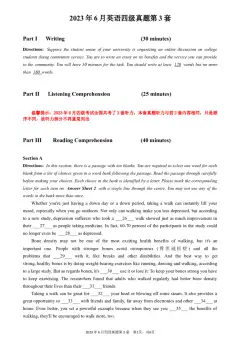
Part I Writing (30 minutes)
Directions: For this part, you are allowed 30 minutes to write a letter to a foreign friend who wants to study in China.
Please recommend a university to him. You should write at least 120 words but no more than 180 words.
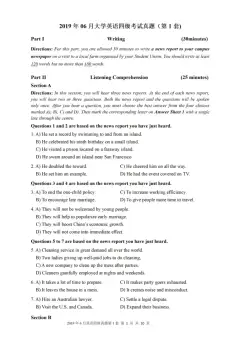
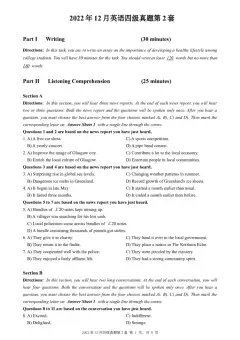
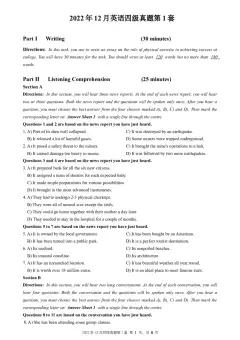
Part II Listening Comprehension (25 minutes)
特别说明:由于2019年12月四级考试全国共考了2套听力,本套听力试题同第1套或第2套试题一致,
因此在本套真题中不再重复出现。
Part III Reading Comprehension (40 minutes)
Section A
Directions: In this section, there is a passage with ten blanks. You are required to select one word for each blank
from a list of choices given in a word bank following the passage. Read the passage through carefully before
making your choices. Each choice in the bank is identified by a letter. Please mark the corresponding letter for
each item on Answer Sheet 2 with a single line through the centre. You may not use any of the words in the bank
more than once.
Questions 26 to 35 are based on the following passage.
Millions of people travel by plane every single day. If you’re planning on being one of them soon, you
might not be looking forward to the ___26___ feeling air travel often leaves you with.
Besides the airport crowds and stress, travelling at a high altitude has real effects on the body. Although the
pressure of the cabin is ___27___ to prevent altitude sickness, you could still ___28___sleepiness or a headache.
The lower oxygen pressure found in an aircraft cabin is ___29___ to that at 6,000-8,000 feet of altitude. A drop in
oxygen pressure can cause headaches in certain ___30___. To help prevent headaches, drink plenty of water, and
avoid alcohol and coffee.
2Airplane food might not really be as tasteless as you ___31___ thought. The air you breathe in a plane dries
out your mouth and nose, which can affect your sense of taste. Perception of sweet and salty foods dropped by
almost 30 percent in a simulation of air travel. However, you can make your taste buds active again by drinking
water. A dry mouth may ___32___ taste sensitivity, but taste is restored by drinking fluids.
Although in-flight infections ___33___ in dry environments like airplanes, your risk of getting sick from an
airplane is actually low because of the air ___34___ used. Unless you’re sitting next to someone who is coughing
or sneezing, you shouldn’t worry too much about getting sick. However, bacteria have been shown to live on
cabin surfaces, so wash your hands ___35___.
A) adjusted I) particular
B) channels J) primarily
C) equivalent K) reduce
D) experience L) renovated
E) filters M) smooth
F) frequently N) thrive
G) individuals O) unpleasant
H) originally
Section B
Directions: In this section, you are going to read a passage with ten statements attached to each statement
contains information given in one of the paragraphs. Identify the paragraph from which the information is
derived. You may choose a paragraph more than once. Each paragraph is marked with a letter. Answer the
questions by marking the corresponding letter on Answer Sheet 2.
A South Korean city designed for the future takes on a life of its own
[A] Getting around a city is one thing—and then there’s the matter of getting from one city to another. One
vision of the perfect city of the future is a place that offers easy access to air travel. In 2011, a University of North
Carolina business professor named John Kasarda published a book called Aerotropolis: The Way We’ll Live
Next. Kasarda says future cities should be built intentionally around or near airports. The idea, as he has put it, is
to offer businesses “rapid, long-distance connectivity on a massive scale.”
[B] “The 18th century really was a waterborne(水运的)century, the 19th century a rail century, the 20th
century a highway, car, truck century—and the 21st century will increasingly be an aviation century, as the globe
3becomes increasingly connected by air,” Kasarda says. Songdo, a city built from scratch in South Korea, is one of
Kasarda’s prime examples. It has existed for just a few years. “From the outset, it was designed on the basis of
connectivity and competitiveness,” says Kasarda. “The government built the bridge directly from the airport to
the Songdo International Business District. And the surface infrastructure was built at the same time as the new
airport.
[C] Songdo is a stone’s throw from South Korea’s Incheon Airport, its main international hub (枢纽). But it
takes a lot more than a nearby airport to be a city of the future. Just building a place as an “international business
district” doesn’t mean it will become one. Park Yeon Soo conceived (构想)this city of the future back in 1986.
He considers Songdo his baby. Park sees himself as a visionary. Thirty years after he imagined the city, Park’s
baby is close to 70 percent built, with 36,000 people living in the business district and 90,000 residents in greater
Songdo. It’s about an hour outside Seoul, built on former tidal flats along the Yellow Sea. There’s a Coast Guard
building and a tall trade tower, as well as a park, golf course and university.
[D] Chances are you’ve actually seen this place. Songdo appears in the most famous music video ever to come
out of South Korea. “Gangnam Style” refers to the fashionable Gangnam district in Seoul. But some of the video
was filmed in Songdo. “I don’t know if you remember, there was a scene in a subway station. That was not
Gangnam. That was actually Songdo,” says Jung Won Son, a professor of urban development at London’s Bartlett
School of Planning. “Part of the reason to shoot there is that it’s new and nice.”
[E] The city was supposed to be a hub for global companies, with employees from all over the world. But that’s
not how it has turned out. Songdo’s reputation is as a futuristic ghost town. But the reality is more complicated. A
bridge with big, light-blue loops leads into the business district. In the center of the main road, there’s a long line
of flags of the world. On the comer, there’s a Starbucks and a 7-Eleven—all of the international brands that you
see all over the world nowadays.
[F] The city is not empty. There are mothers pushing baby carriages, old women with walkers—even in the
middle of the day, when it’s 90 degrees out. Byun Young-Jin chairs the Songdo real estate association and started
selling property here when the first phase of the city opened in 2005. He says demand has boomed in the past
couple of years. Most of his clients are Korean. In fact, the developer says, 99 percent of the homes here are sold
to Koreans. Young families move here because the schools are great. And that’s the problem: Songdo has become
4a popular Korean city more popular as a residential area than a business one. It’s not yet the futuristic international
business hub that planners imagined. “It’s a great place to live. And it’s becoming a great place to work,” says
Scott Summers, vice president of Gale International, the developer of the city. The floor-to-ceiling windows of his
company’s offices overlook Songdo Central Park, with a canal full of small boats and people fishing. Shimmering
(闪烁的)glass towers line the canal’s edge.
[G] “What’s happened is that our focus on creating that quality of life first has enabled the residents to live here,”
Summers says. But there needs to be strong economic incentives for companies to locate here. The city is still
unfinished, and it feels a bit like a theme park. It doesn’t feel all that futuristic. There’s a high-tech underground
trash disposal system. Buildings are environmentally friendly. Everybody’s television set is connected to a system
that streams personalized language or exercise classes.
[H] But this is not Star Trek. And to some of the residents, Songdo feels hollow. “I’m, like, in prison for
weekdays. That’s what we call it in the workplace,” says a woman in her 20s. She doesn’t want to use her name
for fear of being fired from her job. She goes back to Seoul every weekend. “I say I’m prison-breaking on Friday
nights.” But she has to make the prison break in her own car. There’s no high-speed train connecting Songdo to
Seoul, just over 20 miles away.
[I] Park Y eon Soo, the man who first imagined Songdo, feels frustrated, too. He says he built South Korea a
luxury vehicle, “like Mercedes or BMW. It’s a good car now. But we’re waiting for a good driver to accelerate.”
But there are lots of other good cars out there, too. The world is dotted with futuristic, high-tech cities trying to
attract the biggest international companies.
[J] Songdo’s backers contend that it’s still early, and business space is filling up—about 70 percent of finished
offices are now occupied. Brent Ryan, who teaches urban design at MIT, says Songdo proves a universal
principle. “There have been a lot of utopian (乌托邦的)cities in history. And the reason we don’t know about a
lot of them is that they have vanished entirely.” In other words, when it comes to cities—or anything else—it is
hard to predict the future.
36. Songdo’s popularity lies more in its quality of life than its business attraction.
537. The man who conceived Songdo feels disappointed because it has fallen short of his expectations.
38. A scene in a popular South Korean music video was shot in Songdo.
39. Songdo still lacks the financial stimulus for businesses to set up shop there.
40. Airplanes will increasingly become the chief means of transportation, according to a professor.
41. Songdo has ended up different from the city it was supposed to be.
42. Some of the people who work in Songdo complain about boredom in the workplace.
43. A business professor says that a future city should have easy access to international transportation.
44. According to an urban design professor, it is difficult for city designers to foresee what will happen in the
future.
45. Park Y eon Soo, who envisioned Songdo, feels a parental connection with the city.
Section C
Directions: There are 2 passages in this section. Each passage is followed by some questions or unfinished
statements. For each of them there are four choices marked A), B), C) and D). You should decide on the best
choice and mark the corresponding letter on Answer Sheet 2 with a single line through the centre.
Passage One
Questions 46 to 50 are based on the following passage.
The fifth largest city in the US passed a significant soda tax proposal that will levy (征税) 1.5 cents per
liquid ounce on distributors.
Philadelphia’s new measure was approved by a 13 to 4 city council vote. It sets a new bar for similar
initiatives across the country. It is proof that taxes on sugary drinks can win substantial support outside super-
liberal areas. Until now, the only city to successfully pass and implement a soda tax was Berkeley, California, in
62014.
The tax will apply to regular and diet sodas, as well as other drinks with added sugar, such as Gatorade and
iced teas. It’s expected to raise $410 million over the next five years, most of which will go toward funding a
universal prekindergarten program for the city.
While the city council vote was met with applause inside the council room, opponents to the measure,
including soda lobbyists, made sharp criticisms and a promise to challenge the tax in court.
“The tax passed today unfairly singles out beverages—including low-and no-calorie choices,” said Lauren
Kane, spokeswoman for the American Beverage Association. “But most importantly , it is against the law. So we
will side with the majority of the people of Philadelphia who oppose this tax and take legal action to stop it.”
An industry-backed anti-tax campaign has spent at least $4 million on advertisements. The ads criticized the
measure, characterizing it as a “grocery tax.”
Public health groups applauded the approved tax as a step toward fixing certain lasting health issues that
plague Americans. “The move to recapture a small part of the profits from an industry that pushes a product that
contributes to diabetes, obesity and heart disease in poorer communities in order to reinvest in those communities
will sure be inspirational to many other places,” said Jim Krieger, executive director of Healthy Food America.
“Indeed, we are already hearing from some of them. It’s not ‘just Berkeley’ anymore.”
Similar measures in California’s Albany, Oakland, San Francisco and Colorado’s Boulder are becoming
hotbutton issues. Health advocacy groups have hinted that even more might be coming.
46. What does the passage say about the newly-approved soda tax in Philadelphia?
A) It will change the lifestyle of many consumers.
B) It may encourage other US cities to follow suit.
C) It will cut soda consumption among low-income communities.
D) It may influence the marketing strategies of the soda business.
47. What will the opponents probably do to respond to the soda tax proposal?
A) Bargain with the city council. B) Refuse to pay additional tax.
C) Take legal action against it. D) Try to win public support.
48. What did the industry-backed anti-tax campaign do about the soda tax proposal?
A) It tried to arouse hostile feelings among consumers.
7B) It tried to win grocers’ support against the measure.
C) It kept sending letters of protest to the media.
D) It criticized the measure through advertising.
49. What did public health groups think the soda tax would do?
A) Alert people to the risk of sugar induced diseases.
B) Help people to fix certain long-time health issues.
C) Add to the fund for their research on diseases.
D) Benefit low-income people across the country.
50. What do we learn about similar measures concerning the soda tax in some other cities?
A) They are becoming rather sensitive issues.
B) They are spreading panic in the soda industry.
C) They are reducing the incidence of sugar-induced diseases.
D) They are taking away a lot of profit from the soda industry.
Passage Two
Questions 51 to 55 are based on the following passage.
Popping food into the microwave for a couple of minutes may seem utterly harmless, but Europe’s stock of
these quick-cooking ovens emit as much carbon as nearly 7 million cars, a new study has found. And the problem
is growing. With costs falling and kitchen appliances becoming “status” items, owners are throwing away
microwaves after an average of eight years. This is pushing sales of new microwaves which are expected to reach
135 million annually in the EU by the end of the decade.
A study by the University of Manchester calculated the emissions of CO —the main greenhouse gas
2
responsible for climate change—at every stage of microwaves, from manufacture to waste disposal. “It is
electricity consumption by microwaves that has the biggest impact on the environment,” say the authors. The
authors also calculate that the emissions from using 19 microwaves over a year are the same as those from using a
car. According to the same study, efforts to reduce consumption should focus on improving consumer awareness
and behaviour. For example, consumers could use appliances in a more efficient way by adjusting the time of
cooking to the type of food.
However, David Reay, professor of carbon management, argues that, although microwaves use a great deal
8of energy, their emissions are minor compared to those from cars. In the UK alone, there are around 30 million
cars. These cars emit more than all the microwaves in the EU. Backing this up, recent data show that passenger
cars in the UK emitted 69 million tons of CO in 2015. This is 10 times the amount this new microwave oven
2
study estimates for annual emissions for all the microwave ovens in the EU. Further, the energy used by
microwaves is lower than any other form of cooking. Among common kitchen appliances used for cooking,
microwaves are the most energy efficient, followed by a stove and finally a standard oven. Thus, rising
microwave sales could be seen as a positive thing.
51. What is the finding of the new study?
A) Quick-cooking microwave ovens have become more popular.
B) The frequent use of microwaves may do harm to our health.
C) CO emissions constitute a major threat to the environment.
2
D) The use of microwaves emits more CO than people think.
2
52. Why are the sales of microwaves expected to rise?
A) They are becoming more affordable.
B) They have a shorter life cycle than other appliances.
C) They are getting much easier to operate.
D) They take less time to cook than other appliances.
53. What recommendation does the study by the University of Manchester make?
A) Cooking food of different varieties. B) Improving microwave users’ habits.
C) Eating less to cut energy consumption. D) Using microwave ovens less frequently.
54. What does Professor David Reay try to argue?
A) There are far more emissions from cars than from microwaves.
B) People should be persuaded into using passenger cars less often.
C) The UK produces less CO than many other countries in the EU.
2
D) More data are needed to show whether microwaves are harmful.
55. What does Professor David Reay think of the use of microwaves?
A) It will become less popular in the coming decades.
9B) It makes everyday cooking much more convenient.
C) It plays a positive role in environmental protection.
D) It consumes more power than conventional cooking.
Part IV Translation (30 minutes)
Directions: For this part, you are allowed 30 minutes to translate a passage from Chinese into English. You
should write your answer on Answer Sheet 2.
中国汉族人的全名由姓和名组成。中文姓名的特点是,姓总是在前,名跟在其后。千百年来,父姓一直
世代相传。然而,如今,孩子跟母亲姓并不罕见。一般来说名有一个或两个汉字,通常承载父母对孩子的
愿望。从孩子的名字可以推断出父母希望孩子成为什么样的人, 或者期望他们过什么样的生活。父母非
常重视给孩子取名,因为名字往往会伴随孩子一生。
10